75
Type-Sensitive Knowledge Base Inference
Without Explicit Type Supervision
Prachi Jain*1 andPankaj Kumar*1andMausam1andSoumen Chakrabarti2
1Indian Institute of Technology, Delhi
{p6.jain, k97.pankaj}@gmail.com,[email protected]
2Indian Institute of Technology, Bombay
Abstract
State-of-the-art knowledge base comple-tion (KBC) models predict a score for ev-ery known or unknown fact via a latent factorization over entity and relation em-beddings. We observe that when they fail, they often make entity predictions that are incompatible with the type re-quired by the relation. In response, we enhance each base factorization with two type-compatibility terms between entity-relation pairs, and combine the signals in a novel manner. Without explicit super-vision from a type catalog, our proposed modification obtains up to 7% MRR gains over base models, and new state-of-the-art results on several datasets. Further analy-sis reveals that our models better represent the latent types of entities and their embed-dings also predict supervised types better than the embeddings learned by baseline models.
1 Introduction
Knowledge bases (KBs) store facts in the form of relations (r) between subject entity (s) and object entity (o), e.g., hObama,born-in,Hawaiii. Since KBs are typically incomplete (Bollacker et al., 2008), the task of KB Completion (KBC) attempts to infer new tuples from a given KB. Neural ap-proaches to KBC, e.g., Complex (Trouillon et al., 2016) and DistMult (Yang et al., 2015), calculate the scoref(s, r, o) of a tuple(s, r, o) via a latent factorization over entity and relation embeddings, and use these scores to predict the validity of an unseen tuple.
A model is evaluated over queries of the form
hs∗, r∗,?i. It ranks all entitieso in the
descend-*Equal contribution.
ing order of tuple scoresf(s∗, r∗, o), and credit is assigned based on the rank of gold entityo∗. Our preliminary analysis of DistMult (DM) and Com-plex (CX) reveals that they make frequent errors by ranking entities that are not compatible with types expected as arguments ofr∗high. In19.5%
of predictions made by DM on FB15K, the top prediction has a type different from what is ex-pected (see Table 1 for illustrative examples).
In response, we propose a modification to base models (DM, Complex) by explicitly mod-eling type compatibility. Our modified func-tion f0(s, r, o) is the product of three terms: the original tuple score f(s, r, o), subject type-compatibility between r and s, and object type-compatibility betweenrando. Our type-sensitive models, TypeDMandTypeComplex, do not ex-pect any additional type-specific supervision — they induce all embeddings using only the origi-nal KB.
Experiments over three datasets show that all typed models outperform base models by signif-icant margins, obtaining new state-of-the-art re-sults in several cases. We perform additional anal-yses to assess if the learned embeddings indeed capture the type information well. We find that embeddings from typed models can predict known symbolic types better than base models.
Finally, we note that an older model called E (Riedel et al., 2013) can be seen as modeling type compatibilities. Moreover, previous work has explored additive combinations of DM and E (Garcia-Duran et al., 2015b; Toutanova and Chen, 2015). We directly compare against these mod-els and find that, our proposal outperforms both E, DM and their linear combinations.
We contribute open-source implementations1of all models and experiments discussed in this paper
for further research.
2 Background and Related Work
We are given an incomplete KB with entities E
and relations R. The KB also contains T =
{hs, r, oi}, a set of known valid tuples, each with subject and object entities s, o ∈ E, and relation
r ∈ R. Our goal is to predict the validity of any tuple not present in T. Popular top performing models for this task are Complex and DM.
In Complex, each entity e (resp., relation r) is represented as a complex vector aaae ∈ CD
(resp., bbbr ∈ CD). Tuple score fCX(s, r, o) =
<PDd=1asdbrda?od
, where <(z) is real part of
z, andz? is complex conjugate ofz. Holographic embeddings (Nickel et al., 2016) are algebraically equivalent to Complex. In DM, each entity e
is represented as a vectoraaae ∈ RD, each
rela-tion r as a vector bbbr ∈ RD, and the tuple score fDM(s, r, o) = haaas, bbbr, aaaoi = PDd=1asdbrdaod. Earlier, Riedel et al. (2013) proposed a differ-ent model called E: relation r is represented by two vectors vvvr, wwwr ∈ RD, and the tuple score fE(s, r, o) =aaas·vvvr+aaao·wwwr. E may be regarded as a relation prediction model that depends purely on type compatibility checking.
Observe that, in haaas, bbbr, aaaoi, bbbr mediates a di-rect compatibility betweensandofor relationr, whereas, inaaas·vvvr+aaao·wwwr, we are scoring how well
scan serve as subject andoas object of the rela-tionr. Thus, in the second case,aaaeis expected to encode the type(s) of entitye, where, by ‘type’, we loosely mean “information that helps decide if e
can participate in a relationr, as subject or object.” Heuristic filtering of the entities that do not match the desired type at test time has been known to im-prove accuracy (Toutanova et al., 2015; Krompaß et al., 2015). Our typed models formalize this within the embeddings and allow for discovery of latent types without additional data. Krompaß et al. (2015) also use heuristic typing of entities for generating negative samples while training the model. Our experiment finds that this approach is not very competitive against our typed models.
3 TypeDM and TypeComplex
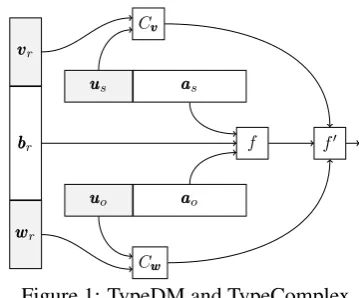
Representation: We start with DM as the base model; the Complex case is identical. The first key modification (see Figure 1) is that each entity
eis now represented bytwovectors:uuue ∈ RK to
encodetypeinformation, andaaae∈RD
0
to encode
information. Typically, K D0. The second, concomitant modification is that each relationris now associated withthree vectors: bbbr ∈ RD
0
as before, and alsovvvr, wwwr ∈ RK. vvvr andwwwr encode the expected types for subject and object entities.
An ideal way to train type embeddings would be to provide canonical type signatures for each relation and entity. Unfortunately, these aspects of realistic KBs are themselves incomplete (Nee-lakantan and Chang, 2015; Murty et al., 2018). Our models train all embeddings usingT only and don’t rely on any explicit type supervision.
DM uses (E +R)D model weights for a KB withRrelations andEentities, whereas TypeDM usesE(D0+K) +R(D0+ 2K). To make compar-isons fair, we setD0andKso that the total number of model weights (real or complex) are about the same for base and typed models.
v v vr
bbbr
w wwr
u
uus aaas
u
uuo aaao
Cvvv
Cwww
[image:2.595.322.502.315.464.2]f f0
Figure 1: TypeDM and TypeComplex.
Prediction: DM’s base prediction score for tu-ple(s, r, o) ishaaas, bbbr, aaaoi. We apply a (sigmoid) nonlinearity:
f(s, r, o) =σ(haaas, bbbr, aaaoi), (1) and then combine with two additional terms that measure type compatibility between the subject and the relation, and the object and the relation:
f0(s, r, o) =f(s, r, o)Cvvv(s, r)Cwww(o, r), (2) where Cxxx(e, r) is a function that measures the compatibility between the type embedding ofefor a given argument slot ofr:
Cxxx(e, r) =σ(xxxr·uuue) (3) If each of the three terms in Equation 2 is inter-preted as a probability,f0(s, r, o)corresponds to a simple logical AND of the three conditions.
Subjects Relationr Gold Objecto Prediction 1 Prediction 2
Howard Leslie Shore follows-religion Jewism (religion) Walk Hard (film) 21 Jump Street (film) Spyglass Entertainment headquarter-located-in El lay (location) The Real World (tv) Contraband (film) Les Fradkin born-in-location New York (location) Federico Fellini (person) Louie De palma (person) Eugene Alden Hackman studied Rural Journalism (education) Loudon Snowden Wainwright III (person) The Bourne Legacy (film)
[image:3.595.85.526.62.116.2]Chief Phillips (film) released-in-region Yankee land (location) Akira Isida (person) Presidential Medal of Freedom (award)
Table 1: Samples of top two DM predictions (having inconsistent types) on FB15K. TypeDM predicts entities of the correct type in top positions in the corresponding examples.
Contrastive Sampling: Training data consist of positive gold tuples (s, r, o) and negative tuples, which are obtained by perturbing each positive tu-ple by replacing either s or o with a randomly sampled s0 or o0. This offers the learning algo-rithm positive and negative instances. The models are trained such that observed tuples have higher scores than unobserved ones.
Loss Functions: We implement two common loss objectives. The log-likelihood loss first com-putes the probability of predicting a responseofor a query(s, r,?)as follows:
Pr(o|s, r) = exp(βf
0(s, r, o))
P
o0exp(βf0(s, r, o0))
(4)
Becausef0 ∈ [0,1]for typed models, we scale it with a hyper-parameter β > 0 (a form of in-verse temperature) to allowPr(o|s, r)to take val-ues over the full range[0,1]in loss minimization.
The sum overo0 in the denominator is sampled based on contrastive sampling, so the left hand side is not a formal probability (exactly as in DM). A similar term is added for Pr(s|r, o). The log-likelihood lossminimizes:
− X
hs,r,oi∈P
logP r(o|s, r;θ)
+ logP r(s|o, r;θ)
(5)
The summation is overP which is the set of all positive facts. Following Trouillon et al. (2016), we also implement thelogistic loss
X
hs,r,oi∈T
logh1 +e−Ysrof0(s,r,o)i (6)
Here Ysro is 1 if the fact (s, r, o) is true and
−1 otherwise. Also, T is the set of all positive facts along with the negative samples. With logis-tic loss, model weightsθ are L2-regularized and gradient norm is clipped at 1.
4 Experiments
Datasets: We evaluate on three standard data sets, FB15K, FB15K-237, and YAGO3-10
(Bor-des et al., 2013; Toutanova et al., 2015; Dettmers et al., 2017). We retain the exact train, dev and test folds used in previous works. TypeDM and TypeComplex are competitive on the WN18 data set (Bordes et al., 2013), but we omit those results, as WN18 has 18 very generic relations (e.g., hy-ponym, hypernym, antonym, meronym), which do not give enough evidence for inducing types.
Model Embedding Number of
dimensions parameters
E 200 3,528,200
DM+E 100+100 3,393,700
DM 200 3,259,200
TypeDM 180+19 3,268,459
Complex 200 6,518,400
TypeComplex 180+19 6,201,739
Table 2: Sizes were approximately balanced be-tween base and typed models (FB15K).
Metrics: As is common, we regard test instances
(s, r,?)as a task of rankingo, with goldo∗known. We report MRR (Mean Reciprocal Rank) and the fraction of queries where o∗ is recalled within rank 1 and rank 10 (HITS). Thefilteredevaluation (Garcia-Duran et al., 2015a) removes valid train or test tuples ranking above (s, r, o∗) for scoring purposes.
Hyperparameters: We run AdaGrad for up to 1000 epochs for all losses, with early stopping on the dev fold to prevent overfitting. All the mod-els generally converge after 300-400 epochs, ex-cept TypeDM that exhausts 1000 epochs. E, DM, DM+E and Complex use 200 dimensional vectors. All except E perform best with logistic loss and 20 negative samples (obtained by randomly cor-rupting s andr) per positive fact. This is deter-mined by doing a hyperparameter search on a set
{10,20,50,100,200,400}.
[image:3.595.336.495.271.355.2]FB15K FB15K237 YAGO3-10
Model MRR HITS@1 HITS@10 MRR HITS@1 HITS@10 MRR HITS@1 HITS@10
E 23.40 17.39 35.29 21.30 14.51 36.38 7.87 6.22 10.00
DM+E 60.84 49.53 79.70 38.15 28.06 58.02 52.48 38.72 77.40
DM 67.47 56.52 84.86 37.21 27.43 56.12 55.31 46.80 70.76
TypeDM 75.01 66.07 87.92 38.70 29.30 57.36 58.16 51.36 70.08
Complex 70.50 61.00 86.09 37.58 26.97 55.98 54.86 46.90 69.08
[image:4.595.308.523.286.535.2]TypeComplex 75.44 66.32 88.51 38.93 29.57 57.50 58.65 51.62 70.42
Table 3: KBC performance for base, typed, and related formulations. Typed models outperform their base models across all datasets.
all the typed models. To balance total model sizes (Table 2), we choose K = 19 dimensions for
uuue, vvvr, wwwrand 180 dimensions foraaae, bbbr2.
Typed models and E perform best with 400 neg-ative samples per positive tuple while using log-likelihood loss (robust to a larger number of neg-ative facts as opposed to logistic loss, which falls for class imbalance). FB15K and YAGO3-10 use L2 regularization coefficient of 2.0, and it is 5.0 for FB15K-237. Note that the L2 regularization penalty is applied to only those entities and rela-tions that are a part of that batch update, as pro-posed by Trouillon et al. (2016).βis set to 20.0 for the typed models, and 1.0 for other models if they use the log-likelihood loss. Entity embeddings are unit normalized at the end of every epoch, for the type models. Also, we find that in TypeDM scal-ing the embeddscal-ings of the base model to unit norm performs better than using L2 regularization.
Results: Table 3 shows that TypeDM and Type-Complex dominate across all data sets. E by it-self is understandably weak, and DM+E does not lift it much. Each typed model improves upon the corresponding base model on all measures, under-scoring the value of type compatibility scores.3 To the best of our knowledge, the results of our typed models are competitive with various reported re-sults for models of similar sizes that do not use any additional information, e.g., soft rules (Guo et al., 2018), or textual corpora (Toutanova et al., 2015). We also compare against the heuristic
genera-2
Notice that a typed model has a slightly higher number of parameters for relation embeddings, because it needs to maintaintwotype embeddings of sizeK, over and abovebbbr.
UsingK= 19reduced and brought the total number of pa-rameters closer to that of the base model, for a fair direct comparison. The model performance did not differ by much when using either of the options (i.e.,K= 19or 20).
3
For direct comparisons with published work, we choose 200 and 400 parameters per entity for DM and Complex re-spectively (Complex model has two 200 dimensional embed-dings per entity). DM and TypeDM, on increasing the di-mensionality to 400, yield MRR scores of 69.79 and 78.91, respectively, for FB15K.
tion of type-sensitive negative samples (Krompaß et al., 2015). For this experiment, we train a Com-plex model using this heuristically generated nega-tive set, and use standard evaluation, as in all other models. We find that all the models reported in Ta-ble 3 outperform this approach.
(a) (b)
(c) (d)
Figure 2: Projection of vectors represent-ing entities belongrepresent-ing to frequent KB
types-{people, location, organisation, film, sports}: a: TypeDM,uuue; b: TypeDM,aaae; c: TypeComplex,uuue; d: DM,aaae.
5 Analysis of Typed Embeddings
We perform two further analyses to assess whether the embeddings produced by typed models indeed capture type information better. For these exper-iments, we try to correlate (and predict) known symbolic types of an entity using the unsupervised embeddings produced by the models. We take a fine catalog of most frequent 90 freebase types over the 14,951 entities in the FB15k dataset (Xie et al., 2016). We exclude /common/topic as it occurs with most entities. On an average each entity has 12 associated types.
Method Embed Size H C Type
-ding F1
TypeDM uuue 19 66.72 66.29 81.77
TypeDM aaae 180 57.89 59.67 75.96
TypeDM Both 199 66.75 66.29 82.57
DM aaae 200 51.40 48.12 81.34
TypeComplex uuue 19 65.90 62.97 82.70
TypeComplex aaae 180x2 50.76 48.57 74.75
TypeComplex Both 379 66.03 63.09 84.14
Complex aaae 200x2 51.56 47.20 81.58
DM+E uuue 19 0.48 2.05 74.66
DM+E aaae 180 49.62 47.24 82.72
DM+E Both 199 49.66 47.26 82.68
[image:5.595.74.289.61.207.2]E aaae 200 39.83 37.62 74.23
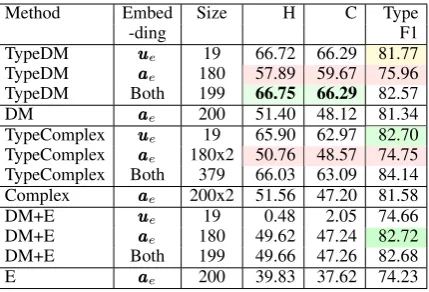
Table 4: Interpretation of embeddings wrt super-vised types: cluster homogeneity H, completeness C, and type prediction F1 score.
belong to one of the 5 types (people, location, organization, film, and sports) from the freebase dataset. These cover 84.88% of FB15K entities. We plot the FB15K entitieseusing the PCA pro-jection ofuuueandaaaein Figure 2, color-coding their types. We observe thatuuueseparates the type clus-ters better thanaaae, suggesting thatuuue vectors in-deed collect type information. We also perform k-means clustering of uuue andaaae embeddings of these entities, as available from different models. We report cluster homogeneity and completeness scores (Rosenberg and Hirschberg, 2007) in Ta-ble 4. Typed models yield superior clusters.
2. Prediction of Symbolic Types: We train a single-layer network that inputs embeddings from various models and predicts a set of symbolic types from the KB. This tells us the extent to which the embeddings capture KB type informa-tion (that was not provided explicitly during train-ing). Table 4 reports average macro F1 score (5-fold cross validation). Embeddings from TypeDM and TypeComplex are generally better predictors than embeddings learned by Complex, DM and E.
uuue ∈R19is often better thanaaae ∈ R180or more,
for typed models. DM+E with 199 model weights narrowly beats TypeDM with 19 weights, but re-call that it has poorer KBC scores.
6 Conclusion and Future Work
We propose an unsupervised typing gadget, which enhances top-of-the-line base models for KBC (DistMult, Complex) with two type-compatibility functions, one between r and s and another be-tweenrando. Without explicit supervision from any type catalog, our typed variants (with simi-lar number of parameters as base models)
substan-tially outperform base models, obtaining up to 7% MRR improvements and over 10% improvements in the correctness of the top result. To confirm that our models capture type information better, we correlate the embeddings learned without type su-pervision with existing type catalogs. We find that our embeddings indeed separate and predict types better. In future work, combining type-sensitive embeddings with a focus on less frequent relations (Xie et al., 2017), more frequent entities (Dettmers et al., 2017), or side information such as inference rules (Guo et al., 2018; Jain and Mausam, 2016) or textual corpora (Toutanova et al., 2015) may fur-ther increase KBC accuracy. It may also be of in-terest to integrate the typing approach here with the combinations of tensor and matrix factoriza-tion models for KBC (Jain et al., 2018).
Acknowledgements
This work is supported by Google language un-derstanding and knowledge discovery focused re-search grants, a Bloomberg award, an IBM SUR award, and a Visvesvaraya faculty award by Govt. of India to the third author. It is also supported by a TCS Fellowship to the first author. We thank Microsoft Azure sponsorships, IIT Delhi HPC fa-cility and the support of nVidia Corporation for computational resources.
References
Kurt Bollacker, Colin Evans, Praveen
Pari-tosh, Tim Sturge, and Jamie Taylor. 2008.
Freebase: a collaboratively created graph
database for structuring human knowledge.
In SIGMOD Conference. pages 1247–1250.
http://ids.snu.ac.kr/w/images/9/98/sc17.pdf.
Antoine Bordes, Nicolas Usunier, Alberto Garcia-Duran, Jason Weston, and Oksana Yakhnenko. 2013. Translating embeddings for modeling
multi-relational data. In NIPS Conference. pages 2787–
2795. http://papers.nips.cc/paper/5071-translating-embeddings-for-modeling-multi-relational-data.pdf.
Tim Dettmers, Pasquale Minervini, Pontus
Stene-torp, and Sebastian Riedel. 2017. Convolutional
2d knowledge graph embeddings. arXiv preprint
arXiv:1707.01476.
Alberto Garcia-Duran, Antoine Bordes, and Nico-las Usunier. 2015a. Composing relationships with
translations. In EMNLP Conference. pages 286–
290. http://www.aclweb.org/anthology/D15-1034.
Alberto Garcia-Duran, Antoine Bordes, Nicolas
Combin-ing two and three-way embeddCombin-ings models for link
prediction in knowledge bases. arXiv preprint
arXiv:1506.00999https://arxiv.org/pdf/1506.00999.
Shu Guo, Quan Wang, Lihong Wang, Bin Wang, and Li Guo. 2018. Knowledge graph embedding with
iterative guidance from soft rules. InProceedings
of the Thirty-Second AAAI Conference on Artificial Intelligence.
Prachi Jain and Mausam. 2016. Knowledge-guided lin-guistic rewrites for inference rule verification. In
Proceedings of the 2016 Conference of the North American Chapter of the Association for Computa-tional Linguistics: Human Language Technologies. pages 86–92.
Prachi Jain, Shikhar Murty, Mausam, and Soumen Chakrabarti. 2018. Mitigating the effect of out-of-vocabulary entity pairs in matrix factorization for kb
inference. InProceedings of the Twenty-Sixth
Inter-national Joint Conference on Artificial Intelligence, IJCAI-18.
Denis Krompaß, Stephan Baier, and Volker Tresp. 2015. Type-constrained representation learning in
knowledge graphs. InInternational Semantic Web
Conference. Springer, pages 640–655.
Shikhar Murty, Patrik Verga, Luke Vilnis, Irena Radovanovic, and Andrew McCallum. 2018. Hier-archical losses and new resources for fine-grained
entity typing and linking. In Proceedings of the
56th Annual Meeting of the Association for Compu-tational Linguistics. Association for Computational Linguistics.
Arvind Neelakantan and Ming-Wei Chang. 2015. In-ferring missing entity type instances for knowledge
base completion: New dataset and methods. In
NAACL.
Maximilian Nickel, Lorenzo Rosasco, Tomaso A Pog-gio, et al. 2016. Holographic embeddings of
knowl-edge graphs. In AAAI Conference. pages 1955–
1961. https://arxiv.org/abs/1510.04935.
Sebastian Riedel, Limin Yao, Andrew McCallum,
and Benjamin M Marlin. 2013. Relation
ex-traction with matrix factorization and universal
schemas. In NAACL Conference. pages 74–
84.
http://www.anthology.aclweb.org/N/N13/N13-1008.pdf.
Andrew Rosenberg and Julia Hirschberg. 2007.
V-measure: A conditional entropy-based external
clus-ter evaluation measure. In EMNLP Conference.
http://aclweb.org/anthology/D/D07/D07-1043.pdf.
Kristina Toutanova and Danqi Chen. 2015.
Ob-served versus latent features for knowledge base
and text inference. In Proceedings of the
3rd Workshop on Continuous Vector Space Mod-els and their Compositionality. pages 57–66. http://www.aclweb.org/anthology/W15-4007.
Kristina Toutanova, Danqi Chen, Patrick
Pan-tel, Hoifung Poon, Pallavi Choudhury, and
Michael Gamon. 2015. Representing text for
joint embedding of text and knowledge bases.
In EMNLP Conference. pages 1499–1509.
https://www.aclweb.org/anthology/D/D15/D15-1174.pdf.
Th´eo Trouillon, Johannes Welbl, Sebastian Riedel, ´Eric
Gaussier, and Guillaume Bouchard. 2016. Complex
embeddings for simple link prediction. In ICML.
pages 2071–2080. http://arxiv.org/abs/1606.06357.
Qizhe Xie, Xuezhe Ma, Zihang Dai, and
Ed-uard Hovy. 2017. An interpretable
knowl-edge transfer model for knowlknowl-edge base
com-pletion. arXiv preprint arXiv:1704.05908
https://arxiv.org/pdf/1704.05908.pdf.
Ruobing Xie, Zhiyuan Liu, and Maosong Sun. 2016. Representation learning of knowledge graphs with
hierarchical types. InIJCAI. pages 2965–2971.
Bishan Yang, Wen-tau Yih, Xiaodong He, Jianfeng Gao, and Li Deng. 2015. Embedding entities and relations for learning and inference in knowledge