20
Improving Neural Network Performance by Injecting Background
Knowledge: Detecting Code-switching and Borrowing in Algerian texts
Wafia Adouane, Jean-Philippe Bernardy and Simon Dobnik
Department of Philosophy, Linguistics and Theory of Science (FLoV),
Centre for Linguistic Theory and Studies in Probability (CLASP), University of Gothenburg {wafia.adouane,jean-philippe.bernardy,simon.dobnik}@gu.se
Abstract
We explore the effect of injecting back-ground knowledge to different deep neural network (DNN) configurations in order to mitigate the problem of the scarcity of an-notated data when applying these models on datasets of low-resourced languages. The background knowledge is encoded in the form of lexicons and pre-trained sub-word embeddings. The DNN mod-els are evaluated on the task of detecting code-switching and borrowing points in non-standardised user-generated Algerian texts. Overall results show that DNNs ben-efit from adding background knowledge. However, the gain varies between models and categories. The proposed DNN archi-tectures are generic and could be applied to other low-resourced languages.
1 Introduction
Recent success of DNNs in various natural lan-guage processing (NLP) tasks has attracted atten-tion from the research community attempting to extend their application to new tasks. Neverthe-less, the large amount of labelled data required to train DNNs limits their application to new tasks and new languages because it is hard to find large labelled corpora for these domains. The issue is even more severe for low-resourced languages.
Another serious problem with most current NLP approaches and systems is that they are trained on well-edited standardised monolin-gual corpora, such as the Wall Street Journal, Wikipedia, etc. This could be explained by the fact that for a long time NLP has been influenced by the dominant descriptive linguistic theories af-fected by the standard language ideology which assumes that natural languages are uniform and
monolingual. However, standardisation is not uni-versal (Milroy, 2001), meaning that not all lan-guages are standardised. Therefore, lexical, struc-tural and phonological variation is, for instance, the norm in natural language and not an excep-tion, meaning that well-edited texts do not really reflect the natural usage of natural languages, but only represent formal languages.
The discrepancy between the assumed unifor-mity of language both in linguistic theory and NLP and their variable nature is accentuated by new technologies, such as social media platforms and messaging services. These new communica-tion platforms have facilitated the proliferacommunica-tion of writing in non-standardised languages on the web, such as colloquial Arabic or what is commonly re-ferred to as dialectal Arabic. This is because in interactive scenarios people usually use spoken-like (colloquial) language or, in multilingual so-cieties where people have access to several lin-guistic codes at the same time, a mixture of lan-guages/language varieties. Consequently, this new kind of written data has created a serious problem regarding the usability of the existing NLP tools and approaches as they fail to properly process it, even in the case of well-resourced languages.
It is a low-resourced multilingual colloquial guage. We chose the task of a word-level lan-guage identification which is a first step towards processing such texts. The task focuses on detect-ing code-switchdetect-ing and borrowdetect-ing points in a text which represents the same utterance. Knowing what parts of text belong to what language variety allows to perform better qualitative and quantita-tive analysis of such texts with other tools.
The paper is organised as follows: in Section2 we briefly describe the complex linguistic situa-tion in Algeria as a result of a language contact. The section aims to explain the linguistic chal-lenges of processing such texts and motivates our choices based on established sociolinguistic theo-ries. In Section3we present our available linguis-tic resources and different DNN configurations. In Section4we describe our experimental setup and analyse the results. Finally, in Section5we com-pare our contribution to previous related work.
2 Linguistic Background
In North Africa in general, and in Algeria in par-ticular, intense language contact between various related and unrelated languages has resulted in a complex linguistic situation where several lan-guages are used in a single communicative event. A few cases of language contact have attracted the attention of the linguistic community while the monolingual norm dominates in linguistics. One kind of language contact situation has been de-scribed by Ferguson (1959) as diglossia which refers to a situation where two linguistic systems coexist in a functional distribution within the same speech community. In another kind of language contact situations, several languages coexist but not in a well-defined functional distribution. This situation is referred to as bilingualism (Sayahi, 2014) which could result from either informal con-tact between coexisting languages like Berber and Arabic, or from formal education where in addi-tion to other language people learn French with varying degrees of competence.
Based on the Fishman’s model (Fishman, 1967), North African Arabic, known as Maghrebi Arabic, is classified as a linguistic situation in the speech community characterised by diglossia with bilingualism. The intense language contact between related and unrelated languages has re-sulted mainly in two widespread linguistic phe-nomena: coswitching and borrowing. As
de-fined by Poplack and Meechan (1998), code-switching is (ideally) integration of material from one language to another without any phonological, morphological or syntactic integration, whereas borrowing is when material is integrated.
For computational purposes, we focus on
diglossic code-switching (Sayahi, 2014), which happens between related languages such as switching between Arabic varieties, andbilingual code-switching, which happens between unrelated languages such as switching between one Ara-bic variety and other coexisting language such as Berber, French or English. Regarding borrowing, it is practically not possible to clearly distinguish whether a word in one Arabic variety is integrated into another variety or not because there are no lexicons for Arabic varieties, except for the stan-dard one, and we also do not have access to acous-tic representations of words. Based on this, we can practically focus only onbilingual borrowing
rather than ondiglossic borrowing.
(1) a.
ú
G
.
ðX ð@ AÓ ¨AK
éA£ ú
¯ @Q ª
éJK.Qå øQKX
øP@YÓ ¼Aë ÈAÔ
«ñ K AîDK. ñÊKYÒ»ð ½Jj.J.@ AîD
¯
Õç' Õç' l'QK QKY
K
b. Put a small towel in a cup of water and dissolve Aspegic in it and cover him with it, it is what I usually do. He will feel quickly better.
As illustration, (1) is a user-generated utterance which contains words in Modern Standard Arabic (
AîD
¯ , ú
¯ , @Q ª
), note that the word@Q ª
ismis-spelled and should be spelt like
èQ ª
, words inlocal Algerian Arabic (
, ú
G
.
ðX ,ð@ , A Ó , ¨A K , øQKX
Õç' Õç' , l'QK ,QKY
K ,ø
P@YÓ , ¼Aë , AîDK. ,ñÊKYÒ»ð
), Frenchwords integrated in Arabic (
éA£ ,
éJK.Qå
) , and aFrench word without integration (
ÈAÔ
«ñ K
).3 Linguistic Resources and Models
3.1 Linguistic Resources
va-rieties (ALG), Modern Standard Arabic (MSA), French (FRC), Berber (BER), English (ENG), non-Arabic words integrated in local Arabic or what is referred to as borrowing (BOR), in addi-tion to language independent categories such as named entities (NER), digits (DIG) and interjec-tions (SND). To the best of our knowledge this is the only available labelled dataset for code-switching and borrowing for Algerian. As the la-belled dataset is small, we also collected a larger unlabelled dataset from the same sources as the authors of the labelled dataset, and pre-processed them in the same way. Table1gives information about the datasets where texts refer to social media texts with an average length of 19 words, words refer to linguistic words excluding other tokens (digits, punctuation, emoticons), and types refer to unique words.
Dataset #Texts #Words #Types Labelled 10,590 213,792 57,054
Unlabelled 311,130 4,928,827 350,759
Table 1: Statistics about the datasets.
We also use the lexicons compiled by the authors of the labelled dataset, with further cleaning. The lexicons include lists of inflected words checked manually, one list per category. Words belonging to more than one category are not included. Ta-ble2gives more information about the sizes of the lexicons.
Category ALG MSA FRC BOR NER ENG BER
#Types 42,788 94,167 3,206 3,509 1,945 165 21,789
Table 2: Statistics about the lexicons.
3.2 Models
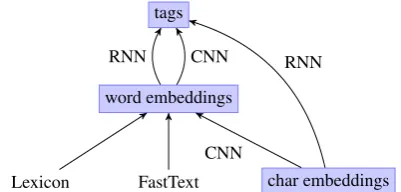
We approach the task of detecting code-switching and borrowing points in text as a sequence tag-ging problem where the aim is to assign a tag to each word in the text depending on its context. We use two DNN architectures, namely Recurrent Neural Network (RNN) and Convolutional Neu-ral Network (CNN) with different configurations summarised in Figure1.
The first option is to use an RNN to map char-acter embeddings to tags directly. Alternatively, we can use word embeddings. Word embedding
word embeddings tags
FastText
Lexicon char embeddings
CNN
[image:3.595.316.517.62.158.2]RNN CNN RNN
Figure 1: A summary of possible tagging models.
can be any combination of (a) fixed lexicon infor-mation (b) fasttext embeddings (c) a custom CNN built from character embeddings. The word em-beddings can be mapped to tags using either an RNN or a CNN, or a simple dense layer with soft-max activation.
Except for the pure Lexicon-based model, all other models have access to characters and thus to the internal structure of words (phoneme and morphemes), which we expect to be predictive of a particular variety. All models are trained end-to-end, except for the fasttext embeddings and the lexicon. We report only the configurations of mod-els which give the best performance, with the fine-tuned parameters, namely the number of units for each RNN layer, dropout rate, the number of fea-tures and the filter size for each CNN layer. The parameters are fine-tuned on a separate develop-ment set containing 1,000 texts (13,771 tokens).
3.2.1 Character-level RNN
The character-level RNN is composed of two LSTM layers of 400 units each, with a dropout of 10%, followed by a dense layer with softmax acti-vation. Due to the nature of RNNs, the network as-signs one language variant per input symbol, and thus per character — but the task is to predict a tag for each word. To deal with this limitation, we consider only the tag associated with the last char-acter of a word.
3.2.2 Word-level RNN
The word-level RNN is composed of a standard LSTM layer with 400 units with a dropout of 10%, followed by a dense layer.
3.2.3 Character-level CNN
3.2.4 Word-level CNN
The word-level CNN is composed of two convolu-tion layers with a filter size 3, with a relu activaconvolu-tion and a dropout of 10%, followed by a dense layer with softmax activation. The first layer uses 100 features and the second 60 features.
3.2.5 Lexicon-based Model
In order to take advantage of the available lexi-cons, Table2, we represent their words as one-hot encoding vector, which we refer to as lexicon em-beddings. The lexicon-based model is composed of the lexicon embeddings followed by two con-volution layers with a filter size 3, with a relu acti-vation and a dropout of 10%, followed by a dense layer with softmax activation. The first layer uses 100 features and the second 60 features.
3.2.6 FastText-based Model
In order to take advantage of the unlabelled dataset, Table 1, containing a high level of mis-spellings and spelling variation, we assume that word embeddings that are based on sub-word in-formation capture spelling variation and morpho-logical information better than the embeddings that take word as a unit. For this purpose we use FastText library designed to train word embed-dings where a word is represented as the sum of its sub-strings (Bojanowski et al.,2016). We cre-ated five fasttext embeddings trained on the unla-belled dataset with different parameters. We found that the optimal parameters are: word vector di-mension of 300, and the range of the size of the sub-strings representing a word between 3 and 6 characters, with a context size of 5 words, trained on 20 epochs. The FastText-based model is com-posed of the fasttext embeddings followed by two convolution layers with filter size 3, with a relu ac-tivation and a dropout of 10%, followed by a dense layer with softmax activation. The first layer uses 100 features and the second 60 features.
4 Experimental Setup and Results
All models and configurations are evaluated under the same conditions using 10-fold cross-validation on the labelled dataset. As a baseline we take an existing system (Adouane and Dobnik, 2017), a classification-based system which uses a chain of additional back-off strategies which involve lexi-cons, linguistic rules, and finally the selection of the most frequent category. We refer to this sys-tem as the baseline.
First, we train the RNN and CNN models only on the labelled data (supervised learning) with-out any background knowledge. We also examine the effect of the FastText-based and the Lexicon-based models separately to quantify the contribu-tion of each. Then we combine both models to optimise their performance. Second, in order to take advantage of all available linguistic resources, we add to each of the RNN and the CNN mod-els background knowledge in the form of (i) lex-icon embeddings; (ii) fasttext embeddings; (iii) a combination of both lexicon and fasttext embed-dings; and (iv) bootstrap the unlabelled dataset with the baseline system and train the best per-forming DNN model on it to investigate whether bootstrapping improves its performance.
All results are reported as the average perfor-mance of the 10-fold cross-validation for each model at epoch 100 using the parameters men-tioned earlier. For short, we use FastText to refer to the FastText-based model and fasttext to refer to the fasttext embeddings, Lexicon to refer to the Lexicon-based model and lexicon to refer to the lexicon embeddings.
4.1 Models without Background Knowledge
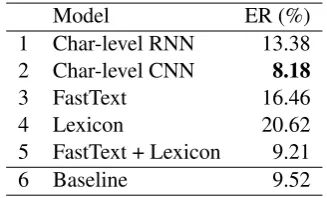
In Table3we report the average error rate of the experiments without background knowledge for only the best performing RNN, CNN, Lexicon, and FastText models.
Model ER (%)
1 Char-level RNN 13.38 2 Char-level CNN 8.18
3 FastText 16.46
4 Lexicon 20.62
5 FastText + Lexicon 9.21
[image:4.595.334.498.489.588.2]6 Baseline 9.52
Table 3: Average error rate of the models without background knowledge.
Results show that the baseline (6) outperforms the Char-level RNN (1), FastText (3) and Lexicon (4) models. However, the baseline is outperformed by the Char-level CNN model (2) with 1.34% er-ror reduction. Combining FastText and Lexicon in one model (5) performs much better than using each model separately, and slightly outperforms the baseline by 0.31% error reduction.
of each model per category, measured as precision, recall, f-score and loss. Notice that we do not re-port the loss for the baseline because of the way the system was designed. The results show that the baseline system performs better on the major-ity categories, ALG and MSA, with an average f-score of 91.91 and 90.44 respectively as well as on non-linguistic categories like DIG and SND with an average f-score of 97.17 and 93.88 respectively. However, the baseline system performs less well on the minority categories, BER and FRC with an average f-score of 80.41 and 80.31 re-spectively, and performs even worse on NER and BOR with an average f-score of 72.55 and 64.70 respectively. It performs the worst on ENG with an average f-score of 49.45. Regarding the minor-ity categories, precision is high on BER (94.51%), BOR (93.61%), FRC (92.97%) and lower on NER (88.20%) and ENG (71.41%). However the re-call is low on all categories BER (72.76%), FRC (70.70%), NER (61.74%) and the lowest on BOR (49.44%), and ENG (39.37%).
The error analysis of the baseline system shows that the system is mostly confused between re-lated language varieties like ALG-MSA as they share a lot of words, as well as between varieties that share lexically ambiguous words like FRC-ALG, BOR-FRC-ALG, FRC-BOR, NER-FRC-ALG, BER-ALG. Several words were neither seen in the train-ing data nor were they covered by the available lexicons which, given that the unknown words are tagged as ALG, leads to confusions such as ENG-ALG, NER-ALG, BER-ALG, BOR-ALG, and FRC-ALG.
(2) a.
ú
G@P
éKAm.Ì
é KAÖÞ AÖÏ ñª¢
®K øXA
« ñËA
¯ ½ñK.
QJË ¨AK
èYJª
é«Q
¯
20 éJ
¯
AÓ
ðXPA
¯
IKQå
ð
b. Since they said that they will cut water next week, I have bought a load of 20 bottles of Saida of 1.5 litre.
The MSA-NER confusion is mainly caused by the fact that many NERs are simply common nouns in MSA. For instance,
èY J ª
could be an adjective in the feminine form in MSA meaninghappy, or a feminine proper name, or something else. In the context of example(2)it is NER as it refers to the name of a product. The word
AÓ
meanswater in ALG, but it is also used as a negation particle in MSA and frequently in ALG, a relative
pronoun in MSA, and a noun meaningmother in ALG. Likewise
é «Q
¯
means bottlein ALG, but it also meanscontestorcompetitionin MSA.The f-score and precision of the Char-level RNN model is lower from the baseline on all cat-egories, and the recall is better on BOR 64.11% compared to only 49.44% on the baseline, and FRC 72.12% compared to 70.70% respectively. ENG, BER, NER, BOR and FRC are the hardest categories to identify with the following respec-tive loss values: -9.56, -6.72, -3.89, -3.57, -2.80, and all categories are confused with ALG, the ma-jority class.
The f-score of the Char-level CNN model is bet-ter on SND, MSA, FRC, DIG, BOR, ALG com-pared to the baseline, but it performs worse on NER, ENG, BER. This could be contributed by the worse recall on these categories which follows the same trend as the f-score. However, in terms of precision, the Char-level CNN model performs better on ALG, BER, ENG and SND and worse on the remaining categories, with the same kind of confusions as the baseline.
The f-score of the FastText model is low on all categories compared to the baseline. The same holds for recall and precision except on BER where the precision is better 96.18% compared to 94.51% on the baseline. The model produces the same kind of errors as the previous models, but which are most similar to the Char-level CNN model.
Compared to the baseline, the Lexicon model performs better in terms of the f-score on BOR (80.94 compared to 64.70), ENG (73.72 compared to 49.45), and FRC (83.60 compared to 80.30). However it performs significantly worse on BER (18.31 compared to 80.41). This is likely because of the limited coverage of the lexicons. The re-sults also indicate the bias of the lexicons to those categories that are more difficult to distinguish au-tomatically. On the other hand, in terms of the re-call, the Lexicon model outperforms the baseline on all categories, except on ALG. In terms of the precision, it is only better on ALG and ENG. The model makes similar errors as the FastText model, only more frequently.
combined model makes the same errors as previ-ous models but less frequently.
Overall, the results in this section show that a simple Char-level CNN model outperforms the more complicated baseline system which uses a back-off strategy and extra resources. However the Char-level CNN model performs worse on the minority classes, particularly on NER, ENG and BER. On the other hand, the other models perform better on the minority classes in terms of recall, but they perform worse on the remaining categories because of the limited coverage of the lexicons or because of lexical ambiguity. This means that the performance of these models is in complementary distribution. We will explore this observation in the following section.
4.2 Models with Background Knowledge
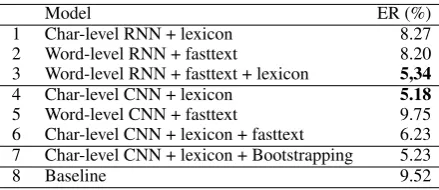
One possible improvement of the models in Sec-tion4.1is to inject information from the lexicons and the knowledge encoded in the fasttext to the DNN models. In Table 4 we report the average error rate of only the best performing experiments combining different models and resources.
Model ER (%)
1 Char-level RNN + lexicon 8.27
2 Word-level RNN + fasttext 8.20
3 Word-level RNN + fasttext + lexicon 5,34
4 Char-level CNN + lexicon 5.18
5 Word-level CNN + fasttext 9.75
6 Char-level CNN + lexicon + fasttext 6.23 7 Char-level CNN + lexicon + Bootstrapping 5.23
[image:7.595.72.292.400.495.2]8 Baseline 9.52
Table 4: Average error rate of the models with background knowledge.
The results show that RNN models (with original error rate of 13.38% for Char-level RNN) benefit from both adding the lexicon (1) and the fasttext (2). The gain is even higher when combining both with the Word-level RNN (3). The CNN mod-els behave differently when adding lexicon and fasttext. The Char-level CNN (4) performs best with the lexicon with 3% error reduction. The Word-level CNN (5) performs worse with fasttext compared to basic Char-level CNN introducing a 1.57% increase in the error rate (Table3). Also the Char-level CNN (6) does not benefit from combin-ing lexicon and fasttext. It appears that the latter introduces noise that CNN is sensitive to. Like-wise, additional bootstrapped training data does not help the otherwise best performing Char-level
CNN + lexicon model (7). This may be also ex-plained by the additional noise in the bootstrapped data.
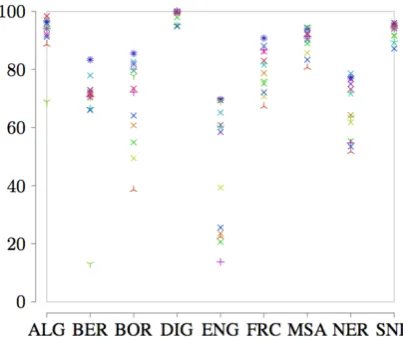
Figure2indicates that adding lexicon informa-tion has a positive effect on the overall perfor-mance of the RNN models. The gain from the lexicons is noticeable on all categories where pre-cision, recall and f-score increase, most impor-tantly on BER, BOR, ENG, FRC and NER. The same kind of errors are present as with the previ-ous models but fewer in number. For instance the number of errors between ALG-MSA drops from 1,077 to 724, and between FRC-ALG from 104 to 64.
Adding lexicon information to the Char-level CNN model boosts its overall performance over models not using lexicons. All the categories ben-efit from the lexicon information and their f-score, recall and precision increase, most importantly on the minority categories such as ENG, with the same errors but less frequent. However, adding fasttext does not improve the performance of the Word-level CNN model. Its average f-score de-creases on all categories except on ENG where it increases from 22.76 to 29.91.
Compared with the Char-level CNN + lexicon model, adding fasttext to Char-level CNN does not have the same positive effect. The only signifi-cant gain is an increase in precision on ENG from 82.59% to 84.79%. Char-level CNN + fasttext + lexicon model performs better than the FastText + Lexicon model. It seems that fasttext does not help the CNN model.
On the other hand, adding fasttext to an RNN boosts its performance. The error rate drops to 13.38% (Char-level RNN) and 8.20% (Word-level RNN). While the precision of each category im-proves, the recall drops on both BOR and ENG categories, by 3.35% and 1.97% respectively. The f-score increases on all categories except on ENG where it drops by 1.76%.
from fasttext compared to lexicon (70.65% com-pared to 66.47%). ENG is the category which is most negatively effected when adding fasttext with a drastic decrease of 36.45% (23.62% with fasttext and 60.07% with lexicon), followed by BOR with 18.98% decrease, and NER with 7.54% decrease. The f-scores have the same pattern as the recall.
A gain of adding lexicon to the Word-level RNN + fasttext model is observed on all cate-gories. While precision increases on all categories, for example on ENG from 78.77% without the lex-icon to 88.04% with the lexlex-icon, it slightly de-creases for NER from 86.77% to 85.97% and SND from 99.00% to 98.86%. The recall and f-score in-crease on all categories.
The gain from using the bootstrapped data is mainly reflected in an increase in precision on the minority categories such as ENG, BOR, FRC and NER (93.04%, 96.71%, 96.68% and 93.85% com-pared to 82.60%, 90.56%, 91.31% and 89.43% re-spectively without using the bootstrapped data). In terms of recall, the bootstrapped data only boosts ALG and SND categories. The f-scores of the model trained without the bootstrapped data are better on all categories. The insignificant effect of the bootstrapped data could be attributed to the ad-ditional noise introduced by the baseline system.
5 Related Work
The emerging digitised multilingual data that followed the introduction of new technologies and communication services has attracted atten-tion of the NLP research community in terms of how to process such linguistic data that resulted from language contact between sev-eral related and unrelated languages, for ex-ample in detection of code-switching where mainly traditional sequence labelling methods are used for Bengali-English-Hindi (Barman et al., 2014a), Nepali-English (Barman et al., 2014b), Spanish-English and MSA-Egyptian Arabic (Diab et al., 2016), MSA-Moroccan Arabic (Samih and Maier,2016), MSA-Algerian Arabic-Berber-French-English (Adouane and Dobnik,2017), etc. The work most closely related to ours is de-scribed in (Samih et al.,2016) who used a super-vised LSTM-RNN model combined with Condi-tional Random Fields to detect switching points between related languages (MSA - Egyptian Ara-bic) trained on a small dataset from Twitter. How-ever, the system was only evaluated on the
major-ity categories. Similarly,Kocmi and Bojar(2017) proposed a supervised bidirectional LSTM-RNN trained on artificially created multilingual edited texts. These does not fully reflect all the complexi-ties of real linguistic use in a multilingual scenario.
Adouane et al.(2018) propose a character-level GRU-RNN on the same task as described here backed by the available unlabelled data. They re-port that their supervised RNN model performs the best on labels with more representative sam-ples. Adding neural language model that was pre-trained on noisy unlabelled data does not help, but bootstrapping the unlabelled data with another system improves the performance of all their sys-tems. In this work we use different DNN ar-chitectures (RNNs and CNNs), and we aim to examine the behaviour of each model when in-jecting background knowledge in the form of en-coded information from the available lexicons and a pre-trained sub-word embeddings from unla-belled data. Our goal is to take advantage of the available NLP resources, with as little processing as possible to mitigate the problem of scarce an-notated data.
6 Conclusion
Acknowledgement
The research reported in this paper was supported by a grant from the Swedish Research Council (VR project 2014-39) for the establishment of the Centre for Linguistic Theory and Studies in Prob-ability (CLASP) at the University of Gothenburg.
References
Wafia Adouane and Simon Dobnik. 2017. Identifica-tion of Languages in Algerian Arabic Multilingual Documents. Association for Computational Linguis-tics.
Wafia Adouane, Simon Dobnik, Jean-Philippe Bernardy, and Nasredine Semmar. 2018. A Com-parison of Character Neural Language Model and Bootstrapping for Language Identification in Multilingual Noisy Texts. In Proceedings of the Second Workshop on Subword and Character Level Models in NLP, New Orleans, Louisiana USA.
Utsab Barman, Amitava Das, Joachim Wagner, and Jennifer Foster. 2014a. Code-mixing: A challenge for Language Identification in the Language of So-cial Media. InIn Proceedings of the First Workshop on Computational Approaches to Code-Switching.
Utsab Barman, Joachim Wagner, Grzegorz Chrupala, and Jennifer Foster. 2014b. Dcu-uvt: Word-Level Language Classification with Code-Mixed Data.
Piotr Bojanowski, Edouard Grave, Armand Joulin, and Tomas Mikolov. 2016. Enriching Word Vec-tors with Subword Information. arXiv preprint arXiv:1607.04606.
Mona Diab, Pascale Fung, Mahmoud Ghoneim, Julia Hirschberg, and Thamar Solorio. 2016. Proceed-ings of the Second Workshop on Computational Ap-proaches to Code Switching. Association for Com-putational Linguistics, Austin, Texas.
Charles Albert Ferguson. 1959. Diglossia. WORD, Routledge, 15(2):325–340.
Joshua Aaron Fishman. 1967. Bilingualism with and without Diglossia; Diglossia with and without Bilin-gualism.Journal of Social Issues, 23:29 – 38.
Tom Kocmi and Ondˇrej Bojar. 2017.Lanidenn: Multi-lingual Language Identification on Text Stream. In Proceedings of the 15th Conference of the European Chapter of the Association for Computational Lin-guistics: Volume 1, Long Papers, pages 927–936. Association for Computational Linguistics.
James Milroy. 2001. Language Ideologies and the Consequence of Standardization. Journal of Soci-olinguistics, 5:530 – 555.
Shana Poplack and Marjory Meechan. 1998. How Lan-guages Fit Together in Codemixing. The Interna-tional Journal of Bilingualism, 2(2):127–138.
Younes Samih, Suraj Maharjan, Mohammed Attia, Laura Kallmeyer, and Thamar Solorio. 2016. Multi-lingual Code-switching Identification via LSTM Re-current Neural Networks. In Proceedings of the Second Workshop on Computational Approaches to Code Switching, pages 50–59.
Younes Samih and Wolfgang Maier. 2016. Detecting Code-Switching in Moroccan Arabic. In Proceed-ings of SocialNLP @ IJCAI-2016.