70
Ling@CASS Solution to the NLP-TEA CGED Shared Task 2018
Qinan Hu12, Yongwei Zhang12, Fang Liu32, Yueguo Gu2 1Institute of Linguistics, Chinese Academy of Social Sciences
2China Multilingual and Multimodal Corpora and Big Data Research Centre 3School of Software & Microelectronics, Peking University
[email protected], [email protected], [email protected], [email protected]
Abstract
In this study, we employ the sequence to sequence learning to model the task of grammar error correction. The sys-tem takes potentially erroneous sen-tences as inputs, and outputs correct sentences. To breakthrough the bot-tlenecks of very limited size of man-ually labeled data, we adopt a semi-supervised approach. Specifically, we adapt correct sentences written by native Chinese speakers to generate pseudo grammatical errors made by learners of Chinese as a second lan-guage. We use the pseudo data to pre-train the model, and the CGED data to fine-tune it. Being aware of the sig-nificance of precision in a grammar er-ror correction system in real scenarios, we use ensembles to boost precision. When using inputs as simple as Chi-nese characters, the ensembled system achieves a precision at 86.56% in the detection of erroneous sentences, and a precision at 51.53% in the correction of errors of Selection and Missing types.
1 Introduction
An inter-language is an idiolect developed by a learner of a second language (or L2). It is char-acteristic that it preserves some features of the first language (or L1), and can overgeneral-ize some L2 linguistic rules. An investigation on the grammatical errors made by L2 learn-ers will disclose the error patterns, which are beneficial to the teaching and learning process. On the other hand, it will promote the devel-opment of systems which can correct gram-matical errors made by L2 learners
automati-cally.
The rest of this paper is organized as follows: Section 2 briefly introduces the definition of the NLP-TEA CGED Shared Task 2018. Sec-tion 3 gives a quick review on previous studies. Section 4 describes the generation of pseudo data in detail. Section 5 introduces the mod-eling of the correction task using sequence to sequence learning. Section 6 analyses the ex-perimental results. Finally, conclusions and prospects are drawn in Section 7.
2 NLP-TEA CGED Shared Task 2018
The goal of Chinese Grammar Error Diag-nosis (CGED) Shared Task in NLP Tech for Education Application (NLP-TEA) is to de-velop NLP techniques to automatically cor-rect grammatical errors in Chinese sentences written by L2 learners. The shared task fa-cilitate researchers using different linguistic knowledges and computational techniques to compare their results on the basis of common datasets and evaluation frameworks.
dis-tance (Bard,2006), respectively. These opera-tions are used to edit a sequence into another. A developed system should indicate types and positions of the errors, and propose correc-tions for the errors of S and M types. A system is to be evaluated using four tasks, including the detection of errors, the identification of er-ror types, the identification of positions, and the corrections.
3 Previous Solutions: A Quick Review
Lee et al.(2013) employed handcrafted linguis-tic rules to detect grammalinguis-tical errors made by learners of Chinese as a second language. Their system is further integrated with N-gram models to detect the errors (Lee et al., 2014). Most previous studies take the diagno-sis of grammatical errors as a sequence label-ing problem. They generally assign a B/I/O tag to each word in an input sentence, or each character in a word, to detect the errors. Yu and Chen (2012) proposed to use Conditional Random Field (CRF) (Lafferty et al.,2001) to detect Chinese word ordering errors. In 2014, Cheng et al. (2014) adopted a Support Vec-tor Machine (SVM) (Hearst et al., 1998) to identify Chinese word ordering errors. In re-cent years, Long-short Term Memory (LSTM) (Hochreiter and Schmidhuber,1997) has been a popular neural network model used for this task (Zheng et al.,2016;Yang et al.,2017).
Various features have been taken as the in-puts into sequence labeling models, includ-ing characters, words, Part-of-Speech (POS) tags (Zheng et al., 2016), dependency infor-mation, and Point-wise Mutual Information (Yang et al.,2017), among many others.
4 Pseudo Labeling
The manually labeled dataset for the task of grammar error correction is of very lim-ited size. Since manual labeling is both la-bor and time consuming, the size of the data set has been a bottleneck for the performances of automatic error correction systems. There have been several approaches to tackling this problem. Cahill et al. (2013) and Grund-kiewicz and Junczys-Dowmunt(2014) use the error corrections extracted from Wikipedia re-vision history as training corpora.
Further-more, many studies adopt a semi-supervised approach to automatically generating a large scale pseudo data set and have reported promising results (Foster and Andersen,2009; Rozovskaya and Roth,2010;Dickinson,2010; Imamura et al., 2012; Felice and Yuan, 2014; Rozovskaya et al.,2017).
4.1 Error Types
In our study, the pseudo data are generated based on a close observation on the errors col-lected from the manually labeled dataset.
4.1.1 Missing
It is observed that missing words are often functional words. As shown in Sentence 1, in which a particle and a preposition are missing. (The erroneous sentence is represented with E; and the correct sentence, C. The erroneous phrases are in bold.) Sentences 2 and 3 show another type of missing errors, which are caused by improper uses of ellipses.
(1-E) 认识到结婚 Ø 过程不满六个月,也可
以说 Ø我的故事中我是主动的。
(1-C) 认识到结婚的过程不满六个月,也可以
说在我的故事中我是主动的。
(2-E)所以家长会在孩子很小的时候就让其接
受各种各样的学校教育,使 Ø还很脆弱的心
理和生理都受到很多压力。
(2-C) 所以家长会在孩子很小的时候就让其接
受各种各样的学校教育,使孩子还很脆弱的心 理和生理都受到很多压力。
(3-E) 在韩国最近很流行不允许 Ø 的电视节
目,这节目说公共场所抽烟是不道德的行为。
(3-C) 在韩国最近不允许抽烟的电视节目很流
行,这些节目说在公共场所抽烟是不道德的行 为。
4.1.2 Redundant
Of all the redundant errors in CGED data set, functional words are among the most frequent. For instance, the particle and the conjunction in Sentences 4-5 are redundant.
(4-E)如何处理现在在做香烟的工厂的人的以
后的生活。
(4-C) 如何处理现在在香烟工厂工作的人的以
后的生活。
(5-E)大家在手术间里,合作无间而救了那位
病人。
(5-C) 大家在手术间里,合作无间救了那位病
4.1.3 Selection
Selection errors often occur when near-synonyms are misused, as shown in Sentences 6-7. The differences of the usages between these near-synonyms are subtle.
(6-E) 他们知不道吸烟对未成年年的影响会造
成的各种害处。
(6-C) 他们不知道吸烟对未成年人会造成的各
种伤害。
(7-E) 从此,父母亲就会教咱们爬行、走路、
叫爸爸妈妈。
(7-C) 从此,父母亲就会教我们爬行、走路、
叫爸爸妈妈。
4.1.4 Word Order
Word ordering errors are typically related to the modification of verbs. For instance, the modifiers of the verbs, the auxiliary verb and the adverbs, are misplaced in Sentences 8-10.
(8-E)采取几种方法应该帮助他们。
(8-C) 应该采取几种方法帮助他们。
(9-E) ……但还是年轻的学生需要大人的支持
和指导……
(9-C) ……但年轻的学生还是需要大人的支持
和指导……
(10-E)我走路时常常想抽烟,可能另外抽烟者
也想这样。
(10-C) 我走路时常常想抽烟,可能别的抽烟
者也这样想。
4.2 Data Generation
Based on the above observations, we adapt the sentences written by native Chinese speak-ers to generate ungrammatical sentences. The canonical sentences come from 12 serials of textbooks for students learning Chinese as a second language, 7 serials of textbooks for native Chinese students, and People’s Daily newspapers. The sentences are filtered with a length threshold and the controlled vocabular-ies for teaching Chinese as a second language (Hanban,2001,2010). These sentences are to-kenized using LTP (Che et al., 2010). And then, the errors of redundant words, missing words, word selection errors and word ordering errors are generated using the operations of in-sertions, deletions, substitutions, and transpo-sitions, respectively. All adaptations are done
in terms of words. 2 millions sentences are adapted in this way.
4.2.1 Missing
(1) To make erroneous sentences with missing words, we randomly select a position in the input sentence. (2) If the word in that position is a functional word, or it is a content word with an antecedent in that sentence, drop this word. Example sentences are shown below.
(11-E)一天,庙里来 Ø 一个瘦和尚。
(11-C) 一天,庙里来了一个瘦和尚。
(12-E)他不仅爱收集动植物标本,还阅读了许
多描写 Ø的书。
(12-C) 他不仅爱收集动植物标本,还阅读了
许多描写动植物的书。
4.2.2 Redundant
(1) Randomly select a position in the input sentence. (2) Randomly select a word accord-ing to word frequencies. (3) Insert the word into that position.
(13-E)达尔文妈妈喜欢种花的。
(13-C) 达尔文妈妈喜欢种花。
4.2.3 Selection
(1) Randomly select a position in the input sentence. (2) Select a near-synonym of the word in that position based on their similari-ties computed using word embeddings. (3) Re-place the word in that position with the near-synonym.
(14-E)老鼠又去咬蜡烛,蜡烛倒了,庙里爆炸
了。
(14-C)老鼠又去咬蜡烛,蜡烛倒了,庙里着火
了。
4.2.4 Word Order
(1) Randomly select a position in the input sentence. (2) Swap the word in that position with its neighbor.
(15-E)这些剪纸的技艺,都是人们世代一代手
把手地下来传的。
(15-C)这些剪纸的技艺,都是人们世代一代手
把手地传下来的。
5 Ling@CASS Solution: Methodology and System Development
intro-duced to CGED 2018. We accordingly need a reconsideration of the appropriateness of us-ing sequence labelus-ing models (Sakaguchi et al., 2017). Unlike the B/I/O tag set which is close, the corrections of the missing, and selection types of errors form an open set. In addi-tion, the corrections generally give rise to out-put sentences with lengths different from in-put ones. Therefore, the correction task has gone beyond the capabilities of sequence la-beling models.
Sequence to sequence learning (seq2seq) maps an input sequence to an output sequence of varying lengths. It has been the main-stream model for machine translation nowa-days (Klein et al.,2017). The correction task can be modeled as a translation task, in which the ungrammatical sentences are from an orig-inal language, and the corrections are from a target language. The translation model has been used in several previous studies on gram-mar error corrections (Schmaltz et al., 2016; Chaitanya,2017;Yuan and Felice,2013).
The state-of-the-art performances on ma-chine translation are presented by FairSeq in terms of both accuracy and speed (Gehring et al.,2017). FariSeq significantly differs from previous seq2seq models in that its architec-ture is based entirely on Convolutional Neu-ral Networks (CNN), instead of the prevalent Recurrent Neural Networks (RNN), so that computations can be fully parallelized during training and optimization.
In our study, we employ the FairSeq model. The Fairseq models are pre-trained with the pseudo labeled data, and fine-tuned with the manually labeled data delivered in CGED. The inputs to Fairseq models are as simple as Chinese characters and POS tags of charac-ters. The POS are tagged using LTP (Che et al., 2010). We use the default settings of FairSeq, except that we use 512 dimensions of character embeddings. The embeddings are randomly initialized and we do NOT use any other resources.
6 Ling@CASS Solution: the Outcome
6.1 Evaluation on Corrections
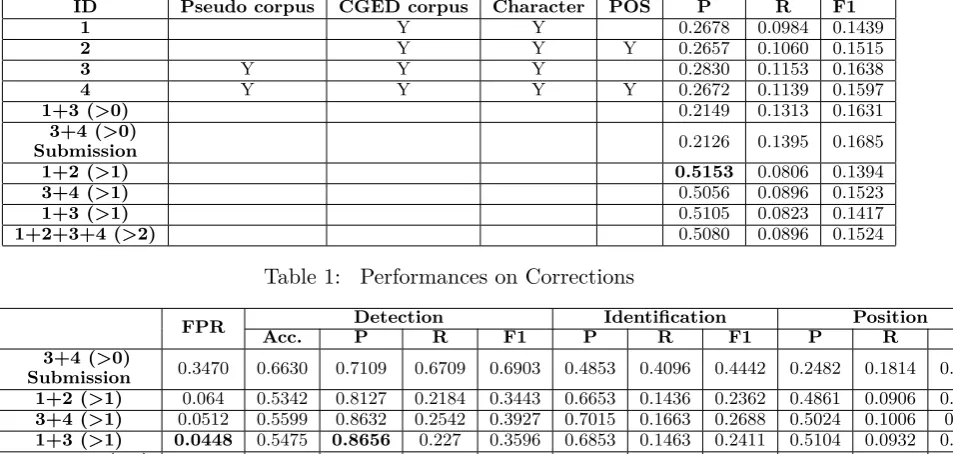
As shown in Table 1, we have four basic sys-tem configurations. These configurations are
different in the use of pseudo corpus and POS tags. The evaluation in Table 1 reveals that the use of pseudo data has improved both pre-cision and recall in the correction task of the word selection errors and missing errors, while that of POS tags does not make a significant contribution.
In real scenarios of grammar error diag-noses, the evaluation metrics of precision, re-call and F1 are not of the same importance. A teacher would always prefers a grammar error correction system with high precision, even if it has a low recall, than a system returns lots of noises. Being aware of the significance of pre-cision in a grammar error correction system in practice, we further use ensembles to boost precisions. The tag ”(>1)” indicates that the correction has been confirmed by at least two basic systems; and ”(>2)”, at least three. The ensembled systems steadily achieve a precision greater than 50%, with a recall greater than 8%. These performances are much higher than the best in CGED 2018 submissions, where the precision is 29.32%, and recall is 1.58%.
The official submission of our team to CGED 2018 is the result of an ensemble of the systems 3 and 4, where the results are simply merged.
6.2 Evaluation on Detections,
[image:4.595.306.526.451.665.2]Identifications of Error Types, and Positions
Figure 1: Impacts of Pseudo Data
ID Pseudo corpus CGED corpus Character POS P R F1
1 Y Y 0.2678 0.0984 0.1439
2 Y Y Y 0.2657 0.1060 0.1515
3 Y Y Y 0.2830 0.1153 0.1638
4 Y Y Y Y 0.2672 0.1139 0.1597
1+3 (>0) 0.2149 0.1313 0.1631
3+4 (>0)
Submission 0.2126 0.1395 0.1685 1+2 (>1) 0.5153 0.0806 0.1394
3+4 (>1) 0.5056 0.0896 0.1523
1+3 (>1) 0.5105 0.0823 0.1417
1+2+3+4 (>2) 0.5080 0.0896 0.1524
Table 1: Performances on Corrections
FPR Acc. DetectionP R F1 PIdentificationR F1 P PositionR F1
3+4 (>0)
Submission 0.3470 0.6630 0.7109 0.6709 0.6903 0.4853 0.4096 0.4442 0.2482 0.1814 0.2096 1+2 (>1) 0.064 0.5342 0.8127 0.2184 0.3443 0.6653 0.1436 0.2362 0.4861 0.0906 0.1528
3+4 (>1) 0.0512 0.5599 0.8632 0.2542 0.3927 0.7015 0.1663 0.2688 0.5024 0.1006 0.168
1+3 (>1) 0.0448 0.5475 0.8656 0.227 0.3596 0.6853 0.1463 0.2411 0.5104 0.0932 0.1577
1+2+3+4 (>2) 0.0544 0.5545 0.8524 0.2471 0.3831 0.6819 0.1600 0.2592 0.5030 0.0996 0.1663
Table 2: Performances on Detections, Identifications of Error Types & Positions
Figure 2: Difficulties of Error Types
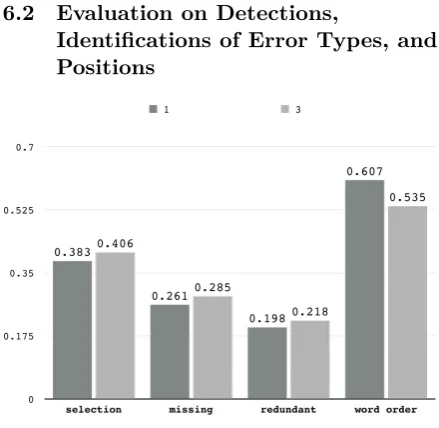
that the current pseudo data has a positive im-pact on the precision of all error types, except for the word ordering errors. It indicates the word ordering pseudo data has much room for improvements.
Figure1shows that the identification of the positions of these errors is of different diffi-culties to the systems. While the ensembled systems are proficient in handling word order-ing errors, they have the most difficulties in handling redundant errors.
Table 2 shows the ensembled system 1+3 (>1) achieves a False Positive Rate (FPR) at 4.48% and a precision of 86.56% the detection of erroneous sentences, which are better than the best FPR 4.99% and the best precision
82.76% in CGED 2018 submissions, respec-tively.
7 Conclusion and Future Work
In CGED 2018, we employ the sequence to se-quence learning to model the task of grammar error correction. We adopt a semi-supervised approach to breakthrough the bottlenecks of very limited size of manually labeled data. Specifically, we adapt correct sentences writ-ten by native Chinese speakers to generate pseudo grammatical errors made by learners of Chinese as a second language. The pseudo data is used to pre-train the model and gives rise to improvements in both precision and re-call. Being aware of the significance of preci-sion in a grammar error correction system in real scenarios, we use ensembles to boost pre-cision. The use of pseudo data has a positive impact on the identification of missing errors, redundant errors, and word selection errors.
In the future work, we will use multi-task to jointly optimize the four tasks all together (Luong et al., 2015). In addition, we will in-vestigate more sophisticated techniques for the generation of pseudo data.
References
[image:5.595.74.551.64.291.2] [image:5.595.74.289.341.506.2]damerau-levenshtein string-edit distance metric. In Australasian Symposium on Acsw Frontiers, pages 117–124.
Aoife Cahill, Nitin Madnani, Joel Tetreault, and Diane Napolitano. 2013. Robust systems for preposition error correction using wikipedia re-visions. In Proceedings of the 2013 Conference of the North American Chapter of the Asso-ciation for Computational Linguistics: Human Language Technologies, pages 507–517.
G Krishna Chaitanya. 2017. GRAMMATICAL ERROR CORRECTION. Ph.D. thesis, In-dian Institute of Technology Bombay Mumbai 400076 (India) 14.
Wanxiang Che, Zhenghua Li, and Ting Liu. 2010. Ltp: a chinese language technology platform. In International Conference on Computational Linguistics: Demonstrations, pages 13–16.
Shuk-Man Cheng, Chi-Hsin Yu, and Hsin-Hsi Chen. 2014. Chinese word ordering errors de-tection and correction for non-native chinese language learners. In Proceedings of COL-ING 2014, the 25th International Conference on Computational Linguistics: Technical Papers, pages 279–289.
Markus Dickinson. 2010. Generating learner-like morphological errors in russian. In Proceedings of the 23rd International Conference on Compu-tational Linguistics, pages 259–267. Association for Computational Linguistics.
Mariano Felice and Zheng Yuan. 2014. Generating artificial errors for grammatical error correction. In Proceedings of the Student Research Work-shop at the 14th Conference of the European Chapter of the Association for Computational Linguistics, pages 116–126.
Jennifer Foster and Øistein E Andersen. 2009. Generrate: generating errors for use in gram-matical error detection. In Proceedings of the fourth workshop on innovative use of nlp for building educational applications, pages 82–90. Association for Computational Linguistics.
Jonas Gehring, Michael Auli, David Grangier, De-nis Yarats, and Yann N Dauphin. 2017. Convo-lutional sequence to sequence learning.
Roman Grundkiewicz and Marcin Junczys-Dowmunt. 2014. The wiked error corpus: A corpus of corrective wikipedia edits and its application to grammatical error correction. In International Conference on Natural Language Processing, pages 478–490. Springer.
Hanban. 2001. 汉语水平词汇与汉字等级大纲 The Syllabus of the Graded Words and Characters for Chinese Proficiency Test. 经济科学出版社
Economic Science Press.
Hanban. 2010. 新汉语水平考试大纲 New Chi-nese Proficiency Test Syllabus. 商务印书馆The Commercial Press, China.
Marti A. Hearst, Susan T Dumais, Edgar Osuna, John Platt, and Bernhard Scholkopf. 1998. Sup-port vector machines. IEEE Intelligent Systems and their applications, 13(4):18–28.
Sepp Hochreiter and Jürgen Schmidhuber. 1997. Long short-term memory. Neural computation, 9(8):1735–1780.
Kenji Imamura, Kuniko Saito, Kugatsu Sadamitsu, and Hitoshi Nishikawa. 2012. Grammar error correction using pseudo-error sentences and domain adaptation. In Pro-ceedings of the 50th Annual Meeting of the Association for Computational Linguistics: Short Papers-Volume 2, pages 388–392. Associ-ation for ComputAssoci-ational Linguistics.
Guillaume Klein, Yoon Kim, Yuntian Deng, Jean Senellart, and Alexander M. Rush. 2017. Open-nmt: Open-source toolkit for neural machine translation.
John Lafferty, Andrew McCallum, and Fer-nando CN Pereira. 2001. Conditional random fields: Probabilistic models for segmenting and labeling sequence data.
Lung-Hao Lee, Li-Ping Chang, Kuei-Ching Lee, Yuen-Hsien Tseng, and Hsin-Hsi Chen. 2013. Linguistic rules based chinese error detection for second language learning. In Work-in-Progress Poster Proceedings of the 21st International Conference on Computers in Education (ICCE-13), pages 27–29.
Lung-Hao Lee, Liang-Chih Yu, Kuei-Ching Lee, Yuen-Hsien Tseng, Li-Ping Chang, and Hsin-Hsi Chen. 2014. A sentence judgment system for grammatical error detection. In Proceedings of COLING 2014, the 25th International Con-ference on Computational Linguistics: System Demonstrations, pages 67–70.
Minh Thang Luong, Quoc V. Le, Ilya Sutskever, Oriol Vinyals, and Lukasz Kaiser. 2015. Multi-task sequence to sequence learning. Computer Science.
Alla Rozovskaya and Dan Roth. 2010. Training paradigms for correcting errors in grammar and usage. In Human language technologies: The 2010 annual conference of the north american chapter of the association for computational lin-guistics, pages 154–162. Association for Compu-tational Linguistics.
Keisuke Sakaguchi, Kevin Duh, Matt Post, and Benjamin Van Durme. 2017. Robsut wrod re-ocginiton via semi-character recurrent neural network.
Allen Schmaltz, Yoon Kim, Alexander M Rush, and Stuart M Shieber. 2016. Sentence-level grammatical error identification as sequence-to-sequence correction. arXiv preprint arXiv:1604.04677.
Yi Yang, Pengjun Xie, Jun Tao, Guangwei Xu, Linlin Li, and Si Luo. 2017. Alibaba at IJCNLP-2017 task 1: Embedding grammatical features into lstms for chinese grammatical error diagno-sis task. In Proceedings of the IJCNLP 2017, Shared Tasks, Taipei, Taiwan, November 27 -December 1, 2017, Shared Tasks, pages 41–46.
Chi-Hsin Yu and Hsin-Hsi Chen. 2012. Detect-ing word orderDetect-ing errors in chinese sentences for learning chinese as a foreign language. Proceed-ings of COLING 2012, pages 3003–3018.
Zheng Yuan and Mariano Felice. 2013. Con-strained grammatical error correction using sta-tistical machine translation. In Proceedings of the Seventeenth Conference on Computational Natural Language Learning: Shared Task, pages 52–61.