Proceedings of the 55th Annual Meeting of the Association for Computational Linguistics, pages 90–101 Vancouver, Canada, July 30 - August 4, 2017. c2017 Association for Computational Linguistics Proceedings of the 55th Annual Meeting of the Association for Computational Linguistics, pages 90–101
Vancouver, Canada, July 30 - August 4, 2017. c2017 Association for Computational Linguistics
Joint Learning for Event Coreference Resolution
Jing Lu and Vincent Ng
Human Language Technology Research Institute University of Texas at Dallas
Richardson, TX 75083-0688
{ljwinnie,vince}@hlt.utdallas.edu
Abstract
While joint models have been developed for many NLP tasks, the vast majority of event coreference resolvers, including the top-performing resolvers competing in the recent TAC KBP 2016 Event Nugget De-tection and Coreference task, are pipeline-based, where the propagation of errors from the trigger detection component to the event coreference component is a ma-jor performance limiting factor. To ad-dress this problem, we propose a model for jointly learning event coreference, trig-ger detection, and event anaphoricity. Our joint model is novel in its choice of tasks and its features for capturing cross-task interactions. To our knowledge, this is the first attempt to train a mention-ranking model and employ event anaphoricity for event coreference. Our model achieves the best results to date on the KBP 2016 En-glish and Chinese datasets.
1 Introduction
Within-document event coreference resolution is the task of determining which event mentions in a text refer to the same real-world event. Compared to entity coreference resolution, event coreference resolution is not only much less studied, but it is arguably more challenging. The challenge stems in part from the fact that an event coreference re-solver typically lies towards the end of the stan-dard information extraction pipeline, assuming as input the noisy outputs of its upstream compo-nents. One such component is the trigger detection system, which is responsible for identifying event triggers and determining their event subtypes.
As is commonly known, trigger detection is another challenging task that is far from being
solved. In fact, in the recent TAC KBP 2016 Event Nugget Detection and Coreference task, trigger detection (a.k.a. event nugget detection in KBP) is deliberately made more challenging by focus-ing only on detectfocus-ing the 18 subtypes of triggers on which the KBP 2015 participating systems’ performances were the poorest (Mitamura et al.,
2016). The best-performing KBP 2016 system on English trigger detection achieved only an F-score of 47 (Lu and Ng,2016).1
Given the difficulty of trigger detection, it is conceivable that many errors will propagate from the trigger detection component to the event coref-erence component in any pipeline architecture where trigger detection precedes event corefer-ence resolution. These trigger detection errors could severely harm event coreference perfor-mance. For instance, two event mentions could be wrongly posited as coreferent if the underlying triggers were wrongly predicted to have the same subtype. Nevertheless, the top-performing sys-tems in the KBP 2016 event coreference task all adopted the aforementioned pipeline architecture (Liu et al.,2016;Lu and Ng,2016;Nguyen et al.,
2016). Their performances are not particularly im-pressive, however: the best English event corefer-ence F-score (averaged over four scoring metrics) is only around 30%.
To address this error propagation problem, we describe a joint model of trigger detection, event coreference, and event anaphoricity in this pa-per. Our choice of these three tasks is moti-vated in part by their inter-dependencies. As men-tioned above, it is well-known that trigger de-tection performance has a huge impact on event coreference performance. Though largely under-investigated, event coreference could also improve
trigger detection. For instance, if two event men-tions are posited as coreferent, then the under-lying triggers must have the same event sub-type. While the use of anaphoricity information for entity coreference has been extensively stud-ied (see Ng (2010)), to our knowledge there has thus far been no attempt to explicitly model event anaphoricity for event coreference.2 Although the mention-ranking model we employ for event coreference also allows an event mention to be posited as non-anaphoric (by resolving it to anull
candidate antecedent), our decision to train a sep-arate anaphoricity model and integrate it into our joint model is motivated in part by the recent suc-cesses ofWiseman et al.(2015), who showed that there are benefits in jointly training a noun phrase anaphoricity model and a mention-ranking model for entity coreference resolution. Finally, event anaphoricity and trigger detection can also mu-tually benefit each other. For instance, any verb posited as a non-trigger cannot be anaphoric, and any verb posited as anaphoric must be a trigger. Note that in our joint model, anaphoricity serves as an auxiliary task: its intended use is to im-prove trigger detection and event coreference, po-tentially mediating the interaction between trigger detection and event coreference.
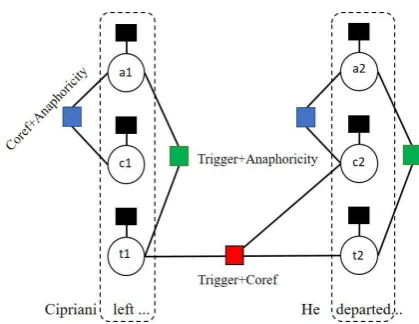
Being a structured conditional random field, our model encompasses two types of factors. Unary factors encode the features specific for each task. Binary and ternary factors capture the interaction between each pair of tasks in a soft manner, en-abling the learner to learn which combinations of values of the output variables are more probable. For instance, the learner should learn that it is not a good idea to classify a verb both as anaphoric and as a non-trigger. Our model is similar in spirit to Durrett and Klein’s (2014) joint model for entity
analysis, which performs joint learning for entity coreference, entity linking and semantic typing via the use of interaction features.
Our contributions are two-fold. First, we present a joint model of event coreference, trigger detection, and anaphoricity that is novel in terms of the choice of tasks and the features used to cap-ture cross-task interactions. Second, our model achieves the best results to date on the KBP 2016 English and Chinese event coreference tasks.
2Following the entity coreference literature, we over-load the termanaphoricity, saying that an event mention is anaphoric if it is coreferent with a preceding mention in the associated text.
2 Definitions, Task, and Corpora
2.1 Definitions
We employ the following definitions in our discus-sion of trigger detection and event coreference:
• An event mention is an explicit occurrence
of an event consisting of a textual trigger, ar-guments or participants (if any), and the event type/subtype.
• Anevent triggeris a string of text that most clearly expresses the occurrence of an event, usually a word or a multi-word phrase
• Anevent argumentis an argument filler that
plays a certain role in an event.
• Anevent coreference chain(a.k.a. anevent hopper) is a group of event mentions that re-fer to the same real-world event. They must have the same event (sub)type.
To understand these definitions, consider the ex-ample in Table 1, which contains two coreferent event mentions, ev1 and ev2. left is the
trig-ger for ev1 and departed is the trigger for ev2.
Both triggers have subtype Movement.Transport-Person. ev1has three arguments, Georges
Cipri-ani, prison, and Wednesday with roles Person,
Origin, andTimerespectively. ev2also has three arguments,He,Ensisheim, andpolice vehiclewith rolesPerson,Origin, andInstrumentrespectively.
2.2 Task
The version of the event coreference task we fo-cus on in this paper is the Event Nugget Detec-tion and Coreference task in the TAC KBP 2016 Event Track. While we discuss the role played by event arguments in event coreference in the previ-ous subsection, KBP 2016 addresses event argu-ment detection as a separate shared task. In other words, the KBP 2016 Event Nugget Detection and Coreference task focuses solely on trigger detec-tion and event coreference.
Georges Cipriani[P erson], {left}ev1 the prison[Origin] in Ensisheim in northern France on parole on Wednesday[T ime].
He[P erson]{departed}ev2Ensisheim[Origin]in a police vehicle[Instrument]bound for an open prison near Strasbourg. Table 1: Event coreference resolution example.
event mentions to be coreferent as long as they in-tuitivelyrefer to the same real-world event. Under this definition, two event mentions can be corefer-ent even if their time and location argumcorefer-ents are not coreferent. In our example in Table 1,ev1and
ev2are coreferent in KBP because they both refer to the same event of Cipriani leaving the prison. However, they arenotcoreferent in ACE because theirOriginarguments are not coreferent (one Ori-gin argument involves a prison in Ensisheim while the other involves the city Ensisheim).
2.3 Corpora
Given our focus on the KBP 2016 Event Nugget Detection and Coreference task, we employ the English and Chinese corpora used in this task for evaluation, referring to these corpora as the KBP 2016 English and Chinese corpora for brevity. There are no official training sets: the task orga-nizers simply made available a number of event coreference-annotated corpora for training. For English, we use LDC2015E29, E68, E73, and E94 for training. These corpora are composed of two types of documents, newswire documents and dis-cussion forum documents. Together they contain 648 documents with 18739 event mentions dis-tributed over 9955 event coreference chains. For Chinese, we use LDC2015E78, E105, and E112 for training. These corpora are composed of dis-cussion forum documents only. Together they con-tain 383 documents with 4870 event mentions dis-tributed over 3614 event coreference chains.
The test set for English consists of 169 newswire and discussion forum documents with 4155 event mentions distributed over 3191 event coreference chains. The test set for Chinese con-sists of 167 newswire and discussion forum docu-ments with 2518 event mentions distributed over 1912 event coreference chains. Note that these test sets contain only annotations for event triggers and event coreference (i.e., there are no event ar-gument annotations). While some of the training sets additionally contain event argument annota-tions, we do not make use of event argument an-notations in model training to ensure a fairer com-parison to the teams participating in the KBP 2016 Event Nugget Detection and Coreference task.
3 Model
3.1 Overview
Our model, which is a structured conditional ran-dom field, operates at the document level. Specif-ically, given a test document, we first extract from it (1) all single-word nouns and verbs and (2) all words and phrases that have appeared at least once as a trigger in the training data. We treat each of these extracted words and phrases as a candidate event mention.3 The goal of the model is to make joint predictions for the candidate event mentions in a document. Three predictions will be made for each candidate event mention that correspond to the three tasks in the model: its trigger subtype, its anaphoricity, and its antecedent.
Given this formulation, we define three types of output variables:
• Event subtype variablest= (t1, . . . , tn). Each
titakes a value in the set of 18 event subtypes
defined in KBP 2016 or NONE, which indi-cates that the event mention is not a trigger.
• Anaphoricity variables a = (a1, . . . , an).
Each ai is either ANAPHORIC or NOT
ANAPHORIC.
• Coreference variablesc= (c1, . . . , cn), where
ci ∈ {1, . . . ,i−1, NEW}. In other words,
the value of eachciis the id of its antecedent,
which can be one of the preceding event men-tions or NEW (if the event mention underly-ingcistarts a new cluster).
Each candidate event mention is associated with exactly one coreference variable, one event sub-type variable, and one anaphoricity variable. Our model induces the following log-linear probability distribution over these variables:
p(t,a,c|x; Θ)∝exp(X
i
θifi(t,a,c,x))
Figure 1: Unary factors for the three tasks, the variables they are connected to, and the possible values of the variables. Unary factors encode task-specific features. Each factor is connected to the correspond-ing output node. The features associated with a factor are used to predict the value of the output node it is connected to when a model is run independently of other models.
whereθi∈Θis the weight associated with feature
functionfiandxis the input document.
3.2 Features
Given that our model is a structured conditional random field, the features can be divided into two types: (1) task-specific features, and (2) cross-task features, which capture the interactions be-tween a pair of tasks. We express these two types of features in factor graph notation. The task-specific features are encoded in unary factors, each of which is connected to the corresponding vari-able (Figure 1). The cross-task features are en-coded in binary or ternary factors, each of which couples the output variables from two tasks (Fig-ure 2). Next, we describe these two types of fea-tures. Each feature is used to train models for both English and Chinese unless otherwise stated.
3.2.1 Task-Specific Features
We begin by describing the task-specific features, which are encoded in unary factors, as well as each of the three independent models.
3.2.1.1 Trigger Detection
When applied in isolation, our trigger detection model returns a distribution over possible subtypes given a candidate trigger. Each candidate triggert
is represented usingt’s word,t’s lemma, word
bi-grams formed with a window size of three from
t, as well as feature conjunctions created by
pair-ingt’s lemma with each of the following features:
Figure 2: Binary and ternary factors. These higher-order factors capture cross-task interactions. The binary anaphoricity and trigger factors encourage anaphoric men-tions to be triggers. The binary anaphoricity and coreference factors encourage non-anaphoric mentions to start a NEW
coreference cluster. The ternary trigger and coreference fac-tors encourage coreferent mentions to be triggers.
the head word of the entity syntactically closest to
t, the head word of the entity textually closest to t, the entity type of the entity that is syntactically
closest tot, and the entity type of the entity that is
textually closest tot.4 In addition, for event
men-tions with verb triggers, we use the head words and the entity types of their subjects and objects as fea-tures, where the subjects and objects are extracted from the dependency parse trees obtained using Stanford CoreNLP (Manning et al., 2014). For event mentions with noun triggers, we create the same features that we did for verb triggers, except that we replace the subjects and verbs with heuris-tically extracted agents and patients. Finally, for the Chinese trigger detector, we additionally cre-ate two features from each character int, one
en-coding the character itself and the other enen-coding the entry number of the corresponding character in a Chinese synonym dictionary.5
3.2.1.2 Event Coreference
We employ a mention-ranking model for event coreference that selects the most probable an-tecedent for a mention to be resolved (or NEW if the mention is non-anaphoric) from its set of candidate antecedents. When applied in isola-tion, the model is trained to maximize the condi-4We train a CRF-based entity extraction model for jointly identifying the entity mentions and their types. Details can be found inLu et al.(2016).
[image:4.595.79.291.61.218.2]tional likelihood of collectively resolving the men-tions to their correct antecedents in the training texts (Durrett and Klein, 2013). Below we de-scribe the features used to represent the candidate antecedents for the mention to be resolved,mj.
Features representing the NULLcandidate
an-tecedent: Besidesmj’s word andmj’s lemma,
we employ feature conjunctions given their useful-ness in entity coreference (Fernandes et al.,2014). Specifically, we create a conjunction between
mj’s lemma and the number of sentences
preced-ing mj, as well as a conjunction between mj’s
lemma and the number of mentions precedingmj
in the document.
Features representing a non-NULL candidate
antecedent, mi: mi’s word, mi’s lemma,
whethermiandmjhave the same lemma, and
fea-ture conjunctions including: (1)mi’s word paired
withmj’s word, (2)mi’s lemma paired withmj’s
lemma, (3) the sentence distance betweenmi and
mj paired withmi’s lemma andmj’s lemma, (4)
the mention distance between mi and mj paired
with mi’s lemma and mj’s lemma, (5) a
quadru-ple consisting of mi and mj’s subjects and their
lemmas, and (6) a quadruple consisting ofmiand
mj’s objects and their lemmas.
3.2.1.3 Anaphoricity Determination
When used in isolation, the anaphoricity model re-turns the probability that the given event mention is anaphoric. To train the model, we represent each event mentionmjusing the following features: (1)
the head word of each candidate antecedent paired with mj’s word, (2) whether at least one
candi-date antecedent has the same lemma as that ofmj,
and (3) the probability thatmjis anaphoric in the
training data (if mj never appears in the training
data, this probability is set to 0.5).
3.2.2 Cross-Task Interaction Features
Cross-task interaction features are associated with the binary and ternary factors.
3.2.2.1 Trigger Detection and Anaphoricity
We fire features that conjoin each candidate event mention’s event subtype, the lemma of its trigger and its anaphoricity.
3.2.2.2 Trigger Detection and Coreference
We define our joint coreference and trigger detec-tion factors such that the features defined on sub-type variables ti and tj are fired only if current
mention mj is coreferent with preceding mention
mi. These features are: (1) the pair of mi and
mj’s subtypes, (2) the pair of mj’s subtype and
mi’s word, and (3) the pair of mi’s subtype and
mj’s word.
3.2.2.3 Coreference and Anaphoricity
We fire a feature that conjoins event mentionmj’s
anaphoricity and whether or not a non-NULL an-tecedent is selected formj.
3.3 Training
We learn the model parameters Θ from a set of
dtraining documents, where document icontains
contentxi, gold triggerst∗i and gold event
coref-erence partition Ci∗. Before learning, there are a
couple of issues we need to address.
First, we need to derive gold anaphoricity la-bels a∗i from Ci∗. This is straightforward: the
first mention of each coreference chain is NOT ANAPHORIC, whereas the rest are ANAPHORIC.
Second, we employ gold event mentions for model training, but training models only on gold mentions is not sufficient: for instance, a trigger detector trained solely on gold mentions will not be able to classify a candidate event mention as NONE during testing. To address this issue, we additionally train the models on candidate event mentions corresponding to non-triggers. We cre-ate these candidcre-ate event mentions as follows. For each wordwthat appears as a true trigger at least once in the training data, we create a candidate event mention from each occurrence of w in the
training data that is not annotated as a true trigger. Third, since our model produces event corefer-ence output in the form of an antecedent vector (with one antecedent per event mention), it needs to be trained on antecedent vectors. However, since the coreference annotation for each docu-mentiis provided in the form of a clusteringCi∗,
we follow previous work on entity coreference res-olution (Durrett and Klein, 2013): we sum over all antecedent structures A(Ci∗) that are consis-tentwithCi∗(i.e., the first mention of a cluster has
antecedent NEW, whereas each of the subsequent mentions can select any of the preceding mentions in the same cluster as its antecedent).
Next, we learn the model parameters to max-imize the following conditional likelihood of the training data with L1 regularization:
L(Θ) =
d X
i=1
log X
c∗∈A(C∗ i)
In this objective, p′ is obtained by
augment-ing the distributionp(defined in Section 3.1) with
task-specific parameterized loss functions:
p′(t,a,c|xi; Θ)∝p(t,a,c|xi; Θ) exp[αtlt(t,t∗)
+αala(a,a∗) +αclc(c, C∗)]
wherelt,laandlc are task-specific loss functions,
and αt, αa and αc are the associated weight
pa-rameters that specify the relative importance of the three tasks in the objective function.
Softmax-margin, the technique of integrating task-specific loss functions into the objective func-tion, was introduced byGimpel and Smith(2010) and subsequently used by Durrett and Klein
(2013, 2014). By encoding task-specific knowl-edge, these loss functions can help train a model that places less probability mass on less desirable output configurations.
Our loss function for event coreference, lc, is
motivated by the oneDurrett and Klein(2013) de-veloped for entity coreference. It is a weighted sum of the counts of three error types:
lc(c, C∗) =αc,F AF A(c, C∗)+αc,F NF N(c, C∗)
+αc,W LW L(c, C∗)
whereF A(c, C∗)is the number of non-anaphoric mentions misclassified as anaphoric, F N(c, C∗) is the number of anaphoric mentions misclassified as non-anaphoric, and W L(c, C∗) is the number of incorrectly resolved anaphoric mentions.
Our loss function for trigger detection,lt, is
pa-rameterized in a similar way, having three param-eters associated with three error types: αt,F T is
associated with the number of non-triggers mis-classified as triggers,αt,F N is associated with the
number of triggers misclassified as non-triggers, and αt,W Lis associated with the number of
trig-gers labeled with the wrong subtype.
Finally, our loss function for anaphoricity deter-mination,la, is also similarly parameterized,
hav-ing two parameters: αa,F A and αa,F N are
asso-ciated with the number of false anaphors and the number of false non-anaphors, respectively.
Following Durrett and Klein (2014), we use AdaGrad (Duchi et al.,2011) to optimize our ob-jective withλ= 0.001in our experiments.
3.4 Inference
Inference, which is performed during training and decoding, involves computing the marginals for a
variable or a set of variables to which a factor con-nects. For efficiency, we perform approximate in-ference using belief propagation rather than exact inference. Given that convergence can typically be reached within five iterations of belief propaga-tion, we employ five iterations in all experiments.
Performing inference using belief propagation on the full factor graph defined in Section 3.1 can still be computationally expensive, however. One reason is that the number of ternary factors grows quadratically with the number of event mentions in a document. To improve scalability, we restrict the domains of the coreference variables. Rather than allow the domain of coreference variable cj
to be of sizej, we allow a preceding mentionmito
be a candidate antecedent of mentionmj if (1) the
sentence distance between the two mentions is less than an empirically determined threshold and (2) either they are coreferent at least once in the train-ing data or their head words have the same lemma. Doing so effectively enables us to prune the un-likely candidate antecedents for each event men-tion. AsDurrett and Klein(2014) point out, such pruning has the additional benefit of reducing “the memory footprint and time needed to build a fac-tor graph”, as we do not need to create any facfac-tor between mi and mj and its associated features if
miis pruned. To further reduce the memory
foot-print, we additionally restrict the domains of the event subtype variables. Given a candidate event mention created from word w, we allow the
do-main of its subtype variable to include only NONE as well as those subtypes thatwis labeled with at
least once in the training data.
For decoding, we employ minimum Bayes risk, which computes the marginals of each variable w.r.t. the joint model and derives the most prob-able assignment to each variprob-able.
4 Evaluation
4.1 Experimental Setup
English
MUC B3 CEAF
e BLANC AVG-F Trigger Anaphoricity
KBP2016 26.37 37.49 34.21 22.25 30.08 46.99 −
INDEP. 22.71 40.72 39.00 22.71 31.28 48.82 27.35
JOINT 27.41 40.90 39.00 25.00 33.08 49.30 31.94
∆over INDEP. +4.70 +0.18 0.00 +2.29 +1.80 +0.48 +4.59 Chinese
MUC B3 CEAF
e BLANC AVG-F Trigger Anaphoricity
KBP2016 24.27 32.83 30.82 17.80 26.43 40.01 −
INDEP. 22.68 32.97 29.96 17.74 25.84 39.82 19.31
JOINT 27.94 33.01 29.96 20.24 27.79 40.53 23.33
[image:7.595.97.502.62.228.2]∆over INDEP. +5.26 +0.04 0.00 +2.50 +1.95 +0.71 +4.02
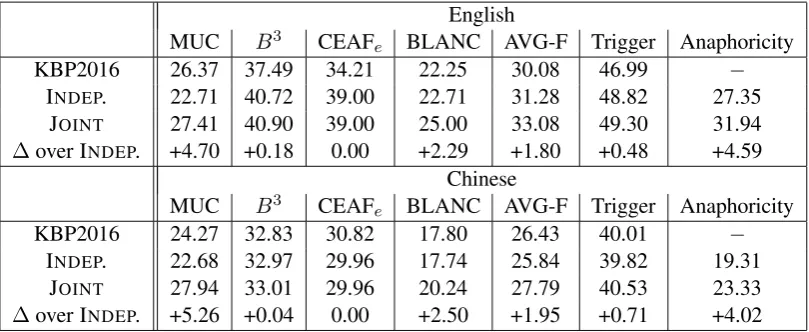
Table 2: Results of all three tasks on the KBP 2016 evaluation sets. The KBP2016 results are those achieved by the best-performing coreference resolver in the official KBP 2016 evaluation.∆is the performance difference between the JOINTmodel and the corresponding INDEP. model. All results are expressed in terms of F-score.
KBP 2016 Chinese test set.
Results of event coreference and trigger de-tection are obtained using version 1.7.2 of the official scorer provided by the KBP 2016 or-ganizers. To evaluate event coreference per-formance, the scorer employs four scoring measures, namely MUC (Vilain et al., 1995),
B3 (Bagga and Baldwin, 1998), CEAF
e (Luo, 2005) and BLANC (Recasens and Hovy,2011), as well as the unweighted average of their F-scores (AVG-F). The scorer reports event mention detec-tion performance in terms of F-score, consider-ing a mention correctly detected if it has an ex-act match with a gold mention in terms of bound-ary, event type, and event subtype. In addition, we report anaphoricity determination performance in terms of the F-score computed over anaphoric mentions, counting an extracted anaphoric men-tion as a true positive if it has an exact match with a gold anaphoric mention in terms of boundary.
4.2 Results and Discussion
Results are shown in Table 2 where performance on all three tasks (event coreference, trigger detec-tion, and anaphoricity determination) is expressed in terms of F-score. The top half of the table shows the results on the English evaluation set. Specif-ically, row 1 shows the performance of the best event coreference system participating in KBP 2016 (Lu and Ng, 2016). This system adopts a pipeline architecture. It first uses an ensemble of one-nearest-neighbor classifiers for trigger detec-tion. Using the extracted triggers, it then applies a pipeline of three sieves, each of which is a
one-nearest-neighbor classifier, for event coreference. As we can see, this system achieves an AVG-F of 30.08 for event coreference and an F-score of 46.99 for trigger detection.
Row 2 shows the performance of the dent models, each of which is trained indepen-dently of the other models. Specifically, each in-dependent model is trained using only the unary factors associated with it. As we can see, the in-dependent models outperform the top KBP 2016 system by 1.2 points in AVG-F for event corefer-ence and 1.83 points for trigger detection.
Results of our joint model are shown in row 3. The absolute performance differences between the joint model and the independent models are shown in row 4. As we can see, the joint model outper-forms the independent models for all three tasks: by 1.80 points for event coreference, 0.48 points for trigger detection and 4.59 points for anaphoric-ity determination. Most encouragingly, the joint model outperforms the top KBP 2016 system for both event coreference and trigger detection. For event coreference, it outperforms the top KBP sys-tem w.r.t. all scoring metrics, yielding an improve-ment of 3 points in AVG-F. For trigger detection, it outperforms the top KBP system by 2.31 points. The bottom half of Table2shows the results on the Chinese evaluation set. The top KBP 2016 event coreference system on Chinese is also the
English Chinese
Coref Trigger Anaph Coref Trigger Anaph INDEP. 31.28 48.82 27.35 25.84 39.82 19.31 INDEP.+CorefTrigger +0.39 +0.42 −0.05 +0.95 +0.56 −0.37
[image:8.595.118.481.62.201.2]INDEP.+CorefAnaph +0.40 −0.08 +3.45 +0.37 +0.04 −0.11 INDEP.+TriggerAnaph +0.11 +0.38 +1.35 +0.14 +0.52 +0.02 JOINT−CorefTrigger +0.56 −0.06 +4.41 +0.19 +0.35 +3.34 JOINT−CorefAnaph +0.63 +0.66 +1.46 +1.50 +0.88 +0.28 JOINT−TriggerAnaph +1.89 +0.50 +4.01 +1.65 +0.50 +1.79 JOINT +1.80 +0.48 +4.59 +1.95 +0.71 +4.02
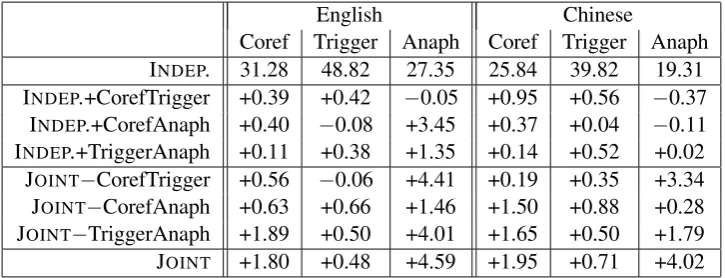
Table 3: Results of model ablations on the KBP 2016 evaluation sets. Each row of ablation results is obtained by either adding one type of interaction factor to the INDEP. model or deleting one type of interaction factor from the JOINT
model. For each column, the results are expressed in terms of changes to the INDEP. model’s F-score shown in row 1.
for all three tasks: by 1.95 points for event coref-erence, 4.02 points for anaphoricity determination, and 0.71 points for trigger detection. Like its En-glish counterpart, our Chinese joint model outper-forms the top KBP system for both event corefer-ence and trigger detection. For event corefercorefer-ence, it outperforms the top KBP system w.r.t. all but the CEAFemetric, yielding an absolute improvement
of 1.36 points in AVG-F. For trigger detection, it outperforms the top KBP system by 0.52 points.
For both datasets, the joint model’s superior per-formance to the independent coreference model stems primarily from considerable improvements in MUC F-score. As MUC is a link-based mea-sure, these results provide suggestive evidence that joint modeling has enabled more event corefer-ence links to be discovered.
4.3 Model Ablations
To evaluate the importance of each of the three types of joint factors in the joint model, we per-form ablation experiments.7 Table 3 shows the re-sults on the English and Chinese datasets when we add each type of joint factors to the independent model and remove each type of joint factors from the full joint model. The results of each task are expressed in terms of changes to the correspond-ing independent model’s F-score.
7Chen and Ng (2013) also performed ablation on their ACE-style Chinese event coreference resolver. However, given the differences in the tasks involved (e.g., they did not model event anaphoricity, but included tasks such as event ar-gument extraction and role classification, entity coreference, and event mention attribute value computation) and the ab-lation setup (e.g., they ablated individual tasks/components in their pipeline-based system in an incremental fashion, whereas we ablate interaction factors rather than tasks), a di-rect comparison of their observations and ours is difficult.
Coref-Trigger interactions. Among the three types of factors, this one contributes the most to coreference performance, regardless of whether it is applied in isolation or in combination with the other two types of factors to the independent coref-erence model. In addition, it is the most effec-tive type of factor for improving trigger detec-tion. When applied in combination, it also im-proves anaphoricity determination, although less effectively than the other two types of factors.
Coref-Anaphoricity interactions. When ap-plied in isolation to the independent models, this type of factor improves coreference resolution but has a mixed impact on anaphoricity determina-tion. When applied in combination with other types of factors, it improves both tasks, partic-ularly anaphoricity determination. Its impact on trigger detection, however, is generally negative.
Trigger-Anaphoricity interactions.When ap-plied in isolation to the independent models, this type of factor improves both trigger detection and anaphoricity determination. When applied in combination with other types of factors, it still im-proves anaphoricity determination (particularly on Chinese), but has a mixed effect on trigger detec-tion. Among the three types of factors, it has the least impact on coreference resolution.
4.4 Error Analysis
Next, we conduct an analysis of the major sources of error made by our joint coreference model.
possess different subtypes in different contexts. For the same reason, words that are only some-times used as triggers are often wrongly posited as triggers when they are not. These two types of triggers have in turn led to the establishment of in-correct coreference links.8
Failure to extract arguments. In the absence of an annotated corpus for training an argument clas-sifier, we exploit dependency relations for argu-ment extraction. Doing so proves inadequate, par-ticularly for noun triggers, owing to the absence of dependency relations that can be used to reli-ably extract their arguments. Moreover, using de-pendency relations does not allow the extraction of arguments that do not appear in the same sentence as their trigger. Since the presence of incompat-ible arguments is an important indicator of non-coreference, our model’s failure to extract argu-ments has resulted in incorrect coreference links.
4.4.2 Three Major Types of Recall Error Missing triggers. Our trigger model fails to identify trigger words that are unseen or rarely-occurring in the training data. As a result, many coreference links cannot be established.
Lack of entity coreference information. Entity coreference information is useful for event coref-erence because the corresponding arguments of two event mentions are typically coreferent. Since our model does not exploit entity coreference in-formation, it treats two lexically different event ar-guments as non-coreferent/unrelated. This in turn weakens its ability to determine whether two event mentions are coreferent. This issue is particularly serious in discussion forum documents, where it is not uncommon to see pronouns serve as sub-jects and obsub-jects of event mentions. The situation is further aggravated in Chinese documents, where zero pronouns are prevalent.
Lack of contextual understanding. Our model only extracts features from the sentence in which an event mention appears. However, additional contextual information present in neighboring sen-tences may be needed for correct coreference res-olution. This is particularly true in discussion fo-rum documents, where the same event may be de-scribed differently by different people. For exam-8In our joint model, mentions that are posited as corefer-ent are encouraged to have the same subtype. While it can potentially fix the errors involving coreferent mentions that have different subtypes, it cannot fix the errors in which the two mentions involved have the same erroneous subtype.
ple, when describing the fact that Tim Cook will attend Apple’s Istanbul store opening, one person said “Cook is expected to return to Turkey for the store opening”, and another person described this event as “Tim travels abroad YET AGAIN to be feted by the not-so-high-and-mighty”. It is by no means easy to determine thatreturnandtravel
trigger two coreferent mentions in these sentences.
5 Related Work
Existing event coreference resolvers have been evaluated on different corpora, such as MUC (e.g., Humphreys et al. (1997)), ACE (e.g., Ahn (2006), Chen and Ji (2009),
McConky et al. (2012), Sangeetha and Arock
(2012), Chen and Ng (2015, 2016), Krause et al.
(2016)), OntoNotes (e.g., Chen et al. (2011)), the Intelligence Community corpus (e.g.,
Cybulska and Vossen (2012), Araki et al. (2014),
Liu et al.(2014)), the ECB corpus (e.g.,Lee et al.
(2012), Bejan and Harabagiu (2014)) and its extension ECB+ (e.g., Yang et al. (2015)), and ProcessBank (e.g., Araki and Mitamura (2015)). The newest event coreference corpora are the ones used in the KBP 2015 and 2016 Event Nugget Detection and Coreference shared tasks, in which the best performers in 2015 and 2016 are RPI’s system (Hong et al., 2015) and UTD’s system (Lu and Ng, 2016), respectively. The KBP 2015 corpus has recently been used to evaluate Peng et al.’s (2016) minimally supervised approach and Lu et al.’s (2016) joint inference approach to event coreference. With the rarest exceptions (e.g.,
Lu et al. (2016)), existing resolvers have adopted a pipeline architecture in which trigger detection is performed prior to coreference resolution.
6 Conclusion
We proposed a joint model of event coreference resolution, trigger detection, and event anaphoric-ity determination. The model is novel in its choice of tasks and the cross-task interaction features. When evaluated on the KBP 2016 English and Chinese corpora, our model not only outperforms the independent models but also achieves the best results to date on these corpora.
Acknowledgments
References
David Ahn. 2006. The stages of event extraction. InProceedings of the COLING/ACL Workshop on Annotating and Reasoning about Time and Events. pages 1–8.
Jun Araki, Zhengzhong Liu, Eduard Hovy, and Teruko Mitamura. 2014. Detecting subevent structure for event coreference resolution. InProceedings of the Ninth International Conference on Language Re-sources and Evaluation, pages 4553–4558.
Jun Araki and Teruko Mitamura. 2015. Joint event trig-ger identification and event coreference resolution with structured perceptron. InProceedings of the 2015 Conference on Empirical Methods in Natural Language Processing, pages 2074–2080.
Amit Bagga and Breck Baldwin. 1998. Algorithms for scoring coreference chains. InProceedings of the Linguistic Coreference Workshop at The First In-ternational Conference on Language Resources and Evaluation, pages 563–566.
Cosmin Adrian Bejan and Sanda Harabagiu. 2014. Un-supervised event coreference resolution. Computa-tional Linguistics40(2):311–347.
Bin Chen, Jian Su, Sinno Jialin Pan, and Chew Lim Tan. 2011. A unified event coreference resolution by integrating multiple resolvers. InProceedings of the Fifth International Conference on Natural Language Processing. pages 102–110.
Chen Chen and Vincent Ng. 2013. Chinese event coreference resolution: Understanding the state of the art. InProceedings of the 6th International Joint Conference on Natural Language Processing. pages 822–828.
Chen Chen and Vincent Ng. 2015. Chinese event coreference resolution: An unsupervised probabilis-tic model rivaling supervised resolvers. In Proceed-ings of Human Language Technologies: The 2015 Annual Conference of the North American Chap-ter of the Association for Computational Linguistics. pages 1097–1107.
Chen Chen and Vincent Ng. 2016. Joint inference over a lightly supervised information extraction pipeline: Towards event coreference resolution for resource-scarce languages. InProceedings of the 30th AAAI Conference on Artificial Intelligence. pages 2913– 2920.
Zheng Chen and Heng Ji. 2009. Graph-based event coreference resolution. InProceedings of the 2009 Workshop on Graph-based Methods for Natural Language Processing (TextGraphs-4), pages 54–57.
Agata Cybulska and Piek Vossen. 2012. Using se-mantic relations to solve event coreference in text. InProceedings of the LREC Workshop on Semantic Relations-II Enhancing Resources and Applications, pages 60–67.
John Duchi, Elad Hazan, and Yoram Singer. 2011. Adaptive subgradient methods for online learning and stochastic optimization. Journal of Machine Learning Research12:2121–2159.
Greg Durrett and Dan Klein. 2013. Easy victories and uphill battles in coreference resolution. In Proceed-ings of the 2013 Conference on Empirical Methods in Natural Language Processing, pages 1971–1982.
Greg Durrett and Dan Klein. 2014. A joint model for entity analysis: Coreference, typing, and linking. Transactions of the Association for Computational Linguistics2:477–490.
Christiane Fellbaum. 1998. WordNet: An Electronical Lexical Database. MIT Press, Cambridge, MA.
Eraldo Rezende Fernandes, C´ıcero Nogueira dos San-tos, and Ruy Luiz Milidiu. 2014. Latent trees for coreference resolution. Computational Linguistics 40(4):801–835.
Kevin Gimpel and Noah A Smith. 2010. Softmax-margin CRFs: Training log-linear models with cost functions. InHuman Language Technologies: The 2010 Annual Conference of the North American Chapter of the Association for Computational Lin-guistics, pages 733–736.
Yu Hong, Di Lu, Dian Yu, Xiaoman Pan, Xiaobin Wang, Yadong Chen, Lifu Huang, and Heng Ji. 2015. RPI BLENDER TAC-KBP2015 system de-scription. InProceedings of the Eighth Text Analysis Conference.
Kevin Humphreys, Robert Gaizauskas, and Saliha Az-zam. 1997. Event coreference for information ex-traction. In Proceedings of the ACL/EACL Work-shop on Operational Factors in Practical, Robust Anaphora Resolution for Unrestricted Texts, pages 75–81.
Sebastian Krause, Feiyu Xu, Hans Uszkoreit, and Dirk Weissenborn. 2016. Event linking with sentential features from convolutional neural networks. In Proceedings of the 20th SIGNLL Conference on Computational Natural Language Learning, pages 239–249.
Heeyoung Lee, Marta Recasens, Angel Chang, Mihai Surdeanu, and Dan Jurafsky. 2012. Joint entity and event coreference resolution across documents. In Proceedings of the 2012 Joint Conference on Empir-ical Methods in Natural Language Processing and Computational Natural Language Learning, pages 489–500.
Zhengzhong Liu, Jun Araki, Teruko Mitamura, and Ed-uard Hovy. 2016. CMU-LTI at KBP 2016 event nugget track. InProceedings of the Ninth Text Anal-ysis Conference.
Jing Lu and Vincent Ng. 2016. UTD’s event nugget detection and coreference system at KBP 2016. In Proceedings of the Ninth Text Analysis Conference. Jing Lu, Deepak Venugopal, Vibhav Gogate, and
Vin-cent Ng. 2016. Joint inference for event corefer-ence resolution. InProceedings of the 26th Inter-national Conference on Computational Linguistics, pages 3264–3275.
Xiaoqiang Luo. 2005. On coreference resolution per-formance metrics. InProceedings of Human Lan-guage Technology Conference and Conference on Empirical Methods in Natural Language Process-ing, pages 25–32.
Christopher Manning, Mihai Surdeanu, John Bauer, Jenny Finkel, Steven Bethard, and David McClosky. 2014. The Stanford CoreNLP natural language pro-cessing toolkit. In Proceedings of 52nd Annual Meeting of the Association for Computational Lin-guistics: System Demonstrations, pages 55–60. Katie McConky, Rakesh Nagi, Moises Sudit, and
William Hughes. 2012. Improving event co-reference by context extraction and dynamic feature weighting. InProceedings of the 2012 IEEE Inter-national Multi-Disciplinary Conference on Cogni-tive Methods in Situation Awareness and Decision Support, pages 38–43.
Teruko Mitamura, Zhengzhong Liu, and Eduard Hovy. 2016. Overview of TAC-KBP 2016 event nugget track. In Proceedings of the Ninth Text Analysis Conference.
Vincent Ng. 2010. Supervised noun phrase coreference research: The first fifteen years. InProceedings of the 48th Annual Meeting of the Association for Com-putational Linguistics. pages 1396–1411.
Thien Huu Nguyen, Adam Meyers, and Ralph Grish-man. 2016. New York University 2016 system for KBP event nugget: A deep learning approach. In Proceedings of Ninth Text Analysis Conference. Haoruo Peng, Yangqiu Song, and Dan Roth. 2016.
Event detection and co-reference with minimal su-pervision. InProceedings of the 2016 Conference on Empirical Methods in Natural Language Pro-cessing. pages 392–402.
Marta Recasens and Eduard Hovy. 2011. BLANC: Implementing the Rand Index for coreference eval-uation. Natural Language Engineering17(4):485– 510.
S. Sangeetha and Michael Arock. 2012. Event coref-erence resolution using mincut based graph clus-tering. InProceedings of the Fourth International Workshop on Computer Networks & Communica-tionspages 253–260.
Zhiyi Song, Ann Bies, Stephanie Strassel, Tom Riese, Justin Mott, Joe Ellis, Jonathan Wright, Seth Kulick, Neville Ryant, and Xiaoyi Ma. 2015. From light to rich ERE: Annotation of entities, relations, and events. In Proceedings of the 3rd Workshop on EVENTS, pages 89–98.
Marc Vilain, John Burger, John Aberdeen, Dennis Con-nolly, and Lynette Hirschman. 1995. A model-theoretic coreference scoring scheme. In Proceed-ings of the Sixth Message Understanding Confer-ence, pages 45–52.
Sam Wiseman, Alexander M. Rush, Stuart Shieber, and Jason Weston. 2015. Learning anaphoricity and an-tecedent ranking features for coreference resolution. InProceedings of the 53rd Annual Meeting of the Association for Computational Linguistics and the 7th International Joint Conference on Natural Lan-guage Processing (Volume 1: Long Papers), pages 1416–1426.
Bishan Yang, Claire Cardie, and Peter Frazier. 2015. A hierarchical distance-dependent Bayesian model for event coreference resolution.Transactions of the Association for Computational Linguistics 3:517– 528.
Appendix: Handling Words that Trigger Multiple Event Mentions
In KBP, a word can trigger multiple event men-tions. However, since we create exactly one can-didate event mention from each extracted word in each test document, our model effectively prevents a word from triggering multiple event mentions. This poses a problem: each word cannot be as-sociated with more than one event subtype. This appendix describes how we (partially) address this issue that involves allowing each event mention to be associated with multiple event subtypes.
To train our joint model, however, the trigger annotations and the event coreference annotations in the training data must be consistent. Since we modified the trigger annotations (by merging event mentions and allowing combined subtypes), we make two modifications to the event coreference annotations to ensure consistency between the two sets of annotations. First, let C1 and C2 be two
event coreference chains in a training document such that the set of words triggering the event mentions in C1 (with subtype t1) is the same as
that triggering the event mentions inC2(with
sub-typet2). If each of the event mentions inC1 was
merged with the corresponding event mention in
C2during the aforementioned preprocessing of the
trigger annotations (because combining t1 and t2