Munich Personal RePEc Archive
On the attitude to risk and the
decision-making behavior
Cocioc, Paul
Babes-Bolyai University
2017
Online at
https://mpra.ub.uni-muenchen.de/83609/
ON ThE aTTiTudE TO Risk
ANd ThE dECISION-MAkINg bEhAvIOr
Paul CoCIoC
Babeş-Bolyai University, Faculty of Economics and Business Administration, Cluj-Napoca, Romania
Please cite this article as:
Cocioc, P., 2017. On the attitude to risk and the decision-making behavior.
Review of Economic Studies andResearch Virgil Madgearu, 10(1), pp.27-46. doi: 10.24193/Rv
Abstract: The paper is intended to be a synthesis of the general approaches on economic risk and economic decisions under risk. Delimitation of the risk from the uncertainty is based on Knight’s views. Basically decisions are analyzed in a conventional manner by using the expected utility hypothesis. The paradigm is presented both historycal and critically from Bernoulli to von Neumann and Morgenstern. It develops some ideas on the elements encountered in establishing the minimal acceptable level of outcomes for risk-taking. The comments and conclusions highlight certain limits on rationality in economic decision.
Key words: risk; risk-aversion; uncertainty; decision-making; expected-utility hypothesis
JEL Classification: D01; D11; D81
1. Introduction
The future is unknown. Everything is possible but nothing is certain. We live in a world dominated by uncertainty, being confronted every day with a spectrum of choices that can influence the future into directions often unanticipated. Nothing is more certain than the uncertainty prevailing on the consequences of any and every decisions and economic activities. Whatever we do in everyday life, any action (or inaction) is subject to risk of total or partial failure. This is the very nature of economic life in a world where the future remains “the great unknown”. At the same time, the risk is - as a general rule - a condition for success. In almost all circumstances when we making plans for the future we have to choose not between different certainties, but between a spectrum of possibilities, which we try to identify and appreciate (estimate) in order to assuming and managing risk in some proportion.
Traditionally, economic theory is focused on the behavior, decisions and actions of an ideal individual: homo oeconomicus. In summary and in a simplified form his basic characteristics are:
(1) Infinitely sensitive - he is able to identify each and every possible alternative;
(2) Fully informed. In a strictly limited sense it means that he knows not only what courses of action are possible, but also knows what event will occur each time and what are the concrete results for every action. Practically it’s a decision under certainty. In an extended approach, it supposedly knows only all the alternatives, the consequences of each of them and their incidence. So, he is able to calculate (objective) or at least to associate (subjective) a probability for each result and to determine its impact;
unlikely is it that the pleasure will occur? (Bentham, 1789: 29-30). Such behavior is predictable, being logical and repeatable. This obviously represents an abstracting of the Homo sapiens.
But such assumptions do not generally correspond to the reality of the economic life: the real man is not and cannot be fully informed; clearly he’s not infinitely sensitive; have limited abilities in understanding and analyzing the world; and often behaves irrationally.
However, in majority of the time and for most cases the assumption of rationality in decision making remains valid. That is why the starting point of our analysis stays a rational individual. Rationality is calculative and pragmatic: it aims both to adequacy the means to ends and to select those ends according the expected effects.That is a subsumption of the instrumental rationality (focused on efficiency) and rationality of choices (based on the future values). As far as we could determine which means are suitable to achieve a certain goal and which are not (within our knowledge) we will be able to estimate the chances of achieving a specific target thru the available resources, and thus to appreciate on this basis (indirectly) the purpose itself as being rational or irrational in practical terms. We can also determine the consequences it could have the application of these means in addition of reaching the targetted objective, given the interdependence of all that happens. In this way we are able to weigh and to compare the pursued consequences of his action as well as the unwanted ones. And thus getting the answer to the question: What is the “cost” of attaining the desired goal in terms of predictable damages to other values? (Weber, 1904). A rational goal is the direct consequence of a rational behavior and in the same times its proof.
Analysis of the process of decision-making, formulating and solving economic decision problems is based on the utility theory as well as on the probability theory and statistics.
The approach on utility in this article is based on the classical analysis of von Neumann and Morgenstern (1944). We will not insist here on the fact that in this analysis the utility is cardinal in some cases (observation is required), but on the introduction of the probabilistic point of view in the theory of utility: the expected utility hypothesis. We related it to more classical expected value paradigm and to certainty equivalent.
This principle was already been proposed by Daniel Bernoulli (1738), which showed that mathematical expectation, the dominant theory until then, it is at best a rule of decision in specific situations. Expected value does not explain decisions in all circumstance and is not applyable in others. Many paradoxes prove it. To justify the rejection of the principle of maximizing the expected amount of money, he gives an example remained famous in literature: Suppose that a very poor fellow somehow obtained a lottery ticket that yield with equal probability either nothing or 20,000 ducats. Will this man considered unintelligent, non-rational, if he sells the ticket for less than 10,000 ducats, as much as the expected winnings are? It looks that a pauper man would be wise if sell the ticket for 9,000 ducats: he would “lose” 1,000 ducats from the mathematical expectation of winning, but he would avoid in full the risk of losing everything. On the contrary, it would seem natural that a rich man to try their luck. All these because the determination of the value of an good must be based on the utility it yields, and that utility is essentially individual, i.e. dependent on the person making the estimate especially on its wealth. Thus there is no doubt that the same amount is more significant to a pauper than to a rich man (Bernoulli, 1738/1954: 23-24).
A concept of economic utility with sugestion of a marginal aproach discussed a century and a half before the marginal utility revolution in economic science
For a more extensive and critical retrospect in the history of the topic see for example Samuelson (1977), Machina (1987) or Eeckhoudt
et al. (2005), as well as Malița and zidaroiu (1988).
2. Uncertainty and risk
To understand and analyze the notion of risk, the economic literature usually starts from the concept of uncertainty.
Uncertainty is considering a situation where there is a total lack of knowledge about the future, there is no available information or the information is extremely limited and / or distrust. It will determine insecurity about the (highly unknown) future. The source of such insecurity could be - as we mentioned - the incomplete or approximate knowledge (information) existing at a time, as well as the (objective) unpredictable nature of some economic processes.
Future is always open and anything can happen. It refers, therefore, to the uncertainty about the expected results from any and from all specific economic actions and activities. Having (almost) no precise information it is impossible to exactly describe the existing state, all possible developments, future outcome, even with a reasonable degree of probability. So, an action is considered uncertain when there is more than one possible result, without knowing the objective or subjective probabilities of occurrence of each of them.
Uncertainty after Knight (1921) appears not only in situations where an economic agent cannot objectively assign probabilities of various alternatives that may arise due to lack of information, but also in situations when it just does not make it. Therefore, in such an approach, if it is assigned by decider certain subjective probabilities beyond the available data, we deal with risk and not with uncertainty.
Unlike uncertainty, risk is characterized by the possibility to define a law of probability for the expected results and economic actors are aware of it. From this point of view the risk would be understood as “quantifiable” uncertainty.
and to determine on this basis the probability of a certain outcome if these events really occur. However uncertainty cannot be removed: unpredictable events may cause deviations able to change significantly the configuration of statistical data identified in the previous observations. The future is not a “rerun”, a repetition (not even at another scale) and nor a linear extrapolation of the past. In addition, uncertainty becomes a potential source of risk, particularly when we are dealing with imperfect information, if the subjective estimations of decision-maker are substantially different from objective reality (more or less known).
Classically, the concept of economic risks includes at least four ideas: (1) an idea of danger or distress - is something you must feared about; (2) closely related to the previous idea is the cost - the level of this cost expresses the seriousness of the risk; (3) a possible measure of the events in terms of probability; (4) finally, an idea of the limited danger (failure) as a condition for any future success.
subjective estimations, and their determination based on such relative approach involves important risks itself. Thirdly, it is worth noting the association between risk and action taken or inaction. Any action is - as we have seen - basically uncertain about its full results and therefore risky. But economically the inaction can be and is generating risks too (of loss) - especially related to economic valorization of the property. The wealth preservation (as a minimum economic rational target) involves engaging in specific actions and taking risks appreciated as lower than those involved by reducing the value due to its non-use. Finally, the risk is not exclusively related to the occurrence of losses. It also related to the possibility that the expected gain will be lower, that objectives are achieve only in part or with higher costs. There are also damages, as difference between the expected outcomes and the real ones (not in absolute terms but into a relative measurement).
Trying an overview of the concept of economic risk, we may highlight some general features such as:
(1) The risk is related to the total or partial lack of information (knowledge), mainly due to the uncertainty over the future;
(2) The presence of certain disturbing factors, known or unknown (in some limits), predictable (objectively) or not, measurable or at least estimable (even subjectively);
(3) The possibility that these factors (or some of them) will influence the future in a specific direction and to produce certain effects (in particular, risk considers only those directions which may lead to negative consequences);
(4) If such a factor act with an significantly under or significantly above mean intensity (or to the expected intensity), will definitely cause changes in the initial estimated conditions and will influence the outcomes of the economic activity (e.g. total or partial failure to attend designed objectives - if we took into consideration the negative impacts);
(5) It produced effects on the welfare, on the assets, for which the injured part can not hold accountable anyone in particular;
In synthesis we can define the economic risk as the possibility (probabilistic estimated) that a factor (or multiples), known and unknown (both partially), more or less predictable, controllable or not, will manifest in the future in a way that might lead to negative consequences for the economic activity and/or outcomes on individual level or to the entire economy.
3. Some considerations on decisions under uncertainty and risk
A decision problem consists essentially in selecting an alternative that is in some sense the “best”. If there are certainty over consequences arising from the adoption of an alternative or another, selecting the best decision does not pose problems (Malița and zidaroiu, 1980: 10). But if we do not know the events that will take place the problem became complicated.
Making a decision requires consideration to multiple elements, mainly related to risk and uncertainty. Although there are analytical tools, methods and techniques more or less complex supporting the decision-maker in the decision process, the very decision itself involves some risk (“decision-making risks”), and not only assuming the risks. A good decision, the correct one can be invalidated by future developments in economic activity. The decision itself cannot be questioned, it fairness remains valid, but the conclusion that follows from this is that: the right decisions cannot and does not eliminate risks; it only reduces the possibility of their occurrence or the consequences of their manifestation.
the basis of proper judgments, if so is consistent with assessments on uncertainty and preferences over estimated consequences. Obviously, there may be some good decisions having “bad” consequences. The chances of occurrence of negative consequences are generally lower when we deal with a rational scientific decision, but the possibility of such consequences is not excluded in any circumstances (Malița and zidaroiu, 1980: 25).
Modern decision theory - as it was developed especially in the economic field - defines three categories of decision:
(1) Decisions under certainty conditions, in which case it is known the precise outcome in every situation (for each alternative we will have a unique result);
(2) Decisions under risk, in which case it is neccessary to identify each and every possible event, and to set a probability of occurrence. Thus, for each alternative and for every associated event the rate of risk is determined (objectively estimated on the basis of the statistically observed frequencies);
(3) Decisions under uncertainty, in which case we may know (more or less) the results for each alternative and / or possible event, but there frequencies are not known or cannot be estimated. Hence the level of risk is unknown even probabilistic.
regrets criterion (opportunity loss), the maximax criterion (overly superoptimistic and aggresive decision maker), the Hurwicz rule or the (Bayes) Laplace insufficient reason criterion.
Under risk the optimal alternative will be the one having the highest expected utility. The decisional context could be summarizing by the below scheme:
E1 E2 ... En p1 p2 ... pn V1 u11 u12 ... u1n V2 u21 u22 ... u2n
... Vi ui1 ui2 ... uin
where: Vi = a specific identified alternative i; En = an possible event
n (state of nature); pn = probability of occurrence of the event En;
uin = utility associated (to outcomes wi) with the alternative Vi if and only if the specific event Entook place.
The objective function to maximize in this case will have the form:
UVi(W) = Σp n·uin
A utility function with the expected utility form is called a von Neumann-Morgenstern expected utility function (EU). In a simplified form for two alternatives the function became:
EU(W) = p·U(w-) + (1-p)·U(w+)
where U(w-) and U(w+) are the utility of the wealth level w-, respectively
w+. Obvious p·U(w-) and (1-p)·U(w+) represents the expected utility of the wealth level w-, respectively w+.
correspond to a certain identifiable attitude towards risk: aversion, seeking (loving) or neutral.
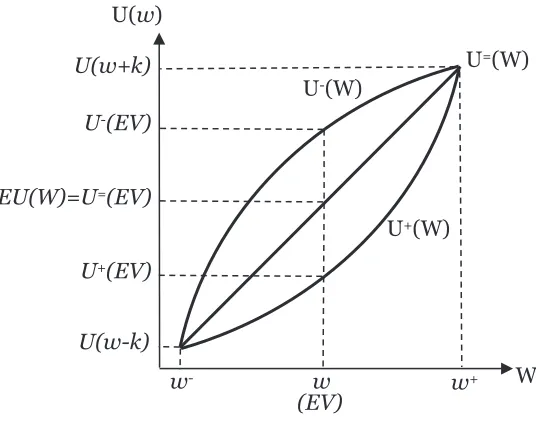
The curvature of the utility function U(W) offers direct informations on the attitudes to risk (see Figure 1). Arrow (1965) and Pratt (1964) use the curvature index (–U″(w)/U′(w)) as a (absolute) measure unit for risk (ARA). The concavity degree will also vary with wealth.
For a risk-averse (or risk avoid) person the utility function (U
-(W)) is increasing with wealth, but with a decreasing ratio. Marginal utility of wealth is always positive (U′(w)>0), but it decreases with the wealth, so the utility function is concave (ARA>0). The utility of the present level of wealth or the utility of the expected value U(EV)
is superior to the expected utility EU(W). In his opinion there is no real opportunity. This represents a typical behavior and is related to economic rationality. More, that is a characteristic of people in general.
[image:12.482.100.368.384.607.2]U(EV) > EU(W) with U′(w)>0, U″(w)>0 U[p∙w-+(1-p)∙w+] > p∙U(w-)+(1-p)∙U(w+)
Figure 1.The utility function’s form for different risk attitude
U=(W)
w- w w+ W
U(w)
U+(W) U-(W)
(EV) U+(EV)
U-(EV)
EU(W)=U=(EV)
Besides the typical case of risk aversion, there are - as already noted - yet two situations appreciated if not as exceptions at least as much rare cases.
If there are preference for risk, the utility function is convex (ARA<0), which implies that the marginal utility of wealth is not only positive, but increasing with the level of wealth. In such a case, the risk-seeking persons are willing to “risk” superior amount of money comparative to mathematical equivalent (certain) of winning. For them the expected utility is higher than utility associated with the expected wealth U(EV). Although this attitude doesn’t derive from a typical human behavior (so neither economic), it does not mean that such decidents will lose for sure. Also, it not to be confused with addiction to risk, it does not mean to ignore the risk in full (choose to ignore any contingency plan) but only to accepte it more easily. The form of the utility function in this case is shown in the Figure 1
as U+(W).
U(EV) < EU(W) with U′(w)>0, U″(w)<0 U[p∙w-+(1-p)∙w+] < p∙U(w-)+(1-p)∙U(w+)
The utility function is linear in the case of risk-neutral (U=(W)) and
the marginal utility evolving strictly proportional to the wealth. Those who have such an attitude will be willing to risk the exact amount of the mathematical equivalent of winning. Expected utility is equal in their assessing to the utility of wealth associated to certain equivalent or to initial condition U(EV).
U(EV) = EU(W) with U′(w)>0, U″(w)=0 U[p∙w-+(1-p)∙w+] = p∙U(w-)+(1-p)∙U(w+)
Prudence (mainly related to savings behavior) and temperance are other concept related to risk attitude (behind risk aversion) developed by economic literature. Intensity and direction of reaction are important elements based on the interpretation of higher order derivates of utility function U(w) such as (-U(n)(w)/U(n-1)(w)). A
defined as -U″′(w)/U″(w). A coefficient of the form -U(4)(w)/U″′(w)
measures the asolute temperance (Eeckhoudt, 2012).
The sets of preferences presented above are usually enough to explain decisions. Such behaviors are consistent for each individual with the same decisional categories and not necessarily at general level and for all its decisions.
4. Comments on the rationality of choices from a theoretically economic perspective
That doesn’t mean that a risk-averse person will never accept risk, or a risk-seeking person will assume the risk in any circumstance. It simply means that the terms which convince one or another to enter in the game are different. And such terms relate basically to the level of the expected outcomes and of the estimated odds. Of course in this context the personality has a role in the attitude to risk, but from psychological aspects we will retain for now only the generally accepted idea that people prefer more not to lose rather than to win. Sure, some differences are identified here too, e.g. prevention-focused people vs. promotion-focused people (Grant and Higgins, 2013 - and all related to regulatory focus theory) which obviously conduct to a more or less propensity to risk-taking.
“The dollar I win is not as worthwhile to me as the dollar I lose, and that is why I will shun a bet at ‘fair’ odds (and, of course, at ‘unfair’ odds)” (Samuelson, 1977: 25). What fair odds means? Are they understood only in terms of probability or in the level of expected gains as well? We try to present in the following a direction to answer it from an economic perspective. If the expected theory integrated the probabilities with outcomes and their utilities, and partially solved the problem, the remaining issue is to appreciate the (minimum) amount of money considered sufficient for a decider to accept the risk (e.g. a game or a investition).
marginal utility of money. Traditionally, a lower level of wealth is related to a more risk-averse reaction. The risk-aversion decreasing directly to an increment of the wealth and at some point may conduct to a risk-seeking attitude. On the other hand, the same sum of money (a possible gain or loss) has different utility according to the individual wealth and in the same time it must be economically seen in a relative manner as a part or quota of the fortune (how much a loss diminished the current wealth). Lower probabilities of winning are not wanted by anybody, but what is a lower probability remain a subjective approach (also related to wealth). More than its absolute level what appears to be significant is the ratio between the probability to lose and the probability of winning.
If we limit our analysis to a simple situation of 2 possible alternatives: win or loss (with associated probabilities p and 1-p), several discussions must be made:
(1) If we presume equal chances to win or lose (e.g. p = 1 - p = ½) the same amount of money k (k>0), it is clear that:
> −
k k
w k w
where (w-k) is the weakened welfare if risks of lose are materialized. Economically the yield is higher for an increase of wealth from
(w - k) to w in comparation with an increase from w to (w+k). That means the potential loss is perceived as higher in relative terms to potential winnings. In this respect the amount of gain is considered to be not enough to action.
(2) To determine in that case the minimum acceptable gain (θk) we must assume at least equal yields for both events: k k
w k w
θ =
− , and
from here we have:
w w k
θ = −
on wealth (w) and maximum possible loss (k). For risk-taking the expected level of gain should exceed possible level of loss by θ times, which in this case is:
w
k k
w k
θ = −
That should be the leverage determining a positive response from decision-makers to accept the risk. It transforms a risk-averse decider to a risk-neutral one. Economically it corresponds to the minimum requirements for risk acceptance. The level is not constant, obviously higher levels of wealth (w → ∞ with k presumed fixed, conduct to
w-k → ∞) determined the decreasing of θ (θ → 1). So, rich people seem to accept lower returns for the same possible losses to accept the same risks. On the other hand rich people are willing to risk larger amount of money for the same expected rate of returns (if θ=ct. and w → ∞, than k → ∞).
Tversky and Kahneman (1992) state that for even chances to win and lose, a prospect will only be acceptable if the gain is at least twice as large as the loss.Geller (2013) appreciates that as correct in normal situations (under a normal level of money anxiety). During times of high money anxiety people are more risk averse and therefore they take the chance of loosing only if the expected winning are four time higher (such as during and in the aftermath of the Great Reccesion in USA). When there are times of very low money anxiety people became willing to take a chance of winning or loosing the same amount.
(3) Finally if we extend the previous assumptions to uneven probabilities (p ≠ 1-p ≠ ½), the expected value became:
EV = (w + θk) – (1+θ)pk
Applying previous risk-neutral transformation (so EU(W) = U(EV)) and considering as a minimum acceptable also the equal yields, but now in the form of: p k (1 p) k
w k w
θ
⋅ − ⋅
=
− , we determine the θ as:
p w
1 p w k
θ = ⋅
And θk
p w
k k
1 p w k
θ = ⋅
− −
So, in addition to the ratio between current and diminished wealth (outlined above ww k− ), the minimum amount of acceptable gain is
proportionally multiply by the ratio between the probability of loss and the probability of winning (p1 p− ). Lower chances of success will increase caeteris paribus the minimum acceptable level of gains. All other comments on wealth and risked amount of money remain valid.
5. Final remarks
A precise and generally applicable form of the utility function could not be determined. It was assumed that the function is concave for low levels of wealth (income) and gradually became convex at higher levels of wealth (income). Economic agents, as well as common people would be more willing to risk as their wealth (income) is larger. This hypothesis could not be verified beyond any controversy. In their famous article, Friedman and Savage (1948) showed how a utility function which was concave at low wealth levels and convex at high wealth levels could explain the behavior of individuals who both incur risk by purchasing lottery tickets as well as avoid risk by purchasing insurance.
Another problem is related to a relative contradictory behavior in some situations. If we analyzes the effects of changes in uncertainty over the economic decision, especially at individual level, we may confront with opposite possible reactions: a risk-averse person could saves more in order to ensure minimum resources for the future or could spent more because of the higher uncertainty of the returns (Rothschild and Stiglitz, 1971).
urge to action (Keynes, 1936). Action in a specific direction, selected as a result of a decisional process and not randomly. Reasonable calculation presumes limited information properly analyzed (according to individuals limited abilities) in an uncertainty background.
We could follow a developing line from the classically rational homo oeconomicus to the limited rationality of behavioral economics. In psychology, decision-making is regarded as a cognitive process aimed to identify the most probable alternatives according to his beliefs and knowledge and to select a particular one based on its own values and preferences. Risk attitudes are usually adopted subconsciously, the exception being when the person or group involved consciously decides to over-ride their automatic response because they want to understand the situation more clearly, and make an appropriate
rather than automatic choice (Hillson and Murray-Webster, 2007).
This is the case with economic decisions. Especially when we
consider professionals decision makers (technocrats). The spectrum of risk attitude as response to uncertainty and in direct relation with comfort/discomfort level is very similar. Excluding the extreme cases of risk-paranoid and risk-addicted, the general human attitude from psychological perspective includes: averse, risk tolerant and risk-seeking. There are some particularities in learning to and in accept risk (especially for risk-tolerant) as well as differences in boundaries (especially for risk-neutral).
The ambition of decision theory was to quantify the uncertainty and preferences for consequences in all situations; but for many real complex situations this ambition is unrealistic (Malița and zidaroiu, 1980: 31).
in the future, if the outcomes that may follow are important for the individual, we appreciate him will end up by expressing its state of knowledge through assessing the probability required. Even the smallest subjective estimation moves us in the area of analysis in terms of risk (from the “un-measurable” Knightian uncertainty or ambiguity, to a risk approximation highly sensitive to the assumptions made).
Let’s note that any objectively determined probabilities are not absolute certainty (even if are usually considered as facts), because they measure the level of our knowledge of the reality and not the actual condition (Malița and zidaroiu, 1980: 51).
In many cases aspects and variables that are not easily quantifiable were left outside the discussion. But constructing a comprehensive list (as complete as possible) of the uncertain events is one of the main conditions for a proper analysis. There are numerous examples that demonstrate the catastrophic consequences that may have the ignoring of a single one.
We must add that the theory of decision under risk (and uncertainty) is a normative theory: it shows how to act consistent to a rational behavior, in a coherent manner with the decider preferences on the future events and the expected consequences.
References
1. Arrow, K.J., 1965. The Theory of Risk Aversion in Aspects of the
theory of risk-bearing. Helsinki: yrjo Jahnssonin Saatio, pp.28-44.
Reprint in Arrow, K.J. (1971). Essays in the Theory of Risk-Bearing. Chicago: Markham Publishing.
2. Bentham, J., 1789. An Introduction to the Principles of Morals
and Legislation. Oxford: Claredon Press [reprint 1907], Library of
Economics and liberty [online] Available at: http://www.econlib. org/library/Bentham/bnthPML.html; [accessed 21 March 2016]. 3. Bernoulli, D., 1954. Exposition of a New Theory on the Measurement
of Risk (1738), Translated into English by L. Sommers, Econometrica,
22(1), pp.23-36. http://dx.doi.org/10.2307/1909829.
4. Clitan, G., 2002. Pragmatică și postmodernism. Despre jocul
raţionalităţii şi presupoziţiilor în abordarea metafilosofică a
5. Cocioc, P., 2000. Fundamente ale științei economice. Cluj-Napoca: Risoprint.
6. Eeckhoudt, L.,2012. Beyond Risk Aversion: Why, How and What’s
Next?. The Geneva Risk and Insurance Review, 37(2), pp.141-155.
http://dx.doi.org/10.1057/grir.2012.1.
7. Eeckhoudt, L., Gollier, C. and Schlesinger, H., 2005. Economic and
financial decisions under risk. Princeton and Oxford: Princeton
University Press.
8. Eeckhoudt, L., 2014. Arrow-Pratt’s risk aversion: 50 years later.
Journees Internationales du risques. Retrived from: http:// iriaf.univ-poitiers.fr/images/medias/fichier/arrow-pratt-50-years_1403101635925-pdf. [Accessed 20 Nov. 2016].
9. Friedman, M. and Savage, L., 1948. The Utility Analysis of Choices
Involving Risk. Journal of Political Economy, 56(4), pp.279-304.
http://dx.doi.org/10.1086/256692.
10. Geller, D., 2013. Money Anxiety:How financial uncertainty changes
consumer behavior and the economy. Sarasota: First Edition Design
Publishing.
11. Grant, H. and Higgins, T.E., 2013. Do you Play to Win or to Not
Lose?. Harvard Business Review, 2. Retrieved from: https://hbr.
org/2013/03/do-you-play-to-win-or-to-not-lose [Accessed 20
November 2016].
12. Hillson, D. and Murray-Webster, R., 2007. Understanding and
Managing Risk Attitude. 2nd ed. Aldershot:Gower.
13. Kahneman, D. and Tversky, A., 1979. Prospect Theory: An Analysis
of Decision under Risk. Econometrica, 47(2), pp.263-292. http://
dx.doi.org/10.2307/1914185.
14. Keynes, J.M., 1936. The General Theory of Employment, Interest
and Money. London: Macmillan.
15. Knight, F.H., 1921. Risk, Uncertainty and Profit. Boston: Houghton
Mifflin [reprint 1933].
16. Maliţa, M. and zidăroiu, C., 1980. Incertitudine şi decizie, vol.1,
Bucureşti: Editura Ştiinţifică şi Enciclopedică.
17. Machina, M.J., 1987. Choice Under Uncertainty: Problems Solved and
Unsolved. The Journal of Economic Perspectives, 1(1), pp.121-154.
http://dx.doi.org/10.1257/jep.1.1.121.
18. Negoescu, G., 1995. Risc și incertitudine în economia de piață.
19. Neumann, J. von and Morgenstern, O., 1944. Theory of Games and
Economic Behavior. Princeton: Princeton University Press.
20. Pratt, J., 1964. Risk Aversion in the Small and in the
Large. Econometrica, 32(1/2), pp.122-136. http://dx.doi.
org/10.2307/1913738.
21. Rothschild, M. and Stiglitz, J.E., 1971. Increasing risk II: Its Economic
consequences. Journal of Economic Theory, 3(1), pp.66-84. https://
doi.org/10.1016/0022-0531(71)90034-2.
22. Samuelson, P.A., 1977. St. Petersburg Paradoxes: Defanged,
Dissected, and Historically Described. Journal of Economic
Literature, 15(1), pp.24-55.
23. Tversky, A. and Kahneman, D., 1992. Advances in Prospect Theory:
Cumulative Representation of Uncertainty. Journal of Risk
and Uncertainty, 5(4), pp.297-323. http://dx.doi.org/10.1007/
BF00122574.
24. Weber, M., 1904. Essais sur la théorie de la science. Premier essai:
“L’objectivité de la connaissance dans les sciences et la politique
sociales”. [e-book] Université du Québec à Chicoutimi. Available at:
http://classiques.uqac.ca/classiques/Weber/essais_theorie_science/ Essais_science_1.pdf [Accessed 20 February 2016].
25. Weber, M., 1913. Essais sur la théorie de la science. Troisième essai:
“Essai sur quelques catégories de la sociologie compréhensive”.
[e-book] Université du Québec à Chicoutimi. available at: http:// classiques.uqac.ca/classiques/Weber/essais_theorie_science/ Essais_science_3.pdf [Accessed 20 February 2016].