Proceedings of the 55th Annual Meeting of the Association for Computational Linguistics, pages 199–208 Proceedings of the 55th Annual Meeting of the Association for Computational Linguistics, pages 199–208
Generating Natural Answers by Incorporating
Copying and Retrieving Mechanisms in Sequence-to-Sequence Learning
Shizhu He1, Cao Liu1,2, Kang Liu1 and Jun Zhao1,2
1 National Laboratory of Pattern Recognition, Institute of Automation, Chinese Academy of Sciences, Beijing, 100190, China
2 University of Chinese Academy of Sciences, Beijing, 100049, China
{shizhu.he, cao.liu, kliu, jzhao}@nlpr.ia.ac.cn
Abstract
Generating answer with natural language sentence is very important in real-world question answering systems, which need-s to obtain a right anneed-swer aneed-s well aneed-s a coherent natural response. In this paper, we propose an end-to-end ques-tion answering system called COREQA in sequence-to-sequence learning, which in-corporates copying and retrieving mech-anisms to generate natural answers with-in an encoder-decoder framework. Specif-ically, in COREQA, the semantic units (words, phrases and entities) in a natural answer are dynamically predicted from the vocabulary, copied from the given ques-tion and/or retrieved from the correspond-ing knowledge base jointly. Our em-pirical study on both synthetic and real-world datasets demonstrates the efficien-cy of COREQA, which is able to generate correct, coherent and natural answers for knowledge inquired questions.
1 Introduction
Question answering (QA) systems devote to pro-viding exact answers, often in the form of phrases and entities for natural language questions ( Wood-s, 1977;Ferrucci et al., 2010;Lopez et al.,2011;
Yih et al.,2015), which mainly focus on analyzing questions, retrieving related facts from text snip-pets or knowledge bases (KBs), and finally pre-dicting the answering semantic units-SU (word-s, phrases and entities) through ranking (Yao and Van Durme, 2014) and reasoning (Kwok et al.,
2001).
However, in real-world environments, most people prefer the correct answer replied with a more natural way. For example, most existing
<ÀîÁ¬½Ü£¬³öÉúµØµã£¬±±¾©> <ÀîÁ¬½Ü£¬¹ú¼®£¬Ð¼ÓÆÂ>
<ÀîÁ¬½Ü£¬³öÉúÄêÔ£¬1963Äê4ÔÂ26ÈÕ> ...
ÀîÁ¬½ÜÊÇÄÄÀïÈË£¿ ÀîÁ¬½Ü³öÉúÓÚ±±¾©£¬Ëû
<ÀîÁ¬½Ü£¬ÐÔ±ð£¬ÄÐ>
ÏÖÔÚÊÇмÓƹú¼®¡£
Copy Reasoning From Question From KB
Question Response
Jet Li
where was Jet Liwas born inBeijing. Heis now aSingaporeancitizen.
Copying and Retrieving Predicting Copying from Question Retrieving from KB
Question Natural Answer Do you know from ?
[image:1.595.310.526.222.306.2]Knowledge Base
Figure 1: Incorporating copying and retrieving mechanisms in generating a natural answer.
commercial products such as Siri1will reply a nat-ural answer “Jet Li is 1.64m in height.” for the question “How tall is Jet Li?”, rather than only answering one entity “1.64m”. Basic on this ob-servation, we define the “natural answer” as the natural response in our daily communication for replying factual questions, which is usually ex-pressed in a complete/partial natural language sen-tence rather than a single entity/phrase. In this case, the system needs to not only parse question, retrieve relevant facts from KB but also generate a proper reply. To this end, most previous approach-es employed mapproach-essage-rapproach-esponse patterns. Figure1
schematically illustrates the major steps and fea-tures in this process. The system first needs to rec-ognize the topic entity “Jet Li” in the question and then extract multiple related facts<Jet Li, gender,
Male>, <Jet Li, birthplace, Beijing> and <Jet
Li, nationality, Singapore> from KB. Based on the chosen facts and the commonly used message-response patterns “where was %entity from?” -“%entity was born in %birthplace, %pronoun is %nationality citizen.”2, the system could finally generate the natural answer (McTear et al.,2016). In order to generate natural answers, typical
1http://www.apple.com/ios/siri/
2In this pattern,%entityindicates the placeholder of the
topic entity, %property indicates the property value of the topic entity.
products need lots of Natural Language Process-ing (NLP) tools and pattern engineerProcess-ing (McTear et al., 2016), which not only suffers from high costs of manual annotations for training data and patterns, but also have low coverage that cannot flexibly deal with variable linguistic phenomena in different domains. Therefore, this paper de-votes to develop an end-to-end paradigm that gen-erates natural answers without any NLP tools (e.g. POS tagging, parsing, etc.) and pattern engineer-ing. This paradigm tries to consider question an-swering in an end-to-end framework. In this way, the complicated QA process, including analyz-ing question, retrievanalyz-ing relevant facts from KB, and generating correct, coherent, natural answer-s, could be resolved jointly.
Nevertheless, generating natural answers in an end-to-end manner is not an easy task. The key challenge is that the words in a natural answer may be generated by different ways, including: 1)the common words usually are predicted using a (con-ditional) language model (e.g. “born” in Figure1);
2)the major entities/phrases are selected from the source question (e.g. “Jet Li”); 3)the answering entities/phrases are retrieved from the correspond-ing KB (e.g. “Beijing”). In addition, some words or phrases even need to be inferred from related knowledge (e.g. “He” should be inferred from the value of “gender”). And we even need to deal with some morphological variants (e.g. “Singapore” in KB but “Singaporean” in answer). Although ex-isting end-to-end models for KB-based question answering, such as GenQA (Yin et al.,2016), were able to retrieve facts from KBs with neural mod-els. Unfortunately, they cannot copy SUs from the question in generating answers. Moreover, they could not deal with complex questions which need to utilize multiple facts. In addition, exist-ing approaches for conversational (Dialogue) sys-tems are able to generate natural utterances ( Ser-ban et al., 2016; Li et al., 2016) in sequence-to-sequence learning (Seq2Seq). But they cannot in-teract with KB and answer information-inquired questions. For example, CopyNet (Gu et al.,2016) is able to copy words from the original source in generating the target through incorporating copy-ing mechanism in conventional Seq2Seq learncopy-ing, but they cannot retrieve SUs from external memo-ry (e.g. KBs, Texts, etc.).
Therefore, facing the above challenges, this pa-per proposes a neural generative model called
COREQA with Seq2Seq learning, which is able to reply an answer in a natural way for a given ques-tion. Specifically, we incorporate COpying and
REtrieving mechanisms within Seq2Seq learning. COREQA is able to analyze the question, retrieve relevant facts and generate a sequence of SUs us-ing a hybrid method with a completely end-to-end learning framework. We conduct experiments on both synthetic data sets and real-world datasets, and the experimental results demonstrate the effi-ciency of COREQA compared with existing end-to-end QA/Dialogue methods.
In brief, our main contributions are as follows:
• We propose a new and practical question
an-swering task which devotes to generating nat-ural answers for information inquired ques-tions. It can be regarded as a fusion task of QA and Dialogue.
• We propose a neural network based model, named as COREQA, by incorporating copy-ing and retrievcopy-ing mechanism in Seq2Seq learning. In our knowledge, it is the first end-to-end model that could answer complex questions in a natural way.
• We implement experiments on both synthet-ic and real-world datasets. The experimental results demonstrate that the proposed model could be more effective for generating cor-rect, coherent and natural answers for knowl-edge inquired questions compared with exist-ing approaches.
2 Background: Neural Models for Sequence-to-Sequence Learning 2.1 RNN Encoder-Decoder
Recurrent Neural Network (RNN) based Encoder-Decoder is the backbone of Seq2Seq learn-ing (Cho et al., 2014). In the Encoder-Decoder framework, an encoding RNN first transform a source sequential object X = [x1, ..., xLX] into an encoded representationc. For example, we can utilize the basic model: ht = f(xt,ht−1);c =
Do you know where was Jet_Li from ?
𝒉1 𝒉2 𝒉3 𝒉4 𝒉5 𝒉6 𝒉7 𝒉8 Subject Property Object
Jet_Li gender Male Jet_Li birthplace Beijing Jet_Li nationality Singapore Jet_Li birthdate 26 April 1963
… … …
Attentive Read from Question
Attentive Read
from KB Copying
from Question
Retrieving from KB
𝒇1
𝒇2
𝒇3
𝒇4
𝒇… 𝒒
𝑠1 𝑠2 𝑠3 𝑠4 𝑠5
<eos> Jet_Li was born in
Jet_Li was born in Beijing
𝑠5
… … …
Softmax
𝑃 Beijing = 𝑃𝑝𝑟(Beijing) + 𝑃𝑐𝑜(Beijing) + 𝑃re(Beijing)
(a) Knowledge (facts) Retrieval (c) Decoder: Natural Answer Generation
(d) Predicting, Copying (from Question) and Retrieving (from KB)
DNN DNN
KB Position Question Position Vocabulary
DNN
Question context
KB context
Question Copying History
KB Retrieving History
(e) State Update
“in” embedding Copying “in” from Question Retrieving “in” from KB
[image:3.595.94.508.63.300.2](b) Encoder: Question and KB Representation
Figure 2: The overall diagram of COREQA.
tricks is Bi-directional RNN, which connect two hidden states of positive time direction and neg-ative time direction. Once the source sequence is encoded, another decoding RNN model is to generate a target sequence Y = [y1, ..., yLY], through the following prediction model: st = f(yt−1,st−1,c); p(yt|y<t, X) = g(yt−1,st,c), where st is the RNN hidden state at time t, the predicted target wordytat timetis typically per-formed by asof tmaxclassifier over a settled vo-cabulary (e.g. 30,000 words) through functiong.
2.2 The Attention Mechanism
The prediction model of classical decoders for each target word yi share the same context vec-torc. However, a fixed vector is not enough to ob-tain a better result on generating a long targets.The attention mechanism in the decoding can dynam-ically choose context ct at each time step (
Bah-danau et al., 2014), for example, representing ct as the weighted sum of the source states{ht},
ct=
XLX
i=1αtihi; αti=
eρ(st−1,hi)
P
i0eρ(st−1,h0i)
(1)
where the function ρ use to compute the atten-tive strength with each source state, which usually adopts a neural network such as multi-layer per-ceptron (MLP).
2.3 The Copying Mechanism
Seq2Seq learning heavily rely on the “meaning” for each word in source and target sequences, how-ever, some words in sequences are “no-meaning” symbols and it is improper to encode them in en-coding and deen-coding processes. For example, gen-erating the response“Of course, read”for reply-ing the message“Can you read the word ‘read’?”
should not consider the meaning of the second
“read”. By incorporating the copying mechanism, the decoder could directly copy the sub-sequences of source into the target (Vinyals et al.,2015). The basic approach is to jointly predict the indexes of the target word in the fixed vocabulary and/or matched positions in the source sequences (Gu et al.,2016;Gulcehre et al.,2016).
3 COREQA
vo-cabulary, copied from the given question, and/or retrieved from the corresponding KB.
3.1 Model Overview
As illustrated in Figure2, COREQA is an encoder-decoder framework plugged with a KB engineer. A knowledge retrieval module is firstly employed to retrieve related facts from KB by question anal-ysis (see Section3.2). And then the input question and the retrieved facts are transformed into the cor-responding representations byEncoders(see Sec-tion3.3). Finally, the encoded representations are feed to Decoderfor generating the target natural answer (see Section3.4).
3.2 Knowledge (facts) Retrieval
We mainly focus on answering the information in-quired questions (factual questions, and each ques-tion usually contains one or more topic entities). This paper utilizes the gold topic entities for sim-plifying our design. Given the topic entities, we retrieve the related facts from the corresponding KB. KB consists of many relational data, which usually are sets of inter-linked subject-property-object (SPO) triple statements. Usually, question contains the information used to match thesubject
andpropertyparts in a fact triple, and answer in-corporates theobjectpart information.
3.3 Encoder
The encoder transforms all discrete input symbol-s (including wordsymbol-s, entitiesymbol-s, propertiesymbol-s and prop-erties’ values) and their structures into numerical representations which are able to feed into neural models (Weston et al.,2014).
3.3.1 Question Encoding
Following (Gu et al.,2016), a bi-directional RN-N (Schuster and Paliwal, 1997) is used to trans-form the question sequence into a sequence of concatenated hidden states with two independent RNNs. The forward and backward RNN respec-tively obtain{−→h1, ...,−→hLX}and{
←−h
LX, ...,
←−h 1}.
The concatenated representation is considered to be the short-term memory of question (MQ =
{ht},ht = [−→ht,←−hLX−t+1]). q = [
− →h
LX,
←−h 1]is
used to represent the entire question, which could be used to compute the similarity between the question and the retrieved facts.
3.3.2 Knowledge Base Encoding
We uses,pandodenote the subject, property and object (value) of one fact f, andes,epandeoto de-note its corresponding embeddings. The fact rep-resentationf is then defined as the concatenation ofes,epandeo. The list of all related facts’ repre-sentations,{f}={f1, ...,fLF}(refer toMKB,LF denotes the maximum of candidate facts), is con-sidered to be a short-term memory of KB while answering questions about the topic entities.
In addition, given the distributed representation of question and candidate facts, we define the matching scores function between question and facts as S(q, fj) = DN N1(q,fj) = tanh(W2 ·
tanh(W1·[q,fj]+b1)+b2), , whereDN N1is the
matching function defined by a two-layer percep-tron, [·,·] denotes vector concatenation, andW1, W2,b1andb2are the learning parameters. In
fac-t, we will make a slight change of the matching function because it will also depend on the state of decoding process at different times. The modified function isS(q, st, fj) = DN N1(q,st,fj)where stis the hidden state of decoder at time t.
3.4 Decoder
The decoder uses an RNN to generate a natural answer based on the short-term memory of ques-tion and retrieved facts which represented asMQ and MKB, respectively. The decoding process of COREQA have the following differences com-pared with the conventional decoder:
Answer words prediction: COREQA predicts SUs based on a mixed probabilistic model of three modes, namely thepredict-mode, the copy-mode and the retrieve-mode, where the first mode pre-dicts words with the vocabulary, and the two latter modes pick SUs from the questions and matched facts, respectively;
State update: the predicted word at stept−1is used to updatest, but COREQA uses not only its word embedding but also its corresponding posi-tional attention informations inMQandMKB;
Reading short-Memory MQand MKB:MQand
MKB are fed into COREQA with two ways, the first one is the “meaning” with embeddings and the second one is the positions of different words (properties’ values).
3.4.1 Answer Words Prediction
layer: shortlistprediction layer,question location
copying layer andcandidate-facts location retriev-ing layer, respectively. And we use thesof tmax classifier of the above three cascaded output lay-ers to pick SUs. We assume a vocabulary V =
{v1, ..., vN} ∪ {UNK}, where UNK indicates any out-of-vocabulary (OOV) words. Therefore, we have adopted another two set of SUsXQandXKB which cover words/entities in the source question and the partial KB. That is, we have adopted the instance-specific vocabulary V ∪ XQ∪ XKB for each question. It’s important to note that these three vocabulariesV,XQandXKB may overlap.
At each time steptin the decoding process, giv-en the RNN statesttogether withMQandMKB, the probabilistic function for generating any target SUytis a “mixture” model as follow
p(yt|st, yt−1,MQ,MKB) = ppr(yt|st, yt−1,ct)·pm(pr|st, yt−1)+
pco(yt|st, yt−1,MQ)·pm(co|st, yt−1)+
pre(yt|st, yt−1,MKB)·pm(re|st, yt−1)
(2)
where pr, co andre stand for the predict-mode, the copy-mode and the retrieve-mode, respective-ly, pm(·|·) indicates the probability model for choosing different modes (we use a sof tmax classifier with two-layer MLP). The probability of the three modes are given by
ppr(yt|·) = 1
Ze ψpr(yt)
pco(yt|·) = 1
Z X
j:Qj=yt
eψco(yt)
pre(yt|·) = 1
Z X
j:KBj=yt
eψre(yt) (3)
where ψpr(·), ψco(·) and ψre(·) are score func-tions for choosing SUs in predict-mode (fromV), copy-mode (from XQ) and retrieve-mode (from
XKB), respectively. And Z is the normaliza-tion term shared by the three modes, Z =
eψpr(v) + P
j:Qj=ve
ψco(v) + P
j:KBj=ve
ψre(v). And the three modes could compete with each oth-er through asof tmaxfunction in generating tar-get SUs with the shared normalization term (as shown in Figure2. Specifically, the scoring func-tions of each mode are defined as follows:
Predict-mode: Some generated words need rea-soning (e.g. “He” in Figure1) and morphological transformation (e.g. “Singaporean” in Figure 1). Therefore, we modify the function as ψpr(yt = vi) =vTi Wpr[st,cqt,ckbt], wherevi ∈ Rdo is the
word vector at the output layer (not the input word embedding), Wpr ∈ R(dh+di+df)×do (di, dh and df indicate the size of input word vector, RNN de-coder hidden state and fact representation respec-tively), andcqt andckbt are the temporary mem-ory of reading MQ andMKB at time t (see Sec-tion3.4.3).
Copy-mode: The score for “copying” the word xj from question Q is calculated as ψco(yt = xj) = DN N2(hj,st,histQ) , where DN N2 is
a neural network function with a two-layer MLP andhistQ∈ RLX is an accumulated vector which record the attentive history for each word in ques-tion (similar with the coverage vector in (Tu et al.,
2016)).
Retrieve-mode: The score for “retrieving” the entity word vj from retrieval facts (“Objec-t” part) is calculated as ψre(yt = vj) = DN N3(fj,st,histKB) , where DN N3 is also a
neural network function andhistKB ∈ RLF is an accumulated vector which record the attentive his-tory for each fact in candidate facts.
3.4.2 State Update
In the generic decoding process, each RNN hid-den state st is updated with the previous state
st−1, the word embedding of previous
predict-ed symbol yt−1, and an optional context vector ct (with attention mechanism). However, yt−1
may not come from vocabulary V and not own-s a word vector. Therefore, we modify the own-state update process in COREQA. More specifically, yt−1 will be represented as concatenated vector of
[e(yt−1),rqt−1,rkbt−1], wheree(yt−1)is the word embedding associated withyt−1,rqt−1 andrkbt−1 are the weighted sum of hidden states inMQ and
MKB corresponding toyt−1respectively.
rqt =
XLX
j=1ρtjhj,rkbt =
XLF
j=1δtjfj
ρtj =
1
K1
pco(xj|·), xj =yt
0 otherwise
δtj =
1
K2
pre(fj|·), object(fj) =yt
0 otherwise
(4)
whereobject(f)indicate the “object” part of
fac-t f (see Figure 2), and K1 and K2 are the
nor-malization terms which equalPj0:x0
j=ytpco(x
could consider the multiple positions matchingyt in source question and KB.
3.4.3 Reading short-Memory MQand MKB COREQA employ the attention mechanism at de-coding process. At each decoder time t, we se-lective read the context vector cqt andckbt from the short-term memory of question MQ and re-trieval facts MKB (alike to Formula 1). In addi-tion, the accumulated attentive vectorshistQ and
histKB are able to record the positional informa-tion of SUs in the source quesinforma-tion and retrieved facts.
3.5 Training
Although some target SUs in answer are copied and retrieved from the source question and the ex-ternal KB respectively, COREQA is fully differen-tial and can be optimized in an end-to-end manner using back-propagation. Given the batches of the source questions{X}Mand target answers{Y}M both expressed with natural language (symbolic sequences), the objective function is to minimize the negative log-likelihood:
L=−1
N M X
k=1
LY
X
t=1
log[p(y(tk)|y(<tk), X(k)] (5)
where the superscript (k) indicates the index of
one question-answer (Q-A) pair. The network is no need for any additional labels for training mod-els, because the three modes sharing the same sof tmax classifier for predicting target words, they can learn to coordinate with each other by maximizing the likelihood of observed Q-A pairs.
4 Experiments
In this section, we present our main experimental results in two datasets. The first one is a small syn-thetic dataset in a restricted domain (only involv-ing four properties of persons) (Section4.1). The second one is a big dataset in open domain, where the Q-A pairs are extracted from community QA website and grounded against a KB with an Integer Linear Programming (ILP) method (Section4.2). COREQA and all baseline models are trained on a NVIDIA TITAN X GPU using TensorFlow3tools, where we used the Adam (Kingma and Ba,2014) learning rule to update gradients in all experimen-tal configures. The sources codes and data will be
3https://www.tensorflow.org/
released at the personal homepage of the first au-thor4.
4.1 Natural QA in Restricted Domain
Task: The QA systems need to answer question-s involving 4 concrete propertiequestion-s of birthdate (in-cluding year, month and day) and gender). Through merely involving 4 properties, there are plenty of QA patterns which focus on different as-pects of birthdate, for example, “What year were you born?” touches on “year”, but “When is your birthday?” touches on “monthandday”.
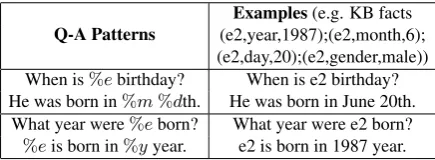
Dataset: Firstly, 108 different Q-A pattern-s have been conpattern-structed by two annotatorpattern-s, one in charge of raising question patterns and an-other one is responsible for generating corre-sponding suitable answer patterns, e.g. When is %e birthday? → She was born in %m %dth. where the variables%e,%y,%m, %dand%g(decidingsheorhe) indicates the per-son’s name, birth year, birth month, birth day and gender, respectively. Then we randomly generate a KB which contains 80,000 person entities, and each entity including four facts. Given KB fact-s, we can finally obtain specific Q-A pairs. And the sampling KB, patterns, and the generated Q-A pairs are shown in Table 1. In order to main-tain the diversity, we randomly select 6 patterns for each person. Finally, we totally obtain 239,934 sequences pairs (half patterns may be unmatched because of “gender” property).
Q-A Patterns (e2,year,1987);(e2,month,6);Examples(e.g. KB facts (e2,day,20);(e2,gender,male)) When is%ebirthday? When is e2 birthday?
He was born in%m%dth. He was born in June 20th. What year were%eborn? What year were e2 born?
[image:6.595.307.525.496.576.2]%eis born in%yyear. e2 is born in 1987 year.
Table 1: Sample KB facts, patterns and their gen-erated Q-A pairs.
sion = 200. We setLF as 5.
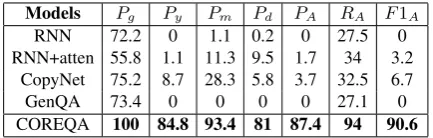
Metrics: We adopt (automatic evaluation (AE)
to test the effects of different models. AE consid-ers the precisions of the entire predicted answer-s and four answer-specific propertieanswer-s, and the ananswer-swer ianswer-s complete correct only when all predicted proper-ties’ values is right. To measure the performance of the proposed method, we select following met-rics, includingPg5,Py,Pm andPdwhich denote the precisions for ‘gender’, ‘year’, ‘month’ and ‘day’ properties, respectively. And PA, RA and F1A indicate the precision, recall and F1 in the complete way.
Experimental Results: TheAEexperimental re-sults are shown in Table2. It is very clear from Ta-ble2that COREQA significantly outperforms all other compared methods. The reason of the Gen-QA’s poor performance is that all synthetic ques-tions need multiple facts, and GenQA will “safe-ly” choose the most frequent property (“gender”) for all questions. We also found the performances on “year” and “day” have a little worse than other properties such as “gender”, it may because there have more ways to answer questions about “year” and “day”.
Models Pg Py Pm Pd PA RA F1A
RNN 72.2 0 1.1 0.2 0 27.5 0
RNN+atten 55.8 1.1 11.3 9.5 1.7 34 3.2 CopyNet 75.2 8.7 28.3 5.8 3.7 32.5 6.7
GenQA 73.4 0 0 0 0 27.1 0
[image:7.595.73.290.411.480.2]COREQA 100 84.8 93.4 81 87.4 94 90.6 Table 2: The AE results (%) on synthetic test data.
Discussion: Because of the feature of directly “hard” copy and retrieve SUs from question and KB, COREQA could answer questions about un-seen entities.To evaluate the effects of answering questions about unseen entities, we re-construct 2,000 new person entities and their correspond-ing facts about four known properties, and obtain 6,081 Q-A pairs through matching the sampling patterns mentioned above. The experimental re-sults are shown in Table3, it can be seen that the performance did not fall too much.
Entities Pg Py Pm Pd PA RA F1A Seen 100 84.8 93.4 81 87.4 94 90.6 Unseen 75.1 84.5 93.5 81.2 63.8 85.1 73.1
Table 3: The AE (%) for seen and unseen entities.
5The “gender” is right when the entity name (e.g. ‘e2’) or
the personal pronoun (e.g. ‘She’) in answer is correct.
4.2 Natural QA in Open Domain
Task: To test the performance of the proposed approach in open domains, we modify the task of GenQA (Yin et al., 2016) for supporting multi-facts (a typical example is shown in Figure 1). That is, a natural QA system should generate a sequence of SUs as the natural answer for a giv-en natural language question through interacting with a KB.
Dataset: GenQA have released a corpus6, which contains a crawling KB and a set of ground Q-A pairs. However, the original Q-Q-A pairs on-ly matched with just one single fact. In fac-t, we found that a lot of questions need more than one fact (about 20% based on sampling in-spection). Therefore, we crawl more Q-A pairs from Chinese community QA website (Baidu Zhi-dao7). Combined with the originally published corpus, we create a lager and better-quality data for natural question answering. Specifically, an Integral Linear Programming (ILP) based method is employed to automatically construct “ground-ing” Q-A pairs with the facts in KB (inspired by the work of adopting ILP to parse question-s (Yahya et al., 2012)). In ILP, the main con-straints and considered factors are listed below: 1) the “subject” entity and “object” enti-ty of a triple have to match with question word-s/phrases (marked assubject mention) and answer words/phrases (marked asobject mention) respec-tively; 2) any twosubject mentionsorobject men-tionsshould not overlap; 3) amentioncan match at most one entity; 4) the edit distance be-tween the Q-A pair and the matched candidate fact (use a space to joint three parts) is smaller, they are more relevant. Finally, we totally obtain 619,199 instances (an instance contains a ques-tion, an answer, and multiple facts), and the num-ber of instances that can match one and multiple facts in KB are 499,809 and 119,390, respectively. Through the evaluation of 200 sampling instances, we estimate that approximate 81% matched facts are helpful for the generating answers. However, strictly speaking, only 44% instances are truly cor-rect grounding. In fact, grounding the Q-A pairs from community QA website is a very challenge problem, we will leave it in the future work.
Experimental Setting: The dataset is split into training (90%) and testing set (10%). The
tences in Chinese are segmented into word se-quences with Jieba8 tool. And we use the word-s with the frequency larger than 3, which cover-ing 98.4% of the word in the corpus. For a fair comparison, we use bi-directional LSTM for the encoder and another LSTM for decoder for al-l Seq2Seq modeal-ls, with hidden al-layer size = 1024 and word embedding dimension = 300. We selec-t CopyNeselec-t (more advanced Seq2Seq model) and GenQA for comparison. We setLF as 10.
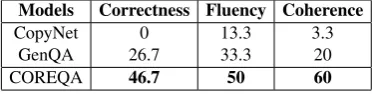
Metrics: Besides adopting the AE as a met-ric (same as GenQA (Yin et al., 2016)), we ad-ditionally usemanual evaluation (ME)as anoth-er metric. ME considers three aspects about the quality of the generated answer (refer to (Asghar et al., 2016)): 1) correctness; 2) syntactical flu-ency; 3)coherencewith the question. We employ two annotators to rate such three aspects of Copy-Net, GenQA and COREQA. Specifically, we sam-ple 100 questions, and conductC32 = 3pair-wise
comparisons for each question and count the win-ning times of each model (comparisons may both win or both lose).
Experimental Results: TheAEandME result-s are result-shown in Table4 and Table5, respectively. Meanwhile, we separately present the results ac-cording to the number of the facts which a ques-tion needs in KB, including just one single fac-t (marked as Single), multiple facts (marked as
Multi) and all (marked as Mixed). In fact, we train two separate models for Single and Multi
questions for the unbalanced data . From Table4
and Table 5, we can clearly observe that CORE-QA significantly outperforms all other baseline models. And COREQA could generate a bet-ter natural answer in three aspects: correctness, fluency and coherence. CopyNet cannot interac-t wiinterac-th KB which is imporinterac-taninterac-t interac-to generainterac-te correc-t answers. For example, for “Who is correc-the direc-tor of The Little Chinese Seamstress?”, if without the fact (The Little Chinese Seamstress, director, Dai Siji), QA systems cannot generate a correct answer.
Models Single Multi Mixed
[image:8.595.323.511.63.110.2]CopyNet 9.7 0.8 8.7 GenQA 47.2 28.9 45.1 COREQA 58.4 42.7 56.6
Table 4: The AE accuracies (%) on real world test data.
8https://github.com/fxsjy/jieba
Models Correctness Fluency Coherence
CopyNet 0 13.3 3.3
GenQA 26.7 33.3 20
COREQA 46.7 50 60
Table 5: The ME results (%) on sampled mixed test data.
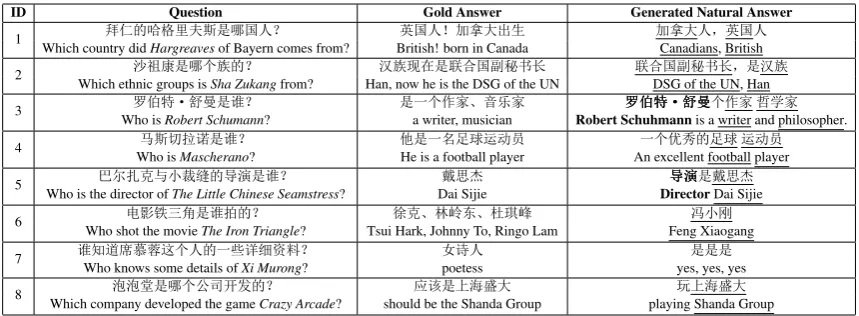
Case Study and Error Analysis: Table6gives some examples of generated by COREQA and the gold answers to the questions in test set. It is very clearly seen that the parts of generating SUs are predicted from the vocabulary, and other SUs are copied from the given question (marked asbold) and retrieved from the KB (marked as underline). And we analyze sampled examples and believe that there are several major causes of errors: 1)
did not match the right facts (ID 6);2)the gener-ated answers contain some repetition of meaning-less words (ID 7);3)the generated answers are not coherence natural language sentences (ID 8).
5 Related Work
Seq2Seq learning is to maximize the likelihood of predicting the target sequence Y conditioned on the observed source sequence X (Sutskever
et al., 2014), which has been applied success-fully to a large number of NLP tasks such as Machine Translation (Wu et al., 2016) and Dia-logue (Vinyals and Le, 2015). Our work is par-tially inspired by the recent work of QA and Dialogue which have adopted Seq2Seq learning. CopyNet (Gu et al., 2016) and Pointer Network-s (Vinyals et al., 2015; Gulcehre et al., 2016) which could incorporate copying mechanism in conventional Seq2Seq learning. Different from our application which deals with knowledge in-quired questions and generates natural answers, CopyNet (Gu et al., 2016) and Pointer Network-s (Gulcehre et al.,2016) can only copy words from the original input sequence. In contrast, COREQA is able to retrieve SUs from external memory. And GenQA (Yin et al., 2016) can only deal with the simple questions which could be answered by one fact, and it also did not incorporate the copying mechanism in Seq2Seq learning.
Moreover, our work is also inspired by Neural Abstract Machine (Graves et al.,2016;Yin et al.,
[image:8.595.114.250.655.702.2]en-ID Question Gold Answer Generated Natural Answer 1 Which country did~; MHargreaves‚pÅd´of Bayern comes from?=I<º British! born in Canada=I<œ\<ŒÑ) \Canadians, British<Œ<§=I<
2 Which ethnic groups isâyx´=‡xSha Zukangº from? Han, now he is the DSG of the UNÇxy3´éÜIB“Ö• éÜIDSG of the UN, HanB“Ö•§´Çx
3 Who isÛËA#Óù´XºRobert Schumann? ´˜‡Š[!ÑW[a writer, musician ÛÛÛËËËAAA###ÓÓÓùùù‡Š[óÆ[ Robert Schuhmannis a writer and philosopher. 4 Who isêdƒ.ì´XºMascherano? ¦´˜¶v¥$ÄHe is a football player An excellent football player˜‡`D v¥$Ä
5 Who is the director ofn SŽ†The Little Chinese Seamstress?à¿ ü´Xº Dai Sijie•g# Directorüüü´•Dai Sijieg#
6 Who shot the movie>Kcn ´XThe Iron Triangle?û º Tsui Hark, Johnny To, Ringo LamMŽ! *À!Új¸ Feng Xiaogang¾ f
7 X•Who knows some details ofR6Iù‡< ˜ Xi Murong?•[] º åpoetess˜< yes, yes, yes´´´
[image:9.595.84.514.61.219.2]8 Which company developed the game,´=‡úimu Crazy Arcade?º should be the Shanda GroupAT´þ°•Œ playing Shanda Groupþ°•Œ
Table 6: Examples of the generated natural answers by COREQA.
tities with neural network based reasoning.
6 Conclusion and Future Work
In this paper, we propose an end-to-end system to generate natural answers through incorporating copying and retrieving mechanisms in sequence-to-sequence learning. Specifically, the sequences of SUs in the generated answer may be predict-ed from the vocabulary, copipredict-ed from the given question and retrieved from the corresponding K-B. And the future work includes: a) lots of ques-tions cannot be answered directly by facts in a KB (e.g. “Who is Jet Li’s father-in-law?”), we plan to learn QA system with latent knowledge (e.g. K-B embedding (Bordes et al.,2013)); b) we plan to adopt memory networks (Sukhbaatar et al.,2015) to encode the temporary KB for each question.
Acknowledgments
The authors are grateful to anonymous review-ers for their constructive comments. The work was supported by the Natural Science Foundation of China (No.61533018) and the National High Technology Development 863 Program of China (No.2015AA015405).
References
Nabiha Asghar, Pascal Poupart, Jiang Xin, and Hang Li. 2016. Online sequence-to-sequence reinforce-ment learning for open-domain conversational a-gents. arXiv preprint arXiv:1612.03929.
Dzmitry Bahdanau, Kyunghyun Cho, and Yoshua Ben-gio. 2014. Neural machine translation by jointly learning to align and translate. arXiv preprint arX-iv:1409.0473.
Antoine Bordes, Nicolas Usunier, Alberto Garcia-Duran, Jason Weston, and Oksana Yakhnenko. 2013. Translating embeddings for modeling multi-relational data. In Advances in neural information processing systems. pages 2787–2795.
Kyunghyun Cho, Bart Van Merri¨enboer, Caglar Gul-cehre, Dzmitry Bahdanau, Fethi Bougares, Holger Schwenk, and Yoshua Bengio. 2014. Learning phrase representations using rnn encoder-decoder for statistical machine translation. arXiv preprint arXiv:1406.1078.
Junyoung Chung, Caglar Gulcehre, KyungHyun Cho, and Yoshua Bengio. 2014. Empirical evaluation of gated recurrent neural networks on sequence model-ing.arXiv preprint arXiv:1412.3555.
David Ferrucci, Eric Brown, Jennifer Chu-Carroll, James Fan, David Gondek, Aditya A Kalyanpur, Adam Lally, J William Murdock, Eric Nyberg, John Prager, et al. 2010. Building watson: An overview of the deepqa project. AI magazine31(3):59–79.
Alex Graves, Greg Wayne, Malcolm Reynolds, Tim Harley, Ivo Danihelka, Agnieszka Grabska-Barwi´nska, Sergio G´omez Colmenarejo, Edward Grefenstette, Tiago Ramalho, John Agapiou, et al. 2016. Hybrid computing using a neural net-work with dynamic external memory. Nature
538(7626):471–476.
Jiatao Gu, Zhengdong Lu, Hang Li, and O.K. Vic-tor Li. 2016. Incorporating copying mechanism in sequence-to-sequence learning. In Proceedings of the 54th Annual Meeting of the Association for Computational Linguistics (Volume 1: Long Paper-s). Association for Computational Linguistics, pages 1631–1640.
Sepp Hochreiter and J¨urgen Schmidhuber. 1997. Long short-term memory. Neural computation
9(8):1735–1780.
Diederik Kingma and Jimmy Ba. 2014. Adam: A method for stochastic optimization. arXiv preprint arXiv:1412.6980.
Cody Kwok, Oren Etzioni, and Daniel S Weld. 2001. Scaling question answering to the web. ACM Trans-actions on Information Systems (TOIS) 19(3):242– 262.
Jiwei Li, Will Monroe, Alan Ritter, Dan Jurafsky, Michel Galley, and Jianfeng Gao. 2016. Deep rein-forcement learning for dialogue generation. In Pro-ceedings of the 2016 Conference on Empirical Meth-ods in Natural Language Processing. Association for Computational Linguistics, pages 1192–1202.
Chen Liang, Jonathan Berant, Quoc Le, Kenneth D Forbus, and Ni Lao. 2016. Neural symbolic ma-chines: Learning semantic parsers on freebase with weak supervision.arXiv preprint arXiv:1611.00020
.
Vanessa Lopez, Victoria Uren, Marta Sabou, and En-rico Motta. 2011. Is question answering fit for the semantic web?: a survey. Semantic Web2(2):125– 155.
Michael McTear, Zoraida Callejas, and David Griol. 2016. The Conversational Interface: Talking to S-mart Devices. Springer Publishing Company, Incor-porated, 1st edition.
Lili Mou, Zhengdong Lu, Hang Li, and Zhi Jin. 2016. Coupling distributed and symbolic execution for natural language queries. arXiv preprint arX-iv:1612.02741.
Mike Schuster and Kuldip K Paliwal. 1997. Bidirec-tional recurrent neural networks. IEEE Transactions on Signal Processing45(11):2673–2681.
Iulian V Serban, Alessandro Sordoni, Yoshua Bengio, Aaron Courville, and Joelle Pineau. 2016. Building end-to-end dialogue systems using generative hier-archical neural network models. InProceedings of the 30th AAAI Conference on Artificial Intelligence (AAAI-16).
Sainbayar Sukhbaatar, Jason Weston, Rob Fergus, et al. 2015. End-to-end memory networks. InAdvances in neural information processing systems. pages 2440–2448.
Ilya Sutskever, Oriol Vinyals, and Quoc V Le. 2014. Sequence to sequence learning with neural network-s. InAdvances in neural information processing sys-tems. pages 3104–3112.
Zhaopeng Tu, Zhengdong Lu, Yang Liu, Xiaohua Liu, and Hang Li. 2016. Coverage-based neural machine translation. arXiv preprint arXiv:1601.04811.
Oriol Vinyals, Meire Fortunato, and Navdeep Jaitly. 2015. Pointer networks. InAdvances in Neural In-formation Processing Systems. pages 2692–2700.
Oriol Vinyals and Quoc Le. 2015. A neural conversa-tional model. arXiv preprint arXiv:1506.05869.
Jason Weston, Sumit Chopra, and Antoine Bordes. 2014. Memory networks.CoRRabs/1410.3916.
William A Woods. 1977. Lunar rocks in natural en-glish: Explorations in natural language question an-swering. InLinguistic structures processing. pages 521–569.
Yonghui Wu, Mike Schuster, Zhifeng Chen, Quoc V Le, Mohammad Norouzi, Wolfgang Macherey, Maxim Krikun, Yuan Cao, Qin Gao, Klaus Macherey, et al. 2016. Google’s neural machine translation system: Bridging the gap between hu-man and machine translation. arXiv preprint arX-iv:1609.08144.
Mohamed Yahya, Klaus Berberich, Shady Elbas-suoni, Maya Ramanath, Volker Tresp, and Gerhard Weikum. 2012. Natural language questions for the web of data. InProceedings of the 2012 Joint Con-ference on Empirical Methods in Natural Language Processing and Computational Natural Language Learning. Association for Computational Linguis-tics, pages 379–390.
Xuchen Yao and Benjamin Van Durme. 2014. Infor-mation extraction over structured data: Question an-swering with freebase. InProceedings of the 52nd Annual Meeting of the Association for Computation-al Linguistics (Volume 1: Long Papers). Association for Computational Linguistics, pages 956–966.
Wen-tau Yih, Ming-Wei Chang, Xiaodong He, and Jianfeng Gao. 2015. Semantic parsing via staged query graph generation: Question answering with knowledge base. InProceedings of the 53rd Annual Meeting of the Association for Computational Lin-guistics and the 7th International Joint Conference on Natural Language Processing (Volume 1: Long Papers). Association for Computational Linguistics, pages 1321–1331.
Jun Yin, Xin Jiang, Zhengdong Lu, Lifeng Shang, Hang Li, and Xiaoming Li. 2016. Neural generative question answering. InProceedings of the Interna-tional Joint Conference on Artificial Intelligence (I-JCAI).
Pengcheng Yin, Zhengdong Lu, Hang Li, and Ben Kao. 2015. Neural enquirer: Learning to query tables.