Proceedings of the 55th Annual Meeting of the Association for Computational Linguistics, pages 1006–1017 Vancouver, Canada, July 30 - August 4, 2017. c2017 Association for Computational Linguistics Proceedings of the 55th Annual Meeting of the Association for Computational Linguistics, pages 1006–1017
Vancouver, Canada, July 30 - August 4, 2017. c2017 Association for Computational Linguistics
Adversarial Connective-exploiting Networks for
Implicit Discourse Relation Classification
Lianhui Qin1,2, Zhisong Zhang1,2, Hai Zhao1,2,∗, Zhiting Hu3, Eric P. Xing3 1Department of Computer Science and Engineering, Shanghai Jiao Tong University
2Key Laboratory of Shanghai Education Commission for Intelligent Interaction
and Cognitive Engineering, Shanghai Jiao Tong University, Shanghai, 200240, China
3Carnegie Mellon University
{qinlianhui, zzs2011}@sjtu.edu.cn, [email protected],
{zhitingh, epxing}@cs.cmu.edu
Abstract
Implicit discourse relation classification is of great challenge due to the lack of con-nectives as strong linguistic cues, which motivates the use of annotated implicit connectives to improve the recognition. We propose a feature imitation frame-work in which an implicit relation net-work is driven to learn from another neu-ral network with access to connectives, and thus encouraged to extract similarly salient features for accurate classification. We develop an adversarial model to en-able an adaptive imitation scheme through competition between the implicit network and a rival feature discriminator. Our method effectively transfers discriminabil-ity of connectives to the implicit features, and achieves state-of-the-art performance on the PDTB benchmark.
1 Introduction
Discourse relations connect linguistic units such as clauses and sentences to form coherent seman-tics. Identification of discourse relations can ben-efit a variety of downstream applications includ-ing question answerinclud-ing (Liakata et al.,2013), ma-chine translation (Li et al.,2014), text summariza-tion (Gerani et al.,2014), opinion spam detection (Chen and Zhao,2015), and so forth.
∗Corresponding authors. This paper was partially
sup-ported by Cai Yuanpei Program (CSC No. 201304490199 and No. 201304490171), National Natural Science Foun-dation of China (No. 61170114, No. 61672343 and No. 61272248), National Basic Research Program of China (No. 2013CB329401), Major Basic Research Program of Shang-hai Science and Technology Committee (No. 15JC1400103), Art and Science Interdisciplinary Funds of Shanghai Jiao Tong University (No. 14JCRZ04), and Key Project of National Society Science Foundation of China (No. 15-ZDA041).
Connectives (e.g., but, so, etc) are one of the most critical linguistic cues for identifying dis-course relations. When explicit connectives are present in the text, a simple frequency-based map-ping is sufficient to achieve over 85% classifica-tion accuracy (Xue et al., 2016; Li et al., 2016). In contrast,implicit discourse relation recognition
has long been seen as a challenging problem, with the best accuracy so far still lower than 50% (Chen et al.,2015). In the implicit case, discourse rela-tions are not lexicalized by connectives, but to be inferred from relevant sentences (i.e.,arguments). For example, the following two adjacent sentences Arg1 and Arg2 imply relationCause(i.e., Arg2 is the cause of Arg1).
[Arg1]: Never mind.
[Arg2]: You already know the answer. [Implicit connective]: Because [Discourse relation]: Cause
Various attempts have been made to directly in-fer underlying relations by modeling the seman-tics of the arguments, ranging from feature-based methods (Lin et al.,2009;Pitler et al.,2009) to the very recent end-to-end neural models (Chen et al.,
2016a;Qin et al.,2016c). Despite impressive per-formance, the absence of strong explicit connec-tive cues has made the inference extremely hard and hindered further improvement. In fact, even the human annotators would make use of connec-tives to aid relation annotation. For instance, the popular Penn Discourse Treebank (PDTB) bench-mark data (Prasad et al.,2008) was annotated by first inserting a connective expression (i.e., im-plicit connective, as shown in the above example) manually, and determining the abstract relation by combining both the implicit connective and con-textual semantics.
Therefore, the huge performance gap between explicit and implicit parsing (namely, 85% vs 50%), as well as the human annotation practice, strongly motivates to incorporate connective infor-mation to guide the reasoning process. This paper aims to advance implicit parsing by making use of annotated implicit connectives available in train-ing data. Few recent work has explored such com-bination. Zhou et al.(2010) developed a two-step approach by first predicting implicit connectives whose sense is then disambiguated to obtain the relation. However, the pipeline approach usually suffers from error propagation, and the method it-self has relied on hand-crafted features which do not necessarily generalize well. Other research leveraged explicit connective examples for data augmentation (Rutherford and Xue,2015;Braud and Denis,2015;Ji et al.,2015;Braud and Denis,
2016). Our work is orthogonal and complemen-tary to this line.
In this paper, we propose a novel neural method that incorporates implicit connectives in a princi-pled adversarial framework. We use deep neu-ral models for relation classification, and take the intuition that, sentence arguments integrated with connectives would enable highly discriminative neural features for accurate relation inference, and an ideal implicit relation classifier, even though without access to connectives, should mimic the connective-augmented reasoning behavior by ex-tracting similarly salient features. We therefore setup a secondary network in addition to the im-plicit relation classifier, building upon connective-augmented inputs and serving as a feature learning model for the implicit classifier to emulate.
Methodologically, however, feature imitation in our problem is challenging due to the semantic gap induced by adding the connective cues. It is nec-essary to develop an adaptive scheme to flexibly drive learning and transfer discriminability. We devise a novel adversarial approach which enables a self-calibrated imitation mechanism. Specifi-cally, we build a discriminator which distinguishes between the features by the two counterpart net-works. The implicit relation network is then trained to correctly classify relations and simulta-neously to fool the discriminator, resulting in an adversarial framework. The adversarial mecha-nism has been an emerging method in different context, especially for image generation ( Good-fellow et al.,2014) and domain adaptation (Ganin
et al., 2016; Chen et al., 2016c). Our adversar-ial framework is unique to address neural fea-ture emulation between two models. Besides, to the best of our knowledge, this is the first adver-sarial approach in the context of discourse pars-ing. Compared to previous connective exploit-ing work (Zhou et al., 2010; Xu et al., 2012), our method provides a new integration paradigm and an end-to-end procedure that avoids inefficient feature engineering and error propagation.
Our method is evaluated on the PDTB 2.0 benchmark in a variety of experimental settings. The proposed adversarial model greatly improves over standalone neural models and previous best-performing approaches. We also demonstrate that our implicit recognition network successfully imi-tates and extracts crucial hidden representations.
We begin by briefly reviewing related work in section2. Section3presents the proposed adver-sarial model. Section 4 shows substantially im-proved experimental results over previous meth-ods. Section 5 discusses extensions and future work.
2 Related Work
2.1 Implicit Discourse Relation Recognition
There has been a surge of interest in implicit dis-course parsing since the release of PDTB (Prasad et al.,2008), the first large discourse corpus distin-guishing implicit examples from explicit ones. A large set of work has focused on direct classifica-tion based on observed sentences, including struc-tured methods with linguistically-informed fea-tures (Lin et al., 2009; Pitler et al., 2009; Zhou et al.,2010), end-to-end neural models (Qin et al.,
2016b,c;Chen et al.,2016a;Liu and Li,2016), and combined approaches (Ji and Eisenstein,2015;Ji et al., 2016). However, the lacking of connec-tive cues makes learning purely from contextual semantics full of challenges.
en-hanced robustness and generalization. Our frame-work is also end-to-end, avoiding costly feature engineering. Another notable line aims at adapt-ing explicit examples for data synthesis (Biran and McKeown,2013;Rutherford and Xue,2015;
Braud and Denis,2015;Ji et al.,2015), multi-task learning (Lan et al., 2013;Liu et al., 2016), and word representation (Braud and Denis,2016). Our work is orthogonal and complementary to these methods, as we use implicit connectives which have been annotated for implicit examples.
2.2 Adversarial Networks
Deep neural networks have gained impressive suc-cess in various natural language prosuc-cessing tasks (Wang et al., 2016; Zhang et al., 2016b; Cai et al., 2017), in which adversarial networks have been shown especially effective in deep genera-tive modeling (Goodfellow et al., 2014) and do-main adaptation (Ganin et al.,2016). Generative adversarial nets (Goodfellow et al., 2014) learn to produce realistic samples through competition between a generator and a real/fake discrimina-tor. Professor forcing (Lamb et al., 2016) ap-plies a similar idea to improve long-term gener-ation of a recurrent neural language model. Other approaches (Chen et al., 2016b; Hu et al., 2017;
Liang et al.,2017) extend the framework for con-trollable image/text generation. Li et al. (2015);
Salimans et al. (2016) propose feature matching which trains generators to match the statistics of real/fake examples. Their features are extracted by the discriminator rather than the classifier net-works as in our case. Our work differs from the above since we consider the context of discrimi-native modeling. Adversarial domain adaptation forces a neural network to learn domain-invariant features using a classifier that distinguishes the domain of the network’s input data based on the hidden feature. Our adversarial framework is dis-tinct in that besides the implicit relation network we construct a second neural network serving as a teacher model for feature emulation.
To the best of our knowledge, this is the first to employ the idea of adversarial learning in the context of discourse parsing. We propose a novel connective exploiting scheme based on feature im-itation, and to this end derive a new adversar-ial framework, achieving substantadversar-ial performance gain over existing methods. The proposed ap-proach is generally applicable to other tasks for
utilizing any indicative side information. We give more discussions in section5.
3 Adversarial Method
Discourse connectives are key indicators for dis-course relation. In the annotation procedure of the PDTB implicit relation benchmark, annotators inserted implicit connective expressions between adjacent sentences to lexicalize abstract relations and help with final decisions. Our model aims at making full use of the provided implicit connec-tives at training time to regulate learning of im-plicit relation recognizer, encouraging extraction of highly discriminative semantics from raw argu-ments, and improving generalization at test time. Our method provides a novel adversarial frame-work that leverages connective information in a flexible adaptive manner, and is efficiently trained end-to-end through standard back-propagation.
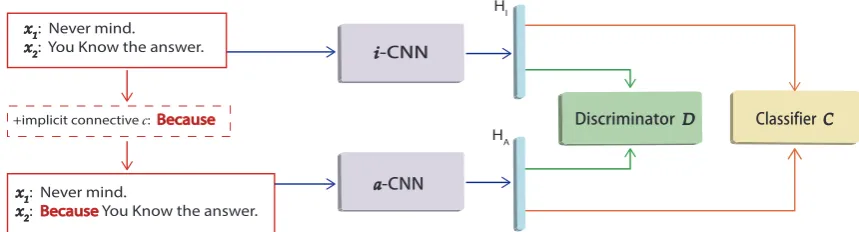
The basic idea of the proposed approach is sim-ple. We want our implicit relation recognizer, which predicts the underlying relation of sen-tence arguments without discourse connective, to have prediction behaviors close to a connective-augmentedrelation recognizer which is provided with a discourse connective in addition to the ar-guments. The connective-augmented recognizer is in analogy to an annotator with the help of connec-tives as in the human annotation process, and the implicit recognizer would be improved by learn-ing from such an “informed” annotator. Specif-ically, we want the latent features extracted by the two models to match as closely as possible, which explicitly transfers the discriminability of the connective-augmented representations to im-plicit ones.
To this end, instead of manually selecting a closeness metric, we take advantage of the ad-versarial framework by constructing a two-player zero-sum game between the implicit recognizer and a rival discriminator. The discriminator at-tempts to distinguish between the features ex-tracted by the two relation models, while the im-plicit relation model is trained to maximize the ac-curacy on implicit data, and at the same time to confuse the discriminator.
x1: Never mind.
x2: You Know the answer. i-CNN
a-CNN
+implicit connective c: Because Discriminator D Classifier C
x1: Never mind.
x2: Because You Know the answer.
HI
[image:4.595.87.517.68.184.2]HA
Figure 1: Architecture of the proposed method. The framework contains three main components: 1) an implicit relation networki-CNN over raw sentence arguments, 2) a connective-augmented relation network a-CNN whose inputs are augmented with implicit connectives, and 3) a discriminator distin-guishing between the features by the two networks. The features are fed to the final classifier for relation classification. The discriminator andi-CNNform an adversarial pair for feature imitation. At test time, the implicit networki-CNNwith the classifier is used for prediction.
discussed in section3.3.
3.1 Model Architecture
Let(x, y)be a pair of input and output of implicit relation classification, where x = (x1,x2) is a
pair of sentence arguments, andyis the underlying
discourse relation. Each training example also in-cludes an annotated implicit connectivecthat best
expresses the relation. Figure1 shows the archi-tecture of our framework.
The neural model for implicit relation clas-sification (i-CNN in the figure) extracts latent representation from the arguments, denoted as
HI(x1,x2), and feeds the feature into a classifier C for final prediction C(HI(x1,x2)). For ease
of notation, we will also useHI(x)to denote the
latent feature on datax.
The second relation network (a-CNN) takes as inputs the sentence arguments along with an implicit connective, to induce the connective-augmented representationHA(x1,x2, c), and
ob-tains relation predictionC(HA(x1,x2, c)). Note
that the same final classifierCis used for both
net-works, so that the feature representations by the two networks are ensured to be within the same semantic space, enabling feature emulation as pre-sented shortly.
We further pair the implicit network with a ri-val discriminatorDto form our adversarial game.
The discriminator is to differentiate between the reasoning behaviors of the implicit networki-CNN
and the augmented networka-CNN. Specifically,
D is a binary classifier that takes as inputs a
la-tent feature H derived from either i-CNN or a-CNNgiven appropriate data (where implicit con-nectives is either missing or present, respectively). The output D(H) estimates the probability that H comes from the connective-augmenteda-CNN
rather thani-CNN.
3.2 Training Procedure
The system is trained through an alternating op-timization procedure that updates the components in an interleaved manner. In this section, we first present the training objective for each component, and then give the overall training algorithm.
LetθDdenote the parameters of the
discrimina-tor. The training objective ofDis straightforward,
i.e., to maximize the probability of correctly dis-tinguishing the input features:
max
θD L
D=E(x,c,y)∼data
h
logD(HA(x, c);θD)+
log(1−D(HI(x);θD))
i
, (1)
where E(x,c,y)∼data[·] denotes the expectation in
terms of the data distribution.
We denote the parameters of the implicit net-work i-CNN and the classifier C as θI and θC,
respectively. The model is then trained to (a) correctly classify relations in training data and (b) produce salient features close to connective-augmented ones. The first objective can be ful-filled by minimizing the usual cross-entropy loss:
LI,C(θI,θC) =E(x,y)∼data
h
J C(HI(x;θI);θC), yi,
Algorithm 1Adversarial Model for Implicit Recognition Input: Training data{(x, c, y)n}
Parameters:λ1, λ2– balancing parameters 1: Initialize {θI,θC} and {θA} by minimizing
Eq.(2) and Eq.(4), respectively
2: repeat
3: Train the discriminator through Eq.(1) 4: Train the relation models through Eq.(5)
5: untilconvergence
Output: Adversarially enhanced implicit relation networki-CNNwith classifierCfor prediction
where J(p, y) = −PkI(y = k) logpk is the
cross-entropy loss between predictive distribution
pand ground-truth labely. We achieve objective (b) by minimizing the discriminator’s chance of correctly telling apart the features:
LI(θI) =Ex∼data
h
log 1−D(HI(x;θI))i. (3)
The parameters of the augmented network a-CNN, denoted asθA, can be learned by simply
fit-ting to the data, i.e., minimizing the cross-entropy loss as follows:
LA(θA) =E(x,c,y)∼data
h
J C(HA(x, c;θA)), yi. (4)
As mentioned above, here we use the same classi-fierCas for the implicit network, forcing a unified
feature space of both networks. We combine the above objectives Eqs.(2)-(4) of the relation classi-fiers and minimize the joint loss:
min
θI,θA,θCL
I,A,C=LI,C(θI,θC) +λ1LI(θI) +λ2LA(θA),
(5)
whereλ1andλ2are two balancing parameters
cal-ibrating the weights of the classification losses and the feature-regulating loss. In practice, we pre-train the implicit and augmented networks inde-pendently by minimizing Eq.(2) and Eq.(4), re-spectively. In the adversarial training process, we found setting λ2 = 0 gives stable
conver-gence. That is, the connective-augmented features are fixed after the pre-training stage.
Algorithm1summarizes the training procedure, where we interleave the optimization of Eq.(1) and Eq.(5) at each iteration. More practical details are provided in section4. We instantiate all modules as neural networks (section3.3) which are differ-entiable, and perform the optimization efficiently through standard stochastic gradient descent and back-propagation.
Concat
Max-pooling
Convolution
Embedding
Arg1: Never mind. Arg2: You know the answer.
H(x)
[image:5.595.312.513.66.232.2]Classification: Cause Discrimination
Figure 2: Neural structure of i-CNN. Two sets of convolutional filters are shown, with the cor-responding features in red and blue, respectively. The weights of the filters on two input arguments are tied.
Through Eq.(1) and Eq.(3), the discriminator and the implicit relation network follow a min-imax competition, which drives both to improve until the implicit feature representations are close to the connective-augmented latent representa-tions, encouraging the implicit network to ex-tract highly discriminative features from raw sen-tence arguments for relation classification. Alter-natively, we can see Eq.(3) as an adaptive regu-larization on the implicit model, which, compared to pre-fixed regularizors such as`2-regularization,
provides a more flexible, self-calibrated mecha-nism to improve generalization ability.
0 1
Input Gate
Output /
HI /HA
Gate
[image:5.595.326.496.574.714.2]3.3 Component Structures
We have presented our adversarial framework for implicit relation classification. We now discuss the model realization of each component. All com-ponents of the framework are parameterized with neural networks. Distinct roles of the modules in the framework lead to different modeling choices.
Relation Classification Networks Figure 2 il-lustrates the structure of the implicit relation net-work i-CNN. We use a convolutional network as it is a common architectural choice for discourse parsing. The network takes as inputs the word vectors of the tokens in each sentence argument, and maps each argument to intermediate features through a shared convolutional layer. The result-ing representations are then concatenated and fed into a max pooling layer to select most salient fea-tures as the final representation. The final classi-fierC is a simple fully-connected layer followed by a softmax classifier.
The connective-augmented networka-CNNhas a similar structure asi-CNN, wherein implicit con-nective is appended to the second sentence as in-put. The key difference fromi-CNNis that here we adoptaverage k-maxpooling, which takes the av-erage of the top-kmaximum values in each
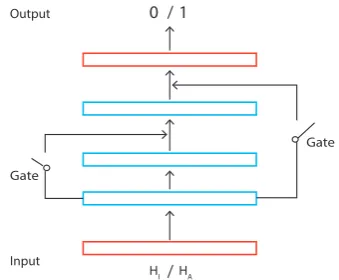
pool-ing window. The reason is to prevent the net-work from solely selecting the connective induced features (which are typically the most salient fea-tures) which would be the case when using max pooling, but instead force it to also attend to con-textual features derived from the arguments. This facilitates more homogeneous output features of the two networks, and thus facilitates feature imi-tation. In all the experiments we fixedk= 2. Discriminator The discriminator is a binary classifier to identify the correct source of an in-put feature vector. To make it a strong rival to the feature imitating network (i-CNN), we model the discriminator as a multi-layer perceptron (MLP) enhanced with gated mechanism for efficient in-formation flow (Srivastava et al.,2015;Qin et al.,
2016c), as shown in Figure3.
4 Experiments
We demonstrate the effectiveness of our approach both quantitatively and qualitatively with exten-sive experiments. We evaluate prediction perfor-mance on the PDTB benchmark in different set-tings. Our method substantially improves over a
diverse set of previous models, especially in the practical multi-class classification task. We per-form in-depth analysis of the model behaviors, and show our adversarial framework successfully en-ables the implicit relation model to imitate and learn discriminative features.
4.1 Experiment Setup
We use PDTB 2.01, one of the largest manually
annotated discourse relation corpus. The dataset contains 16,224 implicit relation instances in total, with three levels of senses: Level-1Class, Level-2
Type, and Level-3 Subtypes. The 1st level con-sists of four major relation Classes: COMPARI -SON, CONTINGENCY, EXPANSION and TEMPO -RAL. The 2nd level contains 16Types.
To make extensive comparison with prior work of implicit discourse relation classification, we evaluate on two popular experimental settings: 1) multi-class classification for 2nd-level types (Lin et al.,2009;Ji and Eisenstein,2015), and 2) one-versus-others binary classifications for 1st-level classes (Pitler et al., 2009). We describe the de-tailed configurations in the following respective sections. We will focus our analysis on the multi-class multi-classification setting, which is most realis-tic in pracrealis-tice and serves as a building block for a complete discourse parser such as that for the shared tasks of CoNLL-2015 and 2016 (Xue et al.,
2015,2016).
Model Training Here we provide the detailed architecture configurations of each component we used in the experiments.
• Throughout the experiments i-CNN and a-CNN contain 3 sets of convolutional filters with the filter sizes selected on the dev set. Table 1 lists the filter configurations of the convolutional layer ini-CNN anda-CNN in different tasks. As described in section 3.3, following the convolutional layer is a max pooling layer in i-CNN, and an average k-max pooling layer withk= 2ina-CNN.
• The final single-layer classifier C contains
512 neurons withtanhactivation function.
• The discriminator D consists of 4
fully-connected layers, with 2 gated pathways from layer 1 to layer 3 and layer 4 (see Figure3).
Task Filter sizes Filter number PDTB-Lin 2, 4, 8 3×256 PDTB-Ji 2, 5, 10 3×256 One-vs-all 2, 5, 10 3×1024
Table 1: The convolutional architectures ofi-CNN
anda-CNNin different tasks (section 4). For ex-ample, in PDTB-Lin, we use 3 sets of filters, each of which is of size 2, 4, and 8, respectively; and each set has 256 filters.
The size of each layer is set to 1024 and is fixed in all the experiments.
• We set the dimension of the input word
vec-tors to 300 and initialize with pre-trained word2vec (Mikolov et al., 2013). The max-imum length of sentence argument is set to 80. Truncation and zero-padding are applied when necessary.
All experiments were performed on a TITAN-X GPU and 128GB RAM, with neural implementa-tion based on Tensorflow2.
For adversarial model training, it is critical to keep balance between the progress of the two play-ers. We use a simple strategy which at each itera-tion optimizes the discriminator and the implicit relation network on a randomly-sampled mini-batch. We found this is enough to stabilize the training. The neural parameters are trained using AdaGrad (Duchi et al.,2011) with an initial learn-ing rate of 0.001. For the balanclearn-ing parameters in Eq.(5), we setλ1 = 0.1, while λ2 = 0. That
is, after the initialization stage the weights of the connective-augmented network a-CNN are fixed. This has been shown capable of giving stable and good predictive performance for our system.
4.2 Implicit Relation Classification
We will mainly focus on the general multi-class classification problem in two alternative settings adopted in prior work, showing the superiority of our model over previous state of the arts. We perform in-depth comparison with carefully de-signed baselines, providing empirical insights into the working mechanism of the proposed frame-work. For broader comparisons we also report the performance in the one-versus-all setting.
2https://www.tensorflow.org
Model PDTB-Lin PDTB-Ji
1 Word-vector 34.07 36.86
2 CNN 43.12 44.51
3 Ensemble 42.17 44.27
4 Multi-task 43.73 44.75
5 `2-reg 44.12 45.33
6 Lin et al.(2009) 40.20
-7 Lin et al.(2009) - 40.66
+Brown clusters
8 Ji and Eisenstein
(2015) - 44.59
9 Qin et al.(2016a) 43.81 45.04
10 Ours 44.65 46.23
Table 2: Accuracy (%) on the test sets of the PDTB-Lin and PDTB-Ji settings for multi-class classification. Please see the text for more details.
Multi-class Classifications
We first adopt the standard PDTB splitting con-vention following (Lin et al., 2009), denoted as PDTB-Lin, where sections 2-21, 22, and 23 are used as training, dev, and test sets, respectively. The most frequent 11 types of relations are se-lected in the task. During training, instances with more than one annotated relation types are con-sidered as multiple instances, each of which has one of the annotations. At test time, a prediction that matches one of the gold types is considered as correct. The test set contains 766 examples. More details are in (Lin et al., 2009). An alternative, slightly different multi-class setting is used in (Ji and Eisenstein,2015), denoted as PDTB-Ji, where sections 2-20, 0-1, and 21-22 are used as training, dev, and test sets, respectively. The resulting test set contains 1039 examples. We also evaluate in this setting for thorough comparisons.
Table 2 shows the classification accuracy in both of the settings. We see that our model (Row 10) achieves state-of-the-art performance, greatly outperforming previous methods (Rows 6-9) with various modeling paradigms, including the linguistic feature-based model (Lin et al., 2009), pure neural methods (Qin et al.,2016c), and com-bined approach (Ji and Eisenstein,2015).
rela-tion network. Our model trained within the pro-posed framework provides significant improve-ment, showing the benefits of utilizing implicit connectives at training time. 3) “Ensemble” has the same neural architecture with the proposed framework except that the input ofa-CNN is not augmented with implicit connectives. This essen-tially is an ensemble of two implicit recognition networks. We see that the method performs even inferior to the single CNN model. This further confirms the necessity of exploiting connective in-formation. 4) “Multi-task” is the convolutional net augmented with an additional task of simultane-ously predicting the implicit connectives based on the network features. As a straightforward way of incorporating connectives, we see that the method slightly improves over the stand-alone CNN, while falling behind our approach with a large margin. This indicates that our proposed feature imitation is a more effective scheme for making use of im-plicit connectives. 5) At last, “`2-reg” also
imple-ments feature mimicking by imposing an `2
dis-tance penalty between the implicit relation fea-tures and connective-augmented feafea-tures. We see that the simple model has obtained improvement over previous best-performing systems in both settings, further validating the idea of imitation. However, in contrast to the fixed`2regularization,
our adversarial framework provides an adaptive mechanism, which is more flexible and performs better as shown in the table.
Model COMP. CONT. EXP. TEMP.
Pitler et al.(2009) 21.96 47.13 - 16.76
Qin et al.(2016c) 41.55 57.32 71.50 35.43
Zhang et al.(2016a) 35.88 50.56 71.48 29.54
Zhou et al.(2010) 31.79 47.16 70.11 20.30
Liu and Li(2016) 36.70 54.48 70.43 38.84
Chen et al.(2016a) 40.17 54.76 - 31.32
[image:8.595.319.513.62.113.2]Ours 40.87 54.56 72.38 36.20
Table 3: Comparisons ofF1scores (%) for binary
classification.
One-versus-all Classifications
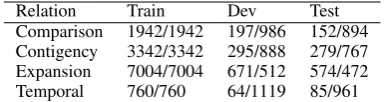
We also report the results of four one-versus-all binary classifications for more comparisons with prior work. We follow the conventional experi-mental setting (Pitler et al.,2009) by selecting sec-tions 2-20, 21-22, and 0-1 as training, dev, and test sets. Table4lists the statistics of the data.
Following previous work, Table3reports the F1
Relation Train Dev Test
Comparison 1942/1942 197/986 152/894 Contigency 3342/3342 295/888 279/767 Expansion 7004/7004 671/512 574/472 Temporal 760/760 64/1119 85/961
Table 4: Distributions of positive and negative in-stances from the train/dev/test sets in four binary relation classification tasks.
scores. Our method outperforms most of the prior systems in all the tasks. We achieve state-of-the-art performance in recognition of the Expansion relation, and obtain comparable scores with the best-performing methods in each of the other rela-tions, respectively. Notably, our feature imitation scheme greatly improves over (Zhou et al.,2010) which leverages implicit connectives as an inter-mediate prediction task. This provides additional evidence for the effectiveness of our approach.
4.3 Qualitative Analysis
We now take a closer look into the modeling be-havior of our framework, by investigating the pro-cess of the adversarial game during training, as well as the feature imitation effects.
Figure 4demonstrates the training progress of different components. Thea-CNNnetwork keeps high predictive accuracy as implicit connectives are given, showing the importance of connective cues. The rise-and-fall patterns in the accuracy of the discriminator clearly show its competition with the implicit relation networki-CNNas train-ing goes. At first few iterations the accuracy of the discriminator increases quickly to over0.9, while
at late stage the accuracy drops to around 0.6,
showing that the discriminator is getting confused by i-CNN(an accuracy of 0.5 indicates full
con-fusion). The i-CNNnetwork keeps improving in terms of implicit relation classification accuracy, as it is gradually fitting to the data and simultane-ously learning increasingly discriminative features by mimickinga-CNN. The system exhibits simi-lar learning patterns in the two different settings, showing the stability of the training strategy.
[image:8.595.75.296.495.592.2]suc-0 5 10 15
Training epochs
0.4 0.6 0.8
Accuracy
a-CNN i-CNN Discr
0 5 10 15 20
Training epochs
0.4 0.6 0.8
Accuracy
a-CNN i-CNN Discr
Figure 4: (Best viewed in colors.) Test-set performance of three components over training epochs. Relation networks a-CNN and i-CNN are measured with multi-class classification accuracy (with or without implicit connectives, respectively), while the discriminator is evaluated with binary classification accuracy. Top: the PDTB-Lin setting (Lin et al.,2009), where first 8 epochs are for initialization stage (thus the discriminator is fixed and not shown);Bottom: the PDTB-Ji setting (Ji and Eisenstein,2015), where first 3 epochs are for initialization.
(a) (b) (c)
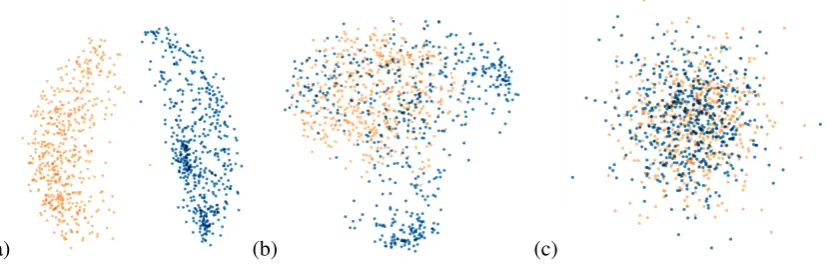
Figure 5: (Best viewed in colors.) Visualizations of the extracted hidden features by the implicit relation network i-CNN(blue) and connective-augmented relation network a-CNN (orange), in the multi-class classification setting (Lin et al., 2009). (a) Two networks are trained without adversary (with shared classifier);(b)Two networks are trained within our framework at epoch 10;(c)at epoch 20. The implicit relation network successfully imitates the connective-augmented features through the adversarial game. Visualization is conducted with the t-SNE algorithm (Maaten and Hinton,2008).
cessfully driveni-CNNto induce similar represen-tations witha-CNN, even though connectives are not present.
5 Discussions
We have developed an adversarial neural frame-work that facilitates an implicit relation netframe-work to extract highly discriminative features by mimick-ing a connective-augmented network. Our method achieved state-of-the-art performance for implicit discourse relation classification. Besides implicit connective examples, our model can naturally ex-ploit enormous explicit connective data to further improve discourse parsing.
The proposed adversarial feature imitation scheme is also generally applicable to other con-text to incorporate indicative side information
[image:9.595.77.517.62.183.2] [image:9.595.93.507.288.420.2]References
Or Biran and Kathleen McKeown. 2013. Aggregated word pair features for implicit discourse relation
dis-ambiguation. In Proceedings of the 51st Annual
Meeting of the Association for Computational Lin-guistics (ACL, Volume 2: Short Papers). Sofia, Bul-garia, pages 69–73.
Chlo´e Braud and Pascal Denis. 2015. Comparing word representations for implicit discourse relation
classi-fication. InProceedings of the 2015 Conference on
Empirical Methods in Natural Language Processing (EMNLP). Lisbon, Portugal, pages 2201–2211.
Chlo´e Braud and Pascal Denis. 2016. Learning
connective-based word representations for implicit discourse relation identification. InProceedings of the 2016 Conference on Empirical Methods in Nat-ural Language Processing (EMNLP). Austin, Texas, pages 203–213.
Deng Cai, Hai Zhao, Zhisong Zhang, Yuan Xin, Yongjian Wu, and Feiyue Huang. 2017. Fast and accurate neural word segmentation for Chinese. In Proceedings of the 55th Annual Meeting of the As-sociation for Computational Linguistics (ACL). Van-couver, Canada.
Changge Chen, Peilu Wang, and Hai Zhao. 2015. Shallow discourse parsing using constituent
pars-ing tree. InProceedings of the Nineteenth
Confer-ence on Computational Natural Language Learning - Shared Task (CONLL). Beijing, China, pages 37– 41.
Changge Chen and Hai Zhao. 2015. Deceptive opinion spam detection using deep level linguistic feature. In The 4th CCF Conference on Natural Language Processing and Chinese Computing (NLPCC 2015),
LNCS. Nanchang, China, volume 9362, pages 465–
474.
Jifan Chen, Qi Zhang, Pengfei Liu, Xipeng Qiu, and Xuanjing Huang. 2016a. Implicit discourse rela-tion detecrela-tion via a deep architecture with gated
rel-evance network. InProceedings of the 54th Annual
Meeting of the Association for Computational Lin-guistics (ACL Volume 1: Long Papers). Berlin, Ger-many, pages 1726–1735.
Xi Chen, Yan Duan, Rein Houthooft, John Schul-man, Ilya Sutskever, and Pieter Abbeel. 2016b. In-fogan: Interpretable representation learning by in-formation maximizing generative adversarial nets. InAdvances in Neural Information Processing
Sys-tems. pages 2172–2180.
Xilun Chen, Ben Athiwaratkun, Yu Sun, Kilian Wein-berger, and Claire Cardie. 2016c. Adversarial deep averaging networks for cross-lingual sentiment clas-sification.arXiv preprint arXiv:1606.01614. John Duchi, Elad Hazan, and Yoram Singer. 2011.
Adaptive subgradient methods for online learning
and stochastic optimization. Journal of Machine
Learning Research12(Jul):2121–2159.
Yaroslav Ganin, Evgeniya Ustinova, Hana Ajakan, Pascal Germain, Hugo Larochelle, Franc¸ois Lavi-olette, Mario Marchand, and Victor Lempitsky. 2016. Domain-adversarial training of neural
net-works. Journal of Machine Learning Research
17(59):1–35.
Shima Gerani, Yashar Mehdad, Giuseppe Carenini, T. Raymond Ng, and Bita Nejat. 2014. Abstractive summarization of product reviews using discourse structure. InProceedings of the 2014 Conference on Empirical Methods in Natural Language Processing (EMNLP). pages 1602–1613.
Ian Goodfellow, Jean Pouget-Abadie, Mehdi Mirza, Bing Xu, David Warde-Farley, Sherjil Ozair, Aaron Courville, and Yoshua Bengio. 2014. Generative
ad-versarial nets. InAdvances in Neural Information
Processing Systems. pages 2672–2680.
Zhiting Hu, Xuezhe Ma, Zhengzhong Liu, Eduard Hovy, and Eric P Xing. 2016a. Harnessing deep
neural networks with logic rules. In Proceedings
of the 54th Annual Meeting of the Association for Computational Linguistics (ACL). Berlin, Germany, pages 2410–2420.
Zhiting Hu, Zichao Yang, Xiaodan Liang, Ruslan Salakhutdinov, and Eric P Xing. 2017. Controllable text generation.arXiv preprint arXiv:1703.00955. Zhiting Hu, Zichao Yang, Ruslan Salakhutdinov, and
Eric P Xing. 2016b. Deep neural networks with
massive learned knowledge. InProceedings of the
2016 Conference on Empirical Methods in Natu-ral Language Processing (EMNLP). Austin, USA, pages 1670–1679.
Yangfeng Ji and Jacob Eisenstein. 2015. One vector is not enough: Entity-augmented distributed semantics for discourse relations. Transactions of the Associ-ation for ComputAssoci-ational Linguistics (TACL)3:329– 344.
Yangfeng Ji, Gholamreza Haffari, and Jacob Eisen-stein. 2016. A latent variable recurrent neural
net-work for discourse-driven language models. In
Proceedings of the 2016 Conference of the North American Chapter of the Association for Computa-tional Linguistics: Human Language Technologies (NAACL). San Diego, California, pages 332–342.
Yangfeng Ji, Gongbo Zhang, and Jacob Eisenstein. 2015. Closing the gap: Domain adaptation from explicit to implicit discourse relations. In Proceed-ings of the 2015 Conference on Empirical Methods in Natural Language Processing (EMNLP). Lisbon, Portugal, pages 2219–2224.
Alex M Lamb, Anirudh Goyal, Ying Zhang, Saizheng Zhang, Aaron C Courville, and Yoshua Bengio. 2016. Professor forcing: A new algorithm for
train-ing recurrent networks. InAdvances In Neural
Man Lan, Yu Xu, and Zhengyu Niu. 2013. Leverag-ing synthetic discourse data via multi-task learnLeverag-ing for implicit discourse relation recognition. In Pro-ceedings of the 51st Annual Meeting of the Associa-tion for ComputaAssocia-tional Linguistics (ACL, Volume 1: Long Papers). Sofia, Bulgaria, pages 476–485. Junyi Jessy Li, Marine Carpuat, and Ani Nenkova.
2014. Assessing the discourse factors that influence
the quality of machine translation. InProceedings
of the 52nd Annual Meeting of the Association for Computational Linguistics (ACL, Volume 2: Short Papers). Baltimore, Maryland, pages 283–288. Yujia Li, Kevin Swersky, and Richard S Zemel. 2015.
Generative moment matching networks. In
Pro-ceedings of the 32nd International Conference on Machine Learning (ICML). Lille, France, pages 1718–1727.
Zhongyi Li, Hai Zhao, Chenxi Pang, Lili Wang, and Huan Wang. 2016. A constituent syntactic parse tree based discourse parser. InProceedings of the Twen-tieth Conference on Computational Natural Lan-guage Learning - Shared Task (CONLL). Berlin, Germany, pages 60–64.
Maria Liakata, Simon Dobnik, Shyamasree Saha, Colin Batchelor, and Dietrich Rebholz-Schuhmann. 2013. A discourse-driven content model for sum-marising scientific articles evaluated in a complex question answering task. InProceedings of the 2013 Conference on Empirical Methods in Natural Lan-guage Processing (EMNLP). Seattle, Washington, USA, pages 747–757.
Xiaodan Liang, Zhiting Hu, Hao Zhang, Chuang
Gan, and Eric P Xing. 2017. Recurrent
topic-transition GAN for visual paragraph generation. arXiv preprint arXiv:1703.07022.
Ziheng Lin, Min-Yen Kan, and Hwee Tou Ng. 2009. Recognizing implicit discourse relations in the Penn
Discourse Treebank. In Proceedings of the 2009
Conference on Empirical Methods in Natural Lan-guage Processing (EMNLP). Singapore, pages 343– 351.
Yang Liu and Sujian Li. 2016. Recognizing implicit discourse relations via repeated reading: Neural net-works with multi-level attention. InProceedings of the 2016 Conference on Empirical Methods in Nat-ural Language Processing (EMNLP). Austin, Texas, pages 1224–1233.
Yang Liu, Sujian Li, Xiaodong Zhang, and Zhifang Sui. 2016. Implicit discourse relation classifica-tion via multi-task neural networks. arXiv preprint arXiv:1603.02776.
Laurens van der Maaten and Geoffrey Hinton. 2008.
Visualizing data using t-SNE. Journal of Machine
Learning Research9:2579–2605.
Tomas Mikolov, Ilya Sutskever, Kai Chen, Greg S Cor-rado, and Jeff Dean. 2013. Distributed representa-tions of words and phrases and their
compositional-ity. InAdvances in neural information processing
systems (3). South Lake Tahoe, Nevada, USA, pages 3111–3119.
Emily Pitler, Annie Louis, and Ani Nenkova. 2009. Automatic sense prediction for implicit discourse re-lations in text. InProceedings of the Joint Confer-ence of the 47th Annual Meeting of he Association for Computational Linguistics and the 4th Interna-tional Joint Conference on Natural Language Pro-cessing (ACL-IJCNLP). Suntec, Singapore, pages 683–691.
Rashmi Prasad, Nikhil Dinesh, Alan Lee, Eleni Milt-sakaki, Livio Robaldo, Aravind K Joshi, and Bon-nie L Webber. 2008. The Penn discourse
tree-bank 2.0. InThe sixth international conference on
Language Resources and Evaluation (LREC). Mar-rakech, Morocco, pages 2961–2968.
Lianhui Qin, Zhisong Zhang, and Hai Zhao. 2016a. Implicit discourse relation recognition with
context-aware character-enhanced embeddings. In
Proceed-ings of COLING 2016, the 26th International Con-ference on Computational Linguistics: Technical Papers. Osaka, Japan, pages 1914–1924.
Lianhui Qin, Zhisong Zhang, and Hai Zhao. 2016b. Shallow discourse parsing using convolutional
neu-ral network. In Proceedings of the CoNLL-16
shared task. Berlin, Germany, pages 70–77. Lianhui Qin, Zhisong Zhang, and Hai Zhao. 2016c. A
stacking gated neural architecture for implicit dis-course relation classification. InProceedings of the 2016 Conference on Empirical Methods in Natu-ral Language Processing (EMNLP). Austin, Texas, pages 2263–2270.
Attapol Rutherford and Nianwen Xue. 2015.
Im-proving the inference of implicit discourse relations via classifying explicit discourse connectives. In Proceedings of the 2015 Conference of the North American Chapter of the Association for Computa-tional Linguistics: Human Language Technologies (NAACL: HLT). Denver, Colorado, pages 799–808.
Tim Salimans, Ian Goodfellow, Wojciech Zaremba, Vicki Cheung, Alec Radford, and Xi Chen. 2016.
Improved techniques for training gans. InAdvances
in Neural Information Processing Systems. pages 2226–2234.
Rupesh Kumar Srivastava, Klaus Greff, and J¨urgen
Schmidhuber. 2015. Highway networks. arXiv
preprint arXiv:1505.00387.
Peilu Wang, Yao Qian, Frank K. Soong, Lei He, and Hai Zhao. 2016. Learning distributed word repre-sentations for bidirectional LSTM recurrent neural
network. In Proceedings of the 2016 Conference
Yu Xu, Man Lan, Yue Lu, Zheng Yu Niu, and Chew Lim Tan. 2012. Connective prediction using machine learning for implicit discourse relation clas-sification. InThe 2012 International Joint Confer-ence on Neural Networks (IJCNN). Brisbane, Aus-tralia, pages 1–8.
Nianwen Xue, Hwee Tou Ng, Sameer Pradhan, Rashmi Prasad, Christopher Bryant, and Attapol Ruther-ford. 2015. The CoNLL-2015 shared task on
shal-low discourse parsing. InProceedings of the
Nine-teenth Conference on Computational Natural Lan-guage Learning - Shared Task (CoNLL). Beijing, China, pages 1–16.
Nianwen Xue, Hwee Tou Ng, Sameer Pradhan, Bon-nie Webber, Attapol Rutherford, Chuan Wang, and Hongmin Wang. 2016. The CoNLL-2016 shared task on shallow discourse parsing. InProceedings of the Twentieth Conference on Computational Natural Language Learning - Shared Task (CoNLL). Berlin, Germany, pages 1–19.
Biao Zhang, Deyi Xiong, jinsong su, Qun Liu, Ron-grong Ji, Hong Duan, and Min Zhang. 2016a. Vari-ational neural discourse relation recognizer. In Pro-ceedings of the 2016 Conference on Empirical Meth-ods in Natural Language Processing (EMNLP). Austin, Texas, pages 382–391.
Zhisong Zhang, Hai Zhao, and Lianhui Qin. 2016b. Probabilistic graph-based dependency parsing with convolutional neural network. InProceedings of the 54th Annual Meeting of the Association for Compu-tational Linguistics (ACL). Berlin, Germany, pages 1382–1392.
Zhi-Min Zhou, Yu Xu, Zheng-Yu Niu, Man Lan, Jian Su, and Chew Lim Tan. 2010. Predicting discourse connectives for implicit discourse relation
recog-nition. In Proceedings of the 23rd International