Proceedings of the 55th Annual Meeting of the Association for Computational Linguistics, pages 1353–1363 Vancouver, Canada, July 30 - August 4, 2017. c2017 Association for Computational Linguistics Proceedings of the 55th Annual Meeting of the Association for Computational Linguistics, pages 1353–1363
Vancouver, Canada, July 30 - August 4, 2017. c2017 Association for Computational Linguistics
Joint Optimization of User-desired Content in Multi-document
Summaries by Learning from User Feedback
Avinesh P.V.S and Christian M. Meyer Research Training Group AIPHES and UKP Lab
Computer Science Department, Technische Universit¨at Darmstadt www.aiphes.tu-darmstadt.de, www.ukp.tu-darmstadt.de
Abstract
In this paper, we propose an extractive multi-document summarization (MDS) system using joint optimization and active learning for content selection grounded in user feedback. Our method interactively obtains user feedback to gradually im-prove the results of a state-of-the-art inte-ger linear programming (ILP) framework for MDS. Our methods complement fully automatic methods in producing high-quality summaries with a minimum num-ber of iterations and feedbacks. We conduct multiple simulation-based exper-iments and analyze the effect of feedback-based concept selection in the ILP setup in order to maximize the user-desired content in the summary.
1 Introduction
The task of producing summaries from a clus-ter of multiple topic-related documents has gained much attention during the Document Understand-ing Conference1 (DUC) and the Text Analysis
Conference2 (TAC) series. Despite a lot of
re-search in this area, it is still a major challenge to automatically produce summaries that are on par with human-written ones. To a large extent, this is due to the complexity of the task: a good sum-mary must include the most relevant information, omit redundancy and irrelevant information, sat-isfy a length constraint, and be cohesive and gram-matical. But an even bigger challenge is the high degree of subjectivity in content selection, as it can be seen in the small overlap of what is considered
1http://duc.nist.gov/ 2http://www.nist.gov/tac/
important by different users. Optimizing a sys-tem towards one single best summary that fits all users, as it is assumed by current state-of-the-art systems, is highly impractical and diminishes the usefulness of a system for real-world use cases.
In this paper, we propose an interactive concept-based model to assist users in creating a personal-ized summary based on their feedback. Our model employs integer linear programming (ILP) to max-imize user-desired content selection while using a minimum amount of user feedback and iterations. In addition to the joint optimization framework us-ing ILP, we explore pool-based active learnus-ing to further reduce the required feedback. Although there have been previous attempts to assist users in single-document summarization, no existing work tackles the problem of multi-document summaries using optimization techniques for user feedback. Additionally, most existing systems produce only a single, globally optimal solution. Instead, we put the human in the loop and create a personal-ized summary that better captures the users’ needs and their different notions of importance.
Need for personalization. Table 1 shows the ROUGE scores (Lin, 2004) of multiple existing summarization systems, namely TF*IDF (Luhn, 1958), LexRank (Erkan and Radev, 2004), Text-Rank (Mihalcea and Tarau, 2004), LSA (Gong and Liu, 2001), KL-Greedy (Haghighi and Van-derwende,2009), provided by the sumy package3
and ICSI4(Gillick and Favre,2009;Boudin et al.,
2015), a strong state-of-the-art approach (Hong et al., 2014) in comparison to the extractive up-per bound on DUC’04 and DBS. DUC’04 is an English dataset of abstractive summaries from
ho-3https://github.com/miso-belica/sumy 4https://github.com/boudinfl/sume
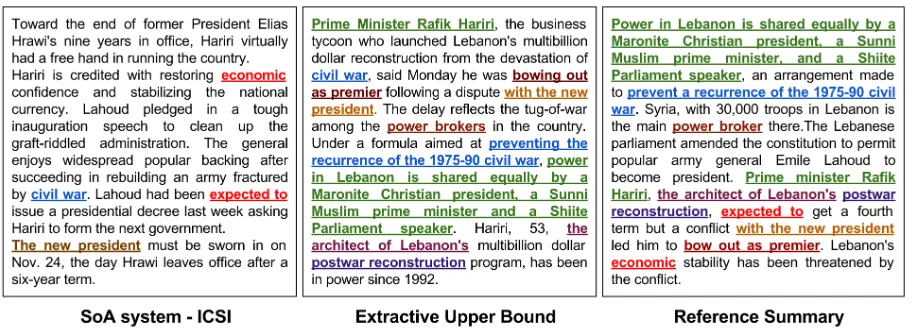
Figure 1: Lexical overlap of a reference summary (cluster D31043t in DUC 2004) with the summary produced by ICSI’s state-of-the-art system (Boudin et al.,2015) and the extractive upper bound
DUC’04 DBS
Systems R1 R2 SU4 R1 R2 SU4
TF*IDF .292 .055 .086 .377 .144 .144 LexRank .345 .070 .108 .434 .161 .180 TextRank .306 .057 .096 .400 .167 .167 LSA .294 .045 .081 .394 .154 .147 KL-Greedy .336 .072 .104 .369 .133 .134 ICSI .374 .090 .118 .452 .183 .190 UB .472 .210 .182 .848 .750 .532
Table 1: ROUGE-1 (R1), ROUGE-2 (R2), and ROUGE-SU4 (SU4) scores of multiple systems compared to the extractive upper bound (UB)
mogenous news texts, whereas DBS (Benikova et al., 2016) is a German dataset of cohesive ex-tracts from heterogeneous sources from the educa-tional domain (see details in section4.1). For each dataset, we compute an extractive upper bound (UB) by optimizing the sentence selection which maximizes ROUGE-2, i.e., the occurrence of bi-grams as in the reference summary (Cao et al., 2016). Although some systems achieve state-of-the-art performance, their scores are still far from the extractive upper bound of individual reference summaries as shown in Figure 1. This is due to low inter-annotator agreement for concept selec-tion:Zechner(2002) reports, for example,κ= .13
andBenikova et al.(2016)κ= .23. Most systems
try to optimize forallreference summaries instead of personalizing, which we consider essential to capture user-desired content.
Need for user feedback. The goal of concept selection is finding the important information
within a given set of source documents. Although existing summarization algorithms come up with a generic notion of importance, it is still far from the user-specific importance as shown in Figure1. In contrast, humans can easily assess importance given a topic or a query. One way to achieve personalized summarization is thus by combining the advantages of both human feedback and the generic notion of importance built in a system. This allows users to interactively steer the summa-rization process and integrate their user-specific notion of importance.
Contributions. In this work, (1) we propose a novel ILP-based model using an interactive loop to create multi-document user-desired summaries, and (2) we develop models using pool-based ac-tive learning and joint optimization techniques to collect user feedback on identifying important concepts of a topic. In order to encourage the community to advance research and replicate our results, we provide our interactive summarizer im-plementation as open-source software.5.
Our proposed method and our new interactive summarization framework can be used in multiple application scenarios: as an interactive annotation tool, which highlights important sentences for the annotators, as a journalistic writing aid that sug-gests important, user-adapted content from multi-ple source feeds (e.g., live blogs), and as a medical data analysis tool that suggests key information as-sisting a patient’s personalized medical diagnosis. The rest of the paper is structured as follows: In section2, we discuss related work. Section 3
introduces our computer-assisted summarization framework using the concept-based optimization. Section4describes our experiment data and setup. In section5, we then discuss our results and an-alyze the performance of our models across dif-ferent datasets. Finally, we conclude the paper in section6and discuss future work.
2 Related Work
Previous works related to our research address ex-tractive summarization as a budgeted subset selec-tion problem, computer-assisted approaches, and personalized summarization models.
Bugeted subset selection. Extractive summa-rization systems that compose a summary from a number of important sentences from the source documents are by far the most popular solution for MDS. This task can be modeled as a budgeted maximum coverage problem. Given a set of sen-tences in the document collection, the task is to maximize the coverage of the subset of sentences under a length constraint. The scoring function estimates the importance of the content units for a summary. Most previous works consider sen-tences as content units and try different scoring functions to optimize the summary.
One of the earliest systems by McDonald (2007) models a scoring function by simultane-ously maximizing the relevance scores of the se-lected content units and minimizing their pairwise redundancy scores. They solve the global opti-mization problem using an ILP framework. Later, several state-of-the-art results employed an ILP to maximize the number of relevant concepts in the created summary: Gillick and Favre (2009) use an ILP with bigrams as concepts and hand-coded deletion rules for compression. Berg-Kirkpatrick et al.(2011) combine grammatical features relat-ing to the parse tree and use a maximum-margin SVM trained on annotated gold-standard com-pressions. Woodsend and Lapata (2012) jointly optimize content selection and surface realiza-tion, Li et al. (2013) estimate the weights of the concepts using supervised methods, and Boudin et al.(2015) propose an approximation algorithm to achieve the optimal solution. Although these approaches achieve state-of-the-art performance, they produce only one globally optimal summary which is impractical for various users due to the subjectivity of the task. Therefore, we research in-teractive computer-assisted approaches in order to
produce personalized summaries.
Computer-assisted summarization. The ma-jority of the existing computer-assisted summa-rization tools (Craven, 2000;Narita et al., 2002; Orˇasan et al., 2003; Orˇasan and Hasler, 2006) present important elements of a document to the user. Creating a summary then requires the hu-man to cut, paste, and reorganize the important el-ements in order to formulate a final text. The work byOrˇasan and Hasler(2006) is closely related to ours, since they assist users in creating summaries for a source document based on the output of a given automatic summarization system. However, their system is neither interactive nor does it con-sider the user’s feedback in any way. Instead, they suggest the output of the state-of-the-art (single-document) summarization method as a summary draft and ask the user to construct the summary without further interaction.
Personalized summarization. While most pre-vious work focuses on generic summaries, there have been a few attempts to take a user’s prefer-ences into account. The study byBerkovsky et al. (2008) shows that users prefer personalized sum-maries that precisely reflect their interests. These interests are typically modeled with the help of a query (Park and An,2010) or keyword annotations reflecting the user’s opinions (Zhang et al.,2003). In another strand of research,D´ıaz and Gerv´as (2007) create user models based on social tag-ging andHu et al.(2012) rank sentences by com-bining informativeness scores with a user’s in-terests based on fuzzy clustering of social tags. Extending the use of social content, another re-cent work showed how personalized review sum-maries (Poussevin et al., 2015) can be useful in recommender systems beyond rating predictions. Although these approaches show that personal-ized summaries are more useful than generic sum-maries, they do not attempt to iteratively refine a summary in an interactive user–system dialog.
3 Approach
3.1 Summary Creation
Our starting point is the concept-based ILP sum-marization framework byBoudin et al.(2015). Let
C be the set of concepts in a given set of source
documentsD,ci the presence of the conceptiin
the resulting summary, wi a concept’s weight, `j
the length of sentence j, sj the presence of
sen-tencejin the summary, andOccij the occurrence
of conceptiin sentencej. Based on these defini-tions, we formulate the following ILP:
max Piwici (1)
∀j. Pj`jsj ≤L (2)
∀i, j. PjsjOccij ≥ci (3) ∀i, j. sjOccij ≤ci (4)
∀i. ci∈ {0,1} (5)
∀j. sj ∈ {0,1} (6)
The objective function (1) maximizes the oc-currence of concepts ci in the summary based on
their weightswi. The constraint formalized in (2)
ensures that the summary length is restricted to a maximum length L, (3) ensures the selection of
all concepts in a sentencesjifsjhas been selected
for the summary. Constraint (4) ensures that a con-cept is only selected if it is present in at least one of the selected sentences.
The two key factors for the performance of this ILP are defining the concept setC and a method
to estimate the weightswi ∈ W. Previous works
have used word bigrams as concepts (Gillick and Favre,2009;Li et al., 2013;Boudin et al.,2015) and either use document frequency (i.e. the num-ber of source documents containing the concept) as weights (Woodsend and Lapata, 2012;Gillick and Favre, 2009) or estimate them using a su-pervised regression model (Li et al., 2013). For our implementation, we likewise use bigrams as concepts and document frequency as weights, as Boudin et al.(2015) report good results with this simple strategy. Our approach is, however, not limited to this setup, as our interactive approach allows for any definition of C and W, including
potentially more sophisticated weight estimation methods, e.g., based on deep neural networks. In section5.2, we additionally analyze how other no-tions of concepts can be integrated into our ap-proach.
3.2 Interactive Summarization Loop
Algorithm1provides an overview of our interac-tive summarization approach. The system takes the set of source documents D as input, derives
the set of conceptsC, and initializes their weights W. In line 5, we start the interactive feedback
loop iterating overt = 0, . . . , T. We first create
a summarySt(line6) by solving the ILP and then
extract a set of concepts Qt (line 7), for which
we query the user in line 11 As the user feed-back in the current time step, we use the concepts
It ⊆ Qt that have been considered important by
the user. For updating the weightsW in line12,
we may use all feedback collected until the cur-rent time stept, i.e.,It
0 =
St
j=0Ij and the set of
concepts Qt0 = Stj=0Qj seen by the user (with Q−01 =∅). If there are no more concepts to query
(i.e.,Qt=∅), we stop the iteration and return the
personalized summarySt.
Algorithm 1Interactive summarizer
1: procedureINTERACTIVESUMMARIZER() 2: input:DocumentsD
3: C ←extractConcepts(D) 4: W ←conceptWeights(C) 5: fort= 0...T do
6: St←getSummary(C, W)
7: Qt←extractConcepts(St)−Qt0−1
8: if Qt=∅then
9: returnSt
10: else
11: It←obtainFeedback(St, Qt)
12: W ←updateWeights(W, It 0, Qt0)
13: end if 14: end for 15: end procedure
3.3 User Feedback Optimization
To optimize the summary creation based on user feedback, we iteratively change the concept weights in the objective function of the ILP setup. We define the following models:
Accept model (ACCEPT). This model presents the current summaryStwith highlighted concepts Qtto a user and asks him/her to select all
impor-tant conceptsIt. We assign the maximum weight
MAX to all concepts in It and consider the
re-maining Qt−It as unimportant by setting their
behind this baseline is that the modified scores cause the ILP to prefer the user-desired concepts while avoiding unimportant ones.
∀i∈I0t. wi =MAX (7)
∀i∈Qt0−I0t. wi = 0 (8)
Joint ILP with User Feedback (JOINT). The ACCEPT model fails in cases where the user could not accept concepts that never appear in one of the
Stsummaries. To tackle this, in our JOINT model,
we change the objective function of the ILP in or-der to createStby jointly optimizing importance
and user feedback. We thus replace the equation (1) with:
max
(P
i6∈Qt
0wici−
P
i∈Qt
0wici ift≤τ
P
iwici ift > τ
(9)
Equation (9) maximizes the use of concepts for which we yet lack feedback (i 6∈ Qt0) and
min-imizes the use of concepts for which we already have feedback (i∈Qt
0). In this JOINT model, we
use an exploration phaset= 0. . . τ to collect the
feedback, which terminates when the user does not return any important concepts (i.e.,It=∅). In the
exploratory phase, the minus term in the equation 9helps to reduce the score of the sentences whose concepts have received feedback already. In other words, it causes higher scores for sentences con-sisting of concepts which yet lack feedback. Af-ter the exploration step, we fall back to the orig-inal importance-based optimization function from equation (1).
Active learning with uncertainty sampling (AL). Our JOINT model explores well in terms of prioritizing the concepts which yet lack user feedback. However, it gives equal probabilities to all the unseen concepts. The AL model em-ploys pool-based active learning (Kremer et al., 2014) during the exploration phase in order to pri-oritize concepts for which the model is most un-certain. We distinguish the unlabeled concept pool
Cu ={Φ(˜x1),Φ(˜x2), ...,Φ(˜xN)}and the labeled
concept poolC`={(Φ(x1), y1),(Φ(x2), y2), . . . ,
(Φ(xN), yN)}, where each concept xi is
repre-sented as ad-dimensional feature vectorΦ(xi) ∈
Rd. The labelsy
i ∈ {−1,1}are1for all important
concepts inI0tand−1for all unimportant concepts
inQt
0 −I0t. Initially, the labeled concept poolC`
is small or empty, whereas the unlabeled concept poolCuis relatively large.
The learning algorithm is presented with aC = C` ∪ Cu and is first called to learn a decision
function f(0): Rd → R, where the function f(0)(Φ(˜x))is taken to predict the label of the input
vectorΦ(˜x). Then, in eachtthiteration, wheret= 1,2, . . . , τ, the querying algorithm selects an in-stance ofx˜t∈Cufor which the learning algorithm
is least certain. Thus, our learning goal of active learning is to minimize the expected lossL (i.e.,
hinge loss) with limited querying opportunities to obtain a decision functionf(1), f(2), . . . , f(τ)that
can achieve low error rates:
minE(Φ(x),y)∈C`hL(f(t)(Φ(x)), y)i (10)
As the learning algorithm, we use a support vec-tor machine (SVM) with a linear kernel. To obtain the probability distribution over classes we use Platt’s calibration (Platt, 1999), an effective ap-proach for transforming classification models into a probability distribution. Equation (11) shows the probability estimates forf(t), wheref(t)is the
un-calibrated output of the SVM in the tth iteration
andA,Bare scalar parameters that are learned by
the calibration algorithm. The uncertainty scores are calculated as described in the equation (12) for all the concepts which lack feedback (Cu).
p(y|f(t)) = 1
1 + exp(Af(t)+B) (11)
ui = 1− max
y∈{−1,1} p(y|f
(t)) (12)
For our AL model, we now change the objec-tive function in order to createStby multiplying
uncertainty scoresui to the weightswi. We thus
replace the objective function from (9) with
max
(P
i6∈Qt
0 uiwici ift≤τ
P
iwici ift > τ
(13)
Active learning with positive sampling (AL+).
One way to sample the unseen concepts is using uncertainty as in AL, but another way is to actively choose samples for which the learning algorithm predicts as a possible important concept. In AL+,
we introduce the notion of certainty (1−ui) for the
positively predicted samples (f(t)(Φ(˜x
Dataset Lang Topics Summary type Length DBS de 10 Coherent extracts ≈500 words DUC’01 en 30 Abstracts 100 words DUC’02 en 59 Abstracts 100 words DUC’04 en 50 Abstracts 100 words
Table 2: Statistics of the MDS datasets used
the objective function (1) for producingSt
max
(P
i6∈Qt
0 (1−ui)`iwici ift≤τ
P
iwici ift > τ
(14)
where`i=
(
0 iff(t)(Φ(˜xi)) =−1 1 iff(t)(Φ(˜x
i)) = 1
(15)
4 Experimental Setup 4.1 Data
For our experiments, we mainly focus on the DBS corpus, which is an MDS dataset of coher-ent extracts created from heterogeneous sources about multiple educational topics (Benikova et al., 2016). This corpus is well-suited for our evalu-ation setup, since we are able to easily simulate a user’s feedback based on the overlap between gen-erated and reference summary.
Additionally, we carry out experiments on the most commonly used evaluation corpora pub-lished by DUC/NIST from the generic multi-document summarization task carried out in DUC’01, DUC’02 and DUC’04. The documents are all from the news domain and are grouped into various topic clusters. Table2 shows the proper-ties of these corpora.
For evaluating the summaries against the refer-ence summary we use ROUGE (Lin,2004) with the parameters suggested by (Owczarzak et al., 2012) yielding high correlation with human judg-ments (i.e., with stemming and without stopword removal).6 Since DBS summaries do not have a
fixed length, we use a variable length parameter
L for evaluation, where L denotes the length of
the reference summary. All results are averaged across all topics and reference summaries.
4.2 Data Pre-processing and Features
To pre-process the datasets, we perform tokeniza-tion and stemming with NLTK (Loper and Bird, 2002) and constituency parsing with the Stanford parser (Klein and Manning,2003) for English and
6-n 4 -m -a -x -c 95 -r 1000 -f A -p 0.5 -t 0 -2 -4 -u
German. The parse trees will be used in sec-tion 5.2below to experiment with a syntactically motivated concept notion.
As a concept’s feature representation Φ for
our active learning setups AL and AL+, we use pre-trained word embeddings. We use the Google News embeddings with 300 dimensions byMikolov et al.(2013) for English and the 100-dimensional news- and Wikipedia-based embed-dings by Reimers et al. (2014) for German. Ad-ditionally, we add TF*IDF, number of stop words, presence of named entities, and word capitaliza-tion as features. Discrete features, such as part-of-speech tags, are mapped into the word representa-tion via lookup tables.
4.3 Oracle-Based Simulation of User Feedback
The presence of a human in the loop typically de-mands for a user study based evaluation, but to collect sufficient data for various settings of our models would be too expensive. Therefore, we resort to an oracle-based approach, where the or-acle is a system simulating the user by generat-ing the feedback based on reference outputs. This idea has been widely used in the development of interactive systems (Gonz´alez-Rubio et al.,2012; Knowles and Koehn,2016) for studying the prob-lem and exhibiting solutions in a theoretical and controlled environment.
To simulate user feedback in our setting, we consider all concepts It ⊆ Qt from the
system-suggested summary St as important if they are
present in the reference summary. LetRef be the set of concepts in the reference summary. In the
tthiteration, we returnIt=Qt∩Ref as the
simu-lated user feedback. Thus, the goal of our system is to reach the upper bound for a user’s reference summary within a minimal number of iterations.
We limit our experiments to ten iterations, since it appears unrealistic that users are willing to par-ticipate in more feedback cycles.Petrie and Bevan (2009) even report only three to five iterations.
5 Results and Analysis 5.1 Methods
Datasets R1 R2 SU4ICSI R1 R2 SU4UB R1 R2 SU4ACCEPT R1 R2 SU4JOINT R1 R2 SU4AL R1 R2 SU4AL+
Concept Notion: Bigrams
DBS .451 .183 .190 .848 .750 .532 .778 .654 .453 .815 .707 .484 .833 .729 .498 .828 .721 .500
DUC’04 .374 .090 .118 .470 .212 .185 .442 .176 .165 .444 .180 .166 .440 .178 .160 .427 .166 .154 DUC’02 .350 .085 .110 .474 .216 .187 .439 .178 .161 .444 .182 .165 .448 .188 .165 .448 .184 .170
DUC’01 .333 .073 .105 .450 .213 .181 .414 .171 .156 .418 .167 .149 .435 .186 .163 .426 .181 .158 Concept Notion: Content Phrases
[image:7.595.73.525.64.194.2]DBS .403 .135 .154 .848 .750 .532 .691 .531 .430 .742 .597 .419 .776 .652 .448 .767 .629 .440 DUC’04 .374 .090 .118 .470 .212 .185 .441 .176 .160 .441 .179 .162 .444 .180 .162 .422 .164 .150 DUC’02 .350 .085 .110 .474 .216 .187 .436 .181 .162 .444 .183 .165 .446 .185 .168 .442 .182 .162 DUC’01 .333 .073 .105 .450 .213 .181 .410 .165 .153 .417 .170 .156 .433 .182 .161 .420 .179 .154
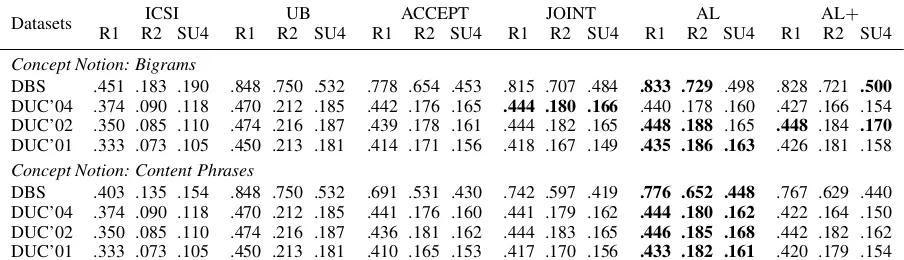
Table 3: ROUGE-1 (R1), ROUGE-2 (R2) and ROUGE SU-4 (SU4) achieved by our models after the tenth iteration of the interactive loop in comparison to the upper bound and the basic ILP setup
Datasets ACCEPT#F JOINT#F AL#F AL#F+
Concept Notion: Bigrams
DBS 313 296 348 342
DUC’04 15 14 16 14
DUC’02 14 13 15 15
DUC’01 13 11 13 13
Concept Notion: Content Phrases
DBS 110 114 133 145
DUC’04 8 9 10 10
DUC’02 7 7 8 6
DUC’01 7 7 8 6
Table 4: Average amount of user feedback (#F) considered by our models at the end of the tenth iteration of the interactive summarization loop
the summary for an individual user, we evaluate our models based on the mean ROUGE scores across clusters per reference summary. In Table4, we additionally evaluate the models based on the amount of feedback (#F = |I0T|) taken by the or-acles to converge to the upper bound within ten iterations.
To examine the system performance based on user feedback, we analyze our models’ perfor-mance on multiple datasets. The results in Table3 show that our idea of interactive multi-document summarization allows users to steer a general sum-mary towards a personalized sumsum-mary consis-tently across all datasets. From the results, we can see that the AL model starts from the concept-based ILP summarization and nearly reaches the upper bound for all the datasets within ten itera-tions. AL+ performs similar to AL in terms of
ROUGE, but requires less feedback (compare Ta-ble 4). Furthermore, the ACCEPT and JOINT models get stuck in a local optimum due to the less exploratory nature of the models.
5.2 Concept Notion
Our interactive summarization approach is based on the scalable global concept-based model which uses bigrams as concepts. Thus, it is intuitive to use bigrams for collecting user feedback as well.7
Although our models reach the upper bound when using bigram-based feedback, they require a sig-nificantly large number of iterations and much feedback to converge, as shown in Table4.
To reduce the amount of feedback, we also con-sider content phrases to collect feedback. That is, syntactic chunks from the constituency parse trees consisting of non-function words (i.e., nouns, verbs, adjectives, and adverbs). For DBS be-ing extractive dataset, we use bigrams and con-tent phrases as concepts, both for the objective function in equation (1) and as feedback items, whereas for the DUC datasets, the concepts are always bigrams for both the feedback types (bi-grams/content phrases). For DUC being abstrac-tive, in the case of feedback given on content phrases, they are projected back to the bigrams to change the concept weights in order to have more overlap of simulated feedback. Table 4 shows feedbacks based on the content phrases reduces the number of feedbacks by a factor of 2. Further-more, when content phrases are used as concepts for DBS, the performance of the models is lower compared to bigrams, as seen in Table3.
5.3 Datasets
0 1 2 3 4 5 6 7 8 9 10 0.1
0.2 0.3 0.4 0.5 0.6 0.7 0.8
R
OUGE
2
Upper bound Active+ Active Joint Accept
0 1 2 3 4 5 6 7 8 9 10
# Iterations
0 50 100 150 200 250 300 350
#
Feedbacks
0 1 2 3 4 5 6 7 8 9 10
0.08 0.10 0.12 0.14 0.16 0.18 0.20 0.22
R
OUGE
2
Upper bound Active+ Active Joint Accept
0 1 2 3 4 5 6 7 8 9 10
# Iterations
0 2 4 6 8 10 12 14 16
#
[image:8.595.80.533.70.395.2]Feedbacks
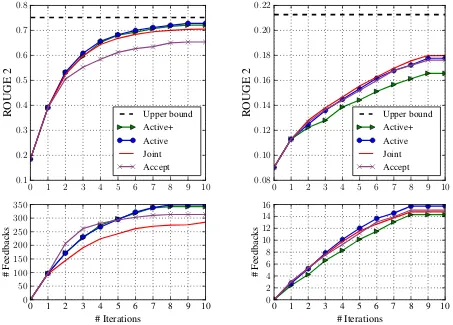
Figure 2: Analysis for the models over the DBS (left) and DUC’04 (right) datasets
on DBS. For DUC’04, the improvements are +.1 ROUGE-2 after ten iterations, which is relatively notable considering the lower upper bound of .21 ROUGE-2. This is primarily because DBS is a corpus of cohesive extracts, whereas DUC’04 con-sists of abstractive summaries. As a result, the ora-cles created using abstractive reference summaries have lower overlap of concepts as compared to that of the oracles created using extractive summaries. For DBS, it becomes clear that the JOINT model converges faster with an optimum amount of feedback as compared to other models. AC-CEPT takes relatively more feedbacks than JOINT, but performs low in terms of ROUGE scores. The best performing models are AL and AL+, which reach closest to the upper bound.
This is clearly due to the exploratory nature of the models which use semantic representations of the concepts to predict uncertainty and importance of possible concepts for user feedback.
For DUC’04, the JOINT model reaches the closest to the upper bound, closely followed by AL. The JOINT model consistently stays above all
other models and it gathers more important con-cepts due to optimizing feedbacks for concon-cepts which lack feedback. Interestingly, AL+performs rather worse in terms of both ROUGE scores and gathering important concepts. The primary reason for this is the fewer feedback collected from the simulation due to the abstractive property of ref-erence summaries, which makes the AL+model’s
prediction inconsistent.
5.4 Personalization
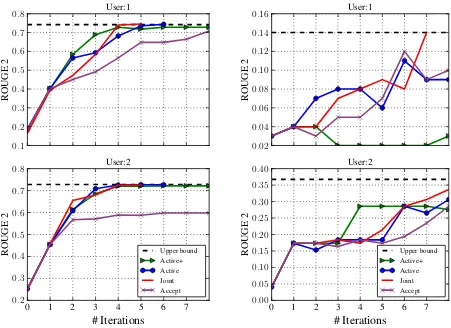
Figure3shows the performance of different mod-els in comparison to two different oracles for the same document cluster. For DBS, the JOINT, AL, and AL+models consistently converge to the
upper bound in 4 iterations for different oracles, whereas ACCEPT takes longer for one oracle and does not reach the upper bound for the other.
For DUC’04, JOINT and AL show consistent performance across the oracles, whereas AL+
0.1 0.2 0.3 0.4 0.5 0.6 0.7 0.8
R
OUGE
2
User:1
0 1 2 3 4 5 6 7
# Iterations
0.2 0.3 0.4 0.5 0.6 0.7 0.8
R
OUGE
2
User:2
Upper bound Active+ Active Joint Accept
0.02 0.04 0.06 0.08 0.10 0.12 0.14 0.16
R
OUGE
2
User:1
0 1 2 3 4 5 6 7
# Iterations
0.00 0.05 0.10 0.15 0.20 0.25 0.30 0.35 0.40
R
OUGE
2
User:2
[image:9.595.81.532.68.396.2]Upper bound Active+ Active Joint Accept
Figure 3: Analysis of models over cluster 7 from DBS (left) and cluster d30051t from DUC’04 (right) respectively for different oracles
However, for User:2, we observe a ROUGE-2 im-provement of +.1 indicating that the predictions of the active learning system are better if there is more feedback. Nevertheless, we expect that in practical use, the human summarizers may give more feedback similar to DBS in comparison to DUC’04 simulation setting.
6 Conclusion and Future Work
We propose a novel ILP-based approach using in-teractive user feedback to create multi-document user-desired summaries. In this paper, we investi-gate pool-based active learning and joint optimiza-tion techniques to collect user feedback for iden-tifying important concepts for a summary. Our models show that interactively collecting feedback consistently steers a general summary towards a user-desired personalized summary. We empiri-cally checked the validity of our approach on stan-dard datasets using simulated user feedback and observed that our framework shows promising re-sults in terms of producing personalized
multi-document summaries.
As future work, we plan to investigate more sophisticated sampling strategies based on active learning and concept graphs to incorporate lexical-semantic information for concept selection. We also plan to look into ways to propagate feedback to similar and related concepts with partial feed-back, to reduce the total amount of feedback. This is a promising direction as we have shown that in-teractive methods help to create user-desired per-sonalized summaries, and with minimum amount of feedbacks, it has propitious use in scenarios where user-adapted content is a requirement.
Acknowledgments
References
Darina Benikova, Margot Mieskes, Christian M. Meyer, and Iryna Gurevych. 2016. Bridging the gap between extractive and abstractive summaries: Cre-ation and evaluCre-ation of coherent extracts from het-erogeneous sources. InProceedings of the 26th In-ternational Conference on Computational Linguis-tics (COLING). Osaka, Japan, pages 1039–1050.
http://aclweb.org/anthology/C16-1099.
Taylor Berg-Kirkpatrick, Dan Gillick, and Dan Klein. 2011. Jointly learning to extract and compress. In Proceedings of the 49th An-nual Meeting of the Association for Computa-tional Linguistics: Human Language Technologies (ACL/HLT). Portland, OR, USA, pages 481–490.
http://aclweb.org/anthology/P11-1049.
Shlomo Berkovsky, Timothy Baldwin, and Ingrid Zuk-erman. 2008. Aspect-based personalized text sum-marization. InAdaptive Hypermedia and Adaptive Web-Based Systems. Proceedings of the 5th Interna-tional Conference, Springer, Berlin/Heidelberg, vol-ume 5149 of Lecture Notes in Computer Science, pages 267–270. https://doi.org/10.1007/978-3-540-70987-9 31.
Florian Boudin, Hugo Mougard, and Benoit Favre. 2015. Concept-based summarization using in-teger linear programming: From concept prun-ing to multiple optimal solutions. In Pro-ceedings of the 2015 Conference on Empiri-cal Methods in Natural Language Processing (EMLNP). Lisbon, Portugal, pages 1914–1918.
http://aclweb.org/anthology/D15-1220.
Ziqiang Cao, Chengyao Chen, Wenjie Li, Sujian
Li, Furu Wei, and Ming Zhou. 2016.
TG-Sum: Build Tweet Guided Multi-Document Sum-marization Dataset. In Proceedings of the Thir-tieth AAAI Conference on Artificial Intelligence (AAAI). Phoenix, AZ, USA, pages 2906–2912.
http://www.aaai.org/ocs/index.php/AAAI/AAAI16. T. C. Craven. 2000. Abstracts produced using
computer assistance. Journal of the American Society for Information Science 51(8):745–756.
https://doi.org/10.1002/(SICI)1097-4571(2000)51:8 <745::AID-ASI70>3.0.CO;2-Z.
Alberto D´ıaz and Pablo Gerv´as. 2007. User-model based personalized summarization. In-formation Process Management 43(6):1715–1734.
https://doi.org/10.1016/j.ipm.2007.01.009.
G¨unes Erkan and Dragomir R. Radev. 2004.
LexRank: Graph-based Lexical Centrality As Salience in Text Summarization. Journal of Artificial Intelligence Research 22(1):457–479.
https://www.jair.org/papers/paper1523.html. Dan Gillick and Benoit Favre. 2009.A scalable global
model for summarization. In Proceedings of the Workshop on Integer Linear Programming for Natu-ral Langauge Processing. Boulder, CO, USA, pages 10–18. http://aclweb.org/anthology/W09-1802.
Yihong Gong and Xin Liu. 2001. Generic text sum-marization using relevance measure and latent se-mantic analysis. In Proceedings of the 24th An-nual International ACM SIGIR Conference on Re-search and Development in Information Retrieval (SIGIR). New Orleans, LA, USA, pages 19–25.
https://doi.org/10.1145/383952.383955.
Jes´us Gonz´alez-Rubio, Daniel Ortiz-Mart´ınez, and Francisco Casacuberta. 2012. Active learning for interactive machine translation. In Proceedings of the 13th Conference of the European Chap-ter of the Association for Computational Linguis-tics (EACL). Avignon, France, pages 245–254.
http://aclweb.org/anthology/E12-1025.
Aria Haghighi and Lucy Vanderwende. 2009. Explor-ing content models for multi-document summariza-tion. In Proceedings of Human Language Tech-nologies: The 2009 Annual Conference of the North American Chapter of the Association for Compu-tational Linguistics (NAACL). Boulder, CO, USA, pages 362–370. http://aclweb.org/anthology/N09-1041.
Kai Hong, John M. Conroy, Benoˆıt Favre, Alex Kulesza, Hui Lin, and Ani Nenkova. 2014. A repos-itory of state of the art and competitive baseline summaries for generic news summarization. In Pro-ceedings of the Ninth International Conference on Language Resources and Evaluation (LREC). Reyk-javik, Iceland, pages 1608–1616. http://www.lrec-conf.org/proceedings/lrec2014/summaries/1093.html.
Po Hu, Donghong Ji, Chong Teng, and Yujing Guo. 2012. Context-enhanced personalized social sum-marization. In Proceedings of the 24th Inter-national Conference on Computational Linguis-tics (COLING). Mumbai, India, pages 1223–1238.
http://www.aclweb.org/anthology/C12-1075.
Dan Klein and Christopher D. Manning. 2003.
Accurate unlexicalized parsing. In Pro-ceedings of the 41st Annual Meeting on Association for Computational Linguis-tics (ACL). Sapporo, Japan, pages 423–430.
https://doi.org/10.3115/1075096.1075150.
Rebecca Knowles and Philipp Koehn. 2016. Neural interactive translation prediction. In Proceedings of the Conference of the Association for Machine Translation in the Americas (AMTA).
Jan Kremer, Kim Steenstrup Pedersen, and Christian Igel. 2014. Active learning with support vector machines. Wiley Interdisciplinary Reviews: Data Mining and Knowledge Discovery 4(4):313–326.
https://doi.org/10.1002/widm.1132.
Chin-Yew Lin. 2004. ROUGE: A Package for Au-tomatic Evaluation of Summaries. In Text Sum-marization Branches Out: Proceedings of the ACL-04 Workshop. Barcelona, Spain, pages 74–81.
http://aclweb.org/anthology/W04-1013.
Edward Loper and Steven Bird. 2002. NLTK: The Natural Language Toolkit. In Proceedings of the ACL-02 Workshop on Effective Tools and Method-ologies for Teaching Natural Language Process-ing and Computational LProcess-inguistics. pages 63–70.
https://doi.org/10.3115/1118108.1118117.
H. P. Luhn. 1958. The automatic creation of literature abstracts. IBM Journal of Re-search and Development 2(2):159–165.
https://doi.org/10.1147/rd.22.0159.
Ryan McDonald. 2007.A study of global inference al-gorithms in multi-document summarization. In Ad-vances in Information Retrieval. Proceedings of the 29th European Conference on IR Research (ECIR), Springer, Berlin/Heidelberg, volume 4425 of Lec-ture Notes in Computer Science, pages 557–564.
https://doi.org/10.1007/978-3-540-71496-5 51. Rada Mihalcea and Paul Tarau. 2004. TextRank:
Bringing Order into Text. In Proceedings of the 2004 Conference on Empirical Methods in Natural Language Processing (EMNLP). Barcelona, Spain, pages 404–411. http://aclweb.org/anthology/W04-3252.
Tomas Mikolov, Kai Chen, Greg Corrado, and Jef-frey Dean. 2013. Efficient estimation of word rep-resentations in vector space. CoRRabs/1301.3781.
http://arxiv.org/abs/1301.3781.
Masumi Narita, Kazuya Kurokawa, and Takehito Utsuro. 2002. A Web-based English Abstract Writing Tool Using a Tagged E–J Parallel Cor-pus. In Proceedings of the Third International Conference on Language Resources and Evalua-tion (LREC). Las Palmas, Spain. http://www.lrec-conf.org/proceedings/lrec2002/sumarios/137.htm. Constantin Orˇasan and Laura Hasler. 2006.
Computer-aided Summarisation: What the User Really Wants. In Proceedings of the 5th International Conference on Language Resources and Evaluation (LREC). Genoa, Italy, pages 1548–1551. http://www.lrec-conf.org/proceedings/lrec2006/summaries/52.html. Constantin Orˇasan, Ruslan Mitkov, and Laura Hasler.
2003. CAST: a computer-aided summarisation tool. InProceedings of the tenth conference on European chapter of the Association for Computational Lin-guistics (EACL). Budapest, Hungary, pages 135– 138. http://aclweb.org/anthology/E03-1066. Karolina Owczarzak, John M. Conroy, Hoa Trang
Dang, and Ani Nenkova. 2012. An assessment of the accuracy of automatic evaluation in sum-marization. In Proceedings of Workshop on Eval-uation Metrics and System Comparison for Auto-matic Summarization. Montr´eal, Canada, pages 1–9.
http://aclweb.org/anthology/W12-2601.
Sun Park and Dong Un An. 2010.
Auto-matic Query-based Personalized Summarization That Uses Pseudo Relevance Feedback with NMF. In Proceedings of the 4th International Con-ference on Ubiquitous Information Management and Communication (ICUIMC). pages 61:1–61:7.
https://doi.org/10.1145/2108616.2108690.
Helen Petrie and Nigel Bevan. 2009. The evaluation of accessibility, usability, and user experience. In Constantine Stephanidis, editor, The Universal Ac-cess Handbook, Boca Raton: CRC Press, Human Factors and Ergonomics, chapter 20, pages 1–16.
https://doi.org/10.1201/9781420064995-c20. John C. Platt. 1999. Probabilistic outputs for
sup-port vector machines and comparisons to regularized likelihood methods. InAdvances In Large Margin Classifiers. MIT Press, pages 61–74.
Micka¨el Poussevin, Vincent Guigue, and Patrick Gal-linari. 2015. Extended recommendation framework: Generating the text of a user review as a personalized summary. InProceedings of the 2nd Workshop on New Trends on Content-Based Recommender Sys-tems co-located with 9th ACM Conference on Rec-ommender Systems (RecSys 2015), Vienna, Austria, September 16-20, 2015. pages 34–41. http://ceur-ws.org/Vol-1448/paper7.pdf.
Nils Reimers, Judith Eckle-Kohler, Carsten Schnober, Jungi Kim, and Iryna Gurevych. 2014. GermEval-2014: Nested Named Entity Recognition with Neu-ral Networks. InWorkshop Proceedings of the 12th Edition of the KONVENS Conference. Hildesheim, Germany, pages 117–120.
Kristian Woodsend and Mirella Lapata. 2012. Multi-ple aspect summarization using integer linear pro-gramming. InProceedings of the 2012 Joint Con-ference on Empirical Methods in Natural Language Processing and Computational Natural Language Learning (EMNLP/CoNLL). Jeju Island, Korea, pages 233–243. http://aclweb.org/anthology/D12-1022.
Klaus Zechner. 2002. Automatic summarization of open-domain multiparty dialogues in diverse genres.
Journal of Computational Linguistics 28(4):447– 485. https://doi.org/10.1162/089120102762671945.
Haiqin Zhang, Zheng Chen Wei-ying Ma, and
Qingsheng Cai. 2003. A study for
docu-ments summarization based on personal annota-tion. In Proceedings of the HLT-NAACL 03 on Text Summarization Workshop. pages 41–48.