Proceedings of the 55th Annual Meeting of the Association for Computational Linguistics, pages 1470–1480 Vancouver, Canada, July 30 - August 4, 2017. c2017 Association for Computational Linguistics Proceedings of the 55th Annual Meeting of the Association for Computational Linguistics, pages 1470–1480
Vancouver, Canada, July 30 - August 4, 2017. c2017 Association for Computational Linguistics
Weakly Supervised Cross-Lingual Named Entity Recognition
via Effective Annotation and Representation Projection
Jian Ni and Georgiana Dinu and Radu Florian
IBM T. J. Watson Research Center
1101 Kitchawan Road, Yorktown Heights, NY 10598, USA
{nij, gdinu, raduf}@us.ibm.com
Abstract
The state-of-the-art named entity recog-nition (NER) systems are supervised ma-chine learning models that require large amounts of manually annotated data to achieve high accuracy. However, anno-tating NER data by human is expensive and time-consuming, and can be quite dif-ficult for a new language. In this pa-per, we present two weakly supervised ap-proaches for cross-lingual NER with no human annotation in a target language. The first approach is to create automati-cally labeled NER data for a target lan-guage via annotation projection on compa-rable corpora, where we develop a heuris-tic scheme that effectively selects good-quality projection-labeled data from noisy data. The second approach is to project distributed representations of words (word embeddings) from a target language to a source language, so that the source-language NER system can be applied to the target language without re-training. We also design two co-decoding schemes that effectively combine the outputs of the two projection-based approaches. We evaluate the performance of the proposed approaches on both in-house and open NER data for several target languages. The results show that the combined sys-tems outperform three other weakly super-vised approaches on the CoNLL data.
1 Introduction
Named entity recognition (NER) is a fundamen-tal information extraction task that automatically detects named entities in text and classifies them into pre-defined entity types such as PERSON, ORGANIZATION, GPE (GeoPolitical Entities),
EVENT, LOCATION, TIME, DATE, etc. NER provides essential inputs for many information ex-traction applications, including relation exex-traction, entity linking, question answering and text min-ing. Building fast and accurate NER systems is a crucial step towards enabling large-scale auto-mated information extraction and knowledge dis-covery on the huge volumes of electronic docu-ments existing today.
The state-of-the-art NER systems are super-vised machine learning models (Nadeau and Sekine, 2007), including maximum entropy Markov models (MEMMs) (McCallum et al., 2000), conditional random fields (CRFs) (Lafferty et al.,2001) and neural networks (Collobert et al., 2011;Lample et al., 2016). To achieve high ac-curacy, a NER system needs to be trained with a large amount of manually annotated data, and is often supplied with language-specific resources (e.g., gazetteers, word clusters, etc.). Annotating NER data by human is rather expensive and time-consuming, and can be quite difficult for a new language. This creates a big challenge in building NER systems of multiple languages for supporting multilingual information extraction applications.
The difficulty of acquiring supervised annota-tion raises the following quesannota-tion: given a well-trained NER system in a source language (e.g., English), how can one go about extending it to a new language with decent performance and no human annotation in the target language? There are mainly two types of approaches for building weakly supervised cross-lingual NER systems.
The first type of approaches create weakly la-beled NER training data in a target language. One way to create weakly labeled data is through an-notation projection on aligned parallel corpora or translations between a source language and a tar-get language, e.g., (Yarowsky et al.,2001;Zitouni and Florian, 2008; Ehrmann et al., 2011). An-other way is to utilize the text and structure of
Wikipedia to generate weakly labeled multilingual training annotations, e.g., (Richman and Schone, 2008;Nothman et al.,2013;Al-Rfou et al.,2015). The second type of approaches are based on di-rect model transfer, e.g., (T¨ackstr¨om et al.,2012; Tsai et al.,2016). The basic idea is to train a single NER system in the source language with language independent features, so the system can be applied to other languages using those universal features.
In this paper, we make the following contri-butions to weakly supervised cross-lingual NER with no human annotation in the target languages. First, for theannotation projectionapproach, we develop a heuristic, language-independent data se-lection scheme that seeks to select good-quality projection-labeled NER data from comparable corpora. Experimental results show that the data selection scheme can significantly improve the ac-curacy of the target-language NER system when the alignment quality is low and the projection-labeled data are noisy.
Second, we propose a new approach for direct NER model transfer based onrepresentation pro-jection. It projects word representations in vector space (word embeddings) from a target language to a source language, to create a universal repre-sentation of the words in different languages. Un-der this approach, the NER system trained for the source language can be directly applied to the tar-get language without the need for re-training.
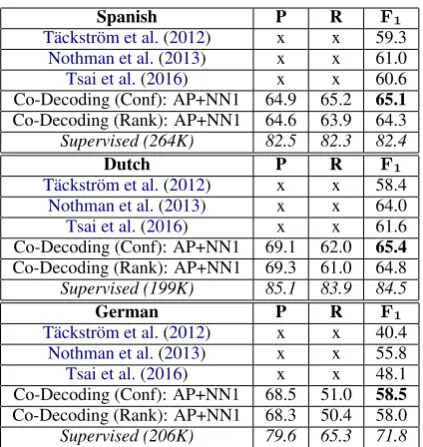
Finally, we design two co-decoding schemes that combine the outputs (views) of the two projection-based systems to produce an output that is more accurate than the outputs of individual sys-tems. We evaluate the performance of the pro-posed approaches on both in-house and open NER data sets for a number of target languages. The re-sults show that the combined systems outperform the state-of-the-art cross-lingual NER approaches proposed in T¨ackstr¨om et al. (2012), Nothman et al.(2013) andTsai et al.(2016) on the CoNLL NER test data (Tjong Kim Sang, 2002; Tjong Kim Sang and De Meulder,2003).
We organize the paper as follows. In Section 2 we introduce three NER models that are used in the paper. In Section 3 we present an anno-tation projection approach with effective data se-lection. In Section 4 we propose a representation projection approach for direct NER model trans-fer. In Section 5 we describe two co-decoding schemes that effectively combine the outputs of
two projection-based approaches. In Section 6 we evaluate the performance of the proposed ap-proaches. We describe related work in Section 7 and conclude the paper in Section 8.
2 NER Models
The NER task can be formulated as a sequence labeling problem: given a sequence of words
x1, ..., xn, we want to infer the NER taglifor each
wordxi,1 ≤ i≤n. In this section we introduce
three NER models that are used in the paper. 2.1 CRFs and MEMMs
Conditional random fields (CRFs) are a class of discriminative probabilistic graphical models that provide powerful tools for labeling sequential data (Lafferty et al.,2001). CRFs learn a conditional probability model pλ(l|x) from a set of labeled
training data, wherex= (x1, ...,xn)is a random
sequence of input words,l= (l1, ...,ln)is the
se-quence of label variables (NER tags) forx, andl
has certain Markov properties conditioned on x. Specifically, a general-order CRF with ordero
as-sumes that label variableliis dependent on a fixed
numberoof previous label variablesli−1, ...,li−o,
with the following conditional distribution:
pλ(l|x) = ePni=1
PK
k=1λkfk(li,li−1,...,li−o,x)
Zλ(x) (1)
wherefk’s are feature functions,λk’s are weights
of the feature functions (parameters to learn), and
Zλ(x)is a normalization constant. Wheno = 1,
we have a first-order CRF which is also known as a linear-chain CRF.
Given a set of labeled training data D = (x(j),l(j))j=1,...,N, we seek to find an optimal set
of parameters λ∗ that maximize the conditional
log-likelihood of the data:
λ∗ = arg max
λ N X
j=1
logpλ(l(j)|x(j)) (2)
Once we obtainλ∗, we can use the trained model pλ∗(l|x)to decode the most likely label sequence l∗ for any new input sequence of wordsx(via the
Viterbi algorithm for example):
l∗= arg max
l pλ∗(l|x) (3)
chain conditioned onx:
pλ(l|x) = n Y
i=1
pλ(li|li−1, ...,li−o,x)
=
n Y
i=1
ePKk=1λkfk(li,li−1,...,li−o,x)
Zλ(li−1, ...,li−o,x) (4)
The main difference between CRFs and MEMMs is that CRFs normalize the conditional distribution over the whole sequence as in (1), while MEMMs normalize the conditional distribu-tion per token as in (4). As a result, CRFs can bet-ter handle the label bias problem (Lafferty et al., 2001). This benefit, however, comes at a price. The training time of order-oCRFs grows
exponen-tially (O(Mo+1)) with the number of output labels
M, which is typically slow even for moderate-size training data ifMis large. In contrast, the training
time of order-o MEMMs is linear (O(M)) with
respect to M independent of o, so it can handle
larger training data with higher order of depen-dency. We have implemented both a linear-chain CRF model and a general-order MEMM model.
2.2 Neural Networks
With the increasing popularity of distributed (vec-tor) representations of words, neural network models have recently been applied to tackle many NLP tasks including NER (Collobert et al.,2011; Lample et al.,2016).
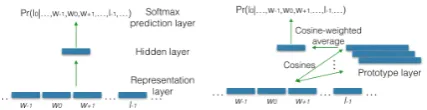
[image:3.595.311.525.62.117.2]We have implemented a feedforward neural net-work model which maximizes the log-likelihood of the training data similar to that of (Collobert et al.,2011). We adopt a locally normalized model (the conditional distribution is normalized per to-ken as in MEMMs) and introduce context depen-dency by conditioning on the previously assigned tags. We use a target word and its surrounding context as features. We do not use other common features such as gazetteers or character-level rep-resentations as such features might not be readily available or might not transfer to other languages. We have deployed two neural network architec-tures. The first one (called NN1) uses the word embedding of a word as the input. The sec-ond one (called NN2) adds a smoothing proto-type layer that computes the cosine similarity be-tween a word embedding and a fixed set of proto-type vectors (learned during training) and returns a weighted average of these prototype vectors as the input. In our experiments we find that with the
Figure 1: Architecture of the two neural network models: left-NN1, right-NN2.
smoothing layer, NN2 tends to have a more bal-anced precision and recall than NN1. Both net-works have one hidden layer, with sigmoid and softmax activation functions on the hidden and output layers respectively. The two neural network models are depicted in Figure1.
3 Annotation Projection Approach The existing annotation projection approaches re-quire parallel corpora or translations between a source language and a target language with alignment information. In this paper, we de-velop a heuristic, language-independent data se-lection scheme that seeks to select good-quality projection-labeled data from noisy comparable corpora. We use English as the source language.
Suppose we have comparable1 sentence
pairs (X,Y) between English and a target
lan-guage, where X includes N English sentences x(1), ...,x(N), Y includes N target-language
sentences y(1), ...,y(N), and y(j) is aligned to x(j)via an alignment model,1≤j≤N. We use
a sentence pair (x,y) as an example to illustrate
how the annotation projection procedure works, wherex= (x1, x2, ..., xs)is an English sentence,
and y = (y1, y2, ..., yt) is a target-language
sentence that is aligned tox.
Annotation Projection Procedure
1. Apply the English NER system on the En-glish sentence x to generate the NER tags l= (l1, l2, ..., ls)forx.
2. Project the NER tags to the target-language sentence y using the alignment
informa-tion. Specifically, if a sequence of English words(xi, ..., xi+p)is aligned to a sequence
of target-language words (yj, ..., yj+q), and
(xi, ..., xi+p) is recognized (by the English
NER system) as an entity with NER tag l,
then(yj, ..., yj+q)is labeled withl2.
Letl0 = (l10, l02, ..., l0t) be the projected NER
tags for the target-language sentencey.
We can apply the annotation projection proce-dure on all the sentence pairs(X,Y), to generate
projected NER tagsL0for the target-language
sen-tencesY. (Y,L0) are automatically labeled NER
data with no human annotation in the target lan-guage. One can use those projection-labeled data to train an NER system in the target language. The quality of such weakly labeled NER data, and con-sequently the accuracy of the target-language NER system, depend on both 1) the accuracy of the En-glish NER system, and 2) the alignment accuracy of the sentence pairs.
Since we don’t require actual translations, but only comparable data, the downside is that if some of the data are not actually parallel and if we use all for weakly supervised learning, the accuracy of the target-language NER system might be ad-versely affected. We are therefore motivated to design effective data selection schemes that can select good-quality projection-labeled data from noisy data, to improve the accuracy of the anno-tation projection approach for cross-lingual NER.
3.1 Data Selection Scheme
We first design a metric to measure the annotation quality of a projection-labeled sentence in the tar-get language. We construct a frequency table T
which includes all the entities in the projection-labeled target-language sentences. For each entity
e, T also includes the projected NER tags for e
and the relative frequency (empirical probability)
ˆ
P(l|e)that entityeis labeled with tagl. Table1
shows a snapshot of the frequency table where the target language is Portuguese.
We usePˆ(l|e) to measure the reliability of
la-beling entity e with tag l in the target language. The intuition is that if an entity eis labeled by a
taglwith higher frequency than other tags in the
projection-labeled data, it is more likely that the annotation is correct. For example, if the joint ac-curacy of the source NER system and alignment system is greater than 0.5, then the correct tag of a random entity will have a higher relative fre-quency than other tags in a large enough sample.
Based on the frequency scores, we calculate the quality score of a projection-labeled
target-2If the IOB (Inside, Outside, Beginning) tagging format is used, then(yj, yj+1, ..., yj+q)is labeled with (B-l, I-l,...,I-l).
Entity Name NER Tag Frequency
Estados Unidos GPE 0.853
[image:4.595.317.519.61.135.2]Estados Unidos ORGANIZATION 0.143 Estados Unidos PEOPLE 0.001 Estados Unidos PRODUCT 0.001 Estados Unidos TITLEWORK 0.001 Estados Unidos EVENT 0.001
Table 1: A snapshot of the frequency table where the target language is Portuguese.Estados Unidos meansUnited States. The correct NER tag for Es-tados Unidos is GPE which has the highest relative frequency in the weakly labeled data.
language sentence y by averaging the frequency
scores of the projected entities in the sentence:
q(y) = Σe∈yPˆ(l
0(e)|e)
n(y) (5)
where l0(e) is the projected NER tag for e, and n(y)is the total number of entities in sentencey.
We use q(y)to measure the annotation quality of sentence y, and n(y) to measure the amount
of annotation information contained in sentencey.
We design aheuristic data selection schemewhich selects projection-labeled sentences in the target language that satisfy the following condition:
q(y)≥q; n(y)≥n (6)
where q is a quality score threshold and n is an
entity number threshold. We can tune the two pa-rameters to make tradeoffs among the annotation quality of the selected sentences, the annotation information contained in the selected sentences, and the total number of sentence selected.
One way to select the threshold parameters q
and n is via a development set - either a small
set of human-annotated data or a sample of the projection-labeled data. We select the threshold parameters viacoordinate searchusing the devel-opment set: we first fixn= 3and search the bestqˆ
in[0,0.9]with a step size of 0.1; we then fixq= ˆq
and select the bestˆnin[1,5]with a step size of 1.
3.2 Accuracy Improvements
Language (q, n) Training Size F1Score
Japanese (0, 0) 4.9M 41.2 (0.7, 4) 1.3M 53.4
Korean (0, 0) 4.5M 25.0
(0.4, 2) 1.5M 38.7
German (0, 0) 5.2M 67.2
[image:5.595.80.283.62.157.2](0.4, 4) 2.6M 67.5 Portuguese (0, 0) 2.1M 61.5 (0.1, 4) 1.5M 62.7
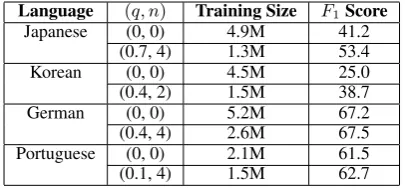
Table 2: Performance comparison of weakly su-pervised NER systems trained without data se-lection ((q, n) = (0,0)) and with data selection
((ˆq,nˆ)determined by coordinate search).
which are served as the test data for evaluating the target-language NER system.
The source (English) NER system is a linear-chain CRF model which achieves an accuracy of 88.9 F1 score on an independent NER test set.
The alignment systems between English and the target languages are maximum entropy models (Ittycheriah and Roukos, 2005), with an accu-racy of 69.4/62.0/76.1/88.0 F1 score on
indepen-dent Japanese/Korean/German/Portuguese align-ment test sets.
For each target language, we randomly select 5% of the projection-labeled data as the develop-ment set and the remaining 95% as the training set. We compare an NER system trained with all the projection-labeled training data with no data selection (i.e., (q, n) = (0,0)) and an NER
sys-tem trained with projection-labeled data selected by the data selection scheme where the develop-ment set is used to select the threshold parame-tersqandnvia coordinate search. Both NER sys-tems are 2nd-order MEMM models3which use the
same template of features.
The results are shown in Table 2. For differ-ent target languages, we use the same source (En-glish) NER system for annotation projection, so the differences in the accuracy improvements are mainly due to the alignment quality of the com-parable corpora between English and different tar-get languages. When the alignment quality is low (e.g., as for Japanese and Korean) and hence the projection-labeled NER data are quite noisy, the proposed data selection scheme is very effective in selecting good-quality projection-labeled data and the improvement is big: +12.2 F1 score for 3In our experiments, CRFs cannot handle training data with a few million words, since our NER system has over 50 entity types, and the training time of CRFs grows at least quadratically in the number of entity types.
Japanese and +13.7 F1 score for Korean.
Us-ing a stratified shufflUs-ing test (Noreen, 1989), for a significance level of 0.05, data-selection is sta-tistically significantly better than no-selection for Japanese, Korean and Portuguese.
4 Representation Projection Approach In this paper, we propose a new approach for di-rect NER model transfer based on representation projection. Under this approach, we train a single English NER system that uses only word embed-dings as input representations. We create mapping functions which can map words in any language into English and we simply use the English NER system to decode. In particular, by mapping all languages into English, we are using one univer-sal NER system and we do not need to re-train the system when a new language is added.
4.1 Monolingual Word Embeddings
We first build vector representations of words (word embeddings) for a language using mono-lingual data. We use a variant of the Con-tinuous Bag-of-Words (CBOW) word2vec model (Mikolov et al., 2013a), which concatenates the context words surrounding a target word instead of adding them (similarly to (Ling et al., 2015)). Additionally, we employ weightsw = dist(1x,x
c) that decay with the distance of a context wordxc
to a target wordx. Tests on word similarity
bench-marks show this variant leads to small improve-ments over the standard CBOW model.
We train 300-dimensional word embeddings for English. Following (Mikolov et al., 2013b), we use larger dimensional embeddings for the target languages, namely 800. We train word2vec for 1 epoch for English/Spanish and 5 epochs for the rest of the languages for which we have less data.
4.2 Cross-Lingual Representation Projection We learn cross-lingual word embedding map-pings, similarly to (Mikolov et al.,2013b). For a target language f, we first extract a small
train-ing dictionary from a phrase table that includes word-to-word alignments between English and the target language f. The dictionary contains
En-glish and target-language word pairs with weights:
(xi, yi, wi)i=1,...,n, where xi is an English word, yiis a target-language word, and the weightwi =
ˆ
P(xi|yi)is the relative frequency ofxigivenyias
Suppose we have monolingual word embed-dings for English and the target language f. Let ui ∈ Rd1 be the vector representation for English
wordxi,vi ∈ Rd2 be the vector representation for
target-language wordyi. We find a linear mapping Mf→e by solving the following weighted least
squares problem where the dictionary is used as the training data:
Mf→e= arg min
M
n X
i=1
wi||ui−Mvi||2 (7)
In (7) we generalize the formulation in (Mikolov et al., 2013b) by adding frequency weights to the word pairs, so that more frequent pairs are of higher importance. UsingMf→e, for
any new word in f with vector representationv,
we can project it into the English vector space as the vectorMf→ev.
The training dictionary plays a key role in find-ing an effective cross-lfind-ingual embeddfind-ing mappfind-ing. To control the size of the dictionary, we only include word pairs with a minimum frequency threshold. We set the threshold to obtain approx-imately 5K to 6K unique word pairs for a target language, as our experiments show that larger-size dictionaries might harm the performance of repre-sentation projection for direct NER model transfer. 4.3 Direct NER Model Transfer
The source (English) NER system is a neural net-work model (with architecture NN1 or NN2) that uses only word embedding features (embeddings of a word and its surrounding context) in the En-glish vector space. Model transfer is achieved sim-ply by projecting the target language word embed-dings into the English vector space and decoding these using the English NER system.
More specifically, given the word embeddings of a sequence of words in a target language f,
(v1, ...,vt), we project them into the English
vec-tor space by applying the linear mappingMf→e:
(Mf→ev1, ...,Mf→evt). The English NER
sys-tem is then applied on the projected input to pro-duce NER tags. Words not in the target-language vocabulary are projected into their English embed-dings if they are found in the English vocabulary, or into an NER-trained UNK vector otherwise.
5 Co-Decoding
Given two weakly supervised NER systems which are trained with different data using different
mod-els (MEMM model for annotation projection and neural network model for representation projec-tion), we would like to design a co-decoding scheme that can combine the outputs (views) of the two systems to produce an output that is more accurate than the outputs of individual systems.
Since both systems are statistical models and can produce confidence scores (probabilities), a natural co-decoding scheme is to compare the con-fidence scores of the NER tags generated by the two systems and select the tags with higher con-fidences scores. However, confidence scores of two weakly supervised systems may not be di-rectly comparable, especially when comparing O tags with non-O tags (i.e., entity tags). We con-sider anexclude-O confidence-based co-decoding schemewhich we find to be more effective empir-ically. It is similar to the pure confidence-based scheme, with the only difference that it always prefers a non-O tag of one system to an O tag of the other system, regardless of their confidence scores.
In our experiments we find that the annotation projection system tends to have a high precision and low recall, i.e., it detects fewer entities, but for the detected entities the accuracy is high. The representation projection system tends to have a more balanced precision and recall. Based on this observation, we develop the followingrank-based co-decoding scheme that gives higher priority to the high-precision annotation projection system:
1. The combined output includes all the entities detected by the annotation projection system. 2. It then adds all the entities detected by the representation projection system that do not conflict4with entities detected by the
annota-tion projecannota-tion system (to improve recall). Note that an entity X detected by the rep-resentation projection system does not conflict with the annotation projection system if the an-notation projection system produces O tags for the entire span of X. For example, suppose the output tag sequence of annotation projection is (B-PER,O,O,O,O), of representation projection is (B-ORG,I-ORG,O,B-LOC,I-LOC), then the com-bined output under the rank-based scheme will be (B-PER,O,O,B-LOC,I-LOC).
Japanese P R F1
Annotation-Projection (AP) 69.9 43.2 53.4 Representation-Projection (NN1) 71.5 36.6 48.4 Representation-Projection (NN2) 59.9 42.4 49.7 Co-Decoding (Conf): AP+NN1 65.7 49.5 56.5 Co-Decoding (Rank): AP+NN1 68.3 51.6 58.8
Co-Decoding (Conf): AP+NN2 59.5 53.3 56.2 Co-Decoding (Rank): AP+NN2 61.6 54.5 57.8 Supervised (272K) 84.5 80.9 82.7
Korean P R F1
Annotation-Projection (AP) 69.5 26.8 38.7 Representation-Projection (NN1) 66.1 23.2 34.4 Representation-Projection (NN2) 68.5 43.4 53.1 Co-Decoding (Conf): AP+NN1 68.2 41.0 51.2 Co-Decoding (Rank): AP+NN1 71.3 42.8 53.5 Co-Decoding (Conf): AP+NN2 68.9 53.4 60.2 Co-Decoding (Rank): AP+NN2 70.0 53.3 60.5
Supervised (97K) 88.2 74.0 80.4
German P R F1
Annotation-Projection (AP) 76.5 60.5 67.5 Representation-Projection (NN1) 69.0 48.8 57.2 Representation-Projection (NN2) 63.7 66.1 64.9 Co-Decoding (Conf): AP+NN1 68.5 61.7 64.9 Co-Decoding (Rank): AP+NN1 72.7 65.0 68.6 Co-Decoding (Conf): AP+NN2 64.7 71.3 67.9 Co-Decoding (Rank): AP+NN2 67.1 72.6 69.7
Supervised (125K) 77.8 68.1 72.6
Portuguese P R F1
Annotation-Projection (AP) 84.0 50.1 62.7 Representation-Projection (NN1) 70.5 47.6 56.8 Representation-Projection (NN2) 66.0 63.4 64.7 Co-Decoding (Conf): AP+NN1 72.0 55.8 62.9 Co-Decoding (Rank): AP+NN1 77.5 59.7 67.4 Co-Decoding (Conf): AP+NN2 68.1 67.1 67.6 Co-Decoding (Rank): AP+NN2 70.9 68.3 69.6
[image:7.595.74.291.60.440.2]Supervised (173K) 79.8 71.9 75.6 Table 3: In-house NER data: Precision, Recall and
F1score on exact phrasal matches. The highestF1
score among all the weakly supervised approaches is shown in bold. Same for Tables4and5.
6 Experiments
In this section, we evaluate the performance of the proposed approaches for cross-lingual NER, in-cluding the 2 projection-based approaches and the 2 co-decoding schemes for combining them: (1) The annotation projection (AP) approach with heuristic data selection;
(2) The representation projection approach (with two neural network architectures NN1 and NN2); (3) The exclude-O confidence-based co-decoding scheme;
(4) The rank-based co-decoding scheme.
6.1 NER Data Sets
We have used various NER data sets for evalu-ation. The first group includes in-house human-annotated newswire NER data for four languages:
Japanese, Korean, German and Portuguese, anno-tated with over 50 entity types. The main motiva-tion of deploying such a fine-grained entity type set is to build cognitive question answering appli-cations on top of the NER systems. The entity type set has been engineered to cover many of the fre-quent entity types that are targeted by naturally-phrased questions. The sizes of the test data sets are ranging from 30K to 45K tokens.
The second group includes open human-annotated newswire NER data for Spanish, Dutch and German from the CoNLL NER data sets (Tjong Kim Sang, 2002; Tjong Kim Sang and De Meulder,2003). The CoNLL data have 4 en-tity types: PER (persons), ORG (organizations), LOC (locations) and MISC (miscellaneous enti-ties). The sizes of the development/test data sets are ranging from 35K to 70K tokens. The devel-opment data are used for tuning the parameters of learning methods.
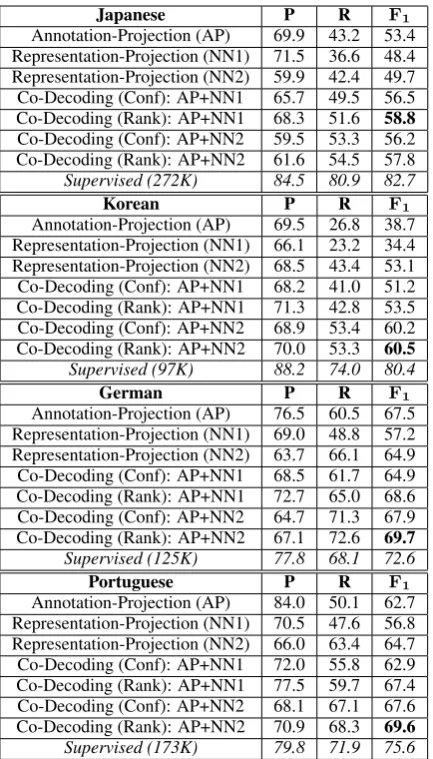
6.2 Evaluation for In-House NER Data In Table 3, we show the results of different ap-proaches for the in-house NER data. For annota-tion projecannota-tion, the source (English) NER system is a linear-chain CRF model trained with 328K to-kens of human-annotated English newswire data. The target-language NER systems are 2nd-order MEMM models trained with 1.3M, 1.5M, 2.6M and 1.5M tokens of projection-labeled data for Japanese, Korean, German and Portuguese, re-spectively. The projection-labeled data are se-lected using the heuristic data selection scheme (see Table 2). For representation projection, the source (English) NER systems are neural network models with architectures NN1 and NN2 (see Fig-ure1), both trained with 328K tokens of human-annotated English newswire data.
The results show that the annotation projection (AP) approach has a relatively high precision and low recall. For representation projection, neural network model NN2 (with a smoothing layer) is better than NN1, and NN2 tends to have a more balanced precision and recall. The rank-based co-decoding scheme is more effective for combining the two projection-based approaches. In particu-lar, the rank-based scheme that combines AP and NN2 achieves the highestF1 score among all the
weakly supervised approaches for Korean, Ger-man and Portuguese (second highestF1 score for
Spanish P R F1
Annotation-Projection (AP) 65.5 59.1 62.1 Representation-Projection (NN1) 63.9 52.2 57.4 Representation-Projection (NN2) 55.3 51.8 53.5 Co-Decoding (Conf): AP+NN1 64.3 66.8 65.5
Co-Decoding (Rank): AP+NN1 63.7 65.3 64.5 Co-Decoding (Conf): AP+NN2 58.0 63.9 60.8 Co-Decoding (Rank): AP+NN2 60.8 64.5 62.6 Supervised (264K) 81.3 79.8 80.6
Dutch P R F1
Annotation-Projection (AP) 73.3 63.0 67.8 Representation-Projection (NN1) 82.6 47.4 60.3 Representation-Projection (NN2) 66.3 43.5 52.5 Co-Decoding (Conf): AP+NN1 72.3 66.5 69.3
Co-Decoding (Rank): AP+NN1 72.8 65.3 68.8 Co-Decoding (Conf): AP+NN2 65.3 64.7 65.0 Co-Decoding (Rank): AP+NN2 69.7 66.0 67.8 Supervised (199K) 82.9 81.7 82.3
German P R F1
Annotation-Projection (AP) 71.8 54.7 62.1 Representation-Projection (NN1) 79.4 41.4 54.4 Representation-Projection (NN2) 64.6 42.7 51.4 Co-Decoding (Conf): AP+NN1 70.1 59.5 64.4 Co-Decoding (Rank): AP+NN1 71.0 59.4 64.7
[image:8.595.74.290.60.347.2]Co-Decoding (Conf): AP+NN2 64.2 59.9 62.0 Co-Decoding (Rank): AP+NN2 66.8 60.6 63.6 Supervised (206K) 81.2 64.3 71.8 Table 4: CoNLL NER development data.
projection-based systems by 2.2 to 7.4F1score.
We also provide the performance ofsupervised learning where the NER system is trained with human-annotated data in the target language (with size shown in the bracket). While the performance of the weakly supervised systems is not as good as supervised learning, it is important to build weakly supervised systems with decent performance when supervised annotation is unavailable. Even if su-pervised annotation is feasible, the weakly super-vised systems can be used to pre-annotate the data, and we observed that pre-annotation can improve the annotation speed by 40%-60%, which greatly reduces the annotation cost.
6.3 Evaluation for CoNLL NER Data
For the CoNLL data, the source (English) NER system for annotation projection is a linear-chain CRF model trained with the CoNLL En-glish training data (203K tokens), and the target-language NER systems are 2nd-order MEMM models trained with 1.3M, 7.0M and 1.2M to-kens of projection-labeled data for Spanish, Dutch and German, respectively. The projection-labeled data are selected using the heuristic data selection scheme, where the threshold parameters q and n
are determined via coordinate search based on the
CoNLL development sets. Compared with no data selection, the data selection scheme improves the annotation projection approach by 2.7/2.0/2.7 F1
score on the Spanish/Dutch/German development data. In addition to standard NER features such asn-gram word features, word type features,
pre-fix and sufpre-fix features, the target-language NER systems also use the multilingual Wikipedia en-tity type mappings developed in (Ni and Florian, 2016) to generate dictionary features and as de-coding constraints, which improve the annotation projection approach by 3.0/5.4/7.9F1score on the
Spanish/Dutch/German development data. For representation projection, the source (En-glish) NER systems are neural network models (NN1 and NN2) trained with the CoNLL En-glish training data. Compared with the stan-dard CBOW word2vec model, the concatenated variant improves the representation projection ap-proach (NN1) by 8.9/11.4/6.8 F1 score on the
Spanish/Dutch/German development data, as well as by 2.0 F1 score on English. In addition,
the frequency-weighted cross-lingual word em-bedding projection (7) improves the representation projection approach (NN1) by 2.2/6.3/3.7F1score
on the Spanish/Dutch/German development data, compared with using uniform weights on the same data. We do observe, however, that using uni-form weights when keeping only the most frequent translation of a word instead of all word pairs above a threshold in the training dictionary, leads to performance similar to that of the frequency-weighted projection.
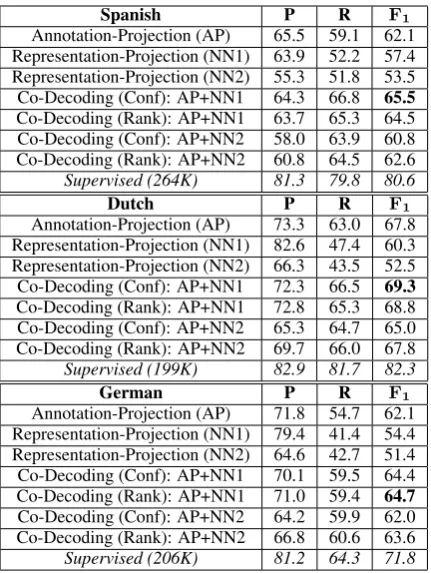
In Table4 we show the results for the CoNLL development data. For representation projection, NN1 is better than NN2. Both the annotation pro-jection approach and NN1 tend to have a high pre-cision. In this case, the exclude-O confidence-based co-decoding scheme that combines AP and NN1 achieves the highestF1score for Spanish and
Dutch (second highestF1 score for German), and
improves over the best of the two projection-based systems by 1.5 to 3.4F1score.
Spanish P R F1
T¨ackstr¨om et al.(2012) x x 59.3 Nothman et al.(2013) x x 61.0 Tsai et al.(2016) x x 60.6 Co-Decoding (Conf): AP+NN1 64.9 65.2 65.1
Co-Decoding (Rank): AP+NN1 64.6 63.9 64.3 Supervised (264K) 82.5 82.3 82.4
Dutch P R F1
T¨ackstr¨om et al.(2012) x x 58.4 Nothman et al.(2013) x x 64.0 Tsai et al.(2016) x x 61.6 Co-Decoding (Conf): AP+NN1 69.1 62.0 65.4
Co-Decoding (Rank): AP+NN1 69.3 61.0 64.8 Supervised (199K) 85.1 83.9 84.5
German P R F1
T¨ackstr¨om et al.(2012) x x 40.4 Nothman et al.(2013) x x 55.8 Tsai et al.(2016) x x 48.1 Co-Decoding (Conf): AP+NN1 68.5 51.0 58.5
[image:9.595.76.288.59.283.2]Co-Decoding (Rank): AP+NN1 68.3 50.4 58.0 Supervised (206K) 79.6 65.3 71.8
Table 5: CoNLL NER test data.
supervised learning.
7 Related Work
The traditional annotation projection approaches (Yarowsky et al.,2001;Zitouni and Florian,2008; Ehrmann et al., 2011) project NER tags across language pairs using parallel corpora or transla-tions.Wang and Manning(2014) proposed a vari-ant of annotation projection which projects expec-tations of tags and uses them as constraints to train a model based on generalized expectation crite-ria. Annotation projection has also been applied to several other cross-lingual NLP tasks, includ-ing word sense disambiguation (Diab and Resnik, 2002), part-of-speech (POS) tagging (Yarowsky et al.,2001) and dependency parsing (Rasooli and Collins,2015).
Wikipedia has been exploited to generate weakly labeled multilingual NER training data. The basic idea is to first categorize Wikipedia pages into entity types, either based on manually constructed rules that utilize the category informa-tion of Wikipedia (Richman and Schone,2008) or Freebase attributes (Al-Rfou et al.,2015), or via a classifier trained with manually labeled Wikipedia pages (Nothman et al.,2013). Heuristic rules are then developed in these works to automatically la-bel the Wikipedia text with NER tags. Ni and Florian(2016) built high-accuracy, high-coverage multilingual Wikipedia entity type mappings us-ing weakly labeled data and applied those map-pings as decoding constrains or dictionary features
to improve multilingual NER systems.
For direct NER model transfer,T¨ackstr¨om et al. (2012) built cross-lingual word clusters using monolingual data in source/target languages and aligned parallel data between source and target languages. The cross-lingual word clusters were then used to generate universal features. Tsai et al. (2016) applied the cross-lingual wikifier developed in (Tsai and Roth, 2016) and mul-tilingual Wikipedia dump to generate language-independent labels (FreeBase types and Wikipedia categories) forn-grams in a document, and those labels were used as universal features.
Different ways of obtaining cross-lingual em-beddings have been proposed in the literature. One approach builds monolingual representations sep-arately and then brings them to the same space typically using a seed dictionary (Mikolov et al., 2013b;Faruqui and Dyer,2014). Another line of work builds inter-lingual representations simulta-neously, often by generating mixed language cor-pora using the supervision at hand (aligned sen-tences, documents, etc.) (Vuli´c and Moens,2015; Gouws et al.,2015). We opt for the first solution in this paper because of its flexibility: we can map all languages to English rather than requiring separate embeddings for each language pair. Additionally we are able to easily add a new language without any constraints on the type of data needed. Note that although we do not specifically create inter-lingual representations, by training mappings to the common language, English, we are able to map words in different languages to a common space. Similar approaches for cross-lingual model trans-fer have been applied to other NLP tasks such as document classification (Klementiev et al.,2012), dependency parsing (Guo et al., 2015) and POS tagging (Gouws and Søgaard,2015).
8 Conclusion
References
Rami Al-Rfou, Vivek Kulkarni, Bryan Per-ozzi, and Steven Skiena. 2015. Polyglot-ner: Massive multilingual named entity recog-nition. In Proceedings of the 2015 SIAM International Conference on Data Mining. SIAM, Vancouver, British Columbia, Canada.
https://doi.org/10.1137/1.9781611974010.66.
Ronan Collobert, Jason Weston, L´eon Bottou, Michael Karlen, Koray Kavukcuoglu, and Pavel Kuksa. 2011. Natural language pro-cessing (almost) from scratch. Journal of
Machine Learning Research 12:2493–2537.
http://dl.acm.org/citation.cfm?id=1953048.2078186.
Mona Diab and Philip Resnik. 2002. An un-supervised method for word sense tagging us-ing parallel corpora. In Proceedings of the 40th Annual Meeting of the Association for Computational Linguistics. Association for Com-putational Linguistics, ACL’02, pages 255–262.
https://doi.org/10.3115/1073083.1073126.
Maud Ehrmann, Marco Turchi, and Ralf Stein-berger. 2011. Building a multilingual named entity-annotated corpus using annotation
projec-tion. In Proceedings of Recent Advances
in Natural Language Processing. Association for Computational Linguistics, pages 118–124.
http://aclweb.org/anthology/R11-1017.
Manaal Faruqui and Chris Dyer. 2014.Improving vec-tor space word representations using multilingual correlation. InProceedings of the 14th Conference of the European Chapter of the Association for Com-putational Linguistics. Association for Computa-tional Linguistics, Gothenburg, Sweden, pages 462– 471. http://www.aclweb.org/anthology/E14-1049.
Stephan Gouws, Yoshua Bengio, and Greg Cor-rado. 2015. Bilbowa: Fast bilingual distributed representations without word alignments. In Proceedings of the 32nd International
Confer-ence on Machine Learning. JMLR Workshop
and Conference Proceedings, pages 748–756.
http://jmlr.org/proceedings/papers/v37/gouws15.pdf.
Stephan Gouws and Anders Søgaard. 2015. Sim-ple task-specific bilingual word embeddings. In Proceedings of the 2015 Conference of the North American Chapter of the Association for Computational Linguistics: Human Language Technologies. Association for Computational Lin-guistics, Denver, Colorado, pages 1386–1390.
http://www.aclweb.org/anthology/N15-1157.
Jiang Guo, Wanxiang Che, David Yarowsky, Haifeng Wang, and Ting Liu. 2015. Cross-lingual de-pendency parsing based on distributed representa-tions. In Proceedings of the 53rd Annual Meet-ing of the Association for Computational LMeet-inguistics
and the 7th International Joint Conference on Natu-ral Language Processing. Association for Compu-tational Linguistics, Beijing, China, pages 1234– 1244.http://www.aclweb.org/anthology/P15-1119.
Abraham Ittycheriah and Salim Roukos. 2005.A max-imum entropy word aligner for arabic-english ma-chine translation. In Proceedings of the Confer-ence on Human Language Technology and Empiri-cal Methods in Natural Language Processing. pages 89–96. http://aclweb.org/anthology/H05-1012.
Alexandre Klementiev, Ivan Titov, and Binod Bhat-tarai. 2012. Inducing crosslingual distributed representations of words. In Proceedings of
COLING 2012. The COLING 2012 Organizing
Committee, Mumbai, India, pages 1459–1474.
http://www.aclweb.org/anthology/C12-1089.
John D. Lafferty, Andrew McCallum, and Fer-nando C. N. Pereira. 2001. Conditional random fields: Probabilistic models for segmenting and labeling sequence data. In Proceedings of the Eighteenth International Conference on Machine Learning. Morgan Kaufmann Publishers Inc., San Francisco, CA, USA, ICML’01, pages 282–289.
http://dl.acm.org/citation.cfm?id=645530.655813.
Guillaume Lample, Miguel Ballesteros, Sandeep Sub-ramanian, Kazuya Kawakami, and Chris Dyer. 2016.
Neural architectures for named entity recognition. InProceedings of the 2016 Conference of the North American Chapter of the Association for Computa-tional Linguistics: Human Language Technologies. Association for Computational Linguistics, pages 260–270. https://doi.org/10.18653/v1/N16-1030.
Wang Ling, Chris Dyer, Alan W Black, and Isabel Trancoso. 2015. Two/too simple adaptations of word2vec for syntax problems. In Proceedings of the 2015 Conference of the North American Chap-ter of the Association for Computational Linguistics: Human Language Technologies. Association for Computational Linguistics, Denver, Colorado, pages 1299–1304. http://www.aclweb.org/anthology/N15-1142.
Andrew McCallum, Dayne Freitag, and Fernando C. N. Pereira. 2000. Maximum entropy markov models for information extraction and segmen-tation. In Proceedings of the Seventeenth In-ternational Conference on Machine Learning. Morgan Kaufmann Publishers Inc., San Fran-cisco, CA, USA, ICML’00, pages 591–598.
http://dl.acm.org/citation.cfm?id=645529.658277.
Tomas Mikolov, Kai Chen, Greg Corrado, and Jeffrey Dean. 2013a. Efficient estimation of word repre-sentations in vector space. CoRR abs/1301.3781.
http://arxiv.org/abs/1301.3781.
Tomas Mikolov, Quoc V. Le, and Ilya Sutskever. 2013b. Exploiting similarities among languages for machine translation. CoRR abs/1309.4168.
David Nadeau and Satoshi Sekine. 2007. A sur-vey of named entity recognition and classifica-tion. Linguisticae Investigationes 30(1):3–26. Publisher: John Benjamins Publishing Company.
https://doi.org/10.1075/li.30.1.03nad.
Jian Ni and Radu Florian. 2016. Improving multi-lingual named entity recognition with wikipedia entity type mapping. In Proceedings of the 2016 Conference on Empirical Methods in Natural Language Processing. Association for Computational Linguistics, pages 1275–1284.
https://doi.org/10.18653/v1/D16-1135.
Eric W. Noreen. 1989. Computer-Intensive Methods for Testing Hypotheses: An Introduction. John Wi-ley & Sons, Inc., New York, NY, USA.
Joel Nothman, Nicky Ringland, Will Radford, Tara Murphy, and James R. Curran. 2013. Learning mul-tilingual named entity recognition from wikipedia. Journal of Artificial Intelligence 194:151–175.
https://doi.org/10.1016/j.artint.2012.03.006.
Sadegh Mohammad Rasooli and Michael Collins. 2015. Density-driven cross-lingual transfer of dependency parsers. In Proceedings of the 2015 Conference on Empirical Methods in Natural Language Processing. Association for Computational Linguistics, pages 328–338.
https://doi.org/10.18653/v1/D15-1039.
E. Alexander Richman and Patrick Schone. 2008. Min-ing wiki resources for multilMin-ingual named entity recognition. In Proceedings of ACL-08: HLT. As-sociation for Computational Linguistics, pages 1–9.
http://aclweb.org/anthology/P08-1001.
Oscar T¨ackstr¨om, Ryan McDonald, and Jakob Uszko-reit. 2012. Cross-lingual word clusters for di-rect transfer of linguistic structure. In Proceed-ings of the 2012 Conference of the North American Chapter of the Association for Computational Lin-guistics: Human Language Technologies. Associa-tion for ComputaAssocia-tional Linguistics, pages 477–487.
http://aclweb.org/anthology/N12-1052.
Erik F. Tjong Kim Sang. 2002. Introduction to the conll-2002 shared task: Language-independent named entity recognition. In Proceedings of the Sixth Conference on Natural Language Learning -Volume 20. Association for Computational Linguis-tics, Stroudsburg, PA, USA, CONLL’02, pages 1–4.
https://doi.org/10.3115/1118853.1118877.
Erik F. Tjong Kim Sang and Fien De Meulder. 2003. Introduction to the conll-2003 shared task: Language-independent named entity recognition. In Proceedings of the Seventh Conference on Natu-ral Language Learning at HLT-NAACL 2003 - Vol-ume 4. Association for Computational Linguistics, Stroudsburg, PA, USA, CONLL’03, pages 142–147.
https://doi.org/10.3115/1119176.1119195.
Chen-Tse Tsai, Stephen Mayhew, and Dan Roth. 2016.
Cross-lingual named entity recognition via wikifica-tion. InProceedings of The 20th SIGNLL Confer-ence on Computational Natural Language Learning. Association for Computational Linguistics, pages 219–228. https://doi.org/10.18653/v1/K16-1022.
Chen-Tse Tsai and Dan Roth. 2016. Cross-lingual wik-ification using multilingual embeddings. In Pro-ceedings of the 2016 Conference of the North Amer-ican Chapter of the Association for Computational Linguistics: Human Language Technologies. Asso-ciation for Computational Linguistics, pages 589– 598. https://doi.org/10.18653/v1/N16-1072. Ivan Vuli´c and Marie-Francine Moens. 2015.
Bilin-gual word embeddings from non-parallel document-aligned data applied to bilingual lexicon induc-tion. In Proceedings of the 53rd Annual Meet-ing of the Association for Computational LMeet-inguistics and the 7th International Joint Conference on Nat-ural Language Processing. Association for Compu-tational Linguistics, Beijing, China, pages 719–725.
http://www.aclweb.org/anthology/P15-2118.
Mengqiu Wang and D. Christopher Manning. 2014.
Cross-lingual projected expectation regularization for weakly supervised learning. Transactions of the Association of Computational Linguistics 2:55–66.
http://aclweb.org/anthology/Q14-1005.
David Yarowsky, Grace Ngai, and Richard Wicen-towski. 2001. Inducing multilingual text analy-sis tools via robust projection across aligned cor-pora. In Proceedings of the First International Conference on Human Language Technology Re-search. Association for Computational Linguis-tics, Stroudsburg, PA, USA, HLT’01, pages 1–8.
https://doi.org/10.3115/1072133.1072187.
Imed Zitouni and Radu Florian. 2008. Mention de-tection crossing the language barrier. In Pro-ceedings of the 2008 Conference on Empirical Methods in Natural Language Processing. Associa-tion for ComputaAssocia-tional Linguistics, pages 600–609.