Proceedings of the 53rd Annual Meeting of the Association for Computational Linguistics and the 7th International Joint Conference on Natural Language Processing, pages 961–970,
Beijing, China, July 26-31, 2015. c2015 Association for Computational Linguistics
Joint Case Argument Identification for
Japanese Predicate Argument Structure Analysis
Hiroki Ouchi Hiroyuki Shindo Kevin Duh Yuji Matsumoto Graduate School of Information and Science
Nara Institute of Science and Technology 8916-5, Takayama, Ikoma, Nara, 630-0192, Japan
{ouchi.hiroki.nt6, shindo, kevinduh, matsu }@is.naist.jp
Abstract
Existing methods for Japanese predicate argument structure (PAS) analysis identify case arguments of each predicate without considering interactions between the tar-get PAS and others in a sentence. How-ever, the argument structures of the pred-icates in a sentence are semantically re-lated to each other. This paper proposes new methods for Japanese PAS analysis to jointly identify case arguments of all predicates in a sentence by (1) modeling multiple PAS interactions with a bipar-tite graph and (2) approximately search-ing optimal PAS combinations. Perform-ing experiments on the NAIST Text Cor-pus, we demonstrate that our joint analysis methods substantially outperform a strong baseline and are comparable to previous work.
1 Introduction
Predicate argument structure (PAS) analysis is a shallow semantic parsing task that identifies ba-sic semantic units of a sentence, such aswho does what to whom, which is similar to semantic role labeling (SRL)1.
In Japanese PAS analysis, one of the most prob-lematic issues is that arguments are often omitted in the surface form, resulting in so-called zero-pronouns. Consider the sentence of Figure 1. 1We use “PAS analysis” in this paper following previous work on Japanese PAS analysis.
Figure 1: An example of Japanese PAS. The En-glish translation is “Because ϕi caught a cold, Ii
skipped school.”. The upper edges are dependency relations, and the under edges are case arguments. “NOM” and “ACC” represents the nominative and accusative arguments, respectively. “ϕi” is a zero-pronoun, referring to theantecedent“watashii”.
The case role label “NOM” and “ACC” respec-tively represents the nominative and accusative roles, and ϕi represents a zero-pronoun. There
are two predicates “hiita (caught)” and “yasunda (skipped)”. For the predicate “yasunda (skipped)”, “watashii-wa(Ii)” is the “skipper”, and “gakko-wo
(school)” is the “entity skipped”. It is easy to iden-tify these arguments, since syntactic dependency between an argument and its predicate is a strong clue. On the other hand, the nominative argument of the predicate “hiita (caught)” is “watashii-wa
(Ii)”, and this identification is more difficult
be-cause of the lack of the direct syntactic depen-dency with “hiita (caught)”. The original nomina-tive argument appears as a zero-pronoun, so that we have to explore theantecedent, an element re-ferred to by a zero-pronoun, as the argument. As the example sentence shows, we cannot use ef-fective syntactic information for identifying such arguments. This type of arguments is known as
phenomenon for PAS analysis (Gerber and Chai, 2010; Laparra and Rigau, 2013).
Previous work on Japanese PAS analysis at-tempted to solve this problem by identifying argu-ments per predicate without considering interac-tions between multiple predicates and arguments (Taira et al., 2008; Imamura et al., 2009). How-ever, implicit arguments are likely to be shared by semantically-related predicates. In the above example (Figure 1), the implicit argument of the predicate “hiita (caught)” is shared by the other predicate “yasunda (skipped)” as its nominative argument “watashii(Ii)”.
Based on this intuition, we propose methods to jointly identify optimal case arguments of all pred-icates in a sentence taking their interactions into account. We represent the interactions as a bipar-tite graph that covers all predicates and candidate arguments in a sentence, and factorize the whole relation into the second-order relations. This in-teraction modeling results in a hard combinatorial problem because it is required to select the optimal PAS combination from all possible PAS combina-tions in a sentence. To solve this issue, we extend the randomized hill-climbing algorithm (Zhang et al., 2014) to search all possible PAS in the space of bipartite graphs.
We perform experiments on the NAIST Text Corpus (Iida et al., 2007), a standard bench-mark for Japanese PAS analysis. Experimental results show that compared with a strong base-line, our methods achieve an improvement of 1.0-1.2 points in F-measure for total case argu-ment identification, and especially improve per-formance for implicit argument identification by 2.0-2.5 points. In addition, although we exploit no external resources, we get comparable results to previous work exploiting large-scale external re-sources (Taira et al., 2008; Imamura et al., 2009; Sasano and Kurohashi, 2011). These results sug-gest that there is potential for more improvement by adding external resources.
The main contributions of this work are: (1) We present new methods to jointly identify case ar-guments of all predicates in a sentence. (2) We propose global feature templates that capture inter-actions over multiple PAS. (3) Performing experi-ments on the NAIST Text Corpus, we demonstrate our methods are superior to a strong baseline and comparable to the methods of representative pre-vious work.
2 Japanese Predicate Argument Structure Analysis
2.1 Task Overview
In Japanese PAS analysis, we identify arguments taking part in the three major case roles, nomina-tive(NOM),accusative(ACC) anddative(DAT) cases, for each predicate. Case arguments can be divided into three categories according to the posi-tions relative to their predicates (Hayashibe et al., 2011):
Dep: The arguments that have direct syntactic de-pendency with the predicate.
Zero: The implicit arguments whose antecedents appear in the same sentence and have no di-rect syntactic dependency with the predicate.
Inter-Zero: The implicit arguments whose an-tecedents do not appear in the same sentence. For example, in Figure 1, the accusative argu-ment “gakko-wo (school)” of the predicate “ya-sunda (skipped)” is regarded as Dep, and the nominative argument “watashii-wa (I)” (the
an-tecedent of zero-pronoun “ϕi”) of the predicate
“hiita (caught)” isZero.
In this paper, we focus on the analysis for intra-sentential arguments (DepandZero). In order to identify inter-sentential arguments (Inter-Zero), it is required to search a much broader space, such as the whole document, resulting in a much harder analysis than intra-sentential arguments.2
There-fore, we believe that quite different approaches are necessary to realize an inter-sentential PAS analy-sis with high accuracy, and leave it for future work.
2.2 Related Work
For Japanese PAS analysis research, the NAIST Text Corpus has been used as a standard bench-mark (Iida et al., 2007). One of the representa-tive researches using the NAIST Text Corpus is Imamura et al. (2009). They built three distinct models corresponding to the three case roles by extracting features defined on each pair of a predi-cate and a candidate argument. Using each model, they select the best candidate argument for each case per predicate. Their models are based on maximum entropy model and can easily incorpo-rate various features, resulting in high accuracy.
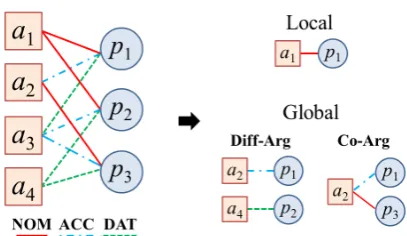
Figure 2: Intuitive image of apredicate-argument graph. This graph is factorized into the local and global features. The different line color/style indi-cate different cases.
While in Imamura et al. (2009) one case ar-gument is identified at a time per predicate, the method proposed by Sasano and Kurohashi (2011) simultaneously determines all the three case argu-ments per predicate by exploiting large-scale case frames obtained from large raw texts. They fo-cus on identification of implicit arguments (Zero
and Inter-Zero), and achieves comparable results to Imamura et al. (2009).
In these approaches, case arguments were iden-tified per predicate without considering interac-tions between multiple predicates and candidate arguments in a sentence. In the semantic role la-beling (SRL) task, Yang and Zong (2014) pointed out that information of different predicates and their candidate arguments could help each other for identifying arguments taking part in semantic roles. They exploited a reranking method to cap-ture the interactions between multiple predicates and candidate arguments, and jointly determine ar-gument structures of all predicates in a sentence (Yang and Zong, 2014). In this paper, we propose new joint analysis methods for identifying case ar-guments of all predicates in a sentence capturing interactions between multiple predicates and can-didate arguments.
3 Graph-Based Joint Models
3.1 A Predicate-Argument Graph
We define predicate argument relations by exploit-ing a bipartite graph, illustrated in Figure 2. The nodes of the graph consist of two disjoint sets: the left one is a set of candidate arguments and the right one is a set of predicates. In this paper, we call it apredicate-argument (PA) graph.
Each predicate node has three distinct edges corresponding to nominative (NOM), accusative (ACC), and dative (DAT) cases. Each edge with a case role label joins a candidate argument node with a predicate node, which represents a case ar-gument of a predicate. For instance, in Figure 2
a1is the nominative argument ofp1, anda3 is the
accusative argument ofp2.
Formally, a PA graph is a bipartite graph
⟨A, P, E⟩, where A is the node set consisting of candidate arguments,P the node set consisting of predicates, andE the set of edges subject to that there is exactly one edgeewith a case role labelc
outgoing from each of the predicate nodes p to a candidate argument nodea. A PA graph is defined as follows:
A={a1, ..., an, an+1=NULL} P ={p1, ..., pm}
E={⟨a, p, c⟩ |deg(p, c) = 1,
∀a∈A, ∀p∈P, ∀c∈C}
wheredeg(p, c)is the number of edges with a case rolecoutgoing fromp, andCis the case role label set. We add a dummy nodean+1, which is defined
for the cases where the predicate requires no case argument or the required case argument does not appear in the sentence. An edge e ∈ E is repre-sented by a tuple⟨a, p, c⟩, indicating the edge with a case rolecjoining a candidate argument nodea
and a predicate nodep. An admissible PA graph satisfies the constraintdeg(p, c) = 1, representing that each predicate nodephas only one edge with a case rolec.
To identify the whole PAS for a sentencex, we predict the PA graph with an edge set correspond-ing to the correct PAS from the admissible PA graph set G(x) based on ascore associated with a PA graphyas follows:
˜
y = argmax
y∈G(x) Score(x, y)
A scoring function Score(x, y) receives a sen-tencex and a candidate graphy as its input, and returns a scalar value.
In this paper, we propose two scoring functions as analysis models based on different assumptions: (1) Per-Case Joint Model assumes the interac-tion between multiple predicates (predicate inter-action) and the independence between case roles, and (2) All-Cases Joint Model assumes the in-teraction between case roles (case interaction) as well as thepredicate interaction.
3.2 Per-Case Joint Model
Per-Case Joint Model assumes that different case roles are independent from each other. However, for each case, interactions between multiple pred-icates are considered jointly.
We define the score of a PA graphy to be the sum of the scores for each case rolecof the set of the case rolesC:
Scoreper(x, y) = ∑
c∈C
Scorec(x, y) (1)
The scores for each case role are defined as the dot products between a weight vectorθcand a feature vectorϕc(x, E(y, c)):
Scorec(x, y) =θc · ϕc(x, E(y, c)) (2)
where E(y, c) is the edge set associated with a case rolecin the candidate graphy, and the feature vector is defined on the edge set.
The edge setE(y, c)in the equation (2) is uti-lized for the two types of features, the local fea-tures and global features, inspired by (Huang, 2008), defined as follows:
θc · ϕc(x, E(y, c)) =
∑
e∈E(y,c)
θcϕl(x, e) + θcϕg(x, E(y, c)) (3)
where ϕl(x, e) denotes the local feature vector, andϕg(x, E(y, c))the global feature vector. The local feature vector ϕl(x, e) is defined on each edge e in the edge setE(y, c) and a sentencex, which captures a predicate-argument pair. Con-sider the example of Figure 2. For Per-Case Joint Model, we use edges, ea1p1, ea1p2, andea2p3, as
local features to compute the score of the edge set with the nominative case.
In addition, the global feature vector
ϕg(x, E(y, c)) is defined on the edge set
E(y, c), and enables the model to utilize lin-guistically richer information over multiple predicate-argument pairs. In this paper, we exploit second-order relations, similar to the second-order edge factorization of dependency trees (McDonald and Pereira, 2006). We make a set of edge pairs Epair by combining two edges ei, ej in the edge setE(y, c), as follows:
Epair ={ {ei, ej} | ∀ei, ej ∈E(y, c), ei ̸=ej}
For instance, in the PA graph in Figure 2, to com-pute the score of the nominative arguments, we make three edge pairs:
{{ea1p1, ea1p2},{ea1p1, ea2p3},{ea1p2, ea2p3}}
Then, features are extracted from these edge pairs and utilized for the score computation. For the accusative and dative cases, their scores are com-puted in the same manner. Then, we obtain the resulting score of the PA graph by summing up the scores of the local and global features. If we do not consider the global features, the model re-duces to a per-case local model similar to previous work (Imamura et al., 2009).
3.3 All-Cases Joint Model
While Per-Case Joint Model assumes the predi-cate interaction with the independence between case roles, All-Cases Joint Model assumes the
case interactiontogether with thepredicate inter-action. Our graph-based formulation is very flex-ible and easily enables the extension of Per-Case Joint Model to All-Cases Joint Model. Therefore, we extend Per-Case Joint Model to All-Cases Joint Model to capture the interactions between predi-cates and all case arguments in a sentence.
We define the score of a PA graphy based on the local and global features as follows:
Scoreall(x, y) = ∑
e∈E(y)
θ ·ϕl(x, e) + θ ·ϕg(x, E(y)) (4)
whereE(y)is the edge set associated with all the case roles on the candidate graphy,ϕl(x, e)is the local feature vector defined on each edge ein the edge setE(y), andϕg(x, E(y))is the global fea-ture vector defined on the edge setE(y).
Consider the PA graph in Figure 2. The local features are extracted from each edge:
Nominative:ea1p1, ea1p2, ea2p3
Accusative:ea2p1, ea3p2, ea3p3
Dative:ea3p1, ea4p2, ea4p3
For the global features, we make a set of edge pairs Epair by combining two edgesei, ej in the
edge set E(y), like Per-Case Joint Model. How-ever, in the All-Cases Joint Model, the global fea-tures may involve different cases (i.e. mixing edges with different case roles). For the PA graph in Figure 2, we make the edge pairs{ea1p1, ea2p1}, {ea3p1, ea1p2}, {ea3p2, ea4p3}, and so on. From
Structure Name Description
Diff-Arg PAIR ⟨pi.rf◦pj.rf◦pi.vo◦pj.vo⟩,
⟨ai.ax◦ai.rp◦pi.ax◦pi.vo⟩,⟨aj.ax◦aj.rp◦pj.ax◦pj.vo⟩
TRIANGLE ⟨ai.ax◦ai.ax◦ai.rp◦aj.rp◦pi.ax◦pi.vo⟩,
⟨ai.ax◦aj.ax◦ai.rp◦aj.rp◦pj.ax◦pj.vo⟩,
QUAD ⟨ai.ax◦aj.ax◦ai.rp◦aj.rp◦pi.vo◦pj.vo⟩
⟨ai.ax◦aj.ax◦pi.ax◦pj.ax◦ai.rp◦aj.rp◦pi.vo◦pj.vo⟩
⟨ai.ax◦aj.ax◦pi.rf◦pj.rf◦ai.rp◦ai.rp◦pi.vo◦pi.vo⟩
Co-Arg BI-PREDS ⟨ai.rp◦pi.rf◦pj.rf⟩,
⟨ai.ax◦ai.rp◦pi.rf◦pj.rf⟩
DEP-REL ⟨ai.ax◦ai.rp◦pi.ax◦pj.ax◦pi.vo◦pj.vo◦(x, y).dep⟩
ifxdepends onyforx,yin (pi,pj), (ai,pi), (ai,pj), (pi,ai), (pj,ai)
Table 1: Global feature templates. pi, pj is a predicate, ai is the argument connected with pi, and aj is the argument connected withpj. Feature conjunction is indicated by◦; ax=auxiliary, rp=relative
position, vo=voice, rf=regular form, dep=dependency. All the features are conjoined with the relative position and the case role labels of the two predicates.
4 Global Features
Features are extracted based on feature tem-plates, which are functions that draw information from the given entity. For instance, one feature template ϕ100 = a.ax◦p.vois a conjunction of two atomic featuresa.axandp.vo, representing an auxiliary word attached to a candidate argument (a.ax) and the voice of a predicate (p.vo). We design several feature templates for characterizing each specific PA graph. Consider the PA graph constructed from the sentence in Figure 1, and a candidate argument “kaze-wo(a cold)” and a pred-icate “hiita (caught)” are connected with an edge. To characterize the graph, we draw some linguis-tic information associated with the edge. Since the auxiliary word attached to the candidate argument is “wo” and the voice of the predicate is “active”, the above feature template ϕ100 will generate a
feature instance as follows.
(a.ax=wo)◦(p.vo=active)
Such features are utilized for the local and global features in the joint models.
We propose the global feature templates that capture multiple PAS interactions based on the
Diff-Arg and Co-Argstructures, depicted in the right part of Figure 1. The Diff-Arg structure rep-resents that the two predicates have different can-didate arguments, and the Co-Arg structure repre-sents that the two predicates share the same can-didate argument. Based on these structures, we define the global feature templates that receive a pair of edges in a PA graph as input and return a feature vector, shown in Table 1.
4.1 Diff-Arg Features
The feature templates based on the Diff-Arg struc-ture are three types: PAIR (a pair of predicate-argument relation),TRIANGLE(a predicate and its two arguments relation), and QUAD (two predicate-argument relations).
PAIR These feature templates denote where the target argument is located relative to another argu-ment and the two predicates in the Diff-Arg struc-ture. We combine the relative position information (rp) with the auxiliary words (ax) and the voice of the two predicates (vo).
TRIANGLE This type of feature templates cap-tures the interactions between three elements: two candidate arguments and a predicate. Like the PAIR feature templates, we encode the relative po-sition information of two candidate arguments and a predicate with the auxiliary words and voice.
QUAD When we judge if a candidate
argu-ment takes part in a case role of a predicate, it would be beneficial to grasp information of an-other predicate-argument pair. The QUAD fea-ture templates capfea-ture the mutual relation between four elements: two candidate arguments and pred-icates. We encode the relative position informa-tion, the auxiliary words, and the voice.
4.2 Co-Arg Features
To identify predicates that take implicit (Zero) ar-guments, we set two feature types,BI-PREDSand
DEP-REL, based on the Co-Arg structure.
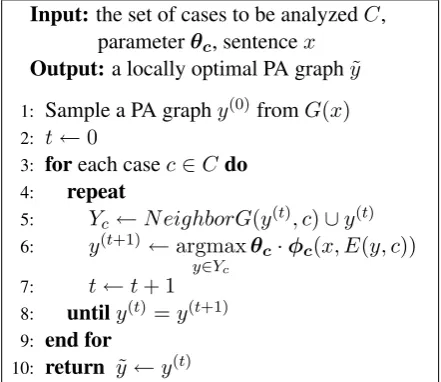
[image:5.595.78.504.86.255.2]Input:the set of cases to be analyzedC, parameterθc, sentencex
Output:a locally optimal PA graphy˜ 1: Sample a PA graphy(0)fromG(x) 2: t←0
3: foreach casec∈Cdo 4: repeat
5: Yc←NeighborG(y(t), c)∪y(t) 6: y(t+1) ←argmax
y∈Yc
θc·ϕc(x, E(y, c))
7: t←t+ 1 8: untily(t)=y(t+1) 9: end for
[image:6.595.63.284.88.279.2]10: return y˜←y(t)
Figure 3: Hill-Climbing for Per-Case Joint Model
Input:the set of cases to be analyzedC, parameterθ, sentencex
Output:a locally optimal PA graphy˜ 1: Sample a PA graphy(0)fromG(x)
2: t←0 3: repeat
4: Y ←NeighborG(y(t))∪y(t)
5: y(t+1)←argmax
y∈Y θ·ϕ(x, E(y)) 6: t←t+ 1
[image:6.595.65.283.316.477.2]7: untily(t) =y(t+1) 8: return y˜←y(t)
Figure 4: Hill-Climbing for All-Cases Joint Model
ment of a predicate, information of another semantically-related predicate in the sentence could be effective. We utilize bi-grams of the reg-ular forms (rf) of the two predicates in the Co-Arg structure to capture the predicates that are likely to share the same argument in the sentence.
DEP-REL We set five distinct feature templates to capture dependency relations (dep) between the shared argument and the two predicates. If two elements have a direct dependency relation, we encode its dependency relation with the auxiliary words and the voice.
5 Inference and Training
5.1 Inference for the Joint Models
Global features make the inference of finding the maximum scoring PA graph more difficult. For searching the graph with the highest score, we
pro-pose two greedy search algorithms by extending the randomized hill-climbing algorithm proposed in (Zhang et al., 2014), which has been shown to achieve the state-of-the-art performance in depen-dency parsing.
Figure 3 describes the pseudo code of our pro-posed algorithm for Per-Case Joint Model. Firstly, we set an initial PA graphy(0)sampled uniformly
from the set of admissible PA graphsG(x)(line 1 in Figure 3). Then, the union Yc is constructed
from the set of neighboring graphs with a case
NeighborG(y(t), c), which is a set of admissible
graphs obtained by changing one edge with the case ciny(t), and the current graphy(t) (line 5).
The current graphy(t)is updated to a higher
scor-ing graph y(t+1) selected from the union Y c (line
6). The algorithm continues until no more score improvement is possible by changing an edge with the casec iny(t) (line 8). This repetition is
exe-cuted for other case roles in the same manner. As a result, we can get a locally optimal graphy˜.
Figure 4 describes the pseudo code of the algo-rithm for All-Cases Joint Model. The large part of the algorithm is the same as that for Per-Case Joint Model. The difference is that the unionY consists of the current graphy(t)and the neighboring graph
set obtained by changing one edge iny(t)
regard-less of case roles (line 4 in Figure 4), and that the iteration process for each case role (line 3 in Fig-ure 3) is removed. The algorithm also continues until no more score improvement is possible by changing an edge iny(t), resulting in a locally
op-timal graphy˜.
Following Zhang et al. (2014), for a given sen-tencex, we repeatedly run these algorithms with
Kconsecutive restarts. Each run starts with initial graphs randomly sampled from the set of admis-sible PA graphsG(x), so that we obtain K local optimal graphs by K restarts. Then the highest scoring one of K graphs is selected for the sen-tencexas the result. Each run of the algorithms is independent from each other, so that multiple runs are easily executable in parallel.
5.2 Training
Given a training data set D = {(ˆx,yˆ)}N i , the
∀i∈ {1, ..., N}, y∈G(xi),
Score(ˆxi,yˆi)≥Score(ˆxi, y) +∥yˆi−y∥1−ξi
whereξi ≥0is the slack variable and∥yˆi−y∥1is
the Hamming distance between the gold PA graph
ˆ
yi and a candidate PA graph y of the admissible
PA graphsG(xi). Following Zhang et al. (2014),
we select the highest scoring graphy˜as follows: TRAIN :y˜= argmax
y∈G(ˆxi){Score(ˆxi, y)+∥yˆi−y∥1}
TEST :y˜= argmax
y∈G(x) {Score(x, y)}
Using the weight vector tuned by the training, we perform analysis on a sentencexin the test set.
6 Experiment
6.1 Experimental Settings
Data Set We evaluate our proposed methods on the NAIST Text Corpus 1.5, which consists of 40,000 sentences of Japanese newspaper text (Iida et al., 2007). While previous work has adopted the version 1.4 beta, we adopt the latest version. The major difference between version 1.4 beta and 1.5 is revision of dative case (corresponding to Japanese case particle “ni”). In 1.4 beta, most of adjunct usages of “ni” are mixed up with the argu-ment usages of “ni”, making the identification of dative cases seemingly easy. Therefore, our results are not directly comparable with previous work.
We adopt standard train/dev/test split (Taira et al., 2008) as follows:
Train Articles: Jan 1-11, Editorials: Jan-Aug
Dev Articles: Jan 12-13, Editorials: Sept
Test Articles: Jan 14-17, Editorials: Oct-Dec We exclude inter-sentential arguments ( Inter-Zero) in our experiments. Our features make use of the annotated POS tags, phrase boundaries, and dependency relations annotated in the NAIST Text Corpus. We do not use any external resources.
Baseline We adopt the pointwise method (using only local features) proposed by Imamura et al. (2009) as the baseline. They built three distinct models corresponding to the three case roles. By using each model, they estimate the likelihood that each candidate argument plays a case role of the target predicate as a score, and independently se-lect the highest scoring one per predicate.
feature Dep Zero Total
PC Joint local 84.59 42.55 77.89
+global 85.51 44.54 78.85
AC Joint local 84.17 41.33 77.43
[image:7.595.303.515.86.159.2]+global 85.92 44.45 79.17
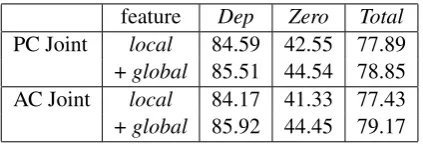
Table 2: Global vs Local features on the develop-ment sets in F-measures. “PC Joint” denotes the Per-Case Joint Model, and “AC Joint” denotes the All-Cases Joint Model.
Features The baseline utilizes theBaseline Fea-turesused in Imamura et al. (2009) and Grammat-ical features used in Hayashibe et al. (2009), as the “Local Features”. In addition, the joint models utilize the “Global Features” in Table 1.
Implementation Details For our joint models with hill-climbing, we report the average per-formance across ten independent runs with 10 restarts, which almost reaches convergence3. We
train the baseline and our joint models for 20 iter-ations with averaged perceptron.
6.2 Results
Local Features vs Global Features
Table 2 shows the effectiveness of the global fea-tures on the development sets. We incrementally add the global features to the both models that uti-lize only the local features. The results show that the global features improve the performance by about 1.0 point in F-measures in total. For and are particularly beneficial to the implicit (Zero) argument identification (an improvement of 1.99 points in Per-Case Joint Model and 3.12 points in All-Cases Joint Model).
Pointwise Methods vs Joint Methods
Table 3 presents the F-measures of the baseline and our joint methods on the test set of the NAIST Text Corpus. We used the bootstrap resampling method as the significance test. In most of the met-rics, our proposed joint methods outperform the baseline pointwise method. Note that since Per-Case Joint Model yields better results compared with the baseline, capturing the predicate inter-action is beneficial to Japanese PAS analysis. In addition, the joint methods achieve a considerable improvement of 2.0-2.5 points in F-measure for 3Performance did not change when increasing the number of restarts
Case Type # of Args. Baseline PC Joint AC Joint
NOM Dep 14055 86.50 87.54 † 88.13 † ‡
Zero 4935 45.56 47.62 48.11
Total 18990 77.31 78.39 † 79.03 † ‡
ACC Dep 9473 92.84 ⋆ 93.09 † ⋆ 92.74
Zero 833 21.38 22.73 24.43
Total 10306 88.86 ⋆ 89.00 † ⋆ 88.47
DAT Dep 2518 30.97 34.29 † 38.39 † ‡
Zero 239 0.83 0.83 4.80
Total 2757 29.02 32.20 † 36.35 † ‡
ALL Dep 26046 85.06 85.79 † 86.07 † ‡
Zero 6007 41.65 43.60 44.09
[image:8.595.124.459.86.269.2]Total 32053 78.15 78.91 † 79.23 † ‡
Table 3: F-measures of the three methods in the test sets. The bold values denote the highest F-measures among all the three methods. Statistical significance with p < 0.05 is marked with † compared with Baseline,‡compared with PC Joint, and⋆compared with AC Joint.
Dep Zero
NOM ACC DAT NOM ACC DAT
TA08 75.53 88.20 89.51 30.15 11.41 3.66
IM09 87.0 93.9 80.8 50.0 30.8 0.0
S&K11 - - - 39.5 17.5 8.9
PC Joint 87.54 93.09 34.19 47.62 22.73 0.83 AC Joint 88.13 92.74 38.39 48.11 24.44 4.80
Table 4: Comparison with previous work using the NAIST Text Corpus in F-measure. TA08 is Taira et al. (2008), IM09 is Imamura et al. (2009), and S&K11 is Sasano & Kurohashi (2011). Their results are not directly comparable to ours since they use external resources and the NAIST Text Corpus 1.4 beta.
the implicit arguments (Zero), one of the problem-atic issues in Japanese PAS analysis.
Comparing the joint methods, each of our two joint methods is effective for a different case role. Per-Case Joint Model is better at the ACC case, and All-Cases Joint Model is better at the NOM andDATcases. One of the possible explanations is that the distribution ofACCcases is different from NOMcases. While the ratio ofDepandZero argu-ments forACCcases is 90:10, the ratio forNOM cases is 75:25. This might have some negative effects on the ACC case identification with All-Cases Joint Model. However, in total, All-All-Cases Joint Model achieves significantly better results. This suggests that capturingcase interactions im-proves performance of Japanese PAS analysis.
Existing Methods vs Joint Methods
To compare our proposed methods with previous work, we pick the three pieces of representative previous work exploiting the NAIST Text
[image:8.595.156.425.331.430.2]7 Conclusion
We have presented joint methods for Japanese PAS analysis, which model interactions between mul-tiple predicates and arguments using a bipartite graph and greedily search the optimal PAS combi-nation in a sentence. Experimental results shows that capturing the predicate interactionand case interaction is effective for Japanese PAS analy-sis. In particular, implicit (Zero) argument identi-fication, one of the problematic issues in Japanese PAS analysis, is improved by taking such interac-tions into account. Since this framework is appli-cable to theargument classificationin SRL, apply-ing our methods to that task is an interestapply-ing line of the future research. In addition, the final results of our joint methods are comparable to represen-tative existing methods despite using no external resources. For future work, we plan to incorporate external resources for our joint methods.
Acknowledgments
We are grateful to the anonymous reviewers. This work is partially supported by a JSPS KAKENHI Grant Number 26730121 and 15K16053.
References
Michael Collins. 2002. Discriminative training meth-ods for hidden markov models: Theory and experi-ments with perceptron algorithms. InProceedings of the 2002 Conference on Empirical Methods in Natural Language Processing (EMNLP), pages 1– 8, Philadelphia, July. Association for Computational Linguistics.
Matthew Gerber and Joyce Chai. 2010. Beyond nom-bank: A study of implicit arguments for nominal predicates. InProceedings of the 48th Annual Meet-ing of the Association for Computational LMeet-inguis- Linguis-tics, pages 1583–1592, Uppsala, Sweden, July. As-sociation for Computational Linguistics.
Yuta Hayashibe, Mamoru Komachi, and Yuji Mat-sumoto. 2011. Japanese predicate argument struc-ture analysis exploiting argument position and type. InProceedings of 5th International Joint Conference on Natural Language Processing, pages 201–209, Chiang Mai, Thailand, November. Asian Federation of Natural Language Processing.
Liang Huang. 2008. Forest reranking: Discrimina-tive parsing with non-local features. InProceedings of 46th Annual Meeting of the Association for Com-putational Linguistics: Human Language Technolo-gies, pages 586–594, Columbus, Ohio, June. Asso-ciation for Computational Linguistics.
Ryu Iida, Mamoru Komachi, Kentaro Inui, and Yuji Matsumoto. 2007. Annotating a japanese text cor-pus with predicate-argument and coreference rela-tions. InProceedings of the Linguistic Annotation Workshop, pages 132–139, Prague, Czech Republic, June. Association for Computational Linguistics.
Kenji Imamura, Kuniko Saito, and Tomoko Izumi.
2009. Discriminative approach to
predicate-argument structure analysis with zero-anaphora res-olution. InProceedings of the Joint Conference of the 47th Annual Meeting of the Association for Com-putational Linguistics and 4th International Joint Conference on Natural Language Processing, pages 85–88, Suntec, Singapore, August. Association for Computational Linguistics.
Egoitz Laparra and German Rigau. 2013. Impar: A deterministic algorithm for implicit semantic role la-belling. InProceedings of the 51st Annual Meet-ing of the Association for Computational LMeet-inguis- Linguis-tics, pages 1180–1189, Sofia, Bulgaria, August. As-sociation for Computational Linguistics.
Ryan McDonald and Fernando Pereira. 2006. Online learning of approximate dependency parsing algo-rithms. In Proceedings of the 11th conference on European Chapter of the Association for Compu-tational Linguistics (EACL), pages 81–88, Trento, Italy, April. Association for Computational Linguis-tics.
Ryohei Sasano and Sadao Kurohashi. 2011. A dis-criminative approach to japanese zero anaphora res-olution with large-scale lexicalized case frames. In
Proceedings of 5th International Joint Conference on Natural Language Processing, pages 758–766, Chiang Mai, Thailand, November. Asian Federation of Natural Language Processing.
Hirotoshi Taira, Sanae Fujita, and Masaaki Nagata. 2008. A japanese predicate argument structure anal-ysis using decision lists. InProceedings of the 2008 Conference on Empirical Methods in Natural Lan-guage Processing (EMNLP), pages 523–532, Hon-olulu, Hawaii, October. Association for Computa-tional Linguistics.
Haitong Yang and Chengqing Zong. 2014. Multi-predicate semantic role labeling. InProceedings of the 2014 Conference on Empirical Methods in Nat-ural Language Processing (EMNLP), pages 363– 373, Doha, Qatar, October. Association for Compu-tational Linguistics.