Neural Responding Machine for Short-Text Conversation
Lifeng Shang, Zhengdong Lu, Hang Li Noah’s Ark Lab
Huawei Technologies Co. Ltd. Sha Tin, Hong Kong
{shang.lifeng,lu.zhengdong,hangli.hl}@huawei.com
Abstract
We propose Neural Responding Ma-chine (NRM), a neural network-based re-sponse generator for Short-Text Conver-sation. NRM takes the general encoder-decoder framework: it formalizes the gen-eration of response as a decoding process based on the latent representation of the in-put text, while both encoding and decod-ing are realized with recurrent neural net-works (RNN). The NRM is trained with a large amount of one-round conversation data collected from a microblogging ser-vice. Empirical study shows that NRM can generate grammatically correct and content-wise appropriate responses to over 75% of the input text, outperforming state-of-the-arts in the same setting, including retrieval-based and SMT-based models.
1 Introduction
Natural language conversation is one of the most challenging artificial intelligence problems, which involves language understanding, reason-ing, and the utilization of common sense knowl-edge. Previous works in this direction mainly fo-cus on either rule-based or learning-based meth-ods (Williams and Young, 2007; Schatzmann et al., 2006; Misu et al., 2012; Litman et al., 2000). These types of methods often rely on manual effort in designing rules or automatic training of model with a particular learning algorithm and a small amount of data, which makes it difficult to develop an extensible open domain conversation system.
Recently due to the explosive growth of mi-croblogging services such as Twitter1and Weibo2,
the amount of conversation data available on the web has tremendously increased. This makes a
1https://twitter.com/. 2http://www.weibo.com/.
data-driven approach to attack the conversation problem (Ji et al., 2014; Ritter et al., 2011) pos-sible. Instead of multiple rounds of conversation, the task at hand, referred to as Short-Text Conver-sation (STC), only considers one round of conver-sation, in which each round is formed by two short texts, with the former being an input (referred to as post) from a user and the latter a response given by the computer. The research on STC may shed light on understanding the complicated mechanism of natural language conversation.
Previous methods for STC fall into two cat-egories, 1) the retrieval-based method (Ji et al., 2014), and 2) the statistical machine translation (SMT) based method (Sordoni et al., 2015; Rit-ter et al., 2011). The basic idea of retrieval-based method is to pick a suitable response by ranking the candidate responses with a linear or non-linear combination of various matching fea-tures (e.g. number of shared words). The main drawbacks of the retrieval-based method are the following
• the responses are pre-existing and hard to cus-tomize for the particular text or requirement from the task, e.g., style or attitude.
• the use of matching features alone is usu-ally not sufficient for distinguishing posi-tive responses from negaposi-tive ones, even after time consuming feature engineering. (e.g., a penalty due to mismatched named entities is difficult to incorporate into the model) The SMT-based method, on the other hand, is generative. Basically it treats the response genera-tion as a translagenera-tion problem, in which the model is trained on a parallel corpus of post-response pairs. Despite its generative nature, the method is intrin-sically unsuitable for response generation, because the responses are not semantically equivalent to the posts as in translation. Actually one post can receive responses with completely different con-tent, as manifested through the example in the
lowing figure:
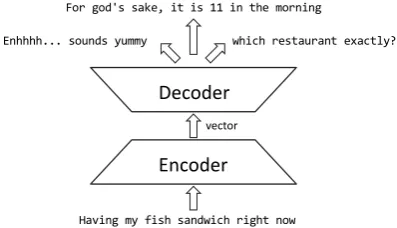
Post Having my fish sandwich right now UserA For god’s sake, it is 11 in the morning UserB Enhhhh... sounds yummy
UserC which restaurant exactly?
Empirical studies also showed that SMT-based methods often yield responses with grammatical errors and in rigid forms, due to the unnecessary alignment between the “source” post and the “tar-get” response (Ritter et al., 2011). This rigid-ity is still a serious problem in the recent work of (Sordoni et al., 2015), despite its use of neu-ral network-based generative model as features in decoding.
1.1 Overview
In this paper, we take a probabilistic model to ad-dress the response generation problem, and pro-pose employing a neural encoder-decoder for this task, namedNeural Responding Machine(NRM). The neural encoder-decoder model, as illustrated in Figure 1, first summarizes the post as a vector representation, then feeds this representation to a decoder to generate responses. We further gener-alize this scheme to allow the post representation to dynamically change during the generation pro-cess, following the idea in (Bahdanau et al., 2014) originally proposed for neural-network-based ma-chine translation with automatic alignment.
Encoder
Having my fish sandwich right now For god's sake, it is 11 in the morning
Decoder
Enhhhh... sounds yummy which restaurant exactly?
[image:2.595.81.280.492.606.2]vector
Figure 1: The diagram of encoder-decoder frame-work for automatic response generation.
NRM essentially estimates the likelihood of a response given a post. Clearly the estimated prob-ability should be complex enough to represent all the suitable responses. Similar framework has been used for machine translation with a remark-able success (Kalchbrenner and Blunsom, 2013; Auli et al., 2013; Sutskever et al., 2014; Bah-danau et al., 2014). Note that in machine
trans-lation, the task is to estimate the probability of a target language sentence conditioned on the source language sentence with the same meaning, which is much easier than the task of STC which we are considering here. In this paper, we demon-strate that NRM, when equipped with a reasonable amount of data, can yield a satisfying estimator of responses (hence response generator) for STC, de-spite the difficulty of the task.
Our main contributions are two-folds: 1) we propose to use an encoder-decoder-based neu-ral network to generate a response in STC; 2) we have empirically verified that the proposed method, when trained with a reasonable amount of data, can yield performance better than traditional retrieval-based and translation-based methods.
1.2 RoadMap
In the remainder of this paper, we start with in-troducing the dataset for STC in Section 2. Then we elaborate on the model of NRM in Section 3, followed by the details on training in Section 4. After that, we report the experimental results in Section 5. In Section 6 we conclude the paper.
2 The Dataset for STC
Our models are trained on a corpus of roughly 4.4 million pairs of conversations from Weibo3.
2.1 Conversations on Sina Weibo
Weibo is a popular Twitter-like microblogging ser-vice in China, on which a user can post short mes-sages (referred to as post in the reminder of this paper) visible to the public or a group of users fol-lowing her/him. Other users make comment on a published post, which will be referred to as a re-sponse. Just like Twitter, Weibo also has the length limit of 140 Chinese characters on both posts and responses, making the post-response pair an ideal surrogate for short-text conversation.
2.2 Dataset Description
To construct this million scale dataset, we first crawl hundreds of millions of post-response pairs, and then clean the raw data in a similar way as suggested in (Wang et al., 2013), including 1) re-moving trivial responses like “wow”, 2) filtering out potential advertisements, and 3) removing the responses after first 30 ones for topic consistency. Table 1 shows some statistics of the dataset used
Training #posts#responses 4,308,211219,905 #pairs 4,435,959
Test Data #test posts 110
Labeled Dataset
(retrieval-based)
#posts 225 #responses 6,017 #labeled pairs 6,017
Fine Tuning
(SMT-based)
[image:3.595.344.489.62.234.2]#posts 2,925 #responses 3,000 #pairs 3,000 Table 1: Some statistics of the dataset. Labeled Dataset and Fine Tuning are used by retrieval-based method for learning to rank and SMT-retrieval-based method for fine tuning, respectively.
in this work. It can be seen that each post have 20 different responses on average. In addition to the semantic gap between post and its responses, this is another key difference to a general parallel data set used for traditional translation.
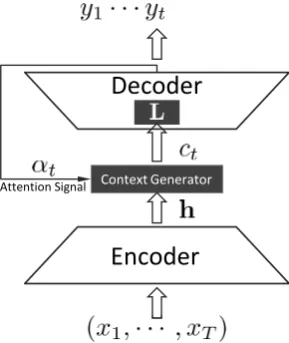
3 Neural Responding Machines for STC The basic idea of NRM is to build a hidden rep-resentation of a post, and then generate the re-sponse based on it, as shown in Figure 2. In the particular illustration, the encoder converts the input sequence x = (x1,· · ·, xT) into a set
of high-dimensional hidden representations h = (h1,· · · , hT), which, along with the attention
sig-nal at timet(denoted asαt), are fed to the
context-generator to build the context input to decoder at time t(denoted as ct). Then ct is linearly
trans-formed by a matrixL(as part of the decoder) into a stimulus of generating RNN to produce thet-th word of response (denoted asyt).
In neural translation system,Lconverts the rep-resentation in source language to that of target lan-guage. In NRM,Lplays a more difficult role: it needs to transform the representation of post (or some part of it) to the rich representation of many plausible responses. It is a bit surprising that this can be achieved to a reasonable level with a linear transformation in the “space of representation”, as validated in Section 5.3, where we show that one post can actually invoke many different responses from NRM.
The role of attention signal is to determine which part of the hidden representationh should be emphasized during the generation process. It should be noted thatαtcould be fixed over time or
Encoder
Context Generator
Decoder
Attention Signal
Figure 2: The general framework and dataflow of the encoder-decoder-based NRM.
changes dynamically during the generation of re-sponse sequence y. In the dynamic settings, αt
can be function of historically generated subse-quence (y1,· · · , yt−1), input sequence xor their latent representations, more details will be shown later in Section 3.2.
We use Recurrent Neural Network (RNN) for both encoder and decoder, for its natural ability to summarize and generate word sequence of ar-bitrary lengths (Mikolov et al., 2010; Sutskever et al., 2014; Cho et al., 2014).
͙͘
[image:3.595.73.291.62.205.2]͙͘
͙͘
Figure 3: The graphical model of RNN decoder. The dashed lines denote the variables related to the functiong(·), and the solid lines denote the vari-ables related to the functionf(·).
3.1 The Computation in Decoder
Figure 3 gives the graphical model of the de-coder, which is essentially a standard RNN lan-guage model except conditioned on the context in-putc. The generation probability of thet-th word is calculated by
[image:3.595.337.496.453.558.2]whereytis a one-hot word representation,g(·)is
a softmax activation function, andstis the hidden
state of decoder at timetcalculated by
st=f(yt−1, st−1, ct),
and f(·) is a non-linear activation function and the transformation L is often assigned as pa-rameters of f(·). Here f(·) can be a logistic function, the sophisticated long short-term mem-ory (LSTM) unit (Hochreiter and Schmidhuber, 1997), or the recently proposed gated recurrent unit (GRU) (Chung et al., 2014; Cho et al., 2014). Compared to “ungated” logistic function, LSTM and GRU are specially designed for its long term memory: it can store information over extended time steps without too much decay. We use GRU in this work, since it performs comparably to LSTM on squence modeling (Chung et al., 2014; Greff et al., 2015), but has less parameters and eas-ier to train.
We adopt the notation of GRU from (Bahdanau et al., 2014), the hidden statestat timetis a linear
combination of its previous hidden statest−1 and a new candidate statesˆt:
st= (1−zt)◦st−1+zt◦ˆst,
where◦is point-wise multiplication,ztis the
up-date gate calculated by
zt=σ(Wze(yt−1) +Uzst−1+Lzct), (1)
andˆstis calculated by
ˆ
st=tanh(W e(yt−1) +U(rt◦st−1) +Lct), (2)
where the reset gatertis calculated by
rt=σ(Wre(yt−1) +Urst−1+Lrct). (3)
In Equation (1)-(2), and (3), e(yt−1) is word em-bedding of the wordyt−1,L={L, Lz, Lr}
spec-ifies the transformations to convert a hidden rep-resentation from encoder to that of decoder. In the STC task, L should have the ability to trans-form one post (or its segments) to multiple differ-ent words of appropriate responses.
3.2 The Computation in Encoder
We consider three types of encoding schemes, namely 1) the global scheme, 2) the local scheme, and the hybrid scheme which combines 1) and 2).
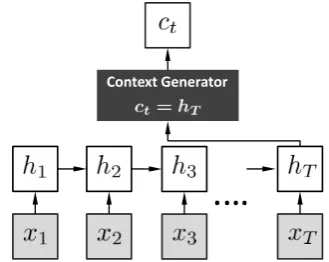
Global Scheme: Figure 4 shows the graphical model of the RNN-encoder and related context generator for a global encoding scheme. The hidden state at time t is calculated by ht = f(xt, ht−1)(i.e. still GRU unit), and with a trivial context generation operation, we essentially use the final hidden state hT as the global
represen-tation of the sentence. The same strategy has been taken in (Cho et al., 2014) and (Sutskever et al., 2014) for building the intermediate representation for machine translation. This scheme however has its drawbacks: a vectorial summarization of the entire post is often hard to obtain and may lose im-portant details for response generation, especially when the dimension of the hidden state is not big enough4. In the reminder of this paper, a NRM
with this global encoding scheme is referred to as NRM-glo.
[image:4.595.332.497.319.450.2]͙͘
Context GeneratorFigure 4: The graphical model of the encoder in NRM-glo, where the last hidden state is used as the context vectorct=hT.
Local Scheme: Recently, Bahdanau et al.
(2014) and Graves (2013) introduced an attention mechanism that allows the decoder to dynamically select and linearly combine different parts of the input sequencect =∑Tj=1αtjhj, where
weight-ing factorsαtjdetermine which part should be
se-lected to generate the new wordyt, which in turn
is a function of hidden states αtj = q(hj, st−1), as pictorially shown in Figure 5. Basically, the at-tention mechanism αtj models the alignment
be-tween the inputs around positionj and the output at positiont, so it can be viewed as a local match-ing model. This local scheme is devised in (Bah-danau et al., 2014) for automatic alignment
tween the source sentence and the partial target sentence in machine translation. This scheme en-joys the advantage of adaptively focusing on some important words of the input text according to the generated words of response. A NRM with this local encoding scheme is referred to as NRM-loc.
͙͘
Attention Signal
[image:5.595.103.262.153.294.2]Context Generator
Figure 5: The graphical model of the encoder in NRM-loc, where the weighted sum of hidden sates is used as the context vectorct=∑Tj=1αtjhj.
3.3 Extensions: Local and Global Model
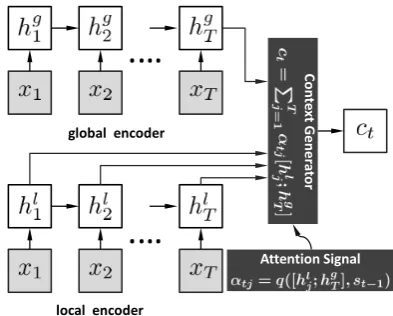
In the task of STC, NRM-glo has the summariza-tion of the entire post, while NRM-loc can adap-tively select the important words in post for vari-ous suitable responses. Since post-response pairs in STC are not strictly parallel and a word in differ-ent context can have differdiffer-ent meanings, we con-jecture that the global representation in NRM-glo may provide useful context for extracting the local context, therefore complementary to the scheme in NRM-loc. It is therefore a natural extension to combine the two models by concatenating their encoded hidden states to form an extended hid-den representation for each time stamp, as illus-trated in Figure 6. We can see the summarization
hgT is incorporated into ct and αtj to provide a
global context for local matching. With this hy-brid method, we hope both the local and global in-formation can be introduced into the generation of response. The model with this context generation mechanism is denoted as NRM-hyb.
It should be noticed that the context generator in NRM-hyb will evoke different encoding mecha-nisms in the global encoder and the local encoder, although they will be combined later in forming a unified representation. More specifically, the last hidden state of NRM-glo plays a role differ-ent from that of the last state of NRM-loc, since it has the responsibility to encode the entire input
sentence. This role of NRM-glo, however, tends to be not adequately emphasized in training the hybrid encoder when the parameters of the two encoding RNNs are learned jointly from scratch. For this we use the following trick: we first ini-tialize NRM-hyb with the parameters of NRM-loc and NRM-glo trained separately, then fine tune the parameters in encoder along with training the pa-rameters of decoder.
global encoder
local encoder
͙͘
Attention Signal
C
o
n
te
x
t G
e
n
e
ra
to
r
͙͘
Figure 6: The graphical model for the encoder in NRM-hyb, while context generator function is
ct = ∑Tj=1αtj[hlj;hgT], here [hlj;hgT]denotes the
concatenation of vectorshl
j andhgT
To learn the parameters of the model, we max-imize the likelihood of observing the original re-sponse conditioned on the post in the training set. For a new post, NRMs generate their responses by using a left-to-right beam search with beam size = 10.
4 Experiments
We evaluate three different settings of NRM de-scribed in Section 3, namely glo, NRM-loc, and NRM-hyb, and compare them to retrieval-based and SMT-retrieval-based methods.
4.1 Implementation Details
We use Stanford Chinese word segmenter5to split
the posts and responses into sequences of words. Although both posts and responses are written in the same language, the distributions on words for the two are different: the number of unique words in post text is 125,237, and that of response text is 679,958. We therefore construct two separate vo-cabularies for posts and responses by using 40,000 most frequent words on each side, covering 97.8%
[image:5.595.315.512.191.349.2]usage of words for post and 96.2% for response respectively. All the remaining words are replaced by a special token “UNK”. The dimensions of the hidden states of encoder and decoder are both 1,000. Model parameters are initialized by ran-domly sampling from a uniform distribution be-tween -0.1 and 0.1. All our models were trained on a NVIDIA Tesla K40 GPU using stochastic gra-dient descent (SGD) algorithm with mini-batch. The training stage of each model took about two weeks.
4.2 Competitor Models
Retrieval-based: with retrieval-based models, for any given postp∗, the responser∗is retrieved from a big post-response pairs (p, r) repository. Such models rely on three key components: a big repository, sets of feature functionsΦi(p∗,(p, r)),
and a machine learning model to combine these features. In this work, the whole 4.4 million Weibo pairs are used as the repository, 14 fea-tures, ranging from simple cosine similarity to some deep matching models (Ji et al., 2014) are used to determine the suitability of a post to a given postp∗ through the following linear model
score(p∗,(p, r)) =∑
i
ωiΦi(p∗,(p, r)). (4)
Following the ranking strategy in (Ji et al., 2014), we pick 225 posts and about 30 retrieved sponses for each of them given by a baseline re-triever6 from the 4.4M repository, and manually
label them to obtain labeled 6,017 post-response pairs. We use ranking SVM model (Joachims, 2006) for the parametersωi based on the labeled
dataset. In comparison to NRM, only the top one response is considered in the evaluation process.
SMT-based: In SMT-based models, the
post-response pairs are directly used as parallel data for training a translation model. We use the most widely used open-source phrase-based translation model-Moses (Koehn et al., 2007). Another par-allel data consisting of 3000 post-response pairs is used to tune the system. In (Ritter et al., 2011), the authors used a modified SMT model to obtain the “Response” of Twitter “Stimulus”. The main modification is in replacing the standard GIZA++ word alignment model (Och and Ney, 2003) with a new phrase-pair selection method, in which all the
6we use the default similarity function of Lucene7
possible phrase-pairs in the training data are con-sidered and their associated probabilities are es-timated by the Fisher’s Exact Test, which yields performance slightly better than default setting8.
Compared to retrieval-based methods, the gener-ated responses by SMT-based methods often have fluency or even grammatical problems. In this work, we choose the Moses with default settings as our SMT model.
5 Results and Analysis
Automatic evaluation of response generation is still an open problem. The widely accepted evalu-ation methods in translevalu-ation (e.g. BLEU score (Pa-pineni et al., 2002)) do not apply, since the range of the suitable responses is so large that it is prac-tically impossible to give reference with adequate coverage. It is also not reasonable to evaluate with Perplexity, a generally used measurement in statis-tical language modeling, because the naturalness of response and the relatedness to the post can not be well evaluated. We therefore resort to human judgement, similar to that taken in (Ritter et al., 2011) but with an important difference.
5.1 Evaluation Methods
We adopt human annotation to compare the per-formance of different models. Five labelers with at least three-year experience of Sina Weibo are in-vited to do human evaluation. Responses obtained from the five evaluated models are pooled and ran-domly permuted for each labeler. The labelers are instructed to imagine that they were the authors of the original posts and judge whether a response (generated or retrieved) is appropriate and natural to a input post. Three levels are assigned to a re-sponse with scores from 0 to 2:
• Suitable (+2):the response is evidently an ap-propriate and natural response to the post; • Neutral (+1): the response can be a suitable
response in aspecificscenario;
• Unsuitable (0):it is hard or impossible to find a scenario where response is suitable.
To make the annotation task operable, the suit-ability of generated responses is judged from the following five criteria:
(a) Grammar and Fluency: Responses should
be natural language and free of any fluency or grammatical errors;
Post ᝅཝ⾷॰䠂㘷ᱥޡѠӰ...འᕖҼ
There are always 8 players at the Italian restricted area. Unbelievable! Related Criterion Labels Response1 ᡇᱥᝅཝ䱕Ⲻ⨹䘭θㅿᖻ∊䎑ᔶခȾ
I am a big fan of the Italy team, waiting for the football game to start Logic Consistency Unsuitable Response2 ᝅཝⲺ伕⢟འ㗄Ҽ
Italian food is absolutely delicious. Semantic Relevance Unsuitable Response3 འᕖҼ!
Unbelievable! Generality Neutral Response4 ૾૾૾ԃ❬ᱥ0φ0 Ⱦ䘎⋗ⵁࡦ䘑⨹Ⱦ
Ha!Ha!Ha! it is still 0:0, no goal so far. Scenario Dependence Neutral Response5 䘏↙ᱥᝅཝᕅ䱨ᆾ䏩⨹Ⱦ
[image:7.595.72.526.62.230.2]This is exactly the Italian defending style football game. ²² Suitable
Figure 7: An example post and its five candidate responses with human annotation. The content of the post implies that the football match is already started, while the author of Response1 is still waiting for the match to start. Response2 talks about the food of Italy. Response3 is a widely used response, but it is suitable to this post. Response4 states that the current score is still 0:0, it is a suitable response only in this specific scenario.
Models Mean Score Suitable (+2) Neutral (+1) Unsuitable (0) Agreement
[image:7.595.92.507.321.411.2]NRM-glo 0.969 34.0% 28.9% 37.1% 0.397 NRM-loc 1.065 36.0% 34.5% 29.5% 0.247 NRM-hyb 1.156 39.3% 37.1% 23.6% 0.309 Rtr.-based 0.984 29.8% 38.7% 31.5% 0.346 SMT-based 0.313 5.6 % 20.0% 74.4% 0.448
Table 2: The results of evaluated methods. Mean score is the average value of annotated scores over all annotations. (Rtr.-based means the retrieval-based method)
ID Post NRM-glo NRM-loc NRM-hyb Rtr.-based
1
∅ᒪݹᰜ䜳ᶛ儎✝Ⱦ
High fever attacks me
HYHU\1HZ<HDU¶V'D\
ཐՇᚥθ໔ᕰރ⯡࣑έ
Rest more to boost your immune system.
∅ᒪݹᰜ䜳ৱॱ䲘ⵁ ⯻
Go to see a doctor
HYHU\1HZ<HDU¶V'D\
⾓ᰟᰛᓭགྷθ䓡։ڛ ᓭέ
Get well soon and stay healthy!
儎✝«
+LJKIHYHU«
2
৾㘷Ҽжθ䉘ᡇԢ 㓺θᡇᖾ儎ު
I gain one more year. Grateful to my group, so happy
⭕ᰛᘡ҆έ≮䘒᭥ᤷ ֖έ
Happy birthday! Will stand by you forever!
⭕ᰛᘡ҆έ≮䘒ᒪ䖱 ┸Ӥέ
Happy birthday! Wish you always stay young and pretty!
㘷Ҽ㘷Ҽθᴾу侬 Ӱέ
Getting old now. Time has no mercy.
ᡇਠᱥ㘷Ҽж
I just gain only one more year.
3
ਹ㍖ㅢжཟθඐᤷօθ ፊᵫȾ
First day of being a vegetarian. Hold on,
CuiDuoLa
ᗻ亱ᶛ᭥ᤷέࣖ⋯έ
I come to offer my support. Keep it up!
ඐᤷօθඐᤷсৱȾ
Hold on, keep it up.
∅ཟ䜳ᱥ㍖伕ѱѿ㘻
I have been being a vegetarian everyday
ඐᤷօέ
Hold on!
4
䘏〃ཟ≊ⵕᓊ䈛ᑜѠᐻ 䬻࠰ৱ䑅䶈䎅㣧
We should go out with some cute guys to enjoy a great outing in such a nice weather.
䘏ᱥଠݵϋⵕ㗄έ
Where is it? It is so beautiful!
䱩ݿ᱄აθᗹ㡈⭻Ⱦ
Such a nice sunny day! I am in a great mood.
䘏〃ཟ≊ⵕуᱥⴌⲺȾ
It is indeed a very nice weather.
ᮽኧ ࠰ৱ䑅䶈ሱ ᢴ⚫ ૾૾
WenShanOHW¶VJRRXW
to get some inspiration. Ha! Ha!
[image:7.595.73.527.455.705.2](b) Logic Consistency: Responses should be log-ically consistent with the test post;
(c) Semantic Relevance: Responses should be semantically relevant to the test post;
(d) Scenario Dependence: Responses can de-pend on a specific scenario but should not con-tradict the first three criteria;
(e) Generality: Responses can be general but should not contradict the first three criteria; If any of the first three criteria (a), (b), and (c) is contradicted, the generated response should be labeled as “Unsuitable”. The responses that are general or suitable to post in a specific scenario should be labeled as “Neutral”. Figure 7 shows an example of the labeling results of a post and its responses. The first two responses are labeled as “Unsuitable” because of the logic consistency and semantic relevance errors. Response4 depends on the scenario (i.e., the current score is 0:0), and is therefore annotated as “Neutral”.
Model A Model B rankingsAverage pvalue
NRM-loc NRM-glo (1.463, 1.537) 2.01%
NRM-hyb NRM-glo (1.434, 1.566) 0.01%
NRM-hyb NRM-loc (1.465, 1.535) 3.09%
Rtr.-based NRM-glo (1.512, 1.488) 48.1% Rtr.-based NRM-loc (1.533, 1.467) 6.20% Rtr.-based NRM-hyb (1.552, 1.448) 0.32%
SMT NRM-hyb (1.785, 1.215) 0.00 %
SMT Rtr.-based (1.738, 1.262) 0.00 %
Table 3: p-values and average rankings of Fried-man test for pairwise model comparison. (Rtr.-based means the retrieval-(Rtr.-based method)
5.2 Results
Our test set consists of 110 posts that do not ap-pear in the training set, with length between 6 to 22 Chinese words and 12.5 words on average. The experimental results based on human annotation are summarized in Table 2, consisting of the ra-tio of three categories and the agreement among the five labelers for each model. The agreement is evaluated by Fleiss’ kappa (Fleiss, 1971), as a sta-tistical measure of inter-rater consistency. Except the SMT-based model, the value of agreement is in a range from 0.2 to 0.4 for all the other mod-els, which should be interpreted as “Fair agree-ment”. The SMT-based model has a relatively
higher kappa value 0.448, which is larger than 0.4 and considered as “Moderate agreement”, since the responses generated by the SMT often have the fluency and grammatical errors, making it easy to reach an agreement on such unsuitable cases.
From Table 2, we can see the SMT method per-forms significantly worse than the retrieval-based and NRM models and 74.4% of the generated re-sponses were labeled as unsuitable mainly due to fluency and relevance errors. This observation confirms with our intuition that the STC dataset, with one post potentially corresponding to many responses, can not be simply taken as parallel cor-pus in a SMT model. Surprisingly, more than 60% of responses generated by all the three NRM are labeled as “Suitable” or “Neutral”, which means that most generated responses are fluent and se-mantically relevant to post. Among all the NRM variants
• NRM-loc outperforms NRM-glo, suggesting that a dynamically generated context might be more effective than a “static” fixed-length vector for the entire post, which is consistent with the observation made in (Bahdanau et al., 2014) for machine translation;
• hyp outperforms loc and NRM-glo, suggesting that a global representation of post is complementary to dynamically gener-ated local context.
The retrieval-based model has the similar mean score as NRM-glo, and its ratio on neutral cases outperforms all the other methods. This is be-cause 1) the responses retrieved by retrieval-based method are actually written by human, so they do not suffer from grammatical and fluency prob-lems, and 2) the combination of various feature functions potentially makes sure the picked re-sponses are semantically relevant to test posts. However the picked responses are not customized for new test posts, so the ratio of suitable cases is lower than the three neural generation models.
com-parable to the NRM-glo method. The NRM-hyb outperforms all the other methods, and the differ-ence is statistically significant (p < 0.05). The difference between NRM-loc and retrieval-based method is marginal (p = 0.062). SMT is signif-icantly worse than retrieval-based and NRM-hyb methods.
[image:9.595.74.288.482.671.2]5.3 Case Study
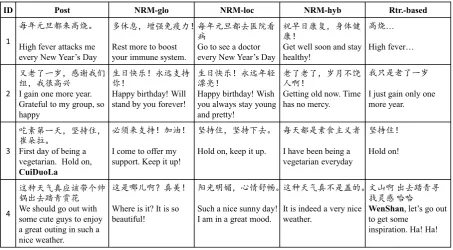
Figure 8 shows some example responses gener-ated by our NRMs (only the one with biggest likelihood is given) and the comparable retrieval-based model. It is intriguing to notice that three NRM variants give suitable but quite distinct re-sponses, with different perspectives and choices of words. This, as we conjecture, is caused by both the architecture variations among models as well as the variations from random effects like the initialization of parameters. Another interest-ing observation is on the fourth example, where the retrieval-based method returns a response with the mismatched entity name “WenShan”, which is actually a quite common problem for retrieval-based model, where the inconsistency details (e.g., dates, named entities), which often render the re-sponse unsuitable, cannot be adequately consid-ered in the matching function employed in retriev-ing the responses. In contrast, we observe that NRMs tend to make general response and barely generate those details.
Post ਹ㍖ㅢжཟθඐᤷօθፊᵫȾ
First day of being a vegetarian. Hold on, CuiDuoLa R1 ඐᤷօθඐᤷ㍖伕έ
Hold on, Keep up your vegetarian diet.
R2
ᜩ㾷ڛᓭ੍ϋᜩ㾷䮵ስ੍ϋ䛙ቧީ⌞ᡇⲺᗤঐȾ
Would you like to be healthy? Would you like to live long? If so, follow me on Weibo.
R3 䘏ቧᱥՖ䈪ѣⲺਹ㍖੍ϋ
This is the so-called vegetarian diet ?
R4
ਹ侧Ҽᢃᴿ࣑≊ࠅ㛛
Eat up so that you will have enough energy to go for a diet!
R5
䓡։ᱥ䶟ળⲺᵢ䫧θу㾷ᙛέ
Health is the essence for winning your future battles. No rush!
Figure 9: Multiple responses generated by the NRM-hyb.
We also use the NRM-hyb as an example to in-vestigate the ability of NRM to generate multi-ple responses. Figure 9 lists 5 responses to the
same post, which are gotten with beam search with beam size = 500, among which we keep only the best one (biggest likelihood) for each first word. It can be seen that the responses are fluent, rele-vant to the post, and still vastly different from each other, validating our initial conjecture that NRM, when fueled with large and rich training corpus, could work as a generator that can cover a lot of modes in its density estimation.
It is worth mentioning that automatic evaluation metrics, such as BLEU (Papineni et al., 2002) as adopted by machine translation and recently SMT-based responding models (Sordoni et al., 2015), do not work very well on this task, especially when the reference responses are few. Our results show that the average BLEU values are less than 2 for all models discussed in this paper, including SMT-based ones, on instances with single reference. Probably more importantly, the ranking given by the BLEU value diverges greatly from the human judgment of response quality.
6 Conclusions and Future Work
In this paper, we explored using encoder-decoder-based neural network system, with coined name Neural Responding Machine, to generate re-sponses to a post. Empirical studies confirm that the newly proposed NRMs, especially the hybrid encoding scheme, can outperform state-of-the-art retrieval-based and SMT-based methods. Our pre-liminary study also shows that NRM can generate multiple responses with great variety to a given post. In future work, we would consider adding the intention (or sentiment) of users as an external signal of decoder to generate responses with spe-cific goals.
Acknowledgments
The authors would like to thank Tao Cai for tech-nical support. This work is supported in part by China National 973 project 2014CB340301.
References
Michael Auli, Michel Galley, Chris Quirk, and Ge-offrey Zweig. 2013. Joint language and transla-tion modeling with recurrent neural networks. In EMNLP, pages 1044–1054.
Dzmitry Bahdanau, Kyunghyun Cho, and Yoshua Ben-gio. 2014. Neural machine translation by jointly
learning to align and translate. arXiv preprint
Kyunghyun Cho, Bart van Merrienboer, Caglar Gul-cehre, Fethi Bougares, Holger Schwenk, and Yoshua Bengio. 2014. Learning phrase representations using rnn encoder-decoder for statistical machine translation. arXiv preprint arXiv:1406.1078. Junyoung Chung, Caglar Gulcehre, KyungHyun Cho,
and Yoshua Bengio. 2014. Empirical evaluation of gated recurrent neural networks on sequence model-ing. arXiv preprint arXiv:1412.3555.
Joseph L Fleiss. 1971. Measuring nominal scale
agreement among many raters. Psychological
bul-letin, 76(5):378.
Alex Graves. 2013. Generating sequences with recur-rent neural networks. preprint arXiv:1308.0850. Klaus Greff, Rupesh Kumar Srivastava, Jan Koutn´ık,
Bas R. Steunebrink, and J¨urgen Schmidhuber.
2015. LSTM: A search space odyssey. CoRR,
abs/1503.04069.
Sepp Hochreiter and J¨urgen Schmidhuber. 1997.
Long short-term memory. Neural computation,
9(8):1735–1780.
David C. Howell. 2010.Fundamental Statistics for the Behavioral Sciences. PSY 200 (300) Quantitative Methods in Psychology Series. Wadsworth Cengage Learning.
Zongcheng Ji, Zhengdong Lu, and Hang Li. 2014. An information retrieval approach to short text conver-sation. arXiv preprint arXiv:1408.6988.
Thorsten Joachims. 2006. Training linear svms in
lin-ear time. InSIGKDD, pages 217–226. ACM.
Nal Kalchbrenner and Phil Blunsom. 2013. Recurrent
continuous translation models. In EMNLP, pages
1700–1709.
Philipp Koehn, Hieu Hoang, Alexandra Birch, Chris Callison-Burch, Marcello Federico, Nicola Bertoldi, Brooke Cowan, Wade Shen, Christine Moran, Richard Zens, et al. 2007. Moses: Open source toolkit for statistical machine translation. In Pro-ceedings of the 45th annual meeting of the ACL on interactive poster and demonstration sessions, pages 177–180. ACL.
Diane Litman, Satinder Singh, Michael Kearns, and Marilyn Walker. 2000. Njfun: a reinforcement
learning spoken dialogue system. In Proceedings
of the 2000 ANLP/NAACL Workshop on Conversa-tional systems, pages 17–20. ACL.
Tomas Mikolov, Martin Karafi´at, Lukas Burget, Jan Cernock`y, and Sanjeev Khudanpur. 2010.
Recur-rent neural network based language model. In
IN-TERSPEECH 2010, pages 1045–1048.
Teruhisa Misu, Kallirroi Georgila, Anton Leuski, and David Traum. 2012. Reinforcement learning of question-answering dialogue policies for virtual
mu-seum guides. InSIGDIAL, pages 84–93. ACL.
Franz Josef Och and Hermann Ney. 2003. A sys-tematic comparison of various statistical alignment
models. Computational linguistics, 29(1):19–51.
Kishore Papineni, Salim Roukos, Todd Ward, and Wei-Jing Zhu. 2002. Bleu: a method for automatic evaluation of machine translation. InProceedings of the 40th annual meeting on association for compu-tational linguistics, pages 311–318. Association for Computational Linguistics.
Alan Ritter, Colin Cherry, and William B Dolan. 2011. Data-driven response generation in social media. In EMNLP, pages 583–593. Association for Computa-tional Linguistics.
Jost Schatzmann, Karl Weilhammer, Matt Stuttle, and Steve Young. 2006. A survey of statistical user sim-ulation techniques for reinforcement-learning of
di-alogue management strategies. The knowledge
en-gineering review, 21(02):97–126.
Alessandro Sordoni, Michel Galley, Michael Auli, Chris Brockett, Yangfeng Ji, Meg Mitchell, Jian-Yun Nie, Jianfeng Gao, and Bill Dolan. 2015. A neural network approach to context-sensitive generation of conversational responses. Conference of the North American Chapter of the Association for Computa-tional Linguistics Human Language Technologies (NAACL-HLT 2015), June.
Ilya Sutskever, Oriol Vinyals, and Quoc VV Le. 2014. Sequence to sequence learning with neural
net-works. InNIPS, pages 3104–3112.
Hao Wang, Zhengdong Lu, Hang Li, and Enhong Chen. 2013. A dataset for research on short-text
conversations. InEMNLP, pages 935–945.
Jason D Williams and Steve Young. 2007. Partially observable markov decision processes for spoken
dialog systems. Computer Speech & Language,