A Dual-Layer Semantic Role Labeling System
Lun-Wei Ku
Institute of Information Science Academia Sinica, Taiwan [email protected]
Shafqat Mumtaz Virk Institute of Information Science
Academia Sinica, Taiwan [email protected]
Yann-Huei Lee Institute of Information Science
Academia Sinica, Taiwan andycyrus.gmail.com
Abstract
We describe a well-performed semantic role labeling system that further extracts concepts (smaller semantic expressions) from unstruc-tured natural language sentences language in-dependently. A dual-layer semantic role labeling (SRL) system is built using Chinese Treebank and Propbank data. Contextual in-formation is incorporated while labeling the predicate arguments to achieve better perfor-mance. Experimental results show that the proposed approach is superior to CoNLL 2009 best systems and comparable to the state of the art with the advantage that it requires no feature engineering process. Concepts are fur-ther extracted according to templates formu-lated by the labeled semantic roles to serve as features in other NLP tasks to provide seman-tically related cues and potentially help in re-lated research problems. We also show that it is easy to generate a different language ver-sion of this system by actually building an English system which performs satisfactory.
1 Introduction
Semantic roles are utilized to find concepts au-tomatically and assure their meaningfulness. Se-mantic role labeling is a research problem which finds in a given sentence the predicates and their arguments (identification), and further labels the semantic relationship between predicates and ar-guments, that is, their semantic roles (classifica-tion). There are several labeling sets. Researchers have widely adopted the semantic role labels de-fined in Propbank (Bonial et al., 2010) like predi-cate (PRED), numbered arguments 0 to 5 (ARG0, ARG1, ARG2, ARG3, ARG4, ARG5), or modifier arguments (ARGM-X); finer labels are those de-fined in Sinica Treebank (Huang et al., 2000) like agent, theme, target, which are labeled on each
node of the parse tree; those defined in FrameNet (Ruppenhofer et al., 2006) are the finest but most expressive. Each set provides semantic information. As long as the semantic relationship between terms derives from their semantic role labels, we are able to determine whether they should be extracted from the current sentence to construct a concept.
The word concept usually refers to an abstract or general idea inferred or derived from specific in-stances. Therefore, the extraction of concepts from text is often defined as extracting terms that are in some way related to one another. These terms could be predefined by people in resources such as ontologies, or they could be typical words in texts. In this paper, we view concepts as thecontinuous or discontinuous meaningful units in a sentence and hence they are tightly related to semantic roles. We propose a dual-layer semantic role labeling system which provides extracted concepts accord-ing to the reported labels, and then demonstrate the functions of this system. Experimental results will show the merit of the proposed framework.
2 Related Work
Previous studies related to this work can be divided into two groups: semantic role labeling and con-cept extraction. Semantic role labeling (SRL) has sparked much interest in NLP (Shen and Lapata, 2007; Liu and Gildea, 2010). The first automatic SRL systems were reported by Gildea and Jurafsky in 2002 (Gildea and Jurafsky 2002); since then, their ideas have dominated the field. In their ap-proach, they emphasize the selection of appropriate lexical and syntactical features for SRL, the use of statistical classifiers and their combinations, and ways to handle data sparseness. Many researchers have tried to build on their work by augmenting and/or altering the feature set (Xue 2004), by ex-perimenting with various classification approaches (Pradhan et al. 2004; Park and Rim 2005), and by attempting different ways to handle data sparseness
(Zapirain, Agirre, and Màrquez 2007). Moreover, some researchers have tried to extend it in novel ways. For example, Ding and Chang (2008) used a hierarchical feature selection strategy, while Jiang, Li, and Ng (2005) proposed exploiting argument interdependence, that is, the fact that the semantic role of one argument can depend on the semantic roles of other arguments.
Many researchers have tried to extract concepts from texts (Gelfand et al., 1998; Hovy et al., 2009; Villalon and Calvo, 2009; Dinh and Tamine, 2011; Torii et al., 2011). Hovy narrowed the domain of interest into concepts “below” a given seed term. Villalon and Calvo extract concepts from student essays for concept map mining, which generates a directed relational graph of the extracted concepts in an essay. For specific domains, biological or medical concepts are of greatest interest to re-searchers (Jonnalagadda et al., 2011). Two rela-tively new and related approaches are the Concept parser (Rajagopal et al. 2013), a part of the SenticNet project (Cambria, Olsher, and Rajagopal 2014) and ConceptNet (Liu and Singh 2004). The former is a tool to decompose unrestricted natural language text to a bag of concepts, which is similar to our work. However, in the final phase a
[image:2.595.311.519.229.394.2]seman-tic knowledge base is used to express a concept in all its different forms and their concept-parser does not use any semantic knowledge during decompo-sition. The latter is a semantic network based on the Open Mind Common Sense (OMCS) knowledge base. As it is a knowledge base, its construction process is quite different from the work described here of automatically extracting concepts from sentences.
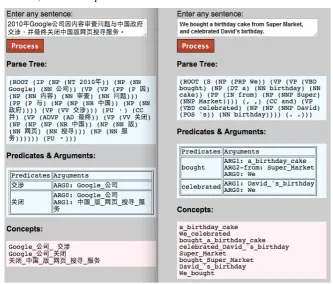
Figure 2: System Interface (Chinese example sentence: In 2010, Google company negotiated with the China gov-ernment on the issue of results censoring, and eventually shut down the web search service.)
Syntactic Parsing
Semantic Role Labeling
Concept Extraction Concept
Templates
Prop-Bank
[image:2.595.129.463.423.707.2]Output: Concepts
Figure 1: System Framework. Input:
3
System
The proposed system includes three major com-ponents: a syntactic parser, a semantic role la-beler, and a concept formulation component. The framework is shown in Figure 1. The input sen-tence is first transformed into a syntactic parse tree through a syntactical analysis step that al-most all automatic semantic role labeling sys-tems require (Johansson and Nugues 2008). Here the Stanford parser (Klein and Manning 2003) is utilized. Figure 2 shows the system interface. The left part is the English system and the right part is the Chinese system. After users input a sentence, the system will automatically parse, label semantic roles and report the related con-cepts for it.
3.1 Semantic Role Labeling
To develop a SRL system, a total of 33 features including features related to the head word relat-ed features, target word relatrelat-ed features, gram-mar related features, and semantic type related features, are collected from related work (Xue, 2008; Ding and Chang, 2008; Sun and Jurafsky 2004; Gildea and Jurafsky 2002). Then the base-line maximum entropy system is developed using these features (Manning and Schutze, 1999). Two sets of data – Chinese Treebank 5.0 together with Propbank 1.0 and Chinese Treebank 6.0 with Propbank 2.0 – are separated into the train-ing and testtrain-ing sets, and are then used to build models to identify and classify semantic labels, and also to evaluate the performance, respective-ly. As Chinese data was selected for experiments, the hypernyms of words from E-Hownet1, a
Chi-nese word ontology, are utilized as the semantic type of words. When applying the whole system on data in other languages, for major languages it is not difficult to find resources to obtain hyper-nyms. For minor languages, it is fine to just ig-nore these features. According to our experience, this will yield F-Score reductions of only 1% to 2%.
We further exploit argument interdependence to enhance performance by the dual-layer framework shown in Figure 2. Suppose for any given predicate P in a sentence, the system has identified the three potential arguments A1, A2, and A3 of the predicate. Next, to predict the se-mantic role labels of those three arguments, a critical observation made by (Jiang, Li, and Ng
1 http://ckip.iis.sinica.edu.tw/CKIP/conceptnet.htm
2005) is that the semantic roles of arguments may depend on each other; this phenomenon is known as argument interdependence. A common way to escape argument interdependence is to adopt sequence labeling, and use the features extracted from the arguments around the current argument together with the features of the current one to predict the label for the current argument. For example, while predicting the label of argu-ment A2, features extracted from arguargu-ments A1 and A3 are also used. Although window sizes can be used to set the scope of this interdepend-ence, the window-size strategy has some practi-cal limits: the typipracti-cally large feature set necessitates the use of smaller window sizes (a window size of [-1,1] is common). However, small window sizes can make it impossible to capture long dependency phenomena.
To overcome the limitations of the window-size strategy, we use all the surrounding argu-ments’ predicted labels – window size [-∞,∞], as opposed to their features – to predict the label of the current node. This also conforms to the rule that when a role is taken by the other argu-ment, it is less likely that the current argument is of the same role. We implement this idea using the dual-layer classification framework shown in Figure 3.
In layer 1 the baseline system is used to pre-dict the labels for identified nodes. Then in layer 2, these predicted labels of all surrounding argu-ments (in this example, A1 and A3) together with other features of the current node (A2) are used
Layer 1
A1 A2 A3
Features Features Features
Label
prediction prediction Label
Layer 2
Features + predicted labels
Predicted label
to predict the label of the current node. Note as this approach is under no window size limitation, the labels of all arguments under the same predi-cate are taken into account. Experimental resu lts show that this strategy works better than the window-size strategy. Table 1 shows the system accuracies for the single- and dual-layer frame-works. The predicted dual-layer framework uti-lized the SRL labels predicted in layer 1, while the gold dual-layer framework used as features the gold SRL labels of the surrounding argu-ments.
System Accuracy
Ding and Chang, 2008 (state of the art) 94.68
Single-layer framework 94.60
Dual-layer framework (predicted) 94.86
Dual-layer framework (gold) 95.40
Table 1. Accuracy of SRL classification phase.
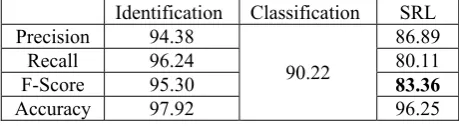
To further evaluate the performance of the proposed system and offer comparisons, we ap-plied it on Chinese Treebank 6.0 with Propbank 2.0 in the same way as in the CoNLL 2009 SRL-only task data according to the information pro-vided by the CoNLL organizers. Table 2 shows the results of the proposed system. Table 3 fur-ther shows the performance of the best systems in CoNLL 2009.
Identification Classification SRL
Precision 94.38
90.22
86.89
Recall 96.24 80.11
F-Score 95.30 83.36
[image:4.595.66.296.450.513.2]Accuracy 97.92 96.25
Table 2. SRL results on Propbank 2.0.
System name Type Score
Nugus (Björkelund et al., 2009)
Closed
chal-lenge, SRL-only
78.50 (F-Score) Meza-Ruiz
(Meza-Ruiz and
Riedel, 2009)
Closed
chal-lenge, SRL-only
82.66 (Precision)
Täckström (Täckström, 2009)
Closed
chal-lenge, SRL-only
79.31 (Recall) Che
(Che et al., 2009)
Open challenge, Joint Task
76.42 (F-Score) Table 3. CoNLL 2009 SRL performance2.
The CoNLL 2009 task builds dependency-based SRL systems, while the proposed system works on the constituent-based parsing trees. Also the settings of the proposed system are not
2 http://ufal.mff.cuni.cz/conll2009-st/results/results.php
all the same as the CoNLL 2009 SRL systems. In CoNLL 2009, as noted in Table 5, participants can participate in open or closed challenges, and can choose whether they want to attempt both syntactic and semantic labeling tasks (joint task) or only to attempt the SRL task. The setting of the proposed system is open challenge, SRL-only, while researchers working on the Chinese data selected only two other different settings: closed challenge, SRL only and open challenge, joint task. However, Table 5 shows that the proposed system outperforms the CoNLL 2009 best sys-tems in terms of precision (86.89 vs. 82.66), re-call (80.11 vs. 79.31), and f-score (83.36 vs. 78.50). Moreover, lately, dependency-based SRL has shown advantages over constituent-based SRL (Johansson and Nugues, 2008); thus we ex-pect to show better results if working on depend-ency-based parsed data. Therefore, we believe the proposed system is comparable or even supe-rior to other systems.
3.2 Concept-Formulations
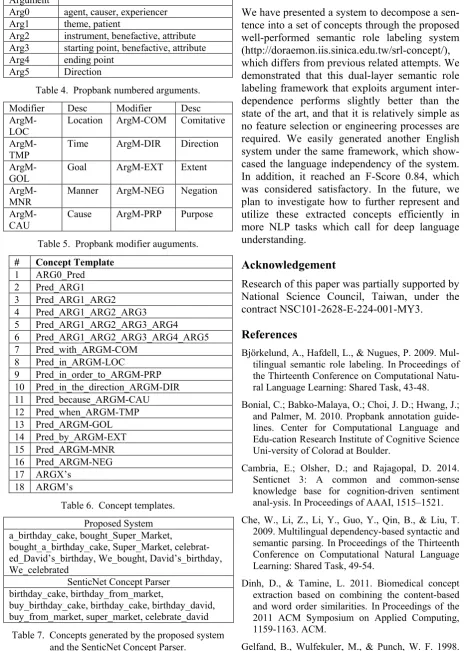
Once the sentence has been annotated seman-tically, the concepts are formulated by concept templates designed according to Propbank SRL labels. Propbank provides semantic role labels of two types. One type is numbered arguments Arg0, Arg1, and so on until Arg5; the other type is modifiers with function tags, which give addi-tional information about when, where, or how the event occurred. Tables 4 and 5 list the descrip-tions of the Propbank arguments utilized for the concept template generation. Table 6 then lists the generated concept templates.
Numbered
Argument Description
Arg0 agent, causer, experiencer
Arg1 theme, patient
Arg2 instrument, benefactive, attribute Arg3 starting point, benefactive, attribute
Arg4 ending point
Arg5 Direction
Table 4. Propbank numbered arguments.
Modifier Desc Modifier Desc
ArgM-LOC Location ArgM-COM Comitative
ArgM-TMP Time ArgM-DIR Direction
ArgM-GOL
Goal ArgM-EXT Extent
ArgM-MNR Manner ArgM-NEG Negation
[image:5.595.63.533.90.742.2]
ArgM-CAU Cause ArgM-PRP Purpose
Table 5. Propbank modifier auguments.
# Concept Template
1 ARG0_Pred
2 Pred_ARG1
3 Pred_ARG1_ARG2
4 Pred_ARG1_ARG2_ARG3
5 Pred_ARG1_ARG2_ARG3_ARG4
6 Pred_ARG1_ARG2_ARG3_ARG4_ARG5
7 Pred_with_ARGM-COM
8 Pred_in_ARGM-LOC
9 Pred_in_order_to_ARGM-PRP
10 Pred_in_the_direction_ARGM-DIR 11 Pred_because_ARGM-CAU 12 Pred_when_ARGM-TMP 13 Pred_ARGM-GOL 14 Pred_by_ARGM-EXT 15 Pred_ARGM-MNR 16 Pred_ARGM-NEG 17 ARGX’s
18 ARGM’s
Table 6. Concept templates. Proposed System
a_birthday_cake, bought_Super_Market, bought_a_birthday_cake, Super_Market, celebrat-ed_David’s_birthday, We_bought, David’s_birthday, We_celebrated
SenticNet Concept Parser birthday_cake, birthday_from_market,
buy_birthday_cake, birthday_cake, birthday_david, buy_from_market, super_market, celebrate_david
Table 7. Concepts generated by the proposed system and the SenticNet Concept Parser.
4
Conclusion
We have presented a system to decompose a sen-tence into a set of concepts through the proposed well-performed semantic role labeling system (http://doraemon.iis.sinica.edu.tw/srl-concept/), which differs from previous related attempts. We demonstrated that this dual-layer semantic role labeling framework that exploits argument inter-dependence performs slightly better than the state of the art, and that it is relatively simple as no feature selection or engineering processes are required. We easily generated another English system under the same framework, which show-cased the language independency of the system. In addition, it reached an F-Score 0.84, which was considered satisfactory. In the future, we plan to investigate how to further represent and utilize these extracted concepts efficiently in more NLP tasks which call for deep language understanding.
Acknowledgement
Research of this paper was partially supported by National Science Council, Taiwan, under the contract NSC101-2628-E-224-001-MY3.
References
Björkelund, A., Hafdell, L., & Nugues, P. 2009. Mul-tilingual semantic role labeling. In Proceedings of the Thirteenth Conference on Computational Natu-ral Language Learning: Shared Task, 43-48. Bonial, C.; Babko-Malaya, O.; Choi, J. D.; Hwang, J.;
and Palmer, M. 2010. Propbank annotation guide-lines. Center for Computational Language and Edu-cation Research Institute of Cognitive Science Uni-versity of Colorad at Boulder.
Cambria, E.; Olsher, D.; and Rajagopal, D. 2014. Senticnet 3: A common and common-sense knowledge base for cognition-driven sentiment anal-ysis. In Proceedings of AAAI, 1515–1521. Che, W., Li, Z., Li, Y., Guo, Y., Qin, B., & Liu, T.
2009. Multilingual dependency-based syntactic and semantic parsing. In Proceedings of the Thirteenth Conference on Computational Natural Language Learning: Shared Task, 49-54.
Dinh, D., & Tamine, L. 2011. Biomedical concept extraction based on combining the content-based and word order similarities. In Proceedings of the 2011 ACM Symposium on Applied Computing, 1159-1163. ACM.
In AAAI 1998 Workshop on Text Categoriza-tion, 13-17.
Gildea, D., and Jurafsky, D. 2002. Automatic labeling of semantic roles. Comput. Linguist. 28(3):245– 288.
Hovy, E., Kozareva, Z., & Riloff, E. 2009. Toward completeness in concept extraction and classifica-tion. In Proceedings of the 2009 Conference on Empirical Methods in Natural Language Pro-cessing: Volume 2-Volume 2, 948-957.
Huang, C. R., Chen, F. Y., Chen, K. J., Gao, Z. M., & Chen, K. Y. (2000, October). Sinica Treebank: de-sign criteria, annotation guidelines, and on-line in-terface. In Proceedings of the second workshop on Chinese language processing: held in conjunction with the 38th Annual Meeting of the Association for Computational Linguistics-Volume 12, 29-37. Jiang, Z. P.; Li, J.; and Ng, H. T. 2005. Semantic
ar-gu-ment classification exploiting argument inter-depend-ence. In Proceedings of the 19th International Joint Conference on Artificial Intelli-gence, IJCAI’05, 1067–1072.
Johansson, R., & Nugues, P. 2008. The effect of syn-tactic representation on semantic role labeling. In Proceedings of the 22nd International Conference on Computational Linguistics-Volume 1, 393-400. R. Johansson and P. Nugues. 2008. Dependency-based semantic role labeling of PropBank. In Pro-ceedings of the 2008 Conference on Empirical Methods in Natural Language Processing.
Jonnalagadda, S., Cohen, T., Wu, S., & Gonzalez, G. 2012. Enhancing clinical concept extraction with distributional semantics. Journal of biomedical in-formatics, 45(1), 129-140.
Klein, D., and Manning, C. D. 2003. Accurate unlexi-cal-ized parsing. In Proceedings of the 41st Annual Meeting on Association for Computational Lin-guis-tics - Volume 1, ACL ’03, 423–430.
D. Liu and D. Gildea. 2010. Semantic role features for machine translation. In Proceedings of the 23rd In-ternational Conference on Computational Linguis-tics.
Liu, H., and Singh, P. 2004. Conceptnet: A practical
commonsense reasoning toolkit. BT
TECHNOLOGY JOURNAL 22:211–226.
Manning, Christopher D. and Schutze, Hinrich. 1999. Foundations of statistical natural language pro-cessing, Cambridge, Mass.: MIT Press.
Meza-Ruiz, I., & Riedel, S. 2009. Multilingual se-mantic role labelling with markov logic. In Proceedings of the Thirteenth Conference on Computational Natural Language Learning: Shared Task, 85-90.
Park, K.-M., and Rim, H.-C. 2005. Maximum entropy based semantic role labeling. In Proceedings of the Ninth Conference on Computational Natural Lan-guage Learning, CONLL ’05, 209–212.
Pradhan, S.; Ward, W.; Hacioglu, K.; and Martin, J. H. 2004. Shallow semantic parsing using support vec-tor machines. In Proceedings of the Conference on the Human Language Technologies and North American Association for Computational Linguis-tics (HLT-NAACL 2004), 233–240.
Rajagopal, D.; Cambria, E.; Olsher, D.; and Kwok, K. 2013. A graph-based approach to commonsense concept extrac- tion and semantic similarity detec-tion. In Proceedings of the 22Nd International Con-ference on World Wide Web Companion, WWW ’13 Companion, 565–570.
Ruppenhofer, J., Ellsworth, M., Petruck, M. R., John-son, C. R., & Scheffczyk, J. (2006). FrameNet II: Extended theory and practice.
D. Shen and M. Lapata. 2007. Using semantic roles to improve question answering. In Proceedings of the Conference on Empirical Methods in Natural Lan-guage Processing and on Computational Natural Language Learning.
Täckström, O. 2009. Multilingual semantic parsing with a pipeline of linear classifiers. In Proceedings of the Thirteenth Conference on Computational Natural Language Learning: Shared Task, 103-108. Torii, M., Wagholikar, K., & Liu, H. 2011. Using
machine learning for concept extraction on clinical documents from multiple data sources. Journal of the American Medical Informatics Association, amiajnl-2011.
Villalon, J., & Calvo, R. A. 2009. Concept extraction from student essays, towards concept map mining. In Proceedings of Ninth IEEE International Con-ference on Advanced Learning Technologies, 221-225.
Xue, N. 2004. Calibrating features for semantic role labeling. In Proceedings of EMNLP 2004, 88–94. Xue, N. 2008. Labeling chinese predicates with
seman-tic roles. Comput. Linguist. 34(2):225–255. Zapirain, B.; Agirre, E.; and Màrquez, L. 2007.