Word-based Japanese typed dependency parsing with grammatical
function analysis
Takaaki Tanaka Nagata Masaaki
NTT Communication Science Laboratories, NTT Corporation 2-4, Hikaridai, Seika-cho, Soraku-gun, Kyoto, 619-0237, Japan
{tanaka.takaaki,nagata.masaaki}@lab.ntt.co.jp
Abstract
We present a novel scheme for word-based Japanese typed dependency parser which integrates syntactic structure analy-sis and grammatical function analyanaly-sis such as predicate-argument structure analysis. Compared to bunsetsu-based dependency parsing, which is predominantly used in Japanese NLP, it provides a natural way of extracting syntactic constituents, which is useful for downstream applications such as statistical machine translation. It also makes it possible to jointly decide de-pendency and predicate-argument struc-ture, which is usually implemented as two separate steps. We convert an existing treebank to the new dependency scheme and report parsing results as a baseline for future research. We achieved a bet-ter accuracy for assigning function labels than a predicate-argument structure ana-lyzer by using grammatical functions as dependency label.
1 Introduction
The goal of our research is to design a Japanese typed dependency parsing that has sufficient lin-guistically derived structural and relational infor-mation for NLP applications such as statistical machine translation. We focus on the Japanese-specific aspects of designing a kind of Stanford typed dependencies (de Marneffe et al., 2008).
Syntactic structures are usually represented as dependencies between chunks called bunsetsus. A bunsetsu is a Japanese grammatical and phono-logical unit that consists of one or more con-tent words such as a noun, verb, or adverb fol-lowed by a sequence of zero or more function words such as auxiliary verbs, postpositional par-ticles, or sentence-final particles. Most publicly
available Japanese parsers, including CaboCha 1 (Kudo et al., 2002) and KNP 2(Kawahara et al., 2006), return bunsetsu-based dependency as syn-tactic structure. Such parsers are generally highly accurate and have been widely used in various NLP applications.
However, bunsetsu-based representations also have two serious shortcomings: one is the discrep-ancy between syntactic and semantic units, and the other is insufficient syntactic information (Butler et al., 2012; Tanaka et al., 2013).
Bunsetsu chunks do not always correspond to constituents (e.g. NP, VP), which complicates the task of extracting semantic units from bunsetsu-based representations. This kind of problem of-ten arises in handling such nesting structures as coordinating constructions. For example, there are three dependencies in a sentence (1): a co-ordinating dependency b2 – b3 and ordinary de-pendencies b1 – b3 and b3 – b4. In extracting predicate-argument structures, it is not possible to directly extract a coordinated noun phrase ワイ ンと酒“wine and sake” as a direct object of the verb 飲んだ “drank”. In other words, we need an implicit interpretation rule in order to extract NP in coordinating construction: head bunsetsu b3 should be divided into a content word 酒and a function wordの, then the content word should be merged with the dependent bunsetsub2.
(1) b1飲んだ nonda
drank
|b2ワイン
wain
wine と to
CONJ
|b3酒
sake
sake の no
GEN
|b4リスト
risuto
list ‘A list of wine and sake that (someone) drank’
Therefore, predicate-argument structure analysis is usually implemented as a post-processor of bunsetsu-based syntactic parser, not just for as-signing grammatical functions, but for identifying constituents, such as an analyzer SynCha 3 (Iida
1
http://taku910.github.io/cabocha/.
2
http://nlp.ist.i.kyoto-u.ac.jp/EN/index.php?KNP.
3
http://www.cl.cs.titech.ac.jp/∼ryu-i/syncha/.
魚/フライ を 食べ た か/も/しれ/ない 三毛/猫
fish / fry -ACC eat -PAST may calico / cat “the calico cat that may have eaten fried fish”
[image:2.595.76.298.62.106.2]SUW NN / NN PCS VB AUX P / P / VB / AUX NN / NN LUW NN PCS VB AUX AUX NN
Figure 1: A tokenized and chunked sentence.
et al., 2011), which uses the parsing results from CaboCha. We assume that using a word as a pars-ing unit instead of a bunsetsu chunk helps to main-tain consistency between syntactic structure anal-ysis and predicate-argument structure analanal-ysis.
Another problem is that linguistically different constructions share the same representation. The difference of a gapped relative clause and a gapless relative clause is a typical example. In sentences (2) and (3), we cannot discriminate the two rela-tions between bunsetsusb2andb3using unlabeled dependency: the former is a subject-predicate con-struction of the noun 猫“cat” and the verb 食べ
る“eat” (subject gap relative clause) while the lat-ter is not a predicate-argument construction (gap-less relative clause).
(2) b1魚 sakana
fish を o
ACC
|b2食べ
tabe
eat た ta
PAST
|b3猫
neko
cat ‘the cat that ate fish’
(3) b1魚
sakana
fish を o
ACC
|b2食べ
tabe
eat た ta
PAST
|b3話
hanashi
story ‘the story about having eaten fish’
We aim to build a Japanese typed depen-dency scheme that can properly deal with syn-tactic constituency and grammatical functions in the same representation without implicit interpre-tation rules. The design of Japanese typed depen-dencies is described in Section 3, and we present our evaluation of the dependency parsing results for a parser trained with a dependency corpus in Section 4.
2 Related work
Mori et al. (2014) built word-based dependency corpora in Japanese. The reported parsing achieved an unlabeled attachment score of over 90%; however, there was no information on the syntactic relations between the words in this corpus. Uchimoto et al. (2008) also proposed the criteria and definitions of word-level depen-dency structure mainly for annotation of a sponta-neous speech corpus, the Corpus of Spontasponta-neous Japanese (CSJ) (Maekawa et al., 2000), and they do not make a distinction between detailed syntac-tic functions either.
.... NP. .... .. NN... ..
三毛猫
calico cat .
..
..
IP-REL sbj. ....
..
AUX...
..
かもしれない
may . .. .. VP. .... .. AUX... ..
た
-PAST . .. .. VP. .... .. VB... ..
食べ
eat . .. .. PP-OBJ. .... .. PCS... ..
を
-ACC . .. .. NN... ..
魚フライ
fried fish . dobj . pobj . aux . aux . rcmod nsubj
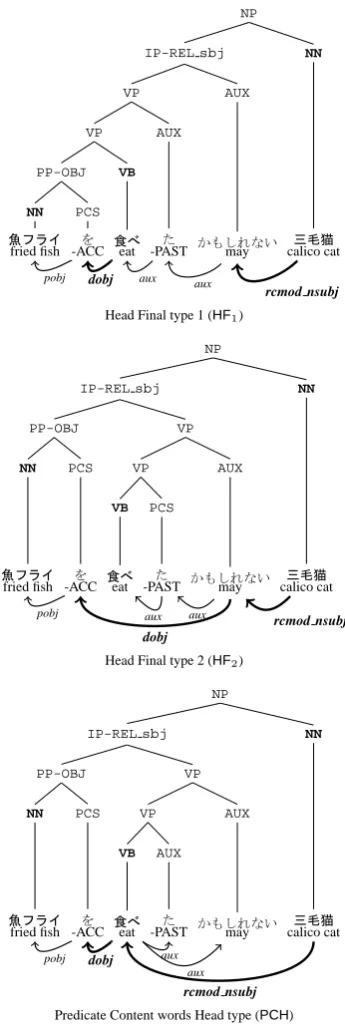
Head Final type 1 (HF1)
.... NP. .... .. NN... ..
三毛猫
calico cat .
..
..
IP-REL sbj. .... .. VP. .... .. AUX... ..
かもしれない
may . .. .. VP. .... .. PCS... ..
た
-PAST . .. .. VB... ..
食べ
eat . .. .. PP-OBJ. .... .. PCS... ..
を
-ACC . .. .. NN... ..
魚フライ
fried fish . dobj . pobj . aux . aux . rcmod nsubj
Head Final type 2 (HF2)
.... NP. .... .. NN... ..
三毛猫
calico cat .
..
..
IP-REL sbj. .... .. VP. .... .. AUX... ..
かもしれない
may . .. .. VP. .... .. AUX... ..
た
-PAST . .. .. VB... ..
食べ
eat . .. .. PP-OBJ. .... .. PCS... ..
を
-ACC . .. .. NN... ..
魚フライ
fried fish . dobj . pobj . aux . aux . rcmod nsubj
Predicate Content words Head type (PCH)
‘ the calico cat that may have eaten fried fish. ’
[image:2.595.327.500.114.633.2]Category Dep. type case (argument) nsubj subject
dobj direct object iobj indirect object case (adjunct) tmod temporal
lmod locative
gapped relative clause rcmod nsubj subject gap relative clause rcmod dobj direct object gap relative clause rcmod iobj indirect object gap relative clause adnominal clause ncmod gapless relative clause adverbial clause advcl
coordinating construction conj apposition appos
function word relation aux relation between an auxiliary verb and other word pobj relation between a particle
[image:3.595.73.294.61.202.2]and other word
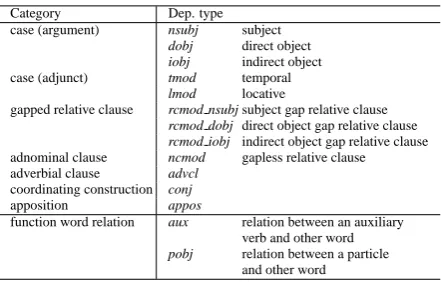
Table 1: Dependency types (excerpt).
We proposed a typed dependency scheme based on the well-known and widely used Stanford typed dependencies (SD), which originated in English and has since been extended to many languages, but not to Japanese. The Universal dependencies (UD) (McDonald et al., 2013; de Marneffe et al., 2014) has been developed based on SD in order to design the cross-linguistically consistent treebank annotation 4. The UD for Japanese has also been discussed, but no treebanks have been provided yet. We focus on the feasibility of word-based Japanese typed dependency parsing rather than on cross-linguistic consistency. We plan to examine the conversion between UD and our scheme in the future.
3 Typed dependencies in Japanese
To design a scheme of Japanese typed depen-dencies, there are three essential points: what should be used as parsing units, which dependency scheme is appropriate for Japanese sentence struc-ture, and what should be defined as dependency types.
3.1 Parsing unit
Defining a word unit is indispensable for word-based dependency parsing. However, this is not a trivial question, especially in Japanese, where words are not segmented by white spaces in its or-thography. We adopted two types of word units defined by NINJL 5 for building the Balanced Corpus of Contemporary Written Japanese (BC-CWJ) (Maekawa et al., 2014; Den et al., 2008): Short unit word (SUW) is the shortest token con-veying morphological information, and the long unit word (LUW) is the basic unit for parsing, con-sisting of one or more SUWs. Figure 1 shows
ex-4
http://universaldependencies.github.io/docs/. 5National Institute for Japanese Language and Linguistics.
ample results from the preprocessing of parsing. In the figure, “/” denotes a border of SUWs in an LUW, and “∥” denotes a bunsetsu boundary.
3.2 Dependency scheme
Basically, Japanese dependency structure is re-garded as an aggregation of pairs of a left-side dependent word and a right-left-side head word, i.e. right-headed dependency, since Japanese is a head-final language. However, how to analyze a predicate constituent is a matter of debate. We de-fine two types of schemes depending on the struc-ture related to the predicate constituent: first con-joining predicate and arguments, and first conjoin-ing predicate and function words such as auxiliary verbs.
As shown in sentence (4), a predicate bunsetsu consists of a main verb followed by a sequence of auxiliary verbs in Japanese. We consider two ways of constructing a verb phrase (VP). One is first conjoining the main verb and its arguments to construct VP as in sentence (4a), and the other is first conjoining the main verb and auxiliary verbs as in sentence (4b). These two types correspond to sentences (5a) and (5b), respectively, in English.
(4) 猫 cat
が
NOM
魚 fish
を
ACC
食べ eat
た
PAST
かもしれない may
‘the cat may have eaten the fish’ a. [ [ [VP 猫が
S 魚を O
食べ]
V た]
aux
かもしれない]
aux b. [ 猫が[
S
魚を[VP
O
食べ V
た aux
かもしれない]]]
aux
(5) a. [ The S
cat[ may aux
have aux
[VP eaten V
the fish] ] ]. O
b. [ The S
cat[ [VP may aux
have aux
eaten] V
the fish] ]. O
The structures in sentences (4a) and (5a) are similar to a structure based on generative gram-mar. On the other hand, the structures in sentences (4b) and (5b) are similar to the bunsetsu structure. We defined two dependency schemes Head Fi-nal type 1 (HF1) and Head Final type 2 (HF2) as shown in Figure 2, which correspond to structures of sentences (4a) and (4b), respectively. Addi-tionally, we introduced Predicate Content word Head type (PCH), where a content word (e.g. verb) is treated as a head in a predicate phrase so as to link the predicate to its argument more directly.
3.3 Dependency type
LUW (Long Unit Word) source
l FORM form LUW chunker
l LEMMA lemma LUW chunker
l UPOS POS LUW chunker
l INFTYPE inflection type LUW chunker
l INFFORM inflection form LUW chunker
l CPOS non-terminal symbol ∗
l SEMCLASS semantic class thesaurus∗∗
l PNCLASS NE class thesaurus∗∗
SUW (Short Unit Word)
s FORM R form (rightmost) tokenizer
s FORM L form (leftmost) tokenizer
s LEMMA R lemma (rightmost) tokenizer
s LEMMA L lemma (leftmost) tokenizer
s UPOS R POS tokenizer
s CPOS R non-terminal symbol ∗
s SEMCLASS R semantic class thesaurus∗∗
[image:4.595.89.275.59.208.2]s PNCLASS R NE class thesaurus∗∗
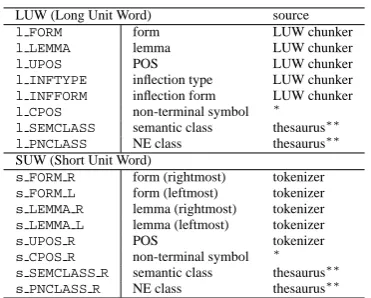
Table 2: Word attributes used for parser features.
∗ 26 non-terminal symbols (e.g. NN, VB) are employed as
coarse POS tags (CPOS) from an original treebank. ∗∗ Se-mantic classesSEMCLASSandPNCLASSare used for
gen-eral nouns and proper nouns, respectively from a Japanese thesaurus (Ikehara et al., 1997) to generalize the nouns.
Table 1 shows the major dependency types. To discriminate between a gapped relative clause and a gapless relative clause as described in Section 1, we assigned two dependency types rcmod and
ncmod respectively. Moreover, we introduced gap
information by subdividing rcmod into three types to extract predicate-argument relations, while the original SD make no distinction between them.
The labels of case and gapped relative clause enable us to extract predicate-argument struc-tures by simply tracing dependency paths. In the case of HF1 in Figure 2, we find two paths between content words: 魚フライ “fried fish”(NN)←pobj←dobj← 食 べ “eat”(VB) and
食 べ (VB)←aux←aux←rcmod nsubj← 三 毛 猫“calico cat”(NN). By marking the dependency types dobj and rcmod nsubj, we can extract the arguments for predicate食べる, i.e.,魚フライas a direct object and三毛猫as a subject.
4 Evaluation
We demonstrated the performance of the typed de-pendency parsing based on our scheme by using the dependency corpus automatically converted from a constituent treebank and an off-the-self parser.
4.1 Resources
We used a dependency corpus that was converted from the Japanese constituent treebank (Tanaka et al., 2013) built by re-annotating the Kyoto Uni-versity Text Corpus (Kurohashi et al., 2003) with phrase structure and function labels. The Kyoto
corpus consists of approximately 40,000 sentences from newspaper articles, and from these 17,953 sentences have been re-annotated. The treebank is designed to have complete binary trees, which can be easily converted to dependency trees by adapt-ing head rules and dependency-type rules for each partial tree. We divided this corpus into 15,953 sentences (339,573 LUWs) for the training set and 2,000 sentences (41,154 LUWs) for the test set.
4.2 Parser and features
In the analysis process, sentences are first tok-enized into SUW and tagged with SUW POS by the morphological analyzer MeCab (Kudo et al., 2004). The LUW analyzer Comainu (Kozawa et al., 2014) chunks the SUW sequences into LUW sequences. We used the MaltParser (Nivre et al., 2007), which marked over 81 % in labeled attach-ment score (LAS), for English SD. Stack algo-rithm (projective) and LIBLINEAR were chosen as the parsing algorithm and the learner, respec-tively. We built and tested the three types of pars-ing models with the three dependency schemes.
Features of the parsing model are made by combining word attributes as shown in Table 2. We employed SUW-based attributes as well as LUW-based attributes because LUW contains many multiword expressions such as compound nouns, and features combining LUW-based tributes tend to be sparse. The SUW-based at-tributes are extracted by using the leftmost or rightmost SUW of the target LUW. For instance, for LUW 魚フライ in Figure 1, the SUW-based attributes are s LEMMA L (the leftmost SUW’s lemma魚“fish”) ands LEMMA R (the rightmost SUW’s lemmaフライ“fry”).
4.3 Results
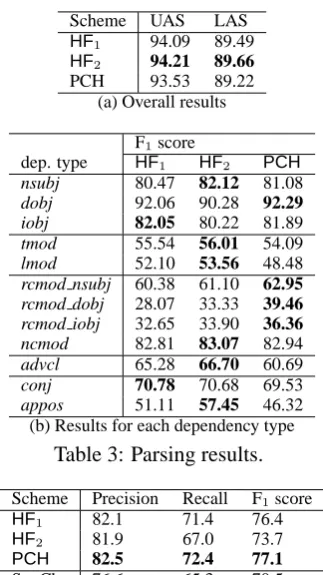
The parsing results for the three dependency schemes are shown in Table 3 (a). The depen-dency schemesHF1andHF2 are comparable, but
PCHis slightly lower than them, which is prob-ably because PCHis a more complicated struc-ture, having left-to-right dependencies in the pred-icate phrase, than the head-final types HF1 and
Scheme UAS LAS
HF1 94.09 89.49
HF2 94.21 89.66
PCH 93.53 89.22 (a) Overall results
F1score
dep. type HF1 HF2 PCH
nsubj 80.47 82.12 81.08
dobj 92.06 90.28 92.29
iobj 82.05 80.22 81.89
tmod 55.54 56.01 54.09
lmod 52.10 53.56 48.48
rcmod nsubj 60.38 61.10 62.95 rcmod dobj 28.07 33.33 39.46 rcmod iobj 32.65 33.90 36.36
ncmod 82.81 83.07 82.94
advcl 65.28 66.70 60.69
conj 70.78 70.68 69.53
appos 51.11 57.45 46.32
[image:5.595.100.262.57.345.2](b) Results for each dependency type
Table 3: Parsing results.
Scheme Precision Recall F1score
HF1 82.1 71.4 76.4
HF2 81.9 67.0 73.7
PCH 82.5 72.4 77.1
SynCha 76.6 65.3 70.5
Table 4: Predicate-argument structure analysis.
dobj and iobj) resulted in relatively high scores
in comparison to the temporal (tmod) and locative (lmod) cases. These types are typically labeled as belonging to the postpositional phrase consisting of a noun phrase and particles, and case particles such asが“ga”,を“o” andに“ni” strongly sug-gest an argument by their combination with verbs, while particlesにandで“de” are widely used out-side the temporal and locative cases.
Predicate-argument structure We ex-tracted predicate-argument structure informa-tion as triplets, which are pairs of predicates and arguments connected by a relation, i.e. (pred,rel,arg), from the dependency parsing re-sults by tracing the paths with the argument and gapped relative clause types. pred in a triplet is a verb or an adjective, arg is a head noun of an argument, andrelis nsubj, dobj or iobj.
The gold standard data is built by converting predicate-argument structures in NAIST Text Cor-pus (Iida et al., 2007) into the above triples. Ba-sically, the cases “ga”, “o” and “ni” in the corpus correspond to “nsubj”, “dobj“ and “iobj”, respec-tively, however, we should apply the alternative conversion to passive or causative voice, since the annotation is based on active voice. The conver-sion for case alternation was manually done for
each triple. We filtered out the triples including zero pronouns or arguments without the direct de-pendencies on their predicates from the converted triples, finally 6,435 triplets remained.
Table 4 shows the results of comparing the ex-tracted triples with the gold data. PCHmarks the highest score here in spite of getting the lowest score in the parsing results. It is assumed that the characteristics ofPCH, where content words tend to be directly linked, are responsible. The table also contains the results of the predicate-argument structure analyzer SynCha. Note that we focus on only the relations between a predicate and its de-pendents, while SynCha is designed to deal with zero anaphora resolution in addition to predicate-argument structure analysis over syntactic depen-dencies. Since SynCha uses the syntactic pars-ing results of CaboCha in a cascaded process, the parsing error may cause conflict between syntac-tic structure and predicate-argument structure. A typical example is that case where a gapped rel-ative clause modifies a noun phrase A の B “B of A”, e.g., [VP 庭 から 逃げ た] [NP 猫 の 足
跡] “footprints of the cat that escaped from a garden.” If the noun A is an argument of a main predicate in a relative clause, the predicate is a de-pendent of the noun A; however, this is not actu-ally reliable because two analyses are separately processed. There are 75 constructions of this type in the test set; the LUW-based dependency pars-ing captured 42 correct predicate-argument rela-tions (and dependencies), while the cascaded pars-ing was limited to obtainpars-ing 6 relations.
5 Conclusion
References
Alastair Butler, Zhen Zhou and Kei Yoshimoto. 2012. Problems for successful bunsetsu based parsing and some solutions. In Proceedings of the Eighteenth
Annual Meeting on the Association for Natural Lan-guage Processing, pp. 951–954.
Marie-Catherine de Marneffe and Christopher D. Man-ning. 2008. The Stanford typed dependencies rep-resentation. In Proceedings of COLING 2008
Work-shop on Cross-framework and Cross-domain Parser Evaluation.
Marie-Catherine de Marneffe, Natalia Silveira, Tim-othy Dozat, Katri Haverinen, Filip Ginter, Joakim Nivre, and Christopher D. Manning. 2014. Uni-versal Stanford Dependencies: A cross-linguistic ty-pology. In Proceedings of the Ninth International
Conference on Language Resources and Evaluation (LREC-2014).
Yasuharu Den, Junpei Nakamura, Toshinobu Ogiso and Hideki Ogura. 2008. A proper approach to Japanese morphological analysis: Dictionary, model and eval-uation. In Proceedings of the Sixth International
Conference on Language Resources and Evaluation (LREC-2008).
Ryu Iida, Mamoru Komachi, Kentaro Inui and Yuji Matsumoto. 2007. Annotating a Japanese Text Cor-pus with Predicate-argument and Coreference Rela-tions. In Proceedings of the the Linguistic
Annota-tion Workshop (LAW ’07), pp. 132–139.
Ryu Iida and Massimo Poesio. 2011. A Cross-Lingual ILP Solution to Zero Anaphora Resolution. In
Pro-ceedings of the 49th Annual Meeting of the Associ-ation for ComputAssoci-ational Linguistics: Human Lan-guage Technologies (ACL-HLT 2011), pp. 804-813.
Satoru Ikehara, Masahiro Miyazaki, Satoshi Shirai, Akio Yokoo, Kentaro Ogura, Yoshifumi Ooyama and Yoshihiko Hayashi. 1998. Nihongo Goitaikei. Iwanami Shoten, In Japanese.
Daisuke Kawahara and Sadao Kurohashi. 2006. A fully-lexicalized probabilistic model for Japanese syntactic and case structure analysis. In Proceedings
of the Human Language Technology Conference of the North American Chapter of the Association of Computational Linguistics (HLT-NAACL 2006), pp.
176–183.
Shunsuke Kozawa, Kiyotaka Uchimoto and Yasuharu Den. 2014. Adaptation of long-unit-word analysis system to different part-of-speech tagset. In Journal
of Natural Language Processing, Vol. 21, No. 2, pp.
379–401 (in Japanese).
Taku Kudo, Kaoru Yamamoto and Yuji Matsumoto. 2004. Applying conditional random fields to Japanese morphological analysis. In Proceedings
of the Conference on Empirical Methods in Natural Language Processing (EMNLP-2004), pp. 230–237.
Taku Kudo and Yuji Matsumoto. 2002. Japanese de-pendency analysis using cascaded chunking. In
Pro-ceedings of the 6th Conference on Natural Language Learning (CoNLL-2002), Volume 20, pp. 1–7.
Sadao Kurohashi and Makoto Nagao. 2003. Building a Japanese parsed corpus – while improving the pars-ing system. In Abeille (ed.), Treebanks: Buildpars-ing
and Using Parsed Corpora, Chap. 14, pp. 249–260.
Kluwer Academic Publishers.
Kikuo Maekawa, Hanae Koiso, Sasaoki Furui, Hitoshi Isahara. 2000. Spontaneous Speech Corpus of Japanese. In Proceedings of the Second
Interna-tional Conference on Language Resources and Eval-uation (LREC-2000), pp. 947–952.
Kikuo Maekawa, Makoto Yamazaki, Toshinobu Ogiso, Takehiko Maruyama, Hideki Ogura, Wakako Kashino, Hanae Koiso, Masaya Yamaguchi, Makiro Tanaka and Yasuharu Den. 2014. Balanced Corpus of Contemporary Written Japanese. Language
Re-sources and Evaluation, Vol. 48, pp. 345–371.
Ryan McDonald, Joakim Nivre, Yvonne Quirmbach-Brundage, Yoav Goldberg, Dipanjan Das, Kuzman Ganchev, Keith Hall, Slav Petrov, Hao Zhang, Os-car T¨ackstr¨om, Claudia Bedini, N´uria Bertomeu Castell´o, and Jungmee Lee. 2013. Universal De-pendency Annotation for Multilingual Parsing. In
Proceedings of the 51st Annual Meeting of the ACL (ACL 2013).
Shunsuke Mori, Hideki Ogura and Teturo Sasada. 2014. A Japanese word dependency corpus. In
Pro-ceedings of the Ninth International Conference on Language Resources and Evaluation (LREC-2014),
pp. 753–758.
Joakim Nivre, Johan Hall, Jens Nilsson, Atanas Chanev, G¨uls¸en Eryiˇgit, Sandra K¨ubler, Svetoslav Marinov and Erwin Marsi. 2007. MaltParser: A language-independent system for data-driven depen-dency parsing, In Journal of Natural Language En-gineering, Vol. 13, No. 2, pp. 95–135.
Takaaki Tanaka and Masaaki Nagata. 2013. Construct-ing a Practical Constituent Parser from a Japanese Treebank with Function Labels. In Proceedings
of the Fourth Workshop on Statistical Parsing of Morphologically-Rich Languages, pp. 108–118.
Kiyotaka Uchimoto and Yasuharu Den . 2008. Word-level Dependency-structure Annotation to Corpus of Spontaneous Japanese and its Application. In
Proceedings of the International Conference on Language Resources and Evaluation (LREC 2008),