539
CUNI System for the WMT19 Robustness Task
Jindˇrich Helcl and Jindˇrich Libovick´y and Martin Popel Charles University, Faculty of Mathematics and Physics,
Institute of Formal and Applied Linguistics, Malostransk´e n´amˇest´ı 25, 118 00 Prague, Czech Republic
{helcl, libovicky, popel}@ufal.mff.cuni.cz
Abstract
We present our submission to the WMT19 Ro-bustness Task. Our baseline system is the Charles University (CUNI) Transformer sys-tem trained for the WMT18 shared task on News Translation. Quantitative results show that the CUNI Transformer system is already far more robust to noisy input than the LSTM-based baseline provided by the task organizers. We further improved the performance of our model by fine-tuning on the in-domain noisy data without influencing the translation qual-ity on the news domain.
1 Introduction
Machine translation (MT) is usually evaluated on text coming from news written by a professional journalist. However, in practice, MT should cover more domains, including informal and not care-fully spelled text that we encounter in the online world.
Although machine translation quality increased dramatically in recent years (Bojar et al.,
2018), several studies (Belinkov and Bisk, 2018;
Khayrallah and Koehn,2018) has shown that the current systems are sensitive to the source-side noise. It is also an issue that was not studied inten-sively in the past because neural systems appear to be more noise-sensitive than the previously used statistical systems (Khayrallah and Koehn,2018). Recently,Michel and Neubig(2018) prepared a dataset called Machine Translation of Noisy Text (MTNT) that focuses exclusively on translating texts from the online environment. This dataset is used for the WMT19 Robustness Task.
2 MTNT Dataset and Baselines
The MTNT dataset consists of sentences collected from Reddit1 posts. Unlike the standard corpora
1http://www.reddit.com
which (in a major part) consist of formal language, often written by professionals, this dataset con-tains a substantial number of spelling errors, gram-matical errors, emoticons, and profanities.
Manual translations are provided with the source sentences crawled from the web. The trans-lators were asked to keep all the noise-related properties of the source sentence.
There are two language pairs included in the dataset: English-French and English-Japanese in both directions. The dataset comes in three splits, for training, validation, and testing. The English-French part consists of 36k examples in the train-ing split, 852 examples for validation, 1020 exam-ples for testing in the En→Fr direction, and 19k, 886, and 1022 examples for training, validation, and testing respectively in the opposite direction. For English-Japanese, the dataset is substantially smaller, with around 6k training examples in both directions. In our experiments, we focus solely on the translation between French and English.
We noticed that the MTNT dataset as provided for the task has some peculiarities that were prob-ably caused inadvertently during the dataset build-ing. Namely, the training and validation splits seem to come from a single alphabetically sorted file. This means that all validation source sen-tences start with the letter “Y”, and anything that comes after “Y” in the alphabetical order. Because of this, the validation scores are unreliable. More-over, a system trained on the training split will have a difficult time translating sentences begin-ning with e.g. the word “You”, which is a com-monly seen instance in the online discussion do-main. This does not affect the test split.
in the LSTMs is 1,024 and the word embedding size is 512.
The model that was used as a baseline for the Robustness Task was trained on the WMT15 par-allel data. Additionally, simple fine-tuning using stochastic gradient descent on the MTNT data is shown to improve the translation quality by a large margin. The translation quality of the system is tabulated among our systems in Table2.
3 Related Work
There have been several attempts to increase the robustness of MT systems in recent years.
Cheng et al.(2018) employ an adversarial train-ing scheme in a multi-task learntrain-ing setup in order to increase the system robustness. For each train-ing example, its noisy counterpart is randomly generated. The network is trained to yield such input representations such that it is not possible to train a discriminator that decides (based on the in-put representation) which inin-put is the noisy one. This method improves both the robustness and the translation quality on the clean data.
Liu et al. (2018) attempt to make the transla-tion more robust towards noise from homophones. This type of noise is common in languages with non-phonetic writing systems and concerns words or phrases which are pronounced in the same way, but spelled differently. The authors of the pa-per train the word embeddings to capture the pho-netic information which eventually leads not only to bigger robustness but also to improved transla-tion quality in general.
To our knowledge, the only work that specifi-cally uses the MTNT dataset attempts to improve the system robustness by emulating the noise in the clean data (Vaibhav et al., 2019). They in-troduce two techniques for noise induction, one employing hand-crafted rules, and one based on back-translation. The techniques offer a similar translation quality gains as fine-tuning on MTNT data.
4 The CUNI Transformer model
Our original plan was to train a system that would be robust by itself and would not require further fine-tuning on the MTNT dataset.
As the baseline model, we use the Trans-former “Big” model (Vaswani et al., 2017) as implemented in Tensor2Tensor (Vaswani et al.,
2018). We train the model using the procedure
Corpus # Sentences
P
arallel
109English-French Corpus 22,520k
Europarl 2,007k
News Commentary 200k
UN Corpus 12,886k
Common Crawl 3,224k
Mono
French News Crawl (’08–’14) 37,320k
[image:2.595.306.526.64.188.2]English News Crawl (’11–’17) 127,554k
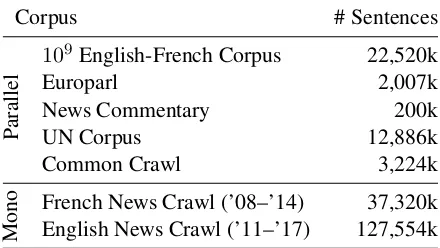
Table 1: Overview of the data used to train the CUNI Transformer baseline system.
described in Popel (2018) and Popel and Bojar
(2018), which was the best-performing method for Czech-to-English and English-to-Czech trans-lation at WMT18 News Transtrans-lation shared task (Bojar et al.,2018).
We trained our model on all parallel data avail-able for the WMT15 News Translation task (Bojar et al.,2015). We acquired additional synthetic data by back-translation of the WMT News Crawl cor-pora (from years 2008–2014 for French and 2011– 2017 for English). We did not include the News Discussion corpus that we considered too noisy for training the system. Table1gives an overview of the training data composition.
5 Fine-Tuning
Similarly to the baseline experiments presented with the MTNT dataset (Michel and Neubig,
2018), we fine-tune our general-domain model on the MTNT dataset.
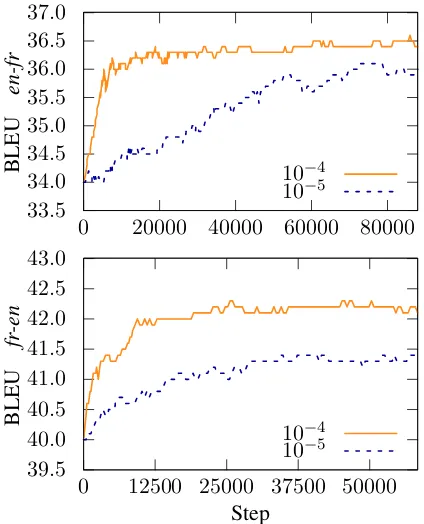
We continued the training of the models using the training part of the MTNT dataset. Unlike the original model, we used plain stochastic gradient descent with a constant learning rate for updat-ing the weights. We executed several fine-tunupdat-ing runs with different learning rates and observed that learning rates smaller than 10−5 do not change
the model outputs at all and learning rates larger than 10−4 cause the models to diverge immedi-ately. The models in our final submission were fine-tuned with a learning rate of10−4.
6 Results
English-French French-English
WMT14 WMT15 MTNT blind WMT14 WMT15 MTNT blind
MTNT baseline 33.5 33.0 21.8 22.1 28.9 30.8 23.3 25.6
+ fine-tuning — — 29.7 — — — 30.3 —
CUNI Transformer 43.6 41.6 34.0 37.0 42.9 39.6 39.9 42.6
[image:3.595.310.522.210.472.2]+ fine-tuning 43.5 41.6 36.6 38.5 41.5 40.9 42.1 44.8
Table 2: BLEU scores of the baseline and CUNI models measured on several datasets.
en-fr fr-en
Naver Labs Europe 41.4 47.9
this work 38.5 44.8
Baidu & Oregon State Uni. 36.4 43.6
Johns Hopkins Uni. — 40.2
Fraunhofer FOKUS – VISCOM 24.2 29.9
MTNT Baseline 22.1 25.6
Table 3: Quantiative comparison of the CUNI Trans-former system + fine-tuning (this work) with other sub-mitted systems.
Because of the large amount of training data available, even the statistical MT systems achieved high translation quality on the news domain. Be-cause of that a slightly different test set, newsdis-cusstest2015, was used as the evaluation test set for the WMT15 competition (Bojar et al.,2015). The test set consists of sentences from discus-sions under news stories from The Guardian and Le Monde. Even though the topics are the same as the news stories, the language used in the dis-cussions is less formal and contains grammatical and spelling errors, which makes them somewhat closer to the MTNT dataset.
Finally, we evaluate the models on the test part of the MTNT dataset (described in Section2) and the blind test set for the WMT19 Robustness Task, which was collected in the same way as the origi-nal MTNT dataset.
The quantitative results are shown in Table 2. The Transformer-based baseline outperforms the RNN-based MTNT baseline by a large margin on both WMT and MTNT test datasets.
The fine-tuning of the RNN-based models brings a substantial translation quality boost of 8 and 7 BLEU points in each direction respectively. This effect is much smaller with our stronger base-line and only improves the performance by around 2 BLEU points in either direction. This may
in-33.5 34.0 34.5 35.0 35.5 36.0 36.5 37.0
0 20000 40000 60000 80000
BLEU
en-fr
10−4 10−5
39.5 40.0 40.5 41.0 41.5 42.0 42.5 43.0
0 12500 25000 37500 50000
BLEU
fr
-en
Step
10−4 10−5
Figure 1: Learning curves showing the progress of fine-tuning on the MTNT test split for English-to-French (top) and French-to-English (bottom) systems with two different learning rates.
dicate that sufficiently strong models are robust enough and do not need further fine-tuning for the type of noise present in the MTNT dataset. Es-pecially in French-to-English translation, the fine-tuning improvement is reached at the expense of decreased translation quality in the news domain.
We plot the learning curves from the progress of the system fine-tuning in Figure 1. Even though the fine-tuning improved the model performance on both language pairs by approximately the same margin, the courses of the fine-tuning differ fun-damentally. For English-to-French translation, we see that the translation quality slowly increases un-til convergence. For the opposite direction, it im-proves immediately and keeps oscillating during the remaining training steps. We found that this effect was similar regardless of the learning rate.
Although we observed a strong effect of check-point averaging during the baseline model train-ing, it has almost no effect on the fine-tuned mod-els. Therefore, we report only the performance for parameter checkpoints with the highest validation BLEU scores.
Table 3 compares the automatic scores with other WMT19 Robustness Task participants. Our submission was outperformed by submissions by Naver Labs Europe in both translation directions. Their submission used the same architecture as our submission, but in addition, it employed corpus tags and synthetic noise generation. Details about other systems were not known at the time of our submission.
7 Conclusions
In our submission to the WMT19 Robustness Task, we experiment with fine-tuning of strong Transformer-based baselines for translation be-tween English and French.
Our results show that when using a strong base-line, the effect of fine-tuning on a domain-specific dataset is much smaller than for weaker models introduced as a baseline with the MTNT dataset.
Acknowledgements
This research has been supported by the from the European Union’s Horizon 2020 research and innovation programme under grant agreement No. 825303 (Bergamot), Czech Science Foundtion grant No. 19-26934X (NEUREM3), and Charles University grant No. 976518 and using language resources distributed by the LINDAT/CLARIN project of the Ministry of Education, Youth and Sports of the Czech Republic (LM2015071).
References
Dzmitry Bahdanau, Kyunghyun Cho, and Yoshua Bengio. 2014. Neural machine translation by jointly learning to align and translate. CoRR, abs/1409.0473.
Yonatan Belinkov and Yonatan Bisk. 2018. Synthetic and natural noise both break neural machine trans-lation. In 6th International Conference on Learn-ing Representations, ICLR 2018, Vancouver, BC, Canada, April 30 - May 3, 2018, Conference Track Proceedings.
Ondrej Bojar, Christian Buck, Christian Federmann, Barry Haddow, Philipp Koehn, Johannes Leveling, Christof Monz, Pavel Pecina, Matt Post, Herve Saint-Amand, Radu Soricut, Lucia Specia, and Aleˇs Tamchyna. 2014. Findings of the 2014 workshop on statistical machine translation. InProceedings of the Ninth Workshop on Statistical Machine Translation, pages 12–58, Baltimore, Maryland, USA. Associa-tion for ComputaAssocia-tional Linguistics.
Ondˇrej Bojar, Rajen Chatterjee, Christian Federmann, Barry Haddow, Matthias Huck, Chris Hokamp, Philipp Koehn, Varvara Logacheva, Christof Monz, Matteo Negri, Matt Post, Carolina Scarton, Lucia Specia, and Marco Turchi. 2015. Findings of the 2015 workshop on statistical machine translation. InProceedings of the Tenth Workshop on Statistical Machine Translation, pages 1–46, Lisbon, Portugal. Association for Computational Linguistics.
Ondˇrej Bojar, Christian Federmann, Mark Fishel, Yvette Graham, Barry Haddow, Philipp Koehn, and Christof Monz. 2018. Findings of the 2018 con-ference on machine translation (WMT18). In Pro-ceedings of the Third Conference on Machine Trans-lation: Shared Task Papers, pages 272–303, Bel-gium, Brussels. Association for Computational Lin-guistics.
Yong Cheng, Zhaopeng Tu, Fandong Meng, Junjie Zhai, and Yang Liu. 2018. Towards robust neural machine translation. InProceedings of the 56th An-nual Meeting of the Association for Computational Linguistics (Volume 1: Long Papers), pages 1756– 1766, Melbourne, Australia. Association for Com-putational Linguistics.
Huda Khayrallah and Philipp Koehn. 2018. On the impact of various types of noise on neural machine translation. InProceedings of the 2nd Workshop on Neural Machine Translation and Generation, pages 74–83, Melbourne, Australia. Association for Com-putational Linguistics.
Hairong Liu, Mingbo Ma, Liang Huang, Hao Xiong, and Zhongjun He. 2018. Robust neural machine translation with joint textual and phonetic embed-ding.CoRR, abs/1810.06729.
Meth-ods in Natural Language Processing, pages 543– 553, Brussels, Belgium. Association for Computa-tional Linguistics.
Martin Popel. 2018.CUNI transformer neural MT sys-tem for WMT18. InProceedings of the Third Con-ference on Machine Translation: Shared Task Pa-pers, pages 482–487, Belgium, Brussels. Associa-tion for ComputaAssocia-tional Linguistics.
Martin Popel and Ondˇrej Bojar. 2018. Training Tips for the Transformer Model. The Prague Bulletin of Mathematical Linguistics, 110:43–70.
Vaibhav, Sumeet Singh, Craig Stewart, and Gra-ham Neubig. 2019. Improving robustness of ma-chine translation with synthetic noise. CoRR, abs/1902.09508.
Ashish Vaswani, Samy Bengio, Eugene Brevdo, Fran-cois Chollet, Aidan Gomez, Stephan Gouws, Llion Jones, Łukasz Kaiser, Nal Kalchbrenner, Niki Par-mar, Ryan Sepassi, Noam Shazeer, and Jakob Uszkoreit. 2018. Tensor2Tensor for neural machine translation. InProceedings of the 13th Conference of the Association for Machine Translation in the Americas (Volume 1: Research Papers), pages 193– 199, Boston, MA. Association for Machine Transla-tion in the Americas.