20
A Paraphrase Generation System for EHR Question Answering
Sarvesh Soni, Kirk Roberts
School of Biomedical Informatics
University of Texas Health Science Center at Houston Houston TX, USA
{sarvesh.soni, kirk.roberts}@uth.tmc.edu
Abstract
This paper proposes a dataset and method for automatically generating paraphrases for clical questions relating to patient-specific in-formation in electronic health records (EHRs). Crowdsourcing is used to collect 10,578 unique questions across 946 semantically dis-tinct paraphrase clusters. This corpus is then used with a deep learning-based question para-phrasing method utilizing variational autoen-coder and LSTM enautoen-coder/deautoen-coder. The ulti-mate use of such a method is to improve the performance of automatic question answering methods for EHRs.
1 Introduction
The useful information present in electronic health records (EHRs) is hard to access due to many of its usability issues (Zhang and Walji,2014). Question answering (QA) systems have the potential to re-duce the time it takes for users to access informa-tion present in the EHRs. However, the effective-ness of such QA systems largely depends on the variety of questions they are capable of handling. Automated paraphrasing techniques are known to improve the performance of QA models in gen-eral domain by generating different variations of a question (Duboue and Chu-Carroll,2006;Fader et al.,2013;Berant and Liang,2014;Bordes et al., 2014a,b;Dong et al.,2015;Narayan et al.,2016; Chen et al., 2016; Dong et al., 2017; Abujabal et al.,2018b). Thus, automatic generation of high quality paraphrases for patient-specific EHR ques-tions has the potential to improve performance of the clinical QA systems.
Paraphrasing is a technique of rewording a given phrase such that its lexical and syntactic structure is different but its semantic information is retained (Bhagat and Hovy,2013). For instance, the following two questions can be considered as paraphrases of each other.
• Whatmedicationsam I currently taking?
• What are my currentmedications?
Such EHR-related questions are usually targeted toward specific clinical information (Roberts and Demner-Fushman, 2016). For ex-ample, the aforementioned questions are intended to get information regarding medications. In such a scenario, paraphrases can be considered as different ways of accessing the same medical data. As such, automatic clinical paraphrase generation can help in increasing the breadth of questions for training a clinical QA system.
While automated paraphrase generation is well-studied in the general domain (Madnani and Dorr, 2010;Androutsopoulos and Malakasiotis, 2010), very few studies have focused on clinical para-phrasing (Hasan et al.,2016;Adduru et al.,2018; Neuraz et al., 2018). On the other hand, clin-ical text simplification, which aims at generat-ing easier to read paraphrases, has received rela-tively more attention (Zeng-Treitler et al., 2007; Elhadad and Sutaria,2007;Del´eger and Zweigen-baum,2008;Kandula et al., 2010;Pivovarov and Elhadad,2015;Qenam et al.,2017;Adduru et al., 2018; Bercken et al., 2019). However, these works in the clinical domain are not representa-tive of QA needs as the usefulness of paraphrases is largely application-specific (Bhagat and Hovy, 2013). Also, existing datasets for clinical para-phrasing consist of either short phrases (Hasan et al.,2016) or webpage title texts (Adduru et al., 2018), both of which are not suitable to build a paraphrase generator for QA. One can resort to using external tools such as Google Translate for generating question paraphrases (Neuraz et al., 2018), but these general-purpose tools are not tai-lored to the medical domain (Liu and Cai,2015).
can be answered using EHR data1. We further propose a deep learning-based automated clinical paraphrasing system utilizing a variational autoen-coder (VAE) and a long short-term memory recur-rent neural network (LSTM) (Gupta et al.,2018). To our knowledge, this is the first work aimed at automatically generating paraphrases without us-ing any external resource for questions specifically focused on retrieving patient-specific information from EHRs. Our main contributions are summa-rized as follows:
• Crowdsourcing a large paraphrasing corpus of questions which are answerable using the data from EHR.
• Application of VAE in context to clinical paraphrasing task.
The rest of the paper is structured as follows. Section2 explores related work in the domain of clinical paraphrasing. Then, Sections3and4 dis-cuss our dataset generation and model implemen-tation details respectively. Next, Section 5 eval-uates the results of our clinical paraphrasing sys-tem. Finally, Section6discusses our findings, and Section7provides a concluding summary.
2 Background
We begin this section by detailing work related to clinical text simplification and paraphrasing in Sections2.1and2.2 respectively. Then, we high-light some of the current work in general-domain paraphrasing for QA as part of Section2.3.
2.1 Clinical Text Simplification
As stated earlier, many studies have focused on clinical text simplification. Text simplification dif-fers from paraphrasing as the former is a uni-directional task whereas the latter can be consid-ered as bi-directional textual entailment (Androut-sopoulos and Malakasiotis, 2010), but the meth-ods nonetheless provide useful context for our work.Elhadad and Sutaria(2007) andDel´eger and Zweigenbaum (2008) relied on parallel or com-parable corpora to construct paraphrase pairs of specialized and lay medical texts. Zeng-Treitler et al. (2007) andKandula et al. (2010) either re-placed the difficult clinical phrases in text with simpler synonyms or included uncomplicated ex-planations for them. Qenam et al.(2017) concen-trated on just substituting the difficult terms with
1The corpus is available upon request.
more comprehensible ones. Much of the simplifi-cation work in the clinical domain has been tar-geted toward lexical methods to convert or ap-pend the complex phrases present in the origi-nal sentence with their simpler alternatives (Pivo-varov and Elhadad,2015). Such simplification ap-proaches usually make use of external vocabular-ies to map the difficult clinical terms. While these techniques reduce the complexity of a sentence at the lexical level, they generally leave the syntactic structure of a sentence unchanged. For instance,
• Patient suffered frommyocardial infarction.
• Patient suffered fromheart attack.
These variations correspond to a specific cate-gory of paraphrases named synonym substitution (Bhagat and Hovy,2013) and amount to a smaller subset of possible paraphrases.
Alternatively,Adduru et al.(2018) andBercken et al. (2019) constructed clinical simplification datasets from various web-based sources such as WebMD, MedicineNet, Wikipedia, and Sim-pleWikipedia utilizing sentence alignment tech-niques. While this approach is capable of gener-ating more variations of a given sentence, it is still a simplification task and hence not suitable to be incorporated in a QA system (Bhagat and Hovy, 2013).
2.2 Clinical Text Paraphrasing
Comparatively, less focus has been drawn to-ward clinical paraphrase generation. Hasan et al. (2016) built their dataset by combining an exist-ing general domain paraphrasexist-ing corpus PPDB 2.0 (Pavlick et al., 2015) with the UMLS (Uni-fied Medical Language System) metathesaurus. Specifically, they utilized fully specified names of medical concepts present in UMLS. Though their corpus contains medical terms, it comprises of comparatively shorter length phrases rather than complete sentences.
Adduru et al. (2018) also created a paraphras-ing corpus utilizparaphras-ing the titles of web articles from Mayo Clinic along with Wikipedia. While this dataset consists of complete clinical sentences, they are atypical of the patient-specific EHR ques-tions.
Scenario 18: You’ve been having some low back pain recently, and want to make an appointment with your doctor’s office through the doctor’s website, but the system isn’t clear. Write a short (up to 15 word), grammatical, one-sentence question asking how you make an appointment. No need to state it is confusing, simply ask a question.
Question: How do I make an appointment?
Scenario 41: Your elderly mother has been taking Metformin (a diabetes drug). She is forgetful and requires someone to organize her pills for each day. However, the person that normally organizes her pills hasn’t done it for this week, and you need to know what the instructions are for your mother’s Metformin prescription. Write a short (up to 15 word), grammatical, one-sentence question asking her doctor for this dosage information. You question must contain the word ’Metformin’.
Question: What are my mother’s Metformin dosage instructions?
Scenario 43: You recently had an automobile accident, and you’ve started taking physical therapy to help recover. Your first appointment went well, but you forgot to write down when your next appointment was scheduled for. Write a short (up to 15 word), grammatical, one-sentence question asking your doctor for this information. Your question must contain ’physical therapy’.
Question: When is my next physical therapy appointment?
Table 1: Three scenarios used to build the CLINIQPARAcorpus, along with a canonical question (not provided to annotators).
development dataset for natural language under-standing task without evaluating the quality of the paraphrases. Such general-purpose machine translation systems lack the ability to capture the domain-specific nuances of biomedicine (Liu and Cai,2015). This suggests the need for a question paraphrasing dataset targeted toward clinical do-main.
As discussed earlier, existing clinical paraphras-ing datasets are not suitable for buildparaphras-ing a para-phrase generation system for clinical questions. To the best of our knowledge, the proposed para-phrasing corpus is the first which aims at clinical questions.
2.3 Paraphrasing for Question Answering
There are several question paraphrasing corpora available for the general domain such as WikiAn-swers (Fader et al., 2013), PPDB (Ganitkevitch et al., 2013), PPDB 2.0 (Pavlick et al., 2015), GraphQuestions (Su et al., 2016), and ComQA (Abujabal et al., 2018a). However, there is a scarcity of such datasets for clinical questions.
The proposed corpus consists of questions which can be answered using EHR data. Such a corpus would have utility beyond QA systems as well, like in question similarity (Luo et al.,2015; Nakov et al.,2017), and in particular could serve as a standard paraphrase corpus for the medical domain.
3 Dataset Construction
In order to quickly and efficiently collect hundreds of paraphrases, we utilized the crowdsourcing platform Amazon Mechanical Turk (AMT). In-stead of prompting AMT workers with a question and directly asking for paraphrases–which could prime the workers and bias them toward very sim-ilar paraphrases–we presented them with a short, 3-6 sentence imaginary scenario that placed them in a situation where a specific piece of information was required (such as their current medications). The workers were then asked to provide questions directed to their doctor to answer that information need. After the crowd-sourced questions were col-lected, they were manually organized into distinct paraphrase clusters. This was necessary because some questions address the information need but are not logically equivalent paraphrases. These steps are discussed in more detail below.
3.1 Scenario Creation
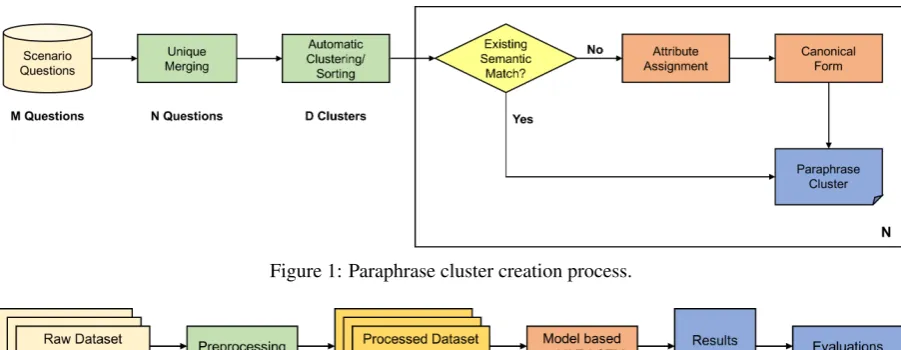
Figure 1: Paraphrase cluster creation process.
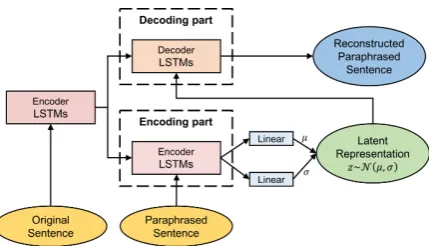
Figure 2: Framework of our paraphrasing system.
3.2 Crowdsourcing
The 50 scenarios were uploaded to AMT in three batches, one scenario per Human Intelligence Task (HIT). Workers were required to provide three questions per HIT, since first question might be obvious and not result in a particularly diverse set of paraphrases. Each HIT was assigned to 100 workers and the annotators were paid $0.08/HIT. Workers were required to be proficient in English, but otherwise no requirements were imposed and no demographic data was collected.
The initial validation process was minimal. HITs were rejected if the workers did not provide 3 questions, or if none of the questions were valid. 93% of submitted HITs were approved. Of the re-jections, 73% were due to not providing 3 tions. Many of the rejections due to invalid ques-tions were for quesques-tions that were completely un-related to the scenario.
3.3 Paraphrase Cluster Creation
After collecting a set of questions for each sce-nario using crowdsourcing, the next step was to manually organize the questions into paraphrase clusters (Figure1). We consider a paraphrase clus-ter to be composed only of exact paraphrases. That is, questions are paraphrases only if they should have the same semantic representation.
The first two steps in paraphrase construction were designed to ease the manual burden of para-phrase cluster assignment. First, questions were merged into case-independent unique sets. Sec-ond, questions were clustered using Dirichlet Pro-cess Mixture Model clustering with unigram and
bigram features. This allowed us to sort the ques-tions so that very similar quesques-tions, which are likely to be paraphrases, are annotated in succes-sion. The remainder of this process required man-ual annotation for each question (with some com-puter assistance).
Each paraphrase cluster is represented by a canonical form. For each unique question, given the correct list of paraphrase clusters, the annota-tor selected a cluster that is the semantic match, or created a new cluster if none existed. Each new paraphrase cluster was assigned several val-ues, notably including whether it was grammat-ical. Invalid questions (non-responsive, spurious responses that are common with crowdsourcing) were placed in either the INVALID-related cluster (invalid questions which were related to the sce-nario), or the INVALID-unrelated cluster. Finally, a canonical form was assigned to valid clusters.
The entire process in Figure1was repeated for each scenario. Since there were 100 workers per HIT, and 3 questions per worker, up to 300 ques-tions needed to be clustered per scenario (with 50 scenarios, there were 15,000 questions). There were much fewer than 300 unique questions per scenario, and the process took between 30-40 min-utes for most scenarios.
Figure 3: Architecture of the paraphrasing model based on VAE-LSTM.
median of 2.8 and mean of 5.6 paraphrase clus-ters, with a minimum of 5 questions, per scenario. Table 2 shows the paraphrase clusters for one of the scenarios.
4 Paraphrase Generator
An overall framework of our paraphrasing system is presented in Figure2.
4.1 Preprocessing
First, we normalize the medical concepts and mask the person references and digits present in the question. This is carried out to make sure the questions from different scenarios are consistent. Consider the following questions and their masked versions:
• What types ofcancerdoes myfatherhave? → What types ofconceptdoes myhumanhave? • Was it in2003that I had myappendectomy?
→ Was it indigitsthat I had myconcept?
After this step, we further deduplicate the ques-tions and remove clusters with only 1 question (as a minimum of two questions are required for eval-uating paraphrasing).
We then construct paraphrase pairs using the created clusters of paraphrases. Specifically, we generate all combinations of questions which are present in the same cluster. This results in over 258,000 unique question-paraphrase pairs for 10,578 questions distributed across 946 semanti-cally distinct paraphrase clusters.
4.2 Model
We use a deep learning model based on VAE-LSTM (Gupta et al., 2018), the architecture of which is presented in Figure3. One of the main characteristics of VAE that makes it a good choice
for paraphrasing task is that its latent representa-tion is continuous. In other words, the encoder outputs a distribution rather than discrete values. This enables the decoder to produce naturalistic outputs even in the cases where latent code does not correspond to any of the already viewed in-puts.
The model consists of two parts, namely, encod-ing and decodencod-ing. On the encodencod-ing side, the orig-inal sentence is first passed to an encoder LSTM which constructs a vector representationxfor the sentence. Then, another encoder LSTM takes as input x along with the paraphrased sentence whose vector representationy is generated as the output. Finally, a feedforward neural network gen-erates the VAE encoder’s mean (µ) and standard deviation (σ) parameters usingy.
Both original and paraphrased sentences are fed into their respective encoder LSTMs using word embeddings. We train the word embeddings on our paraphrasing corpus using word2vec (Mikolov et al.,2013) and keep them fixed while training the paraphrasing system.
In the decoding phase, we first generate a vector representationx by passing the original sentence to an encoder LSTM. Ultimately, a decoder LSTM reconstructs the paraphrased sentence usingxand a latent codez which is sampled from N(µ, σ). While x is fed to the decoder LSTM only at an initial stage,zis taken as input at each of its stages. During training, we aim to maximize the objec-tive function shown below in Equation1, thereby learning the VAE parameters.
O(θ, φ;x, y) = Eqφ(z|x,y)[log(pθ(y|z, x))]
−KL(qφ(z|x, y)||p(z))(1)
where qφ(z|x, y) is a posterior distribution (en-coder model) on z that the VAE aims at keep-ing closer to its priorp(z)(commonly a standard normal distribution).KLrepresents the Kullback-Leibler divergence which intuitively gives a simi-larity measure between the two distributions. At the decoder side, pθ(y|z, x) is a distribution on
y, given the latent code z and vector x, whose expectationEis taken with respect to qφ(z|x, y). The objective function gives a lower bound on the true likelihood of the data. We follow the training mechanism proposed byBowman et al.(2016).
Scenario:
You just realized you should have a doctor’s appointment coming up soon, but cannot find it on your calendar. Write a short (up to 15 word), grammatical, one-sentence question asking your doctor about your next appointment.
Cluster 1 (229 questions, 164 unique): When is my next appointment? When is my next appointment? (frequency = 32)
What time is my next appointment? (6) When is my next scheduled appointment? (5) Can you tell me when my next appointment is? (4) When is my next appointment scheduled? (4) When is my next appointment scheduled for? (4) What is the date and time of my next appointment? (3)
(... 157 more ...)
Cluster 2 (38 questions, 33 unique): Do I have an appointment soon? Do I have an appointment coming up? (3)
Do I have a doctor’s appointment coming up soon? (2) Do I have an appointment soon? (2)
Do I have an upcoming appointment scheduled? (2)
(... 29 more ...)
Cluster 3 (3 questions): Do I have an appointment this week? Am I scheduled to come in to your office this week for an appointment? Do I have an appointment this week?
Is my appointment scheduled for this week?
Cluster 4 (2 questions): Can I make an appointment? Can I make an appointment?
Will you be able to make an appointment any soon?
Cluster 5 (1 question): How long until my next appointment? How long until my next doctor’s appointment?
Cluster 6 (1 question): Is my appointment this week or next? Is my appointment scheduled for this week or next week? Cluster 7 (1 question): Is my appointment next week? Was my appointment scheduled for next week?
Cluster 8 (1 question): Is my appointment on Tuesday? Is my scheduled appointment for Tuesday?
Cluster 9 (1 question): Is my appointment this month?
Do you have a record of my having made an appointment for later this month? Cluster INVALID-related (34 questions)
Can you give me an appointment card? How long will this appointment last? What happens if I miss the appointment?
What will you be discussing in regards to my next check up? Will I be meeting with you or with your assistant?
(... 29 more ...)
Cluster INVALID-unrelated (17 questions)
According to my lab results, what vitamins or supplements should I be taking? Do you have the results of my mri?
How is my BMI?
What does this medicine do? What symptoms should I watch for?
(... 12 more ...)
The presence of input question at the decoder side enables the model to generate its paraphrases.
We utilize the same model parameters asGupta et al.(2018). Namely, the dimension of the word embedding is 300; the dimension of the encoder and decoder is600; the latent space dimension is
1100; the encoder has1layer; the decoder has2
layers; the learning rate is5 x10−5; the dropout rate is30%; the batch size is32. We use PyTorch for implementing the model and run all our exper-iments on an NVidia Tesla V100 GPU (32G).
4.3 Evaluation
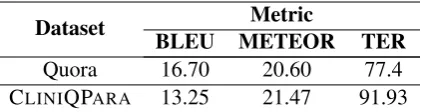
The paraphrased questions generated by the model are re-incorporated with the concept, person names, and digits which were extracted during the preprocessing step. The paraphrases are evaluated using standard paraphrase evaluation metrics such as BLEU (Papineni et al.,2002), METEOR (Lavie and Agarwal, 2007), and TER (Snover et al., 2006), which are shown to work well for the para-phrase identification task (Madnani et al., 2012). BLEU score assesses the lexical similarity of gen-erated paraphrases with the reference ones using exact matching while METEOR additionally takes into account the word stems and synonyms. TER score measures the edit distance (number of edits required to convert one sentence into another) be-tween generated and reference paraphrases. So, higher BLEU and METEOR scores are better whereas a lower TER score is preferable. Since we have multiple paraphrases for each question in our corpus, we calculate these metrics for the gen-erated paraphrases against all the available ground truth paraphrases.
To evaluate the performance measures on all the parts of CLINIQPARAdataset, we perform 10-fold cross validation. Specifically, we split our dataset by scenarios (into 10 groups each containing 5 scenarios) and sequentially test the performance of model on each group of 5 scenarios after training it on the other 45. We report the individual and average scores from all these runs in our results.
We further evaluate the performance of our model on the Quora dataset2, which contains over
400k pairs of questions of which around 150k pairs are paraphrases. We train on 90% of these paraphrase pairs and test on the remaining 10%.
We also perform human evaluation of the
gen-2
https://data.quora.com/First-Quora-Dataset-Release-Question-Pairs
Dataset Metric
BLEU METEOR TER
Quora 16.70 20.60 77.4
[image:7.595.312.523.62.118.2]CLINIQPARA 13.25 21.47 91.93
Table 3: Performance of our paraphrasing system using automated evaluation metrics.
Fold (Scenarios)
Metric
BLEU METEOR TER
1-5 19.25 23.56 92.58
6-10 12.27 19.25 94.01
11-15 18.79 21.93 78.17
16-20 9.72 19.30 91.46
21-25 9.20 20.97 103.25
26-30 16.45 23.66 84.98
31-35 6.07 19.84 111.62
36-40 11.24 20.40 95.05
41-45 14.08 22.33 85.18
46-50 15.48 23.44 82.97
Average 13.25 21.47 91.93
Table 4: Results on CLINIQPARA using automated evaluation metrics for 10-fold cross validation. Each fold contains 5 scenarios over which the model is tested after being trained on the other 45 scenarios.
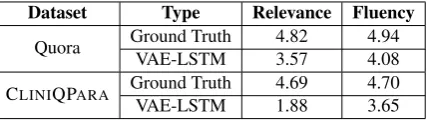
erated paraphrases for quantifying the aspects not covered solely by the automated evaluation met-rics. For the CLINIQPARA dataset, we randomly select a set of 300 questions from all the scenarios. For each of these questions, we further choose a ground truth paraphrase as well as a system gen-erated paraphrase in a random fashion. This result in a total of 600 pairs of question paraphrases, 300 from the gold dataset and 300 generated by the paraphrasing system. The constructed set is sep-arately evaluated by two annotators who are asked to rate the paraphrases based on two parameters:
Dataset Type Relevance Fluency
Quora Ground Truth 4.82 4.94 VAE-LSTM 3.57 4.08
CLINIQPARA Ground Truth 4.69 4.70
[image:8.595.304.527.61.144.2]VAE-LSTM 1.88 3.65
Table 5: Results of human evaluation. Range of scores is between 1 (worst) and 5 (best).
Input Question
Do you know when my next appointment is going to be?
Generated Paraphrases
1. Can you please confirm the date and time of my ap-pointment?
2. On what day and what time do I have my appointment? 3. Do you have the date and time for my appointment? 4. Can you tell me when I am scheduled for my appoint-ment.
Table 6: Example paraphrases generated by the model for an input question from Scenario 3 (Good).
5 Results
The results on CLINIQPARA (our dataset) and Quora dataset using automated evaluation metrics are shown in Table 3. More granular cross val-idation results on CLINIQPARA are presented in Table4. Moreover, the results of our human eval-uation process are shown in Table5. Some of the system-generated paraphrases are included in Ta-bles6and7. Table6shows the examples from a fold which performed well during the cross valida-tion step whereas Table7includes examples from a low-performing fold.
6 Discussion
The quality of generated paraphrases is promis-ing, but further investigation is required to deter-mine if performance is sufficient for use in train-ing a downstream QA system. We note that the METEOR score on CLINIQPARA was compara-ble to that of the results on the Quora dataset. This shows the potential of our paraphrasing system in generating paraphrases similar to the ground truth paraphrases. Our system performed well on the Quora dataset in terms of BLEU score, which can be attributed to the larger size of the Quora dataset in terms of unique questions (150k in Quora vs. 10.5k in CLINIQPARA).
On analyzing the results of the qualitative evalu-ation, we observe that the majority of the errors are related to change in the person reference or ask-ing about frequency-related information. For in-stance, the original question“When shall I come for my next physical therapy?” asking about the
Input Question
Is my latest CAT scan impression complete?
Generated Paraphrases
1. Was my CAT scan impression successful or not? 2. Was my CAT scan impression a success? 3. Was my diagnosis CAT scan impression?
4. does my father ’s file show how many times he has CAT scan impression?
Table 7: Example paraphrases generated by the model for an input question from Scenario 32 (Moderate).
user’s next appointment for a therapy is modified to a question “May I have the number of times my father has physical therapy?” asking about the number of times the user’s father has under-gone the therapy. A similar trend can be seen in the second example where the original question
“Can you please give me the dosage details on the metformin mom takes?” is concerned about get-ting the dosage information for the user’s mother whereas the system generated question “Could you tell me the amount of time my father has met-formin?”is related to the frequency of metformin intake of the user’s father. Further qualitative eval-uation can help pointing out more specific prob-lems with the model.
Our future work includes experimenting with more advanced embedding techniques (Peters et al.,2018;Devlin et al.,2018). We also plan to handle some of the aforementioned errors by in-corporating additional constraints such as restrict-ing the question paraphrase pairs in our corpus to contain only semantically similar masked ref-erences.
7 Conclusion
Automatic paraphrase generation of clinical ques-tions can improve the performance of the QA sys-tems. Little work has been focused on clinical paraphrasing, let alone concentrating on clinical questions. We have proposed a new clinical para-phrasing corpus CLINIQPARA, containing
ques-tions which can be answered using EHRs. Our model based on VAE-LSTM has the potential to generate quality clinical paraphrases.
[image:8.595.77.291.62.122.2]References
Abdalghani Abujabal, Rishiraj Saha Roy, Mohamed Yahya, and Gerhard Weikum. 2018a. ComQA: A Community-sourced Dataset for Complex Fac-toid Question Answering with Paraphrase Clusters.
arXiv preprint arXiv:1809.09528. Version 2.
Abdalghani Abujabal, Rishiraj Saha Roy, Mohamed Yahya, and Gerhard Weikum. 2018b. Never-Ending Learning for Open-Domain Question Answering over Knowledge Bases. InProceedings of the 2018 World Wide Web Conference, pages 1053–1062.
Viraj Adduru, Sadid A. Hasan, Joey Liu, Yuan Ling, Vivek Datla, Kathy Lee, Ashequl Qadir, and Oladimeji Farri. 2018. Towards dataset creation and establishing baselines for sentence-level neural clin-ical paraphrase generation and simplification. In
CEUR Workshop Proceedings, pages 45–52.
Ion Androutsopoulos and Prodromos Malakasiotis. 2010. A survey of paraphrasing and textual entail-ment methods.Journal of Artificial Intelligence Re-search, 38:135–187.
Jonathan Berant and Percy Liang. 2014. Semantic Parsing via Paraphrasing. In Proceedings of the 52nd Annual Meeting of the Association for Com-putational Linguistics, pages 1415–1425.
Laurens van den Bercken, Robert-Jan Sips, and Christoph Lofi. 2019. Evaluating Neural Text Sim-plification in the Medical Domain. In The World Wide Web Conference, pages 3286–3292.
Rahul Bhagat and Eduard Hovy. 2013.What Is a Para-phrase? Computational Linguistics, 39(3):463–472.
Antoine Bordes, Sumit Chopra, and Jason Weston. 2014a. Question Answering with Subgraph Embed-dings. InProceedings of the 2014 Conference on Empirical Methods in Natural Language Processing (EMNLP), pages 615–620.
Antoine Bordes, Jason Weston, and Nicolas Usunier. 2014b. Open Question Answering with Weakly Su-pervised Embedding Models. InProceedings of the Joint European Conference on Machine Learning and Knowledge Discovery in Databases, pages 165– 180.
Samuel R. Bowman, Luke Vilnis, Oriol Vinyals, An-drew Dai, Rafal Jozefowicz, and Samy Bengio. 2016. Generating Sentences from a Continuous Space. InProceedings of The 20th SIGNLL Confer-ence on Computational Natural Language Learning, pages 10–21.
Bo Chen, Le Sun, Xianpei Han, and Bo An. 2016. Sen-tence Rewriting for Semantic Parsing. In Proceed-ings of the 54th Annual Meeting of the Association for Computational Linguistics, pages 766–777.
Louise Del´eger and Pierre Zweigenbaum. 2008. Para-phrase acquisition from comparable medical corpora
of specialized and lay texts. InAMIA Annual Sym-posium Proceedings, page 146.
Jacob Devlin, Ming-Wei Chang, Kenton Lee, and Kristina Toutanova. 2018. Bert: Pre-training of deep bidirectional transformers for language understand-ing.arXiv preprint arXiv:1810.04805. Volume 2.
Li Dong, Jonathan Mallinson, Siva Reddy, and Mirella Lapata. 2017. Learning to Paraphrase for Ques-tion Answering. InProceedings of the 2017 Con-ference on Empirical Methods in Natural Language Processing, pages 875–886.
Li Dong, Furu Wei, Ming Zhou, and Ke Xu. 2015.Question answering over freebase with multi-column convolutional neural networks. In Proceed-ings of the 53rd Annual Meeting of the Association for Computational Linguistics and the 7th Interna-tional Joint Conference on Natural Language Pro-cessing, pages 260–269.
Pablo Duboue and Jennifer Chu-Carroll. 2006. An-swering the question you wish they had asked: The impact of paraphrasing for question answering. In
Proceedings of the Human Language Technology Conference of the North American Chapter of the ACL.
Noemie Elhadad and Komal Sutaria. 2007. Mining a Lexicon of Technical Terms and Lay Equivalents. In
Proceedings of BioNLP, pages 49–56.
Anthony Fader, Luke Zettlemoyer, and Oren Etzioni. 2013. Paraphrase-Driven Learning for Open Ques-tion Answering. InProceedings of the 51st Annual Meeting of the Association for Computational Lin-guistics, pages 1608–1618.
Juri Ganitkevitch, Benjamin Van Durme, and Chris Callison-Burch. 2013. PPDB: The Paraphrase Database. InProceedings of the 2013 Conference of the North American Chapter of the Association for Computational Linguistics: Human Language Tech-nologies, pages 758–764.
Ankush Gupta, Arvind Agarwal, Prawaan Singh, and Piyush Rai. 2018. A Deep Generative Framework for Paraphrase Generation. InThirty-Second AAAI Conference on Artificial Intelligence, pages 5149– 5156.
Sadid A Hasan, Bo Liu, Joey Liu, Ashequl Qadir, Kathy Lee, Vivek Datla, Aaditya Prakash, and Oladimeji Farri. 2016. Neural Clinical Paraphrase Generation with Attention. In Proceedings of the Clinical NLP Workshop, pages 42–53.
Sasikiran Kandula, Dorothy Curtis, and Qing Zeng-Treitler. 2010. A semantic and syntactic text sim-plification tool for health content. InProceedings of the AMIA Annual Symposium, pages 366–370.
of correlation with human judgments. In Proceed-ings of the Second Workshop on Statistical Machine Translation, pages 228–231.
Weisong Liu and Shu Cai. 2015. Translating Elec-tronic Health Record Notes from English to Spanish: A Preliminary Study. In Proceedings of BioNLP, pages 134–140.
Jake Luo, Guo-Qiang Zhang, Susan Wentz, Licong Cui, and Rong Xu. 2015. SimQ: Real-Time Re-trieval of Similar Consumer Health Questions. J Med Internet Res, 17(2):e43.
Nitin Madnani and Bonnie J. Dorr. 2010. Generat-ing Phrasal and Sentential Paraphrases: A Survey of Data-Driven Methods. Computational Linguistics, 36(3):341–387.
Nitin Madnani, Joel Tetreault, and Martin Chodorow. 2012. Re-examining Machine Translation Metrics for Paraphrase Identification. InProceedings of the 2012 Conference of the North American Chapter of the Association for Computational Linguistics: Hu-man Language Technologies, pages 182–190.
Tomas Mikolov, Ilya Sutskever, Kai Chen, Greg S Cor-rado, and Jeff Dean. 2013. Distributed representa-tions of words and phrases and their compositional-ity. InAdvances in Neural Information Processing Systems 26, pages 3111–3119.
Preslav Nakov, Doris Hoogeveen, Llu´ıs M`arquez, Alessandro Moschitti, Hamdy Mubarak, Timothy Baldwin, and Karin Verspoor. 2017. SemEval-2017 Task 3: Community Question Answering. In Pro-ceedings of the 11th International Workshop on Se-mantic Evaluation (SemEval-2017), pages 27–48.
Shashi Narayan, Siva Reddy, and Shay B Cohen. 2016.
Paraphrase Generation from Latent-Variable PCFGs for Semantic Parsing. InProceedings of the 9th In-ternational Natural Language Generation Confer-ence, pages 153–162.
Antoine Neuraz, Leonardo Campillos Llanos, Anita Burgun, and Sophie Rosset. 2018. Natural lan-guage understanding for task oriented dialog in the biomedical domain in a low resources context.
arXiv preprint arXiv:1811.09417. Version 2.
Kishore Papineni, Salim Roukos, Todd Ward, and Wei-Jing Zhu. 2002. BLEU: a method for automatic evaluation of machine translation. InProceedings of the 40th Annual Meeting of the Association for Computational Linguistics, pages 311–318.
Ellie Pavlick, Pushpendre Rastogi, Juri Ganitkevitch, Benjamin Van Durme, and Chris Callison-Burch. 2015. PPDB 2.0: Better paraphrase ranking, fine-grained entailment relations, word embeddings, and style classification. InProceedings of the 53rd An-nual Meeting of the Association for Computational Linguistics and the 7th International Joint Confer-ence on Natural Language Processing, pages 425– 430.
Matthew Peters, Mark Neumann, Mohit Iyyer, Matt Gardner, Christopher Clark, Kenton Lee, and Luke Zettlemoyer. 2018.Deep Contextualized Word Rep-resentations. InProceedings of the 2018 Conference of the North American Chapter of the Association for Computational Linguistics: Human Language Technologies, pages 2227–2237.
Rimma Pivovarov and Nomie Elhadad. 2015. Auto-mated methods for the summarization of electronic health records.Journal of the American Medical In-formatics Association, 22(5):938–947.
Basel Qenam, Tae Youn Kim, Mark J Carroll, and Michael Hogarth. 2017. Text Simplification Using Consumer Health Vocabulary to Generate Patient-Centered Radiology Reporting: Translation and Evaluation.J Med Internet Res, 19(12):e417.
Kirk Roberts and Dina Demner-Fushman. 2016. An-notating logical forms for EHR questions. In Pro-ceedings of the Language Resources & Evaluation Conference, pages 3772–3778.
Matthew Snover, Bonnie Dorr, Richard Schwartz, Lin-nea Micciulla, and John Makhoul. 2006. A Study of Translation Edit Rate with Targeted Human An-notation. InProceedings of 7th Conference of the Association for Machine Translation in the Ameri-cas, pages 223–231.
Yu Su, Huan Sun, Brian Sadler, Mudhakar Srivatsa, Izzeddin Gur, Zenghui Yan, and Xifeng Yan. 2016.
On Generating Characteristic-rich Question Sets for QA Evaluation. InProceedings of the 2016 Con-ference on Empirical Methods in Natural Language Processing, pages 562–572.
Qing Zeng-Treitler, Sergey Goryachev, Hyeoneui Kim, Alla Keselman, and Douglas Rosendale. 2007.
Making texts in electronic health records compre-hensible to consumers: a prototype translator. In
Proceedings of the AMIA Annual Symposium, pages 846–850.