Energy and Power Engineering,2011, 3, 69-78
doi:10.4236/epe.2011.32010 Published Online May 2011 (http://www.SciRP.org/journal/epe)
A Repetitive-PI Current Controller for Boost Single Phase
PFC Converters
Turki Kahawish Hassan
Electrical Engineering Department, University of AL-Mustansiriya, Baghdad, Iraq E-mail: [email protected]
Received November 27, 2010; revised January 4, 2011; accepted January 26, 2011
Abstract
In this paper, the Author presents the theory and application of repetitive proportional integral current con-troller for boost single phase ac-dc converter with power factor correction (PFC). A repetitive concon-troller which is inserted in series with the proportional integral (PI) controller shows very low crossover distortion of input current, low total harmonic distortion and very low tracking error when is compared with the con-ventional proportional integral controller. Full analysis of proposed controller is given and Matlab/Simulink is used for simulation. The simulation results show the validity of the proposed control method.
Keywords:Boost Converter, Unity Power Factor Correction, Repetitive Control
1. Introduction
The developments in power factor correction technology in the past two decades have enabled the design and im-plementation of single phase ac-dc boost converters with close to unity power factor and much less input current distortion that generated by simple diode rectification circuits.
Typical PFC schemes use two cascaded loops: the first loop aims to regulate the boost dc output voltage and provide the amplitude for the reference to the second controller, which controls sinusoidal current provided from grid. This current always contains some residual distortion, especially in the vicinity of zero crossing of the input voltage. The reasons of this zero crossing dis-tortion (also referred to as cross disdis-tortion) are discussed by authors in [1,2] but no any effective method is sug-gested to reduce or eliminate this phenomenon. Feed forward current control methods for boost single phase PFC converters are suggested for robust control against parameters variation and to reduce the total harmonic distortion [3,4] .These methods need additional circuits and the cost is increased .
Receptive control theory [5-7] originating from inter-nal model principle provides a solution for eliminating periodic errors which occur in a dynamic system. A re-petitive controller can be viewed as a periodic waveform generator augmented within the control loop of a control system, which is closed loop regulated by a feed back
controller so that the periodic errors can be eliminated. A number of repetitive control schemes have been devel-oped and applied to eliminate periodic distortions in PWM inverters [8,9].
In this paper, a repetitive controller is proposed and designed to eliminate the zero crossing distortion of in-put current of the converter and to obtain good tracking performance. The design of the repetitive controller is performed by analyzing the frequency domain, and Ny-quist plot play a central role throughout the design phase. The feasibility of the proposed design technique is shown by simulation. The simulation results of the pro-posed system show a highly improvement compared to the conventional PI controlled system.
The reminder of this paper is organized as follows. Section 2 gives operation principle of boost single phase PFC converter and formulates the problem. In Section 3, the principle of repetitive control is reviewed and a re-petitive controller for PFC boost converter is proposed. In section 4, the repetitive controller is designed and several simulation results for proposed and conventional systems are presented. Section 5 concludes the paper.
2. Operation Principe and Problem
Formulation
Vo
in
v
_ L
iin
vin
+
_ _
+ iL
D
C +
d(t)
SW L O
A D
(a)
d(t)
Vo
Vref +
_ Gcv
ev
÷ ×
Peak ABS
vin
s(t)
Iref
iref
iL
Gci
+
_
ei
vtri
+ _
Vcont
in
v
ˆin v
[image:2.595.139.456.76.506.2](b)
Figure 1. Boost single phase PFC converter (a) power circuit and (b) control block diagram.
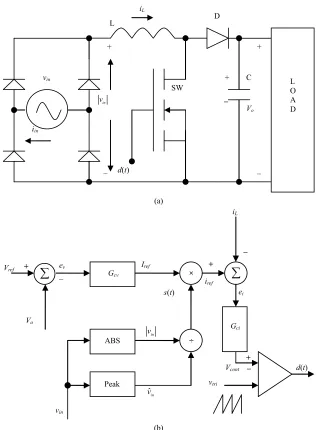
The circuit consists of a full-bridge diode rectifier and a boost dc/dc converter. The dc output voltage of the boost converter Vo is compared with the reference Vref and the error ev is applied to the voltage controller Gcv(s) which is a PI controller. A current command iref is yielded by multiplying the output of voltage controller Iref with a rectified unity sine wave (s(t)) which is:
sinˆ in in v s t
v t
(1)
where vinvˆ sinin t , is the amplitude of input voltage.
ˆin
v
The current command is compared with the inductor current iL and the error ei is applied to the PI current con-troller Gci(s) to obtain Vcont. A pulse width modulation
control signal d which is obtained by comparing Vcont with the triangular wave Vtri is applied to gate of power MOSFET transistor to achieve the sinusoidal input cur-rent iin.
In order to make the following control system analysis and design, some reasonable assumptions are made:
1) the losses of converter components are neglected; 2) the dc output voltage is well regulated such that Vo equals to reference value Vref.
Accordingly one can derive the following equation using the state-space averaging method.
d ˆ sin 1 d
L
in ref
i
L v t d t V
T. K. HASSAN 71
ratio function of the PWM modulator which can be ex-pressed as
ˆcont tri V d tV
(3)
where is the amplitude of the triangular wave. From (2) and (3), one can find
ˆ tri V ˆ sin d ˆ d ref ref in L cont tri V V v t i V t L L LV
(4)
As shown in Figure 1(b), Vcont can be written in laplace form as
cont ref L ci
V s i s i s G s (5) The inductor current iL can be derived from (4) and (5) to be
1
2
1
1
ref in
L
V
v s G s i s i s
G s sL G s s L G s
ref
(6) where
refˆ
ci tri V
G s G s sLV
(7)
and
ici p
K
G s K
s
(8)
where Kp and Ki are proportional and integral gains re-spectively.
According to (6), the absolute value of input voltage can be viewed as a disturbance to the control loop. Also Vref can be considered as a constant disturbance. The objective of control is to make the inductor current tracks a sinusoidal reference current, in face of these distur-bances. In the conventional control method, a propor-tional integral (PI) controller Gci(s) is used in design and implementation, and also the most commonly used one in practical applications. However, it fails to yield excel-lent control performances in both tracking and distur-bance rejection issues. To solve these problems, a repeti-tive controller is proposed and applied to the current loop of boost converter. This controller is discussed in next section.
3. Repetitive Control
3.1. Principle of Repetitive Control
Any periodic signal with period Ts can be generated by the free time delay system. The block diagram of time delay system including unity positive feedback is shown
in Figure 2(a). The resulting transfer function is [5]:
1S s
sT
R u s esT 9)
where y(s) is the output and u(s) is the input. Due to this
y s e G s
(
delay, the transfer function has infinitely many poles on the imaginary axis: jkωs (see Figure 2(b)).The poles can be found from sTs 1.0
s jk s e
for every k = 0, ±1,
±2,
, where ωs = 2л/Ts.e model in (9) is said to be a
he of the proposed repetitive control A controller including th
repetitive controller and a system with such controller is called a repetitive control system.
The basic concept of the repetitive controller origi-nates from the internal model principle [7]. This princi-ple state that the controlled output tracks a set of refer-ence inputs without steady state error if the model which generates these references is included in the stable closed loop system. For example, no steady state error occurs for step reference commands in type-1 stable feedback system that has an integrator (1/s) in the loop, i.e., the generator of step function .However ,stand-alone repeti-tive controller cannot yield good transient performance, therefore the repetitive controller is often used together with another controller such as P-I controller to give quick transient response.
.2. PFC Boost Converter with Repetitive 3
Controller
block diagram T
system is shown in Figure 3. The repetitive controller CRP(s) is located in series with conventional PI controller Gci(s) of current loop of boost converter. The transfer function of the repetitive controller is:
u(s) + y(s)
+ S sT e (a) Re Im 0 jωs
2js
2π
s TS
2jωs
[image:3.595.330.520.495.705.2](b)
CRP(s)
ref
in
V v s
s
sTSq s e
i p
K K
s
Vref
1 sL 1 ˆ tri V L i s
iref (s)
Gci(s)
[image:4.595.139.455.84.262.2]+ + + + + + + _
Figure 3. Block diagram of a repetitive control system.
11 S
RP sT
C s
q s e
(10)
Note that CRP(s) is equivalent to the modified repeti-tiv
ntrol system, (6) can be re
e controller with a(s) = 1 as proposed by Hara et al. [5]. q(s) is a low pass filter that should be appropriately chosen so that good tracking performance is obtained without resultant system instability. The choice of q(s) is not straightforward and simulations are needed to choose the most appropriate filter [10].
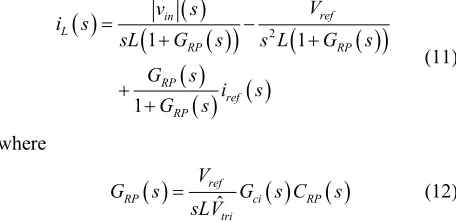
For the proposed repetitive co written as:
2 1 1 1 ref in L RP RP RP ref RP V v s i ssL G s s L G s G s i s G s (11) where
refˆ
RP ci RP
tri V
G s G s C s sLV
(12)
Let Us discuss the effectiveness of the repetitive con-troller according to (11) and (12). The transfer function CRP(s) is large enough for s = jkωs, k = 0, 1, 2, If the proportional integral controller Gci(s) of current oop of boost converter is chosen such that
l RP s
G jk is suf-ficiently large for the selective range
are multiples of frequency of reference current, then
1
of harmonics which
RP s RP s G jk G jk
. Since the denominator is
jected and the inductor cur-rent tracks the sinusoidal reference curcur-rent with very small steady state error.
The stability condition t large, the disturbances are re
hat is obtained in [5] is applied to
ing proposition:
ystem without repetitive controller, i.e.,
proposed repetitive control system to give the
follow-In the repetitive control system shown in Figure 3 if the closed loop s
s
1G s
, is stable and
G q j 1 G j
0
where
2ˆ ref p i
tri V K s
KG s
s V L
then the system is exponentially stable.
The system without repetitive controller is stable since e control system is
G(s) has no unstable poles. The repetitiv
therefore exponentially stable if the Nyquist plot of G(s) [11] does not encircle the (–1, j0) point and lies outside of the circle of radius q j
centered at the (–1, j0) point in the complex plane. The low pass filter q(s) should be chosen so that t uist plot of G(s) remains outside the circle for all frequencies.4. Controller Design and Results
he Nyq
verter with power factor orrection has outer voltage loop and inner current loop.
is shown in Figure 3. The pa
for stable system th
4.1. Controller Design
The boost single phase ac-dc con c
Some nominal values and circuit parameters of the con-verter are shown in Table 1.
Our investigation is focused on the inner current loop with repetitive controller that
rameters of P-I controller of current loop are chosen as Kp = 0.8 and Ki = 300. The repetitive controller is in-serted in series with the PI controller.
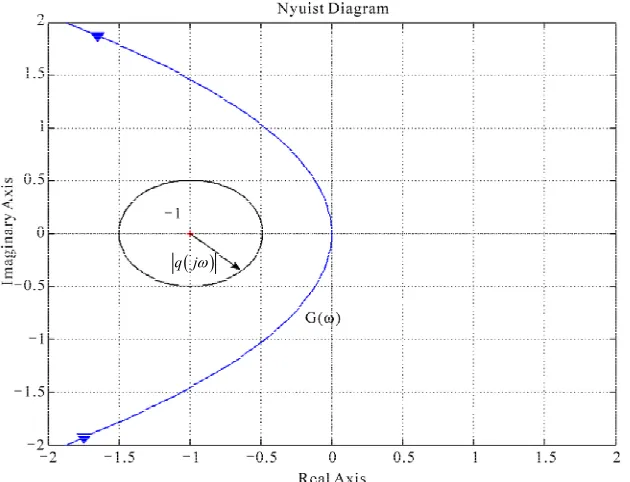
Figure 4 shows the Nyquist plot of G(s). The plot does not encircle the (–1, j0) point and
[image:4.595.58.286.446.557.2]T. K. HASSAN 73
[image:5.595.133.448.79.320.2]q j
Figure 4. Stability circle and Nyquist plot of G(s).
Table 1. Simulated converter parameters.
Input line voltage (peak) vˆin= 170 V Input line frequency f =
e F
ncy
V 50 Hz
Smoothing capacitanc C = 1000 µ
Smoothing inductance L = 1 mH
Rated power 500 W
Carrier freque 25 KHz
Output voltage Vo = 300
q jbetween
must be less than unity to prevent any contact
obtain the cutoff frequency of
the plot of G(s) and the circle (see the stability condition in the previous section). The gain of low pass filter q(s) is chosen as 0.98 to give stable system and good tracking performance.
No systematic method to
q(s), therefore simulation is required to find the best value from the point of view of good tracking and dis-turbances rejection. Accordingly, the cutoff frequency is chosen as 1000 HZ. It seems that 1000 HZ is reasonable choice since most periodic disturbances are expected to lie within this band. Let the filter q(s) be
0.981 2000π
q s s
(13)
In our applications, we require a delay of Ts = 10 ms fo
function
r compensation of harmonics of fs = 100 Hz. Finally, we get a repetitive controller CRP(s), which has transfer
/100
0.98 1
RP
s C s
e
(14)
1
1s 2000π
The effects that the designed repetiti
CRP(s) has on the PFC boost converter system can be investigated by the bode plots of loop gains G(s) and G
in, are clearly seen from the Bo
ve controller
RP(s) (without and with repetitive controller respec-tively) shown in Figure 5.
The major characteristics of the repetitive controller, such as effective rejection of periodic disturbances and reduction of stability marg
de plots. Note that the added repetitive controller in-creases the loop gain at particular frequencies, integral multiples of 100 Hz, maintaining a relatively unchanged gain at other frequencies. Let us considerer the sensitive-
ity function
1
1GRP s which is the transfer function from disturbance input to tracking error, which is of pri-mary importance in judging the performance of feedback control systems. Gain increase at particular frequencies
imulation is performed by Matlab/Simulink to verify leads to decrease in sensitivity at these frequencies. This implies that zero crossing distortion in inductor current which is considered as the periodic disturbances appear-ing at multiple of 100 Hz are more strongly attenuated by the repetitive controller than non periodic disturbances.
4.2. Results
[image:5.595.61.286.365.477.2]Figure 5. Bode plots of G(s) with (dash) and GRP(s) with solid.
the proposed PFC boost con
oller. The converter parameters in Table 1 and the
de-co
r current iL waveforms with 100 W (Rl = 900 Ω)
w
put voltage and input current for Rl = 450 Ω (output power equals 200 W) with
repeti-t currenrepeti-t is canceled compared wirepeti-th Figure 8(
current when load re
racking is achieved with repetitive controller (very sm
verter with repetitive con- Figure 8(a) shows the in tr
signed repetitive controller in the previous section are used in simulation. For all simulation results, the output voltage of the converter is constant and equals to 300 V.
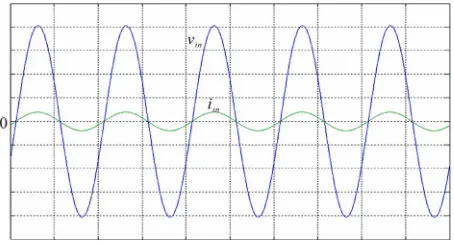
Figure 6(a) and (b) show the input current iin and the input voltage vin waveforms with and without repetitive
ntroller respectively for 100 W output power and load resistance (Rl) of 900 Ω. The input current is in phase with input voltage and has an amplitude of 1.18 A with no zero switching distortion when repetitive controller is used.
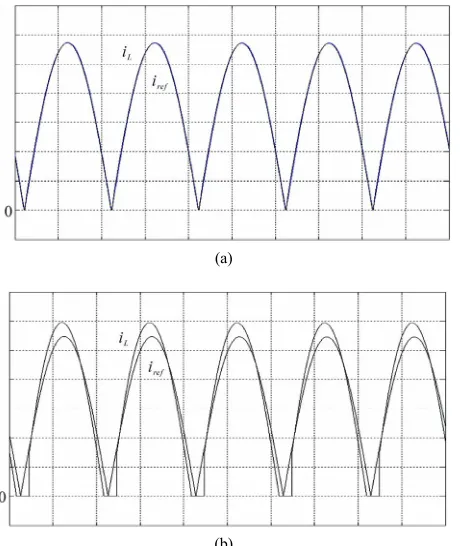
Figure 7(a) shows the reference current iref and the inducto
hen the repetitive controller is applied. Comparison with waveforms in Figure 7(b) when only PI-controller is used indicates that current tracking performance is significantly improved by the proposed repetitive con-troller (reference and inductor current waveforms are coincident.
tive controller. It is noticed that the zero crossing distor-tion in inpu
b) when only P-I controller is used.
Zero crossing distortion in input current shown in Fig-ure 6(b) is more than the distortion shown in Figure 8(b) because of increment in load current with load resistance of 450 Ω.More leading phase of input
sistance is increased (less load current) which causes more zero crossing distortion [1]. This leading phase is not appeared when the proposed repetitive controller is used.
Figure 9(a) and (b) show the reference and inductor current waveforms for load resistance of 450 Ω with and without repetitive controller respectively. It is clear that a good t
all steady state error between reference and inductor currents).
T. K. HASSAN 75
(a)
[image:7.595.310.538.67.352.2](b)
Figure 6. vin and iin waveforms for Rl = 900 Ω (a) With
re-petitive controller; (b) Without rere-petitive controller. Hori-zontal axis 10 ms/div), vertical axes: voltage (50 V/div), current (2.5 A/div).
(a)
(a)
[image:7.595.60.290.73.351.2](b)
Figure 8. vin and iin waveforms for Rl = 450 Ω. (a) With
re-petitive controller; (b) Without rere-petitive controller. Hori zontal axis (10 ms/div).Vertical axes: voltage (50 V/div), current (2.5 A/div).
-(a)
(b)
Figure 7. iref and iL waveforms for Rl = 900 Ω. (a) With
re-petitive controller; (b) Without rere-petitive controller. Hori-zontal axis (5 ms/div).Vertical axis (0.2 A/div).
(b)
Figure 9. irefand iL waveforms for Rl = 450 Ω. (a) With
[image:7.595.311.537.405.684.2] [image:7.595.60.290.409.682.2]-(a)
(b)
Figure 10. vin and iin waveforms for Rl = 225 Ω. (a) With
repetitive controller; (b) Without repetitive controller. Horizontal axis (10 ms/div). Vertical axes: voltage (5 V/div), current (2.5 A/div).
Figure 11(a) shows the reference current and inductor
ident.
factor (PF) and the total harmonic distor-tio
900 Ω to 180 Ω. The input cur-re
0
current waveforms with and without repetitive controller respectively with Rl = 225 Ω (output power equals 400 W).
current waveforms for Rl = 225 Ω when the repetitive controller is applied. It is noticed that the waveforms are coinc
Figure 11(b) is similar to Figure 11(a) but no repeti-tive controller is used. No good tracking between the reference and inductor current is observed.
The power
n (THD) of input current with and without repetitive controller are calculated under various load and are listed in Table 2 and Table 3.
As shown in Table 2, a highly reduction in total har-monic distortion of input current is shown when a repeti-tive controller is used compared with Table 3 (without repetitivecontroller).
The waveforms of input voltage and input current for the proposed repetitive controlled PFC boost converter are plotted in Figure 12 when the load resistance Rl is suddenly changed from
nt magnitude is increased from 1.18 A to 5.8 A. We can find that the input current iin always in phase with the input voltage vin even though under transient response. Consequently, the proposed repetitive controller
(a)
(b)
Figure 11. (a) iref and iL waveforms for Rl = 225 Ω with
repetitive controller. Horizontal axis (5ms/div).Vertical axis (0.5A/div); (b) irefand iL waveforms for Rl = 225 Ω withou
repetitive controller. Horiz l axis (5ms/div). Vertical
All the previous results are obtained for input voltage
ontroller.
Rl(Ω) Output power (w) THD (%) PF
t onta
axis (0.5A/div).
can keep good performance under the condition of load change.
Table 2. Calculated THD and PF for various loads with repetitive c
1800 50 2.1 0.9992
900 100 0.9 0.9998
0.9999 450 200 0.41
225 400 0.22 1
Table 3. Calculated THD and PF arious loads with repetit controller.
Rl (Ω) Output power (w) THD (%) PF
for v ive
1800 50 34.16 0.9965
900 100 14.99 0.9977
0.9992 450 200 6.8
T. K. HASSAN 77
of 1 (peak). der to vali e repe on-troller performance fo input voltag ariation, u-lated steady state eforms of inductor curr L nd
fe e current or the case nput vo ith
70 V In or date th titive c
r wav
e v the sim
ent i a
re renc iref f of i ltage w
[image:9.595.61.286.213.334.2]20% larger than the nominal value and Rl = 450 Ω (out-put power equals 200 W) are plotted in Figure 13. The reference current and inductor current are coincident and good tracking is also maintained and is not affected with the variation of input voltage.
[image:9.595.59.287.382.504.2]Figure 14 shows the input voltage and input current
Figure 12. vin and iin waveforms with repetitive controller.
Rl is changed from 450 Ω to 180 Ω. Horizontal axis (50
[image:9.595.60.287.553.675.2]ms/div).Vertical axes: voltage (50 V/div), current (5 A/div).
Figure 13. iref and iL waveforms for Rl = 450 Ω without
re-petitive controller. Horizontal axis (5 ms/div). Vertical axis (0.2 A/div). Amplitude of input voltage equals 203 V.
Figure 14. vin and iin waveforms for Rl = 450 Ω. with
repeti-tive controller. Horizontal axis (5 ms/div). Vertical ax voltage (50 V/div), current (5 A/div). Amplitude of input voltage equals 203 V.
waveforms for the same conditions in Figure 13. No zero crossing distortion in input current is observed and the input current is in phase with the input voltage.
5. Conclusions
In this paper, the control approach to solve the problem of zero crossing distortion of input current of PFC boost converter has been presented. To achieve this goal, a repetitive controller is inserted in series with the PI con
y. Because our approach is based on
bility ndwidth is included. Several to verify the validity of the proposed
es:
-troller of current loop. We presented a graphical design technique based on the frequency domain analysis of linear system to achieve a repetitive controller that pre-serves system stabilit
graphical inspection of the Nyquist envelop, the design procedure was simple and intuitive. A low pass filter with gain lower than one to ensure the system sta and to limit the ba
tions are performed
repetitive controller. The results obtained with and with-out repetitive controller are compared. The results with repetitive controller shows very low total harmonic dis-tortion of input current, good tracking of reference cur-rent and inductor curcur-rent (very low steady state error) and no zero crossing distortion of input current. Transit responses to step change in load are presented to exhibit the robustness of the proposed repetitive controller against load variations. The performance of the system with the proposed controller has not affected with the variation of input voltage.
6. References
[1] J. Sun, “On the Zero-Crossing Distortion in Single-Phase PFC Converters,” IEEE Transactions on Power Elec-tronics, Vol. 19, No. 3, 2004, pp. 685-692.
doi:10.1109/TPEL.2004.826491
[2] H. C. Chen, “Duty Phase Control for single-Phase Boost- Type SMR,” IEEE Transactions on Power Electronics, Vol. 23, No. 4, 2008, pp. 1927-1934.
doi:10.1109/TPEL.2008.924627
[3] M. Chen and J. Sun, “Feedforward Current Control of Boost Single-Phase PFC Converters,” IEEE Transactions on Power Electronics,Vol. 21, No. 2, 2006, pp. 338-345. doi:10.1109/TPEL.2005.869746
. H. Li and C. M. Liaw, “Switch-Mode Digital Robust Ripple Compensation and Current Waveform Controls,” IEEE Transactions on [4] H. C. Chen, S
Rectifier with
Power Electronics, Vol. 19, No. 2, 2004, pp. 560-566. doi:10.1109/TPEL.2003.823200
[5] S. Hara, Y. Yamamoto, T. Omata and M. Nak petitive Control System: A New
ontrol System Design,” [9] G. Escobar, A. A. Valdez, J. L. Ramos and P. Mattavelli, “Repetitive-Based Controller for a UP
[6] T. Inoue, “Practical Repetitive C
IEEE Proceedings of 29th Conference on Decision and control, Honolulu, 5-7 December1990, pp. 1673-1678. doi: 10.1109/CDC.1990.203906
[7] B. A. France and W. M. Wonha
S Inverter to Com-pensate Unbalance and Harmonic Distortion,” IEEE Transactions on Industrial Electronics, Vol. 54, No. 1, 2007, pp. 504-510. doi:10.1109/TIE.2006.888803 [10] J. H. Moon, M. N. Lee and M. J. Chung, “Repetitive
Control for the Track-Following Serv m, “The Internal Model
Principle for Linear Multivariable Regulators,” Applied Mathematics and Optimization, Vol. 2, No. 2, pp. 170- 194, 1975. doi: 10.1007/BF01447855
[8] Y. Y. Tzou, S. L. Jung, and H. C. Yeh, “Adaptive Repe tive Control of PWM Inverter
o System of an Op-tical Disk Drive,” IEEE Transactions on Control Systems Technology, Vol. 6, No. 5, 1998, pp. 663-670.
doi:10.1109/87.709501
[11] K. Ogata, “Modern Control Engineering,” 4th Edition, Prentice Hall, New Jersey, 2002.
ti-s for Very Low THD Ac-Voltage Regulation with Unknown Loads,” IEEE Transactions on Power Electronics, Vol. 14, No. 5, 1999, pp. 973-981. doi:10.1109/63.788503
Nomenclature
o Dc output voltage of boost converter. ref Reference voltage for voltage loop.
v Voltage error (the difference between refer-ence and output voltage).
cv(s) Voltage controller transfer function. voltage controller. e wave.
t)).
n current
ction.
Vcont Output of current controller. V Triangular wave.
Amplitude of triangular wave. in Ac input current to the rectifier. L Boosting inductance.
d(t) Duty ratio.
Kp Proportional gain of current controller. ller. on.
troller. out repetitive
unction with repetitive
. tri
ˆin v i V
V e G
Iref Output of (t) Unity sin
Ki Integral gain of current contro
s nsfer functi
s q( ) Low pass filter tra
CRPs
iref Current command (Iref multiplied by s( ( ) Transfer function of repetitive con vin Ac input voltage to the rectifier
G(s) Open loop transfer function with ˆin
v Amplitude of ac input voltage. iL Inductor current.
controller).
transfer f GRP(s) Open loop
ei Current error (the difference betwee t).
controller.
/sec)
ωs Double of input line frequency (rad command and inductor curren
s) Cu transfer fun