ALCOHOL AND THE
MENSTRUAL CYCLE
A thesis
submitted in partial fulfilment
of the requirements for the Degree
of
Master of Arts in Psychology.
in the
University of Canterbury
by
M.G.T. van Basten Batenburg
--University of Canterbury
THESIS
I<G-lro 5 V2r'iS
1'184
ACKNOWLEDGEMENTS
A sincere thankyou to my supervisor, Mr S. Hudson, for his time, support and encouragement throughout.
I am also grateful to the Family Planning Clinic, Christchurch, especially Dr Helen McGill for assisting in the selecting of subjects for this project.
In addition, the research was only made possible due to the continued interest and commitment of the
subjects who participated in this study.
My appreciation is also extended to Dr B. Rosenberg for his suggestions regarding the statistical analysis on the computer.
Chapter
1
2
3
TABLE OF CONTENTS
Acknowledgements Table of Contents List of Tables List of Figures Abstract
LITERATURE REVIEW
1.1 General Introduction 1.2 The Menstrual Cycle 1.3 The Menstrual Cycle Alcohol Consumption
1.4 Menstrual Cycle and 1.5 Alcohol and Mood
and Mood
1.6 Properties of Estrogen and Alcohol
1.6.1 Estrogen, MAO and depression
1.6.2 Diuretic and suppressive
1 1
7
8 14
17 18 21 properties of alcohol 22 1.7 A Proposed Etiology for
Alcholism in Women 23
1.8 Longitudinal Studies on Voluntary Consumption of Alcohol in Women 26
1.9 Summary 28
1.10 Organisation of the Remainder
of this Thesis 28
THE PROBLEl>l 29
RATIONALE 35
3.1 Measurement of Mood 35
3.2 Indices of PMS 39
3.2.1 Psychological Indices 42 3.2.2 Physiological Indices 45 3.3 Indices of alcohol consumption 46
3.4 Methodology in menstrual and
alcohol research 48
3.5 Aims of the Research 51
Chapter
4
5
6
7
METHODOLOGY 4.1 Subjects
4.2 Subject Selection
4.3 Apparatus
4.4 Procedure
4.4.1 The Pilot Study 4.4.2 The Actual Study 4.5 The Sample
4.5.1 The demographic characteristics
4.5.2 Alcohol and drug intake
52 52 53 55 61 61 61
63 63
characteristics 66
4.5.3 Eysenck Personality and
life events profile 66
RESULTS 72
Part One: Alcohol Use Characteristics 72
Part Two: Alcohol Consumption and
DISCUSSION CONCLUSIONS
the Menstrual Cycle 76
118 131
Suggestions for Further Research 132
BIBLIOGRAPHY BIBLIOGRAPHY 133
APPENDIX 1 APPENDIX 2 APPENDIX 3 APPENDIX 4
Notice to Subjects Initial Questionnaire Interview Schedule
Life Experiences Survey
146 147 148 150
APPENDIX 5 Eysenck Ppersonality Questionairre 151
APPENDIX 6(i) Daily Diary Use 152
APPENDIX 6(ii) Daily Diary APPENDIX 7
APPENDIX 8 APPENDIX 9
Consent Form
Menstrual Distress Questionnaire Negative Attitude to Menstrual Cycle Questionnaire
153 154
155
APPENDIX 10 9th Revision OCD9 APPENDIX 11 Time Series Analysis APPENDIX 12 Bivariate analysis
for mood and symptoms for subjects 3-10
APPENDIX 13 Bivariate analysis for mood and negative affect for subjects 3-10
APPENDIX 14 Bivariate analysis for mood and physical symptoms for subjects 3-10
APPENDIX 15 Bivariate analysis for
alcohol and stress for subjects 3-10
160 163
165
174
183
Table
1.1
1.2
1.3
1.4
3.1
3.2
3.3
3.4
4.1
4.2
4.3
4.4
4.5
4.6
4.7
4.8
LIST OF TABLES
Alcohol driving offences, 1973, 1974, 1976, 1982
Numbers of alcohol related admissions to Psychiatric Hospitals
Numbers of new contacts in alcohol and drug assessment centres
Alcohol related deaths 1967-1980
Frequently used measurement of mood
Core factors associated with mood
Studies that review mood chancres
during the menstrual cycle ~
Nenstrual distress questionnaire symptom groups
The Subjects: Reasons for not taking part in the project after expressing an interest
Absolute mls of alcohol in popular sized drinks
Demographic Data for each Subject
Menstrual Cycle Data for each Subject
Alcohol intake characteristics for ten subjects
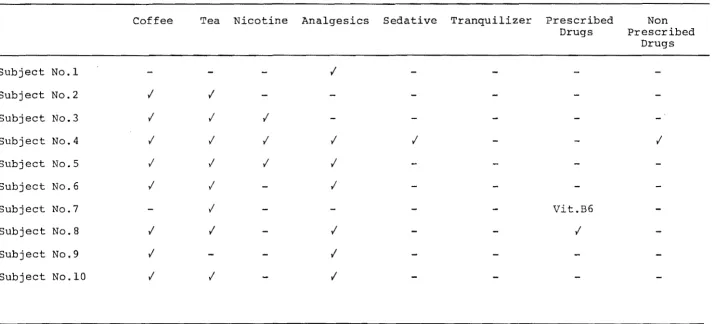
Drug intake characteristics for ten subjects
Eysenck Personality Inventory Scores for the ten subjects
Impact of Life Experiences Survey for the ten subjects
2
2
2
3
36
37
40
43
54
60
64
65
67
69
70
Table 5.1
5.2
5.3
5.4
5.S
5.6
5.7
5.8
5.9
5.10
5.11
5.12
Retrospective and self-monitores alcohol intake for 8 subjects
Recorded alcohol use characteristics during two menstrual cycles
Correlations for each subject on the variables, phase of cycle and
alcohol intake for each recorded cycle
Descriptive statistic summary table for each subject for phase of cycle with variables, absolute mls
alcohol, stress, mood and physical symptoms
ANOVA summary, table for dependent variable alcohol intake
ANOVA summary table for dependent variable symptoms
ANOVA summary table for dependent variable mood
ANOVA summary table for dependent variable affect
ANOVA summary table for dependent variable stress
Eysneck personality Inventory Scores and Symptom Scores
Means and standard deviations of daily reported MDQ Symptom Scores and Retrospective MDQ Symptom Scores
Means and standard deviations
of negative attitude questionnaire
74
75
77
79
81
84
94
95
108
112
113
LIST OF FIGURES
Figure
1.1 Fluctuations in Estrogen and
Progesterone across the menstrual
cycle 9
1.2 Studies on alcohol and the
menstrual cycle 10
1.3 Studies on alcohol metabolism
and estrogen 20
1.4 A model of alcoholism in women 24
2.1 Proposed tentative model
indicating possible antecedents in the relationship menstrual
cycle - alcohol consumption 33
5.1 Alcohol intake for 8 subjects
during two menstrual sycles 73
5.2 Daily physical symptom and negative
affect scores derived from MDQ 83
5.3 - 5.10 Alcohol and Symptom Spectral
Densities for subjects 3-10 85
5.11 - 5.18 Alcohol and Mood Spectral Densities
for subjects 3-10 96
5.19 Alcohol intake and stress score
for subjects 3-10 during two
ABSTRACT
This study explored possible antecedents in moderate women drinkers who have one or more premenstrual symptoms but are menstrating normally. The supposition that women drink more alcohol during premenstruation in order to self medicate premenstrual distress was investigated. A single subject longitudinal design was employed.
Eight moderately~drinking women who reported to have premenstrual syndrome were followed, daily over two
menstrual cycles. Subjects provided daily self reports of alcohol consumption, mood states and physical symptoms. Following post-experimental interviews, two additional questionnaires were administered, relating to the subjects retrospective distress across the cycle and negative
attitudes toward the menstrual cycle.
Bivariate time series analysis was used to seek frequency coherence between the variables alcohol intake and menstrual cycle phase, alcohol intake and symptoms, alcohol intake and mood and finally alcohol intake and stress. Personality type was investigated using the EPI to explore for specific characteristics of this sub group.
Results indicate that moderate drinkers did not
women with premenstrual syndrome to alcohol dependency are the women's age, personality and severity of PMS symptoms. Social and cognitive variables also playa role in a woman's alcohol consumption.
Findings also substantiated the existence of premen-strual syndrome in these normally cycling women. However these women tended to experience a significant increase in physical symptoms but not in emotional stress. Some
1
CHAPTER 1
LITERATURE REVIEW
1.1 General introduction
Recent research in New Zealand indicates that in 1972 48% of women were described as "abstainers". By 1980 the figure was l4% (Casswell, 1980). In New Zealand as in other western countries the prevalence of drinking is
increasing and increasing most amongst women (Shaw, 1980). Gomberg (1981) suggests that an increase in social drinkers does not necessarily produce an increase in the number of problem drinkers. However, other evidence that drinking problems are increasing amongst women are found in three types of statistics: (i) women charged with drunken behaviour, (ii) the number of women receiving treatment for drinking problems, and (iii) women deaths related to alochol (see Tables 1-4).
In New Zealand over the last 10 years a rise in
these indicators has been greater amongst women than amongst men. This same trend is reported in Britain (Shaw, 1980, Smith, 1981) , and America (Beckman, 1975, Pattison and Kaufman, 1982).
2
Table 1: Alcohol driving offences, 1973, 1974, 1976, 1982
M. F. Total % women
of total
1973 8365 188 8553 2.2
1974 9091 218 9309 2.3
1976 10123 286 10409 2.7
1982 13317 762 14081 5.4
Source: Traffic Research Section, Ministry of Transport, 1983. Hurst, P.
Table 2: Numbers of alcohol related admissions to Psychiatric Hospitals
M. F. Total % women
of total
1972 1894 319 2213 14.41
1973 2062 354 2416 14.65
1974 2127 389 2516 15.46
1978 2245 556 2801 19.85
1979 2394 565 2959 19.09
Source: A review of alcohol related statistics in N.Z. J.M. Valentine.
Table 3 : Numbers of ne\V' contacts in alcohol and drug assessment centres.
M. F. Total
*
% womenof total
1981 1396 537 1933 28.0
1982 1901 613 2514 24.4
Table 4: Alcohol related deaths 1967-1980
F.
1967 42 12
1968 33 8
1969 53 22
1970 70 20
1971 86 22
1972 82 27
1973 104 42
1974 162 46
1975 177 51
1976 145 44
1977 162 48
1978 145 41
1979 160 39
1980 156 38
Source: National Health statistics Centre.
The decrease in 1976 is related to "new drinkers" -women who have yet to develop the physical symptoms of alcohol abuse. Popham Schmidt et a1 have referred to this as "cirrhogenic reservoir" effect (1975).
implies one disease instead of the many types of alcohol abuse which exist. Throughout this presentation, the term referred to by the quoted authors will be used,
4
e.g. alcoholism,alcoholic, otherwise the ICD9 nomenclature is used. (See Appendix 1.)
The analogy of an iceberg appears frequently as a description of research on women and alcohol. The small portion of ice seen above the surface is a reflection of the valid research. That which is out of sight serves
well to describe the research yet to be done on the growing number of women who have managed to conceal their alcohol use difficulties.
Chetwynd (1982), in a study of 655 Christchurch women working at home identified 14.7% of the sample to be
problem drinkers.
Chetwynd (1982) identified problem drinkers as those replying to 3 or more items embedded in a general health questionnaire. These seven items asked if drinking had affected health, or work or caused memory loss, caused
argument or embarrassment, cost too much money, or if there had been too much drunk at the wrong time or place and
lastly if the subject had ever attempted to cut down
Problem drinkers tended to be younger women who drank more than women
25
'years and older, more frequently_5
(Robertson in ALAC report, 1983). Past discussion on women and alcohol has tended to be based on studies of men; theories about why females drink are offshoots of
theories about male drinking behaviour (Hoar, 1983). However, women differ from men in their physiological,
psychological and social response to alcohol (Gomberg, 1981; Whitehead, 1976; Ferrence, 1979; McConville, 1983).
McConville (1983) summarizes known biological differences:
Women's bodies are generally smaller and have a higher proportion of fat to water. Alcohol is more concentrated in human females.
Women are more prone to liver damage and to other alcohol related diseases than are men.
Women are more liable to develop digestive and nutritional problems as a consequence of drinking and more likely to become alcohol dependent.
A women's response to alcohol can change during ovulation and menstruation.
If a pregnant woman drinks there is the risk of foetal damage - fetal alcohol syndrome.
Many women are prescribed tranquillizing drugs which in combination with alcohol make women more vulnerable to physical and psychological damage.
Johnson (1982) summarizes social and psychological differences found in a study of 1000 men and 1000 women:
6
The current conflict of ~he women's role inherent in certain lifestyles could give rise to heavier
drinking rates.
Different roles demand different expectations, e.g. the working women particularly those who are married were found to be problem drinkers.
Working women of middle and higher socio-economic levels tend to have alcohol problems.
There appears little descriptive data on women problem drinkers. What appears critical to determine is
(1) onset and course of progressive drinking in women,
(ii) the consequences of problem drinking for women, and
(iii) an understanding of the treatment outcome for women (Corrigan, 1974).
However, females like male problem drinkers are a heterogenous group (Beckman, 1975; Gomberg, 1976). They differ on a variety of dimensions making i t impossible to generalize about the female problem drinker (Horn and Wanberg, 1970).
This has led to investigations of specific sub-groups of female drinkers. Gomberg (l981) states the subgroups are recognized by either the antecedents (risk factors) or consequences of alcohol dependency. Antecedents are the genetic, biochemical psychological and social
factors. Consequences are perceived as the individual's vulnerability, situational circumstances and stresses
7
A specific biological event unique to the female, the menstrual cycle has been related to the onset of regular drinking episodes. It is the premenstrual phase of the cycle that has been implicated as a Pcl ear precipi-tant and maintainence factor of alcoholism in certain women", (Belfar and Shader, 1971; James, 1975; Jones and Jones, 1976a, 1976b; Lisansky, 1957; Lolli, 1953;
Podolsky, 1963; Wall, 1937).
This chapter will review the literature regarding the relationship of the menstrual cycle and alcohol
consumption. The literature is reviewed in six parts, (a) the menstrual cycle and alcohol consumption, (b) menstrual cycle and mood, (c) alcohol and mood, (d)
properties of estrogen and alcohol, (e) a proposed etiology of alcoholism in women, and (f) two longitudinal studies.
1.2 The Menstrual Cycle
The physiological mechanisms of the menstrual cycle are complex. It involves the hypothalamu& the pituatary gland, the adrenal cortex, the ovaries, the
nervous system, in particular the autonomic nervous system. The following is a very simplified description of the
major phases of the menstrual cycle and the hormonal processes that occur during these phases.
Three major phases of the menstrual cycle are distinguished, (1) menstrual (or menses) the time of
8
(± 3 days) immediately proceeding menstruation.
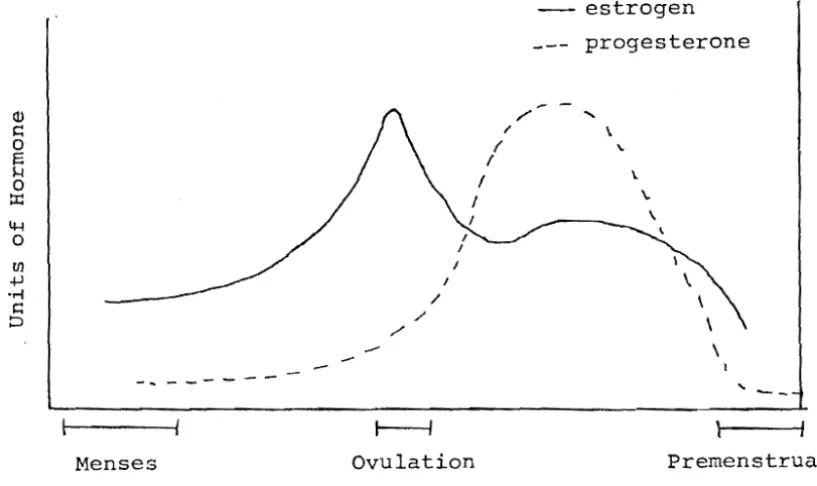
Fluctuations in the two primary ovarian hormones -estrogen and progesterone are presented in Figure 1. This shows low levels of both estrogen and progesterone during the menstrual phase and raised estrogen levels
in tn~'ovulatory phase.
Following menstruation, estrogen levels rise slowly and steadily reaching a peak at the time of ovulation. After ovulation, there is a precipitous drop in estrogen which culminates in a sharp drop during the premenstruum
(Abraham et al 1972; Owen, 1975). This evidence is significant in the work of Jones and jones (1976b) discussed later in this chapter.
1.3 The Menstrual Cycle and Alcohol Consumption Increases in drinking behaviour to alleviate symptoms during the premenstruum and menstruum have
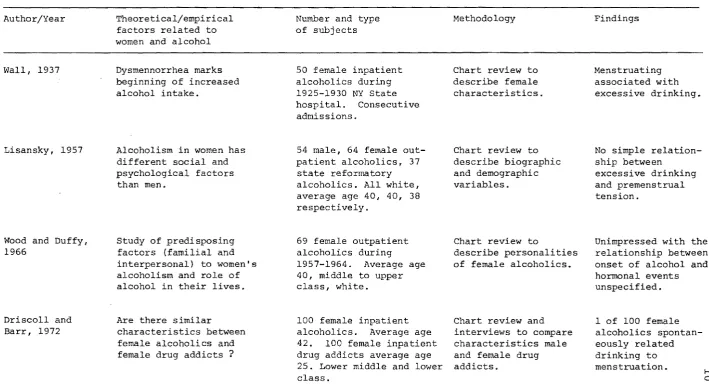
been reported since 1937 (Wall, 1937). Driscoll and Barr (1972), Lisansky (1957), Wood and Duffy (1966) and Wall (1937) use chart reviews to describe biographic and
demographic characteristics of women alcoholics in treat-ment. An outline of these studies is presented in
Figure 2. Conclusions differ and often lack scientific rigour.
Wall (1937) states that dysmennorrhea marked the beginning of increased drinking of alcohol in a subgroup of the researched sample. Wood and Duffy (1966) seemed unimpressed with the relationship between onset of alcoholism and hormonal events.
/ '
- ....
--- --- estrogen _-- progesterone
\ \.
\.
\. \
\
\
\
\ \
'"
9
--Menses Ovulation Premenstrual
Menstrual cycle phases
Fig. 1. Fluctuations in Estrogen and Progesterone
[image:19.599.104.513.288.531.2]Fig. 2. Studies on alcohol and the menstrual cycle Author/Year
viall 1 1937
Lisansky, 1957
Wood and DuffYI 1966
Driscoll and Barrl 1972
Theoretical/empirical factors related to women and alcohol
Dysmennorrhea marks beginning of increased alcohol intake.
Alcoholism in women has different social and psychological factors than men.
Study of predisposing factors (familial and interpersonal) to women's alcoholism and role of alcohol in their lives.
Are there similar characteristics between female alcoholics and female drug addicts ?
Number and type of subjects
50 female inpatient alcoholics during 1925-1930 NY State
hospital. Consecutive
admissions.
54 male, 64 female out-patient alcoholics, 37 state reformatory alcoholics. All whitel
average age 401 40, 38 respectively.
69 female outpatient alcoholics during
1957-1964. Average age
40, middle to upper class, white.
100 female inpatient
alcoholics. Average age
42. 100 female inpatient
drug addicts average age 25. Lower middle and lower class.
Methodology
Chart review to describe female characteristics.
Chart review to describe biographic and demographic variables.
Chart review to
describe personalities of female alcoholics.
Chart review and interviews to compare characteristics male and female drug addicts.
Findings
Menstruating associated with excessive drinking.
No simple relation-ship between
excessive drinking and premenstrual tension.
Unimpressed with the relationship between onset of alcohol and hormonal events unspecified.
1 of 100 female alcoholics spontan-eously related drinking to
menstruation. I-'
[image:20.841.74.784.124.516.2]Fig. 2 (Continued)
James, 1975
Belfar and Shader, 1971
Investigated Jellinek's stages of alcoholism in women.
Evaluation of women's premenstrual function depression and anxiety other factors as they relate to their drinking behaviour.
89 female alcoholics in AA responded to mailed questionnaire.
34 alcoholic women compared to 10 non-alcoholic women
(wives of alcoholic men) •
15% mail questionn-aires return rate to determine validity of Jellinek's stages of alcoholism.
Interview, MMPl, CP1,
2 anxiety scales to determine relation-ship of feminity, alcoholism and menstrual cycle.
31% reported
increased drinking during premenstrual. 17% drank more
during menses.
67% of menstruating
and 42% of non-menstruating
alcoholics related excessive drinking to the premenstruum.
spontaneously related their drinking to menstruation. Lisansky (1957) seemed more cautious and states, in the absence of data analysis, that "no simple relationship existed between increased drinking and premenstrual tension" (p.620). This author suggests a link between the stress of the menstrual cycle affect disorders and alcoholism.
Lolli (1953), published a brief review on
alcoholism in women based on clinical insight during work with alcoholic and non alcoholic female drinkers. He did not focus on psychophysiological factors but noted:
It is frequently possible to see a connection
between the onset of episodes of excessive and uncontrolled drinking behaviour and the
onset of the menstrual period. A mild feeling
of depression is not unusual in women a few
days before their menstrual periods. This
feeling is accentuated in neurotic women. Women who also bear "addictive" traits might
resort to alcohol in the days immediately
preceeding their period in order to get relief
from their depressive symptoms. (p.10)
Lolli infers premenstrual depressive mood to be a pre-cipitator of excessive drinking in women if they are susceptible to drinking problems.
Podolsky (1963) focussed directly on the relation-ship between alcoholism and the menstrual cycle. From the case histories of 7 women he concluded "In general women drink in order to alleviate the symptoms of pre-menstrual tension .•• The tempo of drinking is increased during the premenstruum", (p.8l8) This conclusion is weakened by small sample size.
James (1975) used a mailed questionnaire to
12
drinking during the premenstruum, 17% reported drinking more during the menses. The validity and reliability of these findings is questionable as the questionnaire only had a 15% return rate.
13
Most reviewers cite 'the evidence' for increased drinking during the premenstruum from the study by Belfar and Shader (1971), but the authors do not describe how they obtained their information. I t is assumed to be retro-spective self report. The sample consisted of 34 female alcoholics and a comparison of 10 non-alcoholic women, the spouses of alcoholic men. They found 67% of the menstruating and 46% of the non-menstruating alcoholics
'related their drinking' to the premenstruum. Alcoholic women were more anxious and depressed than non-alcoholic wives. There was no discrimination 'in objective' tests
(see Figure 2) between those women who increased their drinking at the premenstruum and those who did not. However, there is no evidence of statistical analysis
presented. These authors concluded 'the subtle acceptance or non-acceptance of the feminine role heightened by the perception of premenstrual changes may serve as a
significant stress' (p.543).
14
problem drinking. Noted symptoms of the premenstruum were depression, anxiety, tension and irritability.
1.4 .Henstrual Ie and mood
The relevance of the menstrual cycle to the well-being of women remains a controversial issue. I t is
debated whether cyclical changes are psychologically and/ or hormonally determined and whether the changes are an abnormal process or variations of a normal pattern
( Sanders et aI, 1983). Most attention has been paid to the premenstrual phase. The symptoms experienced with the cyclical change is named premenstrual tension or pre-menstrual syndrome < (P.HS) . The symptoms include feelings of
anxiety, depression, fatigue, irritability, fluctuating mood, breast tenderness and headaches. These are
experienced by women in the few days prior to menstruation. At least one premenstrual symptom occurs to a moderate degree in most women (Andersch, et aI, 1980).
The first adequate epidemiological study is reported
..
by Andersch et al {1980} quoted in Sanders et aI, 1983. In a sample of 1083 Swedish women, 2-3% reported severe symptoms and 70% mild moderate emotional and physical changes before menstruation. 92% reported at least one premenstrual change in this phase.
As with research on women and alcohol, there are many methodological shortcomings in menstrual cycle -research. Selection criteria have been ill-defined or
Moos, 1969). The validity and reliability of such methods have been questioned (Abplanalp, 1970; May, 1976; Golub, 1976). Results are susceptible to distor-tion conforming with expectancy or 'pleasing the
experimenter' (Parlee, 1973; Rosenthal, 1969; Ruble 1977; Ruble et al, 1980).
15
Sanders et al, (1983) studied the interrelationship of mood and physical well-being in 55 women grouped
according to symptoms severity (mean age 28) using daily questionnaires over one menstrual cycles. They demon-strated that women's initial retrospective accounts of changes in mood and physical symptoms were related to cycle phase. A peak of positive feelings and well-being occurred in the intermenstruum. Most negative feelings occurred in the premenstruum. The women who reported more severe symptoms also began to notice these earlier
in the cycle. The symptoms that were more marked in women with severe premenstrual syndrome were fatigue, aggression and reduction in relaxation and sexual feelings.
The only other study using similar methodology is Abplanalp et al l1979b). They failed to demonstrate any cyclical pattern of well-being. However, their study involved only 14 subjects who had a mean age of 30. The sample was carefully screened to exclude those with
psychopathology or evidence of neuroticism. In the process they may have excluded women with cyclical mood change
which is not clearly distinguished from other types of mood change.
Sanders et al (1983) were also able to demonstrate
and hormonal phases of the cycle" (p.487). However, the pattern is not always explainable as a psychological or physical reaction to menstruation. Such cyclical
patterns continue in women after the removal of the uterus (Backstrom, 1981). It is likely that an ovarian or hypothalamic factor is involved (Sanders, 1981).
16
These two studies (Andersch, ,1980; Sanders et al 1983) give convincing evidence that there are changes in mood and physical symptoms which are related to phases of the menstrual cycle.
Coppen et al (1963) and Janowsky et al (1966) investigated for a personality factor in relation to the menstrual cycle. Early studies reported women who had menstrual symptoms were neurotic (Kessel et al 1963). More recent studies have pointed out that cyclic hormonal changes during the menstrual cycle are definitely related to menstrual symptoms (Moos, 1968). However, the person-ality of women may be related to their interpretation and the degree of their menstrual symptoms. For instance, extraverts who have been reported to be more outgoing than introverts (Eysenck, 1968) also may report more menstrual symptoms than introverts.
Jones and Jones (1974) found that extraverts are more affected by alcohol than introverts when tested on a
task of cognitive performance. These data are consistent with EysenCk's theory that extraverts are more affected by depressant drugs and introverts are more
affected by stimulant drugs on perceptual and vigilance tasks (Eysenck, 1963).
into a group of extraverts and introverts by ranking EPI scores. They found a trend for extraverts to report more symptoms than introverts on the MDQ (Menstrual Distress Questionnaire, Moos 1969), during all three phases of the mens·trual cycle. From this evidence they suggest either female extraverts have more menstrual symptoms than intro-verts or they are more willing to discuss them. Although the implications are numerous, Jones and Jones conclude that extraverts scored lower on the neuroticism scale than introverts. Menstrual symptoms appear to be negatively
17
related to neuroticism. Therefore women do not have to be neurotic to have cramps.
In a later paper Jones and Jones (1976b) recommend the variable personality type to be included in the
methodologies by future research on menstrual cycle. In summary the support for cyclical hormonal
variation to influence physical as well as psychological characteristics is strong (Klaiber et al 1972; Klaiber et al1974; Lanson, 1975i Little, 1974; Sanders, 1981).
1.S Alcohol and Mood
Freed (1978) has reviewed research since 1968 on the relationship between alcohol and mood. The literature included mixed findings. Motivation for drinking alcohol is for psychological benefit, tension reduction or affect improvement. Some evidence suggests alcoholics experience increasing dysphoria as a consequence of alcohol consumption
(Holloway, 1972).
18
It is noteworthy that Freed (1978) has not distinguished between men or women or recognized menstrual cycle changes, as a variable related to mood change.
Wilkinson (1971) in a study of alcoholics who completed a 90 day treatment programm~ reports patients described themselves as less depressed than at the start of the programme. Mozdzierz (1971) compared a group of college students with 100 hospitalized alcoholics and found the alcoholics had a greater vulnerability to
shifts in mood. Freed (1978) assessed drinking behaviour of alcoholics 3 months after discharge. They found
abstinent subjects had a very low degree of affective
disturbance on a self rating mood questionnaire, unimproved subjects had the highest level of dysphoria and improved subjects were intermediate.
Freed (1978) concludes that there is evidence to suggest that alcoholics show increasing anxiety and
depression with alcohol consumption although they expect the reverse. There is also a social factor that determines the effective consequences of drinking. Generally non-alcoholics anticipate elevated moods and relaxation as a result of drinking and this does tend to occur.
1.6 Properties of Estrogen and Alcohol
Aschkenasy-Lelu (1958, 1960) I Eriksson (1969) I
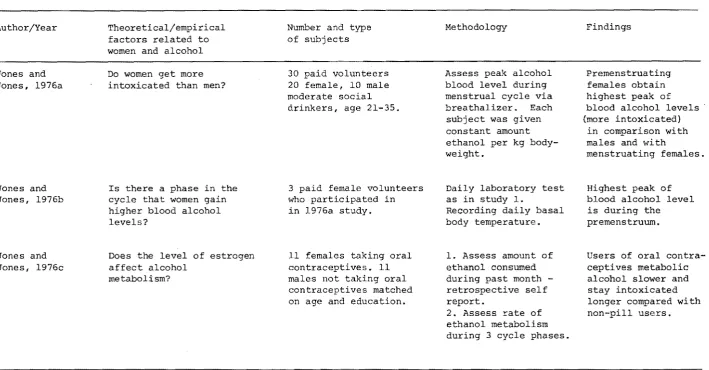
levels and the effect of alcohol consumption in normally cycling women (Fig. 3).
19
The animal studies of voluntary alcohol consumption throughout the "estrous cycle in the rat appear method-ologically sound. Aschkenasy-Lelu (1960) demonstrated that a high estrogen level (artificially induced) is associated with lowered voluntary alcohol intake. The high estrogen levels parallel the ovulatory phase in human females. It was suggested a parallel phenomenon may be found in the human female - that there is lowered alcohol consumption in the ovulatory phase of the cycle. Such a parallel phenomenon has not yet been demonstrated.
Tittmar (1978) demonstrated that continuous consump-tion of alcohol exerted non-estrogenic effects on the rats estrous cycle, causing estrous irregularities and infertility. Similar evidence of human female alcoholics is available. Women who are chronic users of alcohol induce an abrupt cessation of menstruation. However, after 2-3 months sobriety regular menses resume (Ryback, 1977). Wilsnack (1973) also reported a high incidence of gynaecological disorders in 28 alcoholic women.
78% compared with 35% in a matched control group reported amennorhea, difficulties conceiving, repeated miscarriages, and permanent sterility.
Fig. 3. Studies on alcohol metabolism and estrogen
Author/Year
Jones and Jones, 1976a
Jones and Jones, 1976b
Jones and Jones, 1976c
Theoretical/empirical factors related to women and alcohol
Do women get more intoxicated than men?
Is there a phase in the cycle that women gain higher blood alcohol levels?
Does the level of estrogen affect alcohol
metabolism?
Number and type of subjects
30 paid volunteers 20 female, 10 male moderate social drinkers, age 21-35.
3 paid female volunteers who participated in in 1976a study.
11 females taking oral contraceptives. 11 males not taking oral contraceptives matched on age and education.
Methodology
Assess peak alcohol blood level during menstrual cycle via
breathalizer. Each
subject was given constant amount ethanol per kg body-weight.
Daily laboratory test as in study 1.
Recording daily basal body temperature.
1. Assess amount of ethanol consumed during past month -retrospective self report.
2. Assess rate of ethanol metabolism during 3 cycle phases.
Findings
Premenstruating females obtain highest peak of
blood alcohol levels . (more intoxicated)
in comparison with males and with
menstruating females.
Highest peak of blood alcohol level
is during the premenstruum.
Users of oral contra-ceptives metabolic alcohol slower and stay intoxicated longer compared with non-pill users.
I'V
[image:30.841.83.793.119.489.2]1. Females obtained a higher peak blood level than did males at the equivalent dose of alcohol.
2. Females tested during the premenstrual phase reached higher peak blood levels and demonstrated faster absorption rate than females in other phases of the cycle.
21
The difference between women and men in peak blood alcohol levels is related to the difference in body water content. The total body weight of men is composed of 55% to 65% water while the total body weight of women is composed of 45% to .50% water (Bell in Jones and Jones, 1976a). Alcohol is distributed in the body in proportion to water content and tends to be more diluted in males than females. Females have more fatty tissue and males more muscle tissue. More water is contained in muscle than adipose tissue. Therefore the peak blood level should be lower in men than women.
In another study Jones and Jones (1976b) evaluated ethanol metabolism in females taking oral contraceptives and females not taking oral contraceptives. The general trend was for women taking oral contraceptives to
metabolize ethanol slower than the non-pilI-taking group.
1.6.1 Estrogen, MAO arid depression
Following menstruation, estrogen levels rise slowly and steadily (see Fig. 1) reaching a peak at the time of ovulation. Following ovulation there is a fall in
a tenfold increase in monoamine oxi,dase (~1AO)
activity (Grant et aI, 1968).
Ascher Svuam (1982) presents summarized additional data that supports a proposed etiology of alcoholism in women (Jones and Jones, 1976).
1. Alcohol is a monoamine-oxidase (MAO) inhibitor (Schenker et al. 1967)
2. Estrogen like alcohol is a ~1AO inhibitor (Janowsky et al. 1971).
3. Depression is associated with elevated MAO
(Akiskal and McKinney, 1973; Grant et al. 1971; Klaiber et al. 1971, 1972, 1974; White et al. 1980) .
4. Estrogen therapy has been successfully used to
I
treat depressed women (Klaiber et al. 1971, 1974).
Jones and Jones (1976b) present a model that supposes continuous drinking to lead to suppression of estrogen levels which will be presented in section 1.7.
1.6.2 Diuretic and suppressive properties of alcohol There is evidence that alcohol has both diuretic properties which affect water retention and the ability to suppress uterine activity. This was experimentally demonstrated in 1951 (Van Dyke et al). Alcohol may alleviate the discomfort which accompanies water
22
Alcohol may relieve lower abdominal pain and cramps experienced during the premenstrual and menstrual periods
(Fuch , 1968). These are associated with the contractions
of the uterus in expelling the endometrium. Alcohol has
been shown to depress uterine activity in pregnant and non-pregnant women (Puch , 1968). The degree of inhibition in non-pregnant women of uterine activity is related both to the dose of alcohol and the stage of the menst.rual cycle with the most marked inhibition occurring
during menstruation (Puch et al 1968),
These two properties lend support to the etiology of alcoholism in women and are incorporated into the model (Jones and Jones, 1976b).
1. 7 A !Jroposed etiology for alcoholism in \wmen
From the research on women and alcoho~.Jones and
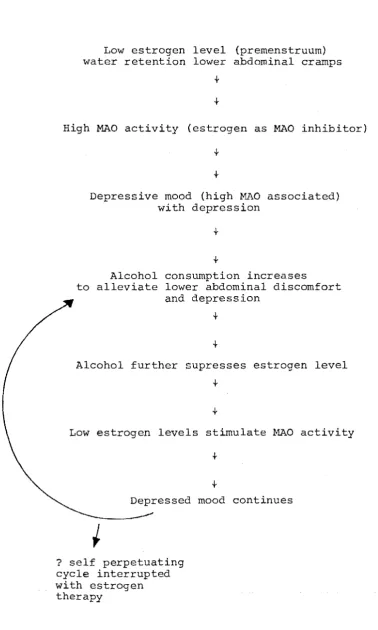
Jones (1976b) propose a model for the study of alcoholism in women (Fig. 4).
A frequently reported symptom in alcoholic women is
depre~sion (Beckman, 1975; Schuckit, 1969; Winokur,
1968). Klaiber et al (1972) have noted that depressed
women tend to have an elevated monoamine oxidase (MAO)
level. Estrogen, a MAO inhibitor has been used to treat
depressed women and Klaiber et al (1972) report it to
reduce MAO levels in depressed women. These studies go
fUrther to suggest alocholic women with depression may
also have elevat~d MAO levels.
Human femal~&have higher MAO activity during the
Fig. 4: A model of Alcoholism in Women
Low estrogen level (premenstruum) water retention lower abdominal cramps
+
High MAO activity (estrogen as MAO inhibitor)
Depressive mood (high MAO associated) with depression
+
Alcohol consumption increases
to alleviate lower abdominal discomfort and depression
+
Alcohol further supresses estrogen level
+
Low estrogen levels stimulate ~~O activity
+
Depressed mood continues
? self perpetuating cycle interrupted with estrogen therapy
Source: Jones and· Jones, 1976 (b) adapted by Ascher Svanum, 1982.
[image:34.594.57.436.114.745.2]Klaiber et al (1972) found depressed Vlomen
described more severe PMS symptoms in the premenstrual phase. Noos (1968) and Kessel et al (1963) found that normal women frequently describe dysphoria in the second half of the cycle. Jones and Jones (197Gb) quote Dalton
(1964) and write, "some women drink alcohol during the premenstrual phase to relieve symptoms". The former authors continue "should ethanol be an MAO inhibitor,
25
women may consume alcohol to reduce ~~_O activity especially during times of low estrogen" (p.123). When estrogen
increases at the beginning of a new menstrual cycle, }V_O is decreased and this may reduce the need for alcohol intake.
Continuous drinking of alcohol prolongs Im'1 levels of estrogen, resulting in greater levels of ~~o activity. Jones and Jones (1976c) found that this leads to depressive symptoms. Drinking alcohol relieves this dysphoria
lowering MAO activity. However, the effect is short-lived. Weingold (1968) and Goss (1969) report this same phenomenon. After the intake of alcohol in heavy drinkers the euphoria is short-lived and dysphoria follows.
The continued drinking of alcohol leads to the suppression of estrogen in a similar way as testosterone is suppressed in males who drink heavily (Mendelson and Mello, 1974). Therapy to interrupt this self-perpetuating cycle would be to administer a ~~O inhibitor - estrogen. This should result in reduced MAO activity and reduced depression with reduced alcohol consumption. The research on this treatment in alcoholic women is non-existent.
of 93 female social drinkers the researchers found that after a 6 week interval women who reported dysphoric mood and who were selected to reduce their alcohol intake, experienced a relative increase in their mood and fewer bouts of anger when they were sober. This was relative
26
to women who increased their alcohol consumption. The authors did not recognize the menstrual cycle as a variable.
Birnbaum et al (1983) concluded a woman's emotional state is influenced by her previous alcohol consumption. The evidence is not conclusive but does offer support for a depressive effect resulting from alcohol intake as suggested by the etiological model of Jones and Jones (1978). The experience of dysphoria as a consequence of drinking alcohol is also reported in other studies (Freed, 1978; Wilkinson, 1971; Mozdzierz, 1971 and Hoffman, 1969).
In summary dysphoric mood appears to be an antecedent to alcohol consumption while irritibility and depressive affect have found to be a consequence of alcohol consumption.
1.8 Longitudinal studies on voluntary consumption of alcohol in women
Only two studies measured the relationship between alcohol consumption and cycle phase (Ascher Suvaum, 1982; Sutker et al 1983) using a longitudinal design. Subjects in both studies recorded daily data over two menstrual
cycles. The data was collected on "psychologically robust women" who were moderate drinkers. The results are
conflicting.
not consume more alcohol during any phase of the cycle. Alcohol intake waS not associated with menstrual or premenstrual distress. This author suggests factors other than biochemical variables play a major role in women's alcohol consumption. However, the age and occupation of the subjects suggests they are:
1. more likely to report dysmennorrhea rather than PMS symptoms. Metcalfe (1980) found that
premenstrual syndrome tends to be established in women with regular ovulatory cycles. Furthermore the probability that ovulation occurs at each
menstrual cycle in a woman /" 25 years is .93 while a younger woman <. 25 years is .74.
2. Younger women drinkers tend to drink more, more frequently (Chetwynd, 1982). They have not established a pattern of alcohol intake (Shaw, 1980; McConville, 1983) and are less aware of premenstrual syndrome (Sanders, 1981).
27
Sutker et al (1983) conducted a time series analysis, within group research design using 21 women and 11 men.
1.9 Summary
A brief general introduction of women and alcohol in New Zealand is followed by a review of the literature relating to alcohol consumption and the menstrual cycle. It is not comprehensive and few firm conclusions can be drawn. Overall the findings suggest alcohol intake increases in those women who experience mild-severe premenstrual symptoms, particularly depression, water retention and physiological discomfort.
It is implied that a subset of these women may be susceptible to a cyclical drinking pattern that eventually leads to alcohol dependency.
Only two studies addressed the issue using a
longitudinal design. The results differ. It is likely that the mean age of the sample is a significant variable.
1.10 Organisation of the remainder of this thesis
Chapter two gives a brief outline of the problem under study. In chapter three issues concerning methods for measuring alcohol intake, mood and symptoms of
premenstrual tension are examined. A description of the design is presented, followed by a statement of the aims
and hypotheses of this research.
The results are reported in chapter five and discussed in chapter six.
Conclusions and suggestions for future research are presented in the final chapter.
CHAPTER 2
THE PROBLEH
The supposition that some women increase their alcohol intake during certain phases of the menstrual cycle/ has not yet been scientifically validated.
Explanations for this phenomenon are proposed in physio-logical/ psychophysio-logical/ behavioural and social terms. The most convincing is physiological research/ however/ most investigators allude to a complex interaction occurring.
A growing number of investigators proposed a
correlation between increased alcohol consumption and the premenstrual phase of the menstrual cycle. The
pre-menstrual phase is the f:\even days prior to the menstruum ± 2-3 days. During this phase some women experience psychological and physiological distress. Sutker et al r(.
(1983) / Ascher Svanum (1982) / Belfar and Shader (1976) / Jones and Jones (1976) / James (1975) / Belfar et al (1971) /
29
Lisansky (1957) / Lolli (1953), propose that some women self medicate with alcohol in this phase of the cycle, to
30
Sutker et al (1983) and Ascher Svanum (1982) are the only two researchers to conduct longitudinal studies assessing voluntary and spontaneous consumption of alcohol daily over two menstrual cycles. The results are
conflicting. Sutker et al found a correlation between negative moods and more frequent drinking during the
menses of the menstrual cycle. Ascher Svanum (1982) found no cyclical drinking pattern in her research sample.
The most convincing empirical support for bio-chemical changes that induce negative affect and alcohol consumption during the menstrual cycle have been described by Jones and Jones (1976a, 1976b, 1976c). These authors put forward an etiology of alcoholism in women as a result of their findings. They propose low levels of the hormone estrogen in the premenstruum induces a depressive state. This is probably because low levels of estrogen inhibit monoamine oxidase OMAO). In this state MAO is active. High MAO "levels are present in persons with depression.
Some women attempt to alleviate the depression with alcohol. But alcohol has the property of suppressing estrogen.
This results in a self-perpetuating depressive cycle. Jones and Jones suggest estrogen therapy would interrupt this cycle. Research on this is scarce and aspects of this hypothesis remain unclear, e.g. the way in which alcohol and estrogen act as MAO inhibitors (Edwards et al 1978; Schildkraut, 1974).
premenstruum. This was not so for 't"omen using oral contraceptives.
31
Koeske and Koeske (1975) proposed that some women drink more in the premenstruum to alleviate the effects of premenstrual symptoms. The explanation is based on a study where women who were lead to believe they were premenstrual reported more symptoms than another group of women who were ovulating. In terms of attribution theory women with
premenstrual syndrome would perceive the drinking of alcohol to alleviate PMS symptoms as acceptable. It is a societal norm to consume alcohol to alleviate distress
(Marshall, 1979).
Ascher Svanum (1982) posits a behavioural model of stimulus control. It is possible that women are medicating some discomforting bodily changes which accompany the
premenstruum particularly water retention and uterine contractions.
Alcohol has a diuretic property and can reduce water retention, i.e. decrease headaches and a feeling of bloating. Alcohol can also suppress uterine activity, e.g. pain and cramps. Ascher Svanum (1982) suggests the physiological discomfort is a stimulus for drinking
behaviour, with the symptoms serving as a discriminative stimuli. Ascher Svanum (1982) develops this model to include stimulus generalization. Some women may learn to react to shi:muli that share similar psychological and physiological symptoms as premenstrual syndrome, by drinking alcohol.
during particular phases of the menstrual cycle.
Schwartz (1982) refers to these kinds of associations to be best represented as a biopsychosocial model.
This model is taken fronl systems theory (de Rosnay, 1979; Miller, 1978; von Bertalanffy 1968) and attempts to provide a unifying meta-theoretical framework for inte-grating how environmental and psychological factors interact with physiologic and biochemical processes in
health and illness.
The aim of this study was to explore possible antecedents in moderate women drinkers who have one or more premenstrual symptoms but are menstruating normally.
32
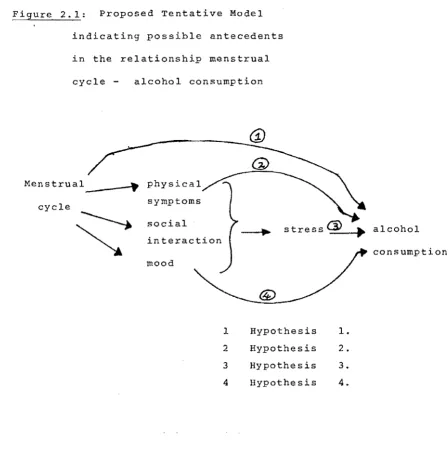
A tentative model to explore possible antecedents is proposed here. It is represented in a diagram in Fig. 2.1.
The menstrual cycle has three phases, menstrual, intermenstrual, and premenstrual. In establishing a
relationship between the menstrual cycle and alcohol intake, four variables are recognized, physical symptoms, mood,
social interaction and stress.
Mood summarizes a variety of feelings and emotions indicated by behavourial acts, facial expression and a
person's verbal response (McKay, 1980). The visual analogue is an appropriate method to measure mood particularly
dysphoric mood may be present in the premenstrual phase. It may be that a significant change in mood is an antecedent to increased alcohol consumption~ (Freed, 1978).
Physical symptoms specific to the premenstrual phase and a second variable that may be an antecedent to increased drinking (Belfar and Shader, 1971: Ryback, 1977).
Figure 2.1: Proposed Tentative Model
indicating possible antecedents
in the relationship menstrual
cycle - alcohol consumption
Menstrual ~ _ _ .... -.. physical
cycle
~
symptoms
social
interaction
mood
1
2
3
4
Hypothesis Hypothesis Hypothesis Hypothesis
33
_._._ .... alcohol
1. 2.
3.
4.
emanate from within or from the environment. In this model stress is the combined effect of mood and physical
symptoms.
Social interaction and personal life events can also affect the state of stress but are considered independent of stress. Such events are! interpersonal relationships! death of family or friends! celebrations of other kinds with family and friends. Such life events may be an antecedent to increased drinking behaviour and may not be related to the cyclical variation of the
menstrual cycle.
34
To explore these possible antecedents a longitudinal design is proposed with daily reporting of alcohol
consumption, moods and symptoms over two menstrual cycles. Variations across phases would be assessed both across and within subjects.
CHAPTER 3
RATIONALE
Dysphoria is a mood that presents with premenstrual syndrome. It is also experienced as a consequence of
drinking alcohol (Birnbaum, 1983; Freed, 1978; Wilkinson, 1971; Mozdzierz, 1971; Hoffman, 1969).
35
This chapter discusses the conceptual and measurement issues of mood, premenstrual tension and alcohol. The
research design is outlined, fo110i.ved by a statement of the aims and hypothesis of this study.
3.1 Measurement of Mood
Moods and feelings defy absolute measurement, only their indicants can be assessed. The indicants are overt behavioural acts, facial expression and a person's verbal response(Mackay, 1980). McKay (1980) and Aitken and
36 .
Table 3.1: Frequently used measurement of mood
Authors
Aitken and Zeal ley
(1970)
Beck et al
(1961)
Clyde (1963)
Green & Nowlis
(1957)
Lorr Da tson & Smith
(1967)
Method of Measuring Mood
Analogue Scales
Inventory of 21 feelings and attitudes on a 5 point scale
Self ratings by choosing adjectives to describe mood
Mood Adjective Checklist
Mood Adjective Checklist
McNair & Lorr (1964) Mood Adjective Checklist
McNair, Lorr,
Droppelman, (1971)
Hamilton (1967)
Jacobson et al
(1978)
Osgood, Suci &
Tannebaum (1957)
Wessman & Ricks
(1966)
Zuckeman (1960)
Zuckerman & Lubin
(1965)
Zung (1965}
Profile of mood states (P0l1S)
Observer ratings
Mood and Symptom Checklist
semantic differential
Mood scales using statements of mood
Mood Adjectives Checklist
Multiple Affect Adjective Checklist (MAACL)
Self ratings of categories of feelings
Principal Mood
Any
Depression
6 mood factors
Many mood factors
Many mood factors
Many mood factors
Many mood factors
Depression and anxiety
Many mood factors
Concepts such as self-esteem, generc evaluation and sexual evaluation
Many mood factors
Anxiety
Anxiety, hostility depression
[image:46.594.79.534.92.724.2]37
experiences. The most frequently used self report measures are tabled in Table 3.1.
Several studies are reviewed by McKay (1980). Most popular is the mood adjective checklist, but this has poor test-retest reliability and is prone to response sets.
Administ.ration and scoring also vary. However, h;ro factors that have resulted from research on this method are:
1. Three core factors are associated with mood (Table 3.2).
2. Factors have bipolar dimensions.
Bond and Lade~ (1976) and Herbert et al (1976) report three similar factors: alertness, contentedness and
calmness. Bush (1973) describes the factors to be pleasant/ unpleasant, level of activation and level of aggression.
*
Meddis (1969) describes the factors as vigour, well-being and tension.
Table 3.2: Core factors associated with mood
Author/date Factors
jl.1eddis, 1969 vigour, well-being, tension Bush, 1973 level of activation, pleasant/
unpleasant, level of aggression Bond and Lader,
1976
) ) ) Herbert et al 1976)
alertness, contentedness, calmness
A more frequent clinical alternative to the word check list is the visual analogue scale (VAS). VAS is a direct estimation of the magnitude of a feeling. ~he
at the time. At the end of the line is a word (usually opposites such as tense - relaxed). The advantages of such scales are that i t is easy for the subject to grasp quick to fill OIt and score, a small amount of subject motivation is needed and the subject can make as fine a discrimina-tion as is needed (McKay, 1980). It reduces word response sets (Joyce, 1968). Nuances of a feeling
are expressed in a continuous rather than digital form.
38
These scales have been tested and found to be
reliable and valid indications of emotional state (~axwell,
1978; Hall, 1980). For example, a comparative study of four depressed scales, Beck, Hamilton, Zung and Taylor, with Visual Analysis Scale showed highly significant
correlations between the ratings (Davies, et al 1975i
Luria, 1975). Nader and Harks (1971) and Hornblow and Kidson (1976) have tested the Visual Analogue state for assessment of anxiety and provides evidence of their validity and reliability.
As the VAS is adequate for a variety of techniques of statistical analysis CHaxwell, 1978) i t was decided that visual analogue scales were appropriate for daily use in the assessment of mood during the menstrual cycle.
The issue of whether such scales are influenced by the individuals expectations or attempts to fulfil the
39
3.2 Indices of PMS
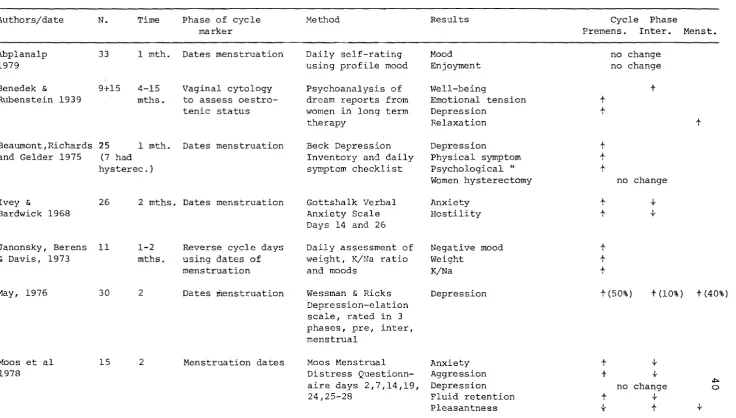
A number of psychological and physiological indices have been used to identify cyclical changes in the menstrual cycle (Table 3.3). Most researchers are concerned with PMS. Psychological indices include daily mood rating
(verbal ratings and VAS) depression ratings (Beck, Wessman and Ricks), Menstrual Distress Questionnaire. Physiological indices include daily reporting of symptoms using the
Menstrual Distress Questionnaire, other physiological indices used are basal body temperature, hormone assays, vaginal cytology, endocrine measures in blood and urine samples as well as the first day of last menstruation.
There are several limitations to these studies listed in Table 3.3. They are, (1) retrospective reporting has been found to differ considerably from daily reports of symptoms. There is evidence of cyclic change in pain, water retention symptoms but evidence of emotional changes over the menstrual cycle are inconsistent. (2) Sample size tends to be small. This is understandable as
completion of daily reports demands considerable co-operation from subjects and generates very large amounts of data for analysis.
Table 3.3: Studies that review mood changes during the menstrual cycle
Authors/date N. Time Phase of cycle Method Results Cycle Phase
marker Fremens. Inter. Menst.
Abplanalp 33 1 mth. Dates menstruation Daily self-rating Mood no change
1979 using profile mood Enjoyment no change
Benedek & 9+15 4-15 Vaginal cytology Psychoanalysis of ~vell-being +
Rubenstein 1939 mths. to assess oestro- dream reports from Emotional tension +
tenic status women in long term Depression +
therapy Relaxation +
Beaumont,Richards 2S 1 mth. Dates menstruation Beck Depression Depression +
and Gelder 1975 (7 had Inventory and daily Physical symptom +
hysterec.) symptom checklist Psychological .. t
Women hysterectomy no change
Ivey & 26 2 mths. Dates menstruation Gottshalk Verbal Anxiety +
..j.-Bardwick 1968 Anxiety Scale Hostility +
..j.-Days 14 and 26
Janonsky, Berens 11 1-2 Reverse cycle days Daily assessment of Negative mood +
& Davis, 1973 mths. using dates of weight, K/Na ratio Weight +
menstruation and moods K/Na +
May, 1976 30 2 Dates menstruation Wessman & Ricks Depression +(50%) +(10%) + (40%)
Depression-elation scale, rated in 3 phases, pre, inter, menstrual
Moos et al 15 2 Menstruation dates Moos Menstrual Anxiety +
4-1978 Distress Questionn- Aggression +
4-aire days 2,7,14,19, Depression no change .::.. 0
24,25-28 Fluid retention +
[image:50.841.68.805.121.539.2]..j.-Table 3.3 (Continued)
Paige 38 2 Basal body Gottshalk verbal Anxiety t -}
1969, 1971 temperature anxiety scale days Hostility t -}
4, 10, 16, 26
Patkai Johannson 6 2 Dates menstruation Daily mood assess. Restlessness t
Post, 1974 Basal body temp. using analogue Negative mood t
scale Sleep disturbance t
Length of sleep t
Rouse, 1978 172 1 Dates menstruation MDQ Pain t
and standardized Retrospective at Fluid retention t
cycle days different cycle Negative moods t
phases
Silbergeld, Brast 8 4 Menstruation date, Comaparison Pain and water retention t -} t
& Nobel, 1971 Basal body pill/non-pill users Crying t
temperature daily mood rating Irritibility t
MDQ Tension t
blood samples Aggression t
psychological Hostility t
{-testing
Zimmerman and 14 1 Dates menstruation Daily self reporting Moods no change
Parlee, 1973 Basal body mood, pain
temperature bloatedness
Wilcoxin,Shrader. 11 1 Dates menstruation Daily assessment Pain and fluid retention t
and Sherif, 1976 MDQ Depression t
Nowlis Checklist Concentration t
Stressful events t
~
42
. group who believed themselves to be
intermenstrual. In fact phase of cycle was identified for both samples. Any factor which stimulates greater awareness of the menstrual cycle is likely to bias reporting toward expectation of the symptoms (Slade, 1984).
3.2.1 Psychological Indices
The menstrual distress questionnaire (1969) is the most standard method for collecting data about the menstrual cycle symptoms. In 1978 Moos derived eight symptom groups by factor analysis on an initial 47 regularly reported
symptoms (Table 3.4). Of these eight, only three are used in this study, water retention, pain and negative affect.
They have been demonstrated to discriminate amongst the menstrual and premenstrual and intermenstrual phases
(Silbergeld, 1971).
Over sixty studies using the MDQ report (Moos, 1977)
1. Significant internal consistency .74 - .98. 2. Significant intercycle stability .81 - .96
showing that women tend to report similar symptoms within phases across cycles.
3. Significant menstrual phase effect, specifically water retention, negative affect and pain.
4. Little or no evidence for instrument deterioration indicating suitability for longitudinal investigations. However l Parlee (1974) claims the questionnaire
concentrates too much on negative mood. For this reason most symptoms of negative affect in this study were
43
Table 3.4: ~lenstrual distress questionnaire symptom groups
Pain Water retention
Muscle stiffness Headache
Cramps Backache Fatigue
General aches and pains
Concentration Insomnia
Forgetfulness Confusion
Lowered judgement
Difficulty concentrating Distractible
Accidents Lowered motor
coordination
Behaviour change
Lowered school or work performance
Take naps, stay in bed Stay at home
Avoid social activities Decreased efficiency
Automatic reactions Dizziness, faintness Cold sweats
Nausea, vomiting Hot flushes
Weight gain Skin disorders Painful breasts Swelling
Negative affect Crying
Loneliness Anxiety Restlessness Irritibility Mood swings Depression Tension
Arousal
Affectionate Orderliness Excitement
Feelings of well-being Bursts of energy, activity
Control
Feelings of suffocation Chest pains
Ringing in the ears Heart pounding
Numbness, tingling
Blind spots, fuzzy vision
Symptom anxiety: tension:
restlessness: irritabili ty: depression:
concentration:
Bipolar dimension very stressed
tense exhausted irritable hopeless unhappy
poor concentration
not stressed relaxed
energetic friendly confident happy
good concentration 44
Sexual feeling was also rated. Similar VAS ratings have been used by Carney et al (l978) and Sanders (1981). Adverse emotional changes before menstruation could either increase or decrease a woman's sexual feelings. The bipolar dimension read sexual feeling none - sexual feeling high.
Furthermore the interaction of alcohol on the
endocrine system is complex. Although i t increases sexual desire by reducing inhibitions, the central contex also impairs performance. It is possible that a reduction of
central inhibition and anxiety by alcohol may increase sexual arousal (Ghodse et al 1980).
Sclaire (1970) in the analysis of women coming for alcoholism treatment found that their help-seeking was triggered by either employment or domestic stress. Women more likely than males drink for 'escape' reasons (Schuckit, 1972). They also tend to put more value on the psychotropic effects of alcohol as a mood changer, tranquilizer and
psychological and physical anaesthetic.