ISSN Print: 2327-5952
DOI: 10.4236/jss.2019.78009 Aug. 19, 2019 111 Open Journal of Social Sciences
The Effect of Developmental Feedback on
Employee Job Crafting: The Mediating Role of
Learning Goal Orientation
Tingting Yao, Minghua Fu
Business School, Nanjing Normal University, Nanjing, China
Abstract
Job crafting, as a proactive behavior, is becoming a hot topic in the field of organizational behavior. Based on the self-determination theory, this paper explored the influence mechanism of developmental feedback on employee job crafting (seeking resources, seeking challenges and reducing demands) and tested the mediating role of learning goal orientation in this relationship through a questionnaire survey of 305 employees. The results show that de-velopmental feedback is positively related to expansion job crafting (seeking resources, seeking challenges), and is significantly negatively correlated with contraction job crafting (reducing demands); the learning goal orientation partially mediates the relationship between developmental feedback and ex-pansion job crafting (seeking resources, seeking challenges), and fully me-diates the relationship between developmental feedback and contraction job crafting (reducing demands). Finally, the implications and limitations of this empirical study are discussed.
Keywords
Developmental Feedback, Learning Goal Orientation, Job Crafting
1. Introduction
With the globalization of economy and the in-depth development of informa-tion technology, the speed of innovainforma-tion and transformainforma-tion of enterprises is accelerating, and the competition among enterprises is intensifying. Dynamic and complex work environment has become a trend, which also increases the in-itiative requirements for employees. Traditional work design is a top-down process in which the managers create jobs or change jobs, tasks, and roles for
How to cite this paper: Yao, T.T. and Fu, M.H. (2019) The Effect of Developmental Feedback on Employee Job Crafting: The Mediating Role of Learning Goal Orienta-tion. Open Journal of Social Sciences, 7, 111-126.
https://doi.org/10.4236/jss.2019.78009
Received: July 16, 2019 Accepted: August 16, 2019 Published: August 19, 2019
Copyright © 2019 by author(s) and Scientific Research Publishing Inc. This work is licensed under the Creative Commons Attribution International License (CC BY 4.0).
DOI: 10.4236/jss.2019.78009 112 Open Journal of Social Sciences
employees. Employees rarely have the opportunity to participate in job design, which ignores the initiative of employees to change their work. With the im-provement of culture, education and economic development, people’s attitudes toward job are changing. More and more people begin to think about the mean-ing of work. Employees are not only satisfied with gettmean-ing money through work to ensure the basic needs of life, but more importantly, they expect to combine personal abilities and interests with their jobs, and give full play to their skills and advantages to achieve self-value. In this context, a new research perspective has emerged in the field of organizational behavior—job crafting. Wrzesniewski and Dutton (2001) introduced the concept of job crafting to capture “the actions employees take to shape, mold, and redefine their jobs”. Job crafting is a bot-tom-up job design process in which employees make the physical and cognitive changes in the task or relational boundaries of their work to match job with their own preference, skill, and ability better [1]. A large number of empirical studies indicated that job crafting contributes to individuals and organizations, such as improving organizational commitment, job performance, job satisfaction, work engagement, reducing turnover intention [2]-[7]. Therefore, it is of great theo-retical and practical significance to understand the influencing factors of job crafting.
How to motivate employees to engage in more job crafting? At present, re-search on the influencing factors of job crafting focuses on employee personal attributes and job characteristics, such as initiative personality, individuals’ work and motivational orientations, regulatory focus, self-efficacy, work pressure and autonomy, task independence [8][9]. Supervisor has an important influence on employee attitudes and behaviors, but there are relatively few studies on the re-lationship between supervisor behaviors and employee job crafting. Wang etal. (2017) found that transformational leadership is an important antecedent of employee job crafting [10]. Tims & Bakker (2010) also suggested that more at-tention should be paid to the influence of supervisors in the job crafting in the future [11]. Supervisors should stimulate employees’ intrinsic motivation of job crafting, and provide feedback on employees’ work behavior and performances, and make employees’ goals consistent with organizational goals, so as to im-prove employee job performance and the perception of work meaning and value. Developmental feedback, a type of feedback designed to help employees learn and grow, is a positive leadership behavior. Whether it can stimulate subordi-nates’ job crafting behavior is seldom studied. Therefore, this paper explores the impact of developmental feedback on job remodeling behavior firstly.
DOI: 10.4236/jss.2019.78009 113 Open Journal of Social Sciences
strive to acquire new knowledge, skills, pay attention to self-development, and have stronger intrinsic motivations (Vandewalle, 2001) [13]. Therefore, can de-velopmental feedback stimulate job crafting by improving employees’ learning goal orientation? In order to answer the above questions, this paper, based on self-determination theory and taking employees as objects, explores the rela-tionship between developmental feedback and job crafting and takes learning goal orientation as the mediator to reveal the black box of the relationship be-tween developmental feedback and job crafting. Through empirical tests, this study will help to further examine the influencing mechanism of employee job crafting behavior, and provide theoretical reference for organizational interven-tion management.
2. Theory and Hypotheses
2.1. Job Crafting
Jobcrafting was first proposed by Wrzesniewski & Dutton (2001). It refers to the self-initiated and change-oriented behavior of employees with the goal to ensure a better fit between the job and individual interests, motivations, and passions. Employees crafting their jobs in three ways: task crafting, relationship crafting, and cognitive crafting. Task crafting means that employees change the number, scope and type of tasks, including increasing or reducing the number of tasks and changing the way they work. Relationship crafting means that employees change the way they interact with others at work. Cognitive crafting refers to employees changing their perception of the job in a way that enhances the mean-ing of work. Through job craftmean-ing, employees will enhance the meanmean-ing of work and have a positive work identity [1].
DOI: 10.4236/jss.2019.78009 114 Open Journal of Social Sciences
(i.e., contraction job crafting) (Wang, Demerouti, & Bakker, 2017) [16]. Studies have shown that expansion job crafting (seeking resources and seeking chal-lenges) is positively related to work engagement and job satisfaction, while con-traction job crafting (reducing demands) is positively related to turnover inten-tions, anti-production behavior, and negatively related to task performance (Pe-trou etal., 2015; Demerouti etal., 2015) [17][18].
Although the above views discuss job crafting from different perspectives, they are closely related. Seeking challenges and reducing demands can be seen as changing the boundaries of tasks, and seeking resources, for example, social support, is similar to relational crafting. The former view by Wrzesniewski & Dutton (2001) puts more emphasis on the individual characteristics in terms of the motivation and outcomes of job crafting, which is lack of discussion on the interaction between job crafting and external environment. The latter makes up for the gap, emphasizing the influence of external environmental factors (e.g., job characteristics) on job crafting. The JD-R perspective on job crafting pro-vides an effective measurement method and has been widely used in empirical research (Tims etal., 2012) [19]. Therefore, this paper adopts the concept of job crafting from the perspective of the JD-R theory.
2.2. Developmental Feedback and Job Crafting
Job crafting is a proactive behavior that employees make changes to their jobs initially, but organizations can stimulate the autonomic motivation of employee job crafting through intervention [20]. Feedback is a common way to intervene in employee behavior and job performance in organizations. The feedback mod-el proposed by Ilgen etal. in 1979 reflects the feedback process more compre-hensively, which involves three key elements: feedback source, feedback content, and feedback recipient. The feedback sources include organizations, supervisors, colleagues, subordinates and themselves. The feedback from the supervisor is the most valuable [21]. Traditional supervisor feedback is based on the employee’s performance and work goals. Longenecker et al. (1996) found that formal per-formance feedback does not play a role in promoting work motivation and im-proving job performance, and he suggested that supervisor feedback should fo-cus on the personal development of employees [22]. That indicates that the su-pervisor should provide more developmental information to the employees in-stead of traditional performance feedback. Developmental feedback refers to the extent to which supervisors provide their employees with helpful or valuable in-formation that enables the employees to learn, develop, and make improvements on the job. It has three characteristics: the feedback source is supervisor; the feedback content is about employee’s development; the feedback type is infor-mative.
DOI: 10.4236/jss.2019.78009 115 Open Journal of Social Sciences
the intrinsic motivation (Zhou, 2003) [24], and stimulate employee job crafting behaviors. The developmental feedback is information-based feedback that aims of providing employees with information that help to improve performance. It does not force employees to achieve specific work goals in the future so that it can meet employees’ need for autonomy. Job autonomy is also a crucial antece-dent variable in job crafting. Developmental feedback focuses on employees’ fu-ture development, aiming to develop the potential of employees and improve their knowledge and ability to meet their need for competence. In addition, de-velopmental feedback can create a relaxed and free atmosphere for employees, improve employees’ trust in supervisors, and promote leader-member exchange (LMX) to meet employees’ need for relatedness. Therefore, developmental feed-back can improve employees’ intrinsic motivation. Employees with strong in-ternal motivation are more likely to craft their jobs (Wrzesniewski & Dutton, 2001). Besides, employees need to pay more time and effort in the process of job crafting, which may lead to higher pressure, workload and burnout [25]. If it fails, employees would be frustrated (Berg, Grant, and Johnson, 2010) [26]. De-velopmental feedback can lower the risk and improve levels of psychological safety. Supervisors convey their expectations for employees through feedback and enhance employee organizational identity [24], making employees aware of what behaviors are allowed and which are not, thereby increasing employees job crafting behavior consistent with organizational goals. The specific explanation is as follows:
First of all, supervisors are familiar with employees’ progress of work, and they can provide employees with valuable information. Supervisors have a lot of precious resources, such as work-related knowledge and experience, which play a significant role in employees’ career development. In communication with employees, supervisors may share these information resources with employees and encourage employees to look for development opportunities and increase job resources. In addition, developmental feedback enables the employees to feel the care and support of leaders and enhance employees’ the intention of seeking feedback. Secondly, developmental feedback is future-oriented, which provides employees with beneficial feedback on learning and development. So employees will feel that supervisors are concerned about their growth and development, thus stimulating individual interest in the work itself and actively seeking chal-lenges. Challenging behavior means risks and uncertainties, but employees feel support and encouragement with developmental feedback and face up to chal-lenges. Reducing demands, for example, reducing workload, is essentially a withdrawal behavior, which is negatively related to contextual performance [27], and positively related to turnover intention and emotional exhaustion [28]. Re-ducing demands is not conducive to the future development of organizations and employees. Therefore, employees will reduce such behavior under the deve-lopmental feedback. Based on the above, we propose:
DOI: 10.4236/jss.2019.78009 116 Open Journal of Social Sciences
seekingresources;
Hypothesis 1b: Developmental feedback is positively related to employees’
seekingchallenges;
Hypothesis 1c: Developmental feedback is negatively related to employees’
reducingdemands.
2.3. Developmental Feedback and Learning Goal Orientation
Goal orientation, derived from Achievement Motivation Theory, refers to indi-vidual preference when pursuing specific goals [29]. Early scholars considered goal orientation as a personality trait variable. In recent years, some studies have found that goal orientation is also a state variable because of influenced by ex-ternal environment [30]. Dweck (1988) divided the goal orientation into two dimensions: learning goal orientation and performance goal orientation. Indi-viduals with learning goal orientation believe that their abilities can be improved through learning, and tend to improve skills and acquire knowledge; individuals with performance goal orientation believe that abilities are inherent, like show-ing themselves, expectshow-ing to get positive evaluations or avoid negative evalua-tions by comparing with others [31]. This paper argues that developmental feedback can motivate the employee’s learning goal orientation. Developmental feedback provides valuable information to improve employees’ abilities, skills. It is considered that the employees’ ability can be improved through efforts but not invariable. Therefore, supervisors will provide feedback that contributes to em-ployees’ learning and development. According to the social information processing theory, the views and behaviors of supervisors will influence the be-haviors of subordinates. Developmental feedback makes subordinates believe that they can improve their abilities and competitiveness by learning, thus pro-moting the learning goal orientation. In addition, the positive and useful feed-back provided by the supervisor will further reinforce the learning goal orienta-tion. Based on the above, we propose:
Hypothesis 2: Developmentalfeedbackispositivelyrelatedto theemployee’s
learninggoalorientation.
2.4. Learning Goal Orientation as a Mediator
DOI: 10.4236/jss.2019.78009 117 Open Journal of Social Sciences
employees, which will stimulate intrinsic motivation (Zhou, 2003). This will en-hance employees’ interest in the task itself and learning goal orientation. So that employees will focus on personal development and self-realization and engage in expansion job crafting (seeking resources, seeking challenges.) rather than con-traction job crafting (reducing demands) to improve themselves. Based on the above, we propose:
Hypothesis 3: Learning goal orientation mediates the relationship between
developmentalfeedbackandjobcrafting (seekingresources,seekingchallenges,
andreducingdemands).
The theoretical model of this paper is shown in Figure 1. We believe that high supervisor developmental feedback will improve employees’ learning goal orientation, and employees with high learning goal orientation will have high intrinsic work motivation, so employees will engage in more expansion job crafting behavior (seeking resources and seeking challenges), and reduce con-traction job crafting behavior (reducing demands). Based on self-determination theory, this paper will explore the relationship between developmental feedback and job crafting, taking learning goal orientation as the mediator.
3. Research Methods
3.1. Sample and Procedure
The participants in the study were 350 randomly selected employees from en-terprises in Anhui, Jiangsu, Zhejiang, and Hubei provinces of China. We col-lected data by online questionnaire survey and field questionnaire survey. In all surveys, a cover letter attached to the questionnaire indicated that the survey was only for academic research purposes, and the strict confidentiality responses were guaranteed. In the end, 335 employees completed the questionnaires. After excluding the incomplete ones, there were 305 valid questionnaires,resulting in
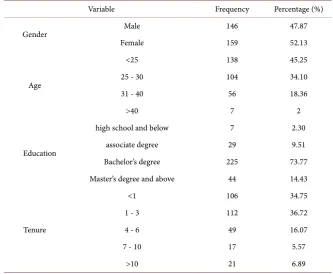
an overall response rate of 87.14%. There were 159 women (52.13%) and 146 men (47.87%) in the sample. The age distribution of the sample population was mainly young people under the age of 30, accounting for 79.35% of the total. About 73.77% of employees had completed a university degree, and about 14.43% of employees even had completed a master degree. Most employees had worked 1 - 3 years, accounting for 36.72%, followed by less than one year, ac-counting for 34.75%. Demographic information for valid samples is shown in
Table 1.
DOI: 10.4236/jss.2019.78009 118 Open Journal of Social Sciences
Table 1. Demographic characteristics of the analytic sample.
Variable Frequency Percentage (%)
Gender Male 146 47.87
Female 159 52.13
Age
<25 138 45.25
25 - 30 104 34.10
31 - 40 56 18.36
>40 7 2
Education
high school and below 7 2.30
associate degree 29 9.51
Bachelor’s degree 225 73.77
Master’s degree and above 44 14.43
Tenure
<1 106 34.75
1 - 3 112 36.72
4 - 6 49 16.07
7 - 10 17 5.57
>10 21 6.89
3.2. Measures
The measurement scales this study were recognized mature scales by most re-searchers. Except for the control variables (gender age, education, and tenure), measures were operationalized with three items and answers were rated on a 7-point Likert scale (l = strongly disagree, 7 = strongly agree). All items were translated the existing scales into Chinese from English, asked are searcher who is proficient in English and Chinese to translate them back to English as an ac-curacy check.
Developmental feedback. We measured developmental feedback with three items from a scale developed by Zhou (2003). A sample item was “My supervisor gave me feedback mainly to help me learn and improve.” Cronbach’s α was 0.822.
Learning goal orientation. We measured Learning goal orientation with five items from a scale developed by Vandewalle (1997). A sample item was “I often read some work-related materials to improve my ability.” Cronbach’s α was 0.853.
DOI: 10.4236/jss.2019.78009 119 Open Journal of Social Sciences
with four items. A sample item was “I try to simplify the complexity of my tasks at work.” Cronbach’s α was 0.827.
Control variables. We controlled for gender, age, education, and tenure in testing our hypotheses.
3.3. Research Analysis Method
In this study, SPSS22.0 and AMOS23.0 were used for statistical analysis. First of all, we verified the reliability and effectiveness of the scale by confirmatory factor analysis. Secondly, we tested the effect of common method bias on our results by common method bias test. Finally, we employed descriptive statistical analysis and regression analysis method to prove the main effect and the mediation ef-fect.
4. Results
4.1. Confirmatory Factor Analysis
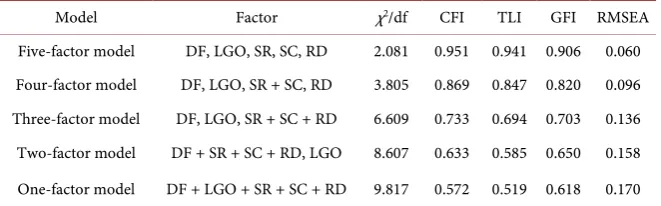
We conducted confirmatory factor analyses to test the discriminant validity of scales of developmental feedback, learning goal orientation, seeking resources, seeking challenges, and reducing demands. The results are shown in Table 2. The five-factor model showed reasonable fit indices, χ2(142) = 2.081,
compara-tive fit index (CFI) = 0.951, root mean square error of approximation (RMSEA) = 0.060. We compared this model to other alternative models in which the factor correlation between constructs (e.g., seeking resources, seeking challenges, and reducing demands) was fixed to unity. Our hypothesized model showed a supe-rior fit to the data than any alternative model, indicating that the constructs are empirically distinct.
4.2. Common Method Bias Test
[image:9.595.210.541.596.699.2]Since our data in this study came from a single source, so we conducted Har-man’s one-factor test to detect the presence of common method variance. The results of the unrotated factor analysis indicated that we had five factors the same number as included in our model. The first factor accounted for 36.895%, and all factors accounted for 72.124% of the variance, indicating that the common
Table 2. Confirmatory factor analysis results.
Model Factor χ2/df CFI TLI GFI RMSEA
Five-factor model DF, LGO, SR, SC, RD 2.081 0.951 0.941 0.906 0.060 Four-factor model DF, LGO, SR + SC, RD 3.805 0.869 0.847 0.820 0.096 Three-factor model DF, LGO, SR + SC + RD 6.609 0.733 0.694 0.703 0.136 Two-factor model DF + SR + SC + RD, LGO 8.607 0.633 0.585 0.650 0.158 One-factor model DF + LGO + SR + SC + RD 9.817 0.572 0.519 0.618 0.170
DOI: 10.4236/jss.2019.78009 120 Open Journal of Social Sciences
method variance of this study is not serious. Because the Harman single factor test method is relatively simple, the reliability of the conclusion is questioned. So we adopted the recommendation by Podsako etal. (2003) to load all items on one general factor which represents the common factor [33]. In the result, the one-factor model showed a worse model fit (χ2(152) = 2.095, CFI = 0.951, GFI =
0.906, RESEA = 0.170) compared with the five-factor model (χ2(142) = 2.081,CFI
= 0.951, RMSEA = 0.060). According to the above analysis, we believe that our results are less affected by common method bias.
4.3. Descriptive Statistics and Correlations
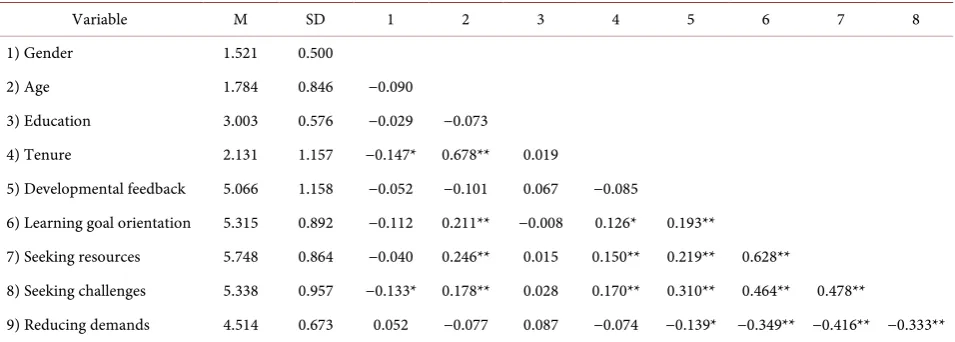
The means, standard deviations and correlations of the variables are presented in Table 3. Developmental feedback had a significant positive correlation with learning goal orientation (r = 0.193, p < 0.01), seeking resources (r = 0.219, p < 0.01), seeking challenges (r = 0.310, p < 0.01), and a significant positive correla-tion with reduccorrela-tion demands (r = −0.13, p < 0.05). As expected, learning goal orientation was significantly and positively correlated with seeking resources (r
= 0.628, p < 0.01), seeking challenges (r = 0.464, p < 0.01), and was significantly and negatively correlated with reducing demands (r = −0.349, p < 0.01). These preliminarily supported our hypotheses.
4.4. Hypotheses Testing
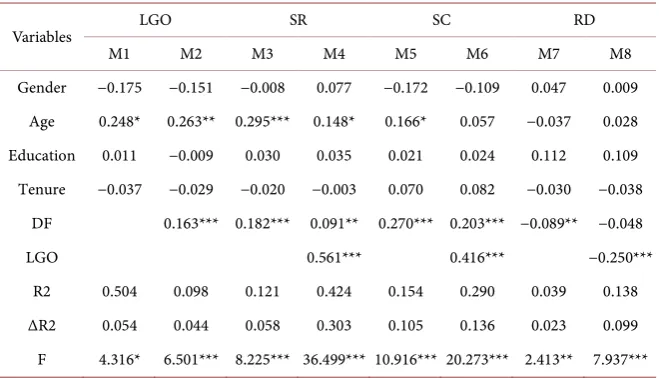
[image:10.595.60.538.539.710.2]We tested our hypotheses using the SPSS22.0 software package. The analysis re-sults are presented in Table 4. Our first hypothesis proposes that developmental feedback is positively related to seeking resources (H1a), seeking challenging (H1b) and negatively related to reducing demands (H1c). As can be seen, deve-lopmental feedback is significantly and positively related to seeking resources (M3, β = 0.182, p < 0.001), seeking challenges (M5, β = 0.270, p < 0.001), and negatively related to reducing demands (M7, β = −0.089, p < 0.01), however. Therefore, hypothesis 1a, 1b, 1c were all supported.
Table 3. Means, standard deviations and correlations among the study variables.
Variable M SD 1 2 3 4 5 6 7 8
1) Gender 1.521 0.500
2) Age 1.784 0.846 −0.090
3) Education 3.003 0.576 −0.029 −0.073
4) Tenure 2.131 1.157 −0.147* 0.678** 0.019
5) Developmental feedback 5.066 1.158 −0.052 −0.101 0.067 −0.085
6) Learning goal orientation 5.315 0.892 −0.112 0.211** −0.008 0.126* 0.193**
7) Seeking resources 5.748 0.864 −0.040 0.246** 0.015 0.150** 0.219** 0.628**
8) Seeking challenges 5.338 0.957 −0.133* 0.178** 0.028 0.170** 0.310** 0.464** 0.478**
DOI: 10.4236/jss.2019.78009 121 Open Journal of Social Sciences
Table 4. Results of regression analyses.
Variables LGO SR SC RD
M1 M2 M3 M4 M5 M6 M7 M8
Gender −0.175 −0.151 −0.008 0.077 −0.172 −0.109 0.047 0.009 Age 0.248* 0.263** 0.295*** 0.148* 0.166* 0.057 −0.037 0.028 Education 0.011 −0.009 0.030 0.035 0.021 0.024 0.112 0.109 Tenure −0.037 −0.029 −0.020 −0.003 0.070 0.082 −0.030 −0.038
DF 0.163*** 0.182*** 0.091** 0.270*** 0.203*** −0.089** −0.048
LGO 0.561*** 0.416*** −0.250***
R2 0.504 0.098 0.121 0.424 0.154 0.290 0.039 0.138
ΔR2 0.054 0.044 0.058 0.303 0.105 0.136 0.023 0.099 F 4.316* 6.501*** 8.225*** 36.499*** 10.916*** 20.273*** 2.413** 7.937*** Note: ***p < 0. 001.
Hypothesis 2 predicted that developmental feedback would be positively re-lated to learning goal orientation. As can be seen, It can be seen from M2 that the developmental feedback is significantly and positively correlated with the learning goal orientation (β = 0.163, p < 0.001). Therefore, H2 is supported by the data.
Finally, hypothesis 3 predicted that developmental feedback would be indi-rectly related to job crafting (seeking resources, seeking challenges, reducing demands) through learning goal orientation. When the developmental feedback and learning goal orientation were entered in the regression model at the same time (see M4 in Table 4), the beta coefficient for developmental feedback was statistically significant and reduced from β = 0.182 (p < 0.001) to β = 0.091 (p < 0.01). Thus, learning goal orientation partially mediated the relationship be-tween developmental feedback and seeking resources. Similarly, learning goal orientation partially mediated the relationship between developmental feedback and seeking challenges (β = 0.203, p < 0.001). As shown M9 in Table 4 that after the learning goal orientation was entered in the regression model, the beta coef-ficient for developmental feedback was not significant (β = 0.048, p > 0.05). So, the learning goal orientation fully mediated the relationship between develop-mental feedback and reducing demands. Taken together, these findings fully support Hypothesis 3.
To sum up, through confirmatory factor analyses and hierarchical multiple regression, we found that supervisor providing developmental feedback can sti-mulate employees to increase expansion job crafting behaviors (seeking re-sources, seeking challenges) and reduce contraction job crafting behaviors (re-ducing demands) through enhancing the employees’ learning goal orientation.
5. Discussion
DOI: 10.4236/jss.2019.78009 122 Open Journal of Social Sciences
feedback and job crafting (seeking resources, seeking challenges, reducing de-mands). According to previous research, seeking resources and seeking chal-lenges were promotion-oriented, and reducing demands were prevention-orien- ted. Different job crafting strategies resulted in different outcomes. Therefore, it is necessary to explore the relationship between developmental feedback and different job crafting behaviors. We also found that learning goal orientation played a mediating mechanism role in the relationship. As we expected, our hy-potheses were supported by empirical results.
5.1. Theoretical Implications
First, our results enrich the job crafting of antecedents. How to stimulate em-ployees job crafting? Previous researches focused on individual proactive perso-nality, self-efficacy and job characteristics through empirical analysis. Schobero-va (2015) studied organization job crafting intervention. He suggested that or-ganizational managers are important participants in job crafting intervention and managers should provide timely feedback on the employees’ work [34]. Van Wingerden (2017) found that job crafting intervention can stimulate employees’ intrinsic motivation of job crafting via work feedback [35]. This paper expanded the research on the influencing factors of job crafting from the perspective of managers and found that developmental feedback can predict expansion job crafting and negatively predict contraction job crafting to the contrary. This re-sponded to the calling of Tims et al. (2010) that the role of supervisors in em-ployees job crafting should be paid more attention.
Secondly, the previous studies regarded job crafting as a whole concept and discussed the positive or negative relationship with other variables. For example, on the whole, job crafting had positive correlation with work engagement [3] [36][37]. However, some found that different job crafting strategies had differ-ent relationships with work engagemdiffer-ent. Demerouti et al. (2015) found that seeking resources and seeking challenges were positively related to work en-gagement, and reducing demands was negatively correlated with work engage-ment. This paper confirmed that point again. Developmental feedback can sti-mulate employees’ intrinsic motivation, then increase the behaviors of seeking resources and seeking challenges. While reducing demands is a withdrawal be-havior, essentially. When supervisors care about subordinate’s development and give them feedback on their work, they will reduce this behavior. To a certain extent, the results deepened the understanding of job crafting.
theo-DOI: 10.4236/jss.2019.78009 123 Open Journal of Social Sciences
retical perspective for explaining the influencing factors of employee job craft-ing.
5.2. Practical Implications
Our study suggests that supervisors should consider providing more develop-mental feedback to motivate employees to craft their jobs. Although job crafting is a proactive behavior, employees need abilities and opportunities, and more importantly, support from supervisors. Supervisors can give some constructive suggestions by feedback, let the employees feel that their supervisors concern about their future development. Previous studies have found that engaging in contraction job crafting such as reducing demands may not be positively related to job performance or may even bring negative outcomes to the organization (Demerouti, Bakker, Halbesleben, 2015). However, when supervisors provide developmental feedback, the employee will increase the expansion job crafting (seeking resources, seeking challenges) and reduce contraction job crafting (re-ducing demands) driven by the intrinsic motivation, so as to bring positive out-comes that individual goals are consistent with organizational goals.
The findings of the mediation effect suggest that an effective way to increase job crafting is by improving employee learning goal orientation. Therefore, ganizations may consider increasing employees learning goal orientation in or-der to promote their job crafting. Developing supervisor developmental feed-back is one way to do this. In addition, some other organizational practices (e.g., organizational support) may also have an impact on employee learning goals. Meanwhile, organizations should collect the candidates with higher learning goal orientation and foster employee’s learning goal orientation when recruiting, training and other human resource management activities.
5.3. Limitations and Future Directions
This study has some limitations that should be acknowledged. First, because of using a cross-sectional design and our variables data came from the same source, our findings can’t provide strong evidence for the causality among variables. In the future, longitudinal research can be adapted to address this issue. Second, because of the self-rating of all variables by employees, although the statistical results showed that there was no obvious common method bias, it cannot be completely excluded. Future studies can try to rate job crafting by colleagues and supervisors. Third, the relationship between developmental feedback and job crafting may also be affected by situational and individual factors. So the boun-dary conditions should also be considered in future research,such as proactive
personality, and job autonomy.
6. Conclusion
DOI: 10.4236/jss.2019.78009 124 Open Journal of Social Sciences
that developmental feedback had a direct effect on job crafting (seeking sources, seeking challenges); learning goal orientation partially mediates the re-lationship between developmental feedback and expansion job crafting (seeking resources, seeking challenges), and fully mediates the relationship between de-velopmental feedback and contraction job crafting (reducing demands). These findings suggest that developmental feedback encourages employees to enrich their job characteristics by increasing job resources and job challenges rather than reducing job demands. Despite existing several limitations, this article makes some important contributions. For example, we found that supervisor developmental feedback is an important antecedent of employees learning goal orientation and job crafting. These findings provide theoretical reference for or-ganizational intervention management. We hope that this topic will be further explored in the future, for example, collecting data from supervisors and col-leagues by longitudinal research design to explore the relationship between de-velopmental feedback and job crafting, as well as other mediators and boundary conditions.
Conflicts of Interest
The authors declare no conflicts of interest regarding the publication of this pa-per.
References
[1] Wrzesniewski, A. and Dutton, J.E. (2001) Crafting a Job: Revisioning Employees as Active Crafters of Their Work. AcademyofManagementReview, 26, 179-201.
https://doi.org/10.5465/amr.2001.4378011
[2] Leana, C., Appelbaum, E. and Shevchuk, I. (2009) Work Process and Quality of Care in Early Childhood Education: The Role of Job Crafting. Academyof Man-agementJournal, 52, 1169-1192.https://doi.org/10.5465/amj.2009.47084651
[3] Bakker, A.B., Tims, M. and Derks, D. (2012) Proactive Personality and Job Perfor-mance: The Role of Job Crafting and Work Engagement. HumanRelations, 65, 1359-1378.https://doi.org/10.1177/0018726712453471
[4] Tims, M., Bakker, A.B. and Derks, D. (2013) The Impact of Job Crafting on Job Demands, Job Resources, and Well-Being. Journal of Occupational Health Psy-chology, 18, 230-240. https://doi.org/10.1037/a0032141
[5] Tims, M., Bakker, A.B. and Derks, D. (2015) Job Crafting and Job Performance: A Longitudinal Study. EuropeanJournalofWorkandOrganizationalPsychology, 24, 914-928.https://doi.org/10.1080/1359432X.2014.969245
[6] Demerouti, E., Bakker, A.B. and Gevers, J.M. (2015) Job Crafting and Extra-Role Behavior: The Role of Work Engagement and Flourishing. JournalofVocational Behavior, 91, 87-96.https://doi.org/10.1016/j.jvb.2015.09.001
[7] Petrou, P., Demerouti, E., Peeters, M.C., Schaufeli, W.B. and Hetland, J. (2012) Crafting a Job on a Daily Basis: Contextual Correlates and the Link to Work En-gagement. JournalofOrganizationalBehavior, 33, 1120-1141.
https://doi.org/10.1002/job.1783
DOI: 10.4236/jss.2019.78009 125 Open Journal of Social Sciences
DevelopmentInternational, 20, 147-162.https://doi.org/10.1108/CDI-12-2014-0162
[9] Tims, M., Bakker, A.B. and Derks, D. (2014) Daily Job Crafting and the Self-Efficacy- Performance Relationship. JournalofManagerialPsychology, 29, 490-507.
https://doi.org/10.1108/JMP-05-2012-0148
[10] Wang, H.J., Demerouti, E. and Le Blanc, P. (2017) Transformational Leadership, Adaptability, and Job Crafting: The Moderating Role of Organizational Identifica-tion. JournalofVocationalBehavior, 100, 185-195.
https://doi.org/10.1016/j.jvb.2017.03.009
[11] Tims, M. and Bakker, A.B. (2010) Job Crafting: Towards a New Model of Individual Job Redesign. SAJournalofIndustrialPsychology, 36, 1-9.
https://doi.org/10.4102/sajip.v36i2.841
[12] Wang, X.H. and Howell, J.M. (2010) Exploring the Dual-Level Effects of Transfor-mational Leadership on Followers. JournalofAppliedPsychology, 95, 1134-1144.
https://doi.org/10.1037/a0020754
[13] Vandewalle, D., Cron, W.L. and Slocum, J.W. (2001) The Role of Goal Orientation Following Performance Feedback. JournalofAppliedPsychology, 86, 629-640.
https://doi.org/10.1037/0021-9010.86.4.629
[14] Demerouti, E., Bakker, A.B., Nachreiner, F. and Schaufeli, W.B. (2001) The Job Demands-Resources Model of Burnout. JournalofAppliedPsychology, 86, 499-512.
https://doi.org/10.1037/0021-9010.86.3.499
[15] Demerouti, E. (2014) Design Your Own Job through Job Crafting. European Psy-chologist, 19, 237-247.https://doi.org/10.1027/1016-9040/a000188
[16] Wang, H., Demerouti, E. and Bakker, A.B. (2016) A Review of Job Crafting Re-search: The Role of Leader Behaviors in Cultivating Successful Job Crafters. In: Parker, S.K. and Bindl, U.K., Eds., Proactivity at Work: Making Things Happen in Organizations, Taylor and Francis, Abingdon-on-Thames, 77-104.
[17] Demerouti, E., Bakker, A.B. and Halbesleben, J.R.B. (2015) Productive and Coun-terproductive Job Crafting: A Daily Diary Study. Journal of Occupational Health Psychology, 20, 469.https://doi.org/10.1037/a0039002
[18] Petrou, P., Demerouti, E. and Schaufeli, W.B. (2015) Job Crafting in Changing Or-ganizations: Antecedents and Implications for Exhaustion and Performance. Jour-nalofOccupationalHealthPsychology, 20, 470-480.
https://doi.org/10.1037/a0039003
[19] Tims, M., Bakker, A.B. and Derks, D. (2012) Development and Validation of the Job Crafting Scale. JournalofVocationalBehavior, 80, 173-186.
https://doi.org/10.1016/j.jvb.2011.05.009
[20] Machteld, V.D.H., Demerouti, E. and Peeters, M.C.W. (2015) The Job Crafting In-tervention: Effects on Job Resources, Self-Efficacy, and Affective Well-Being. Jour-nalofOccupationalandOrganizationalPsychology, 88, 511-532.
https://doi.org/10.1111/joop.12128
[21] Ilgen, D.R., Fisher, C.D. and Taylor, M.S. (1979) Consequences of Individual Feed-back on Behavior in Organizations. JournalofAppliedPsychology, 64, 349-371.
https://doi.org/10.1037/0021-9010.64.4.349
[22] Longenecker, C.O. and Nykodym, N. (1996) Public Sector Performance Appraisal Effectiveness: A Case Study. PublicPersonnelManagement, 25, 151-164.
https://doi.org/10.1177/009102609602500203
DOI: 10.4236/jss.2019.78009 126 Open Journal of Social Sciences
https://doi.org/10.1016/B0-12-657410-3/00689-9
[24] Zhou, J. (2003) When the Presence of Creative Coworkers Is Related to Creativity: Role of Supervisor Close Monitoring, Developmental Feedback, and Creative Per-sonality. JournalofAppliedPsychology, 88, 413-422.
https://doi.org/10.1037/0021-9010.88.3.413
[25] Wrzesniewski, A., Berg, J.M. and Dutton, J.E. (2010) Managing Yourself: Turn the Job You Have into the Job You Want. Harvard Business Review, 36.
[26] Berg, J.M., Grant, A.M. and Johnson, V. (2010) When Callings Are Calling: Crafting Work and Leisure in Pursuit of Unanswered Occupational Callings. Organization Science, 21, 973-994.https://doi.org/10.1287/orsc.1090.0497
[27] Gordon, H.J., Demerouti, E., Le Blanc, P.M. and Bipp, T. (2015) Job Crafting and Performance of Dutch and American Health Care Professionals. Journalof Person-nelPsychology, 14, 192-202.https://doi.org/10.1027/1866-5888/a000138
[28] Rudolph, C.W., Katz, I.M., Lavigne, K.N. and Zacher, H. (2017) Job Crafting: A Meta-Analysis of Relationships with Individual Differences, Job Characteristics, and Work Outcomes. JournalofVocationalBehavior, 102, 112-138.
https://doi.org/10.1016/j.jvb.2017.05.008
[29] Vandewalle, D. (2003) A Goal Orientation Model of Feedback-Seeking Behavior.
HumanResourceManagementReview,13, 581-604.
https://doi.org/10.1016/j.hrmr.2003.11.004
[30] Payne, S.C., Youngcourt, S.S. and Beaubien, J.M. (2007) A Meta-Analytic Examina-tion of the Goal OrientaExamina-tion Nomological Net. JournalofAppliedPsychology, 92, 128-150.https://doi.org/10.1037/0021-9010.92.1.128
[31] Dweck, C. and Leggett, E. (1988) A Social-Cognitive Approach to Motivation and Personality. PsychologicalReview, 95, 256-273.
https://doi.org/10.1037/0033-295X.95.2.256
[32] Vandewalle, D. and Cummings, L.L. (1997) A Test of the Influence of Goal Orienta-tion on the Feedback-Seeking Process. JournalofAppliedPsychology, 82, 390-400.
https://doi.org/10.1037/0021-9010.82.3.390
[33] Podsakoff, P.M., Mackenzie, S.B., Lee, J.Y. and Podsakoff, N.P. (2003) Common Method Biases in Behavioral Research: A Critical Review of the Literature and Recommended Remedies. JournalofAppliedPsychology, 88, 879-903.
https://doi.org/10.1037/0021-9010.88.5.879
[34] Schoberova, M. (2015) Job Crafting and Personal Development in the Workplace: Employees and Managers Co-Creating Meaningful and Productive Work in Per-sonal Development Discussions.
[35] Wingerden, J.V., Bakker, A.B. and Derks, D. (2016) The Longitudinal Impact of a Job Crafting Intervention. EuropeanJournalofWorkandOrganizational Psychol-ogy, 26, 107-119.
[36] Chen, C.Y., Yen, C.H. and Tsai, F.C. (2014) Job Crafting and Job Engagement: The Mediating Role of Person-Job Fit. InternationalJournalofHospitalityManagement, 37, 21-28.https://doi.org/10.1016/j.ijhm.2013.10.006
[37] Vogt, K., Hakanen, J.J., Brauchli, R., Jenny, G.J. and Bauer, G.F. (2015) The Conse-quences of Job Crafting: A Three-Wave Study. EuropeanJournalofWorkand Or-ganizationalPsychology, 25, 353-362.