Christopher Schwaab1, Ekaterina Komendantskaya2, Alasdair Hill2, František Farka1,2, Ronald P. A. Petrick2, Joe Wells2, and Kevin Hammond1
1 School of Computer Science, University of St Andrews, UK {cjs26,ff32,kh8}@st-andrews.ac.uk 2 Department of Computer Science, Heriot-Watt University, UK
{ek19,ath7,rpp6,jbw}@hw.ac.uk
Abstract. As AI applications are deployed in more and more real-world settings, it is becoming increasingly important to verify their safety and security. While declarative languages (of the kind found in automated planners and model check-ers) are traditionally used for verifying AI systems, a big challenge is to design methods that generate verified executable programs. A good example of such a “verification to implementation”cycle is given by automated planning languages like PDDL, where plans are found via a model search in a declarative language, but then interpreted or compiled into executable code in an imperative language. In this paper, we show that this method can itself be verified. We present a for-mal framework and a prototype Agda implementation that represent PDDL plans as executable functions that inhabit types that are given by formulae describing planning problems. By exploiting the well-known Curry-Howard correspondence, type-checking then automatically ensures that the generated program corresponds precisely to the specification of the planning problem.
Keywords: AI Planning · Curry-Howard Correspondence · Constructive Logic · Verification · Dependent Types.
1 Motivation
Declarative programming languages have long provided convenient formalisms for knowledge representation and reasoning, ranging from Lisp and Prolog in the 1960s-1980s to modern SMT solvers [3,2], model checkers [13], and automated plan-ners [4,11]. Common features of such languages typically include a clear logic-based syntax, a well-understood declarative semantics, and an inference engine that produces sound results with respect to the semantics.
we must supplement the ability to prove that a property𝐴holds in a theory𝑇 (denoted 𝑇 ⊢ 𝐴) with robust mechanisms that can generate a program𝑝that executes according to the specification𝐴, together with a proof that𝑝satisfies𝐴(denoted𝑇 ⊢ 𝑝 ∶ 𝐴). Such an approach would embed verification directly as an integral part of the implementation cycle for AI applications.
The well-knownCurry-Howard correspondence [18,19], tells us, of course, that some proofs in intuitionistic first-order logic can be represented as computable func-tions. In this case, first-order formulae are seen astypes, and proofs are seen as terms that inhabit those types. For example, when we write𝑇 ⊢ 𝑝 ∶ 𝐴, we mean that aproof term 𝑝 is an executable programthat satisfies proposition𝐴, and moreover that this inference is sound, i.e. that𝑇 ⊢ 𝑝 ∶ 𝐴holds in some formal system.
Until recently, the significance of the Curry-Howard correspondence has been pre-dominantly theoretical. The main impediment to its practical application has been the immaturity of programming languages that could fully implement this idea. For exam-ple, in order to express verification properties of AI applications, a language that could infer𝑇 ⊢ 𝑝 ∶ 𝐴 must possess at least first-order types. Moreover, it should ideally also possessdependent types. Several dependently-typed languages have now become available and increasingly practical, e.g., Coq, Agda, and Idris. This development has made it possible to re-open the discussion of the actual practical value of the Curry-Howard correspondence. For example, in [6,7] Fu et al. have given a Curry-Howard interpretation for first-order Horn clauses and the resolution algorithm; and Urzyczyn and Schubert [16] have given a constructive semantics for answer set programming (ASP).
In this paper, we turn our attention to AI Planning languages [4,11] – a rapidly grow-ing research and engineergrow-ing area that develops methods and tools for generatgrow-ing plans from declarative problem specifications. We show that the Planning Domain Definition Language (PDDL) [11] is a natural domain for the Curry-Howard implementation of declarative reasoning. In particular, specifications of planning problems that are usu-ally written in first-order logic can be expressed naturusu-ally as types, and executable plans that are generated by PDDL can be formalised as programs that inhabit those types. Type checking thus verifies that correct executable programs are generated from specifications viathe automated planning tool. We provide a proof-of-concept implementation [17] in the dependently-typed language Agda.
2 Example: Proof-Carrying PDDL
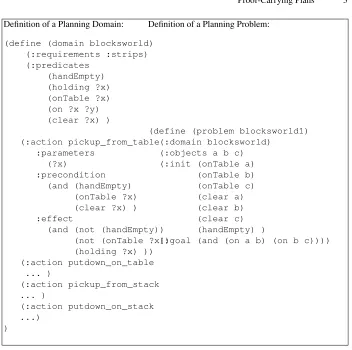
Definition of a Planning Domain: Definition of a Planning Problem: (define (domain blocksworld)
(:requirements :strips) (:predicates
(handEmpty) (holding ?x) (onTable ?x) (on ?x ?y) (clear ?x) )
(:action pickup_from_table :parameters
(?x)
:precondition (and (handEmpty)
(onTable ?x) (clear ?x) ) :effect
(and (not (handEmpty)) (not (onTable ?x)) (holding ?x) )) (:action putdown_on_table
... )
(:action pickup_from_stack ... )
(:action putdown_on_stack ...)
)
(define (problem blocksworld1) (:domain blocksworld)
(:objects a b c) (:init (onTable a)
(onTable b) (onTable c) (clear a) (clear b) (clear c) (handEmpty) )
[image:3.612.133.485.97.447.2](:goal (and (on a b) (on b c))))
Fig. 1.The Blocksworld: a code snippet defining the planning domain and a planning problem.
Plan1 =
pickup_from_table b; putdown_on_stack b c; pickup_from_table a; putdown_on_stack a b.
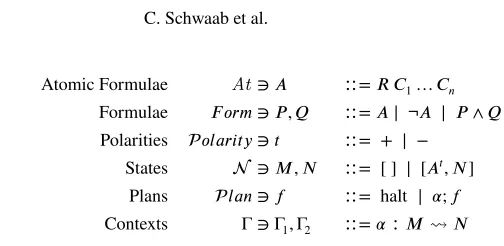
Atomic Formulae At∋ 𝐴 ∶∶= 𝑅 𝐶1… 𝐶𝑛
Formulae 𝐹 𝑜𝑟𝑚 ∋ 𝑃 , 𝑄 ∶∶= 𝐴 ∣ ¬𝐴 ∣ 𝑃 ∧ 𝑄
Polarities 𝒫𝑜𝑙𝑎𝑟𝑖𝑡𝑦 ∋ 𝑡 ∶∶= + ∣ −
States 𝒩 ∋ 𝑀, 𝑁 ∶∶= [ ] ∣ [𝐴𝑡, 𝑁] Plans 𝒫𝑙𝑎𝑛 ∋ 𝑓 ∶∶= halt ∣ 𝛼; 𝑓
[image:4.612.172.424.88.211.2]Contexts Γ ∋ Γ1, Γ2 ∶∶= 𝛼 ∶ 𝑀⇝𝑁
Fig. 2. Definitions of Formulae, States, Plans and Actions, given a set of predicates ℛ = {𝑅, 𝑅1, 𝑅2, ..., 𝑅𝑛}, a set of constants 𝒞 = {𝐶1, 𝐶2, ..., 𝐶𝑘}, and a set of constant actions {𝛼, 𝛼1, … , 𝛼𝑚} ∪ halt.
to ensure that the programs that inhabit the types give us the actual executable plans in the PDDL sense, rather than some arbitrary proof-terms. In this paper, we therefore develop two parallel narratives. The first sets up the general method in mathematical notation independently of the concrete implementation. The second illustrates the im-portant engineering aspect of this work, with reference to the intricacies of the Agda encoding that we give in [17]. The two parallel story lines merge when we come to the main result of this paper: the formal proof of soundness of the proof terms that imple-ment the plans. We state this in standard mathematical notation, but delegate the proof checking to Agda. In time, we envisage that our Agda prototype will become a fully fledged program for generation of executable code from planners, while maintaining the guarantees of soundness of the generated code relative to the plan specification.
3 Planning Problems as Types
In their development of the STRIPS planner, Fikes and Nilsson presented an inference system for planning languages that is based on the notion of states, or possibleworlds. The worlds are sets of atomic formulae, that interpret complex formula of the planning domain. Operators that are defined on the worlds interpret planning actions, and rewrite the worlds by adding and deleting the atomic formulae. The inference algorithm thus starts in an initial world and ends in a goal world by the repeated application of the operators. The system is sound in the sense that the resultant world model satisfies the goal. We now provide a show how to work with STRIPS predicates directly in a type-system, yielding proof obligations that will be fulfilled by plan execution.
3.1 Formal Language and its Declarative Semantics
module𝑃 𝐶𝑃 𝑙𝑎𝑛𝑠 {𝑅∶𝑆𝑒𝑡}
{𝑖𝑠𝐷𝐸∶𝐼𝑠𝐷𝑒𝑐𝐸𝑞𝑢𝑖𝑣𝑎𝑙𝑒𝑛𝑐𝑒
{𝐴 =𝑅} (_≡_) } where
data𝐹 𝑜𝑟𝑚∶𝑆𝑒𝑡where
_∧_∶𝐹 𝑜𝑟𝑚→𝐹 𝑜𝑟𝑚→𝐹 𝑜𝑟𝑚
¬_∶𝑅→𝐹 𝑜𝑟𝑚
𝑎𝑡𝑜𝑚∶𝑅→𝐹 𝑜𝑟𝑚
module𝐵𝑙𝑜𝑐𝑘𝑠𝑤𝑜𝑟𝑙𝑑where
data𝐶∶𝑆𝑒𝑡where 𝑎 𝑏 𝑐∶𝐶 data𝑅∶𝑆𝑒𝑡where
ℎ𝑎𝑛𝑑𝐸𝑚𝑝𝑡𝑦∶𝑅
𝑜𝑛𝑇 𝑎𝑏𝑙𝑒 𝑐𝑙𝑒𝑎𝑟 ℎ𝑜𝑙𝑑𝑖𝑛𝑔∶𝐶→𝑅 𝑜𝑛∶𝐶→𝐶→𝑅
open import𝑃 𝐶𝑃 𝑙𝑎𝑛𝑠{𝑅} {𝑖𝑠𝐷𝐸} Fig. 3.Left: Module𝑃 𝐶𝑃 𝑙𝑎𝑛𝑠giving a general-case Agda definition of a formula, following the set-up of Figure 2. Right: Module𝐵𝑙𝑜𝑐𝑘𝑠𝑤𝑜𝑟𝑙𝑑giving specification of the particular Blocksworld domain from Figure 1: listing its constants and predicates.
𝑊 𝑜𝑟𝑙𝑑∶𝑆𝑒𝑡
𝑊 𝑜𝑟𝑙𝑑=𝐿𝑖𝑠𝑡𝑅
data𝑃 𝑜𝑙𝑎𝑟𝑖𝑡𝑦∶𝑆𝑒𝑡where
+ −∶𝑃 𝑜𝑙𝑎𝑟𝑖𝑡𝑦
𝑛𝑒𝑔∶𝑃 𝑜𝑙𝑎𝑟𝑖𝑡𝑦→𝑃 𝑜𝑙𝑎𝑟𝑖𝑡𝑦
𝑛𝑒𝑔+=−
𝑛𝑒𝑔−=+
Fig. 4.Agda definitions of worlds as lists of atomic formulae, polarities. (Module𝑃 𝐶𝑃 𝑙𝑎𝑛𝑠)
closed world assumption[15], and ensure the decidability of set membership on possi-ble worlds. The latter restriction means that disjunction is not definapossi-ble in our language. In PDDL, two key restrictions apply to the use of disjunction. Firstly, all formulae are pre-compiled into disjunctive normal form. Secondly, no “actions” can have disjunc-tive “effects”, i.e. they cannot give rise to disjuncdisjunc-tive post-conditions. Thus, our second restriction actually adheres to the practice of PDDL plan specification and search. Example 1. Given the syntax of Section 2,handEmpty∧ ¬onTable ais a formula. The inductive definitions of Figure 2 are given as data type definitions in our Agda implementation (Figure 3). We provide a generic Agda module,𝑃 𝐶𝑃 𝑙𝑎𝑛𝑠, that is para-metric in predicates and actions. For each planning problem, the set of predicatesℛ may then be defined concretely, as in the𝐵𝑙𝑜𝑐𝑘𝑠𝑤𝑜𝑟𝑙𝑑module. Propositional equality on atomic formulae must be shown to be decidable for the particular planning problem. As we will show later, this property is needed in order to manipulate world represen-tation. Since our implementation of the𝑃 𝐶𝑃 𝑙𝑎𝑛𝑠module takes a generic approach, a proof that propositional equality_≡_forℛis decidable must also be provided as a module parameter. This explains the declaration of the main module:
module𝑃 𝐶𝑃 𝑙𝑎𝑛𝑠{ℛ∶𝑆𝑒𝑡} {𝑖𝑠𝐷𝐸∶𝐼𝑠𝐷𝑒𝑐𝐸𝑞𝑢𝑖𝑣𝑎𝑙𝑒𝑛𝑐𝑒{𝐴 =ℛ} (_≡_) }
When we instantiateℛwith a finite set of predicates for each planning problem, we need to instantiate𝑖𝑠𝐷𝐸with a proof that propositional equality for this particular problem is indeed decidable ([17] contains examples of such “boilerplate” proofs).
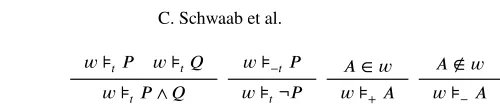
𝑤 ⊧𝑡𝑃 𝑤 ⊧𝑡𝑄
𝑤 ⊧𝑡𝑃 ∧ 𝑄
𝑤 ⊧−𝑡𝑃
𝑤 ⊧𝑡¬𝑃
𝐴 ∈ 𝑤 𝑤 ⊧+𝐴
𝐴 ∉ 𝑤
[image:6.612.165.415.88.143.2]𝑤 ⊧−𝐴
Fig. 5.Declarative interpretation of formulae. We define−𝑡by taking−+ = −and− − = +.
data_⊨[_]_∶𝑊 𝑜𝑟𝑙𝑑→𝑃 𝑜𝑙𝑎𝑟𝑖𝑡𝑦→𝐹 𝑜𝑟𝑚→𝑆𝑒𝑡where
𝑓 𝑙𝑖𝑝∶ ∀{𝑤 𝑡 𝐴} →𝑤⊨[ 𝑛𝑒𝑔𝑡](𝑎𝑡𝑜𝑚𝐴) →𝑤⊨[𝑡]¬𝐴
𝑏𝑜𝑡ℎ∶ ∀{𝑤 𝑡 𝑃 𝑄} →𝑤⊨[𝑡]𝑃→𝑤⊨[𝑡]𝑄→𝑤⊨[𝑡]𝑃∧𝑄
𝑠𝑜𝑚𝑒𝑤ℎ𝑒𝑟𝑒∶ ∀{𝑤 𝑎} →𝑎∈𝑤→𝑤⊨[+]𝑎𝑡𝑜𝑚𝑎
𝑛𝑜𝑤ℎ𝑒𝑟𝑒∶ ∀{𝑤 𝑎} →𝑎∉𝑤→𝑤⊨[−]𝑎𝑡𝑜𝑚𝑎
Fig. 6.Agda definition of the entailment relation given in Figure 5. (Module𝑃 𝐶𝑃 𝑙𝑎𝑛𝑠)
take advantage of the extensive library of list operations, and so define worlds as lists of atomic formulae, as shown in Figure 4. Figure 7 gives an Agda definition of the entailment relation.
Example 2. Given the world𝑤1 = {handEmpty}, we have 𝑤1 ⊧+ handEmpty∧¬ onTable a.
It might be expected that the rule for conjunction with negative polarity to be given by two additional rules: 𝑤 ⊧−𝑃
𝑤 ⊧−𝑃 ∧ 𝑄 and
𝑤 ⊧−𝑄
𝑤 ⊧−𝑃 ∧ 𝑄 . However, our current rule is sound given the syntax restrictions, and it simplifies our reasoning on decidability of normalisation, which we define next.
3.2 Operational Semantics, States and Types
Matching the declarative-style semantics of Figure 5, we can define an operational se-mantics, given by a normalisation function that acts directly on formulae and computes lists of atomic formulae with polarities. Astateis defined as a list of atomic formulae with polarities, as in Figure 2. By a small abuse of notation, we will use∈to denote list membership, as well as set membership. The function↓𝑡normalisesa formula to a state:
(𝑃 ∧ 𝑄) ↓𝑡𝑁 = 𝑄 ↓𝑡𝑃 ↓𝑡 𝑁 ¬𝐴 ↓𝑡𝑁 = 𝐴 ↓−𝑡𝑁
𝐴 ↓𝑡𝑁 = [𝐴𝑡, 𝑁] We write𝑃 ↓𝑡to mean𝑃 ↓𝑡[ ].
Example 3. Continuing with the previous examples, we have: (handEmpty∧ ¬onTable a) ↓+= [handEmpty+,onTable a−].
𝑁𝑃 𝑟𝑒𝑑∶𝑆𝑒𝑡
𝑁𝑃 𝑟𝑒𝑑=𝐿𝑖𝑠𝑡(𝑃 𝑜𝑙𝑎𝑟𝑖𝑡𝑦 ×𝑅)
_↓[_]_∶𝐹 𝑜𝑟𝑚→𝑃 𝑜𝑙𝑎𝑟𝑖𝑡𝑦→𝑁𝑃 𝑟𝑒𝑑→𝑁𝑃 𝑟𝑒𝑑
𝑃∧𝑄↓[𝑡]𝑁=𝑄↓[𝑡]𝑃 ↓[𝑡]𝑁
¬𝑥↓[𝑡]𝑁= (𝑛𝑒𝑔𝑡,𝑥)∷𝑁
𝑎𝑡𝑜𝑚𝑥↓[𝑡]𝑁= (𝑡,𝑥)∷𝑁
Fig. 7.Agda definition of the normalisation function. (Module𝑃 𝐶𝑃 𝑙𝑎𝑛𝑠)
normalisation function for minus could be amended, to allow for non-determinism. Nor-malisation is sound relative to the declarative interpretation of formulae. Given a state 𝑁, define awell-formed world𝑤𝑁 to contain all𝐴such that𝐴+∈ 𝑁 and contain no 𝐴’s such that𝐴−∉ 𝑁. Generally𝑤𝑁is not uniquely defined, and we use the notation {𝑤𝑁}to refer to the (necessarily finite) set of all𝑤𝑁. We then have the result: Theorem 1 (Soundness and completeness of normalisation).Given a formula𝑃and a world𝑤, it holds that𝑤 ⊧𝑡𝑃 iff𝑤 ∈ {𝑤𝑃 ↓𝑡}.
Proof. (⇒)is proven by induction on the derivation of𝑤 ⊧𝑡𝑃.(⇐)follows by induction on the shape of𝑃, cf. the attached Agda file [17] for the fully formalised proof. Example 4. If 𝑁 = (handEmpty∧ ¬onTable a) ↓+, then 𝑤𝑁 may be given by e.g. 𝑤1 ={handEmpty}, or𝑤2 = {handEmpty,onTable b}, or any other world containing handEmptybut notonTable a. The given formula will be satisfied by any such𝑤𝑁. Theorem 1 will allow us to work with states at the type level, while keeping the link to the standard PDDL formula syntax and declarative semantics.
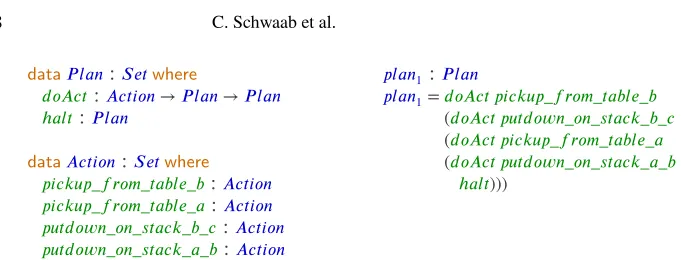
We finally define actions and plans. Given a halting statehalt, and a finite set of con-stantactions{𝛼, 𝛼1, … , 𝛼𝑚}, we defineplansinductively as sequences of action names ending withhalt, cf. Figure 2. Once again, we show an instantiated version of the Agda definition of actions in Figure 8, with actions specified as per the Blocksworld prob-lem. In the Agda prototype [17], we first develop the code for an abstract set𝐴𝑐𝑡𝑖𝑜𝑛, and then instantiate it on the concrete examples. Figure 8 also shows the Agda function 𝑝𝑙𝑎𝑛1 that encodesPlan1given in Section 2 in PDDL syntax. Keeping in line with Section 2, aplanning domain (or a context)Γis a set of actions with effects, of the form 𝛼 ∶ 𝑁 ⇝𝑀, where𝛼is a constant action, and𝑁, 𝑀are states (see Figure 2). Figure 9 shows an Agda implementation of both the general definition of a contextΓand one concreteΓ1that corresponds to the PDDL code snippet of Figure 1.
We now move on to our main goal: to realise the Curry-Howard intuition and define a framework in which plans will inhabit normalised formulae seen as types. We wish to show that, proving that a certain (possibly composite) plan𝑓 satisfies pre- and post-conditions given by the formulae𝑃 and𝑄will be equivalent to typing the judgement
Γ ⊢ 𝑓 ∶ 𝑃 ↓+⇝𝑄 ↓+
data𝑃 𝑙𝑎𝑛∶𝑆𝑒𝑡where
𝑑𝑜𝐴𝑐𝑡∶𝐴𝑐𝑡𝑖𝑜𝑛→𝑃 𝑙𝑎𝑛→𝑃 𝑙𝑎𝑛
ℎ𝑎𝑙𝑡∶𝑃 𝑙𝑎𝑛
data𝐴𝑐𝑡𝑖𝑜𝑛∶𝑆𝑒𝑡where
𝑝𝑖𝑐𝑘𝑢𝑝_𝑓 𝑟𝑜𝑚_𝑡𝑎𝑏𝑙𝑒_𝑏∶𝐴𝑐𝑡𝑖𝑜𝑛 𝑝𝑖𝑐𝑘𝑢𝑝_𝑓 𝑟𝑜𝑚_𝑡𝑎𝑏𝑙𝑒_𝑎∶𝐴𝑐𝑡𝑖𝑜𝑛 𝑝𝑢𝑡𝑑𝑜𝑤𝑛_𝑜𝑛_𝑠𝑡𝑎𝑐𝑘_𝑏_𝑐∶𝐴𝑐𝑡𝑖𝑜𝑛 𝑝𝑢𝑡𝑑𝑜𝑤𝑛_𝑜𝑛_𝑠𝑡𝑎𝑐𝑘_𝑎_𝑏∶𝐴𝑐𝑡𝑖𝑜𝑛
𝑝𝑙𝑎𝑛1∶𝑃 𝑙𝑎𝑛
𝑝𝑙𝑎𝑛1=𝑑𝑜𝐴𝑐𝑡 𝑝𝑖𝑐𝑘𝑢𝑝_𝑓 𝑟𝑜𝑚_𝑡𝑎𝑏𝑙𝑒_𝑏 (𝑑𝑜𝐴𝑐𝑡 𝑝𝑢𝑡𝑑𝑜𝑤𝑛_𝑜𝑛_𝑠𝑡𝑎𝑐𝑘_𝑏_𝑐 (𝑑𝑜𝐴𝑐𝑡 𝑝𝑖𝑐𝑘𝑢𝑝_𝑓 𝑟𝑜𝑚_𝑡𝑎𝑏𝑙𝑒_𝑎 (𝑑𝑜𝐴𝑐𝑡 𝑝𝑢𝑡𝑑𝑜𝑤𝑛_𝑜𝑛_𝑠𝑡𝑎𝑐𝑘_𝑎_𝑏
ℎ𝑎𝑙𝑡)))
Fig. 8.Agda abstract definition of a𝑃 𝑙𝑎𝑛according to Figure 2, in module𝑃 𝐶𝑃 𝑙𝑎𝑛𝑠. A concrete instantiation of the set of actions, a concrete plan𝑝𝑙𝑎𝑛1in module𝐵𝑙𝑜𝑐𝑘𝑠𝑤𝑜𝑟𝑙𝑑.
Γ∶𝑆𝑒𝑡
Γ=𝐴𝑐𝑡𝑖𝑜𝑛→𝑁𝑃 𝑟𝑒𝑑 × 𝑁𝑃 𝑟𝑒𝑑
Γ1∶Γ
Γ1𝑝𝑖𝑐𝑘𝑢𝑝_𝑓 𝑟𝑜𝑚_𝑡𝑎𝑏𝑙𝑒_𝑏=
(𝑎𝑡𝑜𝑚 ℎ𝑎𝑛𝑑𝐸𝑚𝑝𝑡𝑦 ∧ 𝑎𝑡𝑜𝑚(𝑜𝑛𝑇 𝑎𝑏𝑙𝑒 𝑏)∧ 𝑎𝑡𝑜𝑚(𝑐𝑙𝑒𝑎𝑟 𝑏))↓+,
((¬ ℎ𝑎𝑛𝑑𝐸𝑚𝑝𝑡𝑦 ∧ ¬(𝑜𝑛𝑇 𝑎𝑏𝑙𝑒 𝑏)∧ 𝑎𝑡𝑜𝑚(ℎ𝑜𝑙𝑑𝑖𝑛𝑔 𝑏))↓+) Γ1𝑝𝑖𝑐𝑘𝑢𝑝_𝑓 𝑟𝑜𝑚_𝑡𝑎𝑏𝑙𝑒_𝑎=...
Γ1𝑝𝑢𝑡𝑑𝑜𝑤𝑛_𝑜𝑛_𝑠𝑡𝑎𝑐𝑘_𝑏_𝑐=
(𝑎𝑡𝑜𝑚(ℎ𝑜𝑙𝑑𝑖𝑛𝑔 𝑏)∧ 𝑎𝑡𝑜𝑚(𝑐𝑙𝑒𝑎𝑟 𝑐))↓+,
(¬(ℎ𝑜𝑙𝑑𝑖𝑛𝑔 𝑏)∧ ¬(𝑐𝑙𝑒𝑎𝑟 𝑐)∧ 𝑎𝑡𝑜𝑚(𝑜𝑛 𝑏 𝑐)∧ 𝑎𝑡𝑜𝑚 ℎ𝑎𝑛𝑑𝐸𝑚𝑝𝑡𝑦)↓+
[image:8.612.138.482.86.216.2]Γ1𝑝𝑢𝑡𝑑𝑜𝑤𝑛_𝑜𝑛_𝑠𝑡𝑎𝑐𝑘_𝑎_𝑏=...
Fig. 9.Agda definition of the concrete contextΓ1in module𝐵𝑙𝑜𝑐𝑘𝑠𝑤𝑜𝑟𝑙𝑑.
4 Plans as Proof Terms
4.1 Typing Rules for Planning Problems
A naïve attempt to type plans introduces two problems. First, an action𝑓 ∶ 𝑀 ⇝ 𝑁 should not produce exactly𝑁, but an extension of𝑀by𝑁. For example, picking up 𝑏from the table does not affect the fact that𝑐is still on the table (this is known as the STRIPS assumptionin planning [20]). To solve this problem, we introduce an override operator𝑀 ⊔ 𝑁:
𝑀 ⊔ [ ] = 𝑀
𝑀 ⊔ [𝐴𝑡, 𝑁] = [𝐴𝑡, 𝑀\{𝐴+, 𝐴−}] ⊔ 𝑁
NilSub
[ ]<∶ 𝑁 ASub
𝑁<∶ 𝑀 𝐴𝑡∈ 𝑀
[image:9.612.139.479.85.221.2]𝐴𝑡, 𝑁<∶ 𝑀
Fig. 10.Sub-typing of normalised formulae.
Halt 𝑀
′<∶ 𝑀
Γ ⊢ halt ∶ 𝑀 ⇝𝑀′ Seq
𝑀′ 1 <∶ 𝑀1
(𝛼 ∶ 𝑀′
1 ⇝𝑀2) ∈ Γ Γ ⊢ 𝑓 ∶ 𝑀1⊔ 𝑀2⇝𝑀3
Γ ⊢ 𝛼; 𝑓 ∶ 𝑀1⇝𝑀3
Fig. 11.Well-typing relation for plans.
𝑓 ∶ 𝑀 ⇝𝑁can be typed given some planning domainΓ. A well-typed planΓ ⊢ 𝑓 ∶ 𝑀 ⇝𝑁“transports” an initial state𝑀to a goal state𝑁. The Agda code implements the typing relation as an inductive data type with two constructors,ℎ𝑎𝑙𝑡and𝑠𝑒𝑞, following verbatim Figure 11 (see also the accompanying Agda file). To exemplify these rules, we refer again to the Blocksworld problem with the pre-condition𝑃0=onTable a∧ onTable b∧onTable c∧clear a∧clear b∧clear c∧handEmptyand the post-condition𝑄0=on a b∧on b c. Suppose that the PDDL planner proposesPlan1, as given in Section 2. Let𝑝𝑙𝑎𝑛1be the corresponding version in the precise mathematical notation of Figure 2 (cf. also its Agda version in Figure 8):
plan1=pickup_from_table_b;putdown_on_stack_b_c; pickup_from_table_a;putdown_on_stack_a_b; halt
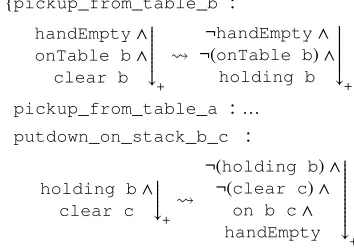
IfΓ1⊢ plan1∶ 𝑃0↓+⇝𝑄0↓+yields a typing derivation by Figure 11, then this typing derivation verifies thatplan1correctly implements the given planning problem in the planning domainΓ1(cf. also Agda code forΓ1in Figure 9). To make our example more readable, we will use our mathematical notation. This gives the following definition of Γ1, corresponding to the Agda code of Figure 9:
Γ1= {pickup_from_table_b ∶
handEmpty∧ onTable b∧
clear b ⏐ ⏐ ⏐ ⏐ ⏐ ⏐ ⏐ ⏐ ⏐ ⏐ ↓+ ⇝
¬handEmpty∧ ¬(onTable b) ∧
holding b ⏐ ⏐ ⏐ ⏐ ⏐ ⏐ ⏐ ⏐ ⏐ ⏐ ↓+
pickup_from_table_a ∶ … putdown_on_stack_b_c ∶
holding b∧ clear c ⏐ ⏐ ⏐ ⏐ ⏐ ⏐ ↓+⇝
¬(holding b) ∧ ¬(clear c) ∧
on b c∧ handEmpty ⏐ ⏐ ⏐ ⏐ ⏐ ⏐ ⏐ ⏐ ⏐ ⏐ ⏐ ⏐ ⏐ ⏐ ⏐ ↓ + putdown_on_stack_a_b∶ …}
[image:9.612.226.403.484.609.2]𝑃0∶𝐹 𝑜𝑟𝑚
𝑃0=𝑎𝑡𝑜𝑚(𝑜𝑛𝑇 𝑎𝑏𝑙𝑒 𝑎)∧ 𝑎𝑡𝑜𝑚(𝑜𝑛𝑇 𝑎𝑏𝑙𝑒 𝑏)∧ 𝑎𝑡𝑜𝑚(𝑜𝑛𝑇 𝑎𝑏𝑙𝑒 𝑐)∧ 𝑎𝑡𝑜𝑚(𝑐𝑙𝑒𝑎𝑟 𝑎)∧ 𝑎𝑡𝑜𝑚(𝑐𝑙𝑒𝑎𝑟 𝑏)∧ 𝑎𝑡𝑜𝑚(𝑐𝑙𝑒𝑎𝑟 𝑐)∧ 𝑎𝑡𝑜𝑚 ℎ𝑎𝑛𝑑𝐸𝑚𝑝𝑡𝑦
𝑄0∶𝐹 𝑜𝑟𝑚
𝑄0=𝑎𝑡𝑜𝑚(𝑜𝑛 𝑎 𝑏)∧ 𝑎𝑡𝑜𝑚(𝑜𝑛 𝑏 𝑐)
𝐷𝑒𝑟𝑖𝑣𝑎𝑡𝑖𝑜𝑛∶Γ1⊢ 𝑝𝑙𝑎𝑛1∶(𝑃0↓+)↝(𝑄0↓+)
𝐷𝑒𝑟𝑖𝑣𝑎𝑡𝑖𝑜𝑛=...
Fig. 12.Agda type-checking the derivation ofΓ1⊢plan1∶ 𝑃0↓+⇝𝑄0↓+. We give the full code
for𝐷𝑒𝑟𝑖𝑣𝑎𝑡𝑖𝑜𝑛in Appendix A or in [17].
pickup_from_table_b. The application of Seq demands that𝑃0 ↓+ is a sub-type of the initial state of the actionpickup_from_table_b inΓ1. A sub-typing deriva-tion provides such a proof, selecting the required piece of evidence from 𝑃0 ↓+, i.e. handEmpty+, (onTable b)+, (clear b)+ <∶ (onTable a)+, (onTable b)+,
(onTable c)+, (clear a)+, (clear b)+, (clear c)+,handEmpty+. We have thus ver-ified that plan1 = pickup_from_table_b; 𝑓′. To complete the proof of well-typedness and compute an action for𝑓′, we must show that the remainder of the plan is typeable. According toSeq, we now have a new state𝑃1= 𝑃0↓+⊔handEmpty−, ( onTable b)−, (holding b)+ = (onTable a)+, (onTable b)−, (onTable c)+, ( clear a)+, ( clear b)+, (clear c)+, ( handEmpty)−, (holding b)+, as well as an obligation to prove 𝑓′ ∶ 𝑃1 ⇝ 𝑄0 ↓+. We can pick the next action from Γ1: putdown_on_stack_b_c. Again 𝑃1 is readily shown to be a sub-type of the pre-conditions of putdown_on_stack_b_c. Continuing in this way for each action in plan1, the final state is
𝑃3=(onTable a)−, (onTable b)−, (onTable c)+, (clear a)+, (clear b)−,
(clear c)−, (on b c)+,handEmpty+, (holding b)−, (on a b)+, (holding a)−. However, this is not the same state as the goal state𝑄0. To resolve such cases, we have the ruleHalt, eliminating all unnecessary evidence from the current state by proof of sub-typing i.e.Γ1⊢ halt ∶ 𝑃3⇝𝑄0. Clearly(on a b)+, (on b c)+<∶ 𝑃3as required. We have thus verified thatΓ1⊢ plan1∶ 𝑃0↓+⇝𝑄0↓+. In Agda, the above derivation will amount to type-checking the function𝐷𝑒𝑟𝑖𝑣𝑎𝑡𝑖𝑜𝑛as shown in Figure 12. If it type-checks, then we know that𝑝𝑙𝑎𝑛1can be soundly executed as a function. Proving this property in general is the subject of the next section.
4.2 Computational Characterisation of Plans: Soundness of Plan Execution
𝐴𝑐𝑡𝑖𝑜𝑛𝐻𝑎𝑛𝑑𝑙𝑒𝑟∶𝑆𝑒𝑡
𝐴𝑐𝑡𝑖𝑜𝑛𝐻𝑎𝑛𝑑𝑙𝑒𝑟=𝐴𝑐𝑡𝑖𝑜𝑛→𝑊 𝑜𝑟𝑙𝑑→𝑊 𝑜𝑟𝑙𝑑
⟦_⟧∶𝑃 𝑙𝑎𝑛→𝐴𝑐𝑡𝑖𝑜𝑛𝐻𝑎𝑛𝑑𝑙𝑒𝑟→𝑊 𝑜𝑟𝑙𝑑→𝑊 𝑜𝑟𝑙𝑑
⟦𝑑𝑜𝐴𝑐𝑡𝛼 𝑓 ⟧𝜎 𝑤=⟦𝑓⟧𝜎(𝜎 𝛼 𝑤)
⟦ℎ𝑎𝑙𝑡⟧𝜎 𝑤=𝑤
𝜎𝛼∶𝑁𝑃 𝑟𝑒𝑑→𝑊 𝑜𝑟𝑙𝑑→𝑊 𝑜𝑟𝑙𝑑
𝜎𝛼[]𝑤=𝑤
𝜎𝛼((+ ,𝑥)∷𝑁)𝑤=𝑥∷𝜎𝛼𝑁 𝑤
𝜎𝛼((− ,𝑥)∷𝑁)𝑤=𝑟𝑒𝑚𝑜𝑣𝑒𝑥(𝜎𝛼𝑁 𝑤)
𝑐𝑎𝑛𝑜𝑛𝑖𝑐𝑎𝑙−𝜎∶Γ→𝐴𝑐𝑡𝑖𝑜𝑛𝐻𝑎𝑛𝑑𝑙𝑒𝑟
𝑐𝑎𝑛𝑜𝑛𝑖𝑐𝑎𝑙−𝜎Γ1𝛼=𝜎𝛼(𝑝𝑟𝑜𝑗2(Γ1𝛼))
Fig. 13.Agda code for an action handler, an evaluation function and a canonical handler.
meaning, i.e. can beevaluated, and that the result of its evaluation is sound. To state this, we need to define anevaluation functionJ.Kthat will interpret actions on worlds. Recall that every state𝑁maps to a world𝑤𝑁. Let us use notation𝜎 for an arbitrary mapping (anaction handler) that maps each action𝛼 ∶ 𝑀 ⇝ 𝑁 to insertions and deletions on the world𝑤𝑀according to𝛼’s action on𝑀. We then define the evaluation functionJK𝜎𝑤thatevaluatesa plan to a world (according to a given world𝑤and action handler𝜎):
JhaltK𝜎 𝑤= 𝑤 J𝛼; 𝑓K𝜎𝑤=J𝑓K𝜎(𝜎 𝛼 𝑤)
We say that an action handler𝜎iswell-formedif, for any𝑤 ∈ {𝑤𝑀},𝑀′<∶ 𝑀 and 𝛼 ∶ 𝑀′⇝𝑁 in Γit follows that(𝜎 𝛼 𝑤) ∈ {𝑤𝑀⊔𝑁}. Figure 13 shows Agda definitions of an action handler and evaluation action.
Canonical Handler.In order to be constructive in our further claims, and to provide a practical solution to the quest for a well-formed handler, we first define acanonical handler for a given context (planning domain). Firstly, we define a function𝜎𝛼 that constructs a world from a state:
𝜎𝛼[ ] 𝑤 = 𝑤
𝜎𝛼[𝐴+, 𝑁′] 𝑤 = 𝜎𝛼𝑁′(𝑤 ∪ {𝐴}) 𝜎𝛼[𝐴−, 𝑁′] 𝑤 = 𝜎𝛼𝑁′(𝑤 ⧵ {𝐴})
Implicit consistency assumption:for every state𝑁, if𝐴𝑡∈ 𝑁then𝐴−𝑡∉ 𝑁. Proposition 1. Given a contextΓ, the canonical action handler𝜎𝛼Γis well-formed. Proof. The proof starts with considering an arbitrary state𝑀with𝑤 ∈ {𝑤𝑀}, an ar-bitrary𝐴𝑡∈ 𝑀, and an arbitrary action𝛼inΓsuch that𝑀′<∶ 𝑀and𝛼 ∶ 𝑀′⇝𝑁. It proceeds by considering two cases, when 𝑡 = + and𝑡 = −, and consequently when 𝐴 ∈ 𝑤 or 𝐴 ∉ 𝑤. In each of these cases, it considers all possible effects of 𝜎𝛼 (i.e. formula deletions and insertions) in the process of constructing the world 𝑤′=𝑐𝑎𝑛𝑜𝑛𝑖𝑐𝑎𝑙−𝜎𝛼 𝑤. The attached Agda file gives the full proof. It uses the implicit consistency assumption to eliminate the cases when states are inconsistent and hence when more than one choice for deletion/insertion are possible.
The next two theorems show that executing a well-typed plan𝑓 by the evaluation functionJ𝑓K𝜎𝑤issound, for any well-formed handler𝜎.
Theorem 2 (Soundness of evaluation for normalized formulae).SupposeΓ ⊢ 𝑓 ∶ 𝑀 ⇝ 𝑁. Then for any 𝑤 ∈ {𝑤𝑀}, and any well-formed handler𝜎, it follows that J𝑓K𝜎𝑤∈ {𝑤𝑁}.
Proof. The proof proceeds by structural induction on the typing derivationΓ ⊢ 𝑓 ∶ 𝑀 ⇝𝑁.
Case 1 (Halt).By assumption𝑤 ∈ {𝑤𝑀}and thus because𝑁 <∶ 𝑀, it follows𝑤 ∈ {𝑤𝑁}. SinceJhaltK𝜎𝑤= 𝑤, we getJhaltK𝜎𝑤∈ {𝑤𝑁}as required.
Case 2 (Seq).Note that𝑓 = 𝛼; 𝑓′and therefore 𝛼 ∶ 𝑀′ ⇝ 𝑀2 is inΓandΓ ⊢ 𝑓′ ∶ 𝑀 ⊔ 𝑀2 ⇝ 𝑁 by inversion on Γ ⊢ 𝛼; 𝑓′ ∶ 𝑀 ⇝ 𝑁. Then by induction every𝑤′∈ {𝑤𝑀⊔𝑀2}gives(J𝑓K𝜎𝑤′) ∈ {𝑤𝑁}for any well-formed𝜎. However, by the well-formedness of𝜎and because𝑤 ∈ {𝑤𝑀}, we have(𝜎 𝛼 𝑤) ∈ {𝑤𝑀⊔𝑀2}. Thus J𝑓′K𝜎(𝜎 𝛼 𝑤)∈ {𝑤𝑁}and thereforeJ𝑓K𝜎𝑤∈ {𝑤𝑁}.
Theorem 3 (Soundness of evaluation).SupposeΓ ⊢ 𝑓 ∶ 𝑃 ↓+⇝𝑄 ↓+then for any 𝑤such that𝑤 ⊧+𝑃, and any well-formed𝜎it followsJ𝑓K𝜎𝑤⊧+𝑄.
Proof. By assumption𝑤 ⊧+𝑃 and by the completeness of normalisation (Theorem 1), we have𝑤 ∈ {𝑤𝑃 ↓+}. Then from Theorem 2, we haveJ𝑓K𝜎𝑤 ∈ {𝑤𝑄↓+}. Thus by the soundness of normalisation (Theorem 1), obtainJ𝑓K𝜎𝑤⊧+𝑄.
Thus the derivation of a type for a plan𝑓induces a proof that the execution of a plan in world𝑤is correct. Although neither of the above theorems depends on the implicit con-sistency assumption for its proofs, the existence of a well-formed and canonical handler is predicated upon the consistency assumption. Our Agda implementation of a canonical handler (cf. Figure 13) allows us to fully harness the computational properties of plans. For the Blocksworld example, we can directly evaluateJplan1K𝜎𝑤by plugging in:
– and in place of𝜎– the canonical handler forΓ1. (Recall thatΓ1is the context that defined the given planning domain in the previous section.)
In Agda, we simply evaluate the term:
⟦ 𝑝𝑙𝑎𝑛1⟧(𝑐𝑎𝑛𝑜𝑛𝑖𝑐𝑎𝑙−𝜎 Γ1) (𝜎𝛼(𝑃0↓[+][])[])
Evaluation of this term results, just as we manually computed in the last section, in a world𝑤′= {handEmpty,on a b,on b c,clear a,onTable c}(in Agda syntax: ℎ𝑎𝑛𝑑𝐸𝑚𝑝𝑡𝑦 ∷(𝑜𝑛 𝑎 𝑏)∷(𝑜𝑛 𝑏 𝑐)∷(𝑐𝑙𝑒𝑎𝑟 𝑎)∷(𝑜𝑛𝑇 𝑎𝑏𝑙𝑒 𝑐)∷ []). That is, the world that corresponds to the state𝑃3of the previous section. Observe that𝑤′= 𝜎𝛼𝑃3∅.
5 Discussion, Conclusions, and Future Work
We have given a proof of concept formalisation of a subset of PDDL plans in type the-ory. In line with the Curry-Howard approach to first-order logic, we formulated an infer-ence system that treats planning domains as types, and generated plans as functions that inhabit these types. Type-checking then ensures the soundness of these executable func-tions relative to the specificafunc-tions given as types. This paper does not cover the whole PDDL syntax, nor does it implement the search and decision procedures of a usual auto-mated planner e.g. theStanford Research Institute Problem SolverSTRIPS [4]. Rather, our contribution is in setting up the original design of a method of Curry-Howard ap-proach to AI planning languages in general, as well as showing the feasibility of its successful implementation in a dependently typed language, such as Agda. This dual purpose has determined our style of presentation, in which the formal method has been given in parallel with, but independently from, the Agda code.
Further experiments with plans: In the accompanying implementation [17], we provide a second fully implemented example of a PDDL domain and plan checking in Agda: for aLogisticplanning problem. The problem consists of finding the best route (airplanes, tracks, cities of call) to deliver a given parcel to a given office. The experiment showed that, once the main Agda implementation is set up, instantaiting it with various problems only takes a routine boilerplate code (such as e.g. proofs of decidability of equality on predicates). Generation of this boilerplate code can in future be fully automated using code reflection. Throughout our implementation, we have been working with plans gen-erated by an on-line PDDL editorhttp://editor.planning.domains/. In the future, a parser can be added to convert PDDL syntax directly into Agda.
assumption, we lose the existence of a well-formed and canonical handler and thus the ability to evaluate the plans. This situation is of course illustrative of the rigour and transparency that a constructive approach brings to verification. In our case, it dictates that any practical deployment of the presented prototype needs to enforce the consis-tency assumption. This can be done by either embedding additional state consisconsis-tency checks or by implementing states as partial functions from formulae to Booleans.
Related work: Verification of AI languages and applications is an active research field. In planning languages, two major trends exist. Firstly, PDDL is used to verify au-tonomous systems and applications, see e.g. [14]; and it has been successfully integrated within other similar languages, such as GOLOG [10], with the purpose of verifying plans written in the situation calculus [1,21]. Secondly, planning domains have been verified using model checkers [9], other automated provers such as Event-B [5], or planning support tools such as VAL [8]. The method that we have presented is complementary to these two trends. Its main difference lies in taking the perspective ofintrinsic, rather than externalverification. That is, the correctness of the generated plans is verified not by an external tool, such as a model checker, but is performed intrinsically within the code that implements the plans. At the same time, the code that implements the plans is insepara-ble from the language in which planning domains are specified. To our knowledge, this is the first attempt to bring these benefits of the Curry-Howard approach to automated planning languages. Provisioning types for plans not only equips planners with certifi-cates of correctness for inspection, but also provides a direct link to an implementation’s type theory. This provides a convenient path to compiler verification.
Current limitations and possible improvements: There are a number of obvious im-provements that could be made to our current work.
First-order planning domains and first-order types:Although the technical devel-opment of the code that we have presented takes full advantage of Agda’s dependent types, the types that represent the predicates and formulae of the planning problems are given by simple types. This is because we propositionalised the planning domains. We however hope to extend this initial framework to the full first-order syntax of PDDL. This development will also involve the following extensions.
Beyond consistency assumptions; constraints:We have discussed the implicit con-sistency assumption that our approach imposes. More generally, we note that PDDL lacks any general method of handling consistency as well as similar but more complex constraints and invariants, such as, for example, constraints saying thathandEmptyand holding xare mutually exclusive. This is a complex problem, but one for which we anticipate that our dependently-typed setting will soon provide some useful solutions.
References
1. Claßen, J., Eyerich, P., Lakemeyer, G., Nebel, B.: Towards an integration of golog and plan-ning. In: Veloso, M.M. (ed.) IJCAI 2007, Proceedings of the 20th International Joint Confer-ence on Artificial IntelligConfer-ence, Hyderabad, India, January 6-12, 2007. pp. 1846–1851 (2007) 2. De Moura, L., Bjørner, N.: Z3: An efficient SMT solver. In: Proceedings of the Theory and Practice of Software, 14th International Conference on Tools and Algorithms for the Con-struction and Analysis of Systems. pp. 337–340. TACAS’08/ETAPS’08, Springer-Verlag, Berlin, Heidelberg (2008)
3. Dutertre, B., De Moura, L.: The Yices SMT solver. Tech. rep. (8 2006), tool paper at http://yices.csl.sri.com/tool-paper.pdf
4. Fikes, R., Nilsson, N.J.: STRIPS: A new approach to the application of theorem proving to problem solving. Artificial Intelligence2(3/4), 189–208 (1971)
5. Fourati, F., Bhiri, M.T., Robbana, R.: Verification and validation of PDDL descriptions using Event-B formal method. In: 2016 5th International Conference on Multimedia Computing and Systems (ICMCS). pp. 770–776 (Sept 2016)
6. Fu, P., Komendantskaya, E.: Operational semantics of resolution and productivity in horn clause logic. Formal Asp. Comput.29(3), 453–474 (2017)
7. Fu, P., Komendantskaya, E., Schrijvers, T., Pond, A.: Proof relevant corecursive resolution. In: Kiselyov, O., King, A. (eds.) Functional and Logic Programming - 13th International Symposium, FLOPS 2016, Kochi, Japan, March 4-6, 2016, Proceedings. Lecture Notes in Computer Science, vol. 9613, pp. 126–143. Springer (2016)
8. Howey, R., Long, D., Fox, M.: VAL: Automatic plan validation, continuous effects and mixed initiative planning using PDDL. In: 16th IEEE International Conference on Tools with Arti-ficial Intelligence. pp. 294–301 (2004)
9. Khatib, L., Muscettola, N., Havelund, K.: Verification of plan models using UPPAAL. In: Rash, J.L., Rouff, C.A., Truszkowski, W., Gordon, D.F., Hinchey, M.G. (eds.) Formal Ap-proaches to Agent-Based Systems, First International Workshop, FAABS 2000 Greenbelt, MD, USA, April 5-7, 2000, Revised Papers. Lecture Notes in Computer Science, vol. 1871, pp. 114–122. Springer (2000)
10. Levesque, H.J., Reiter, R., Lespérance, Y., Lin, F., Scherl, R.B.: GOLOG: A logic program-ming language for dynamic domains. The Journal of Logic Programprogram-ming31(1), 59–83 (1997) 11. McDermott, D., Ghallab, M., Howe, A., Knoblock, C., Ram, A., Veloso, M., Weld, D., Wilkins, D.: PDDL – The Planning Domain Definition Language (Version 1. 2). Technical Report CVC TR-98-003/DCS TR-1165, Yale Center for Computational Vision and Control (1998)
12. Necula, G.C.: Proof-carrying code. In: POPL. pp. 106–119 (1997)
13. Ong, L.: Higher-order model checking: An overview. In: 30th Annual ACM/IEEE Sympo-sium on Logic in Computer Science, LICS 2015, Kyoto, Japan, July 6-10, 2015. pp. 1–15 (2015)
14. Raimondi, F., Pecheur, C., Brat, G.: PDVer, a tool to verify PDDL planning domains. In: ICAPS’09 Workshop on Verification and Validation of Planning and Scheduling Systems, September 20, 2009, Thessaloniki, Greece (2009)
15. Reiter, R.: On closed world data bases. In: Gallaire, H., Minker, J. (eds.) Logic and Data Bases, pp. 55–76. Plenum Press, New York (1978)
16. Schubert, A., Urzyczyn, P.: Answer set programming in intuitionistic logic. Indagationes Mathematicae29(1), 276 – 292 (2018), l.E.J. Brouwer, fifty years later
18. Sorensen, M.H., Urzyczyn, P.: Lectures on the Curry-Howard Isomorphism, Studies in Logic, vol. 149 (2006)
19. Wadler, P.: Propositions as types. Commun. ACM58(12), 75–84 (2015)
20. Waldinger, R.J.: Achieving several goals simultaneously. Machine Intelligence8(1977) 21. Zarrieß, B., Claßen, J.: Decidable verification of GOLOG programs over non-local effect
A The full code for Derivation of Figure 12
𝑃0∶𝐹 𝑜𝑟𝑚
𝑃0=𝑎𝑡𝑜𝑚(𝑜𝑛𝑇 𝑎𝑏𝑙𝑒 𝑎)∧ 𝑎𝑡𝑜𝑚(𝑜𝑛𝑇 𝑎𝑏𝑙𝑒 𝑏)∧ 𝑎𝑡𝑜𝑚(𝑜𝑛𝑇 𝑎𝑏𝑙𝑒 𝑐)∧
𝑎𝑡𝑜𝑚(𝑐𝑙𝑒𝑎𝑟 𝑎)∧ 𝑎𝑡𝑜𝑚(𝑐𝑙𝑒𝑎𝑟 𝑏)∧ 𝑎𝑡𝑜𝑚(𝑐𝑙𝑒𝑎𝑟 𝑐)∧ 𝑎𝑡𝑜𝑚 ℎ𝑎𝑛𝑑𝐸𝑚𝑝𝑡𝑦
𝑄0∶𝐹 𝑜𝑟𝑚
𝑄0=𝑎𝑡𝑜𝑚(𝑜𝑛 𝑎 𝑏)∧ 𝑎𝑡𝑜𝑚(𝑜𝑛 𝑏 𝑐)
{- Γ₁ ⊢ plan₁∶ P₀↓₊↝ Q₀↓₊ -} 𝐷𝑒𝑟𝑖𝑣𝑎𝑡𝑖𝑜𝑛∶Γ1⊢ 𝑝𝑙𝑎𝑛1∶(𝑃0↓+)↝(𝑄0↓+) 𝐷𝑒𝑟𝑖𝑣𝑎𝑡𝑖𝑜𝑛=
𝑠𝑒𝑞(𝑎𝑡𝑜𝑚<∶(𝑡ℎ𝑒𝑟𝑒(𝑡ℎ𝑒𝑟𝑒(ℎ𝑒𝑟𝑒 𝑟𝑒𝑓 𝑙)))
(𝑎𝑡𝑜𝑚<∶(𝑡ℎ𝑒𝑟𝑒(𝑡ℎ𝑒𝑟𝑒(𝑡ℎ𝑒𝑟𝑒(𝑡ℎ𝑒𝑟𝑒(𝑡ℎ𝑒𝑟𝑒(ℎ𝑒𝑟𝑒 𝑟𝑒𝑓 𝑙))))))
(𝑎𝑡𝑜𝑚<∶(ℎ𝑒𝑟𝑒 𝑟𝑒𝑓 𝑙)
([]<∶((+ , ℎ𝑎𝑛𝑑𝐸𝑚𝑝𝑡𝑦)∷
(+ , 𝑐𝑙𝑒𝑎𝑟 𝑐)∷
(+ , 𝑐𝑙𝑒𝑎𝑟 𝑏)∷
(+ , 𝑐𝑙𝑒𝑎𝑟 𝑎)∷
(+ , 𝑜𝑛𝑇 𝑎𝑏𝑙𝑒 𝑐)∷(+ , 𝑜𝑛𝑇 𝑎𝑏𝑙𝑒 𝑏)∷(+ , 𝑜𝑛𝑇 𝑎𝑏𝑙𝑒 𝑎)∷ [])))))
𝑟𝑒𝑓 𝑙
(𝑠𝑒𝑞(𝑎𝑡𝑜𝑚<∶(𝑡ℎ𝑒𝑟𝑒(𝑡ℎ𝑒𝑟𝑒(𝑡ℎ𝑒𝑟𝑒(ℎ𝑒𝑟𝑒 𝑟𝑒𝑓 𝑙))))
(𝑎𝑡𝑜𝑚<∶(ℎ𝑒𝑟𝑒 𝑟𝑒𝑓 𝑙)
([]<∶((+ , ℎ𝑜𝑙𝑑𝑖𝑛𝑔 𝑏)∷
(, 𝑜𝑛𝑇 𝑎𝑏𝑙𝑒 𝑏)∷ (, ℎ𝑎𝑛𝑑𝐸𝑚𝑝𝑡𝑦)∷
(+ , 𝑐𝑙𝑒𝑎𝑟 𝑐)∷
(+ , 𝑐𝑙𝑒𝑎𝑟 𝑏)∷
(+ , 𝑐𝑙𝑒𝑎𝑟 𝑎)∷(+ , 𝑜𝑛𝑇 𝑎𝑏𝑙𝑒 𝑐)∷(+ , 𝑜𝑛𝑇 𝑎𝑏𝑙𝑒 𝑎)∷ []))))
𝑟𝑒𝑓 𝑙
(𝑠𝑒𝑞(𝑎𝑡𝑜𝑚<∶(𝑡ℎ𝑒𝑟𝑒(𝑡ℎ𝑒𝑟𝑒(𝑡ℎ𝑒𝑟𝑒(𝑡ℎ𝑒𝑟𝑒(𝑡ℎ𝑒𝑟𝑒(𝑡ℎ𝑒𝑟𝑒(ℎ𝑒𝑟𝑒 𝑟𝑒𝑓 𝑙)))))))
(𝑎𝑡𝑜𝑚<∶(𝑡ℎ𝑒𝑟𝑒(𝑡ℎ𝑒𝑟𝑒(𝑡ℎ𝑒𝑟𝑒(𝑡ℎ𝑒𝑟𝑒(𝑡ℎ𝑒𝑟𝑒(𝑡ℎ𝑒𝑟𝑒(𝑡ℎ𝑒𝑟𝑒(𝑡ℎ𝑒𝑟𝑒(ℎ𝑒𝑟𝑒 𝑟𝑒𝑓 𝑙)))))))))
(𝑎𝑡𝑜𝑚<∶(ℎ𝑒𝑟𝑒 𝑟𝑒𝑓 𝑙)
([]<∶((+ , ℎ𝑎𝑛𝑑𝐸𝑚𝑝𝑡𝑦)∷
(+ , 𝑜𝑛 𝑏 𝑐)∷
(, 𝑐𝑙𝑒𝑎𝑟 𝑐)∷ (, ℎ𝑜𝑙𝑑𝑖𝑛𝑔 𝑏)∷ (, 𝑜𝑛𝑇 𝑎𝑏𝑙𝑒 𝑏)∷
(+ , 𝑐𝑙𝑒𝑎𝑟 𝑏)∷
(+ , 𝑐𝑙𝑒𝑎𝑟 𝑎)∷(+ , 𝑜𝑛𝑇 𝑎𝑏𝑙𝑒 𝑐)∷(+ , 𝑜𝑛𝑇 𝑎𝑏𝑙𝑒 𝑎)∷ [])))))
𝑟𝑒𝑓 𝑙
(𝑠𝑒𝑞(𝑎𝑡𝑜𝑚<∶(𝑡ℎ𝑒𝑟𝑒(𝑡ℎ𝑒𝑟𝑒(𝑡ℎ𝑒𝑟𝑒(𝑡ℎ𝑒𝑟𝑒(𝑡ℎ𝑒𝑟𝑒(𝑡ℎ𝑒𝑟𝑒(𝑡ℎ𝑒𝑟𝑒(ℎ𝑒𝑟𝑒 𝑟𝑒𝑓 𝑙))))))))
(𝑎𝑡𝑜𝑚<∶(ℎ𝑒𝑟𝑒 𝑟𝑒𝑓 𝑙)
([]<∶((+ , ℎ𝑜𝑙𝑑𝑖𝑛𝑔 𝑎)∷
(− , ℎ𝑎𝑛𝑑𝐸𝑚𝑝𝑡𝑦)∷
(+ , 𝑜𝑛 𝑏 𝑐)∷
(− , 𝑐𝑙𝑒𝑎𝑟 𝑐)∷
(− , ℎ𝑜𝑙𝑑𝑖𝑛𝑔 𝑏)∷
(− , 𝑜𝑛𝑇 𝑎𝑏𝑙𝑒 𝑏)∷
(+ , 𝑐𝑙𝑒𝑎𝑟 𝑏)∷(+ , 𝑐𝑙𝑒𝑎𝑟 𝑎)∷(+ , 𝑜𝑛𝑇 𝑎𝑏𝑙𝑒 𝑐)∷ []))))
𝑟𝑒𝑓 𝑙
(ℎ𝑎𝑙𝑡(𝑎𝑡𝑜𝑚<∶(𝑡ℎ𝑒𝑟𝑒(𝑡ℎ𝑒𝑟𝑒(𝑡ℎ𝑒𝑟𝑒(𝑡ℎ𝑒𝑟𝑒(𝑡ℎ𝑒𝑟𝑒(ℎ𝑒𝑟𝑒 𝑟𝑒𝑓 𝑙))))))
(𝑎𝑡𝑜𝑚<∶(𝑡ℎ𝑒𝑟𝑒(ℎ𝑒𝑟𝑒 𝑟𝑒𝑓 𝑙))
([]<∶((+ , ℎ𝑎𝑛𝑑𝐸𝑚𝑝𝑡𝑦)∷
(+ , 𝑜𝑛 𝑎 𝑏)∷
(− , 𝑐𝑙𝑒𝑎𝑟 𝑏)∷
(− , ℎ𝑜𝑙𝑑𝑖𝑛𝑔 𝑎)∷
(− , 𝑜𝑛𝑇 𝑎𝑏𝑙𝑒 𝑎)∷
(+ , 𝑜𝑛 𝑏 𝑐)∷
(− , 𝑐𝑙𝑒𝑎𝑟 𝑐)∷
(− , ℎ𝑜𝑙𝑑𝑖𝑛𝑔 𝑏)∷
B Experiment with Inconsistent States
--- A simple example that demonstrates violation of the -- implicit consistency assumpion
module𝑃 𝐶𝑃 𝑙𝑎𝑛𝑠_𝑛𝑎𝑢𝑔ℎ𝑡𝑦where
data𝑅∶𝑆𝑒𝑡where
ℎ𝑎𝑛𝑑𝐸𝑚𝑝𝑡𝑦∶𝑅
-- There is only one, naughty, action, which violates -- the implicit consistency assumption
data𝐴𝑐𝑡𝑖𝑜𝑛∶𝑆𝑒𝑡where 𝑛𝑎𝑢𝑔ℎ𝑡𝑦∶𝐴𝑐𝑡𝑖𝑜𝑛
open import𝑃 𝐶𝑃 𝑙𝑎𝑛𝑠{𝐴𝑐𝑡𝑖𝑜𝑛} {𝑅} {𝑖𝑠𝐷𝑒𝑐𝑖𝑑𝑎𝑏𝑙𝑒}
-- The naughty action does not have any preconditions and -- introduces an atomic predicate and its negation as -- postconditions
Γ1∶Γ
Γ1𝑛𝑎𝑢𝑔ℎ𝑡𝑦= ([] ,((, ℎ𝑎𝑛𝑑𝐸𝑚𝑝𝑡𝑦)∷(+ , ℎ𝑎𝑛𝑑𝐸𝑚𝑝𝑡𝑦)∷ []))
-- Despite the obvious inconsistency,
-- the following plan has a derivation that type checks: 𝑝𝑙𝑎𝑛2∶𝑃 𝑙𝑎𝑛
𝑝𝑙𝑎𝑛2=𝑑𝑜𝐴𝑐𝑡 𝑛𝑎𝑢𝑔ℎ𝑡𝑦(ℎ𝑎𝑙𝑡)
𝑄∶𝐹 𝑜𝑟𝑚
𝑄=𝑎𝑡𝑜𝑚(ℎ𝑎𝑛𝑑𝐸𝑚𝑝𝑡𝑦)∧ ¬ ℎ𝑎𝑛𝑑𝐸𝑚𝑝𝑡𝑦
𝐷𝑒𝑟𝑖𝑣𝑎𝑡𝑖𝑜𝑛2∶Γ1⊢ 𝑝𝑙𝑎𝑛2 ∶[]↝(𝑄 ↓[+][])
𝐷𝑒𝑟𝑖𝑣𝑎𝑡𝑖𝑜𝑛2=𝑠𝑒𝑞([]<∶ [])𝑟𝑒𝑓 𝑙(ℎ𝑎𝑙𝑡(𝑎𝑡𝑜𝑚<∶(ℎ𝑒𝑟𝑒 𝑟𝑒𝑓 𝑙)
(𝑎𝑡𝑜𝑚<∶(𝑡ℎ𝑒𝑟𝑒(ℎ𝑒𝑟𝑒 𝑟𝑒𝑓 𝑙))
([]<∶((− , ℎ𝑎𝑛𝑑𝐸𝑚𝑝𝑡𝑦)∷(+ , ℎ𝑎𝑛𝑑𝐸𝑚𝑝𝑡𝑦)∷ [])))))
-- But, at the same time, action naughty
-- invalidates consistency of entire development -- (given the implicit consistency assumption): 𝑝𝑟𝑜𝑝−𝑖𝑛𝑐𝑜𝑛𝑠𝑖𝑠𝑡𝑒𝑛𝑡∶⊥
𝑝𝑟𝑜𝑝−𝑖𝑛𝑐𝑜𝑛𝑠𝑖𝑠𝑡𝑒𝑛𝑡=
𝑖𝑚𝑝𝑙𝑖𝑐𝑖𝑡−𝑐𝑜𝑛𝑠𝑖𝑠𝑡𝑒𝑛𝑐𝑦−𝑎𝑠𝑠𝑢𝑚𝑝𝑡𝑖𝑜𝑛+ ℎ𝑎𝑛𝑑𝐸𝑚𝑝𝑡𝑦(𝑝𝑟𝑜𝑗2(Γ1𝑛𝑎𝑢𝑔ℎ𝑡𝑦))
(𝑡ℎ𝑒𝑟𝑒(ℎ𝑒𝑟𝑒 𝑟𝑒𝑓 𝑙))