EFFECT OF GAMIFICATION AS AN APPROACH IN TEACHING MATHEMATICS
College of Arts & Sciences, Northern
ARTICLE INFO ABSTRACT
This study presents the results of the experimental study on the efficiency of gamification as a teaching approach in the
taken in order to establish and determine the level of performance in Mathematics in the pre the experimental and control group, the level of performance in Mathematics in t
experimental and control group, the significant difference in the level of performance in Mathematics in the pre
performance of the experiment learners and used purposive
obtained through standardized test. As to comparing the groups, independent and paired sample was used in determining the significant difference of the scores between groups. After data were tabulated and analyzed, found were: the level of performance in Mathematics in the pre
the experimental and control group exhibited an ave
test of both the experimental and control group revealed a difference in their mean score, the experimental group gained a high rating while the control group is average, a high significant difference betwe
post-test of the experimental group elicited a statistically increase compared to their pre Statistically, with the significant difference, it shows that the experimen
performance. The results suggest that gamification is more effective in attaining optimum learning compared to the use of the traditional method of curriculum delivery or teaching learning process.
Copyright © 2018, Retchiel O. Zabala. This is an open distribution, and reproduction in any medium, provided
INTRODUCTION
We regard education as a necessity in every
Empowering a society to meet the challenges of a highly competitive globalization of economy thus, many believe that a quality education is the main proponent of such growth. consonance, every Filipino has a deep regard for education, to which they see it as an avenue for social upliftment and economic stability. With this avenue, according to (Buendia, 2011), it helps us realize that quality education is fundamental and essential to every person and every nation.
element in a quality education is Mathematics and one of the important foundations of a basic education. Asserting that failure on these will generate problems to children in developing self-esteem, self-confidence and motivation to learn and in later part in their academic per
Mathematics has been regarded as one of the greatest and satisfying pleasures of human beings. A person who excels in Mathematics is a person who thinks well.
*Corresponding author: Retchiel O. Zabala,
College of Arts & Sciences, Northern Negros State College of Science & Technology, Sagay City, Negros Occidental Philippines
ISSN: 0975-833X
Vol. 10, Issue, 12, pp.
Article History:
Received 15th September, 2018
Received in revised form 24th October, 2018
Accepted 29th November, 2018
Published online 29th December, 2018
Citation: Retchiel O. Zabala, 2018. “Effect of gamification as an approach in teaching mathematics 76149-76153.
Key Words:
Games, Gamification, Teaching, Traditional method.
RESEARCH ARTICLE
EFFECT OF GAMIFICATION AS AN APPROACH IN TEACHING MATHEMATICS
*
Retchiel O. Zabala
ollege of Arts & Sciences, Northern Negros State College of Science & Technology, Sagay City,
Negros Occidental Philippines
ABSTRACT
This study presents the results of the experimental study on the efficiency of gamification as a teaching approach in the teaching-learning process and curriculum delivery of Mathematics. This was taken in order to establish and determine the level of performance in Mathematics in the pre the experimental and control group, the level of performance in Mathematics in t
experimental and control group, the significant difference in the level of performance in Mathematics in the pre-test and post-test of the experimental group, and the significant difference in the post performance of the experimental and control group. Subjects were Grade 9 Junior High School learners and used purposive – total population sampling technique. Data needed for this study were obtained through standardized test. As to comparing the groups, independent and paired sample was used in determining the significant difference of the scores between groups. After data were tabulated and analyzed, found were: the level of performance in Mathematics in the pre
the experimental and control group exhibited an average result, the level of performance of the post test of both the experimental and control group revealed a difference in their mean score, the experimental group gained a high rating while the control group is average, a high significant difference between the performance of the experimental group in the pretest and post
test of the experimental group elicited a statistically increase compared to their pre Statistically, with the significant difference, it shows that the experimen
performance. The results suggest that gamification is more effective in attaining optimum learning compared to the use of the traditional method of curriculum delivery or teaching learning process.
access article distributed under the Creative Commons Attribution the original work is properly cited.
We regard education as a necessity in every society. Empowering a society to meet the challenges of a highly competitive globalization of economy thus, many believe that a quality education is the main proponent of such growth. In consonance, every Filipino has a deep regard for education, to they see it as an avenue for social upliftment and economic stability. With this avenue, according to (Buendia, 2011), it helps us realize that quality education is fundamental and essential to every person and every nation. The key ducation is Mathematics and one of the important foundations of a basic education. Asserting that failure on these will generate problems to children in confidence and motivation to learn and in later part in their academic performance. Mathematics has been regarded as one of the greatest and satisfying pleasures of human beings. A person who excels in
Negros State College of Negros Occidental Philippines
To attain success in Mathematics, many approaches in classroom instruction has emerged over the past decade claiming of being effective and efficient in very diverse settings and across a wide range of content areas. Though learner perceive Mathematics to be a subject too difficult and found it boring. Teachers of the subject should and must be good in motivating the learners especially learners in the primary level. Games in any form increase motivation through engagement (Holloway, 2018). When used in classroom instruction, is called gamification.
game design and mechanics to enhance non
increasing participation, engagement, loyalty and competition. These methods can include points, leaderboards, direct competitions and stickers or badges, and can be found in industries as varied as personal healthcare, retail
course, education, Holloway (2018),
lot of educators have tested this theory and seen positive results. Though, some educators argued that games can’t be used to replace pedagogy. But, gamification can be utilized in enhancing the overall learning experience.
elements that make them powerful vehicles for human learning. They are commonly structured for players to solve a
International Journal of Current Research
Vol. 10, Issue, 12, pp.76149-76153, December, 2018
DOI: https://doi.org/10.24941/ijcr.33241.12.2018
Effect of gamification as an approach in teaching mathematics”, International Journal of Current Research
EFFECT OF GAMIFICATION AS AN APPROACH IN TEACHING MATHEMATICS
Negros State College of Science & Technology, Sagay City,
This study presents the results of the experimental study on the efficiency of gamification as a learning process and curriculum delivery of Mathematics. This was taken in order to establish and determine the level of performance in Mathematics in the pre-test of the experimental and control group, the level of performance in Mathematics in the post-test of the experimental and control group, the significant difference in the level of performance in Mathematics test of the experimental group, and the significant difference in the post-test al and control group. Subjects were Grade 9 Junior High School total population sampling technique. Data needed for this study were obtained through standardized test. As to comparing the groups, independent and paired sample t-test was used in determining the significant difference of the scores between groups. After data were tabulated and analyzed, found were: the level of performance in Mathematics in the pre-test of both rage result, the level of performance of the post-test of both the experimental and control group revealed a difference in their mean score, the experimental group gained a high rating while the control group is average, a high significant en the performance of the experimental group in the pretest and post-test, and the test of the experimental group elicited a statistically increase compared to their pre-test. Statistically, with the significant difference, it shows that the experimental group has a better performance. The results suggest that gamification is more effective in attaining optimum learning compared to the use of the traditional method of curriculum delivery or teaching learning process.
License, which permits unrestricted use,
To attain success in Mathematics, many approaches in classroom instruction has emerged over the past decade claiming of being effective and efficient in very diverse school settings and across a wide range of content areas. Though learner perceive Mathematics to be a subject too difficult and found it boring. Teachers of the subject should and must be good in motivating the learners especially learners in the Games in any form increase motivation through engagement (Holloway, 2018). When used in classroom instruction, is called gamification. Gamification is the use of game design and mechanics to enhance non-game contexts by agement, loyalty and competition. These methods can include points, leaderboards, direct competitions and stickers or badges, and can be found in industries as varied as personal healthcare, retail—and, of Holloway (2018), He also pointed out that a lot of educators have tested this theory and seen positive results. Though, some educators argued that games can’t be used to replace pedagogy. But, gamification can be utilized in enhancing the overall learning experience. Games have many ments that make them powerful vehicles for human learning. They are commonly structured for players to solve a
INTERNATIONAL JOURNAL OF CURRENT RESEARCH
problem; an essential skill needed for today and tomorrow. Many games promote communication, cooperation, and even competition amongst players. Some of the most immersive games have a rich narrative that spawn creativity and imagination in its players. Finally, depending on how they are designed, games can both teach and test their players. They are incredible packages of teaching, learning, and assessment (Schaaf & Quinn, 2017). The structural elements of games are also especially suited to serve this current generation of learners. Gamification or gameful design is an approach of adding game elements such as storytelling, problem solving, aesthetics, rules, collaboration, competition, reward systems, feedback, and learning through trial and error into non-game situations has already experienced widespread implementation in such fields as marketing, training, and consumerism with rampant success (Schaaf & Quinn, 2017).
Theoretical Background: Recent researches on play cite the
work of Piaget, Vygotsky and Bruner. Both Piaget and Vygotsky believed through play children can discover the world, formulate opinions and impart some meaning to their ever-changing view of the world (UK Essays, 2013). Piaget (UK Essays cited Piaget, 2013) believed that children were actively in control of their own learning, with their major task being that to develop an ability to organize their experiences and learn from them, thus enabling children to make sense of the world. Piaget's theory reflects his focus on the intellectual development in children, concentrating on the child's construction of reality rather than on the social context of learning. Piaget perceived play as a method which children use to develop their cognitive abilities and to practice their emerging cultivated capabilities. He also saw play as a child's adaptation to the world around them through application of assimilation. Piaget claimed there are three stages in the development of play; imitative or purposeful play, imaginary play, and play with rules. Vygotsky's (UK Essays cited Vygotsky, 2013) view differed from Piaget about there being stages in play development, however he agreed that play stimulates the development of abstract thought. Vygotsky advocated play based learning, not merely for younger children but those in late childhood too. He argued that through experimental play and experiences children are able to develop vital thinking thought structures. Dewey (UK Essays cited Dewey, 2013) supported this, maintaining that being able to manipulate objects and situations is a significantly more effective teaching and learning method. He refutes methods that rely heavily on content and passive learning, where children are required to memorize information from a book or other source. In the argument of Gardner (UK Essays cited Gardner, 2013), he emphasized that all learners do not learn in the same way, believing formal learning methods do not take into account those who have different learning methods therefore short-changing all but those who happen to match the teaching of the instructor.
Objectives of the Study
This study will test the efficiency of gamification as an approach in teaching Mathematics. Particularly, this study seeks to answer the following questions: (1) what is the level of performance in Mathematics in the pre-test of the experimental and control group? (2) what is the level of performance in Mathematics in the post-test of the experimental and control group? (3) is there a significant difference in the level of performance in Mathematics in the
pre-test and post-test of the experimental group? (4) is there a significant difference in the post-test performance of the experimental and control group?
MATERIALS AND METHODS
Research Design: This is an experimental research. Wherein,
two groups were used in the experimentation, the experimental group wherein gamification approach was used and the control group wherein traditional method was employed.
Subject and Respondents of the Study: The subject and
respondents of this study were Junior High School learners who are in Grade 9.
Population and Sample Size: The subject and respondents
were equated in a manner wherein each group will have equal number of subject-respondents. The subject and respondents were equated in a manner that each group will have equal number of subject-respondents. It will be in such a way that there were 45 learners in the control group comprising 50% of the total subject and respondents of the study. In the experimental group, there was also 45 learners comprising 50% of the total subject and respondents of the study.
Sampling Technique: Purposive – total population sampling
technique was used in this study. Then learners who answered completely the pre-test and post-test were taken as respondents of this study.
Data Gathering Instrument: To gather data on the effect of
gamification as an approach in teaching Mathematics, the following were utilized:
Pre-test was conducted before discussing the topics covering the subject Mathematics. Throughout the experiment, learners’ performance and the effectiveness of the strategy used was evaluated. Then, at the end of the treatment, a post-test was administered to both groups. The instruments applied were the learning assessments on Mathematical concepts and skills learned in the topics. Results of pre-test and post-test were assessed, compared and were used as data of this study. In assessing learners’ performance in Mathematics, the researcher gave assessment. The learners answered the assessment using a standardized test.
Validity and Reliability of the Research Instruments: A
twenty-five-item standardized pre-test/post-test was used. A table of specification (TOS) was formulated to test every item in the standardized test in which area of learning competency a specific item belongs, with a given weight in percentage, this will prove the validity and reliability of the research instrument.
Data Gathering Procedure: In order to obtain the needed
followed for both the experimental and control group. Post-test then was administered. After data were gathered, it was tallied and tabulated for statistical treatment, analysis and interpretation.
Data Analyses
Scores in the pre-test and post-test, the mean and the simple percentage was computed both for the experimental and control group. To answer problems 1 and 2 which seeks to determine the pre-test and post-test performance of both the control group and experimental group in Mathematics using gamification and discussion method, Mean was used. Responses to the 50-item pre-test/post-test were given one point to every correct answer and their total scores in these tests were used to determine the significant difference between the two groups. Range of scores were interpreted and its interpretations was based on the new grading system of the Department of Education (DO 8, s 2015), Policy Guidelines on Assessment for the K to 12 Basic Education Program. In determining the significant difference in: (1) the level of performance in Mathematics in the pre-test and post-test of the experimental group, paired sample t-test was used, and (2) the post-test performance of the experimental and control group, independent sample t-test was used.
RESULTS AND DISCUSSION
The respondents were grouped into two groups equally distributed into two group. The control and experimental groups were both given pre-test to determine the level of their performance in Mathematics before the intervention. The control group then was exposed to the traditional, lecture– discussion, method of instruction while the experimental group was exposed to gamification.
At the culmination of the experiment, the data gathered were compared in order to determine if there exists a significant difference in the level of performance in the pre-test and post-test in Mathematics of both the control and experimental groups.
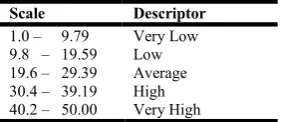
The interpretation of the mean was based on the scale presented below:
Scale Descriptor
1.0 – 9.79 Very Low 9.8 – 19.59 Low 19.6 – 29.39 Average 30.4 – 39.19 High 40.2 – 50.00 Very High
The data gathered are presented, analyzed and interpreted in the following order.
Level of Performance in Mathematics in the Pre-Test of the
Experimental and Control Group: One of the objective of the
study is to establish if there is significant difference between the level of performance in Mathematics in the pre-test of the experimental and control group.
Table 1 answers the first question of the study that explain the level of performance in Mathematics in the pre-test of the experimental and control group. A mean score of 21.4222 and standard deviation of 3.73855 with a variance of 13.977 was exhibited by the experimental group. The control group has a mean score of 22.1778 and standard deviation of 8.53678 with
a variance of 72.877. Overall, based on the test results, the performance of the learners in the pre-test can be interpreted as average.
Level of Performance in Mathematics in the Post-Test of
the Experimental and Control Group: Another objective of
[image:3.595.304.560.291.345.2]the study was to point out the level of performance in Mathematics in the post-test of the experimental and control group.
Table 1. Comparison of the Pre-Test of the Experimental and Control Group
N Mean Std. Deviation Variance
Experimental Group Pre-Test
45 21.4222 3.73855 13.977
Control Group Pre-Test 45 22.1778 8.53679 72.877
Valid N (listwise) 45
Table 2.Comparison of the Post-Test of the Experimental and
Control Group
N Mean Std.
Deviation
Variance
Experimental Group Post-Test 45 41.4222 8.18116 66.931
Control Group Post-Test 45 25.8444 5.92742 35.134
Valid N (listwise) 45
As presented in the table above, it answers the second question of the study that explains the level of performance in Mathematics in the post-test of the experimental and control group. A mean score of 41.4222 and standard deviation of 8.18116 with a variance of 66.931 was exhibited by the experimental group. This can be construed that the experimental group gained a very high rating. Conforming to Shiota (2016), in his conclusion that the gate for teaching and evaluation methods that incorporate the application of gamification concepts is open as learners are more likely to feel the connection between the subject and society. It will also increase learner motivation and interest. As found by Umek and Musek (UK Essays cited Umek and Musek, 2013), gamification, when properly structured, play can enable teachers to see learnerls demonstrating their understanding of a subject, thus making it a method of effective assessment. They argue that children can achieve higher levels of individual cognitive functions (conservation, one-to-one correspondence, decentration) in their symbolic play than they demonstrate when the same mental operations are tested and measured in formal, non-play, situations (UK Essays cited Umek and Musek, 2013). The control group has a mean score of 25.8444 and standard deviation of 5.92742 with a variance of 35.134. It is indicative that the mean obtained by the control group in the post-test is average.
Comparison on the Level of Performance in Mathematics in
the Post-Test and Pre-Test of the Experimental Groups: One
of the main objective of the study was to ascertain if the level of performance in Mathematics of the experimental group differ significantly. As presented in Table 3 below.
[image:3.595.93.234.565.626.2]Thus, the statistical result conforms to Mornar, et al (2017) in their research on gamified math lessons for lower primary school learners arrived on a conclusion that gamification improved motivation and learner interest in the digital math lesson caused the increase of the number of tasks that learners managed to solve in the observed 15-minute sessions. Since there were negative points for wrong answers, learners thrived to solve tasks as both accurately and quickly as possible.
Comparison of the Post-Test Performance in Mathematics of the Experimental and Control Group
The ultimate objective of the study is to establish if there exist a significant difference between the performance of the control and experimental group at the culmination of the study. As shown in Table 4 above. Table 4 presents the comparison of mean gains of the post-test of the control and experimental group. There is a significant difference in the post-test of the control group and experimental group, control group (25.84, ±5.93) and experimental group (41.42, ±8.18), t(88)=10.344, p=0.000. Based on the result, statistically there is a significant difference in the post-test mean score between the control group and experimental group. With the significant difference, it shows that the experimental group have a better performance in the post-test.
The result conforms to the theory of Piaget
Piaget (UK Essays cited Piaget, 2013) believed that children were actively in control of their own learning, with their major task being that to develop an ability to organize their experiences and learn from them, thus enabling children to make sense of the world. Piaget's theory reflects his focus on the intellectual development in children, concentrating on the child’s construction of reality rather than on the social context of learning (UK Essays cited Piaget, 2013). Piaget perceived play as a method which children use to develop their cognitive abilities and to practice their emerging cultivated capabilities. He also saw play as a child's adaptation to the world around them through application of assimilation. Piaget claimed there are three stages in the development of play; imitative or purposeful play, imaginary play, and play with rules (UK Essays cited Piaget, 2013). Vygotsky's (UK Essays cited Vygotsky, 2013) view differed from Piaget about there being stages in play development, however he agreed that play stimulates the development of abstract thought.
Vygotsky advocated play based learning, not merely for younger children but those in late childhood too. He argued that through experimental play and experiences children are able to develop vital thinking thought structures. Dewey (UK Essays cited Dewey, 2013) supported this, maintaining that being able to manipulate objects and situations is a significantly more effective teaching and learning method. He refutes methods that rely heavily on content and passive learning, where children are required to memorize information from a book or other source. In the argument of Gardner (UK Essays cited Gardner, 2013), he emphasized that all learners do not learn in the same way, believing formal learning methods do not take into account those who have different learning methods therefore short-changing all but those who happen to match the teaching of the instructor.
CONCLUSION AND RECOMMENDATION
Summary of Findings
The level of performance in Mathematics in the pre-test of the experimental and control group exhibited that both have an average result based on their mean score. The level of performance of the post-test of the experimental and control group revealed a difference in their mean score, the experimental group gained a high rating while the control group is average. A high significant difference between the performance of the experimental group in the pretest and post-test. The post-test of the experimental group elicited a statistically increase compared to their pre-test.
Statistically there is a significant difference in the post-test mean score between the control group and experimental group. With the significant difference, it shows that the experimental group having a better performance.
Conclusion
Based on the foregoing findings, it can be concluded that gamification as an approach enable teachers to see learners demonstrate understanding of Mathematics then learners can achieve higher level of cognitive function.
Recommendations
Teachers are encouraged to use gamification as an approach in teaching Mathematics.
Table 3. Comparison of the Post-Test and Pre-Test of Experimental Groups
Paired Differences t df Sig. (2-tailed)
Mean SD Std. Error
Mean
95% Confidence Interval of the Difference
Low Up
Experimental Group Post-Test – Experimental Group Pre-Test
[image:4.595.41.553.170.260.2]20.0 7.60 1.13 17.7 22.2 17.65 44 .000
Table 4. Comparison of the Post-Test Performance of the Experimental and Control Group
Levene's Test for Equality of Variances
t-test for Equality of Means
F Sig. t df Sig.
(2-tailed)
Mean Difference
Std. Error Difference
95% Confidence Interval of the Difference
Lower Upper
Post-Test
Equal variances assumed
3.460 .066 -10.344 88 .000 -15.578 1.50603 -18.571 -12.585
Equal variances not assumed
Acknowledgement
My sincerest appreciation to: Dr. Ma. Janet S. Geroso, Dr. Zaldy O. Dequito, Mrs. Merlyn A. Ramos, my Family – my husband and children, and most especially to God, our creator.
REFERENCES
Buendia, Ernesto C. 2011. Cooperative Learning in Teaching Secondary Subjects. Southwestern University, Cebu City. Holloway, S. 2018. Gamification in Education: 4 Ways to
Bring Games to your Classroom. San Francisco.
Mornar, V., Boticki, I. and Jagust, T. 2017. Gamified Digital Math Lessons for Lower Primary School learners. Korea. Schaaf, R. and Quinn, J. 2017. Home The Future of Learning:
12 Examples of Gamification In The Classroom. TeachThought Staff.
Shiota, S. & Sakai, K. 2016. A Practical Study of Mathematics Education Using Gamification. Japan.
Essays, UK. (November 2013). Theories surrounding learning through play. Retrieved from https://www.ukessays.com/ essays/young-people/theories-surrounding-learning-through-play-young-people-essay.php?vref=1