ISSN Print: 2152-7245
DOI: 10.4236/me.2019.107109 Jul. 12, 2019 1671 Modern Economy
The Impact of Corruption on Chinese
OFDI—Based on the Binary Marginal
Perspective
Yongpei Wu
Jinan University, Guangzhou, China
Abstract
This paper uses the China Global Investment Tracker database to map the investment panels of 31 countries along the “Belt and Road” in China, using the system GMM (generalised method of moments) estimation method to study the impact of host country corruption on Chinese OFDI (outward for-eign direct investment). The conclusion is that the level of corruption in the host country and the Chinese OFDI total scale show a non-linear “U” rela-tionship. From the perspective of intensive margin, the relationship between host country corruption and the average amount foreign investment from Chinese enterprises is not significant. From the perspective of extensive mar-gin, corruption and the number of enterprises setting up factories in the host country also show U-shaped relationship, but the relationship with the num-ber of investment industries is not significant.
Keywords
OFDI, Corruption, GMM, Binary Marginal
1. Introduction
In recent years, the world economy has been weak and the growth rate of devel-oped economies has dropped significantly. International trade has remained sluggish and some uncertainties such as Brexit have triggered a huge shock in the international financial market. Therefore, it’s still rugged for countries around the world to develop and expand their scale of OFDI. The Chinese government has actively promoted the “One Belt and One Road” initiative in 2013 and stea-dily carried out international capacity cooperation. The “going out” work system has been continuously improved, so Chinese enterprises take the initiative to
How to cite this paper: Wu, Y.P. (2019) The Impact of Corruption on Chinese OFDI—Based on the Binary Marginal Pers-pective. Modern Economy, 10, 1671-1683. https://doi.org/10.4236/me.2019.107109
Received: May 28, 2019 Accepted: July 9, 2019 Published: July 12, 2019
Copyright © 2019 by author(s) and Scientific Research Publishing Inc. This work is licensed under the Creative Commons Attribution International License (CC BY 4.0).
http://creativecommons.org/licenses/by/4.0/
DOI: 10.4236/me.2019.107109 1672 Modern Economy
accelerate integration into the process of economic globalization. According to the 2016 China Foreign Direct Investment Statistics Bulletin, Chinese OFDI net in 2016 increased by 34.7% year-on-year, setting a record high of 196.15 billion (US dollar) and ranking second in the world.
China’s OFDI not only flows into developed countries, but also developing countries. 80% of OFDI flows into developing countries and regions in Asia, Africa and Latin America. Cheap labor, abundant natural resource endowments and broad market prospects are the main reasons for attracting OFDI inflows. However, developing countries often have an immature institutional environ-ment and corruption problems naturally arise. Corruption in the host country may bring higher entry costs to multinational companies so that it affects the way in which multinational companies enter or the location of multinational companies. Since 2013, China has proposed the construction of the “Belt and Road”, which is to encourage Chinese enterprises to take the initiative to “go out”. Because most of the countries along the “Belt and Road” are developing countries, there are a lot of problems about institutions and corruption. There-fore, this paper has important practical significance in studying the relationship between corruption and OFDI in China. I hope this paper can provide some help for Chinese enterprise OFDI.
Literature Review
At present, the academic community does not form a consistent conclusion on the relationship between the level of corruption in the host country and OFDI. There are mainly the following viewpoints. The traditional view is that corrup-tion in the host country will have a “friccorrup-tional effect” and curb the inflow of transnational OFDI, because the occurrence of corruption in the host country will increase the uncertainty of the investment environment, reduce the
predic-tability of investment activities, and increase investors sunken cost [1]. Blonigen
[2] believes that the mechanism of host country system affecting FDI is mainly
re-flected in the following aspects. First, the bad institutional environment increases the risk of deprivation of investor assets, thereby reducing the likelihood of in-vestment. Defects in the protection of property rights system will hinder invest-ment. Second, the institutional defects in the regulation of market operations will increase investment costs. Problems such as rent-seeking and corruption in-crease investment costs, so companies will reduce investment activities. Third, institutional deficiencies often result in poor quality of public goods (such as the judicial system, government efficiency, and regulation) provided by the govern-ment, thus affecting the expected return on investment. The findings of
Demir-bag et al. [3], Driffield et al. [4], and Duanmu [5] are similar. They believe that
corruption will lead investors to face more uncertainty and need to pay additional operating costs for learning and adapting to the culture, customs, values, business rules. It’s the reason that corruption inhibits foreign direct investment by
coun-DOI: 10.4236/me.2019.107109 1673 Modern Economy
tries in the United States from 2000 to 2008. The empirical results also show that host country corruption will inhibit US direct investment in developing countries.
Another view in the academic world is contrary to the above point of view. It is believed that the corruption actually has a “lubricating effect”. The corruption is conducive to the entry of OFDI and attracts more OFDI. The host country’s relatively inferior institutional environment will induce host country govern-ment officials’ initiative to create rents. The distorted incentives for investors to engage in corrupt behavior will be further strengthened, so that some multina-tional companies with higher ownership advantages also choose corruption as
an alternative source of incentives. Egger and Winner [7] used data from 73
countries that absorbed cross-border direct investment in 1995-1999 and found that corruption can help investors bypass the host country’s unreasonable gov-ernment regulation of foreign investment in a relatively inferior institutional en-vironment. Corruption facilitates transnational inflow of direct investment.
Ca-zurra [8] based on data from 183 home countries’ direct investments in 106 host
countries, also found that host country corruption has a positive effect on cross-border direct investment. In an empirical study on the level of China’s
OFDI and host country corruption, Buckley et al. [9] used China’s OFDI data
from 49 countries in 1984-2001 to study the location distribution characteristics of China’s OFDI. It also founded that corruption has a positive effect on Chinese
OFDI. Kolstad and Wiig [10] used the 2003-2006 China cross-sectional data on
OFDI in 104 countries and found that the quality of the host country institution is negatively correlated with China’s OFDI. They believe that China’s OFDI pre-ferred the country with imperfect institutions and further supported the views of Buckley. Chinese OFDI entering non-OECD countries has significant resource seeking motivation and likes to invest in countries and regions with imperfect
institution systems. Cheung et al. [11] considered the impact of host country
corruption when examining China’s OFDI determinants for African countries and found that host country corruption has a positive proportional relationship
with China’s OFDI inflows. Jiang Guanhong and Jiang Dianchun [12] analyzed
China’s investment in developing countries and examined the impact of the quali-ty of the host country system including corruption on Chinese OFDI. They found that Chinese OFDI favored host countries with worse corruption control. Fung
and Garcia [13] compared the factors affecting FDI between China and India and
founded that the higher level of corruption would attract more OFDI in China. The third view is that there is not a linear relationship between host country
corruption and OFDI, but a non-linear relationship. Straub [14] made a game
Analysis between multinational corporations and host Countries. He founded that corruption makes transnational investors not inclined to enter the host country by direct investment but by choosing bank loans. When the level of corruption rises to a higher level, transnational direct investors tend to invest
directly in the host country. Méon and Weill [15] used empirical data from 54
DOI: 10.4236/me.2019.107109 1674 Modern Economy
quality, corruption is beneficial to production efficiency. Craigwell and Wright
[16] used developing country data as a sample and found that host country
cor-ruption has a certain non-linear effect on cross-border direct investment. Brada et al. [17] used data from direct investment by host countries in transition coun-tries and found that the nonlinear relationship between host country corruption and transnational direct investment still exists. Hu Bing, Deng Fuhua, and
Zhang Ming [18] believe that under certain system constraints, there is a
“thre-shold effect” on the influence of host country corruption on Chinese OFDI. When the level of corruption in the host country is low, the “frictional effect” of corruption will have a negative impact on Chinese OFDI. However, when the host country’s corruption exceeds a certain threshold, Corruption can be used as a sub-optimal choice to produce a certain degree of “lubrication effect” on Chi-na’s OFDI, which will have a certain positive impact on ChiChi-na’s OFDI.
The above is the academic research on the relationship between host country corruption and OFDI. Almost all of them are based on the perspective of OFDI’s one-dimensional scale, that is, empirical research is conducted on the explana-tory variables of investment flows or investment stocks and there are disadvan-tages in empirical methods and models. Compared to previous research, there are two innovations in this article. The first is the research perspective. This pa-per studies the impact of corruption on Chinese OFDI from the pa-perspective of intensive margin and extensive margin. The binary marginal perspective is more helpful in clarifying the impact of corruption on the structural characteristics of OFDI. The second is the empirical method. This paper uses the method of sys-tem GMM to empirical research. Most of the previous empirical studies used gravity models or panel static models, without considering OFDI continuity and dynamic effects. This paper uses the GMM method to overcome these disadvan-tages and make the estimation results more credible.
2. Data and Empirical Models
The basic empirical regression model is as follows:
0 1 , 1 2
it i t it n nt i it
lnfdi =
β
+β
lnfdi − +β
cor +∑
β
X + +γ ε
(1)0 1 , 1 2
it i t it n nt i it
lnifdi =
β
+β
lnifdi − +β
cor +∑
β
X + +γ ε
(2)0 1 , 1 2
1it 1i t it n nt i it
exfdi =
β
+β
exfdi − +β
cor +∑
β
X + +γ ε
(3)0 1 , 1 2
2it 2i t it n nt i it
exfdi =
β
+β
exfdi − +β
cor +∑
β
X + +γ ε
(4)The estimation method used in this paper is the dynamic panel system GMM. The GMM model can effectively reflect the dynamic effects of OFDI and con-sider the continuity of OFDI. It can better solve the endogenous and make the estimated results less biased and more robust. We first estimate the above four
regression models, and then introduce the square of the corruption cor2 to
es-timate whether the host country corruption level has a nonlinear relationship with Chinese OFDI.
DOI: 10.4236/me.2019.107109 1675 Modern Economy
which is established by American Enterprise Research Institute and American Heritage Foundation. The database contains the names of Chinese investment enterprises, the amount of FDI, the proportion of investment scale, foreign co-operative enterprises, foreign investment first-level industries, foreign invest-ment secondary industries, host countries and their regions. Due to the lack of Chinese OFDI statistics along the “Belt and Road” countries, OFDI has not been carried out in some years and the empirical results may be biased. Therefore, this paper use the panel data of the 31 countries along the “Belt and Road” for
2010-2017 for empirical research. This paper refers to the practice of Yang [19].
We define the intensive margin of investment as the average investment amount of OFDI country-industry pairs in a year, reflecting the scale of OFDI of a coun-try’s enterprises. We define the extensive margin of investment as the number of investment enterprises and investment industries in the host country,
re-flecting Chinese diversification of investment in the host country. lnfdiit, lnifdiit,
1it
exfdi and exfdi2it represent respectively the logarithm of Chinese OFDI
to-tal scale in year t and in country i, the logarithm of average OFDI in year t and in
country i, the number of investment enterprises and the number of investment
industries in year t and in country i. The average OFDI is equal to the total in-vestment of all companies in the t year of the country i divided by the number of companies.
The core dependent variable corruption level is adopted by Transparency In-ternational’s annual Corruption Perception Index (CPI). The CPI index is a composite index of the results of surveys conducted by institutions with high credibility in the world. The score is 10 points and the lowest score is 0 points. Higher scores mean less corruption. The index is widely used by academics and governments. In order to facilitate the interpretation of regression results, we
reversed the value of CPI. Defining corit =10−cpiit. corit indicates the
cor-ruption of country i in year t.
, 1, , 1, 1, 1
i t i t i t
lnfdi − lnifdi − exfdi − and exfdi2i t, 1− are the lag term of independent
variable in the regression model, which are used to reflect the dynamics of the regression model and to test the aggregation effect of OFDI.
nt
X are control variables, including the market size of the host country
lnmar, the labor cost of the host country lnlab, the economic development
potential of the host country ggdp, the trade openness of the host country
open, the natural resource endowment of the host country𝑟𝑟𝑟𝑟𝑟𝑟. Allthe variables
related to GDP use the 2010 constant dollar for GDP conversion. Control va-riables are collected in the World Bank database. All variable indicators,
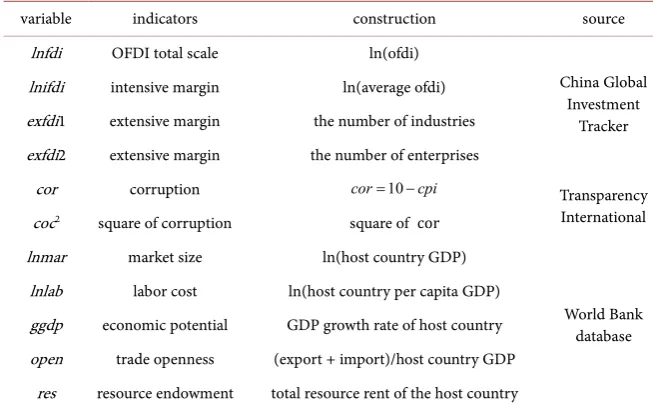
con-structions, and sources are shown in the Table 1.
2.1. Empirical Results and Analysis
Statistical Description
DOI: 10.4236/me.2019.107109 1676 Modern Economy
Table 1. Variables indicators, constructions, and sources.
variable indicators construction source
lnfdi OFDI total scale ln(ofdi)
China Global Investment
Tracker lnifdi intensive margin ln(average ofdi)
exfdi1 extensive margin the number of industries exfdi2 extensive margin the number of enterprises
cor corruption cor=10−cpi Transparency
International coc2 square of corruption square of cor
lnmar market size ln(host country GDP)
World Bank database lnlab labor cost ln(host country per capita GDP)
ggdp economic potential GDP growth rate of host country open trade openness (export + import)/host country GDP
res resource endowment total resource rent of the host country
Table 2. Variables statistical description.
Variable Indicator Mean Std. Min. Max. Obs
dependent variables
lnfdi OFDI total scale 7.26 1.102 4.61 9.56 238
lnifdi intensive margin 6.20 0.715 4.61 8.58 238
exfdi1 extended margin (industries) 2.54 1.400 1 7 238 exfdi2 extended margin (enterprises) 3.63 2.514 1 14 238
independent variables
cor corruption 6.62 1.489 0.7 9.8 238
coc2 Squared corruption 46.09 16.000 0.49 96.04 238 control variables
lnmar market size 25.70 1.466 22.69 28.60 238
lnlab labor cost 8.12 1.242 5.81 10.92 238
ggdp economic potential 0.05 0.032 -0.07 0.15 238
open trade openness 0.73 0.544 0.18 2.81 238
res resource endowment 12.76 13.262 0.00 60.12 238
As can be seen from the data in the above Table 2, Chinese OFDI in some
countries along the “Belt and Road” has not been diversified. Although the number of investment industries and the number of enterprises in some host countries have reached 7 and 14, the average of these two variables is only 1.400 and 2.514. From the perspective of extensive margin, it still shows the singularity of investment and is less resistant to external international investment risks. The
average value of corruption index cor reached 6.62, while the world CPI
aver-age value was 4.23 in 2010-2017. According to the previous formula, the world
[image:6.595.208.539.327.578.2]corrup-DOI: 10.4236/me.2019.107109 1677 Modern Economy
tion index of 6.62 in this paper. This shows that Chinese OFDI enterprises are in the area with high corruption. Most of the countries along the way are in an ex-ternal environment with a high level of corruption, which will inevitably lead to a bad market environment and may bring certain “frictional effects” to Chinese enterprises. In the sample data, the labor cost of the sample countries is 8.12, while in China is 8.68, which indicates that the relatively cheap labor cost of the countries along the “Belt and Road” may be the reason why Chinese enterprises choose to perform OFDI in these countries. As a result, these companies can maximize production profits. In terms of natural resource endowments, the sample country data accounted for an average of 12.76%, which reflects to these countries have considerable natural resources. This is may the reason why Chi-na’s resource-seeking companies choose to make OFDI in these host countries. From the perspective of economic growth rate, the average growth rate of coun-tries along the “Belt and Road” is 5%, far greater than the growth rate of the world economy. According to the report released by the United Nations in 2017, East Asia and South Asia account for nearly half of the world’s economic growth. China alone contributes about one-third of global economic growth and 3% of the world’s economic growth rate is the highest since 2011. This shows that the countries along the “Belt and Road” have certain development potential and will form a larger economic market in the future. It also proves that the “Belt and Road” is a correct initiative to achieve bilateral win-win situation.
3. Basic Model Estimation
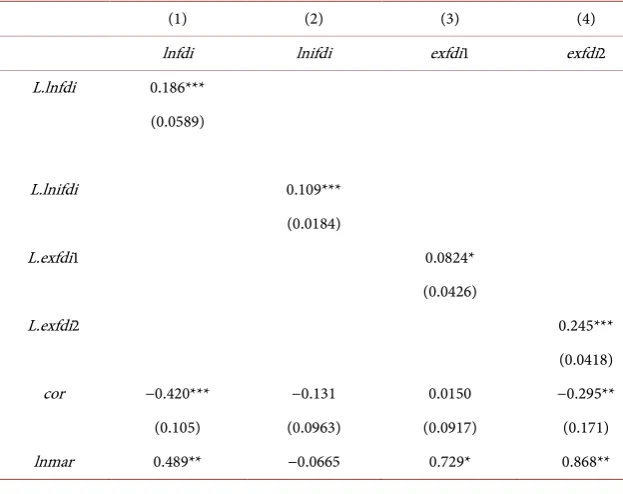
From the above results, the lag term of the dependent variables of models (1)-(4) are significantly positive at the 1% level, which indicates that there is an agglo-meration effect of Chinese enterprises in the OFDI along the “Belt and Road” countries. The previous OFDI will promote the next OFDI, because aggregation can increase the location advantage of multinational companies. A region that has already absorbed foreign-invested companies will have the advantage to
ab-sorb more new foreign investors to invest [20]. There is an agglomeration effect
from both the marginal perspective and the binary marginal perspective.
The core independent variable cor is very significant in (1) and is negative,
indicating that corruption in the countries along the “Belt and Road” has not “lubricated” the OFDI of Chinese enterprises, but hindered the entry of OFDI. Enterprises entering the host country will increase their investment costs due to imperfect market environment and the problems caused by rent-seeking and corruption, so it reduces the OFDI to the host country. From the intensive
mar-ginal perspective of the binary margin, the cor coefficient in (2) is negative,
but not significant, indicating that the reduction of OFDI due to the increase of corruption level is not achieved by reducing the scale of OFDI. From the
pers-pective of extensive margin, the cor coefficient in (3) is not significant, and
the cor coefficient in (4) is significantly negative. The increased level of
busi-DOI: 10.4236/me.2019.107109 1678 Modern Economy
nesses in the host country and a decrease in OFDI flows. The impact of corrup-tion in countries along the “Belt and Road” on the Chinese OFDI is mainly af-fecting the number of OFDI enterprises, not the average investment scale of OFDI.
In terms of control variables, the lnmar coefficient is significantly positive in
(1) (3) (4), indicating that the larger the market size of the host country, the more it can promote the entry of Chinese OFDI. It is also conducive to
promot-ing the diversification of China’s investment. The labor cost lnlab coefficient is
significantly negative in (4), indicating that the cheap labor of the host country is the reason for attracting Chinese enterprises to invest in the host country. The
economic growth potential ggdp coefficient is significantly positive in (2), which
means that the greater the economic potential can attract much bigger average
investment scale. The trade openness open coefficient is significantly negative
in (1) (2) (4), indicating that the increase in trade openness of countries along the “Belt and Road” does not actually promote the scale of OFDI, but rather re-duces the number of Chinese enterprises. The relationship between the host country’s trade and the introduction of foreign investment may be an
alterna-tive, which is in line with Mundell’s mutual substitution model. The res
coeffi-cient is not significant, so the natural resource elements of the host country are not a factor in attracting OFDI.
The last three rows in the Table 3 are the tests set for the system GMM model.
[image:8.595.211.523.485.732.2]The results of the Sargan statistic for models (1)-(4) are all bigger than 0.1, indi-cating that the selected tool variables are valid. From the results of AR(1) and AR(2), the residual terms of models (1)-(4) have first-order autocorrelation and second-order autocorrelation. Therefore, the setting of the system GMM model is effective.
Table 3. Basic model estimation.
(1) (2) (3) (4)
lnfdi lnifdi exfdi1 exfdi2
L.lnfdi 0.186*** (0.0589)
L.lnifdi 0.109***
(0.0184)
L.exfdi1 0.0824*
(0.0426)
L.exfdi2 0.245***
(0.0418)
cor −0.420*** −0.131 0.0150 −0.295**
(0.105) (0.0963) (0.0917) (0.171)
DOI: 10.4236/me.2019.107109 1679 Modern Economy Continued
(0.207) (0.0518) (0.395) (0.269)
lnlab 0.0585 0.222 −0.254 −1.215***
(0.267) (0.114) (0.443) (0.453)
ggdp 0.0131 4.568*** 1.538 6.047
(2.457) (1.156) (2.757) (4.732)
open −1.803*** −0.485*** −1.013 −1.256**
(0.216) (0.139) (0.647) (0.526)
res −0.00217 −0.000431 −0.0263 −0.0409
(0.00616) (0.00401) (0.0136) (0.0229)
cons −2.971 6.887*** −13.43* −5.869
(5.571) (1.858) (7.194) (5.127)
N 200 200 200 200
AR(1) AR(2) Sargan
0.0001 0.5364 0.9998
0.0034 0.6021 0.9997
0.0017 0.1006 0.9981
0.0001 0.5993 0.9824
Standard errors in parentheses, *p < 0.1, **p < 0.05, ***p < 0.01.
4. Estimation of Introducing cor
2In order to further test whether corruption in the host country is nonlinear with the Chinese OFDI, we introduces the square of the corruption in the models
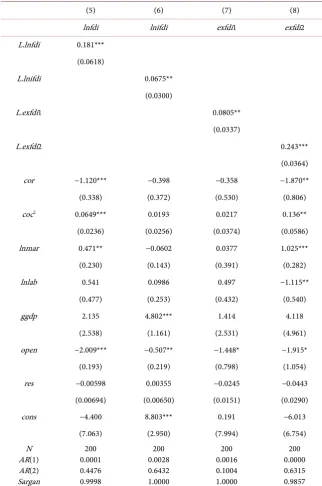
(1)-(4) respectively. The regression results are shown in Table 4. First, the lag
term of the dependent variables of models (5)-(8) is significantly positive,
indi-cating the existence of aggregation effects. This result is the same as in Table 3.
The coefficient cor is the same as in Table 3, which are significantly negative
in terms of the total investment scale and the number of enterprises, but not sig-nificant in the average investment scale and the number of investment
indus-tries. Another core independent variable cor2 is significantly positive in
DOI: 10.4236/me.2019.107109 1680 Modern Economy
Table 4. Estimation of introducing cor2.
(5) (6) (7) (8)
lnfdi lnifdi exfdi1 exfdi2
L.lnfdi 0.181*** (0.0618)
L.lnifdi 0.0675**
(0.0300)
L.exfdi1 0.0805**
(0.0337)
L.exfdi2 0.243***
(0.0364)
cor −1.120*** −0.398 −0.358 −1.870**
(0.338) (0.372) (0.530) (0.806)
coc2 0.0649*** 0.0193 0.0217 0.136**
(0.0236) (0.0256) (0.0374) (0.0586)
lnmar 0.471** −0.0602 0.0377 1.025***
(0.230) (0.143) (0.391) (0.282)
lnlab 0.541 0.0986 0.497 −1.115**
(0.477) (0.253) (0.432) (0.540)
ggdp 2.135 4.802*** 1.414 4.118
(2.538) (1.161) (2.531) (4.961)
open −2.009*** −0.507** −1.448* −1.915*
(0.193) (0.219) (0.798) (1.054)
res −0.00598 0.00355 −0.0245 −0.0443
(0.00694) (0.00650) (0.0151) (0.0290)
cons −4.400 8.803*** 0.191 −6.013
(7.063) (2.950) (7.994) (6.754)
N AR(1) AR(2) Sargan
200 0.0001 0.4476 0.9998
200 0.0028 0.6432 1.0000
200 0.0016 0.1004 1.0000
200 0.0000 0.6315 0.9857
Standard errors in parentheses, *p < 0.1, **p < 0.05, ***p < 0.01.
rights. Corruption is a sub-optimal choice for effective resource allocation. It can not only make up for the shortcomings of the host country system, but also help investors to bypass the various investment barriers of the host country as soon as possible. It can reduce the institutional friction with the host government and facilitate the entry of Chinese OFDI. From the intensive perspective, the level of corruption in the host country does not significantly affect the average
invest-ment by Chinese enterprises, which is consistent with the results in Table 3.
DOI: 10.4236/me.2019.107109 1681 Modern Economy
reflected in the number of invested enterprises.
The coefficients of the control variables are similar to the results of Table 3.
The Sargan statistic and residual term autocorrelation test results AR(1) and
AR(2) are also the same as those in Table 3, indicating the design of the system
GMM estimation based on the model (5)-(8) after introducing the cor2 still
valid.
5. Robustness Test
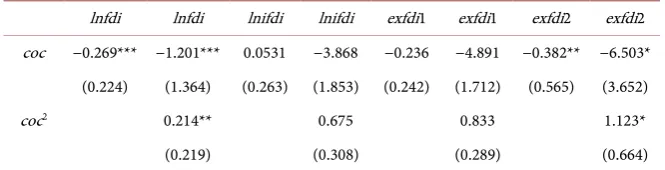
In order to verify the robustness of the above regression results, we use the me-thod of replacing the core independent variables for robustness test. We use the cci (corruption control index) in the World Bank’s Worldwide Governance
In-dicators (WGI) database to replace the original variable cor for robustness
testing. The cci index ranges from −2.5 (most corrupt) to 2.5 (most clean), so we
reversed the value of cci. Defining coc=2.5−cci. It means the bigger the value
of coc, the more serious the corruption. The regression results of the robustness
test are as follows in Table 5.
From the above regression results, it can be seen that although the indepen-dent variables have decreased significantly, they are still significant at the signif-icant level of 10%. Direction of the coefficient are consistent with the original model results. The corruption and the Chinese OFDI are “U” type relationship. Corruption only affects the extensive margin of Chinese OFDI rather than the
intensive margin, which is consistent with the empirical results in Table 3 and
Table 4. Control variables are in the model but not reported.
6. Conclusions and Suggestion
[image:11.595.208.541.626.711.2]This paper uses China’s China Global Investment Tracker to analyze the OFDI panel data of 31 countries along the “Belt and Road” countries in 2010-2017. We use the systematic GMM estimation method to study the relationship between the level of corruption and OFDI from a binary marginal perspective. The re-sults of the system GMM estimation show that from the perspective of the OFDI total scale, there is a “U” relationship between corruption and OFDI. From the perspective of intensive margin, the relationship between host country corrup-tion and the average amount foreign investment of Chinese enterprises is not significant. From the perspective of extensive margin, corruption and the num-ber of enterprises setting up factories in the host country also show U-shaped
Table 5. Robustness test.
lnfdi lnfdi lnifdi lnifdi exfdi1 exfdi1 exfdi2 exfdi2 coc −0.269*** −1.201*** 0.0531 −3.868 −0.236 −4.891 −0.382** −6.503*
(0.224) (1.364) (0.263) (1.853) (0.242) (1.712) (0.565) (3.652)
coc2 0.214** 0.675 0.833 1.123*
(0.219) (0.308) (0.289) (0.664)
DOI: 10.4236/me.2019.107109 1682 Modern Economy
relationship, but the relationship with the number of investment industries is not significant.
With the introduction of the national “Belt and Road Initiative” initiative, more and more enterprises choose to “go global”. Many Chinese enterprises in-vesting in developing countries is gradually increasing. Corruption has a certain “frictional effect” on Chinese enterprises, such as raising the uncertainty of the investment environment, increasing the risk of property rights being invaded and increasing operating costs. However, due to the pursuit of the market or the pursuit of cheap labor, Chinese enterprises still choose to flow to some countries with high levels of corruption. They enjoy the “lubricating effect”. The “lubri-cating effect” of corruption is more likely to play a role in the institutional envi-ronment in which the host country’s incentives are distorted, or the result of suboptimal choices of investors when the host country’s institutional arrange-ments are flawed. As the host country’s economic system and political system continue to develop and improve, this “lubrication effect” will be difficult to sustain in the long run. We believe that the government should further streng-then the public services of foreign direct investment and improve the informa-tion service system for foreign investment cooperainforma-tion. It can strengthen the construction of the “going out” public service platform. At the same time, we need national environmental guidance for companies to conduct foreign in-vestment cooperation. Let Chinese enterprises have a more comprehensive and detailed understanding of the host country when they “go out”. Giving full play to the advantages of Chinese enterprises and choosing the host country that is suitable for them to carry out OFDI, so that China and the host countries can share the development opportunities brought about by the “Belt and Road Initi-ative” and achieve a win-win situation.
Conflicts of Interest
The author declares no conflicts of interest regarding the publication of this pa-per.
References
[1] Habib, M. and Zurawicki, L. (2002) Corruption and Foreign Direct Investment.
Journal of International Business Studies, 33, 291-307.
https://doi.org/10.1057/palgrave.jibs.8491017
[2] Blonigen, B.A. (2005) A Review of the Empirical Literature on FDI Determinants.
Atlantic Economic Journal, 33, 383-403.https://doi.org/10.1007/s11293-005-2868-9
[3] Demirbag, M., Glaister, K.W. and Tatoglu, E. (2007) Institutional and Transaction Cost Influences on MNEs’ Ownership Strategies of Their Affiliates: Evidence from an Emerging Market. Journal of World Business, 42, 418-434.
https://doi.org/10.1016/j.jwb.2007.06.004
DOI: 10.4236/me.2019.107109 1683 Modern Economy [5] Duanmu, J.L. (2011) The Effect of Corruption Distance and Market Orientation on the Ownership Choice of MNEs: Evidence from China. Journal of International
Management, 17, 162-174.https://doi.org/10.1016/j.intman.2011.01.003
[6] Das, A. and Parry, M. (2011) Greasing or Sanding? GMM Estimation of the Cor-ruption-Investment Relationship. International Journal of Environmental Research, 2, 95-108.
[7] Egger, P. and Winner, H. (2005) Evidence on Corruption as an Incentive for For-eign Direct Investment. European Journal of Political Economy, 21, 932-952.
https://doi.org/10.1016/j.ejpoleco.2005.01.002
[8] Egger, P. and Winner, H. (2006) How Corruption Influences Foreign Direct In-vestment: A Panel Data Study. Economic Development and Cultural Change, 54, 459-486.https://doi.org/10.1086/497010
[9] Buckley, P.J., Clegg, L.J., Cross, A.R., Liu, X., Voss, H. and Zhang, P. (2007) The Determinants of Chinese Outward Foreign Direct Investment. Journal of
Interna-tional Business Studies, 38, 499-518.https://doi.org/10.1057/palgrave.jibs.8400277
[10] Kolstad, I. and Wiig, A. (2009) Is Transparency the Key to Reducing Corruption in Resource-Rich Countries? World Development, 37, 521-532.
https://doi.org/10.1016/j.worlddev.2008.07.002
[11] Cheung, Y.W., de Haan, J., Qian, X.W., et al. (2011) China’s Outward Direct In-vestment in Africa. Working Paper, Hong Kong Institute for Monetary Research, Hong Kong.
[12] Jiang, G. and Jiang, D. (2012) Chinese Investment in Developing Countries—Is the Host Country System Important? Management World, 11, 45-56.
[13] Fung, K.C. and Garcia-Herrero, A. (2012) Foreign Direct Investment Outflows from China and India. China Economic Policy Review, 1, Article ID: 1250003.
https://doi.org/10.1142/S1793969012500033
[14] Straub, S. (2005) Informal Sector: The Credit Market Channel. Journal of
Develop-ment Economics, 78, 299-321.https://doi.org/10.1016/j.jdeveco.2004.09.005
[15] Méon, P.G. and Weill, L. (2008) Is Corruption an Efficient Grease? Bank of Finland. Institute for Economies in Transition, BOFIT Discussion Papers, 20.
https://doi.org/10.2139/ssrn.1304596
[16] Craigwell, R. and Wright, A. (2011) Foreign Direct Investment and Corruption in Developing Economies: Evidence from Linear and Non-Linear Panel Granger Cau-sality Tests. Economics Bulletin, 31, 2272-2283.
[17] Brada, J.C., Drabek, Z. and Perez, M.F. (2012) The Effect of Home-Country and Host-Country Corruption on Foreign Direct Investment. Review of Development
Economics, 16, 640-663.https://doi.org/10.1111/rode.12009
[18] Hu, B., Deng, F. and Zhang, M. (2013) Influence of Host Country Corruption on China’s Outward Direct investment: An Empirical Analysis Based on Cross-Country Panel Data. Journal of International Trade, 10.
[19] Yang, L., Liu, X. and Zhang, J. (2016) How Do Bilateral Political Relations Affect Outward Foreign Direct Investment—Based on a Perspective of Binary Margin and Investment Failure. China Industry Economy, 11, 56-72.
[20] Dunning, J.H. and Lundan, S.M. (2008) Theories of Foreign Direct Investment. In: Dunning, J.H. and Lundan, S.M., Eds., Multinational Enterprises and the Global