ISSN Print: 2328-4900
DOI: 10.4236/cus.2019.71003 Mar. 14, 2019 35 Current Urban Studies
Study on the Authenticity Perception of
Intangible Cultural Heritage
Jun Hu, Xiaona Feng, Mu Zhang, Jing Luo
*Shenzhen Tourism College, Jinan University, Shenzhen, China
Abstract
As a challenging topic in tourism, the authenticity of the cultural heritage represents the value and attraction of heritage. With tourism development, scholars have called for the authenticity perception of cultural heritage which still stays at the conceptual level. However, there are few researches that in-volve the essence and protection of authenticity. Hence, after in-depth study on the characteristics of intangible cultural heritage, the authors try to discuss the difference of tourists’ perception on authenticity of the intangible cultural heritage so as to achieve the effective protection of intangible cultural herit-age. The study investigates tourists in Bo Luo Dan Temple Fair with SPSS to carry on the statistics and the main factors affecting the perception of authen-ticity to further study their relationship with satisfaction. The conclusion found that there were two core factors that had an impact on perceived au-thenticity, and there exists significant positive impact between the authentic-ity of the perception and satisfaction.
Keywords
Intangible Cultural Heritage, Authenticity, Visitor, Perception
1. Introduction
In the year of 2003, UNESCO issued “the Convention for the Safeguarding of Intangible Cultural Heritage” to advocate for the worldwide concern about do-mestic intangible cultural heritage. With the speed procedure of economic glo-balization and modernization, traditional belief, value and lifestyle seem to be away from us. Though China witnesses splendid achievement since the reform in the 1980s, we have to admit the weakening impact of traditional culture on
*Corresponding author. How to cite this paper: Hu, J., Feng, X. N.,
Zhang, M., & Luo, J. (2019). Study on the Authenticity Perception of Intangible Cul-tural Heritage. Current Urban Studies, 7, 35-58.
https://doi.org/10.4236/cus.2019.71003
Received: December 24, 2018 Accepted: March 11, 2019 Published: March 14, 2019
Copyright © 2019 by author(s) and Scientific Research Publishing Inc. This work is licensed under the Creative Commons Attribution International License (CC BY 4.0).
DOI: 10.4236/cus.2019.71003 36 Current Urban Studies the youth. Western culture and lifestyle has gradually integrated in our life which brings threats for our traditional culture. In order to tackle this problem, the State Council made “the Notice for Further Safeguarding Intangible Cultural Heritage”. And there set off an upsurge for heritage application after two suc-cessful cases for heritage application which are Kun Opera and Mongolian Long Tone, approved as the representative of Oral and Intangible Culture. Thereafter, there are 25 intangible cultural heritages such as Dragon boat festival, Rice Paper of Anhui, Huaer Tune of Gansu etc. which are ranked in this list. After two ap-plications, there has selected 1028 intangible heritages into the index of national intangible heritage, and 4315 have been listed in provincial index of intangible heritage.
As most intangible heritages are been on the verge of extinction for little sup-port, governments are expected to put large amount of money to guarantee its temporary existence. However, the governments cannot afford to help all the projects. Only a small part of intangible heritage has been taken good care of, because the rest of them have to fight for the survival of themselves. Under this circumstance, both scholars and enterprises have realized economic and tourism value of intangible heritage, so they proposed the necessity and possibility of in-dustrialization of intangible heritage and tourism development. The application of intangible heritage, building of national intangible heritage parks, restoration of Folk or Temple Fair prove the commencement of intangible cultural heritage. In 2009, Ministry of Culture and China National Tourism Administration issued “The Guidance on Promoting the Development of Culture and Tourism” which suggested making full use of the resource strength of intangible cultural heritage to enhance culture status of tourism product by encouraging more cultural projects and activities. Therefore, tourism development of intangible cultural heritage tends to be the trend and a hot topic.
Being away from original environment, most intangible cultural heritages are at the risk of extinction. At present, there are 10 categories in intangible cultural heritage. They are: folk literature, folk music, folk dance, folk drama, folk paint-ing, traditional handicraft, Chinese medication, folk art, acrobatics and folk sports. The purpose of tourism development is to seek the balance between de-velopment and protection to achieve sustainability without damages during this process. Intangible cultural heritage needs necessary publicity and adjustment, however, overpacking might extort the essence of culture which leads to the loss of its natural beauty and tourism value. Hence, it is an important issue to discuss how to safeguard the authenticity of intangible cultural heritage in tourism de-velopment. The study on tourists’ perception on authenticity from intangible cultural heritage will not only provide the foundation for increasing tourists’ ex-perience, but also might offer constructive suggestions on protecting cultural es-sence of intangible cultural heritage.
in-DOI: 10.4236/cus.2019.71003 37 Current Urban Studies tangible culture heritage of Guangdong province as the case to evaluate the dif-ferentiation of their perception to figure out the factors that affect their percep-tion towards authenticity, and finally to conclude the relapercep-tionship between au-thenticity perception and customer satisfaction in intangible cultural heritage tourism.
2. Literature Review on Authenticity of Heritage and
Visitors Perception
2.1. Intangible Cultural Heritage
Comparing with cultural heritage, the concept of intangible cultural heritage re-fers to various practice, performance, exhibition, knowledge, skill, relevant tools, handicrafts, and cultural place regarded by people, group or individual, which is approved by UNESCO in Convention for the Safeguarding of the Intangible cultural Heritage (Wang, 2006).
The term authenticity originates from Greek, which indicates original, it is al-so known as originality or reliability. It was firstly introduced to describe the art exhibition in museum. Macannell is the first scholar to apply authenticity in the research of tourist motives and experience. The understanding of authenticity in perspective of heritage evolves with some documents In “Venice Charter” (1964), it puts forward the policy on the applicable level,for example, this
document emphasizes the job of heritage protection cannot change the original layout and decoration (item 5), and the environment around it should be safe-guarded too (item 6 and 7) etc. Hence, these technical measurements concerning about authenticity have been selected in “Guideline of World Heritage Conven-tion” (1997-2002) Nara Convention (1994) offers a completed conceptual framework of authenticity by positioning it on cultural diversity. It also broa-dens the connotation of authenticity including “form and design, materials, function and utility location and environment and other internal and external factors”. The “Guideline for Application of World Heritage Convention” makes more specific and detailed statements on authenticity (1977-2005). What’s more, another concept “integrity” is introduced in heritage protection, which is de-fined as “the unspoiled measures and integration of nature and cultural heritage. With three implications included: firstly, it contains all the elements of universal value of heritage; secondly, there exists certain size indicating heritage characte-ristics and evolution. Thirdly, it could sustain the negative impact from devel-opment and ignorance.
During twenty years, there are following categories about concept and intona-tion of authenticity.
1) Objectivism
DOI: 10.4236/cus.2019.71003 38 Current Urban Studies Authenticity Theory, the unauthenticiy in real life makes tourism pursuit au-thenticity during the travel. Meanwhile, he also addresses the idea that most modern tourist experience belongs to experiencing stage authenticity rather than the real culture of tourism destination. And authenticity is always described as authentic and unauthentic while analyzing national cultural heritage such as art works, festival, convention, food, costumes, house etc. according to local con-vention and culture (Ma, 2006).
2) Constructivism
It assumes that the authenticity mirrors tourists’ belief, expectation, prefe-rence, image and awareness during the travel. Bruner clarifies the concept of constructive authenticity. That is tourism operator could design scenic spot and relative event tailoring with tourist imagination, expectation, preference and be-lief (Zhou et al., 2007). Hughes addresses that various channels such as tourism enterprise, marketing agent, tour guide and brochure or Vedio producer make tourism authenticity (Hughes, 1995). Under the framework of constructivism, what the tourists seek is only a semiotic and symbolic authenticity which brings by social construction.
3) Post-modernism
Postmodernism views authenticity by emphasizing heterogeneity, particulari-ty and uniqueness and excluding integriparticulari-ty for postmodernism doesn’t concern tourist authenticity for they pursue artificial beauty, entertainment and joy. Ritzer Liskas matters authenticity only when they doubt about un-authenticity. They reflect on the impact from tourists to vulnerable local culture. And they support the positive role of stage authenticity to protect the culture and commu-nity in the destination.
4) Existentialism
As existentialism concerns tourists, though the scenic spot is absolutely un-authentic, it is still workable to pursue it. Because tourist can find an alternative, that is, tourism experience is activated by existing authenticity, which is ap-proved by Naoi. There are two major parts of existing authenticity, intra-personal authenticity and inter-personal authenticity, which are able to guide the devel-opment of tourism. Hence, for the above mentioned, there are different points of view and focuses on authenticity which play a role in tourism development and marketing strategies. In terms of tourism resource development, the historical cultural heritage with great demand of authenticity needs more emphasis on the prominence of its history and tradition, known as tourist’ authenticity. While, those theme parks centered with entertainment should cultivate tourists’ exis-tence authenticity with satisfying tourism psychological needs. And for folk tourism resource, it is suggested to keep balance on tourism development with attaching importance on the authenticity of subject and object.
ap-DOI: 10.4236/cus.2019.71003 39 Current Urban Studies proach could activate folk and traditional culture. While Deepar (2003) pro-posed the authenticity of folk culture, which was beneficial to the reconstruction of traditional culture and nationality identity. So there is no doubt that tourism economy will bring dual influence on the completeness of local economy, resi-dents and heritage. Goulding (2000) insisted that commercialization of culture heritage would never damage its authenticity, rather, It represented its exchange value. What’s more, the experience of pursuit of authenticity is seen as an im-portant tourism tendency, Tomaz and Vesna (2009) agreed with the idea that authenticity was full of significance for tourism, especially heritage tourism, the concept of authenticity would not only help to understand tourist motivation and behavior, it also offered strategic role in the management of tourism desti-nation. Alexandro (2003) proposed that the authenticity would play a critical role in building tourism motive and attraction. Many Chinese scholar partici-pated the hot discussion. Gao (2008) concluded that cultural product and au-thenticity did not hold the opposite stance, instead, they was in the mu-tual-promote relationship under the setting of cultural commercialized devel-opment with case study of the show named “Yunnan Impression”. Ma (2006) discussed the relationship among authenticity, commercialization, national cul-ture heritage and tourism, it suggested if the process of tourism commercializa-tion was dominated by the local, it was possible for the revitalizacommercializa-tion of nacommercializa-tional- national-ity tourism and cultural tourism. Wang and Zhang (2007) found that the stake-holders would bear different understanding for heritage tourism authenticity, as there were different perception on heritage authenticity among tourist, residents and tourism operator with various needs, it was important to construct the au-thenticity of heritage destination in the way of guiding the auau-thenticity mass media, building interpretation system and strengthening residents cultural iden-tity. It is concluded that all the studies on authenticity of intangible cultural her-itage starts from concept, and then people propose the philosophy of protection. But few researches could be found in the perspective of tourists’ perception on authenticity of intangible cultural heritage. Therefore, the authors will study tourists’ perception on authenticity combining with the characteristics of cultur-al heritage tourism, and then further to discuss whether authenticity perception of intangible cultural heritage works on tourists satisfaction.
2.2. On tourist Perception
founda-DOI: 10.4236/cus.2019.71003 40 Current Urban Studies tion for planning and development of destination and product.
It has been proved that tourist perception will work on the formation of their preference, behavior, motive and attitude. Chen, Qiao, & Liu (2009) study on the relationship between tourist risk perception and tourist behavior preference after the empirical investigation on tourists in Beijing. Li, Chen, & Zhang (2007) con-cluded that tourist perception and preference played a significant role for cultur-al heritage tourism destination with the study of Pingyao Town. Luo, Wu, & Deng (2007)investigated perception difference of entertainment usage influence from tourist with difference entertainment motives.
Tourist perception does not only affect one’s decisive behavior, it is of refer-ence role for evaluating tourism destination. Shi et al. (2008)study tourism des-tination competitiveness in the perspective of tourist perception. Yang and Li (2007), and Liu et al. (2005) assessed the development of tourism destination in the city of Xian, Kanasi, Guizhou in the angle of tourist perception.
Most scholars hold the idea that it bears the supportive role of perceptive val-ue for satisfaction and purchase willingness. For example, Zhang (2009) and Tong and Yang (2009) took resort visitor as the cases, Shi and Liu (2009) chose visitors in Jiuzhaigou and Lushan mountain as the objects, Huang & Huang (2008) and Chen (2006) took visitors in Kaifeng city, south-west tribe region as the case study to prove it is a truth. Tian & Bao (2005) did the research on tour-ist satisfaction in the perspective of authenticity through empirical study on Dai Dance in Xishuangbanna. Feng and Sha (2007) set up an evaluation model of “authenticity-satisfaction” in the perspective of tourist perception with the case study of Wuyuan in Jiangxi province. This model composes of five factors such as authenticity perception of historic building, authenticity perception of life-style, authenticity of historic town, tourist satisfaction, tourist loyalty and 16 ob-serving factors which might affect them.
2.3. On Affecting Factor of Visitors’ Authenticity Perception
authentic-DOI: 10.4236/cus.2019.71003 41 Current Urban Studies ity evaluation, they were, authenticity perception of industrial heritage building, authenticity perception of industrial culture, authenticity of industrial heritage, tourist satisfaction and authenticity perception of tourism products.
In conclusion, all the foreign researches show that the authenticity is the core value of cultural heritage. And authenticity plays a vital and special role for the development and protection of cultural heritage. At present, scholars study the intangible cultural heritage authenticity mainly from the perspective of concept discussion. Though Chinese research begins to use empirical analysis to study the perception of cultural heritage authenticity, there is not much research about the intangible culture heritage authenticity perception, Therefore, this paper tries to propose the index to affect authenticity content of intangible cultural heritage. Through studying tourists’ perception difference, the authors adopt the principal component analysis to figure out the core factor, and regression equa-tion will be used to verify the relaequa-tionship between tourist’s percepequa-tion and sa-tisfaction towards intangible cultural heritage authenticity.
3. Framework and Method
3.1. Perception
Perception is a series of simple reflections (such as see, taste, listen, smell and touch) of human sensory organ from object issues. It is a reflection and expe-rience from the individual about an attribute of something. Comparing with perception, consciousness is the mental reflection of an object which directly working on sensory organs. Visitors’ consciousness will be influenced by three major parts, first is stimulating factors, incentive’s attributes, that is, size, color, sound, structure, shape and environment etc. The second is individual factor, for example, tourism objects, events or consciousness of some tourism items. The third concerns tourists’ demographic characteristics, that is, their gender, in-come, age, occupation etc.
3.2. Expectation
It is people’s memory combination from our own experience and acquired ex-ternal information, which include an emotional need and attitude toward exter-nal object. And tourism expectation is affected by tourists’ previous knowledge, experience and destination marketing status.
4. Method
1) ANOVA Analysis
Variance is an investigation on mean value difference between groups to eva-luate whether it exists real global difference and significance. That is, under the settings of homogeneity of variance, it will test whether the average of several individual normal population mean
(
, 2)
i
DOI: 10.4236/cus.2019.71003 42 Current Urban Studies ij i ij
x = +µ α +ε , (i=1, 2, , r; j=1,2, , ni)
µ, αi (i=1, 2, , r) is unknown parameter.
This study mainly analyses the significant difference of various variables from visitors with difference characteristics.
2) Independent sample T Test
T Test for two independent sample is to use two gross independent samples to deduce whether these tow gross averages contain significant different. It will be adopted to study perception difference of visitors with different gender.
3) Principal Component Analysis
Principal component Analysis in Factor analysis is borrowing the idea of di-mension reduction to integrate many indexes into a few relevant comprehensive index, which is mainly used in the field of psychology, medication and economy. Its mathematic principle is to make original P indexes as linear combination to be the new comprehensive index. And we name the first one as F1, the principle to choose this linear combination is to put Var(F1), that is, F1 is the first prin-cipal component, then we choose the second prinprin-cipal component F2 with the same selection rules with the condition of Cov(F1,F2) = 0 and so on to construct the rest principal components. This paper focuses on the extraction of the fac-tors to influence visifac-tors’ perception of authenticity.
4.1. Empirical study of Boluodan in Nanhai Temple
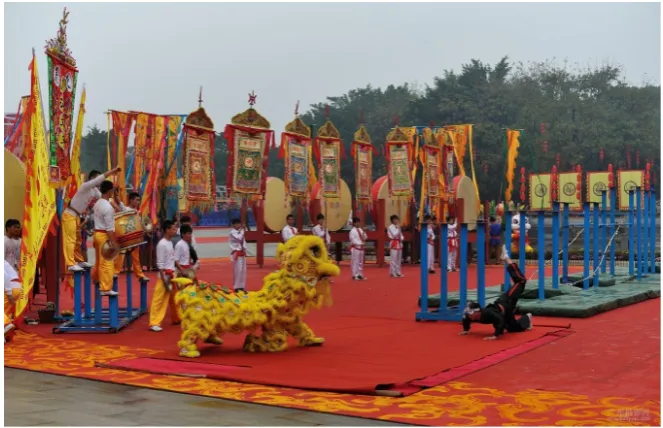
4.1.1. Brief IntroductionBoluodan in Nanhai Temple is hold in every Lunar February 11th-13th, and the day 13th is the birthday of Boluo, this is also regarded as the Birthday of Nan-hai Sea God. This event is originated from Tang Dynasty, is seen as the most special traditional and folk event in Guangzhou, even along Zhujiang River Delta region, it is also the biggest folk Temple event, and the only sacred ocean event in China.
Nanhai Temple is known as “Boluo Temple” which locates in Huangpu Dis-trict of Guangzhou City. It is built by worshipping Zhu Rong, the Sea God of Nanhai Ocean. It is also the oldest port in China with the history of 1410 years. What’s more, it is the biggest, oldest and the most completed maintained Sea God Temple all of China, is one of the birth places of Maritime Silk Road with large number of ancient inscriptions in the temple. And it was ranked as the Key protection historic relics of Guangdong Province in June, 1962. As it was rebuilt in the style of Ming and Qing Dynasty in 1985, it is named as one of the most at-tractive scenery spots in Guangzhou.
DOI: 10.4236/cus.2019.71003 43 Current Urban Studies The event of Temple fair of Boluodan contains diversified activities such as handicrafts, food, convention, worship etc. to display local art of Guangzhou. Since 2005, it has grown to be one of renowned folk cultural brand for public tourism and leisure along Zhujiang River Delta district. There are some tradi-tional foods or conventions. Boluo Chick, it is a handicraft made by paper and feather to pray for lucks and fortune. A traditional food named Boluo dumpling has the history of 800 years. As the most traditional activity in Nanhai Sea God Temple, sea worship activity is the residents’ routine event to pray for fortune and luck. And there are other entertainments such as costume parade, dra-gon-lion dance and flower fair etc.
DOI: 10.4236/cus.2019.71003 44 Current Urban Studies In a word, the development of Boluodan Temple fair mirrors a problem in in-tangible cultural heritage tourism development, people pay too much concern about physical carrier, rather than culture perspective. Our study is expected to promote its development. Meanwhile, it could offer suggestions and opinions for other intangible cultural heritage protection.
4.1.2. Object Selection
[image:10.595.207.539.160.374.2]As there is no identified criterion for authenticity, this study mainly adopted Prof. Wang Ning’s opinion on it. That is, objective authenticity involves the perception about architecture style, impression, internal design of the building and street. Constructive authenticity is the visitors’ reflection of value, expecta-tion, preference, image and opinion towards travel object. Existing authenticity concerns tourist, including their feeling, emotion, understanding and spiritual experience to culture. After the literature study and field trip, combining the idea from Tian Meirong and Kuang Wen, the authors work out following in-fluential factors for this event (Table 1).
Table 1. Element analysis of Boluodan.
Number Item Number Item
1 the attraction from historic relics 7 Detailed Pamphlets
2 Beautiful surrounding scenery 8 Atmosphere
3 Traditional craftsmanship 9 Commercialization
4 which losing original Characteristics Boluo Chicken with new material 10 The knowledge about history
5 Boluo Dumpling 11 Religion and Spirit
DOI: 10.4236/cus.2019.71003 45 Current Urban Studies 1) Questionnaire and analysis
2) Research design and field investigation
The study design, through the questionnaire survey of tourists’ authenticity perception of Boluodan Temple Fair, assesses the development effect of Boluo-dan Temple Fair and offer opinions and suggestions for the development and protection of Boluodan Temple Fair. The first part of the questionnaire involves the study on the tourists’ experience, expectations and motivation of Boluodan. The second part uses Likert 5 subscales to measure the visitors’ perception de-gree of authenticity; 1 means completely disade-gree, 2 means ade-gree a little; 3 means whatever; 4 means somewhat agree and 5 means completely agree. The third part collects demographic data such as the information about tourists’ gender, age, education, occupation, income and population characteristics. The authors conduct the research by one-on-one interview in March of 2015. There are a to-tal of 600 questionnaires, and 565 valid questionnaires.
4.1.3. Data Analysis
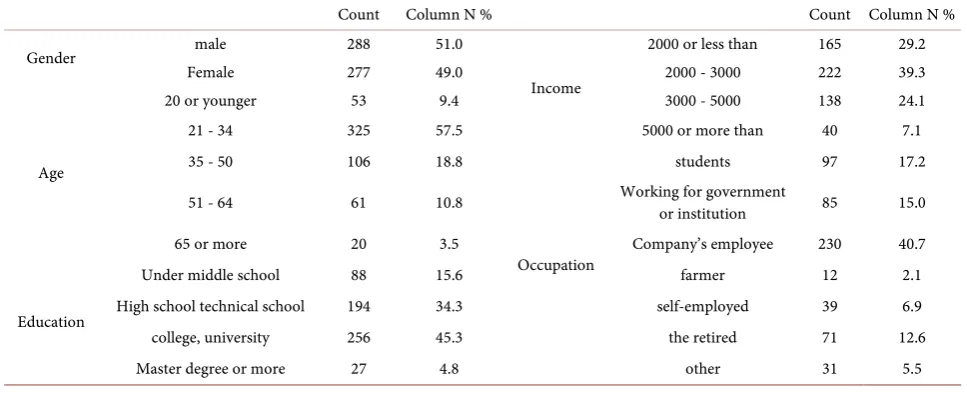
[image:11.595.56.540.525.723.2]Major part of visitors in Boluodan is the residents in Guangzhou city or the ones who live and work along Zhujing River Delta. The data indicates that in our field survey, there are 288 male visitors, and 277 female, which is in an appropriate gender proportion. The visitor younger than 20 is in 9.4%, the ones from 21 - 34 are in 57.5%, the ones more than 35 is in 18.8%, the people above 65 is 3.5%. So we could see the visitors are mainly young and middle-aged people. It is oppo-site with our hypothesis that the main visitors are aged people. The first reason is health condition of senior people, the second is senior people often spend much less time there, just for pray. In terms of career, the people working in govern-ment and institution are the major part of visitors. For income, it is indicated that visitors belong to the ones with middle or low income, which occupies 92.6%. And the education background of visitors ranges from high school, tech-nical school to bachelor degree (Table 2).
Table 2. Demographic statistics of visitor.
Count Column N % Count Column N %
Gender male 288 51.0
Income
2000 or less than 165 29.2
Female 277 49.0 2000 - 3000 222 39.3
Age
20 or younger 53 9.4 3000 - 5000 138 24.1
21 - 34 325 57.5 5000 or more than 40 7.1 35 - 50 106 18.8
Occupation
students 97 17.2
51 - 64 61 10.8 Working for government or institution 85 15.0
65 or more 20 3.5 Company’s employee 230 40.7
Education
Under middle school 88 15.6 farmer 12 2.1
High school technical school 194 34.3 self-employed 39 6.9 college, university 256 45.3 the retired 71 12.6
DOI: 10.4236/cus.2019.71003 46 Current Urban Studies 1) Visitor’s behavior variable statistics
a) Purpose of visiting
The data indicates that worship is the main reason for people being there (there are 332 interviewees). It is a traditional occasion for people in the region. Then other purposes will be taken into visitors’ account, for example, sightsee-ing, experiencing local culture, for leisure, for food. Those are many younger visitors’ motive to be here. What’s more, buying handicrafts such as Boluo Chicken, Boluo windmill, gathering with familiars and friends are goals for some part of visitors.
b) Way of visiting
The statistics show that more than 80% visitors choose to be there with famil-iar and friends. About 8% people come by themselves, only 6% people are com-ing for company or organization’s incentive trip. 61.4% people travel here for the first time, 22% visit here for the second or third time. 16.6% people participate in this event for more than 3 times. Another survey from government proves that there has been increasing number of visitors in Boluodan since 2005, ranging from 300 thousand to 720 thousand.
c) The channel of getting information
The major way of people’s information about this event is from the introduc-tion of friend and TV programme. And some part of them is to know the infor-mation from book and on-line inforinfor-mation. Few people get to know it from tourism pamphlet. The statistics also tell us a fact that only 9.2% people know the Boluodan well, 61.4% people have general idea, and 29.4% people know little about it.
2) Impact analysis of demographic variable on Boluodan authenticity perception
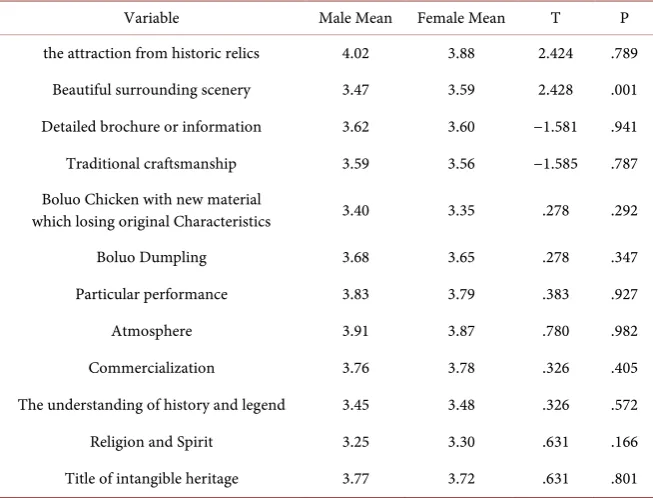
The authors will analyze the variables such as the historical site, surrounding scenery, promotional materials, Boluoji technology, new material, performance, atmosphere, commercialization, understanding of history and legends, religion and spirit, ICH title tec. according to different Boluodan tourists’ gender, age, income, education level and occupation (Table 3).
DOI: 10.4236/cus.2019.71003 47 Current Urban Studies
Table 3. Authenticity perception on Boluodan from visitors with different gender.
Variable Male Mean Female Mean T P the attraction from historic relics 4.02 3.88 2.424 .789
Beautiful surrounding scenery 3.47 3.59 2.428 .001 Detailed brochure or information 3.62 3.60 −1.581 .941 Traditional craftsmanship 3.59 3.56 −1.585 .787 Boluo Chicken with new material
which losing original Characteristics 3.40 3.35 .278 .292 Boluo Dumpling 3.68 3.65 .278 .347 Particular performance 3.83 3.79 .383 .927 Atmosphere 3.91 3.87 .780 .982 Commercialization 3.76 3.78 .326 .405 The understanding of history and legend 3.45 3.48 .326 .572 Religion and Spirit 3.25 3.30 .631 .166 Title of intangible heritage 3.77 3.72 .631 .801
a) Perception on Boluodan from visitors with different gender
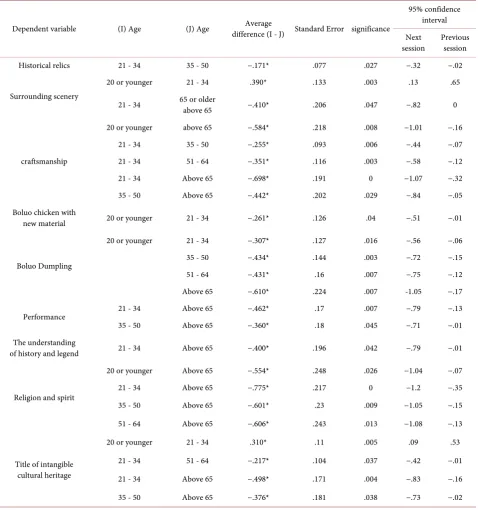
In terms of authenticity perception of historical relics, the visitor with the age of 21 - 34 and the one in 35 - 50 hold significant difference. On one hand, 21 - 34 group know less information about Nanhan Temple than 35 - 50 group. On the other hand, they tend to go there for entertainment rather than getting informa-tion. As for authenticity perception of surrounding scenery, there are signifi-cantly different among people in different ages. 21 - 34 group has great demand in the surrounding scenery. They are quite sensitive on the emission from ship factory of Boluo Temple. While visitor younger than 20, most of them are stu-dents, concern less about environment, and the people above 65, are revisitors of Boluodan, they live near the place, the maintenance and restoration of the phys-ical environment in recent years increase their satisfaction.
DOI: 10.4236/cus.2019.71003 48 Current Urban Studies traditional customs. As for perception of the traditional performance, visitors over 65 are so happy to see the rejuvenation of traditional culture. While poor information about this event from visitors in other age group negatively affect their perception on it. We could also see the tourists under 20 get higher satis-faction on religious and spiritual experience (Mean = 3.40).
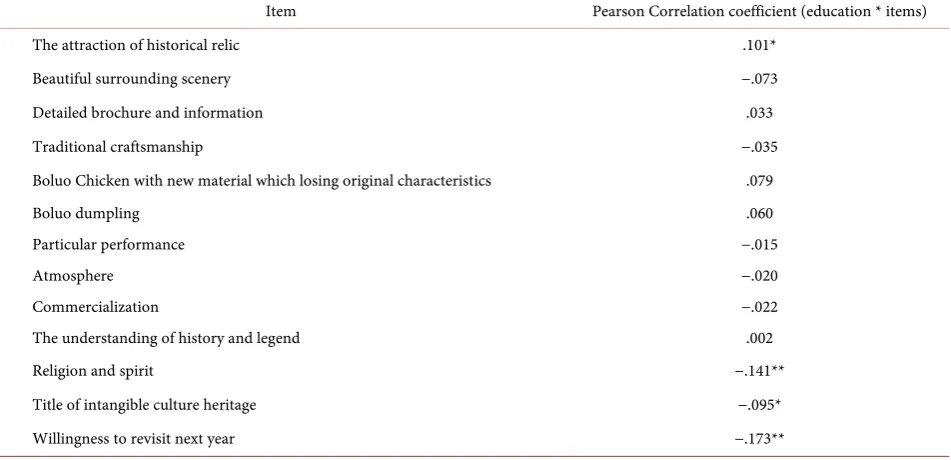
b) Perception on Boluodan from visitors with different education background We study the perception of authenticity in Boluodan from people with differ-ent educational background by single factor variance and Pearson correlation coefficient, the data from single factor variance indicates there is no significant difference in the traditional production process, performance characteristics, atmosphere, commercialization and the understanding of the history and legend. Pearson correlation indicates the more education people receive, the more in-terests and understanding they can do (β = .101*). What’s more, people have more education will demand more for tourism facility, environment and prod-uct, but lower satisfaction in religious and spiritual experience (β = −.141**). From the data of single factor variance, we could see people with different edu-cation background have significant difference on religious and spiritual expe-rience. On the issue whether Boluodan could be entitled as provincial intangible cultural heritage, it shows negative correlation with education background. (β = −.095*) As we all know, people’s perception is closely related with education background, the more we learned, the deeper we might percept. That is why the statistics show that people with high school or technical school education have significant difference with those who graduate from university.
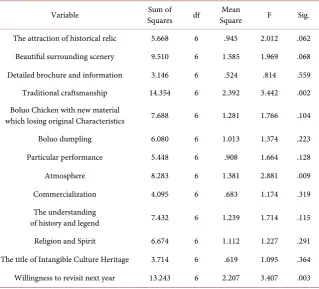
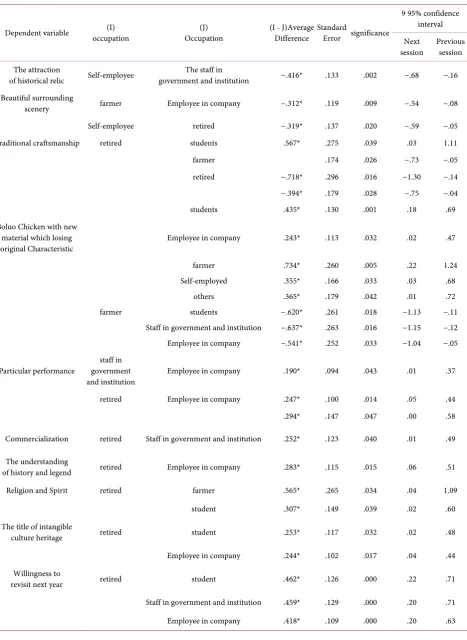
c) Perception on Boluodan from visitors with different education career When significance ≤ .05, it means there exist significant difference in data. We could see from Tables 4-7, visitors from different careers have different authen-ticity perception only in perspective of traditional handicraft and atmosphere.
DOI: 10.4236/cus.2019.71003 49 Current Urban Studies
Table 4. Single factor analysis on authenticity perception difference among visitors with different ages.
Dependent variable (I) Age (J) Age difference (I - J) Standard Error significance Average
95% confidence interval Next
session Previous session Historical relics 21 - 34 35 - 50 −.171* .077 .027 −.32 −.02
Surrounding scenery
20 or younger 21 - 34 .390* .133 .003 .13 .65
21 - 34 65 or older above 65 −.410* .206 .047 −.82 0
craftsmanship
20 or younger above 65 −.584* .218 .008 −1.01 −.16 21 - 34 35 - 50 −.255* .093 .006 −.44 −.07 21 - 34 51 - 64 −.351* .116 .003 −.58 −.12 21 - 34 Above 65 −.698* .191 0 −1.07 −.32 35 - 50 Above 65 −.442* .202 .029 −.84 −.05 Boluo chicken with
new material 20 or younger 21 - 34 −.261* .126 .04 −.51 −.01
Boluo Dumpling
20 or younger 21 - 34 −.307* .127 .016 −.56 −.06 35 - 50 −.434* .144 .003 −.72 −.15 51 - 64 −.431* .16 .007 −.75 −.12 Above 65 −.610* .224 .007 -1.05 −.17
Performance 21 - 34 Above 65 −.462* .17 .007 −.79 −.13 35 - 50 Above 65 −.360* .18 .045 −.71 −.01 The understanding
of history and legend 21 - 34 Above 65 −.400* .196 .042 −.79 −.01
Religion and spirit
20 or younger Above 65 −.554* .248 .026 −1.04 −.07 21 - 34 Above 65 −.775* .217 0 −1.2 −.35 35 - 50 Above 65 −.601* .23 .009 −1.05 −.15 51 - 64 Above 65 −.606* .243 .013 −1.08 −.13
Title of intangible cultural heritage
20 or younger 21 - 34 .310* .11 .005 .09 .53 21 - 34 51 - 64 −.217* .104 .037 −.42 −.01 21 - 34 Above 65 −.498* .171 .004 −.83 −.16 35 - 50 Above 65 −.376* .181 .038 −.73 −.02
The list only including the items with significant difference for too many charts.
d) Perception on Boluodan from visitors with different income
DOI: 10.4236/cus.2019.71003 50 Current Urban Studies
Table 5. ANOVA Analysis on authenticity perception difference among visitors with different education background.
Independent variable Education (I) Education (J) (I - J) Average difference Standard Error Significance
95% confidence interval Next
session Previous session The attraction
of historical relic Middle school and below High school, technical school, college,
university and graduates −.228* .088 .010 −.40 −.06 Beautiful
surrounding scenery
High school or technical school
−.207* .085 .015 −.37 −.04 Technical school,
and university −.387* .151 .011 −.68 −.09 Detailed brochure
and information Middle school and below Master .212* .086 .014 .04 .38
Boluo Chicken with new material which losing original Characteristics
Technical school
and university Master −.415* .176 .019 −.76 −.07 −.371* .161 .022 −.69 −.05
Boluo Dumpling technical school High school, College and university −.183* .081 .025 −.34 −.02
Middle school
and below Master −.429* .189 .024 −.80 −.06
Religion and Spirit
Middle school
and below College and university .292* .116 .012 .06 .52 High school and
technical school College and university .326* .090 .000 .15 .50 Title of intangible
culture heritage High school and technical school College and university .175* .071 .015 .03 .32
Table 6. Correlation analysis on authenticity perception of people with different education background.
Item Pearson Correlation coefficient (education * items)
The attraction of historical relic .101*
Beautiful surrounding scenery −.073
Detailed brochure and information .033
Traditional craftsmanship −.035
Boluo Chicken with new material which losing original characteristics .079
Boluo dumpling .060
Particular performance −.015
Atmosphere −.020
Commercialization −.022
The understanding of history and legend .002
Religion and spirit −.141**
Title of intangible culture heritage −.095*
[image:16.595.62.538.482.712.2]DOI: 10.4236/cus.2019.71003 51 Current Urban Studies
Table 7. ANOVA Analysis on authenticity perception difference among visitors with dif-ferent career.
Variable Squares Sum of df Square Mean F Sig.
The attraction of historical relic 5.668 6 .945 2.012 .062 Beautiful surrounding scenery 9.510 6 1.585 1.969 .068 Detailed brochure and information 3.146 6 .524 .814 .559 Traditional craftsmanship 14.354 6 2.392 3.442 .002 Boluo Chicken with new material
which losing original Characteristics 7.688 6 1.281 1.766 .104 Boluo dumpling 6.080 6 1.013 1.374 .223 Particular performance 5.448 6 .908 1.664 .128 Atmosphere 8.283 6 1.381 2.881 .009 Commercialization 4.095 6 .683 1.174 .319 The understanding
of history and legend 7.432 6 1.239 1.714 .115 Religion and Spirit 6.674 6 1.112 1.227 .291 The title of Intangible Culture Heritage 3.714 6 .619 1.095 .364 Willingness to revisit next year 13.243 6 2.207 3.407 .003
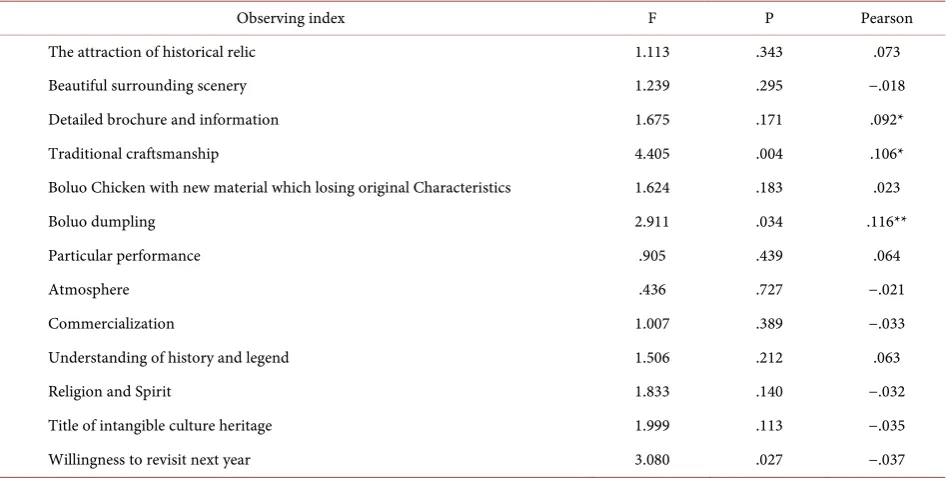
The people with high income have more capacity to purchase, so tasting dum-pling is one of their activities in this event, but the people will less income will not do it. The data from single factor variance shows that the more income the people have, the more difference their perception will be.
The data show that with the increase of income, authenticity perception to-wards pamphlets and handicraft of traditional Boluo chicken will grow. Because well-paid people, to some extent, refer to those who receive higher education, they, therefore, pay more attention to the brochure and pamphlets about the event. In single factor variance analysis, there is significant difference in percep-tion about pamphlets between people with income less than 2000 RMB and those with 3000 - 5000 RMB. What’s more, the people with more income will show more interested in traditional handicraft in Boluo Chick.
3) Expectation and Satisfaction Analysis
DOI: 10.4236/cus.2019.71003 52 Current Urban Studies
Table 8. ANOVA analysis of comparative study of different occupations.
Dependent variable occupation (I) Occupation (J) (I - J)Average Difference Standard Error significance
9 95% confidence interval Next
session Previous session The attraction
of historical relic Self-employee government and institution The staff in −.416* .133 .002 −.68 −.16 Beautiful surrounding
scenery farmer Employee in company −.312* .119 .009 −.54 −.08 Self-employee retired −.319* .137 .020 −.59 −.05 Traditional craftsmanship retired students .567* .275 .039 .03 1.11
farmer .174 .026 −.73 −.05
retired −.718* .296 .016 −1.30 −.14 −.394* .179 .028 −.75 −.04 students .435* .130 .001 .18 .69 Boluo Chicken with new
material which losing
original Characteristic Employee in company .243* .113 .032 .02 .47 farmer .734* .260 .005 .22 1.24 Self-employed .355* .166 .033 .03 .68
others .365* .179 .042 .01 .72 farmer students −.620* .261 .018 −1.13 −.11
Staff in government and institution −.637* .263 .016 −1.15 −.12 Employee in company −.541* .252 .033 −1.04 −.05
Particular performance government staff in
and institution Employee in company .190* .094 .043 .01 .37 retired Employee in company .247* .100 .014 .05 .44 .294* .147 .047 .00 .58
Commercialization retired Staff in government and institution .252* .123 .040 .01 .49
The understanding
of history and legend retired Employee in company .283* .115 .015 .06 .51 Religion and Spirit retired farmer .565* .265 .034 .04 1.09
student .307* .149 .039 .02 .60 The title of intangible
culture heritage retired student .253* .117 .032 .02 .48 Employee in company .244* .102 .017 .04 .44 Willingness to
DOI: 10.4236/cus.2019.71003 53 Current Urban Studies
Table 9. ANOVA analysis on authenticity perception difference among visitors with different income (in RMB).
Dependent variable income (I) income (J) Average difference (I-J) Standard error significance
confidence interval Nest
session Previous session Detailed brochure and information 3000 - 5000 −.187* .092 .044 −.37 −.01
Traditional craftsmanship 2000 RMB or less 2000 - 3000 −.298* .086 .001 −.47 −.13 3000 - 5000 −.247* .097 .011 −.44 −.06 Boluo dumpling 2000 or less 2000 - 3000 −.192* .088 .030 −.37 −.02 3000 - 5000 −.245* .099 .014 −.44 −.05 5000 or more −.316* .151 .037 −.61 −.02 Religion and Spirit 2000 - 3000 5000 or more .335* .163 .041 .01 .66
[image:19.595.64.538.318.557.2]3000 - 5000 5000 or more .398* .171 .020 .06 .73 The title of intangible cultural heritage 2000 - 3000 5000 or more .294* .129 .023 .04 .55
Table 10. Affecting factors analysis on authenticity perception from visitor with different income.
Observing index F P Pearson
The attraction of historical relic 1.113 .343 .073
Beautiful surrounding scenery 1.239 .295 −.018
Detailed brochure and information 1.675 .171 .092*
Traditional craftsmanship 4.405 .004 .106*
Boluo Chicken with new material which losing original Characteristics 1.624 .183 .023
Boluo dumpling 2.911 .034 .116**
Particular performance .905 .439 .064
Atmosphere .436 .727 −.021
Commercialization 1.007 .389 −.033
Understanding of history and legend 1.506 .212 .063
Religion and Spirit 1.833 .140 −.032
Title of intangible culture heritage 1.999 .113 −.035
Willingness to revisit next year 3.080 .027 −.037
Table 11. Analysis of visitors’ expectation and satisfaction about Boluodan.
Expected Coincidence degree Percent Evaluation Percent Satisfaction Percent Totally the same .9 Commercialized behavior 6.4 Totally disagree 1.2
The same 9.4 Commercialization and some traditions are lost 41.2 disagree 5.0 Hard to say 32.9 Hard to say 11.2 Hard to say 29.0
Not same 53.1 Traditions are kept well 25.1 Agree 50.4 Totally not same 3.7 Traditions are carried on 16.1 Totally agree 14.3
DOI: 10.4236/cus.2019.71003 54 Current Urban Studies 4) Principal Component Analysis on affecting visitor’s authenticity per-ception about Bolodan
We extract three common factors after the first factor analysis, but as there only consists the factor of Boluo Chicken made by new material, the content va-lidity will be influenced for one or two questions in one category, so we delete this question and category and start the second factor analysis. This study will make factor analysis on 11 factors about visitors’ perception by SPSS17.0
KMO is sampling appropriateness of Kaiser-Meyer-Olkin. The bigger KMO is, the more common factors among variables, which is more suitable to be fac-tor analysis. Tables 4-14 indicate KMO is 0.960 which is good for factor analy-sis. And Bartlett sphere testing Chi-square value (2736.124) which has reached the degree of significance, it refers to there are common factor among relative matrix, which is suitable for factor analysis.
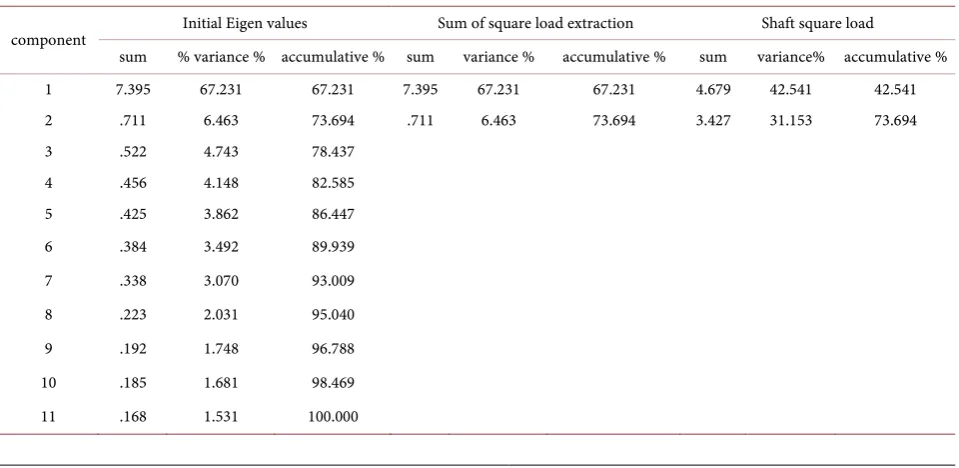
Tables 4-14 indicate that, there chooses two factors among the 11, these two explain 73.69% variation. We figured out 2 core factors for influencing visitors’ authenticity perception. The first factor includes, religion and spirit, the under-standing of legend and history, title of intangible heritage, atmosphere, attrac-tion from historical relics, surrounding scenery, commercializaattrac-tion; the second factors refers to handicraft tradition, Boluo dumpling, detailed brochure and particular performance etc.
Table 12. KMO and Bartlett’s test.
Kaiser-Meyer-Olkin Sampling appropriateness .960
Bartlett Sphere testing
Approximate chi-square distribution 2736.124
Degree of freedom 55
[image:20.595.59.539.501.735.2]significance .000
Table 13. Explanation of variance.
component Initial Eigen values Sum of square load extraction Shaft square load
sum % variance % accumulative % sum variance % accumulative % sum variance% accumulative % 1 7.395 67.231 67.231 7.395 67.231 67.231 4.679 42.541 42.541 2 .711 6.463 73.694 .711 6.463 73.694 3.427 31.153 73.694 3 .522 4.743 78.437
DOI: 10.4236/cus.2019.71003 55 Current Urban Studies
Table 14. Factor loading table after rotation shaft.
Factor Item Component
1 2
F1
Religion and spirit .870 The understanding of history and legend .860 Title of intangible culture heritage .794
atmosphere .789
The attraction of historical relic .707 Beautiful surrounding scenery .618 commercialization .600
F2
Traditional craftsmanship .819
Boluo dumpling .815
Detailed brochure and information .591 Particular performance .584
It only indicates the loading more than .5.
5. Discussion
The study focuses on the analysis of perception difference in perspective of de-mographics in the way of SPSS, single factor analysis and Pearson correlation coefficient. And principal component analysis helps to extract core factors for the perception.
In terms of gender, male’s authenticity perception on historical relics, new trend of folk culture, and overall impression about Boluodan is a bit higher than that of female. While female is more sensitive in perception on surrounding scenery, participation, religious and spiritual experience.
People in different age indicate significant difference in historical relics, sur-rounding scenery, handicraft, Boluo Chick with new material, Boluo dumpling, performance, the understanding of history and legend, religion and spirit, title of intangible culture. However, in the aspects of traditional handicraft, particular performance, atmosphere, commercialization, the understanding of history and legend, the people with different education background don’t show significant difference.
People with different career have significant difference on the authenticity perception about traditional handicrafts and atmosphere. As for people with different income, there are significant difference in traditional handicrafts, Boluo dumpling and willingness of recommendation.
DOI: 10.4236/cus.2019.71003 56 Current Urban Studies
6. Implication
This study offers the deeper perspective on the ICH authenticity perception, as there is even little research on the ICH authenticity protection through the per-ception. This paper tries to propose the index to affect authenticity content of intangible cultural heritage. Visitors’ expectation, evaluation and attitude about intangible cultural heritage will affect their perception and satisfaction. What’s more, their authenticity perception does not only involve the understanding on the physical carrier, but also contains the feeling about intangible ones. After data analysis on perception of visitors, the authors propose some suggestions to improve ICH development: firstly, the construction of spiritual culture should be concerned. The data indicate the factors such as religion and spirit, the under-standing of history and legend, the title of ICH will contribute a lot about visi-tors’ authenticity perception, and the intangible assets such as legend, story, should be full cultivated to enhance people’s perception. Secondly, the role of mass media to publicize ICH should be stressed. It could effectively convey the information about traditional culture with many hi-tech approaches. Thirdly, in terms of scenery management and project design, hi-tech elements and interac-tive programme should be taken into account so as to make it well-known to the public. Fourthly, commercialized construction of traditional temple should be maintained in a balance. On the one hand, commercialization will help to pub-licize the traditional culture. On the other hand, over-development will be avoided to guarantee the authenticity of ICH. Fifthly, the characteristics of tour-ism products will be maintained to make the traditional culture go further.
In all, tourism development of ICH is more than to realize economic target. The more important is to introduce traditional culture to the public to make sure the inheritance and awareness of national culture in China.
The limitation of this study is that it only focuses on the analysis of visitors’ perception after their travel, rather than the comparative study on pre- and post-visit perception. It could be the topic of future research. What’s more, owning to the limited number of index, this research is not able to set up struc-tural model between authenticity perception and satisfaction, which could also be a direction of further research.
Acknowledgements
This research is supported by the key project of National Social Science funding in the Number of 16AZD055.
Conflicts of Interest
The authors declare no conflicts of interest regarding the publication of this pa-per.
References
Tour-DOI: 10.4236/cus.2019.71003 57 Current Urban Studies ism Research, 30, 795-812. https://doi.org/10.1016/S0160-7383(03)00057-4
Chen, N., Qiao, G. H., & Liu, L. (2009). Study on Tourism Risk Perception and Preference Relevance of Outbound Visitors—Case Study of Beijing Visitor. Human Geography, 24, 97-102.
Chen, Y. Y. (2006). Empirical Study on Visitor Perception and Satisfaction—Case Study of Tourism Destination of Kaifeng. Journal of Henan University, 36, 62-66.
Cohen, E. (1988). Authenticity and Commoditization in Tourism. Annals of Tourism Research, 15, 371-386. https://doi.org/10.1016/0160-7383(88)90028-X
Feng, S. H., & Sha, R. (2007). Study on Evaluation Model of “Authenticity and Satisfac-tion” from Visitors in Ancient Village Tourism. Human Geography, 22, 85-89. Gao, F. (2008). Study on Cultural Commercialization and Authenticity in Minority
Tour-ism Development—Case Study of Dynamic Yunnan. Journal of Baoshan Normal Col-lege, 27, 53-56.
Goulding, C. (2000). The Commodification of the Past, Postmodern Pastiche, and the Search for Authentic Experiences at Contemporary Heritage Attractions. European Journal of Marketing, 34, 835-853. https://doi.org/10.1108/03090560010331298 Hu, J. L. (2010). Study on Visitor’s Perception on Industrial Heritage Authenticity in
Shanghai. Shanghai: Shanghai Normal University.
Huang, Y. L., & Huang, Z. F. (2008). Perception Structural Model and Application of Ru-ral Visitors—Case Study of South-West Minority Region. Geographic Research, 27, 1455-1465.
Hughes, G. (1995). Authenticity in Tourism. Annals of Tourism Research, 22, 781-803. Li, Y. L., Chen, Y. S., & Zhang, L. (2007). Cultural Heritage Tourism Study in the
Pers-pective of Visitor Perception and Preference—Case Study on Peing Yao Town. Reform and Strategy, 12, 123-126.
Liu, R., Su, W. C., & Teng, J. Z. (2005). On Rural Eco-Tourism Development in Guizhou. Eco-Economy, 6, 86-89.
Luo, Y. J., Wu, C. C., & Deng, J. Y. (2007). Comparative Study on Affecting Perception of Visitor’s Entertainment Based on Leisure Motive—Case Study of Zhangjiajie National Forest Park. Issues of Forestry Economics, 27, 8-61.
Ma, X. J. (2006). Study on Authenticity of Foreign National Cultural Heritages. Study on Minority of Guangxi, 3, 185-190.
Shi, C. Y., & Liu, Z. H. (2009). Study on Visitor Satisfaction Based on Pure Perception Model. Tourism Tribune, 4, 51-55.
Shi, C. Y., Zhang, J., & You, H. H. (2008). Structural Equation Model of Tourism Desti-nation Competitiveness in the Perspective of Visitor Perception. Geographical Re-search, 27, 703-714.
Tian, M., & Bao, J. (2005). Study on Authenticity of Performance from Visitors—Case Study of Dance in Xishuangbanna. Journal of Guilin Tourism University, 16, 12-19. Tomaz, K., & Vesna, Z. (2009). A Consumer-Based Model of Authenticity. Tourism
Management, 1, 1-13.
Tong, Q., & Yang, R. (2009). Visitor Satisfaction Evaluation of Dongda Spring Resort of Xian. Anhui Agricultural Science, 27, 13421-13423.
Wang, W. (2006). An Introduction to Intangible Cultural Heritage. The Press of Culture and Art.
Herit-DOI: 10.4236/cus.2019.71003 58 Current Urban Studies age Tourism and Heritage Management. Tourism Science, 21, 13-16.
Yang, Y., & Li, T. (2007). Study on Xian Rural Tourism Development in Perspective of Visitor Perspective Evaluation. Tourism Tribune, 22, 32-37.
Yeoman, I. S. Brass, D., & Mcmahon-Beattie, U. (2007). Current Issue in Tourism: The Authentic Tourist. Tourism Management, 28, 1128-1138.
https://doi.org/10.1016/j.tourman.2006.09.012
Zhang, Y. (2009). Empirical Study on the Influence of Visitor Shopping Experience on Purchase Willingness. Journal of Jiangxi University of Finance and Economic, 5, 98-102.