Application of Hypothesis of Replacement at the Analysis
of a Slow Flow of a Body by a Viscous Fluid
Andrey N. Volobuev, Eugene S. Petrov
Department of Physics, Samara State University, Samara, Russia E-mail: [email protected]
Received March 3, 2011; revised May 24, 2011; accepted June 2, 2011
Abstract
On the basis of hypothesis of replacement and the vector formula of Newton’s law for a viscous fluid the way of a finding of resistance a slow flow by an incompressible fluid of bodies of the various form is represented. Application of an offered way to calculation of a flow of various bodies is shown: a sphere, a cylinder, an oblong ellipsoid, a flat plate. Comparison with results of other authors is given.
Keywords:Hypothesis of Replacement, Newton’s Law for Viscosity, Body Flow, Stokes Formula,
Resistance, Oblong Ellipsoid, Flat Plate
1. Introduction
Finding of resistance to a flow of bodies a viscous fluid the important problem for shipbuilding, aircraft, design-ing of devices for heat exchange, etc.
Therefore the finding of simple formulas is of interest for resistance to a slow flow of the cylinder, sphere, ob-long ellipsoid, spheroid, etc. Except for formula Stokes for resistance to a flow of a sphere, the formula for other bodies at different authors considerably differ from each other.
The method for finding the force of the resistance to the flow around the cylindrical form with an arbitrary basis in based on the vector form of Newton’s law for the viscous friction in [1]. However, in some special cases, the vector form of Newton’s law for the viscosity allows the use of a simple method for solving the problems of the slow fluid flow of the body. On the basis of this me-thod some from these tasks are below considered: a flow of the sphere, a flow of the cylinder, a flow of the oblong ellipsoid. Comparison of results of the decision with oth-er authors is shown.
2. Hypothesis of Replacement
Let’s consider the following hypothesis which further we shall name a hypothesis of replacement.
Force of resistance to a slow flow of a body a viscous fluid is proportional to volume of the fluid superseded by a body, both due to replacement of a fluid by a body, and
due to hydrodynamics of a boundary layer about a body. Let W is a volume of the fluid superseded by a body. We count, that force of friction of a fluid about a body is proportional to volume of the superseded fluid
1 2
~
тр
F W W W , where W1 - the volume of a fluid superseded by a body, W2 - the volume of a fluid su-perseded owing to hydrodynamics of a boundary layer about a body.
Check of a hypothesis it is spent for two limiting cases. First, for a flow so-called volumetric bodies where the relation of volume of a body to a surface is great. First of all, for a sphere, where W1W2. Second, for a flow of bodies with small (in a limit zero) the relation of volume of a body to its surface, in particular, for a flat plate, where W2W10.
3. Slow Flow of the Sphere by a Viscous
Fluid
Slow steady flow of the sphere by a viscous fluid was investigated for the first time by Stokes in 1851 [2]. The solution of the Stokes’ problem allows to get the result of the exceptional importance [3]. This is due to the fact that the result of this decision may be used in many fields of science. However, the derivation of Stokes formula, despite its simplicity, is rather cumbersome and not transparent. Therefore, in major monographs, it is either not given [4], although the formula is used, or derivation is not in its full form [5].
obtain the Stokes formula and the formula for the resis-tance of the cylinder in the flow, based on the vector form of Newton's law for a viscous fluid [1].
The vector form of the impulse momentum equation for incompressible fluid was found in [1]. This form is valid for arbitrary direction of the fluid velocity V:
1 d 1 d rgrad
d d
p f
t W W
F F
V
V V , (1)
where Ffr - the frictional force of fluid on the surface of a streamlined body, Fp - the force, driving fluid, t - time, W fluid volume, fluid density.
In [1] also shows that the differential force of friction for incompressible fluid can be written as:
dFfr dSrotV, (2) where S – vector of the contact area of the fluid and the body, - dynamic viscosity of the fluid.
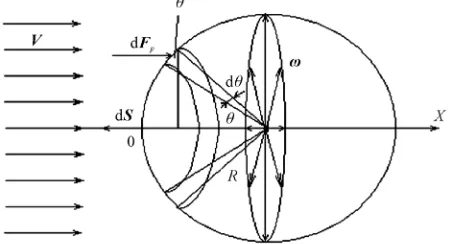
First, we will consider a slow steady sphere flow by the fluid with velocity V, Figure 1, using the Equations (1) and (2). In this case, using the standard approxima-tion for the Stokes problem [3], Equaapproxima-tion (1) takes the form:
d d
d d
p fr
W W
F F
. (3)
We will distinguish, as we follow [3], the belt area on the surface of the sphere:
2
dS2πR sin d , (4) where R – the radius of the sphere, - angle at which the belt is located on the sphere.
When the fluid flows around the sphere, angular ve-locity vector of fluid particles , flowing around the sphere, is always perpendicular to the general differential vector of the belt area dS, Figure 1. Therefore
[image:2.595.59.284.572.694.2]dFfr 2dS. (5) This Equation (5) takes into account that rotV 2ω [4].
Figure 1. The scheme of the sphere flow by the fluid flow in order to find the Stokes formula.
Let us find the right part of Equation (3) in the scalar form:
2
d 2 d
6
d d
fr
F S V
W W R
. (6)
To find (6) we used the following formulas: V
R
and d 1 d
3
W R S. The minus sign reflects the fact that
the friction force Ffr is directed against the force Fp driving the fluid. We shall note, that have neglected a boundary layer, therefore at a flow of a sphere one value of linear speed V is considered only.
The use of the formula for the differential volume dW
is defined as follows. In Equation (1) volume W, in the denominator term, which determines the friction in the fluid, is covered by the surface area S, which is used in formula (2). Surface elements of volume dW that aren’t flowed round by the fluid and the fluid velocity which is perpendicular to them, may not be considered. Therefore, the area of the belt on the sphere dS corres-ponds to the volume of the cone dW, the base of which is the belt dS.
W – is volume of the superseded fluid, as in Arhimed’s law. Force of friction is proportional to volume of the superseded fluid Ffr ~W W W 1 2. In given section
1 2
W W . If volume dW 0, force of friction dFfr 0. Otherwise in the Equation (1) d
d
fr F
W that
is impossible.
We will find the scalar form of the left side of Equa-tion (3):
d d
d d cos
p p
F F
W XdS . (7) In (7) we take into account that the force dFp acts in the direction of the coordinate axis X on the area
d cosS .
Equating (6) to (7) and using (4), we find:
2
dFp 6 V d d cosX S 6π Vsin 2 d dX R
. (8)
Integrating (8) according the angle and the coordi-nate X, we have:
π 2
0 0
6π sin 2 d d 6π R
p
F V
X RV . (9)Since the resistance force of the fluid movement from the sphere - Stokes force - is equal to the force Fp, we can write:
6π C
F RV. (10)
4. Slow Flow of the Plate by a Viscous Fluid
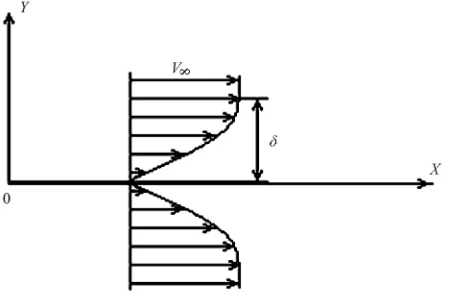
Let’s analyse, using a hypothesis of replacement a slow flow of a flat plate by the viscous fluid, Figure 2.
Let’s find the right part of the Equation (3) for a thin flat plate in width b, streamline along an axis X from two sides. Obviously, in this case all replacement is carried out due to hydrodynamics of a stream and dWdW2.
Force of friction at a flow, taking into account two sides of a plate, is equal:
0
dFfr 2 b Xd , (11)
where 0 - stress of friction on a plate. Using [5], we shall write down:
2 2
2 1 1
0
2
2 2
V V
X X
, (12)
where V - speed of a fluid far from a plate,
1 0
1 V dY V
- thickness of replacement (Y – coor-dinate across plates), 2 0
1 d
V V
Y
V V
- thickness ofloss of the impulse. Sizes 2 1
and 1
2
, where
- thickness of a boundary layer, Figure 2. Substituting (12) in (11), we shall find:
2 2
1 1 1 2
2 2
d
d 2 d
2 2
fr
V V W
F b X
X X
. (13)
For a flat plate elementary volume of replacement
Figure 2. The scheme the flow of the flat plate flow by the viscous fluid.
2 1
dW 2b Xd . The factor takes into account two, that replacement of a fluid goes from both sides of a plate. As
2
dFтр ~ dW , that, actually, the hypothesis of replacement for a plate is proved. We shall show also, that the further transformations result in correct results.
The right part of the Equation (3), taking into account 2
dW dW , for a plate looks like: 2
1
2 2 fr
F V
W X
. (14)
Comparing (12) and (14), we find:
0
1 fr
F W
. (15)
If to enter a gradient of pressure P
X
and to take into account, that for an element of volume of a fluid
dW b X Yd d then differential of driving force
dFpb P Yd d and
p
F P
W X
. Hence, from (3) and (15)
we shall find:
0
1
V V
X
. (16)
The known formula for flow in a boundary layer
V P
V
X X
[5] is used. The received Equation (18) represents the equation of impulse as, found in [5], for a flow of a flat plate:
2
02 1
d d
d d
V
V V
X X
, (17) under condition of neglect the first composed in the right part (a slow flow).
Thus, use of a hypothesis of replacement for a flat plate results in correct results.
Proceeding from (11) and using (16), we shall find force of friction of a fluid about a plate at its slow flow:
2 2
1
0
1 d
fr
V
F b V b V Y
V
. (18)For a finding of resistance of a plate of a flow fluid the knowledge of size 1, i.e. actually forms of a structure of speed V V Y
is necessary. If to use a structure of speed as a polynom of the fourth degree [5], thickness ofreplacement 1 1, 752
l V
, where l - length of a plate. Hence, for a slow flow of a plate force of friction:
3
1,752
fr
[image:3.595.57.289.309.517.2] [image:3.595.60.287.549.697.2]proportional not the areas of a plate, and size b l .
5. Slow Flow of the Long Cylinder by a
Viscous Fluid
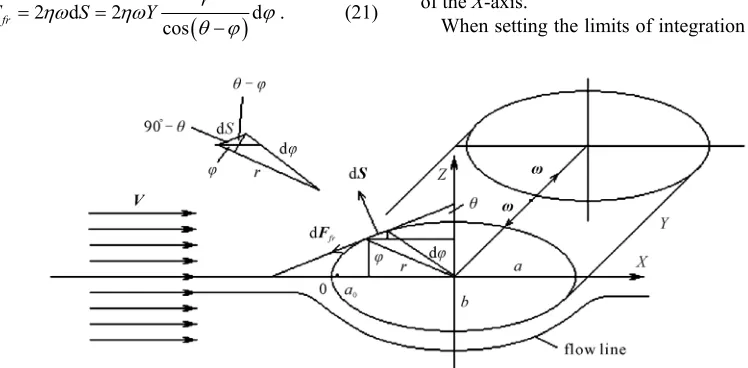
For a long cylinder, which is located across the flow, the flow problem can not be solved, even for very low Rey-nolds numbers, ignoring the inertial (nonlinear) terms of the momentum Equation (1). In the case of writing Newton's law for a viscous fluid in the standard form there is a problem with the boundary conditions for the velocity at large distances from the body [6]. Accounting of inertial terms allows us to solve the problem [7], but, in fact, it is now in the nonlinear approximation. We will show the way to use the vector form of Newton’s law for a viscous fluid in the form (2), applying the used metho-dology for solution of the problem of cylinder flow by the viscous fluid, in the linear approximation, Figure 3.
Now we will consider the fluid flow around a cylinder having an arbitrary profile in a cross section and a center of symmetry.
We distinguish the unit area on the surface of the cy-linder:
d d
cos
r
S Y
, (20)
where r - variable radius of the cylinder, - angle at which the platform is located on the cylinder, - angle determining the position of the tangent to the section of the cylindrical form, Y - the length of the cylinder.
When the fluid flows around the cylinder, the vector of the angular velocity of the fluid particles , a stream-lined cylinder, is directed along the axis of the cylinder and is always perpendicular to the vector of the differen-tial area dS, Figure 3. Therefore, the modulus of the friction force is equal to:
d 2 d 2 d
cos fr
r
F S Y
. (21)
Let us find the right part of Equation (3) in scalar form:
2
2
d 2 d
d 1 2 cos d
4 4
cos cos
fr
F Yr
W Yr
V
r r
. (22)
To find (22) we used the following formulas: V
r
and d 1 2d 2
W Y r .
The selection principle of the volume dW is the same as the principle in the case of the flow of the sphere.
Now we will find the scalar form of the left side of the Equation (3):
d d
d d d cos
p p
F F
W X S . (23)
In (23) we take into account that the force dFp acts in the direction of the coordinate axis X on the area
d cosS .
Equating (22) to (23) and using (20), we find:
2
2
d 4 d d cos
cos
4 cos d d
cos
p
V
F X S
r V
Y X
r
. (24)
Integrating (24) on the angle of and coordinate X, we have:
0
π
2
2
π
0 2
cos d d 4
cos
r
p
X
F VY
r
, (25)where r0 - a half of the size of the profile in the direction of the X-axis.
When setting the limits of integration we take into ac-
[image:4.595.98.472.517.701.2]count that the force Fp acts on the left side of the cy-linder, Figure 3.The beginning of the coordinate X, as well as in case of the sphere flow, is taken on the surface of the left side of the cylinder.
In case of a circular cylinder flow with the radius 0
r a, corners . Therefore: π
2
π 0
2
4 cos d d 8
a
p
V
F Y X VY
a
.The strength of the resistance to the movement of fluid from streamline fluid of the cylinder is equal to:
8 C
F VY. (26) This formula is obtained in [1] according to another method, but it is also based on Newton’s law for a visc-ous fluid in the form (2).
The attention is drawn to the absence of dependence of the force FC on the cylinder radius. This effect accord-ing to the analysis of dimension, is scored in [7]. It is lost in the transition to the nonlinear approximation in the calculation.
Abrupt changes in the kinetic energy flux at the inflec-tion of the flow lines at the beginning and at the end of a cylinder flow, are mainly described by the convective nonlinear terms in the impulse momentum Equation (1). Therefore, the dependence of the force FC on the ra-dius may occur only if we take into account this term, and thus the calculation of the inflection of the flow lines, which is confirmed in [7].
Due to the fact that the flow at the ends of the cylinder was not considered, Equation (26) can be used in prac-tical calculations only in the cases Y a. It gives a good estimation of the resistance of the cylinder in the area Reynolds’s number 0.5 Re 2 .
It is also important to note that due to the identity of the applied methods of finding resistance to the fluid flow of the sphere and the cylinder, the accuracy of the formulas (10) and (26) can be considered the same.
The elliptic cylinder flow is also of a great interest.
Using formula (25) and the ratio cos
X r
, we find:
0
π 2
2 0 π 2
2 0 0
d cos cos d 8
cos
cos cos d 8 ln
cos a
p
a
X
F VY
X
a VY
a
.
In this case а – semiaxisis of the ellipse coinciding with the axis X, a0 the beginning of integration over X. The position of а0 is approximately determined by the
projection of an inflection point of the line flow to the
X-axis, passing near the cylinder in the beginning of its flow. The exact position of the point а0 can be deter-mined only by solving the nonlinear problem.
The relationship between the angles and can be easily found on the basis of the geometric meaning of the
derivative of the ellipse equation
2 2
2 2 1
X Z
a b . Taking
into consideration that both corners are sharp, we have:
2
2
tg a tg
b
, where b – semiaxisof the ellipse, which is perpendicular to the flow. Unfortunately, it does not seem possible to find the force of the resistance of the elliptical cylinder as a simple computational formula similar to (26).
6. Slow Flow of Oblong Ellipsoid of
Rotations by an Incompressible Fluid
Let’s consider a flow of ellipsoid of rotations by a visc-ous incompressible fluid. We believe, that ellipsoid’s section similar to section of the elliptic cylinder on Fig-ure 3. As well as in case of a sphere in a basis of calcu-lation we shall put the Equation (3).Let’s allocate on a surface of ellipsoid of rotations the belt area:
2
2π sin
d d
cos
r
S
. (27)
All designations in (27) correspond Figure 3. Force of friction on a platform dS is equal:
dFfr 2dS. (28) The element of volume corresponding to this force of friction:
1
d d cos
3
W r S . (29)
Taking into account V
r
, we find the scalar form of the right part of the Equation (3):
2
d
6
d cos
fr
F V
W r
. (30)
The scalar form of the left part of the Equation (3) looks like, similar (23):
d d
d d d cos
p p
F F
W X S . (31)
π 2 2 0 0 π 2 2 0cos sin d 12π d
cos
cos sin d 12π
cos
a
p
F V X
Va
. (32)
Force of resistance can be expressed through radius of an equivalent sphere [8]:
0 6π
X p
R F V, (33) where in this case equivalent radius:
π 2 0 2 0 cos sin 2 cos da
. (34)Size a – half-axle of ellipsoid along a stream.
Using
2
2
tg a tg
b
, where b – half-axle of ellipsoid of rotations perpendicular to a stream, we shall transform equivalent radius:
π 2 0 2 0 2 π 2 2 2 0 2 2 cos sin d 2cos
cos arctg tg sin d 2
cos arctg tg
a b b a b a b b a b
. (35)
At a b corners . From the formula (34) fol-
lows, that in this case
π 2
0 0
2a cos sin d a
. Hence,for force of resistance (33) we receive formula Stokes (10).
The integral (35) at 1, i.e. for a oblong ellipsoid rotations, is integrated in quadratures. For this purpose preliminary we get rid from atangent with the help of the
formula
2
4 2 1 cos arctg tg
1 tg
. After sim-
ple transformations the integral (35) will be transformed to a kind:
π
4 2 2
0 2 2 2 2
0
1 tg sin d 2
cos 1 tg
b
.Further substitution Z cos2 we pass to algebraic
functions:
4 1
0 2 2
0
1 d
1
Z Z Z
b Z Z
.Then, using substitution t2 Z 4
1Z
, we pass to rational algebraic functions and as a result we find:2 2 0 2 1 1 arctg 2 1
b
. (36)
At , according to (36), equivalent radius
0 π
2b
. Using (33), we shall find force of resistance of very much oblong ellipsoid rotations at its flow a viscous incompressible fluid along big half-axle:
2
3π
X
R bV . (37) The formula (37) has enough approached character. And force of resistance to a flow at calculation under the formula (37) appears underestimated. It is connected by that in process of lengthening ellipsoid the role of a boundary layer in replacement of a fluid grows.
Dependence of factor of resistance of ellipsoid in ap-proach (37) from Reynolds's number looks like:
2 2 12π
1 π Re
2 X X R C V b
, (38)
where Re Vd
, diameter d 2b, - density of a fluid.
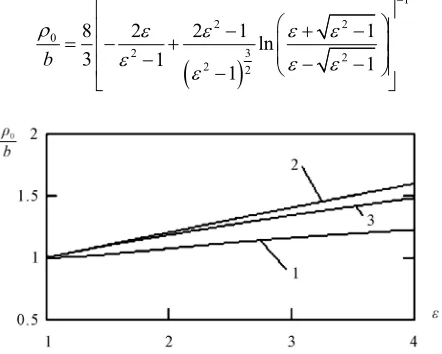
On Figure 4 calculation under the formula (36) rela-
tive equivalent radiuses of ellipsoid rotations 0
b
(line
1) is submitted depending on relative lengthening the
form of it ellipsoid a
b
.
For comparison results of calculation under the for-mula of authors [9]
1
2 2
0
2 3 2
2 2
8 2 2 1 ln 1
3 1 1
[image:6.595.312.533.515.692.2]1 b
(line 2) and [10] under the formula 1
3 2
5b
(line 3) are shown also.
The line 1 has lower results, than lines 2 and 3. Ap-parently, it is connected to increasing influence of re-placement of a fluid in a boundary layer in process of lengthening ellipsoid, but the final choice between the calculations resulted on Figure 4 can be made only as a result of experiments.
7. Conclusions
Thus, use of a hypothesis of replacement allows to esti-mate resistance of bodies of the various form to a slow flow their fluid. Resistance of a body is defined by re-placement of volume of a fluid, both a body, and a boundary layer on a streamline body. Therefore there is an opportunity of definition of parameters of a boundary layer. For example, calculation of thickness of replace-ment, at measurement the general resistance of a body to a flow and a finding of its geometrical volume. The car-ried out analysis shows: than it is more ratio of volume of a body to its surface, especially exact results of calcu-lation of resistance of a body to a slow flow is possible to receive proceeding only from known geometry of a body.
8. References
[1] A. N. Volobuev and E. S. Petrov, “The Research of the Flow of Bodies with Use of the Vector Form of the Newton’s Law for the Viscous Fluid,” Engineering, No. 3, 2011, pp. 162-167.
[2] G. G. Stokes, “On the Effect of Internal Friction of Fluids on the Motion of Pendulums,” Transaction of the Cam-bridge Philosophical Society, Vol. 9, Part 2, 1851, pp. 8-106.
[3] L. G. Lojtsansky, “Mechanics of a Fluid and Gas,” 7th Edition, Drofa, Moscow, 2003.
[4] G. N. Abramovich, “Applied Gas Dynamics,” Science, Moscow, 1969.
[5] G. Schlichting, “Theory of a Boundary Layer,” Science, Moscow, 1974.
[6] G. K. Batchelor, “An Introduction to Fluid Dynamics,” NIC, Moscow-Izhevsk, 2004.
[7] L. D. Landau and E. M. Lifshits, “Hydrodynamics,” Science, Moscow, 1986.
[8] H. Lamb, “Hydrodynamics,” Gostechizdat, Moscow, 1947.
[9] D. Happel and G. Brenner, “Hydrodynamics at Rey-nolds’s Small Numbers,” World, Moscow, 1976.