ISSN Online: 2160-8806 ISSN Print: 2160-8792
DOI: 10.4236/ojog.2019.95073 May 27, 2019 730 Open Journal of Obstetrics and Gynecology
Impact of Facility Delivery Intensity on the
Practice of Active Management of Third Stage
of Labour and Other Labour and Delivery
Interventions in Tanzania
Hilda Kanama, Projestine Muganyizi
*Department of Obstetrics & Gynecology, Muhimbili University of Health Sciences (MUHAS), Dar es Salaam, Tanzania
Abstract
Background: Postpartum haemorrhage (PPH) is the leading cause of mater-nal mortality globally and Tanzania particularly. The World Health Organi-sation recommends Active Management of Third Stage of Labour (AMTSL) in preventing PPH, but its correct implementation has generally remained low. Many factors have been associated with the low practice of AMTSL, but the literature on the impact of delivery intensity is scanty. The aim was to de-termine the impact of facility delivery intensity on correct practice of AMTSL and provision of other labour and delivery interventions. Methods: In 2016, an analytical cross-section study was conducted in four public health facilities in Dar es Salaam. A priori criterion was set at 10 daily deliveries or more for High Delivery Intensity Facilities (HDIFs) in contrast to Low Delivery Inten-sity Facilities (LDIFs). All public obstetric care hospitals and health centres were ranked such that one facility with the highest deliveries and one with the lowest deliveries per category were selected. All eligible deliveries between 8.00 am and 2.00 pm were studied. An observer was assigned to each facility to time and document delivery and third stage events. Data were entered and analysed using SPSS program version 20. Pearson Chi square test was used for categorical data and Student’s t-test for comparing continuous data. Clinical relevance of the differences was evaluated by using 95% confidence intervals. Statistics with p-value < 0.05 were taken as significant. The study was ethically approved by MUHAS Senate Research and Publication Com-mittee. Results: In total, 752 normal deliveries were observed including 376 in LDIFs and 376 in HDIFs. Socio-demographic characteristics of women were comparable in both, except that women with secondary or higher edu-cation were more delivered in LDIFs (60.4%) than in HDIFs (35.1%), p < How to cite this paper: Kanama, H. and
Muganyizi, P. (2019) Impact of Facility Delivery Intensity on the Practice of Active Management of Third Stage of Labour and Other Labour and Delivery Interventions in Tanzania. Open Journal of Obstetrics and Gynecology, 9, 730-744.
https://doi.org/10.4236/ojog.2019.95073
Received: February 18, 2019 Accepted: May 24, 2019 Published: May 27, 2019
Copyright © 2019 by author(s) and Scientific Research Publishing Inc. This work is licensed under the Creative Commons Attribution International License (CC BY 4.0).
http://creativecommons.org/licenses/by/4.0/
DOI: 10.4236/ojog.2019.95073 731 Open Journal of Obstetrics and Gynecology 0.001. LDIFs were more likely to provide Oxytocin as recommended (OR = 4.0, 95% CI: 3.01 - 5.25) and to perform other life saving interventions than the HDIFs. Conclusions: Facility delivery intensity has remarkable impact on correct practice of AMTSL, labor and intra-partum care. Efforts to reduce maternal deaths should minimize facility delivery intensity.
Keywords
Active Management, Third Stage, Delivery Intensity, Hemorrhage, Tanzania
1. Introduction
Obstetric hemorrhage remains the leading cause of maternal mortality in devel-oped and developing countries. Severe hemorrhage after childbirth is the most common form of obstetric hemorrhage, being responsible for approximately a third of all maternal deaths worldwide [1]. In Tanzania, this cause is responsible for up to 39% of all maternal deaths [2] [3].
Most postpartum hemorrhage complications occur within 24 hours of child-birth and are typically due to atonic uterus in 70% of cases [4]. This type of ob-stetric hemorrhage can be effectively prevented by implementing Active Man-agement of Third Stage of Labour (AMTSL) on all women who have given birth since such events are largely unpredictable [5]. According to the International Federation of Gynecology and Obstetrics (FIGO) and the International Confe-deration of Midwives (ICM), AMTSL entails the provision of the uterotonic agent after birth, controlled cord traction and uterine massage after delivery of the placenta [4]. However, a multi-centered Clinical trial studying the relevance of the individual AMTSL components concluded that administration of Oxytoc-ic within 1 minute of childbirth is the single most important component of AMTSL [5] [6] [7]. Following these results and other existing evidence, WHO recommends AMTSL to all delivering women and a uterotonic agent adminis-tered within 1 minute of childbirth as the most important and indispensable component, while the other two components of AMTSL are optional [8]. In Tanzania, the National guidelines for use of uterotonics in AMTSL also recom-mend the use of Oxytocin within a minute of childbirth and mentions Ergome-trine or Misoprostol as alternatives if Oxytocin is not available [9].
in-DOI: 10.4236/ojog.2019.95073 732 Open Journal of Obstetrics and Gynecology dicate the correct uterotonic administration for AMTSL in 7% to 50% of the ob-served deliveries [11] [12] [13].
According to the World Health Report in 2006, Tanzania was one among the 57 countries in crisis for human resource for health, with fewer than 23 work-force (doctors, nurses, midwives) per 10,000 population [14]. The Primary Health Services Development Program (PHSDP) which was introduced in 2007 with the aim to establish and staff an additional 2074 health centres and 8 dis-trict hospitals by 2017 would lead to having a Health Centre at every ward and a District Hospital at every District [15]. While this program would decongest ob-stetric care facilities, the problem persists especially in urban areas and the im-pact of such high delivery intensity on implementing life saving procedures such as AMTSL remains unclear. This study compares adherence to the National guidelines on implementing Active Management of Third Stage of Labor (AMTSL) and other potentially lifesaving labor and delivery interventions in Low Delivery intensity facilities (LDIFs) in contrast to high delivery intensity fa-cilities (HDIFs) in an urban setting. This study intends to inform policy makers, program managers and researchers on the implications of the current delivery intensities on proper implementation of some key life saving obstetric proce-dures at the time when the Primary Health Services Development Program is winding-up while maternal mortality remains persistently high.
2. Methods
This analytical cross-sectional study was conducted in February 2016 in Dar es Salaam Tanzania. Four public obstetric care facilities were selected based on their delivery intensities. From an official exhaustive list of 54 hospitals and health centers that provided obstetric care services in Dar es Salaam, 39 private facilities and the Muhimbili National Hospital were excluded. The remaining 15 facilities were visited and delivery records for the specified past 3 days were re-viewed to establish the average daily number of deliveries. Hospitals and health centers were then ranked separately in the order of daily delivery intensities. From each of the two groups, one facility ranking the highest and one ranking the lowest were selected for the study. It was agreed a priori to take 10 deliveries per day as the cut-off point for HDIFs. Thus, two sets of facilities each with one health center and one hospital were enrolled according to level of delivery inten-sity.
DOI: 10.4236/ojog.2019.95073 733 Open Journal of Obstetrics and Gynecology the study was made after delivery. All eligible women were asked for consent to use their routine records in the study and those who consented were enrolled. A sample size of 752 deliveries was calculated to allow comparison of administra-tion of Oxytocin within 1 minute of birth in LDIFs and HDIFs. Based on the wide prevalence range of appropriate use of uterotonic for AMTSL in Tanzania of 7% to 50% [11] [12] [13], a reasonable assumption of 30% prevalence of cor-rect uterotonic administration in LDIFs and 10% in the HDIFs was made. A sample size of 225 on each group for a two sided significance level with α proba-bility set at 5% would give Power (1-β) of at least 90% to detect the difference. Adjusting for 10% non-response and a 1.5 design effect the sample size of 752 (376 on each group) was considered adequate.
Information about socio-demographic characteristics, past obstetric history, antenatal medical and obstetric complications for current pregnancy, initiation of current labor and monitoring events, medicines and fluids given during labor, timed duration of delivery events and practice of AMTSL was entered in the checklist. These data were obtained from case note records or directly from ob-servation or interview with the women after delivery. Data were recorded on a checklist by data collectors who were intern doctors trained on how to perform AMTSL and on using the checklist (see appendix). These data collectors also participated in pre-testing of the checklist during which the correct observation approach, timing skills using a stop watch, obtaining information from facility records and correct filling of the checklist were fine tuned. Each facility was as-signed a data collector who worked under supervision of the principle investiga-tor. Three components of AMTSL were observed and recorded including the duration from time of delivery of the baby to injection of Oxytocin, application of controlled cord traction and performance of uterine massage [1] [4] [5] [7]. Data for all enrolled women were scrutinized up to 3 hours after delivery. Data analysis was done using SPSS version 20 statistical computer program. In com-paring variables between LDIFs and HDIFs, Pearson Chi square test was used for categorical data and Student’s t-test for continuous data. The clinical rele-vance of the differences was evaluated by the 95% Confidence Intervals. Statistics with p-value < 0.05 were taken as significant.
3. Results
In total, 752 deliveries from the four study facilities were observed, 376 from LDIFs and another 376 from HDIFs. Most women (62.9%) were aged 20 - 29 years with ages ranging from 15 to 45 years, and a median of 25.0 years. Overall, socio demographic characteristics of women who delivered in LDIFs and HDIFs did not differ significantly in terms of age distribution, marital and gravidity statuses on admission. However, significantly more women who are educated to secondary or higher levels delivered in LDIFs (60.4%) than in HDIFs (35.1%), p < 0.001 (Table 1).
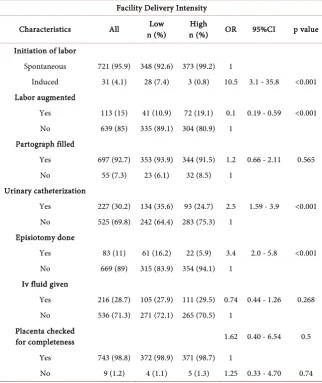
DOI: 10.4236/ojog.2019.95073 734 Open Journal of Obstetrics and Gynecology results are presented in Table 2. Overall, significantly more interventions were practiced in LDIFs than HDIFs.
Comparing with deliveries in HDIFs, women who delivered in LDIFs were more than ten times likely their labor to be induced (OR = 10.5, p < 0.001), more than 2 times likely to be catheterized (OR = 2.5, p < 0.001) and more than three times likely to undergone episiotomy (OR = 3.4, p < 0.001). Partograph filling was universally done in LDIFs as in HDIFs and the provision of intravenous fluids was comparable for the two groups (Table 2).
AMTSL was practiced in all the study facilities. In all the study facilities, Oxy-tocin was the only drug used for AMTSL and was ultimately given to all except two women. Overall, correct provision of Oxytocin within one minute of child-birth was practiced on 497 (66.3%) of the observed deliveries. Other practiced, but less important components of AMTSL are the controlled cord traction and uterine massage (Table 3).
[image:5.595.208.537.398.721.2]Among the 376 women who delivered in LDIFs, 85.6% received Oxytocin within one minute of childbirth compared to only 46.5% of the 376 women who delivered in HDIF, thus giving a four times higher likelihood of receiving Oxy-tocin correctly in LDIFs than in HDIFs, p < 0.001. Likewise, it was overall more likely to have controlled cord traction and uterine massage done in LDIFs than HDIFs (Table 3).
Table 1. Socio-demographic Characteristics of the Delivered Women, N = 752.
Facility Delivery Intensity
Characteristics n (%) All n (%) Low n (%) High OR 95%CI p value
Age
15 - 19 96 (12.8) 41 (10.9) 55 (14.6) 1 0.808 20 - 29 473 (62.9) 240 (63.8) 233 (62.0) 1.20 0.64 - 2.23 30 - 45 183 (24.3) 95 (25.3) 88 (23.4) 1.01 0.69 - 1.50 Marital status
Single 124 (16.5) 68 (18.1) 56 (14.9) 1 0.12
Married/cohabiting 617 (82) 301 (80.1) 316 (84.0) 0.89 0.23 - 3.47 Divorced 11 (1.5) 7 (1.9) 4 (1.1) 1.72 0.47 - 6.29 Level of education
Illiterate 19 (2.5) 11 (2.9) 8 (2.1) 1 <0.001 Primary education 374 (49.7) 138 (36.7) 236 (62.8) 1.40 0.54 - 3.65 Secondary/Higher
education 359 (47.7) 227 (60.4) 132 (35.1) 3.05 2.23 - 4.16 Gravidity
Primigravid 286 (38) 130 (34.6) 156 (41.5) 1 0.103 Gravida 2 - 4 406 (54) 218 (58.0) 188 (50.0) 1.2 0.63 - 2.31
DOI: 10.4236/ojog.2019.95073 735 Open Journal of Obstetrics and Gynecology Table 2. Comparison of labor and delivery interventions in low and high delivery Intensity Facilities.
Facility Delivery Intensity
Characteristics All n (%) Low n (%) High OR 95%CI p value
Initiation of labor
Spontaneous 721 (95.9) 348 (92.6) 373 (99.2) 1
Induced 31 (4.1) 28 (7.4) 3 (0.8) 10.5 3.1 - 35.8 <0.001 Labor augmented
Yes 113 (15) 41 (10.9) 72 (19.1) 0.1 0.19 - 0.59 <0.001 No 639 (85) 335 (89.1) 304 (80.9) 1
Partograph filled
Yes 697 (92.7) 353 (93.9) 344 (91.5) 1.2 0.66 - 2.11 0.565 No 55 (7.3) 23 (6.1) 32 (8.5) 1
Urinary catheterization
Yes 227 (30.2) 134 (35.6) 93 (24.7) 2.5 1.59 - 3.9 <0.001 No 525 (69.8) 242 (64.4) 283 (75.3) 1
Episiotomy done
Yes 83 (11) 61 (16.2) 22 (5.9) 3.4 2.0 - 5.8 <0.001 No 669 (89) 315 (83.9) 354 (94.1) 1
Iv fluid given
Yes 216 (28.7) 105 (27.9) 111 (29.5) 0.74 0.44 - 1.26 0.268 No 536 (71.3) 271 (72.1) 265 (70.5) 1
Placenta checked
for completeness 1.62 0.40 - 6.54 0.5
Yes 743 (98.8) 372 (98.9) 371 (98.7) 1
No 9 (1.2) 4 (1.1) 5 (1.3) 1.25 0.33 - 4.70 0.74
Table 3. The association of practice of AMTSL components with delivery in Low and High Delivery Intensity facilities in Dar es Salaam.
Facility Delivery Intensity OR 95% CI p value
Characteristics All Low High
Oxytocin given within 1 Minute
Yes 497 (66.1) 322 (85.6) 175 (46.5) 3.98 3.01 - 5.25 <0.001 No 255 (33.9) 54 (14.4) 201 (53.5) 1
Controlled cord traction
Yes 737 (98.0) 373 (99.2) 364 (96.8) 4.1 1.1 - 14.7 0.019 No 15 (2.0) 3 (0.8) 12 (3.2)
Uterine massage done
[image:6.595.204.538.528.728.2]DOI: 10.4236/ojog.2019.95073 736 Open Journal of Obstetrics and Gynecology
4. Discussion
Obstetric hemorrhage is the leading cause of maternal mortality globally and in Tanzania where up to 39% of maternal deaths result from this cause [3]. This study was conducted in the context of high maternal mortality, whose ratio is es-timated at 556 deaths per 100,000 live births, and at the peak of government’s efforts through its Primary Health Services Development Program (PHSDP) to construct and staff a large number of health centres and district hospitals by
2017 [15]. A successful PHSDP would have improved obstetric care facility
den-sity in the country and relieved congestion in obstetric care wards. The current study was therefore conducted at the time when congestion in obstetric care wards would be considered at its lowest level and maternal deaths at persistently high figures. The focus of this study was on AMTSL, a recognized gold standard strategy for prevention of postpartum hemorrhage, which is the leading cause of maternal deaths in the country.
Overall, AMTSL was a routine practice in all of the study facilities and two thirds of all the observed deliveries received Oxytocin as recommended by WHO and by the National guidelines [5] [8] [9]. The general high practice of AMTSL to prevent postpartum hemorrhage is similar to what has been observed in many developed and developing countries [11] [13]. The observation that two thirds of deliveries received Oxytocin to prevent postpartum haemorrhage within one minute of childbirth is a remarkable progress compared to the 10.4% which was reported by Cyntia etal., in Tanzania in 2005 [11], and the 7% which was re-ported by Mfinanga et al. in 2008 [12]. In contrast to these two previous studies whose samples were national representative, the current results emanate from a study in an urban setting of a sub-national area where the availability of uterotinics and AMTSL training for health care workers would generally be ex-pected to be better. Further, in contrast to the current study the study by Cyntia etal., was confined to lower delivery intensity facilities (with only one to three deliveries per day) which should have yielded better adherence to implementa-tion of AMTSL. Thus, the current better implementaimplementa-tion of AMTSL in Dar es Salaam could be true sign of improved quality of obstetric care services in more recent years. This connotation is further supported by the most recent study by Bartlett et al. [13] in six Sub-Saharan Africa countries with Tanzania inclusive whereby among the 706 observed deliveries in Tanzania, the correct administra-tion of the uterotonic for AMTSL was observed in 50%. However, the other side of these results shows that a third of delivered women did not receive Oxytocin according to the National guidelines. These women were probably at increased risk for severe postpartum hemorrhage and related morbidity and deaths [16]. More efforts are therefore needed to ensure all delivering women receive Oxyto-cin at the recommended time if maternal deaths and morbidity due to obstetric hemorrhage are to be minimized.
DOI: 10.4236/ojog.2019.95073 737 Open Journal of Obstetrics and Gynecology AMTSL components and other life saving interventions. The distinction be-tween LDIF and HDIF facilities has not been addressed by previously published studies on AMTSL in Tanzania. The results show a significant difference in the practice of AMTSL for the two levels of delivery workload with all the compo-nents of AMTSL being more likely to be performed correctly in LDIFs than HDIFs. In addition, most other important procedures during labour and child-birth were more likely to be performed in LDIFs than HDIFs. It is understood that high intensity delivery wards are likely to be congested, using overwhelmed workforce and probably exhausted supplies and medications [15]. The human resource for health in Tanzania is less than 10 per 10,000 population [15], which is below the 23 human resource for health per 10,000 population threshold for a workforce crisis [14]. Apparently improving human resource and obstetric care facility density are basic for improved life saving obstetric care delivery. It could be said that the Primary Health Services Development Program (PHSDP) in Tanzania was appropriate and focused strategy but the current study results suggest the need for more to be done in order to further reduce delivery work-load to the level that will allow correct implementation of key obstetric life sav-ing procedures. Although there was evidence of progress besav-ing made since 2005, there is still room for improvement. As new evidence becomes available and re-visions to global guidelines are developed, national policies and guidelines should also be updated accordingly. Facility protocols could minimize or elimi-nate the practice of optional components of AMTSL especially in HDIFs in or-der to devote more time on the most relevant and evidence based interventions.
This study has some strengths and limitations. The direct observation and documentation of labor and delivery events gives strength to this study although the approach suffers from the risk of introducing observer bias. The approach could have led to improved performance of health care providers due to the presence of an observer, notwithstanding the efforts made to mask the primary study goal. The limit to observe deliveries occurring between 8.00am and 2.00pm was planned to uniformly evaluate one shift and a reasonable number of daily deliveries. This time limit was also designed to set comparable grounds among facilities at the working time during which medicines and other supplies have not been exhausted. This biased time limit could therefore have exagge-rated the overall prevalence of Oxytocin administration due to non observance of activities during odd working hours. Fortunately, however, Oxytocin was available in adequate supplies in all the study facilities throughout the study pe-riod. Lastly, this study did not focus on the provider per client ratios which may also affect the quality of service delivery. However, the study design involved similar types of facilities on both the study groups, which reassures that the number of providers per shift was not appreciably different.
5. Conclusion
DOI: 10.4236/ojog.2019.95073 738 Open Journal of Obstetrics and Gynecology other life saving interventions during labor and delivery, with poorer perfor-mances being observed in HDIFs than the LDIFs. Strategies to reduce obstetric facility overload should be implemented if maternal lives are to be saved.
Declarations
Ethics Approval and Consent to Participate
This study was ethically approved by the Muhimbili University of Health and Allied Sciences Senate Research and Publication committee. Permission to con-duct the study at the four health facilities was sought from the Dar es Salaam Regional Administrative Secretary (RAS) and the specific Municipal Medical of-ficers. A written consent to participate in the study was obtained from the par-ticipants in conformity with the MUHAS senate Research and Publication committee requirements. Confidentiality and privacy were maintained during data collection, analysis and reporting.
Consent to Publish
Not applicable.Availability of Data and Materials
The datasets generated and/or analysed during the current study are not publicly available but could be available from the corresponding author on reasonable request.
Funding
This study has been funded through a small grant provided by the Directorate of Research and Publications at Muhimbili University of Health and Allied Sciences (MUHAS).
Authors’ Contributions
HK and PS contributed to the planning and design of the study. HK did field work under the supervision of PS. Both were involved in data analysis, manu-script writing, reading and approval of the final draft.
Acknowledgements
The authors of this article would like to acknowledge the contributions from members of academic staff in the Department of Obstetrics and Gynecology at MUHAS for their valuable inputs during designing and planning of the study. Acknowledgement is also made to the data collectors and healthcare providers in Dar es Salaam for their cooperation during data collection. Finally, acknowl-edgement is made to MUHAS for financial support.
Conflicts of Interest
DOI: 10.4236/ojog.2019.95073 739 Open Journal of Obstetrics and Gynecology
References
[1] Royal College of Obstetricians and Gynecologists (RCOG) (2011) Prevention and Management of Post-Partum Haemorrhage: Green-Top Guidelines No. 52. RCOG, London, 1-24.
[2] Tanzania Bureau of Statistics and Macro International (2010) Tanzania Demo-graphic and Health Survey. National Bureau of Statistics Dar es Salaam, Tanzania ICF Macro Calverton, Dar es Salaam, 1-482.
[3] Ministry of Heath, Community Development, Gender, Elderly, and Children (MOHCDGEC) (2015) Availability, Utilisation and Quality of Emergency Obstetric and Newborn Care (EmONC) Services in Tanzania Mainland.
[4] Lalonde, A (2012) Prevention and Treatment of Postpartum Hemorrhage in Low-Resource Settings. International Journal of Gynecology & Obstetrics, 117, 108-118.https://doi.org/10.1016/j.ijgo.2012.03.001
[5] Gulmezoglu, A.M., Lumbiganon, P., Landoulsi, S., Widmer, M., Abdel-Aleem, H., Festin, M., Carroli, G., Qureshi, Z., Souza, J.P., Bergel, E., etal. (2012) Active Man-agement of the Third Stage of Labour with and without Controlled Cord Traction: A Randomised, Controlled, Non-Inferiority Trial. TheLancet, 379, 1721-1727.
https://doi.org/10.1016/S0140-6736(12)60206-2
[6] Sheldon, W.R., Durocher, J., Winikoff, B., Blum, J. and Trussell, J. (2013) How Ef-fective Are the Components of Active Management of the Third Stage of Labor?
BMCPregnancyChildbirth, 13, 46.https://doi.org/10.1186/1471-2393-13-46 [7] Sheldon, W.R. and Winikoff, B. (2012) Controlled Cord Traction in Active
Man-agement of the Third Stage of Labour. TheLancet, 380, 1146.
https://doi.org/10.1016/S0140-6736(12)61664-X
[8] World Health Organization (2012) WHO Recommendations for the Prevention and Treatment of Postpartum Haemorrhage. Geneva.
[9] Ministry of Health and Social Welfare (MOHSW) (2008) United Republic of Tan-zania Ministry of Health and Social Welfare Guidelines for Use of Uterotonics in Active Management of Third Stage of Labour.
[10] Festin, M.R., Lumbiganon, P., Tolosa, J.E., Finney, K.A., Ba-Thike, K., Chipato, T., Gaitan, H., Xu, L., Limpongsanurak, S., Mittal, S., etal. (2003) International Survey on Variations in Practice of the Management of the Third Stage of Labour. Bulletin of the World Health Organization, 81, 286-291.
[11] Cynthia Stanton, D.A., Knight, R., Ariawan, I., Gbangbade, S., Getachew, A., Portil-lo, J.A., Jarquin, D., Marin, F., Mfinanga, S., VallecilPortil-lo, J., Johnsona, H. and Sinta-satha, D. (2009) Use of Active Management of the Third Stage of Labour in Seven Developing Countries. Bulletin of the World Health Organization, 87, 207-215.
https://doi.org/10.2471/BLT.08.052597
[12] Mfinanga, G.S., Kimaro, G.D., Ngadaya, E., Massawe, S., Mtandu, R., Shayo, E.H., Kahwa, A., Achola, O., Mutungi, A., Knight, R., etal. (2009) Health Facility-Based Active Management of the Third Stage of Labor: Findings from a National Survey in Tanzania. HealthResearchPolicyandSystems, 7, 6.
https://doi.org/10.1186/1478-4505-7-6
To-DOI: 10.4236/ojog.2019.95073 740 Open Journal of Obstetrics and Gynecology
gether for Health.
[15] Ministry of Health and Social Welfare (MOHSW) (2014) Human Resource for Health and Social Welfare Strategic Plan 2014-2019. Ministry of Health and Social Welfare, Dar es Salaam.
[16] Soltani, H., Hutchon, D.R. and Poulose, T.A. (2010) Timing of Prophylactic Utero-tonics for the Third Stage of Labour after Vaginal Birth. Cochrane Database of Sys-tematic Reviews, No. 8, CD006173.
DOI: 10.4236/ojog.2019.95073 741 Open Journal of Obstetrics and Gynecology
Abbreviations
AMTSL: Active Management of Third Stage of Labour; FIGO: International Federation of Gynecology and Obstetrics; HDIF: High Delivery Intensity Facil-ity; ICM: International Confederation of Midwives; LDIF: Low Delivery Inten-sity Facility; MUHAS: Muhimbili UniverInten-sity of Health and Allied Sciences; PHSDP: Primary Health Services Development Program; PPH: Postpartum Hemorrhage; RAS: Regional Administrative Secretary.
Appendix
Checklist (English Version)
1) Name of the facility ……… 2) Registration number of the patient ………….. 3) Gravidity………..
4) Parity ………
5) Gestational age at time of delivery (in weeks) ………. 6) Antenatal history:-
a) Number of antenatal visits made ………. b) Last recorded hemoglobin level ………..
c) Last recorded blood pressure [Systole……/Diastole (mmHg) d) PMTCT status: 1/2/0
e) Number of Anti malaria doses received: ………… f) Hematinics doses received …………..
7) Socio demographic factors
a) Maternal age at time of delivery (completed years) ……….. b) Place of residence……….
c) Marital status:- Single
Married Divorced Separated
d) Highest Level of Education:- No formal education Standard seven Form four Form six
College/University 8) Intrapartum History: - a) Initiation of labor
Spontaneous→Skip ii & iii below Induced
b) If labor induced, how Misoprostol
DOI: 10.4236/ojog.2019.95073 742 Open Journal of Obstetrics and Gynecology Oxytocin
Mechanically, balloon catheter Other……… c) Attempts made at labor induction
One
Two
More than two d) Was labor augmented?
Yes
No→ skip v below
e) Dose of oxytocin used for augmentation of labor 5 IU
2.5 IU 1.25 IU
f) Was a partograph filled?
Yes
No
g) Was the patient catheterized?
Yes
No
h) Did the patient receive any i.v fluids during the course of labor
Yes
No
i) If i.v fluids given, how many liters in total ……… j) Type of i.v fluids given
Ringers lactate Normal saline
Dextrose normal saline 5% dextrose solution 10% dextrose solution k) Was episiotomy done
Yes
No
l) Was operative vaginal delivery used to assist delivery?
Yes
No
m)If yes, type of operative vaginal delivery used Vacuum
Forceps
9) Time of delivery………
10)Observed time of delivery of the baby (last baby if twins)………….. 11)Was any oxytocic given after delivery (through 3 hours after delivery?)
Yes
DOI: 10.4236/ojog.2019.95073 743 Open Journal of Obstetrics and Gynecology 12)If given, what type?
Oxytocin Ergomatrine Misoprostol
Other, mention ………
13)If given, how many counted minutes from time of delivery to administration of the Oxytocic medicine? [record stop-watch timing from the time the last babies body part was delivered/not the placenta]?... [N/A if not rec-orded].
14)Was controlled cord traction done? Done
Not done
15)If done, how properly was it done? Perfect
Mainly correct Somehow correct Totally incorrect
16)Was the placenta and its membranes delivered complete?
Yes
No
17)Was uterine massage attempted? Yes
No
18)If uterine massage was done, how properly was it done? Perfect
Mainly correct Somehow correct Totally correct
19)What was the duration of the third stage of labor [From records of complete baby delivery to complete delivery of placenta]? ... (Minutes)
20)How much was the observed blood loss post-delivery? Normal loss
Slightly abnormally large amount but woman looks normal without intra-venous fluids
Excessive blood loss with sick woman needing i.v fluids or blood for rescusi-tation
21)Any HCW in attendance during spontaneous delivery?
Yes
No
22)If HCW was present, what was the cadre? Midwife
DOI: 10.4236/ojog.2019.95073 744 Open Journal of Obstetrics and Gynecology Medical doctor
23)Any complications observed within 3 hours of delivery [tick all that were ob-served]?
Uterine atony
Postpartum hemorrhage Hypotension
Hypovolemic shock Perineal hematoma Fever
Pre-eclampsia/eclampsia