The influence of CpG and UpA dinucleotide
frequencies on RNA virus replication and
characterization of the innate cellular
pathways underlying virus attenuation and
enhanced replication
Nicky J. Atkinson
1, Jeroen Witteveldt
1, David J. Evans
2and Peter Simmonds
1,*
1
Infection and Immunity Division, Roslin Institute, University of Edinburgh, Easter Bush, Edinburgh EH25 9RG, UK and 2School of Life Sciences, University of Warwick, Coventry CV4 7AL, UK
Received October 8, 2013; Revised December 20, 2013; Accepted January 2, 2014
ABSTRACT
Most RNA viruses infecting mammals and other ver-tebrates show profound suppression of CpG and UpA dinucleotide frequencies. To investigate this functionally, mutants of the picornavirus, echovirus 7 (E7), were constructed with altered CpG and UpA compositions in two 1.1–1.3 Kbase regions. Those
with increased frequencies of CpG and UpA
showed impaired replication kinetics and higher RNA/infectivity ratios compared with wild-type virus. Remarkably, mutants with CpGs and UpAs
removed showed enhanced replication, larger
plaques and rapidly outcompeted wild-type virus on co-infections. Luciferase-expressing E7 sub-genomic replicons with CpGs and UpAs removed from the reporter gene showed 100-fold greater lu-minescence. E7 and mutants were equivalently sen-sitive to exogenously added interferon-b, showed no evidence for differential recognition by ADAR1 or pattern recognition receptors RIG-I, MDA5 or PKR. However, kinase inhibitors roscovitine and C16 par-tially or entirely reversed the attenuated phenotype of high CpG and UpA mutants, potentially through inhibition of currently uncharacterized pattern rec-ognition receptors that respond to RNA compos-ition. Generating viruses with enhanced replication kinetics has applications in vaccine production and reporter gene construction. More fundamentally, the findings introduce a new evolutionary paradigm where dinucleotide composition of viral genomes is subjected to selection pressures independently of coding capacity and profoundly influences host– pathogen interactions.
INTRODUCTION
Studies of RNA viruses provide major insights and func-tional understanding of replication mechanisms and host cellular interactions in which processes of mutation, fitness selection, recombination and sequence drift can be directly observed. The small size and necessarily compact arrangement of protein-coding sequences and replication elements creates a range of constraints on sequence change that are frequently both quantitatively and qualitatively different from evolutionary selection pressures on their eukaryotic and prokaryotic hosts. Coding regions of RNA virus genomes frequently contain secondary and higher order RNA structures that function as points of interaction with viral and host cellular proteins and RNA elements such as ribosomes
(1,2). For example, cis-replicating elements of
enteroviruses in the 2C-coding region and of hepatitis C virus in NS5B are revealed by a marked suppression of sequence variability at largely unconstrained synonymous coding sites (3,4). Substitutions in base-paired nucleotides in the stem loop are selected against if they damage the stability of pairing, and changes are often accompanied by compensatory changes in the paired residue to restore pairing. Many RNA viruses have also evolved additional genes to inhibit or divert innate cell defences, typically embedded within other viral genes in alternative reading frames (5), such as the PB1-F2 protein of influenza A virus (6). These interactions place further constraints on virus sequence change in coding regions of RNA viruses over and above their protein-coding function.
While these additional RNA-structure- or protein-coding-based constraints are relatively well understood in viruses where replication mechanisms are characterized, RNA virus genomes additionally evolve under a series of additional compositional constraints for which functional explanations are currently lacking. RNA viral genomes
*To whom correspondence should be addressed. Tel: +44 131 650 7927; Fax: +44 131 651 9105; Email: [email protected]
ßThe Author(s) 2014. Published by Oxford University Press.
This is an Open Access article distributed under the terms of the Creative Commons Attribution License (http://creativecommons.org/licenses/by/3.0/), which permits unrestricted reuse, distribution, and reproduction in any medium, provided the original work is properly cited.
at St Andrews University Library on August 27, 2015
http://nar.oxfordjournals.org/
show an extremely wide range of base compositions; among mammalian viruses, G+C contents range from as low as 33% (respiratory syncytial virus) to 69.9% (rubella virus). Coding regions of RNA viruses frequently show highly abnormal codon usage patterns (7); hepatitis A virus show highly restricted codon usage [formally quantified by measures such as an effective number of codons [Enc] of 39.8; (8)] and codon choices different from mammalian usage [measured as a codon adaptation index of 0.76; (9)].
However, one of the most unexpected compositional abnormalities, particularly among RNA and small DNA viruses infecting mammals and plants, is the markedly biased frequencies of certain dinucleotides such as CpG and UpA throughout their genomes (10–12). For example, poliovirus shows a frequency of CpG dinucleotides in its coding region that is only 54% of the expected value calculated from its (mononucleotide) composition (based
on a 23.5% [frequency of G]23.4% [frequency of C]).
UpA is similarly suppressed (74% of expected value) while
other dinucleotides are over-represented (CpA: 1.32;
UpG: 1.35). The lack of suppression of GpC and ApU
in RNA viruses (and host genomes) demonstrates that this effect is specific to CpG and UpA and does not simply reflect evolutionary pressure for regions of greater or lesser duplex stability.
The overlap between dinucleotides creates
inter-dependencies that complicate analysis of the mutational and selection pressures that underlie these biased
compos-itional frequencies. For example, the
methylation-associated elimination of CpG dinucleotides through
C->T transitions in genomic dsDNA creates TpG and
ApC dinucleotides, a process that potentially accounts for their over-representation in vertebrate DNA (10) and indirectly depletes TpA (13). We recently developed a parameterized Markov method to identify what further dinucleotide context-dependent mutations best account for compositional patterns in genomic and cytoplasmically expressed mRNA sequences of mammals and a range of other eukaryotic phyla. This was extended to analyse compositional abnormalities of RNA viruses infecting mammals and insects (10). As expected, 11- to 14-fold
greater frequencies of C!T transitions upstream of G
(depicted C!T,G) than other transitions best modelled
dinucleotide frequencies in mammalian genomic DNA. Additionally, further mutations that eliminated UpA di-nucleotides and CpG didi-nucleotides were observed in the subset of sequences expressed as mRNA and entering the cytoplasm. Modelling provided evidence for equivalent selection against these dinucleotides in mammalian and plant RNA viruses that is consistent with their
under-representation in previous compositional analyses
(10,11,14). The nature of this apparent selection against CpG dinucleotides operating on both host and viral cyto-plasmic RNA sequences remains unexplained functionally although it has been frequently hypothesized that recog-nition of CpG and potentially UpA motifs is part of an as
yet uncharacterized self–non-self recognition system
coupled to innate immunity (15). This may be functionally and perhaps evolutionarily related to Toll-like receptor 9
that recognizes non-methylated CpG dinucleotides in DNA sequences (14,16).
Further evidence that the presence of CpG dinucleo-tides in viral sequences either activate or are targets of cell defence mechanisms is provided by the observation that polioviruses with artificially elevated CpG frequencies in their genomic RNA were markedly attenuated and replicated to titres several orders of magnitude lower
than wild-type virus in vitro (17). The existence of such
recognition systems may in turn have placed additional selection pressures on host expressed mRNA sequences to evade these viral countermeasures. In the current study, we have developed a model system based on an infectious clone of the enterovirus, echovirus 7 (E7), to investigate the effect of modifying dinucleotide frequencies on virus replication in mammalian cells. The observation that elevated frequencies of both UpA and CpG attenuate viral replication while lowering frequencies below those of native viral sequences enhances replication provided the opportunity to investigate the role of different compo-nents of the innate immune system in dinucleotide recog-nition and recruitment of antiviral defences.
MATERIALS AND METHODS
Cell culture and cell lines
RNA transcripts of the pT7:E7 infectious cDNA clone of the isolate Wallace (accession number AF465516) and pRiboE7luc replicon were used to generate E7 viral stocks and the E7 replicon used in the study. Both were propagated in rhabdomyosarcoma (RD) cells using Dulbecco modified Eagle medium (DMEM) with 10% fetal calf serum (FCS), penicillin (100 U/ml) and
strepto-mycin (100mg/ml). All cells were maintained at 37C
with 5% CO2. Monolayer cultures of A549 cells and
shRNA cell derivatives were used for the interferon pathway analyses while RD cells were used in all other experiments.
In silicodesign of CpG- and UpA-modified viruses
Two regions of the full-length E7 cDNA pT7:E7 clone were selected for mutagenesis. These lay in regions of the genome bounded by the unique restriction sites SalI (genome position 1878) and HpaI (genome position 3119) for Region 1 and EcoRI (genome position 5403) and BglII (genome position 6462) for Region 2. To generate CpG-zero mutants (designated lowercase ‘c’), all CpG dinucleo-tides were eliminated by replacement of either the C or the G base with a randomly alternative selected base selected to preserve coding of the underlying sequence. A similar strategy was used to generate UpA-low (designated ‘u’) and combined zero CpG and low UpA mutants (‘cu’), with the restriction that UpAp(C or U) codons encoding tyrosine precluded elimination of all UpA dinucleotides. Introduction of as many as possible CpG or UpA di-nucleotides while preserving coding was used to generate CpG-high and UpA-high sequences (uppercase ‘C’ and ‘U’, respectively). Sequence changes and their effects on base compositions of the resulting insert sequences are
at St Andrews University Library on August 27, 2015
http://nar.oxfordjournals.org/
shown in Table 1. Sequences generated for the study are provided in Supplementary Data.
The codon adaptation index for human codon usage was calculated through the website http://genomes.urv. es/CAIcal/(9). The Enc (8) and codon pair bias [CPB; (18,19)] were calculated using the program Composition Scan in the SSE package (20). The CPB value was the mean of codon pair scores listed in Supplementary Table S1 (19) corresponding to each codon pair in the insert sequences.
RNA structure prediction and sequence variability
Prototype sequences of each species B enterovirus (http:// www.picornaviridae.com/) were scanned for RNA second-ary structure using the program Folding Energy Scan in the SSE package using 200 base fragments incrementing by 152 bases and 50 sequence-order-randomized control using the algorithm NDR that preserves dinucleotide frequencies of the native sequence (21). Mean folding energy difference (MFED) values for each fragment were plotted against the mid-point of each fragment to localize areas of sequence-order-dependent RNA second-ary structure. MFEDs were also similarly calculated for the reverse complement of each genome sequence. Synonymous sequence variability was determined by measurement of mean pairwise distances using the program Sequence Scan in the SSE package.
Clone construction and recovery of mutant viruses
The full-length E7 cDNA pT7:E7 clone under the control of a T7 promoter was used for this study. Mutant E7 constructs with altered CpG/UpA content were generated by ordering custom DNA sequences (GeneArt, Life Technologies, Paisley, UK). Sequences were provided in standard antibiotic-resistant cloning vectors and were
cloned into pT7:E7. All clones were sequenced over the insert regions prior to further applications. To recover the mutant viruses with altered CpG/UpA content, assembled plasmids were linearized using NotI and RNA generated
using a Mega Script T7 in vitro transcription kit
(Ambion). 100 ng of RNA was transfected into RD cells using Lipofectamine 2000 (Invitrogen) according to the manufacturer’s instructions. The resulting cell lysates were used to generate passage 1 stocks by re-infecting
RD cells. Viral titres were determined by TCID50titration
in RD cells.
Replication phenotype
RD cells were seeded at 5105 cells per well in six-well
plates and subsequently infected with the wild-type (WT) or CpG/UpA mutants at an multiplicity of infection (MOI) of 0.01 per cell for 1 h before removing the inoculum and washing the cells. Samples were then withdrawn at given time points (12, 18, 24, 30 and 42 h post-infection) and the viral titre determined by
measure-ment of TCID50s in 96-well format plates. The assay was
performed in triplicate for each virus. For plaque assays, confluent RD cells in 100-mm dishes or 6-well plates were inoculated with virus in DMEM and incubated for 1 h at
37C with occasional rocking. The inoculum was removed
and replaced with an overlay consisting of 2% Methocell (MC, Sigma) in DMEM. Plates were incubated for 96 h at
37C, fixed with 3.5% formaldehyde and stained with
0.1% crystal violet. Plaque sizes were quantified using ImageJ software.
Quantitative real-time polymerase chain reaction
RNA was isolated from cells using the RNAspin Mini Kit
(GE Healthcare) or from viral supernatant using
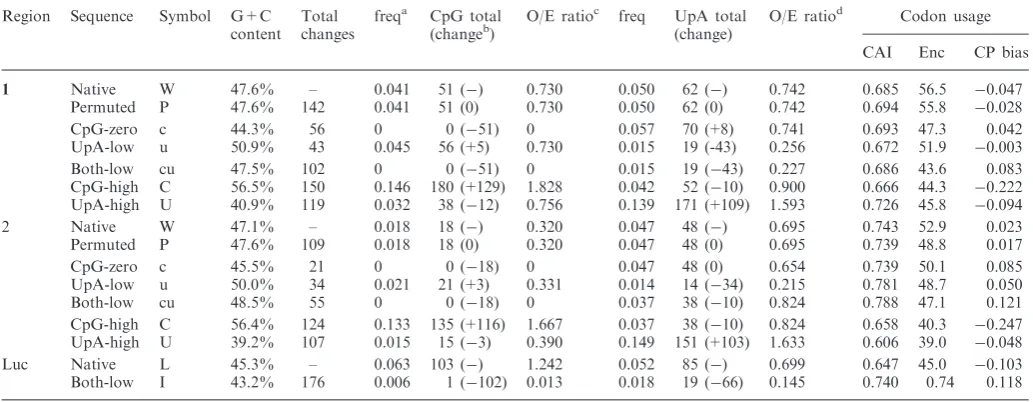
[image:3.612.55.572.86.287.2]the QIAamp Viral RNA Mini Kit (Qiagen). Reverse
Table 1. Composition of e7 and luciferase insert sequences
Region Sequence Symbol G+C content
Total changes
freqa CpG total
(changeb)
O/E ratioc freq UpA total
(change)
O/E ratiod Codon usage
CAI Enc CP bias
1 Native W 47.6% – 0.041 51 () 0.730 0.050 62 () 0.742 0.685 56.5 0.047 Permuted P 47.6% 142 0.041 51 (0) 0.730 0.050 62 (0) 0.742 0.694 55.8 0.028 CpG-zero c 44.3% 56 0 0 (51) 0 0.057 70 (+8) 0.741 0.693 47.3 0.042 UpA-low u 50.9% 43 0.045 56 (+5) 0.730 0.015 19 (-43) 0.256 0.672 51.9 0.003 Both-low cu 47.5% 102 0 0 (51) 0 0.015 19 (43) 0.227 0.686 43.6 0.083 CpG-high C 56.5% 150 0.146 180 (+129) 1.828 0.042 52 (10) 0.900 0.666 44.3 0.222 UpA-high U 40.9% 119 0.032 38 (12) 0.756 0.139 171 (+109) 1.593 0.726 45.8 0.094 2 Native W 47.1% – 0.018 18 () 0.320 0.047 48 () 0.695 0.743 52.9 0.023 Permuted P 47.6% 109 0.018 18 (0) 0.320 0.047 48 (0) 0.695 0.739 48.8 0.017 CpG-zero c 45.5% 21 0 0 (18) 0 0.047 48 (0) 0.654 0.739 50.1 0.085 UpA-low u 50.0% 34 0.021 21 (+3) 0.331 0.014 14 (34) 0.215 0.781 48.7 0.050 Both-low cu 48.5% 55 0 0 (18) 0 0.037 38 (10) 0.824 0.788 47.1 0.121 CpG-high C 56.4% 124 0.133 135 (+116) 1.667 0.037 38 (10) 0.824 0.658 40.3 0.247 UpA-high U 39.2% 107 0.015 15 (3) 0.390 0.149 151 (+103) 1.633 0.606 39.0 0.048 Luc Native L 45.3% – 0.063 103 () 1.242 0.052 85 () 0.699 0.647 45.0 0.103 Both-low I 43.2% 176 0.006 1 (102) 0.013 0.018 19 (66) 0.145 0.740 0.74 0.118
a
Frequency of dinucleotide in insert region.
bTotal number of CpG and UpA dinucleotides in sequence. Changes in numbers between mutated and original WT sequence are indicated in
parentheses.
cRatio of observed dinucleotide frequency (O) to that expected based on mononucleotide composition (E) i.e. f(CpG)/f(C) * f(G). d
O/E ratio based on f(UpA)/f(U) * f(A).
at St Andrews University Library on August 27, 2015
http://nar.oxfordjournals.org/
transcription was performed using M-MLV reverse tran-scriptase (Promega) and random primers The qPCR reac-tions were done using Sensifast SYBR Hi-Rox master mix (Bioline) in a Rotorgene-Q cycler (Qiagen) using the primers listed in Supplementary Table S1. For E7, a standard curve using quantified PCR product was carried out in parallel, allowing quantification of viral copy number. RNA to infectivity ratio was determined by viral load measurements of RNA extracted from
5000 TCID50units of each virus.
siRNA knockdown of PKR
Double stranded RNA-dependent protein kinase (PKR)-specific siRNA (EIF2AK2, Ambion Silencer Select validated siRNA) was used at a concentration of 33 nM. Transfections were performed using Lipofectamine 2000
(Invitrogen) using 1ml of lipofectamine per 24 well
accord-ing to the manufacturer’s instructions. Cells were incubated for 48 h before further experiments were per-formed. Validated non-targeted control siRNA was used at the same concentration and incubation period. To quantify the degree of knockdown of PKR by siRNA, equal amounts of protein extracted from cell lysates 48 h after siRNA transfection were blotted and detected using a PKR-specific mAB (Ye350, Abcam) followed by anti-rabbit HRP-conjugated antibodies (SA1-200, Pierce antibodies) and ECL detection. Band densities were measured for two independent experiments. PKR mRNA expression was quantified at the same time point by qPCR using PKR-specific primers.
Replicon construction and replication kinetics
To accurately quantify intracellular viral replication, the pRiboE7luc sub-genomic replicon plasmid was used. This contains a version of the E7 genome in which the struc-tural genes (nucleotides 753–3118) are replaced with the 1704-bp-long firefly luciferase gene. A synthetic version of the luciferase gene with its CpG and UpA dinucleotides removed while maintaining its coding sequence was designed, which also included a CpG- and UpA-low 72-bp linker sequence at the 3’ containing a SanDI restric-tion site. The sequence was cloned into pT7:E7 using the unique restriction sites KasI (genome position 781) and SanDI (position 3191). To create replicons containing the additional Region 2 CpG or UpA low inserts
(designated ‘lj-jc’ and ‘lj-ju’, with the original clone
designated as ‘Lj-jW’), a 3235-bp section of the replicon
directly downstream of the luciferase gene was excised using SanDI and BglII restriction enzymes. This was then replaced with the equivalent sections of the
previ-ously described cjc or uju constructs with their modified
Region 2 sequences. Replicon plasmids were linearized
using NotI; RNA were synthesized in vitro using T7
RNA polymerase (Ambion); and RNA integrity was con-firmed using an 2100 Bioanalyser (Agilent) before use.
Assays were performed by transfecting 50 ng of replicon
RNA into RD cells seeded at 3104 cells per well in
96-well plates. RNA was transfected at given time points (1, 4, 6, 8 and 12 h) before luciferase assays were carried out using the Luciferase Assay System (Promega),
according to the manufacturer’s instructions. Cells were lysed using the Passive Lysis Buffer, and the cell lysate was transferred to opaque 96-well plates for luminescence analysis using the Glomax Multi Detection System (Promega).
Sequencing of individual virus genomes
Viral RNA was isolated from E7 WT, R1/R2 CpG-high or R1/R2 UpA-high virus stocks generated in RD cells, and cDNA created. Nested primers were designed to
amplify a 500-bp section of the modified Region 1
(nucleotides 1835–2363) and an unmodified region of E7 (nucleotides 3241–3723) using primers listed in Supplementary Table S1 (Supplementary Data). The
proofreading enzyme PfuTurbo DNA Polymerase
(Agilent) was used to amplify the two sections from each cDNA. The products were purified, cloned into a TA vector (pGEM-T easy, Promega) and transformed into
competent E. coli, generating a separate colony for each
copy of the original viral cDNA. The 500-bp inserts were sequenced using M13 primers.
Competition assays
Equal titres of WT and mutant virus (combined MOI = 0.01) were applied simultaneously to RD cells in 24-well plates. Following CPE, the supernatant was
frozen, thawed and 200ml applied to fresh RD cells.
This was continued for up to 10 passages, and performed in triplicate for each virus competition. For the pairwise competition assay, RD cells were inoculated with paired combinations of seven viruses, giving 21 combinations in total. Each pairwise assay was carried out in a single well and passaged through RD cells 10 times. RNA was isolated from the final supernatants; cDNA was generated and nested PCR carried out to amplify either Region 1 or Region 2 using primers listed in Supplementary Table S1. The amplified fragment was then subjected to restriction endonuclease cleavage to estimate the proportion of each sequence (enzymes listed in Supplementary Table S2).
Early intra-cellular replication kinetics
For synchronized infections, RD cells were infected at 4C
with a total of 2108genome copies (1000 per cell) and
maintained at 4C for 30 min before being moved to 37C.
Cells were washed twice with PBS and then trypsinized 1 h or 4 h post infection. The cells were then pelleted and washed again in PBS before RNA was isolated and viral copy number determined by qRT-PCR. Copy number was normalized against the housekeeping gene GAPDH by qRT-PCR primers (primers listed in Supplementary Table S1).
Replication of virus with exogenous interferon-b
RD cells in 24-well plates were pre-treated before infection
with 1000 U/ml human interferon-b (IFNb) for 24 h, or
mock treated with DMEM. Cells were then infected with WT or mutant E7 at an MOI of 1 for 1 h before the inoculum was removed and replaced with media
contain-ing the same concentration of IFNb as previously. Eight
at St Andrews University Library on August 27, 2015
http://nar.oxfordjournals.org/
hours post-infection, RNA was isolated as described above. Viral copy number was determined by qRT-PCR as described previously.
Analysis of viral growth following inhibition/knockdown of signalling pathway components
RD cells in 24-well plates were treated 45 min before infection with 2-aminopurine (2-AP, dissolved in PBS– glacial acetic acid 200:1) and C16 (dissolved in DMSO)
at final concentrations of 5 and 2mM, respectively. RD
cells were treated 2 h before infection with the cyclin-de-pendent kinase (cdk) inhibitor, roscovitine (dissolved in
DMSO), at a final concentration of 40mM. All inhibitor
experiments used mock-treated cells with their respective solvents alone.
Cells were infected with WT or mutant variants of E7 at MOIs of 0.03–0.1, and viral RNA was isolated from cells 24 h later. Viral load was quantified using qRT-PCR. Cells expressing PKR, retinoic acid-inducible gene-I (RIG-I) or melanoma differentiation associated gene 5 (MDA-5) shRNA were used to investigate the effect of PKR, RIG-I or MDA5 knockdown on viral growth. shPKR, shRIG-I and shMDA5 cell lines, as well as the parental A549 line, were infected with WT or mutant variants of E7 at an equal RNA copy number relating to a wild-type MOI of 1. Viral RNA was isolated and quantified 8 h post infection.
Innate and adaptive immune responses PCR array
RD cells in 24-well plates were infected with E7 WT or mutant viruses at an MOI of 10, or a consistent viral genome copy number equating to an MOI of 10 in the WT. Sendai virus and Poly I:C, strong inducers of
IFNb, were separately inoculated as positive controls.
Viral RNA titres were confirmed in virus stock preps using qRT-PCR. Cells were harvested 8 h post infection, and RNA was isolated. RNA from six biological repli-cates was combined, and RNA integrity number was con-firmed to be greater than 9.7 for all samples using a 2100
Bioanalyzer (Agilent). cDNA was made using the RT2
First Strand cDNA Synthesis kit (Qiagen) with 800 ng RNA per sample. The relative expression of 84 candidate genes was then analysed with pre-made ‘Human Innate &
Adaptive Immune Responses PCR Array’ RT2 Profiler
PCR Arrays (SABiosciences, catalogue number
PAHS-052), and RT2 SYBR Green Rox Fast Master Mix
(Qiagen). Cycling conditions were 95C for 10 min,
followed by 40 cycles of 95C for 15 s and 60C for 30 s.
Data were normalized and fold changes calculated using the PCR Array Data Analysis Web Portal (SABiosciences).
RESULTS
Strategy for maximizing or minimizing CpG/UpA content in mutant viruses
Like other small RNA viruses, the frequency of CpG di-nucleotides in the E7 genome is suppressed relative to the expected frequency based on its G+C content, with an
observed to expected ratio of CpG dinucleotides in the coding sequence of E7 of 0.58. Frequencies of UpA di-nucleotides are also suppressed in the E7 genome (observed to expected ratio of 0.78).
To investigate whether CpG and UpA dinucleotide frequencies influenced the ability of E7 to replicate in vitro, we created a series of mutated viruses in which frequencies of both nucleotides were changed from their native levels. This was achieved by reverse genetics using the pT7:E7 infectious clone. RNA transcripts generated from a linearized plasmid containing the E7 complete genome sequence generate infectious virus for phenotypic characterization after transfection into a wide range of mammalian cells.
To select areas for mutagenesis, we sought to avoid regions of the genome that contained RNA elements required for replication or translation functions of the
virus, such as the cis-replicating element (CRE)
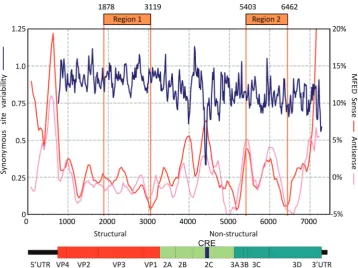
embedded in the 2C coding sequence (2). By scanning an alignment of complete genome sequences of each of the currently described species B serotypes (including the pT7:E7 sequence of the infectious clone), an area of marked suppression of sequence variability co-localized in the 2C region with the CRE (Figure 1). Calculation of folding energies to detected RNA secondary structure in the genome showed prominent regions of structure in the 5’UTR, 3’UTR and the CRE. MFED values were consistently higher for species B sequence orientated in the plus (genomic RNA) orientation. The remainder of the genome showed no evidence for consistent RNA struc-ture formation (MFED values around zero) (Figure 1).
The combination of unrestricted synonymous variabil-ity and an absence of RNA secondary structure over long stretches of the E7 genome provided opportunities for altering dinucleotide frequencies without disrupting po-tential replication elements embedded within the coding sequence. Two genome regions (occupying positions 1878–3119 and 5403–6462, individually corresponding to 16.7% and 14.2% of the full length genome) were selected for mutagenesis based on these criteria. Sequences were modified by replacing nucleotides within CpG or UpA
dinucleotides with alternative bases that preserved
coding. It was possible to remove all CpG dinucleotides from both regions and reduce UpA to frequencies ap-proximately one third of wild-type levels (Table 1; CpG-zero and UpA-low insert sequences). As an alternative strategy, to maximize frequencies of these dinucleotides, every site that could tolerate the creation of these di-nucleotides without changing coding was identified and mutated to create sequences with 2.5–3x their naturally occurring frequencies (Table 1; CpG-high, UpA-high). To ensure that sequence disruption did not damage or destroy undetected replication element(s) within Region 1 and 2, sequences were permuted using the algorithm CDLR in the SSE sequence package (E7-permuted in Table 1). This randomizes the order of codons within the sequence while maintaining coding and dinucleotide frequencies through swaps between equivalently coding triplets in the same upstream and downstream dinucleo-tide contexts. All mutated sequences were then synthesized
at St Andrews University Library on August 27, 2015
http://nar.oxfordjournals.org/
and cloned into the pT7:E7 infectious clone using natur-ally occurring restriction sites.
Replicative fitness of mutants with modified CpG/UpA frequencies
Wild-type E7 and mutant viruses were recovered in cell culture by transfecting whole-genome RNA sequences obtained through T7 transcription of pT7:E7. Recovered
virus was then titred by measurement of TCID50 values
and used in subsequent experiments. In the following sections and associated figures and tables, wild-type and permuted control sequences were designated as W and P; high CpG and UpA mutants as U and C and low mutants as u and c. Clones in which region 1 was exchanged were
designated as UjW and CjW for UpA and CpG-high
sequences respectively; region 2 as WjU and WjC etc.
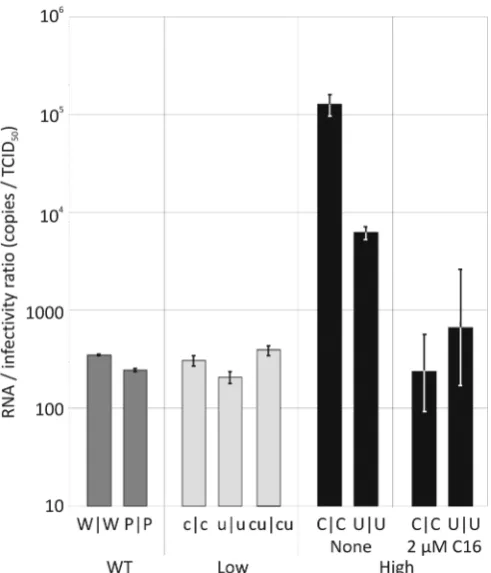
RNA copy to infectivity ratios were determined by extracting viral RNA from a known infectious titre of each virus, and carrying out qRT-PCR quantification (Figure 2). The RNA to infectivity ratio of the permuted
double region mutant, PjP (247 ± 9.2), was similar to that
of the WT E7 virus, WjW (354 ± 8.0), indicating that the
process of synonymous nucleotide replacement while preserving native dinucleotide frequencies does not affect specific infectivity. In contrast, increasing either the CpG or UpA dinucleotide frequency dramatically increased the
RNA to infectivity ratio, with values for the CjC mutant
approximately 350 times the WT value and UjU
approxi-mately 20 times higher. In contrast, the RNA to infectivity ratios of viruses with reduced CpG and UpA frequencies
(cjc, uju and cujcu) were comparable with those of WjW
(Figure 2).
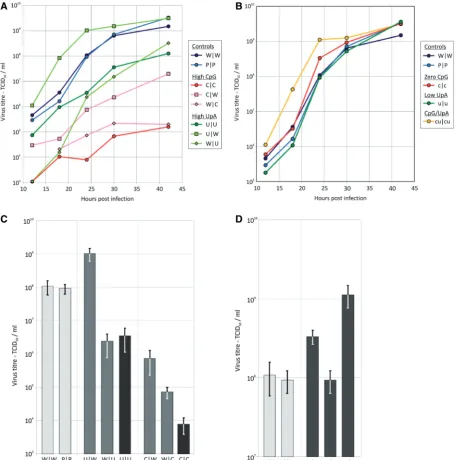
In a multi-step infection using an MOI of 0.01, the growth kinetics of the E7 mutants were compared with that of the WT. Increasing the CpG or UpA dinucleotide frequency caused a severe attenuation of viral replication, resulting in a viral output approximately 7000-fold lower
in CjC than WjW after 24 h, and a 30-fold lower output in
UjU (Figure 3A andC). Mutant viruses replicated more
slowly as well as producing a lower final output of infec-tious particles. Increasing dinucleotide frequencies in Region 2 was more detrimental to viral replication than Region 1, despite its shorter length (1 kb compared with
1.3 kb), with CjW mutants replicating only 144-fold less
than wild type at 24 h, compared to nearly 1500-fold less
in WjC. Amongst the UpA-high mutants, replication was
actually improved by modifying R1, with UjW
consist-ently showing 10-fold greater replication than wild type
while the R2 mutant replicated similarly to UjU.
Replication of the (CDLR–)permuted control (PjP) was
indistinguishable from wild type, confirming that there
were no critical cis-acting replication elements within the
modified regions. A similar but less marked pattern of replication differences was observed in a single-step repli-cation assay where cells were infected at an MOI of 10 at
time zero, including enhanced replication of the UjW
mutant (Supplementary Figure S1A).
[image:6.612.120.479.66.334.2]Mutants with reduced CpG and UpA dinucleotide frequencies compared with the WT level accelerated viral replication (Figure 3B andD). While replication rates and
Figure 1. Genome organization of E7 and positions of mutated insert regions. Insert positions are compared with genome diagram and a plot of
sequence variability within species B enteroviruses at synonymous sites (blue line) and folding energies indicative of RNA secondary structure (red and pink lines). Variability at synonymous sites (left y-axis) was computed at each codon position in alignments, plotted with a window size of 41 codons. MFED values (right y-axis) for sense and antisense RNA sequences were calculated for 200 base fragments, incrementing by 48 bases; values
plotted represent mean values of five consecutive fragments. Nucleotide positions were calculated relative to the pT7:E7 cDNA sequence. at St Andrews University Library on August 27, 2015
http://nar.oxfordjournals.org/
final viral outputs of the CpG-zero (cjc) and UpA-low
(uju) mutants were similar to wild-type and permuted
controls, the double mutant in which both CpG and
UpA were reduced or eliminated (cujcu) showed 10-fold
higher yield than the wild type at both 18 and 24 h post in-fection. Replication differences were again less marked in the less-sensitive single-step assay, with similar replication curves between low mutants and controls (Supplementary Figure S1B).
Altering CpG and UpA dinucleotide frequencies also influenced plaque sizes of individual infectious centres created in RD cell monolayers (Figure 4). R1/R2 CpG high and UpA high mutants showed plaques that were respectively 48% (SEM ± 5%) and 43% (± 6%) the size of WT plaques. Areas of UpA- and CpG-low mutants were conversely consistently greater than WT
(mean values for cjc: 144% (± 19%); uju: 129%
(± 16%) and cujcu: 179% (± 17%) of WT size). In
contrast, plaques produced by the permuted control,
PjP, were indistinguishable to those of WT (98 ± 13%).
To determine whether the low RNA/infectivity ratios and reduced replication of CpG- and UpA-high mutants was the result of their failure to initiate an infection cycle or whether there were later restrictions on the generation of infectious virions, RNA copy numbers immediately post-entry were compared with those 4 h after infection.
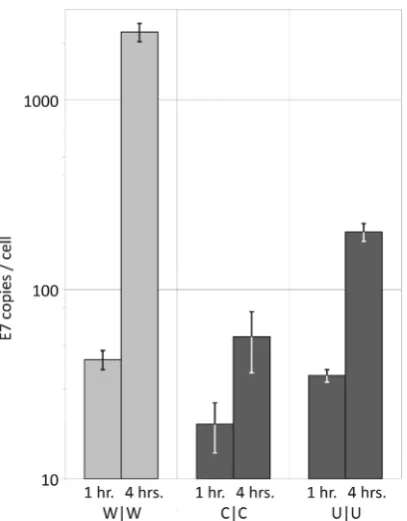
One hour after a synchronous infection with 1000 RNA copies per cell (as determined by qRT-PCR), the number of intracellular viral genome copies was found to be similar between viruses with different dinucleotide com-positions, with 42, 19 and 36 RNA copies detected per
cell in those infected with WT, CjC and UjU mutants,
respectively (Figure 5). However, 4 h post infection, RNA copy numbers of wild-type genome copies increased
to 2362 per cell, whilst the RNA copy numbers of CjC and
UjU mutants only increased marginally (58 and 207 RNA
copies per cell, respectively). The existence of this early impairment has implications in subsequent pathway analyses (see below).
To further investigate the enhancement of replication observed in E7 variants with reduced CpG and UpA frequencies, the effect of dinucleotide changes on the rep-lication of an E7 replicon was investigated. The E7 replicon comprises a monocistronic construct in which structural genes are replaced by a luciferase gene derived from the firefly (Photinus pyralis); detection of lumines-cence enables genome replication to be readily detected and quantified. The luciferase gene in the pRiboE7luc 1.7 kb luciferase gene revealed a strikingly high frequency of CpG (ratio of 1.24; Table 1), consistent with its insect origin (20,22,23). This could potentially attenuate its rep-lication in mammalian cell lines. A replacement luciferase gene was therefore designed in which the CpG ratio was reduced to 0.013 and the UpA ratio to 0.145 (from 0.699), in both cases the lowest values achievable without coding/ restriction enzyme site changes, through introduction of synonymous substitutions. The CpG/UpA-low luciferase
replicon (designated cuj-jW) was further modified by
replacing region 2 with CpG-zero and UpA-low inserts
(designated cuj-jc and cuj-ju respectively; the site of
Region 1 was occupied by the luciferase gene and
indicated as a ‘’).
RNA transcripts were transfected into RD cells, and luminescence was monitored over a 12-h time-course (Figure 6). Compared with the original pRiboE7luc
replicon, the cuj-jW mutant with the luciferase gene
replaced showed a 100-fold increase in relative lumines-cence as early as 4 h post transfection. The replication of the construct was increased a further 6-fold by replace-ment of Region 2 with CpG-zero or UpA-low inserts.
Fitness comparisons of modified viruses using competition assays
To confirm the differences in replicative ability of mutants with altered CpG and UpA frequencies in a more sensitive assay, equal MOIs of WT and mutants were co-inoculated onto RD cells and serially passaged at high MOIs between passages. RNA extracted at different passage numbers was amplified across the modified region and cleaved with restriction enzymes that differentiated WT from mutant sequences. As expected, CpG- and UpA-high
mutants (CjC and UjU) were rapidly outcompeted by
WT virus and were almost eliminated by passage 1, and entirely undetectable at passage 5 (data not shown).
Single region mutants (CjW and WjC) were similarly
[image:7.612.57.303.67.354.2]outcompeted by passage 5, consistent with their reduced
Figure 2. RNA to infectivity ratios of WT and viruses with modified
CpG/UpA frequencies. WT and mutant viruses were recovered from RD cells and TCID50titres determined (note log scale). The number of
viral genome copies was determined through qRT-PCR and compared with the infectivity titre. Results are the mean and standard error from three separate extractions. RNA/infectivity ratios were additionally calculated for CjC and UjU mutants in the presence of C16.
at St Andrews University Library on August 27, 2015
http://nar.oxfordjournals.org/
fitness in the replication assays (Figure 3A and
SupplementaryFigure S1A). Reflecting the more
marginal phenotype of UpA-high mutants, WjU was
eliminated between passage 5 and 10 while UjW
outcompeted the wild-type virus by passage 10 (Figure 7). This latter finding confirms evidence for greater repli-cation of this mutant compared with WT in multi- and single-step replication assays.
The same assay format was used to further characterize the unexpected greater replicative ability of E7 mutants
with reduced CpG and UpA frequencies; cjc and uju
mutants both outcompeted WT showing at least 80%
prevalence after only five passages. By 15 passages, the WT was completely undetectable (data not shown). To investigate this phenomenon further, a series of
competi-tion assays were performed in which WT (WjW), the
permuted control (PjP) and a range of mutants with
dif-fering degrees of CpG and/or UpA underrepresented
(cujW, Wjcu, uju, cjc and cujcu) were each competed
with each other and assayed at passage 6 and 10
(Figure 8). The cujcu mutant showed the highest fitness,
completely outcompeting almost all of the other viruses by
passage 6. The cjc mutant ranked second, followed
[image:8.612.72.529.68.529.2]by cujW. Lowering CpG/UpA frequency in Region 1
Figure 3. Replication kinetics and titres at 24 h of WT and modified viruses infected at a low MOI. RD cells were infected with E7 WT, permuted
(PjP), CpG- and UpA-high mutants (CjC and UjU;AandC) or CpG- and UpA-low mutants (cjc, uju, cujcu;BandD) viruses at an MOI of 0.01. Infectious titre of supernatants was quantified at indicated time points by TCID50(A and B) and mean titres and SEMs at 24 h. Results are the mean
of three biological replicates.
at St Andrews University Library on August 27, 2015
http://nar.oxfordjournals.org/
was demonstrated to have more effect than in R2, as Wjcu
was rapidly outcompeted by cujW as well as
uju. Consistent with the replication assays, reduction
in CpG frequency showed a greater effect than that of UpA.
Mechanism of dinucleotide-dependent replicative fitness differences
The pathway(s) within the cell responsible for the replica-tion phenotypes of viruses with different dinucleotide frequencies is unknown. Investigation of pathways concentrated primarily on measurement of differences
between replication between WT and CjC and UjU
(high) mutants, as these showed the greatest phenotypic differences in replication assays. Secondly, WT E7 replicated rapidly to high titre in fibroblast cell culture and was evidently highly effective at evading host re-sponses induced by infection. As described below, effective control in many aspects of both recognition and effector pathways precluded detection of phenotypic differences from CpG/UpA low mutants.
Replication differences between WT and mutant with altered dinucleotide frequencies may arise through
differ-ences in their susceptibility to IFNb-coupled cellular
defences or through differences in their visibility to pattern recognition receptors (PRRs) that activate the cellular defence response on entry. To investigate the former possibility, susceptibilities of WT and mutant
viruses to exogenous IFNb were determined (Figure 9).
Eight hours after infection, WT and mutant viruses showed dose-dependent attenuation of replication, with between 8- to 27-fold reductions in viral RNA levels
relative to the mock-treated controls at the highest IFNb
dose. While generally similar to WT virus, the replication
of both CjC and UjU (high) mutants showed
approxi-mately 2-fold greater susceptibility to IFNb than WT
[image:9.612.59.303.67.259.2]while the CpG/UpA-low mutant showed approximately 2-fold greater resistance. However, these differences do not account for the 100- to 10 000-fold impairments and
Figure 5. Synchronized infection with equal viral genome copies. RD
[image:9.612.344.548.69.226.2]cells were synchronously infected with 1000 genome copies of WT, R1/ R2 CpG-high or R1/R2 UpA-high virus, as calculated using qRT-PCR. Cells were trypsinized and washed 1 or 4 h post infection and the intra-cellular viral load determined by qRT-PCR. Results are the mean and standard error of three biological replicates.
Figure 4. Plaque morphology of E7 WT and double region mutant
viruses. RD cell monolayers in 10-cm plates were infected with a similar infectious titre of virus and incubated for 96 h at 37C.
(A) Plaque appearance. (B) Plaques sizes of WT and mutant E7 viruses calculated from 25 plaques for each virus using ImageJ software (mean values and SEMs relative to WT control shown as bar heights and error bars).
Figure 6. Analysis of luciferase expression driven by E7 replicons with
reduced CpG/UpA frequencies. Replicons were generated with reduced CpG/UpA frequencies, based on the backbonepRiboE7lucreplicon, in which the structural genes of E7 are replaced by an insect luciferase gene. In the cuj-jW replicon the luciferase gene itself was modified to minimize both CpG and UpA frequency; in the cuj-jc and cuj-ju rep-licons Region 2 was additionally modified to further reduce either CpG or UpA frequency. RNA was generated from replicons and trans-fected into RD cells. Luminescence was measured relative to the mock-transfected control. Results are the mean and standard error of three biological replicates.
at St Andrews University Library on August 27, 2015
http://nar.oxfordjournals.org/
[image:9.612.79.283.350.611.2]10-fold enhancements in replication respectively observed for these mutants (Figure 3).
A second possibility to explain replication phenotypes is that dinucleotide frequencies influence the susceptibility of
viruses to RNA editing by the IFNb-induced p150 isoform
of adenosine deaminase RNA-specific (ADAR1) (24). A greater number of mutations in genomes of CpG- and UpA-high E7 mutants might therefore account for their greatly induced RNA to infectivity ratios (Figure 2). To
investigate this, two 500 base regions of the wild type, CjC
and UjU mutants were sequenced. Sequences from either
the modified Region 1 (nucleotides 1835–2363) or an un-modified region (nucleotides 3723–3241) were amplified and individual population components sequenced by cloning the PCR product and sequencing individual clones. At least 14 clones were sequenced in each region for each virus (Supplementary Table S3). In wild-type E7,
no mutations were observed in the total 15.5 kb
sequenced. In the CjC virus, three synonymous
single-nu-cleotide changes were observed in the total 15 kb
sequenced, while in UjU a total of 15.5 kb revealed one
synonymous change and one U!C substitution,
convert-ing a methionine residue into a threonine. Although the amount of sequence data obtained was limited, the
[image:10.612.330.536.67.280.2]pre-dominantly synonymous mutations observed in CjC and
Figure 7. Fitness determination by competition assays between WT
and modified viruses. RD cells were infected with an equal MOI of WT and modified virus, and the supernatant serially passaged through cells. RNA was isolated and the composition of each virus determined through selective restriction digests. Images show the virus composition in the starting inoculum and in three biological replicates following passage of CpG- and UpA-low mutants and of UjW.
Figure 8. Pairwise fitness comparison between E7 WT and mutant with
[image:10.612.77.258.71.413.2]varying degrees of CpG and/or UpA under-representation. RD cells were infected with an equal MOI of two viruses represented in columns and rows of the matrix and the supernatant serially passaged. The composition of each virus was determined through re-striction endonuclease cleavage (see Figure 7) and outcome displayed by colour shading. The key refers to population representations of viruses listed in columns (for example, all but one variants were out-competed by the cujcu mutant). The fitness ranking deduced from these results is shown underneath the figure.
Figure 9. Effect of exogenous IFN-b on viral replication. RD cells
were treated with 5, 50 and 500 U/ml human IFN-b, or mock treated, then infected with WT E7, CjC, UjU and cujcu mutants at an MOI of 1. RNA was isolated after 8 h and viral load determined by qRT-PCR. Results are the mean and standard error of two biological replicates.
at St Andrews University Library on August 27, 2015
http://nar.oxfordjournals.org/
[image:10.612.310.556.397.621.2]UjU mutants do not suggest any substantially greater sus-ceptibility to ADAR1-mediated mutation, and this would be unlikely to be responsible for their dramatically impaired replication.
Another possibility for the different phenotypes of E7 dinucleotide mutants is that they differentially activate the
IFNbresponse in infected cells. To investigate the cellular
response to infection, the expression of 90 innate immune response genes was analysed following infection with E7,
CjC or UjU viruses. WT E7 induced a minimal IFNb
response at 8 h with transcript levels at the limit of detec-tion, a similarly unaltered level of the early interferon-stimulated genes (ISGs) 15 and 56, and small changes in expression of a total of six genes from the 90 immune response genes (Figure 10 and Supplementary Figure S2). Of these, five were up-regulated 2- to 5-fold and one was down-regulated. The response was quantitatively and qualitatively much weaker than in cells transfected with poly-I:C or infected with Sendai virus (Figure 10), where
there were large increases in the expression of IFN-band a
range of other innate response genes.
Similarly, inoculating cells with infectious doses of CjC
and UjU mutants equivalent in RNA copy number to
those of WjW (i.e. MOIs 100- to 1000-fold lower than
WT) induced no IFNb or ISG responses and minimal
changes in gene expression of other genes in the
PCR array (>2- and <5-fold induction of three and
four genes, respectively; Figure 10 and Supplementary Figure S3). This demonstrated that RNA genomes with increased dinucleotide frequencies entering the cell equiva-lently to WT (see above) activated only a minimal cellular
response. However, infecting cells with UjU and
particu-larly CjC mutants at equal MOI to WT induced a higher
IFNb response, which was also reflected by a greater
number of changes in gene expression in the PCR array.
Infecting with the CjC mutants led to 12 genes being
up-regulated (and 5 down-regulated).
To investigate potential signalling pathways that were differentially activated by viruses with differing dinucleo-tide frequencies, the replication of E7 and mutant viruses
(CjC and UjU) was measured in cells in which expression
of specific signalling component was inhibited. Interferon regulatory factor 3 (IRF3) is a central regulator of type I IFN induction in response to the detection of viral RNA in the cytoplasm or endosomes, and its signalling is
blocked by the viral Npro protein from classical swine
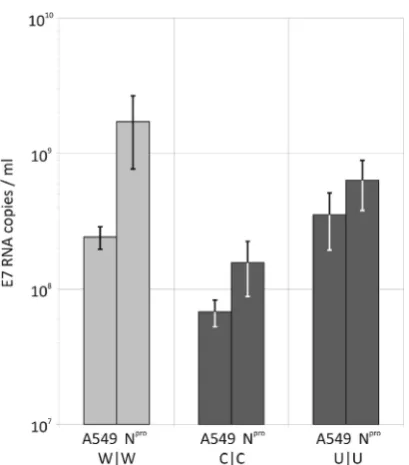
fever virus (25). Both mutant and WT viruses inoculated at equal MOIs replicated to higher levels in cells
express-ing Nprocompared with the parental A549 cell line, with
8-fold increases in WT virus and 3- to 4-8-fold in CjC and
UjU (Figure 11). Replication of E7 is therefore at least
partially controlled through activation of the IRF3
signalling pathway even though IFNb and other cellular
responses are highly restricted. However, there was no evidence that IRF3-signalled inhibition of virus
replica-tion was differentially activated by mutants with
elevated CpG and UpA dinucleotide frequencies; fold in-creases in replication were actually less than those dis-played by WT E7.
IRF3 is part of a signalling pathway that is activated upstream by the cytoplasmic dsRNA sensors RIG-I and
MDA5. Another PRR that is potentially responsible for differential recognition of infecting viruses with differing dinucleotide compositions is PKR. To investigate their
roles in recognition, replication of WjW, UjU and CjC
mutants was determined in A549 cells expressing
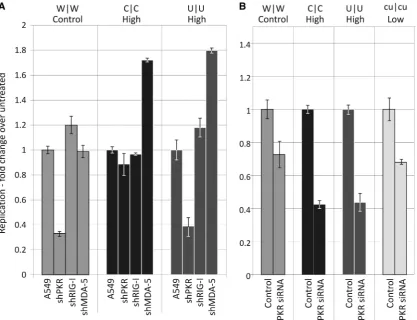
shRNAs targeting each PRR (Supplementary FigureS3). Down-regulation of RIG-1 had no effect on the replica-tion of WT or mutant E7 variants, while the replicareplica-tion of
CjC and UjU mutants (but not WT E7) was marginally
increased (2-fold) in cells expressing the MDA-5 shRNA (Figure 12A). In contrast, down-regulation of PKR had a
partial inhibitory effect on the replication of WT and UjU
mutant E7 variants, but little or no influence on CjC
mutant replication.
We investigated this latter observation further by in-hibiting PKR expression in RD cells by transfecting them with a PKR-specific siRNA to PKR. These down-regulated PKR mRNA and protein expression by
>80%, irrespective of whether infected by E7 or not
(Supplementary Figure S4). Under these conditions, the
replication of WT and CjC, UjU mutants was consistently
reduced compared with that in cells pre-treated with the
control siRNA as was the replication of the cujcu mutant,
which we additionally tested (Figure 12B).
Although specific knockdown of PKR expression by shRNA and siRNA typically inhibited replication of E7 and its mutants, treatment of cells with the kinase in-hibitor C16 dramatically enhanced virus replication of mutants with increased frequencies of CpG and UpA di-nucleotides (Figures 13 and 14). Treatment of cells with C16 led to 10- to 100-fold increased in the replication
of CjC and UjU mutants, while the replication of WT
and cujcu (CpG/UpA-low) mutants was relatively
un-affected (Figure 13). We extended this study to determine the cytopathology of selected mutants. Infecting cells with WT virus at an MOIs of 0.1 produced visible pathology after 22 h, and limited cytolysis at an MOI of 0.01 (Figure 14A). This was unaffected by the addition of C16. In marked contrast, untreated cells infected with
CjC and UjU mutants showed no cytopathology over
the experimental interval while those treated with C16 showed complete CPE at an MOI of 0.01. C16 treatment
similarly increased the infectivity of CjC and UjU mutants
(Figure 14B). Virus stocks containing 3000 PFU/ml, as measured previously on untreated RD cells, were re-titrated in a quantal infectivity assay with six replicated at serial 10-fold dilutions and infectious titres determined by probit analysis. C16 treatment had no effect on the
infectivity of WT or cujcu E7 variants, while infectivity
was enhanced 10-fold (UjU) and nearly 1000-fold (CjC)
in mutants with increased dinucleotide frequencies
(Figure 14B). Using these revised infectivity titres, CjC
and UjU mutants showed equivalent RNA/infectivity
ratios to WT virus in the presence of C16 (Figure 2). The attenuating effect of increased CpG and UpA frequencies on E7 replication is thus entirely reversible by C16; the reduced infectivity of high CpG/UpA mutant stocks is clearly not because the virus is intrinsic-ally defective but because the cell is better able to prevent infection by these mutants than by WT virus.
at St Andrews University Library on August 27, 2015
http://nar.oxfordjournals.org/
Figure
10.
Analysis
of
gene
expression
in
cells
infected
with
WT
E7
and
mutants.
RD
cells
were
infected
with
E7
at
an
MOI
of
10
and
changes
in
expression
at
8
h
of
a
rang
e
of
innate
and
adaptive
immune
response
genes
determined
using
a
PCR
Array.
Responses
were
compared
with
those
induced
in
cells
infected
by
high
CpG-and
UpA
mutants
at
equal
copy
number
to
WT
or
equal
MOI.
Parallel
infections
with
Sendai
virus
(SV)
and
transfection
of
poly-I:C
were
performed.
Non-specific
induction
of
genes
was
controlled
fo
r
by
parallel
assays
of
cells
exposed
to
u/v
inactivated
supernatant
corresponding
in
amount
to
that
added
in
the
equal
copy
number
(C1)
and
equal
MOI
(C2)
assays.
at St Andrews University Library on August 27, 2015
http://nar.oxfordjournals.org/
Although C16 has been considered to be a specific in-hibitor of PKR (26), its effect on the replication of GpG-and UpA-high mutants was inconsistent with the lack of similar replication enhancement using sh- and siRNAs directed against PKR mRNA (Figure 12). The possibility of an off-target effect of C16 was further suggested by the
lack of an equivalent affect on the replication of CjC and
UjU mutants by 2-AP that also inhibits PKR
phosphor-ylation (Figure 13). Documented additional targets of C16 include the cyclin-dependent kinases, CDK2 and CDK5 (27). To investigate whether these unintended actions of C16 were influencing E7 replication, we determined the effect of a well characterized inhibitor of cyclin kinases, roscovitine, on the replication of WT and mutant variants.
Cells infected with WT and cujcu E7 variants showed
nearly 10-fold reduced E7 replication compared with
un-treated cells while the replication of UjU replication was
unchanged and CjC substantially enhanced (&9-fold). As
observed with C16 treatment, roscovitine induced visible
cytopathology in CjC-infected cells while none was
apparent in controls (data not shown). Increased CjC
rep-lication occurred despite a general reduction in cellular gene expression in treated cells (including a 3-fold reduc-tion in the housekeeping gene, GAPDH).
DISCUSSION
Although decreases in virus fitness and replication by increasing CpG and UpA frequencies in RNA virus genomes has previously been described for poliovirus, this study is the first to demonstrate the converse, that
decreasing frequencies of these dinucleotides significantly increases virus replication. This remarkable finding raises profound questions about the nature and direction of evo-lutionary selection operating in enteroviruses and poten-tially each of the many other RNA viruses that show similarly suppressed CpG and UpA frequencies (10–12). The study additionally demonstrates that while E7, along with other enteroviruses, is highly effective at suppressing
IFNbinduction and activation of host cell defences, cells
are nevertheless able to recognize and restrict replication of mutants with differing dinucleotide frequencies. The findings point towards a novel mechanism for recognizing foreign RNA that prevents establishment of virus replica-tion at an early time point after virus entry.
Relationship between virus replication and CpG and UpA frequencies
Increasing the frequency of CpG or UpA dinucleotides in E7 resulted in severe viral attenuation, characterized by reductions in replication rate, smaller plaque areas, low particle to infectivity ratio and a low competitive fitness relative to WT E7. These findings are consistent with replication defects observed in poliovirus with elevated CpG and UpA frequencies in the capsid gene (17,28,29).
The 2009 study by Burns et al. provided a convincing
demonstration that the previously reported attenuating effect achieved by codon de-optimization (28) was second-ary and proportional to increases in CpG and UpA frequencies rather than a slowing of virus replication by in-efficient translation. Moreover, it was shown that changes in the capsid to conventional measures of translation effi-ciency (CAI, Enc, CPB) correlated poorly if at all with replication rate, in contrast to direct correlations with changes in CpG and UpA dinucleotide frequencies.
[image:13.612.78.283.64.297.2]Construction of mutants that increased bias towards unfavourable codon pairs (19) were remarkably effective at reducing poliovirus replication but again these also substantially increased CpG and UpA dinucleotide frequencies. In their study, however, the PV-Min mutant contained an observed to expected frequency of CpG of 1.34 (compared with 0.63 of the WT sequence) and 1.36 for UpA (WT: 0.74) that might similarly account for the observed differences in replication phenotypes rather than translation effects. These indeed approach levels in the CpG-high and UpA mutants constructed in the current study (Table 1). Contrastingly, their attenuation was in-consistent with the modest 50–70% measured reductions in translation efficiencies of the PV-MinXY and PV-MinZ mutants. Indeed, the failure to recover any infectious virus from the whole capsid mutant, PV-Min seems in-compatible with a measured 25% translation efficiency. A previous study in which translation efficiency of polio-virus 5’UTR mutants was reduced to 12–23% of WT levels showed an approximately proportionate (1–1.5 log) reduction in replication kinetics (30), quite different from the replication impairment observed in PV-MinXY, PV-MinZ and PV-Min. Together, these findings concur with the evident lack of correlation between CAI, Enc and CPB values in the E7 insert sequences (Table 1) and their replication phenotypes when inserted into E7.
Figure 11. Replication of WT and dinucleotide-modified viruses in an
IRF3-blocked cell line. A549 cells expressing the viral protein Nproand
non-expressing control cells were infected with WT, CjC (R1/R2 CpG-high) and UjU (R1/R2 UpA-high) at an MOI of 0.01. RNA was ex-tracted from cell culture supernatant at 24 h and viral load determined by qRT-PCR. Results are the mean and standard error of three biolo-gical replicates.
at St Andrews University Library on August 27, 2015
http://nar.oxfordjournals.org/
As examples, CAI values for CpG-zero sequences were
almost identical to WT E7 while their insertion
enhanced replication. CpG- and UpA-high sequences actually had higher CAI values yet showed an impaired replication phenotype. There was a similar lack of associ-ation with Enc and CPB measures and phenotype.
Our findings imply a fundamental role of dinucleotides in replication ability of enteroviruses and potentially other RNA viruses that show evidence for suppression of CpG and UpA frequencies. We would argue that their pheno-typic effects have to be included and allowed for in viral evolutionary studies such as those measuring often subtle effects of codon usage or codon order on virus replication. A case in point relates the concept of evolutionary ‘robust-ness’ of RNA viruses, based on the hypothesis that the evolutionary fitness of viral populations is dependent on shape of the fitness landscape around a consensus wild-type master sequence (31–33). A recent investigation of the effect of different fitness landscapes compared WT poliovirus with two mutants in which codon order, but not usage, was altered (34). These were constructed using capsid region sequences in which codon pair frequencies were skewed towards those most favoured in human coding sequences (PV-Max) and one where codon
order was randomly permuted while retaining CPB (PV-SD). Importantly these had the same CAI and Enc values to WT sequences (and in the case of SD, an iden-tical CPB); both showed equivalent translation efficiencies inin vitro translation assays.
As expected from their different positions in ‘sequence space’, the mutants showed different mutational spectra on passaging with Ribavirin. However what was unex-pected was their replication phenotypes, with PV-SD showing lower fitness but PV-Max greater fitness in com-petition assays with WT. The behaviour of PV-Max is particularly intriguing as, in common with PV-SD, there were hundreds of sequences changes from the WT sequence and likely far from an optimal ‘robustness’ as conceptualized in the study. We suggest a contributory factor or alternative explanation for the replication pheno-types was the unintended alteration of dinucleotide frequencies in the mutant sequences consequent to permu-tation of codon order. The PV-SD mutant (unlike CDLR in the current study) showed increased CpG and UpA
frequencies from 0.60>0 88 and 0.8>0.91 respectively,
[image:14.612.92.510.69.389.2]changes that are consistent with its observed modest fitness defect in competition against WT and lag in replication kinetics. Conversely, optimization for CP
Figure 12. Effect of inhibiting PKR, RIG-I and MDA-5 expression on E7 replication. (A) Comparison of virus replication in control A549 cells at
8 h compared with that in cells expressing shRNAs targeting PKR, RIG-I and MDA-5 (reduction in mRNA levels achieved is shown in Supplementary Figure S3). (B) RD cells were pre-treated for 24 h with an siRNA directed against PKR and infected with WT virus or CpG-high, UpA-high or CPg/UpA-low mutants at an MOI of 0.03. RNA was isolated after 22 h and intracellular viral loads determined by qRT-PCR. Results are shown relative to the replication rate in cells treated with a control (validated non-target) siRNA.
at St Andrews University Library on August 27, 2015
http://nar.oxfordjournals.org/
frequencies in PV-Max contrived to decrease CpG and UpA frequencies to 0.40 and 0.60 and which potentially account for its slight fitness advantage over WT in com-petition assays, although to a proportionately lesser extent
than the cujW and cujcu E7 mutants in the current study.
Our study additionally provides direct evidence against the hypothesis for robustness. The E7 codon permuted
sequences (PjP) generated by the CDLR algorithm in
the current study showed 251 sequence differences from WT yet preserved the exact dinucleotide frequencies of the WT sequence. Although clearly also residing in a quite different ‘sequence space’, it showed identical replication fitness to WT, being present in equimolar amounts to WT even after 10 passages in a competition assay format (Figure 7).
Competition assays with WT E7 and a range of CpG-or UpA-low mutants in regions 1 and 2 showed a close correlation between fitness and numbers of CpG and UpA dinucleotides removed (Figure 8). The proposed fitness ranking additionally demonstrates that both dinucleotides participate in the fitness enhancement. Removal of CpG/ UpA dinucleotides in Region1 had a greater fitness effect than Region 2. This likely reflects natural compositional differences between the two regions; the region 1 WT sequence showed a observed/expected CpG frequency of 0.73, over twice that of Region 2 (0.32). From the first region, 56 CpG dinucleotides were removed to generate the CpG-zero mutant, over twice that of Region 2
(n= 21). Compositional differences also explain why
Region 2 CpG-high mutants showed greater fitness reduc-tions that Region 1, as CpGs are already over-represented in the latter part of the genome.
As a possible contributory factor to the otherwise
un-explained greater replication of UjW compared with WT
[image:15.612.72.289.66.339.2](Figure 3A andC), generating this mutant led to 12 CpG dinucleotides being removed from Region 1 (Table 1). Based on current understanding from the phenotypes of other mutants, this seems insufficient to fully account for the fitness gain. However, we know little about whether specific thresholds for dinucleotide removal exist; specific-ally, are fitness gains associated strictly proportional to the
Figure 14. Influence of the PKR inhibitor E7 cytopathology and
in-fectivity. (A) Cytopathology of WT, CjC and UjU mutants in RD cells infected at MOIs of 0.1 and 0.01 in 2mM C16 or untreated control. Monolayers of untreated cells remain intact on infection with CjC and UjU mutants while those treated with C16 display a complete CPE even at low MOI. (B) Infectivity determination of pre-titred virus stock supernatant (3000 PFU/ml) of WT virus or CpG-high, UpA-high or CPg/UpA-low mutants in the presence of C16. The enhanced infectivity of CjC and UjU mutants restored the RNA/infectivity ratios to those of WT virus (Figure 2).
Figure 13. Effect of the kinase inhibitors, C16, 2-AP and Roscovitine
on E7 replication. Cells were pre-treated for 45 min with 2mM C16, 5 mM 2-AP or 40mM Roscovitine and infected with WT virus or CpG-high, UpA-high or CpG/UpA-low mutants at an MOI of 0.1. RNA was isolated at 24 h, and intracellular viral loads were determined by qRT-PCR. Results are shown relative to the replication rate in cells untreated cells (note log scale).
at St Andrews University Library on August 27, 2015
http://nar.oxfordjournals.org/
[image:15.612.323.568.68.470.2]number of CpG and UpA dinucleotides removed, or could relatively small reductions in frequency display the full phenotypic effect? As a broader question that relates to thresholds, does removing (or adding) CpG and UpA di-nucleotides in two 1000- to 1200-nt regions have the same effect on replication as adding/removing the same number over the whole genome. Whether extending the region of dinucleotide removal to the rest of the genome (excluding critical replication determinants) would lead to further proportionate increases in replication is similarly uncer-tain and is an obvious priority in further studies.
Until we know more about the sequence motifs respon-sible for the differential recognition of sequences of differ-ent dinucleotide frequencies, these questions will remain unresolved. However, the existence of thresholds can be determined through fitness determination of mutants with differing degrees of CpG or UpA removal. These investi-gations are currently planned and will necessitate a more sophisticated mutagenesis algorithm that introduces add-itional mutations to compensate for those introduced to add or remove targeted dinucleotides. The method can maintain exact mononucleotide frequencies and protein coding and, to the greatest allowable extent, frequencies of non-targeted dinucleotides.
Finally, changes in CpG frequency showed a greater effect on viral replication than changes in UpA levels, being both more beneficial to replication when lowered, and more detrimental when raised. When competed directly, the double region CpG-low mutants were fitter than their UpA-low mutant counterparts. These findings are consistent with those in poliovirus where CpG-high mutants also exhibited a more severe attenuation than UpA-high mutants (17); selection to remove CpG di-nucleotides was similarly substantially greater than against UpA during serial passage of mutated viruses (28). Indeed, dissimilar patterns of CpG and UpA sup-pression amongst viruses and host genomes (10,11,31) point to different selective pressures acting upon each dinucleotide.
Irrespective of the underlying mechanism by which removal of CpG and UpA enhances RNA virus replica-tion, the findings may potentially be exploited for enhancing replication of viruses or other genomes recovered by reverse genetics for research, therapeutic, vaccine or other purposes. Changes in the luciferase gene alone enhanced reporter gene expression in the E7
replicon by>10-fold even though constructs of this type
containing luciferase and other reporter with similarly elevated CpG frequencies have been in use for many years without any idea that their replication or reporter gene expression was potentially suppressed. High CpG frequencies may similarly limit the expression of trans-genes and DNA vaccines (35); as with codon pair manipu-lation, the observed enhancement of expression of mammalian ‘codon-optimized’ versions of reporter gene derived from non-vertebrates may indeed be secondary to reductions in CpG frequencies. Finally, large scale removal of CpG and UpA dinucleotides from viruses used as seed stocks for inactivated virus production (including influenza A and B viruses and poliovirus) may increase cell or egg culture virus yields substantially.
Experimental investigation of green fluorescent protein transgene expression in mouse embryos and of influenza production in cell and egg culture using synthetic se-quences in which CpG and UpA have been largely eliminated from coding sequences is currently underway.
Mechanism of CpG and UpA recognition
In common with other RNA viruses infecting mammals and birds, enteroviruses and other picornaviruses have evolved numerous strategies to evade the antiviral effect of the innate host response to infection. The effectiveness of E7 in blocking these cellular response pathways is
attested by the virtual absence of IFNbmRNA synthesis
on infection with high MOIs of WT virus and the minimal up-regulation of other innate immune response genes (Figure 10 and Supplementary Figure S2). Evasion strategies likely resemble those of other enteroviruses that are known to deploy a range of signalling blocks mediated through proteolytic cleavage or inhibition of signalling by RIG-I, MDA-5, TIR-domain-containing
adapter-inducing interferon-b (TRIF), mitochondrial
antiviral signaling protein (MAVS) and the IFNb
receptor, IFNAR1 (36–39), typically by the virally encoded proteinases 2A and 3C. The enterovirus 2A pro-teinase additionally cleaves the translation initiation factor, eIF4G and turns off cap-dependent translation of cellular mRNAs (40). These strategies exert a powerful blunting effect on innate as well as acquired immune re-sponses in the host, as exemplified in hepatitis A virus through cleavage of both TRIF and MAVS and preven-tion of both TLR- and cytoplasmic PRR signalling (41).
Because E7 effectively paralyses IFNb-coupled cellular
responses in infected cells, it is most unlikely that the dif-ferential replication ability of E7 mutants with altered di-nucleotide frequencies is mediated through differences
in susceptibility to IFNb-coupled defence pathways.
Observationally both WT and CpG- and UpA-high mutants were similarly susceptible to exogenously added IFN (Figure 9) and E7 mutants showed little evidence for
greater RNA editing by the IFNb-activated p150 isoform
of ADAR-1 (24) that might otherwise have potentially accounted for their marked differences in RNA/infectivity ratios (Figure 2). The restoration of specific infectivity of
CjC and UjU variants by C16 to WT levels (Figure 2)
indeed demonstrates that these mutant viruses are not in-trinsically defective.
Differences in viral fitness are therefore likely to arise due to differential activation of the host innate immune system, a hypothesis supported by the observation of almost complete attenuation of replication very early
after infection of RD cells with CjC and UjU mutants.
These were able to enter cells within an hour but subse-quently either failed to initiate replication or showed dra-matically reduced genome amplification compared to WT E7 (Figure 5). Candidate PRRs that conventionally rec-ognise infection by RNA viruses include RIG-I and MDA5 although ascribing a protective role against E7 is problematic. For the former, recognition requires RNA
sequences containing 5’ triphosphate groups while
MDA5 requires long dsRNA sequences created during
at St Andrews University Library on August 27, 2015
http://nar.oxfordjournals.org/