1
TITLE: The Conceptual Framing, Design and Evaluation of Device Ecologies for Collaborative Activities
Originally published in the International Journal of Human-Computer Studies (IJHCS), Volume 70, Issue 10, October 2012, Pages 765–779. Elsevier Press.
Author names and affiliations:
Tim Coughlan a, Trevor D. Collins b, Anne Adams c, Yvonne Rogers d, Pablo A. Hayae & Estefanía Martínf
a
Horizon Digital Economy Research, University of Nottingham, UK
b
Knowledge Media Institute, The Open University, Milton Keynes, UK
c
Institute of Educational Technology, The Open University, Milton Keynes, UK
d UCL Interaction Centre, University College London, London, UK.
.
e
Instituto de Ingeniería del Conocimiento, Universidad Autónoma de Madrid, Madrid, Spain.
f
E.T.S Informática, Universidad Rey Juan Carlos, Madrid, Spain.
Corresponding author
Tim Coughlan
Email: [email protected]
Address: Horizon Digital Economy Research, University of Nottingham Innovation Park, Triumph Road, Nottingham, NG7 2TU, UK.
Please note that this is a post-print version acceptable for self-archive purposes. The journal website is: http://www.journals.elsevier.com/international-journal-of-human-computer-studies/
2
The Conceptual Framing, Design and
Evaluation of Device Ecologies for
Collaborative Activities
Abstract
A variety of computing technologies, in addition to the personal computer, are now commonly used in many settings. As networking infrastructures mature, it is increasingly feasible and affordable to consider closer integration and use of these heterogeneous devices in tandem. However, little is known about how best to design or evaluate such ‘device ecologies’; in particular, how best to combine devices to achieve a desired type of collaborative user experience. A central concern is how users switch their attention between devices, to utilize the various elements to best effect. We describe here the development of an ecology of devices for groups of students to use when engaged in collaborative inquiry-learning activities. This included a multi-touch tabletop, laptops, projections, video streams and telephone. In situ studies of students and tutors using it in three different settings showed how individuals and groups switched their foci between the multiple devices. We present our findings, using a novel method for analysing users’ transitions between foci, identifying patterns and emergent characteristics. We then discuss the importance of designing for transitions that enable groups to appropriately utilise an ecology of devices, using the concepts of seams, bridges, niches and focal character.
Keywords:
collaboration, device ecology, foci of attention, collaborative learning, multi-touch, tabletop, seams.
1
Introduction
Human-computer interactions are changing fundamentally, as new forms of technologies proliferate and become widely used, and as networking infrastructures support closer integration between them. As such, we are presented with wider choices of combining personal computers with devices including tabletops, mobile devices, and projections. The available palette of IT has greatly
expanded, such that designers and users now have more degrees of freedom when configuring the socio-physical and technological set up of a space.
3
another? How do these technologies allow a group to co-ordinate its efforts? Is there a need for a central focal point, as is the practice during shared activities such as a meeting or family meal? This research explores how best to design a device ecology that can be employed in different settings. Our goal was to support collaborative, inquiry-based learning through a
technology-enhanced indoor space, which also provides live connections with outdoor field sites (Coughlan et al, 2011). Although a variety of systems have been developed that combine devices or displays, there has been little systematic evaluation of these with authentic users and settings (Huang et al, 2006; Yuill and Rogers, 2012). In this paper, we describe how we designed a learning device ecology. We then analyse the findings of three in situ studies using this system, in terms of the transitions that occurred as group members moved between devices. We discuss the implications of these through a number of related high-level concepts, that enable us to consider how best to design, combine and integrate multiple devices as ecologies.
2
Background
2.1
Device Ecologies
In his vision of ubiquitous computing, Weiser (1991) outlined a future where multiple inch, foot and yard scale interactive technologies would become pervasive in our homes and offices, embedded such that the work of making information available across them would be invisible to the user. He argued that “the real power... comes not from any one of these devices - it emerges from the interaction of all of them”. With the advent of tabletop computers, and widespread use of interactive whiteboards, tablets and smartphone devices, part of this vision is now a reality, but it currently presents a much more disordered user experience than Weiser envisioned (Rogers, 2006; Dourish and Bell, 2011). This messiness is partly formed by the fact that individual devices, as Chalmers and Galini (2004) note, are designed “in a relatively isolated way, so that the use of the digital space…stands above or apart from others”. Moreover, the interdependent relationships between people and devices in these situations are much more complex than those between an individual user and computer. It is not simply a matter of bolting devices together, but of considering how to configure the varied properties of devices into a holistically-designed system, with desirable characteristics in terms of the assemblage of people, artefacts and technologies, and the transitions that occur between them.
4
Another concept that has been proposed is ‘technologically-enhanced spaces’, where large-scale technologies such as a tabletop or public display are combined with personal technologies to support collaborative activities (e.g. Widgor et al 2009; Streiz et al 1999). An identified concern is how best to combine shared and individual devices. An early study showing benefits of multiple displays, when compared with a single shared tabletop, was of an interactive travel planner,
designed for travel agents and customers to build vacations (Rodden et al., 2003). An initial study of groups using a single tabletop display revealed problems when moving objects around, in order to make space for other representations. A revised design, using three interlinked semi-horizontal displays, ‘locked’ the information to spatial positions with persistent relative locations. This helped customers and agents to know where to look for a given piece of information.
Providing multiple displays, rather than one large display, can therefore be an effective way to support multiple people’s workflows. Arias et al’s (2000) Envisionment and Discovery Collaboratory combined horizontal and vertical interactive displays, in order to support different kinds of
collaboration, in either an ‘action space’ or a ‘reflection space’. This differentiation of spaces was found to support collaboration. However, it was also discovered that the boundaries did not distinguish these activities as clearly as expected. Another approach has been to develop shared workspaces that provide one device to control other displays. WeSpace (Wigdor et al., 2009) was designed for collaborative scientific discussion, with a shared tabletop interface controlling a large-scale vertical display. It also allowed the scientists to integrate their laptops and share their own data on the large display. It was found that individual users contributed equally, suggesting this form of design is suited to equitable access and interaction.
Combinations of personal and multi-user devices also offer much potential in education. Slotta (2010) describes the development of ‘Smart Classrooms’ where individual and collaborative learning is structured through personal and shared devices, for example with laptops supporting individual work, and nearby wall displays supporting discussions. In a detailed evaluation of technologies in the classroom, Twining et al (2005) report general agreement from educators that a Tablet PC and projector formed better tools than an interactive whiteboard, or a laptop and projector. This suggests nuanced situations, where simply adding more devices is likely to fail. There needs to be careful consideration of the place of a device in the wider context of classroom use. Rick (2009), for example, argues that a way of envisaging how tabletop computers can fit into a wider classroom ecology of devices is required, so that learning activities can be scripted to utilise and accommodate the different device characteristics.
A potential downside of this is the possibility of becoming overwhelmed by multiple, diverse options. Multi-user interfaces, for example, involve a whole new set of cues about objects to which users direct their actions or intentions. Indeed, it has been found that sometimes people cannot keep track of what is going on and will ask their partners to ‘wait’ or ‘slow down’ (Harris et al., 2009). A key challenge, therefore, is determining how to exploit the characteristics of individual devices and how these can be combined to best effect to support various collaborative activities.
2.2
Understanding transitions from the users’ perspective
5
not have to attend to the interface but be able to focus on the task at hand. For example, Weiser (1994) argued that “a good tool is an invisible tool. By invisible, I mean that the tool does not intrude on your consciousness; you focus on the task, not the tool.”
Since then, researchers have attempted to operationalize what invisible means in the context of device ecologies, for example, Pyla et al (2009) argue that seamless migration of tasks across devices is necessary to avoid “task disconnect”, where users are forced to undertake unnecessary work such as recreating task context, and finding, opening and closing files or applications. Likewise, Rekimoto and Saithoh (1999) designed a ‘spatially continuous’ approach to support the dragging of documents across surfaces, reducing the seams between a laptop, tabletop and wall display.
Chalmers and MacColl (2003), on the other hand, promoted Weiser’s related argument that
“beautiful seams” are necessary. An effective seam enables a tool to “be itself”, rather than reducing its capabilities to a lowest common denominator through over-integration. In addition, Chalmers and Galani (2004) argue that people can appropriate and take advantage of the seams between devices, weaving them together with social interactions and their local environment.
The pros and cons of seamlessly versus seamfully switching between devices continues to cause debate, and the messy reality of our current technological context presents new challenges for this, as individually-designed devices need to be configured together to enable groups to make best use of them. Hornecker et al (2007) argue that the principle of ‘shareability’ is key to engaging co-present users with each other and the objects at an interface. They break down this notion into ‘entry points’ that entice and provide an overview, and ‘access points’ that support joining in with the activity. However, the means through which a device ecology should be designed to invite engagement, or provide opportunities for users to structure their collaborations and interact with each device, is not fully understood.
3
System Design
We present the design and use of the ‘Out There and In Here’ system, which provides an
6
- The types of devices appropriate for the learning activities being supported. - How many of each to provide relative to group size?
- The functionality to make available on each device. - The interdependence between devices.
[image:6.595.101.497.376.643.2]A tabletop computer was chosen as the central focal point of the room, intended to support various collaborative activities, such as using maps, images and data. A Microsoft Surface 1.0 was used for this purpose. A mirrored version of the tabletop display was projected onto a large vertical screen to enable group members to view documents and actions from the tabletop throughout the room. Keeping track of everything through a single tabletop display, however, was considered problematic. Furthermore, some tasks appeared unsuited to a tabletop, such as those that involved extended typing. Laptops were therefore provided, supporting access to existing software, such as a web browser and instant messaging, that were both familiar to users and more efficient for our development, when compared to designing this functionality into our tabletop application. In addition, a number of communication channels were provided to allow the indoor students to keep in touch with the students in the field. A video stream from the field site was projected inside the room to give the participants a sense of current conditions and activities at the site. A telephone was provided to enable conversations between the two groups. Instant messaging was also possible between them using the laptops. Fig. 1 shows an example configuration of the system.
Fig. 1: An example set-up of the learning device ecology
The tabletop was designed to provide a subset of the functions available on the laptops, to interact with information that participants would want to discuss together, including:
- The ability to view a map that showed the field participants’ locations through GPS tracking, and plotted the locations where photos had been taken.
7
- The ability to write, view and vote on hypotheses, answer questions, and to add annotations to images and other data.
An online content management system (CMS) provided a platform for sharing information between devices. The CMS was accessed via a web interface on the laptops, while the tabletop interface provided access to the same information, but was designed without a canonical orientation, and with tagged objects to identify users and collect documents. Hence, it was inevitable that some operations that were functionally equivalent, such as voting, were operationally different across tabletop and laptop.
The types of devices provided were consistent across the studies, while the number of each device could vary, and domain specific resources were provided to meet the needs of the different activities. For example, the number of laptops could be selected depending on the number of participants. Printed materials, digitised documents and information structures were added to the system according to the activity and choices of the tutors in each situation.
The question of how many devices to provide was in part answered by a pilot study; where we found that providing one laptop for each participant resulted in individual engagement, at the expense of co-located interactions with others. This mirrors comments from Weiser (1991), who suggested that the PC can create “unhealthy centripetal forces” that detach us from working together. As our aim was to support collaborative learning, we decided to encourage them to share by providing one laptop for every two users.
4
In Situ Studies
We conducted a series of in situ studies of our device ecology across different user groups, locations and activities. Here, we describe three representative studies with different sites and user groups: (i) university students carrying out geology fieldwork, (ii) university students carrying out biodiversity fieldwork, and (iii) secondary school pupils engaged in a history project focused on a local church. The fundamental components of the device ecology remained the same throughout, but individual situations are described below.
4.1
Undergraduate Geology Study
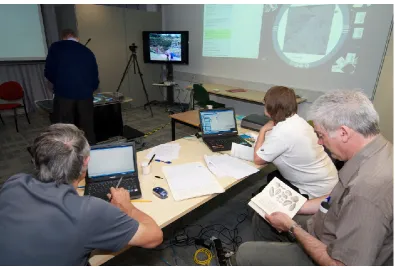
8
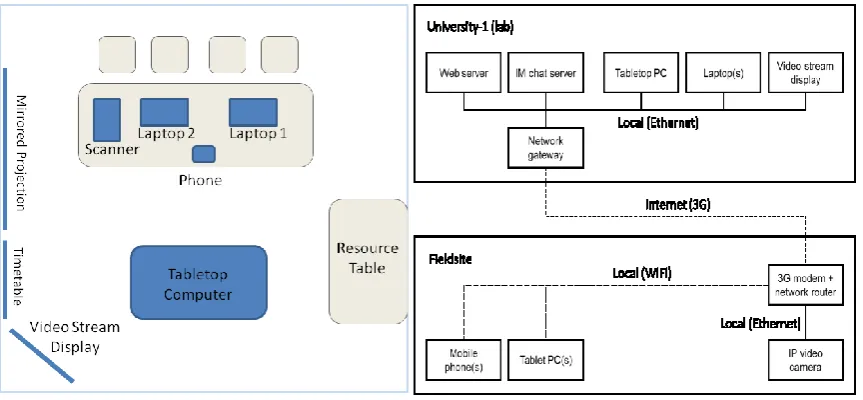
[image:8.595.75.507.112.312.2]five hypotheses about the geology of the site, and discussed and voted on a further two hypotheses from the field team.
Fig. 2: Room layout (left) and system configuration (right) for the geology study
4.2
Undergraduate Biodiversity Study
This study was carried out in a biology laboratory at a second university (see Fig. 3). A group of undergraduates took part in a biodiversity fieldwork activity; identifying the flora and fauna found in a nearby cemetery and adding sighting and identifications to the CMS. The indoor room was only a short walk from the cemetery, enabling students to visit both locations. Five students spent
significant time at the indoor room supported by a tutor, with nine participants involved in total. The CMS was adapted to provide an information structure through which the students could attach identifications to geo-located images of the flora and fauna. The devices provided were a tabletop, laptops, phone, mirrored projection from the tabletop and a video stream display. The study lasted approximately one and a half hours, during which the indoor group identified 32 species of plants and animals from photographs taken outside, using internet resources and guidebooks.
[image:8.595.74.501.523.717.2]9
4.3
School Church Study
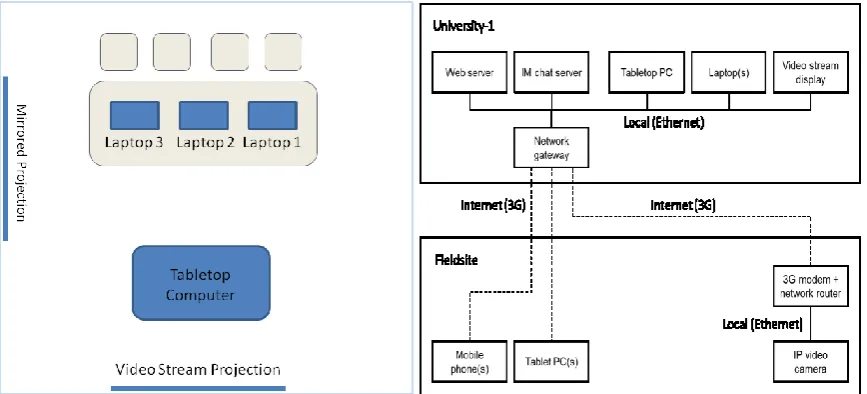
[image:9.595.75.509.286.483.2]This study comprised a group of 14-15 year olds, four of whom were based indoors with a tutor, in a simplified version of the Geology study space (see Fig. 4). A further group of eight went outdoors to explore a nearby historic church and its grounds. Due to the age group, the activity was designed to be more structured than the other studies. The students based indoors were given a set of questions that could only be answered through collaboration with those at the church. For example finding the site of a grave of historical interest, then using the resources provided indoors to answer questions about that person’s life. The indoor team were also in charge of assigning those at the church site specific questions to answer. Relevant historical resources, such as newspaper articles and church records, were digitised and made available through the tabletop and laptops. No printed materials were used. The activity lasted approximately one and a half hours. During this time the students managed to provide answers to 11 of the questions by combining images taken in the field with information from the digitised resources in the CMS.
Fig. 4: Room layout (left) and system configuration (right) for the Church study
5
Analysis
Video data from the indoor room was recorded in each study. A method for capturing how participants focused on devices and other elements in the room, and how they transferred focus over time, was devised, in order to understand how groups used and moved between elements of the device ecology.
5.1
User Foci Analysis
Initially, we recorded the users’ location in the room, but this information was not accurate in identifying what the participants were doing. Each participant’s focus of attention was then
transcribed for one trial, and in the vast majority of cases, it was found that a period of focus on any device was at least 10 seconds in length. Based on this observation, we decided to:
10
our analysis after the technology had been introduced to the participants, and they began to perform activities of their own accord.
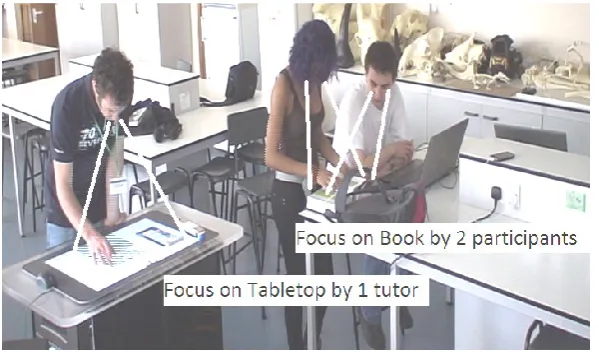
[image:10.595.150.450.173.349.2]2) Cycle through the snapshots, recording the object each participant was looking at, using a set of categories, including the devices, people, and an ‘other’ category for situations where a relevant focus could not be identified (e.g. because the user was walking between devices). Fig. 5 shows an example of this.
Fig. 5: Example of User Foci Analysis method, applied to a frame of video footage
3) Identify the transitions between objects. In many cases, these are immediate, but some included a period of time while users physically moved from one device to another. A transition was therefore defined as any move between different foci that happened within a 30 second period, in which a user moved from one category of foci to another immediately or via the ‘other’ category that reflected an indeterminate step. We then studied patterns of interaction where there were extensive numbers of transitions between devices, or unexpectedly few transitions. This qualitative form of analysis provided a deep
understanding of how the devices were used together during the activities.
6
Findings
6.1
Overall observations
The participants could be observed to readily make use of the device ecology, selecting and combining different resources and interfaces. This suggested that the groups could fluidly combine information from the various devices in the course of their activity. In one example from the Biodiversity study, students used the video stream, a map on the tabletop, and phone
11
6.2
Transitions
[image:11.595.87.513.155.301.2]The number of foci per device in each study is shown in Fig. 6. This represents the total number of participants focused on a particular object across the full set of video frames (e.g. if two people focused on the tabletop at the same time, two would be the result for that 10 second frame).
Fig. 6: Instances of Person Focus by Foci and Study Session
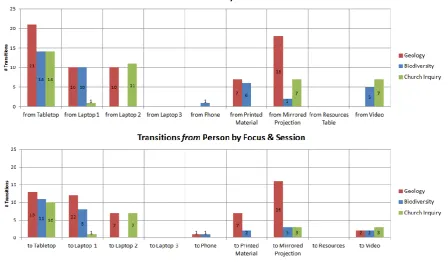
The tabletop was found to be the device most focused on in all the studies. However, if the multiple laptops are counted together, there is greater use of them in the Geology and Church studies. There is also extensive use of the mirrored projections. It is interesting to note that the third laptop provided in the Church study saw markedly less use than the other two, suggesting that it may have been surplus to requirements (only two laptops were provided in the other studies). There was also a timetable projected in the Geology trial that received no attention from participants at all.
[image:11.595.76.525.447.709.2]12
Fig. 7 shows the number of transitions of focus between objects in the room and other participants, giving an insight into the interpersonal interactions occurring through device use. It can be seen that there was a consistently high frequency of transitions between focusing on another participant and focusing on the tabletop. However, there are again a similarly high number of total transitions with the laptops, and with the mirrored projection. This suggests that participants could interweave discussion and interpersonal interactions with each of these devices.
[image:12.595.79.515.268.561.2]6.3
Transitions around the Tabletop
Fig. 8 provides an overall summary of the transitions of foci to and from the tabletop. The data shows that there were transitions between the tabletop and all of the other devices, suggesting that it was a central feature of the ecology. It provides further evidence that there was much switching of attention, especially with the laptops, mirrored projection, and each other.
Fig. 8: Frequency of transitions to and from the tabletop
13
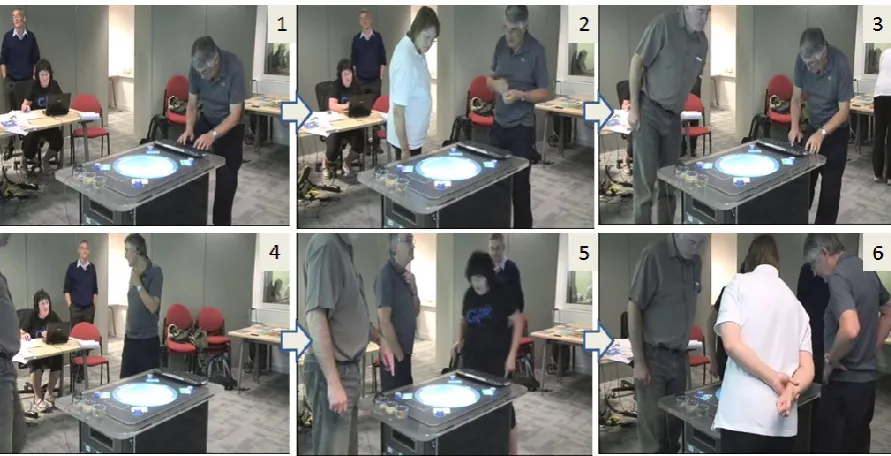
Fig. 9: Fluid gathering around the tabletop in the geology trial
This ‘buffet style’ behaviour (cf. Marshall et al, 2011), where one participant walks up to the tabletop and others join and leave at different stages, was repeated four times in the analysed hour of
Geology study footage, and many more times across all three studies. It shows not only the flexibility of the tabletop to support between one and five participants engaged in these activities, but also how participants expect to join others at the tabletop for particular activities. It also shows how the visibility of movements around the tabletop encourages others to follow, in many cases with no explicit communication. One exception is in the fourth frame of Fig. 9, where the participant at the tabletop asks the participant at the laptop whether they are happy with the current hypothesis, and they come to the tabletop to discuss it.
6.4
Transitions around the Mirrored Projection
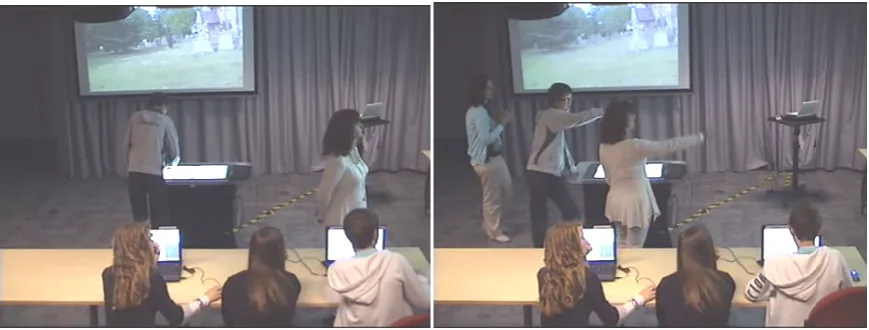
The mirrored projection acted as a bridge, making the tabletop activity visible in other areas of the room and, in so doing, supporting a range of interactions between participants. Fig. 8 shows that transitions between the tabletop and the mirrored projection were common in the Geology and Church studies. However, it is evident that this was dependent on the room configuration, as in the Biodiversity study, the tabletop itself could be easily viewed from the laptop positions, and higher light levels made the projection less salient to look at. There was therefore far less use of the projection than in the other two studies.
14
Fig. 10: Transitions between tabletop and mirrored projection in the Church study (mirrored projection is to the right)
15
Fig. 11: Cycle of events in the Geology study: 1) (top left) The tutor moves to the tabletop view to show the legend; 2) (top right) then points out features that were in the discussion; 3) (bottom left) a student is prompted by a fellow
student to change the view to map, 4) and (bottom right) tutor points out this feature on the map
We found many more instances of this projection being used to switch attention. The analysis of transitions between person and other foci (shown in Fig. 7) also reveals a high number of transitions in focus between the mirrored projection and other people. Therefore, it could be argued that the mirrored projection expands the possibilities for tabletop use, by extending its’ visibility to others and allowing them to interact through it. These examples could be viewed as an ‘extended’ entry point (cf. Hornecker et al, 2007), where the person interacting through it is physically distanced. Conversely, this relationship challenges the expected role of the tabletop, by disrupting the many-to-one mapping between it and users (Rick, 2009). Instead, there are multiple options from which to choose how to engage with the same shared information, however, some choices, such as sitting at a laptop and viewing the mirrored projection, do not provide the expected capability for all users to interact with the tabletop equally.
6.5
Transitions around Laptops
16
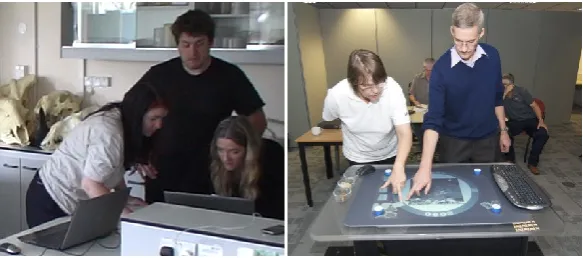
Fig. 12: Discussions around laptop (left) and tabletop (right)
There are other distinguishing features between laptop and tabletop use. Fig. 13 describes
[image:16.595.75.519.334.445.2]transitions to and from printed materials, highlighting how participants frequently transferred focus between printed materials and laptops. In contrast, transitions between the tabletop and printed matter are noticeably lower.
Fig. 13: Frequency of transitions to and from printed materials
17
Figure 14: Printed materials used with the tabletop (left) and with a desk and laptop (right)
7
Discussion
Our analysis of the transitions between the various devices, resources and people within these settings shows how readily the participants were able to transition their focus, and importantly, that they appropriated combinations of devices into effective forms of collaborative behaviour. It is interesting to consider how these phenomena can be conceptually understood. To this end, we analyse them further in terms of the ‘seams’ and ‘bridges’ between devices, the ‘niches’ created, and how these influence the ‘focal character’ of the ecology. This analysis enables us to consider more generally the implications of different kinds of transitions for the design of device ecologies.
7.1
Seams and Bridges
Seams and bridges are properties that can represent the relationships between devices. Seams are disconnects of various forms, and their existence effects user’s behaviour, providing reasons to act in particular ways or transition across devices. Our analysis of transitions between foci in the room suggests that there are different kinds of seams that serve different roles, and also that both designers and users can create ‘bridges’ between seams, that is, ways of overcoming aspects of the disconnect between devices. Bridges, such as the mirrored projection of the tabletop, influence behaviour, but equally, if designers do not provide a bridge, it may be a way to provoke desirable actions from users, who must bridge the disconnect themselves. We identify four types of seams of particular relevance here:
(i) Physical seams distinguish between devices, and the space between them. While most devices are distinguishable as individual physical objects, they are also located across a space, and have different opportunities to be moved by users. For example, the tabletop occupied a specific area and was not moved by participants, the laptops were located in a desk area and, whilst they could feasibly have been moved, remained static. This created a strong physical seam between the tabletop and laptop areas, and instead participants moved themselves to bridge this seam. On the other hand, printed materials, such as maps and books, were regularly picked up by the participants and placed on the desks, such that the physical seams between them and laptops was decreased. In both cases, the participants bridged physical seams themselves.
18
devices, but could be scanned in and shared by users. Alternatively, as designers we bridged information seams between the tabletop, laptops and remote users through a shared content management system, such that images and other data were synchronised across them. Sometimes, information seams were found not to function as anticipated, for example, participants found that instant messages were sent to individual laptops, meaning they had to bridge this seam themselves by copying the information into a text document and saving this to the CMS.
(iii) Sensory seams where something cannot be seen or heard from another part of the device ecology. Within the room, sensory seams are apparent in that the laptop screens can only be viewed within a small area. In contrast, the mirrored projection meant that actions on the tabletop screen could be seen throughout the room. Sensory seams and bridges affect movement around the room, for example participants could be seen to stay seated at the laptops and view actions from the tabletop via the mirrored projection. We also observed participants using the speakerphone
function when making calls to the mobile team, so that participants could listen from any part of the room.
(iv) Interface seams where devices have the same functionality, but provide it in different ways. This can cause confusion for users as they transition. Several cases of this were apparent because the design of the tabletop favours an interface that does not readily translate from a standard PC interface. For example, actions that were clear to laptop users, such as adding evidence to a hypothesis through a standard web form, became unfamiliar after a transition to the tabletop, where the same action was performed by dragging images to a central area beneath the hypothesis text. Hence, users may face the burden of translating their understanding of how to achieve certain tasks across different devices, where there is a different way of performing an operation.
Both seams and bridges can be useful design concepts for considering the interdependencies between devices, and their effects on users. In particular, they provide a practical conceptual framework for designing device ecologies and understanding the actions of users in them. However, they do not, by themselves, suggest how a designer translates their aims into an effective device ecology, or how transitions should be evaluated. This is important because when comparing our aims with previous work, it is clear that each system is addressing subtly different needs. For example Widgor et al (2009) describe the purpose of WeSpace as enabling “spontaneous
collaborative sessions”, while Arias et al (2000) aim to create an environment for extensive sessions of collaborative design. In this case, collaborative inquiry activities require that participants can make choices about how they work together, and that the actions of others are visible. As each aim has produced a different design, these distinctions clearly influence design choices.
7.2
Creating Niches
So how do we begin to think about realising high-level design goals in a device ecology? One concept from ecology that appears particularly relevant is a niche - the ecological role of an organism,
19
collection of niches that support different types of activity. Once we understand the configurations that lead to certain types of niche, we should be able to combine these to produce favourable ecologies for multifaceted activities. Another way of viewing this is to conceive of device ecologies as designing for a ‘sweet spot’. For example, a designer can constrain the number of devices such as laptops to be less than the number in the group, so that it forces them to share and work together. Although we wanted to provide a flexible space such that students could decide for themselves how to approach the activity, overpopulating an ecology may result in devices that are not part of any niche. These may be overlooked, such as the timetable projection in the Geology study. If it was considered desirable to increase interest in such a display, we could try to improve salience by changing its location, making it more eye-catching or interactive, or reducing the ‘draw’ of other niches. A successful niche appears to require both salience and relevance, having an easy entry point and standing out from others.
7.3
Focal Character
Dissecting the effects of technology on contemporary life, Borgmann (1984) argues that modern devices often lack the ‘focal character’ of objects fundamental to social practices, such as the table or hearth, around which these practices are made visible. Here, we refer to focal character in the ways in which combinations of devices make social practices visible. Tabletops offer scope for achieving this, as they provide a physical form suited to making the actions of collaborators visible, and better engaging them with one another. In our ecology this supported physical movements to a distinct ‘other’ space, which can make explicit shifts between tasks. Coming together around the tabletop at critical points (e.g. developing and voting on a hypothesis) indicated that the tabletop had a specific role in their collaboration.
Considering focal character as a property of the ecology design can help where it is essential that social practices are visible to all, leading to them being readily understood and reflected upon. The extensive use of the tabletop suggested that it filled a gap in the practices that participants engaged in, even when familiar tools such as laptops were available. While group discussions also occurred around the laptops, when an effort is made to move to the tabletop, it functions as a visible signal to others, communicating a desire to transfer from a current focus and enter a different phase, and in so doing, taking some or all of the group along in this shift, through a ‘honey pot’ effect (Brignull and Rogers, 2003). This potential only exists because there are other areas from which to arrive, so the focal character of the ecology is not achieved through the introduction of a single device. Instead, it requires thinking holistically about the visibility of actions and potential use of space that results from the niches that exist.
20
Though they can support shared use, many other niches, such as the interaction between a laptop and single user, lack effective entry and access points to multiple users, and do not make actions visible to others. These niches can fragment a group and appear detrimental to focal character. However, niches with different characteristics are important because they allow users to adopt a range of collaborative styles, incorporating individual work, sub groups, and the visibility of the whole team effort.
8
Conclusions
We have provided a way to think about the design of device ecologies in terms of patterns of user behaviour in the transitions between different devices. We proposed a higher-level conceptual framework for analysing the relationships between devices in terms of bridges, seams, niches and focal character. Further research is needed to show how these concepts can lead to more holistic thinking about the needs of different activities, here they were found to be useful in categorising and describing behaviour in relation to the design.
The method we have described is intended to help designers evaluate their design decisions, and consider trade-offs that need to be made. Reflection during our design process led us to conclude that it was better to distribute functionality across heterogeneous devices than to expect a tabletop or personal computer to provide holistic support for all activities. By evaluating transitions, and considering how goals can be achieved through seams and bridges, we can avoid the pitfalls of a one-device-fits-all approach to computing, but also recognise that when combining devices, each can enhance or disrupt the role the other is expected to play. In this regard, the niches that emerge from bridges and seams can maintain or diminish the focal character and practices that are expected to emerge around multi-user devices such as a tabletop. Designing a complementary set of niches, through explicit consideration of the seams and bridges between devices, should allow us to find the sweet spot for a given set of design goals, where it is more likely that the desired forms of
interaction will ensue.
9
Acknowledgements
This research was funded by the EPSRC as part of the ‘Out There and In Here’ project
(EP/H022589/1), and further work occurred at the Horizon DER Institute (EP/G065802/1). Estefanía Martín and Pablo A. Haya would like to acknowledge to the Project ASIES (TIN2010-17344), from Spanish Ministry of Science and Innovation, that partially funded their participation in this research. It would not have been possible without all the participants and organisations who gave their time. This includes the Friends of Mill Road Cemetery (http://www.millroadcemetery.org.uk), Parkside Federation, Stride Design (http://www.stridedesign.com), Anglia Ruskin University, and Cambridge City Council. Others who made the trials and analysis possible included: Jill Eyers, Kevin Church, Canan Blake, John Lea and Janet van der Linden.
10
References
21
Borgmann, A. 1984. Technology and the Character of Contemporary Life. University of Chicago Press, Chicago & London.
Brignull, H., & Rogers, Y. 2003. Enticing People to Interact with Large Public Displays in Public Spaces. Proceedings of Human-Computer Interaction INTERACT '03, IOS Press. 17–24.
Chalmers, M. & Galini, A. 2004. Seamful interweaving: heterogeneity in the theory and design of interactive systems. Proceedings of the 5th conference on Designing Interactive Systems. ACM Press, New York. 243-252.
Chalmers, M., & MacColl, I. 2003. Seamful and seamless design in ubiquitous computing. In Workshop: At the Crossroads: The Interaction of HCI and Systems Issues in Ubicomp.
Coughlan, T., Adams, A., Rogers, Y., & Davies, S. 2011, Enabling Live Dialogic and Collaborative Learning between Field and Indoor Contexts, Proceedings of the 25th BCS Conference on Human-Computer Interaction.
Dourish, P., & Bell, G. 2011. Divining a Digital Future: Mess and Mythology in Ubiquitous Computing, MIT Press.
Harris, A., Rick, J., Bonnett, V., Yuill, N., Fleck, R., Marshall, P. & Rogers, Y. 2009. Around the table: are multiple-touch surfaces better than single-touch for children's collaborative interactions? Proceedings of the 9th international conference on Computer-supported collaborative learning. International Society of the Learning Sciences. 335-344.
Hornecker, E., Marshall, P. & Rogers, Y. 2007. Entry and Access – How Shareability Comes About. Proc. of DPPI’07 (Designing Pleasurable Products and Interfaces). Helsinki. ACM Press, New York. 328-342
Huang, E. M., Mynatt, E. D. & Trimble, J. P. 2006. Displays in the Wild: Understanding the Dynamics and Evolution of a Display Ecology. In: Fishkin, K., Schiele, B., Nixon, P. & Quigley, A., (Eds.) Pervasive Computing: Springer LNCS 3968. Springer Berlin / Heidelberg. 321-336.
Jung, H., Stolterman, E., Ryan, W., Thompson, T. and Siegel, M. (2008). Toward a framework for ecologies of artifacts: how are digital artifacts interconnected within a personal life? Proc. of Nordic Conference on Human-Computer Interaction (NordiCHI), ACM Press, New York. 201 – 210
Loke, S.W. & Ling, S. 2004. Analyzing Observable Behaviours of Device Ecology Workflows. In Proceedings of the 6th International Conference on Enterprise Information Systems. Available from: http://citeseerx.ist.psu.edu/viewdoc/summary?doi=10.1.1.86.9974, last access 06/03/2012.
Marshall, P., Rogers, Y. & Pantidi, N. 2011. Using F-formations to Analyse Spatial Pattersn of Interaction in Physical Environments. Proceedings of the 2011 ACM Conference on Computer-Supported Cooperative Work. ACM Press, New York. 445-454.
22
Pyla, S., Tungare, M., Holman, J., Pérez-Quiñones, M. 2009. Continuous User Interfaces for Seamless Task Migration in Human-Computer Interaction. Ambient, Ubiquitous and Intelligent Interaction. Proceedings of HCI International 2009, Springer Berlin / Heidelberg.
Rekimoto, J. & Saitoh, M. 1999. Augmented Surfaces: A Spatially Continuous Work Space for Hybrid Computing Environments. In proc. of the ACM Conference on Human Factors in Computing Systems (CHI ’99). ACM Press, New York. 378-385.
Rick, J. 2009. Towards a classroom ecology of devices: Interfaces for collaborative scripts. In: Workshop Proc. of 8th International Conference on Computer Supported Collaborative Learning (CSCL2009): “Scripted vs. Free CS collaboration”. Available from: http://oro.open.ac.uk/19511/, last access 06/03/2012
Rodden, T., Rogers, Y., Halloran, J., and Taylor, I, (2003) Designing novel interactional workspaces to support face to face consultations. Proceedings of the Conference on Human Factors in Computing Systems (CHI ’03), ACM Press. 57-64.
Rogers, Y. 2006. Moving on from Weiser's vision of of calm computing: engaging UbiComp
experiences. In: P. Dourish and A. Friday (Eds.) Ubicomp 2006 Proceedings, LNCS 4206, pp. 404-421, Springer-Verlag.
Slotta, J. D. 2010. Evolving the classrooms of the future: The interplay of pedagogy, technology and community. In K. M¨akitalo-Siegl, F. Kaplan, J. Zottmann & F. Fischer (Eds.), Classroom of the Future. Orchestrating collaborative spaces. Rotterdam: Sense.
Streitz, N. A., Geiβler, J., Holmer,T., Konomi, S., Müller, C., Reischl, W., Rexroth, P., Seitz, P & Steinmetz, R. 1999. i-LAND: An interactive landscape for creativity and innovation. Proceedings of the Conference on Human Factors in Computing Systems (CHI ’99). ACM Press, New York. 120-127. Twining, P., Evans, D., Cook, D., Ralston, J., Selwood, I., Jones, A., Underwood, J., Dillon, G., Scanlon, E., Heppell, S., Kukulska-Hulme, A., McAndrew, P. & Sheehy, K. 2005. Tablet PCs in schools: Case study report: A report for Becta by the Open University. Available from:
http://oro.open.ac.uk/6407/, last access 06/03/2012
Weiser, M., 1994. The World is not a Desktop, Interactions 1(1), ACM Press. 7-8.
Weiser, M., 1991. The Computer for the 21st Century. Scientific American. Vol. 265, Issue 3, Munn &
Co, New York. 94-104