New and Notable
A New Type of Radical-Pair-Based Model for Magnetoreception
A. Marshall Stoneham,†6Erik M. Gauger,‡§6*Kyriakos Porfyrakis,‡Simon C. Benjamin,‡§ and Brendon W. Lovett‡{
†Department of Physics and Astronomy, University College London, London, United Kingdom;‡Department of Materials, University of Oxford,
Oxford, United Kingdom;§Centre for Quantum Technologies, National University of Singapore, Singapore; and{School of Engineering and Physical Sciences, Heriot Watt University, Edinburgh, United Kingdom
ABSTRACT Certain migratory birds can sense the Earth’s magnetic field. The nature of this process is not yet properly under-stood. Here we offer a simple explanation according to which birds literally see the local magnetic field through the impact of a phys-ical rather than a chemphys-ical signature of the radphys-ical pair: a transient, long-lived electric dipole moment. Based on this premise, our picture can explain recent surprising experimental data indicating long lifetimes for the radical pair. Moreover, there is a clear evolutionary path toward this field-sensing mechanism: it is an enhancement of a weak effect that may be present in many species.
INTRODUCTION
It is well established that certain migratory birds can detect the direction of the Earth’s magnetic field, and use this as a compass for orientation (1–3). An obvious explanation for this remarkable ability would be the use of magnetized materials in the bird’s body, which is likely to change orien-tation with the external field (4,5). However, for species such as the European Robin the evidence points to a very different mechanism: the prevailing hypothesis is that field orientation is initially detected through its influence on photoexcited electronic spins. Photons are evidently important because the birds can only orientate in a magnetic field when light (which may be dim) is available (6–8), and with an undam-aged visual system (9). A neuronal pathway that is likely responsible for the processing of light-dependent magnetic information was suggested by Heyers et al. (10). Meanwhile, a recent observation provides strong support for the role of electron spins: the birds are disorientated by a weak oscilla-tory field whose frequency is close to the resonant frequency for an electron in the Earth’s magnetic field (8,11). Although these detailed results come from migratory bird studies, there is evidence of a similar sensitivity in nonmigratory birds, such as chickens (12) and zebra finches (13), and in other animal phyla, as evidenced by experiments on the American cockroach (14). This suggests that this form of magnetoreception may occur in diverse organisms.
These findings have led to the popularity of the radical pair (RP) model (8,15–18), which begins to explain how light-activated magnetic sensing could happen. The central feature of the model is an optical excitation of certain biomolecules
that leaves a fraction of these molecules in a spin triplet state, with a spatially separated pair of spins. In magnetically aniso-tropic systems, the number of spin triplets depends on the orientation of the magnetic field. If the molecules are them-selves (at least partly) oriented (19–21) and if the bird can somehow detect the relative population of spin triplets, then an optically activated avian compass is possible.
However, the transduction mechanism by which electron spin states translate to a macroscopic signal is not well understood. A typical explanation is that some signature chemical is synthesized only when the triplet state decays. This chemical may then interfere with the normal process of vision, or it might be detected by some independent sensor structure in the eye (3). Explanations of this kind are puzzling for two reasons:
First, they involve a complex chemistry that must have evolved within the eye, independent of (but consistent with) the process of normal vision. Yet, no sensory addi-tional magnetoreception receptors have yet been identified. Second, this model would seem to function best when the cycle time, i.e., the time for production of the signature chemical(s) or photons, is short—shorter cycles would lead to higher rate of production and thus better signal/noise ratios. However, in the real system it seems that the opposite is true: the RP lifetime, as measured by spin resonance experiments on live birds, is extraordinarily long (11,22,23). At least one simpler alternative to the chemical transduc-tion mechanism has been proposed (24), but this did not explain the then-unrecognized need for long triplet life-times. Here, we will describe a model of the compass in which it is straightforward to understand that need; indeed this property is so crucial that the molecules involved could have evolved through natural selection of slow electronic decay rates. We will further describe why no apparatus for detecting chemical products is required in our model. In
Submitted March 29, 2011, and accepted for publication January 3, 2012.
This article is dedicated to deceased colleague A. Marshall Stoneham.
6A. Marshall Stoneham and Erik M. Gauger contributed equally to this work.
*Correspondence:[email protected]
Editor: R. Dean Astumian.
essence, the Earth’s magnetic field translates to a local elec-trostatic (or strain) field that directly modulates vision. This may be seen as an evolutionary enhancement of an inherent sensitivity, analogous to the well-studied ‘‘Haidinger’s brush’’ (25) phenomenon, in which the polarization of light (as opposed to the direction of a magnetic field) is detected through a molecular electric dipole transduction mechanism. To the best of our knowledge, direct evidence for local elec-trical fields affecting the visual process has not (yet) been re-ported, however, in vitro laboratory studies on pertinent biomolecules show that such effects are possible in principle under realistic circumstances as we presently discuss. In addition, dedicated sensory systems for detecting electric fields do exist in certain species, e.g., sharks and rays are known to be able to detect extremely weak external electric fields as low as 1mV/m (26).
We believe that our version of the RP model is a simpler and more complete hypothesis than previously proposed models. Importantly, our model is equally consistent with all experimental findings while also providing a sound evolutionary pathway to the observed long RP lifetime.
MODEL
We start with a general description of our compass model before turning to a specific set of example parameters to demonstrate the feasibility of our proposed mechanism. Our model features several of the successful tenets of the conventional RP model. First, charge-separated radical pairs are created when light is absorbed by the compass molecule. Second, the radical pair formed within or from the compass molecule is magnetically anisotropic and (at least partially) aligned, and thus the relative population of RPs ending up in triplet and singlet configurations depends on the orienta-tion of the molecule to Earth’s magnetic field. Third, the singlet RP can decay directly back to the ground state, but for the triplet this route is blocked. However, our model differs in the important aspect of the compass signal trans-duction. In contrast to previous proposals for RP-based mag-netoreception, here the signal is not of a chemical nature, but is instead a physical effect that is associated with the decay of the spin triplet state to a long-lived charge-separated state, which serves as the bird’s signaling state. More specifically, the normal vision system (27) is modulated by the electric field of the electric dipole that accompanies this charge-sepa-rated triplet signaling state. This requires the compass mole-cules to be located directly on the retina. However, the retina also seems the most likely location in the standard RP model due to the fact that it is already integrated with a system to initiate signals to the brain in normal vision.
We base our model on a compass molecule with the following properties: First, it possesses an (optically) excited singlet state that can evolve into a triplet state, dependent on an external magnetic field. This phenomenon is well established in artificial systems, such as for example,
self-trapped excitons in alkali halides (28) and NVcenters in diamond (29). Second, we require a lower-lying meta-stable charge-separated triplet state with a sufficient lifetime to influence the visual process in the retina. Sufficiently long triplet lifetimes of a few milliseconds are not uncommon in photoactive molecules (22). Third, we require a spin level structure that allows this long-lived triplet state to be dephased by a resonant radio frequency (RF) field. We shall discuss one possible mechanism for this later. Fourth, as in the standard RP model, the molecules should form an ordered structure on the surface of the retina, although some amount of disorder can be tolerated (19–21). In
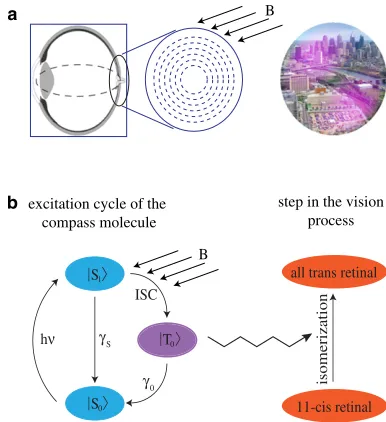
Fig. 1, we display a circular arrangement, but we note the actual pattern in the bird’s eye could be different and our mechanism does not rely on any particular pattern. However, note that in humans a circular arrangement similar to the one shown in Fig. 1 has been proposed for lutein molecules as a possible explanation of the fact that some people can directly see light polarization (25,30). In this case, it has been speculated that the alignment could origi-nate from the known radial orientation of nerve fibers. As will become clear shortly, an elongated shape of the radical pair, e.g., brought about by a rodlike compass molecule, will be desirable to obtain a large radical-pair electric dipole.
The magnetic orientation sensing mechanism then proceeds as follows: optical excitation gives rise to the
B
B b
ISC
hν T0
S0 S1
γS
γ0
11-cis retinal all trans retinal
isomerization
excitation cycle of the compass molecule
[image:2.603.332.525.384.595.2]step in the vision process a
FIGURE 1 (a) (Left) Schematic diagram showing how the molecules might be aligned in the retina; a combination of light and a magnetic field could induce dipole moments for certain molecular orientations. (Right) These dipoles would create an electric field that would allow the bird liter-ally to see the magnetic field direction. (b) Cycle of the compass molecule: after photoexcitation fromjS0itojS1i, the branching ratio of direct
relaxa-tion into the ground state or via a long-lived triplet statejT0idepends on the
orientation of the molecule with the geomagnetic field. The purple color of
jT0idenotes a charge-separated state with an electric dipole moment, thus
formation of the charge-separated triplets—the signaling states—for certain orientations of the magnetic field with respect to the molecular axes. The result is an electric field distribution on the retina that reflects the orientation of the magnetic field. More experimental data are available from studies of bacteriorhodopsins than animal rhodopsins, but the structure of the two are similar despite probably having evolved independently. In particular, both classes have an identical light absorbing chromophore, the 11-cis -retinal, whose photoisomerization is the primary event in their photochemical cycles. Relatively weak electric fields between 105and 107V/m affect the photoenergetic reaction and absorption spectrum of bacteriorhodopsin (31–33), as well as the cis-to-trans isomerization of many other complex molecules (34,35). In Schenkl et al. (36), a link between electric field generation and isomerization of retinal in bacteriorhodopsin was established. It therefore seems plausible, even likely, that there will be an electric effect on retinal isomerization in avian rhodopsin.
An electron-hole dipole with average charge separation of only one nanometer produces an electric dipole field with magnitude 106 V/m up to a distance of 10 nm, whereas a field of ~105V/m even extends to 25 nm. Each compass dipole thus possesses a sizeable sphere of influence in which it could directly affect the photoisomerization of retinal (37), meaning the bird would literally be able to see the magnetic field as a superimposed feature in its normal visual image.
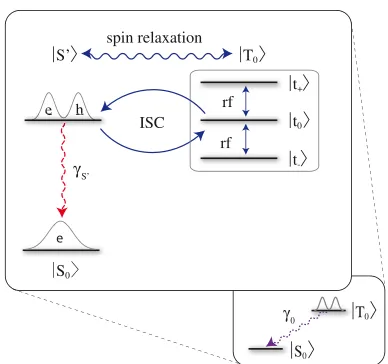
Let us now consider an example system that would exhibit the features required by our model. We will describe the simplest possible molecular energy level structure required for our proposed mechanism, though it is of course likely that any real system will have extra features. The scheme we have in mind possesses four relevant energy levels as sketched inFig. 2.
We imagine that our biomolecule, like most others, has a singlet ground state jS0i. Light can excite population to higher lying singlet states, as these transitions are strongly allowed by dipole selection rules. The molecule may then experience a cascade of nonradiative decays followed by a charge transfer during which the electron and hole become spatially separated, forming the radical-pair singlet state
jS1i. The singlet jS1i would normally simply decay back to the ground state (after a time that may be as short as a nanosecond), but it is also possible that population branches off into a (degenerate or close to degenerate) radical-pair triplet state jT1i. As we discuss below, the rate of the singlet-triplet interconversion—or intersystem crossing (ISC) rate—can be dependent on the geomagnetic field, and lies at the heart of the magnetoreception mechanism.
Finally,jT0iis a lower-lying, long-lived triplet state that is reached through a fast optical or nonradiative decay ofjT1i. The charge-separation of electron and hole in the radical pair configuration means that population in the level jT0i has an associated electric dipole moment, and this triggers
the visual stimulus for the compass. (We note that our model requires a charge separation only for the leveljT0i. It seems likely that the formation of the (charge-separated) radical pair occurs in the relaxation tojS1iand persists until the ground state jS0i is reached. However, in principle, our model would also allow for the levels jS1i and jT1i to have a localized excitonic character, with the spatial separa-tion of charges into the radical pair only happening in the relaxation fromjT1itojT0i.)
The dependence of the intersystem crossing rate on the geomagnetic field must be associated with an anisotropic term in the Hamiltonian. The origin of this term is not important; a hyperfine coupling between the electron in the optically excited exciton and a nuclear spin has been widely proposed in the literature (15,17).To keep our discus-sion as simple as possible, we will assume thatjS1iandjT1i are subject to an isotropic electrong-factorge¼2 and a
uni-axially anisotropic hole tensor,
gh ¼
0
@2þ0dg 2þ0dg 00
0 0 2þDg 1
A; (1)
and as specific examples, we assumedg¼0 andDg¼0.2. Here we have used the language of excitons, which are conventionally pictured as consisting of a single excited electron and a missing ground-state electron (or hole); in a radical-pair picture we would equivalently say that the two g-factors apply to the two unpaired radical spins. We have checked that the qualitative predictions of our model also work for the case of an anisotropic hyperfine coupling similar to the one described in Gauger et al. (23).
ISC
γS
γT
γ0
[image:3.603.333.526.56.232.2]e h
FIGURE 2 Schematic diagram showing the key features of the compass mechanism: the system relaxes back into the singlet ground statejS0iafter
most photoexcitation events. However, there is a small intersystem crossing rate, which depends on the orientation of an asymmetricg-tensor with the geomagnetic field. Population injT1irelaxes into a long-lived triplet state
jT0i. (Red) Transitions between different charge states; (blue) change of
the spin state. The decay fromjT0ito jS0iinvolves both a charge and
Electric dipole selection rules mean that, after the photo-excitation, the system is found in the pure singlet statejS1i, which is degenerate with the triplet leveljT1i. We write for the Hamiltonian at this stage of the process,
HISC ¼ 1
2mBðgeB$S1þB$gh$S2Þ; (2)
where mB is the Bohr magneton, B is the magnetic field
vector, andSi¼(sx,sy,sz) is the spin operator for electron
(i¼1) and hole (i¼2). The factor 1/2 accounts for the fact that all our Pauli matrices have eigenvalues 51. The magnetic field strength in Frankfurt (the site where the relevant experiments were performed (8,11)) isB0¼47mT. The field’s orientation with respect to the g-tensor is determined by the angles q and f, B ¼ B0(cos f sin q, sinfsinq, cosq).
Based on Hamiltonian (2), we obtain the following matrix elements for the three triplet sublevelsjtþi ¼ j[[i,jt0i ¼ (j[Yi þ jY[i)/pffiffiffi2, andjti ¼ jYYiofjT1i:
hS1jHISCjt0i ¼ mBB0Dgcosq; (3)
hS1jHISCjt5i ¼ 5mBB0dgsinqeHif= ffiffiffi
2
p
: (4)
To obtain a signal that depends on the relative orientation of
g-tensor and field, as is required for a compass, we must thus havedgsDg, a condition that is fulfilled by our particular choice of parameters. Owing to the axial symmetry of Hamiltonian (2), f is unimportant and we need only considerq˛[0,p/2].
We now use a phenomenological Lindblad master equa-tion (38) to model the evolution of the density matrix that describes the quantum dynamics of our (open) molecular system. The optical excitation between jS0i and jS1i is modeled as an incoherent process with a Lindblad operator
PX¼ jS1ihS0jwith associated rategX. Similarly, the decay
events are described by Lindblad operators PS¼ jS0ihS1j,
PT ¼ jT0ihT1j, andP0¼ jS0ihT0jwith respective rates gS, gT, and g0, as depicted in Fig. 2. Using only the matrix element Eq. 3 as the effective Hamiltonian H and all of the above Lindblad operators, we obtain as the master equa-tion governing the time evoluequa-tion of the system’s density matrixr(t) (38,39):
_
r ¼ i
Z½H;r þ
X
i
gi
PirPyi12
Py
iPirþrPyiPi: (5)
We are interested in the steady-state population T of the charge-separated triplet leveljT0i, which is found by setting the left-hand side ofEq. 5to zero, yielding
T ¼ 4gXgðqÞ
4gXgðqÞ þg0G
ðgSþgXÞZ2þ 4
gT
1þ2gX
G
gðqÞ ;
(6)
where G ¼ (gs þ gT) and g(q) ¼ jhS1jHISCjt0ij 2
. In the regime of interest, the lifetime ofjT0iis much longer than that of the excited statesjS1iandjT1i, i.e.,g0<<gSzgT.
It is also reasonable to assume thatgX<<gSandgS>> mBB0Dg/Z, and to a good approximation we therefore find
T fg(q)/g0. Importantly, the steady population T is thus largely independent of specific values for any of the decay rates exceptg0, as long as the hierarchy assumed above is fulfilled.
RESULTS
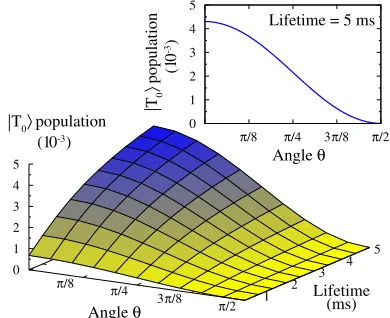
Fig. 3shows a full numerical solution of the triplet popula-tionT as a function of the angleqand the triplet lifetime 1/g0. Here, we have assumed the lifetimes of the jS1iand
jT1istates are 1 ns, and used an excitation rategX¼106s1.
As shown in Fig. 3, a longer excited lifetime would not only increase the average electric field (i.e., the product of the molecule’s dipole moment and the number of dipoles present at any time) but, importantly, it would also give each individual dipole more time to have an effect on other processes in the vision system such as the isomerization of any nearby retinal. We would therefore expect that birds whose signaling states persist longer—by means of a longer spin coherence time—would be able to see the magnetic field with more contrast; i.e., an evolutionary advantage that could have occurred in small increments through natural selection. Note that for our model to work, we must assume that both spins in the jT0i state are devoid of hyperfine-, exchange-, and dipole-coupling-induced spin flip-flops on a submillisecond timescale, as these could enable a faster relaxation back to the jS0i state by corrupting the triplet spin state (see also the discussion in the next two paragraphs).
π/8 π /4 3π/8
π/2 1 2 3
4 5 0
1 2 3 4 5
T0〉 population (10-3)
Angle θ
Lifetime (ms)
0 1 2 3 4 5
π/8 π/4 3π/8 π/2
Lifetime = 5 ms
T0
〉
population (1
0
-3)
Angle θ
FIGURE 3 Steady-state population ofjT0i,T, is shown as a function of
this state’s lifetime 1/g0and the angleqbetween the axialg-tensor and the Earth’s magnetic field forDg¼0.2. For other parameters, see main text; note that 1/g0is assumed to be long in contrast to the lifetimes ofjS1i
andjT1i, which may be as short as 1 ns. (Upper right) Two-dimensional
plot follows the cos2qdependence of the squared relevant matrix element
[image:4.603.331.526.474.633.2]Recent experiments show that a very small oscillating magnetic field can disrupt the bird’s ability to orient (8,11). In Ritz et al. (11), the authors report that a perturbing magnetic field of frequency of 1.316 MHz (i.e., the reso-nance frequency of an electron spin for a g-factor of 2) with a field strength of only 15 nT suffices to completely disorient the birds. The MHz frequency immediately implies a bound on the time of the process (because the field would appear static for a sufficiently rapid decay back to the molecule’s ground state in less than a microsecond). More-over, considering the oscillating magnetic-field strength implies a much longer process time of at least several hundred microseconds to give the weak radiofrequency field sufficient time to affect the spin state (23). Importantly, as discussed above, our proposed transduction mechanism provides a motivation for such a long process time, including the need for faithfully preserving the triplet spin state to block premature relaxation from the signaling state
jT0ito the ground statejS0i.
There are numerous explanations by which a weak RF field could plausibly disrupt the compass mechanism by shortening the lifetime of such a long-lived triplet state. Essentially, whenever the RF field only rotates one of the two spins of the triplet because the two spin transitions are not degenerate due to different g-factors or environmental couplings, a fast decay route to the ground state becomes available by converting the triplet into a singlet radical pair. In the following, we discuss one simple possibility. We focus on the lower-lying triplet to ground-state transi-tion. For understanding the directional sensitivity we needed no more than those two levels, but to understand the reso-nant effects of a magnetic field we must now explicitly include the distinct spin states (seeFig. 4). We distinguish the specific triplet states jtþi,jti, and jt0i, and we label the corresponding singlet level as jS0i. This latter level will have a fast, spin-allowed decay to the molecule’s ground statejS0i. StatejS0ithus separates the spin and the charge transition of this process. Importantly, the auxiliary level could be eliminated from the dynamics so long as the decay gS0 is large enough, reducing the model once
more to the simpler picture displayed inFig. 2.
In our illustrative example, we assume an electron
g-factor ofge¼2 andgh¼2.2 for the hole (both isotropic).
Working in the basis where the z axis is defined by the applied static magnetic field direction, the triplet now has the three sublevels shown in Fig. 4, and the Hamiltonian in an RF field reads:
HRF ¼ 1
2mB½B0ðgesz1þghsz2Þ
þBRFcosutðgesx1þghsx2Þ:
(7)
Here, the oscillatory field of strength BRF ¼ 150 nT and frequency u is applied orthogonal to the static field B0, because only its perpendicular component affects the
compass (11).We emphasize that the magnitude of BRFis 10-times larger than the smallest value that has been re-ported to disrupt the avian compass. If our model is valid then for this stronger RF field we must certainly find that our predicted orientational effect is washed away. Note that the three sublevels jtþi,jt0i, and jti of Fig. 4 take a different form to the sublevels of jT1i that we have considered before, whose axis was defined by the anisotropic g-tensor of the hole. (After a spin-preserving relaxation from jT1i to jT0i, we then obtain the state
jT0i ¼cosqjt0i þsinqðjtþi jtiÞpffiffiffi2, written in terms of the triplet sublevels.)
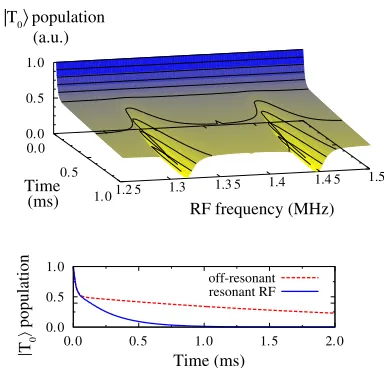
Fig. 5shows the survivingjT0ipopulation as a function of time. This was obtained by using Hamiltonian (7) in a general Lindblad master equation (see Eq. 5) with appro-priate Lindblad operators. In this case, the operators are
PS0 ¼ jS0ihS 0
jfor the decay, andPx,i¼(sx)ifor describing
spin flip decoherence of electron and hole spin, respectively. The decay rate isgS0 ¼105s1and we assume slower but
equal spin decoherence rates of 0.2103s1. As the initial state, we assign half of the population tojt0iand the other half is equally distributed between the sublevels jtþi and
jti, consistent with the state resulting from ajT1idecay. The pronounced kink at short times in the data ofFig. 5
shows how thejT0irelaxation proceeds in two stages: pop-ulation injt0iundergoes a direct ISC tojS0i, subsequently decaying to the ground state in much less than a millisecond. The other half of the triplet population in thejt5isublevels survives much longer, until all spin states are eventually mixed by the Px,i ¼ (sx)i spin decoherence processes.
Only when the oscillatory field is resonant with either the electron or hole spin (at 1.316 or 1.447 MHz due to the
γ0
S0
γS’
e h
e
h
rf [image:5.603.333.527.54.236.2]rf ISC spin relaxation
FIGURE 4 Possible explanation of the relaxation fromjT0ito the ground
statejS0i: the charge relaxation follows a spin transition to the auxiliary
singlet leveljS0i. Population injt0iis connected tojS0ivia an ISC and
thus decays quickly, whereas population injt5iis trapped for the duration
differentg-factors) are all triplet levels mixed on a submilli-second timescale, leading to a fast decay of the entire triplet population. The corresponding two valleys in the data eluci-date how the resonant RF field thus severely reduces the excited triplet lifetime. Such a reduction of thejT0ilifetime would plausibly affect the compass mechanism and disorient the bird.
We note that the general behavior displayed inFig. 5does not depend on the specific choice of parameters, so long as the hierarchy of the various processes is preserved. Indeed, one can also think of entirely different physical mechanisms for thejT0irelaxation that would be equally consistent with experimental observations. Crucially, all possible explana-tions depend on an excited state with a lifetime of more than a millisecond, as the oscillatory field strength is simply too weak to significantly affect the spin state in a shorter duration.
DISCUSSION
A widely proposed molecule for the RP mechanism in birds is cryptochrome, though there is currently only indirect evidence that this is indeed the molecule responsible for magnetoreception (17,40). Further, a recent study suggests that cryptochrome is arranged on the retina in close prox-imity to the UV cones in a fashion fulfilling the require-ments of RP-based magnetoreception (41). Despite the current uncertainty about the role of cryptochromes (42), we feel a presentation of how our model might be realized in cryptochromes would be helpful. These molecules consist of a flavin adenine dinucleotide (FAD) and a light-harvest-ing cofactor. The ground statejS0iis thought, in the avian retina, to correspond to the FAD in its fully oxidized state.
Optical excitation then induces electron transfer from a chain of three tryptophan residues to the FAD, which causes reduction to the radical FADH,. This state would now correspond tojS1i, and can undergo ISC through anisotropic hyperfine interactions. Straightforward dipole-allowed recombination to the ground state is possible for the singlet, but blocked for the triplet. The signaling state is the only one open to the triplet (17), and in our case we would need a long-lived charge separated state. This could possibly be formed through charge transfer to a tyrosine residue (43), though whether the electric dipole so formed would survive for long enough for our purposes before (de)-protonation would need further study.
The model we have proposed could be tested, and we now discuss some possible experiments that might be performed. First, it would be very interesting to probe the RF disrup-tion mechanism further. In particular, if one could test the ability of a bird to navigate in an RF field across a range of static fields, it should be possible to obtain the width of the triplet resonance line that causes the disruption. Indeed, we would expect to find (at least) two resonances—one cor-responding to the electron resonance and the other to the hole resonance (in a radical pair picture, the hole resonance would be the resonance of the second unpaired radical spin). A full mapping of the occurring resonances and their frequency dependence on changes in the external magnetic field would help to answer the question whether the direc-tionality of the compass molecule is provided by an aniso-tropicg-factor or by an anisotropic hyperfine tensor.
A second possibility is that birds using the mechanism we propose would be very sensitive to the polarization of the light used to induce the magnetoreception. The rodlike molecules discussed in this article would be expected to have a highly anisotropic electric susceptibility, and so the method we propose might only work in polarized light for molecules of certain orientations. It may be that the birds can adapt to this, but by changing the polarization of the light to which the birds are exposed periodically any adap-tion could be prevented, and again we might expect to see disruption of magnetoreception. In vitro experiments showing an electroluminescence would help to differentiate our proposed method from the previous RP-based models. Precursor experiments similar to the artificial compass demonstrated by Maeda et al. (16) could first be performed on candidate molecules in the laboratory to identify the specific sets of parameters for experiments on live birds.
We have proposed a comprehensive model that would allow a bird to sense the direction of the Earth’s magnetic field. It relies only on processes that are common to the mechanisms of vision and those that exploit perfectly standard features of small biomolecules; nothing exotic is required. Further, we have suggested that a long-lived triplet, essential for understanding the observed disruption of the effect by very weak radio waves, could have evolved through natural selection. Interestingly a number of human RF frequency (MHz)
Time (ms) 0.0 0.5 1.0 population
(a.u.)
1.2 5 1.3 1.3 5 1.4 1.4 5 1.5 0.0
0.5
1.0 T0
0.0 0.5 1.0
0.0 0.5 1.0 1.5 2.0
T0
population
[image:6.603.76.268.55.239.2]Time (ms) off-resonant resonant RF
FIGURE 5 Surviving jT0i population as a function of time and RF
frequencyu. After an initial fast decay of thejt0ipopulation (see text),
biomedical disorders are attributed—with many doubts and reservations—to low-intensity, oscillating, electromagnetic fields in the same frequency range that disrupts magne-tism-based bird navigation (44,45).
We thank Dr. L. B. Leaver, Prof. P. J. Hore, and Prof. W. B. Motherwell for useful discussions.
This work was supported by the National Research Foundation and Ministry of Education, Singapore; the Engineering & Physical Sciences Research Council (UK); and the Quantum Information Processing Interdis-ciplinary Research Collaboration (grant No. GR/S82176/01). B.W.L. thanks the Royal Society for a University Research Fellowship.
This material is based upon work supported by the Defense Advanced Research Projects Agency under Award No. N66001-11-1-4100. Any opin-ions, findings, and conclusions or recommendations expressed in this publi-cation are those of the authors and do not necessarily reflect the views of the Defense Advanced Research Projects Agency.
REFERENCES
1. Mouritsen, H., and T. Ritz. 2005. Magnetoreception and its use in bird navigation.Curr. Opin. Neurobiol.15:406–414.
2. Johnsen, S., and K. J. Lohmann. 2008. Magnetoreception in animals.
Phys. Today.61:29–35.
3. Ritz, T., M. Ahmad, ., W. Wiltschko. 2010. Photoreceptor-based magnetoreception: optimal design of receptor molecules, cells, and neuronal processing.J. R. Soc. Interface.7 (Suppl 2):S135–S146. 4. Fleissner, G., E. Holtkamp-Ro¨tzler,., W. Wiltschko. 2003.
Ultra-structural analysis of a putative magnetoreceptor in the beak of homing pigeons.J. Comp. Neurol.458:350–360.
5. Falkenberg, G., G. Fleissner,., G. Fleissner. 2010. Avian magnetore-ception: elaborate iron mineral containing dendrites in the upper beak seem to be a common feature of birds.PLoS ONE.5:e9231. 6. Wiltschko, W., and R. Wiltschko. 1972. Magnetic compass of
Euro-pean robins.Science.176:62–64.
7. Wiltschko, W., and R. Wiltschko. 2002. Magnetic compass orientation in birds and its physiological basis.Naturwissenschaften.89:445–452. 8. Ritz, T., P. Thalau, ., W. Wiltschko. 2004. Resonance effects indicate a radical-pair mechanism for avian magnetic compass.Nature.
429:177–180.
9. Zapka, M., D. Heyers,., H. Mouritsen. 2009. Visual but not trigem-inal mediation of magnetic compass information in a migratory bird.
Nature.461:1274–1277.
10. Heyers, D., M. Manns,., H. Mouritsen. 2007. A visual pathway links brain structures active during magnetic compass orientation in migra-tory birds.PLoS ONE.2:e937.
11. Ritz, T., R. Wiltschko,., W. Wiltschko. 2009. Magnetic compass of birds is based on a molecule with optimal directional sensitivity.
Biophys. J.96:3451–3457.
12. Wiltschko, W., R. Freire,., R. Wiltschko. 2007. The magnetic compass of domestic chickens,Gallus gallus.J. Exp. Biol.210:2300–2310. 13. Keary, N., T. Ruploh,., H. J. Bischof. 2009. Oscillating magnetic
field disrupts magnetic orientation in Zebra finches, Taeniopygia guttata.Front. Zool.6:25.
14. Va´cha, M., T. Puzova´, and M. Kvı´calova´. 2009. Radio frequency magnetic fields disrupt magnetoreception in American cockroach.
J. Exp. Biol.212:3473–3477.
15. Ritz, T., S. Adem, and K. Schulten. 2000. A model for photoreceptor-based magnetoreception in birds.Biophys. J.78:707–718.
16. Maeda, K., K. B. Henbest,., P. J. Hore. 2008. Chemical compass model of avian magnetoreception.Nature.453:387–390.
17. Rodgers, C. T., and P. J. Hore. 2009. Chemical magnetoreception in birds: the radical pair mechanism.Proc. Natl. Acad. Sci. USA.106: 353–360.
18. Cai, J., G. G. Guerreschi, and H. J. Briegel. 2010. Quantum control and entanglement in a chemical compass.Phys. Rev. Lett.104:220502. 19. Hill, E., and T. Ritz. 2010. Can disordered radical pair systems provide
a basis for a magnetic compass in animals?J. R. Soc. Interface.7 (Suppl 2):S265–S271.
20. Lau, J. C. S., N. Wagner-Rundell,., P. J. Hore. 2009. Effects of disorder and motion in a radical pair magnetoreceptor.J. Roy. Soc. Interf.7:S257–S264.
21. Solov’yov, I. A., H. Mouritsen, and K. Schulten. 2010. Acuity of a cryptochrome and vision-based magnetoreception system in birds.
Biophys. J.99:40–49.
22. Liedvogel, M., K. Maeda,., H. Mouritsen. 2007. Chemical magneto-reception: bird cryptochrome 1a is excited by blue light and forms long-lived radical-pairs.PLoS ONE.2:e1106.
23. Gauger, E. M., E. Rieper,., V. Vedral. 2011. Sustained quantum coherence and entanglement in the avian compass.Phys. Rev. Lett.
106:040503.
24. Leask, M. J. M. 1977. A physicochemical mechanism for magnetic field detection by migratory birds and homing pigeons. Nature.
267:144–145.
25. Shute, C. C. D. 1974. Haidinger’s brushes and predominant orientation of collagen in corneal stroma.Nature.250:163–164.
26. Kalmijn, A. J. 1971. The electric sense of sharks and rays.J. Exp. Biol.
55:371–383.
27. Lewis, A., and L. V. D. Priore. 1988. The biophysics of visual photo-reception.Phys. Today.41:38–46.
28. Itoh, N., and M. Stoneham. 2000. Materials Modification by Electronic Excitation. Cambridge University Press, Cambridge, UK.
29. Lai, N. D., D. Zheng, ., J.-F. Roch. 2009. Influence of a static magnetic field on the photoluminescence of an ensemble of nitrogen-vacancy color centers in a diamond single-crystal.Appl. Phys. Lett.
95:133101.
30. Bone, R. A., and J. T. Landrum. 1983. Dichroism of lutein: a possible basis for Haidinger’s brushes.Appl. Opt.22:775–776.
31. Birge, R. R. 1990. Photophysics and molecular electronic applications of the rhodopsins.Annu. Rev. Phys. Chem.41:683–733.
32. Borisevitch, G. P., E. P. Lukashev,., A. B. Rubin. 1979. Bacteriorho-dopsin (BR570) bathochromic band shift in an external electric field.
Biochim. Biophys. Acta.546:171–174.
33. Lukashev, E., E. Vozary,., A. Rubin. 1980. Electric field promotion of the bacteriorhodopsin BR570 to BR412 photoconversion in films of Halobacterium halobium purple membranes. Biochim. Biophys. Acta.592:258–266.
34. Wahadoszamen, M., T. Nakabayashi, and N. Ohta. 2004. Electric field effects on photoisomerization process of diphenylpolyenes doped in a polymer film as revealed by a field-induced change in fluorescence spectrum.Chem. Phys. Lett.387:124–129.
35. Tong, X., M. Pelletier,., Y. Zhao. 2008. Fastcis-transisomerization of an azobenzene derivative in liquids and liquid crystals under a low electric field.Angew. Chem. Int. Ed. Engl.47:3596–3599.
36. Schenkl, S., F. van Mourik,., M. Chergui. 2005. Probing the ultrafast charge translocation of photoexcited retinal in bacteriorhodopsin.
Science.309:917–920.
37. Kobayashi, T., T. Saito, and H. Ohtani. 2001. Real-time spectroscopy of transition states in bacteriorhodopsin during retinal isomerization.
Nature.414:531–534.
38. Breuer, H. P., and F. Petruccione. 2002. The Theory of Open Quantum Systems. Oxford University, Oxford, UK.
40. Henbest, K. B., K. Maeda,., E. Schleicher. 2008. Magnetic-field effect on the photoactivation reaction ofEscherichia coliDNA photo-lyase.Proc. Natl. Acad. Sci. USA.105:14395–14399.
41. Niessner, C., S. Denzau,., R. Wiltschko. 2011. Avian ultraviolet/ violet cones identified as probable magnetoreceptors. PLoS ONE.
6:e20091.
42. Liedvogel, M., and H. Mouritsen. 2010. Cryptochromes—a potential magnetoreceptor: what do we know and what do we want to know?
J. R. Soc. Interface.7 (Suppl 2):S147–S162.
43. Aubert, C., P. Mathis,., K. Brettel. 1999. Intraprotein electron trans-fer between tyrosine and tryptophan in DNA photolyase fromAnacystis nidulans.Proc. Natl. Acad. Sci. USA.96:5423–5427.
44. Adair, R. K. 2000. Static and low-frequency magnetic field effects: health risks and therapies.Rep. Prog. Phys.63:415–454.