, 20132194, published 9 October 2013
280
2013
Proc. R. Soc. B
Rachael E. S. Marshall, T. Andrew Hurly, Jenny Sturgeon, David M. Shuker and Susan D. Healy
: deconstructing memory
when
and
where
,
What
References
http://rspb.royalsocietypublishing.org/content/280/1772/20132194.full.html#ref-list-1
This article cites 29 articles, 2 of which can be accessed freeThis article is free to access
Subject collections
(223 articles)
cognition
(1030 articles)
behaviour
Articles on similar topics can be found in the following collections
Email alerting service
right-hand corner of the article or click Receive free email alerts when new articles cite this article - sign up in the box at the topherehttp://rspb.royalsocietypublishing.org/subscriptions
go to:
Proc. R. Soc. B
To subscribe to
on October 15, 2013
rspb.royalsocietypublishing.org
rspb.royalsocietypublishing.org
Research
Cite this article:
Marshall RES, Hurly TA,
Sturgeon J, Shuker DM, Healy SD. 2013
What
,
where
and
when
: deconstructing memory. Proc
R Soc B 280: 20132194.
http://dx.doi.org/10.1098/rspb.2013.2194
Received: 22 August 2013
Accepted: 13 September 2013
Subject Areas:
behaviour, cognition
Keywords:
cognition, hummingbird,
what
–
where
–
when
,
memory reconstruction, episodic-like memory
Author for correspondence:
Susan D. Healy
e-mail: [email protected]
What
,
where
and
when
: deconstructing
memory
Rachael E. S. Marshall
1, T. Andrew Hurly
3, Jenny Sturgeon
4, David M. Shuker
2and Susan D. Healy
21School of Psychology, and2School of Biology, University of St Andrews, St Andrews, UK 3Department of Biological Sciences, University of Lethbridge, Lethbridge, Alberta, Canada 4Institute of Evolutionary Biology, University of Edinburgh, Edinburgh, UK
The ability of animals to remember thewhat,whereandwhenof a unique past event is used as an animal equivalent to human episodic memory. We cur-rently view episodic memory as reconstructive, with an event being remembered in the context in which it took place. Importantly, this means that the components of awhat,where,whenmemory task should be dissoci-able (e.g.whatwould be remembered to a different degree thanwhen). We tested this hypothesis by training hummingbirds to a memory task, where the location of a reward was specified according to colour (what), location (where), and order and time of day (when). Although hummingbirds remem-bered these three pieces of information together more often than expected, there was a hierarchy as to how they were remembered. Whenseemed to be the hardest to remember, while errors relating towhatwere more easily corrected. Furthermore, when appears to have been encoded as a combi-nation of time of day and sequence information. As hummingbirds solved this task using reconstruction of different memory components (what,
where and when), we suggest that similar deconstructive approaches may offer a useful way to compare episodic and episodic-like memories.
1. Introduction
Episodic memory is the system by which humans recall their past experiences and it is this experience that distinguishes it from semantic memory. While semantic memory covers ‘known’ memories, such as remembering that the Battle of Hastings took place in 1066, an episodic memory is one for which the individual has a sense of the event having occurred within a personal past [1], for example reminiscing about sitting in a classroom looking out of the window while learning about the Battle of Hastings. Given that the focus of this definition is on the individual’s sub-jective experience, it has been suggested that episodic memory relies on faculties such as autonoetic consciousness (i.e. an ability to imagine ourselves in the past) and a sense of subjective time [2]. This renders episodic memory either a uniquely human ability or at least only (currently) accessible to study in humans.
Given this difficulty in testing episodic memory in animals, researchers have redefined the problem under the banner of ‘episodic-like’ memory [3]. This has been defined as the ability to integrate thewhat, thewhereand thewhenaspects of a unique past event and to use that memory flexibly to guide behaviour [4]. As a result of using this definition, the ability to act on these three components of a past event simultaneously has now been demonstrated in a range of species (including scrub jays,Aphelocoma coerulescens: [3], chickadees,Poecile atricapillus: [5], meadow voles,Microtus pennsylvanicus: [6] and ratsRattus norvegicus: [7]).
Although there is considerable debate regarding the extent to which episodic-like memory resembles episodic memory [8–10], the central tenet of episodic memory, the experience of the individual, is currently untestable and seems likely to remain so in the foreseeable future. There are, however, other features of episodic memory that are amenable to investigation within an episodic-like frame-work. For example, episodic memory in humans is regarded as reconstructive
[11–13]: that is events are not stored as a whole in memory as by a video recorder, but rather via a system in which the elements of a memory are stored separately and recombined to create the event as it is recollected. This leads to various predictable errors when memory fails [14–16]. By contrast, episodic-like memory investigations typically require an animal to demonstrate that it can remember the three memory components together. If the same mechanisms underpin both episodic-like memory and episodic memory, we suggest that the components of memory of the former should also be dissociable and recombined at the point of recall. This reconstruction may on occasion be imperfect or incomplete, as is often the case for human memory, and thus the errors made in episodic-like memory tasks may be as informative as animals’ successes. If animals make errors in episodic-like memory tasks that are comparable to the errors humans make when using episodic memory, per-haps these two systems are similar in form as well as function. Hummingbirds provide a useful model system for studying the interplay of different sorts of information in memory, as they can remember numerous aspects of the flowers from which they feed, including their colour [17,18], location [19–22] and when they were last visited [23,24]:what,whereandwhen. Here, we investigated whether in a system where thewhat, where and
whencomponents of memories can be experimentally manipu-lated, whether hummingbirds remembered all three pieces of information together as a whole or whether errors tended to reflect failure to recall one aspect of what, where and when
(Experiment 1). If hummingbirds do not make errors at random with respect towhat, where and when, then perhaps these pieces of information are stored separately in memory, in a manner consistent with the reconstructive model of episodic memory. In particular, we predicted thatwhenwould be the piece of information causing the most frequent errors, as this is frequently the most difficult aspect of episodic-like memory to demonstrate [25,26]. In our first experiment, birds might remember the temporal (when) component either by the sequence of rewarded flowers or by the time of day. In our second experiment, we tested whether the birds use time of day, sequence or a combination of the two.
2. Material and methods
(a) Subjects
The subjects in these experiments were 18 free-living male rufous hummingbirds defending feeding territories along the Westcastle Valley, in the Eastern range of the Rocky Mountains (498210N,
1148250W), Alberta, Canada (12 in Experiment 1; six in
Exper-iment 2). Each territory was centred on a single hummingbird feeder, containing 14% sucrose solution. Birds were marked on their breast feathers with a small amount of non-toxic ink, to allow individuals to be identified. Observations were conducted between 07.30 and 19.30 (Mountain Standard Time). Experiment 1 was conducted in June–July 2005 and June 2006, and Experiment 2 from June to July 2008. All work was carried out under permit from Environment Canada and Alberta Sustainable Resource Development with the ethical approval of the University of Lethbridge Animal Welfare Committee.
(b) Experiment 1
(i) Training
There were 2 days of training prior to the experimental pro-cedure. On the first of these days, we presented each bird with
an array of four flowers, coloured blue, red, pink or purple and arranged in a rough 6060 cm square. One flower was filled with sucrose and the remaining three were filled with water, which the birds find unpalatable. The bird was allowed to visit this array until he had fed from the sucrose-filled flower six times, after which time the flowers were removed and the bird’s feeder was replaced. This completed the training for the ‘Morning’ session. The ‘Afternoon’ training began at least 4 hours later. The bird was presented with the second array of four flowers of the same colours in the same relative positions but in a new location at least 10 m from the location of the morn-ing array. For the afternoon array, the rewarded flower was not of the same colour as that rewarded in the morning array and the remaining three flowers contained water. Again, the bird was allowed to feed from the rewarded flower six times.
(ii) Experimental procedure
Following training, in the morning (at any time between 07.30 and 11.00, with the time broadly consistent across days for each bird), we removed a bird’s feeder and presented him with both the morning and afternoon arrays of flowers simul-taneously, arranged as they had been the previous day. The only flower of the eight to contain sucrose was the one that had been rewarded in the previous morning’s training. All the remaining seven flowers contained water. The bird was allowed to visit any of the flowers until he had made six visits to the sucrose-filled flower, which was refilled after each visit, at which point both arrays were removed and the feeder was replaced. Four hours after both arrays were removed, they were returned but with the afternoon flower being the only flower containing reward. Again, the bird was allowed to visit flowers until he had visited the sucrose-filled flower six times. His feeder was then returned for the remainder of the day.
All visits to all flowers were recorded at both morning and afternoon sessions. The number of sessions (morning and after-noon included) experienced by each male varied from 5 to 17 (median¼12).
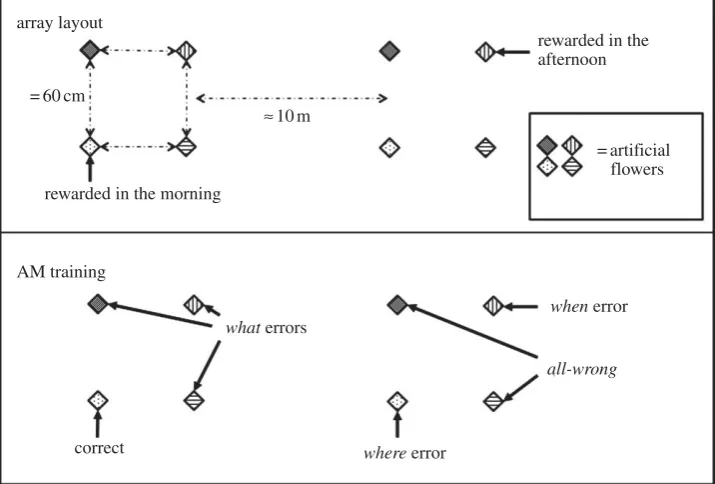
In this design, there were three pieces of information that a bird needed to use in order to locate the rewarded flower:What: the flower’s colour;Where: the array in which the flower is located andWhen: whether it is the morning or the afternoon.We could, therefore, look at whether these components of memory are separ-able by looking at the errors birds made, as they can be classified according to which of these pieces of information is missing from a bird’s choice (figure 1).Whaterrors were those where the bird chose the correct array at the correct time of day but a flower of the wrong colour (chance¼0.375); whereerrors were those where the bird chose a flower of the correct colour at the cor-rect time but in the wrong array (chance¼0.125); whenerrors were those where the bird chose the flower of the correct colour and in the correct array, but that was the flower that was rewarded at the alternative time (chance¼0.125); all-wrongerrors were those where the bird chose a flower of the wrong colour, in the wrong place and at the wrong time (chance¼0.250). Correct choices were those in which the bird chose the rewarded flower (chance¼0.125).
There are two different aspects of birds’ errors that we can examine in this experiment: the kinds of error made and how the birds went about correcting them. To determine whether some errors were easier to correct than the others, we looked at birds’ subsequent choices after making an error, either up to the point where they located the rewarded flower or to their fourth choice within a trial (birds failed to find the rewarded flower within the first four visits on only 20 of a total of 134 trials). We then constructed a partition tree (R package rpart) modelling whether or not an error was corrected on a subsequent choice as a function of trial number, visit number within a trial, the type of error made on the last visit and the individual.
rspb.r
oy
alsocietypublishing.org
Pr
oc
R
Soc
B
280:
20132194
(c) Experiment 2
In Experiment 1, when is defined both by time of day and sequence (i.e. the afternoon comes after the morning). To assess how birds were using these two components to estimatewhen, we conducted the second experiment in which we presented the birds with the same arrays as used in Experiment 1 in morn-ing and afternoon sessions for 5 days. For Experiment 2, however, we included a test phase whereby birds were given an Early test: 2 hours before a morning session; a Midday test: in-between the morning and afternoon sessions; and a Late test: 2 hours after the afternoon session was completed.
Birds were allowed to make one visit to the arrays during each of these early/midday/late tests, after which all flowers were removed and the feeder was replaced. All flowers were empty during these tests. To reiterate, during testing birds con-tinued to experience morning and afternoon trainings at the usual times and birds only experienced one test session per day. The order of the tests was randomized between birds and each bird completed each test only once.
Depending on whether birds used sequential or time of day information, or some combination of the two, birds’ choices at these tests should differ and the explanations for how birds might choose a flower are as follows:
(i) Birds always chose randomly between the morning and afternoon flower, irrespective of time (chance). Predic-tion: birds would choose the morning and afternoon flowers equally across all three tests.
(ii) Birds always chose the morning flower, irrespective of time (all AM). Prediction: birds would choose the morn-ing flower across all three tests.
(iii) Birds always chose the afternoon rewarded flower, irre-spective of time (all PM). Prediction: birds would choose the afternoon flower across all three tests. (iv) Birds always chose the flower corresponding to the time
of day nearest to that to which they were trained (time of day). Prediction: birds would choose the morning flower in the early test, show no preference in the midday test and would choose the afternoon flower in the late test. (v) Birds always chose the next flower due to be rewarded in
the sequence (sequence:avoid previous). Prediction: birds
would choose the morning flower in the early test, the afternoon flower in the midday test and the morning flower in the late test.
(vi) Birds always avoided the next flower due to be rewarded in the sequence (sequence: avoid next). Prediction: birds would choose the afternoon flower in the early test (as the next reward would be the morning flower), the morn-ing flower in the midday test (as the next reward would be the afternoon flower) and the afternoon flower in the late test (as the next reward would be the morning flower the following day).
(vii) Birds combined sequential and time of day information to make their flower choices (mixed). Prediction: birds would choose the afternoon flower in the early test (as the morn-ing flower would be rewarded at the time experienced during morning training and the rewarded flower alter-nates), equally between the morning and afternoon flowers in the midday test (as this test is midway between two known but different rewards) and the morning flower in the late test (as the last reward experienced was that of the flower from the afternoon and the reward alternates).
As the aim of these tests was to compare which of the two flowers (morning or afternoon) birds expected to contain the reward at untrained times of day, we modelled this test as a binary choice, where birds could either choose to visit the morning or the afternoon flower. This meant that we had to exclude cases in which birds made their first choice in a test to a flower that was never rewarded, which accounted for only one of 18 test trials. We used a likelihood approach to compare the likelihood of each hypothesis given the data [27]. We calculated the probability of observing the birds’ choices under each of these scenarios and compared the negative log-likelihoods (2LL), with the smallest
2LL denoting the most likely of the competing hypotheses [27].
3. Results
(a) Experiment 1
Male rufous hummingbirds were able to learn awhat,where,
when task, making their first choice to the correct flower
array layout
AM training
what errors
where error
when error
all-wrong
= 60 cm
rewarded in the morning
rewarded in the afternoon
= artificial flowers ª10m
[image:4.595.120.478.45.287.2]correct
Figure 1.
Schematic showing the two arrays of Experiment 1 and also the flower categorizations (e.g.
correct
or a
what
error) for morning trials.
rspb.r
oy
alsocietypublishing.org
Pr
oc
R
Soc
B
280:
20132194
significantly more often than expected by chance (t11¼6.16, p,0.001). Correspondingly, birds made all-wrong errors significantly less often than expected by chance (t11¼9.32, p,0.001). Critically, the prevalence of what, where and
when errors differed. As predicted, when errors occurred more often than expected by chance (t11¼3.09, p¼0.010). Furthermore, what errors occurred less often than chance andwhereerrors occurred at chance levels: (what:t11¼2.41, p¼0.035,where:t11¼0.71,p¼0.494; figure 2).
Not only were errors non-random, when males made a
whaterror but also they were much more likely to visit the correct flower on their next choice (86% of choices following a what error) than when they had made awhere, when or
all-wrongerror (25% of these errors; figure 3).
(b) Experiment 2
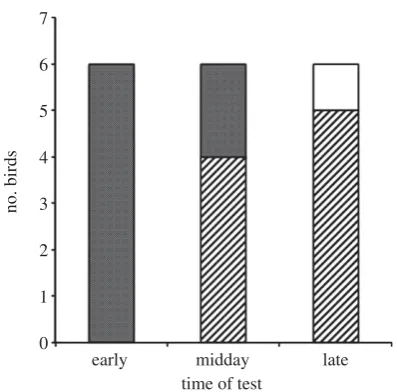
In early tests, the birds’ chose the flower rewarded in the after-noon significantly more often than expected by chance: all six birds chose the afternoon rewarded flower (two-tailed test bino-mial test:N¼6, test-proportion¼0.5, exactp¼0.031; figure 4). In the midday tests, the birds’ performance did not differ significantly from chance: four birds chose the flower rewarded in the morning and two chose the flower rewarded in the after-noon (two-tailed binomial test: N¼6, test-proportion¼0.5, exactp¼0.688). In the late tests, birds tended to choose the flower rewarded in the morning (two-tailed test binomial test:
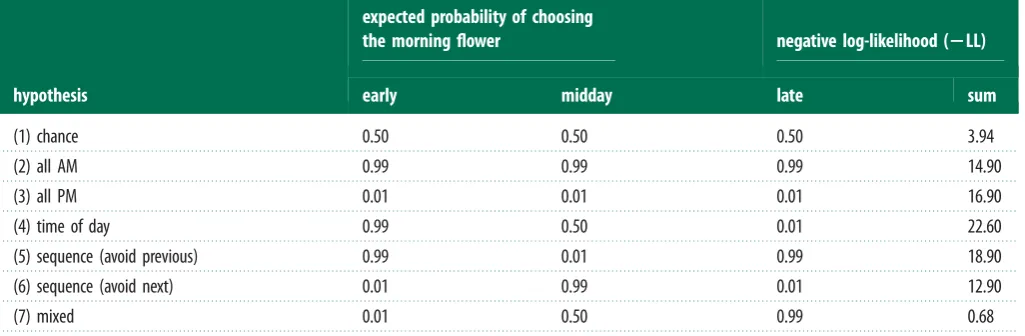
N¼5, test-proportion¼0.5, exactp¼0.063): five birds chose the flower rewarded in the morning while the sixth bird chose a flower that was never rewarded (we excluded this choice from the analysis). When we compared the birds’ per-formance across the early, midday and late tests with our hypotheses, their choices were most consistent with those predicted by the mixed hypothesis (2LL¼0.678; table 1).
4. Discussion
Rufous hummingbirds’ errors on thiswhat,where,whentask were not random. Errors very rarely represented a failure to remember any aspect of the rewarded flower (i.e. all-wrong
errors), rather their errors generally represented the failure to remember one aspect of thewhat,whereorwhen. In particu-lar, birds were most likely to make errors regardingwhena
flower should be rewarded. This is consistent with other studies, where the time component appears to be the most difficult for many animals to learn [25,26]. Furthermore, birds made what errors less frequently than expected by chance. It therefore appears that these birds store what,
where and when as separate pieces of information, as is thought to be the case for human episodic memory [13].
Not only were birds less likely to makewhaterrors, when these errors did occur they were more likely to be followed by a visit to the correct flower. Here,whatis signalled by flower colour, and previous research has suggested that while hum-mingbirds can use colour to direct foraging when no other cue is available [17,18], colour information tends to be oversha-dowed by spatial information [22,24,28]. The ready correction of what errors would suggest that birds knew the correct flower colour but preferred to use other information first. It is worth noting that not allwhaterrors in this experiment were equivalent: birds either chose the flower colour rewarded at the alternative time (one of three flowers) or a flower colour
0.4
0.375 chance for what
0.25 chance for fail
0.125 chance for correct,
where and when
0.3
0.2
proportion of f
irst choices
0.1
0
correct what where
flower choice
[image:5.595.51.277.45.163.2]when fail
Figure 2.
Proportion of first choices of each type in Experiment 1. The solid
line at 0.125 represents chance for
when
,
where
and
correct
choices. The
dashed line at 0.375 represents chance for
what
choices. The dotted line
at 0.25 represents chance for
all
-
wrong
choices. Birds made correct choices
significantly more often than chance, fewer all-wrong errors than chance,
fewer
what
errors than chance and more
when
errors than chance.
first decision
35% first choices correct
previous what error: 86% next choice correct
previous where, when or
all-wrong error: 75% next choice incorrect
65% first choices errors
correcting errors
[image:5.595.320.544.46.177.2]correct error correct error
Figure 3.
Hummingbird choices were corrected non-randomly. 47/134
choices of the birds’ first decision were correct, while 87/134 were errors.
Where birds made
what
errors (whether on their first, second or third
choice), 86% of the next choices were to the correct flower. However, if
birds made a
where
,
when
or
all
-
wrong
error, 75% of the next choices
were also wrong.
7
6
5
4
3
2
1
0
early midday time of test
late
no. birds
Figure 4.
The number of birds that made their first choice to the morning
and afternoon flowers at the early, midday and late tests. Striped portions of
bars represent choices of the afternoon rewarded flower, clear bars represent
choices of the morning rewarded flower and dotted bars represent choices of
unrewarded flowers.
rspb.r
oy
alsocietypublishing.org
Pr
oc
R
Soc
B
280:
20132194
[image:5.595.314.513.284.480.2]that was never rewarded (two of three flowers). It seems that there is a difference in how readily birds made these two types of errors: most of the birds’whaterrors in training were to the colour rewarded at the other time (33 of 37 initial whaterrors), rather than to one of the two never rewarded colours. Given that most of thesewhaterrors were to a specific type of flower, the proportion ofwhaterrors relative to chance was actually very high (figures 2 and 3). It seems likely that birds may have learned which flower colours were rewarded and which were not, but their errors stemmed from failing to integrate this infor-mation withwhereandwhen. We cannot, however, yet exclude the possibility that owing to the distance (10 m) that separated the two arrays correctingwhaterrors was less costly than was correcting where orwhen errors. Testing this possibility (and indeed exploring the optimal use of multi-component memory more generally) requires further experimentation.
Based on the difficulty that animals often have had in remembering the when component in episodic-like exper-iments [25,26], we predicted that the birds would find the
whencomponent of the task the most difficult to remember, which was indeed the case. However, this component of the task was distinct from thewhereorwhatcomponents in that there was more than one kind of information about when that the birds could have used, as the rewarded flower could have been predicted by both the time of day and by the sequence in which arrays were rewarded across the day. Experiment 2 suggests that the hummingbirds used both time of day and sequence information in combi-nation: they learned a sequence (i.e. that the reward in the two flowers alternated) but they also learned that the sequence was anchored to specific times of day. This expla-nation is consistent with the finding that rats can combine different types of information to guide their behaviour [29].
Under its original formulation, animals must remember all three ofwhat,whereandwhensimultaneously in order to show episodic-like memory [4]. However, this all-or-nothing approach to memory is not in close accord with human episo-dic memories, which are often incomplete and thought to be recalled by using reconstructive processes, where an episode
is reassembled as it is recalled [12]. While our experiment does not directly test episodic-like memory, as animals received repeated trials on the same task, our data suggest that the
what,whereandwhencomponents of a memory may likewise be separable in animals. The separability of these components of a memory is supported by the variation in memory impair-ments in mice trained to a what, where andwhen task [30]: hippocampal-lesioned animals were impaired on the overall task, while mice with lesions to the prefrontal cortex were specifically impaired on thewhereelement of the task.
Ifwhat,whereandwhenare indeed remembered in a recon-structive way by hummingbirds and other animals, there may be a number of ways to investigate the similarities (or not) between human episodic memory and animal episodic-like memory. In humans, the integrative nature of episodic memory leads to a variety of memory failures that may be amenable to testing in animals. These include generalization, where subjects incorrectly remember aspects of an event that did not occur owing to their close relation to an event’s actual context. For example, subjects will frequently ‘remem-ber’ words they have not seen if a list of words contains other thematically related words, such as rememberinghospital
having seen the wordsambulance,doctor,operation,X-ray,ward, etc. [14,15]. Another type of reconstructive memory error is blending, where two memories which share many features can be confused with each other and combined to make a novel (and inaccurate) memory [16]. Given that our experiment suggests that information about what, where and when are also separable in animal memory, it seems to us that it would be useful to look for these kinds of reconstruction errors in episodic-like tasks, to see whether animal memory resembles human memory in form as well as content.
Acknowledgements. We thank Kate Morgan, Michelle Arnold, James Ainge and Madeline Eacott for helpful discussion, and two anon-ymous reviewers for their thoughtful comments on an earlier version of the manuscript. The data will be made available on request from the corresponding author.
[image:6.595.43.556.138.306.2]Funding statement.This work was supported by the Natural Environment Research Council (DTG studentship to R.E.S.M.) and NSERC (T.A.H.).
Table 1.
A likelihood analysis of possible decision rules that male hummingbirds may have used to choose which flowers to visit in Experiment 2. We tested
seven hypotheses, including random choice (chance) and fixed choice rules (all morning flowers or all afternoon flowers) plus four hypotheses related to time of
day, sequence and a combination of time and sequence (see main text for more details). The negative log-likelihoods ( – LL) of obtaining the observed patterns
of flower choice across the three tests (early, middle and late) under each hypothesis were calculated using the binomial probability distribution. The smallest
value of – LL indicates the hypothesis with the best support given the data. When a hypothesis involves the probability of choosing the morning flower being
either
p
¼
1 or
p
¼
0 (i.e. always choosing the morning flower or never choosing the morning flower), we used
p
¼
0.99 and
p
¼
0.01 to facilitate the
likelihood calculations.
hypothesis
expected probability of choosing
the morning flower
negative log-likelihood (
2
LL)
early
midday
late
sum
(1) chance
0.50
0.50
0.50
3.94
(2) all AM
0.99
0.99
0.99
14.90
(3) all PM
0.01
0.01
0.01
16.90
(4) time of day
0.99
0.50
0.01
22.60
(5) sequence (avoid previous)
0.99
0.01
0.99
18.90
(6) sequence (avoid next)
0.01
0.99
0.01
12.90
(7) mixed
0.01
0.50
0.99
0.68
rspb.r
oy
alsocietypublishing.org
Pr
oc
R
Soc
B
280:
20132194
References
1. Tulving E. 1993 What is episodic memory?Curr. Dir. Psychol. Sci.2, 67 – 70. (doi:10.1111/1467-8721. ep10770899)
2. Tulving E. 2002 Episodic memory: from mind to brain.Annu. Rev. Psychol.53, 1 – 25. (doi:10.1146/ annurev.psych.53.100901.135114)
3. Clayton NS, Dickinson A. 1998 Episodic-like memory during cache recovery by scrub jays.Nature395, 272 – 274. (doi:10.1038/26216)
4. Clayton NS, Bussey TJ, Dickinson A. 2003 Can animals recall the past and plan for the future?Nat. Rev. Neurosci.4, 685 – 691. (doi:10.1038/nrn1180) 5. Feeney M, Roberts W, Sherry D. 2009 Memory for
what, where, and when in the black-capped chickadee (Poecile atricapillus).Anim. Cogn.12, 767 – 777. (doi:10.1007/s10071-009-0236-x) 6. Ferkin MH, Combs A, delBarco-Trillo J, Pierce AA,
Franklin S. 2008 Meadow voles,Microtus pennsylvanicus, have the capacity to recall the ‘what’, ‘where’, and ‘when’ of a single past event.
Anim. Cogn.11, 147 – 159. (doi:10.1007/s10071-007-0101-8)
7. Babb SJ, Crystal JD. 2006 Episodic-like memory in the rat.Curr. Biol.16, 1317 – 1321. (doi:10.1016/j. cub.2006.05.025)
8. Suddendorf T, Busby J. 2003 Mental time travel in animals?Trends Cogn. Sci.7, 391 – 396. (doi:10. 1016/s1364-6613(03)00187-6)
9. Clayton NS, Bussey TJ, Emery NJ, Dickinson A. 2003 Prometheus to Proust: the case for behavioural criteria for ‘mental time travel’.Trends Cogn. Sci.7, 436 – 437. (doi:10.1016/j.tics.2003.08.003) 10. Suddendorf T, Busby J. 2003 Like it or not? The
mental time travel debate: reply to Claytonet al.
Trends Cogn. Sci.7, 437 – 438. (doi:10.1016/j.tics. 2003.08.010)
11. Conway MA, Pleydell-Pearce CW. 2000 The construction of autobiographical memories in the self-memory system.Psychol. Rev.107, 261 – 288. (doi:10.1037/0033-295x.107.2.261)
12. Schacter DL, Addis DR. 2007 The cognitive neuroscience of constructive memory: remembering the past and imagining the future.Phil. Trans. R. Soc. B362, 773 – 786. (doi:10.1098/ rstb.2007.2087)
13. Schacter DL, Norman KA, Koutstaal W. 1998 The cognitive neuroscience of constructive memory.
Annu. Rev. Psychol.49, 289 – 318. (doi:10.1146/ annurev.psych.49.1.289)
14. Read J. 1996 From a passing thought to a false memory in 2 minutes: confusing real and illusory events.Psychol. Bull. Rev.3, 105 – 111. (doi:10. 3758/bf03210749)
15. Roediger HL, McDermott KB. 1995 Creating false memories: remembering words not presented in lists.J. Exp. Psychol. Learn. Mem. Cogn.21, 803 – 814. (doi:10.1037/0278-7393.21.4.803) 16. Nystrom LE, McClelland JL. 1992 Trace synthesis is
cued-recall.J. Mem. Lang.31, 591 – 614. (doi:10. 1016/0749-596x(92)90030-2)
17. Bateson M, Healy SD, Hurly TA. 2002 Irrational choices in hummingbird foraging behaviour.Anim. Behav.63, 587 – 596. (doi:10.1006/anbe.2001.1925) 18. Bateson M, Healy SD, Hurly TA. 2003
Context-dependent foraging decisions in rufous hummingbirds.Proc. R. Soc. Lond. B270, 1271 – 1276. (doi:10.1098/rspb.2003.2365) 19. Hurly TA. 1996 Spatial memory in rufous hummingbirds: memory for rewarded and non-rewarded sites.Anim. Behav.51, 177 – 183. (doi:10.1006/anbe.1996.0015)
20. Healy SD, Hurly TA. 1998 Rufous hummingbirds’ (Selasphorus rufus) memory for flowers: patterns or actual spatial locations?J. Exp. Psychol. Anim. Behav. Process.24, 396 – 404. (doi:10.1037/0097-7403.24.4.396)
21. Healy SD, Hurly TA. 1995 Spatial memory in rufous hummingbirds (Selasphorus rufus): a field test.
Anim. Learn. Behav.23, 63 – 68. (doi:10.3758/ BF03198016)
22. Hurly TA, Healy SD. 1996 Memory for flowers in rufous hummingbirds: location or local visual cues?
Anim. Behav.51, 1149 – 1157. (doi:10.1006/anbe. 1996.0116)
23. Henderson J, Hurly TA, Bateson M, Healy SD. 2006 Timing in free-living rufous hummingbirds,
Selasphorus rufus.Curr. Biol.16, 512 – 515. (doi:10. 1016/j.cub.2006.01.054)
24. Marshall RES, Hurly TA, Healy SD. 2012 Do a flower’s features help hummingbirds to learn its contents and refill rate?Anim. Behav.83, 1163 – 1169. (doi:10.1016/j.anbehav. 2012.02.003)
25. Hampton RR, Hampstead BM, Murray EA. 2005 Rhesus monkeys (Macaca mulatta) demonstrate robust memory for what and where, but not when, in an open-field test of memory.Learn. Motiv.36, 245 – 259. (doi:10.1016/j.lmot.2005.02.004) 26. Bird LR, Roberts WA, Abroms B, Kit KA, Crupi C.
2003 Spatial memory for food hidden by rats (Rattus norvegicus) on the radial maze: studies of memory for where, what, and when.J. Comp. Psychol.117, 176 – 187. (doi:10.1037/0735-7036. 117.2.176)
27. Hilborn R, Mangel M. 1997The ecological detective: confronting models with data,315 p. Princeton, NJ: Princeton University Press.
28. Hurly TA, Healy SD. 2002 Cue learning by rufous hummingbirds (Selasphorus rufus).J. Exp. Psychol. Anim. Behav. Process.28, 209 – 223. (doi:10.1037/ 0097-7403.28.2.209)
29. Pizzo M, Crystal J. 2002 Representation of time in time – place learning.Learn. Behav.30, 387 – 393. (doi:10.3758/bf03195963)
30. DeVito LM, Eichenbaum H. 2010 Distinct contributions of the hippocampus and medial prefrontal cortex to the ‘what – where – when’ components of episodic-like memory in mice.
Behav. Brain Res.215, 318 – 325. (doi:10.1016/j. bbr.2009.09.014)