PRIORITIZATION OF COMBINATORIAL TEST CASES BY
3
INCREMENTAL INTERACTION COVERAGE
4
RUBING HUANG1,∗, XIAODONG XIE2, DAVE TOWEY3, TSONG YUEH CHEN4, 5
YANSHENG LU1 and JINFU CHEN5
6
1School of Computer Science and Technology, Huazhong University of Science and Technology 7
Wuhan, Hubei 430074, P.R. China
8
2School of Computer Science and Technology, Huaqiao University 9
Xiamen, Fujian 362021, P.R. China
10
3BNU-HKBU: United International College, Zhuhai, Guangdong 519085, P.R. China 11
4Faculty of Information and Communication Technologies, Swinburne University of Technology 12
Hawthorn, Victoria 3122, Australia
13
5School of Computer Science and Telecommunication Engineering, Jiangsu University 14
Zhenjiang, Jiangsu 212013, P.R. China
15
Combinatorial testing is a well-recognized testing method, and has been widely applied
16
in practice. To facilitate analysis, a common approach is to assume that all test cases
17
in a combinatorial test suitehavethe same fault detection capability. However, when
18
testing resources are limited, the order of executing the test cases is critical. To improve
19
testing cost-effectiveness, prioritization of combinatorial test cases isemployed. The most
20
popular approach is based on interaction coverage, which prioritizes combinatorial test
21
cases by repeatedly choosingan unexecuted test case that covers the largest number of
22
uncoveredparameter value combinations of a given strength (level of interaction among
23
parameters). However, this approach suffers from some drawbacks. Based on previous
24
observations that the majority of faults in practical systems canusuallybe triggeredwith
25
parameter interactions of small strengths, we propose anewstrategy of prioritizing
com-26
binatorial test cases by incrementally adjusting the strength values. Experimental results
27
show that our method performs better thantherandom prioritization technique and the
28
technique of prioritizing combinatorial testsuitesaccording to test case generation
or-29
der, and has better performance thantheinteraction-coverage-based test prioritization
30
technique in mostcases.
31
Keywords: Software testing; combinatorial testing; test case prioritization; interaction
32
coverage; incremental interaction coverage; algorithm.
33
1. Introduction
34
Suppose that a system under test (SUT) is affected by itskparameters (or factors),
35
and each of these parameters may have many possible values (or levels). Ideally,to
36
ensure system quality, we should test all combinations of parameter values. However,
37
it is practically infeasible todo this due to the large amount of resources and effort
38
∗Corresponding Author: School of Computer Science and Technology, Huazhong University of
Science and Technology, Wuhan, Hubei 430074, China. Email: [email protected].
required, especially for complex systems with a large number of parameters and
1
values.
2
Combinatorial testing (or combinatorial interaction testing), a black-box
test-3
ing technique, aims at generating an effective test suite in order to detect failures
4
triggered by the interactions among parameters of the SUT. It is widely applied in
5
various applications, especially for highly-configurable systems [1–5]. Combinatorial
6
testingprovides a tradeoff between testing effectiveness and efficiency, as it uses a
7
smaller test suite that covers certain key combinations of parameter values for
sam-8
pling the entire combination space. For example, 2-wise combinatorial testing (or
9
pairwise testing where the level of interaction among parameters, the strength, is
10
2) only requires the generated test suite to cover all possible 2-tuples of parameter
11
values (referred to as 2-wise parameter value combinations).
12
In the faultmodel of combinatorial testing, it is assumed that failures are caused
13
by parameter interactions. Previous studies have shown that faults can normally
14
be identified by testing interactions among a small number of parameters [1, 6, 7].
15
A failure-causing interaction is called a faulty interaction, and the size of a faulty
16
interaction (that is, the number of parameters required to detect a failure) is referred
17
to as thefailure-triggering fault interaction (or FTFI) number [1, 6].
18
Traditionally, combinatorial testing treats all test cases equally in a test suite.
19
However, the order of executing the test cases may be critical in practice, for example
20
in regression testing with limited test resources. Therefore, the potentially
failure-21
revealing test cases should be executed as early as possible. In other words, a
well-22
designedtest case execution order may be ableto identify failures earlier, and thus
23
enable earlier fault characterization, diagnosis and revision[7]. To improve testing
24
efficiency, test case prioritization [8], which means to prioritize test cases according
25
tosome strategy, has beenintroduced. In test case prioritization, a prioritized test
26
suite is generally referred to as a test sequence.
27
Test case prioritization of combinatorial test suites has also been well
stud-28
ied [4, 9–15]. Many techniques have been proposed to guide the prioritization of
29
combinatorial test cases, such as random prioritization [9] and
branch-coverage-30
based prioritization [13]. The most well-studied approach of prioritizing
combina-31
torial test suite is based on interaction coverage (called interaction-coverage-based
32
prioritization), which prioritizes test cases by repeatedly selecting an unexecuted
33
element suchthat it covers the largest number of uncovered parameter value
com-34
binations of a given strength [4, 9–15].
35
However, the interaction-coverage-based prioritization technique has two
chal-36
lenges. Firstly, given a combinatorial test suite T of strength t, the prioritization
37
method by interaction coverage only takes account of parameter value combinations
38
of strengthtfor orderingT, which means that a test sequence prioritized by
inter-39
action coverage may only favor parameter value combinations of strengtht. In other
40
words, this test sequence may not be effective forτ-wise (1≤τ < t) combinations
41
of parametric values. A second challenge is thattesters need to specify the strength.
42
Kuhn and his colleagues [1, 6] investigated interaction failures by analyzing the
faultreports of several software projects. They concluded that over 50% of faults can
1
be triggered by one-wiseinteractions; more than 70% of faults can be detected by
2
testing two-wise interactions; and approximately 90% of the faults can be discovered
3
with three-wise interactions. In other words, the majority of faults in the SUT
4
are generally caused by interactions of small strengths. Therefore, it is reasonable
5
and practical to prioritize combinatorial test cases by covering all parameter value
6
combinations at small strengths as early as possible. /*** Dave’s comment [1]:
7
perhaps delete the next sentence ***/ We would like to emphasize this category of
8
failures in this paper.
9
Motivated by these facts, we propose a novel technique of prioritizing
combina-10
torial test cases based on incremental interaction coverage, which orders
combina-11
torial test cases by reusing already selected test cases and incrementally adjusting
12
the strength values. Given a combinatorial test suite T of strengtht, our strategy
13
aims to prioritize T into a test sequence such that all possible parameter value
14
combinations of each strength lower thant would be covered as earlyas possible.
15
Therefore, our method has at least two advantages over the
interaction-coverage-16
based prioritization technique: (1) no selection of strength is required in advance;
17
and (2) different strengths are considered. Compared with the
interaction-coverage-18
based prioritization technique, our method provides a priority of strengths lower
19
than t over the strength t. In other words, our prioritized test suites cover all
t-20
wise combinations of parameter values with lower priorities – not just all parameter
21
value combinations at strengths lower thant.In terms of covering parameter value
22
combinations and fault detection, experimental results show that our method has
23
better performance than the random prioritization approach and the method of
pri-24
oritizing combinatorial test suite according to the test case generation order, and
25
also performs better than the interaction-coverage-based prioritization technique in
26
most cases.
27
This paper is organized as follows. Section 2 introduces some preliminaries about
28
combinatorial testing, and test case prioritization. Section 3introducesa new
prior-29
itization strategy based on incremental interaction coverage, and analyzes its time
30
complexity. Section 4 presents results ofthesimulations and empirical studies.
Sec-31
tion 5 summarizes some related work, and Section 6 describes the conclusions and
32
potential future work.
33
2. Preliminaries
34
In this section, some preliminaries of combinatorial testing and test case
prioritiza-35
tion are presented.
36
2.1. Combinatorial testing 37
Combinatorial testing is widely used in the combinatorial test space to generate an
38
effective test suite for detecting interaction faults that are triggered by interactions
39
among parameters in the SUT.
Suppose that the SUT has k parameters P1, P2,· · ·, Pk, which may represent
1
user inputs or configuration parameters, and each parameter Pi has discrete valid
2
values from the finite set Vi. Let C be the set of constraints on parameter value
3
combinations, andR be the set of interaction relations among parameters. In the
4
remainder of this paper, we will refer to acombination of parameters as aparameter 5
combination, and acombination of parameter valuesor aparameter value combina-6
tion as avalue combination.
7
Definition 1. A test profile, denoted as T P(k,|V1||V2| · · · |Vk|, C), is about the
8
information on a combinatorial test space of the SUT, including k parameters,
9
|Vi|(i= 1,2,· · · , k) values for thei-th parameter, and constraintsC on value
com-10
binations.
11
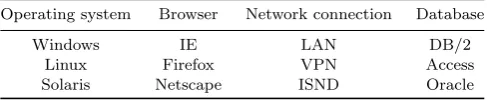
For example, Table 1 gives the configurations of a component-based system,
12
in which there are four configuration parameters, each of which has three values.
13
Therefore, its test profile can be written asT P(4,34,∅).
14
Definition 2.Given a test profile denoted byT P(k,|V1||V2| · · · |Vk|, C), ak-tuple
15
(v1, v2,· · ·, vk) is a test case for SUT, wherevi ∈Vi(i= 1,2,· · · , k).
16
For example, a 4-tuple tc = (Windows,IE,LAN,Access) is a test case for the
17
SUT shown in Table 1.
18
Definition 3.Given aT P(k,|V1||V2| · · · |Vk|, C), anN×kmatrix is at-wise (1≤
19
t ≤ k) covering array denoted as CA(N;t, k,|V1||V2| · · · |Vk|), which satisfies the
20
following properties: (1) each columni(i= 1,2,· · ·, k) contains only elements from
21
the setVi; and (2) the rows of eachN×tsub-matrix cover allt-tuples of parametric
22
values from thetcolumns at least once.
23
When |V1|= |V2| =· · · =|Vk| =v, the covering array can also be written as
[image:4.595.183.427.514.564.2]24
Table 1. Configurations of a component-based system.
Operating system Browser Network connection Database
Windows IE LAN DB/2
Linux Firefox VPN Access
Solaris Netscape ISND Oracle
Table 2. A combinatorial test suite for pairwise testing.
Test No. Operating system Browser Network connection Database
1 Windows IE LAN DB/2
2 Windows Firefox VPN Oracle
3 Windows Netscape ISND Access
4 Linux IE ISND Oracle
5 Linux Firefox LAN Access
6 Linux Netscape VPN DB/2
7 Solaris IE VPN Access
8 Solaris Firefox ISND DB/2
[image:4.595.161.448.606.716.2]CA(N;t, k, v). Obviously, the interaction relation set R has elements of the same
1
size forCA(N;t, k,|V1||V2| · · · |Vk|), that is,R={{Pj1, Pj2,· · ·, Pjt}|1≤j1< j2<
2
· · ·< jt≤k, tis fixed} and|R|=Ct k.
3
On the other hand, a covering arrayT denoted asCA(N;t, k,|V1||V2| · · · |Vk|) is
4
also a covering array of strengthτ(1≤τ < t). In other words,T can also be written
5
asCA(N;τ, k,|V1||V2| · · · |Vk|) where 1≤τ < t. Thus, there exists a subsetT0⊆T
6
such thatT0 is a covering array of strengthτ, that is,CA(|T0|, τ, k,|V1||V2| · · · |Vk|).
7
For example, to achieve exhaustive testing of all possible value combinations
8
for the system shown in Table 1, we should require 34 = 81 test cases. However,
9
as shown in Table 2, 2-wise combinatorial testing requires only a set of 9 test
10
cases (denoted asCA(9; 2,4,34) orCA(9; 2,4,3)) for covering all pairs of parameter
11
values.
12
Definition 4.Given aT P(k,|V1||V2| · · · |Vk|, C), a variable-strength covering array,
13
denoted asV CA(N;t, k,|V1||V2| · · · |Vk|, Q), is anN×kcovering array of strength
14
tcontainingQ, which is a set of CAs, every element of which is of strength> tand
15
is defined on a subset ofkparameters.
16
Intuitively speaking, aV CA(N;t, k,|V1||V2| · · · |Vk|, R) can also be considered a
17
CA(N;t, k,|V1||V2| · · · |Vk|), with the interaction relation setRof the VCA
contain-18
ing elements of different sizes, that is, the VCA contains other CAs.
19
Each row of a covering array or variable-strength covering array stands for a
20
test case while each column represents a parameter of the SUT. Testing with a
21
t-wise covering array is called t-wise combinatorial testing, while testing with a
22
variable-strength covering array is called variable-strength combinatorial testing.
23
In combinatorial testing, the uncovered t-wise value combinations distance
24
(UVCD) is a distance measure often used to evaluate test cases when constructing
25
a covering array or variable-strength covering array [16].
26
Definition 5. Given a combinatorial test suite T, strength t, and a test case tc,
27
uncoveredt-wise value combinations distance (UVCD) oftcis defined as:
28
U V CDt(tc, T) =|CombSett(tc)\CombSett(T)|, (1) where CombSett(tc) is defined as the set of t-wise value combinations covered by
29
test casetc, whileCombSett(T) is the set oft-wise value combinations covered by
30
test suiteT. More specifically, lettc= (v1, v2,· · ·, vk) wherevi∈Vi(i= 1,2,· · · , k),
31
CombSett(tc) andCombSett(T) can be respectively written as follows:
32
CombSett(tc) ={(vj1, vj2,· · ·, vjt)|vj1 ∈Vj1, vj2 ∈Vj2,· · ·, vjt ∈Vjt,
1≤j1< j2<· · ·< jt≤k}, (2)
CombSett(T) = [ tc∈T
To reduce the cost of combinatorial testing, many researchers have focused on
al-1
gorithms to generate the optimal combinatorial test suite with the minimal number
2
of test cases. Unfortunately, it has beenproven that the problem of constructing
cov-3
ering arrays or variable-strength covering arraysis NP-Complete [17].Nevertheless,
4
many strategies and tools for building combinatorial test suiteshave been developed
5
in recent years. Some major approaches to combinatorial test suite construction
6
involve greedy algorithms, heuristic search algorithms, recursive algorithms, and
7
algebraic methods(see [7] for more details).
8
2.2. Test case prioritization 9
To illustrate our work clearly, let us initially define a few terms. /*** Dave’s
10
comment [2]: Earlier, we used tc to refer to test cases, should we continue that
11
here? ***/ Suppose T = {t1, t2,· · ·, tN} is a test suite of size N, and S =
12
hs1, s2,· · ·, sNi is an ordered set suite (we call it a test sequence) where si ∈ T
13
andsi 6=sj(i, j= 1,2,· · · , N;i6=j). If two test sequences areS1=hs1, s2,· · · , smi
14
and S2 = hq1, q2,· · · , qni, we define S1ZS2 as hs1, s2,· · ·, sm, q1, q2,· · ·, qni. By 15
definition,T\S is the maximal subset ofT whoseelements are not inS.
16
Test case prioritization is done to obtain a schedule of test cases, sothat,
accord-17
ing to some criteria (such as the cost of test case execution or statement coverage),
18
test cases with higher priorityare executed earlier in testing. A well-prioritized test
19
sequence may improve the likelihood of detecting faults early. The problem of test
20
case prioritization is defined asfollows, from [8].
21
Definition 5. Given (T,Ω, f), whereT is a test suite, Ω is the set of all possible
22
test sequences obtained by ordering test cases of T, and f is a function from Ω to
23
theset ofreal numbers, the problem of test case prioritization is to findanS∈Ω
24
such that:
25
(∀S0) (S0∈Ω) (S06=S) [f(S)≥f(S0)]. (4) In Equation 4,f is a function which evaluates a test sequence S by returning
26
an award value. /*** Dave’s comment [3]: please confirm the following sentence is
27
correct ***/ The most well-known function isa weighted average of the percentage
28
of faults detected (APFD)[18], which is a measure of how quickly a test sequence
29
can detect faults during the execution. LetT be a test suite of sizen, and letF be
30
a set ofm faults revealed by T. Let SFi be the first test case in test sequence S
31
ofT which detects faulti. The APFD for test sequenceSis given by the following
32
equation from [18]:
33
AP F D= 1−SF1+SF2+· · ·+SFm
n×m +
1
2n. (5)
To date, many techniques of test case prioritization have been proposed
ac-34
cording to different criteria, such as time-aware prioritization [19], search-based
prioritization [20], risk-exposure-based prioritization [21], source-code-based
priori-1
tization [8, 22], fault-severity-based prioritization [23],and history-based
prioritiza-2
tion [24]. Most test case prioritization strategies can be categorized into two classes:
3
greedy methods and meta-heuristic search methods [15].
4
3. Incremental-Interaction-Coverage-Based Test Prioritization
5
In this section, we present a method of prioritizing combinatorial test cases based
6
on incremental interaction coverage (denoted IICBP), a heuristic algorithm
imple-7
menting this method, and a complexity analysis ofthealgorithm.
8
3.1. Method 9
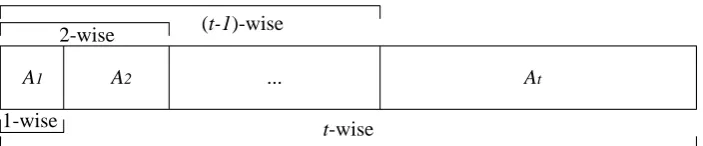
The IICBP technique divides a CA(N;t, k|V1||V2| · · · |Vk|) intot independent
sub-10
sets (A1, A2,· · · , At) such that:
11
Ai\Aj=∅, i, j= 1,2,· · · , t, i6=j; (6)
j
[
i=1
Ai=CA( j
X
i=1
|Ai|;j, k,|V1||V2| · · · |Vk|), j= 1,2,· · · , t, (7) whereAi(i= 1,2,· · ·, t) is a test sequence prioritized by interaction-coverage-based
12
strategy [4, 11–13, 15] of strengthi. Each subsetAj (j = 2,3,· · · , t) is prioritized
13
by ICBP using the seeding setSj−1
l=1Al. However, the processes of covering array
14
partition and prioritization for each sub-partition are inter-related in such a way
15
that once a subpartition is completed, test case prioritization of this sub-partition
16
is also completed. In other words, each test case in Ai(i = 1,2,· · · , t) is selected
17
by using strengthiand previously chosen test cases as seeds. Once alli-wise value
18
combinations are covered by the selected test cases (that is,Aihas been successfully
19
constructed), strengthiis incremented by 1. The criterion is to choose the element
20
e0 from test suiteT as the next test element in test sequenceS such that:
21
(∀e) (e∈T) (e6=e0) [U V CDi(e0, S)≥U V CDi(e, S)]. (8)
A1 A2 ... At
t-wise 2-wise
1-wise
[image:7.595.134.486.607.680.2](t-1)-wise
Algorithm 1Select the best test element (BTES)
Input: Already prioritized test setS, candidate test suite T, and strength t
Output: Best test elementbest data∈T
1: Setbest distance=−1; 2: for(each elemente∈T)
3: Calculate UVCD ofe, that is,U V CDt(e, S); 4: if (U V CDt(e, S)≥best distance)
5: best distance=U V CDt(e, S); 6: best data=e;
7: end if
8: end for
9: return best data.
Algorithm 2Interaction-coverage-based prioritization of combinatorial test cases
(ICBP)
Input: Covering arrayCA(N;t, k,|V1||V2| · · · |Vk|), denoted asT
Output: Test sequenceS
1: InitializeS=hi;
2: while (|S| 6=N)
3: best data=BT ES(S, T, t); //Generate the best test element. 4: T =T\ {best data};
5: S =SZhbest datai;
6: end while
7: return S.
Algorithm 3 Incremental-interaction-coverage-based prioritization of
combinato-rial test cases (IICBP)
Input: Covering arrayCA(N;t, k,|V1||V2| · · · |Vk|), denoted asT
Output: Test sequenceS
1: InitializeS=hi,τ= 1, T0=T;
2: while (|S| 6=N)
3: if (|CombSetτ(S)|==|CombSetτ(T)|) 4: τ =τ+ 1;
5: end if
6: best data=BT ES(S, T0, τ); //Generate the best test element. 7: T0 =T0\ {best data};
8: S =SZhbest datai;
9: end while
The process is repeated until all Ai(i = 1,2,· · ·, t) are prioritized according to
1
i-wise interaction coverage. Fig. 1 gives a schematic diagram for the relationship
2
betweenAi and the relevanti-wise interaction coverage.
3
Since the element selection criterion (see Equation 8) is widely used in the
4
prioritization of combinatorial test cases, we present the algorithm implementing
5
this criterion (Algorithm 1). However, there may exist more than one best test
6
element, indicating that they have the same maximal UVCD value. In such a tie
7
case, we randomly select one best element. The test case prioritization technique
8
by interaction coverage (denoted as ICBP) [4, 11–13, 15]is also given in Algorithm
9
2, and Algorithm 3 presents the detailed IICBP processes.
10
In this paper, we assume that a combinatorial test suite is equivalent to a
11
covering array, and that all parameters are independent. In other words, the
12
variable-strength covering array is not considered in this paper. Also, constraints
13
on value combinations are ignored. Therefore, the test profile can be abbreviated
14
asT P(k,|V1||V2| · · · |Vk|).
15
3.2. Complexity analysis 16
In this subsection, we briefly analyze the time complexity for the IICBP algorithm
17
(Algorithm 3). Given a CA(N;t, k,|V1||V2| · · · |Vk|), denoted as T, we define a =
18
max1≤i≤k{|Vi|}. /*** Dave’s comment [4]: is there any reason for choosing ‘a‘?
19
Can we give an explanation? ***/
20
We first analyze the time complexity of selecting the i-th (i= 1,2,· · ·, N) test
21
case, which depends on two factors: (1) the number of candidates required for the
22
calculation of UVCD; and (2) the time complexity of calculating UCVD of strength
23
l (1≤l≤t) for each candidate during the process of constructingAl.
24
For (1), it requires (N−i)+1 test cases to compute UVCD. For (2), according to Cl
k l-wise parameter combinations, we divide all possiblel-wise value combinations that are derived from aT P(k,|V1||V2| · · · |Vk|) intoCkl sets that form
Πl={πl|πl={(vi1, vi2,· · ·, vil)|vij ∈Vij, j= 1,2,· · · , l},
1≤i1< i2<· · ·< il≤k}. (9) As a consequence, when using a binary search, the order of time complexity of
25
(2) isO(P
πl∈Πllog(|πl\CombSetl(T)|)), which equalsO(
P
πl∈Πllog(|πl|)). Let us
26
define the following function:
27
fl=
0, ifl= 0; l
P
i=1
|Al|,if 1≤l≤t. (10)
FromEquation 10, we haveft=Pt
l=1|Al|=N.
28
According to Al(1 ≤ l ≤ t), the order of time complexity of constructing Al isO((Pfl
i=fl−1+1(N−i+ 1))×(
P
are included in the algorithm IICBP execution, the order of time complexity can be described as follows:
O(IICBP) =O( t
X
l=1 ((
fl
X
i=fl−1+1
(N−i+ 1))×( X πl∈Πl
log(|πl|))))
< O( t
X
l=1 ((
fl
X
i=fl−1+1
(N−i+ 1))×(Ckl ×log(al))))(1≤l≤t). (11)
There exists an integerµ(1≤µ≤t) such that:
1
(∀l) (1≤l≤t) (µ6=l) [(Ckµ×log(aµ))≥(Ckl×log(a l
))]. (12)
As a consequence,
O(IICBP)< O( t
X
l=1 ((
fl
X
i=fl−1+1
(N−i+ 1))×(Ckµ×log(aµ))))
=O(( N
X
i=1
(N−i+ 1))×(Ckµ×log(aµ)))
=O(Ckµ×log(aµ)×(N2+N)/2). (13) Therefore, we can conclude that the order of time complexity of algorithm IICBP
2
isO(N2×Ckµ×log(aµ))(1≤µ≤t).a
3
As discussed in [15], the order of time complexity of algorithm ICBP (Algorithm
4
2) is O(N2×Ckt×log(at)). /*** Dave’s comment [5]: please confirm the next
5
sentence ***/ According to Appendix A, if 1≤t <dk
2e,µ=t, or ifd
k
2e ≤t≤k, 6
µ=dk
2e, then the order of time complexity of algorithm IICBP is the same as that 7
of algorithm ICBP.
8
4. Experimental Results
9
In this section, some experimentalresults from simulations and experiments with
10
real programsare presented to analyze the effectiveness of the prioritization of
com-11
binatorial test cases by incremental interaction coverage.We evaluatetest sequences
12
prioritized by algorithm IICBP (denotedIICBP) by comparing with those ordered
13
by three other strategies: (1) test sequence according to covering array generation
14
sequence (denotedOriginal); (2) random test sequence whose ordering is randomly
15
prioritized (denotedRandom); and (3) test sequence prioritized by algorithm ICBP
16
(denotedICBP).
17
aIf 1≤t <dk
2e,µ=t; ifd k
2e ≤t≤k,µ=d k
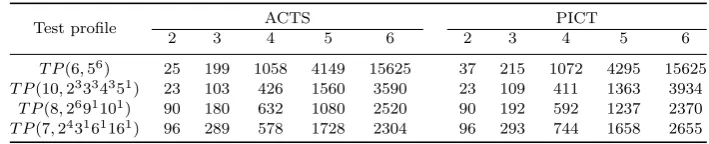
Table 3. Sizes of covering arrays for four test profiles.
Test profile ACTS PICT
2 3 4 5 6 2 3 4 5 6
T P(6,56) 25 199 1058 4149 15625 37 215 1072 4295 15625
T P(10,23334351) 23 103 426 1560 3590 23 109 411 1363 3934
T P(8,2691101) 90 180 632 1080 2520 90 192 592 1237 2370
T P(7,243161161) 96 289 578 1728 2304 96 293 744 1658 2655
4.1. Simulations 1
We initially designed some typical test profiles to construct covering arrays, then
2
applied different test case prioritization techniques to prioritize them, evaluating
3
each prioritization strategy Three simulations wereinvolved. The first simulation
4
was to evaluate the rate of value combinations covered by the different
prioriti-5
zation techniques. The second and third simulations aimed at assessing rates of
6
fault detection for different test sequences when executingall, or some test cases,
7
respectively.
8
4.1.1. Simulation instrumentation 9
We designedfour test profiles as four system models with details shown in Table
10
3. The first two test profiles wereT P(6,56) andT P(10,23334351), both of which
11
have been used in previous studies [15]. The third and fourth test profiles (that
12
is,T P(8,2691101) andT P(7,243161161))werefrom real-worldapplications: a real
13
configuration model of GNUzip (gzip);and a module of a lexical analyzer system
14
(flex).
15
The original covering arrays were generated by two different tools: Advanced 16
Combinatorial Testing System (ACTS) [25, 26] and Pairwise Independent Combi-17
natorial Testing (PICT) [27]. Both of these are supported by greedy algorithms,
18
and implemented, respectively, bytheIn-Parameter-Order (IPO) method [25] and
19
the one-test-at-a-time approach (generating one test case each time) [28]. We
fo-20
cusedon covering arrays with strengtht= 2,3,4,5,6; and the sizes of the covering
21
arrays generated by ACTS or PICT are given in Table 3. Since randomization is
22
used in some test case prioritization techniques, weraneach test profile 100 times
23
and report the average of the results.
24
4.1.2. Simulation One: Rate of covering value combinations 25
In this simulation, wemeasuredhow quickly a test sequencecouldcover value
com-26
binations of different strengths. We onlyconsidered strengtht= 2,3,4.Algorithm
27
ICBP requires that the strength t be initialized in advance. However, because we
28
sometimes may not know the strength of a covering array in practical testing
ap-29
plications, we also take account of test sequences ordered by algorithm ICBP when
30
selecting lower strengthτ(1< τ < t), that is,ICBPτ.
1. Metrics:Average percentage of combinatorial coverage(APCC) [15] is used as the
1
metric to evaluate the rate of value combinations covered by a test sequence. The
2
APCC values range from 0% to 100%; higher APCC values mean better rates
3
of covering value combinations. Let a test sequence be S = hs1, s2,· · · , sNi,
4
obtained by prioritizing aCA(N;t, k,|V1||V2| · · · |Vk|), the formulaforAPCC at
5
strengthτ is given as follows:
6
AP CCτ(S) =
PN−1
i=1 |
Si
j=1CombSetτ(sj)|
N× |CombSetτ(Tall)| , (14) whereTall is the set of all test cases fromT P(k,|V1||V2| · · · |Vk|).
7
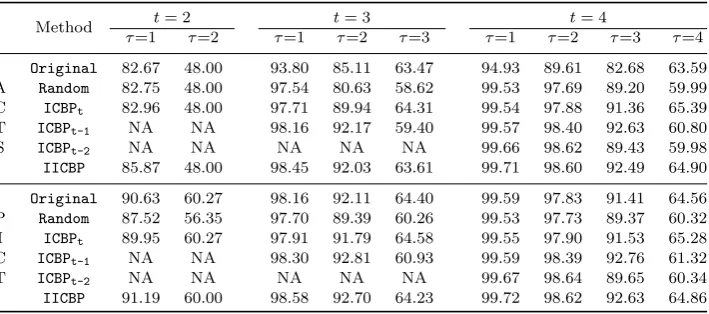
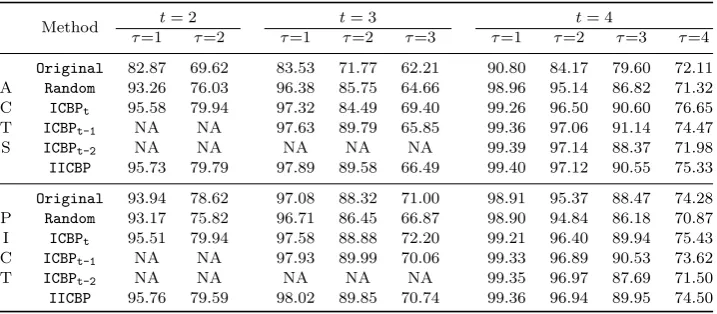
2. Results and analysis: For covering arrays of strengtht(2≤t≤4) on individual
[image:12.595.129.484.361.518.2]8
Table 4.AP CCτ metric (%) for different prioritization techniques forT P(6,56).
Method t= 2 t= 3 t= 4
τ=1 τ=2 τ=1 τ=2 τ=3 τ=1 τ=2 τ=3 τ=4
Original 82.67 48.00 93.80 85.11 63.47 94.93 89.61 82.68 63.59 A Random 82.75 48.00 97.54 80.63 58.62 99.53 97.69 89.20 59.99 C ICBPt 82.96 48.00 97.71 89.94 64.31 99.54 97.88 91.36 65.39 T ICBPt-1 NA NA 98.16 92.17 59.40 99.57 98.40 92.63 60.80
S ICBPt-2 NA NA NA NA NA 99.66 98.62 89.43 59.98
IICBP 85.87 48.00 98.45 92.03 63.61 99.71 98.60 92.49 64.90
Original 90.63 60.27 98.16 92.11 64.40 99.59 97.83 91.41 64.56 P Random 87.52 56.35 97.70 89.39 60.26 99.53 97.73 89.37 60.32 I ICBPt 89.95 60.27 97.91 91.79 64.58 99.55 97.90 91.53 65.28 C ICBPt-1 NA NA 98.30 92.81 60.93 99.59 98.39 92.76 61.32
T ICBPt-2 NA NA NA NA NA 99.67 98.64 89.65 60.34
IICBP 91.19 60.00 98.58 92.70 64.23 99.72 98.62 92.63 64.86
Table 5.AP CCτ metric (%) for different prioritization techniques forT P(10,23334351).
Method t= 2 t= 3 t= 4
τ=1 τ=2 τ=1 τ=2 τ=3 τ=1 τ=2 τ=3 τ=4
Original 86.14 66.55 92.72 85.33 72.17 97.06 88.66 82.99 73.82 A Random 86.15 62.75 96.69 89.52 70.98 99.19 97.28 91.45 76.11 C ICBPt 88.60 67.32 97.56 91.85 74.99 99.36 98.03 93.51 79.98 T ICBPt-1 NA NA 97.67 92.23 72.48 99.42 98.09 93.80 77.97
S ICBPt-2 NA NA NA NA NA 99.45 98.18 92.14 76.35
IICBP 89.31 66.90 97.73 92.06 74.15 99.47 98.15 93.61 79.38
Original 88.18 66.51 97.56 92.21 76.23 99.08 97.44 92.55 78.56 P Random 86.16 63.23 96.90 90.05 72.10 99.15 97.18 91.22 75.45 I ICBPt 88.64 66.82 97.90 92.36 76.10 99.34 97.95 93.26 79.17 C ICBPt-1 NA NA 97.80 92.67 73.70 99.40 98.02 93.56 77.24
T ICBPt-2 NA NA NA NA NA 99.43 98.11 91.89 75.71
[image:12.595.128.486.560.717.2]Table 6.AP CCτ metric (%) for different prioritization techniques forT P(8,2691101).
Method t= 2 t= 3 t= 4
τ=1 τ=2 τ=1 τ=2 τ=3 τ=1 τ=2 τ=3 τ=4
Original 82.87 69.62 83.53 71.77 62.21 90.80 84.17 79.60 72.11 A Random 93.26 76.03 96.38 85.75 64.66 98.96 95.14 86.82 71.32 C ICBPt 95.58 79.94 97.32 84.49 69.40 99.26 96.50 90.60 76.65 T ICBPt-1 NA NA 97.63 89.79 65.85 99.36 97.06 91.14 74.47
S ICBPt-2 NA NA NA NA NA 99.39 97.14 88.37 71.98
IICBP 95.73 79.79 97.89 89.58 66.49 99.40 97.12 90.55 75.33
Original 93.94 78.62 97.08 88.32 71.00 98.91 95.37 88.47 74.28 P Random 93.17 75.82 96.71 86.45 66.87 98.90 94.84 86.18 70.87 I ICBPt 95.51 79.94 97.58 88.88 72.20 99.21 96.40 89.94 75.43 C ICBPt-1 NA NA 97.93 89.99 70.06 99.33 96.89 90.53 73.62
T ICBPt-2 NA NA NA NA NA 99.35 96.97 87.69 71.50
[image:13.595.125.485.389.545.2]IICBP 95.76 79.59 98.02 89.85 70.74 99.36 96.94 89.95 74.50
Table 7.AP CCτ metric (%) for different prioritization techniques forT P(7,243161161).
Method t= 2 t= 3 t= 4
τ=1 τ=2 τ=1 τ=2 τ=3 τ=1 τ=2 τ=3 τ=4
Original 75.54 63.40 76.46 65.40 58.65 76.65 65.68 59.50 55.18 A Random 91.07 69.82 96.85 87.64 68.32 98.38 93.26 81.98 61.31 C ICBPt 93.98 75.77 97.79 90.91 73.82 98.66 94.52 84.12 64.78 T ICBPt-1 NA NA 98.08 92.11 70.08 98.96 95.73 86.39 62.70
S ICBPt-2 NA NA NA NA NA 99.04 96.11 83.45 61.67
IICBP 94.47 75.01 98.16 91.86 72.42 99.08 96.02 85.63 62.62
Original 92.58 74.52 97.25 88.47 72.28 98.70 94.74 86.57 70.84 P Random 91.12 71.04 96.89 87.81 69.80 98.72 94.62 85.05 67.62 I ICBPt 94.17 76.27 97.90 91.36 75.02 99.05 96.24 88.87 72.79 C ICBPt-1 NA NA 98.14 92.19 71.59 99.19 96.80 89.89 70.36
T ICBPt-2 NA NA NA NA NA 99.27 97.00 86.33 68.02
IICBP 94.47 75.66 98.18 91.87 73.74 99.28 96.87 89.12 71.22
test profiles, we have the following observationsbased on the results reportedin
1
Tables 4–6. Each table corresponds to a particular test profile.
2
(a) Combinatorial test sequences prioritized by IICBP strategy have greater
3
APCCτ(1≤τ ≤t) valuesthanOriginaltest sequences andRandomtest
se-4
quences. Therefore, theIICBPtechnique outperformsOriginalandRandom.
5
(b) Given a covering array of strengtht, theICBPτhas the highest APCCτwhen
6
1< τ ≤t; but theIICBPhas the highest APCCτ0 when 1≤τ06=τ ≤t.
7
(c) The ACTS Original test sequences often have lower APCC values than
8
Randomtest sequences; the PICTOriginaltest sequences always outperform
9
Randomtest sequences, and occasionally outperformICBPt-1andICBPt-2test
10
sequences.
Observation (a) is easily explained, hence, we just explain the second and the
1
third observations here. For observation (b), since ICBP prioritizes combinatorial
2
test cases by using strengthτ, therefore its APCC value is the highest at strength
3
τ. However,IICBPcomprehensively considers different strengths for prioritizing test
4
cases, and hence it has the highest APCC values at other strength values.
5
For observation (c), the difference in performance is due to the different
mecha-6
nisms involved in implementing ACTS and PICT. For example, without loss of
gen-7
erality, suppose we have aT P(k,|V1||V2| · · · |Vk|) with|V1| ≥ |V2| ≥ · · · ≥ |Vk|. The
8
ACTS algorithm first useshorizontal growth[25,26] to build at-wise (2≤t≤k) test
9
set for the firsttparameters. This implies that it needs at least 1+(|V1|−1)Qt
i=2|Vi|
10
test casesto coverall 1-wise value combinations. On the other hand, PICT selects
11
a next test case such that it covers the largest number oft-wise value combinations
12
that have not been covered – amechanism similar to that of ICBP.
13
In summary, given a covering array of strengtht,IICBPstrategyperformsbetter
14
than Original and Random strategies with respect to APCCτ(1 ≤ τ ≤ t), and
15
performs better than ICBP technique of strength τ in for strengths that are not
16
equal toτ.
17
4.1.3. Simulation Two: Rate of fault detection when executing all test cases 18
In the second simulation, we modeled four systems with a number of failures by
19
using the same four test profiles as in Section 4.1.1 to analyze the fault detection
20
rate of each prioritization technique when executing all test cases in a covering
21
array.
22
With regard to the distribution of failures, we assigned some failures at lower
23
strengths accordingto resultsreported in [1,6]. For example, in [1], several software
24
projectswere studied and the interaction faults were reported to have 29% to 82%
25
faults as 1-wise faults (that is, the FTFI number is 1); 6% to 47% of faults as
26
2-wise faults; 2% to 19% as 3-wise; 1% to 7% of faults as 4-wise; and even fewer
27
faults beyond 4-wise interactions. Therefore, in our simulation we only considered
28
simulated interaction faults of the FTFI number = 1,2,3,4. As a result, the fault
29
distribution simulated for each test profile was designed as following: thirty 1-wise
30
interaction faults; forty 2-wise interaction faults; twenty 3-wise interaction faults;
31
and five 4-wise interaction faults. Each injected fault was randomly generated with
32
replacement in individual test profiles. Since the simulated interaction fault was
33
randomly chosen and some prioritization strategies involved some randomization,
34
we ran each algorithm 100 times for each test profile, and report the average of the
35
results.
36
1. Metrics: The APFD metric [18]is often used to evaluate fault detection rates of
37
different prioritization techniques. However, this metric does have a requirement
38
that all faults should be detected by a given test sequence. In other words, if a
39
fault cannot be detected, the APFD metric fails. Thenormalized APFD metric
(NAPFD) [13] has been proposed as an enhancement of APFD. It includes
infor-1
mation about both fault finding and time of detection. The higher the NAPFD
2
value, the higher the fault detection rate. Similar to the definition of APFD
3
given in Equation 5, the formula for NAPFD is presented as follows:
4
N AP F D=p−SF1+SF2+· · ·+SFm
n×m +
p
2n, (15)
wherem,n, andSFi(i= 1,2,· · ·, m) have the same interpretations as in APFD,
5
andprepresents the ratio of the number of faults identified by selected test cases
6
relative to the number of faults detected by the full test suite. If a fault,fi, is
7
never found, we set SFi = 0. Obviously, if all faults can be detected, NAPFD
8
and APFD are identical due top= 1.0.
9
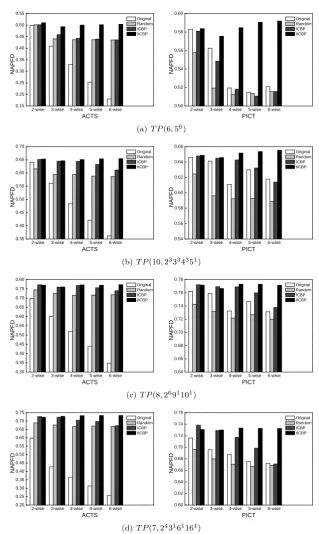
2. Results and analysis: Fig. 2 presents the simulation results in terms of the
10
NAPFD metric values for different prioritization techniques, based on which
11
we have the following observations.
12
(a) The IICBPtechnique has significantly better fault detection rates than the
13
ACTS Original method, but only slightly better performance than the
14
PICT Originalmethod.
15
(b) TheIICBP test sequences have higherNAPFD valuesthan theRandomtest
16
sequences.
17
(c) Compared to ICBP, IICBP has similar NAPFD values. More specifically,
18
when prioritizing the covering arrays of strength t = 2, the IICBP
failure-19
detection rate is sometimes slightly less than that of ICBP; when ordering
20
the covering arrays of strength t > 2,IICBP performs slightly better than
21
ICBP.
22
The first and second observations are consistent with those reported for
Simula-23
tion One. For Observation (c), we take a covering array of strengtht= 5 generated
24
by PICT onT P(10,23334351) as an example. Table 8 shows the average number
25
of test cases required to find all faults at different FTFI numbers. We can observe
26
that for any FTFI number,IICBP performs better than other methods. However,
27
since the size of the original test suite (1363) is much larger than any value shown
28
in Table 8, the difference among NAPFD values obtained by different methods is
[image:15.595.220.389.646.717.2]29
Table 8. The average number of test cases in different sequences required to detect all faults for different FTFI numbers.
Method FTFI number
1 2 3 4
Original 8.97 49.02 120.78 235.43
Random 10.39 52.75 155.64 278.14
ICBP 8.33 33.62 104.09 216.60
0 . 4 5 0 . 5 0 0 . 5 5 0 . 6 0 0 . 6 5 0 . 7 0 0 . 7 5 0 . 8 0 0 . 8 5 0 . 9 0 0 . 9 5 1 . 0 0
6 - w i s e 5 - w i s e
O r i g i n a l R a n d o m I C B P I I C B P
N
A
P
F
D
3 - w i s e 4 - w i s e 2 - w i s e
A C T S
0 . 4 5 0 . 5 0 0 . 5 5 0 . 6 0 0 . 6 5 0 . 7 0 0 . 7 5 0 . 8 0 0 . 8 5 0 . 9 0 0 . 9 5 1 . 0 0
6 - w i s e 5 - w i s e
O r i g i n a l R a n d o m I C B P I I C B P
N
A
P
F
D
3 - w i s e 4 - w i s e 2 - w i s e
P I C T
(a) T P(6,56)
0 . 6 0 0 . 6 5 0 . 7 0 0 . 7 5 0 . 8 0 0 . 8 5 0 . 9 0 0 . 9 5 1 . 0 0
6 - w i s e 5 - w i s e
O r i g i n a l R a n d o m I C B P I I C B P
N
A
P
F
D
3 - w i s e 4 - w i s e 2 - w i s e
A C T S
0 . 6 0 0 . 6 5 0 . 7 0 0 . 7 5 0 . 8 0 0 . 8 5 0 . 9 0 0 . 9 5 1 . 0 0
6 - w i s e 5 - w i s e
O r i g i n a l R a n d o m I C B P I I C B P
N
A
P
F
D
3 - w i s e 4 - w i s e 2 - w i s e
P I C T
(b)T P(10,23334351)
0 . 6 0 0 . 6 5 0 . 7 0 0 . 7 5 0 . 8 0 0 . 8 5 0 . 9 0 0 . 9 5 1 . 0 0
6 - w i s e 5 - w i s e
O r i g i n a l R a n d o m I C B P I I C B P
N
A
P
F
D
3 - w i s e 4 - w i s e 2 - w i s e
A C T S
0 . 6 0 0 . 6 5 0 . 7 0 0 . 7 5 0 . 8 0 0 . 8 5 0 . 9 0 0 . 9 5 1 . 0 0
6 - w i s e 5 - w i s e
O r i g i n a l R a n d o m I C B P I I C B P
N
A
P
F
D
3 - w i s e 4 - w i s e 2 - w i s e
P I C T
(c)T P(8,2691101)
0 . 5 5 0 . 6 0 0 . 6 5 0 . 7 0 0 . 7 5 0 . 8 0 0 . 8 5 0 . 9 0 0 . 9 5 1 . 0 0
6 - w i s e 5 - w i s e
O r i g i n a l R a n d o m I C B P I I C B P
N
A
P
F
D
3 - w i s e 4 - w i s e 2 - w i s e
A C T S
0 . 6 0 0 . 6 5 0 . 7 0 0 . 7 5 0 . 8 0 0 . 8 5 0 . 9 0 0 . 9 5 1 . 0 0
6 - w i s e 5 - w i s e
O r i g i n a l R a n d o m I C B P I I C B P
N
A
P
F
D
3 - w i s e 4 - w i s e 2 - w i s e
P I C T
[image:16.595.143.465.148.697.2](d)T P(7,243161161)
smaller. Therefore,IICBPmay have similar NAPFD values toICBP, and sometimes
1
is similar to Random and Original, when executing all test cases. /*** Dave’s
2
comment [6]: Please check the last paragraph ***/
3
4.1.4. Simulation Three: Rate of fault detection when executing part of the 4
test suite 5
Since resources are limited, in practice it is often the case that not all test cases in
6
a test suite (or test sequence) are executed. In this simulation, wefocused on the
7
fault detection rates of different test case prioritization techniques when running
8
only part of a given test sequence.
9
The simulation designwasconsistent with that of Simulation Two, as explained
10
in Section 4.1.3, includingfault distribution and fault generation. With regard to
11
the portion of the test sequence to be executed, wefollowedthe practice adopted in
12
previous prioritization studies [13] of fixing the number of test cases that would be
13
executed to be the size of a covering array at strengtht= 2. For instance, consider
14
T P(6,56) inTable 3: for any strength, the 25 ACTS test cases and 37 PICT test
15
cases werechosen to be executed in each test sequence generated by each method.
16
1. Metrics: Similar to Simulation Two, the NAPFD metric (Equation 15) wasalso
17
used to evaluate fault detection rates of different prioritization strategies when
18
executing part of test suite. Here, it is should be noted thatninEquation 15is
19
the number of executed test cases rather than the number of all test cases in a
20
given test sequence.
21
2. Results and analysis: TheNAPFD values for the different prioritization methods
22
are summarized in Fig. 3, from which the following observations can be made.
23
(a) The NAPFD values for the Random test sequences were higher than those
24
for ACTS Original, but lower than those for the PICT Originaltest
se-25
quences. This observation is consistent with those reported for the other
26
simulations.
27
(b) IICBP outperformsOriginal, Random,andICBPin most cases.
28
(c) With the increase of strength, the improvement of IICBP over Original,
29
Random, andICBP increases significantly. In other words, when the strength
30
is larger, IICBP is more suitable for prioritizing combinatorial test suites
31
thanOriginal,Random, or ICBP.
32
In summary, according to the APCC and NAPFD metrics, theIICBPtechnique
33
performs better than theOriginaland Randomtechniques. Compared with ICBP,
34
IICBPperforms better at low strengths in terms of APCC metric values. However,
35
IICBP may produce test sequenceswith similar NAPFD metric values to those of
36
ICBP when executing all test cases, but with better NAPFD metric values when
37
running only part of the test suite.
38
Obviously, two faults with the same faulty interaction may have different
prop-39
erties. For example, given a T P(k,|V1||V2| · · · |Vk|), faults f1 and f2 can be both
0 . 1 5 0 . 2 0 0 . 2 5 0 . 3 0 0 . 3 5 0 . 4 0 0 . 4 5 0 . 5 0 0 . 5 5
6 - w i s e 5 - w i s e
O r i g i n a l R a n d o m I C B P I I C B P
N
A
P
F
D
3 - w i s e 4 - w i s e 2 - w i s e
A C T S
0 . 5 0 0 . 5 2 0 . 5 4 0 . 5 6 0 . 5 8 0 . 6 0
6 - w i s e 5 - w i s e
O r i g i n a l R a n d o m I C B P I I C B P
N
A
P
F
D
3 - w i s e 4 - w i s e 2 - w i s e
P I C T
(a) T P(6,56)
0 . 3 5 0 . 4 0 0 . 4 5 0 . 5 0 0 . 5 5 0 . 6 0 0 . 6 5 0 . 7 0
6 - w i s e 5 - w i s e
O r i g i n a l R a n d o m I C B P I I C B P
N
A
P
F
D
3 - w i s e 4 - w i s e 2 - w i s e
A C T S
0 . 5 4 0 . 5 6 0 . 5 8 0 . 6 0 0 . 6 2 0 . 6 4 0 . 6 6
6 - w i s e 5 - w i s e
O r i g i n a l R a n d o m I C B P I I C B P
N
A
P
F
D
3 - w i s e 4 - w i s e 2 - w i s e
P I C T
(b)T P(10,23334351)
0 . 3 0 0 . 3 5 0 . 4 0 0 . 4 5 0 . 5 0 0 . 5 5 0 . 6 0 0 . 6 5 0 . 7 0 0 . 7 5 0 . 8 0
6 - w i s e 5 - w i s e
O r i g i n a l R a n d o m I C B P I I C B P
N
A
P
F
D
3 - w i s e 4 - w i s e 2 - w i s e
A C T S
0 . 6 4 0 . 6 6 0 . 6 8 0 . 7 0 0 . 7 2 0 . 7 4 0 . 7 6 0 . 7 8
6 - w i s e 5 - w i s e
O r i g i n a l R a n d o m I C B P I I C B P
N
A
P
F
D
3 - w i s e 4 - w i s e 2 - w i s e
P I C T
(c)T P(8,2691101)
0 . 2 0 0 . 2 5 0 . 3 0 0 . 3 5 0 . 4 0 0 . 4 5 0 . 5 0 0 . 5 5 0 . 6 0 0 . 6 5 0 . 7 0 0 . 7 5
6 - w i s e 5 - w i s e
O r i g i n a l R a n d o m I C B P I I C B P
N
A
P
F
D
3 - w i s e 4 - w i s e 2 - w i s e
A C T S
0 . 6 0 0 . 6 2 0 . 6 4 0 . 6 6 0 . 6 8 0 . 7 0 0 . 7 2 0 . 7 4 0 . 7 6
6 - w i s e 5 - w i s e
O r i g i n a l R a n d o m I C B P I I C B P
N
A
P
F
D
3 - w i s e 4 - w i s e 2 - w i s e
P I C T
[image:18.595.144.464.153.688.2](d)T P(7,243161161)
identified by a 2-wise faulty interaction {P1, P2}. Faultf1 may be triggered when
1
“(P1 =v1)&&(P2 =v2)” where v1 ∈ V1 and v2 ∈V2; while faultf2 may be
trig-2
gered by “(P16=v1)&&(P26=v2)”. Consider a test case, its probability ofrevealing
3
faultf1(or the failure rate off1– the number of failure-causing test cases revealing 4
f1 as a proportion of all possible tests) is |V 1
1|×|V2|, and the probability of revealing
5
faultf2 is
(|V1|−1)×(|V2|−1)
|V1|×|V2| . When parametersP1 andP2 both have alarge number
6
of possiblevalues, the probabilities of detectingf1 andf2 could be very different.
7
In Simulation Two and Simulation Three, the faulty interaction of each simulated
8
faultwasconsistent with that of faultf1, that is, each fault could only be detected
9
by a special value combination rather than different value combinations. /***
10
Dave’s comment [7]: please confirm the next sentence ***/ As for faults that differ
11
from faultf1, the effectiveness of our method will be investigated later by studying
12
some real-life programs.
13
4.2. An empirical study 14
4.2.1. Experiment instrumentation 15
/*** Dave’s comment [8]: should we remove all mention ofcmdline? ***/
16
We used six C programs (count,series, tokens, ntree, nametbland cmdline),
17
downloaded from http://www.maultech.com/chrislott/work/exp/, as subject
18
programs [29]. These programs were originally created to support research on
com-19
parison of defect revealing mechanisms [29], evaluation of different combination
20
strategies for test case selection [30], and fault diagnosis [31, 32]. Each program
21
contains some faults. To determine thecorrectnessof an executing test case, i.e. an
22
oracle, wecreateda fault-free version of each program by analyzing the
correspond-23
ing fault description.
24
Table 9 describes these subject programs. The third column (LOC) stands for
25
the number of lines of executable code in these programs; while the fifth column
26
(No. of detectable faults) represents the number of faults detected by some test
27
cases derived from the accompanying test profiles, which are not guaranteed to be
28
able to detect all faults. By analyzing the detectable faults, as shown in Table 9, we
29
summarize them according to the FTFI number of each fault. Similar to [30], due
30
to the incomplete specifications ofcmdline, it was notincluded in this study.
[image:19.595.146.467.636.717.2]31
Table 9. Subject programs.
Subject Test profile LOC No. of No. of dete- FTFI number faults ctable faults 0 1 2 3 4
count T P(6,2135) 42 15 12 0 4 4 4 0
series T P(3,5271) 288 23 22 1 3 4 14 NA
tokens T P(8,2434) 192 15 11 1 4 5 1 0
ntree T P(4,44) 307 32 24 0 5 11 7 1
Table 10. Sizes of original test sequences for each subject program.
Subject program ACTS PICT
2 3 4 5 6 2 3 4 5 6
count 15 41 108 243 486 14 43 116 259 486
series 35 175 NA NA NA 39 175 NA NA NA
tokens 12 37 93 212 486 12 39 103 228 482
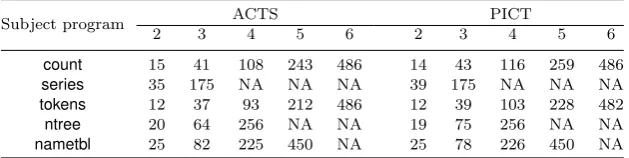
ntree 20 64 256 NA NA 19 75 256 NA NA
nametbl 25 82 225 450 NA 25 78 226 450 NA
Similar to the simulations described above, we also used ACTS and PICT to
1
generate original test sequences for each subject program. Moreover, wefocusedon
2
covering arrays with strengtht= 2,3,4,5,6. Table 10 shows the sizes oftheoriginal
3
test sequences obtained by ACTS and PICT.For the effectiveness metrics, we used
4
NAPFD for respectively executing all test cases and a subset of the entire test suite
5
such that the size of the subset was equal to each covering array of strengtht= 2.
6
Due to randomization in some prioritization techniques, we ran the experiment 100
7
times for each subject program and report the average.
8
4.2.2. Results and analysis 9
The experimental results from running all prioritization techniques to test count,
10
series,tokens,ntree, andnametbl, are summarized in Figs. 4 and 5.
11
1. When executing all test cases in the test suite, as shown in Figs. 4(a)–4(e), we
12
have the following observations: (a) for all test suites at strength t = 3,4,5,6,
13
IICBPperforms significantly better thanOriginalusing ACTS, and has slightly
14
better performance than Random and ICBP, regardless of whether using ACTS
15
or PICT; and(b)for strengtht= 2 test suites, no conclusive observations could
16
be obtained.
17
2. When executing part of the test suite, as illustrated in Figs. 5(a)–5(e), it can
18
be observed that for four programs (count, series, ntree, and nametbl), the
19
performance of the various prioritization strategies wasvery similar: (1) in most
20
cases,IICBPhad higher NAPFD metric values thanOriginal,Random, andICBP;
21
(2) with the increase of strength, the improvement of IICBP over Original,
22
Random, or ICBP generally increased; (3) the Original ACTS test sequences
23
performed worst in terms of fault detection rate, while theOriginalPICT test
24
sequences sometimes have the largest NAPFD values, such as for 2-wiseseries
25
and 3-wisentree; (4) for covering arrays of strengtht= 2 onnametbl,ICBPhas
26
the best performance in terms of the rate of fault detection. These observations
27
are basically consistent with those for the simulations.
28
For the remaining program (tokens), no conclusive remarks could be drawn.
29
As observed, each prioritization method may sometimes perform best, and may
30
sometimesperformworst.
0 . 5 0 0 . 5 5 0 . 6 0 0 . 6 5 0 . 7 0 0 . 7 5 0 . 8 0 0 . 8 5 0 . 9 0 0 . 9 5 1 . 0 0
6 - w i s e 5 - w i s e
O r i g i n a l R a n d o m I C B P I I C B P
N
A
P
F
D
3 - w i s e 4 - w i s e 2 - w i s e
A C T S
0 . 8 2 0 . 8 4 0 . 8 6 0 . 8 8 0 . 9 0 0 . 9 2 0 . 9 4 0 . 9 6 0 . 9 8 1 . 0 0
6 - w i s e 5 - w i s e
O r i g i n a l R a n d o m I C B P I I C B P
N
A
P
F
D
3 - w i s e 4 - w i s e 2 - w i s e
P I C T
(a) Programcount
0 . 7 8 0 . 8 0 0 . 8 2 0 . 8 4 0 . 8 6 0 . 8 8 0 . 9 0 0 . 9 2 0 . 9 4 0 . 9 6 0 . 9 8
6 - w i s e 5 - w i s e
O r i g i n a l R a n d o m I C B P I I C B P
N
A
P
F
D
3 - w i s e 4 - w i s e 2 - w i s e
A C T S
0 . 8 4 0 . 8 6 0 . 8 8 0 . 9 0 0 . 9 2 0 . 9 4 0 . 9 6 0 . 9 8 1 . 0 0
6 - w i s e 5 - w i s e
O r i g i n a l R a n d o m I C B P I I C B P
N
A
P
F
D
3 - w i s e 4 - w i s e 2 - w i s e
P I C T
(b) Programseries
0 . 8 2 0 . 8 4 0 . 8 6 0 . 8 8 0 . 9 0 0 . 9 2 0 . 9 4 0 . 9 6 0 . 9 8 1 . 0 0
6 - w i s e 5 - w i s e
O r i g i n a l R a n d o m I C B P I I C B P
N
A
P
F
D
3 - w i s e 4 - w i s e 2 - w i s e
A C T S
0 . 7 5 0 . 8 0 0 . 8 5 0 . 9 0 0 . 9 5 1 . 0 0
6 - w i s e 5 - w i s e
O r i g i n a l R a n d o m I C B P I I C B P
N
A
P
F
D
3 - w i s e 4 - w i s e 2 - w i s e
P I C T
(c) Programtokens
0 . 6 5 0 . 7 0 0 . 7 5 0 . 8 0 0 . 8 5 0 . 9 0 0 . 9 5 1 . 0 0
6 - w i s e 5 - w i s e
O r i g i n a l R a n d o m I C B P I I C B P
N
A
P
F
D
3 - w i s e 4 - w i s e 2 - w i s e
A C T S
0 . 7 0 0 . 7 5 0 . 8 0 0 . 8 5 0 . 9 0 0 . 9 5 1 . 0 0
6 - w i s e 5 - w i s e
O r i g i n a l R a n d o m I C B P I I C B P
N
A
P
F
D
3 - w i s e 4 - w i s e 2 - w i s e
P I C T
[image:21.595.154.462.160.690.2](d) Programntree
0 . 8 6 0 . 8 8 0 . 9 0 0 . 9 2 0 . 9 4 0 . 9 6 0 . 9 8 1 . 0 0
6 - w i s e 5 - w i s e
O r i g i n a l R a n d o m I C B P I I C B P
N
A
P
F
D
3 - w i s e 4 - w i s e 2 - w i s e
A C T S
0 . 8 6 0 . 8 8 0 . 9 0 0 . 9 2 0 . 9 4 0 . 9 6 0 . 9 8 1 . 0 0
6 - w i s e 5 - w i s e
O r i g i n a l R a n d o m I C B P I I C B P
N
A
P
F
D
3 - w i s e 4 - w i s e 2 - w i s e
P I C T
(e) Programnametbl
Fig. 4. (Continued).
In summary, the experimental study using real programs shows similar results
1
to the simulationsin terms of the rate of fault detection, that is, when executing
2
all test cases in the combinatorial test suite, IICBP had similar performance to
3
Original,Random, andICBP generally; while IICBPperformed better than others
4
in most caseswhen executing only part of the test suite.
5
4.3. Threats to validity 6
Despite our best efforts, our experimentsmay face somethreats to validity. In this
7
section, we present the most significant of these, which are classified into three
8
categories: (1) threats to external validity; (2) threats to internal validity; and (3)
9
threats to construct validity.
10
External validity refers specifically to what extent our experimental results can
11
be generalized. We mainly outline three threats to externalvalidity: (1) Test profile
12
representativeness – in our study, four widely used, but limited test profiles were
13
employed; (2) Subject program representativeness – we have examined only five
14
subject programs, written in the C language, all of which are of relatively small
15
size; and (3) Covering array generation representativeness – in our experiment, we
16
used ACTS and PICT for generating different covering arrays, however, both of
17
these belong to the category of greedy algorithm [7]. To address these potential
18
threats, additional studies using a greater range of test profiles, a greater number
19
of subject programs, and different algorithms for covering array construction will
20
be conducted in the future.
21
Internal validity refers to whether or not there were mistakes in the experiments.
22
We have tried to manually cross-validate our analyzedprograms on small examples,
23
and we are confident of the correctness of the experimental and simulation setups.
24
Finally, construct validity refers towhether or notwe have conducted the studies
25
fairly. In this article, we focus on the rate of covered value combinations and the
26
rate of faultdetection, measured withthe APCC and NAPFD (or APFD) metrics,
27
respectively. The NAPFD and APFD metrics are commonly used in the study of
[image:22.595.144.462.159.285.2]0.1 0.2 0.3 0.4 0.5 0.6 0.7 0.8 0.9 6-wise 5-wise Original Random ICBP IICBP NAPFD 3-wise 4-wise 2-wise ACTS 0.72 0.74 0.76 0.78 0.80 0.82 0.84 0.86 0.88 0.90 6-wise 5-wise Original Random ICBP IICBP NAPFD 3-wise 4-wise 2-wise PICT
(a) Programcount
0.55 0.60 0.65 0.70 0.75 0.80 0.85 0.90 Original Random ICBP IICBP NAPFD 3-wise 2-wise ACTS 0.80 0.82 0.84 0.86 0.88 0.90 0.92 Original Random ICBP IICBP NAPFD 3-wise 2-wise PICT
(b) Programseries
0.60 0.65 0.70 0.75 0.80 0.85 0.90 0.95 1.00 6-wise 5-wise Original Random ICBP IICBP NAPFD 3-wise 4-wise 2-wise ACTS 0.78 0.80 0.82 0.84 0.86 0.88 0.90 6-wise 5-wise Original Random ICBP IICBP NAPFD 3-wise 4-wise 2-wise PICT
(c) Programtokens
0.0 0.1 0.2 0.3 0.4 0.5 0.6 0.7 0.8 0.9 Original Random ICBP IICBP NAPFD 3-wise 4-wise 2-wise ACTS 0.60 0.65 0.70 0.75 0.80 0.85 Original Random ICBP IICBP NAPFD 3-wise 4-wise 2-wise PICT
[image:23.595.150.462.160.695.2](d) Programntree
0.3 0.4 0.5 0.6 0.7 0.8 0.9 1.0
5-wise
Original Random ICBP IICBP
NAPFD
3-wise 4-wise 2-wise
ACTS
0.80 0.82 0.84 0.86 0.88 0.90 0.92 0.94
5-wise
Original Random ICBP IICBP
NAPFD
3-wise 4-wise
2-wise
PICT
(e) Programnametbl
[image:24.595.131.462.152.296.2]Fig. 5. (Continued).
Table 11. State of the art in combinatorial test case prioritization.
Strategies Interaction coverage Incremental interaction coverage
Pure prioritization [4], [11], [12], [13], [15] [33], Focus of this paper Re-generation prioritization [4], [9], [10], [13], [14] [3], [5]
test case prioritization.
1
5. Related Work
2
Techniques for prioritizing combinatorial test cases have been well-researched in
re-3
cent years, and can generally be divided into two categories: (1) pure prioritization:
4
re-prioritizing test cases in the combinatorial test suite; and (2) re-generation
pri-5
oritization: taking account of prioritization in the process of combinatorial test case
6
generation [13]. The method proposed in this paper belongs to the first category.
7
From the perspective of interaction coverage, there are a large number of
strate-8
gies supporting prioritization of combinatorial test cases. For example, Bryce and
9
Colbourn [9, 10] proposed generating prioritized combinatorial test suites by
as-10
signing weights to each pairwise interaction of parameters, a technique in the
re-11
generation prioritization category. Bryce and her colleagues [11, 12] introduced a
12
technique of re-prioritizing combinatorial test cases based on interaction coverage,
13
and applied this technique to event-driven software. Quet al.[13] presented how to
14
assign parameter combination weights that evaluate their importance, and also
ap-15
plied interaction-coverage-based prioritization strategies to configurable systems [4].
16
Chenet al. [14] used a re-generation prioritization strategy to construct
combina-17
torial test sequences by applying the ant colony algorithm. Furthermore, Wang et 18
al.[15] proposed a series of metrics for evaluating combinatorial test sequences by
19
considering different factors such as test case cost and weight, and also introduced
20
two heuristic algorithms in the pure prioritization category.
[image:24.595.141.471.364.408.2]On the other hand, fewer studies have been conducted on the prioritization of
1
combinatorial test cases from the perspective of incremental interaction coverage.
2
Fouch´e et al. [3, 5] have recently proposed a technique named incremental cover-3
ing array failure characterization (ICAFC), where incremental interaction
cover-4
age is used to generate incremental adaptive covering arrays. ICAFC starts at a
5
low strength for constructing a covering array, and gradually increases strength by
6
reusing previous test cases until some conditions are satisfied. However, an
incre-7
mental adaptive covering array of strengthtgenerated by ICAFC may be considered
8
a prioritized combinatorial test suite only from the viewpoint of strength. We will
9
discuss this issue further in the next section. Furthermore, Wang [33] has developed
10
the technique of inCTPri to generate the prioritized combinatorial test cases.
How-11
ever, his inCTPri assumes covering arrays as inputs, while our method is applicable
12
on any combinatorial test suite including coveringarrays. Additionally, our method
13
begins at strengtht= 1 while inCTPri starts at a small strengthvalue greaterthan
14
1.
15
The state of the art in combinatorial test case prioritization is summarized in
16
Table 11, from which it can be seen that the topic has been extensively researched
17
from the perspective of interaction coverage, but has received far less attention from
18
the perspective of incremental interaction coverage. Our investigation (highlighted
19
in the table) attempts to fill this gap in the research.
20
6. Discussion and Conclusion
21
Combinatorial testing has been widely used in practice, and test case prioritization
22
has also been well studied. Prioritization of combinatorial test cases is a popular
23
research area. This paper proposes a new strategy of prioritizing combinatorial test
24
cases based on the intuition of incremental interaction coverage, which is a balanced
25
strategy compared with traditional interaction-coverage-based test prioritization.
26
Experimental results show that our method outperforms the random prioritization
27
approach and the technique of prioritizing combinatorial test suites according to
28
test case generation order, and has better performance than the ICBP technique in
29
most scenarios, with respect to the APCC and NAPFD metrics.
30
/*** Dave’s comment [9]: can you clarify/rephrase the next sentence? ***/
31
Therehave been some studies ofthe application of information on incremental
inter-32
action coverage. As illustrated in Section 5, for example, ICAFC [3, 5] hasrecently
33
beenproposed to generate incremental adaptive covering arrays based on
incremen-34
tal interaction coverage. Although both their and our studiesshare the same goal –
35
identifying failures caused by a small number of parameters, as earlyas possible –
36
there are some fundamental differences between them. Firstly, ICAFC aims mainly
37
at constructing each covering array schedule from the others; /*** Dave’s comment
38
[10]: what do you mean by “others”? ***/ IICBP, on the other hand, aims to
pri-39
oritize combinatorial test cases. Secondly, IICBP belongs to the category of pure
40
prioritization, whereas ICAFC is a re-generation prioritization strategy. Thirdly,