J. Service Science & Management, 2009, 2: 270-275
doi:10.4236/jssm.2009.24032 Published Online December 2009 (www.SciRP.org/journal/jssm)
The Exploration of Implementation of Emissions
Trading System in China
1
Min HU
Economics and management school of Sichuan Normal University, Chengdu, China. Email: [email protected]
Received June 10, 2009; revised July 23, 2009; accepted September 1, 2009.
ABSTRACT
This paper studies the route, steps and measures of the implementation of the emissions trading system in China. It combines desk research and case study. The desk research aims to explore the inherent discipline of emissions trading system, so as to disclose its nature and features while the case study involves the one-year field research conducted by
the author, and provides the pilot emission systems in some provinces, together with the difficulties in its implementa-tion. There are possibilities of comprehensive coverage of emission trading system, which can only be protected by a law relevant to environmental property protection (issued by the Standing Committee of National People’s Congress). And there is necessity for China to set up a quota system for different pollutions. After the initial allocation among provinces, the quota will be divided among enterprises, partial paid and partial for free, under the principle of “Giving priority to efficiency with due consideration to fairness”. It is useful to establish an efficient secondary market of emis-sion trading system.
Keywords: Emissions Trading, System Innovation, Sustainable Development
1. Introduction
China's economic and social development, resources saving and ecological environment protection have be-come increasingly sharp, as a constraint of the bottleneck in achieving sustainable development. Exploring ronmental tools for the conservation of resources, envi-ronmental protection and effective achievement of the economic and social comprehensive development, is a significant major for China right now.Theoretical analy-sis and international experience have shown that emis-sions trading system as a system of market-based incen-tives designed to effectively achieve these objecincen-tives, it is worth drawing on the use of China. However, it is also necessary to fully integrate the implementation of China's emissions trading system with China’s economic and social reality, We need to do some research in the spe-cific systematic construction and operate mechanism as well as make adaptive adjustments, so can we ensure to
turn it into the emissions trading system which suitable for the national needs, as well as a powerful tools to pre-vent pollutions .This article seeks to make some explora-tions.
2. The Inspirations of China’s Experience in
the Emissions Trading Pilot Areas
In recent years, Tianjin, Jiangsu, Zhejiang, Shanghai, Shanxi, Henan, Guangxi and other provinces and mu-nicipalities of China have launched a pilot emissions trading, Jiaxing Zhejiang in November 10, 2007 estab-lished the first national emissions trading reserves center, indicating that China has taken a substantive step for implementation of the right of sewage system. We can draw some experience in the following inspiration by summing up the experience of the pilot areas.
2.1 Legal Matter
The thought of “Total Control” has not been embodied in laws, the property of environmental resources are still lacking the evidence, and the entire emission trading system is extremely fragile. In September, 2002, Xiu Zhou district of Jia Xing began the emission trading sys-tem pilot, but the outcome wasn’t that good, one of the most crucial reasons is the “Total Control” doesn’t have
1
any bottom lines. For example, Shen Yue-ping, the dep-uty director of the Environmental Protection Agency of Jia Xing pointed out:” The rights of Sewage emission means add more administrative permit, if there is no quirement for the volume. It is not the scarcity of re-sources, so there is no need for transactions [1].When the total control becoming a rigid target, the environment capacity is able to become a scarce resource, the market pricing mechanism for emissions trading have the condi-tions. However, the thought of “total control” must be established in the law before it can authoritative. In re-cent years, although China has made significant achievements in environmental protection legislation and building several levels of environmental legal systems, the trading legislation in national level is still empty. Under the existing environmental protection laws and regulations, only the individual provisions for special pollutants embodied in the “total control”, the main laws and regulations do not have the specific rules for “total control”, which directly led to the shortage of legal rules for the property rights of environmental resources, so that the emissions trading system itself is very fragile.
2.2 Inadequate Liquidity
Emissions trading market does not have much of the at-tractiveness of business, which result in the limitation of trading volume and liquidity shortage. For instance, the establishment of the first national emissions trading re-serve center in Jiaxing, Zhejiang, the annual emissions of COD was about 118,000 tons, sulfur dioxide emissions was 273,000 tons in 2007,but the transaction into the trading center was only hundreds of tons of the emission reductions in scale, which is still minimal;And in 2004, emissions of sulfur dioxide and a pilot of emissions trad-ing permit system of sulfur dioxide had been carried ou in Henan Province for 4 years, and suffered from the embarrassment of a zero-transaction [2].
2.3 The Market Risk of “Bad Money Drives out Good Money”
Now the emissions trading mainly carried out in the pilot areas, and this may have the market risk of “bad money drives out good”. Sewage emission enterprises in the emissions trading pilot need to spend a huge amount of money to spend in buying emission rights, which will result in increased operating costs of enterprises, busi-ness competitions in the surrounding areas without the rights of emissions trading is in a “cost disadvantage”, brought about unfair competition objectively. As a result, the full implementation of China's emissions trading sys-tem is imperative.
2.4 The Uncontrolled Situation in the Market
Economic system is still in the transition period, the market economy is not that perfect, which result in low
efficiency of market of emission rights, and even the market failure. Emissions trading system is a policy in-struments to control pollution and protect the environ-ment by market-based instruenviron-ments, nature is the product
of the full development of market economy. However,
the time for establishing Chinese socialist market eco-nomic system is still short. We have made great achie- vements in all aspects, but as a whole we are still in the transition period, we are not perfect and mature enough in many ways, including well-defined property rights, the effective transfer of property rights and the details in the legal protection of property rights. Such an Imperfect market system will inevitably have an adverse effect on the emissions trading system.
2.5 A Awareness of Environmental Protection
People do not have a strong awareness of environmental protection, emissions trading system still lack of social supervision. The economic development of China in re-cently years proves that, whether it is the national or lo-cal government, they just chase the economic interests but ignore the environmental protection, people lack of environmental awareness in general. The environmental awareness, however, as a non-governmental social force, has supervised, supported and promoted the making and practicing of laws concerning environmental protection. However, with the weak public awareness of environ-mental protection, it’s difficult to keep a firm hand on the supervision of trade on the disposal of waste.
2.6 Social Credit System
The unsound social credit system increases the possibil-ity of emissions trading market failure. Social credit sys-tem is the fundamental basis of the effective operation of the market economy. If this system collapses, a small part of people will benefit a little from it temporarily. However, if lack legal sanctions and public condemna-tion, it may make some impacts on other economic enti-ties, so that more companies can benefit from the col-lapse of the credit system, then, finally, the government's regulatory system and the rules of the market become useless, which will lead to an immeasurable loss.
3. The Difficulties of Implementation of
Emissions Trading System in China
3.1 A Vast Territory
A vast territory, the ecological environment and the level of economic development have shown significant re-gional characteristics, the national conditions in China result in the complexity of emissions trading.
The Exploration of Implementation of Emissions Trading System in China 272
affected by geographical location, atmospheric circula-tion, landscape, China can be divided into three nature zone macroscopically. The existence of three nature zones decide the diversities of the climate resources, wild flora and fauna resources, and agriculture materials, so that it further decide the nature of environmental capacity, amount and differences of protection. Due to the unique characteristics of Chinese ecological environment, the regional pollutants needed to be control is quite different, and there is also some differences in pollutants control standards, the subject of emissions trading, measure-ments and supervision of the actual emissions. Thus, it is quite difficult for China to implement the emission trad-ing system comprehensively.
3.1.2 The Clear Differences in the Level of Economy The clear differences in the level of economy. Economi-cally speaking, due to the differences between the nature resources and opportunities of the historical development, China has formed the economic and technological de-velopment level of the gradient distribution of the three major economic areas in central and western. The exis-tence of the three economic zones reflect the diversities of the market economic development and people’s in-come as well as the diverse demands of economic means in the future and the level of environmental quality. In economically developed areas of eastern and central ar-eas, with the improvements of people’s requirements to the environmental quality, there is a trend that the high-polluted enterprises are becoming less, this reflects the implementation of the “total control” is more easily. However, in the western areas, the companies with pol-luted emission account for a large proportion of the eco-nomic development and the employments, the promotion of emission trading system is harder.
3.2 A Balance between the Pollutants Control and Further Development of the Economy
In the unchanged situation of the traditionally extensive economic development means, how to find a balance between the pollutants control and further development of the economy is another difficult in establishing emis-sion trading system.
The population of China, trend of the economy, the level of the technology and management are the three basic factors for damaging the environment. According to the forecast of related departments, among those three reasons, the zero increase in China’s future population will need 30 to 40 years, the rapid increase in the future economy will continue its trend in the next 10 to 20 years, the level of technology and management still need a long time, so that it is impossible for China’s economic growth means transferring from extensive one to inten-sive one in a short term [3–7]. The existence of the ex-tensive growth will give an obvious impact on the emis-sion trading policy with the goal of “total control”.
3.3 China’s Small Sized Companies
The number of China’s small sized companies is great, and the spread of them is wild. However, the pollutants they produced account for half of the total pollutants. The basic national situation decide that on one hand, the cost of information collection is quite expensive in China’s emission trading market, the cost of supervision and implementation of the environmental protection de-partment is also expensive, so that it decreases its effi-ciency and results in market failure. On the other hand, if it is quite common for companies with heavy pollutants can’t effectively deal with it in a short time because of the limitation of fund and technology , it will do harm on the practice of this system.
3.4 The Goal of the Solution of Environment Pollution
There is a difference between the goal of local govern-ment and central governgovern-ment in the solution of environ-ment pollution, and those differences will add some dif-ficulties in the promotion of the emission trading system. Pollutants can’t be eliminated totally, so any companies will produce pollutants during its production. The local government will focus on the economy, including the development of local economy, the unemployment and the GDP which is a measure of the political performance, rather than the impact on the environment. However, by the “total control”, it will definitely make more difficul-ties in the promotion of emission trading system. Ac-cording to the report from the XinHua news agency, on
29th of May 2007, the explorations of Cyan bacteria
caused shortage of water which make the habitants’ lives becoming more difficult. More ironically, the “iron solu-tion” caused hundreds enterprises with high consumption, high pollution, high danger and low efficiency shut down. Unexpectedly, this news attracted lots of organizations to make investment, including the towns nearby in Subei, as well as eastern-west, Sichuan and Jiangxi. The essence of this phenomenon reflects that in the eyes of some local governments in China, the basic policy still remains the pursuit of increase of GDP, lacking of recognition of the limitation of resources, and haven’t pay attention on the environmental protection on mind, so that it continuously creates hidden obstacles to the emission trading system.
3.5 The Power of Deciding the Total Emission Controlled
of central government and local government; if it belongs to the central government, it will have a fierce competi-tion with the local government.
3.6 The Market Participates
It is a tough question for the market participates to reach the goal of guaranteeing the vitality of the market, as well as upgrade the format of production by emission trading system. Therefore, how to choose formats, such as: involving in this program compulsively, volunteer, opening comprehensively and directly, etc, is another problem facing China.
4. Discussion and Conclusions
4.1 The Path of Emission Trading System in China
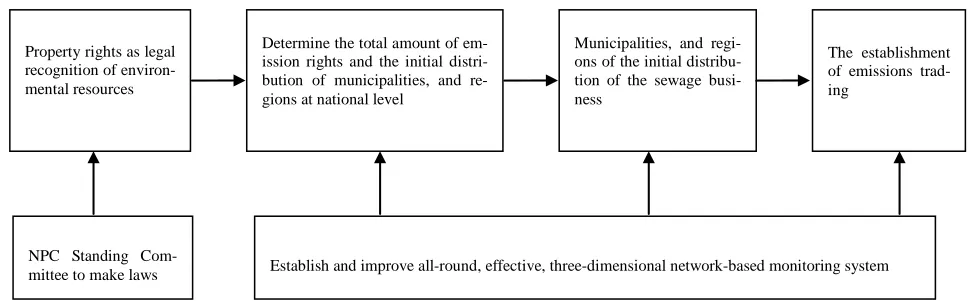
The emission trading system derived from the United States, widely used in the western countries, and some part of China. As the most effective way of treating emission, China will put this system in a general manner in future. So, in essence, it is a problem of transplant system. According to the experience of developed coun-tries, and combination of the social situation of China, the means of establishing emission trading system can be showed in the Figure 1.
4.2 The Steps and Specific Measures of Establishing Emission Trading System in China
4.2.1 Legal Framework
Firstly to confirm the regulation of environmental re-source priority system by the NPC to better the laws and to embody the “overall control” of the intension of envi-ronmental protection and prevention with a view to es-tablishing such system on China’s environment in legal framework.. there is no specific rules of “total control” in the laws and legislations in China, the shortage can
de-cide the fragility of emission trading system, and diffi-culties in the emission control, the extensive growth of the economy hasn’t changed. Therefore, the first step of establishing emission trading system in China is to con-firm the environmental resource system that it can em-body the intension of “total control”.
4.2.2 The Initiative Distribution
In the level of a state, it confirms the initiative distribu-tion of the total control of emission. Because China is a country with wide areas, distinguished ecological envi-ronment, the huge economic gap among different areas, and the different goals of local government and central government, that means local government have the trend of focusing the speed of economic growth but ignoring the environmental protection. If the power of confirming the total emission belongs to the central government, it will reduce the welfare of the society, so the power should belongs to the central government. one reasonable choice for the national overall emission of pollutants as well as for provincial and municipal levels is that the central government confirms national emission of certain pollutants in a given period of time in accordance with domestic development, and that local governments en-force local standards in accordance with relevant princi-ples; that the central government confirms the overall emissions in different regions and regulates them with respective standards in accordance with provincial and municipal economic and social development and in the principle of keeping the balance between national de-mand and local features.
The initiative distribution of every single province and area. Under the guidance of “efficiency combine with justice”, and in the background of China’s economic and social situation, the initiative distribution of emission trades need to combine with two modes: distribute for free, and distribute for charge. The key of this mode is: in the given amount of emission, how to confirm the pro-portion of free distribution and charged distribution, and
Determine the total amount of em- ission rights and the initial distri-bution of municipalities, and re-gions at national level
Property rights as legal recognition of environ- mental resources
Municipalities, and regi- ons of the initial distribu-tion of the sewage busi-ness
The establishment of emissions trad- ing
NPC Standing
[image:4.595.54.538.549.702.2]Com-mittee to make laws Establish and improve all-round, effective, three-dimensional network-based monitoring system
The Exploration of Implementation of Emissions Trading System in China 274
how to distribute it to different corporations in accorda- nce with standard allocation after the confirmation of the total amount. Free distribution of the sewage is the main reason for the contribution of enterprises and the em-ployment created by a net increase of new value- added, therefore, the ratio of free distribution of the main con-siderations are the impact of these two indicators. Envi-ronmental protection department of the provinces and municipalities can trade the remaining parts with sewage companies through auctions, bidding and pricing, after free allocation to sewage companies. And local govern-ments can preserve part of the emission permits in ac-cordance with their own needs, in an attempt to provide support for the future companies with high-efficiency.
4.2.3 The Secondary Market
The establishment of effective transfer of ownership of emission rights in the secondary market. Secondary mar- ket for emissions trading as a supplier of emission rights and the right to demand of sewage through the use of tools for trading emission rights trading and financing market of production factors, in a sense, to cultivate, de-velop and standardize the emission trading market, is more important than the well-defined administrative powers sewage.
4.3 The Relevant Recommendations of China's Emissions Trading System
4.3.1 Environmental Protection Consciousness
Cultivate national awareness of environmental protection, strengthening the right of the sewage system of external oversight. National environmental awareness as non-gov- ernmental social forces, which play an important role in the oversight, support and promote of the formulation and implementation of environmental policies. Therefore, we must cultivate national awareness of environmental protection, strengthening the right of the sewage system of external oversight.
4.3.2 Integrity of Social Environment
Establishing integrity of social environment and enhanc-ing the development and implementation of emissions trading system. Establishing trust system is the public goods provided by the government. Firstly, the govern-ment should maintain absolute authority of national credit as well as break local protectionism. After emis-sions trading system is in place, the government should strongly give a guidance and expectation in accordance with the amount of sewage, time, space, and trading rules. Instead of change so fast that companies feel that this is a short-term policy, passively wait and see. At the same time, establish and improve the credit system and the relevant legal system to ensure that after emissions trad-ing, the normal performance of the contract. Through the establishment of integrity of society, guide these busi-nesses to abide by the laws, and can discharge the
sew-age consciously.
4.3.3 Relevant Laws and Provide Adequate Legal Basis Establish and improve relevant laws and provide ade-quate legal basis for the emission trading system. With the legal basis, the national environmental administration departments should be issued the specific rules and regu-lations relating to emissions trading, Emissions trading a clear approval to the transaction from the uniform stan-dard, in order to facilitate the actual operation of China's emissions trading. Make sure the uniform standard from approval to trade, in order to facilitate the actual opera-tion of China's emissions trading.
4.3.4 The Power of Rent-Seeking
Strengthen the initial allocation of emission rights in the management of the power of rent-seeking. Initial alloca-tion of emission rights for the rental of power - the mainly two causes of the phenomenon of rent-seeking is, on the one hand, “soft power,” on the other hand is the space rent-seeking in the design of allocation mechanism. One of the performances of the previous reason for gov-ernment officials to determine the total amount of sew-age, to control the randomness in the initial distribution in municipalities. Therefore, it is necessary to establish a complete set of evaluation systems, to define the total target scientifically and reasonably, instead of free deci-sion by the officials. Enterprises in all the initial emisdeci-sion rights on the specific share, in strict accordance with the principle of “open, fair, just and transparent”, and the method of calculation in advance. Finally, to further im-prove the legal system, strengthen supervision, to estab-lish a high degree of integrity and efficiency as the hall-mark of the political and administrative system. From the second reason which has caused rent-seeking --- power- renting, in the model of free allocation of emission rights, government officials have greater rights of discretion, which has left a space for rent-seeking. Therefore, with a large scale of emission trading system, the initial model of allocation of emission rights, transition to paid transfer should be gradually put into practice. As result --- rela-tively speaking --- rent-seeking scales of auctions, bid-ding, pricing and trading can be reduced in system -designing. Thus more rent-seeking activities can be regulated.
4.3.5 Take Proactive Measures to Tackle the Problem of the Market failure
support them in tax, technology and capitals and guaran-tee them with price priority, in an attempt to activate the market; confirm the deadlines on emission rights to re-duce the uncertainty of emission rights; break barriers on emission trading market, and take actions to eliminate local protectionism.
4.3.6 Enhance the Construction of Supervision Enhance the construction of supervision on the emission permits market and the legal force on environmental protection. In the construction of supervision on the emission permits market, we should establish the “three systems” in pollution reduction; establish effective, over-all and comprehensive supervision network to create a new type of supervision model; promote managerial, scientific and technological standards, in order to create preferential conditions for the emission permits trade system.
4.3.7 Reform the Counting System of Environmental Costs
Reform the counting system of environmental costs. The newly published Counting Principles requests that com-panies should include costs such as disposal of pollution, in an attempt to make themselves accountable, thus to inspire other companies to reduce pollution, and thus to have them strike a balance between profit making and environmental protection and take part in the emission permits trade system.
4.3.8 Put Green GDP into Practice
Better local performance checking index system; put Green GDP into practice; and to those areas which have a weak eco-system, the government should allow zero growth in local GDP in a given period of time.
REFERENCES
[1] Zhang Yue, “Jiaxing, Zhejiang, the first test of emissions trading, the initial allocation of fair,” China Environment News,” November 13, 2007.
[2] http://paper.people.com.cn/scb/html/2007-12/28/content_ 35730363.htm.
[3] http://www.cas.ac.cn/html/Books/O61BG/c1/2002/1/5/1. 5_3.htm.
[4] S. D. Li, “A research on china’s establishment of an emission permits trading system,” China Soft Science Magazine, Vol. 8, pp. 19–23, 2002.
[5] J. Xu and W. W. Wan, “Designing of trading cost and emission permits trading system,” China Soft Science Magazine, Vol. 7, pp. 38–41, 2002.
[6] D. H. Chen and F. Jiang, “Theory and practice on china’s emission permits,” Soft Science Magazine, Vol. 2, pp. 12–15, 2004.