COMMUNITY PARK
Alice Oldfield
A Thesis Submitted for the Degree of PhD
at the
University of St Andrews
2014
Full metadata for this item is available in
St Andrews Research Repository
at:
http://research-repository.st-andrews.ac.uk/
Please use this identifier to cite or link to this item:
http://hdl.handle.net/10023/6320
‘Placing Value’
Reframing conceptions of the importance of the
community park
Alice Oldfield
i
Declarations
1. Candidate’s declarations:
I, Alice Oldfield, hereby certify that this thesis, which is approximately 66,700 words in length, has been written by me, and that it is the record of work carried out by me, or principally by myself in collaboration with others as acknowledged, and that it has not been submitted in any previous application for a higher degree.
I was admitted as a research student in September, 2010 and as a candidate for the degree of PhD in September, 2010; the higher study for which this is a record was carried out in the University of St Andrews between 2010 and 2014.
Date: signature of candidate:
2. Supervisor’s declaration:
I hereby certify that the candidate has fulfilled the conditions of the Resolution and Regulations appropriate for the degree of PhD in the University of St Andrews and that the candidate is qualified to submit this thesis in application for that degree.
ii 3. Permission for publication: (to be signed by both candidate and supervisor)
In submitting this thesis to the University of St Andrews I understand that I am giving permission for it to be made available for use in accordance with the regulations of the University Library for the time being in force, subject to any copyright vested in the work not being affected thereby. I also understand that the title and the abstract will be published, and that a copy of the work may be made and supplied to any bona fide library or research worker, that my thesis will be electronically accessible for personal or research use unless exempt by award of an embargo as requested below, and that the library has the right to migrate my thesis into new electronic forms as required to ensure continued access to the thesis. I have obtained any third-party copyright permissions that may be required in order to allow such access and migration, or have requested the appropriate embargo below.
The following is an agreed request by candidate and supervisor regarding the publication of this thesis: PRINTED COPY
a) No embargo on print copy
ELECTRONIC COPY
b) An embargo has been approved on all electronic copy for a period of 5 years on the following ground(s):
Publication would preclude future publication Supporting statement for electronic embargo request:
The publication of my thesis in electronic from at this stage would preclude the future publication of the material contained within it as many publisher policies do not permit material to have been made available electronically prior to publication. This is problematic, as I am already preparing papers based on chapters five and seven for submission to peer-reviewed journals. I also hope to rework some of literature review and methodology sections into further academic articles. In order for me to be able to follow through with this publication plan within the timescales involved in the review of academic articles, I require an embargo of five years to be placed upon the electronic copy of my thesis.
Date: signature of candidate:
iii
Acknowledgments
I’d say the acknowledgements of any thesis are the most personal aspect. I expect many people look forward to writing them, not least, because the fact that they entirely represent opinion and pleasantries should make it fairly easy to do so. However, now that I am faced with the task I find myself enormously daunted by it for a few reasons. Firstly, on a practical note, there is a real risk that I’ll forget someone which is something I absolutely do not want to do, but, stylistically, there is also a second concern that these paragraphs will turn into an interminable list of people, akin to a really poor awards speech, and thus become exceedingly boring to read. I’ll endeavour to keep these fairly brief to ensure that isn’t the case.
First of all, it is necessary for me to thank my supervisors Duncan Maclennan and Donald Houston for all the help and support that they have given me during my doctoral work. Duncan, it is almost certain that without your encouragement I would never have believed myself capable of this level of study and, although something I have struggled with at times, the agency that you have allowed me in the design and focus of my research has enabled me to take full ownership of my work and for that I am grateful. Donald, the quest to ‘convince’ you has markedly improved my research and I am really thankful for the innumerable helpful suggestions you have made throughout my PhD to help me to dig myself out of any practical issues.
I am indebted to the Centre for Housing Research for funding my study but I also cannot exaggerate the contribution that my CHR colleagues, past and present, have made to my PhD journey, even if just by sitting through my many park-related seminars and offering their feedback. David, Rory, Ciaran, Lorenzo, Tom and Keith you have all been really helpful sounding boards for nascent ideas over the years and, more importantly, have served as an unending source of fun and social exploit. Nathalie, Bex, Katia and Julie you ladies have demonstrated an overwhelming capacity for generosity and empathy over the years and I am truly thankful. During my studies, I have also benefitted from a raft of support from the wider geography school. Kim and Sharon I am particularly grateful to you for the many pep talks you have given and the insights into your PhD experiences you have shared with me. Thanks also to my Geography PhD comrades Becks and Hannah, for your solidarity and friendship. When it has felt like a battle, you have been there in the trenches with me.
iv Finally, I must thank those who provided my data as, without these amazing people, none of the work in this thesis would have been possible. I must acknowledge Leeds City Council Parks and Countryside Department for providing me with secondary data to help me select my case studies in the initial stages of my research, but, most importantly, I am overwhelmingly indebted to the residents of Pudsey and Crossgates for welcoming me into their homes, often with copious amounts of tea and biscuits, and for sharing their stories of what their local park really means to them.
v
Abstract
In the UK, urban parks face a precarious future and, with projected cuts of over 65% to local authority discretionary funding (Local Government Association, 2012:2), it is ever more important to understand their value. This study interrogates the value of these resources from the perspective of the individual and, through a mixed method comparative case study of two community parks in Leeds, West Yorkshire, identifies four key challenges to existing framings of their significance.
Drawing on primary observational, social survey and interview data, boundaries constructed between forms of value are, firstly, problematized with fluidity recognised between use and non-use aspects. Secondly, a range of previously-omitted past-related values are identified. Negative elements of significance are, then, thirdly, highlighted as heavily interwoven with positive accounts of importance and emphasised as key omissions in prior representations of value. Before, finally, value is stressed as spatially relative, with comparison with other leisure resources noted as an inherent facet of accounts. Taken together, these challenges demarcate an individual perspective of value as notably distinct from those levelled at other scales, such as the firm or community, as it emphasised that, from this perspective, the value of a resource must be rethought as a relational property created in the interaction between people and their environment, rather than an absolute property assigned to a space.
vi
Contents
Declarations
i
Acknowledgments
iii
Abstract
v
Contents
vi
List of Figures
x
List of Tables
xii
Chapter 1: Introduction
1
Chapter 2: Existing Conceptions of the Value of Urban Parks
6
2.1 Introduction 6
2.2 Research attention to public green space 7
2.3 Defining and exploring value 7
2.3.1 Economic valuation of urban green space 8
2.3.2 The non-economic conception of value 11
2.4 An individual perspective on the value of urban parks 17 2.5 Connecting frameworks of value and importance 18
2.5.1 Direct Use and Health 21
2.5.1.i Wellbeing and General Health 21 2.5.1.ii The impact of green space on physical activity levels 23 2.5.1.iii Contributions of public green space to mental health 24
2.5.2 Direct Use and Community 25
2.5.2.i Accessibility 27
2.5.2.ii Voluntary Involvement 28
2.5.2.iii Social Interaction 29
2.5.2.iv Questioning community 30
2.5.3 Indirect Use and Positive Environmental Outcomes 32
2.5.4 Indirect Use and the Economy 34
2.6 Meaning and Value – drawing connections to ‘place’ 36
vii 2.6.2 The importance of the natural environment and time 38
2.7 Conclusion 39
Chapter 3: Investigating the Value of a Community Park
41
3.1 Introduction 41
3.2 Case study research and the issue of generalisation 41
3.2.1 Leeds 45
3.2.2 Selecting case study parks 46
3.3 A concern for integration 54
3.3.1 A philosophical basis for mixed methods research 55
3.3.2 Ensuring data integration 59
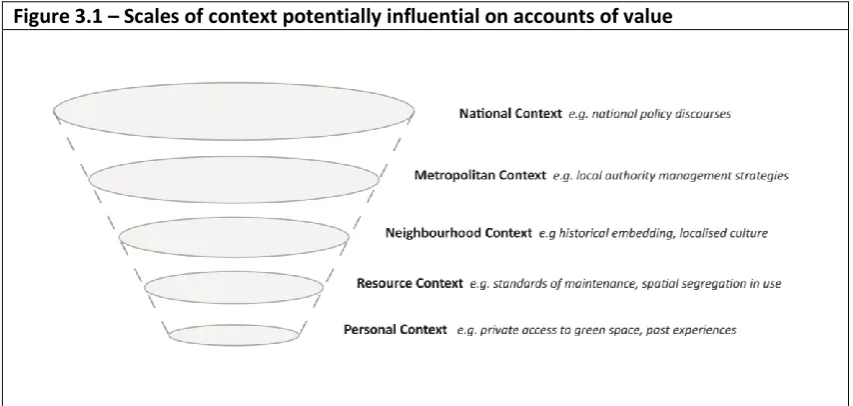
3.3.2.i Stage I:Elucidating context 61
Neighbourhood Context 61
Resource Context 64
Personal Context 66
3.3.2.ii Stage II: Examining direct use 67
Resident survey 69
User survey 71
3.3.2.iii Stage III: Understanding value 72
3.3.3 Towards analytical integration 76
3.3.3.i The integrative potential of grounded theory 77 3.3.3.ii Using CAQDAS to bridge the analytic divide 80
3.4 Quantitative analysis techniques 82
3.5 Conclusion 83
Chapter 4: Valuing the Use of Community Parks
84
4.1 Introduction 84
4.2 Frequency of use 84
4.3 Drivers of direct use 87
4.3.1 Health and community benefits 87
4.3.2 Users as members of a ‘sizeable minority’ 92
4.3.3 Using community parks out of ‘need’ 100
4.3.3.i A ‘need’ for accessibility 100
Proximity 100
viii
4.3.3.ii A ‘need’ for particular functional features 108
Open Space 108
Nature 110
4.4 The influence of negativity on use 111
4.4.1 Physical affordance 112
4.4.2 Atmosphere 115
4.5 Conclusion 118
Chapter 5: Valuing Aspects of the Past
119
5.1 Introduction 119
5.2 The use and non-use value of the past 119
5.2.1 Recollection 120
5.2.2 Heritage 124
5.3 The comparative nature of past values 126
5.3.1 Nostalgia 127
5.3.1.i Facilities 128
5.3.1.ii Supervision and Regulation 129
5.3.2 Viewing the past negatively 130
5.3.2.i Improvement 130
5.3.2.ii Obsolescence 132
5.3.2.iii Negative Perpetuation 133
5.4 Conclusion 134
Chapter 6: Exploring Connections between Values
136
6.1 Introduction 136
6.2 Connecting direct use to other forms of value 136 6.3 Exploring continuity between temporal values 141
6.3.1 Continuity between temporal use values 141
6.3.2 Connections between temporal use and non-use values 145
6.4 Further connections over the use/non-use divide 148
6.4.1 Direct use and philanthropy 148
6.4.1.i Family 149
6.4.1.ii Community 151
6.4.2 Indirect use and existence 152
ix
Chapter 7: Discussion: Reframing Conceptions of Value
157
7.1 Introduction 157
7.2 Use as a facet of value and the importance of others 157
7.2.1 The distinction of use and non-use – understanding value as socially situated
159
7.2.2 The place of indirect use and existence 163
7.3 Incorporating the importance of the past 167
7.3.1 Recollection 167
7.3.2 Socially-situated heritage 169
7.3.3 Comparative values 170
7.3.4 Continuity between temporal values 172
7.4 Understanding value as both positive and negative 173 7.5 Understanding value as spatially relative 177
7.6 Study Limitations 178
7.6.1 Overemphasising value 180
7.6.2 Underplaying the diversity in accounts of value 181
7.6.3 Limiting negativity 182
7.6.4 Limitations of Interpretation and Approach 183
7.7 Conclusions 185
Chapter 8: Conclusions and Wider Implications
187
8.1 Introduction 187
8.2 Insights for policy 187
8.3 Academic implications and future directions 190
Appendices
195
Appendix 1 Ethics Approval Form 196
Appendix 2 Case Study Selection Tables 197
Appendix 3 Data Collection Documents 200
Appendix 4 Dataset Summary Tables 225
Appendix 5 Coding Structure 242
Appendix 6 Full Quantitative Analyses 247
x
List of Figures
Chapter 2
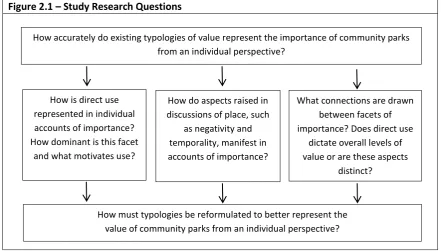
Figure 2.1 Study Research Questions 40
Chapter 3
Figure 3.1 Scales of context potentially influential on accounts of value 42 Figure 3.2 Maps depicting case study location, in the UK (a), within Leeds
(b)and within respective neighbourhoods (c and d).
44
Figure 3.3a Photograph of Manston Park 48
Figure 3.3b Photograph of Pudsey Park 48
Figure 3.4 The sequential research design employed in this study 60 Figure 3.5 Sample behaviour mapping base map for Manston Park 65
Chapter 4
Figure 4.1 Bar chart of summer frequency of use 86
Figure 4.2 Bar chart of winter frequency of use 86
Figure 4.3a Bar chart of the proportion of users who selected reasons for visiting Manston Park (Summer)
90
Figure 4.3b Bar chart of the proportion of users who selected reasons for visiting Pudsey Park (Summer)
90
Figure 4.4a Bar chart of the proportion of users who selected reasons for visiting Manston Park (Winter)
91
Figure 4.4b Bar chart of the proportion of users who selected reasons for visiting Pudsey Park (Winter)
91
Figure 4.5a Word cloud of most-liked aspects of Manston Park 104
Figure 4.5b Word cloud of most-liked aspects of Pudsey Park 104
Figure 4.6a Word cloud of least-liked aspects of Manston Park 114
Figure 4.6b Word cloud of least-liked aspects of Pudsey Park 114
Figure 4.7 Behaviour map of visitors to Pudsey Park during a brass band concert
117
Chapter 7
Figure 7.1 Study Research Questions 158
Figure 7.2 Diagram of forms of value attributed to community parks presented as socially-situated spectrums
xi Figure 7.3 Visual representation of social groupings through which value is
expressed
163
Figure 7.4 Diagram of the marginalisation of indirect use and existence 164 Figure 7.5 The place of existence value amongst socially-situated values 167 Figure 7.6 Diagram of forms of value attributed to community parks following
inclusion of a past temporal dimension
169
Figure 7.7 Diagram of forms of value attributed to community parks with comparative values represented and non-temporally-contiguous continuity represented
176
Appendix 3
Figure A3.1 Sample Behaviour Mapping Data Collection Sheet and Written Up example
201
Figure A3.2 Pilot Resident Questionnaire 202
Figure A3.3 Final Resident Questionnaire 210
Figure A3.4 User Survey Record Sheet 218
Figure A3.5 Pilot Interview Schedule 220
Figure A3.6 Final Interview Schedule 222
xii
List of Tables
Chapter 2
Table 2.1 Values and economic methods for assessing urban green spaces
10
Table 2.2 The Benefits of Parks and Greenspaces 14
Table 2.3 The Potential Value of Good Urban Design 15
Table 2.4 The types of value 16
Table 2.5 Alignment of different typologies of the value or importance of urban green space
20
Chapter 3
Table 3.1 Leeds City Council Urban Parks Typology 46
Table 3.2 Household tenure composition for relevant wards relative to the Leeds average
49
Table 3.3a Gender and age comparisons for Manston Park dataset relative to the ward, city, region and national level
50
Table 3.3b Gender and age comparisons for Pudsey Park dataset relative to the ward, city, region and national level
51
Table 3.4a Ethnic composition comparisons for the Manston Park dataset relative to the ward, city, region and national level
52
Table 3.4b Ethnic composition comparisons for the Pudsey Park dataset relative to the ward, city, region and national level
53
Table 3.5 Traditional distinctions between the qualitative and quantitative ‘paradigms’
55
Table 3.6 Research objectives and the contribution of different data sources
61
Table 3.7 Points of note in neighbourhood observation 63
Table 3.8 Resident survey response figures 71
Table 3.9 Interviewee Age and Gender Distribution 74
Chapter 4
Table 4.1 Measures of central tendency for frequency of use and number of activities selected as a main reason to visit case study spaces
88
xiii Table 4.3 Results of binomial logistic regression analyses exploring
factors that made respondents more likely to be frequent (1) versus infrequent (0) summer users
97
Table 4.4 Results of binomial logistic regression analyses exploring factors that made respondents more likely to be frequent (1) versus infrequent (0) winter users
98
Table 4.5 Percentage of frequent female and male users that selected reasons for summer use
99
Table 4.6 Kendall’s tau correlation coefficients exploring the relationship between age and frequency of use amongst those aged over 65 in second stage resident questionnaire distribution
102
Table 4.7 Kendall’s tau correlation coefficients exploring the relationship between frequency of use and household income
106
Table 4.8 Kendall’s tau correlation coefficients exploring the relationship between frequency of use and the number of dislikes listed
112
Chapter 5
Table 5.1 Amended urban green space value framework including proposed past values
120
Table 5.2 Summary of level of agreement to past-related Likert items 122
Table 5.3 Kendall’s tau correlation coefficients exploring the relationship between past-related values, age and permanency
123
Table 5.4 Summary table of past-related values taking into account the complicating factors of comparison and negativity
127
Chapter 6
Table 6.1 Summary of levels of agreement to value-related Likert items 138 Table 6.2 Measures of central tendency for frequency of use and levels
of agreement to value-related Likert statements
139
Table 6.3a Correlation matrix summary of Kendall’s tau correlation coefficients exploring relationships between frequency of use and levels of agreement with value-related Likert items in the Manston Park dataset
142
Table 6.3b Correlation matrix summary of Kendall’s tau correlation coefficients exploring relationships between frequency of use and levels of agreement with value-related Likert items in the Pudsey Park dataset
143
xiv
Chapter 7
Table 7.1 The forms of value identified by Choumert and Salanié (2008) 159
Appendix 2
Table A2.1 Community Parks in Leeds, West Yorkshire 197
Table A2.2 Case Study Selection Matrix 198
Appendix 4
Table A4.1 Resident survey dataset summary table 226
Table A4.2 User survey dataset summary table 239
Appendix 5
Table A5.1 Summary of coding structure for theme codes 243
Appendix 6
Table A6.1a
Binomial logistic regression analysis exploring factors that made respondents more likely to be frequent (1) versus infrequent (0) summer users of Manston Park
248
Table A6.1b
Binomial logistic regression analysis exploring factors that made respondents more likely to be frequent (1) versus infrequent (0) summer users of Pudsey Park
249
Table A6.2a
Binomial logistic regression analysis exploring factors that made respondents more likely to be frequent (1) versus infrequent (0) winter users of Manston Park
250
Table A6.2b
Binomial logistic regression analysis exploring factors that made respondents more likely to be frequent (1) versus infrequent (0) winter users of Pudsey Park
251
Table A6.3a
Kendall’s tau correlation coefficients exploring relationships between frequency of use and value-related Likert statements in the Manston Park dataset
252
Table A6.3b
Kendall’s tau correlation coefficients exploring relationships between frequency of use and value-related Likert statements in the Pudsey Park dataset
1
Chapter 1: Introduction
Public parks have been etched in UK culture since their heyday in the Victorian era. While initially provided to improve public health and serve as an impetus for civic pride, with increases in leisure time over the 20th century, the role of these public arenas diversified and their benefits for general wellbeing are now widely acknowledged. However, over the last fifty years, with increases in private transportation, advances in communications technology, the emergence of new leisure pursuits and the rise of the dual-earner household, household activity patterns have altered markedly and the value of local leisure resources for individuals has, thus, been called into question. Concerns regarding obesity in recent decades have further hinted at an evolution to more sedentary lifestyles and the significance of parks resources, which have traditionally been associated with sport and activity, can likewise be queried on these grounds.
Urban parks represent costly public resources and their position on the political agenda has varied to a great extent. The 1970s and 1980s were characterised by underinvestment in green space maintenance, leading many parks to fall into disrepair and visitor numbers to decline. However, the late 1990s and 2000s served as a renaissance for park delivery, supported by: the creation of the Urban Green Spaces Taskforce in 2001 which delivered its report ‘Green Spaces, Better Places’ in 2002; a series of funding programmes from the Heritage Lottery Fund and the Big Lottery, and the establishment of CABE space in 2003 as a sub-branch of the Commission for Architecture and the Built Environment (CABE). This thesis explores the significance of small-scale urban parks to individuals and, while policy does not serve as the focus of this research, the present policy context only adds to its timeliness, as recent policy developments have, once more, thrown the future of public parks into doubt with concerns that maintenance may once again be stepped back.
Since their inception in 2010, the Coalition government has been associated with two
connected policy narratives, Localism and the Big Society, which advocate the decentralisation of power from the central state to smaller-scale actors such as local authorities and
community groups. As the Minister for Decentralisation has highlighted, ‘localism is the ethos; decentralisation is the process and the outcome is the Big Society’ (House of Commons
2 Localism Act in November 2011, these linked narratives, together with austerity measures, have had marked implications for the provision and maintenance of local green spaces.
In itself, the drive for devolution of power to smaller scales of governance and greater community control is not new, with roots in New Labour’s Third Way of the 1990s but also stretching back further to the emphasis on community development by the Conservative government of the 1970s. A lack of clarity has however been highlighted as to the specifics of the Coalition government’s agenda, with suggestions that it encapsulates both the transfer of power to local authorities and community groups, whilst failing to elucidate the tension between these entities and their potential interdependencies (Maclennan and O’Sullivan, 2013).
In green space provision, the impact of these policy drivers, together with public funding cuts, has been particularly acute, seeing CABE space incorporated into the Design Council in 2011 with the streamlining of central government, and local authority spending reductions impacting non-compulsory services severely. While the maintenance of park resources has traditionally been predominantly funded by local authorities, this can no longer be the case, as projections indicate cuts to discretionary funding of over 65% (Local Government Association, 2012:2).
Organisations such as Nesta have thus underscored an urgent need to “rethink” the nature and management of UK parks going into the future, advocating a move towards “mixed funding models” (Neal, 2013: 21). Here, there is a drive towards more North American models of park management where, instead of public investment, green spaces generate their own funds through corporate sponsorship, commercial opportunities and philanthropic
endowments. It should, however, be noted, that many of these income generation strategies work best at a large scale and their usefulness for the funding of small scale parks can
3 Community voluntarism has long been a part of park maintenance and funding, with around £30 million raised in the UK annually by approximately 5000 park friends and user groups (Heritage Lottery Fund, 2014:8). This however represents only a fraction of all park spaces and questions remain as to whether voluntarism can be increased sufficiently to offset reductions in local authority support. Reed and Selbee (2001) have highlighted voluntary involvement more generally as an activity predominantly undertaken by only a small subset of the population, termed the ‘civic core’, suggesting any form of community engagement will ultimately reach an upper limit. A recent report on ‘The State of UK Parks’ by the Heritage Lottery Fund warns against an overreliance on voluntarism, emphasising that while voluntary involvement has increased since 2010, this has gone hand-in-hand with a loss in supporting local authority knowledge, leading to deterioration in park quality.
The discussion of value offered in this thesis provides the opportunity to question the basis upon which individuals engage with their local parks and understand more fully the
significance they attach to these spaces. The exploration of this diversity of importance allows for the expression of some scepticism surrounding both how well voluntarism can be
operationalised at the local level and the extent to which expectations of voluntarism may truly be fulfilled. These implications are returned to in Chapter 8.
Existing conceptualisations of the value of urban parks largely derive from work carried out by public bodies such as CABE. In many instances these studies have focused on placing an economic valuation on the intangible benefits of resources and, where non-economic value has been addressed, this has mostly been explored from the perspective of firms or the community in general. While some studies have collected people’s thoughts on their local parks (see, for instance, CABE space (2005a)), this research has been treated in isolation from value discussions and there is thus relatively limited understanding of the value (or
importance) that individuals assign to their local park. The most complete exploration of this has occurred in a top-down fashion in landscape economics where academics have sought to decompose monetary valuations into their constituent elements. Thus, despite the clear connections that can be drawn between value and the geographical notion of ‘place’ attachment, emphasis has centred on functional, often user-centred, appreciations of importance, with more emotive elements of value being somewhat marginalised.
4 resources in general, exploring value in a broad sense. Yet , the transferability of insights between this level of generality to specific green spaces can be cast into doubt, with aspects such as exchange value noted as inapplicable to public park resources. Even where accounts of value have centred specifically on green spaces, many of these have been constructed on the basis of large-scale examples, rather than more everyday spaces, and both the functionality and significance of these arenas may vary considerably by scale. Thus, while authors such as Burgess, Harrison and Limb (1988) have emphasised everyday green spaces as some of most significant, these resources have to date received the scantest attention and understandings of their importance remain relatively incomplete.
The thorough interrogation of value offered by this study adds to this body of work in four key ways. Firstly, in contrast to existing work, here, a bottom-up individual perspective on the importance of a green space resource is explored. Secondly, by focusing on community parks, the comparative case study presented in this thesis, provides a detailed exploration of the importance of local scale resources to local residents, contributing to understandings of how the importance of everyday resources may differ from those provided at a larger-scale. Thirdly, the approach adopted in this research redresses the overemphasis on use and function in existing conceptions of value, employing mixed methods to explore both functional and meaning-laden aspects and, thus, enabling a fuller appreciation of how people engage with these spaces at the individual level. Finally, by exploring previously under-examined connections between value and the notion of ‘place attachment’, this study enables the importance of experience in understandings of value to come to the fore.
The remaining chapters of this thesis fall into three sections. In the first of these sections,
Chapter 2 evaluates existing research into the value of urban parks, unifying the divergent perspectives and distinct scales identified in this body of work and, thus, elucidating in more detail the impetus for this study. In the course of this, three key research questions are identified for specific exploration. Following this, Chapter 3 outlines in detail the comparative case study approach adopted in this study, stressing the use of mixed methods as crucial to ensure consideration of the multiple facets of value, as the inherent qualitative and
5 The second section of this thesis identifies key flaws and omissions in existing understanding of the value of urban parks, consisting of three analytical chapters which explore in detail data collected. In Chapter 4, the dominance of direct use as a facet of value is questioned, as use is highlighted as associated with need rather than choice and negative perceptions are noted as important limitations on the use of case study spaces. Given the longstanding nature of park resources, Chapter 5 explores the role of the past in understandings of their importance, identifying a range of both comparative and absolute values associated with this temporal horizon. Here, the significance brought to current conceptions of importance from experience as a child is stressed as a notable gap in prior understanding. In Chapter 6, in a departure from previous accounts of value, attention is paid explicitly to the connections drawn by participants between different forms of value. Here, a high degree of continuity is identified between temporal values and fluidity between use and non-use values noted, casting the
meaningfulness of boundaries previously drawn between aspects of importance into doubt.
The implications of analytical insights drawn in this study are explored in the final section of this thesis. The discussion presented in Chapter 7 emphasises the individual perspective on the value of urban parks as notably distinct from those levelled at other scales. Situating preceding insights in existing literature, it identifies four marked challenges to existing typologies, noting how theoretical framings of importance must be reformulated to take account of these elements. Here, the integral role of experience in accounts of value is underlined as it is stressed that the value of a park resource must be rethought as a relational rather than absolute property, constituted in the interplay between an individual and that setting.
6
Chapter 2:
Existing Conceptions of the Value of Urban Parks
2.1 Introduction
As highlighted in Chapter 1, urban parks, as part of public infrastructure, are facing an
increasingly difficult economic climate and, with discretionary funding projected to decline by over 60%, local authorities are finding it ever more challenging to justify their outlay on the provision of these resources (Neal, 2013:8). There is therefore an increasing imperative to understand more fully their importance. Urban parks are widely regarded as valuable parts of local neighbourhoods. However, as highlighted in the following sections, prior accounts of their value have largely centred on benefits to firms or communities in general. Understanding of the value of urban parks at the micro scale of the individual, the focus of this study, is, however, much more limited. Nevertheless, with localist discourses advocating local people take on some degree of the management of their community environmental and social infrastructure, the need to understand the basis upon which individuals engage with these arenas is ever more acute.
7
2.2. Research attention to public green space
Public space has been identified as a ‘key concept’ in urban geography (Latham, McCormack, McNamara and McNeill, 2009). Nevertheless, as Byrne and Wolch (2009) have noted,
somewhat surprisingly, these arenas have received relatively little attention from geographers. Instead, urban parks, and urban green space more broadly, have been a field of interest for disciplines as distinct as environmental economics (e.g. Choumert and Salanié,2008; Tyrväinen, 1997); leisure science (e.g. Home, Hunizer and Bauer, 2012); environmental psychology (e.g. Ulrich, 1984) and urban design (e.g. Ward Thompson, Aspinall and Bell, 2010; Coolen and Meesters, 2012; CABE, 2001; CABE, 2006). While some in environmental economics and urban planning have examined the value of these resources as a whole, academics from cognate disciplines have more readily examined particular aspects of this importance, exploring for instance their health benefits in isolation. It has also been noted that these divergent literatures “rarely cite one another” and have often used contrasting terminology, data and questions, creating a kind of language barrier, inhibiting their integration (Irvine, Fuller, Devine-Wright, Tratalos, Payne, Warren, Lomas and Gaston, 2010:216). Knowledge has therefore not coalesced in this area. Sanesi, Lafortezza, Bonnes and Carrus (2006) have examined this disciplinary divergence, comparing two studies of urban green space conducted in Italy, one drawn from environmental psychology and the other from urban forestry. While both studies examined perceptions of and attitudes towards these arenas, researchers had very distinct ideas as to what these concepts meant, with urban foresters utilising more “functional” definitions of key terms and thus drawing notably distinct conclusions (Sanesi et al. 2006:128). The geographical perspective adopted in this thesis represents fertile ground for integrating these interdisciplinary insights into value.
2.3 Defining and exploring value
“Not everything that counts can be counted; and not everything that can be counted, counts.”
(Sign in Albert Einstein’s office, cited in Saxon, 2005:1)
8 society more generally, has seen great plurality emerge in its common-sense meaning. As a result, it is possible to use the term in a contradictory manner, describing both the price of an entity and its aspects which are inherently priceless, and this variability is reflected in its three principal dictionary definitions which consider it: “the regard that something is held to
deserve”, “importance or worth” and “material or monetary worth” (Concise Oxford English Dictionary, 2008). In some senses, this diversity is also reflected in previous work on this topic. However, where the notion of value has been explicitly addressed in relation to parks and green space, it has largely been in connection with the third of these facets, seeking to assign a monetary value to these public arenas. This study focuses more closely on exploring the second meaning of this term, examining the importance of urban parks to individuals, and, thus, makes no attempt to price resources. Economic and non-economic conceptions of value are not, however, diametrically opposed. As Pearce (1993: 13) has highlighted in relation to environmental goods more generally, economic valuations are underpinned by people’s understandings of non-economic value, with money representing a “measuring rod” for underlying preferences. It is therefore useful to synthesise insights from both approaches, understanding the economic view of value and the elements thought to constitute this, when looking to conceptualise non-economic value at the individual level. The techniques employed in this body of work, and aspects of value that are considered to underpin it are therefore discussed in more detail below.
2.3.1 Economic valuation of urban green space
As highlighted in both CABE (2006) and Saxon’s (2005) work on value in the built environment, for many aspects of the urban landscape, particularly commercial developments, economic value can be readily obtained, and included in decision-making processes, equalling the ‘asset value’ (or ‘exchange value’) of the resource; that is “the amount realisable by selling the asset or its income stream” (Saxon, 2005: 10). Limiting value to this entity is, however, problematic when considering urban parks, because here, land value (which could be considered exchange value) is nullified by legal protections which prohibit their exchange and development
9 even the cost of reinstating such a resource and this historic undervaluing in asset terms is thought to have resulted in historic underinvestment in these spaces (CABE space, 2009).
The above approach to economic valuation deals with a very narrow conception of this value, taking no consideration of the benefits derived from these arenas. There has, however, been an upsurge in interest in public green space since the early 2000s as the benefits of green space provision have been increasingly recognised (Swanwick, Dunnett and Woolley, 2003) and publications, including CABE Space reports Making the invisible visible: the real value of park assets (2009) and Does money grow on trees? (2005), have made inroads into assessing the economic value of these spaces more completely. Two dominant research approaches have been employed to explore the economic value of urban green space in this fuller sense, with an aim to capture the amount that an individual is willing to pay for a change in an environmental resource (Pearce, 1993). These are revealed preference and stated preference techniques which are discussed in more detail below.
10
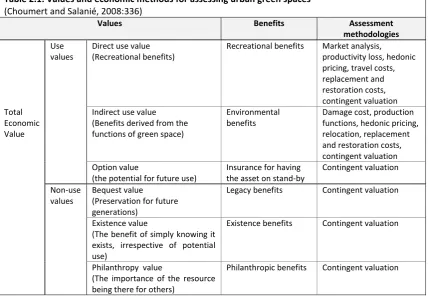
Table 2.1: Values and economic methods for assessing urban green spaces
(Choumert and Salanié, 2008:336)
Values Benefits Assessment
methodologies
Use values
Direct use value (Recreational benefits)
Recreational benefits Market analysis,
productivity loss, hedonic pricing, travel costs, replacement and restoration costs, contingent valuation Total Economic Value
Indirect use value (Benefits derived from the functions of green space)
Environmental benefits
Damage cost, production functions, hedonic pricing, relocation, replacement and restoration costs, contingent valuation Option value
(the potential for future use)
Insurance for having the asset on stand-by
Contingent valuation
Non-use values
Bequest value
(Preservation for future generations)
Legacy benefits Contingent valuation
Existence value
(The benefit of simply knowing it exists, irrespective of potential use)
Existence benefits Contingent valuation
Philanthropy value
(The importance of the resource being there for others)
Philanthropic benefits Contingent valuation
Contingent valuation is the most-used stated preference method and a raft of work has been published that has employed this technique in valuing urban parks specifically (e.g. del Saz Salazar and García Menéndez, 2007; del Saz Salazar and Rausell-Köster, 2008), other green spaces including urban forests (e.g. López-Mosquera and Sánchez, 2011; Tyrväinen, 2001; 1997; Tyrväinen and Väänänen, 1998) and open space more broadly (e.g.McConnell and Walls, 2005). As part of this technique, a value is obtained by presenting individuals with a
11 The idea of the relative importance is more readily incorporated in choice modelling, a second stated preference method which has emerged in green space valuation. Here, participants are asked to trade-off different attributes of a good (Hanley, Mourato and Wright, 2001).
However, this method has also been the subject of critique because, as Bullock (2008) has noted, there is great uncertainty as to how representative these trade-offs are of actual decision-making and whether individuals truly assign value to a park in a cumulative sense, attributing importance to individual aspects. Stated preference techniques also leave little scope for individuals to express aspects that they are unable or unwilling to trade-off (so-called ‘non-compensatory preferences’) (Lockwood 1999). As noted by Lockwood (1999), this issue poses particular practical problems in stated preference studies, in some cases, leading to incomplete datasets in choice modelling and ‘protest zeros’ in contingent valuation studies.
All of the approaches mentioned above point to the complexity of pricing and this has been acknowledged and explored in relation to other goods in other branches of economics, most notably behavioural economics (Poundstone, 2010). While a thorough examination of this body of work is outside of the scope of this review, theories developed here, such as
‘anchoring and adjustment’ (Tversky and Kahneman, 1974), highlight that the economic price assigned to a good is often contingent on the information provided or available to an
individual. This relativity in pricing may also be relevant to non-economic valuation of urban green spaces. In his choice experiment in Dublin, Bullock (2008) highlighted, for instance, that familiarity (which could be considered indicative of the level of information an individual has about a resource) was key in the evaluation of importance. Existing work on the
non-economic conception of value is examined in the section that follows. While not emphasised to date, this relativity is explored in greater detail in later chapters.
2.3.2 The non-economic conception of value
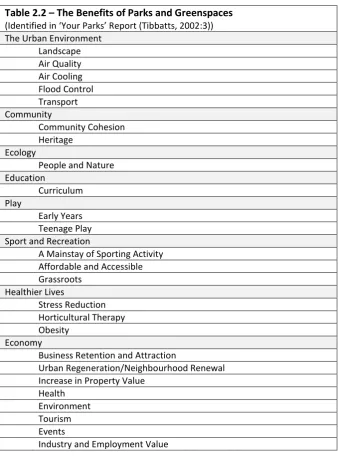
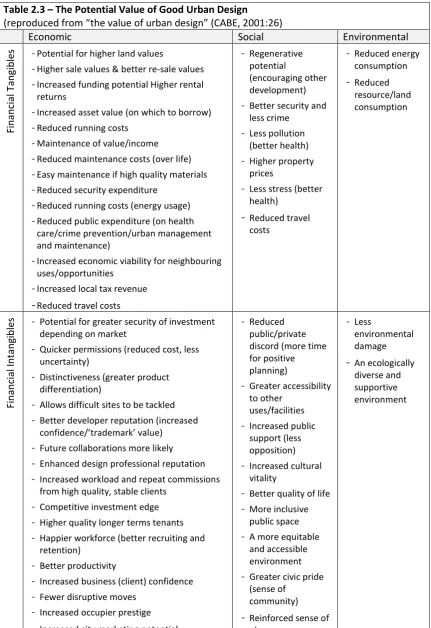
12 published by the Urban Parks Forum in 2002 (Tibbatts, 2002) provides an example of this, identifying, for instance, the positive Environmental, Community, Educational, Recreational, Health and Economic contributions that these spaces make (a full list of benefits identified is provided in Table 2.2). A similar approach to this was adopted by CABE in their 2001 report into the value of urban design more broadly and, here, benefits were summarised according to the 3 pillars of sustainability: economy, society and environment (see Table 2.3). While this work has been useful in highlighting the multi-functionality of urban green spaces, there is scope to question whether value truly equates purely to benefit. For instance, where this term is considered synonymous with significance, logically negative elements should also feature.
While the “value of urban design” (CABE, 2001) report included a discussion of the negative impacts generated by design, these were presented in a table of significant costs, rather than being incorporated into the consideration of value. Nevertheless, the main issue raised by this work relates to great variability in the perspective of value addressed. Tibbatts’ (2002) report examines, for example, benefits in relation to communities and society in general, while others have focused on positive outcomes for local government (CABE, 2006), and discussions of urban design have often centred on beneficial effects on design firms and clients (Saxon, 2005; CABE, 2006). Emphases on both the definition of values and their measurement have diverged between these perspectives leading to a lack of consistency. In this context, the categorisation of aspects into economic, environmental and social benefits has been particularly problematic. The aforementioned report “The value of urban design” (CABE, 2001), written from a design firm perspective, provides a good example of this. Here, as noted in Table 2.3, house price increases are categorised as part of the social value of design. However, from the perspective of an individual or community, this would likely be classed as an economic benefit.
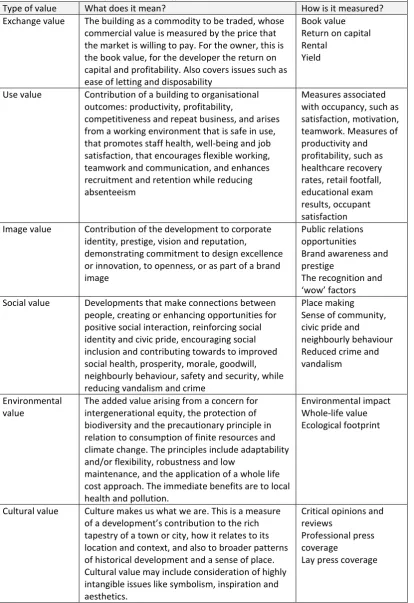
A second approach to non-economic value has examined it with a greater level of abstraction. This is most readily exemplified in the report ‘the value handbook’ produced by CABE in 2006. As summarised in Table 2.4, here 6 forms of value which could be attributed to aspects of the built environment were identified: exchange value, use value, image value, social value, environmental value and cultural value. In common with attention to the benefits of spaces, discussed above, questions can once again be raised as to the variability of value by
13 and press coverage for ‘cultural value’. These elements appear to be of little relevance to an individuals’ sense of value. More importantly, however, the abstraction proposed in this framework also raises questions as to the usefulness of assessing value in a general sense as the transferability of insights across the different built forms examined in the report is variable. For instance, while exchange value is relevant to buildings considered, as noted in section 2.3.1, legal protections mean this aspect of importance has limited application in the valuation of urban parks.
14
Table 2.2 – The Benefits of Parks and Greenspaces (Identified in ‘Your Parks’ Report (Tibbatts, 2002:3)) The Urban Environment
Landscape Air Quality Air Cooling Flood Control Transport Community
Community Cohesion Heritage
Ecology
People and Nature Education
Curriculum Play
Early Years Teenage Play Sport and Recreation
A Mainstay of Sporting Activity Affordable and Accessible Grassroots
Healthier Lives
Stress Reduction Horticultural Therapy Obesity
Economy
Business Retention and Attraction
Urban Regeneration/Neighbourhood Renewal Increase in Property Value
Health Environment Tourism Events
15
Table 2.3 – The Potential Value of Good Urban Design
(reproduced from “the value of urban design” (CABE, 2001:26)
Economic Social Environmental
Fi n an cial T an gib
les -Potential for higher land values
-Higher sale values & better re-sale values
-Increased funding potential Higher rental returns
-Increased asset value (on which to borrow)
-Reduced running costs
-Maintenance of value/income
-Reduced maintenance costs (over life)
-Easy maintenance if high quality materials
-Reduced security expenditure
-Reduced running costs (energy usage)
-Reduced public expenditure (on health care/crime prevention/urban management and maintenance)
-Increased economic viability for neighbouring uses/opportunities
-Increased local tax revenue
-Reduced travel costs
- Regenerative potential
(encouraging other development)
- Better security and less crime
- Less pollution (better health)
- Higher property prices
- Less stress (better health)
-Reduced travel costs
- Reduced energy consumption - Reduced resource/land consumption Fi n an cial In tang ib
les - Potential for greater security of investment
depending on market
- Quicker permissions (reduced cost, less uncertainty)
- Distinctiveness (greater product differentiation)
- Allows difficult sites to be tackled
- Better developer reputation (increased confidence/’trademark’ value)
- Future collaborations more likely
- Enhanced design professional reputation
- Increased workload and repeat commissions from high quality, stable clients
- Competitive investment edge
- Higher quality longer terms tenants
- Happier workforce (better recruiting and retention)
- Better productivity
- Increased business (client) confidence
- Fewer disruptive moves
- Increased occupier prestige
- Increased city marketing potential
- Reduced public/private discord (more time for positive planning)
- Greater accessibility to other
uses/facilities
- Increased public support (less opposition)
- Increased cultural vitality
- Better quality of life
- More inclusive public space
- A more equitable and accessible environment
- Greater civic pride (sense of
community)
-Reinforced sense of place
- Less
environmental damage
16
Table 2.4 – The types of value (reproduced from ‘the value handbook’ (reproduced from “the value handbook” (CABE, 2006:10))
Type of value What does it mean? How is it measured? Exchange value The building as a commodity to be traded, whose
commercial value is measured by the price that the market is willing to pay. For the owner, this is the book value, for the developer the return on capital and profitability. Also covers issues such as ease of letting and disposability
Book value Return on capital Rental
Yield
Use value Contribution of a building to organisational outcomes: productivity, profitability,
competitiveness and repeat business, and arises from a working environment that is safe in use, that promotes staff health, well-being and job satisfaction, that encourages flexible working, teamwork and communication, and enhances recruitment and retention while reducing absenteeism
Measures associated with occupancy, such as satisfaction, motivation, teamwork. Measures of productivity and profitability, such as healthcare recovery rates, retail footfall, educational exam results, occupant satisfaction Image value Contribution of the development to corporate
identity, prestige, vision and reputation,
demonstrating commitment to design excellence or innovation, to openness, or as part of a brand image
Public relations opportunities Brand awareness and prestige
The recognition and ‘wow’ factors Social value Developments that make connections between
people, creating or enhancing opportunities for positive social interaction, reinforcing social identity and civic pride, encouraging social inclusion and contributing towards to improved social health, prosperity, morale, goodwill, neighbourly behaviour, safety and security, while reducing vandalism and crime
Place making Sense of community, civic pride and neighbourly behaviour Reduced crime and vandalism
Environmental value
The added value arising from a concern for intergenerational equity, the protection of biodiversity and the precautionary principle in relation to consumption of finite resources and climate change. The principles include adaptability and/or flexibility, robustness and low
maintenance, and the application of a whole life cost approach. The immediate benefits are to local health and pollution.
Environmental impact Whole-life value Ecological footprint
Cultural value Culture makes us what we are. This is a measure of a development’s contribution to the rich tapestry of a town or city, how it relates to its location and context, and also to broader patterns of historical development and a sense of place. Cultural value may include consideration of highly intangible issues like symbolism, inspiration and aesthetics.
Critical opinions and reviews
Professional press coverage
17
2.4 An individual perspective on the value of urban parks
The majority of work at the individual level relevant to assessing the non-economic value of urban parks comes from attempts by environmental economists to decompose the monetary values they obtain for environmental resources. The most complete summary of these values for urban green space is provided by Choumert and Salanié in their 2008 paper. Here, they identify 6 forms of value thought to combine to underpin economic evaluations: direct use, indirect use, option, philanthropy, existence and bequest. These values are summarised in Table 2.1. An important inclusion made in this framework is the designation of non-use values in addition to the use values of ‘direct use’, ‘indirect use’ and ‘option’ value, although
Choumert and Salanié (2008) are careful not to overemphasise the dominance of these non-use elements. Economists have recognised non-use aspects of value for several decades (see Pearce 1993 for instance). Non-use values of existence, bequest and philanthropy have, however, served as foci for much greater debate, having been aligned to philosophical debates around the anthropocentrism of value and the scope for altruism.
In Choumert and Salanie’s (2008) summary of values, existence value is denoted as a park’s inherent importance, particularly as a part of nature and, invariably this discussion of intrinsic significance is implicated in ethical discussions related to the construction of value. In
discussions of value, distinction is commonly drawn between instrumental and intrinsic value and Curry (2006:42) suggests that “whatever has intrinsic value is whatever is valued for its own sake, without any reference to its usefulness in realising some other goal”. While authors such as O’Neill (1992) have stressed some diversity in the use of this term, it is emphasised that people (and the instrumental, or functional, value of spaces) have been unduly privileged where the value of nature has been discussed. This argument has been extended to question that validity of valuation from a human perspective (anthropocentric valuation) with some have positing that this approach results in an impression that value is “anthropogenic”, in that no value exists outside of that which people value (Curry, 2006). This, however, represents an overextension of this argument, as a large body of work has emerged to highlight the
18 nature, particularly animals and wildlife, may be privileged in these understandings of the inherent importance of nature. Lockwood (1999:389) emphasises the need to “disaggregate intrinsic value” suggesting “some people might accord intrinsic value only to individual mammals, others might include non-sentient creatures, plants or whole species”.
Altruism has been suggested as a further issue in the identification of non-use values. The consideration of others, inherent within these aspects of importance, has been noted as at odds with the traditional basis of economic valuation, utility maximisation. It has thus been posited that these values can only be included “within an economic framework on the assumption that the ultimate motivation is self-interest” and, here, a distinction between ‘selfless’ and ‘selfish’ altruism has been drawn (Crowards 1997:144). This becomes particularly noteworthy where the values of ‘philanthropy’ and ‘bequest’ are considered as these elements offer the greatest potential for self-serving altruism, with the significance of individuals
represented as ‘others’ highly variable, ranging from members of general society to kin. The impact of this distinction in social ties on the prevalence of non-use values has generally been played down (Crowards, 1997). Logically, however, where these values are associated with family members and close friends, they can more readily be associated with selfish altruism. Furthermore, in these cases, non-use values may be more dominant as individuals will likely serve the interests of a group of which they are part, or that they have a genetic stake in, most readily. Authors such as Pearce (1993) have stressed the usefulness of familial relations in economic value assessments, noting their vital role in minimising intergenerational bias. However, there is a need to explore the qualitative scope of non-use values more thoroughly to understand how closely connected self-interest and non-use values truly are.
2.5 Connecting frameworks of value and importance
Urban parks, and public green space more broadly, play many different (intended and unintended) roles in an urban environment. Swanwick et al., (2003) suggest that the aforementioned increased attention to green space provision has resulted from improving evidence as to these and authors have argued “an understanding of the multiple functions of urban green spaces is reasonably well developed” (James, Tzoulas, Adams, Barber, Box,
19 the evidence base for the role that urban parks play in the urban environment is drawn from the literature on urban green space more broadly. However, despite this appreciation of their multi-functionality, as previously mentioned, these functions have largely been investigated in separation from each other, leading to some definitional inconsistencies. Many of the
definitional inconsistencies related to green space stem from the term having a common-sense definition. In the broadest sense, green space can literally mean space which is green. This has led researchers to lack clarity when discussing the subject of their investigations as prior knowledge of the meaning of the term is sometimes assumed. There is, however, reason to question whether the common-sense and technical meanings of green space (and its
associated terms) really coincide. As Swanwick et al. (2003) have noted, there are three areas in which researchers have been particularly unclear as to the definitions they are using: firstly, the terms ‘open space’ and ‘green space’ have been used interchangeably; secondly, urban green space has often been used as a synonym for public green space and, finally, a clear distinction between formal and informal green space has often not been drawn.
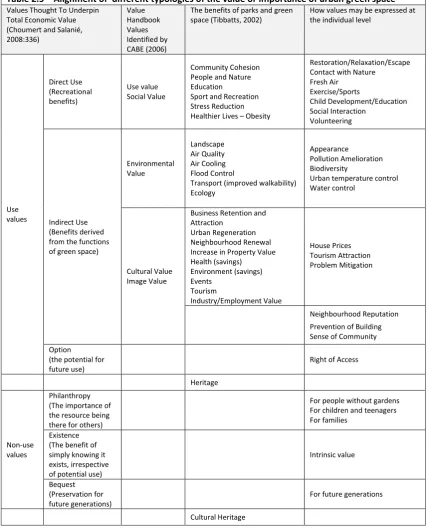
20 people’s use of these spaces using numerical figures. This benefit is, however, well known and thus may be expressed by individuals directly. Considering a park important because it allows you to ‘get a breath of fresh air’, may, for instance, in fact, be an acknowledgment of the environmental function that it serves in relation to pollution. Potential expressions of values are therefore also included in Table 2.5.
Table 2.5 – Alignment of different typologies of the value or importance of urban green space
Values Thought To Underpin Total Economic Value (Choumert and Salanié, 2008:336) Value Handbook Values Identified by CABE (2006)
The benefits of parks and green space (Tibbatts, 2002)
How values may be expressed at the individual level
Use values Direct Use (Recreational benefits) Use value Social Value Community Cohesion People and Nature Education
Sport and Recreation Stress Reduction Healthier Lives – Obesity
Restoration/Relaxation/Escape Contact with Nature
Fresh Air Exercise/Sports Child Development/Education Social Interaction Volunteering Indirect Use (Benefits derived from the functions of green space)
Environmental Value Landscape Air Quality Air Cooling Flood Control
Transport (improved walkability) Ecology
Appearance
Pollution Amelioration Biodiversity
Urban temperature control Water control
Cultural Value Image Value
Business Retention and Attraction
Urban Regeneration Neighbourhood Renewal Increase in Property Value Health (savings) Environment (savings) Events Tourism Industry/Employment Value House Prices Tourism Attraction Problem Mitigation Neighbourhood Reputation Prevention of Building Sense of Community Option
(the potential for future use)
Right of Access
Heritage
Non-use values
Philanthropy (The importance of the resource being there for others)
For people without gardens For children and teenagers For families
Existence (The benefit of simply knowing it exists, irrespective of potential use)
Intrinsic value
Bequest (Preservation for future generations)
For future generations
21 The divisions in urban green space research, noted above, have also led to certain functions being examined more readily than others, remaining relatively disconnected from discussions of overall value. In the wider body of green space research, direct use value has been portrayed as the most pivotal aspect of its importance, with research focusing on health outcomes and the potential of urban parks to aid community formation. In some cases, the focus of research appears to have largely been dictated by a desire for policy relevance, particularly where aspects of direct use are explored. It has been suggested, for instance, that the focus on health research have resulted from this aspect rising on political agendas (Schipperijn, Stigsdotter, Randrup and Troelsen, 2010), perhaps due to growing concern about the state of people’s health in industrialised nations in the face of issues such as the obesity crisis. This body of health-related research is discussed in more detail below.
2.5.1 Direct Use and Health
Within the body of work that connects urban green spaces and health, three broad areas of interest have emerged, which relate to the contribution of these arenas to wellbeing and general health; levels of physical activity and mental health. These different aspects are discussed in turn in the sections that follow.
2.5.1.i Wellbeing and General Health
Research into the effects of green space provision on general wellbeing and health has been conducted for many years. However, there has been an evolution over time in the way that the perception of green space has been conceptualised which has had implications for this research. Initially, where connections to health were explored, the environment was considered primarily as a visual stimulus (Heft, 2010). Ulrich (1984), for example, in his well-cited study, suggested that a view of green space improved recovery times following surgery and this beneficial effect aligns most readily to indirect use in value discussions. However, following this, greater attention has been paid to the contribution to health of active
22 workers in London were disinclined to use outdoor environments, having become accustomed to “only tightly controlled ambient conditions”.
Attention to the health contribution green space as an active arena has been supported by the emergence of a body of work in ecological psychology which employs affordance theory as its basis. Affordance theory was first discussed by Gibson in 1979 (Gibson, 1979:127 cited in Chemero, 2003:182) who noted “The affordances of the environment are what it offers the animal, what it provides or furnishes, either for good or ill”, and this has since been highlighted as a key contribution to understanding the perception of landscapes in a more active sense (Heft, 2010). As Heft (2010: 20) notes, “Although one can perceive affordances from a fixed vantage point, they are all about action. They indicate what one can do in some setting, and what activities may be ruled out”. While affordances are widely acknowledged as ‘relational’, they are not without debate and questions have been raised regarding to both their
conceptualisation and perception (see Chemero (2003) for a greater detail on these) and, in an outdoor setting such as a park, seasonality is likely to have a significant impact on the
affordances perceived.
Nevertheless, parks have been widely acknowledged as “family refuges” (Byrne and Wolch, 2009:743) and authors such as Tuan (1977) that childhood offers some of the most vivid sensory experiences. Thus, particular attention has been paid to the affordances that green spaces offer for children and teenagers in relation to play (see for instance Fjørtoft (2001); Kyttä (2004); Mäkinen and Tyrväinen (2008)). Drawing on the work of Barker and Wright (1955), connections have also been drawn here to discussions of meaning, with Heft (2010), for instance, emphasising this point with reference to open spaces and their use by children, stating “They do more than offer the possibility for running; they entice children to do so” (Heft, 2010:25). This combination of both affordance and meaning has recently been explored by Coolen and Meesters (2012) who identified notable differences in these between public and private green spaces.
23 more markedly (Pain, 2000). Meanwhile, several studies have identified positive connections between public green spaces and a greater sense of wellbeing or general health. de Vries, Verheij, Groenewegen, and Spreeuwenberg (2003), for example, found that greener living environments in Holland were associated with a better level of self-reported health, a result confirmed by a study in Denmark (Stigsdotter, Ekholm, Schipperijn, Toftager, Kamper-Jørgensen and Randrup, 2010) and greener areas have also been associated with increased feelings of social safety (Maas, Spreeuwenberg, Van Winsum-Westra, Verheij, de Vries, and Groenewegen, 2009). Public green spaces are, however, noted as having a variable influence on different aspects of wellbeing. While they are shown to greatly improve social safety and mental health (Maas, Spreeuwenberg et al., 2009) and authors have even suggested that access to green space can reduce health inequalities (Mitchell and Popham, 2008), others, such as Sugiyama, Leslie, Giles-Corti and Owen (2008), highlight that they have a much lesser impact on physical health.
2.5.1.ii The impact of green space on physical activity levels
In spite of a relatively limited evidence base connecting green space and physical health, a part of the direct use value of these arenas derives from them being seen as key spaces for