ISSN Online: 2327-5960 ISSN Print: 2327-5952
DOI: 10.4236/jss.2019.710020 Oct. 22, 2019 255 Open Journal of Social Sciences
Case Test of Citizen Participation in Complex
Governance—Based on the Democracy Cube
Mengqi Shi
Zhou Enlai School of Government, Nankai University, Tianjin, China
Abstract
In recent years, under the policy orientation of expanding public orderly po-litical participation, the government has continuously strived to innovate the form and content of public participation and achieved good implementation results. In this paper, based on the democracy cube, we combine domestic democratic cases which are the representative participatory budget reform in the Xihu district of Nanchang, and discuss citizen participation issues from the perspectives of authority, participants and communication mode in detail.
Keywords
The Democracy Cube, Citizen Participation, Authority, Participants, Communication Mode
1. Introduction
Public participation first originated from direct democracy in ancient Greece. Since modern times, public administration has been controversial around “fair-ness first” or “efficiency first”. The new public administration school, represented by Waldo and Frederickson, places greater emphasis on democratic values. Driven by the new public administration school, participatory budget re-forms have quietly emerged in China. The report of the 19th National Congress of the Communist Party of China has repeatedly mentioned “protecting people’s right to participate” and “equal participation of the people”, which is enough to prove that the central government attaches importance to and supports the par-ticipatory budget reform. Zheng (2015) considers that the fundamental charac-teristic of the modern community governance structure is the participation of the government, social organizations and individual citizens [1]. Chen (2017) argues that the ordering of public participation should stand on China’s con-temporary context, promote the interaction between self-culture and other cul-How to cite this paper: Shi, M.Q. (2019)
Case Test of Citizen Participation in Com-plex Governance—Based on the Democra-cy Cube. Open Journal of Social Sciences, 7, 255-260.
https://doi.org/10.4236/jss.2019.710020
Received: October 8, 2019 Accepted: October 19, 2019 Published: October 22, 2019
Copyright © 2019 by author(s) and Scientific Research Publishing Inc. This work is licensed under the Creative Commons Attribution-NonCommercial International License (CC BY-NC 4.0). http://creativecommons.org/licenses/by-nc/4.0/
DOI: 10.4236/jss.2019.710020 256 Open Journal of Social Sciences tures, construct the model combining leading participation and progressive par-ticipation [2]. In view of this, we intend to select the representative public par-ticipation practice in China—the Participatory Budget of Xihu district in Nan-chang, and use the theory of democratic cube to test the value of public partici-pation from the perspectives of authority, participants and communication mode. It provides theoretical reference and practical enlightenment for the de-velopment of public participation in China.
2. Theoretical Framework
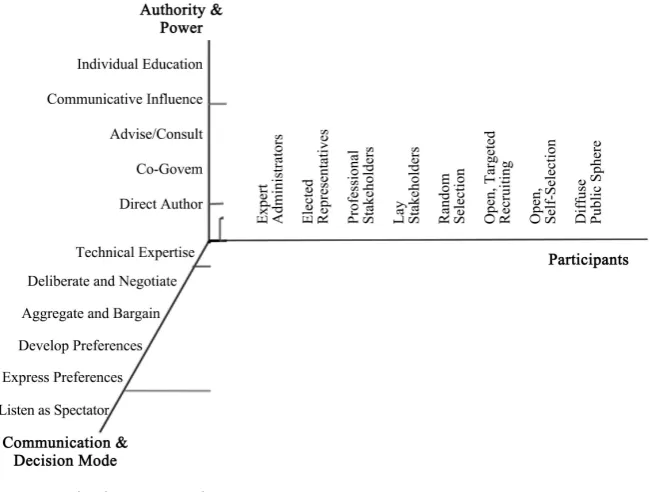
Archon Fung who is an associate professor of public policy at the Harvard Uni-versity’s Kennedy School of Government put forward the democracy cube (Figure 1) [3]. His article “Varieties of Participation in Complex Governance” presents the theoretical connotation of the democracy cube. On the basis of a vast number of case studies, Professor Archon Fung extracted the three most important issues of public participation in different democratic systems: Who participates? How do they communicate and make decisions? What is the con-nection between their conclusions and opinions on one hand and public policy and action on the other? Then using the rubric of a three-dimensional institu-tional space to explore participatory mechanisms that are suited to solve prob-lems in contemporary governance: authority, participants and communication mode.
[image:2.595.211.537.470.716.2]The author has offered a framework for thinking about the major design vari-ations in contemporary participatory institutions. In addition, this article has many highlights. Firstly, the structure of the article is clear and understandable. The subtitle divides the article into several interrelated parts with strong logic.
DOI: 10.4236/jss.2019.710020 257 Open Journal of Social Sciences The three dimensions and values of participation are discussed very clearly. Se-condly, the author provides us with a theoretical framework, and introduces three dimensions of the framework and the three democratic values it serves in detail, this framework can cover all forms of participation. The author discovers the potential of democratic participation and calls for the rational design of pop-ular participation to solve the problem of government failure. Thirdly, the au-thor shows us some cube figures composed of three dimensions, in which dif-ferent ways of participation can find their own position. Moreover, the author also uses many cases to explain the point of view, so that the article is convinc-ing.
But every coin has two sides: The author only lists different ways of participa-tion, but do not evaluate them, we just know what is self-selected, what is selec-tively recruit … so we do not know which made the improvement of democratic participation lacked clear direction. Besides, the author only proposes a work for explaining participation, but do not further suggest how this frame-work can promote better participation. Finally, the author ignores the challenge of participatory innovations aimed at effective governance. Although the num-ber of participatory innovations seems to have proliferated in recent years, the results of many innovations are quite limited, even making them insignificant. We called it is the park bench problem. When authorizes citizens the power to decide which color to paint for their park benches, it will increase public partic-ipation, but it will not be done in a meaningful way, and it is considered to be inefficient to a certain extent. There are many different ways to restrict public participation, so many factors made citizens do not create a substantial role: the outcomes and the agenda of issues that they consider can be highly constrained, or the resources and authorities invested in a participatory process can be tiny. Now we based on the democracy cube, combining domestic democratic cases, discussing citizen participation issues from the perspectives of authority, partic-ipants and communication mode.
DOI: 10.4236/jss.2019.710020 258 Open Journal of Social Sciences organizations, including street empowerment and community empowerment, which laid the foundation for the official launch of the project and facilitated the participation of social organizations. Moreover, due to the empowerment of the district government, the streets responsible for the specific implementation can make the goal commitment of citizens to participate. And the goal commitment is giving the streets 1 million Yuan and the communities 0.3 million Yuan for the citizens’ livelihood investment, and giving the decision power to the citizens completely. Therefore, there is an intrinsic connection between empowerment and goal commitment, which lays the foundation for stimulating the enthusiasm of citizen participation. The participatory budget reform firstly collects project proposals through street empowerment and community empowerment, and then holds round tables to vote after citizens have been negotiated and dis-cussed. Next, through programmatic and project-based project selection, the quota budget and voting results are determined. Finally implements the livelih-ood project. Corresponding to the dimension of authority & power in the de-mocracy cube, the participatory budget reform in the Xihu district is mainly re-lated to “Advise/Consult”: officials preserve their authority and power but com-mit themselves to receiving input from participants. The stated purpose of most public hearings and many other public meetings is to provide such advice [3].
ag-DOI: 10.4236/jss.2019.710020 259 Open Journal of Social Sciences gregates their preferences—often mediated by the influence and power that they bring—into a social choice. The exploration and give-and-take of bargaining al-lows participants to find the best available alternative to advance the joint prefe-rences they have [3].
The third dimension is Participants Selection. The first is the recruitment of social organizations. According to existing experience, the participation of social organizations can play an important role in assisting the equal participation of citizens and promoting consultation, discussion and dialogue among citizens. The social organization of Xihu district in Nanchang is roughly divided into three parts: the alumni associations of universities in Nanchang, the existing so-cial organizations in each community (mainly are entertaining soso-cial organiza-tions, sporting social organizations), and there are also many volunteer associa-tions established by universities such as Nanchang University [5]. Social organi-zations have played an active role in promoting citizens’ participation and thus driving street participation, especially in promoting repeated consultations be-tween citizens. Next is the round table negotiation stage. In the round table, par-ticipants are divided into 6 groups. Each with a table leader, a recorder, a tech-nical consultant which is served by social organizations and 8 - 12 citizens. Eve-ryone knows his place in the group. The leaders of the round table preside over the speeches and discussions in the group. The technical consultants guide, sup-plement and deepen the suggestions of the citizens, and assist the leaders of the round table to mobilize the enthusiasm of the citizens and record their sugges-tions. Then there is the budget quota and voting to determine the implementa-tion project stage. Those as least 15 years of age, the community residents living in the pilot area, working in the community, and students attending the com-munity can vote at the polling points in the comcom-munity. It’s worth noting that the turnout rates of the two streets of Nanpu and Guang Runmen are relatively high, exceeding 50%. The difference is that Nanpu Street has a prior voting rate requirement, while Guang Runmen Street fully respects residents’ willingness. In any case, after the district government’s empowerment at the grassroots level and the mobilization of social organizations, the citizens gradually changed from passive to active, and the active participation of the citizens promoted the enthu-siasm of the community and the streets, making the goal more satisfactorily achieved. In summary, corresponding to the dimension of Participant Selection in the democracy cube, the participatory budget reform in the Xihu district is mainly related to “selectively recruit” when recruiting social organizations. In the round table negotiation stage, it belongs to “lay stakeholder”. In the stage of budget quota and voting to determine the implementation project is mainly at-tached to “randomly selected”.
4. Conclusions
partici-DOI: 10.4236/jss.2019.710020 260 Open Journal of Social Sciences pation and their intrinsic association. Combined with the democracy cube for analysis, the role of the government in Xihu District of Nanchang is relatively weak. Although the street is the representative of the government, the street is basically governed under professional opinion, and there have few colors of ad-ministrative intervention. Meanwhile, the social organizations of Xihu district in Nanchang are relatively active, with various forms of social organizations, such as volunteers organized by universities. Their division of labor is detailed and organized, and they play an active role in mobilizing community citizens, screen-ing of proposal projects. More importantly, due to the active involvement of so-cial organizations, the enthusiasm of the community neighborhood committees has been promoted, which in turn has driven the initiative of street administra-tion, and it is a bottom-up model.
We should realize that there is still no democratic participation practice that can simultaneously satisfy the three-dimensionality of public participation to the greatest extent. Whether such public participation practice will occur in the future is still unknown. However, in any case, participatory budgeting is a very important grassroots governance method and an important manifestation of local gover-nance innovation [6]. Its sustainable operation and long-term influence require both an innovative macro-institutional environment and a micro-institutional mechanism. Thence, participatory budgeting will become an important driving force for promoting grassroots democratic governance in China.
Conflicts of Interest
The author declares no conflicts of interest regarding the publication of this pa-per.
References
[1] Zheng, J.J. (2015) Public Participation: Institutionalization of Community Gover-nance and Social Autonomy. Study & Exploration, 3, 69-73.
[2] Chen, F.L. and Chen, F.G. (2017) The Modern Propulsion of the Ordering of Public Participation: Logical Response Based on Chinese Context. Theory and Reform, 3, 42-50.
[3] Fung, A. (2006) Varieties of Participation in Complex Governance. Public Admin-istration Review, 66, 66-75. https://doi.org/10.1111/j.1540-6210.2006.00667.x [4] Gu, L. (2003) Governance in the Information Society—Research on Government
Governance Concept and Governance Paradigm. Tianjin People’s Press, Tianjin, 28. [5] Yin, L. and Liu, W. (2019) Empowerment, Mobilization and Participation: The
“Xihu Experience” of Participatory Budget Reform. Tribune of Study, 3, 65-72. [6] Walker, A.P.P. (2013) Embodied Identity and Political Participation: Squatters’
En-gagement in the Participatory Budget in Brazil. Ethos, 2, 199-222.