R E S E A R C H A R T I C L E
Open Access
Multiple physical and mental health
comorbidity in adults with intellectual
disabilities: population-based cross-sectional
analysis
Sally-Ann Cooper
1*, Gary McLean
2, Bruce Guthrie
3, Alex McConnachie
4, Stewart Mercer
2, Frank Sullivan
5and Jill Morrison
2Abstract
Background:Adults with intellectual disabilities have increased early mortality compared with the general population. However, their extent of multimorbidity (two or more additional conditions) compared with the general population is unknown, particularly with regards to physical ill-health, as are associations between comorbidities, neighbourhood deprivation, and age.
Methods:We analysed primary health-care data on 1,424,378 adults registered with 314 representative Scottish practices. Data on intellectual disabilities, 32 physical, and six mental health conditions were extracted. We generated standardised prevalence rates by age-groups, gender, and neighbourhood deprivation, then calculated odds ratio (OR) and 95 % confidence intervals (95 % CI) for adults with intellectual disabilities compared to those without, for the prevalence, and number of condition.
Results:Eight thousand fourteen (0.56 %) had intellectual disabilities, of whom only 31.8 % had no other conditions compared to 51.6 % without intellectual disabilities (OR 0.26, 95 % 0.25–0.27). The intellectual disabilities group were significantly more likely to have more conditions, with the biggest difference found for three conditions (10.9 % versus 6.8 %; OR 2.28, 95 % CI 2.10–2.46). Fourteen physical conditions were significantly more prevalent, and four
cardiovascular conditions occurred less frequently, as did any cancers, and chronic obstructive pulmonary diseases. Five of the six mental health conditions were significantly more prevalent. For the adults with intellectual disabilities, no gradient was seen in extent of multimorbidity with increasing neighbourhood deprivation; indeed findings were similar in the most affluent and most deprived areas. Co-morbidity increased with age but is highly prevalent at all ages, being similar at age 20–25 to 50–54 year olds in the general population.
Conclusions:Multi-morbidity burden is greater, occurs at much earlier age, and the profile of health
conditions differs, for adults with intellectual disabilities compared with the general population. There is no association with neighbourhood deprivation; people with intellectual disabilities need focussed services irrespective of where they live, and at a much earlier age than the general population. They require specific initiatives to reduce inequalities.
Keywords:Intellectual disabilities, Mental retardation, Multi-morbidity, Physical health, Mental health, Inequalities, Deprivation
* Correspondence:[email protected]
1Mental Health and Wellbeing group, Institute of Health and Wellbeing,
University of Glasgow, Administrative Building, Gartnavel Royal Hospital, 1055 Great Western Road, Glasgow G12 0XH, UK
Full list of author information is available at the end of the article
Background
Adults with intellectual disabilities are thought to ex-perience health inequalities and earlier age of death compared with the general population [1]. However, there is little reported information on their wider experi-ence of multimorbidity/comorbidity (two or more condi-tions additional to the intellectual disabilities) in this population across the adult lifespan. Comorbidity is clin-ically important, as it may require a different manage-ment approach to the care of an individual disease, and may introduce pharmacological contraindications. There is increasing awareness of its clinical importance, due to the relatively recent studies of multi-morbidity in the general population showing that it starts to become more common over the age of 50 and increases in the elderly [2]. In people with intellectual disabilities, rates of individual disorders have been previously reported, for example, a point-prevalence of 40 % for additional mental ill-health [3], 30 % for epilepsy [4], and 50 % for gastro-oesophageal reflux disorder [5]. This might sug-gest that multi-morbidity would be a particular problem for this population, but we have only been able to find two previous studies on the topic, both of which were focussed only on older people with intellectual disabil-ities [6, 7]. Both reported high rates of multimorbidity/ comorbidity; 71 % in 695 older persons with intellectual disabilities [6], and 80 % in 1047 older persons receiving paid support [7]. These studies did not drawn direct comparisons with rates in the general population living in the same areas, nor at the same age.
The extent of multimorbidity is higher in the general population living in more deprived neighbourhoods [2]. It is therefore important to examine if this is also true for people with intellectual disabilities, since this would indicate higher needs in this population which may need specific organisation to meet. Both children and adults with intellectual disabilities are more likely to live in more deprived areas [8–11]. However, the impact this has on their health and health care has been little stud-ied [10].
This study was undertaken to quantify the extent of recorded ill-health and comorbidity experienced by adults with intellectual disabilities compared with the general population, and to measure the associations be-tween neighbourhood deprivation, age, and comorbidity in adults with intellectual disabilities.
Methods
We used data from the Primary Care Clinical Informat-ics Unit at the University of Aberdeen for all 1,424,378 registered patients aged 18 and over, who were alive and permanently registered with one of 314 Scottish general practices on March 31, 2007 [12]. The dataset is repre-sentative of the whole Scottish population in terms of
age, sex, and socioeconomic deprivation, with a more detailed explanation available elsewhere [2].
Data on the presence of intellectual disabilities, 32 common chronic physical health conditions and six mental health conditions were extracted (definitions are provided in Additional file 1: Appendix 1). We defined intellectual disabilities using a set of Read Codes based on definitions used by NHS Scotland Information Ser-vices and from the Quality & Outcomes Framework (Additional file 1: Appendix 2).
Neighbourhood deprivation was measured using the Carstairs deprivation score divided into quintiles (from most affluent to most deprived) [13]. The Carstairs score is based on postcode of residence and is widely used in healthcare research as a measure of socioeconomic status.
To control for differences between the two popula-tions in age, gender and deprivation levels we adopted a similar approach to that undertaken in previous papers [14, 15] and generated standardised prevalence rates by age groups (18 to 24 years; 25 to 34; 35 to 44; 45 to 54; 55 to 64; 65 to 74 and 75 and over), gender, and deprivation quintile using the direct method. These age-gender-deprivation standardised rates were then used to calculate odds ratio (ORs) and 95 % confidence intervals (95 % CI) for the adults with intellectual disabilities compared to those without (controls), for the prevalence of 32 physical conditions and six mental health condi-tions, as well as by the number of overall conditions and the number of physical and mental health conditions.
We report by age group and gender, differences be-tween those with and without intellectual disabilities in the percentage of individuals with two or more physical conditions and two or more mental health conditions. We used t tests to analyse differences between groups and one-way analysis of variance for differences across age groups and deprivation quintiles. For all statistical analyses, ap-value less than 0 · 05 was considered statis-tically significant. All analyses were performed in Stata version 13.
We also compared the extent of monitoring of blood pressure in the over 50 years with and without intellec-tual disabilities to see if there were any monitoring/re-cording differences. Blood pressure measurement is routinely conducted in practices at this age.
The NHS Grampian Research Ethics Service approved the anonymous use of these data for research purposes.
Results Demographics
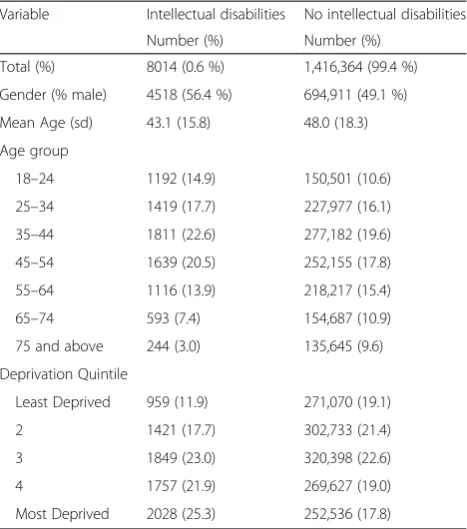
intellectual disabilities group compared to controls (56.4 vs. 49.1 % for controls; p< 0.001). Individuals with recorded intellectual disabilities were on average younger (mean age 43.1 vs. 48.0 years for controls;p< 0.001), with only 11.4 % aged 65 or over compared to 20.6 % of controls. The adults with intellectual disabilities were also more likely to live in areas of high social deprivation, with just over a quarter (25.3 %) with intellectual disabilities resident in the most deprived quintile of postcodes compared to 17.8 % of con-trols (p< 0.001).
Comorbidities
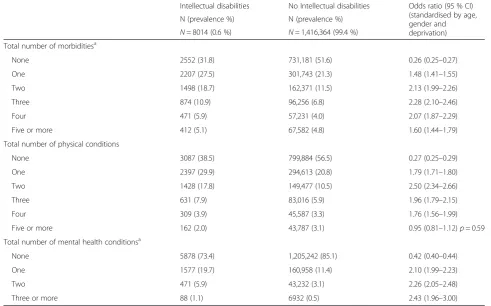
Overall, 31.8 % of individuals with intellectual disabilities had no other conditions compared to 51.6 % of controls with no recorded condition (Table 2). The intellectual disabilities group were significantly more likely to have more of all the specified number of conditions after standardising for age, sex and social deprivation, with the smallest difference found for one condition (intellec-tual disabilities 27.5 % vs. controls 21.3 %; OR 1.48, 95 % CI 1.41–1.55), and the biggest difference found for three conditions (intellectual disabilities 10.9 % vs. controls 6.8; OR 2.28, 95 % (CI 2.10–2.46) (Table 2).
When restricting analysis only to physical health co-morbidities the adults with intellectual disabilities were far less likely to have no physical conditions (intellectual disabilities 38.5 % vs. controls 56.5 %; OR 0.27, 95 % CI 0.25–0.29) and more likely to have one to four physical
conditions, with the biggest difference found for two phys-ical conditions (intellectual disabilities 17.8 % vs. controls 10.5 %; OR 2.50, 95 % CI 2.34–2.66), but there were no differences found for five or more conditions.
People with intellectual disabilities were less likely to have no recorded mental health condition compared to controls (intellectual disabilities 73.4 % vs. controls 85.1 %; OR 0.42, 95 % CI 0.40–0.44) and twice as likely to have one, two and three or more mental health condi-tions, than people with no intellectual disabilities.
Physical health individual conditions
For the intellectual disabilities group, 14 out of 32 phys-ical conditions were significantly more prevalent relative to controls, 11 were significantly less prevalent, with 7 conditions showing no significant differences (Table 3). The largest differences, after standardisation for age, sex and deprivation, were for epilepsy (OR 31.03, 95 % CI 29.23–32.92) constipation (OR 11.19, 95 % CI 10.97– 12.68) and visual impairment (OR 7.81, 95 % CI 6.86– 8.89). Five further conditions were more than twice as likely to be prevalent in those with intellectual disabil-ities compared to controls (hearing loss, eczema, dys-pepsia, thyroid disorders and Parkinson’s Disease or Parkinsonism). Of the eleven conditions for which the relative prevalence for the adults with intellectual dis-abilities was lower, four were cardiovascular related (coronary heart disease OR 0.43, 95 % CI 0.37–0.51, per-ipheral vascular disease OR 0.44, 95 % CI 0.33–0.60, hypertension OR 0.72, 95 % CI 0.66–0.78 and atrial fibril-lation OR 0.83, 95 % CI 0.61–0.98). Lower prevalence in those with intellectual disabilities also included any cancer over the last 5 years (OR 0.69, 95 % CI 0.58–0.83) and chronic obstructive pulmonary diseases (OR 0.84, 95 % CI 0.73–0.97).
Mental health conditions
[image:3.595.57.291.111.376.2]Table 4 highlights that the adults with intellectual dis-abilities had significantly higher prevalence for five of the mental health conditions with no significant differ-ence found for anorexia/bulimia. The biggest differdiffer-ence after standardisation for age, sex and deprivation was for schizophrenia/bipolar (OR 7.16, 95 % CI 6.49–7.89), followed by anxiety (OR 2.62, 95 % CI 2.41–2.84). The highest prevalence for a mental health condition was found for depression with prevalence 15.8 % for those with intellectual disabilities compared to 10.1 % of con-trols (OR 1.88, 95 % CI 1.76–2.00). (The lower preva-lence of dementia in the raw data is because the proportion of people with intellectual disabilities who have dementia is small, given the age distribution of people with intellectual disabilities. However the OR is standardized for age, and so reflects the fact that people with intellectual disabilities, particularly Down syndrome,
Table 1Age, gender, and deprivation status, intellectual disabilities versus controls
Variable Intellectual disabilities No intellectual disabilities
Number (%) Number (%)
Total (%) 8014 (0.6 %) 1,416,364 (99.4 %)
Gender (% male) 4518 (56.4 %) 694,911 (49.1 %)
Mean Age (sd) 43.1 (15.8) 48.0 (18.3)
Age group
18–24 1192 (14.9) 150,501 (10.6)
25–34 1419 (17.7) 227,977 (16.1)
35–44 1811 (22.6) 277,182 (19.6)
45–54 1639 (20.5) 252,155 (17.8)
55–64 1116 (13.9) 218,217 (15.4)
65–74 593 (7.4) 154,687 (10.9)
75 and above 244 (3.0) 135,645 (9.6)
Deprivation Quintile
Least Deprived 959 (11.9) 271,070 (19.1)
2 1421 (17.7) 302,733 (21.4)
3 1849 (23.0) 320,398 (22.6)
4 1757 (21.9) 269,627 (19.0)
Most Deprived 2028 (25.3) 252,536 (17.8)
experience dementia at a much earlier age than the gen-eral population.)
Effect of deprivation
Figure 1 shows the percentage of individuals with two or more physical conditions and two or more mental health conditions by deprivation quintile after age and sex standardisation. Prevalence is higher in the intellectual disabilities group for both physical and mental health conditions across all quintiles. A clear gradient is seen for the general population in whom the percentage with two or more conditions increases as the extent of neigh-bourhood deprivation increases. No such gradient is seen for the adults with intellectual disabilities; indeed the proportion with two or more physical health condi-tions, or two or more mental health condicondi-tions, is simi-lar in both the most affluent and most deprived areas.
Effect of age and gender
Figure 2 shows the percentage of individuals with two or more physical conditions by age group and gender after standardisation by deprivation. Prevalence is higher in the intellectual disabilities group for both men and
women for all age groups with the exception of those aged 75 and above for males. Differences peak at 45–49 for males and 50–54 for females. Women have higher rates for both groups across all ages. In the adults with intellectual disabilities, co-morbidity increased with age but is highly prevalent at all ages, with its extent at age 20–25 being similar to that of 50–54 year olds in the general population.
Figure 3 shows the percentage of individuals with two or more mental health conditions by age group and gen-der, after standardisation by deprivation. A similar trend was found as with physical conditions, with prevalence consistently higher in the intellectual disabilities group for both men and women, and higher rates in women for both groups across all ages.
Monitoring/recording
[image:4.595.53.545.402.708.2]There was no difference in blood pressure monitoring in our population; 83.3 % of the people with intellectual disabilities aged 50 and over had a blood pressure re-corded in the previous three years compared to 84.9 % of those without intellectual disabilities.
Table 2Prevalence and odds ratio for number and type of comorbidities (standardised by age, gender, and deprivation score)
Intellectual disabilities No Intellectual disabilities Odds ratio (95 % CI) (standardised by age, gender and deprivation) N (prevalence %) N (prevalence %)
N= 8014 (0.6 %) N= 1,416,364 (99.4 %) Total number of morbiditiesa
None 2552 (31.8) 731,181 (51.6) 0.26 (0.25–0.27)
One 2207 (27.5) 301,743 (21.3) 1.48 (1.41–1.55)
Two 1498 (18.7) 162,371 (11.5) 2.13 (1.99–2.26)
Three 874 (10.9) 96,256 (6.8) 2.28 (2.10–2.46)
Four 471 (5.9) 57,231 (4.0) 2.07 (1.87–2.29)
Five or more 412 (5.1) 67,582 (4.8) 1.60 (1.44–1.79)
Total number of physical conditions
None 3087 (38.5) 799,884 (56.5) 0.27 (0.25–0.29)
One 2397 (29.9) 294,613 (20.8) 1.79 (1.71–1.80)
Two 1428 (17.8) 149,477 (10.5) 2.50 (2.34–2.66)
Three 631 (7.9) 83,016 (5.9) 1.96 (1.79–2.15)
Four 309 (3.9) 45,587 (3.3) 1.76 (1.56–1.99)
Five or more 162 (2.0) 43,787 (3.1) 0.95 (0.81–1.12)p= 0.59
Total number of mental health conditionsa
None 5878 (73.4) 1,205,242 (85.1) 0.42 (0.40–0.44)
One 1577 (19.7) 160,958 (11.4) 2.10 (1.99–2.23)
Two 471 (5.9) 43,232 (3.1) 2.26 (2.05–2.48)
Three or more 88 (1.1) 6932 (0.5) 2.43 (1.96–3.00)
One-way analysis of variance
All difference significant atp< 0.001 except where marked
a
Discussion Key results
The extent of multi-morbidity experienced by adults with intellectual disabilities, and its direct comparison with the general population, is a novel and important finding, with implications for services, including the age at which they are likely to be needed. Consequently, any policy initiatives or guidelines on multi-morbidity need to be relevant at a much earlier age in people with intellectual disabilities. This
[image:5.595.67.541.226.717.2]difference has not been previously reported. Morbidity bur-den and multimorbidity is higher in the population with in-tellectual disabilities than in the general population, due to higher rates of some physical conditions, for example epi-lepsy, gastro-intestinal disorders, and sensory impairments, and higher rates of a range of mental health conditions. Whereas multi-morbidity is common in the general population only in older age groups, particularly those aged 50–54 and older, it is common in all age groups in adults
Table 3Actual prevalence rates, and standardised odds ratios for individual physical conditions. Conditions are ordered by size of standardised odds ratio (largest to smallest)
Condition Intellectual disabilities No Intellectual disabilities Odds ratio (95 % CI) (standardised by age, gender and deprivation score)
Number (%) Number (%)
Epilepsy 1508 (18.8) 10,876 (0.8) 31.03 (29.23–32.92)
Constipation 1118 (14.0) 35,298 (2.5) 11.19 (10.97–12.68)
Visual impairment 258 (3.2) 8120 (0.6) 7.81 (6.86–8.89)
Parkinson’s disease and Parkinsonism 28 (0.4) 2713 (0.2) 2.83 (1.95–4.13)
Hearing loss 657 (8.2) 54,077 (3.8) 2.81 (2.59–3.06)
Dyspepsia 822 (10.3) 78,382 (5.5) 2.46 (2.28–2.65)
Psoriasis or eczema 132 (1.7) 10,237 (0.7) 2.42 (2.03–2.87)
Thyrotoxicosis/thyroid disorders inc hypothyroidism 629 (7.9) 71,314 (5.0) 2.36 (2.173–2.58)
Bronchiectasis 20 (0.3) 2794 (0.2) 1.68 (1.08–2.61)p= 0.02
Diabetes 531 (6.6) 74,300 (5.3) 1.63 (1.49–1.79)
Migraine 59 (0.7) 9192 (0.7) 1.32 (1.02–1.71)p= 0.03
Active asthma 575 (7.2) 83,930 (5.9) 1.26 (1.16–1.38)
Painful condition 695 (8.7) 125,436 (8.9) 1.20 (1.10–1.30)
Stroke or transient ischaemic attack 171 (2.1) 36,374 (2.6) 1.19 (1.02–1.37)p= 0.02
Glaucoma 72 (0.9) 15,847 (1.1) 1.17 (0.92–1.48)p= 0.18
Chronic kidney disease 135 (1.7) 33,431 (2.4) 1.11 (0.93–1.32)p= 0.22
Heart failure 82 (1.0) 18,817 (1.3) 1.11 (0.89–1.43)p= 0.33
Irritable bowel syndrome 248 (3.1) 51,889 (5.7) 0.97 (0.86–1.11)p= 0.74
Chronic obstructive pulmonary diseases (COPD) 209 (2.6) 52,898 (3.7) 0.84 (0.73–0.97)
Atrial fibrillation 71 (0.9) 23,905 (1.7) 0.83 (0.61–0.98)p= 0.03
Viral hepatitis 7 (0.1) 1168 (0.1) 0.82 (0.39–1.74)p= 0.62
Inflammatory bowel disease 40 (0.5) 9711 (0.7) 0.82 (0.60–1.13)p= 0.23
Hypertension 774 (9.7) 233,540 (16.5) 0.72 (0.66–0.78)
Any new cancer in the last 5 years 131 (1.6) 43,533 (3.1) 0.69 (0.58–0.83)
Prostate disease 41 (0.5) 15,192 (1.1) 0.60 (0.44–0.82)p= 0.01
Inflammatory arthritis and related conditions inc gout 151 (2.2) 57,857 (4.1) 0.57 (0.48–0.67)
Cirrhosis/chronic liver disease/alcoholic liver disease 7 (0.1) 2605 (0.2) 0.49 (0.23–1.04)p= 0.06
Multiple sclerosis 9 (0.1) 3838 (0.3) 0.49 (0.25–0.96)p= 0.03
Diverticular disease 66 (0.8) 33,747 (2.4) 0.49 (0.39–0.63)
Peripheral vascular disease (PVD) 46 (0.7) 23,194 (1.6) 0.44 (0.33–0.60)
Chronic sinusitis 24 (0.3) 9141 (0.6) 0.44 (0.26–0.62)
Coronary heart disease 160 (2.0) 81,307 (5.7) 0.43 (0.37–0.51)
One way analysis of variance
with intellectual disabilities. The pattern of disease also differs from the general population with some condi-tions being less common, such as cardiovascular disease. Additionally, prevalence of multi-morbidity did not follow the typical gradient seen in the general population across areas of increasing neighbourhood deprivation, importantly highlighting that services are equally needed in all areas.
Two previous studies from the Netherlands and Ireland have reported high rates of multimorbidity in older people with intellectual disabilities [6, 7], and we also found this, and extended this finding down the age range to all adults with intellectual disabilities.
Strengths and limitations
Scottish GP practices have held a register of people with intellectual disabilities since a change in their contract introducing pay-for-performance, which precedes the data extraction this study used. Intellectual disability is a lifetime diagnosis, and once coded at birth or in child-hood this remains on the medical record indefinitely. The sample with intellectual disabilities appears to be representative, and benefits from its very large size. As expected, compared with people without intellectual disabilities, there were more men, they were younger, and they were more likely to live in deprived areas. Rates of morbidity were compared with the general population registered at the same general practices, and standardised by age, gender, and neighbourhood deprivation. It is possible that some people with intel-lectual disabilities were not coded as such, for example people with Down syndrome, however the prevalence of the population identified is similar to that reported for adults with intellectual disabilities in a recent meta-analysis of prevalence studies (0.5 %) [16], and the odds ratio for dementia for the intellec-tual disabilities group compared with the general popula-tion suggests people with Down syndrome, who have
dementia at a much earlier age than the general public, were included.
There may be under-reporting of health conditions in the population with intellectual disabilities. This may be so for conditions that are not overtly obvious to paid carers, or where carers attribute the effects of conditions to other reasons. The similarity in extent of blood pres-sure recording in the population with intellectual dis-abilities compared with the general population is reassuring in this regard. If there was under-reporting, then the difference between the two groups would be even more marked than that we report, and the key message of our paper still stands i.e. that multi-morbidity is markedly more common in adults with in-tellectual disabilities than in the general population, and occurs at a much younger age.
Problem behaviours, which occur in 22.5 % of adults with intellectual disabilities [17] were not included in the study, due to the lack of suitable Read codes for these disorders, hampering their recording/consistent re-cording. Comparable problem behaviours are rare in the general population, hence the extent of the difference in multimorbidity would have been greater if these could have been included. We also did not include autism and attention deficit hyperactivity disorder, both of which are known to be more common in people with intellectual disabilities than in the general population. Conditions are coded during routine health care, including primary care encounters and based on letters from secondary care, and there could be some variation between practices.
We do not have information on type of accommoda-tion/support the people with intellectual disabilities had.
Interpretation of findings
[image:6.595.60.540.582.718.2]Some causes of intellectual disabilities also cause physical and/or mental ill-health, for example Down syndrome is associated with thyroid disorder and sensory impairments;
Table 4Prevalence and odds ratios for individual mental health conditions (standardised by age, gender, and deprivation score). Conditions are ordered by size of odds ratio (largest to smallest)
Condition Intellectual disabilities No Intellectual disabilities Odds ratio (95 % CI) (standardised by age, gender and deprivation) total number (prevalence) total number (prevalence)
Schizophrenia (and related non-organic psychosis) or bipolar disorder
448 (5.6) 12,045 (0.9) 7.16 (6.49–7.89)
Anxiety & other neurotic, stress related & somatoform disorders 649 (8.1) 55,077 (3.9) 2.62 (2.41–2.84)
Dementia 84 (0.8) 11,612 (1.1) 2.22 (1.78–2.77)
Depression 1267 (15.8) 142,676 (10.1) 1.88 (1.76–2.00)
Anorexia or bulimia 37 (0.5) 5269 (0.4) 1.31 (0.95–1.82)p= 0.09
Alcohol misuse 304 (3.8) 42,060 (3.0) 1.18 (1.05–1.33)
One way analysis of variance
however, Down syndrome accounts for only about 15 % of the population with intellectual disabilities. Adults with intellectual disabilities are also more likely to lead seden-tary lives and not exercise [18], have more mobility prob-lems [19], obesity [20], and are less likely to eat healthily [21] than the general public, and about a quarter take anti-psychotic drugs [22], which may contribute to some of these conditions. They are also more likely to be pre-scribed multiple drugs, which can adversely affect health through side-effects and drug interactions [21]. They do not always have the knowledge or under-standing to make healthy choices, and are reliant on others for support and communication. These issues are often compounded by difficulties accessing the health services they need.
Eleven of the conditions were recorded statistically less commonly in adults with intellectual disabilities than in the general population. The lower rates of smoking and
alcohol use among the population with intellectual dis-ability may well account for several of these conditions being diagnosed at a lower frequency, particularly car-diovascular disease and chronic obstructive pulmonary disease. The majority of adults with intellectual disabil-ities do not drink alcohol at all, although some do mis-use it, and at a slightly higher rate than the general population in this study.
[image:7.595.57.540.88.472.2]behaviours. People with intellectual disabilities are re-liant on carers recognising they may have a problem and seeking help, and dependent upon carers commu-nicating effectively within the team, and indeed across care teams (e.g. day care team and home care team). Sometimes, health conditions are misattributed by paid carers or health professionals as being part of the adult’s intellectual disabilities (diagnostic oversha-dowing), and not addressed for this reason. These problems are compounded across the entire life-course, rather than just being due to communication problems in late life.
The apparent drop-off in the rate of multimorbidity in men aged 75 and older is likely to be a reflection of the very small numbers in these age groups. Most people with intellectual disabilities do not live to such old ages [29, 30], so these individuals are the“healthy survivors”. Older people with intellectual disabilities typically have milder intellectual disabilities than those who die earlier, and people with milder intellectual disabilities are likely to have fewer health problems than people with more severe intellectual disabilities. Of the total of 4518 men with intellectual disabilities in the study, there were only 60 (1.32 %) aged 75–79, 32 (0.71 %) aged 80–84, and 16 (0.35 %) aged 85 or older. This compares with 24,831 (3.57 %) aged 75–79 out of the total of 694,911 men without intellectual disabilities, 15,921 (2.29 %) aged 80–84, and 11,017 (1.59 %) aged 85 or older.
The lack of association between neighbourhood deprivation and multimorbidity in this population is likely to be due to area based measures of deprivation not accurately reflecting the relative degree of affluence or poverty experienced by people with intellectual dis-abilities, in the face of the extensive difficulties they have to cope with in life. Many adults with intellectual dis-abilities are not integrated within their communities. They do not necessarily have shared values and lifestyles with their local community. Rented accommodation in which adults with intellectual disabilities are placed with individual tenancies, or shared tenancies with other adults with intellectual disabilities, tend to be in less af-fluent areas. One can speculate that their paid carers are more likely to live in the local area, but the adult may still have regular contact with family, whom they grew up with and who may have different levels of affluence and lifestyles compared to the area their adult child with intellectual disabilities now lives in. The interaction of these factors is likely to be complex. Additionally, some of the more congregate care style of housing is more likely to be in affluent areas where there are larger houses; but large group living can result in less individ-ual time from paid carers who are shared by several adults, and less time for community integration. Very few adults with intellectual disabilities have paid employment,
so are likely to be of low socio-economic status, and dependant on state benefits, regardless of the area they live in.
Generalisability of findings
The broader dataset is representative of the Scottish population in terms of age, sex, and deprivation [12]. Intellectual disabilities was found in 0.56 % of the sample. This is slightly higher than the 0.5 % recorded in GP registers for pay-for-performance, reflecting that we used a somewhat broader set of Read Codes (http://www.isdscotland.org/Health-Topics/General-Practice/ Quality-And-Outcomes-Framework/ Accessed 23.12.14.). As expected, there were more men than women with intellectual disabilities (as more boys than girls are born with intellectual disabilities), a smaller proportion at older age groups than in the general population (due to premature death [29, 30]), and more lived in areas of neighbourhood deprivation. This suggests that the sample with intellectual disabilities is representative of the Scottish population, and hence that these findings are generalisable.
Conclusions
Additional file
Additional file 1:Appendix 1: Data dictionary.Appendix 2: Read Codes used to define the presence of intellectual disability (DOCX 21 kb)
Abbreviations
CI:Confidence intervals; NHS: National Health Service; OR: Odds ratio.
Competing interests
The authors declare that they have no competing interests.
Authors’contributions
S-AC conceived the study and planned it with FS, SM and JM. GMcL carried out the analysis with support from AMcC. SM and BG conceived and conducted the original study which created the data used in this analysis. All authors were involved in drafting the manuscript or revising it critically for important intellectual content. S-AC is the guarantor. All authors read and approved the final manuscript.
Acknowledgements
The data contained herein were provided by the Primary Care Clinical Informatics Unit (PCCIU) at the University of Aberdeen. The views in this publication are not necessarily the views of the University of Aberdeen, its agents, or employees. The original study which created the data was funded by Scottish Government Chief Scientist Office Applied Research Programme Grant 07/01.
Author details
1Mental Health and Wellbeing group, Institute of Health and Wellbeing,
University of Glasgow, Administrative Building, Gartnavel Royal Hospital, 1055 Great Western Road, Glasgow G12 0XH, UK.2General Practice and Primary Care group, Institute of Health and Wellbeing, University of Glasgow, 1, Horselethill Road, Glasgow G12 9LX,, UK.3Quality, Safety and Informatics Research Group, Population Health Sciences Division, University of Dundee, Mackenzie Building Kirsty Semple Way, Dundee DD2 4BF, UK.4Robertson Centre for Biostatistics, Institute of Health and Wellbeing, University of Glasgow, Level 11, Boyd Orr Building, University Avenue, Glasgow G12 8QQ, UK.5UTOPIAN FMTU, North York General Hospital, Department of Family & Community Medicine and Dalla Lana School of Public Health, University of Toronto, Toronto, ON M2K 1E1, Canada.
Received: 4 February 2015 Accepted: 21 August 2015
References
1. NHS Health Scotland. People with Learning Disabilities in Scotland: The Health Needs Assessment Report. Scotland, Glasgow: NHS; 2004. 2. Barnett K, Mercer SW, Norbury M, Watt G, Wyke S, Guthrie B. Epidemiology
of multimorbidity and implications for health care, research, and medical education: a cross-sectional study. Lancet. 2012;380(9836):37–43. 3. Cooper S-A, Smiley E, Morrison J, Allan L, Williamson A. Prevalence of and
associations with mental ill-health in adults with intellectual disabilities. Br J Psychiatr. 2007;190:27–35.
4. Airaksinen EM, Matilainen R, Mononen T, Mustonen K, Partanen J, Jokela V, et al. A population-based study on epilepsy in mentally retarded children. Epilepsia. 2000;4:1214–20.
5. Böhmer CJ, Niezen-de Boer MC, Klinkenberg-Knol EC, Deville WL, Nadorp JH, Meuwissen SG. The prevalence of gastroesophageal reflux disease in institutionalized intellectually disabled individuals. Am J Gastroenterol. 1999;94:804–10.
6. McCarron M, Swinburne J, Burke E, McGlinchey E, Carroll R, McCallion P. Patterns of multimorbidity in an older population of persons with an intellectual disability: results from the intellectual disability supplement to the Irish longitudinal study on aging (IDS-TILDA). Res Development Disabilit. 2013;34:521–7.
7. Hermans H, Evenhuis HM. Multimorbidity in older adults with intellectual disabilities. Res Development Disabilit. 2014;35:776–83.
8. Emerson E, Graham H, Hatton C. Household income and health status in children and adolescents in Britain. European J Public Health. 2006;16:354–60.
9. Leonard H, Petterson B, De Klerk N, Zubrick SR, Glasson E, Sanders R, et al. Association of sociodemographic characteristics of children with intellectual disability in Western Australia. Soc Sci Med. 2005;60:1499–513.
10. Cooper S-A, McConnachie A, Allan L, Melville C, Smiley E, Morrison J. Neighbourhood deprivation, health inequalities, and service use of adults with intellectual disabilities. Cross-sectional study J Intellect Disabilit Res. 2011;55:313–23.
11. Morgan CL, Ahmed Z, Kerr MP. Health care provision for people with a learning disability: record linkage study of epidemiology and factors contributing to hospital care uptake. B J Psychiatr. 2000;176:37–41. 12. Elder R, Kirkpatrick M, Ramsay W, MacLeod M, Guthrie B, Sutton M, et al.
Measuring quality in primary medical services using data from SPICE. Edinburgh: Information and Statistics Division: NHS National Services Scotland; 2007.
13. Carstairs V, Morris R. Deprivation and health in Scotland. Aberdeen: Aberdeen University Press; 1991.
14. Smith DJ, Martin DJ, McLean G, Langan Martin J, Guthrie B, Mercer SW. Multimorbidity in bipolar disorder and under treatment of cardiovascular disease: cross sectional study. BMC Medicine. 2013;11:263–74.
15. Court H, McLean G, Guthrie B, Mercer S, Smith D. Visual impairment is associated with physical and mental comorbidities in older adults: a cross-sectional study. BMC Medicine. 2014;12:181.
16. Maulik PK, Mascarenhas MN, Mathers CD, Dua T, Saxena S. Prevalence of intellectual disability: a meta-analysis of population-based studies. Res Dev Disabil. 2011;32:419–36.
17. Jones S, Cooper S-A, Smiley E, Allan L, Williamson A, Morrison J. Prevalence of, and factors associated with, problem behaviours in adults with intellectual disabilities. Journal of Nervous and Mental Diseas. 2008;196:678– 86.
18. Finlayson J, Jackson A, Cooper S-A, Morrison J, Melville C, Smiley E, et al. Understanding predictors of low physical exercise in adults with intellectual disabilities. J Applied Res Intellect Disabilit. 2009;22:236–47.
19. Finlayson J, Morrison J, Jackson A, Mantry D, Cooper S-A. Injuries, falls, and accidents in the population of adults with intellectual disabilities. J Intellect Disabilit Res. 2010;54:966–80.
20. Melville C, Cooper S-A, Morrison J, Allan L, Smiley E, Williamson A. The prevalence and determinants of obesity in adults with intellectual disabilities. J Applied Res Intellect Disabilit. 2008;21:425–37.
21. Draheim CC, Stanish HI, Williams DP, McCubbin JA. Dietary intake of adults with mental retardation who reside in community settings. Am J Ment Retard. 2007;2007(112):392–400.
22. Doan TN, Lennox NG, Taylor-Gomez M, Ware RS. Medication use among Australian adults with intellectual disability in primary healthcare settings: a cross-sectional study. J Intellect Dev Disabil. 2013;2013(38):177–81. 23. Beange H, McElduff A, Baker W. Medical disorders of adults with learning
disabilities: A population study. Am J Ment Retard. 1995;99:595–604. 24. Kapell D, Nightingale B, Rodriguez A, et al. Prevalence of chronic medical
conditions in adults with mental retardation: comparison with the general population. Ment Retard. 1998;36:269–79.
25. Baxter H, Lowe K, Houston H, Jone G, Felce D, Kerr M. Previously unidentified morbidity in patients with intellectual disability. Br J General Practice. 2006;56:93–8.
26. Felce D, Baxter H, Lowe K, et al. The impact of repeated health checks for adults with intellectual disabilities. J Applied Res Intellectual Disabilities. 2008;21:585–96.
27. Chauhan U, Kontopantelis E, Campbell S, Jarrett H, Lester H. Hypothesis: Health checks in primary care for adults with intellectual disabilities: how extensive should they be? J Intellectual Disabilities Res. 2010;54:479–86. 28. Cooper S-A, Morrison J, Allan L, McConnachie A, Melville C, Baltzer M, et al.
Practice nurse health checks for adults with intellectual disabilities: a cluster design randomised controlled trial. Lancet Psychiatry. 2014;1:511–21. 29. Tyrer F, Smith LK, McGrother CW. Mortality in adults with moderate to
profound intellectual disability: a population–based study. J Intellect Disabilit Res. 2007;51:520–7.