arising from Gouy phase shifts in multimode cavity QED
Yudan Guo,1, 2 Varun D. Vaidya,1, 2, 3 Ronen M. Kroeze,1, 2 Rhiannon A. Lunney,4,∗Benjamin L. Lev,1, 2, 3 and Jonathan Keeling4
1Department of Physics, Stanford University, Stanford, CA 94305 2
E. L. Ginzton Laboratory, Stanford University, Stanford, CA 94305
3Department of Applied Physics, Stanford University, Stanford, CA 94305
4SUPA, School of Physics and Astronomy, University of St Andrews, St Andrews KY16 9SS UK (Dated: April 8, 2019)
Optical cavities can induce photon-mediated interactions among intracavity-trapped atoms. Mul-timode cavities provide the ability to tune the form of these interactions, e.g., by inducing a nonlocal, sign-changing term to the interaction. By accounting for the Gouy phase shifts of the modes in a nearly degenerate, confocal, Fabry-P´erot cavity, we provide a theoretical description of this in-teraction, along with additional experimental confirmation to complement that presented in the companion paper, Ref. [1]. Furthermore, we show that this interaction should be written in terms of a complex order parameter, allowing for a U(1)-symmetry to emerge. This symmetry corresponds to the phase of the atomic density wave arising from self-organization when the cavity is trans-versely pumped above a critical threshold power. We theoretically and experimentally show how this phase depends on the position of the Bose-Einstein condensate (BEC) within the cavity and discuss mechanisms that break theU(1)-symmetry and lock this phase. We then consider alternative Fabry-P´erot multimode cavity geometries (i.e., beyond the confocal) and schemes with more than one pump laser and show that these provide additional capabilities for tuning the cavity-meditated interaction among atoms, including the ability to restore the U(1)-symmetry despite the presence of symmetry-breaking effects. These photon-mediated interactions may be exploited for realizing quantum liquid crystalline states and spin glasses using multimode optical cavities.
I. INTRODUCTION
The cavity QED system of quantum degenerate atoms trapped inside an optical cavity opens numerous possi-bilities for studying quantum many-body systems in a driven-dissipative setting [2]. Recent advances include demonstration of supersolidity [3], supermode-polariton condensation [4], and spinor self-ordering [5]. Beyond the traditional single-mode cavity system, degenerate multi-mode cavities have emerged as promising platforms for realizing nontrivial interactions among trapped atoms [6] and exotic photonic matter [7]. Simultaneously address-ing the multiple degenerate (or nearly degenerate) modes of a cavity, which may have distinct and incommensurate transverse spatial profiles, greatly expands the number of transverse degrees of the freedom in the cavity. This, in turn, provides the ability to engineer tunable-range cavity-photon-mediated interactions, as described in our previous work of Ref. [6].
A less-studied and subtle point is the role of the dif-fering longitudinal profiles of these degenerate modes, particularly the effect of the Gouy phase shift contribu-tion [8][9]. As briefly mencontribu-tioned in Ref. [6], and presented more extensively in the companion paper of Ref. [1], the Gouy phase shifts affect how different transverse modes sum to produce an effective nonlocal and sign-changing cavity-mediated interaction in the transverse direction.
∗Present address: School of Physics and Astronomy, Cardiff Uni-versity, Cardiff CF24 3AA, United Kingdom
The present work explores the origin of this effect and its consequences.
For a BEC trapped in a transversely pumped cavity, atoms will start to self-organize coinciding with the su-perradiant emission of cavity photons; i.e., atoms will form a density wave commensurate with the optical lat-tice due to the dynamically generated cavity light when the cavity-mediated interaction overcomes the kinetic en-ergy cost of the associated density wave [2, 4, 6, 10–12]. Compared to the case of a single-mode cavity [12], where the density wave is forced to conform to the shape of the single cavity mode and the transition is adequately de-scribed by the Hepp-Lieb-Dicke model [2, 13], atoms in a degenerate cavity have more freedom. The interference of many transverse modes allows the atoms to adopt a far wider range of shapes, which can induce a more exotic phase transition [14, 15]. Moreover, the intracavity pho-tons can be in a superposition of many modes, leading to a localized photonic wavepacket. This induces a local-ized, short-range photon-mediated interaction between atoms [6]. In addition, the distinct longitudinal profiles of the transverse modes, due to Gouy phase shifts, re-sult in a phase degree of freedom of the density wave. That is, not only the amplitude, but also the phase of the atomic density wave can vary across the cavity and can in principle become free (in the sense of aU(1)-symmetry) under special conditions. These features, especially the enhanced phase space of the order parameter, greatly en-rich the physics of the self-organization transition.
this nonlocal interaction and determine the atomic den-sity wave phase degree of freedom through this in-teraction. Section II presents a general derivation of cavity-mediated interactions, complementing that first discussed in our Ref. [6], while also deriving a general form of the nonlocal interaction studied in the compan-ion paper [1]. Sectcompan-ion III A then discusses how these in-teractions determine the density wave state arising from the Dicke superradiant, self-ordering density-wave tran-sition studied in the companion paper [1]. We also show how the spatial structure of the field emitted from the cavity reveals important information about the phase of the atomic density wave. Restricting to an ideal confocal cavity, we show that the atomic density wave possesses a continuous degree of phase freedom and aU(1)-symmetry emerges at special positions in the cavity. Section IV discusses this U(1)-symmetry in an ideal confocal cav-ity. We provide a qualitative discussion of the physical picture behind cavity-mediated interactions in Sec. III B. Section V describes the mechanisms that break this sym-metry in realistic confocal cavities coupled to BECs of finite size. Results of experiments that image cavity field emission are presented, demonstrating this symme-try breaking. Section VI then describes the consequences of this symmetry breaking for realizing various quantum many-body systems such as quantum liquid crystalline states [14, 15]. Section VII presents a proposal for a pumping scheme that restores the U(1)-symmetry and is robust against various possible symmetry breaking ef-fects. Generalization of the cavity mediated interaction to three dimensions is also discussed in Sec. VIII. Lastly, before concluding remarks, we derive in Sec. IX the form that cavity-induced interactions take in Fabry-P´erot mul-timode cavities with geometries beyond the confocal.
II. CAVITY-MEDIATED INTERACTION AND SELF-ORGANIZATION
We start by introducing a model ofNatoms in a Bose-Einstein condensate (BEC) with wavefunction Ψ(x) and interacting with cavity modes described by annihilation operators ˆaµ,Q. The cavity axis is taken to lie along ˆ
z, while the transverse, standing-wave pump field is ori-ented along ˆx. The Hamiltonian for this can be written as:
H =−X µ,Q
∆µ,Qˆa†µ,Qˆaµ,Q
+N
Z
d3xΨ∗(x)
−∇
2
2m+V(x) + U
2|Ψ(x)| 2
Ψ(x) + N
∆a
Z
d3xΨ∗(x)|φˆ|2Ψ(x). (1) For compactness, we index the transverse modes with the single variable µ, rather than separate indicesl and
mfor the Hermite-Gauss functions of thexandy coordi-nates. We thus use useµ= (l, m) to label the transverse
electric electromagnetic mode function TEMµ≡TEMl,m and define the total mode family indexnµ=l+m. The indexQdefines the longitudinal mode number; we keep the dependence on this explicit for now. When we later consider a given family of degenerate modes in a confo-cal or equivalent cavity, the longitudinal and transverse mode numbers are related to one another. This behav-ior is discussed in detail for general cases of multimode cavity geometries in Sec. IX.
The first term in Eq. (1) is the Hamiltonian of the cavity modes with detuning from the transverse pump field ∆µ,Q. The second line is the standard Hamiltonian for a weakly interacting BEC with contact interactions of strengthU in an external trapV(x). The final line is the optical potential from the Stark shift, proportional to 1/∆a, due to the combined cavity and pump light. The light field ˆφthus consists of the standing-wave pump and a sum over all cavity modes with their transverse and longitudinal spatial dependence [16],
ˆ
φ(r) = Ω cos(krx) +g0
X
µ,Q ˆ
aµ,QΞµ(r) cos
kr
z+ r 2
R(z)
−θµ,Q(z)
.
(2) Here, Ω is the pump’s Rabi frequency,kris the recoil mo-mentum of the atom,g0is the bare atom-cavity coupling strength defined for an atom coupled to the peak intra-cavity field of the TEM00mode, and Ξµ(r) are Hermite-Gauss mode functions of the cavity. We have restricted the sum in this expression to run over those cavity pho-ton modes that are near resonance with the pump, hence the longitudinal wavevector is also set tokr. Only these modes can be populated by scattering from the pump. In writing in Eq. (2), we have included the radial depen-dence of the phase r2/R(z), where R(z) = z+zR2/z is the radius of curvature of the phase fronts at longitu-dinal position z and zR is the Rayleigh length. When we consider atoms near the cavity midplanez = 0, we have that R(z) → ∞, so the phase fronts become flat and this contribution to the phase can be neglected. The form of Eq. (2) results in a spatially varying single-photon Rabi frequency g0Ξµ(r)/Ξ00(0) for the mode µ (assum-ing atoms are located at the antinodal planes along the cavity). Note that here, and in the following, we user
to denote the coordinate in the plane transverse to the cavity axis.
The cosine appearing in Eq. (2) also contains the term
θµ,Q(z), which describes terms varying slowly compared to krz. The subscripts indicate that this term depends both on the transverse indexµand the longitudinal mode numberQ. We may write this term as [16]:
more complex than the analogous expression in our pre-vious work [6]. This term accounts for several effects. First, in order to satisfy Maxwell’s equations, terms which vary faster in the transverse plane must vary more slowly along the cavity axis. Thus, the z depen-dence of the phase is given by (nµ+ 1)ψ(z) where we have ψ(z) = arctan(z/zR). The existence of this extra phase evolution, known as the Gouy phase shift, or phase anomaly [8, 16], and particularly itsnµ dependence (i.e., the phase shift increases for greaternµ), is the source of the rich physics discussed in this paper. The other term contained in Eq. (3), nµψ(L/2)−ξµ,Q, describes phase offsets required for the cosine function to match bound-ary conditions at the mirrors (which are assumed to be placed at z = ±L/2). The division of this phase shift into the two termsnµψ(L/2) and ξµ,Q will simplify the expressions when we consider a degenerate cavity below.
As noted earlier, atoms subject to transverse pumping, as described by Eq. (1), will undergo self-organization to form an atomic density wave commensurate with the op-tical lattice due to the pump and cavity light. To describe this transition, we need to write the motional wavefunc-tion of the atoms, allowing for scattering of atoms by the combined pump and cavity lattices. We assume that most of the condensate is in the ground state, with a small fraction having undergone a momentum kick from either scattering a photon from the retroreflected trans-verse pump into the cavity or vice-versa. Hence, we write
Ψ(x) =Z(z−z0)
p
ρ(r)
ψ0+
√
2 cos(krx)×
{ψccos(krz+δ) +ψssin(krz+δ)}, (4)
where Z(z) is an envelope function which describes the confinement of the gas at a positionz0along the ˆz direc-tion, ρ(r) is the density profile of the atoms in the cav-ity transverse plane, ψ0 is the amplitude of the ground-state condensate wavefunction of the gas, and ψc,s are the amplitudes of the parts of the gas that have been scattered into two out-of-phase density profiles. The sep-arable form of this ansatz relies on the assumption that the atoms are confined tightly enough in the zdirection that we can neglect variation of the Gouy phase across the cloud—i.e., that the extent inzis much smaller than the Rayleigh length, and that the atom density profile
ρ(r) is smooth on the scale of a wavelength. We have written two independent components ψc, ψs to allow us to describe an emergent freedom between the amplitudes
of these two components. The fixed phase offsetδis in-troduced for later convenience—in the following we will choose a value which enables us to simplify overlaps with the light field. We may also considerψc andψs as being the real and imaginary components of a complex order parameter describing the atomic density wave, i.e., using
ψ1=ψc+iψsand thus writing: Ψ(x) =Z(z−z0)
p
ρ(r)[ψ0+
√
2 cos(krx)<{ψ1eikrz+δ}]. We can now use Eq. (1) to find the mean-field equa-tions of motion forψ0,c,s andαµ,Q≡ hˆaµ,Qi. It is conve-nient to write equations in terms of only the transverse coordinatesr, for which we must perform the z integral in Eq. (1). This can be done straightforwardly in the limit where we assume Z(z) has a width wz and that
λwzzR. The first inequality allows us to drop any terms oscillating at wavevector kr or 2kr; this imposes momentum conservation so that recoiling atoms pick up the difference of pump and cavity momenta. The second condition means that we can evaluate the slowly varying phase terms as being effectively constant over the width of the gas: we can approximateθµ,Q(z)'θµ,Q(z0). Both conditions are well-satisfied in typical experiments [6].
In this paper, we will consider the onset of self-organization, where the ψc,s become non-zero, leading to an atomic density wave with an associated occupation of the cavity modes. To understand the transition to this state, and the patterns of atomic density waves which be-come occupied, we focus on linear stability of the normal state. That is, we linearize in the variablesψc, ψsandαµ. In this linearized treatment, we find that all the relevant
zintegrals involve a cross term between pump light and cavity light that causes scattering between at-rest atoms
ψ0 andψc,s. We then find that the zintegrals yield two possible overlap values,
Oσ µ,Q=
(
cos[θµ,Q(z0)−δ] σ=c sin[θµ,Q(z0)−δ] σ=s
, (5)
where the superscriptσdistinguishes between two possi-ble out-of-phase density waves ψc,s. In Sec. IX, we will revisit the assumption that we may approximate the z
dependence ofθµ,Q by its value at z =z0 and consider the leading order corrections to this result.
In the linearized regime, we need only consider equa-tions forψσandαµ,Qbecause the ground-state amplitude
i∂tαµ,Q=−(∆µ,Q+iκ)αµ,Q−
g2 0N 2∆a
X
ν
Z
dr|ψ0|2ρ(r)Ξµ(r)Ξν(r)αν,Q0(ν)
− g0NΩ
2√2∆a
Z
drΞµ(r)ρ(r)
X
σ=c,s
[ψ∗0ψσ+ψ0ψσ∗]Oσµ,Q (6)
i∂tψσ =
Z
dr(µ+ 2ωr)ρ(r)ψσ+ 1 2
Z
drU ψ20ψ∗σρ(r)− g0Ω 2√2∆a
Z
drX
µ,Q
(α∗µ,Q+αµ,Q)Ξµ(r)ψ0ρ(r)Oµ,Qσ , (7)
where we have included the photon loss rate 2κ,µis the chemical potential of the ground-state condensate (when not used as an index), andωris the recoil energykr2/2m. The chemical potential is introduced purely to eliminate the time dependence of the condensate wavefunction. In writing these equations, we have dropped fast oscillating terms due to the pump since the atomic density profile extends over several optical wavelengths λ. The sub-script Q0(ν) appearing on the amplitude α in the first
expression indicates the fact that since we restrict the summation to include cavity modes nearly resonant with the pump—the allowed longitudinal mode numbers Q0
and transverse modesν in the sum are not independent. The precise restriction on howQ0 relates toνdepends on the degeneracy of the cavity and is discussed further in the following section when we consider a confocal cavity. Since we expect the cavity field to reach a steady state on a timescale much faster than the atomic motion, we adiabatically eliminate the photons by setting the time derivative in Eq. (6) to zero and solve forαµ,Q. We also neglect the corrections to the bare cavity modes caused by the ground-state atomic gas; i.e., the term propor-tional to the integral of |ψ0|2 is neglected. Substituting
αµ,Qback into the equation of motion of the atomic con-densate gives
i∂tψσ=
Z
dr(µ+ 2ωr)ρ(r)ψσ+ 1 2
Z
drU ψ02ψσ∗ρ(r)
+ g
2 0Ω2N 2∆2
a∆µ0,Q0 Z
dr Z
dr0 X
τ=c,s
<{Dστ(r,r0)}ρ(r)ρ(r0)
× |ψ0|2
h
ψτ+ψ∗τ
i
, (8) where ∆µ0,Q0 is taken as the detuning of some reference
mode (which, later we will take as the fundamental mode in a degenerate family), and the cavity-mediated inter-action takes the form:
Dστ(r,r0) = ∆µ0,Q0 X
µ,Q
Ξµ(r)Ξµ(r0) ∆µ,Q+iκ O
σ µ,QO
τ
µ,Q. (9)
This interaction matrix describes the interaction in terms of the real and imaginary componentsψτ of the complex order parameter describing atomic density waves, with freedom of both density wave amplitude and phase.
Expression (9) captures the general cavity-mediated interaction between the two density wave components without any assumptions about the structure of the cav-ity modes or their degeneracies. In the following sections, we will focus on a confocal cavity, where many modes are degenerate (or nearly so in realistic cavities), and restrict our attention to that family of nearly resonant modes closest to the pump frequency, with all other mode fam-ilies being relatively far detuned.
III. CAVITY-MEDIATED INTERACTIONS IN A CONFOCAL CAVITY
A. Derivation of interaction for a confocal cavity
In this section, we consider how the general results of the previous section apply for a confocal cavity. As noted in the introduction and previous section, for a degener-ate cavity, the existence of many degenerdegener-ate modes allows for both transverse spatial variation of the light and for transverse variation of whether it couples to sine or cosine atomic density waves. To explore this, we will examine how the effective cavity-mediated interaction matrix be-haves in the confocal limit.
We first summarize the standard results [16] for the pa-rameters defining the mode functions in a confocal cavity; a general derivation of equivalent results for all degener-ate Fabry-P´erot cavities is given in Sec. IX. A confocal cavity is defined by the cavity geometryR =L, where
Ris the radius of curvature of the mirrors and L is the length of the cavity. Matching the curvature of phase fronts with the radius of curvature of the mirrors, we find that the Rayleigh length zR = L/2. This means thatψ(±L/2) =±π/4 and so we may evaluate the phase difference between the two ends of the cavity as
Qπ=krL−[θµ,Q(L/2)−θµ,Q(−L/2)]
=krL−(nµ+ 1)π/2. (10)
We thus see that for a given family of degenerate modes— i.e., having fixed wavevectorkr—the longitudinal mode numberQis locked toµviaQ=Q0−(nµ−η)/2, where
η = 0 or 1. As expected for a confocal cavity, this for-mula leads to separately resonant families of odd and even transverse modes as selected by η. We consider a regime where one specific degenerate family is near-resonant with the pump laser and all other degenerate frequencies can be neglected. Because of this, we can suppress the Q dependence of the formulae written in Sec. II, and sum only over transverse modes. We can however allow small deviations from confocality, by con-sidering the detunings within the near-resonant family to take the form ∆µ,Q → ∆µ = ∆Q0 +nµ where ∆Q0 is
the detuning of the fundamental mode in a given family and describes the residual splitting of near-degenerate mode frequencies [6].
With this restriction to a single degenerate family, we can also simplify the overlap factors. Because Q and µ
are locked, we find that within a given degenerate family, the phase shift ξµ,Q required to match boundary condi-tions becomes constant, i.e.,ξµ,Q =ξQ0. The expression
θµ,Q appearing in the cosine to give the slow phase de-pendence can be split into two parts independent of nµ and dependent onnµ; i.e. θµ,Q(z0) = ΘQ0(z0)+nµθ0(z0). For the confocal case, usingzR=L/2, we explicitly have that
θ0(z0) =π/4 + arctan(z0/zR) (11) and ΘQ0(z) =ψ(z)−ξQ0. We may also note thatξQ0 =
(π/2)(Q0+ 1) for even parity modes, so the longitudinal profiles of the modes one free-spectral-range (FSR) apart are phase shifted by a quarter period. Furthermore, we may now choose the phase offsets of the atomic density waves asδ= ΘQ0, simplifying the overlap factors as
Oσ µ,Q =
(
cos(nµθ0) σ=c sin(nµθ0) σ=s
. (12)
For brevity, we have suppressed thez0 dependence ofθ0 here and in the following expressions.
In this confocal limit, where sums are restricted to modes within a given family, we may simplify the inter-action matrix in Eq. (9) significantly. Since, as already noted, a confocal cavity only supports degenerate fam-ilies with the same parity, to find the cavity-mediated interaction, summation over transverse modes should be restricted to nµ being either even or odd. This can be done by introducing an appropriate factorSµ in Eq. (9) to cancel unwanted modes in a particular confocal cavity family; the sum is then made to be over all transverse modes. This factor should be chosen as
S±
µ = [1±(−1)nµ]/2 (13) for even (+) or odd (−)nµfamilies. For simplicity, in the subsequent discussion, we will focus on even resonance families. Thus, we consider the interaction:
D+
στ(r,r0, z0) = ∆Q0 X
µ
Ξµ(r)Ξµ(r0) ∆µ+iκ O
σ µO
τ µS
+
µ. (14)
To evaluate the sums over Gauss-Hermite functions ap-pearing here, we will make repeated use of the Green’s function of the harmonic oscillator, which can be written as a sum over Gauss-Hermite functions; namely:
G(r,r0, ϕ)≡X µ
Ξµ(r)Ξµ(r0)e−nµϕ
= 1
π(1−e−2ϕ)exp
"
−(r
2+r02 )/w2
0 tanh(ϕ) +
2r·r0/w2 0 sinh(ϕ)
#
= e
ϕ
2πsinh(ϕ)exp
−(r−r
0)2/w2 0 2 tanh(ϕ/2) −
(r+r0)2/w2 0 2 coth(ϕ/2)
.
(15) We can then rewrite the expressions actually required in Eq. (14) in terms of this closed-form expression. First, to account for the denominator present in Eq. (14), we define a modified Green’s function as:
G(r,r0, ϕ) =X µ
Ξµ(r)Ξµ(r0)e−nµϕ 1 + ˜nµ+iκ˜ =
Z ∞
0
dλe−λ(1+iκ˜)G(r,r0, ϕ+ ˜λ), (16) with ˜=/∆Q0 and ˜κ=κ/∆Q0. Second, to account for the factorS± in the sum, we can note that Ξµ(−r0) = Ξµ(r0)(−1)nµ, and so we define:
G+(r,r0, ϕ) =
G(r,r0, ϕ) +G(r,−r0, ϕ). (17) Using these results, we can also include the phase factors arising from the overlaps Oσ
µ to obtain D+ in matrix form:
4D+(r,r0, z0) =1G+(r,r0,0) +σ
z 2
G+(r,r0,
−2iθ0) +G+(r,r0,2iθ0) +σ
x 2i
G+(r,r0,
−2iθ0)− G+(r,r0,2iθ0), (18) where1, σzandσxare the standard Pauli matrices, and thez0dependence of this expression comes from the form ofθ0.
As discussed in our previous work [6] and explored in the companion paper Ref. [1],G+(r,r0,0) corresponds to the local part of the interaction, while the terms involving
G+(r,r0,
±2iθ0)giverise to a sign-changing nonlocal in-teraction. On the midplane of the cavity whereθ0=π/4, this interaction is proportional to cos(2r·r0/w2
0). There are two consequences of the existence of the nonlocal interaction: 1) different phases of the atomic density wave are preferred at different locations in the cavity due to the spatial dependence of G+(r,r0,2iθ
0[z0]); 2) cou-pling betweenψc,sis introduced by the nonlocal interac-tion and atoms may adopt intermediate phases between cos(krz+δ) and sin(krz+δ).
self-organization transition threshold. To show why, we must determine the light field in the cavity and extract the forward propagating part, since we only image the field emitted from one side of the cavity. From Eq. (6), we see that within the approximation that allows us to perform adiabatic elimination of cavity modes, the
am-plitudes of these modes take the form:
αµ= Ωg0N 2√2∆a
Z
dr0 Ξµ(r
0) ∆µ+iκρ(r
0) X
σ=c,s
Oσ
µχσ, (19)
where we have definedχσ≡ψ0ψ∗σ+ψ0∗ψσ. We can then write the spatially varying light field in the cavity as:
˜
α(r, z)≡X µ
αµΞµ(r) cos(krz−ΘQ0−nµθ0) =
Ωg0N 2√2∆a
Z
dr0 X
µ,σ=c,s
Ξµ(r)Ξµ(r0) ∆µ+iκ
cos(krz−ΘQ0−nµθ0)O
σ µχσρ(r0)
∝12ei(krz−ΘQ0)
Z
dr0
χcG+(r,r0,0) +G+(r,r0,−2iθ0)+iχsG+(r,r0,0)− G+(r,r0,−2iθ0) ρ(r0)+ 1
2e
−i(krz−ΘQ0) Z
dr0
χcG+(r,r0,0) +G+(r,r0,2iθ0)−iχsG+(r,r0,0)− G+(r,r0,2iθ0) ρ(r0),
(20)
where again we have used Eq. (16) to rewrite the sum over transverse modes. The forward traveling component of the light field can then be rewritten as
˜
αF(r)∝
Z
dr0ρ(r0)G+(r,r0,0) +e−i2φA
Z
dr0ρ(r0)G+(r,r0,−2iθ0), (21) where φA = Arg[χc+iχs]. Thus, while the lightinside the cavity is purely real, the forward travelling wave, and thus the cavity light emitted out of one side of the cav-ity, contains important phase information. Physically,
φAcorresponds to the phase of the density wave adopted by the atoms. In the cavity output field,G+(r,r0,0) and
G+(r,r0,−2iθ
0) correspond to two distinct spatial fea-tures: the former results in an intense localized spot at the position of the atoms, while the latter gives rise to an weak oscillating background cos(2r·r0/w2
0), as shown below. Both have been observed [1, 6]. Therefore, mea-suring the phase difference between these two parts of imaged light field, ∆φ =−2φA, reveals the phase offset of the atomic density wave relative to the cavity modes, as explored in the companion paper Ref. [1].
B. Physical picture for photon-mediated interactions in confocal cavities
This section provides an intuitive physical picture for the cavity-mediated atom-atom interactions in a confocal cavity based on a combination of ray-tracing, Gaussian optics, and scattering pictures. The local part of the in-teractions induced by a confocal cavity arise from mode superposition. That is, they arise from the superposi-tion of transverse modes into which each atom scatters a pump photon. The superposition of Hermite-Gaussian
TEMl,mmode-functions leads to a photon wavepacket lo-calized transverse to the cavity axis and centered around the scattering atom. Before these photons leak out of the cavity, they may be exchanged between atoms that reside within the volume of the wavepacket. This leads to an atom-atom interaction. Summing over all trans-verse modes, this mode superposition gives an interaction that decays ase−∆r/ξ/p∆r/ξin the transverse plane [6]. Here, ∆ris the transverse distance between the scatter-ing atoms, and the length scaleξis inversely proportional to the number of modes in the superposition.
The interaction range in the longitudinal direction re-mains very long, however, and is typically longer than the atomic gas. This is because the Rayleigh length of a confocal cavity is equal to half the cavity length, and consequently, the differential phase advance of the Gouy phase anomalies varies only slowly with distance. This leads to negligible longitudinal destructive interfer-ence, as is also the case for near-planar cavities and in-teractions mediated by a single-mirror [17]. By contrast, near-concentric cavities allow for significant destructive longitudinal interference because their modes’ Rayleigh lengths are far shorter than the cavity length: Concentric cavities support both transverse and longitudinal local cavity-photon-mediated interactions.
mode family is involved. Superimposing a set of TEMl,m modes with a subset missing induces constructive inter-ference revivals at locations in the transverse plane. The field from those revivals augments the scattered photon wavepacket with a nonlocal, cosine-like contribution; see Fig. 1d in Ref. [1]. The crossing diagonal rays in the bow tie pattern of the ray-tracing picture represent this portion of the field.
The origin and form of this pattern may be understood from the propagation of Gaussian beams. The field of the local wavepacket around the scattering atom at z = 0 forms a spot. This field propagates to and from a mirror a total distance R. Because the mirror has radius of curvatureR, it acts as a lens with focal lengthR/2 that projects the Fourier plane exactly back onto the object plane atz= 0 where the atoms lie. Thus, the interference pattern is the field from the cosine-like Fourier transform of a spot at positionr.
Putting the above together, the light emitted from the cavity, after propagating through a lens, contains two bright spots and an interference pattern at the image plane. This is the image of the intracavity field at the object plane of the atoms (z = 0) [19]. The two bright spots are from the atom and its mirror image atr=−r
in the transverse plane. The mirror image arises because each confocal resonance is composed of either even or odd parity modes, leading to constructive interference revival at−r; the photon wavepacket has support around bothr
and−rand can mediate atom-atom interactions at either location, as demonstrated in Ref. [6]. The fringe field between them is their Fourier transform. The cos(2r· r0/w2
0) nonlocal interaction term therefore arises from the exchange of photons in the part of the photon wavepacket associated with the Fourier transform of its local part.
We note that atoms away from the cavity center would exchange an out-of-focus, blurred version of this nonlocal field. The form of the nonlocal interaction away from
z = 0 is presented in Sec. IX B for general multimode Fabry-P´erot cavities. Indeed, the nonlocal interaction contains terms that look like the Airy rings produced by out-of-focus images.
IV. U(1)-SYMMETRY IN AN IDEAL CONFOCAL CAVITY
We now consider the case of an ideal confocal cavity (i.e., all modes are perfectly degenerate= 0) and show the emergence of a U(1)-symmetry for the phase of the density waves in the self-organization transition. More-over, we will consider the case where there is no cavity loss (κ = 0). Together, these allow the replacement of
G+ in the previous section with the symmetrized, bare harmonic oscillator Green’s function
G+(r,r0, ϕ) =G(r,r0, ϕ) +G(r,−r0, ϕ) (22) withG(r,r0, ϕ) as defined in Eq. (15). We note that for atoms trapped at the midplane of the cavity, z0 = 0 so
θ0 =π/4, and so the nonlocal interaction now reduces to G+(r,r0, iπ/2) and can be directly evaluated using Eq. (15) as
G+(r,r0, iπ/2) = 1
πcos
2r ·r0
w2 0
, (23) which is the nonlocal interaction studied in the compan-ion paper [1]. This expresscompan-ion is purely real, and so by inserting this into Eq. (18), we see that there is no σx term. Moreover, at 2r2/w2
0 = (n+ 1/2)π, with integer
n, the self-interaction 4<{D+(r,r)
} = 1G+(r,r,0) will become proportional to the identity matrix, indicating complete freedom about what the relative amplitudes of the sine and cosine components of the density wave can be. That is, these two density wave patterns become degenerate.
If we return to consider a general valueθ0, and thus a general longitudinal locationz0of the atomic gas, we can explore how these zeros of the non-local interaction ma-trix evolve. We consider here the case of a single atomic cloud where the Thomas-Fermi radius of the cloud is much smaller than the cavity waist w0. Since we have already integrated out all fast oscillations at the cavity wavevector, this assumption allows us in the remaining equations to approximate the atomic density profileρ(r) as aδ-function when evaluating terms that vary on the scale ofw0. For a cloud centered at location z0 andr0, with density profile δ(r−r0) in the cavity transverse plane, the interaction matrix given by
4<{D+(r0,r0, z0)}=1G+(r0,r0,0)+
σz<{G+(r0,r0,−2iθ0)}+σx={G+(r0,r0,−2iθ0)}. (24) Note here, we have used that G+(r
0,r0,−2iθ0)∗ =
G+(r
0,r0,2iθ0), a result that holds for the bare Green’s functionG+(r0,r0, ϕ) but does not directly hold for the general formG(r0,r0, ϕ); we return to this point below. As such, we note that a degeneracy betweenψc and ψs occurs when
|G+(r0,r0,2iθ0)|= 0. (25) Neglecting all prefactors, we find this condition equiva-lent to:
e
−i2r2
0tan(θ0)/w02+e+i2r02cot(θ0)/w20
= 0. (26)
Using the fact that tan[θ0(z0)] = tan
π
4 + arctan
z
0
zR
= zR+z0
zR−z0
, (27) we can directly find the equation for radii at which degen-eracy between the sine and cosine density wave patterns occurs,
√
2r0/w0=
s z2
R−z 2 0
z2 R+z02
−
1.0
−
0.5
0.0
0.5
1.0
z/z
R0
1
2
3
4
√
2
r
0/w
0
0.2 0.4 0.6 0.8 1.0
[image:8.612.67.291.55.214.2]Magnitude
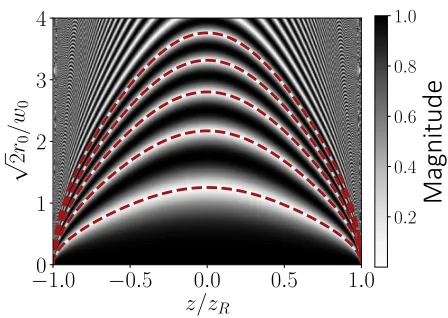
FIG. 1. Magnitude of|G+(r0,r0,2iθ0(z0))| as a function of radiusr0(vertical axis) and distance along the cavityz (hor-izontal axis). Red dashed lines mark solutions to Eq. (28), indicating contours at which there is a degeneracy between the sine and cosine density wave patterns.
wherenis a non-negative integer that indexes the family of possible radii. We readily see that for z0 = 0 this reproduces the zeros of cos(2r2/w2
0). The contours for other positionsz0 are illustrated in Fig. 1.
To understand the consequence of such degeneracy, it is useful to consider the effective Hamiltonian corre-sponding to Eq. (8). Neglecting the bare atomic Hamil-tonian, at a radius r0 satisfying Eq. (28), the effective Hamiltonian describing the cavity-mediated interaction is given by
Heff ∝ χc χs
G+(r
0,r0,0) 0 0 G+(r
0,r0,0)
χc
χs
.
(29) We can now see that the Hamiltonian is invariant under the transformation
ψc
ψs
→R(φ)
ψc
ψs.
, R(φ)≡
cosφ −sinφ
sinφ cosφ
.
(30) Physically, the transformation corresponds to the free-dom in the phase of the atomic density wave, i.e., any
density wave cos(kz+δ) with arbitraryδis allowed. This degeneracy is analogous to the situation in a recent ex-perimental realization of a supersolid via the coupling of a BEC to two crossed cavities [3]. The spontaneous breaking of thisU(1)-symmetry can be directly observed by imaging the phase of the forward-traveling component of the cavity light field, as can be seen from Eq. (21).
So far we have only showed that the symmetry exists when we ignore the contribution quadratic in the light field Ξµ(r) in the equation of motion. As such, one may question whether the symmetry should survive far above threshold, where there is scattering between different cav-ity modes (in the second term on the right-hand side of Eq. (6)). As we will next show, the symmetry in fact exists even when such coupling terms are included, as long as we remain in the confocal limit. To see this, we rewrite the initial atom-cavity Hamiltonian in terms of new photon field operators. Specifically, we define the new operators
ˆ
ac,s= 1
p Nc,s
X
µ ˆ
aµΞµ(r0)Sµ+
(
cos(nµθ0) sin(nµθ0)
,
where r0 is the position of the atomic cloud. The nor-malization factorNc,sis required to impose bosonic com-mutation relations on the cavity modes. Computing the commutation relations, we obtain
[ˆac,ˆa†s] = 1 2√NcNs={
G+(r0,r0,2iθ0)} (31) [ˆac,ˆa†c] =
1 2N2
c
G+(r0,r0,0) +<{G+(r0,r0,2iθ0)}
[ˆas,ˆa†s] = 1 2N2
s
G+(r0,r0,0)− <{G+(r0,r0,2iθ0)}.
We may now observe that the cross-commutator neces-sarily vanishes when the locationr0of the atoms satisfies the condition in Eq. (25),|G+(r
0,r0, i2θ0)|= 0. This im-plies that the normalizations required to satisfy the other two commutation relations are equal,Ns=Nc. We will see that this equality leads to the emergence of theU (1)-symmetry of interest.
Using the above definitions, along with the parameteri-zation in Eq. (4), we can rewrite the matter-light coupling terms in the original Hamiltonian Eq. (1) as
Hcoupling=
g0NΩ 2√2∆a
X
σ=c,s
p
Nσψ0(ψ∗σ+ψσ)(ˆa †
σ+ ˆaσ) +
g20N
2∆a
h Ncˆa†cˆac
ψ02+3 4|ψc|
2+1 4|ψs|
2
+Nsˆa†sˆas
ψ20+3 4|ψs|
2+1 4|ψc|
2
+1 4
p
NcNs(ψc∗ψs+ψ∗sψc)(ˆa†cˆas+ ˆa†sˆac)
i
. (32)
hcos2(krz) sin2(krz)i= 1/8 encountered when taking the averages of the Stark shifts. When Ns =Nc = N, we can rewrite the term in brackets as
Nh ˆa†cˆac+ ˆa†saˆs
ψ20+1 2|ψc|
2+1 2|ψs|
2
+1 4 ˆa
†
cˆac−aˆ†sˆas
|ψc|2− |ψs|2
+1 4(ψ
∗
cψs+ψs∗ψc)(ˆac†ˆas+ ˆa†sˆac)
i
and then readily verify that the Hamiltonian is invariant under the combined rotation
ac
as
→R(φ)
ac
as
,
ψc
ψs
→R(φ)
ψc
ψs
, (33)
Hence, it appears that the U(1)-symmetry remains ro-bust in a perfect confocal cavity even when including the nonlinear terms that are relevant far above threshold.
V. BREAKING OF EMERGENT U(1)-SYMMETRY
The previous section assumes a perfect confocal cavity, with no loss and no transverse mode dispersion. In that case, we anticipated perfect U(1)-symmetry at special radii. Experimentally, this should correspond to a shot-to-shot fluctuating density wave phase for these radii. As discussed below, this is not seen experimentally. Instead, there is a window where the phase of the density wave evolves smoothly and deterministically from φA = 0 to
φA = π/2. To understand this, we next discuss the ef-fects beyond the ideal solution, specifically efef-fects of a finite cloud size, effects of displacement from the mid-point of the cavity, and effects of a small mode-splitting
and cavity loss κ.
To study the emergence of symmetry-breaking terms, we consider the scenario where a single BEC is placed at a radius r0 in the cavity transverse plane, and we determine the phase of density wave formed in the self-organization transition from the eigenvectors of the effec-tive interaction matrix. The effeceffec-tive interaction matrix is the generalization of Eq. (18) to include the aforemen-tioned deviations from an ideal confocal cavity.
A. Displacement from midplane of cavityz0= 0
Displacing the BEC from the midpoint z0 = 0 of the cavity induces a density wave that is, in general, neither of purely sine nor cosine pattern except at special po-sitions where complete phase freedom (U(1)-symmetry) is restored. Admixtures of sine and cosine patterns are favored at positions where G+(r
0,r0,2iθ0) is complex. This function is complex at all points in the cavity ex-cept at its midpoint whereG+(r0,r0, iπ/2) is purely real, as well as at the points indicated by the red dashed line
contours in Fig. 1 whereG+(r0,r0,2iθ0) = 0, resulting in positions of restored phase freedom. As such, displace-ment from the midplane of the cavity does not break the
U(1)-symmetry at these specific radii.
In the following, we will see that finite cloud size and nonconfocality can alter this picture. These nonidealities lift the pattern degeneracy even at these special positions. What is left is instead a smooth, deterministic evolution of density wave phase with no U(1)-symmetry points. The exception to this is at midplanez0= 0. That is, de-spite these nonidealities, the interaction remains purely real at the midpoint of the cavity because θ0 = π/4 at
z0 = 0. Therefore, at the midplane of the cavity, there continue to exist special radii where theU(1)-symmetry is expected even under conditions of finite cloud size and nonconfocality.
We shall focus on the nonlocal contribution
G+(r
0,r0,2iθ0) to the self-interaction, since the effects of nonconfocality on the local interaction G+(r
0,r0,0) have been studied in detail in Ref. [6]. Moreover, as seen in Eq. (18), the density wave phase is determined not by the local terms, which scale the components of the identity matrix, but by the nonlocal terms that determine theσxandσz parts of the interaction matrix.
B. Nonconfocality
To consider nonconfocality, we return to using the Green’s functions defined in Eq. (16), i.e., allowing for nonzeroandκ. We first note that by using this Green’s function, the matrix form of the nonlocal cavity-mediated interaction Eq. (18) can be put into the form
4Dnonlocal+ (r0, z0) =
Z ∞
0
dλe−λ(1+iκ˜)hσz<{G+(r0,r0, λ˜−2iθ0)} +σx={G+(r0,r0, λ˜−2iθ0)}
i
, (34) where once again we note thez0dependence comes from the form ofθ0. We further note that away fromθ0(0) =
π/4, the quantity G+(r0,r0,−2iθ0) is complex, so both components exist (except at the special points mentioned above where it is zero). We can simplify this further, since the actual interaction appearing in Eq. (8) involves
<{D+
}. Since the term in brackets in Eq. (34) is by definition real, taking the real part thus replacese−iλκ˜→
cos(˜κλ). We can then write the final form for the relevant part of the interaction as:
4<{D+nonlocal(r0, z0)}=σz<{Ge+(r0,r0,−2iθ0)} +σx={Ge+(r0,r0,−2iθ0)} (35) where we have defined a nonconfocal Green’s function:
e
G+(r,r0, ϕ) =
Z ∞
0
From this expression, we can see that we still have an interaction that is purely ofσzform atθ
0=π/4. To see this, we note that
={G+(r,r0,˜λ−iπ/2)}
≡ = (
X
µ
Ξµ(r)Ξµ(r0)Sµ+e−nµ
(ϕ−iπ/2)
)
=X
µ
Ξµ(r)Ξµ(r0)Sµ+e−nµϕsin(nµπ/2).
Because S+
µ restricts the sum to even terms, we imme-diately see that sin(nµπ/2) = 0 for these terms so all terms vanish. The vanishing imaginary part then means the interaction matrix becomes purely diagonal and there still exists points where the interaction is proportional to the identity matrix, giving degeneracy and the U (1)-symmetry. However, away fromθ0=π/4, one can read-ily check that|Ge+(r0,r0,2iθ0)|does not vanish, i.e., the real and imaginary parts of this function no longer van-ish at the same points. As a result, there would be a deterministic phase at all radii (other than those at the midpoint), with the sense of phase winding dependent on the displacement from the midpoint of the cavity.
C. Finite transverse size of atomic gas
A second effect that also leads to a deterministic phase winding is the finite size of the condensate. To capture this, we consider averaging the interaction matrix over the spatial profile of the cloud. That is, we define an averaged function
G+avg(r0, ϕ)≡
Z
dr Z
dr0ρ(r0)G+(r,r0, ϕ)ρ(r), (37)
and then define the corresponding interaction matrix, de-scribing the self-interaction due to the non-local part of the interaction,
4<{Davg+ ,nonlocal(r0, z0)}=σz<{G+avg(r0,r0,−2iθ0)} +σx={G+avg(r0,r0,−2iθ0)},
(38) where once again thez0dependence comes from the form ofθ0.
The integral over coordinatesr,r0 can be evaluated by using a Gaussian density profile:
ρ(r−r0) = 1 2πσ2
A exp
−(r−r0)2 2σ2
A
, (39)
where σA is the BEC width, and by making use of the harmonic oscillator Green’s function Eq. (15). We find
0.0 0.5 √ 1.0 1.5
2r/w0
−0.2
−0.1
0.0
0.1
0.2
0.3
{G+
avg}
{G+
avg}
[image:10.612.340.537.53.203.2]Magnitude
FIG. 2. Real and imaginary parts ofG+
avg for a BEC at a transverse plane (z0/zR= 0.3) located away from the cavity
midplane and with a Gaussian width ofσA/w0 = 0.1. Black dashed line marks zero. Note that<{G+
avg}and={G+avg}do not vanish at the same point.
the integral over radius yields
G+avg(r0, ϕ) =
A/π
1−e−2ϕ
n
exp
− 2r
2 0 2σ2
A+ coth(ϕ/2)w20
+ exp
− 2r
2 0 2σ2
A+ tanh(ϕ/2)w20
o
,
where the prefactorAtakes the form
A=
1 + 2σ
2 A
w2
0coth(ϕ/2)
1 + 2σ
2 A
w2
0tanh(ϕ/2)
−1
.
(40) One can then combine the effects of nonconfocality with finite cloud size by using Ge(r,r0, ϕ) in the
right-hand side of Eq. (37). In practice, one first performs the Gaussian integral defined above and then defines
e
G+avg(r0, ϕ) =
Z ∞
0
dλe−λcos(˜κλ)G+avg(r0,˜λ+ϕ), (41) which can be inserted into Eq. (38) to find the effec-tive interaction. The final integral over λis performed numerically. We note that even when ˜ = 0, the fi-nite extent σA of the atoms already has the effect of turning G+
avg(r0,−2iθ0) into a complex quantity and ensuring that |G+
avg(r0,−2iθ0)| does not vanish when away from the cavity midplane. Figure 2 plots the real and imaginary part ofG+avg(−2iθ0) for atoms located at
z0/zR= 0.3. Crucially, the real part and imaginary part do not vanish at the same point, therefore there is al-ways a preferred phase of the atomic density wave and, consequently, no emergentU(1)-symmetry.
D. Comparison to experiment
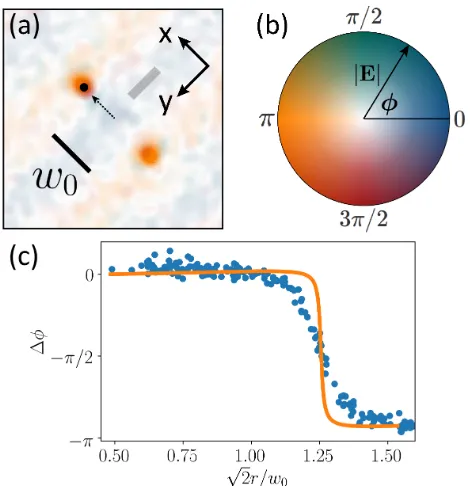
FIG. 3. (a) Example of the experimental phase and ampli-tude of the cavity emission. The waist w0 of the TEM00 in the image plane is indicated. ∆φ = −2φA is computed
from the difference in phase between the regions marked by black dot and the average phase of the gray rectangular re-gion. They correspond to the localG+(r,r0
,0) and nonlocal
G+
(r,r0,2iθ0) contribution to the light field in Eq. (21), resp. (b) Color wheel for illustrating electric field amplitude and phase. (c) Measured phase difference between the local and nonlocal contribution to the cavity field as a function of the distance r of a single BEC from the cavity axis. The data shown here are taken with cavity detuning ∆Q0=−120 MHz. The distance is extracted by fitting to the amplitude of the measured field. The path ofrtaken in thex-yplane from the cavity axis is shown as an black dashed arrow in panel (a).
reported in our works reported in Refs. [1, 6]. In brief, we create a BEC of 87Rb with population 2.5(3)×105 inside the cavity; see Ref. [20] for tech-nical details. The BEC is confined in an opti-cal tweezer trap of trap frequencies (ωx, ωy, ωz) = 2π×[189(2),134(1),90(1)] Hz and Thomas-Fermi radii (Rx, Ry, Rz) = [4.2(1),5.8(3),8.9(1)]µm. Due to exper-imental constraints [21], the BEC is fixed at a position of z0 ≈240 µm from the cavity midplane. The tweezer allows us to controlr0 by moving the BEC in the trans-verse plane. The confocal cavity has length L = 1 cm and TEM00 mode waist w0 = 35 µm. For this system,
g0= 2π×1.47(3) MHz andκ= 2π×167(4) kHz. To measure the U(1)-symmetry-breaking, we observe the phase difference ∆φbetween the cavity emission aris-ing from the local versus nonlocal interaction terms while moving a single BEC across a node of the oscillatory co-sine pattern due to G+(r,r0,2iθ0). The amplitude and phase of the cavity field emission are detected through
the holographic reconstruction of a spatial heterodyne measurement; see Refs. [1, 5] for details. The detec-tion of the density wave phase relies on the fact that the phase difference ∆φ is related to the density wave pattern through ∆φ = −2φA using Eq. (21). That is, the observable ∆φis directly related to the phase of the density wave.
Figure 3 shows the results of such measurements. An example of a holographically reconstructed cavity emis-sion field is shown in Fig. 3(a). The two orange spots are the emission due to the local interaction termG+(r,r0,0) centered about the real and mirror images of the BEC in the object plane, while the orange and blue striped oscil-lation arises from the nonlocal termG+(r,r0,2iθ
0). Figure 3(c) shows how ∆φevolves versusr. A particu-lar direction of the phase winding is preferred as the BEC is gradually moved away from the cavity midplane. As discussed in the beginning of this section, rather than observe a point of random shot-to-shot density wave phase due to aU(1)-symmetry, we observe that the phase smoothly winds from 0 to −π as the BEC crosses the node at the point√2r/w0 ≈
p
π/2≈1.25, as expected from Eq. (28). The orange solid line is the predicted theoretical phase difference taking into account: 1) the finite mode dispersion ˜; 2) finite sizeσA of the cloud in the transverse plane; and 3) the aforementioned displace-mentz0 of the atoms in ˆz from the cavity midplane.
Our theory could not reproduce the width of the tran-sition region in the density wave phase. We attribute this discrepancy to the coupling between density waves through the nonlinear atom-cavity coupling term that is proportional tog2
0/∆ain Eq. (6), which is not taken into account at the current level of our theory. However, our experimental data is taken above the self-organization transition threshold with macroscopic population of cav-ity photons. In this regime, scattering between different cavity modes is no longer negligible. We also note that we have assumed paraxial optics and only taken into ac-count of the linear dispersion between transverse modes. Contributions from cavity mirror aberrations (e.g., spher-ical aberration) could further complicate the phase de-pendence of transverse modes beyond the included Gouy phase shifts. Lastly, we note that the finite extent of the BEC along the cavity axis could play a role. We leave a discussion of this effect to the Appendix.
VI. DETERMINISTIC EVOLUTION OF THE DENSITY WAVE PHASE
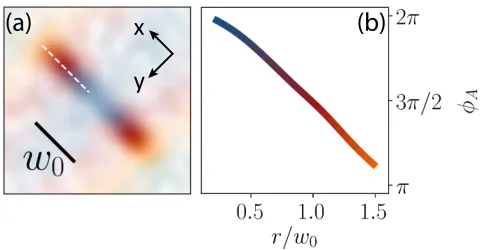
[image:11.612.60.295.58.301.2]phase smoothly evolves from 0 toπas shown in Fig. 4. To observe this, we prepare a BEC that is elongated along one direction using a dithered optical tweezer beam to make an elongated trap. The mean position of the BEC is placed away from the center of the cavity trans-verse plane. Figure 4 shows the cavity field emission above the self-organization transition threshold. As men-tioned above, we observe a smooth phase variation from 0 to π across the BEC straddling the two antinodes of the cavity emission that arises from the nonlocal inter-action term. This phase evolution is reminiscent of the “spoiled helix” state arising in a single-component Mat-tis model. Such systems exhibit a ferromagnetic state wherein the spin locally breaks aZ2symmetry but with a local rotation of the definition of up and down spin versus position [22].
While this directly indicates that the phase of the den-sity wave formed in the self-organization transition is no longer restricted to be the same in the entire atomic gas, as was predicted in Ref. [6], we do not observe any shot-to-shot fluctuations in this phase evolution pat-tern. The phase evolution is deterministic, by which we mean that the phase winds with the same pattern from experimental shot-to-shot and is predictable by ac-counting for the effects discussed in the previous sec-tion. That is, there is no fluctuation of the phase or change of the winding orientation indicative of an un-derlying U(1)-symmetry at these special radii. By con-trast, such fluctuations in the self-organized density wave are expected in a multimode cavity of the ideal con-centric configuration [14, 15]. Those works showed how such fluctuations of a density wave primarily along the cavity axis could lead to a quantum Brazavoskii transi-tion in transversely pumped concentric multimode cav-ity QED systems. That is, such fluctuations could drive the system from a Dicke-like superradiant, self-ordering phase transition into a Brazovskii-like superradiant, self-ordering transition, as discussed in Refs. [14, 15]. (The Brazovskii transition [23, 24] is a weakly first-order, fluctuation-induced transition that would result in a su-perfluid smectic—‘supersmectic’—state. The Dicke tran-sition, by contrast, is a second-order mean-field transition to a supersolid state [25].)
The deterministic phase variation we observe in Fig. 4 illustrates that the preferred density wave phase is differ-ent at differdiffer-ent locations, but there are no fluctuations in this nonideal confocal cavity. Moreover, such fluctuations in thelongitudinal direction are not likely to be possible in even an ideal confocal cavity due to the long Rayleigh length of the modes in such a cavity. In summary, various corrections to Dnonlocal+ in a nonideal confocal cavity lift the expectedU(1)-symmetry at all positions in the mul-timode cavity other than the ones in the midplane. This symmetry-breaking will hamper one’s ability to observe Brazovskii physics in a nonideal confocal cavity pumped with a single field.
The next section proposes a new pumping scheme that restores this U(1)-symmetry and thus reintroduces the
(a)
x
(b)
y
FIG. 4. (a) Reconstructed cavity superradiance from a BEC with length on the order of the cavity waistw0. The phase of the atomic density wave varies smoothly from one side of a node to the other. Note that the gas is positioned to only one side of the cavity axis. (b) Line-cut of the phase winding as indicated by white dashed line in panel (a). rdenotes the distance from the cavity axis.
possibility that fluctuations in the phase of the atomic density waves can drive the system to a supersmectic state via a quantum Brazovskii transition.
VII. PROPOSAL FOR RESTORATION OF U(1)-SYMMETRY
The aforementioned rigidity in the allowed phase of the density wave is a direct result of the nonlocal interaction. We now propose a pumping scheme, involving two de-generate resonances in a confocal cavity, for eliminating theD+nonlocal term from the cavity-mediated interaction. This would restore the full phase freedom in the atomic density wave, perhaps allowing Brazovskii physics to be explored in a confocal cavity, even a nonideal one.
We suggest adding a second transverse pump at a fre-quency near a confocal resonance one FSR away from the first pump. As noted in Eq. (2), the phase varia-tion of different transverse modes depends on the gitudinal index. For a resonance 1 FSR away, the lon-gitudinal index Q changes by 1. Thus, in this newly driven set of degenerate mode family resonances, theµ -independent part of the slowly varying phase changes from ΘQ0 →ΘQ0+π/2. Since the atomic density wave offsetδcan only be adjusted to match one family, we find that for this second mode family, computing the overlap factors as in Eq. (12) gives
O0σ µ =
(
−sin [nµθ0(z)] σ=c cos [nµθ0(z)] σ=s
. (42)
Since these are two nearby resonances within the same cavity, it is reasonable to assume that they have the same couplingg0 and residual mode splittings. Thus, if we choose the two pumps to have the same effective detuning ∆Q0 and the same pumping strength Ω2/∆2
[image:12.612.321.564.54.179.2]total cavity-mediated interactionT is simply the sum of the contribution from individual resonances
Tστ = ∆Q0 X
µ
Ξµ(r)Ξµ(r0) ∆µ+iκ O
σ µO
τ
µ+O0σµO0τµ
S+
µ
∝1G+(r,r0,0). (43)
This identity holds because the sign change inOµ0cO0sµ ver-sus Oc
µOsµ cancels the off diagonal components. There-fore, the combined interaction T is now diagonal in the basis of ψc,s and the system exhibits a U(1)-symmetry in the entirety of the cavity’s transverse plane. We note that this result is general and does not rely on an ideal cavity or the atoms being at special radii in the midplane of the cavity. Combined with a short-range local inter-actionG+(r,r0,0), observation of fluctuations in atomic density wave in a large BEC should be possible, which may in turn lead to a Brazovskii transition. This will be the subject of future work.
VIII. CAVITY MEDIATED INTERACTION IN THREE DIMENSIONS
In the discussion so far, we have assumed the cavity couples to atomic density waves. Under this assumption, combined with the restriction of atoms to a thin cloud withwz zR, we could ignore thez dependence of the cavity-mediated interaction, and replace it with the ma-trix structure in terms of sine and cosine quadratures of atomic density waves. In order to be able to apply the results discussed here to spin models (where atoms could in principle be placed at arbitrary positions r, z), such as recently realized in a BEC system [5], it is useful to also present the cavity-mediated interaction with its z -dependence included. That is, we allow for interactions between atoms at distinct longitudinal coordinateszand
z0. We thus consider:
D+ 3D(r,r
0, z, z0) =X
µ
Φµ(r, z)Φµ(r0, z0) 1 + ˜nµ+iκ˜ S
+
µ, (44) where Φµ(r, z) = Ξµ(r) cos[krz−ΘQ0(z)−nµθ0(z)] is
the full mode function. One may see that this takes the form:
D+ 3D(r,r
0, z, z0) =1 4
X
τ,τ0=±
G(r,r0,−i[τ θ0(z) +τ0θ0(z0)])
×eikr(τ z+τ0z0)−i[τΘQ0(z)+τ
0Θ Q0(z
0)]
. (45) This expression represents the most general cavity-mediated interaction in a near-confocal cavity.
Moreover, we can now transform this expression into the form used in the companion paper [1]. To do so, we should consider this expression under the special condi-tion that we work near the midpoint of the cavity, so that thez-separation between atoms is small compared to the Rayleigh length. We may then neglect thez-dependence
ofθ0and ΘQ0, and useG(r,r
0,−iπ/2) =G(r,r0, iπ/2) to write:
D+ 3D(r,r
0, z, z0) = 1 2
h
G(r,r0,0) cos(kr(z−z0)) +G(r,r0,−2iθ0) cos(kr(z+z0)−2ΘQ0)
i
. (46) For even cavities, ΘQ0 is an integer multiple of π, and thus we can write:
D+ 3D(r,r
0, z, z0) = 1 2
h
Glocal(r,r0) cos[kr(z−z0)]
± Gnonlocal(r,r0) cos[kr(z+z0)]
i
. (47) This expression matches the form of the interaction in-troduced in the companion paper [1]. Integrating this over atomic density waves naturally recovers the interac-tion matrix discussed in Sec. III A, while for spin degrees of freedom, this expression can be directly applied, de-pending on the locations of trapped spinful atoms.
IX. BEYOND CONFOCAL CAVITIES
All the results so far are based on cavity configura-tions near the confocal geometrical configuration. How-ever, there exist a much wider set of Fabry-P´erot cavity configurations with resonances at which multiple modes become degenerate. To describe these cases, let us note that we can consider all degeneracies as arising from the way the frequencies of different transverse modes shift and cross as one varies the length of the cavity from a short (nearly planar) configuration ofL R, past the confocal point ofL=R and toward the concentric limit ofL= 2R. This is illustrated in Fig. 5. In the following, we first review the basic physics of higher-order degenera-cies, generalizing the discussion of Ref. [16]. We provide the following summary here for completeness.
A. Generalized degeneracy conditions
Planar
M/N=1/3
Confocal
FSR
[image:14.612.65.289.50.212.2]Concentric
FIG. 5. Diagram illustrating evolution of cavity frequencies versus changing cavity length. Black vertical lines at the top of the panel indicate different longitudinal resonances, sepa-rated by one free spectral range (FSR). As one moves from the planar limit (top, L R) to the concentric limit (bot-tom,L= 2R), the different transverse modes within a given mode family split and cross with those from higher longitu-dinal families. Some degenerate configurations are indicated by horizontal blue lines.
away, and so on. Therefore, the cavity becomes highly degenerate. Moreover, the 1st-order transverse modes of a given family will be degenerate with theN+ 1th modes of the family M away, etc. Thus, there are N distinct types of degenerate points, generalizing the two odd/even sets of degeneracy families of the confocal case.
The condition on cavity length and mirror curvature required for such a degeneracy can be found by requir-ing equal wavevectors between pairs of modes indexed as described above. Using the mode functions as written in Eq. (2), and in particular, the phase θµ,Q(z) written in Eq. (3), we find that to match the boundary condi-tions that cavity light vanishes on-axis at the mirrors at
z=±L/2, we require that
−kµ,Q
L
2 −θµ,Q(−L/2) =
π
2, (48)
kµ,Q
L
2 −θµ,Q( L/2) =
π
2 +Qπ. (49) where kµ,Q is the wavevector associated with the mode with transverse index µ and longitudinal modenumber
Q. Note that as per its definition, Q counts the phase difference between the mirrors, thus labelling the longitu-dinal mode number. In addition, to match the boundary condition across the transverse plane of the mirrors, we require that the radius of curvature R(z) at the mirror locations z =±L/2 should match the mirror curvature
R.
To solve Eqs. (48) and (49), we take sums and differ-ences. Using the definition of θµ,Q(z) in Eq. (3), these
yield the following equations:
kµ,QL=Qπ+ 2ψ(L/2)(1 +nµ), (50) 2ξµ,Q= (Q+ 1)π+ 2nµψ(L/2). (51) The first of these equations is the condition to solve for degenerate points. Specifically, ourM/N resonance means that the values ofkµ,Qshould be equal for (nµ, Q) and (nµ+N, Q−M). The condition for this to occur is thusM π = 2N ψ(L/2). Using the definition ofψ(z), we may regard this condition as definingzR in terms of
L/2 to ensure resonance. We can then use this, combined with the definition ofR(z), to find the radius of curva-ture at the mirrors. We thus find the M/N resonance corresponds to:
zR=
L
2 cot
M π
2N
, R= L 2cosec
2
M π
2N
.
From this condition we may note that even with a small range of tunability of cavity lengthL, one can nonethe-less realize high-order resonances by finding irreducible fractionsM/N near the confocal point ofM/N = 1/2.
We may note that since the degeneracy is between transverse modes with total index nµ separated by N, there will beN separate degeneracies, corresponding to
η =nµ modN, with η ∈ {0. . . N −1}. Each of these families has an offset cosine along the longitudinal direc-tion. To see this, one may note that from the degeneracy condition between modes (nµ, Q) and (nµ+N, Q−M), we may thus labelnµ =η+P N, Q=Q0−P M for in-teger P, where Q0 is the longitudinal mode number of the lowest transverse mode in the given family. As a re-sult ξµ,Q = ξQ0 = (π/2)(Q0+ 1 +ηM/N) is constant
within a given degenerate family. We also see that as with the confocal case, families separated by one FSR differ in phase byπ/2, giving an associated offset of the atomic density waves. We may note that while for the confocal resonance, different mode families had orthogo-nal longitudiorthogo-nal dependence, this is not true for general
M/N.
B. Generalized interaction matrix
Having found the resonances, we may now consider one near-degenerate family withkµ,Q = kr and find the ef-fective interaction matrix. Focusing on a single degener-ate family, we consider atomic density waves of the form cos(krz+δ),sin(krz+δ) with a phase offsetδ= ΘQ0(z0)
now be:
Sη µ=
1
N
N−1
X
s=0
exp(i2πs(nµ−η)/N).
This gives 1 fornµ=η modN, and zero otherwise. The labelηthus replaces the±label for even/odd modes. We can then similarly define
Gη(r,r0, ϕ) = 1
N
N−1
X
s=0
e−i2πsη/NG(r,r0, ϕ−i2sπ N). (52)
Using the above, we can then calculate the interaction matrix, the equivalent of Eq. (18); we find:
2Dη(r,r0) =1Gη(r,r0,0) +σ
z 2 [G
η(r,r0,
−2iθ0) +Gη(r,r0,2iθ0)] +σ
x 2i [G
η(r,r0,
−2iθ0)− Gη(r,r0,2iθ0)], (53) which is identical in structure to the confocal case, up to the replacement of G+
→ Gη and the modified value of
θ0. One may also verify that by takingM/N→1/2 and usingη= 0,1 for the±families, we recover the confocal results.
In the confocal case, neglecting effects of finite cloud size, we noted that at the cavity midplane, z0 = 0, and the coupling between sine and cosine density waves van-ished at all radii. The same applies here forη= 0 (anal-ogous to the even modes considered before). In fact, we can extend this to all η if we consider an η-dependent shift to the phase offset δ. Specifically, we choose the offset such that the overlap factors become
Oσ µ=
(
cos(nµθ0−πM η/2N) σ=c sin(nµθ0−πM η/2N) σ=s
. (54)
With this, we find that at the cavity midplane (where
θ0=M π/2N), the remaining kernel takes the form: 2Dη(r,r0) =1Gη(r,r0,0)
+σze−iπM η/NGη(r,r0,−iM π/N). (55) In terms of the spatial structure of these functions, there is one notable differences between the confocal case and the higher-order resonances. This is that in the con-focal case,N= 2, and at the cavity midplane, the angle
θ0=π/4 led to an especially simple form of the nonlocal interaction, cos(2r·r0/w2
0). For the higher-order reso-nances, no such simplification occurs, and thus the non-local interaction takes a form involving a sum of terms of the more general form cos(A+Br·r0/w02+C(r2+r02)/w20). Thus, for such a higher resonance, the output light com-ing from a scom-ingle spot involves not only a set of paral-lel fringes (contours of constantr·r0), but also a set of circular fringes around the location of the atom cloud. Whether such interactions could be used for engineering interesting cavity-mediated spin-spin interactions is the subject of future work.
X. CONCLUSIONS AND OUTLOOK
We have shown that the structure of Gaussian modes in a near-confocal multimode cavity leads to cavity-mediated atom-atom interactions that can favor distinct patterns of atomic density waves as one moves trans-versely across the cavity. We find, moreover, that there can exist specific radii where there is phase freedom for the atomic density wave. For a perfectly confocal cavity and small-sized BECs, such radii exist at all longitudinal distances along the cavity. Including effects of finite non-confocality, the emergent symmetry exists on the mid-plane of the cavity, while elsewhere we have symmetry breaking. Nonetheless, the symmetry-broken state still shows interesting phase evolution of the atomic density wave versus radius, smoothly evolving between sine and cosine density waves as the atomic gas is moved across the transverse plane. Such behavior matches that which we report experimentally.
The results presented here provide the foundation to further control the cavity-mediated interaction among in-tracavity atoms and atomic spins. In particular, we show that a configuration involving two pump laser frequencies can induce a fullU(1)-symmetry, even accounting for im-perfections of the real cavity. This provides a route to exploring liquid crystalline order [14, 15] in experimen-tally accessible conditions with a confocal cavity. At the same time, we showed how other, more complex, interac-tions can be engineered, by using higher-order cavity res-onances. In particular, since resonances are labelled by irreducible fractionsM/N, high-order resonances can be realized without requiring a significant change of cavity length. These higher-order resonances provide a further tool in realizing tunable cavity-mediated interactions.
ACKNOWLEDGMENTS
We acknowledge funding support from the Army Re-search Office, the National Science Foundation under Grant No. CCF-1640075, and the Semiconductor Re-search Corporation under Grant No. 2016-EP-2693-C. J. K. acknowledges support from SU2P.
Appendix A: Finite BEC extent along cavity axis
One additional effect that may be considered as a source of breaking of theU(1)-symmetry is the finite ex-tent of the atom gas along the cavity axis. This corre-sponds to relaxing our simplifying assumption that the phase of cavity modes is constant over the extent of the atomic gas, and can result in a more complicated overlap factor in Eq. (12). However, as seen below, this effect on its own does not to lead to a smooth phase evolution.
![Fig. 1d in Ref. [1].](https://thumb-us.123doks.com/thumbv2/123dok_us/8698632.381077/7.612.320.561.576.647/fig-d-in-ref.webp)