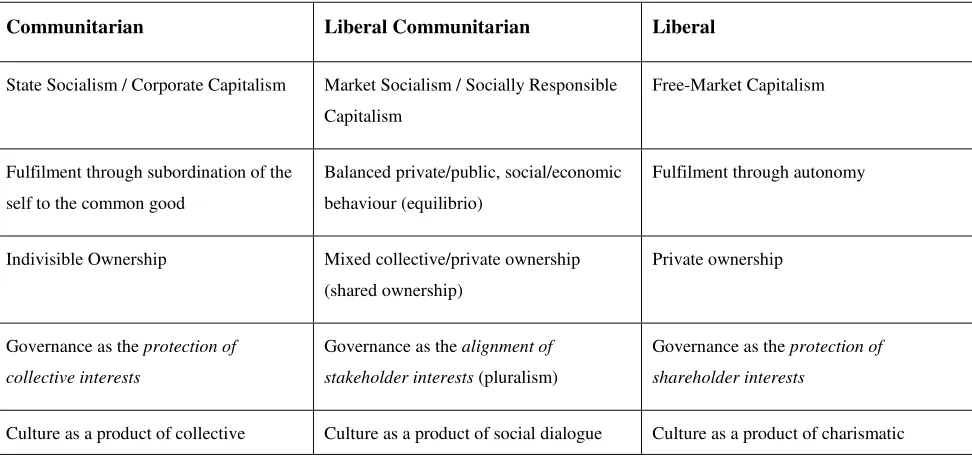
management, governance and ownership models
RIDLEY-DUFF, R. <http://orcid.org/0000-0002-5560-6312>Available from Sheffield Hallam University Research Archive (SHURA) at: http://shura.shu.ac.uk/723/
This document is the author deposited version. You are advised to consult the publisher's version if you wish to cite from it.
Published version
RIDLEY-DUFF, R. (2004). Communitarian governance: the development of
management, governance and ownership models. In: 6th International Management Control Association Conference, Edinburgh, 12th-14th July.
Copyright and re-use policy
Communitarian Governance
The Development of
Management, Governance and Ownership Models
Rory Ridley-Duff
Sheffield Hallam University
Faculty of Organisation and Management
June 2004
Paper to:
6
thInternational Management Control Association Conference 2004
Abstract
The purpose of corporate governance as the protector of shareholder interests is a view that is still
widely held. Recently it has been subject to repeated challenge. A new conception of governance
that recognises a plurality of interests, particularly those of employees, has received both theoretical
attention and practical examination. This paper examines the connection between liberal and
communitarian philosophy in the recent debate about corporate governance. Empirical evidence
from a critical ethnography is used to show how communitarian ideas can influence the governance
model of a medium-sized company, and also how social influences constrain and frustrate the
application of these ideals. The result is a formal statement of culture built through a process of
consultation, and institutionalised in contractual rights and responsibilities. The company leaders
have been drawn towards models of control and ownership found in the employee-owned and
co-operative sectors. These are perceived to increase participation and involvement, and give voice
to more people in the enterprise. During debate and discussion, however, the management group
reduced the powers initially proposed for the governing body, and empirical data suggests this was
partly to win support from those sceptical about the proposals, partly to protect decision-making
Introduction
This paper investigates the way that liberal and communitarian philosophies affect notions of
corporate governance. Custom Products Ltd – a medium-sized business based in the north of
England – has evolved a model of governance over a 15-year period. Throughout 2003, the directors
investigated a number of new models from the employee-ownership and co-operative sector and used
ideas from them to create new models for management, governance and ownership.
Based upon a critical ethnography conducted over an 18-month period – including a 7-month period
of intensive participant observation - the paper describes the intentions, concerns, and
communication strategies of the company leaders in their attempt to evolve their models of
governance. The result is an emergent theory of corporate governance that shows how liberal and
communitarian philosophies manifest themselves in corporate governance.
Evidence is evaluated from additional primary and secondary sources to critique the emergent theory
and highlight issues with the practices that result. This critique suggests that the behavioural model
that underpins ideals of governance is a form of “liberal communitarianism” (Lutz, 2000:343), a
distinct philosophical position which integrates aspects of both philosophical traditions.
Individualist Philosophy
The purpose of corporate governance as the protector of shareholder interests is a view that is still
widely held (Berry, Broadbent and Otley, 1995; ICAEW, 1999; Coad and Cullen, 2001). This view
is bound up with individualist philosophy as far back as Plato, based on the concept of pure reason.
Within this philosophical tradition, reasoning is a private thought process in which people can
separate themselves from the world and think rationally about it. The idea of pure reason is taken up
in the writings of Locke, Smith, Hegel, Hobbes, Kant and Rawls. Taken together, they establish a
body of thought that decisions are based on rational self-interest and that it is possible to determine
an “absolute” or “universal” truth about social phenomena.
From a similar ontological stance different philosophers have applied this notion and suggested very
different types of ideal society. In a Hobbesian view, individual self-interest leads to inevitable
conflict and a constant “state of war” (see Cladis, 1992; Gaus, 2003:62). He argues that to counter
this tendency, a sovereign power is required to bring order and social control. Smith, on the other
contends that a great many people all pursuing self-interest results in the market’s “invisible hand”
where equilibrium between producers and suppliers ensures the most good for the most people. The
resulting society – in which free-traders are in abundance – is one where economic power is
distributed widely.
Contemporary Debate
Liberal philosophers have struggled to free themselves from the Enlightenment view that the
application of reason reveals universal truths. As Gaus (2003:2) states:
Milton and Mill advance classic statements of a basic liberal theme. Given freedom of thought, speech and inquiry, our common human reason leads us toward increasing agreement on truths and rejection of falsehoods.
“Scientific” knowledge is believed to advance through positivist assumptions and the search for
universal laws. Rational economics – based on models of human behaviour that assume people act
in individualistic profit-maximising ways – evolved from Adam Smith’s ideas about the division of
labour (Smith, 1776) and Taylor’s doctrine of scientific management (Taylor, 1911). Taylor broke
down jobs into easy repetitive tasks, offered higher wages for those that were prepared to do them,
and succeeded in demonstrating that productivity could be hugely increased by – in effect – bribing
people into acting as component parts in the mechanics of production.
A contemporary articulation of Smith’s views can be found in the work of Charles Handy (2002),
who argues that we can only be truly at the service of other people when we are pursuing what we
love to do. But even Handy concedes that the only way to tame the market, and put capital at the
service of humanity, is for people to discover their own social purpose. Having discovered it, he
argues – as do Smith and Rawls - that the mechanisms of a liberal market economy provide the
freedom to pursue these to society’s best advantage.
Rawls (1999:24) describes how scientific management ideas were transferred into the public domain:
Governance, therefore, is seen as the enforcement of one person’s (or a ruling elite’s) vision.
Although Rawls’ personal views are at variance with the above, his philosophy still amounts to a
defence of private interests through publicly agreed minimum standards of rights.
As Morrison notes, these views of organisational life are underpinned by the notion that “people tend
to project onto the world the order they find in their minds” (Morrison, 1991:107). The debate
amongst liberal philosophers, therefore, has moved onto new ground. How can we create the
conditions in which people can deliberate together and find workable solutions in political, civil and
business life while accepting that different ways of thinking and divergent opinions are inevitable?
The Influence of Social Psychology
Gaus (2003:9) describes the influence of psychology on liberal philosophy:
Independently, psychological studies of human reasoning have led to doubts about whether everyone shares the same norms of reasoning. The work of, amongst others, Richard Nisbett, Lee Ross, Paul Slovic and Amos Tversky showed that normal adults often do not employ the norms of reasoning long-advocated as correct by philosophers.
This view is backed by a large body of social psychology research (see Aronson, 2003). The
emerging view from this discipline is that people frequently engage in rational self-justification as a
result of cognitive dissonance (Festinger, 1957) – a process by which they are influenced by their
social context to adopt a course of action and then justify it to both themselves and others. In doing
so, their values change to match the actions they have been induced to follow – but only if there is an
element of choice. One key finding is that the more choice a person feels they have, the more they
will internalise new values and adopt them as their own.
As a result, liberal thought has begun to grapple with the idea that cognitive processes have a
significant social element, and that different points of view are inevitable. From Berlin to Gray, and
Hobbes to Rawls, the debate has centred on how “collective reason” can be achieved in societies that
are pluralist (Gaus, 2003:93). John Rawls (Rawls, 1999:10) suggests a structure for society based
on:
..the principles that free and rational persons concerned to further their own interests would accept in an initial position of equality…[that] specify the kinds of social cooperation that can be entered into and the forms of government that can be established.
He argued that such principles would regulate all political life and be oriented towards the
pursue. In the economic sphere, Rawls position was taken to strengthen the arguments originally put
forward by Adam Smith. Looser controls on trade (free markets), reductions in the power of the
state and other monopolies (state businesses and trade unions) and policies to strengthen private
ownership (houses and share ownership) would all lead to a more liberal and equitable democracy.
Critiques of Individualist Views
Rawls ideas have been critiqued on a number of fronts. Philosophers from the tradition of Aristotle
and Hume regard knowledge as a social creation. Aristotle set out in Politics his view that people are
social animals that have to participate in society (Aronson, 2003). Hume supports the Aristotelian
view that knowledge is linked to experience (Open University, 1981:229).
It is only experience which teaches us the nature and bounds of cause and effect, and enables us to infer the existence of one object from that of another. Such is the foundation of moral
reasoning, which forms the greater of human knowledge, and is the source of all human action and behaviour.
Another problem is the question that haunted Kant in particular: “Whence reason?” (Cladis,
1992:18). The principles that Rawls puts forward can only be the outcome of a political process and
discourse. The views of Giddens (1984, 1991) that we recursively evolve our own social structures
suggests that rights are necessarily an outcome of social processes. How, then, can they ever be
primary and precede social life?
Lastly, individualist philosophers are challenged on the nature of learning and knowledge creation.
Philosophers from the existential school believe that reasoning is an outcome of interacting with the
world. It is based on experiential learning and, therefore, constrained (and enabled) by the social
context in which it takes place. This assumption can be found in the works of Marx, Engels,
Rousseau, Durkheim, Mayo and Dewey.
The Communitarian Critique
Lutz (2000:343) describes two contemporary strands of communitarianism; the first he associates
with a school of thought with "an inclination towards moral and cognitive relativism" and which he
disparagingly calls republican communitarianism. The second, a form he finds more congenial,
stems from the thinking of Durkheim, Dewey and Hobhouse. This line of thought has been
Durkheim recognised individualist and communitarian philosophies as "two extreme positions
around which moral theories are grouped" (Cladis 1992:1) and sought to find an explanation for the
relationship between private and public that would avoid the tendency to reduce it to these two
contrary positions. He…
…sought to protect liberalism from egoism, and communitarianism from fatalism, the absorption of individuals into the social mass. The result was a social theory that articulated and promoted the dignity and rights of the individual within the moral idiom of social traditions and commitment to a common good…
This is articulated persuasively by Etzioni (1998:xvi). Describing the “apple that hit my forehead”,
he recalls research in which young Americans overwhelmingly state their desire to be tried by jury.
However, a substantial number of the same group also state that they do not wish to serve on a jury.
It occurred to Etzioni that rights cannot be exercised without acceptance of responsibilities: the right
to trial by jury can only be protected if we accept our responsibility to serve on juries. The apparent
tension between the primacy of rights and responsibilities dissolves and the debate moves to one
where we seek to identify the responsibilities that protect corresponding rights. Governance becomes
a role through which community leaders take responsibility for protecting citizens rights through
measures to encourage (and ensure) that all citizens fulfil their responsibilities.
Etzioni’s position appeals to logic. How can we exercise the right to education without some
members of society taking responsibility for our education? But herein lies a circular problem. The
character of that education will be deeply affected by the attitude of the educator. If education is
offered to serve the needs of the educator then the practices and outcomes will be different to an
education offered to help students establish and pursue their own goals. In short, it matters whether
the educator is acting from individualistic or communitarian motives and how they perceive notions
of the common good.
Etzioni does, however, successfully communicate two key tenets of liberal communitarian thought;
firstly a need to restore the balance between rights and responsibilities; secondly, that rights
themselves cannot exist without social agreement on what responsibilities we are required to uphold.
It is Tam, however, who extends these principles to the sphere of business (Tam 1999:10).
Cooperation in this context does not mean bargaining to secure the best advantage for one's own group with minimal concession to others, but to developing shared values and long-term goals so that each is ready to contribute to the well-being of the whole enterprise.
In short, he argues against adversarial relations and argues that social and business problems require
resolution through people learning to question and deliberate together.
Tam, however, is unable to completely free himself from Enlightenment thinking. While he accepts
that many values may be culture or context specific, he claims there are four common values that
"can be traced back thousands of years and across different cultures"(Tam 1999:16). Love, wisdom,
justice and fulfilment are the most deeply valued human experiences.
While Tam defines these as shared values, psychologists argue that they may be grounded in innate
human needs (Glasser, 1998, Aronson 2003). Glasser speculates whether they are part of our genetic
heritage, but Aronson takes the view that human beings – particularly those with high self-esteem -
are protective of their own self-concept as good and decent people. This leads them to articulate
their own behaviour as good and decent, leading to divergent opinions about what constitutes good
and decent behaviour. Where such a person engages in a business enterprise and persuades other
people to follow him or her, followers adopt the same (or similar) values to reduce the dissonance
that arises if they challenge the values of those on whom they are dependant.
As a result, there have been a number of challenges to the individualist view of corporate governance
(Ellerman 1990; Turnbull 1994; Cornforth 1988, 1995; Major 1996, 1998; Major and Boby 2000,
Johnson 2004). A new conception of governance that recognises a plurality of interests has received
both theoretical attention (Turnbull 1994, Coad and Cullen 2001, Ridley-Duff 2002) and practical
examination in studies (Whyte and Whyte 1991; Kasmir 1996; Lutz 1997; Cheney 1999; Coad and
Cullen 2001).
In the following section we consider the methodology and methods used to capture and analyse data
from the primary case study and additional sources. Then we will examine the extent to which
communitarian values are expressed in the business practices of three organisations.
Methodology
There are two key aims in this research. Firstly to describe the formal and informal culture
also a participant). Secondly, I need to analyse the underlying philosophy and values implicit in the
behaviour of participants. In this section, we look at the methodological implications of exploring
these two dimensions of organisational life.
Description of the Behavioural Model
The primary case study was undertaken to explore how employees are affected by the application of
communitarian ideas in governance. This requires a descriptive approach as there is no hypothesis to
test. Hypothetico-deductive techniques are inappropriate but we do not have to abandon positivist
assumptions that there is an external reality. Nor do we have to discard the aim of representing the
phenomenological world of the participants in an authentic way.
Ethnography, with its combination of participant observation, interviews and document analysis, is
an appropriate methodology. The truth – at least initially – is the truth as seen by participants. Its
triangulated approach – using multiple sources of data, and a mixture of methods to collect data -
enables a researcher to claim that the phenomena described are authentic and a good basis for further
theorising.
Philosophy, Values and Meanings
Having described the set of attitudes and values implicit in the model, the focus will turn to the
justifications for it, and the meanings that participants assign to it when interpreting events and
making decisions. To examine this area, I present the formal statements of culture and examine how
managers rationalise and justify them. I then examine how participants interpret them and the extent
to which they believe the formal statements of culture match their own experience. In doing so, I
share critical theory’s epistemological and ontological assumptions, and propose to draw on its tools
and techniques of analysis.
This takes us beyond what Johnson and Duberley call “conventional ethnography” and sets us on the
path of “intensive analysis concerned with combining interpretive understanding, causal analysis and
critique” (Johnson and Duberley, 2000:135). The study is a critical ethnography (Thomas 1993) in
which there is a search for the nature of ideological hegemony and explanation of mismatches
between publicly stated philosophy and the private philosophies employed by individuals operating
One of the key choices of the ethnographer is the extent to which they immerse themselves in the
culture, or restrict their role to observation (Gill and Johnson, 2002). I proceeded on the basis that
my own subjective experiences would assist me in understanding organisational life, and help me
empathise with other organisation members. I accepted the view that "the researcher's knowledge of
his own feelings becomes a vital source of data" (Gill and Johnson, 2002:145).
I asked the person acting as my line manager – as far as was possible – to treat me in the same way
as other organisation members. I also took opportunities to expose myself to experiences that would
provide me with as much insight as possible into the thoughts and feelings of others. In my journal, I
recorded more than descriptions; it included data on my own feelings and thoughts about the
experience of working as an employee.
Theory Building
In constructing theoretical explanations, and exploring disparities between public and private
philosophies, I have chosen to draw on the techniques of grounded theory (Glaser and Strauss, 1967).
However, the final objective is not to build a neutral theory to explain social life, but to show how
different interests influence social relations. In particular, I will show how the interests of the
organisation leaders in using governance as an agent of change has produced different sets of social
relations.
Methods
Data was collected between October 2002 and March 2004 – a period of nearly 18 months. For 7
months, I worked inside the organisation for approximately 20 hours per week. I also participated in
social events, weekend and evening shifts, and socialised with some staff in the evenings. During the
summer months I worked for 12-hours each week in the Operations area where value-added
manufacturing activities, packing and dispatch took place.
Throughout the whole study, I made journal entries each time I was in contact with the organisation.
Due to the large amount of contact, many of these had to be recorded on a digital dictaphone and
summarised and analysed at the end of the data collection period. In order to ensure that analysis
took place during data collection, the journal was used to capture both descriptive material and
reflections on the processes within the company, the evolution of my thoughts, comments on how
As it is a principle of Grounded Theory to set aside theoretical reading during data collection and
analysis (Glaser and Strauss 1967, Partington 2000, Locke 2001), I limited reading to those books
that were in active circulation inside the company. This was intended to help me understand the
influences on their thinking, how these informed their actions, and also to enable me to engage in
more meaningful discussions with a range of people.
To focus on corporate governance I participated in initial discussions on changes, a field trip, board
meetings, management meetings and company-wide meetings throughout the whole research period.
I was invited to give input into early discussions with two directors. Once the proposals went to the
board, my input was more limited, but still sought from time to time. Once the proposals were
submitted to managers and staff, my input diminished further and I played an observational role.
I collected additional documents: minutes of board meetings, powerpoint presentations prepared by
directors for managers and staff; working documents created to assist discussion of the principles for
new governance and ownership arrangements. One of these – a submission to a DTI consultation –
became a focal point for discussion and agreement about the principles of governance that should
apply to the company. The way these proposals were modified during board discussions is discussed
in the next section.
Additional primary data was collected from SoftContact Ltd to compare the development of
communitarian objectives and management practices in the two companies. As I held a senior
position, I was able to access e-mail correspondence, documents, constitution, business plans, staff
appraisals, and witness statements to an employee tribunal. SoftContact Ltd comprises two
organisations; a common ownership co-operative and an employee-owned sister business. The way
democratic values were re-interpreted over a thirteen-year period, particularly in the formation of the
employee-owned business, is helpful to this research.
The last set of primary data was collected on a 2-day field trip to the Mondragon Corporacion
Cooperativa (MCC). This trip served a dual purpose. Firstly, it was a chance to interact with and
study two of the directors from Custom Products Ltd. Secondly, it provided an opportunity to collect
primary data on another comparison company. Our host Mikel Lezamiz, organised a series of
interactive lectures on governance and philosophy, arranged a tour of one company, and a visit to the
entrepreneurial unit based in the local university. This was supplemented by informal discussions
On our return from Mondragon, I participated in follow up discussions (2 hrs each) with the two
directors from the primary case study company in order to capture their interpretations and reactions.
Interpreting primary data was assisted by further reading (Oakeshott 1990; Whyte and Whyte 1991,
1998; Morrison 1991; Turnbull 1994; Kasmir 1996; Lutz 1997; Cheney, 1999).
To analyse data I made summary notes of all journal entries up to the end of August 2003 (the end of
the work placement) and reviewed all manual notes of board meetings, management meetings and
company presentations. I used NVivo to do text analysis, but found that working on paper was also
useful in sketching emergent theories while writing up journal entries. The theories were
authenticated and developed by constantly comparing them against newly summarised journal data,
and by using opportunities for ongoing contact with members of the company to authenticate my
findings.
All methodologies have their limitations. Ethnography’s strongest claim is that it can “penetrate the
various complex forms of misinformation, fronts, evasions and lies’ that are considered endemic in
most social settings” (Gill and Johnson, 2002:145). But this strength leaves the researcher deep in
the contestable world of social meaning, relying on their own interpretative skills to authenticate
findings. Triangulation, of both methods and data sources, can assist in determining the course of
events. In the sphere of behavioural and linguistic meaning all claims are open to challenge. The
ethnographer’s best hope is to capture an authentic interpretation, rather than an unchallengeable
truth.
In this research, I was able to actively participate in (and observe) different work settings. All these
activities were documented in a daily journal, and contemporaneous notes were taken at pre-arranged
meetings. A few meetings were recorded and transcribed. Interviewing was often ad-hoc and
haphazard. Note-taking was not always possible due the informal and diverse settings in which
chance meetings took place. This inevitably affects the scope for triangulation during analysis.
Lastly, this paper was written at the half way stage of a 3-year research project. Further data analysis
and reflection may result in the amendment of theoretical claims. Therefore any theoretical
Case Studies
Custom Products Ltd is a 15-year old company in the North of England that has established itself as a
market leader. It buys in products from a number of suppliers and decorates them for different
markets. The company was established by its current Managing Director in the late 1980s: he
currently holds 55% of the equity of the company. Using a number of recognised measures, the
company would be regarded as successful. In 1999, it was listed as one of the fastest growing
companies in the UK. In 2002 and 2003 it won awards for customer service and the development of
its staff. In 2002, its profits approached £1m.
About 50% of staff have small shareholdings with the majority (over 80%) in the hands of directors
and early supporters1. In early 2004, proposals were agreed to transfer 51% of the directors’ shares into an Employee Share Ownership Trust (ESOT) in order to protect the company’s values and
ensure that there is internal control over future decisions. This also provides an exit route for the
founders whose shares will be purchased through a bank loan that will be repaid out of future profits.
Linked to this is a proposal to establish an elected Council with powers to appoint and remove the
MD. The directors regard this body as “guardians of the culture” with responsibility to review the
social impact of business plans and policies.
The proposals were influenced by the other case study companies. In 2002, the MD of Custom
Products approached SoftContact Ltd to establish a dialogue over democratic constitutions and
organisation change. In early 2003, directors from Custom Products Ltd visited the MCC to learn
more about democratic governance arrangements and the problems and benefits of greater worker
involvement in governance.
Control Through Culture
The company has a public statement of its culture that is communicated to potential recruits in the
form of a leaflet which outlines the early history of the company and how the two founders pursued
their own “agenda for the kind of working environment they wanted and the values that they
intended to uphold”. In a key passage, the “essence” of the company is described.
1
The essence of [the company] is centred on the ideal of a group of people sharing common goals and values, with a culture based upon equality of respect and tolerance. The [company] exists primarily to enhance the lives of all those employed within it.
I was able to verify with many members of staff that the process of developing shared values did
include all members of the company and was perceived by many participants to be a genuinely
inclusive process. However, when I later observed one of these company-wide events and the
presentation techniques used to communicate new ideas, feelings about the way shared values were
established varied widely. Many enthusiastically involved themselves in discussions, but some were
confused about what to think and took refuge in asking the opinions of others. People on one
particular table expressed the view that it was “an insult to any thinking person” and “an exercise in
manipulation”. One of the more cynical participants commented: “if you ask the right questions,
you’ll get the answers you want.”
The other case study companies – Mondragon and SoftContact – made similar attempts to create a
formal statement of culture. During the field trip to Mondragon, Mikel (a director of
the management school) outlined the 10 key principles agreed at a congress and adopted by each
member business after debate and a vote. When Mikel heard us use the word equilibrio, his eyes lit
up and he became very animated. He grabbed a pen and balancing it on the tip of his finger he said
“always the balance”. Later, while again balancing the pen on the tip of his finger, he used phases
such as “we do the business, we do the philosophy” or “we do the ‘social’, we do the ‘economic’”.
In SoftContact’s spin off company, a statement of Guiding Principles formulated by the founding
members is included in the company mission statement. This was prominently displayed in the
company entrance and also printed as the second page of the business plan distributed to every
member of staff. The notion of rights and responsibilities is implicit in the following clause:
Membership not employment – Staff who work in our company are members not just employees. Each member must fulfil their obligations in order to earn their rights regarding governance of the company.
Recruitment and Induction
At Custom Products Ltd, the recruitment and induction process has been organised so that people
• Application forms are not sent out (except to sales reps) – the company organises a short tour
of the offices/warehouse. If a person is not prepared to attend a tour, they effectively deselect
themselves.
• The tour is designed to give information on the company, salary levels and flexible working
so that people who do not like what they hear do not apply.
• The application form states that CVs are not accepted in order to prevent applications from
job seekers whose interest is speculative.
• The application form includes questions on personal philosophy and conflict handling – the
covering notes say that if the applicant struggles to answer these questions then perhaps they
should reconsider whether to apply.
• Short-listed applicants are sent a leaflet and told to read and consider its content for the
interview. The leaflet includes the company’s vision statement and text that stresses that the
applicant must satisfy themselves that they are willing to accept the responsibilities outlined
in the document.
• The first interview is ‘behavioural’ – each question is designed to test cultural compatibility.
The behavioural interview enquires into the person’s upbringing, schooling and job history.
It can take up to 3-hours (up to 2 hours for temporary staff). HR staff look for evidence of
behaviours that indicate a match to the company’s values (e.g. flexibility, interest in
self-development, sensitivity in conflict handling, support for others, recognition of interests
wider than their own etc).
In all these stages, the management rationale is that the process should deter people who are
interested only in their own advancement or material (financial) gain. After going through the
interview myself, I recorded these reflections in the journal:
It focuses on character, not technical skills, although technical ability will become manifest through the career development described by the candidate. Anyone who is not reflective and thoughtful about their workplace and themselves will not score well in the interview process. Anyone who is not able to describe how they have dealt with conflict or disagreement will also not score well.
The opinions of those who had come through the interview process were varied. One member of
staff regarded it as a “wacky interview”. Some were amazed at the questions about personal
company’s understanding of culture. Others reported that the experience was quite emotional,
particularly when talking about close family members.
Temporary members of staff who applied for permanent jobs but did not pass the interview were
perplexed about the reasons. One claimed that she had been labelled “too loud” and was openly
hostile about not being given a job after several years as a temporary worker. Another temporary
member of staff was sad rather than angry:
I could tell she was down – she was not her normal cheerful self. I asked “have you got the job?” She had not. She felt her inability to answer some questions counted against her. “I just don’t know what they want from me.”
The HR view is that people who do not understand why they have failed the interview “just don’t get
the culture”. However, some of those who have passed the interview take a different view. Two
people claimed there is no fairness at all, that selection depends on whether your face fits. One man
felt that the recruitment process selected people on the basis of how easily they could be
manipulated.
Managers and directors, however, put considerable faith in the interview process. Even when a
whole department challenged the directors over the rejection of a particular applicant, they rode out
the conflict and refused to appoint the person. One director took the view that the system had served
the organisation well over a number of years and that they were right to trust it.
Communicating Cultural Expectations
The evolution of the behavioural model is described at seven voluntary culture classes. In one class
there was a discussion about recruitment and some class participants expressed the view that good
people were not being taken on because of the way the interview was conducted and evaluated. They
were concerned that this was detrimental to the company:
There was genuine concern amongst the people there at the potential pitfalls regarding recruitment and induction. The MD made a robust defence of recruitment policy based on the argument that training people is easier than changing people's values. He asked a question which I found strange, but which reveals a great deal about the rationale for their recruitment policy:
"Is it morally right to try to change a person's values?"
In a follow up discussion with another director, I discussed the system of assignments used to assist
selection of future team leaders and managers. I felt this provided a sophisticated level of control
over promotions and allowed the person who marked the assignment to act as a “gatekeeper” of the
culture:
Director: There are control mechanisms in every organisation where people feel pressure if they want to advance their careers, we are not so different.
Researcher: At SoftContact Ltd there was no “appointment” system for managers, but inevitably people assumed management roles (otherwise the place would not have functioned). This led to a paper in which we put together an understanding of the way management responsibilities were assumed. It was conceived as a person’s evolution: Trainee – Professional – Expert – Manager: I don’t think your system is wrong – just that there are outcomes of the system in place due to different cognitive models. Do you think we become trapped by our cognitive models?
Director: Very interesting – and to a degree we are “trapped” by our own models. Schema theory suggests that we wouldn’t be able to function effectively if we didn’t have these pre-formed schemas through which we view the world. Obviously, these schemas are influenced by a variety of things such as personality, genes, values, experience and the interplay of each of these on the others.
Another director felt that the assignments were not the final determinant of appointments. He could
not recall anyone who had been proposed and seconded at board level being denied a promotion and
was uncomfortable with the concept that his colleague was a “gatekeeper”.
The classes were very enjoyable and I learned a lot, but I had two significant concerns which I fed
back through the assignments. The first was a lack of balance in the focus on responsibilities and
rights:
I feel there may be over emphasis on upholding responsibilities and insufficient attention to upholding the rights of others. There seems to be a presumption that rights will be upheld automatically, but my experience suggests that rights can get ignored too, particularly in self-management situations. Has a team member ever felt a colleague is not receiving a ‘Fair Reward’ for example – and acted on that feeling? Not an easy step to take, one that leaves you feeling in a vulnerable position if opposed.
Secondly, I felt that staff were being encouraged to see their own workplace as much better than
other workplaces in an uncritical way. In one session this became so extreme that I commented on
the self-congratulatory character of the discussion:
from ours. Then – I believe – we would have got real balance into the debate rather than “We, Good, Others Bad” kind of attitude.
Managers acknowledged both these points in a follow up meeting to discuss changes for the future.
Control Through Pay Policy
Surplus Sharing
The policy of Custom Products Ltd was to pay local market wages regardless of the profitability of
the company. On top of this, after setting aside monies for reinvestment in stock, some of the
end-of-year surpluses were distributed to all permanent staff (excluding temporary workers).
Surpluses are distributed in the form of dividend payments to shareholders, profit-share for every
member of staff (equal amounts), and profit-related pay distributed pro-rata according to salary.
A 55-page document includes Appendices B and C that outline the Profit Share and Share Ownership
schemes as they stood in 2000. The rationale is clearly stated.
1. Encourage maximum turnover from customers
2. Encourage maximum cost savings through greater efficiency and improved supplier rates
Depending on the level of profit, between 5% and 12.5% of profits are allocated to a Profit Pool:
35% of this is distributed equally; 65% is distributed according to “extra-hours” worked
(accumulated units over the course of the whole year).
The share ownership scheme committed the company to offering at least 20% of shares to
non-director employees after the company had been in existence for 20 years. This process was
taking place. On a show of hands at a company wide consultation, it was clear that approximately
50% of staff held some shares although the exact percentage held by non-directors was unclear.
Everybody I spoke to said the shares had been a good investment for them.
At Mondragon, a much greater percentage of surpluses/losses (up to 45%) are distributed to
individual “social accounts” held by the local bank (Field Notes 2003). Our host claimed that after
about 20 years service, workers accumulate in the region of £100,000 in their social accounts and
proudly waved his bank book to illustrate the point. Similar claims appear in the literature on
Although not technically owning shares, the joining fee entitles members to a share of surpluses and
the organisation’s assets. As there are strict rules about wage differentials, the distribution of
surpluses to the workforce is more widespread and equitable than at Custom Products Ltd. Members
can sell their co-operative, but our host said that this was a low priority and considered a “bad
dream” by those who thought this way. He recounted a story of one management group that
proposed selling out to a German company2. After many hours of debate the employees (members) narrowly threw out the proposal. The management group was immediately replaced. However, the
fact that this debate took place illustrates that members have the same rights to capital growth and
residual assets as shareholders in private companies, as well as effective control over the governing
elite.
Retained surpluses at Mondragon are reinvested either in the business or through corporate bodies
(both charitable and commercial) serving the whole group of companies. No surpluses are paid to
external shareholders (these are not permitted) and reinvestment levels are extremely high.
Additional finance, if required, is arranged through fixed and variable interest loans from a local
bank.
SoftContact Ltd originally modelled its arrangements for surplus sharing on Mondragon. Individual
accounts for the distribution of surpluses/losses were introduced in the mid 1990s and 100% of
surpluses (after reinvestment decisions) were credited to them. These were not held in a bank,
however – they existed only on paper as part of the informal management accounts of the company.
Nor did they appear in the audited company accounts. Consequently, when members left – and
should have received the proceeds from these accounts – the executive director responsible
persuaded members that the company was justified in delaying payment. In 2003, the company had
to defend this position in a court case and lost.
The spin off company pre-empted such a situation by changing to a system of shares. Each
employee received voting shares (1 for each of the first 5 years), and non-voting shares in proportion
to their financial investment (minimum 15% of starting salary). Surpluses were divided 50/50
between staff bonuses and dividends for shareholders. If any part of surplus is transferred to
reserves, new shares have to be issued to existing members in recognition that this constitutes an
2
additional investment. As at the other two companies employees had a majority stake in the residual
assets of the organisation.
Wages Rates
The management rationale for the pay policy at Custom Products Ltd was discussed at one of the
culture classes. Salary bands were set on the basis of local market rates for particular jobs. The
stated intention was to protect jobs by creating a mechanism for distributing extra pay on the basis of
company performance in the previous year. A director made the case that increasing wages above
market rates in good years could cause problems in subsequent years if the company did not perform
well. In short, setting wages too high could threaten jobs in the longer term.
At an earlier class, members discussed how much input they had been able to give the pay review:
There was disagreement about this. It was given from the floor as an A2 decision3, but someone said it was fait accompli, people were not consulted. Others argued with him and said they were given a chance to feedback. But this person kept stressing it had come down from the top and was a fait accompli.
Privately, some staff were unhappy at changes to the pay system. One woman spoke about how
demotivated she felt that the salary for her position had been capped. Another anonymously sent me
their response to a company survey on which extreme dissatisfaction was expressed. One man spoke
to me privately about the unfairness of the review and the fact that managers “had done very well out
of it”. When I talked up the profit related earnings scheme that had been introduced he said “let’s
wait and see”. His comments about managers' salaries were confirmed by a director; some managers
had received increases as a result of the review; non-managerial salaries had remained the same.
At SoftContact Ltd, there was a long history of equal pay (from 1979 to the mid 1990s4). This was eventually replaced by pay for length of service in the mid 1990s in order to retain experienced
members. The ratio between the lowest and highest paid, however, was 1:2. When the spin off
3
An internal description of a decision where the framework has been set by managers but staff can suggest
modifications to a proposal.
4
There was frequently an annual vote on whether to keep this policy. In the early years of my employment this
was supported by an overwhelming majority (14 to 1 in 1990, 11 to 1 in 1995). It was not until the late 90s,
company was formed, graduated pay scales were replaced by a market salary assessment similar to
that in operation at Custom Products Ltd and the ratio increased to 1:3. To ensure accountability of
both managers and staff to each other and changing social conditions, there was a requirement that
salary levels be approved by a vote of all members5 and be subject to external mediation in the event of a dispute. The Articles contain the following clauses:
25 (g) An ordinary resolution of any shareholder class can require revaluation of any member’s Market Salary by an independent expert with experience of assessing local wage rates. Any costs associated with revaluation will be borne by the shareholder class that proposed the resolution.
This rule was designed to allow both workers and shareholders to control management pay and to
counter the influence of managers’ direct control over workers’ pay. It also allowed groups of
workers to collectively challenge the pay of other groups (or a particular person) if they felt there
was bias or favouritism. To prevent a stalemate, parties had to agree to final arbitration at ACAS if
no internal agreement could be reached6.
The cultural and behavioural impact of the reward system at Custom Products Ltd is observable in a
number of ways. Each month, directors and managers give information to staff at a Figures Meeting.
The importance of keeping costs down – in order to increase profit-share – was raised in two of the
meetings I attended. Indeed, the awareness of staff as to how their own work affected the
commercial success of the organisation was something I spotted very early on:
Nearly all the staff I have talked to seem commercially aware of their actions. Neil talked to Misha and I about the issues in accepting products of marginal quality, and also about the purchasing decisions that affected cashflow and unit cost. Of course, lots of people in the workplace will be commercially aware, but I felt there was an unusually high understanding of the need to avoid waste and ensure the fewest possible number of errors during the processing of an order.
Every item of wastage was recorded in a book, and responsibility for the wastage was investigated
and signed for by the relevant department manager. Each month, departments would review their
wastage performance against budget and look at the causes, and discuss ways to reduce it. Although
wastage was a small percentage (about 0.3% in the departmental meetings I attended), this was
5
All employees became members and received one vote upon appointment.
6
translated into an amount per year and communicated in terms of money available to recruit new
staff, or additional £s available for profit-share.
The concern for quality control and commercial awareness was found in both the other case study
companies. All the Mondragon co-operatives and SoftContact’s spin off company had implemented
Constitutional Change
In March 2003, two directors of Custom Products Ltd visited the Mondragon Corporacion
Cooperativa (MCC) in Spain7. They were considering a range of governance models from
employee-ownership and co-operative organisations (from SoftContact Ltd, Baxi Investment Trust,
Democratic Business Ltd, and Mondragon). The stated aim was to protect both the company’s
values and assets. One drew attention several times to a text that discussed the separation of
ownership and control (Ridley-Duff, 2002) and was keen to visit Mondragon to explore the way this
separation worked in a corporation comprising some 190 member businesses (145 co-operatives and
45 commercial partnerships). The group has enjoyed significant commercial success – 57% of goods
were exported internationally, staff numbers had grown to 67,000 and turnover approach €10 billion8 worldwide. Our host, Mikel, discussed the following governance model9:
7
I accompanied the two directors, together with a colleague from the Sheffield Hallam University
8
Source: Field notes from presentation materials and annual reports handed out during the field trip.
9
Source: Handouts during seminar on governance Supreme Body General Assembly
Account Auditors Watchdog Body
Governing Council
Managing Director
Social Council Governing Body
Executive Body
Advisory Body
Functional Departments
Within this structure, full members (typically 90% or more of those employed) have a vote in the
General Assembly. The General Assembly elects between 5 and 12 people to a Governing Council
for 4 years (50% rotated every 2 years). Key plans and policies are prepared by managers, discussed
and approved by the Governing Council, then presented for debate and vote at an annual General
Assembly. In this way, the Governing Council not only has powers to appoint/remove the General
Manager, but also control over which business plans and policies are presented to the whole
organisation for discussion and approval.
Our host described how he participated in some key debates and verified that the General Assembly
has, on more than one occasion, forced the resignation of the Governing Council or Executive Body
when it was perceived that they threatened the interests of the member company or the corporation.
Key policies – such as management pay – could be debated for many hours before a vote took
place10.
Discussions during the field trip centred on the role that could be played by the Governing Council,
and particular attention was given to the impact of non-executive members of the organisation
serving on a governing body. There was a frank discussion about the potential for conflict, and how
support structures can help make this a constructive, rather than destructive experience.
Mikel: It was a fight and also a political problem….a political something, they fight the blue collars workers.
MD: Is that having a bad effect on the company’s performance? Is that negatively affecting the company performance?
Mikel: Yes, in our opinion. I am helping them as a coach to the Governing Council. As a coach, because – as I told you before – they have to develop their three skills; communication skills; how we can make decisions; and the third one is leadership. I am the coach of this Governing
Council. We speak sometimes about these problems, about the political problems, and this confrontation. They realise this not good.
At Mondragon a management school provides induction training to Governing Council members,
and then provides a mentor for a period of 2 years to assist with skill development. The impact of
Mondragon on one director at Custom Products Ltd was apparent in the company newsletter the
following week:
10
We all came away thoroughly energised from the trip with many issues to ponder and consider. I see this trip as the start of a long and prosperous relationship with the Mondragon people. We also now speak fluent Basque (“Ya”!!)
Over the next two months, I discussed the field trip at length with two directors. We produced a
governance model adapted to UK law incorporating elements from Mondragon. This was submitted
to the DTI and the board of Custom Products Ltd.
There are a few key points to note in this model:
• The Operating Board prepares proposals that are presented for discussion and approved by
the General Council.
• The General Council decides which proposals go the General Assembly for debate and
company-wide approval.
• The General Assembly has the power to reject proposals originated by the Operating Board.
• The Governing Council is responsible for proposing changes in the constitution and terms of
employment.
In these early discussions, there was a wish to avoid creating an adversarial structure that was
bureaucratic. Fears were expressed about introducing an “extra level” and avoiding a “them and us”.
There was concern that the introduction of new bodies would result in staff “avoiding existing
structures” which were perceived to be working well. In particular, there was a wish for discussion
of policy to remain within Action Group Meetings (departmental staff meetings) rather than the
Debates About the Governing Council
A journal entry on 3rd June 2003 makes it clear that discussion originally centred on the authority of the Governing Council (GC).
The MD feels the Governing Council members should not be directors at Companies House (that they should be from the Operating Board). The current thinking is that the GC should govern the culture. I wondered whether the GC would have sufficient influence if not containing any legal directors – that they should avoid a situation where the people who have a veto over business plans were overruling others who have legal responsibility for the business. The Operating Board may not accept the authority of GC if it does not have any legal responsibility for the impact of its decisions.
The understanding at this time was that the Governing Council (GC) would have decision-making
powers to block policies and plans that it did not feel were ready for approval in the General
Assembly. Out of this discussion, it was also proposed that the legal board should comprise two
Operating Board (OB) and two Governing Council members to ensure that both bodies had legal
responsibility for its decisions.
However, upon presenting these proposals to the full board, there was opposition from two of the
Operating Board (OB)
Development of Business Strategy
Company Management and Business Planning
General Assembly
Stakeholders – Sovereign Body
Approves/Rejects Proposals presented by the Governing Council
Appoint
Appoint
Managers & Teamleaders
Action Group(s)
Voting Rights Elects
Governing Council
Accepts/Rejects proposals of the Operating Board
Controls changes to constitution and terms of
employment
Legal Board
Legal Responsibility
Managing Director + ? President + VP
There were objections from the board to the model. It was seen as bureaucratic and had the potential to debilitate the company. The MD feels the objections are understandable. Others generally felt the new governance model may be unnecessary. They questioned whether it was just a safety net. There was also an issue regarding who may get voted onto the Governing Council. One director put forward the positive impact that would result from people’s perceptions of ownership and involvement but he felt others probably don’t feel this.
To discuss these objections, and win support, the two directors proposing the changes agreed to have
one-to-one discussions with the others before bringing the issues back to future board meetings.
At the next board meeting, new concerns were voiced. Firstly, a board member wanted reassurance
that the Governing Council (GC) would not be responsible for appraising senior managers’
performance. After discussion, it was agreed this would apply only to the MD.
Secondly, it was felt that the Governing Council (GC) should not have powers to block business or
strategic plans and that it should only have responsibility for social policies. Opinion converged on a
view that the GC could act as “guardians of the culture”. A summary document to the board
(25th June 2003) outlined a decision agreed at the meeting:
11. Further discussion will take place to clarify the social/commercial remits of the GC and OB. The consensus view was that the primary concern of the Governing Council was social, and the primary concern of the Operating Board was commercial.
By the time the proposals were put to managers, the decision-making rights of the GC on social
issues had been modified so that it would be “proactively consulted on the social impact of strategy”.
Its powers, therefore, had been reduced so that it would act as an advisory body except in the key
task of appointing the MD:
The MD raised the election of his successor. There was a big discussion. Two directors wanted the GC only to have veto rights over the appointment of a future MD. All others wanted the power of appointment the other way around. They made the argument that the Operating Board (OB) may look at the appointment of a future MD from predominantly a management or
operational perspective. The existing MD put a scenario. His successor resigns – the OB as a whole may be tarnished. What then? Should we allow a tarnished board to appoint its own MD? The others did not really have an answer.
There were two key arguments against the OB appointing the MD; firstly, there would be a “circular
problem of accountability” if the MD was responsible for appointing the other executives and vice
versa; secondly, it may be necessary for an incoming MD to change the OB. If the OB were
responsible for the appointment of a new MD, they may be tempted to protect their own position
The issues over eligibility continued for the next two board meetings. At the last board meeting I
attended, the selection criteria were reviewed.
There were 4 key criteria. Firstly, that a person has been in the company for 2 years. Secondly, that they have a clean disciplinary and grievance record for 2 years. Thirdly, that they have attended an ‘orientation’ session to explain what is involved. Lastly, that they agree to undergo training and assignments. I felt the provision of disciplinary and grievance could be abused; a manager could accuse someone in order to prevent them standing for the council. When I raised this, the board members were unanimous that this would only apply if a complaint was found to be justified. I feel this clearly gives managers effective control over who can stand for the council.
I compared the proposals to the other two case study companies. At SoftContact Ltd, a person was
eligible to vote after completing their probationary period (normally 6 months)11. At SoftContact’s sister company, eligibility to vote started upon appointment12 and there were no restrictions on eligibility for directorship13. At Mondragon, eligibility was tied to membership14 and training was given after election. I clarified this in a follow up e-mail to two of the directors.
I found in reviewing my notes from Mondragon, the training (cultural and management) takes place after a person has been elected (as something they need to fulfil their democratic duty) - it is not something they have to do to exercise their democratic rights. I think, therefore,
that the arrangements proposed are part of a re-discussion, re-negotiation of the mechanisms of management control - the culture still has key differences in this regard from those I've been part of before, or others we are studying. In recognising this, I don't want you to think I'm for or against what has been proposed - it may well be this approach sustains your commercial advantage and none of us would want to throw that away.
The Social Council
Initially the MD took the following view about the Social Council:
I don’t even know whether we need to go there. The Social Council – we could see why in a 500 staff company it was necessary. But we don’t believe in 500 staff companies (laughs).
11
Conditions of employment, clause 3.
12
Article 3a (i)
13
Article 13 defines members rights in General Meeting, which include standing for directorship. Articles 21a, b,
It was quickly dismissed as inappropriate for a company with just over 100 staff. Whyte and Whyte
(1991), however, found that the first social council was formed when Mondragon co-operatives had
only 50 members. It was intended from the outset to provide a voice for marginalised workers and
became a key forum for non-managerial staff and staff representing the views of external bodies (e.g.
trade unions). The only strike on record at Mondragon was triggered, in part, by a failure of the
social councils to represent the views of a marginalised minority.
Its practical role, despite its formal constitution as an advisory body, often included negotiation with
managers on issues typically handled by trade unions. Its ambiguous position in the constitution – as
a communication body chaired by the President – resulted in a mixed history with both executives
and grass roots activists using it to influence debate. After repeated calls for the Social Council to
elect its own chair from its membership, the Governing Council finally conceded control. Even with
this, the effectiveness of the Social Councils is still highly variable across the corporation15.
Constitutional Change at SoftContact Ltd
SoftContact Ltd was originally a company limited by Guarantee and registered under the Industrial
and Provident Societies Act. All members have 1 vote and 1 share after completing their
probationary period. There are no external shareholders. A different conception of management and
governance existed in the early 1990s. Management was conceived as a series of functions
distributed amongst the members of the company according to the willingness and skills of members
to undertake them. Care was taken to ensure that functions were rotated amongst members in
accordance with their personal development wishes. Upon completing their probationary period,
each member was expected to take on one or more management task to ensure no-one had a
monopoly on management power.
Over time, however, the competence of some people in a range of management skills resulted in
others deferring to them (by choice or necessity) with the result that they came to be seen as “expert”
in one or other area of technical or personal management. Their responsibility for these tasks
intensified when other members left and new members were recruited and over time they became de
facto - rather than appointed – managers but without any powers to discipline other members of staff.
15
We discussed this with our host during our field trip who confirmed that effectiveness often depended on the
commitment of the membership to use it and the strength of support amongst Governing Council members. In
This understanding of management as a social process, in which some people emerge as managers
(whether desired or not) was captured in a discussion paper (see page 15). The impact this
eventually had on formal governance arrangements is outlined in a statement to a court case in 2003.
In the London office, there was collective management until December 2000, although longer serving members often played important roles in the organisation, led discussions and prepared proposals for group consideration. In the Yorkshire office, while staff were consulted and involved in changes in their own sphere of work, there was a line management arrangement.
In December 2000 I put proposals forward to the General Meeting that we should elect two executive directors and a General Manager to steer the company back to profitability…The General Meeting elected two members to the position of executive director, and elected me to the position of General Manager. I reported to the executive directors. Monthly General Meetings gave way to monthly executive meetings and quarterly General Meetings. The executive directors and General Manager still reported to (and were accountable to) the General Meeting – decisions made at General Meeting were the highest authority in the company. There was a clear
management structure – but managers were constitutionally accountable to the members of the company (its employees).
When establishing a sister company (Limited by Shares), this view of management as a set of social
and technical functions was extended to the reward system. Salary bands were linked to local market
rates and also to the extent that a person had developed along their evolutionary path. Changes to
the reward system were subject to a vote of all members. In practice, pay levels and the empirical
evidence needed to verify an evolutionary progression were agreed with a representative of each job
function. In this way, a person’s current salary, job title and career progression opportunities were
established.
After formal line management arrangements were introduced, the kinds of disputes typical in
conventional companies began to surface. One employee claimed that I “had too much power”.
Later a person threatened an industrial tribunal if his terms and conditions of employment were
changed against his wishes16. The company introduced 360 appraisals in 2000 so it is possible to compare feedback before and after my appointment as CEO. Appraisals started to contain more
critical and mixed comments:
16