ALLELOPATHY EFFECT OF STRAGGLER DAISY (AN EMERGING
AGGRESSIVE INVASIVE WEED) ON ITS ASSOCIATED FLORA.
*Kavitha Sagar
Botanical Garden & Herbarium, UAS, GKVK, Bengaluru-560 065.
ABSTRACT
Root, stem and leaves extracts of stragler daisy (Calyptocarpus vialis
Less.) were prepared in water, ethyl acetate, methanol and chloroform in order to study the allelopathy effects on beggar’s ticker (Bidens pilosa) and cinderella weed (Synedrella vialis). Different concentrations viz., 1%, 2%, 4%, 6%, 8%, 10% and 12% were prepared for the study. Even at low concentrations i.e. 1 and 2% of straggler daisy also there was very meager rate of germination noticed in both the plant species. At higher concentrations i.e. 4%, 6%, 8%, 10% and 12% there were nil rather only one or two seeds were seen with very short radical at the end of two weeks study. This clearly reveals the strong allelopathy effects of aqueous root and leaves extracts of C. vialis on B. pilosa and S. nodiflora. Further, it is suggested that more emphasis has to be done on cost effective control measures of this emerging and aggressive herbaceous weed. Avenues of future research may be usage of herbicides with mixture of molecular targeting components, which may definitely inhibit the growth of straggler daisy and thus prevent the loss of native herbaceous flora.
KEYWORDS: Allelopathy, straggler daisy, Beggar’s ticker, Cinderella weed.
INTRODUCTION
Allelopathy refers to the phenomenon of growth inhibition of one plant through the release of chemicals from another plant into the environment is generally defined as allelopathy (Inderjit & Callaway 2003). Generally weeds are known to exhibit allelopathy by releasing water- soluble allelochemicals from leaves, stems, roots, rhizomes, flowers, fruits and seeds into the environment (Alam et al., 1990; Ahn & Chung, 2000; Batish et al., 2007a, 2007b; Duke et al., 2007; Le Tourneau et al., 1956; Rice, 1984). This is the reason which enhances competitive ability of weeds over native species. Allelopathic effect of some invasive species
Volume 7, Issue 1, 532-544. Research Article ISSN 2277– 7105
Article Received on 09 Nov. 2017,
Revised on 29 Nov. 2017, Accepted on 19 Dec. 2017
DOI: 10.20959/wjpr20181-10188
*Corresponding Author
Kavitha Sagar
Botanical Garden &
Herbarium, UAS, GKVK,
over other species is stronger in introduced habitats than in native lands because in new habitat native species may not be as adapted to specific allelochemicals of invaders as species do in the native range. Allelopathic chemicals can also persist in soil, planted in succession affecting both neighboring plants as well as those allelochemicals released by invasive species also affect native species through different pathways that includes interruption of plants nutrients uptake, change in membrane permeability, interference in cell division and elongation process in roots and shoots, interference in chlorophyll formation protein synthesis inhibition and change or inactivate the activity and functions of certain hormones and enzymes. Hence, allelopathy has been considered as among of key factor to the success of invasive plant species over native species. The science of allelopathy has a very crucial role in maintaining the phytodiversity / biodiversity of a particular region. In fact, the phenomenon of biodiversity is the reflection of allelopathic interactions in that area. The losses in phytodiversity which are taking place at an alarming rate throughout the world is mainly attributed to introduction of invasive / alien species which substitute the native ones.
Calyptocarpus vialis Less. (Asteraceae) commonly known as straggler daisy, native to South America, Mexico and West Indies has very recently established in India (Sundar Rajan, 2000) and has already become invasive species. The species has been introduced in Bengaluru just only 10-12 years back now it has occupied almost all places forming dense compact carpet-like patches in moist shady places near footpaths, parks, road sides, under the shade of large trees etc. Today, this weed is the only dominant ground cover that has even completely replaced many local species including the low grass cover and other herbaceous flora (Rao and Sagar, 2010). Which directly leads us to focus on its allelopathy properties. From India it was first reported from Pune in 1969 by Ahuja and Pataskar and from Dharwad, Karnataka in 2002 by Hebbar et al. Today in Karnataka this has become a nuisance found as an aggressive weed in Mysuru, Bengaluru, Ballari, Dharwad, Vijayapura, Kalaburagi and other places of Karnataka. When an effort to find reports available on allelopathic activities of C. vialis was made, to our knowledge no reports were found neither from Karnataka nor from any other States in India. In view of the above, it was found necessary to study allelopathy nature of C. vialis. Again Synedrella nodiflora (L.) Gaertn. (Cinderella weed) and
decreased year by year. In the view to study the definite impact with reference of allelopathic nature of C. vialis on Bidens pilosa and Synedrella nodiflora, the present study was done.
MATERIALS AND METHODS Preparation of Extract
10 g of each dried sample was dissolved in 100 ml of methanol, chloroform, ethyl acetate, absolute alcohol and water in conical flask and kept on rotary shaker for 72 h then filtered, collected in 100 ml conical flasks and made up to 100 ml with respective solvents. This gave 10% concentration and is a stock. From the above stock various concentrations were prepared.
The seeds of Bidens pilosa and Synedrella nodiflora were collected from the C. vialis
invaded sites from GKVK Campus, Bengaluru and soaked in 3% sodium hypochlorite for 2 mins to prevent fungal infection, later rinsed for about 5 min in running water. The seeds were washed in distilled water. 10 seeds were placed on paper towel which was wrapped in a tissue paper and placed in sterilized petri dishes of 9 cm. The filter paper in each Petri dish was moistened with 10 ml of extract. The petri plates with seeds moistened with distilled water was treated as control. The Petri dishes were sealed with clear tape or parafilm strips and incubated at room temperature for 1-2 weeks. At interval of every 2 days 2-3 ml of extracts were added, as the solvents chloroform, methanol and ethyl acetate tend to evaporate. Emergence of 1 mm of the radicle was used as the criterion for germination experiment.
Seedling length, root length, leaf length, fresh weight, dry weight was measured. All experiments were conducted in triplicates.
To assess the rate of germination, final germination percentage (G %) and mean germination time (i.e., time from imbibition to radicle emergence) (MGT) were calculated using the formulas:
G% = (a/b) 100, Where, a is the proportion of germinant and b the total number of seeds germinates in control treatment.
Where, n is the number of seeds which germinated after each period in days (d) and N is the total number of seeds germinated at the end of the experiment. Radicle and plumule growth elongation measurements were recorded after the 7th day.
RESULTS AND DISCUSSION EFFECT ON BIDENS PILOSA
Root, stem and leaves extracts were used prepared in water, ethyl acetate, methanol and chloroform in order to study the allelopathy effects of C. vialis on Bidens pilosa and
Synedrella nodiflora.
ROOT EXTRACT i) Aqueous Extract
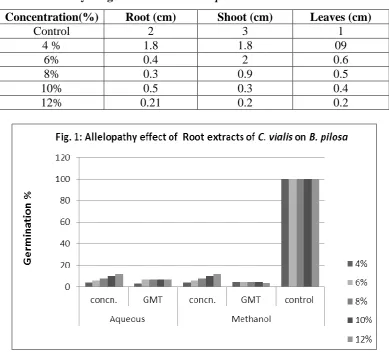
Different concentrations viz., 4%, 6%, 8%, 10% and 12% were used for the study. At 4% concentration out of 10 seeds 9 seeds germinated with very short root, shoot and leaves. At 6%, 8%, 10% and 12% only one seed germinated with very short radical when compared to control (Plate I & Fig-1).
These treated seeds were then transferred to pots and again the same concentrations were added in order to study whether the treated seeds germinate or not. After one week when observed there were absolutely no seeds which germinated. This reveals allelopathy effect of
C. vialis root aqueous exract on Bidens pilosa and Synedrella nodiflora.
ii) Methanol Extract (RME)
At 4%, 6%, 8%, 10% and 12% concentration, the germination in B. pilosa was observed with decreasing lengths (cm). The germination was concentration dependant and at higher concentration i.e. 12% very short radical, shoot and leaves length was recorded. (Table- 1 2 & 3; Fig-1).
Table 1: Allelopathy effect of Root Methanolic extract (RME) on Bidens pilosa.
Concn. (%) G %
4 100
6 90
8 80
10 80
Table 2: Root, shoot and leaf length of Bidens pilosa after treatment with RME of C. vialis.
Concn. Fresh weight
(mg)
Dry weight (mg)
Control 110 12
4 % 68 7.6
6% 60 7.2
8% 49 6.3
10% 20 6.0
[image:5.595.198.397.115.233.2]12% 16 2.4
Table 3: Fresh and dry weight of treated Bidens pilosa seeds with RME of C. vialis.
Concentration(%) Root (cm) Shoot (cm) Leaves (cm)
Control 2 3 1
4 % 1.8 1.8 09
6% 0.4 2 0.6
8% 0.3 0.9 0.5
10% 0.5 0.3 0.4
12% 0.21 0.2 0.2
iii) Chloroform Extract
There was no germination at all at any concentrations of chloroform extract.
iv) Ethyl Acetate Extract
[image:5.595.103.493.253.606.2]Plate I: Effect of root Aqueous extract (RAE) of Calyptocarpus vialis on Bidens pilosa.
LEAVES EXTRACT
i) Methanol Extract
There was no germination observed at any concentration. (Fig-2).
ii) Chloroform Extract
Plate II: Effect of Leaves Chloroform Extract (LCE) of Calyptocarpus vialis on Bidens pilosa.
iii) Ethyl Acetate Extract: No germination was observed at any concentrations (Fig-2).
STEM EXTRACT i) Aqueous Extract
At 10% of the aqueous stem extract of C. vialis, only 8 seeds germinated in plate. But when transferred to pot no seedlings further germinated and no growth was observed (Plate VI & Fig-3).
Plate III: Effect of Stem Aqueous Extract (SAE) of Calyptocarpus vialis on Bidens pilosa.
EFFECT ON SYNEDRELLA NODIFLORA
Plate IV: Effect of Root Methanolic Extract (RME) of Calyptocarpus vialis on Synedrella nodiflora.
Plate VI: Effect of Stem Aqueous Extract (SAE) of Calyptocarpus vialis on Synedrella nodiflora.
The effect of different concentrations of Calyptocarpus vialis on shoot length, root length, fresh weight and dry weight of Bidens pilosa and Synedrella nodiflora were assessed.
The aggressiveness of C. vialis growing as monoculture is a result of accumulation of allelochemicals. The allelopathic effects have affected the associated flora B. pilosa and
sustainable agriculture and loss of other susceptible plant species can be avoided which ultimately serves the best for the protection and conservation of biodiversity, as a whole.
CONCLUSION
The present study reveals the allelopathy effect of Calyptocarpus vialis on Bidens pilosa and
be usage of herbicides with mixture of molecular targeting components, which may definitely inhibit the growth of straggler daisy and thus prevent the loss of native herbaceous flora.
ACKNOWLEDGEMENT
The author sincerely thanks University Grants Commission for the award of Post Doctoral Fellow and providing financial support.
REFERENCES
1. Ahn and Chung M. 2000. Allelopathic potential of rice hulls on germination and seedling growth of barnyardgrass. Agron. J., 92: 1162-1167.
2. Ahuja KK and Pataskar RD. 1969. Synedrella vialis (Less.) A. Gray: A New record for India, Indian Forester, 95: 267.
3. Alam SM, Azmi AR. and Ali SA. 1990. Effect of purple nutsedge (Cyperus rotundus L.) leaf extract on germination and seedling growth of wheat. Pak. J. Sci. Ind. Res., 33: 235-235.
4. Batish DR. Lavanya K. Singh HP and Kohli RK. 2007a. Phenolic allelochemicals released by Chenopodium murale affect the growth, nodulation and macromolecule content in chickpea and pea. Plant Growth Regul, 51: 119- 128.
5. Batish DR. Lavanya K. Singh, HP and Kohli RK. 2007b. Rootmediated allelopathic interference of nettle-leaved goosefoot (Chenopodium murale) on wheat (Triticum aestivum). J. Agronomy & Crop Science, 193: 37- 44.
6. Duke SO, Baerson SR, Rimando AM, Pan Z, Dayan FE and Belz RG. 2007. Biocontrol of weeds with allelopathy: Conventional & transgenic approaches, In: Vurro M Gressel J (Eds.) Novel Biotechnologies for biocontrol agent enhancement and management. Springer, Netherlands, pp. 75-85.
7. Ganaie,KA, Aslam S and Nawchoo IA. 2011. No chilling obligation for germination in seeds of Arnebia benthamii: A critically endangered alpine medicinal plant of north-west Himalayas. International Journal of Biodiversity and Conservation, 3(5): 155-159.
8. Hebbar SS. Harsha VH. Shripathi and Hegde GR. 2002. Record of Synedrella vialis (Asteraceae) and Passiflora suberosa (Passifloraceae) from Dharwad, Karnataka, Indian forester, 128: 461- 464.
10.Le Tourneau D. Failes G D. Heggeness MG. 1956. The effect of aqueous extracts of plant tissue on germination of seeds and growth of seedlings. Weeds, 4(4): 363-368.
11.Rao RR and Kavitha Sagar. 2012. Synedrella vialis Less. (Asteraceae)– Yet another new invasive weed to South India. Journal of Economic and Taxonomic Botany, 34(4): 869-872.
12.Rice EL. 1984. Allelopathy. 2nd Edn., Academic Press, New York.