Mesh optimisation based on Willmore energy
ALBOUL, Lyuba <http://orcid.org/0000-0001-9605-7228>, BRINK, Willie and
RODRIGUES, Marcos <http://orcid.org/0000-0002-6083-1303>
Available from Sheffield Hallam University Research Archive (SHURA) at:
http://shura.shu.ac.uk/7891/
This document is the author deposited version. You are advised to consult the
publisher's version if you wish to cite from it.
Published version
ALBOUL, Lyuba, BRINK, Willie and RODRIGUES, Marcos (2006). Mesh
optimisation based on Willmore energy. In: 22nd European Workshop on
Computational Geometry, Delphi, Greece, March 27-29 2006.
Copyright and re-use policy
See
http://shura.shu.ac.uk/information.html
Mesh optimisation based on Willmore energy
Willie Brink∗ Lyuba Alboul† Marcos Rodrigues‡
Abstract
An algorithm for improving the quality of an ini-tial triangulation on a fixed set of vertices is sug-gested. The edge flip operation is performed consec-utively, aiming to minimise the discrete Willmore en-ergy over a triangulated surface (or mesh). The Will-more energy of a surface is a function of Gaussian and mean curvature, and measures local deviation from a sphere. Virtual points are introduced in the triangu-lation to overcome the local invariance of Willmore energy under edge flips. Some experimental results are given.
1 Introduction
Computer-based modelling and visualisation has nu-merous applications in engineering, science and the in-dustry. In particular, the digital capturing and recon-struction of a physical 3D object has applications in computer graphics and vision, computational geome-try, reverse engineering, terrain modelling, tomogra-phy and medical imaging.
A polyhedral surface, or mesh, is a piecewise planar surface and is commonly used in computer graphics for approximating smooth surfaces. We will be con-cerned with triangular meshes, hereafter referred to as triangulations.
Given a set of vertices sampled from the surface of some physical 3D object, surface reconstruction is concerned with finding an “optimal” triangulation that in some sense best approximates the original sur-face. If the coordinates of the vertices are fixed these triangulations are said to be data-dependent.
Some examples of methods for surface reconstruc-tion from scattered data may be found in [3, 6, 7]. These methods aim at constructing a triangulation that defines an underlying smooth surface (e.g. by means of subdivision) that somehow approximates the surface of the original 3D object in an optimal man-ner. Most of the reconstruction methods therefore contain an optimisation step that changes some ini-tial triangulation on the scattered data such that the resulting triangulation induces a smooth surface that is optimal. This paper focusses on that step.
∗Materials and Engineering Research Institute, Sheffield
Hallam University, UK,[email protected](corresponding au-thor)
†idem,[email protected] ‡idem,[email protected]
The problem that is addressed may be stated as follows: given a fixed set of points in 3D, typically ac-quired from the surface of a physical object by means of a 3D scanner, and some initial triangulation on these points, improve (or optimise) the local quality of this triangulation. This is generally referred to as mesh optimisation.
Some mesh optimisation algorithms based on min-imising certain geometric properties of a polyhedral surface have been proposed. Examples include min-imising the total area of the triangular mesh [10], minimising discrete analogues of the integral Gaus-sian curvature [1] and absolute mean curvature [2]. See also [5] for algorithms based on minimising these curvatures. The question of which of these algorithms produce the “best” result remains unanswered.
We propose an algorithm similar in structure to those mentioned above. However, we incorporate a geometric property known as Willmore energy. This, to our knowledge, is a new approach to mesh optimi-sation.
The rest of the paper is structured as follows: Sec-tion 2 briefly outlines the theory of discrete curva-tures, with specific focus on the Willmore energy of a surface. Section 3 describes the mesh optimisation algorithm. Some experimental results are given in Section 4 and Section 5 concludes.
2 Discrete curvatures
For a smooth surface with Gaussian curvatureKand mean curvatureH the following geometric properties are of importance: the area,RdA; the total Gaussian curvature,R K dA; the total mean curvature,RH dA; and the total Willmore energy,R(H2−K)dA.
Consider a simplicial triangular surface (i.e. a tri-angulation) with vertex setV, face setF and edge set
E. Discretisations for the first three of these proper-ties are well known for this type of surface (see for example [1, 8]).
The discrete area is simply the sum of areas of all the triangular faces.
The discrete analogue of the Gaussian curvature at a vertexv∈V is defined as
G(v) = 2π−X
i
αi,
whereαidenotes the angle atvof every triangle
given byG=Pv∈V G(v).
The discrete analogue of the mean curvature at an edge e∈E is defined as
M(e) =θ|e|,
where|e|denotes the length of the edge andθthe an-gle between the normals of the two adjacent faces. The total mean curvature is then given by M =
P
e∈EM(e).
Bobenko [4] recently proposed a discrete analogue of the Willmore energy for a triangulated surface. At a vertexv it is defined as
W(v) =X
e∋v
β(e)−2π,
where the sum is taken over all incident edges of v. For each edge e the angle β(e) is calculated as fol-lows: letvi andvj denote the endpoints ofe, andvk
andvℓ the other two vertices of the adjacent faces, as
shown in Figure 1. The value of β(e) is then defined to be the external angle of intersection between the circumcircles of the two trianglesvjvivk andvivjvℓ.
✁ ✂
✁ ✄ ✁☎
✁ ✆
[image:3.595.319.507.167.247.2]✝✞ ✟ ✠
Figure 1: The angle β(e) of an edgee= (vi, vj).
The total discrete Willmore energy of the mesh is then given byW =Pv∈VW(v).
Bobenko [4] derives some properties of this energy, most notably that W(v) ≥ 0 and W(v) = 0 if and only ifv is convex andvand all its neighbours lie on a common sphere (possibly with infinite radius, i.e. a plane).
It is therefore expected that a surface with mini-mum Willmore energy would be smooth and visually pleasing. This motivates the need for developing a mesh optimisation algorithm that aims at minimising Willmore energy.
3 Mesh optimisation
Consider a given set of vertices V and some initial triangulation on these points. Our mesh optimisation algorithm attempts to minimise the discrete Willmore energy of this surface by changing the triangulation.
Following the methodology of [2], the triangulation is changed with the edge flip operation illustrated in Figure 2. A cost function is defined for a specific triangulation and edge flips that result in a decrease in this cost function are then performed successively until a minimum is reached.
✁ ✁
✁ ✁
✁
✁
✁ ✁
✁
Figure 2: The edge flip operation.
The algorithm assigns to each edge a value that reflects the difference between the cost function before and after flipping the corresponding edge. We refer to this value as the cost reduction value.
The order in which the edges are flipped may be chosen by an optimisation method such as simulated annealing, but at this stage our algorithm is greedy in nature, flipping an edge that maximally reduces the cost function at every step. It is important to note that this may not always lead to a global minimum in the cost function and the algorithm may terminate at a local minimum. Techniques to escape from such a local minimum are currently under investigation. Pos-sibile strategies include implementing multiple edge flips at each step [9].
Since the aim of our algoritm is to minimise the Willmore energy of the surface we want to define the cost function to be the total discrete Willmore energy of the current triangulation. However, as also men-tioned in [4], for an edge eand its flipped versione′,
β(e) =β(e′). This may lead to the Willmore energy
being locally invariant under flips.
Attempting to overcome this we introduce “virtual” points to the triangulation. To assign a cost reduction value to an edgeewe implement a simple subdivision scheme by adding a vertex v in the middle of eand connect it as shown in Figure 3. The total Willmore energy is calculated for this new triangulation and then compared to the total Willmore energy of the triangulation resulting from flipping e to e′, with a
pointv′in the middle ofe′. The cost reduction value
of eis then taken to be the difference between these energies. Since in general the positions of v and v′
would differ there would also be a difference in the Willmore energy before and after the flip.
We call the pointsv andv′ virtual since they only
[image:3.595.92.233.373.513.2]✂ ✂
✂
✂
✄
☎ ✆
✝ ✝
✝
✝ ✁
✞
✟ ✟
✟
✟
✠
✡ ✆
[image:4.595.74.283.85.234.2]✞
Figure 3: Adding points to the triangulation.
In one of the proofs of Bobenko [4] the combina-torics of a mesh is changed by adding points to every edge and connecting them in a similar way as depicted in Figure 3. This is done in order to render an ab-stract simplicial sphere inscribable and is therefore essentially quite different from what we are doing.
In the implementation of the algorithm there are some types of edges that cannot be flipped without changing the topological type of the triangulation. An edge e with flipped version e′ should not be flipped
ife′ is already an edge of the triangulation. For such
edges we define the cost reduction function to be−∞. Note also that β(e) is undefined for a boundary edgee (i.e. an edge with only one adjacent face). It is also clear that a boundary edge cannot be flipped. Hence the cost reduction function of boundary edges are also defined as−∞.
It is important to realise that the algorithm de-scribed above does not necessarily minimise the total discrete Willmore energy of the triangulated surface since this energy might remain unchanged under edge flips. The virtual Willmore energy (VWE) might be a new type of energy somehow related to the Will-more energy. It can be said that our algorithm at-tempts to minimise the VWE over a triangulation in the hopes of minimising the Willmore energy of the underlying smooth surface induced by the triangula-tion. Whether or not this would always be achieved is still under investigation although experiments do suggest that it would.
4 Results
This section provides some experimental results from applying our mesh optimisation algorithm on a few test models.
The data of the first model comprises of the 8 cor-ners of a cube with 6 vertices added to the centres of each face, slightly inside the cube. Figure 4 shows on the left an initial triangulation on these vertices. The result of applying our algorithm on this triangulation is shown on the right of the figure.
[image:4.595.323.542.219.322.2]What is interesting about this result is that the ini-tial triangulation is a so-called tight triangulation [1], i.e. a triangulation on the data with minimum total absolute extrinsic curvature. Our algorithm changes this triangulation to what appears to be a triangu-lation with minimum total area. An algorithm that minimises total absolute curvature [2] has the exact opposite effect on this data. Exactly how these al-gorithms relate to each other is a topic for further study.
Figure 4: Test model I - a cube with 6 added vertices, initial (left) and optimised (right).
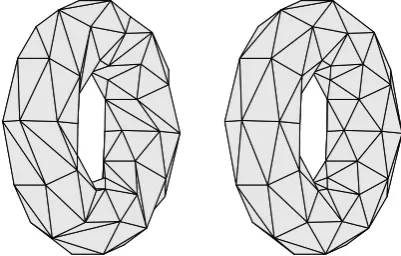
The second test model consists of points sampled on the surface of a torus. Figure 5 shows an initial triangulation on the left. On the right of the figure the result of applying our algorithm is shown.
The resulting triangulation is clearly more regular (the triangles are more or less equal in size). The tri-angulation is also visually smoother. This may be due to the fact that for a region of a smooth surface that closely resembles a sphere the corresponding Willmore energy is close to zero. It would seem that our algo-rithm attempts to extract regions in a triangulation that is spherelike.
Figure 5: Test model II - points sampled on a torus, initial (left) and optimised (right).
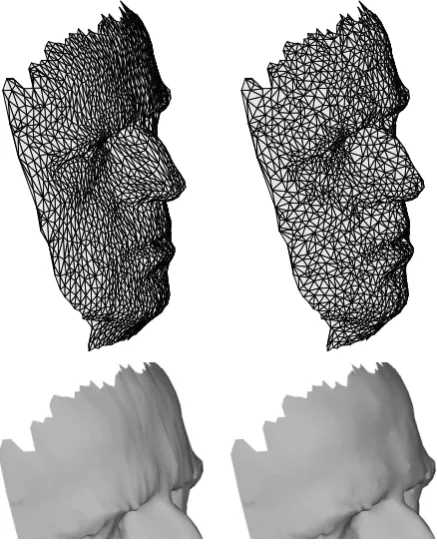
[image:4.595.332.533.527.655.2]top right of the figure. The figure also shows shaded versions of the top parts of these two triangulations.
[image:5.595.48.267.213.486.2]There are many “vertical” edges visible in the initial triangulation. This is a parameterisation artifact and results in the underlying smooth surface to have many vertical creases (see lower left part of Figure 6). Our algorithm does seem to smooth out these creases (a result from flipping most of the vertical edges in the initial triangulation), as can be seen on the lower right of Figure 6.
Figure 6: Test model III - points sampled on a face, initial (left) and optimised (right).
Regarding the compexity of the algorithm, consider a triangulation with n edges. By keeping record of adjacency in the mesh (edges to faces) a single edge flip can be performed inO(1) time. Searching through a priority queue for which edge to flip would require
O(logn) time. The worst case scenario, in which every edge is flipped, would thus beO(nlogn).
5 Conclusion and future work
We presented a new mesh optimisation algorithm. The algorithm attempts to minimise the so-called vir-tual Willmore energy of a triangulation by performing the edge flip operation successively.
An important area for further research is to study and develop methods for escaping from local minima in the cost function. Implementing other optimisation strategies such as simulated annealing, rather than our greedy method, might prove to be useful.
Another important issue in the algorithm is that
some edge flips can result in the surface intersecting itself. Detecting these edges and avoiding such inter-sections is still an open problem.
Based on results obtained experimentally our algo-rithm seems to be promising. It should be stressed that the arguments upon which the algorithm is built are mostly heuristic in nature and a comprehensive analytical analysis is necessary.
Topics of current ongoing research also include de-termining under what circumstances the choice of where to position the virtual points on the edges af-fects the outcome, and the relationship between this algorithm and other algorithms such as minimising area or mean curvature.
The discrete analogue of Willmore energy is rela-tively new. It would be interesting to learn how dif-ferent areas in shape modelling could benefit from this concept.
References
[1] L. Alboul and R. van Damme. Polyhedral metrics in surface reconstructions. In: The Mathematics of Surfaces VI, G. Mullineux (Ed.), Clarendon Press, Oxford, 171–200, 1996.
[2] L. Alboul, G. Kloosterman, C. Traas and R. van Damme. Best data-dependent triangulations. Jour-nal of computatioJour-nal and applied mathematics, 119:1– 12, 2000.
[3] F. Bernardini and C.L. Bajaj. Sampling and recon-structing manifolds using alpha-shapes. Proceedings of the 9th Canadian conference of computational ge-ometry, 193–198, 1997.
[4] A.I. Bobenko. A conformal energy for simplicial sur-faces. Combinatorial and computational geometry, 52:133–143, 2005.
[5] N. Dyn, K. Hormann, S.J. Kim and D. Levin. Op-timizing 3D triangulations using discrete curvature anlysis. Mathematical methods for curves and sur-faces, Oslo, 135–146, 2000.
[6] H. Hoppe, T. DeRose, T. Duchamp, J. McDonald and W. Stuetzle. Surface reconstruction from unorganized points. ACM SIGGRAPH ’92, 71–78, 1992.
[7] K. Hormann. From scattered samples to smooth surfaces. Proceedings of the 4th Israel-Korea bi-national conference on geometric modeling and com-puter graphics, 1–5, 2003.
[8] M. Meyer, M. Desbrun, P. Schr¨oder and A.H. Barr. Discrete differential-operators for triangulated 2-manifolds. In: Visualization and mathematics III, Hege and Polthier (Eds.), 35–57, 2003.
[9] A. Netchaev. Triangulations and their application in surface reconstruction. PhD thesis, University of Twente, The Netherlands, September 2004.