Working with top management teams : conversations
contributing to board development
FIELD, Richard D
Available from Sheffield Hallam University Research Archive (SHURA) at: http://shura.shu.ac.uk/6850/
This document is the author deposited version. You are advised to consult the publisher's version if you wish to cite from it.
Published version
FIELD, Richard D (2005). Working with top management teams : conversations contributing to board development. Doctoral, Sheffield Hallam University.
Copyright and re-use policy
See http://shura.shu.ac.uk/information.html
Fines are charged at 50p per hour
ProQuest Number: 10694530
All rights reserved
INFORMATION TO ALL USERS
The quality of this reproduction is dependent upon the quality of the copy submitted.
In the unlikely event that the author did not send a com plete manuscript and there are missing pages, these will be noted. Also, if material had to be removed,
a note will indicate the deletion.
uest
ProQuest 10694530
Published by ProQuest LLC(2017). Copyright of the Dissertation is held by the Author.
All rights reserved.
This work is protected against unauthorized copying under Title 17, United States C ode Microform Edition © ProQuest LLC.
ProQuest LLC.
789 East Eisenhower Parkway P.O. Box 1346
Working with Top Management Teams: Conversations Contributing to Board Development
Richard D Field OBE MPhil
A thesis submitted in partial fulfilment of the requirements of Sheffield Hallam University
for the Doctor of Business Administration
Richard D Field OBE MPhil
Working with Top Management Teams: Conversations Contributing to Board Development
A thesis submitted in partial fulfilment of the requirements of Sheffield Hallam University for the Doctor of Business Administration (DBA)
April 2005
Abstract
There has been much written about top teams, that is, existing teams that have the executive responsibility for leading their organisations each day, not specifically focused on one project or one change programme. However, little research has been carried out on meetings processes within ongoing top management teams and almost no research has been carried out over an extended period which has involved top management team members in their own Action Research. This research covers the period from early-2000 until mid-2004, and includes fieldwork with three organisations: Yorkshire Water, Loop Customer Management and A4e Work. An ‘Iterative Meetings Model’ has been developed that identifies what areas emerge when addressing team meetings; and within this model there has been developed a ‘Dialogue
Declaration:
This thesis is all my own work, and has not been submitted for any other academic award.
Contents
Chapter 1 Introduction...1
1.1 Overview of the chapter...1
1.2 Purpose and process of thesis...1
1.3 Outline of this thesis...2
1.4 Justification for the research... 3
1.5 Methodology...4
1.6 What a Top Management Team is... 5
1.7 What a Top Management Team is not... 5
1.8 Pre-learnings...5
1.8.1 1973 -1980 (aged 28 to 35)...6
1.8.1.1 Bridon Wire Limited...6
1.8.1.2 Manchester Business School... 7
1.8.1.3 Bamford Business Services... 7
1.8.1.4 Lessons learned (1973 -1980)... 9
1.8.2 1980 -1994 (aged 35 to 49)...9
1.8.2.1 The Dyson Group pic...9
1.8.2.2 Annual Objectives...11
1.8.2.3 Top Management Programme...11
1.8.2.4 Queen Margaret’s School...12
1.8.2.5 Lessons learned to date (1973 -1994)... 12
1.8.3 1994 - 2001 (aged 49 to 56)... 13
1.8.3.1 Hong Kong...13
1.8.3.2 Kaku - President of Canon...14
1.8.3.3 Discipline...14
1.8.3.4 Lessons learned to date (1973 - 2001)... 15
1.9 Research question(s) ...15
1.10 Summary of chapter and link forward... 16
Chapter 2 Literature Survey...17
2.1 Overview of the chapter...17
2.2 Structure of the chapter...17
2.3 First research question: In top management teams, is there a process that could encourage communication?... 18
2.3.1 How do effective top management teams spend their time? 18 2.3.2 How do top management team members presently communicate within their teams? ...27
2.3.3 Back to the first research question: In top management teams, is there a process that could encourage communication?...30
2.3.4 What is dialogue?...33
2.3.5 More on conversations...39
2.3.6 Other processes of communicating within a top management team... 43
2.4 Second research question: Is there a model that enhances understanding of the teams’ progress, or lack of it?...50
2.5 Third research question: Is there a way of measuring that progress?... 59
Chapter 3 Methodology and Methods...65
3.1 Overview of the chapter...65
3.2 Context...65
3.3 Methodology...65
3.3.1 Ethnography and case study... 67
3.3.2 Action Research, Action Science and Action Inquiry...69
3.3.3 Why Action Research rather than consultancy or ‘basic’ research?...75
3.3.4 Periods of deep reflection... 76
3.3.5 So how does Action Inquiry work in practice?...77
3.3.6 Developing the theoretical research model... 82
3.4 Methods...87
3.5 Assembling and Retrieving Data... 96
3.6 A4 Books, Microsoft Word and lever arch files...96
3.7 Visual Concept...98
3.8 NVivo (NUDIST)... 99
3.9 Reflecting and Giving Feedback... 101
3.9.1 Marking the four-stage group development model then discussing those marks in the team... 102
3.9.2 Reviewing of previous workshops; reviewing each dialogue and conversation; and reviewing of each workshop... 102
3.10 Validity, reliability, and its link with triangulation...103
3.10.1 Validity...103
3.10.2 Reliability...103
3.10.3 Triangulation...104
3.11 Summary and lessons learned...105
Chapter 4 Fieldwork...106
Chapter 4.1 Yorkshire Water (November 2000 to June 2004)...108
Introduction... 108
Company Background...109
Overview of the journey...110
Context... 116
Before Dialogue (December 2000 to December 2001)... 116
During Dialogue (Calendar year 2002)... 132
Interviews with the CEO...140
Workshop in June 2004... 144
Summary of the Yorkshire Water Story...149
Chapter 4.2 Loop (October 2002 to September 2003)...151
Introduction... 151
Company Background...151
Overview of the journey...153
Initial Interviews in October and November 2002... 156
Meeting with CEO and HR Director...184
Comments from team members on this story... 185
Workshop in June 2004... 189
Summary of the Loop Story...192
Chapter 4.3 A4e Work (May 2001 to July 2004)... 195
Introduction... 195
Company Background...195
Before dialogue...199
During dialogue...200
A process...203
After dialogue...204
Comments from team members on this 'case study'...213
Summary of the A4e Work Story... 218
Fieldwork Summary...219
Chapter 5 Findings... 221
5.1 Overview of the chapter... 221
5.2 Why?...223
5.2.1 Why is the CEO key to the process?... 223
5.3 What?...227
5.3.1 What is the ‘Iterative Meetings Model’?... 227
5.3.2 What do effective top management teams talk about?...229
5.4 How?...230
5.4.1 How does the ‘Dialogue Process for Top Management Team Meetings’ work?...231
5.4.2 How can top management teams measure their progress or lack of it?...237
5.5 So what?...243
5.5.1 So what effects has development upon the quality of arguments? ... 243
5.5.2 So what continuing development is needed for top management teams?...245
5.5.3 So what about teams that are not top management teams? .... 251
5.5.4 So what are the learnings for the researcher/facilitator? 252 5.5.5 So what is the essence of top management teams being effective in meetings?...256
Chapter 6 Conclusions... 259
6.1 Overview of the chapter...259
6.2 Top management teams need a specific purpose and/or vision separate from that of their organisations... 259
6.3 A key principle in top management team conversations is the need for a short cycle of time between dialogue, and review and planning261 6.4 The dialogue process does not work unless all of those present are committed to each others’ and the team’s success...263
6.5 Limitations of this study...264
6.6 Recommendations for further research... 265
6.7 The last word...269
Appendices...270
Appendix 1: List of appointments held by the researcher...270
Appendix 2: Interview questionnaire: used with members of the top management teams, managers, and staff in client organisations 271 Appendix 3: Role of the Board questionnaire... 273
Appendix 4: Yorkshire Water Behaviours questionnaire...274
Appendix 5: Initial guidelines given to top management teams 275 Appendix 6: Conditions for dialogue + conversations...277
Appendix 7: Initial questionnaire used... 281
Appendix 9: The Purpose of the Top Management Team of Yorkshire Water...284 Appendix 10: Progress of GB Posters’ directors and managers during the eighteen months to June 2004... 286 Appendix 11: Procedures produced by both Loop and A4e Work, and
principles produced by A4e Work... 287 Appendix 12: Example of a book review recorded on flipcharts 288 Appendix 13: Kolb’s learning styles... 289 Appendix 14: The six criteria in great companies (Collins 2001:12). 289 Appendix 15: “First, Break All The Rules” 12 questions...290 Appendix 16: Good to Great Questionnaire... 291 Appendix 17: The six Good to Great questions...297 Appendix 18: Route maps for development of the top management team...298 Appendix 19: Some of the development processes and why they were used...299 Appendix 20: Feedback process used with Yorkshire Water 301 Appendix 21: The Iterative Meetings Model... 302 Appendix 22: Yorkshire Water: The team’s reviews of their dialogue sessions...303 Appendix 23: Loop: The team’s reviews of their dialogues sessions306 Appendix 24: A4e Work: The team’s reviews of their dialogue sessions ... 315 Appendix 25: Strengths and weaknesses of research methods chosen ...321
Exhibits
All figures, tables, diagrams and photographs are labelled Exhibits.
Exhibit 2.1: Team Performance Curve (Katzenbach + Smith 1993:84)...19
Exhibit 2.2: The more uncertainty in its task, the more any group has to share (Critchley + Casey 1996:340)... 21
Exhibit 2.3: Casey Model, linked by the researcher, with clockwork, snake pit & rainforest organisations... 24
Exhibit 2.4: Casey Model & Flow of Csikszentmihalyi, linked by the researcher... 26
Exhibit 2.5: Adapted from Scharmer’s dialogue process (Isaacs 1999a:261)49 Exhibit 2.6: Lacoursiere’s (1980:151) group development stages (GDS) model adapted by Blanchard et al (1996:107)...58
Exhibit 2.7: Photo of the adapted model of Tuckman’s stages... 58
Exhibit 2.8: Wilbur’s Four Quadrants (1996:71; 2000:71), adapted by the researcher...60
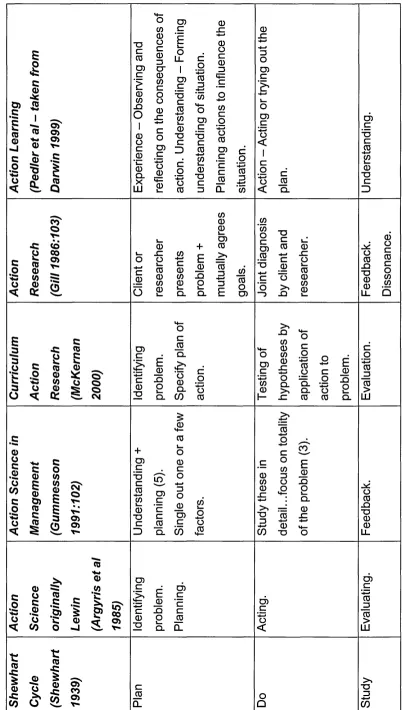
Exhibit 3.1: Model adapted by Woodsmall (1999:15) from McCarthy (1987) 78 Exhibit 3.2: Table of comparative iterative research methodologies (1)... 79
Exhibit 3.3: Table of comparative iterative research methodologies (2)... 80
Exhibit 3.4: Action Inquiry using the Hermeneutic Cycle (incorporating the 4MAT system)...83
Exhibit 3.5: Example of the use of Visual Concept constructed byA4e Work team...99
Exhibit 3.6: Document Explorer in NVivo... 101
Exhibit 4.1: Yorkshire Water team’s vision... 122
Exhibit 4.2: Graphs...145
Exhibit 4.3: This graph shows the results of some twenty-nine interviews of directors and managers in February and March 2003; the full questionnaire is set out in Appendix 16... 147
Exhibit 4.4: Perceptions of Yorkshire Water’s Top Management Team from December 2000 to November 2002, using the business measures set out in Appendix 7: By themselves...147
Exhibit 4.5: Perceptions of Yorkshire Water’s Top Management Team to February 2003, using the business measures set out in Appendix 7: By themselves and managers...147
Exhibit 4.6: Perceptions of Yorkshire Water’s Top Management Team December 2000 to June 2004, using the business measures set out in Appendix 7: By themselves...148
Exhibit 4.7: Yorkshire Water’s Four-Stage Development Models for June 2002 and June 2004...148
Exhibit 4.8: Team’s perceptions marked on a flipchart... 163
Exhibit 4.9: Perceptions of Loop Top Management Team’s performance to September 2003, using the business measures set out in Appendix 7: By themselves...190
Exhibit 4.11: Perceptions of Loop Top Management Team’s performance
against their five company values: By themselves...191
Exhibits 4.12, 4.13 and 4.14: Perceptions of Loop Top Management Team’s stages on the four-stage development model in February, March and May 2003: By themselves...191
Exhibit 4.15: Perceptions ofA4e Work Top Management Team’s performance from May 2001 to February 2004, using business measures set out in Appendix 7; By themselves... 216
Exhibit 4.16: A4e Work Top Management Team’s own rating against the six Good to Great questions (GGQ) (Collins 2001:12- see Appendix 17) in February 2003, plus one year forward and one year back....216
Exhibit 4.17: A4e Work Top Management Team’s own rating against the twelve “First Break All The Rules” questions (FBQ) (Buckingham + Coffman 1999:28 - see Appendix 15) at November 2003, both with the CEO and without him... 217
Exhibits 4.18, 4.19 and 4.20: Perceptions ofA4e Work Top Management Team’s on the four-stage development model in January 2002, March 2003, and July 2003: By themselves... 217
Exhibits 4.21, 4.22 and 4.23: Perceptions ofA4e Work Top Management Team’s on the four-stage development model in November 2003, January 2004, and February 2004: By themselves...218
Exhibit 4.24: Perceptions of A4e Work Top Management Team’s on the four-stage development model in May 2004: By themselves...218
Exhibit 5.1: The Iterative Meetings Model (see Appendix 21 and Exhibit 3.4 for further details)...229
Exhibit 5.2: Role of the board... 230
Exhibit 5.3: Researcher’s perception of the direction of energies within the team in each quadrant... 245
Exhibit 5.4: The Vine... 249
Exhibit 5.5: Thinking, feelings and actions in each of the 4 quadrants 250 Exhibit 5.6: Yin & Yang, adapted by the researcher: on the left, to reflect the words of the principle of knowing polarity (Wing 1988:42); and on the right, incorporating thinking, feelings and actions in each of the 4 quadrants within ‘all things’...258
Exhibit A5.1: Initially used with Yorkshire Water in February 2002 (Adapted from Dixon, 1998:11)... 275
Exhibits A5.2, A5.3, A5.4 and A5.5: Used with dialogues (Adapted from Flick 2000:36)...276
Exhibit A10.1: GB Posters’ progress... 286
Exhibit A11.1: Process designed and used by Loop in March 2003... 287
Exhibit A11.2: Process and set of principles produced and used by A4e Work in May 2004...287
Exhibit A12.1: Book review on flipcharts... 288
Exhibit A18.1: Route maps...298
Exhibit A20.1: Feedback process used with Yorkshire Water....301
Working with Top Management Teams: Conversations Contributing to Board Development
By
Richard D Field OBE MPhil
Chapter 1 Introduction The Journey Begins
1.1 Overview of the chapter
After a brief introduction into the importance of this research and my case for making a contribution to this field, stories of key pre-learning experiences are shared. This then leads on to the questions that will be addressed in the research process.
1.2 Purpose and process of thesis
Some top management teams are effective and others are not. What if there was a process of conversing together that would enhance the chances of teams being effective?
This thesis discovers and develops:
• an overall process for identifying what meetings need to take account of to enhance the likelihood of their success,
• a process of communicating which has a role in enhancing the effectiveness of top management teams,
• guidelines and principles underpinning effective team communication, • a process for monitoring the progress of top management teams, • a process for reflecting upon and learning from the journey, • the key role that CEOs play in developing their teams, • the need for a top management team purpose,
The process includes: using pre-learnings to identify some beliefs of the researcher; a literature survey to reflect upon and learn from the writings and research of others; through this, to identify an initial theory and produce a model for use with three selected companies. A methodology and methods are then identified, and are employed within the companies and in the records of the researcher, and summarised within this thesis; and findings from the practical applications of the theoretical model are then analysed and
evaluated; and finally both findings and conclusions are drawn with lessons learned and further areas for research identified.
1.3 Outline of this thesis
Chapter 1 covers why communication within top management teams is worthy of study, and why the researcher believes that he can add value to this area of knowledge. This is backed up by some pre-learnings and concludes by
setting out questions to be addressed in the research being undertaken.
Chapter 2 focuses on these research questions by surveying relevant literature and concentrates upon communication within top management teams, dialogue and conversations, development of teams over time, feedback and reflection. It then brings together the learnings by positing a theoretical model on how top management teams can communicate more effectively together.
Chapter 3 identifies a methodology and methods used after looking at a number of approaches, to find one that will be appropriate to the questions to be addressed and the approach being taken with the fieldwork. The chapter also covers all of the methods used and how the information obtained was stored for effective recovery and further application. The strengths and weaknesses of each have also been identified and are set out in the appendices.
analysis and findings; also included are interviews with CEOs and comments from the participants/fellow-researchers on these case studies, after sharing the researcher’s write-ups with them.
Chapter 5 consolidates the progress to date. This chapter brings together the findings from both the literature survey and fieldwork, and sets out twenty- eight of the implications of this research: what needs to be taken into account when considering meetings, how to communicate within a meeting, identifying a means of measuring progress, or lack of it, and learning from reviews and reflections - for top management teams, facilitators and researchers.
Chapter 6 ends the thesis by focusing upon just three conclusions and further contributions to knowledge, each of which will affect the performance of the top management teams during their meetings together. It also suggests further research needed in this area, and limitations of this study.
1.4 Justification for the research
Since 1973, I have been a member of over two dozen boards, as chairman, CEO, and as an executive and a non-executive director (Appendix 1); and have also worked with a number of other boards and project teams. During this time I have been searching for a more enjoyable, productive and
consistent way of participating, communicating and working with colleagues; some way that would also enhance the effectiveness of top management teams. Or put another way, I have sought to reduce the pain and increase the pleasure of the journey.
Shareholders exert a growing influence through not only the Stock Exchange but also through, in an increasing number of cases, confrontational annual general meetings (Durman 2003:3.5). Employees look to their boards to provide security, stability of employment, and an increasing standard of living. Legislation on what directors must do and must not do is increasing (Becket 2003:A3; Pierce 2001:9); communities look to their local employers to 'get involved' in providing money, time and expertise for their good causes and to look after the environment (Cadbury 2002:156; Smith 2004:S14; Taylor 2004:2). The boards are also expected to lead their organisations with clear and inspirational purpose and direction; plus create cultures of 'success and happiness’, have achievable strategies - which they believe to be true (Moore 2004:27) - and find time to report back regularly to all their stakeholders in line with Stock Exchange regulations. And, as if that is not enough, board
members have lives outside of work that need to be lived to the full and enjoyed as well! The nature of the lives of directors is often likely to be frenetic, stressful, action-orientated and performance-related, in fact “life has probably never been harder for board directors” (Wyman 2004:10).
1.5 Methodology
Research addresses ethnography, case study, action research, action
science, action inquiry, consultancy, and ‘basic research’, before settling on an action research ontology and epistemology, and within that, an action inquiry methodology. After designing a model of Action Inquiry using the Hermeneutic Cycle (incorporating the 4MAT system) the chapter goes on to identify each method used, setting out why it was used, what it entailed and, in Appendix 26, the strengths and weaknesses of each, and finally setting down the effects the methods had on the outcome. Methods used were: interviews,
1.6 What a Top Management Team is
For the purposes of this thesis, a top management team is an executive team in which the CEO and his/her executive members work together to lead their organisation, with the intention of focusing on the long-term sustainability and enhancement of their business. I have served, or am serving, as an executive chairman/director on eight such teams (Appendix 1).
1.7 What a Top Management Team is not
A top management team, for the purposes of this thesis, is not one that
consists of any non-executive members. A top management team, for the
purposes of this thesis, is also not one that consists of any project teams, that
is, teams set up for the purpose of completing a project. The reason for their exclusion is that, in my experience, one has a different mindset when pursuing a single objective, which might well be short-term in duration. Again, in my experience, it is easier to sustain a passion and enthusiasm for a one-off, often short-term, objective, than for an on-going long-term commitment.
1.8 Pre-learnings
The importance of this section is that all that follows was the
Set out below are experiences during a journey of some twenty-eight years from first becoming a member of a top management team to starting this research. The incidents share a number of learnings that constitute a springboard, a theory, from which this research has commenced; also set down are the questions that the research has focused upon answering. In 1980 I started writing journals of my key business experiences; there are now 167 completed A4 journals setting down meetings, conferences, workshops, phone calls, reflections, planning schedules and action notes (Megginson 2003:85+88). It is whilst reading through and reflecting upon these journals that the following stories have emerged as relevant to this research. To make this section clearer and easier to follow, the selected stories are set out in chronological order by date and include context, incident, thoughts, feelings, actions, and learnings.
1.8.1 1973 -1980 (aged 28 to 35)
In 1973, seven years before the A4 journals were started, I joined my first top management team, at:
1.8.1.1 Bridon Wire Limited
The Bridon Group (now Bridon pic) reorganised into three major subsidiaries in 1973, and I became chief accountant of one of them, Bridon Wire Ltd, and two and a half years later, Finance Director. There were two thousand
employees in the company, with sixty in my team responsible for the
company’s finances, group administration, group transport and group IT. Our monthly board meetings covered the progress and strategic direction of the company; however we were never really close to each other, each focusing on our own functions (de Geus 2000:92). For example, at one meeting a director presented a plan which had major implications for the company and others within the team, but none of us had been consulted upon his
and to prepare; and second, because the director hadn’t let me know of his intentions. Probably there was also a feeling of guilt, because I was just as guilty as this director of not consulting with team members on other issues. So the actions taken were to field the inevitable financial questions as best as I could; rather poorly, as I recall. My learnings were that a team cannot function effectively without involving each other in activities that affect them.
1.8.1.2 Manchester Business School
In 1980, as the three major subsidiaries of the Bridon Group consolidated back into one, I was made redundant. This gave me the opportunity to attend the General Management Programme at Manchester Business School to find out more about how to manage. Forty of us spent ten weeks under the watchful eyes of Tom Lupton, Enid Mumford, Tudor Rickards and others; reading, learning, participating in exercises, and sharing theories and experiences on general management and leadership. My thoughts were that this is not what I expected or wanted at all! We are being given theories and case studies, and told to be flexible and creative; I'm a trained accountant - I need rules and facts - it’s frightening; a great many people seem to know what to do, and how to do it, and I’m very confused. Even the factory that some of us visited
(BICC) felt 'uncontrolled' and vulnerable; there must be other ways and places from where to learn, to give me more confidence in the ways of management and in myself. So after this experience, I joined a small team of business consultants at Bamford Business Services Ltd, rather than return to another large organisation, in order to apply the theories learned at Manchester Business School (MBS) and to gain some experience in how to work as a ‘company doctor’. My learnings from MBS were that managing is not like working on a set of accounts: there seem to be no 'once and for all' answers when working with people.
1.8.1.3 Bamford Business Services
and also to run a business consultancy, Bamford Business Services, which I joined. For me, and interestingly for my wife Pippa - who felt that she was
part of this ‘family’ - these were two of the happiest years of my working life. Incident (1): 'Richard, we have a company that needs immediate attention: I need you there first thing in the morning - for as long as it takes.' 'But Hugh I've got these five other projects on the go; how on earth can I fit this one in as well?' 'You're right, I had forgotten; you've got quite enough on your plate, there's only one thing for it, I'll do it myself.' Now, however hard I was working, my perception was that Hugh was working far harder than I was. 'No, it's OK Hugh - I'll do it.' Incident (2): 'Richard, you've been working over in Wales for some weeks now, I need a meeting with you at The Rising Sun in Bamford; can you leave early and be with me at 7.30pm?' 'Yes, of course, Hugh.' When I arrived, Hugh and Ruby, his wife, had organised a surprise party for all of the team - partners, including Pippa, had been secretly invited; it was a wonderful and unique experience. Incident (3): I was winding up a project in London, so completed and submitted my timesheet as usual; the week had been long, ninety-nine chargeable hours. Back came a note from David Frith, 'Slacking again, Richard, you can't even manage I00 hours!' Hugh asked me to pop in on the following Monday and said, 'Now that you have finished the project, go home and see something of your daughters and Pippa, take a week's holiday.' This is the only time I can remember ever being given such a caring and precious gift, upon reflection, I have never given such a gift either.
became possible, for few others, in my experience, work to such high
standards. My learnings were to find and work with role-models - and hang on to their shirt-tails! Be prepared to be like a child and constantly ask questions and learn from them.
1.8.1.4 Lessons learned (1973 -1980)
1. A team cannot function effectively without respect for each other. 2. There are no hard and fast rules when working with people.
3. Effective top management team members need to be role-models for those around them.
1.8.2 1980 -1994 (aged 35 to 49)
1.8.2.1 The Dyson Group pic
After two years with Bamford Business Services, I joined J & J Dyson pic (now Dyson Group pic). Having been a non-executive director for a year, I was told by the group chairman, 'Richard, stop banging the table and get in and do some work!' I became chairman of the group’s two major subsidiaries, Dyson Refractories Ltd and Pickford Holland Ltd. These two companies were making combined losses of £300,000-£400,000 a month, and the overdraft and stocks were each increasing at the rate of £3 million a year. Incident (1): After
Director (now Group CEO) Mike O'Brien, who knew what needed to be done. He soon became a role-model for me for what a top management team member needs to be and do. Example: Initially we reduced our workforce by 500 to 1,500 in early 1981, to assist in stemming the mounting losses;
however, the situation worsened as the coal strike cut UK output of steel again: between 1970 and 1980 UK steel production reduced from 28.3 to 11.3 million tonnes (ISSB Crude Steel Production figures - Temple 2004:1) and 85% of Dyson's output was being sold to the British Steel Corporation (now Corns Group pic). In 1982,1 found myself in exactly the same position as some of the directors were a year before: unable to make a decision upon what further actions to take, for now the 1,500 employees had become friends. It was Mike O'Brien who clarified what needed to be done which, in my
opinion, saved the group from extinction or, at least, from a great deal more pain and trauma. My learnings were twofold: that I was very lucky that Mike was there; and when addressing a problem, feelings can have a major impact upon one’s decision-making capacity.
Incident (2): Turning to an old friend David Frith, Managing Director of
Bamford Business Services: 'Other than agreeing and implementing a strategy within the company, what should I be doing as CEO?' 'Only two things,' said David, 'first, be there when your people need you and, second, listen.' My thoughts were that this sounded too simple a solution; yet I tried it and it worked. Example: As the company began to stabilise, we needed to build a
new factory on one of our sites; the factory manager at our Totley site in Sheffield, John Gray, invited me to his managers' meeting, where they gave a presentation upon why theirs was the best site to locate the factory. Later, as we were walking around the site, I said, 'John, thanks for the presentation but I can't promise you'll get the factory.' He replied, 'I understand that and
wherever you decide to build it we'll support you 100%.' 'Why?' 'Because you came and listened to us, Richard.' (Thank you, David Frith!) My learning was to be there when needed and listen. Upon reflection, this advice is just as true for life in general as it is for top management teams. Incidentally, we did
1.8.2.2 Annual Objectives
There were many things that needed enhancing in my life, and there still are. At that time they were: being a better chairman, becoming healthier, being a more attentive husband and father, etc. Incident (1): For five years, I clarified my objectives over the Christmas holidays, and then budgeted time to achieve them by breaking the budget down by month, by week, by day, and then into quarter of an hour slots; these were then monitored every two hours or so, and then analysed and evaluated weekly. Thus, I knew exactly what I needed to do and how much time it would take me to get where I had decided to go, it also gave a sense of being grounded and focused that I had never felt before. This rigid schedule, every day for five years, helped achieve all of my objectives, and the journey was written up in the Yorkshire Post (Wilford 1992). My learnings were that focus brings achievement, and it’s a discipline that needs persistence. Incident (2): After five years, I couldn’t muster any enthusiasm for identifying a further set of objectives, another five-year plan, so walking in the park with a friend, Paul Thompson, I shared my concerns. He said, ‘Who is your role-model?’ ‘Well, ultimately, Jesus Christ.’ ‘Did he have a five year plan?’ ‘Not him!’ From this revelation we decided that what was a more appropriate way forward was to spend more time preparing for the future, whatever that might bring, rather than planning in so much detail. My thoughts were that this is more empowering, more flexible and less rigid; feelings of a sense of release, and also sadness and unease at no longer having a
disciplined and structured process to follow. As a result I became more relaxed and open, but not so ‘achieving’ or focused. The learning was that a solution at one stage of one’s life may be inappropriate at another (Megginson 1999:64).
1.8.2.3 Top Management Programme
After participating in numerous courses, I attended the Cabinet Office's Top Management Programme with twelve civil servants and twelve
were split into groups and given the challenge of solving Britain’s housing problem: We were given dozens of books and parliamentary papers to refer to, and we had one day to complete the task. My thoughts were: ‘Why on earth am I on this programme? In business we solve problems, this is insoluble! Perhaps it’s time to pack up and go home, for I feel out of my depth, helpless, and angry with the organisers for giving us such a complex problem’. Well, I didn’t go home, I participated and struggled. My learnings were that in business we develop ourselves to become problem-solvers; yet some problems cannot be solved so need to be managed - if only I had known about Casey’s model then (Critchley + Casey 1996:340), see Exhibit 2.2. Incidentally, the course also taught me that, in general, civil servants are more competent than they believe they are!
1.8.2.4 Queen Margaret’s School
In 1986,1 became chairman of Queen Margaret’s School, in Escrick, York, having been involved with looking at the financial viability and buying it on behalf of the pupils’ parents. Before the first term began, I said to the head teacher (the CEO), Colin McGarrigle, ‘We need to do something special to show parents that this is the start of a new era’. ‘Come to the window, Richard’ he said, ‘my family and I have built a nine-hole golf course for the pupils in the school grounds during the holidays’. My learning was that however good the financial figures look, it still takes a CEO with initiative and energy to make a dream become reality.
1.8.2.5 Lessons learned to date (1973 -1994)
1. A team cannot function effectively without respect for each other. 2. There are no hard and fast rules when working with people.
3. Effective top management team members need to be role-models for those around them.
6. Be there when needed, and listen.
7. Focus brings achievement; and it’s a discipline that needs persistence. 8. Some problems cannot be solved so need to be managed.
9. However good the financial figures look, it still takes a CEO with initiative and energy to make a dream become reality.
1.8.3 1994 - 2001 (aged 49 to 56)
1.8.3.1 Hong Kong
In 1997, Sheffield Chamber of Commerce sent a business delegation to visit Hong Kong, there a colleague and I met two Chinese professors from the City of Hong Kong University who gave us advice upon what to do and what not to do when dealing with the Chinese. This advice seems appropriate just as much to the West as to the East, and certainly to top management teams: 1. ‘Relationships are everything in business in China. Always give leeway,
even when you are in a winning position, and help the other person to ‘save face’. One day it might be the other way around; it may be you who needs to save face.
2. Reciprocity is a way of life. We do favours and we return favours - the West sometimes sees this as corruption, we do not see it in that way. 3. We spend much time in ‘guanxi’ (Graham + Lam 2003:86); you would call
this ‘networking’.
This is how we cultivate long-term relationships, although the young Chinese now tend to be more selfish and think short-term.’
These attitudes of building long-term relationships and networking are both behaviours that top management teams could benefit from. I remember feeling gratitude for the openness and sharing of these two academics’
1.8.3.2 Kaku - President of Canon
During 1997, a body called the ‘Caux Round Table’ met in Caux, Switzerland; it was chaired by Ryuzaburo Kaku, then President of Canon - one of the largest companies in the world at that time. The purpose of the Round Table was to bring leaders together from Japan, the USA and Europe - forty
members attended - to set down recommendations for ethical standards of behaviour for International Companies. The group had already produced and published The Principles of Business Practice' (Skelly 1995) which (I was informed) was one of the, if not the, most widely published set of guidelines on business ethics in the world. The Americans were very keen to set up action teams throughout the USA to obtain 'buy-in' from fellow business leaders; the Japanese, on the other hand, were reticent to do anything other than keeping the dialogue between us all alive. As the second day of discussion became heated, Kaku raised his hand and said the only words I remember him
speaking throughout the three-day meeting, 'We have a saying in my country: when you are in a hurry, take the long road.' At the time, I didn’t know what he was talking about; upon reflection, I believe that he meant that we needed just to keep talking to understand more deeply each others' thinking processes before taking any further steps, and understanding each other takes time. I felt admiration for this great man who had survived the Hiroshima bombing, and saved the lives of his team too; frustration as well, for we were not going to take any positive action, in fact so frustrated was I that I resigned from the group because there seemed to be so little progress. Looking back, my
learning is that it takes time to understand others’ thinking processes; although the dialogue process that was being advocated is not for everybody; including this researcher at that stage in his life.
1.8.3.3 Discipline
skill becomes second nature. Further, I have commented to both my T’ai Chi Ch’uan instructor, Reza Hezaveh, and my friend Andy Thrasyvoulou who practises meditation, that they must have such extraordinary discipline; their replies were the same: ‘It’s not discipline, it’s just who I am. As John Garnett, who headed the Industrial Society for many years, used to say: ‘By doing you become.’ (See also Gallwey 1986:53; and de Bono 1990:7)
1.8.3.4 Lessons learned to date (1973 - 2001)
1. A team cannot function effectively without respect for each other. 2. There are no hard and fast rules when working with people.
3. Effective top management team members need to be role-models for those around them.
4. Feelings can have a major impact upon one’s decision-making capacity. 5. The right solution at one stage of one’s life may be inappropriate at
another.
6. Be there when needed, and listen.
7. Focus brings achievement; and it’s a discipline that needs persistence. 8. Some problems cannot be solved so need to be managed.
9. However good the financial figures look, it still takes a CEO with initiative and energy to make a dream become reality.
10. Focus on building mutually beneficial long-term relationships. 11. It takes time to understand others’ thinking processes.
12. The more one practises a skill the more that skill becomes second nature. 13. By doing you become.
1.9 Research question(s)
journey, both effectiveness and relationships can be enhanced within these teams. One other key point is that this research is specifically focusing on existing teams; thus it is not a matter of deciding who should be and not be included in a team (Belbin 1981:48); it is the enhancement of an existing top management team which is being researched here.
So the research question based upon these pre-learnings is:
Is there a replicable process by which existing top management team members can build mutually beneficial long-term relationships with each other, whilst enhancing their team’s effectiveness?
To answer this question the following specific questions, which link with the pre-learnings, also need answering:
In top management teams, is there a:
1. Process that encourages communication?
2. Model that enhances understanding of the teams’ progress, or lack of it? 3. Way of measuring that progress?
1.10 Summary of chapter and link forward
This chapter has: set out why research into top management teams is worth exploring; defined what a top team is and what it is not; identified why the researcher is well placed to carry out this research; set down some pre learnings from twenty-eight years of working in and with top management teams before starting this project; and, finally, focused down on the questions needing to be addressed through this research. This next chapter surveys the literature relevant to the subject being addressed, specifically: top
Chapter 2 Literature Survey Climbing upon the shoulders of others
“We have much to do together. Let us do it in wisdom love and joy.
Let us make this the human experience.” - Zukav (1993:15).
2.1 Overview of the chapter
First, top management teams are reviewed to identify what they do now and what communication processes, if any, they already use. Critchley + Casey’s model (1996:340) is found useful in situating where conversations involving problems and uncertainty lie. An investigation follows into different kinds of communication commencing with dialogue. ‘Mainstream’ dialogue was found to be inappropriate for top management teams; however the principles of ‘limited’ dialogue work well with all types of effective conversations
researched. Stages of team development are then researched and linked with other readings, including linking back to dialogue; this is followed by an
investigation into reflection which culminates in clarifying a monitoring process using feedback of thinking, feelings and actions needed to continue to improve the teams’ process of conversations.
As identified in the first chapter, the specific research questions to be addressed are:
In top management teams, is there a:
1. Process that could encourage communication?
2. Model that enhances understanding of the teams’ progress, or lack of it? 3. Way of measuring that progress?
2.2 Structure of the chapter
2.3 First research question: In top management teams, is there a process that could encourage communication?
2.3.1 How do effective top management teams spend their time?
2.3.2 How do top management team members presently communicate within their teams?
2.3.3 Back to the first research question: In top management teams, is there a process that could encourage communication?
2.3.4 What is dialogue? 2.3.5 More on conversations
2.3.6 Other processes of communicating within the team
2.4 Second research question: Is there a model that enhances understanding of the teams’ progress, or lack of it?
2.5 Third research question: Is there a way of measuring that progress? 2.6 So what was the initial theoretical model used with the three client organisations?
2.3 First research question: In top management teams, is there a process that could encourage communication?
Before answering the above, the following questions need to be addressed: 1. How do effective top management teams spend their time?
2. How do top management team members presently communicate within their teams?
2.3.1 How do effective top management teams spend their time?
‘How do effective top management teams spend their time’ is not as straightforward a question as at first it might appear, for although Watson (1995:10) says, “managing an organisation is a simple process but that is not to say it is easy!” Gosling + Mintzberg (2003:55) disagree, saying, “The problem...is that plain old management is complicated and confusing.”
Katzenbach + Smith (1993:173) concur with this last comment: “Building team performance at the top...is more difficult than anywhere else...team
performance at the top of any organisation is more the exception than the rule...teams at the top are tougher to form (1993:217).” And Casey (1985:7) adds: “The barriers are truly daunting; only fools would try to break through (to where real teamwork takes place), unless the rewards were perceived by them as exceptionally high.”
HIGH-PERFORMING TEAM
Q -LD
O
REAL TEAM.
LU
CL
WORKING - i GROUP
POTENTIAL TEAM LEAP OF FAITH
TEAM EFFECTIVENES! PSEUDO-TEAM
Exhibit 2.1: Team Performance Curve (Katzenbach + Smith 1993:84)
become a ‘real team’ (a team that works together well) and, perhaps in time, a ‘high-performing team’. What is interesting about this model is that although most of the hard work and time need to be put in for the team to rise from ‘potential’ to ‘real team’ status, to ascend from being a ‘real team’ to the
highest accolade, that of a ‘high-performing team’, what is required is for team members to work towards making their colleagues successful too (Crockett 2004:72; Katzenbach + Smith 1993:84), such as where there is a “willingness to defer judgement...and support another’s ideas” (Rickards + Moger
ESSENTIAL TO SHARE
SHARING BARRIER
SOME NEED TO
SHARE CO
g
pg
NO NEEDTO SHARE
SIMPLE
PUZZLES COMPLEXPUZZLES PROBLEMS
LEVELS O F UNCERTAINTY
Exhibit 2.2: The more uncertainty in its task, the more any group has to share (Critchley + Casey 1996:340)
Casey (1985:5 +1996:37; Critchley + Casey 1984 +1996:340 + 345) also helps to clarify what effective teams actually do. He says that, when working with issues that have a high degree of certainty, which he calls problems, work should be delegated to an individual within the team, using basic social
processes, that is, polite social skills (1985:6), leaving the more complex puzzles and problems for the team as a whole to address. “The more
uncertainty - the more need to share...any uncertainty, emotional, physical or intellectual, can best be coped with by sharing” (Critchley + Casey 1996:339). The distinction that Critchley and Casey make between ‘complex puzzles’ and ‘problems’ is that, for a ‘complex puzzle’ an answer is known to exist
1996:339). Gosling and Mintzberg (2003:58) call these ‘simple’, ‘complicated’ and ‘complex’ tasks; and to make complex decisions “you have to take into account soft data, including the values underlying such choices”.
‘Puzzles’, Critchley and Casey add, can be solved by “a solid raft of straightforward interpersonal skills...needed by all managers - empathy, cooperation, communication, listening, negotiating and many more”
(1996:344), for puzzles are predominantly task-focused challenges. I have to say that I’m pretty impressed by this list, as they are not in the armoury of most managers in my experience. ‘Problems’, on the other hand, are in the domains of both task and feelings - not a frequently visited area for top management teams: “in Britain, we have the...difficulty of our cultural
resistance to working with feelings” (1996:345-346) and this is not restricted to Britain (Kuttab 1998:25), and also require “the highest possible level of
interpersonal skills in the rarefied atmosphere of highest uncertainty and real teamwork” (Critchley and Casey 1996:344). Strategic thinking can fall into this ‘problem’ area - an area of both uncertainty and possibility; Casey and
Critchley identify that many teams avoid issues which contain considerable uncertainty - the complex problems - and ‘fall back’ into the relative safety of ‘being cooperative’ (1996:36; see also Schwarz 1994:32). The challenge with not confronting the complexity and depth of issues is that they tend not to be bottomed and issues return as ‘festering sores’ some time in the future. Perhaps this is because, as Casey puts it (1985:6): “in the bewildering,
uncertain, frightening world of real problems literally nobody knows what to do; nobody round the table has the appropriate expertise because nobody knows what expertise is appropriate...all management groups face problems, very few management groups face up to them.”
A 'simple' or Newtonian (Stacey 2003:228) view of top management teams is that they are preoccupied with order, aligning businesses through having a clear purpose, vision, values, and control through performance targets, stability, accountability, processes and systems (de Geus 2000:92; Drucker 1979:9 + 1989:106). This view is sometimes known as the ‘classical’
and philosophically is closely aligned to Utilitarianism (McAuley 1996:252) and Managerialism (McAuley 2001:253). The approach is essential in excellent companies (Peters + Waterman 2000:15), however there needs to be a balance (Ibarra 2004:11): at the other end of the scale, there are the highly autocratic organisations, where complex problems are not shared or
discussed, but rather decided upon by the top executive(s). These can be seen as ‘snake pit’ organisations (Schwartz 1990:7), run autocratically, usually without teams; and rife with fear, grapevines, quick fixes and multiple
R ainforest C L O C K W O R K
ESSENTIAL TO SHARE
8 5
CO
p SOME Jr NEED TO Uj SHARE
§
g
NO NEED
TO SHARE SNAKEPIT
SIMPLE COMPLEX PROBLEMS
PUZZLES PUZZLES
LEVELS O F UNCERTAINTY
Exhibit 2.3: Casey Model, linked by the researcher, with clockwork, snake pit & rainforest organisations
Herb et al (2001:32) agree that it is essential to share, to work as a team; they say that, “In reality, long-term success depends on the whole leadership team, for it has a broader and deeper reach into the organisation than the CEO does, and its performance has a multiplier effect: a poorly performing team breeds competing agendas and turf politics; a high performing one,
organisational coherence and focus” (2001:34). Although Bennis (2001:4) says, “many leaders of great groups are abrasive, if not downright arrogant” (Bennis 2001:4), Herb et al (2001:32) confirm that “increasingly, the top team is essential to the success of the enterprise”. And as Isaacs remarks,
Building on Casey’s model, if one accepts, as I do, that by moving up the levels one encounters increasing complexity, Csikszentmihalyi (1998:41) says that the self might be said to grow too, as complexity is the result of two
psychological processes, and a complex self is one that succeeds in combining these opposite tendencies: differentiation, “moving towards
uniqueness, towards separating oneself from other”, and integration, “a union with other people, with ideas and entities beyond the self, or as Lee Nichol (Bohm 2000:xvi) puts it: “a process of perpetual ‘enfolding’ and ‘unfolding’”. Only when a person invests equal amounts of psychic energy in these two processes and avoids both selfishness and conformity is the self likely to reflect complexity (Csikszentmihalyi 1998:42). Thus, if one turns around the axes on Csikszentmihalyi’s model (1998:74), it follows Casey, for as the complexity of the problems grow so can anxiety, and as the skills grow so can the boredom; so the ‘middle path’ - the ‘flow channel’ - follows that of Casey. Incidentally, a contribution from the researcher is that Csikszentmihalyi’s theory of flow (1998) can be captured by four ‘C’s: clarity of goals,
ESSENTIAL TO SHARE
UJ
S
O SOME Jr NEED TO 8 SHARE yj
NO NEED TO SHARE
SIMPLE COMPLEX PROBLEMS
PUZZLES PUZZLES
LE V E L S O F U N C E R T A IN T Y
Exhibit 2.4: Casey Model & Flow of Csikszentmihalyi, linked by the researcher
To summarise and build on the findings so far
Top management teams are responsible for the strategic direction of their organisations (Pierce 2001:79; Garratt 1997:47 + 2001:81) which are “characterised by a high level of choice and by the condition of maximum uncertainty” (Critchley + Casey 1996:337). These ‘problems’ require top management team members to work at the highest level of interpersonal skills, which includes sharing feelings as well as their thinking processes. Also effective team members need to spend considerable time and energy focusing on assisting each others’ development; and, incidentally, meet together
regularly and often (Eisenhardt 1997:84; Collins 2001:164), in fact “the entire top team should spend one day each month together” (Herb et al 2001:1).
From the above research, the criteria listed below were used later, see sections 2.3.2 and 2.6 below, when identifying principles to use when communicating within effective top management teams. To:
1. Have high levels of interpersonal skills, including being prepared to share their feelings with their colleagues;
2. Help each other in succeeding, through spending considerable time, energy and focus on assisting colleagues with their issues.
2.3.2 How do top management team members presently communicate within their teams?
Brief overview of this section: Effective top management teams spend much of their time together asking non-threatening but pressing questions and
communicating with the intent to understand others’ meanings. Lack of confrontation can lead to issues not being properly resolved and thus being liable to re-emerge.
Collins (2001:7) identifies eleven highly effective companies who spend much of their time in “dialogue and debate” (2001:114); he talks of “love and respect for each other” (2001:62), of “a long-standing tradition of forums” (2001:72) “where truth is heard” (2001:73), and has written a whole section on a council where members can “argue and debate in search of understanding”
(2001:115). Questions like “Why did you mess this up?” are not asked, rather they seek to understand each other with questions like: “So, what's on your mind?” “Can you tell me about that?” “Can you help me understand?” And “What should we be worried about?” (2001:75), searching for meaning. His research uncovers that, potentially, the more often teams meet together, the more effective they are likely to become as teams (2001:164) - a theme echoed by Katzenbach and Smith (1993:68); and by Drucker (1980:24) who says people need to be constantly challenged, and questioned (1980:44) to improve what they are already doing; Jones (1989:110) echoes this when he writes “we need companions who will struggle with us (and sometimes against us) for the sake of value and meaning”.
was more like a heated scientific debate, with people engaged in a search for the best answers” (2001:77) - I’m presuming these are the ‘best’ answers for the organisations and not for the individuals themselves!...’’every group must go through some growing pains while members work on...issues and find their place” (Schein 1988:47). Joe Jaworski (1996:10) also believes that the world “is primarily made up of relationships (for) we live in a world of possibilities”; Jaworski (1996:10) also asserts that “ when we actually begin to accept one another as legitimate human beings, it's truly amazing”. “Perhaps this is what love means” (Collins 2001:11)... “relationship (is) the organising principle of the universe” (2001:45). There is a word of caution from Shaw (2002:161) who finds disturbing the missionary zeal of writers presumably like Collins (2001) and Jaworski (1996), for she says they talk of “communities of love” and “the soul at work”; she does not aspire to dealing with these “ endless ethical dilemmas”. Shaw presumably agrees with Pascale et al (2000:238) who say that “making straight talk a ‘discipline’ requires objective data”.
However, Axelrod believes that cooperation based upon reciprocity comes from durability not friendship (1990:188).
Relationship-building is also a fundamental principal of organisational design within effective Japanese companies studied by Ikujiro Nonaka (2000:26): “the conscious overlapping of company information, business activities, and
managerial responsibilities...because it encourages frequent dialogue and communication...helps to create ‘a common cognitive ground’...and thus facilitates the transfer of tacit knowledge”. Senior managers ask questions including: “What are we trying to learn?” “What do we need to know?” “Where should we be going?” (2000:29; see also Ibarra 2004:11)... “Teams play a central part in the knowledge-creating company because they provide a shared context where individuals can interact with each other and engage in constant dialogue and discussion...this dialogue can - indeed, should - involve considerable conflict and disagreement” (2000:31; see also Schwarz 1994:24). Jack Welch, CEO of General Electric said, “We’ve developed an incredibly talented team of people running our major businesses, and, perhaps more important there’s a healthy sense of collegiality, mutual trust, and
Mutual trust and a sense of group identity are also prerequisites for team effectiveness and building emotional intelligence according to Druskat + Wolff (2001:83). Drucker (1989:249+250) explains the importance of language as follows:
“For communication to be effective there has to be both ‘information’ and ‘meaning’. And ‘meaning’ requires communication. If somebody whose language I do not speak calls me on the telephone, it doesn’t help me at all that the connection is crystal clear. There is no meaning unless I understand the language...! ‘know’ is the catalyst that converts ‘information’ into ‘communication’.”
To summarise and build on the findings so far
Effective top management teams spend considerable time conversing
together. Dixon (1998:7) says that seventy-five per cent of a manager’s day can be spent working on issues, using dialogues and debates, in which arguments can, and sometimes need to, develop. Handy says that senior managers can spend eighty percent of their time in meetings of some sort or another (Warner 1996:43). Through these conversations team members not only confront key issues but also can come to know, understand and respect colleagues more deeply, as Axelrod says co-operation comes from being nice, provocable, forgiving, and clear (1990:176). However, there is often an
individual (Garner 1997:89) or institutionalised defensiveness against confronting crucial issues (Argyris 1990:21). This leads to a team losing its effectiveness, for “the alternative to conflict is not usually agreement but rather apathy and disengagement” (Eisenhardt et al 1999:172).
This list continues the building from the above research, and the criteria below were used later, see section 2.6 below, when identifying principles to use when communicating within effective top management teams. To:
1. Have high levels of interpersonal skills, including being prepared to share their feelings with their colleagues;
2. Help each other in succeeding, through spending considerable time, energy and focus on assisting colleagues with their issues;
4. Confront and ‘follow through’ issues until they are bottomed.
(These criteria assisted in the decision of the researcher to use guidelines adapted from Adams in Dixon 1998:117; Flick 2000:36. See appendix 5: ‘Initial guidelines given to top management teams).
What this reading is missing for me is a process, or what Johnson + Johnson (2003:28) refer to as task and feelings processes; what the literature keeps referring to is what communication is effective and what is not effective, there is no sense that here we have a continuum from, at one end, not being
effective in communicating; to, at the other end of the spectrum, being highly effective. If communication is a skill then it should be able to be learned during a process of growing awareness, for learning is a process (Kolb et al
1995:48; Kolb 1996: 270): a voyage of discovery, a journey, and a process of evolution.
2.3.3 Back to the first research question: In top management teams, is there a process that could encourage communication?
Brief overview of this section: A number of different words have been used to talk of communication in effective teams: here those words are clarified and focused down initially to the word dialogue. ‘Mainstream’ dialogue is found to be inappropriate for top management teams whereas ‘limited’ dialogue, and the principles that underpin this concept, work well with all researched effective conversations.
In the above section, Collins (2001:114) talks of dialogue and debate, and Nonaka (2000:31) and Senge (1990:238) write of dialogue and discussion; so what do these words mean, and do these the words - dialogue, debate and discussion - have the same meaning or are they different?
(2000:6) says that the word discussion has the same roots as percussion and concussion, and he compares discussion with a game of ping-pong where the object of the game is to win or to get points for you, for you to win and the other person to lose; Argyris (1991:103) believes this to be a “universal human tendency”.
Bohm’s World of Discussion Concept:
Discussion - ‘analysing and breaking things up’ (2000:7)
Principle:
Win/Lose - impose my ‘truth’ as an authority
Process:
Thinking: Content - assumptions, opinions, ‘necessities’...
Feelings: Hate, anger, frustration...
Behaviours: Judging, defending (usually not on purpose), problem-solving, ‘blocking’ communication especially areas which are “non-negotiable and not touchable” (2000:7).
Outcome:
Struggle of opinions where the strongest wins although it may not be right. In fact, none of the opinions may be right (2000:12).
Flick’s (2000:36) distinctions relate closely to Bohm’s ‘world of discussion’ above, except that she uses the word ‘debate’ rather than ‘discussion’; and Isaacs identifies the roots of debate to mean ‘to beat down’ (1999a:42). “People do not simply raise different views, they try to overcome others with their views” (1999a:42). Now compare this with Bohm’s theory of dialogue (Senge 1990:239) where “nobody is trying to win. Everybody wins if anybody wins (2000:7)...We do not play against each other; rather we play with each other, where everybody wins.”
Bohm’s World of Discussion Bohm’s World of Dialogue
Discussion - ‘analysing and breaking things up’
Principle:
Win/Lose - impose my ‘truth’ as an authority
Process:
Thinking: Content - Assumptions, opinions, ‘necessities’.
Feelings: Hate, anger, frustration.
Behaviours: Judging, defending (usually not on purpose), problem solving, ‘blocking’ communication.
Procedure:
Outcome:
Struggle of opinions where the
Dialogue - is aimed at the
understanding of consciousness per se, as well as exploring the
problematic nature of day-to-day relationship and communication (2000: xi); creating shared meaning
Principle:
Win/Win - “Nobody is trying to win. Everybody wins if anybody wins” (2000:7).
Process:
Thinking: Process - Seeking to understand self + others’
assumptions and opinions, and process of thinking that arrived at those assumptions + opinions.
Feelings: Trust, impersonal fellowship (2000:32)
Behaviours: Suspending judgement, observing self and others including emotions felt. Creating something new together.
Procedure:
1. Listen to understand meaning, whilst suspending judgement of own and others’ opinions (Senge
1990:243).
2. Observe and examine own thinking process and emotions. 3. Seek to understand difference between problems and paradox. 4. Seek to suspend own needs.
strongest wins although it may not be right. In fact, none of the opinions may be right.
A pool of common meaning that might have created something new
together.
Dialogue might be useful to top management teams, so to find out more about this the following questions have been addressed:
1. What is dialogue?
2. What other processes of communication are there which might be equally or more appropriate?
3. What are the underlying similarities and differences between dialogue and these other communication processes?
4. What theoretical process and procedures could be used to underpin communication within top management teams?
2.3.4 What is dialogue?
Brief overview of this section: There are many definitions of dialogue, and what almost all the writers agree upon is that dialogue is ‘a good thing’, although ‘mainstream’ dialogue is not appropriate for use in top management team meetings.
definitions, there may be some key principles which are common to all or most of these; so whilst visiting the literature the researcher identified some
definitions of dialogue, these are listed below to show how they contrast, are differentiated from each other, these are then followed by my own definition and a set of ‘mainstream’ principles:
• “Dialogue is people talking together. The important thing is that the people agree to do that and nothing else...all who gather should clearly realise that very little is guaranteed” (Blake 2004:1).
• “Dialogue is a way of observing, collectively, how hidden values and intentions can control our behaviour, and how unnoticed cultural
differences can clash without our realising what is occurring” (Bohm et al 1991:1).
• “Dialogue is aimed at the understanding of consciousness per se, as well as exploring the problematic nature of day-to-day relationship and
communication” (Bohm 2000: xi).
• “...we suspend our opinions and judgements in order to be able to listen to each other” - Bohm (Briggs et al 1999:1).
• “The flow of meaning between and among us” - Bohm (van den Heuvel 1997:1)
• Dialogue marks a different way of thinking and communicating - tangential and analogic - as distinct from the binary digital logic of the one-to-one dyad. It is articulate, circular, lateralized as distinct from linear, meaningful as distinct from causal (de Mare et al 1991:17).
• “The language of listening” - Chawla (Ellinor + Gerard 1998: xix). This is later emphasised by Gerard (1998: xlvii) when she writes “and above all LISTEN, LISTEN, LISTEN”.
• “A way of thinking and reflecting together.. .a living experience of inquiry within and between people” (Isaacs 1999a:9).