EFFICACY OF SUPPLEMENTATION OF METHIOREP, A HERBAL
METHIONINE SUPPLEMENT IN IMPROVING GROWTH,
PERFORMANCE & CARCASS TRAITS IN BROILERS: A FIELD
STUDY
Vijay Kumar.M1, K. Ravikanth2, Shivi Miani2, Adarsh2*
1
Assistant Professor, Department of Veterinary Pharmacology and Toxicology, Veterinary College, KVAFSU, Bidar (KS)-585401.
2
Research & Development Division, Ayurvet Limited, Baddi, India.
ABSTRACT
Objective of the experimental trial was to study the efficacy of supplementation of Methiorep, a herbal methionine supplement for improving growth, performance and carcass traits in broilers. 200 day-old unsexed broiler chicks (Ven cobb ) were u s e d f o r t h e t r i a l and were randomly allotted to two treatment groups, T0 & T1
comprising 100 chicks each. Group T0 supplemented with commercial
feed only (no over and above Methionine- DLM supplementation) and in group T1 commercial feed supplemented with Methiorep (M/S Ayurvet Limited, India) @1.5 kg/tonne of feed. The experiment lasted for 42 days. Statistical analysis of results showed that in group T1 a
significant (P<0.05) increase in mean final body weight (g) and live weight gain (g) was observed in comparison to unsupplemented control group T0. FCR in group T1 was found to
be significantly (P<0.05) better from the control group T0. Significantly (P<0.05) improved
dressing % and bursa weight (g) was observed in Methiorep supplemented T1 group in
comparison to control T0 group, suggesting efficacy of Methiorep in improving immunity.
Colour of fresh meat was significantly better and desirable in Methiorep supplementedgroup as compared to control group. Cooked meat colour, flavour, juiciness, texture and overall acceptability of T1 group was observed to be significantly (P<0.05) better. Numerically lower
mortality occurred in Methiorep supplemented T1 group (6%) as compared to untreated
control T0 group (8%). Considering growth performance, economics and other attributes the
trial investigation revealed that over and above supplementation of Methiorep (M/S Ayurvet
Volume 3, Issue 7, 716-725. Research Article ISSN 2277 – 7105
Article Received on 22 July 2014,
Revised on16 August 2014, Accepted on 10 Sept 2014
*Correspondence for
Author
Adarsh
Research & Development
Division, Ayurvet Limited,
Limited, India) @1.5kg/tonne of feed alongwith commercial ration in broilers helped in improving growth, performance, feed efficiency, carcass traits. The product was found to be safe for usage.
KEY WORDS: Methiorep, live weight gain (LWG), feed conversion ratio (FCR)
INTRODUCTION
The proteins in animals are broken down into amino acids and their proper balance in the diet is required to maintain protein quality, feed consumption, growth rate and carcass composition, as a result receiving considerable attention in industry. Amino acids which cannot be produced by animals are referred as ess ential amino acids [1] [2]. Methionine is one of the essential amino acids for poultry. Methionine can improve a grass pea-based diet for broiler chicks, can protect young chicks from neurological symptoms [3] and also reduces the risk of necrotic enteritis [4] in short methionine is an essential amino acid for healthy and productive poultry. Methionine deficiency leads to weight loss, significant increase in hepatic damage enzymes [5]and has a carcinogenetic effect [6]. So methionine should be provided in a right quantity in to the feed ration. But more synthetic methionine in the diet is metabolized into highly toxic compounds like methyl propionate, thereby, adversely altering the performance of birds [7]. Synthetic methionine is listed among the prohibited synthetic substances and its usage has been questioned in organic farming practices [8]. Organic farming concept is new and generally practised to avoid adverse effects related to the use of synthetic drugs in poultry. Herbal preparations composed of single or multiple plant ingredients are used in poultry for various indications [9][10]. Herbal methionine as a source of active methionine is claimed to be effective on performance, cost benefit ratio, meat and feather quality of broiler chicken [11]. The aim of the study is to evaluate efficacy of herbal methionine supplement formulation Methiorep (M/S Ayurvet Limited, Baddi, India) in improving overall growth, productivity and performance in poultry birds.
MATERIALS AND METHODS
The research was carried out at a commercial poultry farm at Kamthana , Bidar (KA), India. 200 day-old unsexed broiler chicks (Ven cobb ) were u s e d f o r t h e t r i a l and were randomly allotted to two treatment groups, T0 and T1 comprising 100 chicks each. Group T0
Methionine 300g/100kg feed in starter ration and 500g/100kg feed in finisher ration as per NRC recommendations. During the first three weeks of trial, the chicks were fed ad libitum
with standard starter crumble feed and thereafter with finisher Crumble. Birds of all the groups were vaccinated with new castle disease (ND) vaccine on 7th and 21st and 31st day and infectious bursal disease (IBD) vaccine on 14th day.
Table-1: Feed ration for broilers
Ingredients Starter phase (%) Finisher phase (%) Methionine (content)
Maize 49.00 50.00 0.98g
Soybean meal 18.50 15.00 1.32g
Groundnut cake 15.00 11.00 0.6g
Fishmeal 2.00 2.00 0.36g
Wheat offal 12.45 19.05 0.25g
Bone meal 2.00 2.00 0.13g
Salt 0.25 0.25 -
Premix 0.25 0.25 -
Methionine 0.30 0.5 -
Lysine 0.25 0.20 -
100 100
Body Weight, feed consumption, feed conversion ratio, physical evaluation and mortality record
abdominal muscles. The dressing percentage was calculated as the ratio of the carcass weight to the live weight. The weight of the breast muscle and thigh meat were expressed as their rates to the carcass weight and the relative weight of liver, gizzard, abdominal fat, spleen, bursa of fabricius, and thymus and are reported as the percentage of live weight. Mortality was recorded daily in each group [14].
Meat Colour Evaluation
The breast muscle was cut and exposed to air for 15 min at room temperature prior to color measurement. The meat color was then measured three times using white ceramic tile (L*=92.30;a*=0.32 and b*=.33 as standard). The meat colour was expressed as Hunter Values (L*=Lightness; a*=redness; b*=yellowness)[15].
Statistical analysis
The data from the study were pooled and subjected to suitable statistical analysis. The data were represented as Mean±S.D. at P<0.05 level of significance as suggested by Steel et al[16].
RESULTS AND DISCUSSION Body weight and weight gain
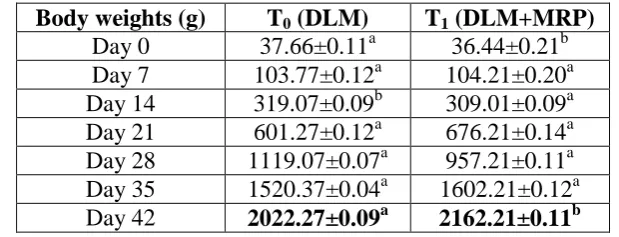
[image:4.595.141.451.602.720.2]The weekly body weight and weight gain of broilers have been presented in table 2A and in table 2B. Statistical analysis of results showed that in group T1 a significant (P<0.05) increase
in mean final body weight (g) (2162.21±0.10b) was evident in comparison to unsupplemented control group T0 (2022.27±0.12a) (table-2A). LWG in Methiorep supplemented T1 group
(2125.77±0.16a g) was observed to be significantly (P<0.05) higher by 141.16g/bird in comparison to untreated control T0 group (1984.61±0.13a g) as shown in table-2B.
Table-2A: Effect of Methiorep™ supplementation via feed for 42 days on LBW of broiler chicks
Body weights (g) T0 (DLM) T1 (DLM+MRP)
Day 0 37.66±0.11a 36.44±0.21b
Day 7 103.77±0.12a 104.21±0.20a
Day 14 319.07±0.09b 309.01±0.09a
Day 21 601.27±0.12a 676.21±0.14a
Day 28 1119.07±0.07a 957.21±0.11a
Day 35 1520.37±0.04a 1602.21±0.12a
Day 42 2022.27±0.09a 2162.21±0.11b
Table-2B: Effect of Methiorep ™ supplementation via feed for 42 days on BWG of broiler chicks
BWG (g) T0 (DLM) T1 (DLM+MRP)
BWG0-7 66.11±0.11b 67.77±0.12a
BWG 7-14 215.3±0.10b 204.8±0.16a
BWG14-21 282.2±0.09b 367.2±0.10a
BWG21-28 517.8±0.12a 281±0.12a
BWG28-35 401.3±0.11a 645±0.16b
BWG35-42 501.9±0.09a 560±0.11b
cBWG0-42 1984.61±0.13a 2125.77±0.16a
Results are expressed as mean ± standard deviation. BWG: body weight gain; BWGi-i+1: body weight gain calculated weekly; cBWG0-42: cumulated body weight gain calculated for a period of 42 days.
The results of the present trial are in accordance with the findings of Kalbande et a.[17], Narayanswamy and Bhagwat [18] and PN Onu et al.,[19] reported that the chicks in herbal methionine group showed a significant (p<0.01) gain in body weight as compared to the chicks in control group and numerically higher weight gain as compared to the chicks in synthetic methionine group. These studies showed that the herbal source of methionine can replace DL-methionine in the diet of commercial broiler chicks.
Feed conversion ratio
Cumulative FCR of group T1 (1.86) was found to be significantly (P<0.05) better from the
control group T0 (2.25) as shown in table-3.
Table-3: Effect of Methiorep ™ supplementation via feed for 42 days on FCR of broiler chicks
FCR (g/g) T0 (DLM) T1 (DLM +MRP)
FCR 0-7 1.60± 0.01 b 1.32± 0.12 a
FCR 7-14 1.59± 0.22b 1.77± 0.22 a
FCR14-21 2.29± 0.20ab 1.56± 0.16a
FCR21-28 1.59± 0.12ab 2.78± 0.20a
FCR28-35 2.97± 0.05 b 1.58± 0.12 b
FCR35-42 2.70± 0.07 ab 2.02± 0.08 b
cFCR0-42 2.25 1.86
findings of Garcia Neto M et al.[20]who claimed a 13% increase in FCR by methionine and betaine supplement.
Carcass traits and Immune organ weights
The effect of supplementation of Methiorep on carcass traits and visceral organs weight expressed as percent of live weight is presented in table-4. Dressing % was found to be significantly (P<0.05) higher in T1 (73.91 %) as compared to T0 group (72.79 %).
Significantly (P<0.05) improved bursa weight (g) was observed in T1 group (5.12 ± 0.84b) in
comparison to control T0 group (3.59 ± 0.43a) suggesting efficacy of Methiorep in improving
immunity. Spleen weight (g) was observed significantly (P<0.05) higher (3.63±0.84b) in Methiorep supplemented T1 group in comparison to control T0 group (2.39±0.17a).
Table-4: Effect of Methiorep ™ supplementation via feed for 42 days on the carcass traits and Immune organ weights in broiler chickens
Parameters T0 (DLM) T1 (DLM +MRP)
Slaughter weight (g) 2022.27±0.12a 2162.21±0.10 a
Hot carcass weight (g) 1472.4 ± 11.2ab 1598.1 ± 13.6 a
Carcass yield (%) 72.79 ± 0.8b 73.91 ± 0.8 b
Spleen weight (g) 2.39±0.17a 3.62±0.84b
Spleen yield (%) 0.12± 0.01 a 0.17 ± 0.03 b
Bursa weight (g) 3.59 ± 0.43 a 5.12 ± 0.84 b
Bursa yield (%) 0.18 ± 0.01 a 0.24 ± 0.03 b
Organ yield was calculated by the following formula: 100 x organ weight / carcass weight. Different superscripts a, b in the same row indicate significant differences (P<0.05) between the treatment groups. Results are expressed as mean ±standard deviation.
The results are in accordance with Ojano-Dirain and Waldroup [21] who observed that a significant improvement (P<0.05) in dressing percentage and breast meat yield between the broilers fed NRC methionine level and those fed higher levels. Study showed that on Methionine supplementation there is an improvement in the carcass traits.
Fresh meat colour, sensory evaluation of cooked chicken and mortality
Color and odour of cooked poultry meat is important because consumers associate it with the product’s freshness, and they decide whether or not to buy the product based on their opinion
Table-5A: Effect of Methiorep ™ supplementation via feed for 42 days on fresh Meat colour
Parameters T0(DLM) T1 (DLM+MRP)
Lightness 55.16b 64.24a
Redness 3.37a 3.74ab
Yellowness 14.57a 16.84b
Different superscripts a, b in the same row indicate significant differences (P<0.05) between the treatment groups.
Flavour, juiciness of meat and other important organoleptic characteristic have been presented in table 5B. Sensory attributes of cooked chicken of T1 group was observed to be
significantly (P<0.05) better and acceptable (7.13b vs 6.97a) as per the 8-point hedonic scale method given by Keeton [22].
Table-5B: Effect of Methiorep ™ supplementation via feed for 42 days on the Sensory attributes of cooked Chicken using 8-point hedonic scale
Parameters T0(DLM) T1 (DLM+MRP)
Color/ Appearance 6.37 a 7.04 b
Flavour 6.57 a 6. 96 b
Juiciness 6.36 a 6.89 b
Texture 7.04 a 7.17 a
Saltiness 6.92 a 7.09 a
Mouth Coating 6.76 a 6.92 a
Overall Acceptability 6.97 a 7.13 b
Different superscripts a, b in the same row indicate significant differences (P<0.05) between the treatment groups.
It can be inferred that supplementation of Methiorep might have lead to improvement in collagen and myofibrillar solubility, in turn improving the tenderness of edible muscles. Mortality in both groups was noted during the entire trial. The percentage mortality recorded in both groups is shown in table-6.
Table-6: Effect of Methiorep ™ supplementation via feed for 42 days on the mortality rates in broiler chickens
Parameters T0(DLM) T1 (DLM+MRP)
Total No. of Birds in the group 100 100
No. of birds Died 8 6
In Methiorep supplemented T1 group (6%) non-significantly (P<0.05) different but
numerically lower mortality was recorded as compared to untreated control T0 group (8%).
The results are in accordance with G. Halder and B. Roy [11], who observed relatively lower mortality in herbo methionine supplemented group in comparison to synthetic DL-methionine supplemented group.
CONCLUSION
On the bases of present investigation it can be concluded that herbal feed premix Methiorep is efficacious in improving commercial broiler performance (growth, FCR, and livability parameters) and can successfully replace synthetic DL methionine in feed.
ACKNOWLEDGEMENT
The author is thankful to Department of Veterinary Pharmacology and Toxicology, Veterinary College, KVAFSU, Bidar (KS), India for availing research facilities and Ayurvet Limited, Baddi, H.P.,India for providing necessary samples and guidance.
REFERENCES
1. Baker DH. Advances in protein-amino acid nutrition of poultry. Amino acids, 2009; 37(1): 29-41.
2. Jacob J. Synthetic Methionine and Organic Poultry Diets. Organic Agriculture, 2013. 3. Fikre A, Yami A, Kuo YH, Ahmed S, Gheysen G, Lambein F. Effect of methionine
supplement on physical responses and neurological symptoms in broiler chicks fed grass pea (Lathyrus sativus)-based starter ration. Food Chem Toxicology, 2010;1:11–17.
4. Dahiya JP, Hoehler D, Van Kessel AG, Drew MD. Effect of different dietary methionine sources on intestinal microbial populations in broiler chickens. Poult Sci, 2007; 86(11):2358-66.
5. Marcolin E, Forgiarini LF, Tieppo J, Dias AS, Freitas LA, Marroni NP. Methionine- and choline-deficient diet induces hepatic changes characteristic of non-alcoholic steatohepatitis. Arq Gastroenterol, 2011; 48(1):72-9.
6. Sawada N, Poirier L, Moran S, Xu YH, Pitot HC. The effect of choline and methionine deficiencies on the number and volume percentage of altered hepatic foci in the presence or absence of diethylnitrosamine initiation in rat liver. Carcinogenesis, 1990; 11(2):273-81.
8. Anonymous 1999. Organic production of agricultural products and indications referring there to on agricultural products & food stuffs to include livestock products. Official J European Committees, 1999; 1:22.
9. Waghmare DL, Ranade AS, Desai DN, Patil MB and Avari PE. Evaluation of oil fortified with herbs on performance of broilers. J. Bombay Vet. Coll, 2006; 14: 1-2.
10. Ramnath V, Rekha, PS and Sujatha KS. Amelioration of heat stress induced disturbances of antioxidant defense system in chicken by brahma rasayana. eCAM, 2008; 5: 77-84. 11. G. Halder and B. Roy. Effect of Herbal or Synthetic Methionine on Performance, Cost
Benefit Ratio, Meat and Feather Quality of Broiler Chicken. Int J Agri Res, 2007; 2(12): 987-96.
12. Tanweer AJ, Chand N, Khan S, Qureshi MS, Akhtar A and Niamatullah M. Effect of methanolic extract of Peganum Harmala on weight gain, feed conversion ratio, feed cost and gross return of broiler chicks. J Anim plant Sci, 2012; 22 (2): 264-267.
13. Close B, Banister K, Baumans V, Bernoth EM, Bromage N, Bunyan J, Erhardt W, Flecknell P, Gregory N, Hackbarth H, Morton D, Warwick C. Recommendations for euthanasia of experimental animals. Laboratory Animals, 1997; 31: 1-32.
14. Oh PS, Min RC, Sung PB and Jong H. The meat quality and growth performance in broiler chickens fed diet with cinnamon powder. J Environ Biol, 2013; 34: 127-133. 15. Hunter RS and Harold R. The measurement of appearance. 2nd ed., New York; Wiley:
1987.
16. Steel RG, Torrieand JH and Dickey DA. Principles and procedures of statistics. B i o m et e ri c al Ap p r oa c h . 3rd ed., New York; McGraw-Hill Book Co. Inc: 1997 17. Kalbande VH, Ravikanth K, Maini S and Rekhe DS. Methionine supplementation options
in poultry. IJPS, 2009; 8(6): 588- 91.
18. Narayanswamy HD, Bhagwat VG. Evaluating the efficacy of methionine supplementation options in commercial broiler chickens. Poultry Line, 2010; 3: 5-7. 19. Onu PN, Ayo-Enwerm MC and Ahaotu EO. Evaluation of carcass characteristics and cost
effectiveness of broiler chicks fed synthetic lysine and methionine supplemented soyabean base diets. IJSN, 1(1): 22-26.
21. Ojano-Dirain CP, Waldroup PW. Evaluation of lysine, methionine and threonine needs of broilers three to six weeks of age under moderate temperature stress. Int J Poult Sci, 2002; 1: 16-21.