www.wjpr.net Vol 8, Issue 4, 2019. 678
A STUDY TO EVALUATE THE EFFECTIVENESS OF STRUCTURED
TEACHING PROGRAMME (STP) ON LEVEL OF KNOWLEDGE AND
PRACTICE ON BREAST CANCER AND BREAST
SELF-EXAMINATION (BSA) AMONG ADOLESCENT GIRLS AT SELECTED
COLLEGE IN CHENNAI
1
Dr. Maheswari Jaikumar*, 2G. Anitha and 3P. Meena
1
Prof and Principal, Meenakshi College of Nursing, MAHER, Chennai. 2
Asst Professor, Meenakshi College of Nursing, Chennai) Instead of Dr. Vaijayanthimala. 3
Asst Professor, Meenakshi College of Nursing, Chennai.
ABSTRACT
Back ground: Cancer is the second leading cause of mortality and morbidity in both developed and developing countries. Breast cancer is
most frequently diagnosed cancer and leading causes of cancer is death
in women worldwide. A majority of women who did practice BSE,
further more were unsure of their ability to detect abnormalities.
Objectives: To assess pre and post-test knowledge and practice on breast cancer and breast self-examination among adolescent girls and
to establish the effectiveness of structured teaching programme on
breast cancer and breast self-examination. Methodology: A Pre Experimental - One group pre and post-test design was carried out to
assess the effectiveness of STP on Breast cancer & BSE in Sri Muthukumaran Arts and
Science College at Chikkarayapuram, near Mangadu, Chennai. 100 adolescent girls was
recruited through purposive sampling technique. Structured proforma containing
demographic variables and items on breast cancer and BSE was administered to the study
subjects to assess their knowledge levels. Breast Self-Examination was demonstrated to the
participants to assess their practice. The collected data was analysed using descriptive and
inferential statistics. Result: : In pre-test the adolescent girls had 37% inadequate knowledge and in post-test no one had inadequate knowledge and mean value of knowledge in pre-test
was 12.13 where as in post-test it had improved to 18.4. Conclusion: The study concludes
Volume 8, Issue 4, 678-685. Research Article ISSN 2277– 7105
1
Article Received on 21 Jan. 2019,
Revised on 11 Feb. 2019, Accepted on 04 March 2019
DOI: 10.20959/wjpr20194-14465
*Corresponding Author
Dr. Maheswari Jaikumar
Prof and Principal,
Meenakshi College of
www.wjpr.net Vol 8, Issue 4, 2019. 679
that the study subjects had improved knowledge on breast cancer and breast self-examination
following the STP and demonstration on BSE.
KEYWORD: Knowledge, Practice of Breast Self-Examination.
INTRODUCTION
Breast cancer is the second leading causes of cancer death in women and poses a global
public health concern.[1] Cancer occur in the fatty tissue are the fibrous connective tissue in
breast. Annually around 1.7 million women worldwide diagnosed with breast cancer.[2] In
female the most common type of cancer are breast cancer, colorectal cancer, lung cancer,
cervical cancer.
These amount to a total 411,000 deaths from breast cancer accounting for 14% of female
cancer death worldwide.[3,4] it is estimated that about half (60%) of breast cancer death occur
in economically developing countries[5]. Typically the cancer forms in either the lobule or the
duct of the breast.
Breast cancer being an invasive and aggressive disease and is associated with a poorer
prognosis in older women.[6] The tumor is malignant if the cell can grow into (invade)
surrounding tissues or spread to distant area of the body.
In India the age standardized incidence rate of breast cancer varies between 19 and 32 per 1,
00,000 women to generate the reliable date on magnitude and pattern of cancer, India started
national cancer registry program 1981.[7]
In India, no of new breast cancer case in about 1,15,000 per year and this is expected to rise
to 2,50,000 new cases per year by 2015.[8]
The peak occurrence of breast cancer in developed countries is above the age 15 years, as
compared to India, where it occurs in a younger age group.[9]
Breast self-examination is a screening method to detect early breast cancer .the method
involves the women herself looking at and feeling each breast for possible lump distortion or
www.wjpr.net Vol 8, Issue 4, 2019. 680
A recent study also conducted at Makerere University, found that the practice of BSE among
students was low: only 1% of the students knew the BSE technique and only 14% regularly
carried out BSE.[10]
The American cancer society also recommends women from the age of 20 years onward
should be educated on the benefit of performing BSE monthly.[11]
There is evidenced that women who correctly practice BSE monthly are more likely to detect
a lump in the early stage and early diagnosis has been reported to influence early treatment,
to yield better survival rate.[12] Breast cancer mortality rate increase 5.3% annually during the
last decade.[13]
Early detection rate through breast self- examination [BSE] play an important role in
decrease in the morbidity and mortality rate in addition to several other factors.[14] Breast
self-examination is one such technique that helps your get familiar with the size, shape and
texture of your breast. Public health awareness activities and use of screening programs, we
can detect the disease early.
MATERIAL AND METHODS
A Pre experimental one group pre and post-test design was adopted to assess the knowledge
and practice on breasr cancer and breast self-examination among students of Sri
Muthukumaran Arts and Science College at Chikkarayapuram, near Mangadu, Chennai. 100
adolescent girls were recruited through purposive sampling technique. A Structured Profoma
comprising demographic variables and items on knowledge on breast cancer and Video
Assisted Teaching cum demonstration session were used to elicit the practice of adolescent
girls. The collected data was analysed using descriptive and inferential statistical procedure.
The collected data was analysed by descriptive statistical method such as frequency
percentage, mean and standard deviation to assess the knowledge and practice of breast
cancer and breast self-examination. Chi square was used to find association and student
“t”-test was used to compare pre and post-“t”-test mean score value.
Ethical consideration: Written permission was obtained from the Principal of Sri Muthukumaran Arts and Science College. A written consent was also obtained from the
www.wjpr.net Vol 8, Issue 4, 2019. 681 RESULT
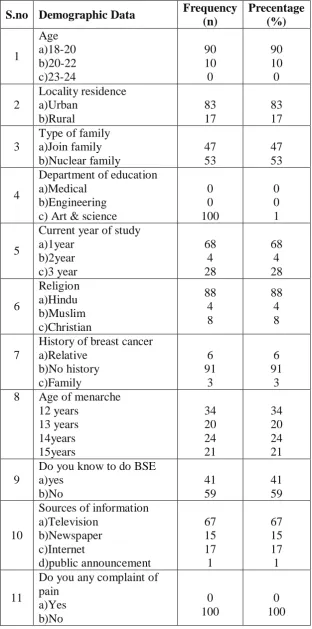
Table 1: Frequency and percentage distribution of demographic variable. N=100
S.no Demographic Data Frequency (n) Precentage (%) 1 Age a)18-20 b)20-22 c)23-24 90 10 0 90 10 0 2 Locality residence a)Urban b)Rural 83 17 83 17 3
Type of family a)Join family b)Nuclear family 47 53 47 53 4
Department of education a)Medical
b)Engineering c) Art & science
0 0 100 0 0 1 5
Current year of study a)1year b)2year c)3 year 68 4 28 68 4 28 6 Religion a)Hindu b)Muslim c)Christian 88 4 8 88 4 8 7
History of breast cancer a)Relative b)No history c)Family 6 91 3 6 91 3 8 Age of menarche
a) 12 years b) 13 years c) 14years d) 15years
34 20 24 21 34 20 24 21 9
Do you know to do BSE a)yes b)No 41 59 41 59 10
Sources of information a)Television b)Newspaper c)Internet d)public announcement 67 15 17 1 67 15 17 1 11
www.wjpr.net Vol 8, Issue 4, 2019. 682
12
When did you notice a)1year back
b)2year back c)3year back
0 0 0
0 0 0
N=100
Figure 1: Percentage and distribution of pre-test and post-test knowledge on Breast Cancer and Breast Self- Examination.
N=100
Figure 2: percentage and distribution of pre-test and post-test practice on Breast Cancer andBreast Self -Examination.
Table 2: Mean, SD and ‘t’ value scores of knowledge on breast cancer and breast self- examination among adolescent girls in pre-test and post-test.
N=100
S. No Variables Mean Sd ‘t’ Table value
1. Pre test 12.13 93.93
42.6 1.98
[image:5.595.143.455.65.318.2] [image:5.595.144.455.388.557.2]www.wjpr.net Vol 8, Issue 4, 2019. 683
The table depicts mean knowledge score of study subjects pre-test and post-test scores on
breast cancer and breast self-examination 12.13 + (93.93) and 18.4 + (122.11) respectively.
The mean t = 42.6 score substantiates an increase in the level of knowledge following the
Structured teaching programme significant at 0.05 value.
Table 3: Mean, SD and‘t’ value scores of practice on breast cancer and breast self -examination among adolescent girls in pre and post – test.
N=100
S. No Variables Mean Sd ‘t’ Table value
1. Pre test 12.76 123.23
36.92 1.98 2. Post test 15.42 348.07
(P<0.05) df (99) = 1.98
The table depicts the mean practice score of the study subjects in pre and post-test before and
after the intervention at 12.76 + (123.23) and 15.4 2+ 348.07 respectively.
From the mean score it is clear that the subjects post test scores were high following the STP
with “t” 36.92 significant at 0.05 value.
A significant association of the subjects post-test is observed with their age, history of breast
cancer
DISCUSSION
The objective of the study was to assess the level of knowledge breast cancer and breast
self-examination among adolescence girls in Sri Muthukumaran Arts and Science College. It is
evident that 37(37%) had Inadequate knowledge, 68(68%) had moderately adequate
knowledge in the pre test and in the post-test no one had Inadequate knowledge, 83(83%) had
moderately adequate knowledge, 17 (17%) adequate knowledge.
Elobaid Y. E et al., (2014) in their cross sectional study on breast cancer screening awareness knowledge and practice among Arab women in the United Arab Emirate in a
survey was conducted in 2013 using the breast cancer awareness measure (CAM). Despite
the increase in the uptake of screening modalities in thier study group a lack of knowledge
about breast cancer screening was evident almost 44.8% of women who never had a clinical
breast exam and 44.1% of women who never had a mammography expressed a lack of
www.wjpr.net Vol 8, Issue 4, 2019. 684 Oxford University (2015) in their observational cross- sectional study on knowledge, attitude and practice regarding breast self -examination among female medical students in
Taif conducted by faculty of medicine during October 2013 with size was 378. A self-
administrated questionnaire was used to collect data on knowledge, attitude and practices
toward BSE and knowledge about breast cancer. Although 66% of the study sample had
positive attitude toward BSE. A significant positive moderate correlation was found between
overall knowledge score and attitude towards BSE (r =0.449 & p =0.000).[16] Most female
medical students in our sample did not perform BSE or perform at irregularly.
CONCLUSION
Hence the investigator concludes that health education on prevention of breast cancer has
potentials to develop the positive practices and stresses the need for a sensitization
programme among adolescents on breast cancer.
ACKNOWLEDGEMENT
All participants in the study are highly acknowledged.
REFERENCES
1. Ferlay j, soejometaram I, dikshit , esers, mathers C, Rebetometal, cancer incidence and
mortality worldwide source methods and major pattern in GLOBOCAN 2012 Int J
cancer, March, 2015; 136(5): E359– E386. 10.1002/ijc.29210 [PubMed] [CrossRef].
2. International agency for research on cancer. Global International agency for research on
cancer. Globalcan 2012: estimated cancer incidence, mortality, and prevalence worldwide
in 2012. globacan.iarc.fr/Default.aspx. Published 2012. Accessed on May 24, 2017.
3. Akpo EE, Akpo Mo, Akhator A.Breast cancer knowledge and screeing. Int J health, 2010;
11(2).
4. Battaglia F, Plotti, Zullo MA, Panici PB, Plotti G,Brown LA,et at. Gynecologic
cancer.cancer, 2006; 16: 29-35.
5. Jemal A, Bray F,Center MM,Ferlay J,ward E,forman D global cancer statistics CA
cancer. J clin, mar-apr, 2011; 61(2): 69-90 10.3322/caac.20107 [pub Med][cross ref].
6. Gakwaya A.Kigula-Mugambc JB. Kavuma A.Fualal J.Jombwe J.et al.cancer of the
breast: 5-year survival in a tertiary hospital in uganda.Br J cancer, Jul, 2008; 99(1): 63-67.
10.1038/sj.bjc.6604435 [PMCfree article] [Pubmed] [Crossref]
7. National cancer registry programme report (1981_2001) [last accessed on 2011 Jan 24].
www.wjpr.net Vol 8, Issue 4, 2019. 685
8. Parkin DM, Bray F, ferlay J, pisari p.global cancer statistics, 2002 CA cancer J chin,
2005; 55: 74_108. [PUBMED]
9. Parkin DM, Bray F, ferlay J, pisari P.Global cancer statistics,2002 CA cancer J chin,
2005; 55: 74_108. [PUBMED]
10. Obaikol R, galukande M, Fualal J.knowledge and practice of breast self-examination
among female students in a sub_saharam african university, 2010.
11. Obaikol R, galukande M,Fualal J.knowledge and practice of breast self-examination
among female students in a sub_saharam african university, 2010.
12. National Cancer Registry Programme, N ational center for disease informatics and
research. Three year report of population based cancer registries 2009-2011 National
Cancer Registry Programme 2009-2011.
13. Freitas_junior R.Gonzaga CMR,Freitas NMA,Martins F,Dardes RCN,Disparities in
female breast cancer mortality rates in Brazil between 1980 and2009.clinics, 2012; 67(7):
731_737. [links]
14. Tavafian SS, Hasani I; Aghamolaei T, Zare S,Gregory D. Prediction of breast
self-examination in a sample of Iranian women: an application of the Health Belief Model.
BMC Womens Health, 2009; 9(1): 37. 10.1186/1472-6874-9-37 [PMCfree article]
[Pubmed] [Crossref]
15. ElobaidYE et al., cross sectional study on Breast cancer screening awareness knowledge
and practice among arab women in the United Arab Emirate, 2014.
16. Oxford university Observational cross- sectional study on knowledge, attitude and
practice regarding breast self-examination among female medical students in taif was