
Indirect Model Predictive Control Strategy with
Active Damping Implementation for a Direct Matrix
Converter Operating at Fixed Switching Frequency
M. Rivera Faculty of Engineering Universidad de Talca, Curic´o, Chile
H. Dan
School of Information Science and Engineering Central South University, ChangSha, China
L. Tarisciotti, P. Wheeler
Dep. of Electrical and Electronic Engineering University of Nottingham, Nottingham, UK
Abstract—One of the main drawbacks of the implementation of predictive control in a direct matrix converter is the high com-putational cost and the adequate selection of weighting factors in order to control both input and output sides. In this paper is proposed an indirect model predictive current control strategy enhanced with a fixed switching predictive strategy and an active damping implementation. With all this, the idea is to reduce the computational cost while eliminating the necessity of weighting factors and improving the performance of the full system. The proposed method is based on the fictitiousdc-link concept, which
has been used in the past for the classical modulation and control techniques of the direct matrix converter. Simulated results confirm the feasibility of the proposal demonstrating that it is an alternative method to classical predictive control strategies for the direct matrix converter.
Index Terms—active damping, current control, matrix convert-ers, indirect model predictive control, fictitiousdc-link.
NOMENCLATURE
is Source current [isAisB isC]T vs Source voltage [vsAvsB vsC]T ii Input current [iA iB iC]T vi Input voltage [vA vB vC]T
idc Fictitiousdc-link current
vdc Fictitiousdc-link voltage
io Load current [ia ib ic]T vo Load voltage [va vb vc]T i∗ Load current reference [i∗
a i∗b i∗c]T
Cf Input filter capacitor
Lf Input filter inductor
Rf Input filter resistor
R Load resistance
L Load inductance
I. INTRODUCTION
The direct matrix converter (DMC) can generates sinusoidal input and output currents but also it has regeneration capabil-ity and adjustable input displacement power factor [1], [2]. Compared to the back-to-back converter, the DMC features some advantages in terms of power densities and capacity to work in harsh pressures and temperatures. Venturini is one of the most classical modulation techniques together with Pulse Width Modulation (PWM), Space Vector Modulation (SVM) as well as Direct Torque Control (DTC) and Model Predictive
To solve issues such as computational cost, weighting factor selections, operation at variable switching frequency and resonances on the input filter, this paper proposes an indirect model predictive control (IMPC) strategy working at fixed switching frequency with active damping implementation. The idea is to emulate the DMC as a two stage converter linked by a fictitiousdc-link allowing a separated and parallel control of both input and output stages, avoiding the use of weighting factors and choosing into the cost function a set of optimal vectors and their respective duty cycles to be applied to the converter.
II. MATHEMATICALMODEL OF THEDMC
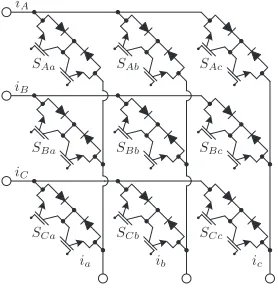
[image:2.612.360.499.66.210.2]The general structure of the three-phase DMC is shown in Fig. 1. In order to ensure the safe operation of the DMC, the following expression must be accomplished:
SAy + SBy + SCy = 1, ∀ y=a, b, c (1)
The relations between the input and output variables of the DMC are defined by:
vo =T vi (2)
ii=TTio (3)
whereTis the instantaneous transfer matrix defined as:
T=
SAa SBa SCa
SAb SBb SCb
SAc SBc SCc
(4)
There are some techniques that uses the concept of fictitious
dc-link in order to simplify the modulation and control of the DMC [14], [15], which consists in to divide the converter into a rectifier and an inverter linked by a fictitious dc-link such as represented in Fig. 2. The rectifier have associated six active current space vectors which are represented in Fig. 3 (left) and Table I. The inverter have associated eight voltage space vectors which are represented in Fig. 3 (right) and Table II. The technique modulates both converters separately, but considering the relationship between both stages.
III. PROPOSEDMETHOD FOR THEDMC
M2PC has been implemented in a DMC feeding an in-duction machine [16], [17], where input and output sides of the converter are controlled all together by including a predictive model of the instantaneous reactive input power and a predictive model of the load currents. These predictions are compared with their respective references in a single cost function, being necessary the inclusion of a weighting factor in order to provide more priority to one of the controlled variables. At every sampling period three active and three zero optimal vectors are chosen which are applied to the converter. In this method two main issues are observed: first, it is necessary the adequate selection of a suitable weighting factor value in order to prioritise for the control of the load current or the instantaneous reactive input power and second, as the full converter control is considered, a large amount of available switching states is considered.
iA
iB
iC
ia ib ic
SAa SAb SAc
SBa SBb SBc
SCa SCb SCc
Fig. 1. Power circuit of the direct matrix converter.
[image:2.612.313.544.240.298.2]DMC Fictitious Converter
Fig. 2. Representation of the fictitiousdc-link concept for the DMC.
α α
β β
i1
(AC)
i2
(BC)
i3
(BA)
i4
(CA)
i5
(CB)
i6
(AB)
v1
(100)
v2
(110)
v3
(010)
v4
(011)
v5
(001)
v6
(101)
v7
(111)
v8
(000)
Fig. 3. Current and voltage space vectors of the fictitious converter. Left: current space vectors for the fictitious rectifier, right: voltage space vectors for the fictitious inverter.
TABLE I
VALID SWITCHING STATE ON THE FICTITIOUS RECTIFIER
# Sr1Sr2Sr3Sr4Sr5Sr6 iA iB iC vdc
1 1 1 0 0 0 0 idc 0 -idc vAC
2 0 1 1 0 0 0 0 idc -idc vBC
3 0 0 1 1 0 0 -idc idc 0 -vAB
4 0 0 0 1 1 0 -idc 0 idc -vAC
5 0 0 0 0 1 1 0 -idc idc -vBC
6 1 0 0 0 0 1 idc -idc 0 vAB
TABLE II
VALID SWITCHING STATE ON THE FICTITIOUS INVERTER
# Si1Si2Si3Si4Si5Si6 vab vbc vca idc
1 1 1 0 0 0 1 vdc 0 -vdc ia
2 1 1 1 0 0 0 0 vdc -vdc ia+ib
3 0 1 1 1 0 0 -vdc vdc 0 ib
4 0 0 1 1 1 0 -vdc 0 vdc ib+ic
5 0 0 0 1 1 1 0 -vdc vdc ic
6 1 0 0 0 1 1 vdc -vdc 0 ia+ic
[image:2.612.302.554.330.452.2]To solve these issues, in this paper we use the concept of fictitious dc-link in order to propose the IMPC strategy for the DMC. The idea is to separate the control of both input and output fictitious stages of the converter in order to avoid complex and large calculations and as well simplify the controller while avoiding the use of weighting factors. In addition, the proposal enhances the performance of the system by the implementation of active damping method in order to mitigate the resonance of the input filter.
A. Control of the Rectifier
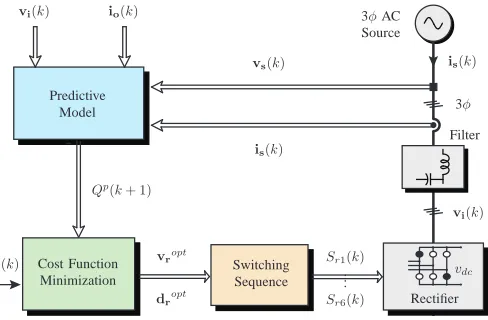
As indicated in Fig. 3 (left) and Table I, there are six active current space vectors which correspond to the suitable switching states of the rectifier. The proposed technique de-tailed in Fig. 4, consists in to control the input side of the converter by considering these available switching states and the mathematical model of the rectifier defined by:
vdc=
Sr1−Sr4 Sr3−Sr6 Sr5−Sr2
vi (5)
ii=
Sr1−Sr4
Sr3−Sr6
Sr5−Sr2
idc (6)
For the control of the input side it is necessary the prediction model of the source current which is given by the linear model of the input side as:
dis
dt =
1
Lf
(vs−vi)−Rf
Lf
is (7)
dvi
dt =
1
Cf
(is−ii) (8)
By considering the guidelines presented in [18] for the current and voltage predictions, it is possible to define the cost functiongr associated to the input control in theα-β plane:
gr = [vsα(k+ 1)isβ(k+ 1)−vsβ(k+ 1)isα(k+ 1)]2
(9) At every sampling instantTs, each pair of current vectors
are evaluated for cost functiongr which means that for each
sector two cost functions are given, the first associated to one current vector gr1 and other related to the adjacent current
vector gr2. Later, these cost functions are used to compute
the duty cycles which are calculated assuming that they are proportional to the inverse of the corresponding cost function value, whereKr is a constant to be determined:
dr1 = Kr/gr1
dr2 = Kr/gr2
dr1+dr2 = 1
(10)
With these duty cycles and cost function values, is defined a new cost function which is given by:
grec = dr1gr1+dr2gr2 (11)
This is done, at every sampling time, for each of the six sectors and finally, the pair of vectors that minimizes the cost functiongrecare selected as the optimalvroptto be applied in
Predictive Model
Cost Function Minimization
Filter 3φAC
Source
io(k)
Sr1(k) .. .
Sr6(k)
is(k)
is(k) vs(k) vi(k)
vi(k)
Q∗(k)
Qp(k+ 1)
3φ
vdc
Rectifier Switching
Sequence
vropt
[image:3.612.309.553.67.227.2]dropt
Fig. 4. Indirect predictive control strategy for the fictitious rectifier.
Predictive Model Cost Function
Minimization
io(k)
io(k) ip
o(k+ 1)
i∗
o(k)
Si1(k) .. .
Si6(k)
vo(k)
R L
Load 3φ vdc
[image:3.612.322.533.259.436.2]Fictitious Inverter
Fig. 5. Indirect predictive control strategy for the fictitious inverter.
vi(k)
vidq vdhdq idhdq i∗
o(k)
iout∗dq
θs
SRF
PLL abc
abc dq
dq
Digital dc-blocker
1
[image:3.612.304.555.469.524.2]Rd +
Fig. 6. Active damping implementation.
the next period. The time that each vector is applied is given by:
tr1 = dr1Ts
tr2 = dr2Ts
(12)
B. Control of the Inverter
The control diagram of this stage is represented in Fig. 5. The mathematical model of the inverter is defined as:
idc=
Si1 Si3 Si5
io (13)
vo=
Si1−Si4
Si3−Si6
Si5−Si2
Assuming a passive RL load, the mathematical model of the load is defined as:
vo=Ldio
dt +Rio (15)
With these definitions, the prediction model of the output side using a forward Euler approximation in eq. (15) is:
io(k+ 1) =c1vo(k) +c2io(k) (16)
where, c1 = Ts/L and c2 = 1 −RTs/L, are constants
dependent on load parameters and the sampling timeTs. The
associated cost functiongi for the output stage is:
gi = [i∗α−iα(k+ 1)]2+ [i∗β−iβ(k+ 1)]2 (17)
In order to enhance the performance of the system and to mitigate the potential resonance of the input filter excited by potential harmonics in the ac source and the converter itself, in this paper we add an active damping technique to the predictive controller of the inverter, by modifying the load current reference as shown in Fig. 6 and indicated in [12], [13]. In this method, we use a virtual harmonic resistive damperRd, which is immune to system parameter variations,
in parallel with the input filter capacitorsCf, to suppress the
system harmonics without affecting the fundamental compo-nent. The converter draws a damping current proportional to the capacitor voltage, which is extracted by the converter itself, emulating the damping resistanceRd as indicated by:
id = vi
Rd
(18)
This method is easy to implement, do not affects the efficiency of the converter and do not involves additional measurements or any modification to the predictive algorithm. From Fig. 3 (right), six sectors are identified which are given by two active voltage vectors. At every sampling instant Ts,
each pair of voltage vectors and one zero vector are evaluated for cost function gi which means that for each sector three
cost functions are given gi0, gi1 and gi2. Later, these cost
functions are used to compute the duty cycles which are calculated assuming that they are proportional to the inverse of the corresponding cost function value, whereKi is a constant
to be determined:
di0 = Ki/gi0
di1 = Ki/gi1
di2 = Ki/gi2
di0+di1+di2 = 1
(19)
With these duty cycles and cost function values, is defined a new cost function which is given by:
ginv = di1gi1+di2gi2 (20)
This is done, at every sampling time, for each of the six sectors. The pair of vectors that minimizes the cost function
ginv are selected as the optimalvioptto be applied in the next period. The time that each vector is applied is given by:
ti0 = di0Ts
ti1 = di1Ts
ti2 = di2Ts
(21)
ti0 4
ti1 2
ti2 2
ti0 2
ti2 2
ti1 2
ti0 4
ts
tr1 tr2
[image:4.612.325.528.73.262.2]b) a) 1 1 1 1 1 0 0 0 0 0 vr1 vr2 vi1 vi2 vi0
Fig. 7. Switching pattern: a) for the rectifier side; b) for the inverter side.
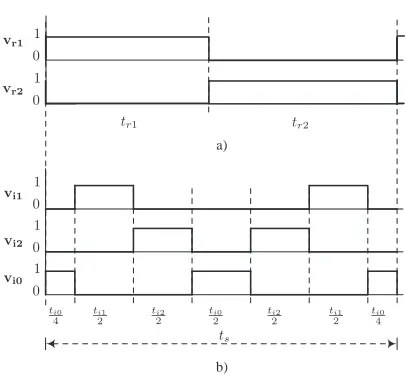
After obtaining the duty cycles and selecting the optimal vectors to be applied in both the rectifier and inverter, a switch-ing pattern procedure is adopted with the goal of applyswitch-ing the optimal vectors [19] (Fig. 7).
C. Relationship between the fictitious converter and the DMC
As it is necessary to apply the switching signals to the switches of the DMC, it is required to adapt the switching states of both input and output fictitious stages to the real one. As indicated in eq. (2), the relationship between the input voltage vi and load voltage vo depends on the state of the
switching given by matrixT. Based on the fictitious definition,
the load voltage vo is given as indicated in eq. (14). At the
same time, the fictitious dc-link voltage vdc is given by eq.
(5). In summary,
vo=
Si1−Si4
Si3−Si6
Si5−Si2
Sr1−Sr4 Sr3−Sr6 Sr5−Sr2 vi (22) and thus the relationship between the switches of the DMC and fictitious converter is given as:
SAa SBa SCa SAb SBb SCb SAc SBc SCc =
(Si1−Si4)(Sr1−Sr4) (Si1−Si4)(Sr3−Sr6) (Si1−Si4)(Sr5−Sr2) (Si3−Si6)(Sr1−Sr4) (Si3−Si6)(Sr3−Sr6) (Si3−Si6)(Sr5−Sr2) (Si5−Si2)(Sr1−Sr4) (Si5−Si2)(Sr3−Sr6) (Si5−Si2)(Sr5−Sr2)
(23)
IV. RESULTS
To validate the effectiveness of the proposed method, simu-lation results in Matlab-Simulink were carried out considering
Cf=21 [µF], Lf=400 [µH], Rf=0.5 [Ω], R=10 [Ω], L=10
(a)
(b)
Time [s]
0.02 0.03 0.04 0.05 0.06 0.07 0.08 0.09 0.1
0.02 0.03 0.04 0.05 0.06 0.07 0.08 0.09 0.1
[image:5.612.308.550.67.263.2]-30 -20 -10 0 10 20 30 -30 -20 -10 0 10 20 30
Fig. 8. Simulation results of the classical MPC; beforet= 0.06[s] without active damping, aftert= 0.06[s] with active damping: (a) source voltage vsA[V/10] and source currentisA[A]; (b) capacitor voltagevA[V/10] and
input currentiA[A].
(a)
(b)
Time [s]
0.02 0.03 0.04 0.05 0.06 0.07 0.08 0.09 0.1
0.02 0.03 0.04 0.05 0.06 0.07 0.08 0.09 0.1
-400 -200 0 200 400 -10 0 10
Fig. 9. Simulation results of the classical MPC; beforet= 0.06[s] without active damping, aftert= 0.06[s] with active damping: (a) load currentsio
[A] and its respective referencesio∗[A]; (b) load voltageva[V].
In this paper two cases are presented. First the classical MPC with and without active damping implementation is presented followed by the proposal with and without active damping technique.
Fig. 8 and Fig. 9 show simulated results for the classical MPC technique for the DMC with and without active damping implementation. Before the implementation of active damping technique, Fig. 8(a) shows the source voltagevsA and source
current isA which is in phase to its respective voltage but
as expected and due to the variable switching frequency it presents several oscillations and distortions with a THD of 66.95%. This resonance is also reflected in the capacitor voltagevA shown in Fig. 8(b).
(a)
(b)
Time [s]
0.02 0.03 0.04 0.05 0.06 0.07 0.08 0.09 0.1
0.02 0.03 0.04 0.05 0.06 0.07 0.08 0.09 0.1
[image:5.612.44.287.67.264.2]-30 -20 -10 0 10 20 30 -30 -20 -10 0 10 20 30
Fig. 10. Simulation results of the proposed IMPC; beforet= 0.06[s] without active damping, after t= 0.06[s] with active damping: (a) source voltage vsA[V/10] and source currentisA[A]; (b) capacitor voltagevA[V/10] and
input currentiA[A].
(a)
(b)
Time [s]
0.02 0.03 0.04 0.05 0.06 0.07 0.08 0.09 0.1
0.02 0.03 0.04 0.05 0.06 0.07 0.08 0.09 0.1
-400 -200 0 200 400 -10 0 10
Fig. 11. Simulation results of the proposed IMPC; beforet= 0.06[s] without active damping, aftert= 0.06[s] with active damping: (a) load currentsio
[A] and its respective references io∗[A]; (b) load voltageva[V].
After the implementation of active damping, the source currentisA is improved and the THD is reduced to 10.62%.
In Fig. 8 is also evident the effect of the input filter which mitigates the high harmonic components of the input currents due to the commutations. Fig. 9(a) shows the load currentsio
which track very well their respective references io∗ which
[image:5.612.308.551.323.521.2] [image:5.612.46.287.323.520.2]As shown in Fig. 10(a), despite of the operation at fixed switching frequency, there is still an oscillation in the source current with a THD of 13.71%which is reduced to 4.30%with the active damping technique. This effect is also observed in Fig. 10(b) where the capacitor voltagevApresents a better
si-nusoidal waveform in comparison to the classical MPC. Again, it is obtained a good performance of the input filter because the high order harmonics produced by the commutation of the switches are eliminated. Fig. 11 show the results on the load side of the DMC where is observed a very good tracking of the load currentsio to their respective referencesio∗ with lower
ripple in comparison to the classical MPC implementation. Before the implementation of active damping the THD of the load currents is equal to 0.84% and after that it is equal to 0.87%.
V. CONCLUSION
In this paper has been presented an indirect model predictive current control strategy with minimization of the instantaneous reactive input power for a direct matrix converter operating at fixed switching frequency which has been enhanced with an active damping method to reduce the resonance of the input filter. The method uses the idea of fictitiousdc-link in order to separate the control of both input and output stages of the converter. By doing this, it is possible to reduce the complexity of the control, the operation at fixed switching frequency but also avoid the calculation of a suitable weighting factor for the control of both instantaneous reactive input power and load currents variables. By considering the proposed strategy, a new alternative has emerged for the control of both the input and load currents in a direct matrix converter.
ACKNOWLEDGMENTS
The authors would like to thank the financial support of Programa en Energ´ıas CONICYT - Ministerio de Energ´ıa ENER20160014 and FONDECYT Regular 1160690 Research Project.
REFERENCES
[1] L. Empringham, J. Kolar, J. Rodriguez, P. Wheeler, and J. Clare, “Technological issues and industrial application of matrix converters: A review,” Industrial Electronics, IEEE Transactions on, vol. 60, no. 10, pp. 4260–4271, Oct 2013.
[2] J. Rodriguez, M. Rivera, J. Kolar, and P. Wheeler, “A review of control and modulation methods for matrix converters,” Industrial Electronics,
IEEE Transactions on, vol. 59, no. 1, pp. 58–70, Jan 2012.
[3] S. A. Davari, D. A. Khaburi, and R. Kennel, “An improved fcs-mpc algorithm for an induction motor with an imposed optimized weighting factor,” IEEE Transactions on Power Electronics, vol. 27, no. 3, pp. 1540–1551, March 2012.
[4] C. A. Rojas, J. Rodriguez, F. Villarroel, J. R. Espinoza, C. A. Silva, and M. Trincado, “Predictive torque and flux control without weighting factors,” IEEE Transactions on Industrial Electronics, vol. 60, no. 2, pp. 681–690, Feb 2013.
[5] M. Uddin, S. Mekhilef, M. Rivera, and J. Rodriguez, “Predictive indirect matrix converter fed torque ripple minimization with weighting factor optimization,” in 2014 International Power Electronics Conference
(IPEC-Hiroshima 2014 - ECCE ASIA), May 2014, pp. 3574–3581.
[6] Y. Zhang and H. Yang, “Two-vector-based model predictive torque control without weighting factors for induction motor drives,” IEEE
Transactions on Power Electronics, vol. 31, no. 2, pp. 1381–1390, Feb
2016.
[7] V. P. Muddineni, A. K. Bonala, and S. R. Sandepudi, “Enhanced weighting factor selection for predictive torque control of induction motor drive based on vikor method,” IET Electric Power Applications, vol. 10, no. 9, pp. 877–888, 2016.
[8] L. Tarisciotti, A. Formentini, A. Gaeta, M. Degano, P. Zanchetta, R. Rabbeni, and M. Pucci, “Model predictive control for shunt active filters with fixed switching frequency,” IEEE Transactions on Industry
Applications, vol. 53, no. 1, pp. 296–304, Jan 2017.
[9] S. A. Odhano, A. Formentini, P. Zanchetta, R. Bojoi, and A. Tenconi, “Finite control set and modulated model predictive flux and current control for induction motor drives,” in IECON 2016 - 42nd Annual
Conference of the IEEE Industrial Electronics Society, Oct 2016, pp.
2796–2801.
[10] H. Huisman, M. Roes, and E. Lomonova, “Continuous control set space vector modulation for the 3x3 direct matrix converter,” in 2016 18th
European Conference on Power Electronics and Applications (EPE’16 ECCE Europe), Sept 2016, pp. 1–10.
[11] J. Lei, B. Zhou, J. Wei, J. Bian, Y. Zhu, J. Yu, and Y. Yang, “Predictive power control of matrix converter with active damping function,” IEEE
Transactions on Industrial Electronics, vol. 63, no. 7, pp. 4550–4559,
July 2016.
[12] M. Rivera, J. Rodriguez, B. Wu, J. Espinoza, and C. Rojas, “Current control for an indirect matrix converter with filter resonance mitigation,”
Industrial Electronics, IEEE Transactions on, vol. 59, no. 1, pp. 71–79,
Jan 2012.
[13] M. Rivera, C. Rojas, J. Rodridguez, P. Wheeler, B. Wu, and J. Espinoza, “Predictive current control with input filter resonance mitigation for a direct matrix converter,” Power Electronics, IEEE Transactions on, vol. 26, no. 10, pp. 2794 –2803, oct. 2011.
[14] J. Rodriguez, “A new control technique for ac-ac converters,” IFAC
Con-trol in Power Electronics and Electrical Drives, Lausanne Switzerland,
pp. 203–208, 1983.
[15] P. Wheeler, J. Rodriguez, J. Clare, L. Empringham, and A. Weinstein, “Matrix converters: a technology review,” Industrial Electronics, IEEE
Transactions on, vol. 49, no. 2, pp. 276–288, Apr 2002.
[16] M. Vijayagopal, L. Empringham, L. de Lillo, L. Tarisciotti, P. Zanchetta, and P. Wheeler, “Control of a direct matrix converter induction motor drive with modulated model predictive control,” in 2015 IEEE Energy
Conversion Congress and Exposition (ECCE), Sept 2015, pp. 4315–
4321.
[17] ——, “Current control and reactive power minimization of a direct matrix converter induction motor drive with modulated model predictive control,” in 2015 IEEE International Symposium on Predictive Control
of Electrical Drives and Power Electronics (PRECEDE), Oct 2015, pp.
103–108.
[18] C. F. Garcia, M. E. Rivera, J. R. Rodr´ıguez, P. W. Wheeler, and R. S. Pe˜na, “Predictive current control with instantaneous reactive power minimization for a four-leg indirect matrix converter,” IEEE
Transactions on Industrial Electronics, vol. 64, no. 2, pp. 922–929, Feb
2017.
[19] S. Vazquez, A. Marquez, R. Aguilera, D. Quevedo, J. Leon, and L. Franquelo, “Predictive optimal switching sequence direct power control for grid connected power converters,” Industrial Electronics,
![Fig. 10. Simulation results of the proposed IMPC; before tactive damping, after = 0.06 [s] without t = 0.06 [s] with active damping: (a) source voltagevsA [V/10] and source current isA [A]; (b) capacitor voltage vA [V/10] andinput current iA [A].](https://thumb-us.123doks.com/thumbv2/123dok_us/8583433.370072/5.612.308.551.323.521/simulation-results-proposed-tactive-voltagevsa-current-capacitor-andinput.webp)
