Adaptive Real-Time Predictive Collaborative
Content Discovery and Retrieval in Mobile
Disconnection Prone Networks
MILENA RADENKOVIC 1, VU SAN HA HUYNH 1, AND PIETRO MANZONI 2
1School of Computer Science, The University of Nottingham, Nottingham NG8 1BB, U.K.
2Departamento de Informática de Sistemas y Computadores, Universitat Politècnica de Valéncia, 46022 Valéncia, Spain
Corresponding author: Milena Radenkovic ([email protected])
ABSTRACT Emerging mobile environments motivate the need for the development of new distributed technologies which are able to support dynamic peer to peer content sharing, decrease high operating costs, and handle intermittent disconnections. In this paper, we investigate complex challenges related to the mobile disconnection tolerant discovery of content that may be stored in mobile devices and its delivery to the requesting nodes in mobile resource-constrained heterogeneous environments. We propose a new adaptive real-time predictive multi-layer caching and forwarding approach, CafRepCache, which is collaborative, resource, latency, and content aware. CafRepCache comprises multiple multi-layer complementary real-time distributed predictive heuristics which allow it to respond and adapt to real-time-varying network topology, dynamically changing resources, and workloads while managing complex dynamic tradeoffs between them in real time. We extensively evaluate our work against three competitive protocols across a range of metrics over three heterogeneous real-world mobility traces in the face of vastly different workloads and content popularity patterns. We show that CafRepCache consistently maintains higher cache availability, efficiency and success ratios while keeping lower delays, packet loss rates, and caching footprint compared to the three competing protocols across three traces when dynamically varying content popularity and dynamic mobility of content publishers and subscribers. We also show that the computational cost and network overheads of CafRepCache are only marginally increased compared with the other competing protocols.
INDEX TERMS Mobile disconnection tolerant networks, content discovery and retrieval, content caching, latency awareness, congestion awareness.
I. INTRODUCTION
We live in the era when smart, ubiquitous devices are embed-ded in our day-to-day activities and allow us to form diverse dynamic communities in which we are able to share rich and complex data. Majority of the applications and services which are hosted in the mobile edges today suffer from two related problems: they do not handle well limited network coverage and they may generate dynamically changing vol-umes of traffic which can cause localized congestion. Both of these cause delays and packet losses in the network and so seriously impair end-user service quality [4], [19], [39], [40]. There is currently limited work that combines support for rich collaboration of dynamically varying numbers of simultaneous distributed mobile users with predictive local-ized responsiveness to congestion in the face of lack of global network information and unknown-in-advance user
publishers and subscribers activity patterns. While mobile offloading approaches [35] and content distribution network approaches [19] address problems of fast increasing data in mobile networks and traffic surges respectively, they do not address high topology dynamics with intermittent disconnec-tions and dynamically changing publishers and subscribers workload patterns which we focus on in this paper.
We propose to integrate distributed predictive adaptive localized ad-hoc real-time decision making for content retrieval across multiple layers to include predictive con-gestion avoidance in mobile disconnection tolerant networks and predictive content-centric layer in the face of unknown-in-advance dynamically changing social, interest and net-work structures. We investigate complex challenges of mobile latency aware and disconnection tolerant discovery of con-tent stored in remote mobile devices and its delivery to
32188
2169-35362018 IEEE. Translations and content mining are permitted for academic research only.
the requesting nodes in heterogeneous mobile disconnection prone environments.
At the heart of our approach is a distributed edge based col-laborative caching which uses several multidimensional pre-dictive analytics that builds multi-attribute complementary predictive heuristics and utilities. We build on the principle of dynamic predictive relative utilities [14], [18] and propose a new intelligent collaborative caching algorithm which allows individual nodes to achieve greater caching utility compared to the case where no collaboration is used in making decisions in distributed mobile disconnection tolerant caching. The questions we specifically focus on are: where to cache, what to cache and how to manage the cache. Previous research has shown that collaborative caching usually outperforms both locally and centrally optimized algorithms [22]. Note that our focus is not to build a protocol that forces nodes to collab-orate or provide protection against malicious behavior, but rather to design an underlying algorithm that can adaptively share distributed cache space across trusted collaborators when both network topology and workloads are dynamically varying. We extend the idea of behavioral locality toexploit similarities between the content interests and users’ connec-tivity patterns. We expand the idea ofcontent popularitywith
popularity stabilityin order to minimize the negative impact of flash crowds [4]. We tackle the challenge of maximizing the number of data chunks retrieval with as low delay as possible even in sparse fragmented topologies. We propose that distributed nodes use CafRepCache algorithm to form dynamic transient interest and data dissemination topologies based on predictive analysis and commonalities between their interests, caches and retrieval histories as well as connectiv-ity histories. This provides each node with a set of overlay neighbors whose browsing history most closely resembles their own. CafRepCache emerges from this topology as the federation of the local caches of anode’s ego networkandthe closest available nodes. We argue thatadaptive replication
and caching are both necessary to address multi-user data communications in dynamicfragmented and sparse topolo-gies. We envisage that CafRepCache will be an integral part of a robust network support that will allow reliable operation of future rich mobile multimedia services in a variety of appli-cation areas (such as smart transportations [31], [42] or smart festivals mass events [33], [34]) where users often suffer from limited network coverage and congestion.
The rest of the paper is organized as follows. Section II provides a systematic review of related work across a range of specific multilayer challenges in peer-to-peer content shar-ing in mobile disconnection prone networks and outline ten criteria which we use to evaluate the related work and guide our proposal. In Section III, we describe key features of our proposal to address the identified criteria and propose congestion, latency and content aware adaptive predictive and collaborative protocol, CafRepCache. More specifically, we propose a novel distributed multi-layer real-time pre-dictive and adaptive CafRepCache design, provide its ana-lytical model and identify multiple novel complementary
real-time predictive CafRepCache’s heuristics that enable CafRepCache to manage adaptive real-time complex trade-offs among time-varying networks, dynamically changing resources, dynamically changing workloads, and changing content popularity. Section IV describes CafRepCache archi-tecture and design space, and provides pseudo-code which uses multiple complementary multi-layer adaptive fully dis-tributed real-time predictive analytics to allow CafRepCache nodes to dynamically adapt to dynamic underlying topolo-gies, dynamic resources, workloads and content popularity. Section V provides a detailed description of multiple sets of experiments which we perform to evaluate CafRepCache performance against three state-of-the-art intelligent caching algorithms in heterogeneous real-world mobile disconnec-tion prone networks. More specifically, we compare CafRep-Cache against SocialCafRep-Cache [9], HyMobi [10] and Least Recently Used (LRU) across a range of metrics over three heterogeneous real-world mobile social and vehicular traces for dynamically varying workload patterns and content popu-larity. We show that CafRepCache fully localizedsingle node and ego networkadaptive real-time collaborative predictive heuristics can better predict and adapt to dynamically varying regional and temporal resources, forwarding possibilities and data interests. CafRepCache consistently manages to achieve higher content discovery and delivery rates and better caching efficiency while keeping lower delays and packet loss rates compared to three competing protocols for very different real-world dynamically changing mobile topologies. We also show that CafRepCache computational and network overhead costs are only marginally increased compared to the other competing protocols. Section V gives a conclusion and out-lines future work.
II. RELATED WORK
In this section, we provide systematic review of related work across a range of specific challenges for peer to peer content sharing in mobile disconnection prone networks with dynam-ically changing workloads. We begin with reviewing useful state of the art content centric and content distribution tech-niques for peer to peer content sharing and identify what pre-vents them from being used in the dynamically changing and disconnection prone network environments and workloads. We then move to reviewing state of the art approaches for data forwarding and congestion control in mobile disconnection tolerant networks on which we build our proposal. Subse-quently, we review emerging intelligent caching mechanisms which are most relevant for dynamic content and network scenario and identify their limitations. We present a table which summarizes ten core criteria which we used to evaluate the related work and which guide our proposal.
A. P2P CONTENT SHARING
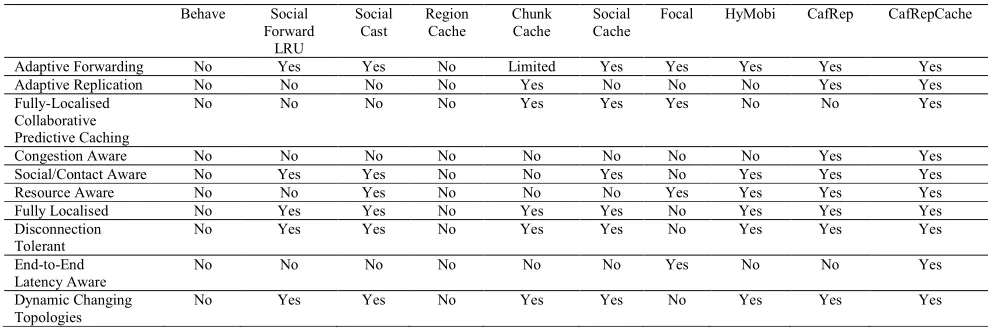
TABLE 1. Overview of the techniques that deal with efficient content dissemination and query in mobile disconnection prone networks.
scenarios [19], [20], [25]. Dernbach et al. [19] propose a regional caching approach of video content that captures the overlap between inter-regional and intra-regional prefer-ences to provide better cache performance. Frey et al.[20] propose a peer-to-peer cache-oriented approach for Web applications based on the principles of Behavioral Local-ity inspired by collaborative filtering. Dernbach et al.[19] and Frey et al. [20] apply centralized decision making and require global information, thus do not support fully-localized distributed decision making which we aim to do in our proposal (see Table 1). Carofiglio et al. [25] propose an approach which combines latency-aware fully dis-tributed caching and load-aware dynamic forwarding strate-gies in order to improve the content-centric network delivery performance. To optimize performance of popularity-aware caches which requires optimal split of the forwarded traffic, Carofiglio et al. [25] route more popular content requests through a single path without considering congestion control and avoidance (Table 1). Carofiglioet al.[25] also do not sup-port fully-localized (i.e. open loop) decision makings. None of the above approaches support disconnection tolerance and dynamically changing workloads and network topologies which are inherent in the scenarios of mobile publishers and subscribers [5].
The problem of content sharing among mobile pub-lishers and subscribers is still not understood sufficiently clearly [7], [38], [45] and leads to lower quality of service. In the rest of this section, we review the state-of-the-art forwarding, replication, congestion control and caching protocols which have been proposed for the context of mobile heterogeneous environments. Even though these pro-tocols support fully-localized distributed decision making for mobile subscribers and publishers, they do not address all of the criteria we identify and tackle in our proposal.
B. CONTENT FORWARDING, REPLICATION, CONGESTION CONTROL AND AVOIDANCE IN MOBILE DISCONNECTION PRONE NETWORKS
Daly and Haahr [18] propose SimBetTS which combines betweenness, similarity and tie strength for social routing
metric to direct the traffic to more central nodes and increase the probability of finding the optimal relay for delivering packets to the destination. Costaet al.[38] propose Social-Cast which is a routing framework for publish-subscribe that utilizes social metrics (i.e. colocation and mobility patterns among communities) to identify the best relay nodes that support delay-tolerant communication in human networks. Zhouet al.[37] propose an efficient data forwarding in oppor-tunistic networks which uses predictive nodes’ social contact patterns from the temporal perspective. None of the above approaches supports latency awareness, resource awareness, congestion control and avoidance (Table 1) which is neces-sary for improving network reliability of social routing and forwarding that may congest at the points with higher social centrality.
Radenkovic and Grundy [14] propose fully localized adap-tive forwarding, replication and congestion control proto-cols, Café and CafREP, to enable congestion-aware mobile social framework for predictively adaptive data forwarding and rate adaptation over heterogeneous disconnection tol-erant networks. Flores et al. [10] propose a social-aware hybrid offloading strategy based on node’s stability which is measured by contact frequency and duration in order to improve the availability of offloading support for mobile users. However, Flores et al. [10] do not consider predic-tive congestion and latency awareness (Table 1). The above approaches mainly focus on adaptive content forwarding, replication and congestion control in mobile disconnection prone networks, but have not focused on in-network fully-localized predictive caching which is important to address-ing latency awareness which we aim to do in this paper (see Table 1). In the next section, we review the state of the art content caching algorithms in mobile disconnection prone networks.
C. CONTENT CACHING IN MOBILE DISCONNECTION PRONE NETWORKS
its replacement, SocialCache may remove a cached content from the network, thus reduce the cache hit ratio and increase delays. This problem is exacerbated when the resource is limited and the replacement rate is high as [9] is not resource and congestion aware (Table 1).
Vigneri et al. [32], [41] show that vehicles and people acting as mobile relays can store more replicas of popular content and thus can increase the ‘‘effective’’ storage capacity a user has access to since a user can meet a large number of vehicles and people. Vigneriet al.[32], [41] focus on the problem of offloading data traffic from main infrastructure to vehicles acting as mobile caches. However, the above approaches neither address dynamic changing topologies and workload pattern, nor take into account resource awareness, network overhead cost and social awareness (e.g. between vehicles and people) which have been shown in Table 1 as important criteria in mobile disconnection prone networks.
Wang et al. [2] propose a low-complexity heuristic FairCache algorithm that models collaborative caching as a bargaining game to address the fairness problems in fixed environments. Wang et al.[2] suffer from multiple limita-tions when applied to the mobile dynamic heterogeneous context: i) Wang et al.[2] do not support dynamic content request patterns which is significant for fully-localized col-laborative predictive caching (Table 1). ii) Wang et al. [2] consider cache hit ratio to define utility function but does not take into account end-to-end latency (Table 1) [3] which is important for our mobile disconnection tolerant scenarios [4]. iii) Wanget al.[2] do not support congestion control, resource awareness (Table 1) nor considers the trade-off between caching performance and overheads which is necessary for more realistic scenarios (i.e. note that optimal solution for the bargaining game requires either global knowledge which is infeasible in dynamic topology or massive messages exchanged between individuals).
Wanget al.[2] and Bertsimaset al.[13] have shown that collaborative caching usually outperforms locally optimized algorithms [22] and attaining a global optimum often disad-vantages some parties e.g. nodes may be unfairly exploited by other caches redirects (at the cost of their own performance), thus we argue that our work does not aim to achieve the global optimum as in [24] and [26], but to propose a distributed fully-localized predictive caching algorithm in collaborative manner which allows every individual node to achieve greater utility.
Our previous work [4] describes our early proof of con-cept CafRepCache that combines multi-path content and interest forwarding and replication with latency aware adap-tive collaboraadap-tive cogniadap-tive caching in heterogeneous oppor-tunistic mobile networks which utilizes fully localized and ego networks multi-layer predictive heuristics about dynam-ically changing topology, resources and popularity content. CafRepCache [4] does not require the global knowledge of network topology and content, and it aims to enable the high-performance efficiency of individual caches while avoid-ing drainavoid-ing the resources of other nodes and decreasavoid-ing
their performances. In this work, we formalize the model and provide comprehensive performance analysis of CafRep-Cache in a wide range of different context scenarios and against more competitive and benchmark protocols.
D. SUMMARY
In Table 1 we systematically outline core criteria that we used to review the related work and guide our proposal for a distributed multi-layer real-time predictive and adaptive forwarding and caching framework in mobile disconnection prone networks (CafRepCache).
Table 1 presents a summary of the techniques discussed in this section in terms of the ten criteria. Note that, apart from CafRepCache, none of the existing approaches pro-vides support for all criteria: adaptive forwarding, adaptive replication, fully-localized collaborative predictive caching, congestion awareness, social contact awareness, resource awareness, full localisation, disconnection tolerance, end-to-end latency awareness and dynamic changing topologies. In our section V, we compare our CafRepCache algorithm against state-of-the-art intelligent forwarding and caching algorithms in mobile disconnection tolerant networks: Social-Cache [9] and HyMobi [10], and also use Least Recently Used (LRU) algorithm as a benchmarking cache replacement algorithm.
III. CAFREPCACHE PROPOSAL
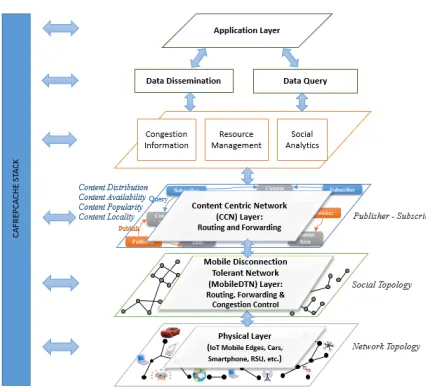
FIGURE 1. Multi-layer CafRepCache architecture.
size, chunk popularity, etc. Based on both node’s and con-tent’s characteristics, we propose three integrated modules: Resource Management, Social Analytics and Congestion Awareness. Resource Management module allows real-time predictive buffer storage, intelligently schedules and priori-tizes packets; Social Analytics module examines social met-rics (e.g. similarity, betweenness, tie strength) of neighbors and continuously evaluates its social heuristic utility value; Congestion Awareness module resolves the retentiveness, receptiveness and congesting rate of nodes to avoid overload and congestion. On the top of our framework, the Application Layer offers two types of services: content dissemination and multi-attribute content query.
A. CAFEREPACHE FRAMEWORK AND SYSTEM MODEL
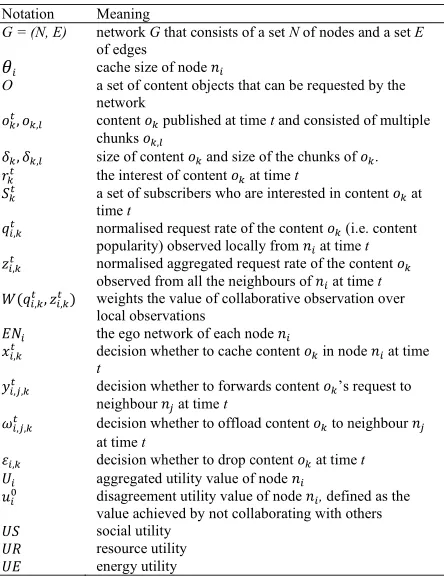
We model CafRepCache system as a networkGthat consists of a setN of nodes and a setEof edges,G=(N, E).As the connectivity of the network and the state of the nodes change over time, we model each of these sets as time series, thus
N = {Nt :t∈T}andE = {Et :t∈T}.
We assume that each CafRepCache node in the network
ni∈N has a cache of sizeθi. We denote withOa set of con-tent files that can be requested by the network. Each concon-tent
otk ∈ O(orok for simplicity) is published at timet and has the sizeδk. Contentokconsists of an array of chunksok,l. For simplicity, we assume all chunksok,l of a single contentok will have the same chunk sizeδk,lwithout losing generality. We also denoterkt as the interest about contentok at timet. At each nodeni ∈ N,qti,k is the normalized request rate of the contentok(i.e. content popularity) observed locally from
ni at timet,Pkqti,k =1;zti,k is the normalized aggregated request rate of the contentokobserved from all the neighbors ofniat timet,Pkzti,k =1. When two CafRepCache nodes are in contact, they exchange their local content popularity observations. Each node continuously resolves the value of dynamically changing content popularity based on its local
observation and the collaborative observations it gets from others.
W(qti,k,zti,k)=αqti,k+βzti,kdenotes the function to weight the value of collaborative observations over local observation. At timet, each nodeni∈N may act as either a subscriber of contentok, denoted bySit,kor a publisherPti,kor a caching pointCit,k with caching capability. Thus for any contentok, a set of subscribers who are interested inok is denoted as
Skt = {Sit,k|ni∈N}and so on.
We integrate ‘‘ego network’’ of each nodeni: ENi as a dynamic network consisting of the nodeni and contacts it meets most frequently or most recently. In this way, ego network allows each node to give its own regional or temporal perspective of the network (or both are included).
To model our caching strategy, we denotexit,k ∈ {0,1}
whether nodenidecides to cache or not contentokat timet,
yti,j,k ∈ {0,1}whether nodeni forwards or not contentok’s request to neighbor nj ∈ ENi at time t, ωti,j,k ∈ {0,1} whether nodenidecides to offload or not contentoktonjand
[image:5.576.322.500.65.257.2]εi,k ∈ {0,1}whether nodenidecides to drop or not contentok at timet.
TABLE 2. Table of notions used in the paper.
a request to a nearby collaborative cache, rather than forward-ing to the original publisher.
B. BACKGROUND OF BARGAINING GAMES
The bargaining game is a model [1] aims to understand better how individuals collaborate when they target to reach a mutu-ally beneficial agreement. We model our CafRepCache algo-rithm as a bargaining game where nodes reach an agreement on how to efficiently share the utility gained by cooperating with others.
Definition 1:An in-network caching problem is a pair<
U, u01,u02,u30, . . . ,u0i >whereU ⊂RN is a compact and convex set, containing all values gained via collaboration and
u0i is an initial disagreement value defined as the worst utility value payoff a node would accept for collaboration.
Definition 2: A fair caching solution is a function f:
Ue → ϕ,Ue ⊂ U is the Pareto frontier of set U such that (u∗1,u∗2, . . .u∗i)=f(U,u01, . . . ,u0i).
A cache solution is fair if it satisfies the axioms imposed:
• Individual Rationality:u∗i >u0i
• Feasibility:u∗ i ∈U • Pareto efficiency: If ui,u0
i ∈ U,ui < u 0 i then f
U,u0i6=ui
• Symmetry: If (u1,u2) ∈ S ↔ (u2,u1) ∈ S,
u01=u0
2then u ∗ 1=u
∗ 2
• Independence of irrelevant alternatives: If(u∗1,u∗ 2, . . .u
∗ i)
∈ U0 ⊂ U then = f(U0,u01, . . . ,u0i) = f(U,u01, . . . , u0i)=(u∗1,u∗i)
• Independence of linear transformation: Letu01=c1u1+
c2,u02=c3u2+c4, . . . then f(U0,c1u01+c2, . . . ,cxu0i
+cx+1)=(c1u∗1+c2, . . . ,cxu ∗
i +cx+1)
Theorem 1: There is a unique solution called Nash Bargaining Solution (NBS) that satisfies all the axioms above:
arg(U
1,U2,...)∈U,Ui>u0i max Y
ni∈N
(Ui−u0i)
The symmetry axiom implies that all players are equal in the bargaining game. However, to be more realistic, we argue that some nodes have priority over others, thus we modify the objective function to:
arg(U
1,U2,...)∈U,Ui>u0imax Y
ni∈N
(Ui−u0i) w0i
(1)
in whichw0iis a weighing parameter that values each node’s priority.
C. CAFREPCACHE
Core CafRepCache utility aims to provide higher delivery success and lower delay when serving dynamically chang-ing users’ demand patterns in dynamic mobile networks. The node’s utility is improved by a caching node using its local cache, or redirecting the request to nearby col-laborative cache. In order to improve cache performance, we integrate the following hybrid and complementary the criteria:
• Content utility: Content utility is dynamically resolved by performing predictive analytics of local cache hit rates and collaborating with other nodes – this increases the cache’s utility since the relay nodes serve contents on behalf of publishers.
• Social utility: Social utility is collaboratively ana-lyzed and resolved based on complex network metrics [18], [4]: similarity, betweenness and tie strength that is used to find the higher centrality nodes for caching contents or forwarding requests in order to increase the higher chances of requested contents being successfully delivered to subscribers (i.e. the success ratio). The intuition behind is that the caching nodes not only need to predict and cache the right contents but also have to deliver successfully that requested contents to subscribers.
• Resource utility: Resource utility [14] is based on dynamic real-time predictive analytics of available dynamic in-network storage, dynamic in-network delays that node ni may add to content ok before cache hit happens and the content are sent towards subscriber and by how likely caching (or forwarding a request of) contentok will result in a congestion.
• End-user utility: End-user utility monitors and analyses numbers of different subscribers that adds value to the cache’s utility in order to avoid serving content requests to only a small number of subscribers in specific local region.
More specifically, multiple, multi-layer and complementary CafRepCache utility metrics can be defined separately as below:
1) CONTENT UTILITY
Content utility is resolved dynamically by performing caching decisions on whether to cache, forward or delegate content chunks based on local and collaborative content popularity predictions. Intuitively, node ni’s content utility will be maximized when it caches the highest popularity contents as it will improve the cache hit ratio. Node ni will also gain content utility by helping to redirect the request to a collaborative cache and a hit is attained there. The utility gained is proportional to the size of the cached content.
X
ok∈O
δkW(qti,k,zti,k)xit,k+
X
ok∈O X
nj∈ENi
δkW(qtj,k,zjt,k)yti,j,k (2)
Our content popularity analytics is defined as:
P(Ti)= ObservedTimePeriod(Ti)∗
Total−time∗Betweeness(Ti)∗Recency(Ti)
P(Ti)measures probability caching decision over a certain period (i.e. temporal locality) in which P is the weight that identifies the content popularity. Betweeness(Ti) is the tem-poral function that measures the time gap between con-tinuous requests and Recency(Ti) denotes the most recent interest request. P(Ti) aims to provide a trade-off between current observed content popularity versus long-term interest in it in order to balance between potentially fake news and long-term useful content. When a caching node detects it is likely to start congesting, it ranks the content in terms of its popularity and delegates the least popular content to a suitable node. Nodes suitability is ranked in terms of the same multi-criteria metric we described (social, resources and workload).
2) SOCIAL UTILITY
Social utility is based on complex temporal social metrics (betweenness, similarity and tie strength [18], [4]) that favors higher centrality nodes to cache contents as they may have a high probability to deliver that content to their subscribers successfully. The intuition behind this is that in order to gain utility, node ni not only needs to cache the right con-tent but also need to ensure that the cached concon-tent will be delivered successfully to the subscriber. In mobile hetero-geneous environments, only cache hit ratio does not guar-antee for a subscriber to retrieve its requested content. The same logic is applied when node ni decides to forward the request to its ego network that is shown in the second term
of (3).
X
ok∈O X
s∈St k
USi,s·xti,k+
X
ok∈O X
nj∈ENi X
s∈St k
USj,s·yti,j,k
USi,s = 1
|F|∗
X
f∈F
αUSfi,s
f ∈ F = {Social,ENSoc|Social = {Betweenness,
Similarity,TieStrength}} (3) Social utility of nodeniis measured by the Betweenness value ofnias well as the Similarity and Tie Strength betweenniand subscribers∈Skt.
USBeti,s = PN a=1
Pa−1 b=1
gab(ni)
gab , gab(ni) is the number of
paths linking nodeaand nodebthat includesni
USSimi,s = |Ni∩Ns| is the similarity of contact between nodeniand subscribers.
USTSi,s = f(s)
F(n)−f(s)+ rec(s) T(n)−rec(s)+
d(s)
D(n)−d(s) combine both
frequency and recency of contacts between cache node niand
subscribers.
USENi,s = 1
EN
P
nj6=ni∈ENUS
Bet
j,s +USSimj,s +USTSj,s is the utility value ofni’s ego networks.
3) RESOURCE UTILITY
Resource utility is analyzed based on the remaining storage, the delay thatni may add to content ok before a cache hit happens and the content is sent towards subscriber. Further-more, resource utility is also measured by how likely caching (or forwarding a request of) contentok will result in a con-gestion.
X
ok∈O X
s∈Skt
URi,s·xti,k +
X
ok∈O X
nj∈ENi X
s∈Skt
URj,s·yti,j,k
URi,s = 1
|F| ∗
X
f∈F
αURfi,s
f ∈ F = {Resource,ENRes|Resource= {Retentiveness,
Receptiveness,CongestingRate}} (4)
URReti,s = θi−P
ok∈Osk as the node’s available storage at
timet, measured by the sum of all cached content occupancy subtracted from the node’s cache buffer capacity.
URRepi,s =P
ok∈Otnow−t
i
received as the delay nodeniadds to contentok, measured by the sum of differences between the current time and the time each content was received.
URCRi,s =( t
congestion end −t
congestion start
tstartcongestion+1−t congestion end
)f
ef wheret congestion start
or tendcongestion denotes the time when congestion occurs or finishes,tstartcongestionandtstartcongestion+1are two adjacent conges-tions occurred,f is the observed congestion frequency. For simplicity, we assumef =1.
URENi,s = 1
EN
X
nj6=ni∈EN
4) ENERGY UTILITY
X
ok∈O
UEi,kxit,k+
X
ok∈O X
nj∈ENi
UEj,kyti,j,k (5)
We denoteEias a remaining energy of nodeni. Energy utility
UEi,k is measured as the remaining lifetimeRT of nodeni which is defined asRTi,k= costγEi
k in whichcostkis the energy
cost to transmit the contentok.γwill be set low if nodeniis an important node which has to be protected from being battery drainage.
5) NUMBER OF SERVED SUBSCRIBERS
The utility value of nodeniincreases as it serves to as many different subscribers as possible. The intuition behind is that a caching point will be encouraged to fairly serve not only highly connectivity subscribers requesting high popularity contents but also those who have lower connectivity and requests lower popularity contents.
X
ok∈O
Sktxit,k+ X
ok∈O X
nj∈ENj
Sktyti,j,k (6)
As the result, we define the total cache’s utility functionUit
(orUifor simplicity) for nodenias:
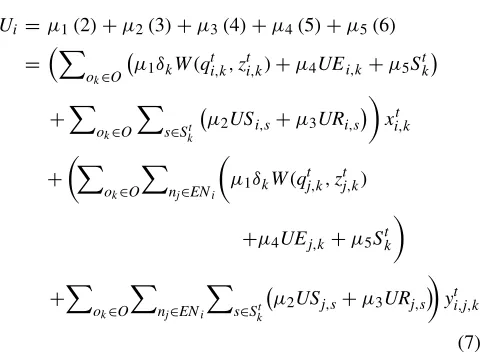
Ui =µ1(2)+µ2(3)+µ3(4)+µ4(5)+µ5(6)
=X
ok∈O µ1δk
W(qti,k,zti,k)+µ4UEi,k+µ5Stk
+X
ok∈O X
s∈Skt µ2USi,s+µ3URi,s
xit,k
+
X
ok∈O X
nj∈ENi
µ1δkW(qtj,k,ztj,k)
+µ4UEj,k+µ5Stk
+X
ok∈O X
nj∈ENi X
s∈St k
µ2USj,s+µ3URj,s
yti,j,k
(7)
In [14] and [44], we show that assigning different weightsµ to each of the CafRep’s and CafRepCache’s utilities results in different performance for real-world traces. We argue that there is a need to study and evaluate both empirically and theoretically the performance of different utility weighting models for multiple complementary heuristics in order to understand its impact on every layer of our caching frame-work. In this paper’s experiments, we assume equal weight between each heuristic utility of CafRepCache as studying weighting models are out of scope of this paper and we plan to investigate adaptive weighting across utilities in the future work.
We propose CafRepCache as a low-complexity distributed and predictive heuristic algorithm that does not require the global knowledge of network topology and content, com-bines multi-path content and interest forwarding with adap-tive collaboraadap-tive cogniadap-tive caching and replication that allow
individual nodes to achieve greater utility compared to the case when there is no collaboration in making decisions.
IV. CAFREPCACHE WITH COMPLEMENTARY MULTI-LAYER REAL-TIME PREDICTIVE HEURISTICS
[image:8.576.317.512.204.469.2] [image:8.576.37.277.346.525.2]We describe CafRepCache which comprises of multiple mobile edge predictive heuristics that leverage information on the local available resources, connectivity patterns, mobility of publishers/subscribers and dynamic content popularity. Fig. 2 shows CafRepCache’ architecture and design space.
FIGURE 2. CafRepCache’s design space and CafRepCache node architecture.
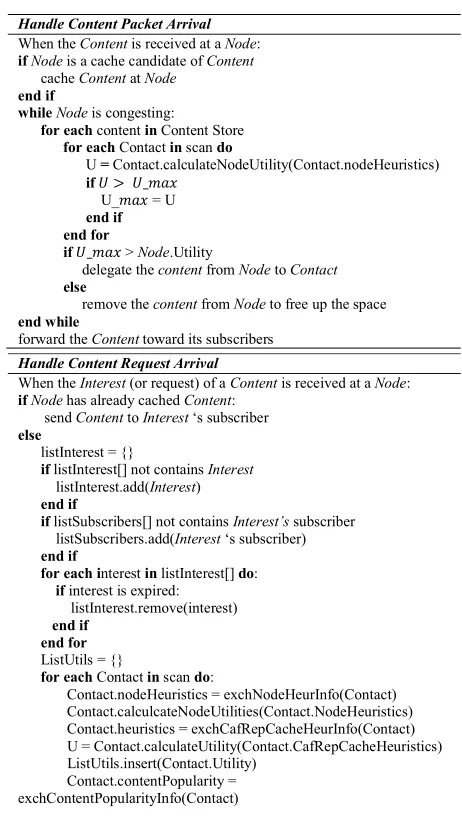
We provide CafRepCache pseudo code in Table 3. Each node has a unique ID and every routed message has an associated key and state information which may contain con-tent topics and concon-tent data, publishers’ IDs, subscribers IDs, timestamps, location, IDs of other encountered nodes, times stamps of these meetings etc. Contents are tagged with a set of attributes which are hashed and stored in DHT-like overlay that effectively matches the hash value of interest with attributes representing the content.
TABLE 3. CafRepCache’s pseudo code.
to the subscriber. Otherwise, it checks whether if it knows who owns the content (results from content advertisement process), then forward the request to next hops.
When interest packet reaches the nearest cached con-tent or the publisher, the node forwards the actual concon-tent data back to the subscriber using CafRepCache forward-ing scheme. Durforward-ing content retrieval process, usforward-ing interest forwarding table, relay node matches the content topic and summary vector of the subscriber with the information it has about the published content, and forwards it to the subscriber. Along with forwarding the content or queries to next hops that
have high social centrality and resources, intermediate nodes decide whether to cache the content, forward it or delegate it in case of resources limitations. When a caching node detects it is likely to start congesting, it ranks the content in terms of its popularity and delegates the least popular content to a suitable node. Nodes suitability is ranked in terms of the same multi-criteria metric we described (social, resources and workload).
Each caching point tries to maximize its utility value or in other words, minimize its total cost. During the operation, the node adapts with changing environment and adjusts its local caching strategy (xnt,k,ytn,i,k) that may decide whether to cache the content if it improves the utility value, or stop retrieving a content from another node due to high cost.
V. EVALUATION
A. EVALUATION METHODOLOGY
In order to better understand performance characterizes of the multi-dimensional and multi-layer design of CafRep-Cache, we perform two major groups of experiments each aiming to compare CafRepCache with multiple state-of-the-art and benchmark proposals across a range of criteria and in different contexts. As mobility and connectivity of the nodes have a major impact on the performance of any opportunistic communication protocol, it is fundamental to evaluate our caching algorithm over multiple heterogeneous real-world mobile data sets. We use San Francisco Cab [21], RollerNet [29] and Infocom [30] traces in ONE [17]. San Francisco Cab Trace [21] includes GPS traces of 550 cabs over a period of 30 days in the San Francisco Bay Area. RollerNet [29] spans three hours during which 62 roller-bladders travel about 20 miles in Paris and utilize Bluetooth on their cell phones for communication. Infocom [30] is a 4-day trace that consists of 78 volunteers equipped with Bluetooth devices and additional 20 static long-range devices placed at various semi-static and static locations of the con-ference venue. Fig. 3 shows analysis of the distribution of contact duration, isolation duration and number of contacts in these different mobile heterogeneous datasets.
FIGURE 3. Distribution of contact duration, isolations and number of contacts.
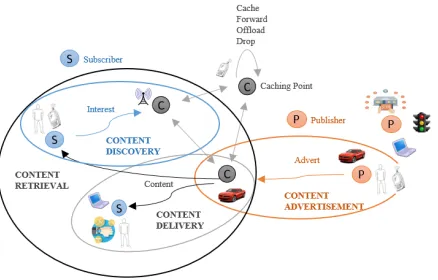
In the first set of experiments, we compare CafRepCache against two state-of-the-art intelligent caching algorithms in opportunistic networks, SocialCache [9], HyMobi [10] and a benchmark protocol Least Recently Used (LRU) over differ-ent criteria: cache hit ratio, success ratio, delay and packet loss in the face of dynamically varying content popularity skewness in order to evaluate our forwarding and caching algorithm in the presence of dynamic content request pat-terns. We analyze two parts ofend-to-end content retrieval
(shown in Fig. 4):content discovery(i.e. time taken between sending interest packets to the network and discovering a requested content) and content delivery (i.e. time taken for the content to be delivered successfully to the interested sub-scribers from the time content was discovered in the network) in order to provide more insightful analysis of CafRepCache compared with other state of the state of the art and bench-marks protocols.
FIGURE 4. Content Retrieval: Content Discovery and Content Delivery.
In the second set of experiments, we conduct perfor-mance analysis of CafRepCache against two state-of-the-arts caching algorithms (SocialCache [9], HyMobi [10]) and a benchmark algorithm (LRU) while dynamically varying patterns of subscribers (in terms of their geographical and connectivity properties as well as their numbers). We show that CafRepCache outperforms other competing protocols in terms of success ratio, delay, packet loss and relative footprint reduction for content discovery, content delivery and the
end-to-end content retrieval process in the presence of het-erogeneous network connectivity and dynamic workloads.
[image:10.576.301.532.356.500.2]In terms of forwarding interests, we assume nodes with higher social utility (i.e. betweenness and similarity cen-trality) and resource utility are preferred. Note that in the experiments, we assume interest packet size are relatively small compared to the content packet. The general simulation parameters details are shown in Table 4.
TABLE 4.Values of the simulation parameters.
B. EVALUATION IN THE PRESENCE OF DYNAMIC CONTENT POPULARITY SKEWNESS
We generate content requests to follow Zipf-distribution using Hawkes process [28] in which the probability for a request of the kth most popular content is P(k, α,K) =
1/kα
PK q=11/qα
with α refers to the popularity skewness. The
[image:10.576.50.269.450.590.2]FIGURE 5. Cache hit rate vs. Content popularity skewness.
FIGURE 6. Content discovery success ratio vs. Content popularity skewness.
are publishers. All experiments are repeated ten times and averaged. We assume that contents are uniformly distributed among publishers. We compare CafRepCache performance against benchmark protocol LRU and state-of-the-art Social-Cache [9] and HyMobi [10] over three heterogeneous traces ranging from vehicular to social: SF Cab [21], RollerNet [29] and Infocom [30]. In order to enable fair analysis, we imple-ment LRU over social forwarding as other algorithms have different social forwarding algorithms and all three traces have been shown to have social character [4], [14].
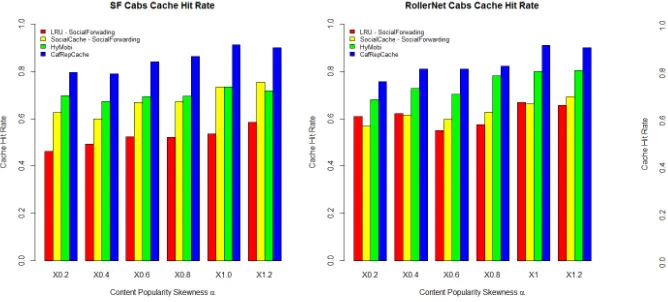
We begin by analyzing the performance ofcache hit ratio
which refers tohow manyinterest packets arematched with the contents in caching points without being forwarded to publishers and indicates the efficiency of caching decisions and locations. In Fig. 5, we show that CafRepCache achieves the highest cache hit ratio (typically above 88% for all three traces and in the face of dynamic content popularity skewness α) compared to state of the art algorithms SocialCache and HyMobi and benchmark protocol (LRU). CafRepCache is followed by HyMobi, which manages up to 70% for all three traces, SocialCache ranges from 56%-66% for San Francisco and RollerNet traces and up
to 77% for Infocom trace. LRU has the worst performance manging around 44%-48% for San Francisco, 58%-64% for RollerNet and up to 70% for Infocom. We observe that higher
α leads to bigger performance gap between CafRepCache and other competing protocols. This is because CafRep-Cache profits from its adaptive caching and smart partial replicationwhich allow it to minimize packet loss rates and better predict and cope with fragmentation more efficiently. CafRepCache is also able to take advantage of highly skewed content popularity and content request locality to efficiently predict the incoming content requests.
[image:11.576.55.389.73.224.2]FIGURE 7. Content discovery packet loss vs. Content popularity skewness.
FIGURE 8. Content discovery delay vs. Content popularity skewness.
become limited and the content replacement rate is high, both only removing strategy and offloading strategy result in decreased content discovery. LRU has the worst perfor-mance of 75% as it suffers from resource congestion and non-adaptive content management.
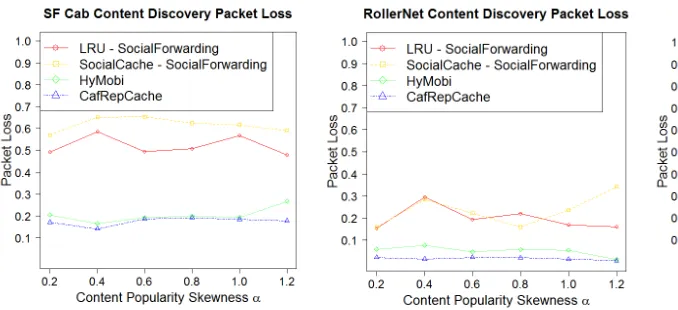
In Fig. 7, CafRepCache shows lowest packet loss rates compared to HyMobi, SocialCache and LRU because it uses distributed predictive analytics of how likely the nodes and their ego networks are to congest and predictive in-network delay analytics in order to be able to avoid offloading from one node to another node where congestion may happen. SocialCache and LRU have highest packet loss rates as they push the contents to the nodes with the highest social degree and may cause their congestion. HyMobi aims to offload the contents to other nodes which have more resource currently in order to avoid removing the cached content from the network, however it does not consider how fast these resources are likely to congest and thus may result in delayed congestion. LRU and SocialCache packet loss rates are significantly higher (up to 2 to 3 times higher) than CafRepCache and HyMobi as shown in Fig 7. Because CafRepCache performs adaptive and predictive analytics on the content, connectivity and resource levels, fRepCache is
FIGURE 9. End-to-end content retrieval success ratio vs. Content popularity skewness.
FIGURE 10. End-to-end content retrieval delay vs. Content popularity skewness.
FIGURE 11. End-to-end content retrieval packet loss vs. content popularity skewness.
content may be pushed farther away from the subscribers during the offloading process.
Our extensive experiments have shown that the perfor-mance of content delivery from caches to subscribers is sig-nificantly higher than that of content discovery (e.g. the delay in content delivery is much lower than that in content discov-ery). The overall content retrieval performance (success ratio,
delay, packet loss) is thus significantly affected by the content discovery process, which in turn, is affected by the cache hit ratio for all three traces. Therefore we move to analyzing content retrieval performance for the rest of the paper.
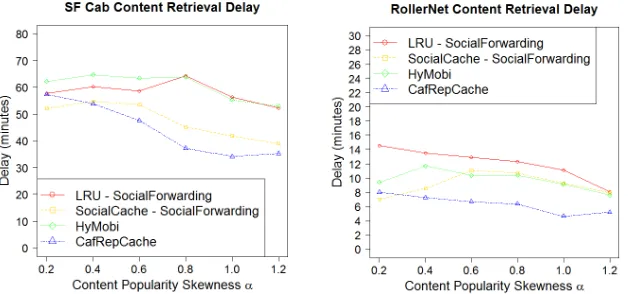
[image:13.576.49.367.257.404.2] [image:13.576.49.407.444.595.2]varying content popularity. We observe that CafRepCache achieves highest content retrieval success ratio (82% for San Francisco, 88% for RollerNet and 92% for Infocom), lowest delay (below 40min for San Francisco, 6min for RollerNet and 3min for Infocom) and lowest packet loss (below 13% for San Francisco, 4% for RollerNet and 1% for Infocom). HyMobi outperforms LRU and SocialCache but underperforms CafRepCache. LRU, in overall, has the lowest performance.
We observe that higherαleads to the more significant gap in performance between CafRepCache and state of the art (HyMobi and SocialCache) and benchmark protocols (LRU). Across the three traces, CafRepCache manages to keep lower delays compared to the other protocols due to the following two reasons: First, CafRepCache is able to predict regional in-network delays with good accuracy because of checking for the in-network delays of both the nodes and their ego networks. In this way, CafRepCache is able to more quickly identify (potentially) longer but less congested paths with lower delays than the other protocols. Neither SocialCache, LRU nor HyMobi are able to adaptively for-ward interest and content nor adaptively manage the content chunks. Second, using Social utility as part of the CafRep-Cache utility, CafRepCafRep-Cache ensures the best prediction of the most direct route to the destination. Neither of the HyMobi, LRU, SocialCache uses predictive social metrics and resource metrics together and are thus not able to adjust to the dynam-ics in both of these dimensions.
Similarly, across all three traces, CafRepCache sustains higher node and region availability than other protocols. This is because CafRepCache is able to make good predictions of node and ego network availability which avoids deplet-ing the cachdeplet-ing resources of frequently used cachdeplet-ing nodes and regions in the network that may drop packets. HyMobi, SocialCache and LRU protocols result in lower node caching availability as they congest the regions that are highly central and where the nodes cannot offload the traffic faster than the traffic is generated (that is the example application scenario we are considering).
SocialCache and LRU heuristics perform well because they allow congruency with distributed mobile data queries and dynamic interactions while depicting dynamics of the underlying topology (all three topologies have social char-acter [4] with social metrics being applicable). HyMobi is more successful compared to SocialCache and LRU as it performs in-network predictive resource analytics and rebal-ances the caching nodes locations so that it avoids con-gestion while keeping high social metrics to drive caching closer to the subscribers. CafRepCache is most successful as it includes both social and resource metrics, but when the caching node predicts that it is likely to get congested, it delegates caching of the least popular content from its local cache to another node that has most appropriate contact it meets.
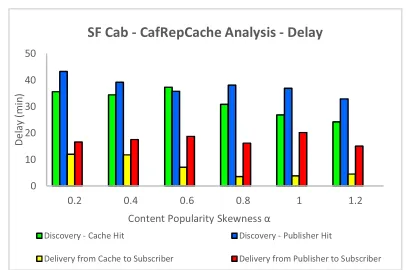
[image:14.576.315.518.62.197.2]Fig. 12 shows the importance of CafRepCache caching by comparing delays between requesting content with and
FIGURE 12. Difference in delay in two scenarios: cache hit and cache miss.
without caching points. We show that caching helps to significantly reduce the delays compared to when there are no caches and interests have to traverse the network in order to be matched the content at the publishers.
C. EVALUATION IN THE PRESENCE OF DYNAMIC PATTERNS OF SUBSCRIBERS
In order to understand the influence of variable workloads, in these experiments, we vary the patterns of subscribers requesting contents from a fixed number of publishers (e.g. 20%) and evaluate success ratio, delay and packet loss of different caching algorithms on different content retrieval processes. We assume that subscribers are mobile and not uniformly distributed as well as that they can have dif-ferent connectivity patterns. Note that connectivity patterns (i.e. how central subscribers are in the network) and their locations (how close to the publishers and to each other subscribers may be) strongly influences content retrieval characteristics. We first rank the nodes in terms of their connectivity (more specifically degree centrality). In Figures 13-15, we increase the numbers of subscribers starting from top 10% best connected random nodes, fol-lowed by increments of 15% (i.e.25, 40%, 55, 70 and 85%). This allows us to show how CafRepCache performs in a wide range of different topologies ranging from dense to sparse. We compare CafRepCache against two state of the art (HyMobi and SocialCache) and one benchmark (LRU) algo-rithms over multiple criteria and over three heterogeneous mobility traces.
FIGURE 13. Content retrieval success ratio vs. Number of subscribers.
FIGURE 14. Content retrieval delay vs. Number of subscribers.
FIGURE 15. Content retrieval packet loss vs. Number of subscribers.
ranges between 50-70% due to the lack of multilayer adap-tation mechanisms. More specifically, predictive analytics of resources and connectivity enables CafRepCache to man-age topologies with very different density/sparseness patterns while predictive content analytics enables both smart caching and replication of suitable content at the suitable nodes.
[image:15.576.49.398.260.411.2]also be able to place the interest and content packets in the most suitable locations due to its adaptive forwarding and replication that diverts the content workload from its conventional social aware path at times of congestion and directs it via a different path that decreases the load of caching points, thus reduces end-to-end delays while keeping high success ratios. HyMobi, SocialCache and LRU either under-utilise or overunder-utilise the forwarding, caching opportunities and the resources, thus results in lower success ratios and higher delays.
In Fig.14 and Fig.15, CafRepCache achieves the lowest overall delay and packet loss compared to the other state of the art caching algorithms [9], [10] and LRU. We observe that the delays are slightly increased for all protocols when the diversity and number of subscribers increase but this is due to increase in subscribers with lower connectivity degree. CafRepCache reduces delays 20-30% compared with SocialCache, LRU or HyMobi. CafRepCache manages to keep packet loss to less than 10% when serving an increasing number of subscribers with the dynamic content workload. This is due to CafRepCache managing dynamic real-time trade-off between predictive in-network node and ego net-work delay analytics and predictive content analytics, and thus enables collaborative adaptive and predictive forward-ing, caching and replication necessary for content retrieval in heterogeneous mobile environments. More specifically, SocialCache uses social driven heuristics for both contacts and contents that exploits contact relationships among nodes and social-based popularity of contents in order to allow optimal directionality, caching opportunity and delivery prob-ability of a node, thus helps to reduce the end-to-end delays. HyMobi uses resource-driven heuristics to offload the traffic from high central nodes and avoid congestion which helps to reduce the packet loss compared to SocialCache but may increase the delays as it does not adapt to regional conges-tions and may push the contents far away from interests packets.
CafRepCache dynamically combines implicit content, social and resource (buffer availability, in-network delays, congesting rate) heuristics in addition to ego network (regional) driven heuristics that aim to detect and adapt buffer availability, delays and congesting rates of different parts of the network, thus keep the delay and packet loss as low as possible. Selecting the node that represents the best carrier for the right contents and deciding on the optimal number of replicas to forward and cache are multiple attribute decision problems across multiple measures that CafRepCache is able to deal with, where the aim is to select the best contents to cache, the most suitable nodes to carry the contents and the number of cached contents that provide the maximum utility in the presence of dynamic content workload, connectivity and resources in heterogeneous mobile environment.
Similarly to [3], we consider caching footprint and aim to keep it a low as possible. We analyze a relative footprint reduction metric rather than footprint reduction metric pro-posed [3] as it is more suitable for Content Centric Networks
in mobile heterogeneous environments.
Relative footprint reduction
=success ratio·
1− hop count
hop count when no cache
.
[image:16.576.321.512.291.428.2]where average hop count and footprint reduction are consid-ered to be two key metrics for evaluating cache performance. Higher footprint reduction value indicates higher cache hit ratio and traffic reduction. As shown in the formula above, a solution for improving the relative footprint reduction is to place the popular content as close to subscribers as possible that also means lower average hop count. Fig. 16 shows that CafRepCache outperforms HyMobi, SocialCache and LRU in terms of footprint reduction. This is because we not only get highest success ratio, but also cache the content as close as possible to the subscribers that requires less hop for the interests to reach the cache and for the requested content to traverse back to the subscribers.
[image:16.576.300.534.490.542.2]FIGURE 16. Content Retrieval – Footprint Reduction.
TABLE 5.Location efficiency.
In Table 5, we evaluate the efficiency of CafRepCache individual caches in terms of how much of the cached content they store is delivered to the subscribers. We show that the caching efficiency for each traces is very high: 90% (Info-com), 70% (San Francisco) and 84% (RollerNet). Similarly, we investigate individual partial replication efficiency and show in Table 5 that its efficiency is very high too across all thee traces: 93% (Infocom), 68% (San Francisco) and 67% (RollerNet) (Table 5). In this way, we show that our col-laborative and adaptive cognitive caching manages to select highly suitable locations for caching and replication as well as suitable content chunks to cache and replicate when needed for very heterogeneous mobility and connectivity trances.
FIGURE 17. Average Computational Cost vs. Number of subscribers.
FIGURE 18. Total number of packets forwarded vs. Number of subscribers.
LRU-SocialForwarding in terms of average computational cost (CPU usage) and routing cost (total number of packets forwarded while routing). In Fig. 17, we observe that CafRep-Cache has a small computational increase (up to 11.2%, 20.7% and 27.9%) compared to HyMobi, SocialCache and LRU-SocialForwarding respectively while it has much higher success ratio, lower delay and packet loss compared to the competing protocols. Regarding the total number of pack-ets forwarded, Fig. 18 shows that CafRepCache has up to 18.4% increase in the number of forwarded packets compared to SocialCache and LRU-SocialForwarding. Note that this increase is only transient in nature when network congestion is predicted and the traffic is adaptively moved to less con-gested parts of the network (this is a feature which other pro-tocols do not support). Interestingly, CafRepCache has fewer packets forwarded compared to HyMobi (above 10.9%) due to CafRepCachebeing able to both choose the most suitable set of nodes to forward the cached content toas well asthe most suitable set of contents to remove from congested nodes, thus avoid unnecessarily forwarding, offloading packets and reduce the total cost of routing.
[image:17.576.45.532.269.441.2]content layer in order to analyze the effect of our adaptive content-aware caching protocol in the presence of dynamic content request patterns, dynamic mobility and connectivity. Additionally, in [43], we argue that the question on how to adaptively weight and combine the value of local observation and different collaborative observations is an important and challenging problem that needs to be addressed in order to utilize efficiently the exchanged information, thus improve caching performance. We integrated ‘‘ego network’’ of each node as a dynamic network consisting of that node and contacts it meets most frequently or most recently. Thus, ego network allows each node to give its own regional and temporal perspective of the network. However, as not every node’s perspective of the network may have the same importance and level of accuracy, we plan to investigate if fuzzy approaches or fully distributed collaborative reputation approaches may be helpful towards proposing newadaptive weighting mechanismswhich can evaluate and weight differ-ent exchanged observation derived from differdiffer-ent nodes in the network in a predictive manner and congruent with the under-lying network mobility, connectivity and content interest in order to improve the overall performance of our framework. Note that we assume there are no malicious nor selfish nodes in the network in this paper, but for our future work we plan to investigate different incentive mechanisms (such as proposed in [36]) as well as to explore extending CafRep-Cache to adaptively utilize the exchanged information from trusted collaborators. More specifically, we plan to focus on the content-centric layer of CafRepCache and investigate complex challenges related tocontent popularity weighting
process in CafRepCache suitable for heterogeneous mobile disconnection prone environments. We aim to propose a new intelligent popularity weighting mechanism that will allow CafRepCache to adapt to realistic cases where caching points gathering content popularity observed by others may not take into account equally all nodes but differentiate between them according to nodes’ dynamic reputation values or fuzzy logic which will enhance the accuracy of CafRepCache predictive content analytics and improve its cache hit ratio.
VI. CONCLUSION
This paper proposed CafRepCache, a multi-layer predictive caching framework that combines real-time adaptive multi-path content and interest forwarding, with adaptive cognitive collaborative caching. We showed that CafRepCache signif-icantly improves the performance of content discovery and retrieval over very different time-varying real-world network topologies and mobility patterns for wide range of dynamic changing workload of content publishers and subscribers against the three competing protocols across a range of met-rics. CafRepCache utilizes both single node and ego net-worksmulti-layer real-time predictive heuristics to manage complex dynamic trade-offs between dynamically changing topology, dynamic resources and varying content popularity and interest in order to achieve high cache availability, cache
efficiency and success ratio while keeping low delays, packet loss rates and cache footprint.
In our future work, we plan to investigate energy efficient data sharing approaches that will make CafRepCache smart data dissemination and query more usable, reliable and scal-able in opportunistic disconnection tolerant networks. In part-nership with Nottingham City Council, we will build and deploy a real-world testbed which integrates CafRepCache with a lightweight publish/subscribe messaging transport protocol designed for connecting constrained devices, people, vehicles and infrastructure to contribute towards integrative smart city planning. We envisage that CafRepCache will be an integral part of a more robust and reliable network support that allows the scalable operation of rich mobile services with and without the infrastructure.
REFERENCES
[1] J. F. Nash, Jr., ‘‘The bargaining problem,’’Econometrica, vol. 18, no. 2, pp. 155–162, 1950.
[2] L. Wang, G. Tyson, J. Kangasharju, and J. Crowcroft, ‘‘Milking the cache cow with fairness in mind,’’ACM/IEEE Trans. Netw., vol. 25, no. 5, pp. 2686–2700, Oct. 2017.
[3] L. Wang, J. Kangasharju, and J. Crowcroft. (2016). ‘‘You really need a good ruler to measure caching performance in information-centric net-works.’’ [Online]. Available: https://arxiv.org/abs/1603.05963
[4] M. Radenkovic and V. S. H. Huynh, ‘‘Collaborative cognitive content dissemination and query in heterogeneous mobile opportunistic networks,’’ inProc. 3rd Workshop Experiences Des. Implement. Smart Objects, 2017, pp. 7–12.
[5] D. Grewe, M. Wagner, M. Arumaithurai, I. Psaras, and D. Kutscher, ‘‘Information-centric mobile edge computing for connected vehicle envi-ronments: Challenges and research directions,’’ inProc. Workshop Mobile Edge Commun. (MECOMM), Los Angeles, CA, USA, 2017, pp. 7–12. [6] C. Fang, F. R. Yu, T. Huang, J. Liu, and J. Liu, ‘‘A survey of green
information-centric networking: Research issues and challenges,’’ IEEE Commun. Surveys Tuts., vol. 17, no. 3, pp. 1455–1472, 3rd Quart., 2015.
[7] J. Augé, G. Caroglio, G. Grassi, L. Muscariello, G. Pau, and X. Zeng, ‘‘MAP-Me: Managing anchor-less producer mobility in information-centric networks,’’CoRR, vol. abs/1611.06785, 2016.
[8] V. S. H. Huynh and M. Radenkovic, ‘‘A novel cross-layer framework for large scale emergency communications,’’ inProc. 13th Int. Wireless Commun. Mobile Comput. Conf. (IWCMC), Valencia, Spain, Jun. 2017, pp. 2152–2157.
[9] T. Le, Y. Lu, and M. Gerla, ‘‘Social caching and content retrieval in disruption tolerant networks (DTNs),’’ inProc. Int. Conf. Comput., Netw. Commun. (ICNC), Feb. 2015, pp. 905–910.
[10] H. Floreset al., ‘‘Social-aware hybrid mobile offloading,’’Pervasive Mobile Comput., vol. 36, pp. 25–43, Apr. 2017.
[11] S. Bayhan, E. Hyytia, J. Kangasharju, and J. Ott. ‘‘Search in digital pockets: Retrieving remote content in mobile opportunistic networks,’’ IEEE Wireless Commun., vol. 23, no. 3, pp. 10–18, Jun. 2016.
[12] S. Boyd and L. Vandenberghe,Convex Optimization. Cambridge, U.K.: Cambridge Univ. Press, 2004.
[13] D. Bertsimas, V. F. Farias, and N. Trichakis, ‘‘The price of fairness,’’ Oper. Res., vol. 59, no. 1, pp. 17–31, Feb. 2011.
[14] M. Radenkovic and A. Grundy, ‘‘Efficient and adaptive congestion control for heterogeneous delay-tolerant networks,’’Ad Hoc Netw., vol. 10, no. 7, pp. 1322–1345, 2012.
[15] M. V. Radenkovic and B. Wietrzyk, ‘‘Wireless mobile ad-hoc sensor networks for very large scale cattle monitoring,’’ inProc. ASWN, 2006, pp. 1–10.
[16] M. Radenkovic, ‘‘Cognitive privacy for personal clouds,’’ Mobile Inf. Syst., vol. 2016, 2016, Art. no. 7107103. [Online]. Available: https://doi.org/10.1155/2016/7107103