Understanding Licences: An Analysis and
Evaluation of Creative Commons
Authors: Jackie Proven, John Casey, David Dripps The moral rights of the authors have been asserted
Please send comments to:[email protected]
Copyright statement and conditions of use:
The copyright in this work is owned by:
The University of Ulster, Shore Road, Newtownabbey, Co. Antrim, BT37 0QB, Northern Ireland.
UHI Millennium Institute, Executive Office, Ness Walk, Inverness, Scotland, IV3 5SQ.
Distributed under a Creative Commons License - Attribution 2.5 UK: Scotland
You are free: to copy, distribute, display, and perform the work, to make derivative works, to make commercial use of the work
Under the following conditions:
Attribution. You must attribute the work in the manner specified by the author or licensor:
You must acknowledge the names of the authors and the Copyright owners.
For any reuse or distribution, you must make clear to others the license terms of this work.
This licence can be found here:
http://creativecommons.org/licenses/by/2.5/scotland/
NBparts of this pack and referenced works may require different conditions of use, for instance the HEFCE report is not for commercial use. These are indicated where possible; however it is the responsibility of the reader to comply with such requirements.
Limitations of Indemnity
The information contained in this report is intended to be used as general background information and is not to be relied on as definitive or comprehensive guidance in any particular circumstances. Educational institutions are urged to seek their own legal and professional advice on any employment law or intellectual property law issues relevant to their own circumstances before acting on any guidance contained in this report. To the extent permitted by law, neither the authors, their employers, JISC nor any contributors to this report shall be liable to any person for any claims, costs, proceedings, losses, expenses, fees or damages whatsoever arising directly or indirectly from any error or omission (whether negligent or otherwise) contained in this report.
Background
This is part of the TrustDR IPR Institutional Development Pack and is part of the outcomes of the work of theTrustDRproject (TrustinDigitalRepositories) funded by the JISC (Joint Information Systems Committee) the UK government body responsible for supporting education and research by promoting innovation in new technologies and by the central support of ICT (Information and Communication Technology) services.
TheTrustDRproject was a partnership between the University of Ulster and UHI Millennium Institute and operated between June 2005 and August 2007 as part of the JISC Digital Repositories Programme.
Project website:
http://trustdr.ulster.ac.uk/
Digital Repositories Programme website:
1 INTRODUCTION ... 4
1.1 STRUCTURE OF THIS DOCUMENT... 4
2 PREPARATION: DECISIONS AND PROCEDURES ... 5
2.1 ORGANISATIONAL PROCEDURES FOR POLICY CREATION... 5
2.1.1 Recognition ... 5
2.1.2 Assertion ... 5
2.1.3 Expression ... 6
2.1.4 Rights embedded in policy... 6
2.2 UNDERSTANDING LICENCES... 6
2.2.1 Licence structure... 6
2.2.2 Implications of licensing ... 6
2.3 CONCEPTS OFCREATIVECOMMONS... 7
2.4 EXAMPLES OFADAPTINGCREATIVECOMMONSLICENCES: BC COMMONS ANDCREATIVE ARCHIVE... 7
2.4.1 BC Commons... 7
2.4.2 Creative Archive... 8
2.4.3 Extending or ‘diluting’ Creative Commons?... 8
2.5 LICENCE ARCHITECTURE... 8
2.5.1 Architecture of Creative Commons ... 8
2.6 ADDRESSINGCONCERNSABOUTCREATIVECOMMONS... 9
2.6.1 Are CC licences suitable for institutions? ... 10
2.6.2 What procedures would need to be in place to allow material to be granted a CC licence? ... 10
2.6.3 What is the position if a licence was applied by an individual to material not owned/controlled by them or not sanctioned by their institution? ... 10
2.6.4 Can a copyright statement be attached that satisfies an attribution requirement for both individuals and institutions? ... 10
2.6.5 How are Moral Rights dealt with by CC licences? ... 11
2.6.6 What about our material being used as endorsement (of products or views) against our wishes? ... 11
2.6.7 Does technical protection break the licence terms? How do we justify limiting access by password protection?... 11
2.6.8 How do the various UK licences relate and are they equivalent? Which licence would be selected in N. Ireland?... 11
2.6.9 Will use of a standard licence cause a loss of direct relationships with users? 12 2.6.10 Does a CC licence form a contract?... 12
2.6.11 Creative Commons and Database Rights ... 12
2.7 PROCEDURES FOR ATTACHING THE LICENCE... 12
3 EXPLANATION OF THE CC LICENCE ... 13
3.1 COMMONSDEED... 13
3.2 LEGALCODE AND COMMENTARY... 14
3.2.1 Preamble and notices ... 15
3.2.2 Licence introduction ... 15
3.2.3 Definitions ... 16
3.2.4 The Licence ‘Grant’... 16
3.2.5 Warranties and limit of liability ... 19
3.3 FURTHER COMMENTS... 20
4 ALTERNATIVE LICENSING CULTURES ... 21
5 A WAY FORWARD ... 21
REFERENCES ... 22
1 Introduction
Until recently licences were time-consuming and expensive to create and institutions or individuals were unlikely to be able to create suitable agreements covering use of their material. Now, however, there are a range of ‘off-the shelf’ ready-made licences in use covering creative content including learning material, and it may be possible to map an existing licence to the intended policy of a repository or institution.
The Creative Commons (CC) movement builds on traditional copyright and is based on the notion of “some rights reserved”, providing a balance between creators and consumers of intellectual property. A set of licences allows rights to be offered under certain conditions, with “Attribution” being a base right for all. These licence terms are projected by presenting symbols and logos with distinct meanings along with the work, and referring to the full legal code. The intention is for the symbols to become widely recognised and so ease the uncertainty prevalent in using copyright material.
CC licences have similar principles to Open Source software licences and there is a growing movement to have them recognised and embedded in institutions. Rowan Wilson describes the benefits of using CC licenses in a paper published by OSS Watch (Wilson, 2005) and the Open University has very recently announced a major project to release materials under Creative Commons1. A report for the Common Information Environment (CIE)2provides the rationale for use of Creative Commons
(CC) licences in public sector organisations, and overcomes many of the perceived barriers to their use (Barker, 2005). These are all endorsements for use of CC licences in the education sector, and the work of the Centre for Open and Sustainable Learning (COSL) based in Utah, USA aims to further promote and embed this licensing
model.3
A Creative Commons licence is non-revocable; therefore it is crucial that authors and copyright holders are very clear about the terms of the licence before they release content. This commentary is designed to serve as a basis for understanding, using or adapting the licences. It will be applicable to managers of learning object repositories as well as content creators. It also compliments a previous commentary in a guide to IPR for content developers (Casey, 2004)
1.1 Structure of this document
The following section (Section 2) outlines the procedures that need to be in place before releasing content (especially that created within an institution) under a Creative Commons licence. It deals with policy issues within institutions; the basics of
understanding licences; the rights and responsibilities of individuals using a licence;
1http://oci.open.ac.uk/
2http://www.common-info.org.uk/The CIE is a group of public sector bodies collaborating to deliver common information and services across sectors in the online environment.
the concepts of Creative Commons and different types of licence available and the process for attaching a licence.
Section 3 then explains a specific CC licence in detail, with a commentary on the full legal code and further comments on the implications of its terms and conditions. Section 4 moves on to briefly examine other licences in use with a comparison of cultural differences they represent.
2 Preparation: Decisions and procedures
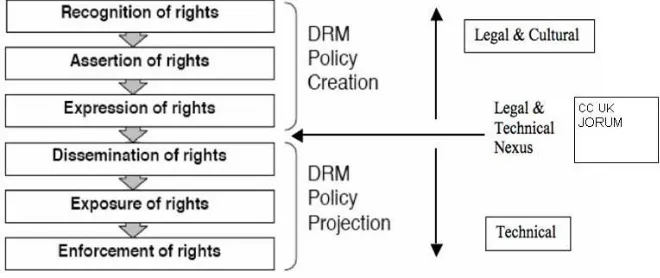
[image:5.595.131.461.328.467.2]There is a considerable amount of preliminary detail that must be attended to before arriving at the point where an institution can apply CC licences to content. The TrustDR framework (reproduced below) illustrates the stages for managing rights in digital material. It shows several stages leading up to the “legal and technical nexus” where a licence can be applied, which require policy creation decisions to be made. The application of a licence then has an impact on all subsequent stages including any technical measures implemented to project the licence terms and conditions.
Fig. 1 The TrustDR framework for managing IPR in e-learning
2.1 Organisational procedures for policy creation
The first requirement is to establish with whom copyright ownership in content lies, to recognise the rights that this entails under the law and to develop policy that embodies these rights and creates a fair environment for all stakeholders. Policy creation is discussed in the TrustDR documentAfter the Delugein WP1-4 as well as thePolicy Options Discussionsdocument in the Appendix of the pack, the first three stages are summarised here:
2.1.1 Recognition
Defining ownership, clarifying records management procedures and considering intended uses of content.
2.1.2 Assertion
2.1.3 Expression
Gathering and recording the information needed to manage rights – metadata creation and management
2.1.4 Rights embedded in policy
The policy must also explicitly give the right to attach licences to materials to
designated people in the organisation, whether this is restricted or given to all content creators. This will need to be supported with training and awareness to ensure staff are aware of how material will be distributed, the choices they have, any restrictions they must comply with and how attribution can be assured.
2.2 Understanding licences
This section provides a very brief introduction to the concept of licences to orientate the reader. Further information and a complete guide to a licence framework can be found inLicensing Digital Resources: How to avoid the legal pitfalls 2ndedition2001 by Emanuella Giavarra available at:http://www.eblida.org/ecup/docs/licensing.htm
2.2.1 Licence structure
Licences consist of a number of clauses outlining the terms of agreement. The text should clearly and unambiguously sets out:
who are parties to the agreement
definitions of terms used
rights granted by the licence
restrictions or conditions on access
term of the licence, and provision for termination
(not to be overlooked) warranties and indemnities outlining the responsibilities of licensors (people offering the licensed material) and licensees (people in receipt of the licensed material)
Within its structure a licence may also contain a summary of the agreement (a useful point of reference but it must always be supported by legal text), notices and
schedules with supplementary information relevant to the specific context. Without the necessary clauses a licence can become ambiguous, or even unenforceable. Licences you encounter may not have all these elements, or they may appear in different ‘guises’. We will look at specific clauses in the commentary (section 3).
Licences can beexclusive(allowing only the licensee a particular right) or non-exclusive (rights are offered to multiple users).
2.2.2 Implications of licensing
2.3 Concepts of Creative Commons
Creative Commons (CC) builds on traditional copyright to provide a flexible solution for content creators to distribute and share their work.The CC movement is based on the notion of “some rights reserved”, providing a balance between creators and consumers of intellectual property. The concept allows clear indication of how work may be used, reused and distributed, while ownership remains in the control of authors and copyright owners. Creative Commons hopes to revolutionise the way creativity builds and generates new content, cutting through the complexity (and often perceived absurdity) of copyright law. Learn more from the CC website at
http://creativecommons.org/
CC licences have similar principles to Open Source software licences and there is a growing movement to have them recognised and embedded in institutions. See a paper on this from the Open Source Software Advisory Service, Oxford at http://www.oss-watch.ac.uk/resources/cclicensing.xml
The concept of CC licences maps onto the principles of Open Course Ware (OCW), a movement led from the US to provide open access to e-learning material. They are therefore used for OCW content. See more about the case for reuse and derivative work at
http://cosl.usu.edu/projects/start-an-ocw/intellectual-property-for-opencourseware/licensing-materials-for-reuse
2.4 Examples of Adapting Creative Commons Licences: BC
Commons and Creative Archive
2.4.1 BC Commons
Other groups have taken the basic principles of Creative Commons and developed them for supporting initiatives that have a regional or consortia context. BCcampus is an initiative creating open online resources in British Columbia, Canada with
contributors given the option of a Creative Commons licence or a derivative - BC Commons4- created specially to address the needs of their community.
BC Commons has the same underlying principles as CC (namely a sharing model based on attribution) but limits use to post-secondary education in British Columbia and stipulates that modified resources are shared back for re-use. The model
recognises that IP is retained by creators (either individuals or institutions depending on local policy) and crucially contains a clause addressing 3rdparty material and giving explicit notice of the need for clearing any 3rdparty rights.
BC Commons may be a useful model to explore for the UK as it addresses many of the concerns expressed about Creative Commons (see section 2.5).
2.4.2 Creative Archive
In the UK, a consortium of the BBC, Channel 4, MLA, the OU and others has developed the Creative Archive licence5to allow distribution of content according to the ‘share and remix’ principles, but with limitations:
content may only be used within the UK for non-commercial and educational use to reflect public funding and potential broadcast distribution restrictions
the licence adds a ‘no endorsement’ clause, which means that content may not be used to endorse any product, belief or campaigning purpose and is designed to protect the reputation of member organisations.
2.4.3 Extending or ‘diluting’ Creative Commons?
These and other licence models extend the principles of the Creative Commons to create solutions for specific communities. Each derivative licence or set or licences will become familiar to its primary users, perhaps with new icons created to portray permissions and constraints. While this may satisfy requirements in theory, it may introduce the danger of confusion amongst users who may need to become familiar with subtle variations in terms across multiple licences in practice. A comparison might be made with the increasing numbers of metadata standards creating complexity where the ‘one size fits all’ approach is deemed unacceptable.
2.5 Licence architecture
The following section describes the architecture of CC licence sets in more detail.
2.5.1 Architecture of Creative Commons
Creative Commons comprises a set of licences that allow rights to be offered under certain conditions, with “Attribution” being a base right for all. This ‘family’ of licences represents the concepts described above and provides for shades of ‘value’ that can be applied to content for individuals and communities.
The licences originated in the US and were governed by American law, but over the years new sets have been created under other jurisdictions to allow easier recognition internationally. There are also variations for specific communities such as developing nations, music sharing or wikis. The licences also evolve to reflect changes in
legislation and to improve their applicability to a wide range of formats.
Each licence exists in 3 formats – a ‘human readable’ version providing a summary of the main points, a ‘lawyer-readable’ version containing the full legal text and a
‘machine readable’ version that can be embedded in files and used for projecting the licence and for resource discovery.
2.5.1.1 Variations of CC licences
All CC licences come with baseline rights which include
Copyright is retained by creators
Fair dealing rights are not affected
Requirements to keep copyright notices intact, retain a link to the licence and not do anything to restrict the terms of the licence
Permissions to copy, print, perform or distribute the work
Global and irrevocable application
All current versions now also have ‘Attribution’ as a base right
Decisions are then made from other conditions depending on whether the licensor wishes to allow (1) commercial use or (2) derivative works with or without a
requirement to license new works under the same terms. One of six licences is formed depending on these decisions which have easily recognisable logos and shortened names to highlight the terms to users. The 6 licences6are:
Attribution (by)
Attribution-No derivatives (by-nd)
Attribution-Share Alike (by-sa)
Attribution-Non-commercial (by-nc)
Attribution-Non-commercial-No derivatives (by-nc-nd)
Attribution-Non commercial-Share Alike (by-nc-sa)
The original licences were based on US law. Subsequent versions have been created to take account of other national laws, and allow for any disputes to be considered under the jurisdiction of the country of origin. Details of the England & Wales and Scotland versions can be found athttp://www.creativecommons.org.uk/
Updated versions are created based on the experience of CC and to reflect any changes in the law. New versions keep all the founding principles but seek to clarify definitions and terms. All previous versions will be maintained so that links from licensed works will go to the appropriate version which remains in force.
Further CC licences are also available for more specialised situations such as Sampling Licence7to allow remixing, Music Sharing8to promote legal use of compositions and recordings and Developing Nations9offering less restrictive terms to certain countries10. See the full range of licences at
http://creativecommons.org/about/licenses/meet-the-licenses.
2.6 Addressing Concerns About Creative Commons
As Creative Commons licences become more prevalent, confidence in their ability to protect resources and build on copyright will grow. In the meantime, case studies will be useful to illustrate how they can work for educational content and specific
6
Described in more detail athttp://creativecommons.org/about/licenses/meet-the-licenses
7Seehttp://creativecommons.org/about/sampling
8Seehttp://creativecommons.org/license/music
9Seehttp://creativecommons.org/license/devnations
10
institutional aims. It is hoped they will empower individuals and encourage greater sharing of content.
As awareness grows, questions will also increase. Some specific concerns that may exist are addressed below in the following sections.
2.6.1 Are CC licences suitable for institutions?
YES – the term ‘person’ in the licence can also mean a body of persons, so the ‘Licensor’ can therefore be an organisation. (See more on definitions in the
commentary section). A copyright statement can be added to the work that provides for attribution to authors and credit to ‘any other person’ such as the institution as copyright owner. See an example of this in the copyright statement for this document (p2).
The work being done by COSL (http://cosl.usu.edu/projects/cc-eduCreative Commons Education License project) will provide material to promote use of CC licences in educational institutions.
2.6.2 What procedures would need to be in place to allow material to be granted a CC licence?
Copyright ownership must be clarified to establish whether individual staff or the institution is the first copyright holder. It is also vital to identify responsibility for any third party work included in staff produced materials and clear rights as necessary.
A policy or contract must be in place explicitly stating that individuals or delegated persons are allowed to attach CC licences to content, or individual permission negotiated.
There must be a clear audit process for checking all IP in content to ensure 3rdparty material is not included without permission.
2.6.3 What is the position if a licence was applied by an individual to material not owned/controlled by them or not sanctioned by their institution?
The greatest risks are probably loss of reputation; inconvenience caused by loss of access to material following copyright infringement notice or resource implications for tracing wrongly licensed material, rather than economic cost. Subsequent users are unlikely to be liable for their use if they had no ‘actual knowledge’ of their potential infringement. However if CC licences are applied incorrectly this could undermine their value, effectively creating an invalid licence which could have negative ramifications on subsequent users. It is therefore crucial that the groundwork (procedures in 2.6.2) is done to ensure only suitable content is licensed.
2.6.4 Can a copyright statement be attached that satisfies an
attribution requirement for both individuals and institutions?
2.6.5 How are Moral Rights dealt with by CC licences?
Once paternity rights have been asserted by the attribution clause (copyright owners can decide who is attributed – the institution and/or individuals) then integrity rights can be invoked. The UK licences specifically states that derogatory treatment of the work is not allowed (e.g. Section 2.2c, Creative Commons Attribution 2.5 Scotland Licence). Additionally, all licences instruct that credits must be removed in derivative work if requested by the Licensor.
Moral rights can be waived, and a discussion of the pros and cons of waiving moral rights can be found in relation to integrity and use of CC in Canada at
http://creativecommons.ca/index.php?p=moralrights
2.6.6 What about our material being used as endorsement (of products or views) against our wishes?
CC does not have a ‘no endorsement’ clause so this might be considered as part of a risk management strategy. The fact is that use of material out of context might occur however it is licensed, so a degree of trust is required if it is distributed in any way. But remember moral rights give you the ability to enforce ‘removal of attribution’ in derivative works that you object to if necessary, but you have to assert your moral rights in the first place.
2.6.7 Does technical protection break the licence terms? How do we justify limiting access by password protection?
Measures that act to restrict the terms of the licence, such as software settings limiting the ability to print, should not be used. However, the founder of Creative Commons Laurence Lessig was interviewed by Paul Miller for Talking with Talis
(http://talk.talis.com/archives/2006/01/lawrence_lessig.html) and he describes how CC licences should not interfere with the right of a content creator to hold their material in password-protected areas, the licence terms are intended to inhibit
"downstream" protection. In effect, this means that any CC materials that are subject to local technical protection and restrictions may be accessed and used according to the terms of their original licences i.e. the CC terms override any such local measures.
2.6.8 How do the various UK licences relate and are they
equivalent? Which licence would be selected in N. Ireland?
All CC licences refer to a country of jurisdiction in case of court action, but are also designed to be compatible with each other. It is always preferable to specify the country of jurisdiction and this choice should be part of policy development. There is a continual process of updating versions as they adapt to new laws and changes in the digital environment. International compatibility means that the generic version11can be used if no local version exists. In this case you will have asserted your rights and the only impact would be that jurisdiction has not been specified for any dispute (which might refer users to the inconvenience of US courts).
Specific licences have been adopted in Scotland and England & Wales. The laws of England and Wales are normally applicable in Northern Ireland, so the latest E & W version would be most appropriate in this case.
University College Cork is currently working on porting the CC licences to Ireland – seehttp://creativecommons.org/worldwide/ie/.
2.6.9 Will use of a standard licence cause a loss of direct relationships with users?
The act of negotiating an individual licence may be part of creating valuable
relationships, but also consumes a large amount of human resources. The use of CC licences may actually forge stronger relationships and create new users by embedding cultures of sharing and trust.
2.6.10 Does a CC licence form a contract?
Under Scots Law, the Scottish version has a contractual status. The E & W version should also be subject to contract law as the rights offered on acceptance of the terms and conditions are deemed to be ‘consideration’. (“THE LICENSOR GRANTS YOU THE RIGHTS CONTAINED HERE IN CONSIDERATION OF YOUR
ACCEPTANCE OF SUCH TERMS AND CONDITIONS”, Creative Commons Attribution 2.0 England and Wales Licence.) Generic versions will be subject to copyright law and have been shown to be legally binding12.
2.6.11 Creative Commons and Database Rights
The Creative Commons licences don’t address the database rights of those who commission and implement databases, this is an important area of the law for those involve in e-learning. The reason for this is that this right does not exist in the USA where the licences originated but it does apply in the UK and Europe. It is likely that this will be addressed in future versions of the licences. Until then, those who wish to manage their database rights will need to find other means to do so – such as licence agreements that specifically deal with these rights. Remember to consider whether CC is ‘fit for purpose’.
2.7 Procedures for attaching the licence
Once policy decisions have been taken, delegated individuals may ‘attach’ an appropriate licence to a work. It is essential to remember the irrevocable nature of a CC licence, so a full commentary of a CC licence is given in Section 3 to aid
understanding. This section forms part of the process of raising awareness about use of the licences.
Prospective users of a work are made aware of the conditions under which the work may be used by the following methods –
12
The Creative Commons (CC) symbol along with “Some rights reserved” is embedded in a document or placed prominently on web pages, illustrated here:
Fig 1. Creative commons logo
This serves to raise awareness
Gives immediate notice for those familiar with the “brand”
Possibly a brief description of conditions
Prompts users to understand the intentions of author
Specific notice of copyright holders / authors for attribution
May reproduce the wording of the “Commons Deed” if online access is not available.
Link (URL) to the appropriate licence
Gives users immediate access to a summary of the licence, and a link to the full legal code
Licence documentation held centrally to avoid duplication
Postal address is also given to acquire copy of the licence
If technically possible a machine-readable format is embedded in the work
Allows search engines to retrieve content based on permissions and constraints
The licence conditions can be transported between systems
3 Explanation of the CC licence
As described above, CC licences are expressed in three formats –
Human readableCommons Deed– a user-friendly summary presented in one
page
Legal Code(full licence) – the full text of the licence making clear the terms and conditions enforceable by law
Machine readable code(metadata) – the licence expressed in RDF format enables discovery and projection of the licence between systems. Licences have also been created in ODRL to promote interoperability of rights metadata using a profile created specifically to express the semantics of Creative
Commons (seehttp://odrl.net/Profiles/CC/SPEC.html). See more in the TrustDR documentExpressing and Encoding Digital Rights Information: reviewing ODRL in practice in WP2-3
3.1 Commons Deed
Version and jurisdiction indicated
Very briefly explains the main ways the work can be used, and the conditions that apply.
Symbols reinforce the message – they are a trademark of Creative Commons -and so should only be used in the context of a licence.
Based on the principles of copyright, the licence does not affect existing rights such as fair dealing
[image:14.595.127.460.209.500.2] Important to note the disclaimer noting that the deed should be used only to refer to the full licence.
Fig. 2 Commons deed for CC Attribution-Non-commercial-ShareAlike 2.5 UK:Scotland licence
3.2 Legal Code and commentary
This commentary is on a specific version of CC licence requiring attribution (BY), prohibiting commercial use (NC) and requiring derivative work to use the same licence (SA). This is described as the ‘strongest (and most popular) licence’
(Guadamuz, Appendix C in Barker et al. 2005), the most suitable for sharing learning materials and for underpinning the principles of CC licences with its ‘viral’ effect.
The licence forms a contract without need for signature – recently confirmed by case law in the Netherlands and reported on Creative Commons Canada website13.
Actual wording from the licence has been placed in text boxes to provide orientation, with notes and commentary to aid the readers’ understanding, not so much of the legal aspects but how the terms of the licence affect decision-making, risk management and ultimately use of CC licensed work. This commentary does not constitute legal
advice, and your attention is drawn to the notice on page 2 of this document. A description of legal aspects to this recent licence is available from Creative Commons UK athttp://creativecommons.org.uk/?n=Scotland.Draftlicence
The full licence is reproduced in Appendix 1.
3.2.1 Preamble and notices
All legal codes give the full title of the licence, in this case
Attribution - Non-commercial - Share-Alike 2.5 Scotland
All licences are introduced with a statement about Creative Commons, making it clear that the organisation has no liability or legal role in enacting the licence. This notice is repeated at the end of the licence to clarify CC is not a party to any agreement (unless of course it is licensing its own material). CC acts solely to enable people to use model licences. The notice also alerts parties to the conditions under which CC logos and trademarks can be used, i.e. in accordance with their usage guidelines at
http://creativecommons.org/
3.2.2 Licence introduction
Note the worldwide provision, common to all CC licences. This was one reason the BBC created its own version of the licence (Creative Archive14) as they wished to restrict use to the UK. The “non-commercial” provision appears here as it is regarded as the crucial condition of this BY-NC-SA licence.
13 http://www.creativecommons.ca/blog/archives/2006/03/14/dutch-court-upholds-creative-commons-license/
14http://creativearchive.bbc.co.uk/
This Creative Commons Scotland public licence enables You to Use the Work worldwide for non-commercial purposes provided that You keep to the terms of this Licence.
A “person” here can also be taken to mean an institution (see definitions). It is important that whoever attaches the licence has the right to do so, i.e. they are acting in accordance with institutional policy. This section clearly states that an agreement is being formed.
3.2.3 Definitions
This section is important for ensuring a common understanding of the meanings to be attached to the terms used in the licence. It may be used to resolve disputes if they arise. It is placed at the start so that is forms the basis of understanding as you read through the licence. Licensees may not otherwise understand the exact meanings of terms such as “Collective Work” or “Derivative Work”. Note that “Person” can also mean a body of persons, therefore includes institutions. The UK version uniquely refers to “Derogatory Treatment” as defined in the CDPA 1988, reflecting focus in UK law, unlike the US where ‘parody’ is a well-known legal use (difficult to reconcile with derogatory treatment).
3.2.4 The Licence ‘Grant’
2.1 The Licensor grants to You a worldwide, royalty-free, non-exclusive, licence to Use the Work for the duration of its copyright.
This section outlines the permissions granted to potential users of the work such as copy, publish or perform and in this case create derivative works. It is important to read in conjunction with subsections below – no clauses should be taken in isolation within a licence as rights and obligations are co-dependent.
The licence attempts to be ‘future proof’ by stating use can be “in any medium whether now known or created in the future”.
This section outlines conditions that apply to permitted use, i.e. things you have not been given permission to do (such as copying for commercial advantage). The 2.2 However, this Licence does not allow you to:
a. use the work in any way primarily intended for commercial advantage or payment; but exchange for other copyrighted work without payment (whether by means of digital file-sharing or otherwise) is not to be taken to be so intended;
b. impose any terms or any technological measures on the Work, or a Derivative Work, that alter or restrict the terms of this Licence or any rights granted under it or have the effect or intent of restricting the ability of any person to exercise those rights;
c. sublicense the Work; or
restriction on imposing technical protection has caused concern for those holding material in password-protected areas, but interpretation of this section by lawyers allows for this type of use, provided the work is also made available without restriction, thereby not affecting the ability of users to exercise the terms of the licence. “Commercial” is not defined, but can be reasonably interpreted, and would ultimately be decided by case law.
UK law has stringent tests for upholding claims of ‘derogatory treatment’, but this clause does provide some satisfaction for creators concerned of the risks represented by their work being used out of context. Remember, to benefit from this the
creator/author should assert their moral rights.
This subsection describes the way attribution must be given, the first three being common to all variations of the licence. Note that in (a) any other ‘person’ can be attributed, allowing licensors to stipulate credit is given to individuals and institutions. The copyright statement of this document uses this provision (p2). This is where comprehensive and interoperable rights information become crucial, as without it these clauses are difficult to comply with.
2.3 You must, if you publish or distribute the Work or any Derivative Work to anyone else in any way, give reasonable credit to the Original Author as follows:
a. by giving the name of the Original Author if that has been supplied; or a pseudonym if that has been supplied instead; and/or the name of any other person if that has been supplied for attribution in place of the Original Author;
b. by giving the title of the Work if that has been supplied;
c. by giving the Uniform Resource Identifier of the Work if that has been supplied, but you need not do so if this does not refer to its copyright terms or to its licensing information;
d. in the case of a Derivative Work, by identifying how the Work has been used (for example, "French translation of the Work by X", or "Screenplay based on original work by X"); and
e. in the case of a Derivative Work or a Collective Work, placing that credit in the same place, and at least as prominently, as any comparable authorship credit.
But, if what you are publishing or distributing is a Derivative Work or a Collective Work, you must remove any of these credits if you are asked to do so by the Licensor and if it is practicable to do so.
This clause would allow for authors names to be removed if they no longer wish to be credited, perhaps as the work becomes modified beyond their original intentions.
Note the warning here of the importance of these conditions and risk of breaching terms.
This clause asserts the right of authors to be identified as above, as it is required by UK law to ensure attribution. It means that moral rights come into effect, but also allows for them to be waived.
This subsection is designed to ensure that licence conditions will remain attached to the work throughout its lifecycle. This may be a tricky clause to uphold when work is disaggregated, but is important nonetheless.
This upholds the concept that the terms are conditions are offered non-exclusively, to all potential users of the work, however it is distributed. Users are obliged to comply with this instruction from the original licensor.
Specific to this licence, this section outlines the need for derivative work to be released under the same terms and conditions. This is similar to the “copyleft” principle of the free software movement15. Note that the same basic terms will be
15See Free Software Foundationhttp://www.fsf.org/and http://www.gnu.org/licenses/licenses.html
2.4 The Original Author asserts the right to be identified as the original author of the Work; but only as and when required by clause 2.3 above.
2.5 You must also, if you publish or distribute the Work or any Derivative Work to anyone else in any way:
a. include a copy of this Licence (or its Uniform Resource Identifier) with it; and b. keep intact any copyright notices for the Work and notices that refer to this Licence.
These are important conditions of this licence and if you fail to do so you will be in material breach of its terms.
2.6 Each time You publish the Work or any Derivative Work to anyone else in any way, the Licensor offers to the recipient a licence to the Work on the same terms and conditions as this Licence.
found in a licence under different jurisdictions, as all licences are checked by Creative Commons to be compatible as far as possible.
Again with wording specific to this (NC) version, section 2.8 reserves the right of the author to exploit or make commercial use of the work. This is an important
consideration, and is intended to promote distribution while protecting the potential livelihood of authors. This means that content shared freely for education may later be used as the basis for a textbook or commercial e-learning material.
This section underlines the fact that a CC licence builds on copyright and does not remove the rights given by law, such as fair dealing or educational provision under the CPDA16.
3.2.5 Warranties and limit of liability
This clause states that the licensor cannot be held responsible for the content of the work and that no claim is made of accuracy, protecting authors from any claim that might arise from use. It is a very short clause compared to many licences, but serves its purpose.
16
Copyright, Designs and Patents Act 1988
http://www.opsi.gov.uk/acts/acts1988/Ukpga_19880048_en_1.htm
a. the right to collect royalties for any commercial use of the Work is reserved;
b. the right to collect payments via a licensing body or collecting society for any commercial use of the Work is reserved;
c. the right to collect payments under the Public Lending Right scheme (or any public scheme that provides payment for public borrowing or use) is reserved;
d. the right to release the Work under different terms, or to stop distributing the Work, is reserved; and
e. all other rights not expressly granted by the Licensor are reserved.
2.9 This Licence does not affect any rights that You or anyone else may independently have under any applicable law (including fair dealing, fair use, or any other legally recognised limitation or exception to copyright infringement) to make any Use of this Work.
3.1 The Work is licensed by the Licensor "as is" and without any warranty of any kind, either express or implied, whether of title, of accuracy, of fitness for purpose, or otherwise.
This section explicitly protects the licensor against any claim for loss or damage arising from use of the work, although liability may be limited by UK law (depending on any interpretation of ‘unfair terms’) if the licensor is found to be negligent and a user suffers direct financial loss. Full interpretation of this section would require input from lawyers to settle any claim.
This section states that the terms of the licence subsist for the full duration of
copyright in the work (after which it would fall into the public domain) and reminds us that the licence is non-revocable, unless the terms are breached. Anyone breaching the terms of the licence (for example not providing attribution) can therefore have permissions withdrawn from them and the licence is effectively terminated for that user. However, anyone who has complied with the licence terms will not be affected. This protects use by those who comply even if they received the work from someone who broke the terms.
As a legal safety net this section states that if any part of this agreement is found to be defective then that shall not invalidate the rest of the agreement. It affirms that the licence is the only document that will be considered in discussions between the parties relating to the use of the work.
This section also clears up specific provisions under the law of Scotland, and the way in which terms should be upheld.
3.3 Further comments
The CC licences (as they are designed primarily for use by individuals) do not deal with specific use cases for institutions. There is no reference to assignment of rights or inclusion of 3rdparty material as this is not within its remit.
It may seem that exploration of this licensing option is resource-intensive, as it does require a clear understanding of issues such as ownership and rights. However these are issues that are essential to explore if any efficient use is to be made of learning materials, so the CC model can be seen as a driver to policy and organisational development. Once sufficient awareness and support is embedded at institutional level, it may provide an easier solution to sharing certain types of content than individually created licences (or reliance on full copyright with no projection of rights). TrustDR Workpackage 1-3 deals with concepts of value and utility on the path to assessing the applicability of Creative Commons. Morrison (2005) presents a conceptual ‘hand-grenade’ in his article on value and this view would allow CC to meet the low ‘protection’ needs for the majority of e-learning content.
While it may not represent a complete solution, there is no reason why certain material or collections cannot be released under Creative Commons, with other material licensed in other ways, including under derivatives of Creative Commons – for instance just for use within an institutions or partnership.
5. Termination
4 Alternative licensing cultures
The JORUM national repository service has created two licences – for contributors17
and users18of material. The development of these licences represents a culture where content must be strictly controlled and risk is very tightly managed, very different to the principles portrayed by Creative Commons. These licences have been used as the basis for derivatives where a requirement has been identified to ‘lock-up’ content within a defined community.
The culture in the US appears to be dominated by a greater awareness of the
transaction costs and legal costs of locking up content, and an ability to live with risk management. The US academic community also appears to have a stronger ‘mission’ of information dissemination, with initiatives such as Open Course Ware and support from some quarters for the Google print initiative despite copyright infringement fears. The UK educational community is entering into the digital repository domain with existing embedded cultures that may take some time to adapt, particularly to the elements of risk and new ways of working that are involved.
5 A way forward
As suggested in this document, the Creative Commons movement may provide a useful driver to raising awareness of Intellectual Property Rights in e-learning content, and in some cases may represent a simple solution to managing content for sharing.
The principles of the Adelphi Charter, designed to influence governments and policy makers, may also be useful in changing attitudes.
“Creativity and investment should be recognised and rewarded. The purpose of intellectual property law (such as copyright and patents) should be, now as it was in the past, to ensure both the sharing of knowledge and the rewarding of innovation” (RSA, 2005).
If Creative Commons and other licences are to be used effectively by institutions, a central ‘registry’ could provide a useful tool for easy selection, maintenance, reuse and improved user awareness.
17
Contributors licence agreement availablehttp://www.jorum.ac.uk/contributors/cregister/index.html
References
Barker, E. et al. (2005).The Common Information Environment and Creative
commons: Final report to the Common Information Environment Members of a study on the applicability of Creative Commons Licences. Intrallect and AHRC Research Centre for Studies in Intellectual Property and Technology Law. Available at http://www.common-info.org.uk/publications.shtml[Accessed 17.10.05] or http://www.intrallect.com/cie-study/[Accessed 18.01.2006]
Casey, J. (2004).Intellectual Property Rights (IPR) in networked e-learning: a beginners guide for content developers.JISC Legal Information. Available at http://www.jisclegal.ac.uk/publications/johncasey_1.htm[accessed 03.10.05]
Morrison, D. (2005)Let me tell you a Shibboleth. Auricle. Available
http://www.bath.ac.uk/dacs/cdntl/pMachine/morriblog_comments.php?id=410_0_4_0 _C[Accessed 06.06.06]
RSA. (2005) The Adelphi Charter. London: Adelphi. Available http://www.adelphicharter.org/[Accessed 07.06.06]
Wilson, R. (2005)Creative Commons and Open Content. OSS Watch: the Open Source Software advisory service. Available at
Appendix 1: Creative Commons
Attribution-Non-Commercial-ShareAlike 2.5 Scotland Licence
Attribution - Non-commercial - Share-Alike 2.5 Scotland
CREATIVE COMMONS CORPORATION IS NOT A LAW FIRM AND DOES NOT PROVIDE LEGAL SERVICES. DISTRIBUTION OF THIS LICENCE DOES NOT CREATE AN AGENT-CLIENT RELATIONSHIP. CREATIVE COMMONS PROVIDES THIS INFORMATION ON AN "AS-IS" BASIS. CREATIVE COMMONS MAKES NO WARRANTIES REGARDING THE INFORMATION PROVIDED, AND DISCLAIMS LIABILITY FOR DAMAGES RESULTING FROM ITS USE.
Licence
This Creative Commons Scotland public licence enables You to Use the Work worldwide for non-commercial purposes provided that You keep to the terms of this Licence.
'The Licensor'(the Person offering the Work under the terms and conditions of this Licence)
and
'You'(the Person acquiring rights under this Licence)
agree as follows:
1. Definitions of Capitalised Words
a. "Collective Work"means a work made up of the Work in its entirety in unmodified form, along with other work, assembled into a collective whole. b. "Derivative Work"means a work that Uses the Work (or any substantial part
of the Work) in any material form whatsoever (such as a translation,
dramatisation, or abridgment), other than (i) as a whole and in unmodified form or (ii) by modifying it as may be technically necessary to Use it in a different mode or format; but a Collective Work is not a Derivative Work for the purpose of this Licence.
c. "Derogatory Treatment"means derogatory treatment as defined by section 80 of the Copyright Design and Patents Act 1988, except as allowed by that Act: and it has that meaning wherever that treatment may take place and whoever may carry it out.
d. "Licence Elements"means the following licence attributes indicated in the title of this Licence: Attribution, Non-commercial, Share-Alike.
e. "Original Author"means the Person who created the Work.
g. "Use", as a verb, means doing any act which is restricted by copyright, whether in the original medium or any other; and includes modifying the Work as may be technically necessary to Use it in a different mode or format.
h. "Work"means the work protected by copyright which is offered under the terms of this Licence, and includes the Work as incorporated in any Collective Work.
i. Words in the singular include the plural and vice versa.
2. The Rights Granted
2.1 The Licensor grants to You a worldwide, royalty-free, non-exclusive, licence to Use the Work for the duration of its copyright.
So you may, for example:
a. copy the Work, or create Derivative Works or incorporate it into a Collective Work;
b. copy Derivative Works, or the Work as incorporated in any Collective Work; and c. publish, perform or communicate the Work and/or Derivative Works and/or the
Work as incorporated in any Collective Work to anyone;
in any medium whether now known or created in the future.
2.2 However, this Licence does not allow you to:
a. use the work in any way primarily intended for commercial advantage or payment; but exchange for other copyrighted work without payment (whether by means of digital file-sharing or otherwise) is not to be taken to be so intended;
b. impose any terms or any technological measures on the Work, or a Derivative Work, that alter or restrict the terms of this Licence or any rights granted under it or have the effect or intent of restricting the ability of any person to exercise those rights;
c. sublicense the Work; or
d. subject the Work to Derogatory Treatment.
2.3 You must, if you publish or distribute the Work or any Derivative Work to anyone else in any way, give reasonable credit to the Original Author as follows:
a. by giving the name of the Original Author if that has been supplied; or a pseudonym if that has been supplied instead; and/or the name of any other person if that has been supplied for attribution in place of the Original Author; b. by giving the title of the Work if that has been supplied;
d. in the case of a Derivative Work, by identifying how the Work has been used (for example, "French translation of the Work by X", or "Screenplay based on original work by X"); and
e. in the case of a Derivative Work or a Collective Work, placing that credit in the same place, and at least as prominently, as any comparable authorship credit. But, if what you are publishing or distributing is a Derivative Work or a Collective Work, you must remove any of these credits if you are asked to do so by the Licensor and if it is practicable to do so.
These are important conditions of this licence and if you fail to do so you will be in material breach of its terms.
2.4 The Original Author asserts the right to be identified as the original author of the Work; but only as and when required by clause 2.3 above.
2.5 You must also, if you publish or distribute the Work or any Derivative Work to anyone else in any way:
a. include a copy of this Licence (or its Uniform Resource Identifier) with it; and b. keep intact any copyright notices for the Work and notices that refer to this
Licence.
These are important conditions of this licence and if you fail to do so you will be in material breach of its terms.
2.6 Each time You publish the Work or any Derivative Work to anyone else in any way, the Licensor offers to the recipient a licence to the Work on the same terms and conditions as this Licence.
2.7 Any Derivative Work you create must be under a licence which is either one with the same terms and conditions as this Licence, or a later version of this Licence with the same Licence Elements as this Licence, or another Creative Commons licence with the same Licence Elements as this Licence (for example, Attribution-Noncommercial-ShareAlike 2.5 Slovenia).
2.8 And:
a. the right to collect royalties for any commercial use of the Work is reserved; b. the right to collect payments via a licensing body or collecting society for any
commercial use of the Work is reserved;
c. the right to collect payments under the Public Lending Right scheme (or any public scheme that provides payment for public borrowing or use) is reserved; d. the right to release the Work under different terms, or to stop distributing the
Work, is reserved; and
e. all other rights not expressly granted by the Licensor are reserved.
3. Warranties and Disclaimer
3.1 The Work is licensed by the Licensor "as is" and without any warranty of any kind, either express or implied, whether of title, of accuracy, of fitness for purpose, or otherwise.
4. Limit of Liability
4.1 Subject to any liability which may not be excluded or limited by law, the Licensor shall not be liable for, and expressly excludes, all liability for loss or damage however and whenever caused to anyone by any Use under this Licence, whether by You or by anyone else, and whether caused by any fault on the part of the Licensor or not. If liability may not be excluded by law, it is limited to actual and direct financial loss to the extent it is caused by proved negligence on the part of the Licensor.
5. Termination
5.1 Any breach by You of the terms of this licence (for example, by distributing the work licensed without attributing authorship as appropriate) entitles the Licensor to terminate this Licence with immediate effect and without notice to you. Persons who have received the Work, Derivative Works, or Collective Works from You under this Licence, however, will not have their licences terminated provided their use is in full compliance with this Licence or a licence granted under clause 2.6 of this Licence.
5.2 If You are not in breach of the terms of this licence, the Licensor may not terminate your rights under it.
5.3 Unless terminated under clause 5.1, this Licence is granted to you for the duration of copyright in the Work.
6. General
6.1 If any provision of this Licence is held to be invalid or unenforceable, that shall not affect the validity or enforceability of the remainder of the terms of this Licence.
6.2 This Licence is the entire agreement between the parties with respect to the Work licensed here. It replaces any earlier understandings, agreements or representations with respect to the Work not specified here.
6.3 If You are in breach of the terms of this Licence (for example, by distributing the work licensed without attributing authorship as appropriate) you will not be entitled to rely on the terms of this Licence or to complain of any breach by the Licensor.
6.4 Neither You, nor anyone else, may enforce any provision of this Licence by specific implement or interdict.
6.5 This Licence is governed by the law of Scotland and the parties accept the exclusive
6.6 If there is any dispute as to the meaning or effect of any provision of this Licence, it must so far as possible be read and given effect in a way that is compatible with the provisions of the Creative Commons generic licence, version 2.5, which has the same Licence Elements.
The Notice below is not part of this licence.
Creative Commons is not a party to this Licence, and makes no warranty whatsoever in connection with the Work. Creative Commons will not be liable to You or any party on any legal theory for any damages whatsoever, including without limitation any general, special, incidental or consequential damages arising in connection to this licence. Notwithstanding the foregoing two (2) sentences, if Creative Commons has expressly identified itself as the Licensor hereunder, it shall have all rights and obligations of Licensor.
Except for the limited purpose of indicating to the public that the Work is licensed under the Creative Commons Public Licence, neither party will use the trademark "Creative Commons" or any related trademark or logo of Creative Commons without the prior written consent of Creative Commons. Any permitted use will be in compliance with Creative Commons' then-current trademark usage guidelines, as may be published on its website or otherwise made available upon request from time to time.