A CROSS-SECTIONAL STUDY OF THE INTER-RELATIONSHIPS OF STRATEGIC, CONTEXTUAL AND PERFORMANCE VARIABLES
(VOL. I)
Check-Teck Foo
A Thesis Submitted for the Degree of PhD at the
University of St. Andrews
1990
Full metadata for this item is available in Research@StAndrews:FullText
at:
http://research-repository.st-andrews.ac.uk/
Please use this identifier to cite or link to this item:
http://hdl.handle.net/10023/2947
A CROSS-SECTIONAL STUDY
OF THE INTER-RELATIONSHIPS OF
STRATEGIC, CONTEXTUAL AND PERFORMANCE VARIABLES
FOO CHECK-TECK 1990
ABSTRACT
This is an empirical investigation of the nature of corporate strategic planning practices among major corporations operating
in the ASEAN countries - Singapore, Malaysia, Thailand, Philippines and Indonesia. The study is structured along a
hypothesis testing framework. The data was collected via mailed survey instruments (using mainly 5-point Likert-type scales)
which were developed for each respondent type - the Chief Executive, Senior Manager, and Corporate Planner - and refined
through pre-testing. Comparative analyses are made of inter-country and inter-industry differences in strategic
planning practices. Hypotheses concerning the interrelationships of strategic, contextual and performance variables are then subjected to statistical testing. This study found interesting individual as well as patterns of correlationships between
CONTENTS OF THESIS
VOLUME ONE
PART I - INTRODUCTION, HYPOTHESES AND METHODOLOGY PAGE
CHAPTER 1 : OBJECTIVES AND PLAN OF THE STUDY, THESIS STRUCTURE AND LIMITATIONS
1.1 Introduction
1.2 Motivation for Study
1.3 The ASEAN Setting -Singapore, Malaysia, Thailand Philippines and Indonesia 1.4 Gap In the Research Literature
1.5 Contribution of this Research study 1.6 Key Research Questions
1.7 Planning of the Research Work 1.8 Thesis Structure
1.9 Some Limitations of this Research Design 1.10 Concluding Remarks
1 2 3
5 5 6 7 9 9 13
CHAPTER 2 : REVIEW OF LITERATURE
2.1 Introduction 14
2.5 Literature Review of Planning 20 Contingency Research
2.6 Literature Review of Planning 29 -Performance Research
2.7 Relating to the Wider Empirical Literature 34 2.8 Key Hypotheses and the Literature 37
2.8.1 Goals 45
2.8.2 Strategic Thinking, Ideas and 46 Planning Culture
2.8.3 Strategy Formulation Behaviour 47 2.8.4 Planning Role Specialisation 48 2.8.5 Structural Dimensions of Formal 49
Planning Process
2.8.6 Information Gathering, Techniques 51 and Control
2.8.7 Environmental Uncertainty Context 53 2.8.8 Participation and Organisational 54
Climate
2.8.9 Corporate and Planning System 55 Performance
• 2.8.10 Strategy Process and Context 58 2.8.11 System Performance and Context 60 2.8.12 Strategy Process and System 62
Performance
CHAPTER 3 : CONCEPTUAL FRAMEWORK OF RESEARCH STUDY AND THE DEVELOPMENT OF HYPOTHESES
3.1 Introduction 66
3.2 Group of Strategic Variables 67 3.3 Group of Contextual Variables 70 3.4 Group of Performance Variables 74 3.5 Variables Reflecting Changes 77
3.6 Integrated Research Schema 80
3.7 Conceptual Framework for Hypotheses 82 Development
3.8 Test of Hypotheses 84
3.9 Concluding Remarks 128
CHAPTER 4 : SURVEY INSTRUMENT DEVELOPMENT, DATA COLLECTION AND SAMPLE
4.1 Introduction 129
4.2 Instrument Development 129
4.3 Integrating Survey Design and the 132 Literature
4.4 Envelope 133
4.5 Cover Letter 135
4.6 Survey Instruments 139
4.7 Reminder Letter 140
4.8 Survey Refinement Through Pre-testing 141
4.9 Field Work in Pre-testing of Instruments 143
4.11 Efforts at Increasing Response Rate 146
4.12 Mail Survey Returns 146
4.13 Response Rate 147
4.14 Industrial Composition of the Sample 150 4.15 Characteristics of Response and 151
Non-Response Samples
4.16 Characteristics of Respondents 152
4.17 Concluding Remarks 153
CHAPTER 5 : APPROACH TO ANALYSES OF DATA
5.1 Introduction 154
5.2 Processing of the Survey Instruments 154
5.3 Variable Coding Scheme 155
5.4 Creation of the Computer Files 158 5.5 Missing Values of Financial Information 159 5.6 Checking of the Data Entries 160
5.7 Qualitative Comments 160
5.8 Rationale for Fine Grained Analysis 161
5.9 Statistical Procedures 162
5.10 T-test Statistic 162
5.11 Frequency and Means 163
5.12 Pearson Product Moment Correlations 165
PART II - EMPIRICAL RESULTS
168 169 169 170 171 171 172
174 176 177 179 180
181
183
184 186 CHAPTER 6 : THE STATE OF THE ART OF STRATEGIC MANAGEMENT
IN THE ASEAN REGION
6.1 Introduction
6.2 Quantitative Goals 6.3 Qualitative Goals 6.4 Setting of Goals 6.5 Achievement of Goals 6.6 Strategic Thinking
6.7 Environmental Scanning for Strategic Decision Making
6.8 Predictability of Environment 6.9 CEO Categorisation of Planning 6.10 Utility of Planning
6.11 Planning and Goal Attainment
6.12 Planning and Coping with Environmental Changes
6.13 CEO's Own Values and Philosophy In Managing the Company
6.14 Senior Management Orientation to Strategic Planning
6.17 Senior Manager Planning System Focus 188 6.18 Planning System Organisation 190 6.19 Scanning Focus - Gathering of Information 192
6.20 Forecast Utilisation 194
6.21 Technique Utilisation 195
6.23 General Features 197
6.24 Comparisons with Companies in the 199 Same Industry
6.25 Planning Time Horizon 201
6.26 Qualitative Aspects of Planning by 201 Senior Managers
6.27 Formal Planning System 202
6.28 Corporate Planning Context 204
6.29 Monitoring of Performance Ratios 207 6.30 Utilisation of Ideas or Know-how in 209
Formal Planning
6.31 Written Functional Plans 210
6.32 Benefits of Formal Planning Process 211 6.33 Problems of Formal Planning Process 213 • 6.34 Comparisons of Past with Present 215
6.35 Future Changes 217
6.36 Factual Data on Formal Planning 219 6.37 Qualitative Comments by Corporate Planner 220
CHAPTER 7 : ANALYSIS OF RELATIONSHIPS BETWEEN STRATEGIC VARIABLES
7.1 Introduction 222
7.2 On the Nature of Goals 222
7.3 Strategy Formulation Behaviour 227
7.4 Senior Management Strategy 233
Formulation Behaviour
7.5 Techniques in Strategic Planning Process 240 7.6 Innovativeness As A Planning Feature 248 7.7 Processes of Formal Corporate Planning 250 7.8 Monitoring of Performance in Formal 255
Planning Processes
7.9 Utilisation of Ideas In the Formal 258 Planning Process
7.10 Functional Plans In the Formal 262 Planning Process
7.11 Goals, the CEO and Structuring of the 264 Planning Process
7.12 Functional Plans and the Structuring of 273 Planning Process
7.13 Structuring of the Planning Process 276 7.14 Aspects of Formal Planning Structures 276 7.15 Planning Structures, Strategic Thinking and 287
Ideas Utilisation
7.16 Planning Perceptions, Structures and 294 the Processes
CHAPTER 8 : ANALYSIS OF RELATIONSHIPS OF CONTEXTUAL AND PERFORMANCE VARIABLES
8.1 Introduction 305
8.2 Environmental Uncertainty 305
8.3 Planning Participation 308
8.4 Adequacy of Resources 310
8.5 Organisational Climate 312
8.6 Bureaucracy 314
8.7 Management Orientation 316
8.8 Environmental Uncertainty and the 318 Shaping of Strategy Orientation
8.9 Participatory Context, Planning Resource 322 Munificence, Organisational Climate,
Planning Orientation and Structural Forms
8.10 Organisational Climate Context, Planning 332 Resource Munificence, Structural Forms
and Planning Orientation
8.11 Goal Achievement 338
8.12 Utility of Planning 340
8.13 Coping with Environmental Changes 342
8.14 Relative Performance 345
8.15 Planning Benefits 348
8.16 Planning Problems 351
8.17 System Capability In Coping with 353 Environmental Changes, Goal Context and
8.18 Corporate Relative Performance, Goal Context 358 and Planning System Effectiveness
8.19 Planning System Attributes, Goal Context 373 and CEO Perceived Value of Planning
8.20 Concluding Remarks 378
CHAPTER 9 : ANALYSIS OF CORRELATIONSHIPS BETWEEN STRATEGIC, CONTEXTUAL AND PERFORMANCE VARIABLES
9.1 Introduction 379
9.2 Environmental Turbulence and Planning 379 Effectiveness in Coping with Changes
9.3 Environmental Turbulence and Corporate 383 Goal Performance
9.4 Environmental Turbulence and CEO Perceived 386 Value of Planning
9.5 Participatory Context, Corporate Relative 390 Performance, CEO Perceived Value of
Planning and System Effectiveness
9.6 Context of Resource Munificence, Corporate 399 Goal Performance and System Effectiveness
9.7 Organisational Climate, Corporate Goal 402 Performance and System Effectiveness
9.8 Managerial Orientation, Corporate Performance 406 and System Effectiveness
9.10 Structuring of Facets of Corporate Planning 426 Process and Key Contextual Variables
9.11 Structuring of the Planning Process, Corporate 441 Performance and System Effectiveness
9.12 Structuring of Facets of Corporate Planning 455 Process, Corporate Performance and System
Effectiveness
9.13 Concluding Remarks 474
PART III - IMPLICATIONS FOR MANAGEMENT AND SUGGESTIONS FOR FUTURE RESEARCH WORK
CHAPTER 10 : IMPLICATIONS OF THE EMPIRICAL RESULTS FOR MANAGEMENT
10.1 Introduction 475
10.2 Strategic Planning Process 494' 10.3 Participation and Orientation 502
10.4 Contextual Factors 510
10.5 System Performance 518
10.6 Corporate Performance 525
CHAPTER 11 : FUTURE RESEARCH DIRECTIONS
11.1 Introduction
11.2 Replication in the ASEAN Region 11.3 Varying ASEAN Sample Type
-Size, Ownership and Non-Profit
11.4 Extending the Work Beyond the ASEAN 11.5 In-depth Investigative Research
11.6 Further Statistical Work on Database 11.7 Curvilinear Relationships
11.8 Scale Construction of Key Variables
11.9 Using Taxonomical Approaches in Analysis 11.10 Analysing Contextual Influences and
Effects of Contingencies 11.11 Concluding Remarks
11.12 Post-Script
535 536 537
538 540 544 545 546 548 549
551 552
LIST OF TABLES AND FIGURES
Table 1.1 Macroeconomic Data of ASEAN Countries 4 Table 1.2 Research Schedule Guiding the Doctoral Research 8 Figure 2.1 Conceptual Model of Planning Process ( Grinyer ) 19 Figure 2.2 Strategy Research Paradigm (Fahey & Christensen) 22 Figure 2.3 Dimensions of Strategic Process Research 25
( Huff and Reger )
Table 2.1 Dimensions of Planning Systems 28 ( Ramanujan et. al. )
Table 2.3 Prior Studies on Planning-Performance 32 Relationship ( Rhyne )
Table 2.4 Review of Literature on Strategic Planning 38 Figure 3.1 Diagram of Strategic Variables 68 Figure 3.2 Diagram of Contextual Variables 71 Figure 3.3 Diagram of Performance Variables 75 Figure 3.4 Diagram of Past Changes Variables 78 Figure 3.5 Diagram of Future Changes Variables 79 Figure 3.6 Conceptual Framework of Research Study 81 Figure 3.7 Conceptual Framework for Tests of Hypotheses 83
of Nature of Inter-relationships
a
Table 3.1 List of First and Second Order Hypotheses 85 Figure 4.1 Survey Instrument Design and Development Process 130 Table 4.1 Patterns of Returns Over Time 148 Figure 4.2 Graphical Representation of Returns Over Time 149 Table 5.1 Summary Table of Statistical Techniques 167 Table 10.1 Summary of Pattern of Correlation Tables 476
Figure 10.1 Strategic Variables 482
Figure 10.2 Contextual Variables 483
Figure 10.3 Performance Variables 484
Figure 10.4 Context and Performance Variables 485 Figure 10.5 Strategic with Context and 486
Performance Variables
Figure 10.6 Overall Scheme of Correlationships Tested 487 in This Research
SCHEDULE OF PEARSON PRODUCT MOMENT CORRELATION TABLES
TABLE DESCRIPTION PAGE
NUMBER
(1) Correlation of Quantitative Goal Variables 223 (2) Correlation of Qualitative Goal Variables 225 (3) Correlation of Goal Setting Variables 226 (4) Correlation of Strategic Thinking Variables 228 (5) Correlation of CEO Environmental Scanning Variables 231 (6) Correlation of Planning Categorisation Variables 232 (7) Correlation of Strategy Mapping Variables 234 (8) Correlation of (Senior Manager) Planning 237
System Variables
(9) Correlation of Planning (Unit) Organisation Variables 239 (10) Correlation of Information Gathering Variables 242 (11) Correlation of Forecast Utilisation Variables 244 (12) Correlation of Technique Utilisation Variables 247 (13) Correlation of General Feature Variables 249 (14) Correlation of Formal Planning System Variables 253 (15) Correlation of Monitoring of Performance 257
Ratio Variables
(16) Correlation of Utilisation of Ideas Variables 260 (17) Correlation of Written Functional Plans Variables 263 (18) Correlation of Planning Categorisation and 265
Quantitative Goal Variables
(20) Correlation of Planning Categorisation and 268 Goal Setting Variables
(21) Correlation of Planning Categorisation and 269 Strategic Thinking Variables
(22) Correlation of Planning Categorisation and 272 CEO Environmental Scanning Variables
(23) Correlation of Planning Categorisation and 274 Mapping of Strategies Variables
(24) Correlation of Planning Categorisation and 277 Planning Unit Organisation Variables
(25) Correlation of Planning Categorisation and 280 Gathering of Information Variables
(26) Correlation of Planning Categorisation and 281 Forecast Utilisation Variables
(27) Correlation of Planning Categorisation and 282 Technique Utilisation Variables
(28) Correlation of Planning Categorisation and 284 Monitoring of Performance Variables
(29) Correlation of Strategic Thinking and 288 Utilisation of Ideas Variables
(30) Correlation of Planning Categorisation and 290 Utilisation of Ideas Variables
(31) Correlation of Mapping of Strategies and 292 Utilisation of Ideas Variables
(32) Correlation of Planning Categorisation 296 and Formal Planning System Variables
(34) Correlation of Mapping
of
Strategies and 300Written Functional Plans
(35) Correlation
of
Environment certainty Variables 306 (36) Correlation of Participation Variables 309(37) Correlation of Adequacy of Resource Variables 311 (38) Correlation
of Organisational Climate Variables
313 (39 Correlationof
Bureaucracy Variables 315 (40) Correlation of Senior Management Orientation Variables 317(41) Correlation of Environmental Certainty with 319 Senior Management Orientation Variables
(42) Correlation of Environmental Certainty with 320
Bureaucracy Variables
(43) Correlation
of
Participation with Adequacy 323of
Resource Variables(44) Correlation
of
Senior Management Orientation 325 with Adequacyof
Resource Variables(45) Correlation of Participation with 327
Bureaucracy Variables
(46) Correlation of Senior Management Orientation 328
with Bureaucracy Variables
(47) Correlation
of
Participation with Organisational 329 Climate Variables(48) Correlation of Participation with Senior Management 330
Orientation Variables
(49) Correlation
of
Organisational Climate with Adequacy 333of
Resource Variables(51) Correlation of Organisational Climate with 337 Senior Management Orientation Variables
(52) Correlation of Goal Achievement Variables 339 (53) Correlation of Utility of Planning Variables 341
(54) Correlation of Coping with Environment Variables 344 (55) Correlation of Performance Relative 346
to Industry Variables
(56) Correlation of Formal Planning Benefit Variables 350 (57) Correlation of Formal Planning Problem Variables 352 (58) Correlation of Utility of Planning with 354
Goal Achievement Variables
(59) Correlation of Coping with Environment with Goal 355 Achievement Variables
(60) Correlation of Coping with Environment with 356 Utility of Planning Variables
(61) Correlation of Performance Relative to Industry 359 with Achievement of Goal Variables
(62) Correlation of Performance Relative to Industry 361 with Coping with Environment Variables
(63) Correlation of Performance Relative to Industry 362 with Utility of Planning Variables
(64) Correlation of Performance Relative to Industry 364 with Formal Planning Benefit Variables
(65) Correlation of Performance Relative to Industry 366 with Formal Planning Problem Variables
(67) Correlation of Formal Planning Benefit with Utility 377 of Planning Variables
(68) Correlation of Environment Certainty with 381 Coping with Environment Variables
(69) Correlation of Environment Certainty with 384 Achievement of Goals Variables
(70) Correlation of Environment Certainty with 388 Planning Help on Strategy Variables
(71) Correlation of Participation with Achievement 391 of Goals Variables
(72) Correlation of Participation with Planning Help 392 on Strategy Variables
(73) Correlation of Participation with Performance 393 Relative to Industry Variables
(74) Correlation of Participation with Formal Planning 395 Benefit Variables
(75) Correlation of Adequacy of Resources with 400 Achievement of Goal Variables
(76) Correlation of Adequacy of Resources with 401 Formal Planning Benefit Variables
(77) Correlation of Organisational Climate with 403 Achievement of Goals Variables
(78) Correlation of Organisational Climate with 404 Formal Planning Benefit Variables
(79) Correlation of Organisational Climate with 405 Formal Planning Problem Variables
(81) Correlation of Senior Management Orientation 408 with Help on Strategy ( Utility ) Variables
(82) Correlation of Senior Management Orientation with 410 Performance Relative to Industry Variables
(82) Correlation of Senior Management Orientation with 412 Formal Planning Benefit Variables
(84) Correlation of Planning Categorisation with 417 Environment Certainty Variables
(85) Correlation of Planning Categorisation with 418 Participation Variables
(86) Correlation of Planning Categorisation with 420 Bureaucracy Variables
(87) Correlation of Planning Categorisation with 421 Senior Management Orientation Variables
(88) Correlation of Planning Categorisation with 422 Adequacy of Resources Variables
(89) Correlation of Planning Categorisation with 425 Organisation Climate Variables
(90) Correlation of Formal Planning System with 428 Environment Certainty Variables
(91) Correlation of Formal Planning System with 431 Participation Variables
(92) Correlation of Formal Planning System with 433 Bureaucracy Variables
(93) Correlation of Formal Planning System with 435 Senior Management Orientation Variables
(95) Correlation of Formal Planning System with 440 Organisational Climate Variables
(96) Correlation of Planning Categorisation with 442 Goal Achievement Variables
(97) Correlation of Planning Categorisation with 444 Help On Strategy ( Utility of Planning ) Variables
(98) Correlation of Planning Categorisation with 446 Coping with Environment Variables
(99) Correlation of Planning Categorisation with 449 Performance Relative to Industry Variables
(100) Correlation of Planning Categorisation with 452 Formal Planning Benefit Variables
(101) Correlation of Planning Categorisation with 454 Formal Planning Problem Variables
(102) Correlation of Formal Planning System with 456 Goal Achievement Variables
(103) Correlation of Formal Planning System with 460 Help on Strategy ( Utility ) Variables
(104) Correlation of Formal Planning System with 464 Coping with Environment Variables
(105) Correlation of Formal Planning System with 468 Performance Relative to Industry Variables
(106) Correlation of Formal Planning System with 472 Formal Planning Benefit Variables
CHAPTER 1
OBJECTIVES AND PLAN OF THE STUDY, THESIS STRUCTURE AND LIMITATIONS
1.1 INTRODUCTION
/
The continuing unstable and turbulent environment of the 1980/ s together with the complexity of the task of managing large corporations should lead to an enhanced interest in corporateplanning. The propositions, drawn from the widely known prescriptive literature on strategic planning ( for example, Steiner (1979),
Andrews (1980) among others, see
bibliographical. references in
Appendix (X) ), suggest that inter alia factors such as the stability of the broad, general environment, the industry characteristics,
( both of the manufacturing and service sectors ) and the texture of the internal organisational environments exert influences on the
design of corporate planning system. This has led to the emergence of a contingency perspective of corporate planning ( Grinyer et. al.
(1986) ) or of business strategy ( Hofer, (1976) ). This research study seeks to extend the existing body of empirical, large scale studies of corporate or strategic planning to include the ASEAN region. Inspite of previous planning studies, there remains a need for such empirical research work so as to help further our
1.2 MOTIVATION FOR STUDY
There are many reasons why organisations engage in the strategy
process ( for general reading, see Quinn et.al . (1988) ). Underlying the motivation for this study is the desire to build a firm basis for a better appreciation of the often cited reasons in the prescriptive literature. For example, one of the declared ultimate objectives of top management implanting ( Ansoff, (1984) ) and/or re-designing aspects of formal corporate planning system or even broadly of structuring of organisations ( Mintzberg (1979) ) or changing strategic management approaches - whether the other benefits of integration, team-spirit generation, sense of direction are realised - is to achieve superior performance relative to competitors in the industry. Yet the question of whether in the real world benefits achieved by planning actually do lead to superior relative
performance is still to be unambigously resolved. Moreover what particular aspects of relative performance are influenced by the planning system ? Further, the relationships between planning and performance cannot be properly tested without allowing for industrial and market context. Hence this research seeks to advance, in
parallel, our understanding of the nature of the planning-context, planning-performance and context-performance relationships. Embedded in these interrelationships are likely to be some of the most
In order that the findings are generalisable, a cross-sectional diverse sample of corporations from different countries and
industries is needed. This study chooses for its sampling frame a large indigenous sample of publicly listed corporations operating in the ASEAN ( the Association of South East Asian Nations ).
1.3 THE ASEAN SETTING
SINGAPORE, MALAYSIA, THAILAND, PHILIPPINES AND INDONESIA The ASEAN group of countries comprise of Singapore, Malaysia,
Thailand, Philippines and Indonesia. Of the Pacific Rim countries, the ASEAN countries ( with 27.1% of Pacific Rim population ) are more fully integrated economically and havepaa enjoyed high rates of growth. However within ASEAN, the countries differ sharply in their natural endowment, culture, state of economic development, industrial structure, population size and racial mix and of other factors.
Differences can also be found in respect of per capita gross domestic product, real rates of economic growth, and each country's population size. Table ( 1.1 ) provides the key statistical data.
Table 1.1
Real
Per Capita Economic Populations GDP ( USD ) Growth (millions)
1985 1988 1987
Singapore 6,810 9.1 3
Malaysia 2,870 7.7 16
Thailand 880 8.8 54
Philippines 550 6.5 62
Indonesia 430 4.5
la
D
(
source of data : Koch (1989) ).Newly Industrailised Country, to be followed by Malaysia.
Given these diversities, an empirical investigation of the corporate strategic planning practices of large, indigenous and publicly listed corporations in the region had particular attractions, in that their effects on such practices could be tested.
1.4 GAP IN THE RESEARCH LITERATURE
Corporate strategic planning techniques as advocated in the
literature have their origins in United States. Despite numerous studies of corporate planning practices which are reviewed in
Chapter 2, these have been limited to countries other than the ASEAN. So far, to the best knowledge of the researcher there has not been any comprehensive, large scale and in-depth investigation of
strategic planning practices of major, indigenous publicly-listed corporations from the region. Isolated case studies of planning experience by corporations had been reported but not such a major survey of the scale, scope and type envisaged in this pioneering research effort.
1.5 CONTRIBUTION OF THIS RESEARCH STUDY
This study therefore seeks to contribute to the literature by documenting strategic planning practices of corporations in the region. By collecting data from companies across such a wide
some of the key propositions in the literature with a sample drawn from a contextually varied and culturally different population. A very large number of research questions can be addressed given the research design, but this thesis will focus on selected key aspects, in view of the limits of time, resources and length of thesis.
1.6 KEY RESEARCH QUESTIONS
The general research questions formulated below give an idea of the main thrust of this thesis
(1) What are the characteristics of corporate strategic planning systems among the large corporations in the ASEAN ?
(2) Are there significant patterns of inter-relationships among variables within each of the groups of strategic, contextual and performance variables and how do these add to our
understanding of the strategy process ?
(3) Are there significant inter-relationships between variables in each of these groups ? In other words, do strategic-contextual, contextual-performance and strategic-performance co-relationships shed light on the validity of some of the propositions in the literature ?
Clearly each of these general questions subsumes a large number of more specific questions. In addressing these, the thesis seeks to enrich our understanding generally of how organisations structure their strategic planning activities, the planning structural and contextual relationships, and of the nature of planning system and performance relationships. By developing instruments that are
This will enable future researchers to replicate the work. Later expansion of the corporate strategic planning database, using these instruments would further help advance the theoretical development of the subject of " Strategic Management".
1.7 PLANNING OF THE RESEARCH WORK
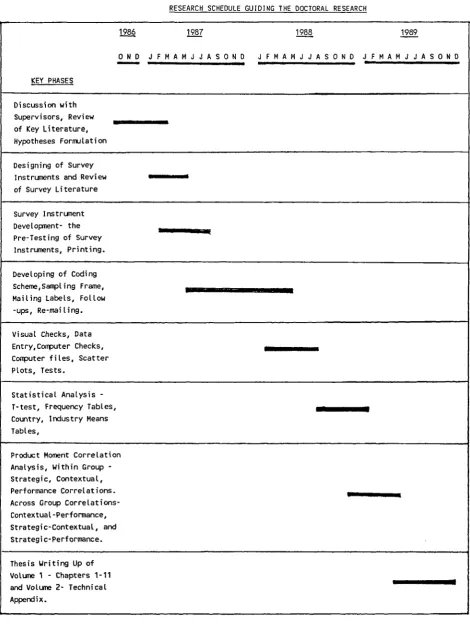
This research effort was carefully planned at the outset so as to ensure due completion on time and within the personal resources of the researcher. Use was made of a detailed planning schedule with all the key phases of the research charted. Although there are minor
deviations and overlaps from the research project schedule, in general the progress of the research conforms more or less to the schedule as set out in Table ( 1.2 ).
A set of interrelated hypotheses was drawn from the literature and discussion at St. Andrews. These were subjected to fine-grained statistical tests rather than the application of data reduction
techniques such as factor analysis which could have obscured detailed relationships of major interest. As can be seen in the discussion of the research results ( chapters 7,8,9 ) this strategy yielded a rich insight to the nature of the relationships being investigated.
Table 1.2
RESEARCH SCHEDULE GUIDING THE DOCTORAL RESEARCH
1986 1987 1988 1989
OND
KEY PHASES
JFMAMJJASOND JFMAMJJASOND JFMAMJJASOND
Discussion with
Supervisors, Review
of Key Literature,
Hypotheses Formulation
Designing of Survey
Instruments and Review
of Survey Literature
Survey Instrument
Development- the
Pre-Testing of Survey
Instruments, Printing.
ammummormsaq
Developing of Coding
Scheme,Sampling Frame,
Mailing Labels, Follow
-ups, Re-mailing.
Ilsommilanommlimem1111
Visual Checks, Data
Entry,Computer Checks,
Computer files, Scatter
Plots, Tests.
Statistical Analysis
-1-test, Frequency Tables,
Country, Industry Means
Tables,
Product Moment Correlation
Analysis, Within Group
-Strategic, Contextual,
Performance Correlations.
Across Group
Correlations-Contextual-Performance,
Strategic-Contextual, and
Strategic-Performance.
Thesis Writing Up of
Volume 1 - Chapters 1-11
and Volume 2- Technical
V.
1.8 THESIS STRUCTURE
The thesis proper comprises of two volumes. Volume one contains the main text whilst the appendixes are found in volume two.
Volume one, which is this volume, is made up of three key parts. Each part ( made up of chapters ) has a specific theme. Part I is concerned with the introduction, the literature review, the
conceptual framework and hypotheses that guide this study , the development of the measuring instruments and the statistical techniques employed. Part II provides the empirical core of the findings with discussion of the descriptive results as well of
hypotheses testing. Part III addresses itself to the implications of the study for managers and researchers.
Volume two comprises appendixes on sample characteristics,
sample t-test results, scales of variables, frequency tables, means of individual variables by country and industry, the qualitative responses to the survey, the total survey instrument package, the computer system files that are created and bibliography.
1.9 SOME LIMITATIONS OF THIS RESEARCH DESIGN Given the constraint on resources and time, this research has limitations as has any other such empirical study. These are
The mail survey instrument is not in the native language of the
country being surveyed - for example in Chinese language, Tagalog or Malay or Thai or Indonesian. It may be added that this is not a
serious limitation as respondents' backgrounds clearly indicate good facility with the English language. This is not surprising as the English language has become very much the commercial language within the region and as the respondents are operating in major business corporations.
The mailed questionnaires were pre-tested only in Singapore and as a result there may well be different shades of meaning attached to the English words used in other countries in the ASEAN. Although much care had been taken in the pretesting phase to replace words capable of ambiguity, this limitation remains. Again this is unlikely to be a source of major difficulty for the reasons given in the last
paragraph. Moreover most respondents had business-related, tertiary-level qualifications and could so have been expected to have acquired a relatively common vocabulary in English, the language in which
most, if not all would have been taught.
A replicated study may not necessarily yield identical findings since individual perceptions, of for example the predictability of the environment, may vary from person to person and indeed for any one individual over time. The best one can do in the circumstances is to ensure that the most appropriate respondent's perceptions
statement of the position of the intended respondent.
This study did not utilise as a measure of corporate performance, objectively determined financial ratios of profitability, such as return on assets, return on sales or return on equity or of growth ratios such , as profit, sales, or assets. Even though the sample selected comprises major, publicly-listed corporations in the ASEAN, the problem of obtaining complete, timely and comparable financial data is still a major and unresolved problem. Unlike the U.S. or the U.K. there are not easily accessible financial data-bases for all countries in the ASEAN region. Furthermore, as this study design is cross-sectional in terms of countries and industries, even if the financial ratios had been available, they would have been unlikely to be meaningful measures in their "raw" form unless standardised by country and industry. This means that financial data is needed not only for the corporations surveyed but also for their industries. Creation of such a financial database would clearly be a major
research undertaking in itself ! Moreover, even were such financial measures readily available, their linkages with aspects of strategic management, given diverse contexts and complex interactions among factors affecting financial performance, might not be easily and
Given the goal-oriented purpose of corporate strategic planning, an assessment of system ability in helping the organisation achieve the goals would seem to be an appropriate measure of a particular system design effectiveness. Such an assessment is likely to be of greater validity if the scoring is obtained from the Chief Executive. Similarly one might seek to measure how useful the system
is in helping the CEO in his strategy formulation or in terms of other key aspects such as of the identification of SWOT ( strengths, weaknesses, opportunities, threats ).
Furthermore qualitative assessments of performance of the company relative to the industry are equally valid as financial performance Such perceptual, subjective measures ( Dess, 1984 ) can correspond closely with the objective situation. Hence use of such measures of system performance, provides a valid basis for assessment of planning system.
This research design has its strengths too. The very geographical scope of the study, the ASEAN region, which may create some problems, allows for cross country and cross-cultural comparisons. By using standard instruments, it is possible to investigate the spatial
1.10 CONCLUDING REMARKS
This chapter provides an introduction to the general objectives of this research study as well as of the motivating factors. A snapshot of ASEAN is provided and in interpreting the results, the broad regional context should be borne in mind. With the prospect of the world being increasingly carved up and integrated into economic
blocs, of which EEC is the most notable example, this study may help stir other researchers to conduct such regional studies of corporate planning. Across economic-bloc comparisons of planning
practices could then be made, within this area of research, into the 1990 . An overview is given of the contents of the doctoral
CHAPTER 2
REVIEW OF LITERATURE
2.1 INTRODUCTION
In this chapter a survey of the key general prescriptive and
descriptive works in the area of strategic planning is followed by a review of literature on contingency perspective of management. A more detailed discussion, especially of the several literature reviews of empirical strategic planning research, is then made. This is followed by a review integrating the wider literature with some of the key propositions that are being tested in this study.
2.2 PRESCRIPTIVE STRATEGY WORKS
Since the seminal work of Ansoff's Corporate strategy (1965), the prescriptive literature on corporate or strategic planning has burgeoned ( see Table (2.4) on review of literature on strategic planning under "general works" and bibliography in Appendix (X) ). Also, there appears to be a broad shift in emphasis from planning ( whether long range, corporate, strategic ) per se to strategic
management which is recognised even in the changed titles of the later editions of standard textbooks such as Glueck (1988) or Greenley (1989).
techniques, plans and takes into account the contextual elements such as the market and political environment and organisational climate.
Implicitly or explicitly they assume that the strategic planning process will generally be beneficial and enhance corporate
performance. Yet this and other implicit assumptions have not been tested very extensively, if at all. Moreover it can be argued that benefits or planning outcomes will tend to be contingent on a match between approach taken and contextual factors such as size, market environment, technology, organisational climate, among others.
2.3 THE CONTINGENCY PERSPECTIVE OF MANAGEMENT
Cyert and March (1963) suggested a behavioural approach in the study of organisations. One pathway for the better understanding of
organisational behaviour, lies in unraveling the nature of
organisation-environment interactions. Strategic planning processes are structurally the core mechanisms through which organisations respond to environment changes. Indeed, Dill (1958), argued early that, "...The investigation of environmental influences that are
relevant to organisational planning is very important..". Clearly organisational planning design, processes, attributes are the
critical ( responsive ) elements of organisational structure. Aspects of strategic planning system characteristics, as will be argued, are likely to be contingently related with each other, the context as well as both corporate and system performance.
The early contingency theorists had contributed much to the
classic work, argued for the adoption of a bureaucratic model of organisational structure. Burns and Stalker (1961) indeed found the existence of bureaucratic or mechanistic structures but these are of organisations facing a stable, homogenous environment. Organisations that have to cope with unstable and heterogenous environment, found organic structures to be more effective. Different persons had
contributed to further development of the contingency perspective on organisation structure. Woodward (1965) found technology
( manufacturing process ) to explain the variations in organisation structure. The technology imperative is such that "...Commercially successful firms seemed to be those in which function and form were complementary.." The "Aston studies" ( Pugh et. al. 1963, 1968, 1969; Grinyer, 1978 ) investigating into standardisation, specialisation and formalisation aspects of organisation structure found
organisation size to be major predictor of structure ( more than technology ). Child (1972) found size to be major predictor of
decentralisation. Grinyer and his co-workers ( Grinyer and Ardekani, 1980 & 1981 ; Grinyer et.al ., 1980; 1986 ) in further extension of research on these contingency aspects of organisational structure found strategy/structure relationship involves size. Recent research work by Foo ( forthcoming, 1990 ) found contextual factors such as size, charter and ownership to influence corporate productivity practices.
In the United States, the poineering work of Lawrence and Lorsch (1967) is instructive. They found that organisational performance/to
03e related to degree of consistency of structure with the
selecting for investigation contrasting industry environmental conditions and of the orientations of organisations in terms of formality of structure, goals, temporal and the interpersonal. Galbraith (1973) contributed to the importance of an information processing perspective to organisation structure. Task certainty is found by him to be related to planning which results in a lesser need for continuous flows of information. On the other hand, more
environmental changes will lead to more coordinative structures. Thompson (1967), stressing the open system perspective, argued for organisation structure to be related to the technological and
environmental demands.
The strategic planning process is clearly an important aspect of organisational structure. By analysis of the inter-relationships of strategic, contextual and performance variables, it is possible that further clarification can gained of the empirical nature of the
strategy process ( Quinn,' (1988) ) and particularly from a
contingency viewpoint. Such analysis may lead to better understanding of the behaviour of organisations, see for example March and Simon
(1958), Cyert and MarCh (1963), Hall (1987), Scott (1981), Miller and
Friesen (1984). ( For a discussion of the contribution of f/tx
administrative behaviour school to strategic management in terms of the relationships between strategy, structure and performance, see Jemison (1981) ). This study emphasizes the view that organisations should be seen not in terms of independent compartments, but in a more total perspective, as comprising of reinforcing strategic, contextual and performance elements and that their
The discussion now turns to more specific prescriptive and strategic planning research review literature.
2.4 "AN ANATOMNY OF STRATEGIC PLANNING"
Although the general body of prescriptive literature has strongly influenced this work, the "anatomny of strategic planning" article by Grinyer (1965), ought to be mentioned specifically since the key
conceptual premise of the corporate strategic planning process is inspired and influenced by it. The conceptual model ( see the
diagrammatical representation which is reproduced in Figure (2.1) ) attempts to reflect the process flow of planning. In arguing for such a priori, conceptual model of strategic planning, it is opined ( in the words of the author ) that
-"..any new model needs to recognise the systematic, logical
nature..allow for the basic complexity..reiterative nature of the planning process, its dynamic and continuing nature, and the
chronological movement of search, evaluation and selection.."
This is based on the thesis that the complexity of the strategic problems
-...makes a systematic. .attack on formulation of strategies necessary."
‘tNt twinmmtcA
to"."n ‘ çO I.
Information fro
•
€ „ eny
11.0e)„,,
Ne.
Z: ... ...
Profitec 1.Potentiat 2.f4ormative 3.Competence G.Comparative •
06% ".• g • <C• • • 0 • ee . n3.‘ (5. • k
• •
1 •
Ne.
f4e o,.e.ei
... e,., of ..
..0 d) .
#)) ro
eI.„, ")) -. ..c. 4 l'e. ,, ,• Present strategy c Diversification Expansion proposals Specific Set objectives Figure 2.1
Source Grinyer P.H., The Anatomy of Business Strategic Planning
qualification of the model that,
" It is not suggested, however, that the model itself is such a procedure" [ ( referring to effective planning procedures ) . But rather that ] "..it provides insight into the underlying rational structure of...strategic planning...and the model is a reasonable basis for a programme of research."
This article is the initial basis for this research. The pervasive influence of this article can be seen in the detailed questionnaire items developed for the categorisation of planning by the Chief Executive ( see in particular Chief Executive Instrument in the Appendix VIII - Total Survey Instrument Package, the item number 5.1 ) and by the Corporate Planner ( similarly, but in the Corporate Planner Instrument, the item number 1.1 to 1.10 ) in respect of
facets of the planning process. Using prescriptive works ( such as this ) as antecedents for the development of a research programme is useful as these provide the theoretical premises for the formliation of testable hypotheses related to the discipline.
2.5 LITERATURE REVIEW OF PLANNING CONTINGENCY RESEARCH
Hofer (1975), in an early article, " Toward a Contingency Theory of Business Strategy ", provides a detailed summary of the the
propositions related to strategy that is embodied in the research studies as well as from the normative literature. Although seen from a business, product life cycle perspective, his review is useful in advancing a contingency perspective to strategic planning, for
and Organisational Variables " ( in Table 8 of the article ).
His later paper Hofer (1976) which is specifically titled, " Research On Strategic Planning : A Survey of Past Studies and Suggestions for Future Efforts" provides an even broader survey of the literature. He provided a comprehensive picture of the research in the manner of a table ( Table 1, page 282 ) where in respect of each head of the research types for example on the cost and benefits of planning, specific suggestions as to the potential for future research, and of the suggestions for future research. In the summing up section, he proposed that
most of the future research should begin to involve some sort of
hypothesis
testing.."and that,
...larger samples will be needed to assure the external validity of any set of findings.."
His survey of the literature is however, somewhat dated.
-u .. for purposes of this article adopts the common convention of
equating strategy content with strategy formulation content."
( Table 1 in page 169 provides a list of representative studies ).
They commented that,
"..Because strategy content questions emphasize the posturing of the firm with respect to its environment, strategy content studies
typically examine external conditions, with considerably less
attention ( and, in many cases, none at all) devoted to conditions internal to the firm. "
This implies a need for studies that examine both the internal as well as external contextual factors. Of interest is their observation that,
" ..For measurement objectivity and data availability, most goal content research to date has focused almost solely on performance defined in economic terms. Considerable opportunities exist to conduct research on other goals or multiple goals.."
On the question of broader environmental influences on strategy formulation, they observed,
They also suggested on methodology that,
".. Streams of related studies, adopting theory-oriented
perspectives...relationships among external conditions, strategy, goals are required.."
Given this research design of investigating inter-relationships of strategic, contextual and performance variables, some contributions can be expected from this research effort.
Huff and Reger (1987) followed up the strategy research literature by focusing on the strategic process research. They limited their survey to articles appearing in Strategic Management, Journal
of Business Strategy, Academy of Management Journal, Academy Academy of Management Review, Administrative Science Quarterly, Journal of Management and Management Science.
In the process, they identified nine streams of work. Using Huff's classification of the nine distinctive strategic research
alternatives ( as is reproduced here in Figure (2.3) ), this research although springs from ( 5 ), is broadly integrative in that it
encompasses the other streams as well given the lack of compactness of each classification. They suggested that future research should give,
"...simultaneous attention to the content as well as the process of strategy ", " build on existing theory and research" , " consider the "organisational and environmental context " II aim for
.--Le; .n-n
•n•• ....
t.) 7.--:
....
. ......, 14
r3 ..." ...
- —
---.4
1.... —
... 0
.._. . —
—-:17;
>-, ...0
... 1.)
— ....)
.. .... ... _. t... -0 = c.)
•n•• ••n•• ". !...)
1.) ... —.. .... -1: *---'
->-, —
. c- i
•••-• 1...
Zo.
"--.:/.. .... ...)
> I-. ... —
a •,,r
•
= tj t...) =
7....J 0 ,... .... cr) =?3 . ,...,...., >< >< a
1.) v .,..-• = a r— ../ u -. . Do I .. .. .1.; . ''..j ..., ... . _ -t.-0 -6 a . .. • - ,_.
E u
a ..,)
...._„ I-. 0... CL.• ,-.._. -... • _ :4 .. . - zn.,...) ....
<
tO 7,1s: u au . _
c -- a 0,,,74 .73 I.... ... 0,...
a
74 0• ._. -.a --, a a
c.) 0
to ...
< <
. .
..-.. C4") 1r) r-:
could be made to this (agendas) stream by careful large scale surveys, unobtrusive measures.." These views have influenced the design of this research study.
Of particular relevance to this research effort are the comments that they made in relation to the article titled, Towards A Contingency Theory of Corporate Planning: Findings in 48 U.K. Companies,
( Grinyer, Al-Bazzaz, and Ardekani, 1986 )
" Grinyer, Al-Bazzaz and Yasai-Ardekani (1986) exemplify the planning practices sub-stream concerned with planning contingencies. Through correlation and regression analysis of approximately a dozen planning system characteristics and another dozen contextual contingency
variables, they found that certain contextual variables. .were related to certain planning system characteristics....Their work constitutes a major contribution because it begins to move away from the
generalities that have characterised prescriptive and descriptive work on planning to address some of the critical contingencies that shape planning systems in practice "
Also of interest is one data analytical approach which argues for the use of fine-grained approaches,
"...finer grained analysis showed the strong relationships between contextual and planning variables loading onto these factors to be independent of size ..."
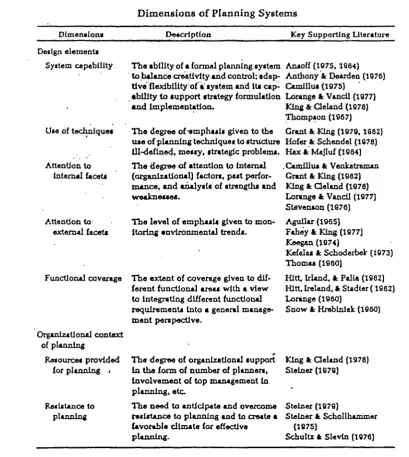
The implications of the internal organisational context of planning on planning system dimensions had, for example being recently
investigated by Ramanujam, Venkatraman and Camillus (1986). Table (2.1) is used to relate the key supporting literature ( no
distinction' being made to prescriptive and empirical research-based literature ) to the set of planning dimensions being investigated is shown here. Even though they concluded that,
"...overall the most important dimensions were system capability, resources provided for planning and functional coverage.."
they commented that,
"..influences on effectiveness seem to vary depending on the criterion of effectiveness.."
On future extensions of the study, they suggested that,
Use of technique
[image:54.595.56.466.109.567.2]Attention to Internal facets
Table 2.1
Dimensions of Planning Systems
Dimension Description Key Supporting Literature
Design elements System capability Attention to external facets Functional coverage Organizational context of planning Resources provided for planning Resistance to planning
The ability of a formal planning system •to balance creativity and control;
adap-tive fle)dbIlityof. i system and its
cap-•ability to support strategy formulation and Implementation.
The degree of -emphasis given to the use of planning techniques to structure ill-defined. messy, strategic problems.
The degree of attention to internal (organizational) factors, past perfor-mance, and analysis of strengths and weaknesses.
The level of emphasis given to mon-itoring environmental trends.
The extent of coverage given to dif-ferent functional areas with a view to integrating different functional requirements into a general manage-ment perspective.
The degree of organizational support In the form of number of planners. Involvement of top management in planning. etc.
The need to anticipate and overcome resistance to planning and to create a favorable climate for effective planning.
Ansoff (1975, 1984)
Anthony .& Dearden (1978)
Camillus (1975)
-Lorange & Vancil (1977)
King & Cleland (1978)
Thompson (1987)
Grant & King (1979, 1982)
Hofer Schendel (1978)
Hax & Majluf (1984)
& Venkatraman Grant & King (1982)
King & Cleland (1978)
Lors.nge & Vancil (1977)
Stevenson (1976)
Aguilar (1965)
Fahey & King (1977)
Keegan (1974)
Kefalas & Schoderbeir (1973)
Thomas (1980)
Hitt. lrla.nd, & Palia (1982)
Hitt. Ireland, & Stsdter ( 1982)
Lounge (1980)
Snow & Hrebiniak (1980)
King & Cleland (1978)
Steiner (1979)
Steiner (1979)
Steiner & Schollhammer
(1975)
Schultz & Slavin (1978)
Source : Ramanujam, Venkatraman and Camillus, Multi-Objective Assessment of Effectiveness of Strategic Planning:
They further commented that,
"..We believe that research on planning is at a critical crossroads.."
2.6 LITERATURE REVIEW OF PLANNING-PERFORMANCE RESEARCH
Armstrong (1982) in reviewing the empirical research on the question of the value of formal planning for strategic decisions summarise the
state of the findings in a table which is reproduced here ( Table (2.2) ). The main conclusions from his survey of literature is that formal planning was useful. He proposed in the suggestions for further research that,
"..Progress will occur much more rapidly if the evaluation studies make assessments of the process, the situation and overall results."
The paradigm of strategic-contextual-performance used in this study is a good approximation of his "process-situation-results" framework for future research. In his conclusions, he suggested that,
"..further research is needed to identify which aspects of this process are relatively most useful in strategic planning for organisations.."
He thus advocated a detailed analysis of strategic planning process
Sl2p1OtplEIS
1D410 ty„ EL, r• • r •
• -..
ii3P10,41mS
;.41.:31duto3 6.1„ 4294 iku!ruzaun ql!H -C-•
f•- C. •
C'-32.1e7 i,131.sew tu3pcipui > >->2
1U 31.11111.1.1tUOD EL. <- • r • I:- •
lupr ow I • tr. • • T. •
- C. - c C-. r • C..• •
LL. c:› c, U..
Z
c•• Z c• • c"'
- e- Z c•• c- ••n••
>-Z cs- C."
U. t•-• r• c• U.. U..
••••
-C-. c-- c-r• C-LL. s312 31e 31E111Z.A3 SZ1231C1 zleiztwO
s3A xi's°
C-'V 7, ci c c V
c. s, - V • J.t
CC
• 5
C.)
z tr
_
:•• c • E C.
a)
o •„ 4.)
E,„ •-• "
CF_
D 0
u) -5_ ▪ IF.:4 . 1" e_ •.-1
c ,3
r• • C • U..
r. r - t• • r • G7 r • r- r•
t--
(.2-.... - r-- o :7.' 0-._. ,.... _. ..c
.-_-:
3 E ,; 0
c W. = , c,... P
-V7
75 0 .= •C • c;
:,; .
-
., • -0 ,
.3.e o L^ .t-.:
o o -7- . o ' E 1:: c 0 c
.-O ..F.... - (,-.1 .. 5 6.4 -_,::: .,... ..,„ O . o 7 ... c ,-- _ o 0 ,.. c sl... z,-, Cl z
..; at' ... - .-. X' E "0 el -c •z-.. Cl v,
C; > ,
a- •• = = v•
v, 04 -: ....
e... " C C v. ..; .., rit t. C..
C 0 • 0 ..41. ..-• r. a, .... C 0 t- LA 0 • J. •• a.. tl ). a- 0 c c „, 0 ›-•,.-0 -....-- — . c -E E ..., ) V C ....- 7 , CT C ,.- C. v >
C l
,os •-• L. 7% V,
, E a- c ..; C 0- .•C v ,,.," ..9 =., ,...-• G g., 8 ....
, ... . ... CI = • e n 1-* ...c :... E c C -, E :-..c
a •- c.. E rc 7a .- ..., c
Cc
F-* it• C .7, -C O. .-- ‘- - - - ..., ..- C; c - - - C - . a 0 C. 6-* 6-* 2.1 :C Z. ..,
,„..--1.1 ma 6 -.7. c 9' 'g E 9' 14 ...- 11 ; 13.. ;1 18
-12-_..,...:,_,.., -
.--..._ a .- c, 0
c-0- =EcE og.c.0.,D.E...- -E. .. ::-.... „ 7. t-. c c as 7., c u - ,a- .... c,••
8 6 7- c "' v ' -- " '''' 0 .-. c a , c ", c E ..- L.; a ";,.. 'L.!" •:: ..,...2 ,..416.1 -u- 17.. ,.4 02 77: . 2 a., .ar, -; ›,..: 0E- 0 La_ .,..., -; .12
7 •C ... . 4J •-•
wo CJ • ' . --->C>•"..-_•-•C'"0•-• ::: C , .... cp, • - .- •L) , c •-• ..-- •.= •••• to t.i...lc_ c a ->0 ....›.. .." ..= Le., 67- 4.," -c - ,..c..-1 ., - . '-' -° u c 17.-' c a 8
.2 11: —c."----&-' c.-E c ,,; o c c .... c.... o
:2 v .0 .- - c - c -0 :3 o S-.: 4., u 1-, ..- =..?.;:zEa :3 0 0 . - 0 u ..• -7. u :719 :3 "c, :: = "ii . = c 7: = ° ›.,7,.,..oagEttcgce:cc E
6-5 E •E F, 6 —L
•
E ,,..,„--. t...s ...2 0 0 L.> 0 _ 0 ,_ c cg z ...., i5.,, c .. 0 a.- cr. co 2 ..,A. c. 0 0..8 ;:. ,;-, osc,, tr.. -9c s•-•4 u •... .. .. •-: .. Nr
--0-. C., L. • • . , CC r.1 Os ci., ,..,
.... .0 < CO (.)
0, < < d 0 rs
-••••, ..
00
•-•
°.... fl... G f..."-"' ca
.,...- a..,,
Zi-f.- r- . a = C-. a- -
.
•-ic" cL -cl f-u• = "--•-•
co' a ci. 7-3 c4 U.
r.... - - .:C 4-•
S-..._.. , 4:: z.o.r.s.n.-7....6...--- ..-..-c'sr: ..._::0..._.!..._.7-5
°2-:::aar-7.
co .._. .:. 0 c L.. 13 ,
Gs
.:-_-- .7....7.- :7E . s... .7,—
0 0. --a- 0 _ ch , :-. as co 0, -, o• 1:1 as -0 as g Cis.-- C C's" "0 Cs" MCLI. Cr%
-.., - - -. •-•
I.--- • •7 ••••• ..0 ••••:. .0.6 r- - r-- ,-,
--- 0. ----_ i •-•..-% __ 0.1a . - ----: 5 ;..o....0 r...cr .0,-- go ,., r-- N. ..QCC E
••••
-
r--> . -..- • F. 1 ,_ ;:---.1y_' n 3;alici-9:.--o,... .1 :: -.-. - 1••••• - • 00 ro --- 0 ...c) , r: <2- (-4 c _,...." L.. c L.'s
r- iu ••0 no r's w --- >, cn "' c. ,f?.. •-• " c: --• v. .- = - ..-. Ct"-s .• a '.=*--. 7.7 •-• , - •-• 0 a• Dig.'4 0.• 0 0 ._„ as .1_- C:_„ -^ c ..._ n --. 0 .7_' - LLsC ..- " s ..=.
"' Cs r, a r. a
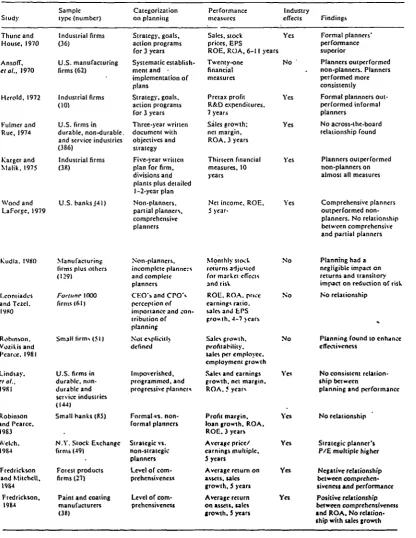
Rhyne (1986) recently reviewed the research literature investigating the planning-performance relationship, offered yet another useful summary of the literature ( which is shown here in Table (2.3) ). He commented that,
".. more recent studies have reported contradictory findings on the relationship between planning and financial success."
His own study found that,
"..planning systems that combined an external focus with a long-term perspective were found to be associated with superior 10-year total return on stockholders".
He advocated that,
"..future research studies must be designed to measure not only the existence, but also the characteristics of the planning systems under investigation. Careful selection of performance measures also is
necessary to insure that they accurately reflect truly effective management practices"
Kudla. 1980 1.contiadcs and Tezel. 1980 Robinson. Vozikis and Pearce. 1981 Lindsay. Cr at.. 1981 Robinson and Pearce. 1983 Welch. 1984
la nu fact u ring firms plus others (129)
Fodune 1000 Items (61)
Smal l firm, (51)
U.S. firms in durable. non-durable and service industries ((44)
Small hanks (85)
[image:58.595.85.502.127.666.2]N.Y. Stock Exchange firms (49)
Table 2.3
Prior studies on relationship between planning and performance
Study
Thunc and House, 1970
Ansoff,
eta,., 1970
Herold. 1972 Fulmer and Rue, 1974 Karger and Malik, 1975 Wood and LaForge. 1979 Sales, stock prices, EPS
ROE, ROA, 6-11 years
Twenty-one financial measures Sample type (number) Industrial firms (36) U.S. manufacturing firms (62) Industrial firms (10)
U.S. firms in durable, non-durable. and service industries (386)
Industrial firms (38)
U.S. banks ,(41)
Categorization on planning
Strategy, goals, action programs for 3 years
Systematic establish-ment and • implementation of plans
Strategy, goals, action programs for 3 years
Three-year written document with objectives and strategy
Five-year written plan for firm, divisions and plants plus detailed
1-2-year plan Non-planners. partial planners. comprehensive planners Non-planners. incomplete planne:s and complete planners
CEO's and CPO" perception of importance and con-tribution of planning Not explicit!. defined Impoverished, programmed, and progressive planners, Formal•vs. non-formal planners Strategic vs. non-strategic planners
Level of com-prehensiveness Performance measures Pretax profit R&D expenditures. 7 year Sales growth: net margin. ROA. 3 years
Thirteen financial measures, 10 years
Net income, ROE. 5 year'
Monthly stock returns adjusted for market effects
and risk ROE. ROA. price earnings ratio. sales and EPS growth. 4-7 )cars
Sales growth. profitability. sales per employee. employment growth
Sales and earnings growth, net margin. ROA. 5 years
Profit margin, loan growth., ROA. ROE, 3 years
Average price/ earnings multiple. 5 years
Average return on assets, sales growth, 5 years
Average return on assets, sales growth, 5 years
Industry
effects Findings
Yes Formal planners'
performance superior
No Planners outperformed
non-planners. Planners performed more consistently
Yes Formal plannners
out-performed informal planners
Yes No across-the-board
relationship found
Yes Planners outperformed
non-planners on almost all measures
Yes Comprehensive planners
outperformed non-planners. No relationship between comprehensive and partial planners
No Planning had a
negligible impact on returns and transitory impact on reduction of risk
No No relationship
No Planning found to enhance
effectiveness
Yes No consistent
relation-ship between
planning and performance
Yes No relationship •
Yes Strategic planner's
P/E multiple higher
Yes Negative relationship
between comprehen-siveness and performance
Yes Positive relationship
between comprehensiveness and ROA. No relation-ship with sales growth
Fredrickson Forest products
and Mitchell. firms (27)
1984
Fredrickson, 198.5
Paint and coating Level of
corn-manufacturers prehensiveness
(38)
Dess and Robinson (1984) examine the usefulness of subjective performance measures and in the discussion concluded that,
"..these subjective perceptions of relative improvement were strongly correlated with objective measures of the absolute changes in return on assets and sales over the same time period."
Further in the discussion,
"..subjective measures may be useful in attempting to operationalise broader, non-economic dimensions of organisational performance"
and that,
"..subjective performance measures are probably most appropriate in examining relative performance within an industry.."
In the light of this finding, in this study I gathered subjective relative to industry performance data, as well as heeding the call by Fahey and Christensen (1986) for measurement of the non-economic goals and of planning effectiveness by Rhine (1986) ( see above ), the performance criteria may also be extended to include perceived benefits and problems, help yo CEO in strategy formulation and SWOT,
qualitative goal achievements, and a broad range of relative to industry performance measures.
where further research progress on strategic planning can be made.
2.7 RELATING TO THE WIDER EMPIRICAL LITERATURE
In order to relate more specific aspects of this research study to a wider body of empirical strategic planning and organisational
literature, the a priori clusters of variables within each broad grouping of strategic, performance and contextual variables are
related to other studies that had been undertaken. Although a concept or characteristic studied may be the same across a number of studies there are differences in operationalising it both between published studies and often between earlier work and this study. One example of the differences in measurement ( there are many ) are the studies cited in relation to environmental uncertainty. This study utilises a perceptual approach (Duncan,1972) whilst it is possible to measure this by use of objective measurements ( Snyder and Glueck,1982; Tosi et.al .,1973 ). The structural dimensions are also captured
perceptually utilising questionnaires ( Sathe, 1978; Ford 1979 ). In some instances, there are also differences in the manner of
conceptualisation. One example is that of the time of the CEO. Ramanujan (1986) treated this as a resource availability variable whilst in this study it is conceptualised simply as a strategic planning variable. It should be clear that although the empirical
studies quoted are extensive, they are by no means comprehensive but purely representative.
The three main grouping of variables correspond to the broad
contextual and performance variables. Most of the sub-groups, for example of environmental scanning, consist of individual items "clustered" together . For details of the individual items within each of the cluster the reader is referred to Appendix III in Volume Two.
This study is designed from the outset to test hypotheses requiring detailed analysis of the inter-item correlations within each of these clusters and across clusters. As argued in chapter 5, proceeding from correlational analysis is procedurally sound. The application of data reduction methods by aggregation of the items or by way of factor analysis will result in the loss of information that can be
contributive to our understanding of key relationships within each cluster as well as across-cluster.
The strategic group includes variables on goals, goal setting, CEO time, environmental scanning, CEO categorisation of planning system, functional strategy mapping, perceptions of the senior management on planning system, organisation of planning, information gathering, forecast utilisation, technique utilisation, general features, the formality of the planning system, monitoring of performances, sources of ideas utilised and use of written functional plans. It should be noted in respect of some of the variable cluster such as general
features of planning, the studies cited may relate only to one of the item variable in that cluster.