A Hyper-heuristic Approach to Automated Generation of Mutation
Operators for Evolutionary Programming
Libin Honga, John H. Drakeb, John R. Woodwardc, Ender ¨Ozcana
aSchool of Computer Science, University of Nottingham
bOperational Research Group, School of Electronic Engineering and Computer Science,
Queen Mary University of London, E1 4NS, UK
cComputing Science and Mathematics, University of Stirling
Abstract
Evolutionary programming can solve black-box function optimisation problems by evolving a
pop-ulation of numerical vectors. The variation component in the evolutionary process is supplied by
a mutation operator, which is typically a Gaussian, Cauchy, or L´evy probability distribution. In
this paper, we use genetic programming to automatically generate mutation operators for an
evo-lutionary programming system, testing the proposed approach over a set of function classes, which
represent a source of functions. The empirical results over a set of benchmark function classes
illustrate that genetic programming can evolve mutation operators which generalise well from the
training set to the test set on each function class. The proposed method is able to outperform
exist-ing human designed mutation operators with statistical significance in most cases, with competitive
results observed for the rest.
Keywords: Evolutionary Programming; Genetic Programming; Automatic Design;
Hyper-heuristics; Continuous Optimization
1. Introduction
Black-box function optimisation is the task of finding the optima of an objective function for
which we do not have access to an analytical form. A generate-and-test approach can be used
to sample the domain of the function in order to identify potential optima. Different black-box
optimisation techniques have been proposed; the majority of which are the result of much manual
effort. In addition, each optimisation algorithm is designed in isolation from a problem environment.
A proposed algorithm is usually tested on a number of benchmark functions to demonstrate its
a parameterised function in which the parameters have a certain range of values. Thus a function
class represents an infinite source of functions, from which it is possible to draw sets of sample
functions from the same distribution.
This paper is concerned with evolutionary programming (EP) [1], which evolves a population
of real-valued input vectors for a function, a technique widely applied to real-world problems [2,
3, 4]. As EP has an evolutionary basis, each vector undergoes selection, evaluation, and mutation,
with the expectation that fitter and fitter vectors are obtained. Here we focus on the mutation
component of EP, which in the past has been designed manually. Real-valued optimisation is an
active research topic and several population-based metaheuristics have been applied to function
optimisation, including differential evolution and its variants [5, 6] , particle swarm optimisation
[7], covariance matrix adaptation evolution strategy (CMA-ES) [8] and hybrid methods [9]. We
acknowledge the existence of these algorithms. However, as this study is concerned specifically
with the modification of EP, a full review of all of these algorithms is beyond the scope of this
paper.
A hyper-heuristic is a search method or learning mechanism for selecting or generating heuristics
to solve computational search problems [10]. In addition to the broad distinction between selection
and generation hyper-heuristics, it is also possible to classify hyper-heuristics according to the
source of feedback during learning. Online hyper-heuristics learn while solving a given instance of
a problem, whilst hyper-heuristics which learn in anoffline manner gather knowledge in the form
of rules or programs, from a set of training instances, that would hopefully generalise to the process
of solving unseen instances. genetic programming (GP) [11] is a population-based evolutionary
computation method for evolving program trees, that has frequently been used as a generation
hyper-heuristic in the literature [12].
In this paper, we use GP as an offline generation hyper-heuristic to automatically create
mu-tation operators for EP operating on function classes. A mumu-tation operator in EP is a probability
distribution, represented as a random number generator. We present an algorithmic framework
which can not only express a number of currently existing EP mutation operators, but also
gen-erate novel variants of EP mutation operators. Using a train-and-test approach, GP is used to
evolve mutation operators for EP, using a training set drawn from a class of functions which is
then validated on a larger set of unseen instances taken from the same class. We use the term
by GP. We demonstrate that the ADMs for EP are capable of comparable, and often superior,
performance to existing human designed operators. An additional set of experiments that takes
ADMs that are trained on one function class, but then tested on a different function class is also
conducted to further examine the performance of the evolved ADMs.
The outline of the remainder of this paper is as follows. In Section 2, we give the background
to the proposed approach of automatically designing algorithms using GP-based hyper-heuristics.
In Section 3 we consider the task of function optimisation and introduce the notion of a function
class. Section 4 presents our experimental results, which are analysed in Section 5. In Section 6
we discuss the research presented and in Section 7 we summarise the article and outline potential
further research directions.
2. Automated Design Using Hyper-Heuristics
The key distinction between metaheuristics and hyper-heuristics is that the former operate
directly on the solution search space, while the latter operate indirectly on the solution search
space, working with a set of low-level heuristics or heuristic components. Hyper-heuristics come in
two main types: heuristics to choose heuristics and heuristics to generate heuristics [10]. In this
paper we are concerned with the second of these two categories, heuristics to generate heuristics [12].
The automated generation of heuristics has received much attention in the last few years.
Wood-ward et al. [13] automatically search the space of genetic algorithm (GA) selection operators, which
contain fitness proportional and rank selection, where bitstrings in the population are chosen in
proportion to their fitness value or indexed position in the sorted population respectively. In a later
paper by the same authors, novel mutation operators were automatically constructed using random
search and multiple-restart hill-climbing to search the space of mutation operators [14]. The
sys-tem was capable of expressing two well-known mutation operators: one-point anduniform. While
random search and hill-climbing may not be considered to be particularly ‘sophisticated’, they
were sufficient to discover new selection and mutation operators which outperformed their human
designed counterparts. Diosan and Oltean [15] evolved crossover operators for genetic algorithms
outperforming existing crossover operators on some function optimisation problems.
As one of the main applications areas of metaheuristics is combinatorial optimisation problems,
it is not surprising that this type of problem has attracted the attention of automated design.
used GP to automatically design algorithms for job-shop scheduling, Keller et al. [17] tackled the
travelling salesman problem, while Bader El Den et al. [18, 19] evolved timetabling heuristics.
Drake et al. [20] used GP to evolve a scoring mechanism to determine the order in which knapsack
items should be considered by a constructive heuristic for the multidimensional knapsack problem.
Hong et al. [21] used GP to automate the design of probability distributions as mutation operators
for evolutionary programming. GP was used to generate new data mining algorithms which were
tested on well-known machine learning benchmark datasets by Freitas and Pappa [22]. Their paper
showed that GP could outperform random search in searching the space of rules for data mining.
The rules evolved by GP were observed to be at least as good as human designed rules in terms
of classification. GP has also been used to automatically design schedule policies for dynamic
multi-objective job shop scheduling [23], to evolve ensembles of dispatching rules for the job shop
scheduling problem [24], and to automate the design of production scheduling heuristics [25]. Both
online and offline bin packing have attracted attention within the heuristic generation research
community [26]. Heuristic functions have been evolved to determine in which bin to place a given
item [27]. In this case, the evolved heuristic functions have been shown to perform well on problem
instances drawn from the same problem class used in the training phase, while a degradation in
performance is witnessed when heuristics are applied to problem instances drawn from different
problem classes. Heuristics have been evolved on problem instances containing a small number of
items, then applied to much larger problem instances containing many more items [28]. In these
approaches, a heuristic function is evolved as a GP syntax tree. However, more recently, both
a look-up table (referred to as a “matrix”) [29, 30] and function interpolation [31] have also been
used to represent a heuristic function. Other metaheuristics have been automatically designed using
hyper-heuristics, such as particle swarm optimisation [32] and variable neighbourhood search [33].
This current paper builds on previous papers. Hong et al. [21] first demonstrated that GP could
automatically construct random number generators which are typically used in EP. In a second
paper, it was shown that ADMs could be trained on collections of functions classes, showing good
performance across a broader range of functions [34], however a tradeoff between general training
and specific performance was observed. This paper presents a study of the design of 23 ADMs, for
3. Optimisation and Function Classes
In this section we first discuss optimisation with EP, and then introduce function classes as
probability distributions over functions. Function classes are central to this paper, differentiating
our approach from the standard convention of benchmarking on arbitrary functions. Rather than
demonstrating the utility of an optimisation algorithm for specific arbitrary functions, we
demon-strate the utility of an ADM on a set of functions are drawn from a fixed probability distribution
(i.e. a function class).
3.1. Evolutionary Programming and Optimisation
We follow the formulation of optimisation as stated by Yao et al. [1, 35], which we repeat here.
Global minimisation can be formalised as a pair (X, f), whereX∈Rn is a bounded set inRn and
f :X →Ris ann-dimensional real-valued function. The objective is to find a pointxmin∈X such
thatf(xmin) is a global minimum inX. More specifically, it is required to find an xmin such that
∀x∈X :f(xmin)≤f(x).
Here,f does not need to be continuous or differentiable. While the aim of optimisation is to identify
global optima of the function, in practice we often settle for methods, such as EP, which identify
near-optima. EP is a widely used evolutionary algorithm for continuous optimisation introduced
by B¨ack and Schwefel [36] as follows:
1. Generate the initial population of µ individuals. Each individual is taken as a pair of
real-valued vectors, (xi, ηi), ∀i ∈ {1, . . . , µ}, where xi’s are objective variables and ηi’s are standard
deviations for Gaussian mutations.
2. Evaluate the fitness value for each (xi, ηi), ∀i ∈ {1, . . . , µ}, of the population based on the
objective function,f(xi).
3. Each parent (xi, ηi), ∀i ∈ {1, . . . , µ}, creates λ / µ offspring on average, so that a total
of λ offspring are generated. Offspring are generated by: for i ∈ {1, . . . , µ}, j ∈ {1, . . . , n} and
p∈ {1, . . . , λ},
ηi0(j) =ηi(j)exp(γ0N(0,1) +γNj(0,1)) (1)
x0p(j) =xi(j) +η0p(j)Dj (2)
where xi(j), x0p(j), ηi(j) and ηp0(j) denote the j-th component of the vectors xi, x0p, ηi and ηp0
and standard deviation 1. Nj(0,1) indicates that the random number is generated anew for each
value ofj. The factorsγ andγ0 are set to (p2√n)−1 and(√2n)−1 [36].
4. Calculate the fitness of each offspring (x0p, η0p),∀p∈ {1, . . . , λ}, according to f(x0p).
5. Conduct pairwise comparison over the union of parents (xi, ηi) and offspring (x0p, ηp0), ∀i∈
{1, . . . , µ},∀p∈ {1, . . . , λ}. For each individual,qopponents are selected randomly from the parents
and offspring. For each comparison, if the individuals’ fitness is no smaller than the opponent’s it
receives a ‘win’.
6. Select theµindividuals out of the parents and offspring ((xi, ηi) and (x0p, ηp0),∀i∈ {1, . . . , µ},
∀p∈ {1, . . . , λ}) that have the most wins to be the parents of the next generation.
7. Stop if the halting criterion is satisfied; otherwise return to Step 3.
Different variants of EP can be obtained by using different probability distributionsDj in Step
3 above. If Gaussian distribution is used, then the algorithm is classical evolutionary programming
(CEP) [1], the Cauchy distribution is used in Fast EP (FEP) [1] whereas the L´evy distribution is
used in L´evy evolutionary programming (LEP) [37]. The L´evy distribution is parameterised with
a single parameterα, and corresponds to the Cauchy distribution when α=1.0 and the Gaussian
distribution when α=2.0. Where LEP is used in this paper, the L´evy Lα,γ(y) distribution is
implemented according to Mantegna [38] as given by Lee and Yao [37], withγfixed at 1 (note that
γhere is independent from step 3 above):
Lα,γ(y) = 1
π
Z ∞
0
e−γqαcos(qy)dq, y∈R. (3)
In this paper we will use genetic programming to evolve distributions to replaceDj as a mutation
operator in the EP system described above. In each case, we use the same parameters for EP as
previous publications [1, 35], using tournament selection with tournament size 10 on a population of
100 individuals. The initial value of the strategy parameterηis set to 3.0.The number of generations
is different for each function and is specified in Table 1 below.
3.2. Functions and Function Classes
In previous papers [35, 37, 39, 40], methods have been compared on functions from an arbitrary
set. Each method is executed multiple times on asinglefunction to provide a statistical comparison.
representing a probability distribution over a set functions. An example of a function class is
y=ax2 wherea is uniformly distributed in the range [1, 2]. In this case,y = 1.3x2 is a function
from this function class, whiley= 0.3x2is not from this function class. For each of the 23 standard
functions often used in EP research [1, 35], we have constructed a corresponding function class.
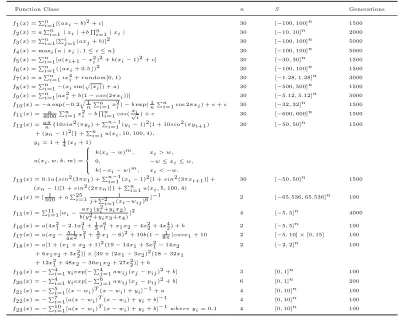
The 23 benchmark function classes are given in Table 1. These can be classified as follows: f1–f7
are unimodal functions,f8–f13 are multimodal functions with many local optima, andf14–f23are
[image:7.612.104.503.251.568.2]multimodal function with few local optima [35].
Table 1: Function classes with number of dimensionsn, domainS, and number of generationsGen. The parametersa,b
andcare uniformly distributed in [1 ,2], [-1, 1] and [-1, 1], respectively. For the values ofwinf19tof23, please see [35]
Function Class n S Generations
f1 (x) =Pn
i=1[(axi−b)2 +c] 30 [−100,100]n 1500
f2 (x) =aPn
i=1|xi|+b
Qn
i=1|xi| 30 [−10,10]n 2000
f3 (x) =Pn
i=1[
Pi
j=1(axj+b)]2 30 [−100,100]n 5000
f4 (x) = maxi{a|xi|,1≤i≤n} 30 [−100,100]n 5000
f5 (x) =Pn
i=1[a(xi+1−x2i)2 +b(xi−1)2 +c] 30 [−30,30]n 1500
f6 (x) =Pn
i=1(baxi+ 0.5c)2 30 [−100,100]n 1500
f7 (x) =aPn
i=1ix4i+random[0,1) 30 [−1.28,1.28]n 3000
f8 (x) =Pn
i=1−(xisin(
p
|xi|) +a) 30 [−500,500]n 1500 f9 (x) =Pn
i=1[ax2i+b(1−cos(2πxi))] 30 [−5.12,5.12]n 5000
f10 (x) =−aexp(−0.2
q
1 n
Pn
i=1x2i)−bexp( 1n
Pn
i=1cos 2πxi) +e+c 30 [−32,32]n 1500
f11 (x) =4000a Pn i=1x2i−b
Qn
i=1cos(√xii) +c 30 [−600,600]
n 1500
f12 (x) =aπn{10sin2 (πyi) +Pn−1
i=1(yi−1)2 [1 + 10sin2 (πyi+1 ) + (yn−1)2 ]}+Pn
i=1u(xi,10,100,4), yi= 1 + 14(xi+ 1)
u(xi, w, k, m) =
k(xi−w)m , xi > w,
0, −w≤xi≤w,
k(−xi−w)m , xi <−w.
30 [−50,50]n 1500
f13 (x) = 0.1a{sin2 (3πx1 ) +Pn−1
i=1(xi−1)2 [1 +sin2 (3πxi+1 )] + (xn−1)[1 +sin2 (2πxn)]}+Pn
i=1u(xi,5,100,4)
30 [−50,50]n 1500
f14 (x) = [5001 +aP25
i=1j+P2 1
i=1(xi−wij)6
]−1 2 [−65.536,65.536]n 100
f15 (x) =P11 i=1[wi−
ax1 (yi2+yix2 ) b(yi2+yix3 +x4 )
]2 4 [−5,5]n 4000
f16 (x) =a(4x21−2.1x41 +13x61 +x1x2−4x22 + 4x42 ) +b 2 [−5,5]n 100
f17 (x) =a(x2−4π5.12x21 +π5x1−6)2 + 10b(1− 1
8π)cosx1 + 10 2 [−5,10]×[0,15] 100
f18 (x) =a[1 + (x1 +x2 + 1)2 (19−14x1 + 3x21−14x2 + 6x1x2 + 3x22 )]×[30 + (2x1−3x2 )2 (18−32x1 + 12x21 + 48x2−36x1x2 + 27x22 )] +b
2 [−2,2]n 100
f19 (x) =−P4
i=1yiexp[−
P4
j=1awij(xj−pij)2 +b] 3 [0,1]n 100
f20 (x) =−P4
i=1yiexp[−
P6
j=1awij(xj−pij)2 +b] 6 [0,1]n 200
f21 (x) =−P5
i=1[(x−wi)T(x−wi) +yi]−1 +a 4 [0,10]n 100
f22 (x) =−P7
i=1[a(x−wi)T(x−wi) +yi+b]−1 4 [0,10]n 100
f23 (x) =−P10
i=1[a(x−wi)T(x−wi) +yi+b]−1where yi= 0.1 4 [0,10]n 100
4. Experimental Design
In this section we describe the experimental set-up of GP and EP. With hyper-heuristic
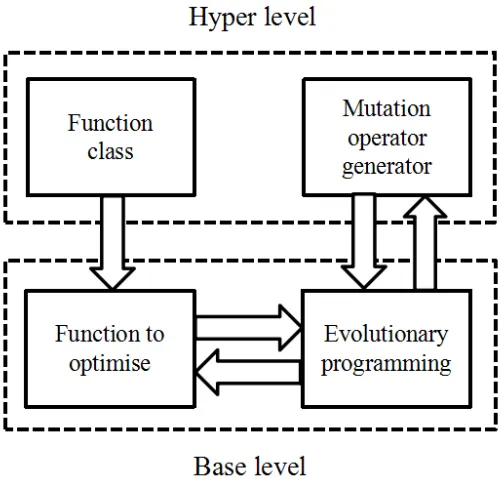
Figure 1: Overview of the hyper-heuristic framework used
hyper-heuristic, a metaheuristic operates on a space of (meta) heuristics, which operate directly
on the space of solutions. Here we use GP as a mutation operator generator at the hyper-level to
manipulate the mutation operators within a population of EP algorithms working at the base level.
The overall framework used is given in Figure 1.
Previous approaches manually build optimisation methods and test them on benchmark
func-tions [1, 35]. Here we employ a train-and-test approach, in which a first set of funcfunc-tions is used to
train a method before it is tested on a second independent set of functions drawn from the same
probability distribution to analyse performance.
4.1. The Training Phase
We call a program generated by GP an ‘automatically designed mutation operator’ (ADM),
which is in effect a random number generator. Each ADM is used as an EP mutation operator on
5 training functions drawn from a given function class. The fitness of an ADM is the average of
the best values obtained in each of the individual 5 EP runs on a given function class. We use the
each function class, 10 functions are taken for training, 5 of which are used to calculate the fitness,
and 5 of which are used to monitor overfitting.
4.2. The Testing Phase
When the training phase of EP is complete for a given function class, the output is an ADM
intended solely for the function class on which it was trained. We then draw 50 new functions
from the given function class and test the ADM, comparing against 6 existing EP variants (CEP,
FEP and EP with 4 settings for the α parameter of the L´evy distribution). Note that training
is expensive, as many ADMs are evaluated, so a small set of functions is used when training. In
contrast, testing involves only a single ADM so is less costly, and a larger number of testing samples
allows a better comparison through statistical tests.
4.3. Parameter Settings for Genetic Programming
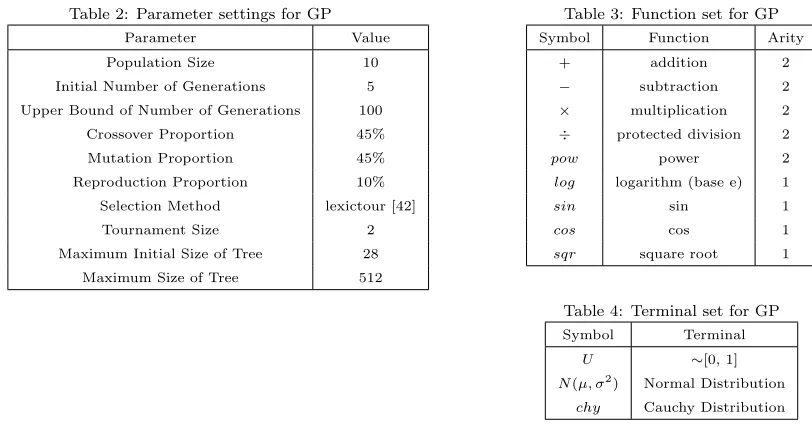
The GP implementation used in this paper is the genetic programming toolbox for Matlab
(GPLAB) [41]. The parameters for GP are given in Table 2. We use subtree crossover, in which
a node in each of the parent programs is chosen uniformly at random, and the respective subtrees
are swapped, creating two new offspring. One point mutation is also used, where a node is chosen
in the parent tree and substituted for a new tree created with the Grow initialisation method [11],
obeying the size and depth restrictions imposed by the GP parameters. The fitness of each GP
individual is calculated as the average best fitness values of the EP runs on each of the 5 training
functions, as described in Section 4.1 above. At each generation, the best individual from both
parents and offspring, along with the best offspring created during that generation are retained
in the population. The selection method used is ‘lexictour’, which uses lexicographic parsimony
pressure when two individuals are compared [42], if two individuals are of equal fitness, the tree
with a smaller number of nodes is chosen. As the evolutionary process is incredibly expensive
in computational terms (each GP individual has to perform 5 EP runs), the maximum number
of generations is initially set at a low value to reduce the amount of computational effort spent.
The maximum number of generations is set dynamically to try to ensure that a sufficient number
of evaluations are made to achieve convergence, whilst minimising the time spent on evaluating
poor quality runs. If the best individual in the population is found within the final three
evolutionary process to continue. The maximum number of generations is capped at 100, with the
[image:10.612.103.509.139.351.2]evolutionary process terminated regardless of when the best individual in the population was found.
Table 2: Parameter settings for GP
Parameter Value
Population Size 10
Initial Number of Generations 5
Upper Bound of Number of Generations 100
Crossover Proportion 45%
Mutation Proportion 45%
Reproduction Proportion 10%
Selection Method lexictour [42]
Tournament Size 2
Maximum Initial Size of Tree 28
[image:10.612.105.321.146.294.2]Maximum Size of Tree 512
Table 3: Function set for GP
Symbol Function Arity
+ addition 2
− subtraction 2
× multiplication 2
÷ protected division 2
pow power 2
log logarithm (base e) 1
sin sin 1
cos cos 1
sqr square root 1
Table 4: Terminal set for GP
Symbol Terminal
U ∼[0, 1]
N(µ, σ2) Normal Distribution
chy Cauchy Distribution
The function and terminal sets for GP are given in Tables 3 and 4, respectively. U is the
uniform distribution on [0, 1]. N(µ, σ2) is the normal distribution with mean µand variance σ2.
Here we clarify that thisµis independent to that used in the EP descriptions in Section 3 In our
experiments,µlies within the range [-2, 2] andσ2is in [0, 10]. chyis the Cauchy distribution. ‘÷’ is
protected divide: if the numerator is divided by a zero denominator, then the numerator is returned.
The square root function is also the protected variant, taking the square root of the absolute value
of a single argument to ensure that no negative input is used. As the L´evy distribution can be
constructed from the normal distribution and arithmetic operators [38], it is also within the search
space that GP is operating in. In the terminal set there are no input variables, here we are using GP
to construct mutation operators which are effectively random number generators so do not require
any input variable.
5. Analysis of the Performance of the Automatically Designed Mutation Operators
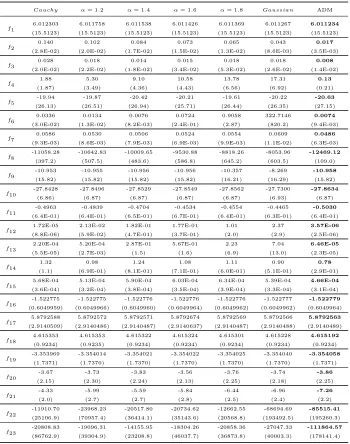
Table 5 reports the average best values obtained over 50 EP runs of each of the 23 function
classes using a number of different mutation operators. The corresponding standard deviations are
L´evy withα= 1.0), L´evy withα= 1.2,α= 1.4,α= 1.6 andα= 1.8, and Gaussian (CEP, L´evy
with α= 2.0), as well as the best ADM evolved by GP for that function class. The best values
[image:11.612.132.482.194.638.2](lowest, as we are minimising) are in boldface.
Table 5: ADMs compared to human designed mutation operators, means and (standard deviations), averaged over 50 runs.
The best fitness values are in bold.
Cauchy α= 1.2 α= 1.4 α= 1.6 α= 1.8 Gaussian ADM
f1
6.012303 6.011758 6.011538 6.011426 6.011369 6.011267 6.011234
(15.5123) (15.5123) (15.5123) (15.5123) (15.5123) (15.5123) (15.5123)
f2
0.140 0.102 0.084 0.073 0.065 0.043 0.017
(2.8E-02) (2.0E-02) (1.7E-02) (1.5E-02) (1.3E-02) (8.6E-03) (3.5E-03)
f3
0.028 0.018 0.014 0.015 0.018 0.018 0.008
(2.0E-02) (2.2E-02) (1.8E-02) (3.4E-02) (5.3E-02) (2.6E-02) (1.4E-02)
f4
1.88 5.30 9.10 10.58 13.78 17.31 0.13
(1.87) (3.49) (4.36) (4.43) (6.56) (6.92) (0.21)
f5
-19.94 -19.87 -20.42 -20.21 -19.61 -20.22 -20.63
(26.13) (26.51) (26.94) (25.71) (26.44) (26.35) (27.15)
f6
0.0336 0.0134 0.0076 0.0724 0.9058 322.7146 0.0074
(3.0E-02) (1.3E-02) (8.2E-03) (2.4E-01) (2.87) (820.2) (9.4E-03)
f7
0.0586 0.0530 0.0506 0.0524 0.0554 0.0609 0.0486
(9.3E-03) (8.6E-03) (7.9E-03) (6.9E-03) (9.9E-03) (1.1E-02) (6.3E-03)
f8
-11058.28 -10642.83 -10009.65 -9530.88 -8818.26 -8053.96 -12469.12
(397.2) (507.5) (483.6) (586.8) (645.2) (603.5) (109.0)
f9
-10.953 -10.955 -10.956 -10.956 -10.357 -8.269 -10.958
(15.82) (15.82) (15.82) (15.82) (16.21) (16.29) (15.82)
f10
-27.8428 -27.8496 -27.8529 -27.8549 -27.8562 -27.7300 -27.8634
(6.86) (6.87) (6.87) (6.87) (6.87) (6.93) (6.87)
f11
-0.4963 -0.4839 -0.4704 -0.4534 -0.4554 -0.4465 -0.5030
(6.4E-01) (6.4E-01) (6.5E-01) (6.7E-01) (6.4E-01) (6.3E-01) (6.4E-01)
f12
1.72E-05 2.13E-02 1.82E-01 1.77E-01 1.01 2.37 3.57E-06
(8.8E-06) (5.9E-02) (4.7E-01) (3.7E-01) (2.0) (2.9) (2.5E-06)
f13
2.20E-04 5.20E-04 2.87E-01 5.67E-01 2.23 7.04 6.46E-05
(5.5E-05) (2.7E-03) (1.5) (1.6) (6.9) (13.0) (2.3E-05)
f14
1.32 0.98 1.24 1.08 1.11 0.90 0.78
(1.1) (6.9E-01) (8.1E-01) (7.1E-01) (6.0E-01) (5.1E-01) (2.9E-01)
f15
5.68E-04 5.13E-04 5.90E-04 6.03E-04 6.34E-04 5.39E-04 4.66E-04
(3.6E-04) (3.2E-04) (3.8E-04) (3.5E-04) (3.9E-04) (3.3E-04) (3.1E-04)
f16
-1.522775 -1.522775 -1.522776 -1.522776 -1.522776 -1.522777 -1.522779
(0.6049959) (0.6049966) (0.6049960) (0.6049964) (0.6049962) (0.6049962) (0.6049964)
f17
5.8792588 5.8792572 5.8792571 5.8792674 5.8792569 5.8792566 5.8792563
(2.9140509) (2.9140486) (2.9140487) (2.9140637) (2.9140487) (2.9140488) (2.9140489)
f18
4.615353 4.615353 4.615322 4.615324 4.615301 4.615228 4.615192
(0.9234) (0.9235) (0.9234) (0.9234) (0.9234) (0.9234) (0.9234)
f19
-3.353969 -3.354014 -3.354021 -3.354022 -3.354025 -3.354040 -3.354058
(1.7371) (1.7370) (1.7370) (1.7370) (1.7370) (1.7370) (1.7371)
f20
-3.67 -3.73 -3.83 -3.56 -3.76 -3.74 -3.86
(2.15) (2.30) (2.24) (2.13) (2.25) (2.18) (2.25)
f21
-4.33 -5.99 -5.59 -5.84 -6.44 -6.96 -7.26
(2.0) (2.7) (2.7) (2.8) (2.5) (2.4) (2.2)
f22
-11910.70 -23968.23 -20517.80 -20734.62 -12662.55 -68694.69 -85515.41
(25106.9) (70957.4) (36414.1) (35143.6) (20568.8) (193492.5) (195260.3)
f23
-20808.83 -19096.31 -14155.95 -18304.26 -20858.36 -27047.33 -111864.57
For all 23 of the function classes, the GP designed ADM outperform the 6 human designed
mutation operators. In Table 5 the evolved ADMs show the best performance on both unimodal
and multimodal functions generated by all listed function classes in Table 1. We retain 2, 3 or 4
digits after the decimal point for most of the results. To distinguish the difference of testing results
onf1,f16 andf18, we retain 6 digits after the decimal point. We retain 7 digits after the decimal
point for testing results onf17.
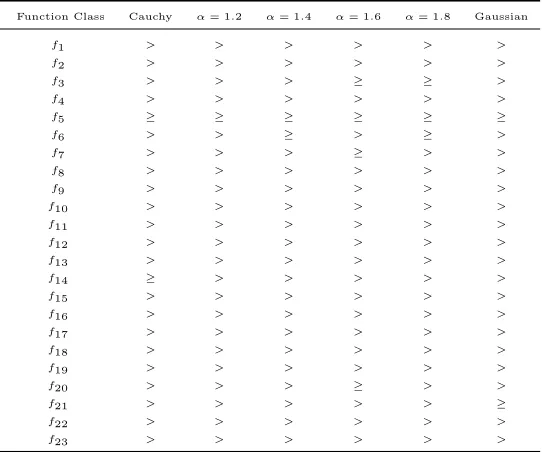
To determine which of these performances differ with statistical significance, we perform a
Wilcoxon signed-rank test, the results of which are presented in Table 6. Shown are the results
of the Wilcoxon signed-rank test within a 95% confidence interval of an ADM compared with
other mutation operators. In this table, ‘≥’ indicates that the ADM performs better than another
mutation operator on average. In the cases where this difference is statistically significant, ‘>’
is used. In the majority of the cases, the ADMs outperform human designed mutation operators
[image:12.612.171.442.351.577.2]including Gaussian, Cauchy and L´evy, and this performance difference is statistically significant.
Table 6: Wilcoxon Signed-Rank Test of ADMs versus Gaussian, Cauchy and L´evy (withα= 1.2, 1.4, 1.6, 1.8) onf1–f23.
Function Class Cauchy α= 1.2 α= 1.4 α= 1.6 α= 1.8 Gaussian
f1 > > > > > >
f2 > > > > > >
f3 > > > ≥ ≥ >
f4 > > > > > >
f5 ≥ ≥ ≥ ≥ ≥ ≥
f6 > > ≥ > ≥ >
f7 > > > ≥ > >
f8 > > > > > >
f9 > > > > > >
f10 > > > > > >
f11 > > > > > >
f12 > > > > > >
f13 > > > > > >
f14 ≥ > > > > >
f15 > > > > > >
f16 > > > > > >
f17 > > > > > >
f18 > > > > > >
f19 > > > > > >
f20 > > > ≥ > >
f21 > > > > > ≥
f22 > > > > > >
f23 > > > > > >
There are only 2 (f5, f14), 1 (f5), 2 (f5, f6), 4 (f3, f5, f7, f20), 3 (f3, f5, f6) and 1 (f5)
function classes for which evolved ADMs perform slightly better than Cauchy, Levyα=1.2, Levyα=1.4,
a number of reasons. It is possible that EP has been run for so many iterations that it does not
matter which mutation operator is used, and any difference in performance is negligible. It also
may be the case that GP would be able to find better mutation operators if it were allowed to run
for a longer period of time. One reason that GP can consistently find ADMs which perform at least
as well as human designed mutation operators is that they are easily expressed within the function
and terminal set used.
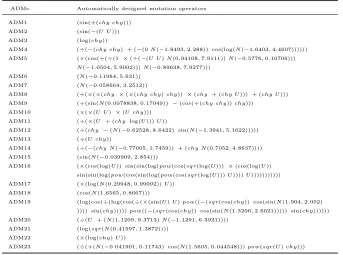
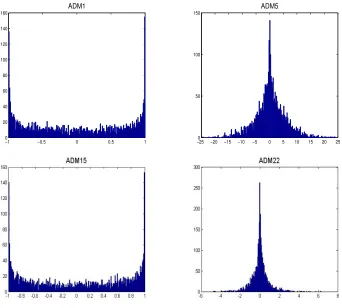
The best ADMs obtained with GP for each function class are listed in Table 7. Figure 2 provides
histograms for a subset of ADMs, showing 3000 samples taken from the ADM to give an indication
[image:13.612.136.479.279.534.2]of the underlying probability distribution they represent.
Table 7:Evolved ADMs for all 23 function classes. These have been algebraically simplified where possible.
ADMs Automatically designed mutation operators
ADM1 (sin(+(chy chy)))
ADM2 (sin(−(U U)))
ADM3 (log(chy))
ADM4 (÷(−(chy chy) + (−(0N(−1.8493,2.288)) cos(log(N(−1.6403,4.4607))))))
ADM5 (×(cos(+(÷(1 ×(÷(−(U U)N(0.94108,7.9111))N(−0.5776,0.10706)))
N(−1.0504,5.9002)))N(−0.89638,7.9277)))
ADM6 (N(−0.11984,5.631))
ADM7 (N(−0.058664,3.2512))
ADM8 (+(×(×(chy ×(×(chy chy)chy)) ×(chy + (chy U))) + (chy U)))
ADM9 (÷(sin(N(0.0078838,0.17049))−(cos(÷(chy chy))chy)))
ADM10 (×(×(U U) ×(U chy)))
ADM11 (÷(×(U ÷(chy log(U)))U))
ADM12 (÷(chy −(N(−0.62528,8.6422) sin(N(−1.3941,5.1622)))))
ADM13 (÷(U chy))
ADM14 (÷(−(chy N(−0.77005,1.7459)) + (chy N(0.7052,4.8637))))
ADM15 (sin(N(−0.039909,2.854)))
ADM16 (×(cos(log(U)) sin(sin(log(pow(cos(sqr(log(U))) ×(cos(log(U))
sin(sin(log(pow(cos(sin(log(pow(cos(sqr(log(U)))U))))U)))))))))))
ADM17 (×(log(N(0.29948,0.99092))U))
ADM18 (cos(N(1.6565,0.8667)))
ADM19 (log(cos(÷(log(cos(÷(×(sin(U)U)pow((−(sqr(cos(chy)) cos(sin(N(1.904,2.002)
)))) sin(chy)))))pow((−(sqr(cos(chy)) cos(sin(N(1.3206,2.6021))))) sin(chy))))))
ADM20 (÷(U + (N(1.1209,9.3713)N(−1.1291,6.3921))))
ADM21 (log(sqr(N(0.41597,1.3872))))
ADM22 (×(log(chy)U))
ADM23 (÷(+(N(−0.041901,0.11743) cos(N(1.5605,0.044548)))pow(sqr(U)chy)))
One might expect that for unimodal functions (e.g. f1-f8) unimodal distributions make good
mutation operators. The intuition being, as one moves around the domain of the function, there are
corresponding changes in the objective value which can clearly guide the search. Similarly, one might
expect, multimodal probability distributions to be more suitable to search multimodal functions
than unimodal probability distributions. However, our results do not support this. For example,
−1 −0.5 0 0.5 1 0
20 40 60 80 100 120 140 160
ADM1
−25 −20 −15 −10 −5 0 5 10 15 20 25
0 50 100 150
[image:14.612.136.478.195.503.2]ADM5
trigonometric function. In contrast, ADM5 is unimodal. Conversely, some multimodal functions
have resulted in symmetric unimodal probability distributions. For example, ADM15 is U-shaped
and not the traditional bell-shape typically used with EP. Not all of the ADMs are symmetric, for
example, ADM22, where the log function introduces asymmetry into the mutation operator.
In all but two cases (ADM6 and ADM7), the ADM is not a standard probability distribution
(normal, Cauchy, L´evy) but something more complex. It is worth noting that these standard
probability distributions are within the GP terminal set, however more ‘complex’ ADMs are the
best found by GP for each function class. This supports the case for the automatic design of
mutation operators. An alternative would be to automatically tune the numerical parameters of a
L´evy distribution (theαparameter), or normal distribution (i.e. the mean and standard deviation),
but this would only ever result in normal distributions which are a linearly scaled version ofN(0,1).
However, the automatic design process starts by defining a much broader search space than can be
done with numerical parameters alone. This allows GP to find new probability distributions which
perform better than the standard probability distributions as mutation operators for EP.
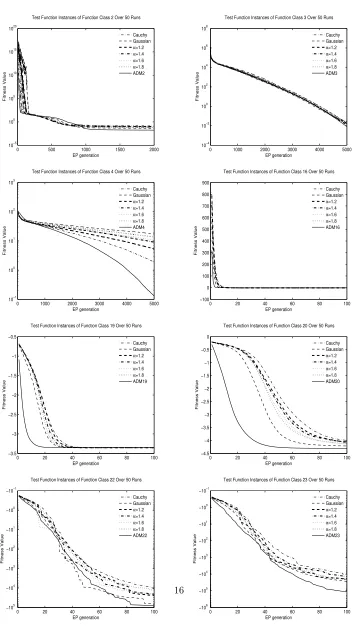
Figure 3 shows the performance of different mutation operators during an EP run, using a single
function for eight of the function classes tested.
The ADMs show significant improvement on f2, f3, f4, f20, f22, f23. The figures of f4, f19,
f20 and f23 shows that the ADMs not only perform well in early generations of the evolutionary
process, but also in later generations. The figure forf2shows that ADM2 has good performance in
the early generations, poor performance towards the middle, but outperforms all other methods by
the end the run. This phenomenon was also found and discussed in previous references combining
Cauchy and Gaussian mutation operators together. This suggests that, as the performance of a
mutation operators varies at different stages of the search, using dynamic or multiple mutation
operators may be preferable to using a single operator.
5.1. Performance of Evolved Mutation Operators on Other Function Classes
As a result of the train-and-test approach used, each ADM evolved by GP is designed for a
specific function class. For example, ADM1 was designed for functions drawn from the function
class f1. Specifically, it was trained on 10 functions (although only 5 were used for evaluation)
drawn fromf1and tested on a further 50 functions also taken from f1. This presents the following
0 500 1000 1500 2000 10−5 100 105 1010 1015 1020 EP generation Fitness Value
Test Function Instances of Function Class 2 Over 50 Runs
Cauchy Gaussian α=1.2 α=1.4 α=1.6 α=1.8 ADM2
0 1000 2000 3000 4000 5000
10−4 10−2 100 102 104 106 108 EP generation Fitness Value
Test Function Instances of Function Class 3 Over 50 Runs
Cauchy Gaussian α=1.2 α=1.4 α=1.6 α=1.8 ADM3
0 1000 2000 3000 4000 5000
10−1 100 101 102 103 EP generation Fitness Value
Test Function Instances of Function Class 4 Over 50 Runs
Cauchy Gaussian α=1.2 α=1.4 α=1.6 α=1.8 ADM4
0 20 40 60 80 100
−100 0 100 200 300 400 500 600 700 800 900 EP generation Fitness Value
Test Function Instances of Function Class 16 Over 50 Runs
Cauchy Gaussian α=1.2 α=1.4 α=1.6 α=1.8 ADM16
0 20 40 60 80 100 −3.5 −3 −2.5 −2 −1.5 −1 −0.5 EP generation Fitness Value
Test Function Instances of Function Class 19 Over 50 Runs
Cauchy Gaussian α=1.2 α=1.4 α=1.6 α=1.8 ADM19
0 20 40 60 80 100
−4.5 −4 −3.5 −3 −2.5 −2 −1.5 −1 −0.5 0 EP generation Fitness Value
Test Function Instances of Function Class 20 Over 50 Runs
Cauchy Gaussian α=1.2 α=1.4 α=1.6 α=1.8 ADM20
0 20 40 60 80 100
−105 −104 −103 −102 −101 −100 −10−1 EP generation Fitness Value
Test Function Instances of Function Class 22 Over 50 Runs
Cauchy Gaussian α=1.2 α=1.4 α=1.6 α=1.8 ADM22
0 20 40 60 80 100
−106 −105 −104 −103 −102 −101 −100 −10−1 EP generation Fitness Value
Test Function Instances of Function Class 23 Over 50 Runs
[image:16.612.127.483.86.717.2]from a different function class? In other words, is the tailored ADM better than an arbitrary ADM?
We will now compare the performance of an ADM tailored to one function class with the other
22 ADMs which are intended for use on different function classes. The mean values and standard
deviations achieved by each ADM are presented in Tables 8 and 9. The diagonal is in boldface
and represents the performance of ADMion the function classfi. For a given row (fi), the values
in boldface indicate the ADMs that have beaten ADMi on fi. For example, for f1, ADM1 is
outperformed only by ADM10. From both tables we can see that ADM8, ADM11, ADM12 and
ADM16 have the best performance on f8, f11, f12 andf16, respectively. ADM1, ADM4, ADM7,
ADM9, ADM13, ADM19 and ADM20 have the second best performance on f1, f4, f7, f9, f13,
f19 andf20, respectively. The worst performance of the tailored ADMs are ADM15, ADM18 and
ADM22: their ranks are 11th, 11th, and 12th, onf15,f18andf22, respectively. Overall, as expected
an ADM tailored to a function class has better performance than the non-tailored ADMs. Table 10
shows the results of a Wilcoxon signed-rank test within a 95% confidence interval of a tailored ADM
(TADM) compared with non-tailored ADMs (with statistically significant differences in boldface).
The tailored ADM is an ADM trained for that specific function class. For example, ADM1 is the
TADM for function class 1, but ADM1 is a non-tailored ADM for function class 2. In this table,
‘≥’ and ‘≤’ indicate that an ADM performs better or worse than the other ADMs. In the case that
this difference is statistically significant, ‘>’ and ‘<’ are used. Although ADM16 shows the best
performance on f16, in Table 10 ‘=’ indicates that the performances of ADM16 and ADM19 are
equal onf16. Forf8, ‘≥’ indicates that the performance of ADM8 is better than that of ADM23,
but that this is not significant. As can be seen from the last column in Table 10, in the majority of
Table 8: Comparison (averaged over 20 runs) of each of the 23 ADMs on each of the 23 function classes (f1–f19). The fitness value of the TADM is in bold, and those other fitness values that are better than the fitness value of the TADM are also in bold.
ADM1 ADM2 ADM3 ADM4 ADM5 ADM6 ADM7 ADM8 ADM9 ADM10 ADM11 ADM12 ADM13 ADM14 ADM15 ADM16 ADM17 ADM18 ADM19 ADM20 ADM21 ADM22 ADM23
f1
3.79604 3.79679 3.79617 3.80010 3.79822 3.79843 3.79682 2531.21 3.79606 3.79599 3.84599 3.79619 3.79628 3.79665 3.79612 1655.31 16670.68 3.80282 4.26045 3.79609 44.19 3.79607 3.81683
(15.53) (15.53) (15.53) (15.53) (15.53) (15.53) (15.53) (11290.26) (15.53) (15.53) (15.53) (15.53) (15.53) (15.53) (15.53) (2395.68) (7873.98) (15.53) (15.51) (15.53) (49.93) (15.53) (15.53)
f2
3.27E-02 1.73E-02 6.41E-02 2.44E-01 2.27E-01 2.42E-01 1.41E-01 10.89 1.26E-02 1.56E-02 8.78E-01 4.83E-02 6.82E-02 1.02E-01 3.30E-02 5.65 62.09 2.94E-02 3.08E-03 8.14E-03 2.69E-01 3.31E-02 3.96E-02
(6.2E-03) (3.2E-03) (1.2E-02) (5.3E-02) (4.2E-02) (4.5E-02) (2.7E-02) (29.6) (2.4E-03) (3.2E-03) (2.2E-01) (9.0E-03) (1.3E-02) (2.1E-02) (6.5E-03) (6.57) (15.77) (5.4E-03) (8.5E-04) (1.5E-03) (1.5E-01) (6.5E-03) (3.9E-02)
f3
0.0591 0.5426 0.0186 0.1031 0.0139 0.0142 0.0059 33.78 2.67 2.04 0.9379 0.2866 0.0641 0.0970 0.0849 3433.71 7087.02 0.1574 50.23 5.58 11.02 0.1992 182.15 (0.1276) (0.9071) (0.0388) (0.0522) (0.0062) (0.0059) (0.0031) (25.61) (3.03) (2.68) (0.4713) (0.4207) (0.1000) (0.1135) (0.1233) (3872.31) (4298.40) (0.1946) (47.12) (6.89) (7.78) (0.3809) (157.13)
f4
17.26 19.42 16.15 0.29 9.65 14.05 16.79 28.13 10.99 14.20 0.16 2.63 4.40 1.33 21.58 68.40 74.66 40.88 37.07 16.70 61.05 15.81 8.93 (4.97) (7.25) (4.89) (0.50) (5.40) (7.01) (7.26) (43.09) (5.90) (6.77) (0.13) (2.04) (2.85) (1.70) (7.95) (7.99) (7.26) (9.61) (14.01) (5.75) (8.86) (4.98) (5.60)
f5
-12.5987 -11.3929 -13.3862 -12.1777 -12.9862 -13.2639 -13.4344 4522608.39 -12.8065 -12.3842 -10.2108 -12.6180 -12.0733 -12.3406 -11.3735 768.5564 189434.0968 -11.6838 -10.2007 -10.9133 6.0180 -12.7928 -7.3536 (19.08) (16.78) (19.29) (20.18) (18.94) (19.31) (19.83) (4559249.52)(19.39) (17.83) (18.26) (18.51) (17.93) (17.08) (18.02) (1491.14) (135909.77) (18.82) (17.38) (18.05) (25.80) (19.30) (20.10)
f6
422.03 1143.00 12.17 0.135 0.058 0.054 0.11 9.298 0.107 0.015 0.326 0.039 0.035 0.032 195.78 17987.88 37431.70 424.44 375.22 0.017 4999.89 185.43 83.99 (1649.47) (2074.28) (38.35) (0.27) (0.22) (0.22) (0.30) (6.86) (0.25) (0.02) (0.16) (0.06) (0.07) (0.02) (490.12) (13480.82) (19447.52) (752.32) (888.00) (0.03) (5268.86) (446.24) (123.80)
f7
0.0655 0.0783 0.0562 0.0841 0.0470 0.0488 0.0487 2.8072 0.0635 0.0586 0.1949 0.0619 0.0537 0.0623 0.0702 0.5328 45.5222 0.0915 0.0870 0.0659 0.4786 0.0629 0.1865 (0.0108) (0.0243) (0.0116) (0.0196) (0.0061) (0.0065) (0.0077) (1.2139) (0.0128) (0.0093) (0.0418) (0.0107) (0.0081) (0.0107) (0.0105) (0.4611) (19.5016) (0.0228) (0.0255) (0.0123) (0.1751) (0.0157) (0.1112)
f8
-7476.80 -7873.51 -8371.09 -11531.08 -8638.19 -8567.79 -8461.85 -12471.54 -10836.76 -10864.24 -11921.11 -11261.25 -11017.46 -11363.52 -7712.38 -9103.97 -7289.48 -7716.48 -11715.12 -10802.04 -7922.38 -8271.94 -12347.43 (648.37) (503.11) (779.63) (307.06) (533.70) (489.80) (682.14) (158.44) (498.97) (528.49) (319.68) (332.98) (352.28) (396.68) (673.42) (629.07) (588.01) (519.33) (392.40) (383.83) (534.77) (686.29) (208.99)
f9
-6.3643 -6.6138 -7.2742 -8.8411 -6.5252 -6.6248 -6.1178 -7.4905 -8.8540 -8.8540 -8.7243 -8.8536 -8.8532 -8.8521 -5.7131 -8.4279 11.8005 -6.4276 -8.7550 -8.8541 -5.8654 -7.2526 -8.8323 (13.55) (14.20) (13.11) (11.28) (13.91) (14.12) (14.37) (11.30) (11.28) (11.28) (11.25) (11.28) (11.28) (11.28) (15.25) (11.22) (19.67) (13.48) (11.37) (11.28) (13.78) (13.43) (11.26)
f10
-26.5488 -27.6246 -27.8734 -28.5297 -28.4378 -27.4749 -28.1247 -7.2537 -28.5828 -28.5820 -23.8488 -28.5745 -28.5713 -28.5635 -27.3001 -16.8669 -4.3441 -26.5893 -28.4834 -28.5836 -23.4200 -27.4131 -28.5401 (8.64) (7.69) (7.11) (6.28) (6.45) (8.12) (6.63) (14.71) (6.29) (6.29) (13.26) (6.29) (6.29) (6.29) (7.78) (9.53) (2.23) (8.95) (6.39) (6.29) (9.54) (7.76) (6.29)
f11
-0.6511 -0.4304 -0.6994 -0.7322 -0.6968 -0.7229 -0.6814 -0.7159 -0.6402 -0.6742 -0.7384 -0.7172 -0.7353 -0.7251 -0.6194 72.6735 245.0964 -0.3781 -0.3158 -0.5856 5.0014 -0.5955 -0.7322 (0.55) (0.59) (0.53) (0.55) (0.57) (0.54) (0.55) (0.55) (0.56) (0.55) (0.55) (0.56) (0.54) (0.54) (0.53) (74.08) (108.70) (0.52) (0.64) (0.54) (4.93) (0.54) (0.55)
f12
2.38 1.52 8.18E-01 4.99E-05 1.14 1.08 2.61 2.95E+08 8.63E-02 4.90E-02 7.61E-04 2.74E-06 2.39E-02 9.89E-06 1.50 34.73 1.5E+07 2.15 2.01E-01 1.21E-01 18.16 1.13 4.26E+04 (2.85) (2.15) (1.30) (1.32E-05) (1.20) (2.17) (3.63) (5.62E+08) (2.99E-01) (1.77E-01) (2.36E-04) (1.09E-06) (5.98E-02) (3.88E-06) (1.33) (35.79) (2.46E+07) (1.76) (4.23E-01) (3.22E-01) (10.06) (1.06) (1.90E+05)
f13
7.53 11.54 5.38 6.69E-04 3.18 5.34 10.81 4.51E+08 3.80E-03 1.87E-03 1.01E-02 4.50E-05 6.35E-05 1.26E-04 3.66 333.02 7.36E+06 18.23 7.15E-01 2.86E-02 257.29 5.85 527.92 (11.5) (12.6) (10.3) (1.4E-04) (5.0) (5.6) (19.7) (611339756.7)(7.1E-03) (4.6E-03) (2.3E-03) (2.0E-05) (1.7E-05) (2.9E-05) (4.6) (304.3) (4.79E+06) (21.7) (1.6) (7.2E-02) (118.6) (7.5) (2359.9)
f14
1.73 1.77 1.23 1.07 1.69 1.81 1.17 0.75 1.29 1.05 0.78 0.83 1.24 0.84 1.46 2.63 0.99 1.35 1.25 1.65 1.54 1.05 0.87 (1.39) (1.52) (0.56) (0.66) (1.66) (1.35) (0.60) (0.17) (1.08) (0.57) (0.17) (0.31) (1.22) (0.34) (0.86) (3.71) (0.55) (0.87) (1.99) (1.30) (1.42) (0.68) (0.35)
f15
6.43E-04 1.55E-03 7.85E-04 7.66E-04 2.25E-03 1.92E-03 1.20E-03 1.64E-03 5.36E-04 4.18E-04 1.10E-03 5.80E-04 5.80E-04 6.34E-04 7.07E-04 1.55E-03 1.23E-03 1.41E-03 4.96E-04 4.42E-04 6.56E-04 4.79E-04 8.71E-04 (5.4E-04) (4.4E-03) (8.6E-04) (8.6E-04) (5.8E-03) (3.5E-03) (1.8E-03) (2.0E-03) (3.7E-04) (2.9E-04) (1.2E-03) (4.0E-04) (3.6E-04) (3.9E-04) (5.4E-04) (4.5E-03) (6.9E-06) (3.9E-03) (3.9E-04) (3.5E-04) (4.3E-04) (3.1E-04) (4.5E-04)
f16
-1.92447213 -1.924473263-1.924470875-1.924468207-1.924439114-1.924429001-1.924455664-1.924280681-1.924473516-1.924473529-1.924454275-1.924473348-1.924472904-1.924472224-1.924472113-1.924473543-1.92447336 -1.924472505-1.924473543-1.924473528-1.924473215-1.924473016-1.92447352 (0.58) (0.58) (0.58) (0.58) (0.58) (0.58) (0.58) (0.58) (0.58) (0.58) (0.58) (0.58) (0.58) (0.58) (0.58) (0.58) (0.58) (0.58) (0.58) (0.58) (0.58) (0.58) (0.58)
f17
3.786952682 3.786952414 3.786953089 3.786953821 3.786960153 3.786965855 3.786956682 3.7870070253.786952351 3.7869523473.78696211 3.786952403 3.78695256 3.786952596 3.7869526883.786952342 3.7869523953.78695256 3.7869532073.7869523463.786952426 3.786952433 3.786952348 (2.37) (2.37) (2.37) (2.37) (2.37) (2.37) (2.37) (2.37) (2.37) (2.37) (2.37) (2.37) (2.37) (2.37) (2.37) (2.37) (2.37) (2.37) (2.37) (2.37) (2.37) (2.37) (2.37)
f18
4.5750315334.5749718194.575098811 4.575282035 4.5763558 4.577539016 4.575858015 4.5887151334.574958404 4.5749582054.5763717224.5749678134.575001205 4.575011001 4.575028689 6.0057613374.574969199 4.575008958 4.57495705 4.574957813 4.574974777 4.574979692 4.57495876 (1.12) (1.12) (1.12) (1.12) (1.12) (1.12) (1.12) (1.11) (1.12) (1.12) (1.12) (1.12) (1.12) (1.12) (1.12) (6.14) (1.12) (1.12) (1.12) (1.12) (1.12) (1.12) (1.12)
Table 9:Comparison (averaged over 20 runs) of each of the 23 ADMs on each of the 23 function classes (f20–f23).
ADM1 ADM2 ADM3 ADM4 ADM5 ADM6 ADM7 ADM8 ADM9 ADM10 ADM11 ADM12 ADM13 ADM14 ADM15 ADM16 ADM17 ADM18 ADM19 ADM20 ADM21 ADM22 ADM23
f20
-4.0774 -4.0748 -3.8878 -4.0932 -4.0110 -3.4181 -4.0560 -3.9522 -4.1095 -4.1141 -3.8083 -4.1051 -4.1100 -3.8682 -4.0393 -4.0958 -4.0869 -4.0615 -4.1102 -4.1107 -4.0990 -4.0948 -4.1099
(2.02) (1.98) (1.95) (2.02) (2.10) (1.85) (2.03) (2.02) (2.04) (2.04) (1.97) (2.05) (2.04) (1.85) (2.07) (2.05) (1.99) (1.98) (2.05) (2.04) (2.05) (2.02) (2.04)
f21
-7.50 -8.26 -6.75 -3.69 -4.44 -4.58 -4.06 -3.64 -7.63 -7.12 -3.55 -7.50 -7.12 -5.96 -7.50 -3.99 -8.24 -6.87 -3.97 -8.14 -7.63 -7.24 -6.99
(2.4) (1.6) (2.9) (1.5) (1.9) (2.6) (1.7) (0.3) (2.3) (2.7) (0.7) (2.3) (2.7) (2.6) (2.1) (3.3) (1.5) (2.7) (2.7) (1.9) (2.4) (2.3) (2.5)
f22
-22690.01 -138764.16 -16262.26 -7564.46 -4081.24 -7710.71 -8391.89 -661.13 -138490.10 -156034.53 -2163.99 -121815.79 -75620.18 -21671.31 -184449.89 -20512221.26-71248.07 -53103.24 -3872071.64 -266869.50 -88299.30 -72258.79 -156292.70
(30957.5) (240207.8) (22759.7) (14484.9) (7046.2) (20971.9) (15850.7) (1197.4) (193997.9) (256068.3) (4065.4) (272880.3) (142754.5) (34334.5) (574931.9) (81568165.2)(109512.0) (85281.3) (7903902.6) (408822.5) (146589.9) (79909.2) (227462.4)
f23
-32152.70 -52174.33 -26607.57 -21922.82 -6153.03 -5790.76 -9617.22 -380.46 -103530.92 -132236.20 -2388.34 -50209.17 -29264.20 -14424.39 -24997.68 -3511793.67-98707.40 -211246.70 -1024445.84 -290292.30 -107802.76 -36810.44 -111941.27 (61337.3) (93572.1) (68340.3) (54964.3) (11938.5) (11424.6) (19983.7) (657.0) (206684.0) (244626.7) (4202.0) (100548.3) (59321.4) (31387.8) (51026.8) (8105197.0) (235422.7) (642660.0) (2471291.7) (839727.1) (284455.3) (74288.9) (233075.7)
Table 10: Comparison of ADMs on different function classes.
FC TADM TADM TADM TADM TADM TADM TADM TADM TADM TADM TADM TADM TADM TADM TADM TADM TADM TADM TADM TADM TADM TADM TADM TADM WIN -ADM1 -ADM2 -ADM3 -ADM4 -ADM5 -ADM6 -ADM7 -ADM8 -ADM9 -ADM10 -ADM11 -ADM12 -ADM13 -ADM14 -ADM15 -ADM16 -ADM17 -ADM18 -ADM19 -ADM20 -ADM21 -ADM22 -ADM23 TIMES
f1 N/A > > > > > > > ≥ < > > > > ≥ > > > > ≥ > ≥ > 21
f2 > N/A > > > > > > < < > > > > > > > > < < > > > 18
f3 ≥ > N/A > ≤ ≤ ≤ > > > > > > > > > > > > > > > > 19
f4 > > > N/A > > > > > > ≤ > > > > > > > > > > > > 21
f5 ≥ ≥ ≤ ≥ N/A ≤ ≤ > ≥ ≥ > ≥ ≥ ≥ > > > ≥ > > > ≥ > 19
f6 > > > > ≥ N/A ≥ > > ≤ > < < < > > > > > ≤ > > > 17
f7 > > > > ≤ ≥ N/A > > > > > > > > > > > > > > > > 21
f8 > > > > > > > N/A > > > > > > > > > > > > > > ≥ 22
f9 > > > > > > > > N/A > > > > > > ≥ > > > < > > > 21
f10 > ≥ > > > > > > < N/A > > > > > > > > > < > > > 20
f11 > > > ≥ > ≥ > > > > N/A > ≥ > > > > > > > > > > 22
f12 > > > > > > > > > ≥ > N/A > > > > > > > > > > > 22
f13 > > > > > > > > > ≥ > < N/A > > > > > > > > > > 21
f14 > > > ≥ > > ≥ ≤ ≥ ≥ ≤ ≤ ≥ N/A > > ≥ > ≥ ≥ ≥ ≥ ≥ 19
f15 ≤ ≥ ≥ ≥ ≥ > > > < < > ≤ ≥ ≤ N/A > > ≥ < < ≤ < ≥ 12
f16 > > > > > > > > > > > > > > > N/A > > = > > > > 22
f17 > ≥ > > > > > > < < > ≥ > > > < N/A > > < > ≥ > 18
f18 > < > > > > > > < < > < ≥ ≥ > > < N/A < < < < < 12
f19 > > > > > > > > > > > > > > > ≤ > > N/A > > > > 21
f20 > > > > > > > > > < > > > > > ≥ > > ≥ N/A > > > 21
f21 ≥ < > > > > > > ≥ ≥ > ≥ ≥ > ≥ > ≤ ≥ > ≤ N/A ≥ ≥ 19
f22 > ≤ > > > > > > < ≤ > ≤ ≤ > ≤ ≤ ≥ ≥ ≤ < ≤ N/A ≤ 11
f23 ≥ ≥ ≥ ≥ ≥ > > > ≥ ≤ > ≥ > ≥ ≥ ≤ ≥ ≤ ≤ ≤ ≥ ≥ N/A 17
[image:19.612.55.740.227.478.2]6. Discussion
One of the advantages of the new method presented here is that it eliminates the need for human
researchers to continually propose new distributions for use as mutation operators in EP. Instead, we
have a search space which contains a rich set of mutation operators, and we can let a metaheuristic,
such as GP, sample this space and select a suitable choice for the sample of functions at hand.
In addition, it designs an ADM within the context of a function class. In other words, it tailors
a mutation operator (random number generator) to a function class (probability distribution over
functions). The suitability of mutation operator depends on the function class. Rather than tuning
anumerical parameter to a function class, it tunes aprogram that generates random numbers to a
function class.
One of the apparent disadvantages of the proposed system is the time needed to evolve the
ADMs. This is because we have an EP algorithm at the base level, the mutation operator of
which is being evolved by a GP algorithm at the hyper-level. While this may appear to be a
superficial disadvantage, there are other advantages. Firstly, it is difficult to measure the amount
of human effort required in designing a new mutation operator, and therefore it is difficult to directly
compare the design phases of human and machine (GP in this case). We can only sensibly compare
the performance of two mutation operators at the testing phase. Secondly, the system can be used
to automatically generate new ADMs as and when needed to the demands of a new function class,
whereas the human designer would have to start the whole process over again.
It is important to note that the fact that the training and testing are drawn from the same
distribution is central to the train-and-test approach. In our case, this means that an ADM is
developed to be used as a mutation operator for a given function class, but also, importantly,
within a given EP algorithm, which includes a fixed EP population size and number of generations.
One of the current limitations of the proposed method is that not only must the training set
of functions be representative of the testing set of functions, but also the conditions under which
they are sampled must be similar. For example, when testing a function from function classf1, we
used the same population size and number of generations of EP as in the training phase. This is
a limitation which needs to be addressed. One possibility would be to use GP to train EP using a
different number of generations and population sizes. However, this would only partially address
the issue, since if we attempted to use an ADM with a population size and number of generations
7. Summary and Future Work
In this paper we have used genetic programming (GP) as an offline hyper-heuristic to
automat-ically evolve probability distributions, to use as mutation operators in evolutionary programming
(EP). This is in contrast to existing operators in the literature which are human designed. The
function and terminal set for GP was chosen to be able to express a number of currently existing
human designed mutation operators, namely Cauchy, Gaussian and L´evy, and also express novel
automatically designed mutation operators (ADMs). Each ADM is constructed from a function set
including arithmetic and trigonometric functions, and a terminal set of probability distributions
included as standard in many programming libraries and mathematical packages. Using a
train-and-test approach, where two independent sets of functions are drawn from the samefunction class
for training and testing, it is shown that GP is capable of generating ADMs which outperform
existing EP variants over a number of different function classes. As an additional validation
exer-cise, we have also presented experiments to show that the ADM tailored to a given function class
performs better that ADMs tailored to different function classes.
There are a number of possible directions for future work. As GP has been able to evolve good
variation operators for EP, further work will explore the ability of GP to generate variation operators
for other real-valued optimisation methods such as differential evolution (DE) and particle swarm
optimisation (PSO), particularly for the case of function classes where a train-and-test approach
can be used. Another direction within EP is to extend our hyper-heuristic approach beyond simple
static mutation operators. It has been observed previously that both Cauchy and Gaussian mutation
are effective in EP at different points of a search [35]. As both of these operators can be defined
as a parameterised version of the L´evy distribution, through the use of differentαvalues, we will
evolve the value ofαas a function over time, subsequently defining a family of adaptive mutation
operators which can be trained to specialise in solving different classes of functions.
References
[1] X. Yao, Y. Liu, Fast evolutionary programming, in: Proceedings of the Fifth Annual Conference
on Evolutionary Programming, MIT Press, 1996, pp. 451–460.
[2] N. Sinha, R. Chakrabarti, P. Chattopadhyay, Evolutionary programming techniques for
[3] P. Shelokar, A. Quirin, O. Cord´on, A multiobjective evolutionary programming framework for
graph-based data mining, Information Sciences 237 (2013) 118–136.
[4] M. Mutyalarao, A. Sabarinath, M. Xavier James Raj, Taboo evolutionary programming
ap-proach to optimal transfer from earth to mars, in: Proceedings of Swarm, Evolutionary, and
Memetic Computing (SEMCCO 2011) - Part II, Vol. 7077 of LNCS, Springer, Visakhapatnam,
Andhra Pradesh, India, 2011, pp. 122–131.
[5] A. K. Qin, V. L. Huang, P. N. Suganthan, Differential evolution algorithm with strategy
adaptation for global numerical optimization, IEEE transactions on Evolutionary Computation
13 (2) (2009) 398–417.
[6] R. Mallipeddi, P. N. Suganthan, Q.-K. Pan, M. F. Tasgetiren, Differential evolution algorithm
with ensemble of parameters and mutation strategies, Applied Soft Computing 11 (2) (2011)
1679–1696.
[7] J. Kennedy, R. Eberhart, Particle swarm optimization, in: Proceedings of the IEEE
Interna-tional Conference on Neural Networks, Vol. 4, Perth, Australia, 1995, pp. 1942–1948.
[8] N. Hansen, The cma evolution strategy: A comparing review, in: Towards a New Evolutionary
Computation, Vol. 192 of Studies in Fuzziness and Soft Computing, Springer Berlin Heidelberg,
2006, pp. 75–102.
[9] S. M. Elsayed, R. A. Sarker, D. L. Essam, Adaptive configuration of evolutionary algorithms
for constrained optimization, Applied Mathematics and Computation 222 (2013) 680–711.
[10] E. Burke, M. Hyde, G. Kendall, G. Ochoa, E. ¨Ozcan, J. Woodward, A classification of
hyper-heuristic approaches, in: M. Gendreau, J.-Y. Potvin (Eds.), Handbook of Metahyper-heuristics, Vol.
146 of International Series in Operations Research and Management Science, Springer US,
2010, pp. 449–468.
[11] R. Poli, W. B. Langdon, N. F. McPhee, A field guide to genetic programming, Published via
http://lulu.com and freely available at http://www.gp-field-guide.org.uk, 2008, (With
contri-butions by J. R. Koza).
[12] E. Burke, M. Hyde, G. Kendall, G. Ochoa, E. ¨Ozcan, J. Woodward, Exploring hyper-heuristic
Intelligence, Vol. 1 of Intelligent Systems Reference Library, Springer Berlin Heidelberg, 2009,
pp. 177–201.
[13] J. R. Woodward, J. Swan, Automatically designing selection heuristics, in: Proceedings of
the Genetic and Evolutionary Computation Conference Companion (GECCO 2011), ACM,
Dublin, Ireland, 2011, pp. 583–590.
[14] J. R. Woodward, J. Swan, The automatic generation of mutation operators for genetic
algo-rithms, in: Proceedings of the Genetic and Evolutionary Computation Conference Companion
(GECCO 2012), ACM, Philadelphia, Pennsylvania, USA, 2012, pp. 67–74.
[15] L. Dio¸san, M. Oltean, Evolving crossover operators for function optimization, in: P. Collet,
M. Tomassini, M. Ebner, S. Gustafson, A. Ek´art (Eds.), Proceedings of the European
Con-ference on Genetic Programming (EuroGP 2006), Vol. 3905 of LNCS, Springer, Budapest,
Hungary, 2006, pp. 97–108.
[16] S. Nguyen, M. Zhang, M. Johnston, K. Tan, Automatic design of scheduling policies for
dy-namic multi-objective job shop scheduling via cooperative coevolution genetic programming,
IEEE Transactions on Evolutionary Computation 18 (2) (2013) 193–208.
[17] R. E. Keller, R. Poli, Linear genetic programming of parsimonious metaheuristics, in: D.
Srini-vasan, L. Wang (Eds.), Proceedings of the IEEE Congress on Evolutionary Computation (CEC
2007), IEEE Press, Singapore, 2007, pp. 4508–4515.
[18] M. Bader El Den, R. Poli, Grammar-based genetic programming for timetabling, in:
Proceed-ings of the IEEE Congress on Evolutionary Computation (CEC 2009), IEEE Press, Piscataway,
NJ, USA, 2009, pp. 2532–2539.
[19] M. Bader El Den, R. Poli, S. Fatima, Evolving timetabling heuristics using a grammar-based
genetic programming hyper-heuristic framework, Memetic Computing 1 (3) (2009) 205–219.
[20] J. H. Drake, M. Hyde, K. Ibrahim, E. ¨Ozcan, A genetic programming hyper-heuristic for the
multidimensional knapsack problem, Kybernetes 43 (9-10) (2014) 1500–1511.
[21] L. Hong, J. Woodward, J. Li, E. ¨Ozcan, Automated design of probability distributions as
mutation operators for evolutionary programming using genetic programming, in: Genetic
[22] G. L. Pappa, A. A. Freitas, Discovering new rule induction algorithms with grammar-based
genetic programming, in: Soft Computing for Knowledge Discovery and Data Mining, Springer,
2008, pp. 133–152.
[23] S. Nguyen, M. Zhang, M. Johnston, K. C. Tan, Automatic design of scheduling policies for
dynamic multi-objective job shop scheduling via cooperative coevolution genetic programming,
IEEE Transactions on Evolutionary Computation 18 (2) (2014) 193–208.
[24] J. Park, S. Nguyen, M. Zhang, M. Johnston, Evolving ensembles of dispatching rules using
genetic programming for job shop scheduling, in: Genetic Programming, Vol. 9025 of Lecture
Notes in Computer Science, Springer International Publishing, 2015, pp. 92–104.
[25] J. Branke, S. Nguyen, C. W. Pickardt, M. Zhang, Automated design of production scheduling
heuristics: A review, IEEE Transactions on Evolutionary Computation 20 (1) (2016) 110–124.
[26] R. Poli, J. Woodward, E. K. Burke, A histogram-matching approach to the evolution of
bin-packing strategies., in: Proceedings of the IEEE Congress on Evolutionary Computation (CEC
2007), IEEE, 2007, pp. 3500–3507.
[27] E. K. Burke, M. R. Hyde, G. Kendall, J. Woodward, Automatic heuristic generation with
genetic programming: evolving a jack-of-all-trades or a master of one, in: Proceedings of
the Genetic and Evolutionary Computation Conference Companion (GECCO 2007), ACM,
London, England, 2007, pp. 1559–1565.
[28] E. K. Burke, M. R. Hyde, G. Kendall, J. R. Woodward, The scalability of evolved on line bin
packing heuristics, in: D. Srinivasan, L. Wang (Eds.), Proceedings of the IEEE Congress on
Evolutionary Computation (CEC 2007), IEEE Press, Singapore, 2007, pp. 2530–2537.
[29] A. Parkes, E. ¨Ozcan, M. Hyde, Matrix analysis of genetic programming mutation, in:
A. Moraglio, S. Silva, K. Krawiec, P. Machado, C. Cotta (Eds.), Genetic Programming, Vol.
7244 of LNCS, Springer Berlin Heidelberg, 2012, pp. 158–169.
[30] E. ¨Ozcan, A. J. Parkes, Policy matrix evolution for generation of heuristics, in: Proceedings of
the Genetic and Evolutionary Computation Conference (GECCO 2011), ACM, Dublin, Ireland,
[31] J. H. Drake, J. Swan, G. Neumann, E. ¨Ozcan, Sparse, continuous policy representations for
uniform online bin packing via regression of interpolants, in: European Conference on
Evo-lutionary Computation in Combinatorial Optimization (EvoCOP 2017), Vol. 10197 of LNCS,
Springer, 2017, pp. 189–200.
[32] R. Poli, W. Langdon, O. Holland, Extending particle swarm optimisation via genetic
pro-gramming, in: M. Keijzer, A. Tettamanzi, P. Collet, J. Hemert, M. Tomassini (Eds.), Genetic
Programming, Vol. 3447 of LNCS, Springer Berlin Heidelberg, 2005, pp. 291–300.
[33] J. Drake, N. Kililis, E. ¨Ozcan, Generation of vns components with grammatical evolution for
vehicle routing, in: Genetic Programming, Vol. 7831 of LNCS, Springer Berlin Heidelberg,
2013, pp. 25–36.
[34] L. Hong, J. H. Drake, J. R. Woodward, E. ¨Ozcan, Automatically designing more general
mutation operators of evolutionary programming for groups of function classes using a
hyper-heuristic, in: Proceedings of the Genetic and Evolutionary Computation Conference (GECCO
2016), ACM, New York, NY, USA, 2016, pp. 725–732.
[35] X. Yao, Y. Liu, G. Lin, Evolutionary programming made faster, IEEE Transactions on
Evolu-tionary Computation 3 (1999) 82–102.
[36] T. B¨ack, H.-P. Schwefel, An overview of evolutionary algorithms for parameter optimization,
Evolutionary Computation 1 (1) (1993) 1–23.
[37] C.-Y. Lee, X. Yao, Evolutionary programming using mutations based on the l´evy probability
distribution, IEEE Transactions on Evolutionary Computation 8 (1) (2004) 1–13.
[38] R. N. Mantegna, Fast, accurate algorithm for numerical simulation of l´evy stable stochastic
processes, Physical Review E 49 (1994) 4677–4683.
[39] H. Dong, J. He, H. Huang, W. Hou, Evolutionary programming using a mixed mutation
strategy, Information Sciences 177 (1) (2007) 312 – 327.
[40] R. Mallipeddi, S. Mallipeddi, P. Suganthan, Ensemble strategies with adaptive evolutionary
[41] S. Silva, J. Almeida, Gplab-a genetic programming toolbox for matlab, in: Proceedings of the
Nordic MATLAB conference, 2003, pp. 273–278.
[42] S. Luke, L. Panait, Lexicographic parsimony pressure, in: Proceedings of the Genetic and
Evolutionary Computation Conference (GECCO 2002), Morgan Kaufmann Publishers, New