OMEGA – OSIRIS Mapping of Emission-line Galaxies in A901/2 – I.
Survey description, data analysis, and star formation and AGN activity in
the highest density regions
Ana L. Chies-Santos,
1,2,3ܠ
Bruno Rodr´ıguez del Pino,
1,9‹Alfonso Arag´on-Salamanca,
1Steven P. Bamford,
1Meghan E. Gray,
1Christian Wolf,
4Asmus B¨ohm,
5David T. Maltby,
1Irene Pintos-Castro,
6,7,8,9Miguel Sanch´ez-Portal
8,10and Tim Weinzirl
11School of Physics and Astronomy, The University of Nottingham, University Park, Nottingham NG7 2RD, UK 2Instituto de Astronomia, Geof´ısica e Ciˆencias Atmosf´ericas, Universidade de S˜ao Paulo, S˜ao Paulo, SP, Brazil 3Departamento de Astronomia, Instituto de F´ısica, UFRGS. Av. Bento Gonc¸alves 9500, Porto Alegre, RS, Brazil
4Research School of Astronomy and Astrophysics, Australian National University, Cotter Road, Weston Creek, ACT 2611, Australia 5Institute for Astro- and Particle Physics, University of Innsbruck, Technikerstr. 25/8, A-6020 Innsbruck, Austria
6Instituto de Astrof´ısica de Canarias, La Laguna, Tenerife, Spain 7Universidad de La Laguna, Tenerife, Spain
8ISDEFE, Madrid, Spain
9Centro de Astrobiolog´ıa, INTA-CSIC, Madrid, Spain
10European Space Astronomy Centre (ESAC)/ESA, PO Box 78, 28690 Villanueva de la Canada, Madrid, Spain
Accepted 2015 April 2. Received 2015 February 9; in original form 2014 November 21
A B S T R A C T
We present an overview of and first results from the OMEGA (OSIRIS Mapping of Emission-line Galaxies in the multicluster system A901/2) survey. The ultimate goal of this project is to study star formation and active galactic nucleus (AGN) activity across a broad range of environments at a single redshift. Using the tuneable-filter mode of the Optical System for Imaging and low-Intermediate-Resolution Integrated Spectroscopy (OSIRIS) instrument on Gran Telescopio Canarias, we target Hαand [NII] emission lines over an∼0.5×0.5 deg2
re-gion containing thez∼0.167 multicluster system A901/2. In this paper, we describe the design of the survey, the observations and the data analysis techniques developed. We then present early results from two OSIRIS pointings centred on the cores of the A901a and A902 clusters. AGN and star-forming (SF) objects are identified using the [NII]/HαversusWHαdiagnostic
diagram. The AGN hosts are brighter, more massive, and possess earlier type morphologies than SF galaxies. Both populations tend to be located towards the outskirts of the high-density regions we study. The typical Hαluminosity of these sources is significantly lower than that of field galaxies at similar redshifts, but greater than that found for A1689, a rich cluster atz∼0.2. The Hαluminosities of our objects translate into star formation rates (SFRs) between∼0.02 and 6 Myr−1. Comparing the relationship between stellar mass and Hα-derived SFR with
that found in the field indicates a suppression of star formation in the cores of the clusters. These findings agree with previous investigations of this multicluster structure, based on other star formation indicators, and demonstrate the power of tuneable filters for this kind of study.
Key words: galaxies: clusters: individual: general – galaxies: star formation.
1 I N T R O D U C T I O N
Galaxies are not randomly distributed in the Universe: while most are part of groups and clusters, they are also found in isolation or
The first two authors have contributed equally to this paper. †E-mail:[email protected]
in the field. The observed properties of galaxies are strongly
de-pendent on the environment in which they reside (Dressler1980).
In the local universe, galaxies in low-density environments are more likely to have spiral morphologies, blue colours and be form-ing stars, whereas those livform-ing in high-density regions are largely
bulge-dominated, red and passive (Balogh et al. 2004; Bamford
et al.2009). These two populations may be connected by one or
more evolutionary processes by which galaxies falling into denser
low-luminosity AGNs do not show particular preference for any
kind of environment (Martini et al.2002,2006; Miller et al.2003),
luminous AGNs are preferentially found in the field (Kauffmann
et al.2004) and groups (Popesso & Baviano2006) rather than in
clusters. Peng et al. (2010) and Thomas et al. (2010) showed that
both stellar-mass and environmentally driven quenching of star for-mation are important in governing the evolution of a galaxy and that their effects can be separated from each other.
Vogt et al. (2004) and Jaff´e et al. (2011) have shown that
galax-ies falling into clusters experience a removal of their gas, which in principle should lead to a gradual decline of the star formation activ-ity. However, the average star formation rate (SFR) in star-forming (SF) galaxies remains roughly constant with environment, and it is
only the fraction of SF galaxies that changes (Balogh et al.2004;
Bamford et al. 2008; Poggianti et al. 2008; Verdugo, Ziegler &
Gerken 2008). The extent of ongoing star formation within a
galaxy has also been shown to correlate with environment (Moss &
Whittle 2000; Koopmann & Kenney 2004; Bamford,
Milvang-Jensen & Arag´on-Salamanca2007), implying a truncation of the
star formation taking place first in the outer parts of the infalling galaxies. In fact, the last episode of star formation in cluster disc galaxies is seen to be concentrated towards the central regions
(John-ston, Arag´on-Salamanca & Merrifield2014; Rodr´ıguez Del Pino
et al.2014).
In order to understand the full degree of transformation and the relative role played by external and internal processes, we
se-lected the field of the A901/2 multicluster system atz∼ 0.167.
This large structure has been the subject of study of the STAGES
project (Gray et al.2009), where a wealth of data exists: an
80-orbitF606W Hubble Space Telescope(HST)/ACS mosaic covering
the full∼0.5×0.5 deg2(∼5×5 Mpc2) span of the system,
com-plemented by extensive multiwavelength observations withXMM–
Newton,GALEX,Spitzer, 2dF, GMRT, Magellan, and the 17-band
COMBO-17 photometric redshift survey (Wolf et al.2003,2004).
The broad range of galaxy environments and luminosities sampled by these observations provide the perfect laboratory to study both obscured and unobscured star formation, stellar masses, AGN ac-tivity and galaxy morphologies.
Previous work in the A901/2 field has included studies of both
star formation (Gray et al.2004) and AGN activity and how they
relate to galaxy environment. Wolf, Gray & Meisenheimer (2005)
discovered red spirals in the system which suggested reduced
cur-rent SFRs in a large fraction of the galaxies. Gallazzi et al. (2009)
found an overall suppression in the fraction of SF galaxies with density by combining the UV/optical SEDs from COMBO-17 and
Spitzer24μm photometry. The surviving star formation was shown
(OSIRIS) in tuneable-filter mode to obtain very deep spatially re-solved emission-line images of the complete A901/2 STAGES field.
We have targeted the Hα(λ0=6563 Å) and [NII] (λ0=6583 Å)
lines. The former is the best optical tracer of SFR (Kennicutt1998),
whereas the combination of the two lines provides one of the most reliable optical AGN diagnostics available (Cid Fernandes et al.
2010).
In this paper, we present the design of the OSIRIS Mapping of Emission-line Galaxies in A901/2 (OMEGA) survey, the data reduction procedures adopted and a first analysis of two of the 20 pointings, demonstrating some of the science that the survey can achieve. OMEGA has been designed to address star formation and AGN activity as a function of galaxy properties and environment in A901/2. In the present work, we show a tentative census of AGN and SF galaxies in the highest density cluster regions. A full environmental analysis of both integrated and spatially resolved galaxy properties will be presented in subsequent papers.
We adopt anH0=70 km s−1Mpc−1,m=0.3 and=0.7
cosmology throughout.
2 D E S C R I P T I O N O F T H E P R O G R A M M E A N D D E S I G N O F T H E O B S E RVAT I O N S
The OMEGA survey was designed to obtain very deep spatially resolved emission-line images for the A901/2 multicluster system and, in turn, recover low-resolution spectra in a wavelength range
that covers Hαand [NII] for the galaxies of the system. Moreover,
OMEGA is intended to sample the 16.0≤mR≤23 magnitude range.
This roughly corresponds to stellar masses of 9.0≤log (M/M)
≤11.5 at the cluster redshift, reaching lower SFRs than possible at
high-z. The survey is based on a 90 h ESO/GTC Large Programme
allocation (PI: A. Arag´on-Salamanca).
In order to meet the objectives of OMEGA, we make use of the
tuneable-filter capabilities of the OSIRIS instrument (Cepa2013;
Cepa et al.2013), located at the Nasmyth-B focus of the 10.4 m
GTC, at the Roque de los Muchachos Observatory on La Palma. Tuneable-filter imaging is a method that lies between classical narrow-band imaging and spectroscopy, in terms of observing time costs and the quality of the information obtained. Although the spectral resolution is relatively low, the wavelength sampling is quite sufficient for reliable star formation and AGN activity esti-mates for most of the cluster members. Mapping the spectral region
around Hα, [NII]λ6548 and [NII]λ6583 for all the galaxies in the
While long-slit spectroscopy normally only provides information along one of the axes of the galaxies (usually chosen to be the major axis), tuneable-filter imaging provides 2D maps. The tuneable-filter technique has not been much employed previously in this field. A heroic attempt includes the CADIS survey of emission-line galaxies
(ELGs) measuring SFRs betweenz=0.25 andz=1.2 (Hippelein
et al.2003).
Our increased spectral resolution over standard narrow-band Hα
imaging surveys (see e.g. Kennicutt1992; Gallego et al.1997) has
the advantages of avoiding contamination from the [NII] line in the
star formation estimates and enabling AGN to be identified (Cid
Fernandes et al. 2010). Finally, while integral field spectrograph
(IFS) surveys, such as CALIFA and MaNGA, also provide spatial information, their fields of view (FOV) are much smaller than that of OSIRIS. Even large IFSs – such as MUSE, recently installed
on the VLT – have an FOV that is∼50 times smaller than that of
OSIRIS. The full unvignetted FOV of OSIRIS is 7.8×7.8 arcmin2,
imaged using two 2048×4096 Marconi CCDs with a 9.4 arcsec
gap between them. The plate scale, using 2×2 pixel binning, is
0.25 arcsec pixel−1. We can therefore obtain spectral and spatial
information for a much larger number of galaxies, and thus gain a much more complete picture, than is possible with current IFSs.
The OSIRIS tuneable-filter system consists of two reflecting plates (a Fabry–P´erot etalon) working in a collimated beam. The re-sulting interference allows only specific narrow wavelength ranges to be transmitted. One can tune the properties of the filter by modify-ing the separation between the optical plates of the device. Standard narrow-band order-sorting filters (OSFs) are used to isolate specific interference orders. Reliable observations are limited to a circular FOV of radius 4 arcmin, within which they are assured to be free from contamination by other orders. OSIRIS has two different tune-able filters, one for the blue and the other for the red wavelength range. We use the latter, which is capable of tuning filters to wave-lengths in the 6510–9350 Å range with a spectral resolution of 14 Å full width at half-maximum (FWHM).
A given radius from the optical centre in the image plane corre-sponds to a specific angle in the incoming collimated beam, which is incident on the Fabry–Perot etalon. As the transmission wavelength of the interferometer depends upon incidence angle, the wavelength of the transmitted light varies as a function of position in the im-age. The result is a circular pattern with rings of constant effective
wavelength,λ, which depends on the radius,r, from the optical
centre. In order to achieve the best accuracy in the estimation of the wavelength we use the following expression (Gonzalez et al.
2014):
λ=λ0−5.04r2 +a3(λ)r3, (1)
where
a3(λ)=6.0396−1.5698×10⁻³λ+1.0024×10⁻⁷λ2, (2)
whereλis in Å andλ0is the effective wavelength at the optical
centre. Since the useable FOV is limited to a radius of 4 arcmin, the maximum variation in the effective wavelength is 80 Å.
In Fig.1, we show the OSIRIS observed fields as circles 8 arcmin
in diameter, overlaid on top of the footprint of the 80-tile STAGES
HST/ACS mosaic (Gray et al.2009) and ground-based COMBO-17
R-band image (Wolf et al.2004). Cluster galaxies withmR<23.5 are
also plotted. Given the available observing time, the initial plan was
to tile the FOV uniformly in a 4×5 grid. However, the north-east
and north-west tiles contain bright stars that would have produced reflection ghosts, seriously compromising the quality of the data for these tiles. For this reason, we decided to re-locate these two
pointings to cover the regions with the highest galaxy densities, which correspond to Fields 21 (A901a) and 22 (A902). These fields are referred to as F21 and F22, respectively.
Fig.2shows the spectroscopically determined redshift
distribu-tion of galaxies within 1.2 Mpc diameter apertures centred upon the three main cluster cores. The redshifts were drawn from a spec-troscopic survey of the 300 brightest cluster galaxies in the region obtained with the AAT 2dF spectrograph (Gray et al., in prepara-tion). The dashed lines indicate the redshift range probed by our
observations. Within these redshift ranges, we target both the Hα
and [NII]λ6583 emission lines. Thezranges are slightly narrower
for the two pointed observations of the A901a and A902 regions (F21 and F22).
For an optimal deblending of Hαand [NII], the tuneable-filter
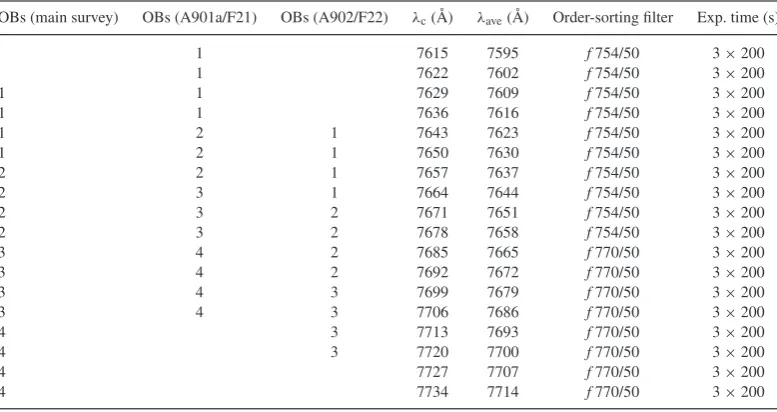
FWHM bandwidth is set to 14 Å, and the spacing between succes-sive wavelengths to 7 Å. Therefore, in order to cover the desired wavelength range in F21 and F22 we require 14 and 12 wavelength settings, respectively, whereas for the rest of the fields we need 16
wavelength settings (see Figs2and3, and Table1). Moreover, for
each wavelength setting, three dithered images are taken typically
with an∼40 pixel (10 arcsec) separation. This increases our number
of images (and individual wavelengths sampled) by a factor of 3 and ensures that the inter-CCD gap is imaged. A total of 42 and 36 images have been obtained for Fields 21 and 22, respectively, and 48 for the remaining 18 fields. Note however, that the wavelength
varies across the field, according to equation (1). In Fig.4, we show
an illustration of this dependence.
Since the wavelength varies across the FOV, the central
wave-lengthλcof each wavelength setting needs to be optimized in such
a way that the desired wavelength range is covered for as many
galaxies as possible. The average wavelengthλave of each setting
was calculated as the meanλwithin the central 5.6-arcmin diameter
circle of each pointing (the approximate area uniquely covered by
one tile). For Fields F2–F20, 7609≤λave(Å)≤7714, ensuring that
both Hαand [NII] are observed in the 0.1594≤z≤0.1718 redshift
ranges. This corresponds to rest-frame velocities in the range−1447
≤v(km s−1)≤1751, wherev=0 corresponds toz=0.167, the
average redshift of the structure. For Field F21, 7595≤λave(Å)≤
7686, and for F22, 7623≤λave(Å)≤7700, thus covering a slightly
narrower redshift/velocity range for these two fields (see Fig.2and
Table1for details). Note that these are average values: the exact
wavelength range covered for each galaxy depends on its position with respect to the centre of the pointing. Moreover, given the signif-icant tile overlap, a sizeable fraction of the galaxies will be observed in more than one pointing, increasing the available wavelength range and the number of independent wavelength samples obtained.
A summary of the observational setup is given in Table1. The
observations were executed in ‘observing blocks’ (OBs), as shown
in Table1and illustrated in Fig.3. They were carried out during the
first halves of 2012 and 2013, and completed in 2014 February.
3 DATA R E D U C T I O N
In this section, we describe the data reduction methods we have developed for the OMEGA data.
3.1 Imaging data reduction
The data reduction was carried out with the Osiris Offline Pipeline
software (OOPs; Ederoclite2012). The OOPs reduction consists of
Figure 1. The OSIRIS observed fields (labelled 2–3, 5–22), represented as circles of radius 4 arcmin, overlaid on top of the footprint of the 80-tile STAGES HST/ACS mosaic and a COMBO-17R-band image. The very small black circles mark the positions of cluster galaxies withmR<23, where cluster membership is defined as in Gray et al. (2009) using the COMBO-17 photometric redshifts.
Figure 2. Spectroscopically determined redshift distribution of galaxies within 1.2-Mpc diameter apertures around the three main cluster cores, from a limited spectroscopic survey of the∼300 brightest galaxies in the region, taken with the AAT 2dF instrument. Arrows mark the positions of the brightest cluster galaxies. Dashed lines indicate the velocity range probed by OMEGA: the top histogram indicates the limits of the survey proper (Fields 2, 3 and 5–20), while the ranges for the two pointed observations of the A901a and A902 cluster cores presented in this paper (Fields 21 and 22, respectively) are specially tuned (cf. Table1).
frames taken at the telescope. Flat-fields were obtained using dome flats with the filter tuned to the same wavelength as the science ob-servations. Usually three to five flat frames were taken each night at each wavelength. In the second step, we reduce the science frames: we remove the overscan and subtract the bias from the science frames and divide these frames by the masterflat. The vignetted regions of the images are also trimmed at this stage.
The final step carried out within OOPs is the sky subtraction. Due to the wavelength variation across the FOV, sky OH emission
lines appear as rings (see top panel of Fig.5). To correct for these
features, each science exposure is artificially dithered on a 3×3
grid. The dither step size (a few arcseconds) is larger than the vast majority of the sources, but small compared to the ring features. Therefore, median-combining the dithered images leaves only the sky rings. These can then be subtracted from the original image.
Fig.5presents the first image of Field 21, withλc=7615 Å. The
upper panel shows the raw image while the bottom panel displays the final output from OOPs.
As mentioned in Section 2, we obtain three dithered exposures
for eachλc(see Fig.3). This dithering introduces small shifts in the
wavelength corresponding to each pixel. As we wish to retain this information, to improve our spectral sampling, we do not co-add the dithered images. To correct for cosmic rays, we therefore employ
a similar routine toQZAPinIRAFapplying a 3σclipping with a flux
[image:4.595.69.261.456.604.2]OB1 λ1 λ2
λ3
λ4
OB2 λ5 λ6
λ7
OB3
OB4 λ
11
λ12
λ13
λ14
OSF 2 OSF 1
λ
λ8
λ9
λ10
OB1 λ1 λ2
λ3
λ4
OB2 λ5 λ6
OB3 λ9 λ10
λ11
λ12
OSF 1
OSF 2
λ
A901a/F21 A902/F22
OB1 λ1
λ2
λ3
Main Survey
OB2
OB3
OSF 2 OSF 1
λ9
λ10
λ11
λ12
λ5
λ6
λ7
λ8
λ13
λ14
λ15
OB4
λ
λ7
λ8
λ16
[image:5.595.44.545.52.297.2]λ4
Figure 3. A cartoon illustrating the design of the observations for the main survey and the two cluster core fields (F21 and F22). Note that this illustration is valid in the case of a single galaxy, for which the wavelength is almost constant (for a given image there is wavelength variation across the field of view, see equation 1 and Fig.4). A given galaxy is observed using a series of wavelength setupsλiand a three-position dithered pattern. In each dithered position, the wavelength changes slightly because the distance to the centre of the field changes. The order-sorting filter (OSF) separates the different tuned wavelengths. The observations are executed in ‘observing blocks’ (OBs). Seehttp://www.nottingham.ac.uk/astronomy/omega/videos/for videos with successive frames of a given galaxy.
Table 1. Summary of the observations.
OBs (main survey) OBs (A901a/F21) OBs (A902/F22) λc(Å) λave(Å) Order-sorting filter Exp. time (s)
1 7615 7595 f754/50 3×200
1 7622 7602 f754/50 3×200
1 1 7629 7609 f754/50 3×200
1 1 7636 7616 f754/50 3×200
1 2 1 7643 7623 f754/50 3×200
1 2 1 7650 7630 f754/50 3×200
2 2 1 7657 7637 f754/50 3×200
2 3 1 7664 7644 f754/50 3×200
2 3 2 7671 7651 f754/50 3×200
2 3 2 7678 7658 f754/50 3×200
3 4 2 7685 7665 f770/50 3×200
3 4 2 7692 7672 f770/50 3×200
3 4 3 7699 7679 f770/50 3×200
3 4 3 7706 7686 f770/50 3×200
4 3 7713 7693 f770/50 3×200
4 3 7720 7700 f770/50 3×200
4 7727 7707 f770/50 3×200
4 7734 7714 f770/50 3×200
pixels and the flux in the candidate one to check whether the pixel has been hit by a cosmic ray).
Bad pixels are corrected using theIRAFtask FIXPIX.
Astrome-try solutions are found using CCMAP and CCSETWCS with the
COMBO-17R-band image as reference. In order to avoid
unneces-sary distortions, we work with the two separate CCDs of OSIRIS throughout the analysis, obtaining astrometric solutions with rms
accuracies≤0.1 arcsec.
3.2 Wavelength calibration
The nature of the observations mean that the wavelength of a given object will depend on the central wavelength of each image as well as its distance to the optical centre. Both parameters change from exposure to exposure. The variation of wavelength across the FOV
for a given central wavelength is shown in Fig.4.
The wavelength calibration of the OSIRIS tuneable filter has
[image:5.595.100.489.401.607.2]Figure 4. A mock reduced image withλc=7615 Å, illustrating the radial
wavelength dependence according to the colour bar (labelled by wavelength in Å). The vertical line in the middle represents the 9.4 arcsec gap between CCD1 and CCD2 and the axis are in pixels.
its accuracy is crucial for studies of extended sources, as well as for estimating redshifts of both point-like and extended sources. Fortunately, the sizes of our objects are small (the largest objects in
F21 and F22 have a radius of∼7 arcsec), and hence the wavelength
changes are negligible across individual objects in the OMEGA
sample (at most∼2 Å, i.e. much smaller than the spectral resolution,
14 Å FWHM). The general form of theλcalibration follows from
equation (1). The optical centre is located on pixelX0=1051 and
Y0= 976 (CCD1) andX0 = −10 andY0= 976 (CCD2) of the
raw images, according to the OSIRIS website.1This corresponds
to X0 = 772,Y0 = 976 (CCD1) and X0 = −35 and Y0 = 976
(CCD2) on the images output from OOPs. Although there are other
optical centres listed in the literature (M´endez-Abreu et al.2011
and the OSIRIS manual), the change they introduce is smaller than 0.2 per cent in wavelength. Using either of these values makes no difference for the purposes of the current paper. Here, we are
interested primarily in the measurement of the Hαand [NII] line
fluxes, and not in the determination of accurate redshifts. However, in future papers, the combination of the images for all 20 OMEGA fields will allow us to evaluate the accuracy of the wavelength calibration using a very large number of galaxies in the overlap
regions (see Fig. 1) that are observed two or even three times.
Furthermore, the available AAT 2dF spectroscopic redshifts will provide an external cross-check.
3.3 Flux calibration and zero-point estimation
Different image sets (OBs) for a single field are not necessarily observed on the same night or with the same observing conditions. In order to perform consistent photometry, we therefore need to correct for differences in the seeing conditions, transparency and airmass.
To match the seeing conditions our procedure is as follows: we measure the PSF in all the images using unsaturated stars with
1http://www.gtc.iac.es/instruments/osiris/
Figure 5. Example of the first image of F21 withλc=7615 Å. Top panel:
raw image. Bottom panel: after OOPs processing. The red circle has a radius of 4 arcmin, within which the observations are free from contamination by other interference orders.
mR, COMBO-17 < 19 (from the STAGES catalogue of Gray et al.
2009). We then convolve each image with a Gaussian function of
the required width to produce images with the same PSF. From now on, we use images matched to the worst seeing, which is
1.2 arcsec. These operations were performed using theIRAFtasks
PSFMEASURE and GAUSSIAN.
We perform photometric measurements usingPHOTwithinIRAF
on the stars in each individual OSIRIS image (typically, 15–25 stars per field) using an aperture of 2 arcsec (8 pixels) radius, suffi-cient to measure the total flux for these point sources. Because the wavelength at which each star is observed varies for different
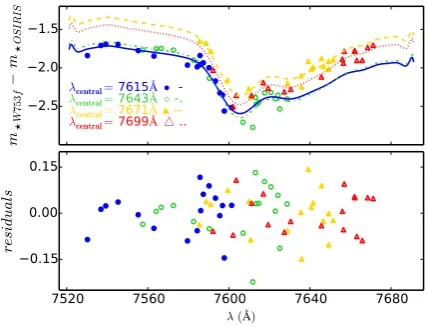
im-ages, we obtain a wavelength-dependent zero-point zp(λ) function,
[image:6.595.309.548.57.527.2]Figure 6. Top panel: the wavelength-dependent zero point, zp(λ)=
mOSIRIS−mW753f, for 4 different dithered images in Field 21. Each set
of∼25 stars is shown with a different colour and symbol. We only show 4 of the total 42 images for clarity. In order to model the effect of the telluric line, we fit a polynomial. The best solution for each image set is shown by the lines. Bottom panel: the residuals with respect to the polynomial fits.
wheremW753fis the standard magnitude of that star, defined below,
andmOSIRISis the instrumental magnitude of the star measured in PHOT.
To calibrate our fluxes we use the Vega magnitudes of the same stars in the closest COMBO-17 filter, W753f, as standard magni-tudes. This filter samples the range 7440–7620 Å. Vega magnitudes were calculated from the photon fluxes tabulated in the COMBO-17
catalogue. Our zero-point functions are shown in Fig.6. Because
there is a strong absorption feature caused by a double telluric sky
line atλ=7633 Å, the zero-point function has a strong wavelength
dependence.
In order to correct for the effect of the atmospheric telluric ab-sorption, we fit this feature with a series of Chebyshev polynomials. The shape of the absorption feature is constant, except for a scal-ing factor and offset that vary with the observscal-ing conditions. We therefore fit all the zero-point functions simultaneously, to obtain a general set of polynomial coefficients, together with an offset and scaling factor for each set of dithered images (14 in the case of Field 21, and 12 for Field 22). We use a similar fitting technique to that
described later, in Section 4.1. In Fig.6, we show the zero points, as
well as our fits and their residuals, as a function of wavelength. For clarity, we only show these for 4 images from the set of 14 dithered images.
The scatter in the zero point introduces additional wavelength-dependent errors that must be incorporated in our photometric
un-certainties. We estimate these by taking a 3σ-clipped standard
de-viation of the residuals in bins of 10 Å. These zero-point errors are
found to be always0.1 mag.
3.4 Galaxy photometry
We perform aperture photometry on the galaxies withPHOT. We
measure each galaxy using two apertures: a PSF-matched aperture
of radius 1.2 arcsec (5 pixels, from now on referred to asRPSF) and a
total aperture (essentially the Kron radius; Bertin & Arnouts1996),
withRtot=2.5×SMA. Here SMA is the second central moment
of the light distribution, derived from ACS images withSEXTRACTOR
and contained within the STAGES catalogue (Gray et al.2009).
We use these two different aperture radii as appropriate throughout
the paper.RPSFprovides information about the nucleus of a given
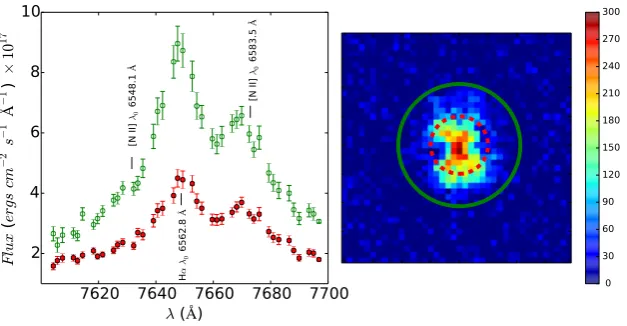
galaxy, whileRtotaverages over its full extent. Fig.7shows the
spectra constructed for one of the galaxies in F21 using bothRPSF
orRtotapertures.
Since at different wavelengths the galaxies’ light distributions may change, we do not re-centre the aperture for each measurement, but instead fix the aperture position to the RA and Dec. from the
STAGES catalogue of Gray et al. (2009). The flux calibration is
then applied using the zero point zp(λ) previously obtained via
equation (3):
mcalib(λ)=mOSIRIS(λ)−zp(λ). (4)
When working in fluxes this becomes
Fcalib(λ)=FOSIRIS(λ)×10zp(λ)/2.5, (5)
where Fcalib(λ) is our calibrated flux in erg cm−2s−1Å−1 and
FOSIRIS(λ) is the flux measured withPHOT.
3.5 Building the spectra
After the flux and wavelength calibrations are performed, we are able to construct a spectrum for each of the galaxies in the observed fields. An example of such a spectrum can be found in the left-hand
panel of Fig.7, where we indicate the location of Hαand the two
[NII] lines with their respective rest-frame wavelengths. By design,
the wavelength range of the spectra for cluster members should
cover both Hα and [NII]λ6583, which will appear as emission
lines in galaxies hosting star formation and/or AGN activity. In addition to finding spectra of galaxies with clear emission lines, we also expect to obtain spectra of galaxies with weak or absent
emission (or absorption in Hα) lines.
4 A N A LY S I S
4.1 Spectral fitting
Our goal is to measure fluxes for Hαas well as the brightest [NII]
line at 6583 Å. We also wish to obtain reliable constraints for the
continuum, in order to measure the equivalent widths (WHα and
W[NII]) of these lines. Due to the limited wavelength coverage and
the moderate spectral resolution and sampling of our spectra, this exercise becomes very challenging for weak ELGs.
To account for all the features present in our spectra, we fit them with a composite of three Gaussian functions and a linear continuum. Since the ratio of the fluxes of the two nitrogen lines
([NII]λ6583/[NII]λ6548) is fixed by atomic physics to a value of
3.06 (determined by the ratio between the transition probabilities of
each line; Osterbrock & Ferland1989), we only need one parameter
to fit both their fluxes. We therefore fit, at most, six parameters:
continuum intercept, continuum slope, redshift, flux of Hα, width
of Hαand flux of [NII]λ6583.
In order to exploit all the information contained in our data, the fitting procedure must evaluate all possible combinations of the parameters in a thorough yet efficient way. Conventional fitting techniques, such as Levenberg–Marquardt optimization, can be sen-sitive to the initial values, and can become trapped in local maxima in the parameter likelihood space. These problems can be amelio-rated by using Markov Chain Monte Carlo (MCMC) techniques.
In particular, we use the softwareEMCEE(Foreman-Mackey et al.
2013), which implements the Affine Invariant MCMC Ensemble
sampler of Goodman & Weare (2010).
Figure 7. Left-hand panel: the flux-calibrated spectra for the central (filled red circles) and total (open green circles) apertures of the bright (mR∼18.7) galaxy with STAGES ID 42713. The locations of Hα(λ0=6562.8 Å) and the two [NII] lines (λ0=6548.1 Å and 6583.5 Å) are indicated. Right-hand panel: image
of galaxy 42713 atλ=7646 Å, with the total and PSF apertures overlaid as solid green and dashed red lines, respectively. This image has not been convolved to the standard PSF although the fluxes are actually measured on the convolved images. The image is 40 pixels on a side, which corresponds to 10 arcsec or 28 kpc atz=0.167. The colour bar indicates the flux in counts.
set of model parameters is given the data. From Bayes Theorem, the posterior is given by the product of the prior distribution (which can be thought of as pre-existing constraints on the parameter values) and the likelihood function (which describes how closely the data correspond to the model, for a given set of parameters). MCMC algorithms explore the parameter space along a chain. At each step, new values for the parameters are proposed. These are accepted or rejected, depending on the probability of the proposed values rela-tive to that of the current parameter set. If the probability is higher, then the proposed parameters will be adopted. However, if the prob-ability is lower, there remains some chance of the new values being accepted. In this way, the parameter space is thoroughly explored, and ultimately sampled in proportion to the posterior probability density.
The Affine Invariant MCMC Ensemble sampler uses multiple ‘walkers’ to produce a set of chains. These are started at different points of the parameter space. Each walker explores following a proposal distribution that depends on the current position of the rest of the walkers. In this way, the parameter space can be mapped more efficiently than with the original Metropolis–Hastings algo-rithm. We also make use of parallel tempering, in which additional sets of walkers take significantly larger steps than the standard set. This eases communication between different maxima in the case of multimodal posterior distributions and generally speeds up conver-gence.
The performance of the MCMC depends on two issues: the ‘initialization bias’ and the ‘autocorrelation in equilibrium’ (Sokal
1996). The first one refers to the need of reaching the equilibrium
distribution and therefore ‘erasing’ any dependence on the initial conditions. This can be achieved by estimating the autocorrelation time in the burn-in phase, and producing chains long enough for them to move away from the initial conditions. The burn-in phase will then be discarded and not included in the posterior distribu-tions. The second one implies that once the chains have reached equilibrium, we need to take enough samples to obtain a statisti-cally significant estimate of the errors. Therefore, the performance of MCMC will strongly depend on the length of the chains and the number of walkers, but also on the election of the priors. To ensure a good performance for our analysis, we use 300 walkers, a burn-in
phase of 500 iterations (∼10 times the autocorrelation time) which
are discarded and 500 iterations after the burn-in phase to sample the posterior distributions.
An example of the performance of this algorithm using a four-parameter model (described below) for the spectrum of one of our
galaxies is shown in Fig.8. Unless otherwise specified, we
sum-marize our fit results using the median value of the (marginalized) posterior distribution of each parameter, and estimate uncertainties from the 16th and 84th percentiles.
A crucial element of this process is to set the priors that appropri-ately constrain the regions of parameter space to be explored. From what we already know of our model and data, we set the following priors:
(i)F[NII]λ6583>0;
(ii) redshift consistent with the Hαline being within the
wave-length range probed by our spectrum, with an additional 20 Å window on each side and
(iii)F[NII]λ6583<3 (FHα+continuum).
The first of these forces the flux of [NII]λ6583 (which, physically,
can never be negative) to be positive; the second assumes that the Hα
line lies within the spectral range and the third sets an upper limit for
the [NII]λ6583 flux such that it cannot be larger than three times the
flux of Hα(which is the maximum value of [NII]/Hαobserved in
the [NII]/HαversusWHα(WHAN) diagram; Cid Fernandes et al.
2010), including the possibility of up to 3 Å equivalent width of
absorption in Hα.
As mentioned above, we define our model using six different pa-rameters. This number can be reduced if we assume some properties of our spectra. First, one can assume that the slope of the continuum is roughly the same for all the galaxies, which is reasonable consid-ering the short wavelength range covered by the OMEGA spectra
(≤200 Å). Secondly, the width of the emission lines will be limited
by the instrumental resolution and only substantially broadened in
cases of strong AGN (1000–25 000 km s−1). Due to the low
spec-tral resolution and the faintness of some of the objects, adding these constraints will improve the reliability of our estimates.
Figure 8. Parameter–parameter likelihood distributions with 1σ(solid), 2σ(dashed) and 3σ(dash–dotted) contours obtained for the four-parameter model of theRtotaperture spectrum of galaxy 42 713 (the same galaxy shown in Fig.7). On the top right, we show the observed spectrum (blue points) together with
the model fits (red lines). We plot only 1/100 of all the individual MCMC fits for clarity, but they are all very similar. The median values of the parameters’ probability distribution are plotted as a white cross on the two-dimensional distributions. The parameters shown are the continuum flux density, the redshift and the integrated fluxes of the Hαand [NII]λ6583 emission lines. Fluxes are given in c.g.s units.
six-parameter MCMC runs considering only those galaxies that show clear emission lines. We then select galaxies with less than 15 per cent uncertainty in the estimation of the flux and width of
the Hαline, and the median value of the redshift consistent with
Hαand [NII]λ6583 being within the wavelength range. In total, we
find 28 galaxies that fulfil these requirements. For these galaxies,
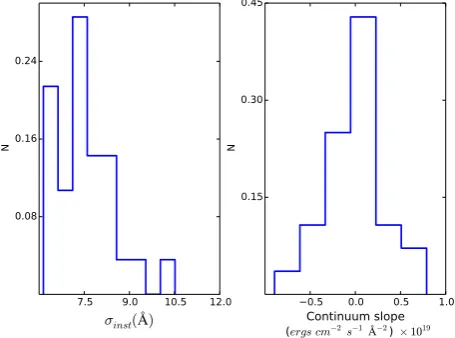
Fig.9shows the distribution of the line-width and the slope of the
continuum. The continuum slope is consistent with zero, while the distribution of the width of the lines shows a clear peak at 7.5 Å. These findings allow us to confidently fix these two parameters and use only four-parameter models to fit the spectra.
4.2 Defining the OMEGA sample of ELGs
After fitting the Hα and [NII] lines as described above, in this
section we describe the different criteria we use to define the sample of ELGs we will use in the remainder of the paper. We start with
all objects in the STAGES catalogue with 16 ≤mR≤ 23.0 that
are detected in both COMBO-17 (combo_flag>1) and inHST
(stages_flag>1). At this stage, we do not require them to also
[image:9.595.312.540.496.665.2]Figure 10. The distribution of the Hαflux for the 124 ELGs in our sample, where the error bars are 1/√N.
be flagged as cluster members according to the definition of Gray
et al. (2009).2
We use measurements made within the total aperture, Rtot, as
defined in the previous section. Our final sample of ELGs in F21 and F22 contains 124 objects fulfilling the following selection criteria:
(i) relative error (WHα)<0.15;
(ii) probability of detecting the Hα line in emission,
P(FHα>0)>99.7 and
(iii) the Hαline falls within the wavelength range probed by our
observations.
Out of these 124 objects, 103 have been morphologically
classi-fied by the STAGES collaboration (see e.g. Wolf et al.2009; Maltby
et al.2010). The galaxies without morphological classification have
zphot>0.4, the STAGES cut-off for visual classification. Of the 124
ELGs, 72 are classified as clusters members in the STAGES
cata-logue based on their COMBO-17 photometry (combo_flag>3).
For the parts of our analysis that make use of both Hαand [NII]
measurements (e.g. Section 5.1), we define a subsample
requir-ing both Hαand [NII]λ6583 to be within our wavelength range.
This subsample contains 82 ELGs with bothRtotandRPSFaperture
measurements.
4.3 Detection efficiency and limits
Our ability to detect Hαemission depends on a complex interplay
between the brightness of a galaxy, its size, and its Hαflux and
equivalent width. For instance, for a given Hαflux, galaxies with
stronger continuum will be harder to detect. Figs10and11show
the distribution of the Hαfluxes and equivalent widths (WHα) for
the 124 ELGs in our sample. We are able to detect galaxies with Hα
fluxes as low as∼1.3×10⁻¹⁷erg cm−2s−1. Given the relatively
small sample presented in here (only galaxies in F21 and F22), we
leave for a later paper a detailed discussion of the Hα flux and
equivalent-width distributions and their dependence on the intrin-sic properties of the galaxies and the environment. Reassuringly,
2Membership of the A901/2 cluster structure is determined taking into
ac-count the COMBO-17 photometric redshifts and their uncertainties. Given the high accuracy of these redshifts, the procedure maximizes complete-ness without introducing unacceptable contamination. Details are given in Section 3.3 of Gray et al. (2009). See, in particular, their fig. 13 and equation 8.
Figure 11. The distribution ofWHαfor the 124 ELGs in our sample, where the error bars are 1/√N. For equivalent widths larger than∼20–30 Å the distribution declines steeply with incompleteness kicking in below∼5 Å. We have fitted a line with slope−1.5 and an intercept of 3.8.
theWHαdistribution we obtain is broadly compatible with the one
found by Balogh et al. (2004). For equivalent widths larger than
∼20–30 Å the distribution declines steeply, following roughly a
power law. At lower equivalent widths, the distribution flattens out
until incompleteness probably kicks in below∼5 Å. When
inter-preting our data it is important to bear in mind that the sensitivity of our survey declines for lower equivalent widths.
Due to the complex nature of the Hαdetection process, it would
be very difficult to model accurately the detection limits and the completeness of our sample from first principles. Instead, we follow an empirical approach that takes advantage of the wealth of data
available from the STAGES data base. Hαemission is expected to
be present in blue, SF galaxies. Moreover, many red spirals have been shown to have a certain degree of star formation (Wolf et al.
2005). Here, we compare our Hαdetections with the numbers of
blue-cloud and red spiral galaxies (SF candidates) in the STAGES catalogue in order to evaluate how efficient the OMEGA survey is at detecting SF galaxies and to assess the sample completeness.
In the top panel of Fig.12, we show themRdistribution for the
galaxies in our sample where Hαhas been detected (green). For
comparison, we overplot in yellow the distributions for all COMBO-17 cluster galaxies in the same FOV and in blue those identified as SF. SF galaxies are either blue-cloud or red-spiral galaxies (Gray
et al.2009). The dashed histograms show the same COMBO-17
samples corrected for completeness and contamination (see below). One caveat here is that we do not separate the so-called retired
galaxies (Cid Fernandes et al.2011; Yan & Blanton2012), which
also have Hαemission, from the SF ones. More details are given
in Section 5.1, when we discuss AGN activity.
The parent sample of COMBO-17 galaxies in F21 and F22
con-tains∼1400 objects, with 326 galaxies expected to be cluster
mem-bers (listed in the STAGES catalogue as having 16.0≤mR≤23 and
combo_flag>3) with stellar masses 9.0≤log (M/M)≤11.5.
Of these, 203 are either red spirals (sed_flag_cl=2) or belong
to the blue cloud (sed_flag_cl=3), both thus considered to be
SF galaxies, based on their COMBO-17 SEDs. We securely detect
Hαin 124 objects. From this, we estimate that we are able to detect
Hαin∼40 per cent of the cluster members and in∼60 per cent of
the cluster SF galaxies more massive than 109.0M
[image:10.595.320.536.57.230.2]Figure 12. Top panel: themRdistribution of galaxies determined to be clus-ter members using the COMBO-17 photometric redshifts (sample denoted cmc17, in yellow), and the subset of these that are expected to be SF (galaxies classified as blue cloud or red spiral, in blue). The dashed histograms indicate the same cmc17 and SF cmc17 samples, but corrected for completeness and contamination as discussed in the text. The green square-filled histogram is the distribution of galaxies for which Hαhas been detected in our OSIRIS spectra. Bottom panel: the Hαdetection rate, expressed as a fraction of the full sample of cluster members (fHαdet; green stars) and as the fraction of
SF cluster members (fSFHαdet; blue circles), plotted as a function ofmR. See text and equations (8) and (9) for details.
As described in Gray et al. (2009), the cluster membership was
determined using COMBO-17 photometric redshifts. Despite the relatively high accuracy of these redshifts, the cluster sample suf-fers from a certain degree of incompleteness and contamination, particularly at faint magnitudes. Therefore, the ‘true’ (corrected for incompleteness and contamination) number of cluster galaxies
Nc
cmc17can be estimated as
Nc cmc17=
Ncmc17(1−contfrac)
compfrac
, (6)
whereNcmc17is the observed number of cluster members based on
their photometric redshifts. In this equation, compfrac and contfrac
are the magnitude-dependent completeness and contamination
frac-tions, respectively (see fig. 14 of Gray et al.2009). Similarly, the
‘true’ number of SF cluster galaxiesNc
SFcmc17is
Nc SFcmc17=
NSFcmc17(1−contfrac)
compfrac
, (7)
whereNSFcmc17is the observed number of SF cluster galaxies.
The bottom panel of Fig.12shows as green stars the fraction of
cluster galaxies detected in Hα, defined as
fHαdet=
NHαdet
Nc cmc17
, (8)
and as blue circles the fraction of SF cluster galaxies detected in
Hα
fSFHαdet=
NHαdet
Nc SFcmc17
. (9)
We effectively detect Hα for all SF cluster members brighter
thanmR ∼ 20. Fainter than this, the completeness drops off, as
expected – only galaxies that are bright in Hαare detected. Note
that the apparent drop for galaxies brighter thanmR∼19 is due
to low number statistics in the brightest bins. As a fraction of all
cluster members, the completeness does not depend strongly onmR
since at lower masses a greater fraction of cluster galaxies are SF.
Note thatfdet>1 means that we are detecting Hαin more galaxies
than are expected to be SF (based on thesed_flag_clflag). This
reflects both the uncertainty in the COMBO-17 SED classification and the high sensitivity of our survey.
5 R E S U LT S
As a preview of the kind of scientific issues that we will be able to address using OMEGA data, in this section we identify SF galaxies and AGN from our ELG sample, and investigate their properties, including mass and morphology. This is done by cross-matching our OMEGA observations with the STAGES catalogue (Gray et al.
2009). In addition, we present the Hαluminosity function (LF) in
the densest regions in order to understand how comparable our Hα
SFRs are to literature values of other sources. We finally compare
our Hα-derived SFRs to UV and IR ones from Gray et al. (2009). In
subsequent papers, we will present a full analysis for the complete data set.
5.1 AGN and star-forming galaxies
In Fig.13we show the WHAN (Cid Fernandes et al.2010,2011)
diagram for our ELGs. Here, we use the RPSF aperture, as this
Figure 13. A diagnostic plot of [NII]/Hα versus WHα, the so-called
WHAN diagram (Cid Fernandes et al.2010). The vertical and horizontal lines separate regions with different sources of ionization (Cid Fernandes et al.2010,2011). We only show detections usingRPSFaperture
measure-ments where both Hαand [NII] fall in the OMEGA probed wavelength
[image:11.595.307.546.449.636.2]probability of being SF-dominated (blue stars). The remaining 56 galaxies (green points) have less certain classifications due to the
observational uncertainties on [NII]/Hα. Obviously, it is possible
to classify galaxies into SF and AGN with less certainty by lowering the probability threshold. This would increase the size of the SF and AGN samples, but the confidence for each individual object would be reduced. Nevertheless, since we have robust probability distri-butions for the line ratios, the statistical properties of such samples can still be analysed rigorously. It is important to bear in mind, however, that in reality there is no hard division between SF- and AGN-dominated systems. Better observational errors would place the galaxies more accurately on the WHAN diagram, but since the boundaries are somewhat fuzzy (and depend on other physical pa-rameters such as metallicity and interstellar medium density), the classifications would, in many cases, remain uncertain: a signifi-cant fraction of the green points may well contain mixed sources of ionization.
One interesting population revealed by the WHAN diagram is
the so-called retired galaxy population (Cid Fernandes et al.2011;
Yan & Blanton2012; Stasi´nska et al.2015). They are located in
the bottom-right part of such diagram, which is also occupied by LINER-type AGN. These retired galaxies have stopped forming stars, their gas is believed to be ionized by hot low-mass evolved stars, and they do not have a detectable contribution from an AGN.
Furthermore, their Hαemission is often extended (Belfiore et al.
2015). This population will be addressed in detail in a subsequent
paper, when we analyse the resolved emission-line images. In the following, we explore how the properties of the SF galaxies and AGN hosts that we have identified compare to one another and
to the overall population of ELGs. We consider here their totalmR,
morphologies and stellar masses.
In Figs14and15, we present histograms ofmRand stellar masses
for the ELGs with both Hαand [NII]λ6583 secure detections. The
distributions of the secure AGN (Seyferts) and SF objects are also
shown. Galaxies hosting AGN are brighter in theRband and more
massive than SF galaxies. Moreover, the overall behaviour of the
Hα-detected galaxies appears to mimic the mass andmRdistribution
of SF galaxies, suggesting that the majority of the galaxies with uncertain classifications are SF-dominated.
In Fig.16, we show the distribution of morphologies. Galaxies
determined to be hosting AGN with≥3σconfidence are typically of
earlier type than those for which the dominant source of ionization is SF or uncertain.
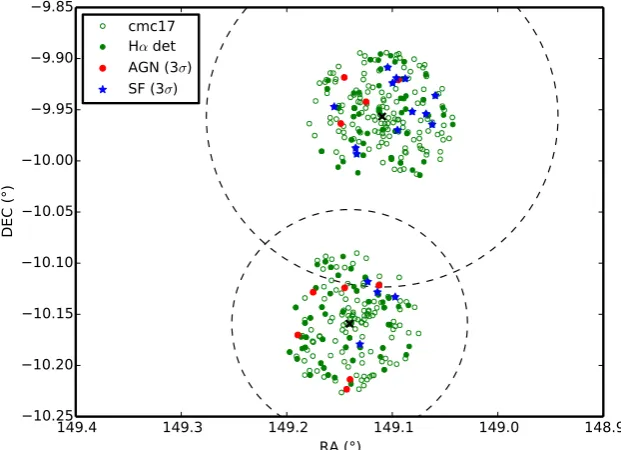
In Fig.17, we show the distribution on the sky of the galaxies
in the F21 and F22 regions down tomR<23 that are classified
as cluster members in the STAGES catalogue. Galaxies with more
[image:12.595.331.521.55.205.2]the subsamples of high-confidence AGN (Seyferts; red histogram) and SF objects (in blue). See text for details.
Figure 15. Stellar mass distribution for ELGs with detected [NII]λ6583 and Hα, together with the AGN and SF subsamples. Object selection and lines as in Fig.14.
Figure 16. The distribution of morphologies for ELGs with detected [NII]λ6583 and Hαas well as the subsamples of the high-confidence (≥3σ) AGN and SF objects.
than 3σ confidence of being AGN- or SF-dominated (see Fig.13)
are denoted by red and blue filled circles, respectively, whereas
other Hαsecure detections are indicated by filled green circles.
[image:12.595.330.522.269.420.2] [image:12.595.330.525.476.628.2]Figure 17. The distribution on the sky of the cluster galaxies (as determined by COMBO-17; denoted cmc17 in the legend) in the F21 and F22 regions down to mR<23. ELGs (where Hαhas been securely detected) are represented by green filled circles. Galaxies classified as AGN or star forming with≥3σconfidence are shown as solid red circles and blue stars, respectively. The centres of A901a and A902 (determined from the brightest cluster galaxies) are marked with black crosses. The large dashed circles show ther200radii of A901 and A902 derived from the weak lensing analysis of Heymans et al. (2008).
note that secure SF and AGN galaxies are located towards the outer parts of the clusters and are completely absent in the central regions, especially when looking at F22.
Gilmour et al. (2007) presented a catalogue ofXMM-detected
point sources in the A901/902 field (see their table 12). From the 12 X-ray sources that they identify as likely AGN within the cluster, 4 objects fall in the FOV of F21 and F22. Only one of them is part of
our ELG sample with securely detected Hα(ID11827). However,
this galaxy is not classed as an AGN because the [NII]λ6583 line
used in the classification process falls outside the wavelength range
probed by the F22 observations. Reassuringly, the [NII]λ6548 line
is detected and, based on its intensity, this object has a 93.5 per cent probability of being an AGN. Moreover, preliminary analysis of an overlapping field (which samples a slightly different
wave-length range) indicates that [NII]λ6583 is clearly detected for this
object, indicating that it is probably an AGN. For a second X-ray
AGN (ID41435) neither Hαnor [NII] fall in the wavelength range
probed by our observations. For the remaining two X-ray AGNs
(ID12953 and ID44351), our observations sample both Hα and
[NII] but their Hαlines are below our detection probability
thresh-old (P(FHα>0)<99.7; see Section 4.2) and therefore do not make
it into our ELG sample. In summary, one out of the four X-ray AGNs that we could have detected is also highly likely to be an op-tical AGN. The others have either too faint emission lines or do not
have Hαor [NII] in our probed wavelength range. It is possible that
these objects may be heavily obscured Compton-thick AGN and therefore would not be expected to show optical signs of nuclear activity. On the other hand, the fact that none of the 10 highly likely optical AGN found in the OMEGA survey are associated with a
Gilmour et al. (2007) X-ray source clearly shows that OMEGA is
able to detect a large number of optical AGN with relatively weak or no X-ray emission.
5.2 The Hαluminosity function
The HαLF of SF galaxies is an important measurement for
compar-ison among different studies and environmental dependences. The
luminosity of the Hαnebular emission line is an SFR indicator with
a direct physical connection to short-lived, massive stars. In order
to calculate the LF of Hα, line fluxes are converted to luminosities
via the following:
LHα=4πDL2FHα, (10)
whereDLis the luminosity distance (795 Mpc atz=0.167).
In Fig.18, we show the Hαcumulative LF for the highest density
regions of A901/2, using our Hαdetections from F21 and F22 as
described in the previous sections. The top axis shows the SFR, assuming 1 mag average extinction, according to
SFRHα Myr−1=2×10−41LHα erg s−1, (11)
following Kennicutt (1998).
We use the results of Section 4.3 in order to correct the OMEGA
Hα LF for incompleteness. We parametrize the dependence of
fSFHαdeton theR-band magnitudemRas
fSFHαdet=
−0.24mR+5.7 ifmR≥20
1.0 ifmR<20. (12)
We consider our sample to be essentially complete formR<20 (see
bottom panel of Fig.12). To correct for incompleteness, we weight
the OMEGA HαLF by 1/fSFHαdet.
For comparison, we show the A1689 LF (at z= 0.18) from
Balogh et al. (2002) as well as the field Hα LF from GAMA
(Gunawardhana et al. 2013). For the field Hα LF we use the
best-fitting parameters of the Saunders function (Saunders et al.
Figure 18. The cumulative Hαluminosity function for the highest density regions of A901/2 corrected (solid green line) and uncorrected (solid yellow line) for contamination and completeness. For comparison, we show the Hα LF from the cluster A1689 atz=0.18 (blue dash–dotted line; Balogh et al.
2002) and the field from the GAMA survey atz=0.1–0.2 (red dashed line; Gunawardhana et al.2013). The densest regions studied by OMEGA have SFRs that fall in between those of the cluster A1689 and the field.
z=0.1–0.2 (logL∗ =34.55, logC= −2.67,α= −1.35,σ=0.47)
to reconstruct the corresponding normalized cumulative fraction.
For A1689, we use the Schechter function parameters:α= −0.1
and L∗ = 1040erg s−1 given by Balogh et al. (2002), to
recon-struct the cumulative HαLF. Compared to the field sample from
Gunawardhana et al. (2013), the densest parts of A901/2 contain
galaxies with lower, on average, SFRs. Conversely, A901/2 hosts
brighter Hαemitters than A1689. This is not a surprise, as A1689
is a more evolved and denser cluster than the densest regions of
A901/2 (Lemze et al.2009; Alamo-Mart´ınez et al.2013). We
con-clude that in the densest regions of the A901/2 system star formation has been significantly suppressed compared to the field, but not as much as in denser, more evolved, cluster environments.
5.3 Star formation rates
The SFR–stellar mass relation is a useful diagnostic for the star formation properties and history of a galaxy population. In this parameter space, there is a reasonably well-defined main sequence whose properties have been characterized at different redshifts (see
e.g. Whitaker et al.2012). Several tracers across the electromagnetic
spectrum may be used to estimate the SFR of a given galaxy. The
STAGES catalogue of Gray et al. (2009) provides UV and IR SFRs
for the A901/2 region. Rest-frame UV light originates mainly from massive stars and thus directly traces young stellar populations
(with main-sequence lifetimes 108 yr); however, it is strongly
attenuated by dust. The SFR from the UV continuum is often dubbed ‘current SFR’. The interstellar medium associated with an SF region can be quite dusty, so a significant fraction of the UV luminosity produced by massive young stars can be absorbed. This radiation heats the dust and is re-emitted in the far-infrared. Moreover, the interstellar medium around young massive stars is ionized by the Lyman-continuum photons they emit. The recombination of this
ionized gas produces Hαemission lines. The SFR from the Hα
nebular emission is often dubbed ‘instantaneous SFR’, tracing stars
with main-sequence lifetimes of2×107yr (Mo, van den Bosch
[image:14.595.46.285.59.240.2]& White2010). In the following figures, we adopt an HαSFR
Figure 19. The log SFRHα determined fromRtot aperture measurements
compared with other estimates of log SFR. See legend and text for details on the meaning of the different data points.
with 1 mag of extinction (see equation 11). At this point, we do not attempt to subtract the AGN contribution to the SFR from the
Hαfluxes. Resolved star formation properties will be studied in a
subsequent manuscript.
We compare our Hα SFR against those from other available
tracers in Fig.19. The UV SFRs are based on the UV luminosity
es-timated using the 2800 Å rest-frame luminosity from COMBO-17, which has a complete coverage around the A901/2 multicluster sys-tem. The UV SFRs have been corrected for extinction as part of the SED-fitting procedure. Details can be found in Gallazzi et al.
(2009) and Wolf et al. (2009). The IR SFRs are determined from
Spitzer/MIPS 24μm data. In the cases where there was no detec-tion in the IR, upper limits to the SFRs were estimated (Wolf et al.
2009). The green data points (denoted ‘UV+IR’ in the figure legend)
represent the composite SFR measurements. Note that these points, which account for the obscured and unobscured star formation, are,
on average,∼0.3 dex above the one-to-one line. This difference
may be due to the HαSFR estimates missing heavily obscured SF,
but it could also be indicative of a declining SFR, given the different time-scales of the indicators. In the case of the SFRs from the UV
alone, the correlation with the HαSFR is stronger, which is not
surprising as the UV and Hαare sensitive to comparable SF
time-scales, with the UV tracing slightly longer ones than Hα. However,
there is also a clear∼0.3 dex offset since the effect of extinction is
significantly stronger in the UV than in the red.
In Fig.20, we show the stellar mass versus the Hα-determined
SFR. Galaxies reliably classified as AGN and SF objects (cf.
Sec-tion 5.1 and Fig.13) are indicated by red circles and blue stars,
respectively. At a given stellar mass, only the galaxies that are
brightest in Hα can be reliably classified as SF or AGN, while
Figure 20. Stellar mass versus SFR(Hα) determined fromRtot aperture
measurements. The galaxies with a 3σ confidence of being AGN- or SF-dominated, with selection based on the PSF aperture (see Fig.13) are denoted by red circles and blue stars, respectively. The dashed-line is an SFR–mass relation for field star-forming galaxies atz=0.167 (Whitaker et al.2012). Comparing our secure Hαdetections to the dashed-line representing the field galaxies indicates a suppression of star formation in these high-density regions.
of Whitaker et al. (2012) for SF field galaxies at the redshift of
A901/2,
log SFR=0.68 logM−6.56. (13)
The stellar masses used by Whitaker et al. (2012) are derived
from medium-band photometry using Bruzual & Charlot (2003)
models that assume a Chabrier (2003) initial mass function (IMF),
solar metallicity and the Calzetti et al. (2000) extinction law. The
stellar masses that we use were estimated by Borch et al. (2006)
using the COMBO-17 photometry in conjunction with a template library derived using the PEGASE stellar population models (Fioc
& Rocca-Volmerange 1997) with solar metallicity and a Kroupa
(2001) IMF. The different IMFs used by Whitaker et al. (2012) and
Borch et al. (2006) would only change the stellar masses by∼10
per cent. Moreover, the stellar masses derived in these works are quantitatively consistent with those derived using a simple
colour-based stellar mass-to-light ratio (Bell et al.2003). We are therefore
confident that the stellar masses used here can be directly compared, and that any systematic differences will not affect our conclusions.
The SFRs estimated by Whitaker et al. (2012) are based on UV+IR
indicators, and are therefore expected to be on average∼0.3 dex
higher, than the Hα-based ones. This has to be taken into account
when comparing our data with that of Whitaker et al. (2012).
Nev-ertheless, even if we consider such offset and any likely systematic
uncertainties, it is clear that most of our Hα-detected galaxies would
still fall clearly below the field SFR–mass relation, consistent with
the differences found between our HαLF and the field one (Fig.18).
This confirms that many of the SF galaxies located in the centres of the A901/2 clusters appear to have their SFR significantly sup-pressed relative to the field. This suppression seems to occur at all stellar masses.
At first sight, this seems to contradict previous results which sug-gest that the average SFR in SF galaxies remains roughly constant with environment, and it is only the fraction of SF galaxies that
changes (Balogh et al.2004; Bamford et al.2008; Poggianti et al.
2008; Verdugo et al.2008). However, this contradiction is only
ap-parent. The relative fraction of SF and non-SF galaxies depends on the depth of the survey. Because we are able to detect very low
Hαfluxes (and thus very low levels of star formation), our
sam-ple contains Hα-emitting galaxies that would have been missed by
most other surveys. Therefore, strongly suppressed galaxies still
appear as Hαemitters in our sample. Cluster galaxies with strong
star formation (exemplified by the blue stars in Fig.20) have levels
of SF comparable with those found in the field. If only galaxies with strong star formation are detected in a survey, it would appear that their SF has not been suppressed. Since galaxies with very low
levels of star formation would not have been detected in Hαin
most other surveys, they would have been (erroneously) classified as non-SF and one would conclude that only the relative fraction of SF and non-SF galaxies has been affected by the environment.
Wolf et al. (2009) reached the same conclusion based on
rest-frame UV and 24μm data of Abell 901/2. They found a large
pop-ulation of lower SFR galaxies, mostly red spiral galaxies seemingly in transition from normally SF galaxies to quiescent ones. This population had higher FIR luminosities than expected from their broad-band optical colour alone, suggesting that the specific SFR (SSFR) of the average red spiral at a given stellar mass was only three times lower than the SSFR of the average blue spiral at similar
mass. An earlier study by Wolf et al. (2005) had already revealed
this population from optical photometry alone, using medium-band imaging to discriminate between red colours due to high age in the absence of dust and those due to moderate age in the presence of moderate amounts of dust, thus differentiating between what they called ‘old red’ galaxies and ‘dusty red’ galaxies. The average SSFR
estimated from [OII] emission in their ‘dusty red’ population was
four times lower than that in blue galaxies. While this paper in-vestigates only a small part of the same cluster, we find a similar
transition population in SFRs estimated from Hαnow. We are thus
suggesting that this cluster contains a rich population of moderately SF galaxies filling the previously considered gap between non-SF and SF galaxies. This view is now supported by evidence from a
range of tracers, from UV and 24μm, from [OII] and Hαemission,
and from a detailed analysis of the optical SED. A detailed study of the environmental dependence of the SF for the full galaxy sample will be presented in a subsequent paper.
6 S U M M A RY A N D C O N C L U S I O N S
In this paper, we have introduced the OMEGA survey. The ul-timate goal of this project is to study star formation and AGN activity across a broad range of environments at a single redshift. Using the tuneable-filter mode of the OSIRIS instrument on the
10.4 m GTC we have targeted Hαand [NII] emission lines over
an∼0.5×0.5 deg2region covering the z∼ 0.167 multicluster
system containing Abell 901 and 902.
Based on observations of 2 out of the 20 fields covered by this survey, this paper outlines the data reduction procedures followed and describes the analysis we have developed in order to reliably
measure the fluxes and equivalent widths of the Hαand [NII] lines.
We present the quantitative criteria used to define a robust sample of ELGs and analyse its properties in terms of detection efficiency, detection limits and completeness. This paper also presents some examples of the kind of science that can be done with the survey. The scientific results we discuss are based on only 10 per cent of the surveyed area, corresponding to the highest density regions of the A901/2 structure. An analysis of the full survey is left for future papers, but interesting results are already emerging.
(i) In these two fields, we detect 124 ELGs down to




![Figure 14. The distribution of the R-band magnitudes from COMBO-17for ELGs with detected [N II] λ6583 and H α (green line), as well as forthe subsamples of high-confidence AGN (Seyferts; red histogram) and SFobjects (in blue)](https://thumb-us.123doks.com/thumbv2/123dok_us/8667406.376223/12.595.330.525.476.628/distribution-magnitudes-detected-subsamples-condence-seyferts-histogram-sfobjects.webp)