2 Abstract
Vocabulary for describing the structures, roles, and relationships characteristic of traditional, or ‘offline’, education has been seamlessly applied to the designs of ‘online’ education. One
example is the lecture, delivered as a video recording. The purpose of this research is to consider the concept of ‘lecture’ as realised in both offline and online contexts. We explore how media differences entail different student experiences and how these differences relate to design decisions associated with each. We first identify five features of traditional lecturing that have been invoked to understand its impact. We then describe a taxonomy of online lecture design derived from digital artefacts published within web-based courses. Analysis of this taxonomy reveals six design features that configure differently the experience of lectures in the two
presentational formats: classroom and video. Awareness of these differences is important for the practitioner who is now increasingly involved in developing network-based resources for
3
The video lecture 1. Introduction
As everyday transactions are increasingly made possible in digital formats, so our language for describing them migrates into the digital realm. In referring to this online “world”, there exists a common vocabulary for the various roles, relationships, tools, and spaces that constitute virtual transactions. So, the online store1 can comfortably refer to its ‘aisles’,
‘shopping baskets’ and ‘checkout’ or the online museum2 can refer to its ‘galleries’, ‘permanent collections’ and museum ‘cafe’. Moreover, the social practices we construct within these online and offline transactions also share a vocabulary, one that acts to unify our material and digital selves. In this way, we become both ‘shoppers’ in the online store and ‘visitors’ to the online museum: even though we simply face the same screen making the same clicks.
Such offline-to-online translation also applies to educational practice: that is, activities around the online school, classroom, desktop, portfolio, and so forth. We are concerned here with the particular case of the online lecture: the ways in which this traditional format is now
commonly rendered as a digital video artefact (Giannakos, 2013) and, then, the ways in which it’s possible designs might be experienced by the online student. Whether a given video presentation should be called a ‘lecture’ is a difficult judgement. We suggest such a recording would be an expository presentation of disciplinary content, associated with a focal voice, and embedded in a curriculum. The more orchestrated performances of, for example, TED talks must be on the boundary of this conception and, while their status is intriguing, embracing them requires a fuller analysis than the present discussion allows.
1.1 The lecturing imperative
The value of lecturing to students has long been contested (Bligh, 1971). However, that value is judged especially harshly in current critiques of educational practice (Biggs & Tang, 2011; Lambert, 2012; Laurillard, 2013). For many commentators, lecturing involves a troublesome relationship. The principle partner in this relationship is “(t)he one who has the knowledge and transmits that knowledge to the students” (the lecturer). And then there are the students, or those who “(s)imply memorize the information and later reproduce it on an exam – often without even thinking about it.” (King, 1993, p. 30). To confront this unhappy situation, King prescribes an attitude shift based around a simple binary contrast - one that has resonated well with sceptics ever since: the lecturer must cease to be a “sage on the stage” and, instead, aspire to be a “guide on the side”. Certainly in higher education, such a recommendation sits well with institutional preferences for a student-centered culture of practice but it also resonates with the preferences of pedagogic theorists for a more constructivist approach to teaching and learning.
Yet despite such scepticism, the lecture - and expository teaching more generally - has survived well (Brent, 2005; Friesen, 2011a). Lecturers continue to lecture, while students, who may acknowledge limitations to this format, still accept it (O’Neill & Sai, 2014; Petrovic & Pale, 2015). Such tolerance suggests that critics of the lecture might be addressing a tired stereotype. Lecturing need no longer resemble the canonical form of a medieval recitation: it has evolved. Friesen (2011a) traces this history, converging on a perspective that celebrates the lecture as a site of ‘transmedial experimentation’. This formulation recognizes how the oral tradition of the
1 http://sainsburys.co.uk
4
lecture is increasingly made to align with developments in representational technologies (e.g., Gourlay, 2012). Naturally, this includes an integration of the lecturer’s voice with the ubiquitous ‘slideshow’ but also the integration of such resources as video, audio, voting systems, and dialogue tools. Moreover, technologies may be coordinated with the very design of the lecturing space (Crook & Bligh, 2016). This transmedial view should be contrasted with a sceptical but narrower conception of the lecture: “Lectures also have limited value, as they’re easy to record and to duplicate … How many introductory psychology courses does a field need?” (McCauley, Stewart, Siemens & Cormier, 2010, p. 44).
McCauley and colleagues are distinguished innovators for Massively Open Online Courses (MOOCs) and it is in the context of contemporary online education that the status of the lecture seems particularly strained. On the one hand, the spirit of MOOC design appears to challenge the institutional certainties of the traditional classroom – so much so that the co-founder of a major MOOC platform (Coursera) can sound out a “death knell for the lecture” (Koller, 2011). On the other hand, the widespread insertion of “video lectures” within the design of MOOCs suggests a vigorously healthy format. All of which implies a tension between
pedagogic vision and commercial practice. Indeed, Bogost (2013) observes how MOOC platforms express enthusiasm for the ‘flipped classroom’ because of their capability for
providing the very kind of video lecture that is often central to implementing a ‘flip’. However, the MOOC is no longer a single thing: it has cleaved into the more instructivist xMOOC and the more constructivist cMOOC. So, it may be possible to resolve this tension around lecturing by mapping the appetite for lectures-in-video onto the more highly structured format of the
xMOOCs, while suspicion of the whole lecture tradition fits better the spirit of cMOOCs. A simple point stands: the lecture still seems likely to thrive in online media.
In practice, it may be that the phrase ‘video lecture’ gets recruited to cover too wide range of expository styles. One of our ambitions in the present paper is to explore the reach of this phrase by scrutinizing a sample of designs from within the corpus of current web-based courses. Therefore, a primary concern will be with whether certain features of the traditional lecture can be preserved intact when lecturing is realized as an online artefact. We are particularly concerned with how video design variations might constrain or afford those features of traditional lecturing that make it potent for students - that make it engaging. However, first it is necessary to consider just what those traditional features are: that is, to build a case for comparing the video lecture with the more familiar classroom format. In what follows next we suggest five features of the lecture experience that have been invoked to characterize its dynamic and, ultimately, its impact. This will form the basis for evaluating those online lecture formats that we shall identify as commonplace in current video design practice.
1.2 Intersubjectivity within lecturing
One popular association that arises when reflecting on the potency of lectures is a sense of them as ‘performances’ (Timpson & Tobin, 1982). On this analogy, Alison King’s ‘stage’ is conceived as being occupied by a ‘sage’ transformed into performer. Certainly, uninterrupted speech delivered on a stage works well for theatre audiences. Yet this need not depend upon vigorous forms of theatrical conflict or drama, as may be implied by ‘performance’ metaphors. The playwright David Hare comments: “Lectures and plays are alike in relying for their true vitality on the richness of the interaction between the performance itself and the thoughts and feelings created by the unspoken reaction in the room” (Hare, 2005, p. 5).
5
describes the capacity of human interlocutors, acting in a situation of communication, to share perspectives - and be aware of that sharing. It is regarded as fundamental to human sociality (Tomasello, 2009) and productive dialogue. Theories of educational practice do celebrate dialogue, but this should not mean unthinking dismissal of monologue (Zvernbekk, 2012). In short, the uninterrupted speech of a lecture can acquire a dialogic quality. It achieves this when it is recruited by a speaker in order to animate that “unspoken reaction in the room”. This occurs when intersubjectivity makes possible an implicit conversation between speaker and (silent) audience. This approach to communication is well developed in the work of Bakhtin (1979/2010) and Lotman (1988). Lotman, for instance, characterizes all spoken and written texts has having both univocal and dialogic functions. The univocal function communicates existing meaning with maximum precision while the dialogic function generates new meanings – doing so in private collaboration with audiences.
Of course, speech is common to both traditional and video lecturing and so, at first sight, intersubjectivity may seem a poor basis for our comparative interest. However, intersubjectivity is also crafted from acts of non-verbal communication. Although, again, the traditional/video contrast may seem undermined if non-verbal communication is vivid in both formats. However, video is a medium whose properties and impact depend on the creative shaping of designers, editors, and producers. Therefore, how these intermediaries act to ‘project’ the lecture will be relevant to the interpretative potentials in that lecturer’s ‘performance’.
How a speaker’s demeanor, movement and gesture create strength of intersubjective relation has rarely been studied in the context of online presentation. However, in the live classroom the concept of instructor ‘immediacy’ (Mehrabian, 1971) seems related. Studies have identified a range of teacher activities in the traditional classroom that can contribute to this immediacy (Park, Lee, Yun & Kim, 2009; Richmond, Lane & McCroskey, 2006) while other classroom research demonstrates their contribution to effective student engagement (Ghamdi, Samarji & Watt, 2016). In relation to online teaching, Richardson, Koehler, Besser et al (2015) focus on the ‘live’ exchanges sometimes offered in that context and invoke ‘instructor presence’ as a related concept. This term may capture well the quality outlined here.
We have identified here the management of intersubjectivity as animating an implicit dialogue or an “unspoken reaction in the room”. Of course, that management involves language but it will also depend upon how words are integrated with the various other semiotic resources of a lecture. In particular, it will depend on how demeanor, movement and gesture are integrated with speech.
1.3 Agency in lecturing
A sense of agency in learning occurs when some educational practice offers students active participation. For instance, Palinscar and Brown’s (1984) classic studies of ‘reciprocal reading’ involve a teacher orchestrating students’ participation in a reading conversation. In this conversation, the students play different roles relevant to understanding a text (questioning, summarizing, predicting etc.). While, within a higher education context, Kraemer (1997) describes a “performance pedagogy” in which a kind of “lecturing disguised as discussion” (p. 175) through a pattern of Socratic questioning weaved into the lecturer’s presentation.
6
performed as symbol manipulation on some teaching surface. Mathematics academics therefore often defend the lecture, but on the grounds that it functions as an arena in which they enact the subject, rather than simply report it (Pritchard, 2010; Rood, 2003; Weber, 2004).
However, a similar sense of practitioner agency can be conveyed for other disciplines.. A straightforward approach to this possibility is through drawing: a commonplace activity for lecturers as they work with whiteboards and similar representational surfaces. In which case, the role of agency is a matter of whether some visual image accompanying spoken exposition is more effective if that image is constructed on-the-fly by the lecturer. Fiorella and Mayer (2015) demonstrate that the witnessed act of drawing does create just that advantage. Moreover, in a video exposition such effects are strongest when they are concentrated on attention to the hands that are producing the drawing.
Thus, the second feature of the lecture associated with its potentially engaging quality is a potential for manifest agency. The student encounters ideas-in-construction. Moreover, the impact may be stronger the more intense the sense of agency – as with the case of concentrating attention on the hands that are executing a drawing. In considering the design of video formats, this may be another feature that lecture design must strive to protect.
1.4 Embodiment in the lecture
Discussion of agency requires consideration of lecturing as an ‘embodied’ form of activity. However, embodied action is implicated in communicative activities beyond agency alone. Perhaps the most compelling examples of how embodied thinking relates to teaching and learning comes from social semiotics. That approach is concerned with the various signs
implicated in the making of meaning. Its ‘social’ dimension stresses how (classroom) meaning is negotiated within exchanges between teachers and students. Authors working in this tradition emphasize how such meaning making should be understood as ‘multimodal’ in nature (Jewitt, Kress, Ogborn & Tsatsarelis, 2001) - not restricted to writing and speech. While stressing the importance of visual images within educational communication, multimodal approaches include ‘modes’ other than this; in particular communicative actions that are concentrated on the body and its posture, movements and gestures.
Roth and colleagues have studied the physicality of communication in science teaching (Hwang & Roth, 2011; Pozzer-Ardenghi & Roth, 2007). Put simply, they document how movement and gesture articulate science concepts during spoken exposition. Hwang and Roth (2011, p. 465) ask: “Given that there are many good physics books on the market and an
increasing number of Internet resources, it is a legitimate question why universities offer lectures as part of their curriculum. What is it that lectures offer over and above verbal content and visual representations?” Their answer is cast in terms of how a physics concept is typically distributed across a range of semiotic resources, such that “(s)tudents do not perceive what might be in the head of the lecturer — what they concretely perceive is his/her vocal, gestural, and positioned bodily performance of concepts in the here and now of the classroom.” (op. cit., p. 464).
Moreover, they suggest that it is this distributed communication that explains tensions associated with students volatile “feelings of understanding”. That is, the strong sense of confidence
7 1.5 The expression of personal identity in lecturing
If adults reminisce on their education, individual teachers tend to be prominent in their memories and, often, in their affections. When reflecting on university experience, it is the lecturer that is typically remembered. Teachers-as-people loom large in our adult memories. This must imply that they acquire distinctive identities and this, in turn, must have significant roots in how they present themselves during exposition. Moreover, identity is salient at the time – not just when reminiscing. There are numerous case studies in which lecturers’ identities are in the foreground of students’ responses to teaching (e.g. Thesen, 2009).
Some of the features of lecturing identified in the above three sections are likely to be implicated in defining distinctive teacher identity: for example, sensitive management of
intersubjectivity, compelling exercise of agency, or skillful use of multimodality. Yet the sum of such parts may not capture the whole. Such shortfall is important because measures of lecturer personality traits (Patrick, 2011) and charisma (Lin & Huang, 2016) tend to show correlations with measures of student course satisfaction – although relations with learning outcomes are less frequently reported.
In his essay ‘Forms of Talk’, Goffman (1981) sees lecturing as an act of personal exposure: revealing how that speaker personally relates to taught material. But Goffman also stresses a mutuality. The lecturer needs to see the audience, to monitor their reactions and then to adjust delivery in response. The lecturer must wrestle with a dynamic involving a text and a mode of presentation that animates that text. However, on the matter of presentation, Goffman cautions that “(c)ertainly the listeners are to be carried away so that time slips by, but because of the speaker’s subject matter, not his antics” (op. cit. p. 166). Yet, as Friesen (2011a) points out, the management of this “illusion” (one of improvisation and spontaneity) is increasingly
supported not so much by Goffman’s “antics” but by a “panoply of devices and media” (p. 100). In relation to online recordings this panoply is surely more in the gift of the video designer, editor or producer.
What is clear from studying online learner experience is that the implicit relationship with an instructor’s manner of presentation influences student engagement with their studies (Borup, Graham & Velasquez, 2011; Ladyshewsky, 2013). In addressing the design of online lectures below, we consider how the communication of identity might be shaped by design decisions made in the recording of instructor presentations.
1.6 The lecture as episode
In the four sections above, lecturing has been discussed with focus on the lecturer and the enactment of their text. However, these events also have an episodic quality. They are contained within a kind of shell: they manifest a socio-cultural ecology. This can be considered at two levels of granularity. First, each lecture is a singular episode around which there may occur a variety of social exchanges. Before, during and after each event, students may convene around or within the venue to engage in peer conversations catalyzed by their commitment to
attendance. Indeed, through regularly photographing the students’ seating pattern in lectures, Koen and Durrheim (2009) show how quickly a stable social segregation and congregation can become organized.
8
their motives for attending lectures (when online alternatives are provided), they stress the self-discipline that the episodic lecture ritual imposes – at the same time as noting the procrastination encouraged by online and recorded lectures (Gysbers, Johnstone, Hancock, & Denyer, 2011). Bassili (2008) stresses the significance of these episodes for scaffolding a self-regulation of learning: “The fact that students who tend to monitor their learning tend to go to lectures rather than watch them online suggests either that the lecture hall experience provides better clues than online learning of how learning is progressing or, alternatively, that the lecture hall provides better supports for some students for maintaining attention and learning” (p. 143).
Any comparative consideration of online and offline lectures should therefore consider this ecology within which the individual event is embedded. How far is the design of that ‘shell’ important to what is achieved within it?
1.7 Addressing the online lecture
In the sections above, we identified salient features that characterize traditional lecturing. Now our attention moves to consider the design conditions of video presentation: how might they amplify, attenuate or re-configure the various communication features of lecturing
identified. For example, some commentators have noted the common practice of including the lecturer as a video window embedded in an expository background (Pi and Hong, 2016) and others have determined this to be an engaging design decision (Kizilcec, Bailenson, and Gomez, 2015; Lyons, Reysen and Pierce, 2012). To explore the wider range of design possibilities for the video format , we sampled a set of online (video) lectures, approaching them with two concerns. First, how is the visual design of such occasions commonly realized in the digital medium? Second, how do those design choices manifest the five lecturing features that have been identified in Sections 1.2 – 1.6 above?
What is then the ideal source for assembling a corpus of online lectures? This is a comparative exercise. One side of the contrast is the familiar institutional lecture delivered within a course of study. So, on the other side (the video lecture), examples should be drawn from a context that echoes the ecology of the typical bricks-and-mortar course. The natural choice would be online lectures that are presented as part of MOOCs. The MOOC aspires to reproduce the core structure of a university course.
Accordingly, in the next section we describe our strategy for assembling a sample of online lectures affording the development of a simple taxonomy of designs. We then move to consider these instances within categories of design practice, to judge how they mediate the various key features of lecturing that have been identified above.
2. Method
Expository formats in current use were explored by self-enrolling in a representative sample of active MOOCs. Using the Class Central website3, online course providers (N=41) were first identified. For each provider, the number of courses offered was noted (a total of 5,575, as of 10/2015). How many courses each provider contributed to this overall number was then calculated - for example, Coursera (35%), EdX (19%), FutureLearn (7%) – and this distribution was used to determine representation in the final set.
It was understood that different academic disciplines might adopt different expository styles. Courses were therefore selected in a manner that reflected the relative prominence of
9
different disciplinary subjects (using the ‘Class Central’ categorization scheme), as well as the relative prominence of each course provider to the overall MOOC portfolio.
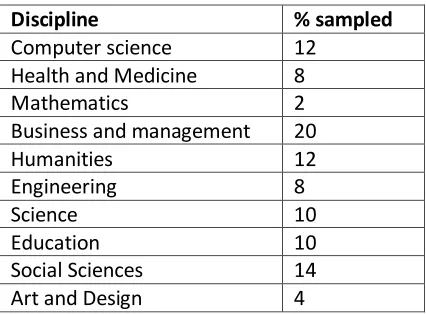
A sample of 50 courses was used to initiate exploration of design variations. The
representation of different academic disciplines is shown in Table 1. No two courses were taught by the same instructor. Four videos were chosen from each course, each taken from different weeks in that course’s presentation. They were watched for at least 2 minutes each, fast-forward visual scanning across their duration. Any change in style was thereby noted and if such a change had not yet been included in the overall corpus, then it was added. Courses were progressively selected from the sample to continue identifying new style approaches until the sample appeared to be ‘saturated’ with distinctive design formats (Glaser and Strauss, 1967). In total, 50 courses were sampled and 200 videos watched.
- Insert Table 1 about here -
Whilst watching the content a screenshot was taken at intervals when the presentation design changed. Consequently, for each video viewed there was the potential to categorize more than one design style, should there occur transitions. The attributes for each style were noted and styles that shared similar attributes were grouped into higher level categories. This sample was extracted by a first observer. The coding was compared with judgements from a second observer working on this extracted sample. Differences in judgement were rare but were fully discussed and resolved. The basis of categorization is clearly illustrated in Table 1, therefore reliability procedures were not applied to these codings as the exercise does not claim to report relative frequencies for the occurrences of these categories.
To validate the appropriateness of judgements made, the set was presented for feedback to 15 people, comprising university lecturers, students, and members of staff. This was treated as an expert panel (Given, 2008) that would strengthen confidence in the distinctions made. The presentation to this group lasted an hour and gave way to open discursive feedback. New styles were identified, and categorization of styles variously challenged and re-ordered.
3. Design Findings
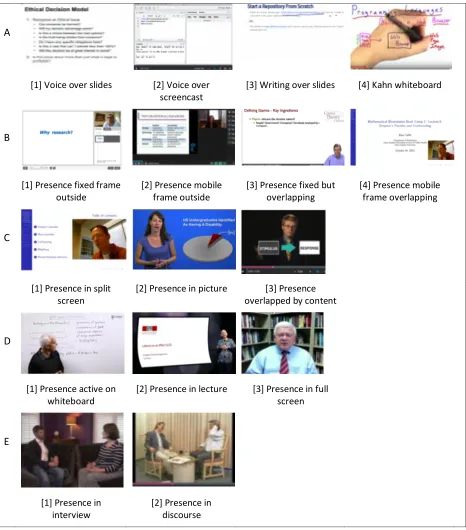
Here the categories of lecture design that were identified are described. In Table 1, 16 formats are illlustrated and organized to permit subsequent referencing in a column:row manner (i.e., A1 to E2).
- Insert Table 1 about here -
The principle voice, or lecturer, is termed the video “narrator” and their ‘presence’ is described in relation to a visual context that may be a ‘domestic’ scene, a series of slides, a whiteboard, or a topic-relevant context.
A1 Voice over slides: A sequence of slides is narrated by a hidden voice.
A2 Voice over screencast: A record of continuous screen recording (as opposed to discrete and static slides) is narrated by a hidden voice.
A3 Writing over slides: Narrated slides include superimposed the narrator’s writing. Graphic annotation is added to one or more static images, implicitly by the speaker.
A4 Kahn whiteboard: Narrated whiteboard includes manual acts of superimposed writing4. This is similar to A3, except that speaker’s hand is made visible as they perform the annotation,
thereby conveying a stronger sense of agency.
10
B1 Fixed frame outside: Video narrator in a window fixed adjacent to a slide sequence. The first of four formats that explore picture-in-picture presence of the lecturer. These may each vary in size but are generally small, typically occupying 20% of screen space.
B2 Mobile frame outside: Video narrator in a window in various positions adjacent to the sequence of background presentation activity.
B3 Fixed but overlapping: Video narrator at fixed position but overlapping the background sequence rather than being a framed picture in picture.
B4 Mobile frame and overlapping: Video narrator is now framed, but presented at varying positions in the background sequence.
C1 Presence in split screen: Video narrator and slide sequence are presented simultaneously and in adjacent frames.
C2 Presence in picture: Video narrator is visually integrated with slide images as if standing in front of a display surface
C3 Presence overlapped by content: Symbolic material is superimposed on a video narrator. D1 Presence active on whiteboard: Narrator moves in front of content and acts upon it but visual presence overlaps a full-screen presentation surface.
D2 Presence in lecture: Direct recording of narrator in traditional lecture context. The continuity of speaker and display surface is broken, conveying an in-room sense of the two.
D3 Presence in full screen: Close up on a solitary narrator in local ‘domestic’ or topic-relevant context.
E1 Presence in interview: recorded interview.
E2 Presence in discourse: recorded conversation. This and E1 correspond to more traditional ‘talking heads’ formats common in broadcast expositions.
This system of categories may not be exhaustive. However, the audit was sufficiently thorough that these distinctions can underpin a discussion (to follow) addressing how design format shapes the experience of those lecturing practices discussed earlier. Neither is it implied that a given lecture is composed of one and only one presentation design. Transitions are common, as acknowledged below.
4. Discussion
The same teaching event realized in different media will provide different experiences. Understanding such differences is important if a common vocabulary for categorizing
educational practice is in use – for instance, “the lecture”. In this section, we reflect on viewing these online lectures, doing so as a phenomenological exercise. Distinctions will be developed to describe our experiences regarding the design constraints and opportunities of this online
medium. These design features themselves seem to us uncontroversial but nevertheless important to recognize. This is because they define striking differences between offline (classroom) and online (video) lectures: differences which have psychological significance and potential
11
In what follows the various lecture designs summarized in Table 1 are discussed in relation to how they shape the experience of a learner audience. In some cases, the points made will be linked (via footnote) to video illustrations.
4.1 The recurring lecture format
An audit like this one quickly problematizes the ambition to contrast offline and online designs for lecturing. This is because the range of designs for online presentation blurs the boundary of what can be understood as a lecture. However, prevailing designs are not haphazard. Indeed, they suggest a rough continuum. That continuum could map a balance involving the presence of a lecturer and the presence of content: where ‘content’ might be traditional slides, a whiteboard, or some enveloping site of practice relevant to the topic. Thus, items in Row A of Table 1 are content-heavy and lecturer-light. Items in Row E illustrate the reverse balance. In between (Rows B,C,D), are various configurations of that balance. Of course, there exist relevant variations of presentation design that are not conveyed by such still images, although some of these will be taken up in the discussion that follows.
Row E items are particularly problematic. What sustains a link between these formats and others in the set is the presence of a lead voice. However, E1 and E2 ‘talking heads’ are unusual in the traditional, or offline, lecture venue (where they are an intriguing and neglected format of conversational exposition). The boundary that E1 and E2 rest upon is between the familiar sense of ‘lecture’ (with its continuous lead voice) and something we might call a “documentary” (with its shifting sequence of settings and protagonists). Some MOOC platforms apply the term
“lesson”. although typically they are still described as “lectures” in introductory MOOC credits. This labelling practice is all the more interesting given that the typical MOOC lecture is very short in relation to it’s offline relative. Guo, Kim and Rubin (2014) analyzed 6.9 million student viewing sessions from four MOOC courses and report that 89% of videos were either “lectures” or “tutorials”. They also found that the median student engagement time was only 6 minutes, regardless of total video length. Yet even though many online lectures may be only minutes in length, the viewer’s experience of lecturing is strong. This reflects a certain manner of addressing the audience but also a certain structuring of speaker relationships with supporting visual content. In terms of the ecology of these events (discussed as ‘episodes’ earlier), they often are isolated from any other study activities, apart from assessment. In fact, these short expository encounters may be, in some MOOCs, the only form of study resource that the student encounters. Evidently, such lecturing denies the student the experiences we described earlier as a “shell”. Because they are not viewed collaboratively and there can be no synchronous peer discussion – either within the event or in any informal digital “corridors” of synchronously tuning into it. Moreover, the self-pacing of a MOOC course makes it harder for coordinated engagements in which regular lectures might act as the scaffold for study conversations.
4.2 The mise-en-scène of online lectures
12
design features that underpin this difference in experience. We review them below under six headings.
Cross cutting. Attending a traditional lecture, the student can enjoy a strong sense of control over where to look. This will often be governed by actions, gestures, and eye gaze that the lecturer presents and so the student is likely to be following these cues. However, in an online lecture neither the student nor the lecturer enjoys such autonomy. The video editor will often manage attention. In cases such as D1 and D2, attention may then be governed by camera
movements between speaker and visual content. While in cases such as C2 and C3, there may be cross cutting between a close-up of the speaker’s face, full body shots, and whole-screen shots of the visual content they are referring to. On behalf of the online student, these decisions about optimal attentional investment may be wisely managed. Yet they must erode the sense of an attentional dialogue, or intersubjectivity, with the speaker - because the effects of gesture and eye contact must be shared between the student and an invisible video editor. While for the online lecturer, that loss of control over the listener’s visual attention may dampen their expressive activity. Occasionally this cross cutting can be to scenes that are outside of the lecturing space altogether or to different lecturers. All such dynamics disturb the sense of intersubjectivity: something that rests upon a degree of narrative continuity.
Modality alignment. Sometimes the intersubjective management of attention is retained for the participants but design decisions in video production mean that it is not rendered
effectively. Here, “modality alignment” means those relationships constructed by the lecturer to signal reference towards some available visual content: perhaps an alignment between visually projected material and either voice, gaze, gesture, or movement (Kalyuga, 2012). This is
smoothly executed in offline lectures but may be poorly managed in editing – often by allowing the speaker to refer to slide material while not naturally orienting towards it. In some cases, (such as B1, B4 or C1), we witnessed the speaker looking in a completely different direction to where the slide material was positioned on screen – perhaps as they located that material on a computer resting on their own desk. In designs such as C2, the speaker seems, through gaze and facial response, to be reacting to changing material on a screen in front of them but which, for the viewer, is projected onto the speaker’s background. A different form of alignment tension involves over-attention to the synchrony of voice and image. In some cases, this can take the form of an exact following of the two, such that everything that is said demands a visual analogue. Such relentless alignment can create a representational experience that is overwhelming5.
Depth of field. Video designers must make decisions between shots that create an exclusive and central focus (e.g., D3) versus those that stand further back from the action (e.g., D2). In the offline lecture, natural perceptual mechanisms (size constancy) tend to create a sustained sense of close connection with the speaker. However, the same scene viewed as video can make the speaker a sufficiently minor presence that their embodied engagement with content and audience is attenuated. On the other hand, a small depth of field (particularly if held
constant) can create an over-bearing sense of presence – for instance, when a narrow range of speaker gestures are repeatedly executed, to a point where they are more distracting than referential6.
13
Jump Cut. The screenshots assembled in Table 1 should not imply that an online lecture is necessarily a fixed-perspective window. Sometimes it may be but, often, editing presents a sequence of transitions between different versions of the designs illustrated. This might imply a distinctive richness of communication for the online lecture: insofar as it recruits a wide range of voices, viewing points, or representational devices. Yet these transitions might undermine the coherence or continuity that is familiar in offline lectures. Indeed, such jump cutting can be the design feature that most clearly queries whether an online recording is actually an online lecture. It is the shifting in and out of a particular presentational space, or the shifting to-and-fro between presenters, that creates a blurring of the boundary between a “video lecture” and something we might rather call a “video exposition”. One form of discontinuity that seemed particularly
disorienting was the cut to a self-assessment question. This tended to happen unexpectedly, while the return to exposition was equally sudden and might even lack a speaker acknowledgement of the insertion. Increasingly, traditional classroom lecturers also deploy this practice of inserted assessment, so it is not unique to the online format. However, through careless online editing it can create a sense of narrative disruption.
Scripting. Video recording producers will be conscious of the potentially long lifetime of their work and the potentially large audiences for viewing it. Consequently, most of the lectures we watched were characterized by an even pace and a careful scripting. Such precision of design might seem only to strengthen the communication. This may be the case. However, our aim is not to judge the difference in online and offline formats in terms of learner outcomes; it is more to note the nature of different experiences that seem to arise from these formats. In response to careful scripting, a lecture is likely to undermine the important quality of improvisation (Sawyer, 2004). Scripting creates a feeling that time matters. Of course, it does – but not simply in terms of minimizing its use. Consequently, carefully articulated words may lack the richness of pause, gesture and movement that were identified above as a strongly embodied quality in live
lecturing. So, if there is lecturer effort to convey agency, it typically seems to have a more rehearsed quality; while the asking of questions to an (imaginary) audience lacks a convincing intersubjectivity.
Décor. Lecture halls are rarely richly decorated spaces. Their appeal as places will have more to do with what can be experienced there: the social buzz and the teaching presence. Online lectures may need to sacrifice both. However, ‘décor’ may still be experienced - in two general ways. Where online lectures are not set against slides (as defined in Table 1 examples), the producer may instead select relevant backdrops and props to convey meaning. D3 in Table 1 positions a speaker against a dense array of scholarly texts. Other lecturers convey informality through strategically positioning their coffee paraphenalia or wearing T-shirts with written messages on them. Yet the most distinctive decoration in online lectures is auditory in nature – namely, music. Often a MOOC lecture will be launched with a musical theme and it is not uncommon for them to have a continuous musical background. Finally, while wallcoverings or color schemes may be of secondary significance in a traditional lecture hall, concern for searting arrangements is a different matter. The modern lecture theatre strives for a flexibility of seating that permits the lecture to prompt occasional informal discussion. This elaboration of the live lecture is less readily replicated online. The event can still be a platform of discussion but for the online course (the MOOC in particular), the lack of a set time for participation makes
14 4.3 Impacts and implications
In this report, we are identifying the various ways in which the experience of lecturing is re-mediated around the online/offline modality difference. The point is not to question the value of video lectures or to undermine their use. Yet making the contrast helps us notice the natural micro-structure of traditional lecturing, as well highlight implementation challenges for designers. In this final section, we consider why an understanding of this is helpful, while also noting some limitations in the reach of the analyses that have been reported here.
One motive for what has been described here is to inform the design of more effective educational practices. Unfortunately, there is scarce research concerning how some of the design features discussed above relate to learning outcomes. Most often, the dependent variables studied have been measures of engagement such as video watching time or self-reported
evaluations. Where measures of learning outcome have been attempted they tend to take the form of some short test related to lecture content. These have limitations: often they are administered immediately after an intervention and address rather shallow forms of knowledge. This is not to deny the value of MCQs and similar methods but the typical university practitioner will be seeking measures for deeper forms of impact – such as those associated with critical reflection (Power, 2016) or the development of professional identity (Ryan & Carmichael, 2016).
Nevertheless, and bearing these concerns in mind, studies of online lecture design do show influences on learning outcomes, (as well as quite strong effects in relation to engagement measures). Thus, Kizilcec, Papadopoulos and Sritanyaratana (2014) report on the value of seeing the lecturer’s face in a lecture design, while Pi, Hong and Yang (2017) show the influence of the size of that image. Theonas, Hobbs and Rigas (2008) show differences arising from how facial expression is used. Other studies have assessed the video lecturer’s communicative effort in relating to their audience and shown positive impacts arising from this (Ozan & Ozarslan, 2016; Ryan & Carmichael, 2016).
There is a further caution regarding how outcome studies can guide design decisions. Kelly, Ponton and Rovai (2007) report on students evaluating matched courses taken either online or offline. They found that student satisfaction did not differ greatly between them. However, a closer look at the student responses showed that satisfaction was governed by different features in the two different formats. Doubtless the same complexity of judgement will apply to the particular case of online/offline lectures and their design features. Therefore, analysis in the present paper may support higher education practitioners in their thinking around what form of impact they wish to achieve and how different features of online design might serve them. However, online courses (such as MOOCs) have been the focus of the present analysis and so the conclusions might seem less relevant to the campus-based lecturer, whose concern may be with the narrower practice of ‘lecture capture’. Yet digital media are making new creative demands on teachers. For example, the e-book may require them to exercise textbook authoring skills (Gu, Xu, Wang & Crook, in press). Similarly, virtual learning environments may call upon web designing skills (Crook & Cluely, 2009). Browsing
15
for student engagement (Adams, Yin, Madriz & Mullen, 2014; Borup, West & Graham, 2012). Yet it seems from what has been illustrated here that presence can become precarious for online lecturing. To understand this, two other analytic terms may be helpful.
One is ‘credibility’, the other is ‘brilliance’. ‘Credibility’ is suggested because online design must struggle with several features that create an illusion of presence: for example, the imagined audience, an imperative of the script, discontinuities in the leading voice, ambiguous or misleading embodied reference, and the fragility of an implicit audience dialogue. All of these threaten to disturb a credibility of presentation that audiences might feel they deserve and which they need to respond to.
If online media design must struggle to overcome credibility challenges, the problems might be laid at the door of our second interpretative concept: that is, “brilliance”. Friesen (2011b) invokes this concept to characterize a general difference between offline and virtual learning resources. ‘Brilliance’ is a term that describes learning artefacts stripped of all design detail that apparently does not serve their principle instructional purpose. The motives for such ‘lean’ design may reflect the instrumentalism in educational practice described by Biesta (2005) and associated with what he terms the “learnification” of education. Friesen argues that it is an essential characteristic of interactions in the online world that roles and functions are more precisely defined and located in this way. What is meant by ‘marking’, ‘tutoring’, ‘chatting’, ‘discussing’, or ‘lecturing’ is activity that is tied to particular design features of the online space. Accordingly, it may be that there is a precision or instrumentality that guides the design of online lectures – creating a ‘brilliance’ of form that may, in some contexts, be powerful but in others it may represent a loss of something very valuable.
References
Adams, C., Yin, Y., Madriz, L. F. V., & Mullen, C. S. (2014). A phenomenology of learning large: the tutorial sphere of xMOOC video lectures. Distance Education, 35(2), 202– 216.
Bakhtin, M. M. (2010). Speech Genres and Other Late Essays. Austin: University of Texas Press.
Bassili, J. N. (2008). Motivation and cognitive strategies in the choice to attend lectures or watch them online. International Journal of E-Learning & Distance Education, 22(3), 129– 148.
Bhat, S., Chinprutthiwong, P., & Perry, M. (2015). Seeing the Instructor in Two Video Styles: Preferences and Patterns. International Educational Data Mining Society. Retrieved from http://eric.ed.gov/?id=ED560520.
Biesta, G. (2005). Against learning. Reclaiming a language for education in an age of learning. Nordisk Pedagogik, 25(1), 54–66.
Biggs, J., & Tang, C. (2011). Teaching for quality learning at university: What the student does (Vol. 4th). Philadelphia: Society for Research into Higher Education; Open University Press.
Bligh, D. A. (1971). What’s the use of lectures? Middlesex: Penguin Education. Bogost, I. (2013, August 27). The condensed classroom. The Atlantic. Retrieved from http://www.theatlantic.com/technology/archive/2013/08/the-condensed-classroom/279013/.
16
environment. In A. Kitchenham (Ed.), Blended learning across disciplines: Models for implementation (pp. 38–57). Hershey, PA: IGI Global.
Borup, J., West, R. E., & Graham, C. R. (2012). Improving online social presence through asynchronous video. The Internet and Higher Education, 15(3), 195–203.
Brent, D. (2005). Teaching as performance in the electronic classroom. First Monday, 10(4).
Budwig, N., Užgiris, I. Č., & Wertsch, J. V. (2000). Communication: An arena of development. Westport, Conn: Greenwood Publishing Group.
Cole, B. (2009). John Coltrane. New York: Da Capo Press.
Crook, C.K. and Bligh, B. (2016). Technology and the dis-placing of learning in educational futures. Learning, Culture and Social Interaction. 11(1), 162-175.
Crook, C.K., & Cluley, R. (2009). The teaching voice on the learning platform: seeking classroom climates within a virtual learning environment. Learning, Media and Technology, 34(3), 199–213.
Fiorella, L., & Mayer, R. E. (2015). Effects of observing the instructor draw diagrams on learning from multimedia messages.Journal of Educational Psychology,108(4), 528.
Friesen, N. (2011a). The lecture as a transmedial pedagogical form: A historical analysis. Educational Researcher, 40(3), 95–102.
Friesen, N. (2011b). The place of the classroom and the space of the screen: Relational pedagogy and internet technology. New York: Peter Lang.
Garrison, D. R. (2007). Online community of inquiry review: Social, cognitive, and teaching presence issues. Journal of Asynchronous Learning Networks, 11(1), 61–72.
Ghamdi, A., Samarji, A., & Watt, A. (2016). Essential considerations in distance education in KSA: Teacher immediacy in a virtual teaching and learning environment. International Journal of Information and Education Technology,6(1), 17-22.
Giannakos, M. N. (2013). Exploring the video‐based learning research: A review of the literature. British Journal of Educational Technology, 44(6), 191-195.
Given, L. M. (Ed.). (2008). The Sage encyclopedia of qualitative research methods. Sage Publications.
Glaser, B.G., & Strauss, A.L. (1967). Discovery of grounded theory. Mill Valley, Ca.: Sociology Press.
Goffman, E. (1981). Forms of talk. Philadelphia: University of Pennsylvania Press. Gourlay, L. (2012). Cyborg ontologies and the lecturer’s voice: A posthuman reading of the “face-to-face.” Learning, Media and Technology, 37(2), 198–211.
Guo, P. J., Kim, J., & Rubin, R. (2014). How video production affects student
engagement: An empirical study of MOOC videos. In Proceedings of the First ACM Conference on Learning @ Scale Conference (pp. 41–50). New York, NY, USA: ACM.
Gu, X., Xu, X., Wang, H., & Crook, C. (in press). Design possibilities for the e-schoolbag: Addressing the 1:1 challenge within China. British Journal of Educational Technology, Retrieved from https://doi.org/10.1111/bjet.12434.
Gysbers, V., Johnston, J., Hancock, D., & Denyer, G. (2011). Why do students still bother coming to lectures, when everything is available online? International Journal of Innovation in Science and Mathematics Education, 19(2), 20-36.
Hare, D. (2005). Obedience, struggle and revolt. Chicago: Macmillan.
17
Jewitt, C., Kress, G., Ogborn, J., & Tsatsarelis, C. (2001). Exploring learning through visual, actional and linguistic communication: The multimodal environment of a science classroom. Educational Review, 53(1), 5–18.
Kalyuga, S. (2012). Instructional benefits of spoken words: A review of cognitive load factors. Educational Research Review, 7(2), 145–159.
Kelly, H. F., Ponton, M. K., & Rovai, A. P. (2007). A comparison of student evaluations of teaching between online and face-to-face courses. The Internet and Higher Education, 10(2), 89–101.
Kim, Y., & Thayne, J. (2015). Effects of learner–instructor relationship-building strategies in online video instruction. Distance Education, 36(1), 100–114.
King, A. (1993). From sage on the stage to guide on the side. College Teaching, 41(1), 30–35.
Kizilcec, R. F., Bailenson, J. N., & Gomez, C. J. (2015). The instructor’s face in video instruction: Evidence from two large-scale field studies. Journal of Educational Psychology, 107(3), 724.
Kizilcec, R. F., Papadopoulos, K., & Sritanyaratana, L. (2014). Showing face in video instruction: Effects on information retention, visual attention, and affect. In Proceedings of the SIGCHI Conference on Human Factors in Computing Systems (pp. 2095–2102). New York, NY, USA: ACM.
Koen, J., & Durrheim, K. (2009). A naturalistic observational study of informal segregation: Seating patterns in lectures. Environment and Behavior. 42(4), 448-468.
Koller, D. (2011, December 5). Daphne Koller: Technology as a passport to personalized education. The New York Times. Retrieved from
http://www.nytimes.com/2011/12/06/science/daphne-koller-technology-as-a-passport-to-personalized-education.html.
Kraemer, D. (1997). Don’t lecture me: A case study of performance pedagogy. English Education, 29(3), 173–182.
Kvernbekk, T. (2012). Revisiting dialogues and monologues. Educational Philosophy and Theory, 44(9), 966–978.
Ladyshewsky, R. (2013). Instructor presence in online courses and student satisfaction. International Journal for the Scholarship of Teaching and Learning, 7(1), 1-23.
Lambert, C. (2012, February 6). Twilight of the lecture. Retrieved from http://harvardmagazine.com/2012/03/twilight-of-the-lecture.
Laurillard, D. (2013). Rethinking university teaching: A conversational framework for the effective use of learning technologies. London: Routledge.
Lin, S.-H., & Huang, Y.-C. (2016). Examining charisma in relation to students’ interest in learning. Active Learning in Higher Education, 17(2), 139–151.
Lotman, Y. M. (1988). Text within a text. Soviet Psychology, 26(3), 32–51.
McAuley, A.; Stewart, B.; Siemens, G.; Cormier, D. (2010). The MOOC model for digital practice. University of Prince Edward Island. Retrieved from
http://www.elearnspace.org/Articles/MOOC_Final.pdf.
Mehrabian, A. (1971). Silent messages. Belmont, CA: Wadsworth Publishing Company. O’Neill, D. K., & Sai, T. H. (2014). Why not? Examining college students’ reasons for avoiding an online course. Higher Education, 68(1), 1–14.
18
Palinscar, A. S., & Brown, A. L. (1984). Reciprocal teaching of comprehension-fostering and comprehension-monitoring activities. Cognition and Instruction, 1(2), 117–175.
Park, H. S., Lee, S. A., Yun, D., & Kim, W. (2009). The impact of instructor decision authority and verbal and nonverbal immediacy on Korean student satisfaction in the US and South Korea. Communication Education, 58(2), 189-212.
Patrick, C. L. (2011). Student evaluations of teaching: effects of the Big Five personality traits, grades and the validity hypothesis. Assessment & Evaluation in Higher Education, 36(2), 239–249.
Petrović, J., & Pale, P. (2015). Students’ perception of live lectures’ inherent disadvantages. Teaching in Higher Education, 20(2), 143–157.
Pi, Z., & Hong, J. (2016). Learning process and learning outcomes of video podcasts including the instructor and PPT slides: a Chinese case. Innovations in Education and Teaching International, 53(2), 135-144.
Pi, Z., Hong, J., & Yang, J. (2017). Does instructor’s image size in video lectures affect learning outcomes?: Image size. Journal of Computer Assisted Learning.
https://doi.org/10.1111/jcal.12183
Power, J. B. (2016). Has this begun to change the way they think? Moving undergraduate learners’ level of reflection from where it is to where it needs to be. Teaching in Higher
Education, 21(3), 235–248.
Pozzer‐Ardenghi, L., & Roth, W. M. (2007). On performing concepts during science lectures. Science Education, 91(1), 96-114.
Pritchard, D. (2010). Where learning starts? A framework for thinking about lectures in university mathematics. International Journal of Mathematical Education in Science and Technology, 41(5), 609–623.
Richardson, J. C., Koehler, A. A., Besser, E. D., Caskurlu, S., Lim, J., & Mueller, C. M. (2015). Conceptualizing and investigating instructor presence in online learning environments. The International Review of Research in Open and Distributed Learning, 16(3),256-297.
Richmond, V. P., Lane, D. R., & McCroskey, J. C. (2006). Teacher immediacy and the teacher-student relationship. In T. P. Mottet, V. P. Richmond, & J. C. McCroskey, Handbook of Instructional Communication: Rhetorical & Relational Perspectives. Boston, MA: Allyn & Bacon.
Richmond, V. P., & McCroskey, J. C. (2012). Power in the classroom: Communication, control, and concern. London: Routledge.
Rodd, M. (2003). Witness as participation: The Lecture theatre as site for mathematical awe and wonder. For the Learning of Mathematics, 23(1), 15–21.
Ryan, M., & Carmichael, M.-A. (2016). Shaping (reflexive) professional identities across an undergraduate degree programme: a longitudinal case study. Teaching in Higher Education, 21(2), 151–165.
Sawyer, R. K. (2004). Creative teaching: Collaborative discussion as disciplined improvisation. Educational Researcher, 33(2), 12–20.
Theonas, G., Hobbs, D., & Rigas, D. (2008). Employing virtual lecturers’ facial
expressions in virtual educational environments. International Journal of Virtual Reality, 7(1), 31–44.
19
Timpson, W. M., & Tobin, D. N. (1982). Teaching as performing: A guide to energizing your public presentation. Englewood Cliffs, NJ: Prentice-Hall.
Tomasello, M. (2009). The cultural origins of human cognition. Cambridge, Ma.: Harvard University Press.
Weber, K. (2004). Traditional instruction in advanced mathematics courses: a case study of one professor’s lectures and proofs in an introductory real analysis course. The Journal of Mathematical Behavior, 23(2), 115–133.
Wenger, E. (1998). Communities of practice: Learning, meaning, and identity. Cambridge: Cambridge University Press.
20 A
[1] Voice over slides [2] Voice over
screencast
[3] Writing over slides [4] Kahn whiteboard
B
[1] Presence fixed frame outside
[2] Presence mobile frame outside
[3] Presence fixed but overlapping
[4] Presence mobile frame overlapping
C
[1] Presence in split screen
[2] Presence in picture [3] Presence
overlapped by content
D
[1] Presence active on whiteboard
[2] Presence in lecture [3] Presence in full
screen
E
[1] Presence in interview
[image:20.612.74.540.69.599.2][2] Presence in discourse
21
Discipline % sampled
Computer science 12
Health and Medicine 8
Mathematics 2
Business and management 20
Humanities 12
Engineering 8
Science 10
Education 10
Social Sciences 14
[image:21.612.200.413.105.262.2]Art and Design 4