1
Turnaround and Failure:
Resource Weaknesses and the Rise and Fall of Jarvis
Dr Andrew Wild
Nottingham University Business School The University of Nottingham
Jubilee Campus Nottingham
NG8 1BB
Professor Andy Lockett Warwick Business School
University of Warwick Coventry
CV4 7AL
Abstract
2 Turnaround and Failure:
Resource Weaknesses and the Rise and Fall of Jarvis
Introduction
The quest to find the actions needed to turnaround a failing firm has progressed slowly and
with little success. After more than twenty years since Pearce and Robbin’s review of the
turnaround literature, what we know about decline and turnaround is far outweighed by
what is unknown and understudied.1 In particular, little theoretical headway has been
made, although a resource-based focus has been highlighted as having potential in this
regard.2 Turnaround research in the business history literature has tended to focus on the
decline and rise of particular industries, with business evolution, rather than business
revolution being prominent.3 Whilst evolutionary incrementalism is an important aspect of
the corporate landscape, so too are events of a more rapid, discontinuous nature, with
turnarounds providing valuable microcosms to examine such cases of dramatic change.4 We
find the current scenario unfortunate as the skills that business historians can bring to the
study of business turnarounds, encompassing a depth of analysis, contextual understanding,
and an appreciation of change in the long-run, are exactly the type of attributes lacking in
turnaround research.
Despite the use of historical case studies being noticeably absent in many areas of
management research, in recent years a number of studies in the business history literature
have sought to develop strategy (and management) theory through the use of cases.5
Included within this group are a number of articles employing the resource-based view of
the firm (henceforth RBV).6 To date the overwhelming focus of RBV research has been on
3 sustainable competitive advantage. In relation to turnarounds, contributions made by
scholars of the small number of resource-based studies have centred on the acquisition of
new capabilities or the redeployment of existing resources in-order to create resource
strengths that can elevate firm performance.7 Turnarounds frequently involve the
installation of new management, who are not entangled in the current practices of the firm,
and therefore, may sometimes perceive alternative ways in which to utilise existing
resources.8
Scholars have recently employed the RBV to explore the positive contribution of
resources to firm performance with respect to turnarounds.9 The singular focus on the
upside of resources, however, underplays the potential contribution the RBV can make to
the study of turnarounds. Firm performance is dependant not just on positions of strength,
but also weaknesses, and it is the interaction between these opposing factors that influence
organizational outcomes.10 The small number of papers relating to the influence of resource
weaknesses on firm performance have primarily been conceptual in nature, which we find
surprising given the potential relevance of the concept of resources weaknesses to assist
our understanding of turnarounds. 11 Relatedly, Trahms et al. argue that investigation into
resources that detract from a firm’s ability to generate rent may be crucial in understanding
limitations to the ability of a firm to turnaround. Furthermore, Trahms et al. argue that in
order to understand more about corporate turnaround, fine-grained analysis is required
that not only examines instances of sustained turnaround, but also cases where the final
outcome is one of failure, with the firm being forced to cease trading.12
To address this research gap we explore the characteristics of resource weaknesses that
may hinder and prevent a sustained turnaround, ultimately leading to business demise,
4 DeCastro, who highlight the nature of resource weaknesses and inadequacies, but call for
future developmental work, believing that the idiosyncratic nature of weaknesses and their
evolution over time requires rich case studies and longitudinal research in order to help
explore the origins and categories of resource weaknesses. In their conceptual work, West
and DeCastro propose that weaknesses must be rare with respect to both industry and the
firm within its strategic context. A firm may exhibit a certain kind of weakness, but if
unrelated to strategic context and behaviour, it would not be a critical point of weakness. In
developing this further, West and DeCastro point out that weaknesses may become more
pronounced if either firm strategy or industry changes take place, thus making their
presence salient.13 We explore the type of strategic change that may result in resource
weaknesses becoming more salient, and therefore more dangerous, to the performance of
the organization.
Closely linked to the work of West and DeCastro, Arend’s conceptualization of
weaknesses as strategic liabilities draws on Barney’s RBV tenets (valuable, rare, inimitable
and non-substitutable) to define strategic liabilities as those resources that damage and
destroy a firm’s ability to generate rents. They are “firm factors that are costly,
supply-restricted (scarce and economically inconvertible) and appropriated (economically
non-transferable)”,14 with reasons for economic inconvertibility being similar to those for
economic inimitability and non-substitutability, arising due to characteristics such as
immobility, inseparability, and path dependency.15 Resource stocks cannot be changed
instantaneously, an argument that may pertain as much to resource weaknesses as it does
to resource strengths. The dismantlement of a firm’s resource weaknesses may, therefore,
5 company trying to improve performance, the nature and severity of the firm’s resource
weaknesses may be critical to the chances of turnaround or failure.
Arend suggests definitions of performance-related characteristics of strategic liabilities
that mirror those that have evolved for strategic assets: Firms with more strategic liabilities
perform worse; a strategic liability that fulfils the relevant characteristics more fully affects
its owner’s performance more unfavourably; and firms with strategic liabilities that are
complementary and firms without offsetting strategic assets, performance worse. Arend
continues briefly to suggest that where complementary strategic liabilities exist, costs to the
firm are higher than if the two liabilities existed separately. Whilst the notion of
complementary resource weaknesses is clearly intriguing, further discussion, examination
and development of these factors fall outside the scope of Arend’s research.17 To this end
we heed Sirmon et al.’s call to explore the concept of complementarities between resource
weaknesses, exploring how they may arise, the nature of interactions between resource
weaknesses including how they may combine and reinforce one another over time, and
their potential impact on firm performance.18
In summary, our research has three clear objectives. First, we seek to make a theoretical
contribution to the study of turnarounds, an area where theory has been noticeably lacking
to date, employing the RBV and in particular the concept of resource weaknesses.19 Through
a detailed analysis of the case of Jarvis we explore the factors that may hinder or prevent
turnarounds, ultimately leading to business failure.20 In so doing, we seek to develop
insights into the type of categories and characteristics of resource weaknesses, addressing
calls for future research by scholars of resource weakness, and turnarounds.21 Second, it has
been agued that strategic change may result in particular resource weaknesses becoming
6 resource weaknesses to become more damaging over time, through which we explore the
type of strategic actions that can increase the relevance and liability of resource weaknesses
to management. Third, the concept of complementarities between resource weaknesses
has been highlighted as an area warranting further investigation.23 We explore the potential
complementarities between resource weaknesses, and examine how they may have highly
destructive consequences for organizational performance.
Method and data
Our research design consists of four main stages of activity. First, we engaged in
purposeful case selection. Jarvis has previously been identified as a turnaround firm, moving
from three years of poor performance to three years of high performance, measured by
changes in ROCE relative to both industry participants and firms across the economy during
the period 1989-2003.24 Given the high level of publicity in the company, we were also
aware that Jarvis had been forced into administration a number of years after the
turnaround. In charting the ongoing performance of the firm since 2003 it became clear that
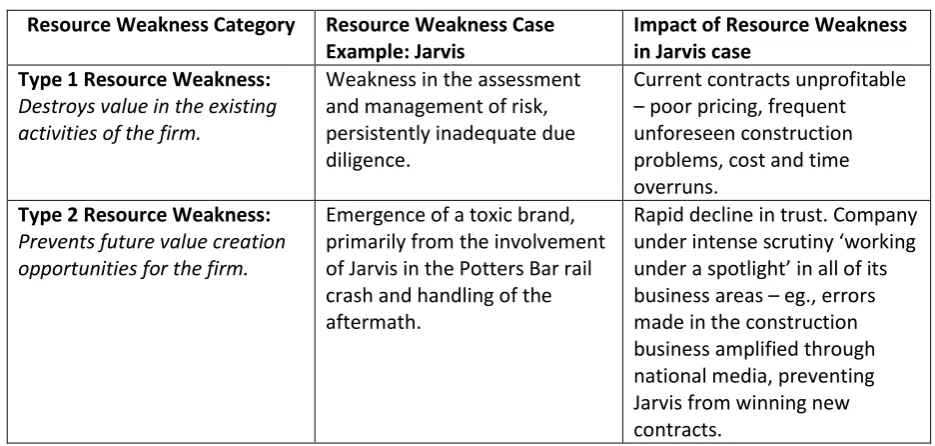
Jarvis had accumulated critical weaknesses that had led to a catastrophic fall. Jarvis,
therefore, provided a valuable case in which to examine the reasons why a business that
had achieved the rare label of turnaround, was unable to sustain the improved
performance. By the time of its demise, Jarvis had become a toxic company in the eyes of
media commentators, with destructive weaknesses.
Second, we constructed a historical case for Jarvis gathering data for a twenty-two year
period (1989 to 2010 inclusive), drawing from a plethora of sources. Whilst annual reports
provided useful information, there was a need to search much more widely in order to gain
7 leading the organisation may not have been inclined to share. The case of Jarvis was one of
particular public sensitivity in light of the company’s links to the Potters Bar train crash
tragedy and therefore it is probably not surprising that interviewees from within the
company at the time, nor those associated with its subsequent insolvency, were not
forthcoming. Likewise, despite an exhaustive search across UK archives, no record of
internal documents was available for consultation and contact with the firm’s insolvency
practitioners also provided no awareness of internal documents being kept for the
company. Despite this absence, a myriad of other valuable sources were available, far more
plentiful than our early hopes. Financial press, other broadsheets, trade journals, academic
journals, business magazines, investment analyst reports, government investigations and
reports, client reports, insolvency report to creditors, books and web-based publications
were all consulted. Source criticism constitutes a key element of historical methodology and as per the guidance of Kipping, Wadhwani and Bucheli, we sought to establish source validity, credibility, and expectations of source transparency. This process is “designed to allow researchers to understand not just what a source tells us about a development or topic of interest, but also the
limits on relying on that particular source”.25 Sources produced by different authors with different motives and perspectives constitute an important part of historical research procedures for overcoming the limitations identified for a particular source. In evaluating the various data sources, we maintained an awareness of the conditions and intentions that may have
underpinned their creation, seeking to provide a critical engagement with the records of the
8 The financial press provided a particularly prominent source in the study, especially in
light of its influence on the resource weaknesses that developed in the firm. Company
annual reports also contained a wealth of valuable data. Both sources, however, required a
degree of caution in their analysis. We were fortunate to be able to draw from government
commissioned reports that interviewed all Jarvis clients, as well as investigations
undertaken by the clients themselves. Sometimes this data provided supportive
triangulation of evidence, but occasionally revealed instances that jarred with those
presented in the press or other sources, which we openly then subjected to further critical
evaluation in the text, enabling a more nuanced appreciation of the resource weaknesses
and the effects of their interactions to emerge.27 Given the acquisitive nature of Jarvis, it
was often necessary to perform similar searches for purchased organizations, therefore
providing further detail, including an appreciation of capabilities brought to the group. In
Gephart's terms, we were able to collate "a substantial archival residue" from the different
published sources.28
Third, we analysed the data consistent with Langley’s approach to longitudinal
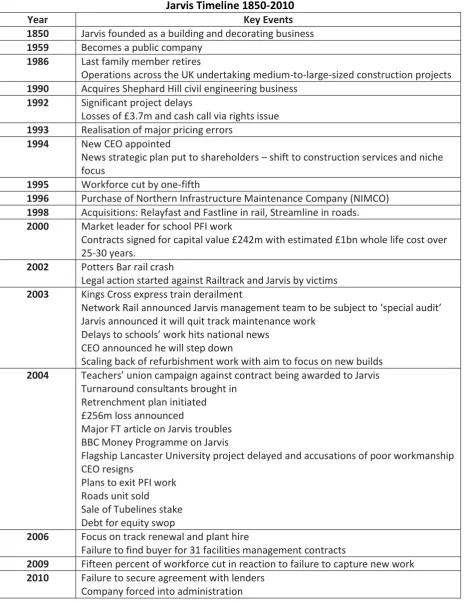
research.29 First, a timeline and narrative concerning the development of Jarvis was
constructed, as presented in figure 1. Second, temporal bracketing was undertaken,
identifying two distinct periods for the organization. The periods were separated by a major
break, hence permitting “the constitution of comparative units of analysis for the
exploration and replication of theoretical ideas”.30 We present the historical narrative in the
next two sections. Period 1 captures the turnaround of Jarvis; and period 2 examines the
9 FIGURE 1
Jarvis Timeline 1850-2010
Year Key Events
1850 Jarvis founded as a building and decorating business 1959 Becomes a public company
1986 Last family member retires
Operations across the UK undertaking medium-to-large-sized construction projects 1990 Acquires Shephard Hill civil engineering business
1992 Significant project delays
Losses of £3.7m and cash call via rights issue 1993 Realisation of major pricing errors
1994 New CEO appointed
News strategic plan put to shareholders – shift to construction services and niche focus
1995 Workforce cut by one-fifth
1996 Purchase of Northern Infrastructure Maintenance Company (NIMCO) 1998 Acquisitions: Relayfast and Fastline in rail, Streamline in roads. 2000 Market leader for school PFI work
Contracts signed for capital value £242m with estimated £1bn whole life cost over 25-30 years.
2002 Potters Bar rail crash
Legal action started against Railtrack and Jarvis by victims 2003 Kings Cross express train derailment
Network Rail announced Jarvis management team to be subject to ‘special audit’ Jarvis announced it will quit track maintenance work
Delays to schools’ work hits national news CEO announced he will step down
Scaling back of refurbishment work with aim to focus on new builds 2004 Teachers’ union campaign against contract being awarded to Jarvis
Turnaround consultants brought in Retrenchment plan initiated £256m loss announced
Major FT article on Jarvis troubles BBC Money Programme on Jarvis
Flagship Lancaster University project delayed and accusations of poor workmanship CEO resigns
Plans to exit PFI work Roads unit sold Sale of Tubelines stake Debt for equity swop
2006 Focus on track renewal and plant hire
Failure to find buyer for 31 facilities management contracts
2009 Fifteen percent of workforce cut in reaction to failure to capture new work 2010 Failure to secure agreement with lenders
Company forced into administration
Finally, we used the two time periods as comparative units of analysis for the exploration
10 engaged in a process of theorization, meshing together both inductive and deductive
reasoning. In doing so, we moved back and forwards between the theory and the data,
linking our inductive ideas with existing concepts and frameworks.31
Turnaround and failure: The case of Jarvis
We present the case of Jarvis in the next two sections, and then progress to our
theorization of the case in the discussion section.
Period 1: The turnaround of Jarvis
Jarvis was founded as a building and decorating business in Shoreditch, London, by John
Jarvis in 1850. The company gradually expanded its building activities in the 1920s and 30s,
undertaking a range of projects, from underground stations and municipal garages, to
factories and offices, seeking to build a reputation for high quality workmanship sufficient to
increase its client base.32 Jarvis became a public company in 1959, with the Jarvis family still
actively involved and eager to further grow the business. Profits of £43,000 in 1961 had
increased to £118,000 by 1968, and a decade later had risen to £519,000.33 As per the
experience of many in the construction industry, there were also challenging years. Sir
Adrian Jarvis noted the difficulties of maintaining returns in periods of full employment in
the 1960s.34 Similarly challenging were periods of recession in the 1970s, where margins fell
to less than 2%.35 With low gearing and often substantial cash resources, the firm
weathered these adversities and continued to increase its work-flow, recording a profit of
over £700,000 by the early 1980s. 36 By the time the last family member retired in 1986,
Jarvis had grown substantially from its London origins, primarily undertaking medium to
11 geography, but now also encompassing a property development and investment business.
Seeing opportunities for further expansion, Mr H. Bard, a London property investor,
together with his venture partner, Mr M. Rueben, acquired a controlling interest in Jarvis in
1987, bringing new board members and an aggressive expansion plan for the company,
aimed at rapidly creating a national construction capability, both by organic and acquisitive
growth. They were joined by Patrick Rogers in 1988 to further this strategy, moving from his
corporate finance and investment research position in the City.37 Within eighteen months
Jarvis had already doubled in size and the new approach had not gone unnoticed by industry
observers: “Throughout the recession, Jarvis has gained a reputation as a vulture company
poised to pick up the pieces of broken companies. From the outside it may seem as if Jarvis
is hell bent on building an empire while the going is good”.38 Acquisitions such as Auldyn
Building and H. Webb construction expanded geographical coverage, whilst the company
also expressed a desire to add complementary construction skills to the business, taking
advantage of the recession to buy failed companies from the receivers.39 In 1990 Jarvis
acquired both a shop-fitters and a civil engineering firm. Whilst the new Chairman had
stated his intention to grow by both organic and acquisitive growth, in reality it was the
latter that was the primary driver of the expansion. The acquisition of the Shephard Hill civil
engineering business, with a turnover of £53m, substantially extended the productive
opportunity set of Jarvis, with expertise added to the group in roads and bridges, water
supply and treatment, dams and reservoirs, and coastal defence works.40 Shephard Hill’s
failure had been triggered by the collapse of one of its bankers, to which it owed £4.5m, but
despite the harsh recessionary climate, the performance of the civil engineering business
was soon helping to offset some of the poor returns from Jarvis’s construction operations,
12 The following year saw group performance fall significantly further, with losses of £3.7m
resulting in a cash call via a rights issue. Demand was failing to match the new scale of the
construction operations and with a shortage of work, turnover fell from £119.7m to £92.1m
and excess capacity resulted in the announcement of redundancies. Problems with existing
contracts were in evidence, with delays to three projects exacerbating the financial woes. A
year later, little improvement had been made, with losses of £3.15m and delays to major
contracts in both the building division and civil engineering works being cited as
contributory factors. From a relatively conservative company, with net borrowings of just
11% of shareholders’ funds, rapid expansion had led to a scenario that in 1993 a rights issue
was needed to improve liquidity.42 Jarvis was also feeling the impact of errors it was now
making in its aggressive pricing of contracts:
“…contracts are only won if optimistic assumptions are made about progress, productivity, ground conditions and the weather. Inevitably, some of these assumptions prove to be incorrect, but the attainable margins are insufficient to cover the risk of this occurring and the anticipated positive contribution turns into a significant loss which has to be financed, even if there is an expectation of an eventual improvement. The company had to contend with a number of such contracts during the year.”43
With financial pressure quickly mounting, Jarvis needed a turnaround. Changes in
leadership were initiated with a new CEO and investor recruited, Paris Moayedi, coupled
with three new directors.44 As the company announced losses of £4.9m in 1994, a new
strategic plan was put to shareholders, comprising the following key elements: (i)
rationalisation of construction businesses and a shift to becoming managers of construction
services; (ii) development of niche markets, through Jarvis Projects, including education and
healthcare, by offering construction-related professional services; and (iii) overhead
13 National Westminster Bank into a five-year loan and an additional £1.2m being made
available to the company via a new overdraft facility.45
With immediate effect, a re-organization ensued, with numerous construction offices
closed, new senior management appointed, a reduction in the total workforce of almost
one-fifth, and a concerted effort to win new work, resulting in an increased order book.
Efforts were soon rewarded with a modest profit of £510,000 in 1995, but more dramatic
changes were on the horizon. Five years prior, Jarvis’s purchase of the civil engineering
business Shephard Hill from the receivers had opened up new opportunities for the group.
Shephard Hill’s skill base in road schemes, bridges and water supply, had been cited as
important capabilities associated with the acquisition. One of these areas, the construction
of bridges, had led to a number of projects being undertaken for Railtrack, including bridge,
station and platform building work. By 1995, “rail schemes” had been added to the list of
niche markets that were the focus of the civil engineering division.46
While just a small part of the overall group at this time, the link with the railways soon
took on a whole new magnitude. Shares in Jarvis rose by 40% in May 1996 with an
announcement that the company had purchased a railway maintenance company, backed
by a rights issue. The Northern Infrastructure Maintenance Company (NIMCo) was the last
of the seven regional infrastructure companies to be privatised by the UK government and
undertook most of its work for Railtrack. The £9m purchase price appeared highly attractive,
with contracts in place lasting for three to five years and generating operating profits of
£14.8m on a turnover of £126.4m.47
Within just two years of assuming leadership of Jarvis, Paris Moayedi had facilitated a
repositioning of the company and now stated his intention to focus on expanding the
14 division.48 Amidst the euphoria of the deal, Jarvis’s management acknowledged “we do have
a lot of our eggs in one basket with Railtrack”.49 Further acquisitions in the proceeding two
years bolstered the rail business. To supplement the railway infrastructure operations, a
track renewal capability was acquired via the purchase of Relayfast and Fastline, giving the
group the ability to maintain and renew track anywhere in Britain.50 Relayfast also brought
with it heavy plant resources and the combined companies gave Jarvis such a commanding
position in the track renewals business that the takeover was only approved by the
Monopolies and Mergers Commission on condition of Jarvis hiring out equipment to other
operators.51 By 1998, turnover was up to £355m, with profits amounting to £37m.52
Expansion wasn’t just restricted to the rail business. A dispute between Railtrack and
Jarvis over pricing had provided a warning signal that helped fuel a desire to try and avoid
an over-reliance on rail. Railtrack had argued Jarvis’s prices were up to six times higher than
those of other contractors for similar work and had threatened to suspend Jarvis from
bidding on other projects unless it cut its prices.53 Within hours of the disagreement going
public, both sides said they had resolved their differences and looked forward to
“continuing their constructive relationship”,54 but the event had provided a stark example of
the potential consequences of any fallout with their dominant client.
In 1998, Jarvis acquired Streamline Holdings for approximately £185m. Streamline’s
specialist road service businesses in the UK and Europe were viewed as complementary to
Jarvis’s operations in the rail sector and provided an opportunity to help create a broader
transport infrastructure company.55 While the track renewal businesses had been
considered as a good deal for Jarvis, reuniting the maintenance and renewal operations of
railway infrastructure that had been split from each other as part of the government’s
15 with Moayedi left justifying “you cannot get a bargain buying a public company in a niche
market which is producing margins of 10 per cent”.56 Within a period of around four years,
the market capitalisation of Jarvis had gone from about £10m to close to £1bn.57
In addition to the railway and road businesses, Jarvis was also making progress towards
becoming a more “niche-focused” construction operator, both in the education sector and
healthcare.58 In particular, Jarvis was having considerable success in winning bids to build
and maintain schools, as well as contracts for the construction of university student
accommodation. The company was becoming highly adept at seizing Private Finance
Initiative (PFI) work, even creating a specific PFI unit to deal with the increasing number of
opportunities in the area.59 By 2000, Jarvis had become the market leader for school PFI
work, securing eight of the nineteen contracts that had become available, and bringing
Jarvis’s total school facilities projects to 47. Contracts signed in the year 1999 to 2000 had a
combined capital value of £242 million and estimated at nearly £1bn in terms of whole life
costs over 25-30 years.60 Although the scale of activity was now stretching the company’s
operational capacity beyond its limits, requiring a much greater reliance on sub-contractors,
the success rate of the division was much lauded, moving from initial submission to
preferred bidder status in 43% of cases.61
The Chairman commented in 2001: “The success of Jarvis’s strategy is demonstrated by
the number of significant contract signings and our appointment as preferred bidder on
other major projects during the year”.62 The growth of Jarvis Projects, coupled with the
Streamline acquisition had helped to reduce the dominance of rail within the company, with
the Chairman now referring to the group as a “well-balanced portfolio of high-added value
services”.63 The CEO, Moayedi, emphasised the change process from “high risk, low margin”
16 for selection”.64 The evidence suggested that Moayedi had achieved a substantial
turnaround in performance, elevating Jarvis’s return on capital from amongst the poorest to
one of the highest relative to both its industry compatriots and firms across the economy.65
As further PFI and railway work poured in during 2001, some commentators viewed the
“specialist” Jarvis shares as having significant potential.66
Period 2: The decline and failure of Jarvis
In May 2002, a train travelling at high speed derailed at Potters Bar station, killing seven
with over 70 injured. The track in question was part of Jarvis’s maintenance contract and the
company quickly raising the possibility of sabotage on the line as a potential cause, an
argument later rejected by the Health and Safety Executive.67 Despite Jarvis’s efforts to
diversify the business, rail still counted for £303m of the £677m turnover and shares in the
company reacted with a fall of 22% in just two days due to concerns over potential liabilities
and the impact on future maintenance work.68 One analyst commented “we don’t
necessarily know with these contracts or any other contract where the buck stops for a
major disaster”.69
As turnover increased to £949m and profits to £46m in the year to March 2002, with
Jarvis’s Chief Executive and Chief Operating Officer benefiting from cash pay rises, news of
the company in the press was turning increasingly hostile.70 By the end of 2002, victims of
the crash had already started legal action against Railtrack and Jarvis, and then in May 2003,
an official report by the Health and Safety Executive stated the cause of the crash to be the
result of a failure of points that were in poor condition and had been poorly maintained.71
Network Rail, which had by then taken over Railtrack’s role, announced it was
17 suffered again when a derailment of an express train at London’s King Cross station
occurred in September 2003. Jarvis explained that the accident occurred because its staff
failed to disconnect equipment that allowed trains to be routed over a piece of track
removed during maintenance. The event bore similarity to an incident with a freight train
near Rotherham the previous November, again a track maintained by Jarvis. Whilst there
were no injuries, the accident caused further reputational damage to Jarvis and Network
Rail announced they would be subjecting Jarvis’s management to a special audit concerning
the firm’s working practices.73
On October 10 2003, Jarvis announced it would quit track maintenance work, the CEO
commenting that “the reputational risks that are associated with this business for Jarvis
overshadow the very successful other parts of the business”.74 A timely announcement that
Jarvis had won the UK’s largest student accommodation contract (£339m), to build and
manage rooms for Lancaster University, came as a welcome relief to the market.
Accommodation services had quickly risen to account for around one-third of group
turnover in the previous year, with Jarvis being the market leader for outsourced
accommodation, a portfolio that included contracts to provide rooms for about 20,000
students, accommodation for schools, the NHS, local authorities and many more. Citing a
forward order book of £4.2bn, albeit including projects at the preferred bidder stage, there
were high hopes that the division would drive considerable future growth for the
company.75
Whilst Jarvis’s executives had hoped the exit from rail maintenance would see Jarvis
escape from being a regular feature of the news headlines, they were mistaken. In
November 2003, Jarvis was in the news again concerning delays to a PFI project that had
18 outstanding.76 Although an inconvenience, in normal circumstances the event may not have
been worthy of national print, but as one journalist commented “since the rail accidents,
any problem with a Jarvis contract, from schools to the underground, had been headline
news”.77 A shareholder noted “it has become difficult to work in a spotlight”.78 Pressure
started to mount from some investors for Paris Moayedi to stand down, whilst others were
less convinced that this would be enough to repair reputational damage. One analyst stated
“the name Jarvis is the biggest liability rather than Paris”,79 while another analyst
emphasised “the press pressure on Jarvis has got to the point where it is affecting the
business”.80
Jarvis was starting to find it harder to win contracts and following a board meeting, an
announcement was made that Moayedi would step down and Stephen Norris, a former
Conservative Transport Minister, would become Non-executive Chairman.81 In the same
month, Jarvis announced it was scaling down school refurbishment work to concentrate on
new-build school contracts after running into a number of problems on existing sites. The
Chief Executive of Jarvis’s Accommodation Services explained that refurbishment projects
were “by their very nature risk-heavy and you can say that the extent of the risk has been
learned from experience”, referring to the delays to the Wirral schools and a similar
experience at schools in Kirklees.82 The extent of hostility towards the company was
highlighted further by a Derby teachers’ union campaign against a PFI contract being
awarded to Jarvis, with the union saying “We are opposed to privatisation in principle. But
within the process that exists in Derby … we are absolutely opposed [to Jarvis being
awarded the contract]. We are more opposed to Jarvis than others”.83 The representative
went on to say they were opposed to Jarvis mainly due to the company being at the centre
19 PFI contracts.84 The PFI project manager at the Council stated “it would be foolish in the
extreme to pretend that the council is not aware of some of the publicity that Jarvis as an
organisation attract”.85 At a University of Lancaster Council Meeting, reference was made to
the implications for Jarvis of the recent rail crash at Potters Bar. Noting that the company
would be fully aware of the force of public perceptions and that “this should be taken into
account by the negotiating team in deciding what had to be accepted on behalf of the
university.”86
Jarvis was beginning to look as though it was in a financially precarious position.87 The
company had become highly dependent on front-end cash flow from new contracts and as
new business dried up, so did this cash flow.88 The settlement of a major claim with Network
Rail, coupled with provisions made against problems in the accommodation services division
meant that banking covenants would be breached. A new CEO, Kevin Hyde, argued for a
dramatic shift away from the company’s aggressive growth strategy, putting forward a plan
for retrenchment around core operations and cost reductions. A fundamental review of all
activities resulted in a recovery strategy, which was to: (i) implement strategic disposals to
reduce debt; (ii) exit non-core activities; (iii) focus on core infrastructure services; (iv)
recover outstanding debts; (v) reduce the cost base; and (vi) scale back and exit higher risk
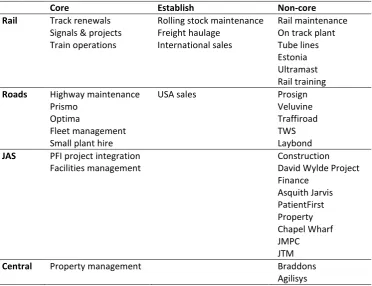
20 TABLE 1
The core and non-core businesses of Jarvis in 2004
Core Establish Non-core
Rail Track renewals Signals & projects Train operations
Rolling stock maintenance Freight haulage
International sales
Rail maintenance On track plant Tube lines Estonia Ultramast Rail training
Roads Highway maintenance Prismo
Optima
Fleet management Small plant hire
USA sales Prosign Veluvine Traffiroad TWS Laybond
JAS PFI project integration Facilities management
Construction David Wylde Project Finance Asquith Jarvis PatientFirst Property Chapel Wharf JMPC JTM
Central Property management Braddons
Agilisys
Source: Annual Report, 2004, p5.
To assist with the change effort, the board appointed a Chief Restructuring Officer (CRO)
from the turnaround and restructuring specialists, AlixPartners. The CRO spent four weeks
identifying the causes of distress, which were diagnosed as: (i) an unnecessarily complex
business portfolio; (ii) inadequate control systems; (iii) inadequate liquidity; (iv) a
“revenue-oriented” contract portfolio; (v) dangerous levels of management turnover; and (vi)
excessive debt and contingent liabilities.90 Additional AlixPartners consultants were brought
in to assist in the turnaround, including a crisis manager to oversee daily operations, a
consultant tasked with responsibility for treasury operations, and a consultant with
expertise in construction management to assess the true financial state of active building
21 Negotiations with lenders and other stakeholders gave the company a life-line, while the
sale process of dozens of non-core assets ensued. 2004 saw Jarvis deliver a loss of £256m.92
A key problem for Jarvis concerned the PFI contracts it had entered into. The company’s
success rate at moving from submission to the award of contract resulted in a winner’s
curse, with aggressive pricing meaning that assumptions tended to be overly optimistic and
sufficient due diligence frequently lacking. Risks were consistently underestimated and the
resultant under-pricing left Jarvis locked into unattractive contracts that would cost the
company for years to come.93 The case of Kirklees schools provided an all too familiar story
for the company. In bidding for work, Jarvis had failed to conduct any surveys beyond those
provided to them by the council’s Estates and Property Services, which were “neither
intensive nor intrusive”.94 The bid by Jarvis Projects was recommended to the panel as the
most affordable and the only one that represented value for money.95 Jarvis had bid £96.2m
compared to the other bids of £115m and £119m. It was noted in a later report,
commissioned by the council, that given the unlikely scenario that Jarvis had taken the
contract as a loss leader, they had underestimated the true costs and had massively
under-priced the work. At the time, the panel had been informed that although Jarvis were PFI
market leaders, their expertise was in new-build and not refurbishment. There were other
contractors at the time that specialised in construction refurbishment projects of this
nature, but they had not applied to be put on the tender list.96 The construction phase had
started slipping relatively early: “alarm bells about the contractor’s performance had begun
to ring as early as 3 or 4 months into the project”.97 Schools also commented on the poor
quality of the workmanship, materials and finishes, which was put down to the contractor’s
22 Further bad publicity came from a substantial Financial Times article, detailing the trail of
delays and dissatisfaction concerning Jarvis’s accommodation services projects. The
problems that had been present the pre-turnaround Jarvis, including poor risk assessment,
delays, quality issues and consistent under-pricing, were manifest again. In addition to a
plethora of school blunders, the article also raised awareness of Jarvis’s problems with
university student accommodation contracts, including its flagship contract with Lancaster
University, again delivered late amidst calls of shoddy workmanship. Whilst the head of
Accommodation Services resigned, accusations of late payments to subcontractors
damaged credibility further, and in the Financial Times report, as in virtually every other
news story, the name Jarvis was followed by a line reminding readers that this was the
company at the centre of investigations concerning the fatal Potters Bar rail crash.
Recognising the liability in its name, Jarvis attempted to rebrand some of its subsidiaries
bidding for PFI work, using “Engenda” for new schools and healthcare projects, but a BBC
Money Programme report suggesting Jarvis faced construction losses of over £5m on the
refurbishment of just five schools, provided further bad publicity. The press reports of errors
made by Jarvis in their PFI construction activities could not be denied with respect to their
accuracy, with client and government reports echoing many of the failings.99
In hindsight, however, the press intensity and ferocity directed towards the construction
operations of the company may have been particularly severe when examining the
performance of Jarvis in relation to other PFI construction companies. A study
commissioned by the Department for Education and Skills into PFI projects post-contract
signing, interviewed all schools where Jarvis had been lead contractor. Surprisingly, despite
the high level of negative publicity, satisfaction scores for projects where Jarvis had a lead
23 satisfaction levels were recorded for pricing variations, whereby Jarvis was suspected of
elevating pricing of contract variations, a likely attempt to claw-back monies lost from their
under-pricing of the main contract. Criticisms were also levelled at the poor integration of
bidding, construction and facilities management businesses.100The findings of the
investigation were barely reported at the time, but are worthy of considerable note. At a
time when media reports of the failings of Jarvis and its construction activities were at their
height, presenting an image of a dysfunctional firm and the laggard of its industry, actual
satisfaction ratings with both its PFI buildings and services were above average. Regardless
of the performance of the company relative to its peers, the public image of Jarvis meant
that new projects were becoming almost impossible to acquire. The Jarvis brand was now a
major resource weakness and the “unusually low success rate in winning PFI projects” was
now creating further unrecoverable bid costs.101
Turnover in the top management team increased with the resignation of the Finance
Director and then the new Accommodation Services Chief Executive, the latter having only
been in the post for five months.102 After three profit warnings in as many months, a further
write-off of £156m was announced, with questions now being raised as to the likely survival
of the group.103 Politicians were quick to iterate that there would be no public sector
assistance for the company.104 Shares had been commensurately falling as worries grew,
losing 80% of their value within six months.105 Despite Jarvis’s struggle, shares in other large
PFI construction companies remained surprisingly firm, with analysts believing that poor
management, rather than poor opportunities, to be culpable for the failure. This viewpoint
was supported by national concerns that many of the construction companies undertaking
PFI work were doing so at excessively high margins, making the losses of Jarvis even more
24 opportunity to grow very, very quickly, and they grabbed that opportunity too aggressively.”
One competitor noted “Anybody who has been bidding for school contracts often found
themselves second to Jarvis [because they were offering lower prices]”.107
The scenario was now very different for Jarvis, with potential clients looking at a much
wider picture. Fife council in Scotland chose to revoke the company’s status as preferred
bidder on a £177m contract to build and maintain ten schools, a particularly worrying sign
given that the recent recovery plan was built on the assumption of retaining existing clients
and continuing to win new contracts. The project solicitor at the council stated that Jarvis’s
financial position and the fact that its restructuring plan could not be resolved within the
time-table envisaged for the project, had prevented Fife from reaching final agreement on
the contract. Meanwhile, further delays in the handover of university accommodation
accompanied an announcement that Jarvis would not be bidding for future work in the area,
with the team responsible for bidding for PFI projects being sold.108
Introduced by the Conservative government in 1992 then expanded by the Labour
government after 1997, PFI had been intended as a way to harness the private sector’s
efficiency, management and commercial expertise to bring greater discipline to the
procurement of public infrastructure. PFI essentially enabled a shift of funding and
management of public sector projects to the private sector to enable rapid improvement of
public infrastructure without politically unacceptable tax rises. The initiative aimed to
transfer appropriate risks to the private sector and focus on the whole life costs of
projects.109 By 2001 over 350 PFI projects were under consideration.110 Despite the clamour
for work, many in the construction industry had concerns from the outset, with a survey of
builders and civil engineers viewing the excessive shouldering of risk by the private sector as
25 large to ignore, but not large enough to be a single source of business. In addition, the
sporadic nature of PFI projects, their variability in size, scope, and balance of construction
and operations, coupled with long gestation periods and risk of government regulatory
changes, created a degree of unpredictability for contractors.112 Bid costs were also a
consideration, being much higher than for traditionally tendered work due to the
complexity and longevity of contracts.113 Despite the risks, many construction firms bid for
PFI work in the hope of obtaining higher levels of profitability and long-term income
streams.114 Whilst the profitability of PFI for the private sector has been subject to
considerable debate, research has suggested that for many firms, PFI projects have provided
attractive returns, placing pressure on government to be more aggressive in negotiating
contracts.115 Whilst many profited, however, Jarvis was not the only construction firm to get
into difficulties through its PFI projects, with Sir Robert McAlpine, Ballast UK and Metronet
being other exemplars of firms beset by cost overruns and delays.
For Jarvis, the disconnect between the PFI bidding team and the rest of the business was
mentioned by numerous Jarvis clients in the DfES investigation, making proper risk
assessment of projects a rarity.116 A Jarvis staff member acknowledged that even if the
company had failed to find a buyer for the PFI team it would be “going come what may”.117
An ill-considered incentive scheme had also meant that the PFI team were rewarded for
deals done, without due consideration of adequate margins. The result was a team adept at
winning work, but at prices and risk levels that damaged the future health of the
organisation. The future cash flows from many of the company’s investments in school PFI
and university projects were sold for a loss of £6m.118 Recognising the errors in governance,
the company announced it would combine the bidding, construction and facilities
26 move already too late in the decline. The new board initiated a review of internal control
processes and procedures, with the resulting observations that the company had significant
shortcomings in the information provided to the board concerning the key features of
significant transactions and insufficient independent review and challenge of complex
commercial, legal and contractual issues. In particular, poor appreciation and handling of
risk was raised, with new systems designed to embed risk identification and evaluation
within the operational process of the organisation. Heads of each operating division would
be required to report monthly on key risk matters and the agenda of the executive
committee would be revised to separately address risk considerations on a regular basis.119
By the end of 2004, the CEO in charge of the turnaround effort had also resigned. Of the
nine directors listed in the 2003 Annual Report, only two now remained. The news that five
executives who had left the firm received bonuses of £800,000 for the year in which the
Potters Bar crash occurred, further dented an image that was now looking far beyond
repair. 120 To make matters worse, the incoming CEO, who had undertaken an urgent
review, announced that the financial situation was worse than expected, with total group
cash outflow likely to be £80m higher than previously forecast. The Chairman warned that a
substantial proportion of the proceeds from ongoing asset sales would now be needed for
working capital rather than for debt repayment. Shares tumbled a further 60% on the news
to 13p, a sharp contrast to the 575p price obtained just over two and a half years prior. The
company was now in a vicious circle. With sub-contractors not getting paid, work was
grinding to a halt, therefore, incurring financial penalties for failing to meet deadlines.121
With debts standing at an estimated £240m, strategy was changing by the week. In
December 2004, plans were detailed to exit all PFI work and concentrate on plant hire and
27 later, the roads unit had been sold for £24.5m.122 Further efforts to improve corporate
governance were made, “focusing directly on the shortcomings of processes and procedures
that led the Company to its current position”, with risk analysis being a key factor in the
committee’s work.123 Pre-tax losses widened to £354m in 2005, but the sale of a one-third
stake in Tubelines, a private consortium to manage, maintain and upgrade a third of the
London Underground network, and then a debt-for-equity swop, provided a further life-line
for the company, with shareholders giving up 95% of their ownership in exchange for the
£350m of debt. A more manageable balance sheet emerged with a net debt of £22.2m. The
company bonus scheme was suspended for 2005. Ironically the bonus scheme had been
based on objectives that included profitable forward order book growth and effective risk
management, both features that had been markedly lacking in prior executive performance,
despite bonus payments being made.124 As part of the corporate governance review, further
changes were made to the processes aimed at evaluating business risks, with risk
management reviews being incorporated into the whole commercial “tender to delivery”
process.125
By early 2006, the business focus had shrunk primarily to track renewal and plant hire,
the winding down of the construction business helping to stem the cash outflow, although
Jarvis had yet to find a buyer for 31 of its facilities management contracts, five of them
loss-making.126 Ironically, following the rash of disposals, the rail sector now accounted for the
majority of turnover once again at approximately 65%.127 As some saw Jarvis “emerging
from the intensive care ward,” the fragile state of the company was still of concern.128 The
exit of the CEO that had been at the helm of the latest restructuring did little to calm fears
and the future was now pinned on the rail business being chosen as one of four major
28 To the surprise of some, Jarvis was selected as one of the four, but the promise of an
immediate uplift in activity was short-lived. Network Rail announced its intention to
increase overall renewal volumes in the medium term, but reduce volumes in the
short-term, unfortunately a critical time for Jarvis. Management reacted to the news by cutting
450 staff, 15% of the workforce, but lenders were becoming concerned for the viability of
the company without new orders coming through.130 For continued lender support,
guarantees of future payments from Network Rail were required, but meetings between
Jarvis, its lenders, and Network Rail officials, failed to secure any such agreement and a
formal statement to the stock exchange was issued: “following negotiations with the
company’s secured lenders, it has become clear that sufficient support will not be extended
to the company to enable it to continue trading as a going concern”.131 One commentator
summarised the position: “Jarvis, one of the most infamous names in the world of British
engineering over the last ten years, has finally been forced into administration”.132
Discussion
Despite the RBV now being a mainstream theory in strategy and management research, its
application to the study of turnarounds has so far been limited.133 Where utilised, there has
been an overwhelming focus on the upside of resources, namely where they may result in a
sustained competitive advantage, yet this may overlook the other side of the ledger, the
resources that damage profitability for the firm. Calls have been made for detailed
longitudinal case studies to build on the conceptual work on resource weaknesses
undertaken by West and DeCastro, and Arend.134 The business history field appears
particularly well placed to help achieve such an aim, and in so doing, promote greater
29 Furthermore, studies of turnarounds can provide further evidence within the business
history literature of more radical and discontinuous change, to complement the
considerable wealth of business history studies that deal with incremental evolution.136 An
examination of resource weaknesses in the case of Jarvis, a firm that made desperate efforts
to turnaround, yet eventually succumbed to failure, provides valuable insight into factors
that may hinder or prevent turnaround.
With over a century of trading, Jarvis had gradually grown to become a well respected
construction firm, undertaking a range of medium to large sized projects for wide client
base, under the guidance of the Jarvis family. Like many other construction firms, the
company had suffered in numerous cyclical downturns, yet had showed substantial
resilience, in part due to a conservatism that ensured relatively low debt levels were
maintained. New ownership in the 1980s brought ambitions expansion plans, with
debt-financed acquisitions quickly taking the company to a new scale and scope. As turnover
increased, profitability fell, and as the company struggled to find sufficient work in the
recessionary climate, financial concerns escalated to the extent that a change in leadership,
coupled with a further injection of funds, was required to ensure the continuation of the
firm. The early stages in the turnaround of Jarvis followed a familiar formula of leadership
change, refocusing and repositioning.137 Unaddressed, however, was an underlying resource
weakness in the evaluation and management of construction risks, which had emerged
during the period of rapid expansion. In a highly competitive environment where new
business was hard to obtain, Jarvis was finding it had persistent problems in its existing
activities, with recurring errors in the assessment and management of contracts damaging
profitability. Inadequate due diligence as to the likely risks and potential costs of projects
30 subsequent delays in completion.138 Whilst the weaknesses were recognised by the
management team, new leadership believed the best course of action to be the
re-orientation of the company from a traditional construction firm to a manager of
construction services, with niches in areas such as education and healthcare.139 At the time
the sale of a number of rail maintenance and renewal companies, as part of the UK
government’s rail privatisation programme, presented an opportunity to fast track the
strategic re-orientation of the company.
The purchase of one such organization, NIMCo, realised Moayedi’s ambitions to become
a service-oriented company in a niche market for what many regarded to be a low price
given the limited competition and long-term assured contract.140 Whilst a bold move,
path-breaking acquisitions of this nature have been highlighted in the turnaround literature as a
potential way of rapidly bringing new capabilities to an organisation where a fundamental
shift in strategic focus is desired.141 For a firm that had found itself with capabilities no
longer able to provide competitive advantage, such an approach offers a potential escape
route, yet one that also contains an element of risk that may be not be fully recognised by
the incumbent leadership. Whilst the CEO, Moayedi, believed that in turning Jarvis around
the company had moved from “…high risk, low margin” general contracting to “…high tech,
lower risk operations..,”142 in reality, through further debt-finance acquisitions, the
company had moved into an area with considerable risk and a degree of unfamiliarity for
the management team.
Much as been written concerning the identification, development and exploitation of
resource strengths over time, with complexity and causal ambiguity being cited as factors
that may benefit a firm by hindering imitation by competitors.143 In contrast, West and
31 to resource weaknesses, with liabilities remaining hidden before emerging suddenly to
damage profitability.144 In the case of Jarvis, however, management showed an awareness
of their deficiencies, yet also believed that the performance problems of the company could
be overcome by strategic reorientation to more lucrative business areas.145 The existing
literature on turnarounds highlights the important role of the environment in turnarounds,
in particular its role in relation to decline.146 Research examining external causes of
organizational decline has focused on a range of factors (not exhaustively) including:
environmental jolts, technological changes, industry decline, and competitive dynamics.147
For Jarvis and many other construction companies, however, changes in the environment by
way of government shifts to PFI work, were cautiously viewed as a new opportunity, and
one that was too large to be ignored. On the surface, the turnaround strategy appeared to
be effective. Jarvis was one of the first movers to take advantage of the government’s PFI
scheme in the education sector. Contracts usually encompassed both a build and
maintenance agreement, resulting in long-term revenue streams. With a conversion rate
from bid submission to signed contract ahead of its peers, Jarvis rapidly became recognised
as the market leader. As Jarvis benefitted from the generous margins in its rail business,
coupled with upfront payments on its PFI projects, both turnover and profits grew apace,
while market capitalisation escalated from £10m to almost £1bn.148
Within the turnaround strategy, however, the seeds of future problems had already been
sown. Failure to address the resource weaknesses present in the assessment and
management of construction risk ensured their continuation as Jarvis moved into new
activities. Much of the PFI work involved refurbishment of existing buildings. Whilst Jarvis
had a good track record in the construction of new premises, they were less skilled in
32 Jarvis’s clients commonly resulted in the comment “Jarvis were fine in the new build but for
the refurbishment was not of a standard we would expect”.149 By their very nature,
refurbishment projects carry a greater degree of risk, with under pricing a higher likelihood
due to the emergence of unforeseen problems and costs. In-depth due diligence, including a
thorough appraisal of potential risks, may go some way in circumventing such occurrences.
In both these areas, however, the approach taken by Jarvis was regarded as lackadaisical,
with later corporate governance committees highlighting the absence of appropriate risk
evaluation throughout the organisation. To make matters worse, the PFI bidding team,
incentivised to get deals done, were disconnected from the construction operations of the
company, resulting in a scenario where contracts were frequently won at prices that could
not be profitably delivered.
From a resource-based perspective, the rapid expansion of a firm can bring critical
challenges. Penrose emphasises the risks that “there are times when the difficulty of making
the necessary administrative adaptations may result in a very critical period in a firm’s
growth during which its continued existence hangs in the balance”.150 In particular, Penrose
notes that the risks that may evolve from expansion of a complex nature, not only due to
the “greater variety of managerial tasks to perform”, but also by way of the integration with
the rest of the firm.151 For Jarvis, as expansion increased, the corporate governance and risk
management processes of the firm became inadequate for the new demands placed upon
it, a factor frequently overlooked in the resource-base of a firm.152 As management failed to
evaluate and control the new risks, the lack of integration between activities only
exacerbated problems further.
The process of success and failure is central to Penrose’s view of the resource-based
33 manager’s decisions “are based on expectations about the future that which are held with
varying degrees of confidence”.153 As managers are forced to take decisions on the basis of
imperfect information in an uncertain environment, some decisions will inevitably turn out
ex post to have been unfortunate despite having been made with the ex ante intention of
maximizing profits. Where managers do not deploy the resources in an efficient manner,
their actions may reveal information that will enable them to learn and make more
informed decisions over time, and if not the firm may fail and the resources be re-circulated
in to the economy to be used by others. The process of success and failure, therefore, are
central to Penrose’s view of the resource-based view, and is one that aligns closely with
Austrian economics.154
In addition to the problem of imperfect information, Penrose highlighted the influence of
path-dependence on managerial decision-making. She argued that: “the services that
resources will yield depend on the capacities of the men using them, but the development
of the capacities of men is partly shaped by the resources men deal with. The two together
create the special productive opportunity of a particular firm.”155 Hence, the managers of
every firm confront a different set of resources leading them to make different strategic
decisions that, in turn, further modify the resource bundle. In addition to the problems of
imperfect information, therefore, firm failure may arise through the path dependent nature
of managerial choices that lock firms in to corridors of activity and/or may hinder the
managers of the firm from learning over time. In the case of Jarvis, the market changed
around how government contracted for the long-run maintenance of public sector
infra-structure through the PFI initiative. The problem for the management of Jarvis was that they
systematically misdiagnosed the risk and under-priced the contracts they won, which then
34 management’s ability to address their decisions, even if they were able to fully learn from
their mistakes.
Relatedly, West and DeCastro suggest that weaknesses are not static, and may become
more pronounced if either firm strategy or industry changes take place.156 For Jarvis, the
shift to focus on niche PFI contracts unwittingly had the effect of significantly increasing the
long-term value destruction emanating from the resource weakness.157 As Jarvis won more
and more long-term PFI contracts, the salience of the resource weaknesses vis-á-vis its
competitors became more pronounced. As upfront payments accumulated, in the
short-term, management were unaware of the underlying dangers in their construction activities
and focus was drawn to the rail side of the company.
Scholars of the RBV suggest that the resource-base of a firm cannot be changed
instantaneously, and it has been proposed that like strengths and competencies,
weaknesses and inadequacies will take time to develop and manifest themselves.158 The
Jarvis case, however, raises the possibility that for resource weaknesses, there may
sometimes be a greater immediacy of change, highlighting a potential asymmetry with the
characteristics of resource strengths. Asymmetry allows for the causes leading to an
outcome to be different from those leading to the absence of the outcome.159 For instance,
if one were to model the inverse of high performance, the results of a correlational analysis
would be unchanged, except for the sign of the coefficients. In contrast, a causal
understanding of necessary and sufficient conditions suggests that the set of causal
conditions leading to the presence of the outcome may be different from the set of
conditions leading to the absence of the outcome. Even though the presence of a particular