Constraining symmetron fields with
atom interferometry
Clare Burrage
aAndrew Kuribayashi-Coleman
aJames
Stevenson
aand Ben Thrussell
aaSchool of Physics and Astronomy,
University of Nottingham, Nottingham, NG7 2RD, United Kingdom
E-mail: [email protected],
Abstract.
We apply the new constraints from atom-interferometry searches for screen-ing mechanisms to the symmetron model, findscreen-ing that these experiments exclude a previously unexplored region of parameter space. We discuss the possibility of net-works of domain walls forming in the vacuum chamber, and how this could be used to discriminate between models of screening.Contents
1 Introduction 1
2 The Symmetron 2
3 Atom Interferometry 4
3.1 Other Experiments with Unscreened Test Particles 5
4 Domain Walls 6
5 Conclusions 9
1
Introduction
Theories of dark energy that introduce new, light scalar fields coupled to matter have inspired the study of screening mechanisms to explain why the associated fifth forces have not yet been detected [1, 2]. Screening mechanisms allow the scalar field theory to have non-trivial self-interactions, and so the properties of the scalar, and the re-sulting fifth force, can vary with the environment. Whilst screening mechanisms were introduced in order to explain the absence of an observation of a fifth force to date, that does not mean that such fifth forces are intrinsically unobservable. Experimen-tal searches need only to be carefully designed to take advantage of the non-linear screening behaviour.
Given a background field profile, the self interactions of the screened scalar field can have three possible consequences on the properties of scalar fluctuations on top of that background [1]:
1. The mass of the fluctuations becomes dependent on the background. If the field becomes heavy in dense environments and light in diffuse ones, this can explain why the scalar force would not be detected around the macroscopic dense sources used in current fifth force experiments. This is known as the chameleon mechanism after the archetypal chameleon model [3, 4].
2. The strength of the coupling to matter becomes dependent on the background. If the field becomes weakly coupled in experimental environments it is clear that it will be harder to detect. Examples of models that employ this mechanism include the symmetron [5, 6] and density dependent dilaton [7, 8].
It has recently been demonstrated that atomic nuclei inside a high quality vacuum chamber are very sensitive probes of chameleon screening, this is because the nucleus is so small that the screening cannot work efficiently. Forces on individual atoms can now be measured to a very high precision using atom interferometry, and as a result new constraints on chameleon models have been derived. Further improvements to these experiments are cureently underway.
It remains to be determined whether the power of atom interferometry can be ex-tended to constrain theories which screen through other means. Vainshtein screening will not be accessible, because the gradient self-interactions mean that the screening takes place over much longer distance scales than are achievable in a terrestrial labo-ratory. In contrast, however, theories which screen by varying their coupling constant with the environment are phenomenologically similar to chameleon models, and so it is expected that atom interferometry could also provide useful constraints.
In this work we will focus on the symmetron model, as an example of a theory which screens by varying its coupling constant. This model is chosen because it has been shown that the model can be constructed in such a way that it is radiatively stable and quantum corrections remain under control [14]. Earlier work studied a similar model but with a different motivation [15,16], and string-inspired models with similar phenomenology have also been proposed [7, 17].
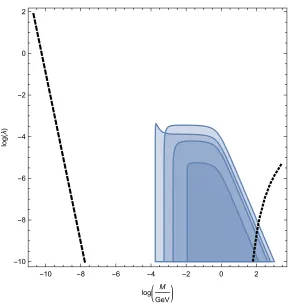
In Section2we will review the symmetron model, and how the force between two extended objects can be screened. In Section 3 we apply the results of existing atom interferometry experiments to find new constraints on the symmetron model which are presented in Figure 1. In Section 4we discuss the possibility that domain walls could form inside the vacuum chamber, leading to the possibility that atoms could experience a symmetron force, even in the absence of a source inside the vacuum chamber. We conclude in Section 5.
2
The Symmetron
The simplest version of the symmetron model is as a canonical scalar field with poten-tial
V(φ) = λ 4φ
4− µ2
2 φ
2 , (2.1)
whereλ(which is dimensionless) andµ(which has mass dimensions) are the parameters of the theory which must be determined by experiment. The scalar field couples to matter through dimension six terms in the Lagrangian of the form
L ⊃ φ
2
2M2T µ
µ , (2.2)
whereTµν is the energy-momentum tensor of all of the matter fields andM is an energy
scale which controls the strength of the coupling to matter.
The interactions with matter mean that in the presence of a non-relativistic, static background matter density ρ the symmetron field moves in an effective potential
Veff(φ) =
1 2
ρ M2 −µ
2φ2+ λ
4φ
from which it can be seen that when the density is sufficiently high, ρ > M2µ2, the
effective potential has only one minimum and the field is trapped at φ = 0. As the density is decreased the potential undergoes a symmetry breaking transition, and the field can roll into one of two minima with φ2 = (µ2−ρ/M2)/λ.
In Ref. [6], the symmetry-breaking scale is chosen close to the cosmological density today, i.e. µ2M2 ∼H2
0MPl2, where H0 is the present-day Hubble scale. In addition, the
symmetron force in vacuum is required to have approximately gravitational strength, i.e. φ/M2 ∼ 1/MPl, such that there may be observable consequences without
fine-tuning of the coupling scale. However, other choices of parameters are possible. In particular it has been shown that both E¨ot-Wash experiments [18], and measurements of exo-planets [19] constrain a very different region of parameter space with coupling constants M . 10 TeV and the mass scale µ around the electronvolt scale. The self coupling parameter λ is very poorly constrained currently.
The radiatively stable model derived in [14] has a slightly more complicated po-tential
V(φ) =
λ 16π 2 φ4 ln φ 2
m2 −Y
, (2.4)
for constant m, λ and Y. However, the structure of the symmetry breaking transi-tion, and the resulting phenomenology remains essentially the same as the original symmetron model, and so we will focus our attention on the simpler model in what follows.
Around a static, spherically symmetric object of density ρin and radius R,
em-bedded in a background density ρout, the symmetron field profile is
φ=φout−
(φout−φin)Remout(R−r) r
minR−tanhminR minR+RmouttanhminR
, (2.5)
where min andmout are respectively the mass of the field inside the source object, and
outside, and φin and φout are the values of the scalar field that minimize the effective
potential inside and outside the source. The force on a test particle moving on top of this field profile is then given by F =φ∇φ/M2.
If everywhere in the experiment the density is higher than that required for the symmetry breaking transition, (ρout, ρin)> M2µ2, then the field will be constrained to
be φ = 0 everywhere and it will never be possible to see the associated fifth forces. If
ρout < µ2M2 then the field has a non-trivial profile inside the vacuum chamber, and
the value of the field at the center of the vacuum chamber (assumed to be spherical for simplicity) depends on the relative sizes of the radius of the vacuum chamber L and the Compton wavelength of the field. If moutL&1 then
φout =
1 √
λ
µ2− ρout
M2 1/2
, (2.6)
otherwise the field does not have room to evolve away from φ = 0 in the walls of the chamber and we have
If ρin < µ2M2, then the source object causes only a small perturbation of the
background field. In this case there is no screening, and the force has the usual Yukawa form. On the other hand, if ρin> µ2M2 and minR1, then the symmetry is restored
inside the source and the resulting force on a test particle is suppressed [5].
We are not interested, however, in the force on an infinitesimal test particle but instead in the force between two extended objects either or both of which could be screened. Following the arguments of [20] if we assume a hierarchy between mass A and mass B, so that the field profile due to B can be considered a small perturbation on the field profile of A at the surface of mass B, then the force can be found by considering the change in momentum of ball B and using the Bianchi identity. The symmetron force between two objects A and B is therefore
Fsymm= 4πλAλB(1 +moutRB)(1 +moutr)
emout(RA−r)
r2 , (2.8)
where
λi = (φout−φin)R
minR−tanhminR minR+RmouttanhminR
i
, (2.9)
where all of the quantities on the right hand side of Equation (2.9) are evaluated for the object in question. λi can therefore be considered the symmetron ‘charge’ for the
object. The fact that we are treating the field profiles due to A and B hierarchically explains the slight asymmetry in the dependencies on RA and RB. If λi 1 then we
say that the object is screened, and the force is suppressed.
3
Atom Interferometry
Atom interferometry has been shown to be a powerful technique for constraining chameleon models with screening [21]. These experiments work by putting an atom into a superposition of states which travel on two different paths. If the wavefunction accumulates a phase difference between the two paths this can be detected as an in-terference pattern when the two path are merged [22, 23]. If the atoms experience a constant acceleration in the same direction as the separation between the paths then this results in exactly such a phase difference, allowing the force the atoms have expe-rienced to be measured very precisely. Atom interferometry measurements looking for chameleons have reached a sensitivity of 10−6g (whereg is the acceleration due to free fall at the surface of the earth) and are forecast to reach 10−9g [24, 25].
Do these same advantages also apply to symmetron screening? Assuming the walls of the vacuum chamber have a density of ρwall ∼g/cm3 then the field can reach φ = 0 and restore the symmetry inside the walls if the thickness of the walls is greater than ∼ 1/mwall. We will see shortly that atom interferometry experiments constrain
a fairly narrow region in µ around µ ∼ 10−4 eV and coupling strengths in the range 10−4 GeV < M < 104 GeV. In this region of the parameter space the Compton
wavelength of the field in the symmetry restored vacuum in the wall has a maximum value of 1/mwall ∼1 mm. Therefore we should expect the symmetry to be restored in
the wall in the region of parameter space we consider, and so the interior is effectively decoupled from the behaviour of the symmetron in the exterior.
For a compact object to be screened from the symmetron force we need both
ρin/M2 > µ2 and minR 1. The first condition is actually easier to satisfy for an
atomic nucleus than for a macroscopic test mass, because the nuclear density is much higher than the density of, for example, silicon. The second condition is harder to satisfy for atoms than macroscopic masses because of the small size of the atomic nuclei. It is therefore not always the case that atoms make better probes of the symmetron field than macroscopic objects do, however they will be sensitive in some region of the parameter space which we will now determine.
We apply the results of reference [24], which measures the acceleration of cold caesium 133 atoms. The atoms were held 8.8 mm away from an aluminium sphere of radius 9.5 mm. The experiment was performed in a vacuum chamber of radius 5 cm and pressure 6× 10⁻¹⁰ Torr. No anomalous acceleration of the atoms is measured, restricting the acceleration due to the symmetron field to satisfy a <6.8×10⁻⁶ m/s2
. The constraints that this places on the symmetron parameter space can be seen in Figure 1.
Constraints are restricted to a narrow range of the mass parameter µ, around ∼ 10−4,10−5 eV. For smaller µ the Compton wavelength of the symmetron in the
vacuum is larger than the size of the vacuum chamber and so the field cannot vary its value over the scale of the experiment. For larger µ the Compton wavelength of the symmetron in vacuum is so small that the Yukawa term exponentially suppresses the force. The peak in theµ= 10−4 eV plot occurs because there is a value ofM for which
the Compton wavelength of the field in vacuum exactly matches the distance between the aluminium sphere and the atoms.
We see that, whilst the range of µ values that are accessible is relatively con-strained, where atom interferometry experiments do give constraints they explore a region of parameter space that is inaccessible to other experiments and observations.
3.1 Other Experiments with Unscreened Test Particles
-10 -8 -6 -4 -2 0 2
-10
-8
-6
-4
-2 0 2
log M GeV
log
(
λ
)
Figure 1. Constraints on the symmetron parameters from the atom interferometry exper-iment of [24]. The excluded regions are shaded blue. The different regions are for different
values ofµ; from left to rightµ= 10−4 eV,µ= 10−4.5 eV,µ= 10−5 eV,µ= 10−5.5 eV. The
black dashed line on the left shows constraints from observations of exo-planets (points to
the left of the line are excluded), with µ → 0 the most constraining choice [19]. The black
dotted line on the right shows the constraints from torsion pendulum experiments (points to
the right of the line are excluded) with µ= 10−4 eV chosen for reference [18].
however, that silicone microspheres have a lower average density than neutrons and atomic nuclei, and so, if the sensitivity can be improved, they may provide the best prospect for searching for symmetron forces.
4
Domain Walls
[image:7.612.161.450.78.384.2]If we approximate the wall as being straight and static, then its field profile is
φ(z) = φ0tanh
˜
µz
√ 2
, (4.1)
where
˜
µ2 :=µ2− ρ
M2 , (4.2)
and φ0 = √µ˜λ, meaning that the thickness of the wall is ∼ 1/µ˜, and its tension is
= 4 ˜mu3/(3λ) [33].
Taking into account that the atom may be screened, the acceleration experienced by atom moving in the neighbourhood of a domain wall is
~a = 4πλatom(1 +moutRatom)∇φ , (4.3)
where we should remember thatλatomdepends on the background field valueφout which
in this case should be replaced with the domain wall field profile φ evaluated at the position of the atom.
The maximum acceleration that an atom may experience in such a situation is roughly proportional to |φ∇φ|. We can find an approximation for this by assuming the domain walls are small compared to the radius of the chamber such that we can use the planar solution for a domain wall given above in equation (4.1). We find that this maximum acceleration aφ ≈ φM∇2φ ≈ 0.27
˜ µ3
λM2, which is always much less than 10
−10 g
within the parameter space we have examined. This means that any domain walls that form will have a negligible effect on searches for symmetron fifth forces between atoms and source masses in the vacuum chamber, and that sensitivity must be improved if we are to detect the forces due to the domain wall directly.
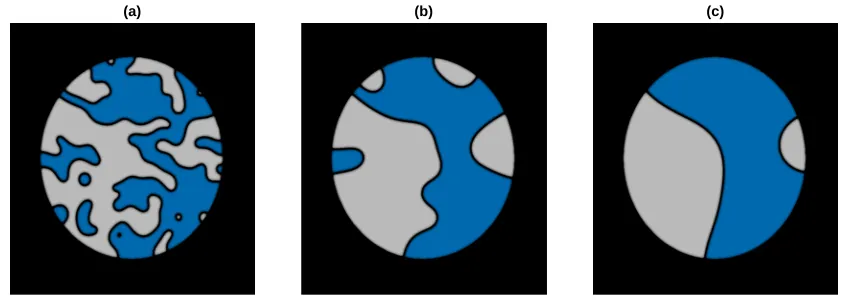
Of course, depending on the correlation length more than one domain wall can form creating a network. The symmetry is restored in the walls of the vacuum chamber, and in the core of the domain wall, so from the point of view of the field the walls can be viewed as a fixed sphere of φ = 0 surrounding the domain wall network. We know from cosmological studies [33] that networks of domain walls want to evolve towards the configuration with the minimum wall length. Therefore we can assume that the network inside the vacuum chamber is not stable, and the domain walls will straighten, and merge with one another and with the walls of the vacuum chamber. It is therefore reasonable to expect that the end point of this evolution will be the vacuum chamber entirely filled with one domain and no domain walls are present. An example of such an evolution is shown in Figure 2. This figure was constructed using two-dimensional numerical simulation with unphysical values for the symmetron parameters, and so should be considered only as an example of what kind of evolution is possible. We leave a full numerical simulation for future work.
(a) (b) (c)
Figure 2. A two dimensional domain wall network inside a circular cavity. The colours
indicate the value of the scalar field. Blue and grey regions represent the positive and negative symmetry broken vacua respectively, and in the black regions the symmetry is restored at
φ = 0. The system evolves in time from left to right. This simulation was performed with
unphysical values for the symmetron parameters due to numerical limitations.
short period of time. However, this motion can be slowed down by friction if the walls interact with a surrounding particle bath. The force per unit area on the wall can be approximated by [34]
Ffriction∼N nT v , (4.4)
where N is the number of light particles interacting with the domain wall, n is the number density of these particles, T is their temperature and v the velocity of the wall compared to the background. Taking the number density corresponding to the hydrogen gas pressure in the atom interferometry experiment described above, which is performed at room temperature, we find
Ffriction∼v×1.3×10−45 GeV4 . (4.5)
This frictional force is comparable to the domain wall tension if Ffriction ∼4µ3/(3λR),
where R is the mean curvature radius. From this we can deduce that the strings will move non-relativistically if
0.02cm
R
λ . (4.6)
This suggests that at least for some values ofλ, the domain walls could be long lived in-side the vacuum chamber. As mentioned above, a full numerical study of the evolution of the domain walls in a vacuum chamber remains a topic for future work.
5
Conclusions
We have shown that symmetron fifth forces, inspired by theories of dark energy, can be constrained by terrestrial experiments using cold atoms. The constraints we have found in Figure 1, are particularly interesting as they fill a previously empty region of parameter space between the constraints coming from E¨ot-Wash experiments, and those coming from observations of exo-planets.
We have also discussed the possibility that symmetron domain walls may form in the vacuum chamber, leading to the atoms experiencing a fifth force without the need to place a source mass inside the vacuum chamber. Whilst we find that the accelerations experienced by the atoms are smaller than the sensitivity of current experiments, they are not so small that it would be impossible to detect them in the future. Additionally, as the domain walls only form for symmetron models, if a screened fifth force is ever detected in a terrestrial experiment the presence or absence of these domain walls would provide a way to discriminate between different models of screening.
In the final stages of writing this article it has come to our attention that Brax and Davis have derived the same constraints on the symmetron model using the tomo-graphic model of screening [35].
Acknowledgements
We would like to thank Ed Copeland for useful discussions during the completion of this work. CB is supported by a Royal Society University Research Fellowship. JS is supported by the Royal Society
References
[1] Austin Joyce, Bhuvnesh Jain, Justin Khoury, and Mark Trodden. Beyond the
Cosmological Standard Model. Phys. Rept., 568:1–98, 2015.
[2] Timothy Clifton, Pedro G. Ferreira, Antonio Padilla, and Constantinos Skordis.
Modified Gravity and Cosmology. Phys. Rept., 513:1–189, 2012.
[3] Justin Khoury and Amanda Weltman. Chameleon cosmology. Phys. Rev.,
D69:044026, 2004.
[4] Justin Khoury and Amanda Weltman. Chameleon fields: Awaiting surprises for tests
of gravity in space. Phys. Rev. Lett., 93:171104, 2004.
[5] Kurt Hinterbichler and Justin Khoury. Symmetron Fields: Screening Long-Range
Forces Through Local Symmetry Restoration. Phys. Rev. Lett., 104:231301, 2010.
[6] Kurt Hinterbichler, Justin Khoury, Aaron Levy, and Andrew Matas. Symmetron
Cosmology. Phys. Rev., D84:103521, 2011.
[7] T. Damour and Alexander M. Polyakov. The String dilaton and a least coupling
[8] Philippe Brax, Carsten van de Bruck, Anne-Christine Davis, and Douglas Shaw. The
Dilaton and Modified Gravity. Phys. Rev., D82:063519, 2010.
[9] Alberto Nicolis, Riccardo Rattazzi, and Enrico Trincherini. The Galileon as a local
modification of gravity. Phys. Rev., D79:064036, 2009.
[10] E. Babichev, C. Deffayet, and R. Ziour. k-Mouflage gravity. Int. J. Mod. Phys.,
D18:2147–2154, 2009.
[11] Philippe Brax, Clare Burrage, and Anne-Christine Davis. Screening fifth forces in
k-essence and DBI models. JCAP, 1301:020, 2013.
[12] Clare Burrage and Justin Khoury. Screening of scalar fields in Dirac-Born-Infeld
theory. Phys. Rev., D90(2):024001, 2014.
[13] A. I. Vainshtein. To the problem of nonvanishing gravitation mass. Phys. Lett.,
B39:393–394, 1972.
[14] Clare Burrage, Edmund J. Copeland, and Peter Millington. Radiative screening of fifth forces. 2016.
[15] Massimo Pietroni. Dark energy condensation. Phys. Rev., D72:043535, 2005.
[16] Keith A. Olive and Maxim Pospelov. Environmental dependence of masses and
coupling constants. Phys. Rev., D77:043524, 2008.
[17] Philippe Brax, Carsten van de Bruck, Anne-Christine Davis, Baojiu Li, and
Douglas J. Shaw. Nonlinear Structure Formation with the Environmentally Dependent
Dilaton. Phys. Rev., D83:104026, 2011.
[18] Amol Upadhye. Symmetron dark energy in laboratory experiments. Phys. Rev. Lett.,
110(3):031301, 2013.
[19] Marcelo Vargas dos Santos and David F. Mota. Extrasolar planets as a probe of modified gravity. 2016.
[20] Lam Hui, Alberto Nicolis, and Christopher Stubbs. Equivalence Principle Implications
of Modified Gravity Models. Phys. Rev., D80:104002, 2009.
[21] Clare Burrage, Edmund J. Copeland, and E. A. Hinds. Probing Dark Energy with
Atom Interferometry. JCAP, 1503(03):042, 2015.
[22] Pippa Storey and Claude Cohen-Tannoudji. The Feynman path integral approach to
atomic interferometry: A tutorial. J. Phys. II, 4(11):1999–2027, 1994.
[23] Richard P. Feynman and A. R. Hibbs. Quantum Mechanics and Path Integrals. Dover
Publications Inc., emended ed. edition edition, 2010.
[24] Paul Hamilton, Matt Jaffe, Philipp Haslinger, Quinn Simmons, Holger Mueller, and
Justin Khoury. Atom-interferometry constraints on dark energy. Science, 349:849–851,
2015.
[25] Benjamin Elder, Justin Khoury, Philipp Haslinger, Matt Jaffe, Holger Mller, and Paul
Hamilton. Chameleon Dark Energy and Atom Interferometry. Phys. Rev.,
D94(4):044051, 2016.
[26] Philippe Brax and Guillaume Pignol. Strongly Coupled Chameleons and the
[27] A. N. Ivanov, R. Hollwieser, T. Jenke, M. Wellenzohen, and H. Abele. Influence of the chameleon field potential on transition frequencies of gravitationally bound quantum
states of ultracold neutrons. Phys. Rev., D87(10):105013, 2013.
[28] Philippe Brax, Guillaume Pignol, and Damien Roulier. Probing Strongly Coupled
Chameleons with Slow Neutrons. Phys. Rev., D88:083004, 2013.
[29] T. Jenke et al. Gravity Resonance Spectroscopy Constrains Dark Energy and Dark
Matter Scenarios. Phys. Rev. Lett., 112:151105, 2014.
[30] H. Lemmel, Ph. Brax, A. N. Ivanov, T. Jenke, G. Pignol, M. Pitschmann, T. Potocar, M. Wellenzohn, M. Zawisky, and H. Abele. Neutron Interferometry constrains dark
energy chameleon fields. Phys. Lett., B743:310–314, 2015.
[31] K. Li et al. Neutron Limit on the Strongly-Coupled Chameleon Field. Phys. Rev.,
D93(6):062001, 2016.
[32] Alexander D. Rider, David C. Moore, Charles P. Blakemore, Maxime Louis, Marie Lu, and Giorgio Gratta. Search for Screened Interactions Below the Dark Energy Length Scale Using Optically Levitated Microspheres. 2016.
[33] A. Vilenkin and E. P. S. Shellard. Cosmic Strings and Other Topological Defects.
Cambridge University Press, 2000.
[34] T. W. B. Kibble. Topology of Cosmic Domains and Strings. J. Phys., A9:1387–1398,
1976.