Unsupervised Sense Disambiguation Using Bilingual Probabilistic Models
Indrajit Bhattacharya
Dept. of Computer Science University of Maryland
College Park, MD, USA
Lise Getoor
Dept. of Computer Science University of Maryland
College Park, MD, USA
Yoshua Bengio
Dept. IRO Universit´e de Montr´eal
Montr´eal, Qu´ebec, Canada
Abstract
We describe two probabilistic models for unsuper-vised word-sense disambiguation using parallel cor-pora. The first model, which we call the Sense model, builds on the work of Diab and Resnik (2002) that uses both parallel text and a sense in-ventory for the target language, and recasts their ap-proach in a probabilistic framework. The second model, which we call the Concept model, is a hier-archical model that uses a concept latent variable to relate different language specific sense labels. We show that both models improve performance on the word sense disambiguation task over previous unsu-pervised approaches, with the Concept model show-ing the largest improvement. Furthermore, in learn-ing the Concept model, as a by-product, we learn a sense inventory for the parallel language.
1 Introduction
Word sense disambiguation (WSD) has been a cen-tral question in the computational linguistics com-munity since its inception. WSD is fundamental to natural language understanding and is a useful in-termediate step for many other language process-ing tasks (Ide and Veronis, 1998). Many recent approaches make use of ideas from statistical ma-chine learning; the availability of shared sense defi-nitions (e.g. WordNet (Fellbaum, 1998)) and recent international competitions (Kilgarrif and Rosen-zweig, 2000) have enabled researchers to compare their results. Supervised approaches which make use of a small hand-labeled training set (Bruce and Wiebe, 1994; Yarowsky, 1993) typically out-perform unsupervised approaches (Agirre et al., 2000; Litkowski, 2000; Lin, 2000; Resnik, 1997; Yarowsky, 1992; Yarowsky, 1995), but tend to be tuned to a specific corpus and are constrained by scarcity of labeled data.
In an effort to overcome the difficulty of find-ing sense-labeled trainfind-ing data, researchers have be-gun investigating unsupervised approaches to word-sense disambiguation. For example, the use of
par-allel corpora for sense tagging can help with word sense disambiguation (Brown et al., 1991; Dagan, 1991; Dagan and Itai, 1994; Ide, 2000; Resnik and Yarowsky, 1999). As an illustration of sense disam-biguation from translation data, when the English
word bank is translated to Spanish as orilla, it is
clear that we are referring to theshoresense of bank,
rather than thefinancial institutionsense.
The main inspiration for our work is Diab and Resnik (2002), who use translations and linguistic knowledge for disambiguation and automatic sense tagging. Bengio and Kermorvant (2003) present a graphical model that is an attempt to formalize probabilistically the main ideas in Diab and Resnik (2002). They assume the same semantic hierarchy (in particular, WordNet) for both the languages and assign English words as well as their translations to WordNet synsets. Here we present two variants of the graphical model in Bengio and Kermorvant (2003), along with a method to discover a cluster structure for the Spanish senses. We also present empirical word sense disambiguation results which demonstrate the gain brought by this probabilistic approach, even while only using the translated word to provide disambiguation information.
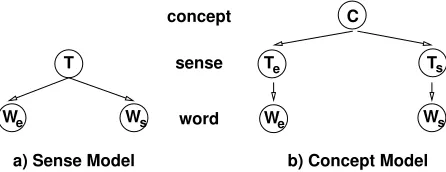
Our first generative model, the Sense Model,
groups semantically related words from the two
languages into senses, and translations are
gener-ated by probabilistically choosing a sense and then words from the sense. We show that this improves on the results of Diab and Resnik (2002).
Our next model, which we call the Concept
Model, aims to improve on the above sense struc-ture by modeling the senses of the two languages separately and relating senses from both languages through a higher-level, semantically less precise
concept. The intuition here is that not all of the senses that are possible for a word will be relevant for a concept. In other words, the distribution over
the senses of a wordgivena concept can be expected
re-source for identification of semantic concepts. Note that actual translated word pairs are not always good matches semantically, because the translation pro-cess is not on a word by word basis. This intro-duces a kind of noise in the translation, and an addi-tional hidden variable to represent the shared mean-ing helps to take it into account. Improved perfor-mance over the Sense Model validates the use of concepts in modeling translations.
An interesting by-product of the Concept Model is a semantic structure for the secondary language. This is automatically constructed using background knowledge of the structure for the primary language and the observed translation pairs. In the model, words sharing the same sense are synonyms while senses under the same concept are semantically re-lated in the corpus. An investigation of the model trained over real data reveals that it can indeed group related words together.
It may be noted that predicting senses from trans-lations need not necessarily be an end result in it-self. As we have already mentioned, lack of labeled data is a severe hindrance for supervised approaches to word sense disambiguation. At the same time, there is an abundance of bilingual documents and many more can potentially be mined from the web. It should be possible using our approach to (noisily) assign sense tags to words in such documents, thus providing huge resources of labeled data for super-vised approaches to make use of.
For the rest of this paper, for simplicity we will refer to the primary language of the parallel docu-ment as English and to the secondary as Spanish. The paper is organized as follows. We begin by for-mally describing the models in Section 2. We de-scribe our approach for constructing the senses and concepts in Section 3. Our algorithm for learning the model parameters is described in Section 4. We present experimental results in Section 5 and our analysis in Section 6. We conclude in Section 7.
2 Probabilistic Models for Parallel Corpora
We motivate the use of a probabilistic model by il-lustrating that disambiguation using translations is possible even when a word has a unique transla-tion. For example, according to WordNet, the word
prevention has two senses in English, which may
be abbreviated as hindrance (the act of hindering
or obstruction) andcontrol (by prevention, e.g. the
control of a disease). It has a single translation in
our corpus, that being prevenci´on. The first
En-glish sense, hindrance, also has other words like
bar that occur in the corpus and all of these other
words are observed to be translated in Spanish as
the word obstrucci´on. In addition, none of these
other words translate to prevenci´on. So it is not
unreasonable to suppose that the intended sense for
prevention when translated asprevenci´on is
differ-ent from that ofbar. Therefore, the intended sense
is most likely to be control. At the very heart of
the reasoning is probabilistic analysis and indepen-dence assumptions. We are assuming that senses and words have certain occurrence probabilities and that the choice of the word can be made indepen-dently once the sense has been decided. This is the flavor that we look to add to modeling parallel doc-uments for sense disambiguation. We formally de-scribe the two generative models that use these ideas in Subsections 2.2 and 2.3.
T
We Ws
Te Ts
C
Ws We
word concept
sense
[image:2.595.319.542.292.378.2]b) Concept Model a) Sense Model
Figure 1: Graphical Representations of the a) Sense Model and the b) Concept Model
2.1 Notation
Throughout, we use uppercase letters to denote ran-dom variables and lowercase letters to denote spe-cific instances of the random variables. A
transla-tion pair is (
,
) where the subscript and
indicate the primary language (English) and the sec-ondary language (Spanish).
and
. We use the shorthand
for !#" $
.
2.2 The Sense Model
The Sense Model makes the assumption, inspired by ideas in Diab and Resnik (2002) and Ben-gio and Kermorvant (2003), that the English word
!
and the Spanish word %
in a translation pair share the same precise sense. In other words, the set of sense labels for the words in the two lan-guages is the same and may be collapsed into one set of senses that is responsible for both English and Spanish words and the single latent variable
in the model is the sense label &
'()*(+,
for both words
and
-. We also make the as-sumption that the words in both languages are con-ditionally independent given the sense label. The
probability(
of each sense(
and the conditional
probabilities 21(
and3 *1(
of each word
and
in the two languages given the sense. The generation of a translation pair by this model may be viewed as a two-step process that first selects a sense according to the priors on the senses and then selects a word from each language using the conditional probabilities for that sense. This may be imagined as a factoring of the joint distribution:
&
4"5
&
1
&
1
&
. Note that in the absence of labeled training data, two
of the random variables
-and
are observed,
while the sense variable& is not. However, we can
derive the possible values for our sense labels from WordNet, which gives us the possible senses for
each English word
-. The Sense model is shown in Figure 1(a).
2.3 The Concept Model
The assumption of a one-to-one association be-tween sense labels made in the Sense Model may be too simplistic to hold for arbitrary languages. In par-ticular, it does not take into account that translation is from sentence to sentence (with a shared mean-ing), while the data we are modeling are aligned
single-word translations % -6
, in which the
in-tended meaning of
-does not always match
per-fectly with the intended meaning of7
. Generally,
a set of 8 related senses in one language may be
translated by one of 9 related senses in the other.
This many-to-many mapping is captured in our al-ternative model using a second level hidden
vari-able called a concept. Thus we have three
hid-den variables in the Concept Model — the English sense &
, the Spanish sense &
and the concept : ,
where&
;" ( < *( >=
,&
?" ( < *( A@
and
:
" B)*<BCD
.
We make the assumption that the senses &
and
&
are independent of each other given the shared
concept : . The generative parameters .
/ in the
model are the prior probabilities B
over the
concepts, the conditional probabilities ( E1B
and
(
*1
B
for the English and Spanish senses given the
concept, and the conditional probabilities
F1
(
$
and 21( $
for the words
and
in each language given their senses. We can now imag-ine the generative process of a translation pair by the Concept Model as first selecting a concept ac-cording to the priors, then a sense for each lan-guage given the concept, and finally a word for each sense using the conditional probabilities of the words. As in Bengio and Kermorvant (2003), this generative procedure may be captured by factor-ing the joint distribution usfactor-ing the conditional
inde-pendence assumptions as 3 - -
&
&
:
"
:
&
F1
:
3 !21
&
$
&
E1
:
21
&
$
. The Concept model is shown in Figure 1(b).
3 Constructing the Senses and Concepts
Building the structure of the model is crucial for our task. Choosing the dimensionality of the hidden variables by selecting the number of senses and con-cepts, as well as taking advantage of prior knowl-edge to impose constraints, are very important as-pects of building the structure.
If certain words are not possible for a given sense, or certain senses are not possible for a given con-cept, their corresponding parameters should be 0.
For instance, for all words
that do not belong to a sense(
, the corresponding parameter .EGIH$JKLH would
be permanently set to 0. Only the remaining param-eters need to be modeled explicitly.
While model selection is an extremely difficult problem in general, an important and interesting op-tion is the use of world knowledge. Semantic hi-erarchies for some languages have been built. We should be able to make use of these known tax-onomies in constructing our model. We make heavy use of the WordNet ontology to assign structure to both our models, as we discuss in the following sub-sections. There are two major tasks in building the structure — determining the possible sense labels for each word, both English and Spanish, and con-structing the concepts, which involves choosing the number of concepts and the probable senses for each concept.
3.1 Building the Sense Model
Each word in WordNet can belong to multiple synsets in the hierarchy, which are its possible senses. In both of our models, we directly use the WordNet senses as the English sense labels. All WordNet senses for which a word has been ob-served in the corpus form our set of English sense labels. The Sense Model holds that the sense labels for the two domains are the same. So we must use the same WordNet labels for the Spanish words as
well. We include a Spanish word
for a sense(
if
is the translation of any English word
in(
.
3.2 Building the Concept Model
Concept Model
te2 te1 ts1
[image:4.595.76.535.71.148.2]bar prevention c6118 ts2 c20 prevencio’n obstruccio’n Sense Model bar prevention te1 te2 prevencio’n obstruccio’n
Figure 2: The Sense and Concept models forprevention, bar, prevenci ´onandobstrucci´on
For each Spanish wordM
, we have its set of
En-glish translationsN=O
. One possibility is to group Spanish words looking at their translations. However, a more robust approach is to consider the
relevant English senses for
. Each English
trans-lation for
has its set of English sense labelsP
GIHDQ
drawn from WordNet. So the relevant English sense
labels for
may be defined as P
GSR
"UTNV
P
GIH Q.
We call this the English sense map or 2WXY for
. We use the2WXY s to define the Spanish senses.
We may imagine each Spanish word to come from one or more Spanish senses. If each word has a
single sense, then we add a Spanish sense (
for
each *WZXY and all Spanish words that share that
2WXY belong to that sense. Otherwise, the*WZXY s
have to be split into frequently occurring subgroups.
Frequently co-occurring subsets of2WXY s can
de-fine more rede-fined Spanish senses. We identify these
subsets by looking at pairs of 2WZXY s and
comput-ing their intersections. An intersection is consid-ered to be a Spanish sense if it occurs for a
signifi-cant number of pairs of 2WXY s. We consider both
ways of building Spanish senses. In either case, a
constructed Spanish sense (
comes with its
rele-vant set (
Q
of English senses, which we denote
as2WZXY
(
.
Once we have the Spanish senses, we cluster
them to form concepts. We use the *WZXY
corre-sponding to each Spanish sense to define a measure of similarity for a pair of Spanish senses. There are many options to choose from here. We use a simple measure that counts the number of common
items in the two*WZXY s.
1The similarity measure is
now used to cluster the Spanish senses (
. Since this measure is not transitive, it does not directly
define equivalence classes over (6
. Instead, we get a similarity graph where the vertices are the Span-ish senses and we add an edge between two senses if their similarity is above a threshold. We now pick each connected component from this graph as a cluster of similar Spanish senses.
1Another option would be to use a measure of similarity for
English senses, proposed in Resnik (1995) for two synsets in a concept hierarchy like WordNet. Our initial results with this measure were not favorable.
Now we build the concepts from the Spanish sense clusters. We recall that a concept is defined by a set of English senses and a set of Spanish senses that are related. Each cluster represents a concept. A particular concept is formed by the set of Spanish senses in the cluster and the English senses relevant for them. The relevant English senses for any
Span-ish sense is given by its2WZXY . Therefore, the union
of the*WZXY s of all the Spanish senses in the cluster
forms the set of English senses for each concept.
4 Learning the Model Parameters
Once the model is built, we use the popular EM al-gorithm (Dempster et al., 1977) for hidden vari-ables to learn the parameters for both models. The algorithm repeatedly iterates over two steps. The first step maximizes the expected log-likelihood of the joint probability of the observed data with the
current parameter settings. / . The next step then
re-estimates the values of the parameters of the model. Below we summarize the re-estimation steps for each model.
4.1 EM for the Sense Model
3
&
V
" ( [" \
] ^ _ VL` ) &
" ( 1
Q Q . / Q " 1 & V
" ( a"
b ^ GIHDQ ` c VL` ) 3 &
" ( 1
Q d Q .F/ b b ^e H Q ` <c VL` ) &
" ( 1
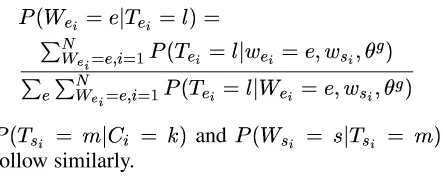
Q Q . / Q " 1 & V " ( follows similarly.
4.2 EM for the Concept Model
!
Q
"
1
&
Q
"lk ["
b
^e
HDQ
`
<c VL`
)
&
Q
"lk<1
Q
"
Q
. /
b
b
^e
HDQ
`
<c VL`
)
&
Q
"gk1n
Q
"
Q
.
/
&
Q
"
8
1
:
V
"ofh
and
Q
"
1
&
Q
"
8
follow similarly.
4.3 Initialization of Model Probabilities
Since the EM algorithm performs gradient ascent as it iteratively improves the log-likelihood, it is prone to getting caught in local maxima, and se-lection of the initial conditions is crucial for the learning procedure. Instead of opting for a uni-form or random initialization of the probabilities, we make use of prior knowledge about the English words and senses available from WordNet. Word-Net provides occurrence frequencies for each synset in the SemCor Corpus that may be normalized to
derive probabilities
Gqp ( $
for each English sense
(>
. For the Sense Model, these probabilities form the initial priors over the senses, while all English (and Spanish) words belonging to a sense are tially assumed to be equally likely. However, ini-tialization of the Concept Model using the same knowledge is trickier. We would like each
En-glish sense (
to have
V
p
V
K
( "r
Gqp ( $
. But the fact that each sense belongs to multiple
con-cepts and the constraint b
KH6sEt
(
E1
B
u"
\ makes
the solution non-trivial. Instead, we settle for a
compromise. We set
V
p
V
K
( E1B v"w
Gqp ( $
and
B x" b
KLH s2t
Gqp ( $
. Subsequent normalization takes care of the sum constraints. For a Spanish sense, we set(< a"
b
KLH s y{z}|E~
KLR
Gqp (>
. Once we have the Spanish sense probabilities, we follow
the same procedure for setting( 21B
for each con-cept. All the Spanish and English words for a sense are set to be equally likely, as in the Sense Model. It turned out in our experiments on real data that this initialization makes a significant difference in model performance.
5 Experimental Evaluation
Both the models are generative probabilistic models learned from parallel corpora and are expected to fit the training and subsequent test data. A good fit should be reflected in good prediction accuracy over a test set. The prediction task of interest is the sense of an English word when its translation is provided. We estimate the prediction accuracy and recall of
our models on Senseval data.2 In addition, the
Con-cept Model learns a sense structure for the Spanish
2Accuracy is the ratio of the number of correct predictions
and the number of attempted predictions. Recall is the ratio of the number of correct predictions and the size of the test set.
language. While it is hard to objectively evaluate the quality of such a structure, we present some in-teresting concepts that are learned as an indication of the potential of our approach.
5.1 Evaluation with Senseval Data
[image:5.595.76.297.71.159.2]In our experiments with real data, we make use of the parallel corpora constructed by Diab and Resnik (2002) for evaluation purposes. We chose to work on these corpora in order to permit a direct compar-ison with their results. The sense-tagged portion of the English corpus is comprised of the English “all-words” section of the SENSEVAL-2 test data. The remainder of this corpus is constructed by adding the Brown Corpus, the SENSEVAL-1 corpus, the SENSEVAL-2 English Lexical Sample test, trial and training corpora and the Wall Street Journal sec-tions 18-24 from the Penn Treebank. This English corpus is translated into Spanish using two com-mercially available MT systems: Globalink Pro 6.4 and Systran Professional Premium. The GIZA++ implementation of the IBM statistical MT models was used to derive the most-likely word-level align-ments, and these define the English/Spanish word co-occurrences. To take into account variability of translation, we combine the translations from the two systems for each English word, following in the footsteps of Diab and Resnik (2002). For our ex-periments, we focus only on nouns, of which there are 875 occurrences in our tagged data. The sense tags for the English domain are derived from the WordNet 1.7 inventory. After pruning stopwords, we end up with 16,186 English words, 31,862 Span-ish words and 2,385,574 instances of 41,850 distinct translation pairs. The English words come from 20,361 WordNet senses.
Table 1: Comparison with Diab’s Model
Model Accuracy Recall Parameters
Diab 0.618 0.572
-Sense M. 0.624 0.616 154,947
Concept M. 0.672 0.651 120,268
0 0.1 0.2 0.3 0.4 0.5 0.6 0.7 0.8
0.2 0.3 0.4 0.5 0.6 0.7 0.8 0.9
Recall
Accuracy unsup.
[image:6.595.75.261.75.206.2]sup. diab concept model sense model
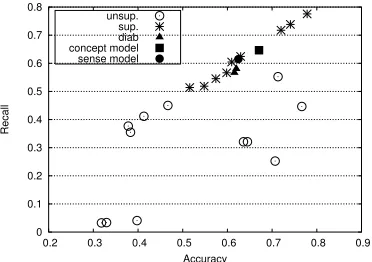
Figure 3: Comparison with Senseval2 Systems
single-sense model are similar.
In Figure 3, we compare the prediction accuracy and recall against those of the 21 Senseval-2 English All Words participants and that of Diab (2003), when restricted to the same set of noun instances from the gold standard. It can be seen that our mod-els outperform all the unsupervised approaches in recall and many supervised ones as well. No un-supervised approach is better in both accuracy and recall. It needs to be kept in mind that we take into
accountonly bilingual datafor our predictions, and
not monolingual features like context of the word as most other WSD approaches do.
5.2 Semantic Grouping of Spanish Senses
Table 2 shows some interesting examples of
differ-ent Spanish senses for discovered concepts.3 The
context of most concepts, like the ones shown, can be easily understood. For example, the first concept is about government actions and the second deals with murder and accidental deaths. The penulti-mate concept is interesting because it deals with
dif-ferent kinds of association and involves three
dif-ferent senses containing the word conexi´on. The
other words in two of these senses suggest that
they are aboutunionandrelationrespectively. The
third probably involves thelinksense ofconnection.
Conciseness of the concepts depends on the simi-larity threshold that is selected. Some may bring together loosely-related topics, which can be sepa-rated by a higher threshold.
6 Model Analysis
In this section, we back up our experimental results with an in-depth analysis of the performance of our two models.
Our Sense Model was motivated by Diab and Resnik (2002) but the flavors of the two are quite
3Some English words are found to occur in the Spanish
Senses. This is because the machine translation system used to create the Spanish document left certain words untranslated.
different. The most important distinction is that the Sense Model is a probabilistic generative model for parallel corpora, where interaction between differ-ent words stemming from the same sense comes into play, even if the words are not related through translations, and this interdependence of the senses through common words plays a role in sense disam-biguation.
We started off with our discussions on semantic ambiguity with the intuition that identification of semantic concepts in the corpus that relate multi-ple senses should help disambiguate senses. The Sense Model falls short of this target since it only brings together a single sense from each language. We will now revisit the motivating example from Section 2 and see how concepts help in disambigua-tion by grouping multiple related senses together.
For the Sense Model, S<F IDE ?1( >
S<F IDE ?1( <
since it is the only word that
(
can generate. However, this difference is
com-pensated for by the higher prior probability
(
, which is strengthened by both the translation pairs. Since the probability of joint occurrence is given by
the product 3( F1( 21(
for any sense (
, the model does not develop a clear preference for any of the two senses.
The critical difference in the Concept Model can be appreciated directly from the corresponding joint
probability B ( F1B O1( ( 21B 21( 6
,
where B
is the relevant concept in the model. The preference for a particular instantiation in the
model is dependent not on the prior (
over
a sense, but on the sense conditional 3( 21B
. In
our example, since bar, obstrucci´on
can be
generated only through conceptBE
, ( *1BE
is the only English sense conditional boosted by it.
prevention, prevenci´on
is generated through a
different concept B
\F\ , where the higher
condi-tionalqE SDDE ?1(
gradually strengthens one of the possible instantiations for it, and the other one becomes increasingly unlikely as the iterations progress. The inference is that only one sense of
preventionis possible in the context of the parallel corpus. The key factor in this disambiguation was
that two senses ofprevention separated out in two
different concepts.
The other significant difference between the mod-els is in the constraints on the parameters and the effect that they have on sense disambiguation. In
the Sense Model, b
K
( u"
\ , while in the
Con-cept Model, b
KH6sEt
( E1B ?"
\ separately for each
concept B
. Now for two relevant senses for an
en-Table 2: Example Spanish Senses in a Concept. For each concept, each row is a separate sense. Dictionary senses of Spanish words are provided in English within parenthesis where necessary.
actos accidente accidentes
supremas muertes(deaths)
decisi´on decisiones casualty
gobernando gobernante matar(to kill) matanzas(slaughter) muertes-le
gubernamentales slaying
gobernaci´on gobierno-proporciona derramamiento-de-sangre (spilling-of-blood)
prohibir prohibiendo prohibitivo prohibitiva cachiporra(bludgeon) obligar(force) obligando(forcing) gubernamental gobiernos asesinato(murder) asesinatos
linterna-el´ectrica linterna(lantern) man´ia craze
faros-autom´ovil(headlight) culto(cult) cultos proto-senility linternas-portuarias(harbor-light) delirio delirium
antorcha(torch) antorchas antorchas-pino-nudo rabias(fury) rabia farfulla(do hastily) oportunidad oportunidades diferenciaci´on
ocasi´on ocasiones distinci´on distinciones riesgo(risk) riesgos peligro(danger) especializaci´on destino sino(fate) maestr´ia (mastery)
fortuna suerte(fate) peculiaridades particularidades peculiaridades-inglesas probabilidad probabilidades especialidad especialidades
diablo(devil) diablos modelo parang´on
dickens ideal ideales
heller santo(saint) santos san
lucifer satan satan´as idol idols ´idolo deslumbra(dazzle) dios god dioses cromo(chromium) divinidad divinity
meteoro meteoros meteor meteoros-blue inmortal(immortal) inmortales meteorito meteoritos teolog´ia teolog
pedregosos(rocky) deidad deity deidades variaci´on variaciones minutos minuto
discordancia desacuerdo(discord) discordancias momento momentos un-momento desviaci´on(deviation) desviaciones desviaciones-normales minutos momentos momento segundos discrepancia discrepancias fugaces(fleeting) variaci´on diferencia instante momento
disensi´on pesta˜neo(blink) gui˜na(wink) pesta˜nean adhesi´on adherencia ataduras(tying) pasillo(corridor)
enlace(connection) ataduras aisle
atadura ataduras pasarela(footbridge) conexi´on conexiones hall vest´ibulos conexi´on une(to unite) pasaje(passage)
relaci´on conexi´on callej´on(alley) callejas-ciegas (blind alley) callejones-ocultos implicaci´on (complicity) envolvimiento
tire set of senses for the corpus. In contrast, if these two senses belong to the same concept in the Con-cept Model, the difference in the sense conditionals will be highlighted since the normalization occurs over a very small set of senses — the senses for only that concept, which in the best possible sce-nario will contain only the two contending senses,
as in conceptB
\F\ of our example.
As can be seen from Table 1, the Concept Model not only outperforms the Sense Model, it does so with significantly fewer parameters. This may be counter-intuitive since Concept Model involves an extra concept variable. However, the dissociation of Spanish and English senses can significantly reduce the parameter space. Imagine two Spanish words that are associated with ten English senses and
ac-cordingly each of them has a probability for belong-ing to each of these ten senses. Aided with a con-cept variable, it is possible to model the same re-lationship by creating a separate Spanish sense that contains these two words and relating this Spanish sense with the ten English senses through a concept variable. Thus these words now need to belong to only one sense as opposed to ten. Of course, now there are new transition probabilities for each of the eleven senses from the new concept node. The exact reduction in the parameter space will depend on the
frequent subsets discovered for the 2WXY s of the
[image:7.595.65.547.105.531.2]7 Conclusions and Future Work
We have presented two novel probabilistic models for unsupervised word sense disambiguation using parallel corpora and have shown that both models outperform existing unsupervised approaches. In addition, we have shown that our second model, the Concept model, can be used to learn a sense inventory for the secondary language. An advan-tage of the probabilistic models is that they can eas-ily incorporate additional information, such as con-text information. In future work, we plan to investi-gate the use of additional monolingual context. We would also like to perform additional validation of the learned secondary language sense inventory.
8 Acknowledgments
The authors would like to thank Mona Diab and Philip Resnik for many helpful discussions and in-sightful comments for improving the paper and also for making their data available for our experiments. This study was supported by NSF Grant 0308030.
References
E. Agirre, J. Atserias, L. Padr, and G. Rigau. 2000. Combining supervised and unsupervised lexical knowledge methods for word sense
disambigua-tion. InComputers and the Humanities, Special
Double Issue on SensEval. Eds. Martha Palmer and Adam Kilgarriff. 34:1,2.
Yoshua Bengio and Christopher Kermorvant. 2003. Extracting hidden sense probabilities from bi-texts. Technical report, TR 1231, Departement d’informatique et recherche operationnelle, Uni-versite de Montreal.
Peter F. Brown, Stephen Della Pietra, Vin-cent J. Della Pietra, and Robert L. Mercer. 1991. Word-sense disambiguation using
statisti-cal methods. In Meeting of the Association for
Computational Linguistics, pages 264–270. Rebecca Bruce and Janyce Wiebe. 1994. A new
approach to sense identification. InARPA
Work-shop on Human Language Technology.
Ido Dagan and Alon Itai. 1994. Word sense disam-biguation using a second language monolingual
corpus. Computational Linguistics, 20(4):563–
596.
Ido Dagan. 1991. Lexical disambiguation: Sources of information and their statistical realization. In
Meeting of the Association for Computational Linguistics, pages 341–342.
A.P. Dempster, N.M. Laird, and D.B. Rubin. 1977. Maximum likelihood from incomplete data via
the EM algorithm. Journal of the Royal
Statis-tical Society, B 39:1–38.
Mona Diab and Philip Resnik. 2002. An unsuper-vised method for word sense tagging using
paral-lel corpora. InProceedings of the 40th
Anniver-sary Meeting of the Association for Computa-tional Linguistics (ACL-02).
Mona Diab. 2003. Word Sense Disambiguation
Within a Multilingual Framework. Ph.D. thesis, University of Maryland, College Park.
Christiane Fellbaum. 1998. WordNet: An
Elec-tronic Lexical Database. MIT Press.
Nancy Ide and Jean Veronis. 1998. Word sense
dis-ambiguation: The state of the art. Computational
Linguistics, 28(1):1–40.
Nancy Ide. 2000. Cross-lingual sense
determina-tion: Can it work? In Computers and the
Hu-manities: Special Issue on Senseval, 34:147-152. Adam Kilgarrif and Joseph Rosenzweig. 2000. Framework and results for english senseval.
Computers and the Humanities, 34(1):15–48. Dekang Lin. 2000. Word sense disambiguation
with a similarity based smoothed library. In
Computers and the Humanities: Special Issue on Senseval, 34:147-152.
K. C. Litkowski. 2000. Senseval: The cl research
experience. In Computers and the Humanities,
34(1-2), pp. 153-8.
Philip Resnik and David Yarowsky. 1999. Distin-guishing systems and distinDistin-guishing senses: new evaluation methods for word sense
disambigua-tion. Natural Language Engineering, 5(2).
Philip Resnik. 1995. Using information content to evaluate semantic similarity in a taxonomy. In
Proceedings of the International Joint Confer-ence on Artificial IntelligConfer-ence, pages 448–453. Philip Resnik. 1997. Selectional preference and
sense disambiguation. In Proceedings of ACL
Siglex Workshop on Tagging Text with Lexical Semantics, Why, What and How?, Washington, April 4-5.
David Yarowsky. 1992. Word-sense disambigua-tion using statistical models of Roget’s
cate-gories trained on large corpora. InProceedings
of COLING-92, pages 454–460, Nantes, France, July.
David Yarowsky. 1993. One sense per collocation. In Proceedings, ARPA Human Language Tech-nology Workshop, Princeton.
David Yarowsky. 1995. Unsupervised word sense disambiguation rivaling supervised methods. In